Search Results: "edd"

24 May 2007

Eddy Petrișor: DebConf7 plane ticket 2

I forgot to say, I payed for it yesterday. Now I have to buy another suitcase since the one I bought 2 years ago was ruined by the people which do the luggage handling on the Otopeni port, when I returned from Spain in September last year.

Thijs Kinkhorst: Do as I say, or else

Eddy writes about Mozilla not implementing feature requests. His post basically reads: "You, free software developer, do not implement my wish. You suck big time.". I think that's a very sorry attitude to have. As a developer for a free software project, I occasionally get that attitude from users aswell: "Please implement this feature." And then later: "Why haven't you implemented my feature yet??" I always make sure to lecture such people like the following. I'm sorry, you don't get to tell me that I suck because I do not spend my voltuneer efforts according to your wishes. Eddy is free to supply a patch. Another strategy would be to put up a bounty. Or he can help in any other way he can think of. Maybe he can ask his money back. Better options to consider instead of blogging "Mozilla sucks big time"?

23 May 2007

Mike Hommey: Mozilla feature request response time

Eddy has been exposing some of the long standing feature requests for Mozilla. They have a huge record or such requests. My favourites: And these requests are only a small subset… On the other hand, I’m amazed the 1.8.1 branch (the one for Firefox 2.0) is ABI compatible with 1.8.0 (Firefox 1.5). I’m currently running epiphany with a pre-release of libxul 1.8.1.3 (coming soon in sid), and it works flawlessly (so far), without rebuilding epiphany.
I must say I’m impressed, especially when I look back at how 1.7.x releases were.

Martin-Éric Racine: Bidding farewell to 32-bit computing

A number of recent events reminded me of how much time has passed since I started using Linux. Among these, the retirement of several 32-bit CPU architectures from the list of supported platforms on Debian and Ubuntu. The first architecture to fall was m68k. Release Managers at Debian proposed to drop support for m68k after Sarge, which indeed happened: Etch was released earlier this month and, for the very first time in Debian history, without m68k support. Granted, a number of dedicated developers are working on porting the GNU toolchain to Coldfire (an embedded platform that supports about 80% of the m68k instruction set) and good chances are that they will succeed but, let's not fool ourselves: m68k is gone. Around the same time, Ubuntu dropped support for PowerPC, just before releasing Feisty. Granted, there is still some PPC64 hardware being manufactured, but this is on the server side and thus getting farther away from the desktop market that constitutes Ubuntu's core business. Of course, given the plethora of 32-bit PPC hardware in circulation, in the form of second-hand Power Macs, the platform still has some lifespan left but, again, let's not fool ourselves: PowerPC is gone too. And now, a message sent to Debian mailing lists suggested that, as of Linux kernel 2.6.21, support for 32-bit SPARC was broken and, due to an insufficient developer interest for maintaining the GNU toolchain, 32-bit SPARC was likely to be dropped for the Lenny release. Yup, we really cannot fool ourselves: support for 32-bit architectures really is gone. Not surprisingly, my own computer collection has followed a similar trend: this morning, my beloved PA-RISC host left for the home of a happy computer hobbyist who had won the online auction on it. My Atari TT030 is likely to follow a similar route fairly soon. Ditto for the exotic Atari Stacy sitting besides it ...and let's not mention the huge stack of Pentium II and K6 desktop hardware sitting in the corner. Looking back, I'm glad to have shared so many brilliant years with 32-bit hardware. The variety of CPU architectures and hardware designs was quite a learning experience. This being said, life goes on and my current needs are fully covered by my Linutop and by my aging ThinkPad. Thank you for all those years, 32-bit computers. Enjoy a well-deserved rest in bit heaven.

MJ Ray: Co-op: National AGM, Whistleblower, Food Miles online discussion

Rounding off AGM season, Sam reports on the national AGM with a second part and also mentions more on the food retail ethical policy. While considering food retail ethics, did you see last night's BBC Whistleblower programme about dodgy practices at Tesco and Sainsburys? I don't believe the claims that this isn't widespread. I've not bought much fresh stuff from them since a friend told me about discovering some of those tricks during his time working in two of those stores. Most of the time, I buy fresh from small independents, but I'm not going to link them here because I don't like their web sites. I'm glad the co-operative food wasn't on the BBC show, but I wonder how good our labelling is at showing the source. It can't be that bad, as I've been able to choose not to buy co-op's Kent-sourced Cheddar since moving to Somerset, as I mentioned in the Food Miles topic of the Climate Doctor Online Discussion yesterday (members only link). I was quite talkative in that, but hopefully not too much. It's not a very lively "live" discussion, because there's no way to see new contributions as they come in or discuss things privately. It's like a web discussion board from 1996, but less accessible.

Eddy Petrișor: Mozilla feature request response time...

I wonder how hard is to actually allow people to define their keyboard shortcuts and close all those keyboard shortrcut releated issues. There has been 3 years since this bug is open and still, no released version of thunderbird/icedove with working shortcut for select thread.


Well, I guess hopes aren't high since, for yet another wanted feature, direct Maildir support, the issue is waiting for 7 (yes, seven) years and still nothing happened.

Mozilla sucks big time.

22 May 2007

Eddy Petrișor: gettext: lesson 2

The first lesson was about wrong assumptions that people do when it comes to i18n. This article is mostly targeted at developers which want to support i18n properly, in particular, plural forms.

This is my second n?getetxt lesson.
This is about making your update-po target to include all the strings you want localized in the pot file.

Probably, at some point you, as a developer have written something like:

print("You won %d point%s", points, points>1?"s":"" ) ;


Well, is nice and dandy that you want to make the proper choice of words when you have more than one point. I appreciate that, but you are doing it wrong. There is a tool for that, as I explained before.

Now, lesson 2.

You have understood what you have to do, but you just hate typing ngettext/gettext all over the place, so you probably defined something like:

#define _(X) gettext(X)
#define _n(sg,pl,n) getext(sg,pl,num)

So now you can write trhis piece of code:

print(_n("You won %d point", "You won %d points", points), points ) ;

The problem: how to convince xgettext to add those strings to the pot file?

Nothing simpler... just add _n as an additional keyword when invoking xgettext... but you have to specify that this is a definition for ngetetxt, so, you will end up having in your update-po target something like this:

xgettext ../src/*.c --keyword=_ --keyword=_n:1,2


TADA!

Erich Schubert: Birthday dancing

Tonight I turned 27. By chance, this fell onto a Tuesday, and there is a great dancing party every Monday. This monday, there was also a great band, the Souvenirs. They're pure fun and great for dancing - so I obviously opted to celebrate my birthday there.This probably was the nicest birthday party I've ever had: lots of friends showed up (though mostly girls, but thats fine with me :-)), we danced a lot. And danced. And danced. :-) And I'll probably spend some more hours today dancing later this day.And with dancing I mean: Swing, Lindy Hop, Balboa. I just love this music and these dances. So playful, sometimes cheeky - swinging...
Would you like to swing on a star
Carry moonbeams home in a jar
Todays music was also great, a nice speed and patterns you could play with... I don't know what it is, adrenaline?, that makes dancing so much fun. And probably the communication. Dancing is all about communication. There was this class titled "Moves that make the follow smile" once... That is the best moment in a dance, when you managed to lead the follow into some slight variations or some fun move matching the music, it worked out great and you see this flash of delight in their face... this "I'm not sure what we just did, but it felt just so right"-smile. The "I didn't know we could do that"-smile. That's what I'm striving for. Sometimes there are some moments in a song where this works out great, and occasionally there is a song where it works out through most of the song. These are the really great moments when dancing.Sorry, no pictures or videos. Just memories.Keep on swingin'!I'm really looking forward to events such as Senigallia (Summer Jamboree) or the Munich Lindy Exchange.And of course our regular events here in Munich, such as our Thursday open air get-together at Hofgarten, sundays in Salon Erna and mondays in Cord.

Adam Rosi-Kessel: Mind Walker and Cookies

Pete, an old high school friend and biology-project partner, recently discovered my email address and we reconnected. It occurred to me that the next generation may never experience reunion with long-lost friends: they’re all on Facebook and Myspace from middle school on up, so how will they ever lose touch in the first place? Peter wrote to ask me the name of an Amiga game we used to play in the late 1980’s. I knew immediately which game he was asking about: Mind Walker. I remembered it as a fantastic surreal action/video game exploration of the human psyche. I think it was probably more Freudian than Jungian. Only a few games stuck with me at this level — another one was Weird Dreams. (The problem with Weird Dreams was that it was impossibly difficult to get past the level where you have to smack Dali-esque statues with flying fish. If anyone ever did, I’d like to know what happened next.) This review gives a good summary of Mind Walker:
You are a physics professor gone mad. Your course of action? Delve into your Mind, to inspire “Ideas” by tracing “Paths of Coherent Thought”, with the help of your split ego. Then through opened-up Tubes, enter your Brain, to retrieve “Shards of Sanity”. Finally, put them back together in Subconscious.
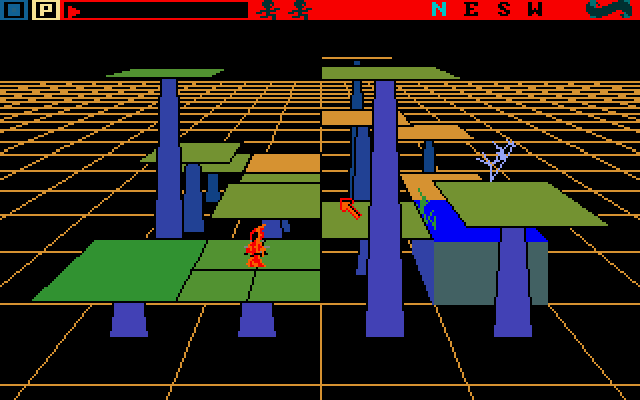
I remember Mind Walker as having amazingly spooky and captivating graphics. Then I found this screenshot: Mind Walker Screenshot Oh well. I’m sure it actually was impressive at the time. This discovery reminded of times when I’ve rediscovered a favorite food from childhood — for example, a certain type of cookie — only to find that it really isn’t very good at all. Just kind of sugary and low-quality chocolate. It’s also like going back to watch the original Jurassic Park again. The amazement is gone. Actually, even though the Mind Walker graphics aren’t as impressive as I remember them, I’m sure it was still a great game. Anyone have screenshots from Weird Dreams?

21 May 2007

Neil Williams: gpe-cash - double entry accounts on handhelds

subtitle: Break up GnuCash into lots of forks

With an ISP problem throttling my broadband to 4000B/s, I've switched to developing in C instead of building Emdebian packages - downloading Debian sources was taking an hour or more even for small packages.

This has made time for a long overdue project: gpe-cash - double entry accounting for handhelds. It's a spin-off from the stalled cashutil project and it just might provide the impetus to get cashutil into a releasable state.

gpe-cash uses QOF (Query Object Framework) which itself was spun out from GnuCash some years ago when it was described as "the gnucash engine without all the financial stuff". So gpe-cash is a happy reunion of the engine and the financial stuff along with Gtk+, only a lot smaller than GnuCash. Yes, it is a fork but a fork done for, IMHO, very good reasons. (Why write free software and then frown on forked projects?) There's little hope of getting GnuCash to run on any embedded hardware (it would probably end up as a laptop instead of a handheld in the process) so it has to be broken up: forked into a few smaller bits and simply dropping larger bits.

I've long wanted to break up the GnuCash behemoth and this is how this fork will work:

  1. Package the basic GnuCash objects as a shared library with -dev, -dbg and -doc

  2. Package the GnuCash business objects as another shared library, with ditto.

  3. Leave the commodity (stocks and shares) objects for a later date due to QOF compatibility issues with the GnuCash code.

  4. Use the pilot-qof Default Currency Table to create a tiny set of gnucash compatible currencies. (Also used by gpe-expenses already.)

  5. Share live expense data with gpe-expenses and gpe-cash (prevent duplication)

  6. Share contacts and live calendar data with gpe-invoice (calculate invoices)

  7. Drop direct file compatibility with GnuCash until GnuCash itself supports a sane backend, a suitable data import or cashutil is fixed, whichever comes soonest.

  8. Retain object compatibility with GnuCash at the QOF level - permits removing certain parts of GnuCash specific code from the objects whilst retaining functionality.

  9. Drop all reports, graphs, CSV import, QIF import, Scheme and other complexity of GnuCash.

  10. Use a simple SQLite backend via QOF.


Best laid plans . . . etc. It always ends up a bit different to the plan but you have to have a plan of some kind. (No?, well I do.) ;-)

The code is a combination of gpe-expenses and cashutil. It will (eventually) live within the cashutil SVN at SourceForge but I haven't committed the first changeset yet. The basic structures already work, it is tying the C objects to the Gtk that is the bulk of the remaining work.

If anyone is interested in upstream development, subscribe to the (very low volume) QOF-devel mailing list and let me know.

Simon Richter: Wacky Ideas: The Gathering

At this year's Debian conference, I'm planning to hold a BoF session on "wacky ideas". The idea is to gather everyone who needs (or believes so) an extension to the Debian package format or other piece of infrastructure around a round table and come up with something that works for everybody and a transition plan that leads us there. I hope to get at least some of the embedded and some of the translation bits on the way there. Our mascot is a rabbit with antlers (the infamous Wolpertinger).

MJ Ray: the Cooperative Group: United merger

bill watson commented:
"Excellent report. I'm a member of Co-op Group (Northern) and also United. United is an extremely well run outfit with well maintained shops. They also have about 30 petrol stations, mostly in Yorkshire and Greater Manchester. The fear from United members, on the proposed merger, is that focus will be lost and regional investment diluted. United are also trialing factory made shop units which are erected on-site (similar to the way McDonalds do it). This gives a turnaround time of about 16 weeks from start to shop opening. There is one not far from me (Ditton) and it's very popular. The United website United Acquisitions gives lots of info on this and other things."
I've mixed feelings on modular build (McStores?) - it makes the construction greener, but there seems little information on the long-term energy use of the store. Maybe it's simply unknown yet. The offer of a finder's fee for new store sites is interesting. I wonder if that will spread to the Co-operative Group after the merger. As I understand it, the fear from tCG members is that we're getting a lot of new members and a new chief exec who seems to have a very different focus to the members. I'm sure we'd be happy to see well-run and well-maintained shops, but will it mean even more centralisation and all the mistakes that means? Like stocking no Somerset Cheddars in some Somerset stores, with the confusing excuse that (as far as I could understand - see previously-mentioned answers to AGM food questions) no supplier offers enough units that meet the specifications or it's unsuitable for our type of stores ("Welcome"). I'm glad so many people liked the report, anyway.

Eddy Petrișor: I lost a big chunk of my todo list...

I don't want to get into the details, but I lost a big chunk of my to do list due to an unexpected power problem. So, if I promised/told you that I will take care of an issue and I will not do it, please remind me.

What I didn't lost and concerns others:
- tdebs wiki page update (Hi Chealer)
- po-debconf translation compendium for Romanian
- some aspell-ro related stuff
- naughtysvn coding: adding update command
- apt-zip - update support merge
- ppp-udeb - integrate with netcfg
- d-i documentation addition: new language process: X layout selection (Hi bubulle)
- svn-bp: bug squashing party
- gnome-screensaver translation
- NM (Hi Christian)

18 May 2007

Eddy Petrișor: DebConf7 plane tickets

I got the confirmation mail with the flight details. Monday or Tuesday I'll go and pay for it.

Eddy Petrișor: Debconf7, here I come

Since I never got managed to reemit my credit card, I was forced to reserve my plane ticket to DebConf7 via phone.

The good news is that, this time I was able to find e-car.ro which apparently has some better search engine since I still found some cheaper (not much) flights than I did in January (I have a printout of the flight I thought of initially).

The price now is NOT a lot bigger than the one I found in January. Back then it was about 400 , now I'll have to pay around 425 [*]. Is not the same set of flights, but I don't mind.

So, now I have these flights:
I would have liked to have a wider window at return, between the flights, but, although there was some flight that left from AMS at 13:00, it was not possible to couple with that flight and keep a low fare :-( . So, my visit to Amsterdam must wait for another occasion.

So,
  1. if anybody else will be on any of these flights, I would welcome company.
  2. Helooooo, DebConf
Now I'll just have to have the confirmation mail and go myself to do the payment at e-car. Fortunately e-car is somewhere in the center of Bucharest, in the Roman Plaza (Pia a Roman ).

[*] If this sounds like a contradiction with the previous, is not. Now I found some of the previousely found flights and some new cheaper ones (all "now" prices), but since the booking is done later, all "now" prices are bigger than "January" prices. So if I had done the same booking back in January, I would have payed less; but back then I didn't found the flights I booked now.

Russell Coker: SE Linux in Debian

I have now got a Debian Xen domU running the strict SE Linux policy that can boot in enforcing mode. I expect that tomorrow I will have it working with full functionality and that I will be able to run another SE Linux Play Machine in the near future. After getting the strict policy working I want to build a Debian kernel with CONFIG_AUDITSYSCALL and an audit package so that I can audit system calls that an application makes and also so that the auditd can collect the SE Linux log messages. Other people have talked about packaging audit for Debian, hopefully one of them will do it first and save me the effort, but it shouldn’t be too difficult to do if they don’t. Then I need to investigate some options for training people about SE Linux. As I don’t currently have the bandwidth for serving large files I’m thinking of basing some SE Linux training on Xen images from the jailtime.org repository. My rough plan at the moment is to have people download Xen images, run through them while consulting a web page, and ask questions on an IRC channel. I’m not sure what the demand will be for this but some web pages teaching people about SE Linux will be a useful resource even if the IRC based training doesn’t work out. Another thing I want to do is to get PolyInstantiated Directories working in Debian. The pam_namespace.so module needed for this is written for a more recent version of PAM, so I might just work on merging the Debian patches with the latest upstream PAM instead of back-porting the module to the ancient Debian PAM.

Eddy Petrișor: (Not) Getting Carbide C++ to run on your amd64 Debian Etch. But you get CodeWarrior!

A while ago I decided I wanted to make a couple of nice little apps for my Nokia 6600.
After my successful adventure with pys60 I decided/realized that the Python API does not contain appropriate functions for what I need in my apps, so I decided to setup the development environment for C++ with Carbide C/C++ (the recommended IDE for S60 development for Nokia).

Of course, the IDE is a Windows application and the reason for which Nokia doesn't provide an IDE for Linux (is expected since they are developing maemo and are so into OS) eludes me.
On top of that, I have an Debian Etch amd64 installation[1], so that's more fun.

Fortunately, thanks to Robert Millan and Ove Kaaven, wine is installable from unstable on amd64 and a chroot is not needed[2] anymore.


Now let's see the dependency tree:
Yes, that is all ... summarized. And you can imagine I went though leaps and bounds and wasted a night with this to find out the hard way.

If you don't care about the reasons/story, you can skip to the paragraph where I ran into license issues.

So, first Carbide needs Active Perl. Not any version, but ActivePerl-5.6.1.635. You will find out after you install Carbide c++.

Active Perl, by default, will refuse to install in wine. It relies on some Script Host support.
Good news: it is available on Microsoft's support pages. Bad news: the file is not provided until you go through some crazy scheme[3] to certify you have a genuine Windows installation.

Of course, the genuine stuff failed to work in wine, duh, but having a windows XP OS in qemu was really useful... to try to go further.

Now that I mentioned the Windows XP machine in qemu you might be wondering 'why didn't you installed Carbide c++ in there and start hacking in qemu?' . Well, I wish it was that simple! Believe it or not, the installation in the Windows virtual machine failed in a muuuuch earlier stage it initially did in Wine! It failed in the unpacking phase of the installation, while in Wine that part worked without problems (default config is for Windows XP emulation). Talk about irony!

After a while of trying, I took the risky path (maybe I should install an antivirus, as suggested by wine) and downloaded the kit for the script host stuff from some site on the net (shhh!). Good. I don't remember if I used cabextract or if it worked quite straight forward, but the special configuration entry in Wine Configurator suggests otherwise.

Back to Active-Perl. Now we can try again to install it.

wine msiexec ActivePerl-5.6.1.635-MSWin32-x86.msi

Guess what? The installation failed now, too. After some time of poking, I realised the bastard was looking for mfc42.dll in the installation. There was no word about that in the error message, only in the wine logs there were some hints. No wonder Windows users learn very early to ignore error messages (the error message was plain uninformative).

Where to get mfc42.dll from? The virtual machine! I tried to send them via email, but the link was too slow. Now I realised I could have used winscp, but I didn't thought of that at the time.

The rescue did come this time from M$, but with some effort. It appears that mfc42.dll is by default present on XP, so you only find it for download in some kit (vc6redistsetup_enu.exe) for Windows 9x. That works (lost some time to figure that out, too) since the kit contains a mix of 9x, NT and independent dlls. I think this installation didn't work and I had to cabextract the files by hand and copy them in system32. I registered the mfc42.dll module, after copying it in windows/system32.

wine msiexec /y mfc42.dll

Well, now I have everything installed Carbide should start... Well, no! License issues! I got a message about not having a license for the installation. Ain't that great? I just installed the thing and is the free/handicapped version. What gives? Well, in Carbide C++ 1.2, the Express part of the kit is broken and doesn't install the license file.

So, I installed the professional version since it had a longer trial period, hoping that now I'll be able to see the IDE and start working.

After this, I tried several times to start Carbide itself, but it failed at different points in time. I "just"[4] configured wine for this app to set the order to 'native,builtin' for msvcrt, ole32, oleacc and shdocw and got further.

Hopeless attempts follow....

At this point I got stuck. There was still some error from ole32.dll (apparently), but I couldn't go further.

I tried to install the 1.1 trial version. Got stuck. In any way I couldn't start Carbide c++ :-(( .

GRAND FINALE!

In the end, I also tried the deprecated CodeWarior. Guess what? It installed and ran immediately. Although I am not sure if any of the previous poking had anything to do with it.


[1] I have some packages from unstable
[2] although I had one, I wanted to get rid of it, since gnash started to perform better in the latest versions - still not satisfactory, but OK
[3] some browser plugin WPGInstall.exe, iirc and some app which should send your privat^W^W^Wanalise your system to generate some code that should identify your system as genuine
[4] this also took me some time... start, identify the dll, change the order, restart...
17 May 2007

Miriam Ruiz: Ren Py Visual Novel Engine in Debian

Ren’Py is an engine that supports the creation of visual novels and storytelling. I fell in love with it since I first saw it, almost two years ago, and some of my friends know how much work I’ve devoted to that package so that it’s finally in Debian in a proper state, including submitting many patches to upstream. Lots of thanks go to Ana for all her help and support with this package. Ren’Py is designed to make writing complete visual novels as easy as possible. The engine supports, of course, conversations between the two characters, but also images, different transitions between pictures, music and sound, so playing a game can be a complete multimedia experience. The engine itself is based in Python and SDL (in fact, it is based in python-pygame). Anyway, ccording to the manual, you don’t need to know any programming, or be able to program, to use Ren’Py. Even though right now there are a lot of games made with Ren’Py available for downloading, most of them are released pre-compiled (for a certain version of python, including the whole interpreter and libraries in the release), and usually targeted towards Windows (even though Ren’Py is supported on Windows, Mac OS X, and Linux, and can be made to run on other platforms). Of course all the authors of the games are welcome if they want to publish them as Free Software, anyway my plans go towards using the engine for developing educative applications. My only problem is that I need to draw the characters I’ll use throughout the tutorias, which is something I’m not especially good at. I’ve got myself a book on how to draw manga and anime characters, but it’s probably taking a while until I’m proficient enough at that. I’ll try to find someone to help me with that. In fact, it would be great to release a free set of characters that newbie creators of stories could use as a starting point. Lets see if I can find an artist for that. The main drawback I see is that the dependencies might be too much to put the engine in a small embedded portable gadget to be able to play a visual novel anywhere. Who knows, maybe in the future.

16 May 2007

Edd Dumbill: XTech heatmaps

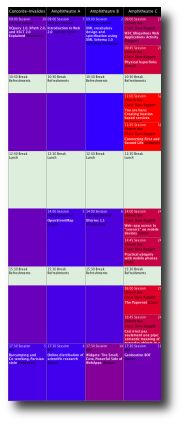
One of the fun and useful things we've been able to do in Expectnation with the personal scheduler is to use the data to help us as organizers. We recently added in dynamic overlays to the organizer's view of the schedule, enabling us to create heatmaps of the most popular talks. Heatmap
Screenshot of personal scheduler popularity overlaid on event timetable As well as satisfying natural curiosity, the heatmaps let us identify issues such as possible room overcrowding in advance. We're able also to record actual attendance figures as the conference goes on, and I will try and make an analysis of how attendees' intentions stack up against their actions. 

Next.

Previous.