
Search Results: "az"

20 November 2008

Martin Michlmayr: Case stories of good and bad community interaction

It is often argued that companies have to work with the FOSS community and there are good reasons for doing so. I've tried to collect a number of case stories of good and bad community interaction that may help as a starting point for further exploration of this topic: Can you think of other examples? (Originally published on FOSSBazaar where comments are possible)

John Goerzen: The Demise of PC Magazine

I just read the news that PC Magazine is being canceled. It’s not exactly a shock, given the state of technical magazines right now. I haven’t read one of those in years, since they turned to be more of a consumer than a technical publication. But I hope I am not the only one out there that remembers PC Magazine from the mid to late 1980s. I had two favorite parts in each issue: the programming example, and the “Abort, Retry, Fail” page at the back of the magazine. The programming example was usually some sort of DOS (or, on occasion, OS/2) utility. It was usually written in assembly, and would be accompanied by a BASIC program you could type in to get the resulting binary, as assemblers weren’t readily available. The BASIC program was line after line of decimal numbers that would decode them and write out the resulting binary — sort of a primitive uuencode for paper. Trying to type those in gave me some serious eyestrain on more than one occasion. By now, I forget what most of those utilities did, but I remember one: BatchMan. It was a collection of tools for use in DOS batch files, and could do things like display output in color or even — yes — play monophonic music. It came with an example that displayed some lyrics about batch programming on-screen, set to what I later realized was the Batman theme. Geek nirvana, right? But Batchman was too big to publish the source code, or the BASIC decoder, in print. It might have been one of those things that eventually led me to a CompuServe account. PC Magazine had some deal with CompuServe that you could get their utilities for free, or reduced cost — I forget. CompuServe was probably where I sent my first email, from my account which was 71510,1421 — comma and all. In later years, you could pay a small fee to send email to the Internet, and I had the amazingly attractive email address of 71510.1421@cis.compuserve.com. Take that, gmail. PC Magazine eventually stopped running utilities that taught people about assembly or batch programming and shifted more to the genre of Windows screensavers. They stopped their articles about how hard disks work and what SCSI is all about, and instead have cover stories like “Vista made easy!” I am, sadly, not making this up. Gone are the days of investigating alternative operating systems like OS/2. It appears that “Abort, Retry, Fail” is gone, too. It was a one-page thing at the back of each magazine that featured braindead error messages and funny stories about people that did things like FAX an image of a floppy disk to a remote office — before such stories were cliche. Sort of like DailyWTF these days. The sad truth is that the people that would FAX an image of a floppy are probably the ones that are reading PC Magazine today. I still have a bunch of PC Magazine issues — the good ones — in my parents’ basement. I also still have my floppies with the utilities on them somewhere. One day, when I get some time — I’m estimating this will be about when Jacob goes to college — I’ll go back and take another look at them.

18 November 2008

Adrian von Bidder: SyncML (new toy)

Q: is a mobile phone (nice hardware, shitty firmware, btw) waterproof? A: I now got this new toy (Sony Ericsson S500i) as aresult. And because I don't really like losing contacts again (I never managed to connect to the old phone from Linux and was too lazy to use the Windows software), I have now fired up kitchensync with the OBEX SyncML client from the OpenSync project. And was very surprised that after only very little fiddling with the configuration I could indeed copy the contacts from the phone to KDE's addressbook. There seems to be a — not so usual anymore in this decade — utf8 problem somewhere (it looks as if the encoding from the phone is converted to utf8 twice, or it is latin1 to utf8 encoded but was already utf8 on the phone), and synchronisation is only one way so far (from the phone to KDE-PIM), with changes on the KDE side being overwritten. No idea which component those bugs are in, and documentation I've found is not very verbose. So, to start with: I've gotten this nice dump with hcidump. Now, how do I extract the actual data streams from that dump? I know I have to use wbxml2xml on the data, but first I need to unwrap the network data, and I haven't found that (probably read past it in the manpage of hcidump because I'm a bit tired.) Of course, if anybody out there has solved my issues I'd be just as happy with information on how that was done instead. In the mean time, I at least have reasonable back up of my phone's contact database again.

Ingo Juergensmann: Nikon D90 and Linux - a quick update

As I have reported lately I obtained a Nikon D90 DSLR some weeks ago. Gphoto2 (and other application depending on its functionality like digikam) didn't recognized the D90 in PTP mode and the camera can't be configured yet to offer the SD card as a mass storage device.

In the meantime I found out that the D90 does work with gphoto2 in generic PTP mode - at least this is with Ubuntu Intrepid on my x86 laptop while Debian Sid on my G4 PowerPC fails to detect the D90. It detects the camera, the pictures, loads some 1 or 2 thumbs and hangs.
So, I don't know whether there are some differences between Intrepid and Sid (gphoto2 is the same version as reported by dpkg - with the exception of the "ubuntu" version string in Intrepid) or a PPC vs x86 issue - or maybe a kernel issue as this is different between those two machines as well.

This is just a quick note, mostly for myself. I'll try to get more details within the next days and file a bugreport. But if you, dear lazyweb, have some additional pointers for me, I'd appreciate those! :-)

Matthew Garrett: Aggressive graphics power management

My current desktop PC has an RS790-based Radeon on-board graphics controller. It also has a Radeon X1900 plugged in. Playing with my Watts Up, I found that the system was (at idle!) drawing around 35W more power with the X1900 than with the on-board graphics.

This is clearly less than ideal.

Recent Radeons all support dynamic clock gating, a technology where the clocks to various bits of the chip are turned off when not in use. Unfortunately it seems that this is generally already enabled by the BIOS on most hardware, so playing with that didn't give me any power savings. Next I looked at Powerplay, the AMD technology for reducing clocks and voltages. It turns out that my desktop hardware doesn't provide any Powerplay tables, so no joy there either. What next?

Radeons all carry a ROM containing a bunch of tables and scripts written in a straightforward bytecode language called Atom. The idea is that OS-specific drivers can call the Atom tables to perform tasks that are hardware dependent, even without knowledge of the specific low-level nature of the hardware they're driving. You can use Atom to do several things, from card initialisation through mode setting to (crucially) setting the clock frequencies. Jerome Glisse wrote a small utility called Atomtools that lets you execute Atom scripts and set the core and RAM frequencies. Playing with this showed that it was possible to save the best part of 5W by underclocking the graphics core, and about the same again by reducing the memory clock. A total saving of 9-10W was pretty significant.

The main problem with reducing the memory clock was that doing it while the screen is being scanned out results in memory corruption, showing up as big ugly graphical artifacts on the screen. I'm a fan of doing power management as aggressively as possible, which means reclocking the memory whenever the system is idle. Turning the screen off to reclock the memory would avoid the graphical corruption but introduce irritating flicker, so that wasn't really an option. The next plan was to synchronise the memory reclocking to the vertical refresh interval, the period of time between the bottom of a frame and the top of the next frame being drawn. Unfortunately setting the memory frequency took somewhere between 2 and 20 milliseconds, far too long to finish inside that time period.

So. Just using Atom was clearly not going to be possible. The next step was to try writing the registers directly. Looking at the R500 register documentation showed that the MPLL_FUNC_CNTL register contained the PLL dividers for the memory clock. Simply smacking a new value in here would allow changing the frequency of the memory clock with a single register write. It even worked. Almost. I could change the frequency within small ranges, but going any further resulted in increasingly severe graphical corruption. Unlike the sort I got with the Atom approach to changing the frequency, this corruption manifested itself as a range of effects from shimmering on the screen down to blocks of image gradually disappearing in an impressively trippy (though somewhat disturbing) way.

Next step was to perform a register dump before and after changing the frequencies via Atom, and compare them to the registers I was programming. MC_ARB_RATIO_CLK_SEQ was consistently different, which is where things got interesting. The AMD docs helpfully describe this register as "Magic field, please use the excel programming guide. Sets the hclk/sclk ratio in the arbiter", about as helpful as being told that the register contents are defined by careful examination of a series of butterflies kept somewhere in Taiwan. Now what?

Back to Atomtools. Enabling debugging let me watch a dump of the Atom script as it ran. The relevant part of the dump is here. The most significant point was:
MOVE_REG @ 0xBC09
src: ID[0x0000+B39E].[31:0] -> 0xFF7FFF7F
dst: REG[0xFE16].[31:0] <- 0xFF7FFF7F
, showing that the value in question was being read out of a table in the video BIOS (ID[0x0000+B39E] indicating the base of the ROM plus 0xB39E). Looking further back showed that WS[0x40] contained a number that was used as an index into the table. Grepping the header files gave 0x40 as ATOM_WS_QUOTIENT, containing the quotient of a division operation immediately beforehand. Working back from there showed that the value was derived from a formula involving the divider frequencies of the memory PLL and the source PLL. Reimplementing that was trivial, and now I could program the same register values. Hurrah!

It didn't work, of course. These things never do. It looked like modifying this value didn't actually do anything unless the memory controller was reinitialised. Looking through the Atom dump showed that this was achieved by calling the MemoryDeviceInit script. Reimplementing this from scratch was one option, but it had a bunch of branches and frankly I'm lazy and that's why I work on this Linux stuff rather than getting a proper job. This particular script was fast, so there was no real reason to do it by hand instead of just using the interpreter. Timing showed that doing so could easily be done within the vblank interval. This time, it even worked.

I've done a proof of concept that involved wedging this into the Radeon DRM code with extreme prejudice, but it needs some rework. However, it demonstrates that it's possible to downclock the memory whenever the screen is idle without there being any observable screen flicker. Combine that with GPU downclocking and we can save about 10W without any noticable degradation in performance or output. Victory!

I gave the code to someone with an X1300 and it promptly corrupted their screen and locked their machine up. Oh well. Turns out that they have a different memory controller or some such madness.

So, obviously, there's more work to be done on this. I've put some test code here. It's a small program that should be run as root. It should reprogram an Atom-based discrete graphics card[1] to half its memory clock. Running it again will halve it again. I don't recommend doing that. You'll need to reboot to get the full clock back. This isn't vblank synced, so it may introduce some graphical corruption. If the corruption is static (ie, isn't moving or flickering) then that's fine. If it's moving then I (and/or the docs) suck and there's still work to be done. If your machine hangs then I'm interested in knowing what hardware you have and may have some further debugging code to be run. Unless you have an X1300, in which case it's known to break and what were you thinking running this code you crazy mad fool.

Once this is stable it shouldn't take long to integrate it into the DRM and X layers. I'm also trying to get hold of some mobile AMD hardware to test what impact we can have on laptops.

[1] Shockingly enough, it's somewhat harder to underclock graphics memory on a shared memory system

John Goerzen: Frozen Bicycling

Some of you might recall that I’ve been bicycling to work, about 10 miles each way. Over the last two weeks, I haven’t been able to ride much because it’s been too muddy. Today I rode to work. It was about 25F-30F out there, so this was my first below-freezing bicycle ride. It went OK, though I was somewhat on the cool side — I’ll add more layers next time. Today, I wore wool socks, bicycling shorts, tights over that, my short sleeve shirt, a long-sleeve shirt over it, full gloves, and a balaclava. I should have worn probably one more layer everywhere, but I survived and I’m not frozen. You may now commence speculation about whether or not I am crazy.

15 November 2008

Joost Yervante Damad: Intel Matrix Storage: software raid?

It's still unclear to me if this is software raid or not.
It might depend on the chipset. My chipset is "Intel ICH9M-E SATA AHCI/RAID controller hub" which seems to hint that it is hardware RAID.

Dear lazyweb, anyone know how to find if this is software or hardware raid?

13 November 2008

Lucas Nussbaum: Living in France? Not an April member? You are WRONG.

I’ve been a member of April, the french association for promotion and defense of Free Software, for a bit more than a year, and I often regret not becoming a member earlier. (I was feeling so guilty and shameful about not being a member that I actually postponed becoming a member.) Stop feeling guilty and shameful, become an April member today! Why Is becoming an April member so important? Some of the things they worked on recently (from the top of my head): So, really, become a member today. It’s only 10 EUR, and you already know they will be well used. April is trying to reach 5000 members by the end of 2008. (Apparently, if you use that address, April will now that you came from me. No benefit for me at all.)

Michal &#268;iha&#345;: Firefox hidden config of the day

browser.tabs.loadDivertedInBackground = True and Firefox 3 no longer steals focus when I open link from external application. PS: This seems to be most interesting post in my blog, at least when counting email feedback - looks like there was lot of people annoyed by this behaviour and too lazy to search for solution :-).

11 November 2008

Ross Burton: Asynchronous Flickr Library, version 0.3

Finally, Flickrpc 0.3 is released. Some nice features that we all know and love from Postr here: Grab a tarball here or the Bazaar tree here.

10 November 2008

Ian Wienand: When craziness wraps around...

Rob Landley writes:
A common trick years ago was to set up your routing tables and then have PID 1 exit so the kernel paniced, because the paniced kernel would continue to route packets with _no_userspace_running_. Darn hard to hack a system like that.
This is such a ridiculously stupid idea I think it has wrapped all the way around to the point where it just grazes "genius"!

Gunnar Wolf: 4 Rodada Nacional Tri-Estatal M xico-Pachuca

Yesterday I took part of the fourth inter-state bike ride, requesting the construction of proper and safe cycling ways. Tens of Mexican bike-rider organizations were part of the organization, althought the effort is basically grouped under the Ciclopistas y Ciclov as Interestatales project - For further details on the route we took, you can look at the M xico-Pachuca road map, although it was not followed literally.

I am very happy I decided to take part of this - I went with Adri n, but after the first rest/grouping we lost track of each other, and decided the best would be for each to go at his own pace. He managed to do the 95Km ride, I decided to stop at about 85 (I set my target to the first houses of Pachuca, so I could say I arrived ;-) ) and took a ride from the barredoras that were trailing us. Still, 85Km in about six hours (including the two rests) are well over what I expected to endure. And although the conditions were not ideal (i.e. there was some re-pavement jobs in a large portion between Tizayuca and Pachuca, which led to poor road conditions in some areas, and the dry, horrid smell of tar in others; we cycled along the vehicles in the very busy highway, so we didn't exactly get a dose of clean air), it was great. And I thought each of my muscles would hurt like hell today, but no, they are just feeling lazy ;-)
The GPS tracking on Nokia SportsTracker, The GPS tracking on OpenStreetMap

9 November 2008

Andrew Pollock: [tech] Keeping hard drives cool

I've had this crazy ATA over Ethernet SAN for my MythTV setup for as long as I've been running MythTV. I'm using minotaur, an old Pentium III 1RU VA Linux server as the "head". Originally, I had 4 IDE hard drives, attached to minotaur via IDE-USB adapters. This worked perfectly fine, but I missed the ability to query SMART information, and do other low-level drive tweaking with hddparm So a while ago, NewEgg had a sale on 750Gb SATA drives, and I bought a 4 port eSATA card, and took the plunge with SATA. That all went fine. The entire time, I've had the 4 hard drives themselves just sitting on top of minotaur, on cork trivets. The whole arrangement is in the bottom of our linen closet, as this is where the patch panel for the apartment is. I've graphed the temperature of linen closet for some time now, but the benefit of having hard drives connected via SATA was that I could easily graph the temperature of them as well, which I started doing recently. The catalyst for wanting to do this was that I had a drive fail, and I was concerned that they were getting too hot, just sitting in the closet with no airflow. Matt Bottrell's recent reminder of Google's research into hard drive failures also helped bring this concern to forefront. Seagate's product documentation for the Barracuda 7200.10 claims that ambient operating temperature must be between 0 C and 60 C. I'm assuming that's the environment the hard drive is in, and not the temperature of the drive itself as reported by something like hddtemp. The closet is typically in the high 30's. If you believe what SMART reports, it seems to imply that anything over 45 C is a Bad Thingtm. So after I had a drive fail, I figured I should probably try to do something about the temperature situation, and started looking around for an external enclosure. I'd previously had problems with the IEC-to-Molex power supplies I was using to power the disks, and think that they'd been the cause of some failures of my IDE disks, so was quite eager to stop using them as well, which was something else an external enclosure would give me. I had trouble finding an enclosure that presented 4 separate eSATA ports, and I was talking to Marc about SATA port multipliers, when he mentioned he had a brand-new unused full-height SCSI enclosure, for four disks, which was surplus to his requirements. Since all I really needed was external power and cooling, I thought I could cannibalise this to my needs. Sure enough, I could just remove the SCSI cables and their Centronics connectors, and feed the eSATA cables out the gap they left, and use the molex-SATA power splitters I already had. Because the enclosure was intended for full-height 3.5" hard drives, there was plenty of air space between each disk. The enclosure included two fans. The results? Well the graph speaks for itself:

Graph of hard drive temperatures (I'm not entirely sure why minotaur's internal disk occasionally reports a very low temperature) The added bonus is I've cleaned up the rats nest of cables in the linen closet. So thanks very much, Marc!

Simon McVittie: Implementing D-Bus services with telepathy-glib

(Part 1 of an ongoing series: shiny things in telepathy-glib)
16:46 < epmf> tp-glib is made of magic

—#telepathy, 2008-04-15

Rob pointed out today that I'd been promising to blog about telepathy-glib for several months and still haven't done so. I think there's too much to cover in one blog post, so I'll start with the oldest part - implementing a service (typically a Telepathy connection manager).

While telepathy-glib is (obviously) intended for Telepathy implementors, I think the ideas we've been implementing are likely to be useful for any D-Bus API, particularly flexible/complex APIs where an object implements many interfaces.

Introduction to telepathy-glib telepathy-glib started out as a collection of code extracted from our XMPP connection manager, telepathy-gabble, but at some point it grew beyond that into a wrapper around/partial replacement for dbus-glib. We've been quite pleased with it, really :-) My first major round of work on telepathy-glib, during the first half of 2007, was to split it out from telepathy-gabble (versions up to 0.5.9 were released as part of Gabble 0.5.x tarballs, in fact), leading to the release of the 0.6.x stable branch in late September. This was very helpful for implementing connection managers - Salut, Idle and telepathy-sofiasip (our connection managers for link-local XMPP, IRC and SIP) all started off by forking/cargo-culting from Gabble, and achieved huge code reductions by porting to telepathy-glib. Also, Will Thompson used it in his Summer of Code project, telepathy-haze, to go from nothing to a working and useful Telepathy implementation based on libpurple in a matter of a few months. The second major round of work, which I'll discuss in a later article, added client code to telepathy-glib, obsoleting the older/worse libtelepathy and allowing client programs like Empathy and telepathy-stream-engine to be written using telepathy-glib. In the process, I accidentally reinvented DBusGProxy :-) More details to come later!
Some background: service-side code generation
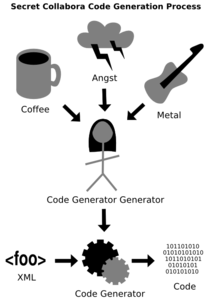
The secret Collabora code-generation process

(credit: daf)

Supporting D-Bus in the GObject world has always involved quite a lot of code generation. The core API of dbus-glib is heavily reliant on varargs functions, which aren't type-safe and are easy to get wrong. dbus-glib contains a program called dbus-binding-tool, which is meant to generate reasonably sane GObject APIs for D-Bus objects. Unfortunately, it seems to be intended to generate a whole GObject at a time. Early versions of telepathy-gabble used dbus-binding-tool plus a script called gengobject.py to generate API stubs for the exported objects; developers then filled in the blanks, and hey presto, we had a GObject on D-Bus. This was fine up to a point, but had a couple of major drawbacks. Whenever we changed the D-Bus API (quite common during the early development of Telepathy), there was a very laborious and error-prone merging process. We ended up with the following process:
  • copy the D-Bus introspection XML from the telepathy-spec repository into a directory xml/pristine (actually, the canonical form for the spec was Python for a while, and we had a script that exported a contrived object onto D-Bus and introspected itself to get the XML - but that's another story!)
  • preprocess the introspection XML to add the dbus-glib CFunctionName annotation, resulting in a directory xml/modified
  • run dbus-binding-tool and a Python script gengobject.py to generate C source in xml/src
  • three-way-diff the old version of xml/src, the new version of xml/src, and the real C code in src to create a new version of src
  • pray that the diff process hadn't randomly exchanged functions' implementations
  • update the resulting code in src so it worked
  • check the whole mess back into darcs
  • hope that nobody else had made changes that would result in darcs conflicts
If you haven't yet gathered, this was a bit of a nightmare. Also, it was very easy to return the wrong thing from a method without noticing - because all the APIs were varargs, the compiler didn't notice, and the first we'd know about it was a mysterious segfault under certain circumstances.
How telepathy-glib fixes code generation telepathy-glib improves on this by taking advantage of this innocuous-looking feature in dbus-glib:
commit 355ef78d98d6fc65715845d56232199162cab12a
Author: Steve Fr cinaux <steve istique net>
Date:   Thu Aug 17 11:48:20 2006 +0200
    Interface support for bindings.
Instead of running dbus-binding-tool or creating GObjects with D-Bus interfaces, we put the entire Telepathy spec through glib-ginterface-gen.py, a distant descendant of Gabble's gengobject.py. For each interface in the spec, we generate a GInterface that mirrors the D-Bus interface. Any GObject that implements the GInterface automatically gets the D-Bus interface if it's exported onto D-Bus. There are a few non-obvious refinements, though:
  • The signature of the method implementation is always in the mode that dbus-glib calls "asynchronous", where the method implementation can either send a reply message before or after it returns. For "slow" methods, this is the only thing you can do. For instance, many Telepathy D-Bus methods can't return anything until some TCP round-trips to the server have happened. This is also the only thing you can do if you want to extract extra information, like the sender's unique name, from the method-call message (dbus-glib's "synchronous" API doesn't allow this to be done). For "fast" methods, sending a reply message before returning is just as easy as using the "synchronous" API (it's just a difference of syntax), and has an API consistent with that of the "slow" methods, making it easier for service authors.

  • The layout of the GInterface vtable is private, and (auto-generated) accessor functions are used to fill in implementations. This means our ABI doesn't change just because we re-ordered functions in the spec.

  • If no implementation is provided for a method, we just raise an appropriate error (org.freedesktop.Telepathy.Errors.NotImplemented), rather than suffering an assertion failure. This means we can safely add methods to an interface.

  • While we're generating code anyway, we generate some static inline wrapper functions which wrap dbus_g_method_return(), to have type-safe method returns. You can easily check that a method replies with correct types, by checking that the implementation of Foo() replies by calling tp_svc_some_interface_return_from_foo().

  • Similarly, we generate wrapper functions to emit signals, to get type-safe signal emission.

Not all interfaces are stable enough to be included in telepathy-glib's stable API and ABI, so some of our other projects include a copy of the telepathy-glib code-generation tools, and generate their own "mini-telepathy-glib" (traditionally in a /extensions/ directory) for their implementation-specific (drafts of) interfaces. This isn't yet as polished as it ought to be (mainly because we don't want to freeze the augmented-introspection-XML format that we write the Telepathy spec in, because it's rather ad-hoc and hackish in places) but it works quite well in practice. To see what this looks like in practice, have a look at the examples in telepathy-glib, or at a Telepathy connection manager like telepathy-gabble.
Mixins and base classes Another feature of telepathy-glib which makes life easier for connection manager authors is that it provides "mixins" and base classes which implement some of the GInterfaces. There's absolutely nothing magic about the base classes - they don't have any access to private implementation details of the GInterfaces, they just implement them like everyone else does. The "mixins" are only slightly more magical - they store some extra state inside the structures representing GObjects and their classes, and use it to provide default implementations of some or all of the methods on a particular interface (or two interfaces, in the case of the new TpMessageMixin). I'll leave it up to Rob to explain those in greater detail, since I seem to remember that he invented them :-P The examples and regression tests in telepathy-glib are quite good examples of how these work in practice.

Russell Coker: LUV Talk about Cloud Computing

Last week I gave a talk for the Linux Users of Victoria about Cloud Computing and Amazon EC2 [1]. I was a little nervous as I was still frantically typing the notes a matter of minutes before my talk was due to start (which isn’t ideal). But it went well. There were many good questions and the audience seemed very interested. The talk will probably appear on the web (it was recorded and I signed a release form for the video). Also I have just noticed that Amazon have published a license document for their AMI tools, so I have added the package ec2-ami-tools to my Debian/Lenny repository (for i386 and AMD64) with the following APT sources.list line: deb http://www.coker.com.au lenny misc Also the Amazon license [2] might permit adding it to the non-free section of Debian, if so I’m prepared to maintain it in Debian for the next release - but I would prefer that someone who knows Ruby take it over.

7 November 2008

Axel Beckert: e-mail.is-not-s.ms

When I first read http://two.sentenc.es/ in (if I remember correctly) madduck’s signature, I thought something like “This can’t be! Why are people castrating themself?” Although I really understand that the inventor has good reasons for such a personal policy, I notice how much time I waste by trying to fit all the information I want to transmit in the 160 characters a short messages allows — or, even worse, into the 140 characters microblogging services like identi.ca or Twitter allow. So I had to oppose something to this, but even to only reach the coolness level of the domain “sentenc.es” is hard, you probably can’t top it at all. For luck, I’m not alone and Venty had the right idea for a hostname which has at least some geeky niveau. So here it is, our pleading for e-mails as long and detailed as necessary:

http://e-mail.is-not-s.ms/ A German version will be available soon at http://e-mail.ist-nicht-s.ms/. Feel free to add either URL to your e-mail signature. :-) Oh, and thanks to the Government of Montserrat which allows strangers to register .ms domains without any hassles. :-) Update / FAQ Seems to be necessary to make a few things clear…

  1. No, I do not think that everyone using two.sentenc.es has neither style nor knows anything about grammar or punctuation. What I say is that the site two.sentenc.es itself with its comparision to short messages (and especially without reading the author’s blog post about the site’s background) indirectly suggests to drop grammar, punctuation and style by cramming all information into a limit number of characters as often done with short messages or microblogging. And the limitation in senctences leads to tapeworm sentences which I try to avoid since they’re considered bad style, too.
  2. And yes, it’s consciously written and designed to be the opposite of two.sentenc.es — even the colors and the font — and therefore is of course very close to the original. See it as it parody or satire if the closeness makes you angry.
  3. And no, I currently don’t care if the site makes less sense if you don’t know two.sentenc.es — people usually can follow hyperlinks on websites.
  4. We weren’t the first ones who noticed that e-mail is not SMS. An example of the problem described above from 2001.

John Goerzen: Wow

People often talk about "memorable moments" -- times where pretty much everybody in the country remembers where they were at that exact time.

There are probably only two of those moments I can remember: the 1989 earthquake during the World Series and the time 9/11 happened. My car was in for service that day, and I was sitting in the lobby of the mechanics watching it on TV.

So now I have a third: watching Barack Obama win the presidency.

We were installing some new blinds in the kitchen while listening to the coverage on NPR, periodically going over to the office to watch the TV coverage on the computer. (Our TV is upstairs right now, so that was more convenient.)

A few minutes before the election was called, I remember Brian Williams saying something like "We're going to go to local stations now, but you better not walk away. We'll have some amazing news at the top of the hour."

We watched that announcement, then saw McCain's speech, and finally Obama's speech (missed the first minute or two of it actually). What an amazing evening.

Then seeing the stories of people celebrating all around the country and around the world: the impromptu party in front of the White House Tuesday night, the small gathering at the Lincoln Memorial Wednesday morning, the Obama parties all around the world. And we watched it on TV in our house while Jacob slept. I feel like I missed out somehow.

Adeodato Sim : More software that rocks: rxvt-unicode

This one didn’t arrive on time for the previous post, so here it is now. I’ve been meaning to find alternatives to Konsole for a bit now. I’ve always wanted the ability to click on URLs in my terminal emulator and have them open on my browser, which the Konsole in KDE3 can’t do. When I learnt that KDE4’s Konsole can, I ooh-ooh-ooh’ed and I gave it a try. But whilst KDE3’s Konsole is a very good application, amazing, even, I found KDE4’s to suck in a variety of ways, including speed. And then my quest began. I gave rxvt-unicode a try yesterday, and so far I’m very satisfied. I quickly managed to configure it to my taste; it has tabs, which I can’t do without, and you can click on URLs as well. These two features are implemented via Perl extensions because, yes, rxvt is extendable with Perl. These two extensions are not very configurable, though, so in order to have the Next tab/Previous tab movements use my preferred keys, I had to edit the Perl source and place it under $HOME.

6 November 2008

David Moreno Garza: Harlem and the elections

A lot has been said about the elections already. I just want to share my personal experiences about it. During the weekend, Tom invited us to his place in lower Harlem (we live upper Harlem) on 123rd St and Adam Clayton Powell Jr Ave, for Tuesday night. As Tuesday arrived, we didn’t see too many people too excited about it. Living in Harlem, we were pretty used to black people supporting Obama, so getting closer and closer to the elections, we didn’t feel people anxious. On Tuesday, we commuted to work and some of our co-workers got to work late because they have been standing in lines for a couple of hours to vote in polls. The whole day was about talking on how much that day was representing for the US and the world, guessing how they results were going to end up, etc. Later at night, Greg, Phil, Raquel and I headed to Tom’s place for his watch-the-results party. His fridge was full of Blue Moon beer, but he also had some Red Stripe :) Since I like to go light on politics, I preferred some other American variantion, Coors Light :) Vermont, Connecticut and a few other New England states were claimed by the Democrats. Matty, a friend of Tom attending the party brought US maps with the electoral votes on each one for people to color them as they were called. It was pretty fun. At some point we forgot about the maps since it was pretty clear that Obama was gonna win. But when they called him at around 11 pm (and I was starting to feel nicely drunk), the whole neighborhood and people in the streets just went completely nuts. It’s something I hadn’t experienced at all in my life, it was like if Mexico would have won the f tbol World Cup (which yes, it will never happen anytime soon :P), but nicer. People went out to the Harlem State Office Building square were cars were honking, and a huge amount of people gathered to celebrate, play brass music, cheer “Yes We Can”. Ghetto guys, white hippies, curious latinos, Africans, African Americans, Puerto Ricans, just a lot, a lot of people, all kinds of them, just a clusterfuck. They projected Obama’s speech from Chicago and people went nuts. It was just, fucking amazing. The images they projected from Harlem to the outside world was in that same square we were in. Our Flickr set for the celebration here.

Mike Hommey: Emptying a deleted file

Yesterday, at work, we had the typical case where df would say there is (almost) no space left on some device, while du doesn’t see as much data present as you would expect from this situation. This happens when you delete a file that another process has opened (and, obviously, not yet closed). In typical UNIX filesystems, files are actually only entries in a directory, pointing (linking) to the real information about the content, the inode. The inode contains the information about how many such links exist on the filesystem, the link count. When you create a hard link (ln without -s), you create another file entry in some directory, linking to the same inode as the “original” file. You also increase the link count for the inode. Likewise, when removing a file, the entry in the directory is removed (though most of the time, really only skipped, but that’s another story), and the link count decreased. When the link count is zero, usually, the inode is marked as deleted. Except when the usage count is not zero. When a process opens a file, the kernel keeps a usage count for the corresponding inode in memory. When some process is reading from a file, it doesn’t really expect it to disappear suddenly. So, as long as the usage count is not null, even when the link count in the inode is zero, the content is kept on the disk and still takes space on the filesystem. On the other hand, since there is no entry left in any directory linking to the inode, the size for this content can’t be added to du’s total. Back to our problem, the origin was that someone had to free some space on a 1GB filesystem, and thought a good idea would be to delete that 860MB log file that nobody cares about. Except that it didn’t really remove it, but he didn’t really check. Later, the “filesystem full” problem came back at someone else, who came to ask me what files from a small list he could remove. But the files were pretty small, and that wouldn’t have freed enough space. That gave me the feeling that we probably were in this typical case I introduced this post with, which du -sk confirmed: 970MB used on the filesystem according to df, but only 110MB worth of data… Just in case you would need to find the pid of the process having the deleted file still opened, or even better, get access to the file itself, you can use the following command:
find -L /proc/*/fd -type f -links 0
(this works on Linux ; remove -L on recent Solaris ; on other OSes, you can find the pid with lsof) Each path this command returns can be opened and its content accessed with a program, such as cat. That will give access to the deleted content. I already adressed how to re-link such a file, which somehow works under Linux, but in my case, all that mattered was to really remove the file, this time. But we didn’t know if it was safe to stop the process still holding the file, nor how to properly restart it. We were left without a possible resolution, but still needed to come up with something before the filesystem gets really full while waiting to be able to deal with the root of the problem. The first crazy idea I had was to attach a debugger to the process, and use it to close the file descriptor and open a new file instead (I think you can find some examples with google). But there was no debugger installed. So, I had this other crazy idea: would truncate() work on these /proc/$pid/fd files? You know what? It does work. So I bought us some time by running:
perl -e 'truncate("/proc/$pid/fd/$fd", 0);'
(somehow, there is no standard executable to do a truncate(), so I always resort to perl) Afterwards, I also verified the same works under Linux (where you wouldn’t really know what it’d do with these files that are symbolic links to somewhere that doesn’t exist). The even simpler following command works, too.
> /proc/$pid/fd/$fd
It doesn’t truncate() but open() with O_WRONLY O_CREAT O_TRUNC, and close() right after (to simplify), which has the same effect. Good to know, isn’t it?

Next.

Previous.

