Search Results: "reg"

4 April 2014

Luciano Bello: Private folder in Dropbox

I wanted to have a directory in my Dropbox where every file placed get some sort of encryption. They might be personal pictures (if you know what I mean), finance notes, patent ideas, or the like. I create those files constantly, often with my phone. While I would like to back them up on the cloud, I don t need to access them regularly. The problem is that I don t want my phone to storage them (at least not plain) for obvious reasons. And, on top of this, Android s Dropbox app does not allow to disable synchronization by folder. So, here is the scheme I came up with. Maybe it is also useful for you or you get some idea how to improve it. You will need an always-on-line computer with Dropbox client (for Dropbox synchronization), GnuPG (for cipher the files), and a really nice tool called incron (which monitors a directory and trigger actions). The instructions: That s all, each time you put something in your private folder, incron will cipher it and leave it there.

Gunnar Wolf: Mozilla: So our communitary echobox *does* resound with social issues

I woke up to the news that, after a very short tenure, Brendan Eich steps down as the Mozilla CEO. Why? Because of the community outcry. Because some years ago, Eich pubilcly supported (and donated funds) the ban of any kind of marriages in California that were not between a man and a woman. The world has advanced enormously in this regard in the last years/decades, and so many individuals and organizations opposed and announced they would boycott Mozilla that either him or Mozilla could not stand the pressure anymore. So, of course, it's sad the person had to resign. Many people talked about freedom of speech, freedom of harbouring his own personal opinion But when it comes to the rights of minorities, particularly of minorities that have suffered such hard prejudice and abuse as the gay, lesbian and all the other non-orthodox sexual- and gender- orientations, righting a wrong is much more important than preserving an individual's freedom of opinion. Besides, it's not just thinking or talking about something The concrete proposition Eich supported (and eventually made him resign) is about bringing the life of thousands of people to a hellish state of uncertainty, and going back to not having a way for the society to legally recognize their way of being, their love, their lifes. But anyway What prompts me into writing this is that, once again, the Free Software (and related denominations) community has shown that a set of core values, seemingly shared by a very large amount of our own people with no coordination or correlation with what conforms us as a community (and thus, being emergent traits), are strong enough to create a critical mass, to achieve cohesion. And that ours is not just a technical community of people writing software at all layers of the stack, but first and foremost is a group of social activists, committed to making the world better. I will quote from Matthew Garrett's post on this topic, clearly more contundent and thorough that what I'm trying to come up with:
The Mozilla Manifesto discusses individual liberty in the context of use of the internet, not in a wider social context. Brendan's appointment was very much in line with the explicit aims of both the Foundation and the Corporation - whatever his views on marriage equality, nobody has seriously argued about his commitment to improving internet freedom. So, from that perspective, he should have been a fine choice. But that ignores the effect on the wider community. People don't attach themselves to communities merely because of explicitly stated goals - they do so because they feel that the community is aligned with their overall aims. The Mozilla community is one of the most diverse in free software, at least in part because Mozilla's stated goals and behaviour are fairly inspirational. People who identify themselves with other movements backing individual liberties are likely to identify with Mozilla. So, unsurprisingly, there's a large number of socially progressive individuals (LGBT or otherwise) in the Mozilla community, both inside and outside the Corporation. A CEO who's donated money to strip rights from a set of humans will not be trusted by many who believe that all humans should have those rights. It's not just limited to individuals directly affected by his actions - if someone's shown that they're willing to strip rights from another minority for political or religious reasons, what's to stop them attempting to do the same to you? Even if you personally feel safe, do you trust someone who's willing to do that to your friends? In a community that's made up of many who are either LGBT or identify themselves as allies, that loss of trust is inevitably going to cause community discomfort.

3 April 2014

Johannes Schauer: mapbender - maps for long-distance travels

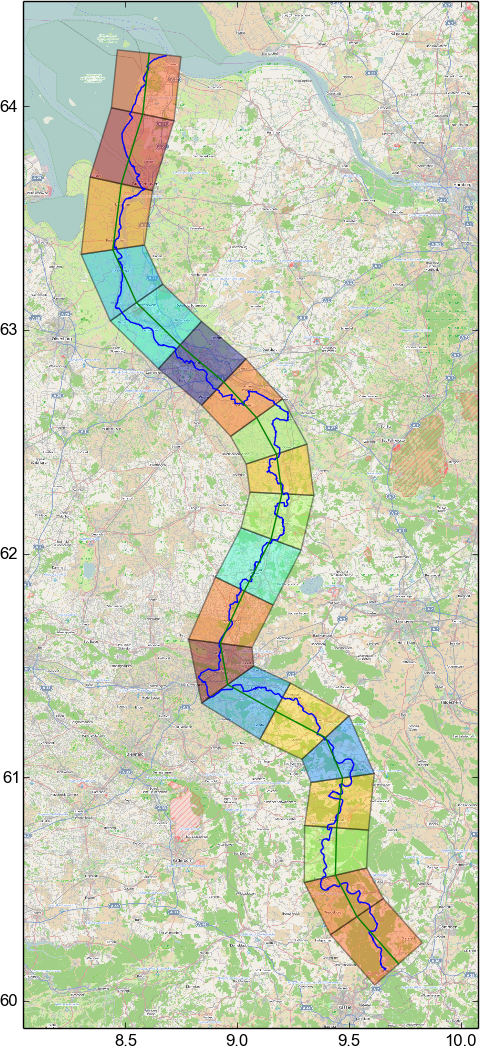
Back in 2007 I stumbled over the "Plus Fours Routefinder", an invention of the 1920's. It's worn on the wrist and allows the user to scroll through a map of the route they planned to take, rolled up on little wooden rollers. At that point I thought: that's awesome for long trips where you either dont want to take electronics with you or where you are without any electricity for a long time. And creating such rollable custom maps of your route automatically using openstreetmap data should be a breeze! Nevertheless it seems nobody picked up the idea. Years passed and in a few weeks I'll go on a biking trip along the Weser, a river in nothern Germany. For my last multi-day trip (which was through the Odenwald, an area in southern Germany) I printed a big map from openstreetmap data which contained the whole route. Openstreetmap data is fantastic for this because in contrast to commercial maps it doesnt only allow you to just print the area you need but also allows you to highlight your planned route and objects you would probably not find in most commercial maps like for example supermarkets to stock up on supplies or bicycle repair shops. Unfortunately such big maps have the disadvantage that to show everything in the amount of detail that you want along your route, they have to be pretty huge and thus easily become an inconvenience because the local plotter can't handle paper as large as DIN A0 or because it's a pain to repeatedly fold and unfold the whole thing every time you want to look at it. Strong winds are also no fun with a huge sheet of paper in your hands. One solution would be to print DIN A4 sized map regions in the desired scale. But that has the disadvantage that either you find yourself going back and forth between subsequent pages because you happen to be right at the border between two pages or you have to print sufficiently large overlaps, resulting in many duplicate map pieces and more pages of paper than you would like to carry with you. It was then that I remembered the "Plus Fours Routefinder" concept. Given a predefined route it only shows what's important to you: all things close to the route you plan to travel along. Since it's a long continuous roll of paper there is no problem with folding because as you travel along the route you unroll one end and roll up the other. And because it's a long continuous map there is also no need for flipping pages or large overlap regions. There is not even the problem of not finding a big enough sheet of paper because multiple DIN A4 sheets can easily be glued together at their ends to form a long roll. On the left you see the route we want to take: the bicycle route along the Weser river. If I wanted to print that map on a scale that allows me to see objects in sufficient detail along our route, then I would also see objects in Hamburg (upper right corner) in the same amount of detail. Clearly a waste of ink and paper as the route is never even close to Hamburg.
As the first step, a smooth approximation of the route has to be found. It seems that the best way to do that is to calculate a B-Spline curve approximating the input data with a given smoothness. On the right you can see the approximated curve with a smoothing value of 6. The curve is sampled into 20 linear segments. I calculated the B-Spline using the FITPACK library to which scipy offers a Python binding.
The next step is to expand each of the line segments into quadrilaterals. The distance between the vertices of the quadrilaterals and the ends of the line segment they belong to is the same along the whole path and obviously has to be big enough such that every point along the route falls into one quadrilateral. In this example, I draw only 20 quadrilaterals for visual clarity. In practice one wants many more for a smoother approximation.
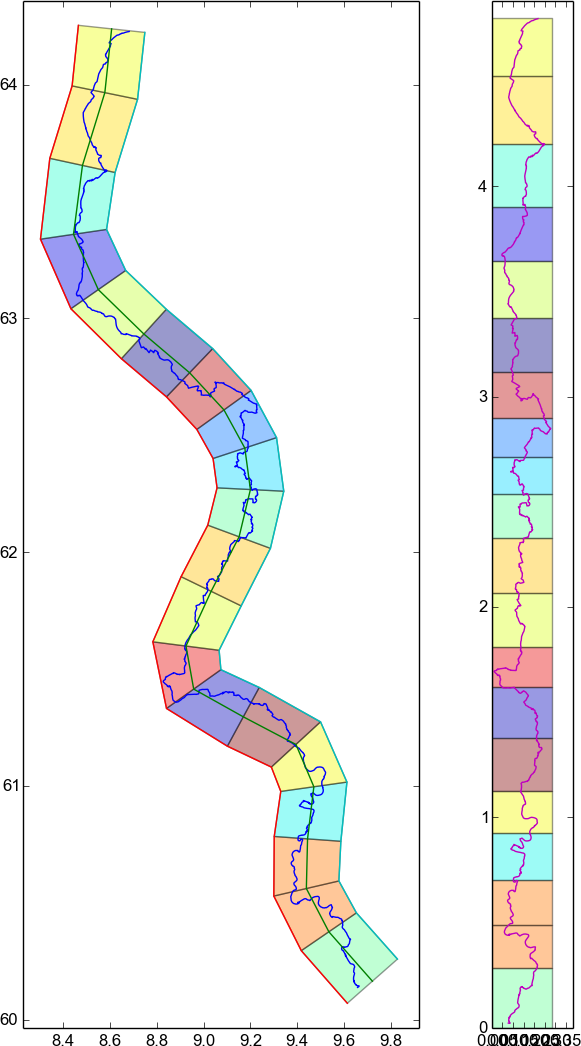
Using a simple transform, each point of the original map and the original path in each quadrilateral is then mapped to a point inside the corresponding "straight" rectangle. Each target rectangle has the height of the line segment it corresponds to. It can be seen that while the large scale curvature of the path is lost in the result, fine details remain perfectly visible. The assumption here is, that while travelling a path several hundred kilometers long, it does not matter that large scale curvature that one is not able to perceive anyways is not preserved. The transformation is done on a Mercator projection of the map itself as well as the data of the path. Therefore, this method probably doesnt work if you plan to travel to one of the poles. Currently I transform openstreetmap bitmap data. This is not quite optimal as it leads to text on the map being distorted. It would be just as easy to apply the necessary transformations to raw openstreetmap XML data but unfortunately I didnt find a way to render the resulting transformed map data as a raster image without setting up a database. I would've thought that it would be possible to have a standalone program reading openstreetmap XML and dumping out raster or svg images without a round trip through a database. Furthermore, tilemill, one of the programs that seem to be one of the least hasslesome to set up and produce raster images is stuck in an ITP and the existing packaging attempt fails to produce a non-empty binary package. Since I have no clue about nodejs packaging, I wrote about this to the pkg-javascript-devel list. Maybe I can find a kind soul to help me with it.
Here a side by side overview that doesnt include the underlying map data but only the path. It shows how small details are preserved in the transformation. The code that produced the images in this post is very crude, unoptimized and kinda messy. If you dont care, then it can be accessed here

Steve Kemp: Tagging images, and maintaining collections?

I'm an amateur photographer, although these days I tend to drop the amateur prefix, given that I shoot people for cash at least once a month. (It isn't my main job, and I'd never actually want it to be, because I'm certain I'd become unhappy hustling for jobs and doing the promotion thing.) Anyway over the years I've built up a large library of images, mostly organized in a hierarchy of directories beneath ~/Images. Unlike most photographers I don't use aperture, lighttable, or any similar library management. I shoot my images in RAW, convert to JPG via rawtherapee, and keep both versions of the images. In short I don't want to mix the "library management" functions with the "RAW conversion" because I do regard them as two separate steps. That said I'm reaching a point where I do want to start tagging images, and finding them more quickly. In the past I wrote a couple of simple tools to inject tags into the EXIF data of images, and then indexed them. But that didn't work so well in practise. I'm starting to think instead I should index images into sqlite: The downside is that this breaks utterly as soon as you move images around on-disk. Which is something my previous exif-manipulation was designed to avoid. Anyway I'm thinking at the moment, but I know that the existing tools such as F-Spot, shotwell, DigiKam, and similar aren't suitable. So I either need to go standalone and use EXIF tags, accepting the fact that the tags I enter won't be visible to other tools, or I cope with the file-rename issues by attempting to update an existing sqlite database via hash/size/etc.

Andrew Pollock: [life] Day 65: Playgroup, and the foil confetti play date

Zoe slept pretty well last night. She only woke up briefly at 4am because Cowie had fallen out of bed and she couldn't find her. Today was the last Playgroup of the term. Megan, her little sister and her Dad came as well to check it out, which was nice, because Zoe then had someone to actively play with in addition to me. After Playgroup, we went to the adjacent Bulimba Memorial Park with Megan, and then had some lunch at Grill'd. Megan's Dad wanted to do some work on their house while Megan's little sister napped, so I offered to give Megan a play date at our place. The plan was to watch a movie and chill out. The girls picked Ratatouille and I made a batch of popcorn for them. Unfortunately Megan seemed to be less of a square eyes than Zoe, and she lost interest after a bit, so we stopped watching the movie and moved out to the balcony to do some craft. Zoe had been wanting to make a crown for Mummy's boss for a while, so we made a couple of crowns with the hot glue gun. I had bought this bag of mixed craft "jewels" and it's probably the best single craft thing I've bought. Zoe loves gluing them onto everything. After that, Zoe pulled out the bag of coloured foil confetti. If the gems were the best thing I've bought, this would have to be the worst. So far, all it's done is leak in the drawer it's been stored in, and I've been avoiding using it because it was going to be messy. Today, Zoe wanted to glue it onto the outside of her cardboard box, so I decided to give in and embrace the mess, and boy, did we make a mess. It probably ended up being the longest bit of cooperative play the girls did. They'd alternate between handing each other a fistful of confetti while I applied globs of glue where directed. Probably about 10 percent of each handful ended up stuck to the rocket, so the balcony looked like quite a mess by the end of it all, but at least it was a dry mess, so I could just vacuum it all up. I suspect I'll be encountering dregs for quite a while, because I doubt it's stuck to the cardboard particularly well. After that, the girls played indoors for a bit, and watched a bit more of the movie, but Megan seemed to be scared of Anton Ego, so I think that was why it wasn't holding her attention. The other activity that the girls seemed to thoroughly enjoy was tearing around the living room squealing while they took turns at throwing a grapefruit-sized beach ball at me, and I threw it back at them. Jason came back to pick up Megan, and I started dinner. Not that long after Megan left, Sarah arrived to watch Zoe for me so I could go visit my cousin in hospital. I had dinner on the table pretty much as soon as she walked in the door, and headed out.

2 April 2014

Tassia Camoes Araujo: Mini-Debconf Barcelona videos now available

Hello world!!! For those who were impatiently waiting for the Mini-Debconf Barcelona videos, there you go, enjoy it! We ll probably have subtitles and some late slides soon, so come back after a while. Thank you very much for all those who make this adventure possible! If you also want to thank the videoteam, the orgateam, Debian Women, or the Universe, for converging and bringing us together in Barcleona, please do it! Just for the records, it was a great success in terms of women participation. As we didn t collect gender information at the registration, it is hard to make a clear comparison with previous Debconfs. Since 2007, the rate of non-male participants ranged from 13% to 17%. For this Mini-Debconf, the orga team did the gender identification per name and found a non-male rate of 36%. Again, since the methods were not the same we cannot safely compare, but still, I think it s worth it to make this info public ;-) The most important thing to save from this experience is that we were around 160 human beings together, sharing common goals, in a lovely and warm place, with kids around, baby trollers on the stage, painting table in the patio yes it was fun!
BCN group photo - first try

BCN group photo first try

BCN group photo - second try

BCN group photo second try

Last but not least, now we need to gather information for a final report, so if you can help, please speak up! Hope to see you all soon!

1 April 2014

Marco d'Itri: Real out of band connectivity with network namespaces

This post explains how to configure on a Linux server a second and totally independent network interface with its own connectivity. It can be useful to access the server when the regular connectivity is broken. This can happen thanks to network namespaces, a virtualization feature available in recent kernels. We need to create a simple script to be run at boot time which will create and configure the namespace. First, move in the new namespace the network interface which will be dedicated to it:
ip netns add oob
ip link set eth2 netns oob
And then configure it as usual with iproute, by executing it in the new namespace with ip netns exec:
ip netns exec oob ip link set lo up
ip netns exec oob ip link set eth2 up
ip netns exec oob ip addr add 192.168.1.2/24 dev eth2
ip netns exec oob ip route add default via 192.168.1.1
The interface must be configured manually because ifupdown does not support namespaces yet, and it would use the same /run/network/ifstate file which tracks the interfaces of the main namespace (this is also a good argument in favour of something persistent like Network Manager...). Now we can start any daemon in the namespace, just make sure that they will not interfere with the on-disk state of other instances:
ip netns exec oob /usr/sbin/sshd -o PidFile=/run/sshd-oob.pid
Netfilter is virtualized as well, so we can load a firewall configuration which will be applied only to the new namespace:
ip netns exec oob iptables-restore < /etc/network/firewall-oob-v4
As documented in ip-netns(8), iproute netns add will also create a mount namespace and bind mount in it the files in /etc/netns/$NAMESPACE/: this is very useful since some details of the configuration, like the name server IP, will be different in the new namespace:
mkdir -p /etc/netns/oob/
echo 'nameserver 8.8.8.8' > /etc/netns/oob/resolv.conf
If we connect to the second SSH daemon, it will create a shell in the second namespace. To enter the main one, i.e. the one used by PID 1, we can use a simple script like:
#!/bin/sh -e
exec nsenter --net --mount --target 1 "$@"
To reach the out of band namespace from the main one we can use instead:
#!/bin/sh -e
exec nsenter --net --mount --target $(cat /var/run/sshd-oob.pid) "$@"
Scripts like these can also be used in fun ssh configurations like:
Host 10.2.1.*
 ProxyCommand ssh -q -a -x -N -T server-oob.example.net 'nsenter-main nc %h %p'

Thorsten Glaser: Sorry about the MediaWiki-related breakage in wheezy

I would like to publicly apologise for the inconvenience caused by my recent updates to the mediawiki and mediawiki-extensions source packages in Debian wheezy (stable-security). As for reasons I m doing Mediawiki-related work at my dayjob, as part of FusionForge/Evolvis development, and try to upstream as much as I can. Our production environment is a Debian wheezy-based system with a selection of newer packages, including MediaWiki from sid (although I also have a test system running sid, so my uploads to Debian are generally better tested). I haven t had experience with stable-security uploads before, and made small oversights (and did not run the full series of tests on the final , permitted-to-upload, version, only beforehand) which led to the problems. The situation was a bit complicated by the need to update the two packages in lockstep, to fight an RC bug file/symlink conflict, which was hard enough to do in sid already, plus the desire to fix other possibly-RC bugs at the same time. I also got no external review, although I cannot blame anyone since I never asked anyone explicitly, so I accept this as my fault. The issues with the updates are: My unfamiliarity with some of the packaging concepts used here, combined with this being something I do during $dayjob (which can limit the time I can invest, although I m doing much more work on Mediawiki in Debian than I thought I could do on the job), can cause some of those oversights. I guess I also should install a vanilla wheezy environment somewhere for testing I do not normally do stable uploads (jmw did them before), so I was not prepared for that. And, while here: thanks to the Debian Security Team for putting up with me (also in this week s FusionForge issue), and thanks to Mediawiki upstream for agreeing to support releases shipped in Debian stable for longer support, so we can easily do stable-security updates.

Joey Hess: adding docker support to propellor

Propellor development is churning away! (And leaving no few puns in its wake..) Now it supports secure handling of private data like passwords (only the host that owns it can see it), and fully end-to-end secured deployment via gpg signed and verified commits. And, I've just gotten support for Docker to build. Probably not quite work, but it should only be a few bugs away at this point. Here's how to deploy a dockerized webserver with propellor:
host hostname@"clam.kitenet.net" = Just
    [ Docker.configured
    , File.dirExists "/var/www"
    , Docker.hasContainer hostname "webserver" container
    ]
container _ "webserver" = Just $ Docker.containerFromImage "joeyh/debian-unstable"
        [ Docker.publish "80:80"
        , Docker.volume "/var/www:/var/www"
        , Docker.inside
            [ serviceRunning "apache2"
                 requires  Apt.installed ["apache2"]
            ]
        ]
Docker containers are set up using Properties too, just like regular hosts, but their Properties are run inside the container. That means that, if I change the web server port above, Propellor will notice the container config is out of date, and stop the container, commit an image based on it, and quickly use that to bring up a new container with the new configuration. If I change the web server to say, lighttpd, Propellor will run inside the container, and notice that it needs to install lighttpd to satisfy the new property, and so will update the container without needing to take it down. Adding all this behavior took only 253 lines of code, and none of it impacts the core of Propellor at all; it's all in Propellor.Property.Docker. (Well, I did need another hundred lines to write a daemon that runs inside the container and reads commands to run over a named pipe... Docker makes running ad-hoc commands inside a container a PITA.) So, I think that this vindicates the approach of making the configuration of Propellor be a list of Properties, which can be constructed by abitrarily interesting Haskell code. I didn't design Propellor to support containers, but it was easy to find a way to express them as shown above. Compare that with how Puppet supports Docker: http://docs.docker.io/en/latest/use/puppet/
docker::run   'helloworld':
  image        => 'ubuntu',
  command      => '/bin/sh -c "while true; do echo hello world; sleep 1; done"',
  ports        => ['4444', '4555'],
...
All puppet manages is running the image and a simple static command inside it. All the complexities that puppet provides for configuring servers cannot easily be brought to bear inside the container, and a large reason for that is, I think, that its configuration file is just not expressive enough.

31 March 2014

Francesca Ciceri: Random notes from MiniDebconf Barcelona 2014

First of all, let me say this: Barcelona MiniDebconf was awesome. So the most important part of this post is a very big thank you to the organizers, volunteers, speakers, sponsors and attendees. Now, down to business. Day 0 Day 0 was a day of travelling, more or less: the Italian Cabal (me, Enrico, Elena and Diego) left in the early morning from Varese (where we had an epic Munchkin Apocalypse game the night before), and we travelled by car across Liguria and France and finally reached Barcelona in the evening. (Boring! Even more if you don't drive. I hate long trips by car) We reached Barcelona in time for the pre-registration event at Falstaff Bar, eat a great Falafel and hugged lots of people. Day 1 To me the highlight of Day 1 was to finally meet in person Laura Arjona, Spanish translator, publicity volunteer, pump.io and mediagoblin contributor. We had decided to have a workshop together about translations and we spent the morning more or less tweaking our presentation and chatting :). So, save for Elena's talk on 3d printing in Debian ("The Universal OS: now making tabletop games and cookie cutters!" -- which was great!) I missed all the talks in the morning. But thanks to the always amazing videoteam, I'll be able to watch them later, when the recordings will be published :). For me, the best talk of the day - well, no, actually of the conference! - was that afternoon: Ana Isabel Carvalho told us about the Libre Graphics Magazine project. Libre Graphics Magazine is a well written and designed magazine at the crossroad between Free Software tools and ideals and graphic arts and design. A crossroad not very much frequented, I'd say. But then, maybe I'm wrong: it's not that graphic artists don't use Free Software tools, it's more like the one who do are invisible.
This is one purpose of a Libre Graphics Magazine: to serve as a catalyst for discussion, to build a home for the users of Libre Graphics software, standards and methods. In such a magazine, we may unite all our previously disparate successes, all the successes which have, until now, stood alone as small examples, disjointed from the larger community. We have the opportunity to elevate the discourse around Libre Graphics as a professionally viable option, to raise previously unmentioned issues and to push forward the conception of just what Libre Graphics can produce.
If you are even only vagued interested in typefaces, fonts, design and graphic art take a look at the magazine: it's CC-BY-SA licensed and you can download it for free, or buy a paper copy (which is amazing, really!). And it's not just about graphic arts: if you skim over the titles of the issues, you can find that they've talked about things like "Localisation/Internationalization", "Use Cases and Affordances" and, my favourite, "Gendering F/LOSS". On a similar topic, Siri's talk about "Why aren't more designers using Debian or working for Debian?" tried to shed a light on the difficult relationship between Free Software tools and graphic artists. These are the voices we need to listen to if we want to bring more graphic artists to Debian, and $deity knows that Debian needs them a lot :). After Solveig's talk about bug triaging and Miriam's one on packaging, it was time for the l10n workshop. I think it went well: we tried to briefly explain the translation workflow in Debian, and to translate together with the audience a po-debconf message. It wasn't maybe enough to complete and submit a translation, but hopefully it gave the audience an idea about how to do it. The day ended with a party for Debian Women 10th anniversary. And the cake wasn't a lie, beside being very good. Day 2 This, I'll remember as "the day I exited my comfort zone". Ok, I'm making a bit of fuss about it, but it was my first talk in English all alone. I spoke about the non-uploading DD process and how to keep your (and others') sanity in a big community project (slides here). I think it's very important to remind people that not all DDs are coding persons. And you don't need to be a developer to love Debian, contribute to it and become an official member of the project. But writing this presentation was for me also the occasion to take stock of my experience in Debian so far: in that talk slipped many of my demons, as impostor syndrome or overcommitment. But all the things I said are more or less, common sense - nothing new! - and lesson learned on the road: it's been now 2 years as DD and 4 as contributor. I'm pretty sure it's thanks to the special conditions of this conference (only speakers identifying themselves as female, a safe and very friendly environment) that I had the courage to give a talk. So the conference was a complete success on that regard, too. In the afternoon I was able to do one of the things I love: videoteam duty. Though I convinced Riccio to switch roles and to give me the camera: my experience in directing during last DebConf left me a bit scarred. Special mention for Laura speaking of pump.io and MediaGoblin and Solveig of Tails during the "Lightning Talks" and the people from LelaCoders during the "Bits from Local Communities" session. The Day(s) after: a Debian Contributors hackathon In my experience a measure of a conference's success is the burst of activity in pet projects just afterwards. In this, also, Barcelona MiniConf was a success: during the weekend, Enrico, Laura and I had the chance to talk together about Debian Contributors and make some plans.
So, as soon as we got in Italy again, I took possession of Enrico's couch for a couple of days and we did a little bit of hacking on Contributors. For my part, I mostly worked in trying to add more data sources to the site: my (not so) secret agenda is to map most of the non-coding contributions. That basically means: translators, publicity editors, event organizers and volunteers, etc. Being in the same room as Enrico, gave me the chance to ask him how to add data sources and to test the existing code (we spot a little problem in the prototype for svn repository mining he made a while ago). At the end of the hackathon, I had managed to: Please note that if you have contributed to one of the repo above and you are not listed there, it means that the automatic recognition of your email address didn't work. We still need to implement a manual interface for the recognition of email addresses: patches are very much welcome! Meanwhile Enrico: If you care about recognition of diverse contributions in Debian, help us: read the project todo list and subscribe to the low traffic mailing list or browse the project Git repository.

Mart&iacute;n Ferrari: Fun with Linux telephony

Continuing with my tendency to vent about stuff, today I want to talk about telephony. Since a few years ago, I need to use different VoIP providers to keep in touch with friends and family, in different parts of the world. So, I have a DID in Argentina (bought trough the excellent DIDWW), and another one in Ireland (which came for free when I was using BlueFace for call termination). I also have a service to handle outbound calls (FlowRoute), but it is not necessarily the only one I use, as cost and quality of Internet calls vary wildly. I have also used several Betamax providers, the aforementioned BlueFace, tried Netelip, etc. This results in having soft-phones installed in my mobile devices and laptop, and a hardware SIP phone that I carry around; all of them having configurations for at least 3 different providers. This does not lead to hilarity. In light of this, it's been a long time since I want to set up my own SIP router to be able to handle all of this, and be able to register to a single SIP proxy that will handle all the complexity. Last Friday, the Irish DID decided to stop working. It turns out, that since I don't have my own setup, I was using that provider as a kind of hub, with their provided voicemail, and terminating the Argentinian DID there. So the damage was big. This made me spend way too many hours during the weekend trying to set up some SIP solution. And I am not pleased.

Asterisk First, I went with the old and known Asterisk. The default installation in Debian puts 95 configuration files in /etc/asterisk, which you are supposed to review and adjust. Yes, you've read correctly: ninety-five different configuration files. None of them having anything close to a sensible explanation of their syntax or function. Also, not a remote hint of consistency. I could not find any configuration helper in the Debian archive, just hundreds of PHP-based projects scattered around the web. All the started guides I've found only guided you for the most basic tasks, but did not give you a way to have a functioning system. Needless to say, after a short time I grew tired of this, and decided to try something else.

Way too many options After this, I have spent an inordinate amount of hours, just trying to comprehend the difference between the gazillion different VoIP systems out there, I am still struggling to see that. Even if I understand that X is not a PBX, I don't exactly need a PBX, and most products deliver at least some of the features I need. It seems none of them makes a good job of just explaining what you can or can't do with their software. Documentation is awful in all the projects I researched. When it is there at all, it is incomplete, maybe super detailed at points, but in most cases, there is just no big picture view of the system to just start understanding how things work, and how to find your way. Sadly, not even the distros seems to be able to put a list of "recommended VoIP software for different needs".

Yate Finally, I've found YATE (Yet Another Telephony Engine). It seemed promising: not too bloated, fairly extensible, and scriptable in a few languages! Sadly, after many hours, it turned out to be a fiasco. The documentation seems decent, until you realise there are many key details left out. Basic information about how a call is handled cannot be found anywhere. Using the scripting power, I was able to find out at least the variables that were available, but that was not enough. I found a mailing list (with the worst archive reader I've seen in ages), where people made the very same questions I have, and nobody has replied. In years. So here I am, stuck with not being able to tell if a call is coming from a random host on the internet, or one of my DIDs, or one of the authenticated clients. I guess I will have to start from scratch with Yet Another (Another) Telephony Engine.

29 March 2014

Dirk Eddelbuettel: R / Finance 2014 Open for Registration

The annoucement below just went to the R-SIG-Finance list. More information is as usual at the R / Finance page:
Now open for registrations: R / Finance 2014: Applied Finance with R
May 16 and 17, 2014
Chicago, IL, USA
The registration for R/Finance 2014 -- which will take place May 16 and 17 in Chicago -- is now open! Building on the success of the previous conferences in 2009, 2010, 2011, 2012 and 2013, we expect around 300 attendees from around the world. R users from industry, academia, and government will joining 30+ presenters covering all areas of finance with R. We are very excited about the four keynotes by Bill Cleveland, Alexios Ghalanos, Bob McDonald and Luke Tierney. The main agenda (currently) includes sixteen full presentations and twenty-one shorter "lightning talks". We are also excited to offer four optional pre-conference seminars on Friday morning. To celebrate the sixth year of the conference in style, the dinner will be returning to The Terrace of the Trump Hotel. Overlooking the Chicago River and skyline, it is a perfect venue to continue conversations while dining and drinking. More details of the agenda are available at:
http://www.RinFinance.com/agenda/
Registration information is available at
http://www.RinFinance.com/register/
and can also be directly accessed by going to
http://www.regonline.com/RFinance2014
We would to thank our 2014 Sponsors for the continued support enabling us to host such an exciting conference:
International Center for Futures and Derivatives at UIC Revolution Analytics
MS-Computational Finance at University of Washington OneMarketData
RStudio
On behalf of the committee and sponsors, we look forward to seeing you in Chicago!
Gib Bassett, Peter Carl, Dirk Eddelbuettel, Brian Peterson,
Dale Rosenthal, Jeffrey Ryan, Joshua Ulrich
See you in Chicago in May!

This post by Dirk Eddelbuettel originated on his Thinking inside the box blog. Please report excessive re-aggregation in third-party for-profit settings.

Steve Kemp: Some things on DNS and caching

Although there wasn't too many comments on my what would you pay for? post I did get some mails. I was reminded about this via Mario Langs post, which echoed a couple of private mails I received. Despite being something that I take for granted, perhaps because my hosting comes from the Bytemark, people do seem willing to pay money for DNS hosting. Which is odd. I mean you could do it very very very cheaply if you had just four virtual machines. You can get complex and be geo-fancy, and you could use anycast on a small AS, but really? You could just deploy four virtual machines0 to provide a.ns, b.ns, c.ns, d.ns, and be better than 90% of DNS hosters out there. The thing that many people mentioned was Git-backed, or Git-based DNS. Which would be trivial if you used tinydns, and no much harder if you used bind. I suspect I'm "not allowed" to do DNS-things for a while, due to my contract with Dyn, but it might be worth checking... ObRandom: Beat me to it. Register gitdns.io, or similar, and configure hooks from github to compile tinydns records. In other news I started documenting early thoughts about my caching reverse proxy, which has now got a name stockpile. I wrote some stub code using node.js, and although it was functional it soon became callback hell: Expressing the rules neatly is also a challenge. I want the server core to be simple and the configuration to be something like:
is_cachable ( vhost, source, request, backened )
 
    /**
     * If the file is static, then it is cachable.
     */
    if ( request.url.match( /\.(jpg png txt html? gif)$/i ) )  
        return true;
     
    /**
     * If there is a cookie then the answer is false.
     */
    if ( request.has_cookie? )   return false ;  
    /**
     * If the server is alive we'll now pass the remainder through it
     * if not then we'll serve from the cache.
     */
    if ( backend.alive? )  
        return false;
     
    else  
        return true;
     
 
I can see there is value in judging the cachability based on the server response, but I plan to ignore that except for "Expires:", "Etag", etc ,etc) Anyway callback hell does make me want to reexamine the existing C/C++ libraries out there. Because I think I could do better.

28 March 2014

Andrew Pollock: [life] Day 59: Rain, BJJ, play cafe, bunk beds and a car wash

Today was another wet day. Sarah dropped Zoe around in the morning, and she watched a little bit of TV before we drove to Brazilian Jiu-Jitsu class. My cycling fitness is going to go completely to hell. Zoe's really taken to her teacher, Patrick. The classes have pretty much been just Zoe and I on Friday's, with the occasional other kids, and so she's formed a pretty close relationship with her teacher. The last few weeks, Zoe's really liked to help Patrick set up and tidy up the space before and after the classes. She loves to tell Patrick about what's been going on in her life. It's really sweet to watch. Today there was another 3 year old boy, but he was much less focused than Zoe. I will miss the classes, because I've seen real self-defense value in what they've been teaching. For proper comparison, I should see tae kwon do clases as well, but currently I'd be pretty happy with what I've seen taught in Brazilian Jiu-Jitsu. I can see the practical application of it. We're going to go watch Patrick compete in May, and I'm looking forward to seeing some adult-level stuff. Megan's Dad was looking for something to do with his kids, so I suggested we meet at Lollipops Playland & Cafe in Cannon Hill after BJJ class. We were a bit late in getting there, mostly because Zoe wanted to hang around after class for a bit, but we got there eventually, and Zoe and Megan had a great time. We stayed for lunch and the girls played a bit more. It's the first time I've used a play cafe since coming back to Australia, and I found it almost overwhelmingly loud and busy. These places must love it when it rains. It was nice that Zoe's at an age now where she can go off and play on her own. Having Megan there was a great help in that regard, but the girls did keep losing each other, although that wasn't a big problem for either of them. While we were at the play cafe, I received an email saying that the Kindergarten working bee for tomorrow had been canceled on account of the wet weather, so that's opened up our Saturday significantly. After that, we headed down to Bunkers to place the order for the bunk bed I want to get Zoe for her birthday. I'd expected with all the morning's activities, for her to pass out in the car immediately, but surprisingly she lasted the distance, and had a great time sampling all the different bunk beds at the store. Even on the way back home, it took her a little while to fall asleep, so I extended the car ride by driving around the Port of Brisbane to see how much there was to see that might be interesting for Zoe when she's awake. After that, we went to the car wash to get the car cleaned, because it's been a while. Zoe had a babyccino and we sorted through the DreamWorks cards we'd traded with Megan that morning. It was time for dinner after the car wash, so we headed home, and Zoe watched some TV while I prepared dinner. At bath time, I realised that we hadn't had time to do anything for Science Friday. Yesterday at Bunnings I bought a roll of clear tubing for the heck of it, so we made a siphon in the bath. Zoe thought the tube was great fun, and had a good time blowing bubbles in the bath with it. Tomorrow we'll have to use some bubble bath for added entertainment. Bedtime went smoothly enough.

Dirk Eddelbuettel: Upcoming Rcpp talks and workshops

A number of talks about Rcpp are scheduled over the next couple of months: So the month of June is still pretty open. If someone wants me to talk somewhere else, preferably on a Saturday, feel free to get in touch.

This post by Dirk Eddelbuettel originated on his Thinking inside the box blog. Please report excessive re-aggregation in third-party for-profit settings.

27 March 2014

Mario Lang: Demonstrating a common m17n a11y problem with a web audio game

There is a rather infamous multilingualisation bug in almost every screen reader I have ever used. As a german native speaker, I usually set my operating system user interface language to german. However, since I do a lot of technical work, I frequently end up on english websites. But if I temporarily switch my speech synthesis language to english, certain user interface elements and key names are not translated! So the screen reader continues to say "Eingabe" or "Leertaste", but with an english accent! I consider this behaviour hilarious, especially in 21st century. To demonstrate how hilarious it actually is, I have made a little browser audio game. Voice snippets have been contributed by my girlfriend. A natural voice is still a lot better than sampled speech synthesizers, and sounds more fun as we think. The idea is simple: Angela will announce a key name, and you are supposed to hit it on the keyboard as fast as possible. After a round of 50 guesses (time to answer will decrease with every guess) a final score will be announced. I usually don't write any JavaScript. I still managed to hack this up (with a little help from Simon) in roughly 2 hours of browsing Stackoverflow. The game is here. The code is on GitHub. If you have any problems getting this to work, please let me know or send a pull request. I'd like to get it working at least on iOS as well (after all, it is the touch device platform with best accessibility support currently), however, I could not get mobile safari to behave. So patches to enable use on touch devices are welcome. It should be simple, just add a few buttons which call the pressed function with the appropriate character as parameter. However, I tried, and something is fishy regarding window.setTimeout since it does not behave the same way as if you use it with Firefox. Oh, and my favourite key name is "Runt Glamour Zoo" :-) Now, this was funny. But it is also very sad. If you play this game, remember that blind and visually impaired computer users really have to cope with such accented pronounciations on a daily basis. We grew used to it, but if I take a step backward, it's really unacceptable that we still have to cope with this daily. And this is the simple part of the bug, since it is only dealing with key labels, which are internal to the system. It gets much worse if you want your screen reader to automatically switch to the correct synthesis language. Language detection is apparently not good enough to be implemented, at least that's what they tell me. And if the document (HTML) specifies a language, it's wrong in more than 50% of the cases. This is a disaster. Come to think of it, that is probably a reason why I prefer braille over speech. With braille, this problem goes away completely.

26 March 2014

Russell Coker: The Aspie Accent

I am often asked about my accent . The most common guess is that it s a British accent, while I lived in London for about a year I don t think that my accent changed much during that time (people have commented on the way I speak since I was in primary school). Also there isn t a British accent anyway, the Wikipedia page of Regional Accents of English has the first three sections devoted to accents in the island of Britain (and Northern Ireland is part of the United Kingdom which people often mean when they sat Britain ). The Received Pronounciation is the main BBC accent and the accent that is most associated with Britain/England/the UK (which are three different things even though most people don t know it) and I don t think that I sound like that at all. I ve had various other guesses, the Netherlands (where I lived for a few years but mostly spoke to other foreigners), New Zealand (which I ve visited a couple of times for conferences), Denmark (the closest I got was attending a conference in Sweden), and probably others I can t remember. If I actually had developed an accent from another country then it would probably be from the US. The amount of time I ve spent watching Hollywood movies and watching US TV shows greatly exceeds the amount of time I ve spent listening to people from all other countries. The fact that among all the people who wanted to try and guess where my accent supposedly originated none have ever included the US seems like strong evidence to suggest that I don t have any sort of accent that really derives from another country. Also I have never had someone mistake me for being a resident of their own country based on accent which seems like clear evidence that all claims about me having a foreign accent are bogus. Autism forums such as WrongPlanet.net [1] always turn up plenty of results for a search on accent . In such discussions it seems that a British accent is most common mistake and there are often theories raised about why that is often related to speaking in a formal or precise way or by using a large vocabulary. Also in such discussions the list of countries that people supposedly have accents from is very inclusive, it seems that any country that the listener has heard of but doesn t know that well is a good candidate. The fact that Aspies from outside the US are rarely regarded as having an American accent could be due to the fact that Hollywood has made most of the world population aware of what most American accents sound like. Also if I really had some sort of accent from another country then probably someone would comment on that when I m outside Australia. When I m travelling people tend to recognise my accent as Australian, while it doesn t please me when someone thinks that I sound like Crocodile Dundee (as happened in the Netherlands) it might not be entirely inaccurate. This is Annoying The way the issue of accent is raised is generally in the form of people asking where I m from, it seems to imply that they don t think I belong in Australia because of the way I speak. It s particularly annoying when people seem unable to realise that they are being obnoxious after the first wrong guess. When I reply no to the first are you from $COUNTRY question and don t offer any further commentary it s not an invitation to play 20 questions regarding where I m supposedly from, it s actually an indication that I m not interested in a conversation on that topic. A Social Skills 101 course would include teaching people that when someone uses one-word answers to your questions it usually means that they either don t like your questions or don t want to talk to you. Social Skills vs Status The combination of persistence and misreading a social situation which are involved when someone interrogates me about my supposed accent are both parts of the diagnostic criteria for Autism. But I generally don t get questions about my accent in situations where there are many Aspies (IE anything related to the Free Software community). I think that this is because my interactions with people in the Free Software community are based around work (with HR rules against being a jerk) and community events where no-one would doubt that I belong. I mostly get questions about my accent from random middle-class white people who feel entitled to query other people about their status who I meet in situations where there is nothing restraining them from being a jerk. For example random people I meet on public transport.

Neil Williams: LAVA packages for Debian

Packaging LAVA for Debian unstable with notes on other distributions I ve been building packages for LAVA on Debian unstable for several months now and I ve been running LAVA jobs on the laptop and on devices in my home lab and on an ARMv7 arndale too. Current LAVA installations use lava-deployment-tool which has only supported Ubuntu 12.04 LTS Precise Pangolin. There has been a desire in LAVA to move away from a virtual environment, to put configuration files in FHS compliant paths, to use standard distribution packages for dependencies and so to make LAVA available on more platforms than just precise. Packaging opens the door to installing LAVA on Debian, Ubuntu, Fedora and any other recent distribution. Despite LAVA currently being reliant on 12.04 Precise, some of the python dependencies of LAVA have been able to move forward using the virtual environment provided by builtout and pypi. This means that LAVA, as packaged, requires a newer base OS suite than precise for Ubuntu, the minimal base is Saucy Salamander 13.10 and for Debian it would be Jessie (testing) although there is currently a transition ongoing in Debian which means that uwsgi is not in testing and Debian unstable would be needed instead. The work to migrate configuration snippets out of deployment-tool and to ensure that the tarball built using setuptools contains all of the necessary files for the package has already been done. The packaging itself is clean and most of the work is done upstream. There is, as ever, more to do but the packages work smoothly for single install LAVA servers where the dispatcher is on the same machine as the django web frontend. The packages have also migrated to Django1.6, something which is proving difficult with the deployment-tool as it has not kept pace with the changes outside the virtual environment, even if other parts of LAVA have. LAVA will be switching to packages for installation instead of deployment-tool and this will mean changes to how LAVA works outside the Cambridge lab. When the time comes to swich to packaging, the plan is to update deployment-tool so that it no longer updates /srv/lava/ but instead migrates the instance to packages. Main changes
  1. Configuration files move into /etc/
    • Device configuration files /etc/lava-dispatcher/devices/
    • Instance configuration files/etc/lava-server/
  2. Log files move into /var/log/
    • Adding logrotate support no more multi-Gb log files in /srv/lava/
  3. Commitment to keeping the upstream code up to date with dependencies
  4. Support for migrating existing instances, using South.
  5. Packaging helpers
    • add devices over SSH instead of via a combination of web frontend and SSH.
    • Developer builds with easily identifiable version strings, built as packages direct from your git tree.
  6. New frontend
    • Although django1.6 does not change the design of the web frontend at all, LAVA will take the opportunity to apply a bootstrap frontend which has greater support for browsers on a variety of devices, including mobile. This also helps identify a packaged LAVA from a deployment LAVA.
  7. Documentation and regular updates
The Plan LAVA has made regular releases based on a monthly cycle and these will be provided as source tarballs at http://www.linaro.org/downloads/ for distributions to download. The
official monthly release and any intervening updates will be made available for distributions to use for their own packaging. Additionally, Debian packages will be regularly built for use within LAVA and these will be available for those who choose to migrate from Ubuntu Precise to Debian Jessie. LAVA will assist maintainers who want to package LAVA for their distributions and we welcome patches from such maintainers. This can include changes to the developer build support script to automate the process of supporting development outside LAVA. Initially, LAVA will migrate to packaging internally, to prove the process and to smooth out the migration. Other LAVA instances are welcome to follow this migration or wait until the problems have been ironed out. The Issues Build Dependencies For Debian unstable, the list of packages which must be installed on your Debian system to be able to build packages from the lava-server and lava-dispatcher source code trees are:
debhelper (>= 8.0.0) python   python-all   python-dev   python-all-dev 
python-sphinx (>= 1.0.7+dfsg)   python3-sphinx python-mocker 
python-setuptools python-versiontools
(python-versiontools may disappear before the packages are finalised) In addition, to be able to install lava-server, these packages need to be built from tarballs released by Linaro (the list may shorten as changes upstream are applied)
linaro-django-pagination, 
python-django-restricted-resource (>= 0.2.7), 
lava-tool (>= 0.2), lava-utils-interface (>= 1.0), 
linaro-django-xmlrpc (>= 0.4),
python-versiontools (>= 1.8),
python-longerusername,
linaro-dashboard-bundle (>= 1.10.2), 
lava-dispatcher (>= 0.33.3)
lava-coordinator, lava-server-doc
The list for lava-dispatcher is currently:
python-json-schema-validator, lava-tool (>= 0.4), 
lava-utils-interface, linaro-dashboard-bundle (>= 1.10.2), 
The packages available from my experimental repository are using a new packaging branch of lava-server and lava-dispatcher where we are also migrating the CSS to Bootstrap CSS. Installing LAVA on Debian unstable
$ sudo apt-get install emdebian-archive-keyring
Add the link to my experimental repository (amd64, i386, armhf & arm64) to your apt sources, e.g. by creating a file /etc/apt/sources.list.d/lava.list containing:

deb http://people.linaro.org/~neil.williams/lava sid main
Update with the new key

$ sudo apt-get update
It is always best to install postgresql first:

$ sudo apt-get install postgresql
There are then three options for the packages to install (Please be careful with remote worker setup, it is not suitable for important installations at this time.):
  1. Single instance, server and dispatcher with recommended tools
    apt-get install lava
    Installs linaro-image-tools and guestfs tools.
  2. Single instance, server and dispatcher
    apt-get install lava-server
    Installs enough to run LAVA on a single machine, running jobs on boards on the same LAN.
  3. Experimental remote worker support
    apt-get install lava-worker
    Needs a normal lava-server installation to act as the master scheduler but is aimed at supporting a dispatcher and boards which are remote from that master.
The packages do not assume that your apache2.4 setup is identical to that used in other LAVA installations, so the LAVA apache config is installed to /etc/apache2/sites-available/ but is not enabled by default. If you choose to use the packaged apache config, you can simply run:

$ sudo a2ensite lava-server
$ sudo apache2ctl restart
(If this is a fresh apache install, use a2dissite to disable to default configuration before restarting.) Information on creating a superuser, adding devices and administering your LAVA install is provided in the README.Debian file in lava-server:

$ zless /usr/share/doc/lava-server/README.Debian.gz
Provisos and limitations Please be aware that packaged LAVA is still a work-in-progress but do let us know if there are problems. Now is the time to iron out install bugs and other issues as well as to prepare LAVA packages for other distributions. It will be a little while before the packages are ready for upload to Debian I ve got to arrange the download location and upload the dependencies first and some of that work will wait until more work has gone in upstream to consolidate some of the current dependencies.

Dirk Eddelbuettel: RProtoBuf 0.4.1

A new bug-fix release release 0.4.1 of RProtoBuf, is now on CRAN. RProtoBuf provides GNU R bindings for the Google Protocol Buffers ("Protobuf") data encoding library used and released by Google, and deployed as a language and operating-system agnostic protocol by numerous projects. Murray once more shouldered most of the actual burden and fixed a number of issues detailed below.
Changes in RProtoBuf version 0.4.1 (2014-03-25)
  • Document and add a test for the deprecated group functionality.
  • Add a CITATION file pointing to our arXiv.org preprint.
  • Fix a bug in the show method for EnumDescriptor types.
  • Import all top-level enums from imported .proto files.
  • Removed duplicate enum value type from the unit tests that caused problems with the most recent libprotobuf-2.5. (without option allow_alias).
CRANberries also provides a diff to the previous release. More information is at the RProtoBuf page which has a draft package vignette, a 'quick' overview vignette and a unit test summary vignette. Questions, comments etc should go to the rprotobuf mailing list off the RProtoBuf page at R-Forge.

This post by Dirk Eddelbuettel originated on his Thinking inside the box blog. Please report excessive re-aggregation in third-party for-profit settings.

25 March 2014

Sylvain Le Gall: Release of OASIS 0.4.3

I am happy to announce the release of OASIS v0.4.3. Logo OASIS small OASIS is a tool to help OCaml developers to integrate configure, build and install systems in their projects. It should help to create standard entry points in the source code build system, allowing external tools to analyse projects easily. This tool is freely inspired by Cabal which is the same kind of tool for Haskell. You can find the new release here and the changelog here. More information about OASIS in general on the OASIS website. Here is a quick summary of the important changes: Features: This new version closes 4 bugs, mostly related to parsing of _oasis. It also includes a lot of refactoring to improve the overall quality of OASIS code base. The big project for the next release will be to setup a Windows host for regular build and test on this platform. I plan to use WODI for this setup. I would like to thanks again the contributor for this release: David Allsopp, Martin Keegan and Jacques-Pascal Deplaix. Their help is greatly appreciated.

Next.

Previous.