Search Results: "he"

24 May 2022

Bits from Debian: Debian welcomes the 2022 GSOC interns

GSoC logo We are very excited to announce that Debian has selected three interns to work under mentorship on a variety of projects with us during the Google Summer of Code. Here are the list of the projects, interns, and details of the tasks to be performed.
Project: Android SDK Tools in Debian The deliverables of this project will mostly be finished packages submitted to Debian sid, both for new packages and updated packages. Whenever possible, we should also try to get patches submitted and merged upstream in the Android sources.
Project: Project: Quality Assurance for Biological and Medical Applications inside Debian Deliverables of the project: Continuous integration tests for all Debian Med applications (life sciences, medical imaging, others), Quality Assurance review and bug fixing.
Congratulations and welcome to all the interns! The Google Summer of Code program is possible in Debian thanks to the efforts of Debian Developers and Debian Contributors that dedicate part of their free time to mentor interns and outreach tasks. Join us and help extend Debian! You can follow the interns' weekly reports on the debian-outreach mailing-list, chat with us on our IRC channel or reach out to the individual projects' team mailing lists.

23 May 2022

Arturo Borrero Gonz lez: Toolforge Jobs Framework

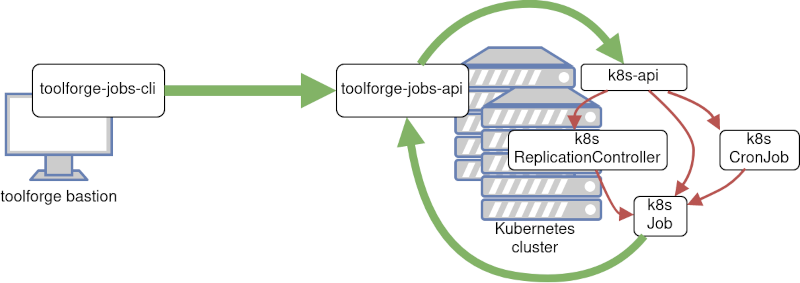
Toolforge jobs framework diagram This post was originally published in the Wikimedia Tech blog, authored by Arturo Borrero Gonzalez. This post continues the discussion of Toolforge updates as described in a previous post. Every non-trivial task performed in Toolforge (like executing a script or running a bot) should be dispatched to a job scheduling backend, which ensures that the job is run in a suitable place with sufficient resources. Jobs can be scheduled synchronously or asynchronously, continuously, or simply executed once. The basic principle of running jobs is fairly straightforward: So far, if a tool developer wanted to work with jobs, the Toolforge Grid Engine backend was the only suitable choice. This is despite the fact that Kubernetes supports this kind of workload natively. The truth is that we never prepared our Kubernetes environment to work with jobs. Luckily that has changed.

We no longer want to run Grid Engine In a previous blog post we shared information about our desired future for Grid Engine in Toolforge. Our intention is to discontinue our usage of this technology.

Convenient way of running jobs on Toolforge Kubernetes Some advanced Toolforge users really wanted to use Kubernetes. They were aware of the lack of abstractions or helpers, so they were forced to use the raw Kubernetes API. Eventually, they figured everything out and managed to succeed. The result of this move was in the form of [docs on Wikitech][raws] and a few dozen jobs running on Kubernetes for the first time. We were aware of this, and this initiative was much in sync with our ultimate goal: to promote Kubernetes over Grid Engine. We rolled up our sleeves and started thinking of a way to abstract and make it easy to run jobs without having to deal with lots of YAML and the raw Kubernetes API. There is a precedent: the webservice command does exactly that. It hides all the details behind a simple command line interface to start/stop a web app running on Kubernetes. However, we wanted to go even further, be more flexible and prepare ourselves for more situations in the future: we decided to create a complete new REST API to wrap the jobs functionality in Toolforge Kubernetes. The Toolforge Jobs Framework was born.

Toolforge Jobs Framework components The new framework is a small collection of components. As of this writing, we have three:
  • The REST API responsible for creating/deleting/listing jobs on the Kubernetes system.
  • A command line interface to interact with the REST API above.
  • An emailer to notify users about their jobs activity in the Kubernetes system.
Toolforge jobs framework diagram There were a couple of challenges that weren t trivial to solve. The authentication and authorization against the Kubernetes API was one of them. The other was deciding on the semantics of the new REST API itself. If you are curious, we invite you to take a look at the documentation we have in wikitech.

Open beta phase Once we gained some confidence with the new framework, in July 2021 we decided to start a beta phase. We suggested some advanced Toolforge users try out the new framework. We tracked this phase in Phabricator, where our collaborators quickly started reporting some early bugs, helping each other, and creating new feature requests. Moreover, when we launched the Grid Engine migration from Debian 9 Stretch to Debian 10 Buster we took a step forward and started promoting the new jobs framework as a viable replacement for the grid. Some official documentation pages were created on wikitech as well. As of this writing the framework continues in beta phase. We have solved basically all of the most important bugs, and we already started thinking on how to address the few feature requests that are missing. We haven t yet established yet the criteria for leaving the beta phase, but it would be good to have:
  • Critical bugs fixed and most feature requests addressed (or at least somehow planned).
  • Proper automated test coverage. We can do better on testing the different software components to ensure they are as bug free as possible. This also would make sure that contributing changes is easy.
  • REST API swagger integration.
  • Deployment automation. Deploying the REST API and the emailer is tedious. This is tracked in Phabricator.
  • Documentation, documentation, documentation.

Limitations One of the limitations we bear in mind since early on in the development process of this framework was the support for mixing different programming languages or runtime environments in the same job. Solving this limitation is currently one of the WMCS team priorities, because this is one of the key workflows that was available on Grid Engine. The moment we address it, the framework adoption will grow, and it will pretty much enable the same workflows as in the grid, if not more advanced and featureful. Stay tuned for more upcoming blog posts with additional information about Toolforge. This post was originally published in the Wikimedia Tech blog, authored by Arturo Borrero Gonzalez.

22 May 2022

Sergio Talens-Oliag: New Blog

Welcome to my new Blog for Technical Stuff. For a long time I was planning to start publishing technical articles again but to do it I wanted to replace my old blog based on ikiwiki by something more modern. I ve used Jekyll with GitLab Pages to build the Intranet of the ITI and to generate internal documentation sites on Agile Content, but, as happened with ikiwiki, I felt that things were kind of slow and not as easy to maintain as I would like. So on Kyso (the Company I work for right now) I switched to Hugo as the Static Site Generator (I still use GitLab Pages to automate the deployment, though), but the contents are written using the Markdown format, while my personal preference is the Asciidoc format. One thing I liked about Jekyll was that it was possible to use Asciidoctor to generate the HTML simply by using the Jekyll Asciidoc plugin (I even configured my site to generate PDF documents from .adoc files using the Asciidoctor PDF converter) and, luckily for me, that is also possible with Hugo, so that is what I plan to use on this blog, in fact this post is written in .adoc. My plan is to start publishing articles about things I m working on to keep them documented for myself and maybe be useful to someone else. The general intention is to write about Container Orchestration (mainly Kubernetes), CI/CD tools (currently I m using GitLab CE for that), System Administration (with Debian GNU/Linux as my preferred OS) and that sort of things. My next post will be about how I build, publish and update the Blog, but probably I will not finish it until next week, once the site is fully operational and the publishing system is tested.
Spoiler Alert: This is a personal site, so I m using Gitea to host the code instead of GitLab. To handle the deployment I ve configured json2file-go to save the data sent by the hook calls and process it asynchronously using inotify-tools. When a new file is detected a script parses the JSON file using jq and builds and updates the site if appropriate.

Ulrike Uhlig: How do kids conceive the internet? - part 3

I received some feedback on the first part of interviews about the internet with children that I d like to share publicly here. Thank you! Your thoughts and experiences are important to me! In the first interview round there was this French girl.
Asked what she would change if she could, the 9 year old girl advocated for a global usage limit of the internet in order to protect the human brain. Also, she said, her parents spend way too much time on their phones and people should rather spend more time with their children.
To this bit, one person reacted saying that they first laughed when reading her proposal, but then felt extremely touched by it. Another person reacted to the same bit of text:
That s just brilliant. We spend so much time worrying about how the internet will affect children while overlooking how it has already affected us as parents. It actively harms our relationship with our children (keeping us distracted from their amazing life) and sets a bad example for them. Too often, when we worry about children, we should look at our own behavior first. Until about that age (9-10+) at least, they are such a direct reflection of us that it s frightening
Yet another person reacted to the fact that many of the interviewees in the first round seemed to believe that the internet is immaterial, located somewhere in the air, while being at the same time omnipresent:
It reminds me of one time about a dozen years ago, when i was still working closely with one of the city high schools where i d just had a terrible series of days, dealing with hardware failure, crappy service followthrough by the school s ISP, and overheating in the server closet, and had basically stayed overnight at the school and just managed to get things back to mostly-functional before kids and teachers started showing up again. That afternoon, i d been asked by the teacher of a dystopian fiction class to join them for a discussion of Feed, which they d just finished reading. i had read it the week before, and came to class prepared for their questions. (the book is about a near-future where kids have cybernetic implants and their society is basically on a runaway communications overload; not a bad Y[oung]A[dult] novel, really!) The kids all knew me from around the school, but the teacher introduced my appearance in class as one of the most Internet-connected people and they wanted to ask me about whether i really thought the internet would do this kind of thing to our culture, which i think was the frame that the teacher had prepped them with. I asked them whether they thought the book was really about the Internet, or whether it was about mobile phones. Totally threw off the teacher s lesson plans, i think, but we had a good discussion. At one point, one of the kids asked me if there was some kind of crazy disaster and all the humans died out, would the internet just keep running? what would happen on it if we were all gone? all of my labor even that grueling week was invisible to him! The internet was an immaterial thing, or if not immaterial, a force of nature, a thing that you accounted for the way you accounted for the weather, or traffic jams. It didn t occur to him, even having just read a book that asked questions about what hyperconnectivity does to a culture (including grappling with issues of disparate access, effective discrimination based on who has the latest hardware, etc), it didn t occur to him that this shit all works to the extent that it does because people make it go. I felt lost trying to explain it to him, because where i wanted to get to with the class discussion was about how we might decide collectively to make it go somewhere else that our contributions to it, and our labor to perpetuate it (or not) might actually help shape the future that the network helps us slide into. but he didn t even see that human decisions or labor played a role it in at all, let alone a potentially directive role. We were really starting at square zero, which wasn t his fault. Or the fault of his classmates that matter but maybe a little bit of fault on the teacher, who i thought should have been emphasizing this more but even the teacher clearly thought of the internet as a thing being done to us not as something we might actually drive one way or another. And she s not even wrong most people don t have much control, just like most people can t control the weather, even as our weather changes based on aggregate human activity.
I was quite impressed by seeing the internet perceived as a force of nature, so we continued this discussion a bit:
that whole story happened before we started talking about the cloud , but the cloud really reinforces this idea, i think. not that anyone actually thinks that the cloud is a literal cloud, but language shapes minds in subtle ways.
(Bold emphasis in the texts are mine.) Thanks :) I m happy and touched that these interviews prompted your wonderful reactions, and I hope that there ll be more to come on this topic. I m working on it!

Russ Allbery: Review: On a Sunbeam

Review: On a Sunbeam, by Tillie Walden
Publisher: Tillie Walden
Copyright: 2016-2017
Format: Online graphic novel
Pages: 544
On a Sunbeam is a web comic that was published in installments between Fall 2016 and Spring 2017, and then later published in dead tree form. I read the on-line version, which is still available for free from its web site. It was nominated for an Eisner Award and won a ton of other awards, including the Los Angeles Times Book Prize. Mia is a new high school graduate who has taken a job with a construction crew that repairs old buildings (that are floating in space, but I'll get to that in a moment). Alma, Elliot, and Charlotte have been together for a long time; Jules is closer to Mia's age and has been with them for a year. This is not the sort of job one commutes to: they live together on a spaceship that travels to the job sites, share meals together, and are more of an extended family than a group of coworkers. It's all a bit intimidating for Mia, but Jules provides a very enthusiastic welcome and some orientation. The story of Mia's new job is interleaved with Mia's school experience from five years earlier. As a new frosh at a boarding school, Mia is obsessed with Lux, a school sport that involves building and piloting ships through a maze to capture orbs. Sent to the principal's office on the first day of school for sneaking into the Lux tower when she's supposed to be at assembly, she meets Grace, a shy girl with sparkly shoes and an unheard-of single room. Mia (a bit like Jules in the present timeline) overcomes Grace's reticence by being persistently outgoing and determinedly friendly, while trying to get on the Lux team and dealing with the typical school problems of bullies and in-groups. On a Sunbeam is science fiction in the sense that it seems to take place in space and school kids build flying ships. It is not science fiction in the sense of caring about technological extrapolation or making any scientific sense whatsoever. The buildings that Mia and the crew repair appear to be hanging in empty space, but there's gravity. No one wears any protective clothing or air masks. The spaceships look (and move) like giant tropical fish. If you need realism in your science fiction graphical novels, it's probably best not to think of this as science fiction at all, or even science fantasy despite the later appearance of some apparently magical or divine elements. That may sound surrealistic or dream-like, but On a Sunbeam isn't that either. It's a story about human relationships, found family, and diversity of personalities, all of which are realistically portrayed. The characters find their world coherent, consistent, and predictable, even if it sometimes makes no sense to the reader. On a Sunbeam is simply set in its own universe, with internal logic but without explanation or revealed rules. I kind of liked this approach? It takes some getting used to, but it's an excuse for some dramatic and beautiful backgrounds, and it's oddly freeing to have unremarked train tracks in outer space. There's no way that an explanation would have worked; if one were offered, my brain would have tried to nitpick it to the detriment of the story. There's something delightful about a setting that follows imaginary physical laws this unapologetically and without showing the author's work. I was, sadly, not as much of a fan of the art, although I am certain this will be a matter of taste. Walden mixes simple story-telling panels with sweeping vistas, free-floating domes, and strange, wild asteroids, but she uses a very limited color palette. Most panels are only a few steps away from monochrome, and the colors are chosen more for mood or orientation in the story (Mia's school days are all blue, the Staircase is orange) than for any consistent realism. There is often a lot of detail in the panels, but I found it hard to appreciate because the coloring confused my eye. I'm old enough to have been a comics reader during the revolution in digital coloring and improved printing, and I loved the subsequent dramatic improvement in vivid colors and shading. I know the coloring style here is an intentional artistic choice, but to me it felt like a throwback to the days of muddy printing on cheap paper. I have a similar complaint about the lettering: On a Sunbeam is either hand-lettered or closely simulates hand lettering, and I often found the dialogue hard to read due to inconsistent intra- and interword spacing or ambiguous letters. Here too I'm sure this was an artistic choice, but as a reader I'd much prefer a readable comics font over hand lettering. The detail in the penciling is more to my liking. I had occasional trouble telling some of the characters apart, but they're clearly drawn and emotionally expressive. The scenery is wildly imaginative and often gorgeous, which increased my frustration with the coloring. I would love to see what some of these panels would have looked like after realistic coloring with a full palette. (It's worth noting again that I read the on-line version. It's possible that the art was touched up for the print version and would have been more to my liking.) But enough about the art. The draw of On a Sunbeam for me is the story. It's not very dramatic or event-filled at first, starting as two stories of burgeoning friendships with a fairly young main character. (They are closely linked, but it's not obvious how until well into the story.) But it's the sort of story that I started reading, thought was mildly interesting, and then kept reading just one more chapter until I had somehow read the whole thing. There are some interesting twists towards the end, but it's otherwise not a very dramatic or surprising story. What it is instead is open-hearted, quiet, charming, and deeper than it looks. The characters are wildly different and can be abrasive, but they invest time and effort into understanding each other and adjusting for each other's preferences. Personal loss drives a lot of the plot, but the characters are also allowed to mature and be happy without resolving every bad thing that happened to them. These characters felt like people I would like and would want to get to know (even if Jules would be overwhelming). I enjoyed watching their lives. This reminded me a bit of a Becky Chambers novel, although it's less invested in being science fiction and sticks strictly to humans. There's a similar feeling that the relationships are the point of the story, and that nearly everyone is trying hard to be good, with differing backgrounds and differing conceptions of good. All of the characters are female or non-binary, which is left as entirely unexplained as the rest of the setting. It's that sort of book. I wouldn't say this is one of the best things I've ever read, but I found it delightful and charming, and it certainly sucked me in and kept me reading until the end. One also cannot argue with the price, although if I hadn't already read it, I would be tempted to buy a paper copy to support the author. This will not be to everyone's taste, and stay far away if you are looking for realistic science fiction, but recommended if you are in the mood for an understated queer character story full of good-hearted people. Rating: 7 out of 10

21 May 2022

Dirk Eddelbuettel: #37: Introducing r2u with 2 x 19k CRAN binaries for Ubuntu 22.04 and 20.04

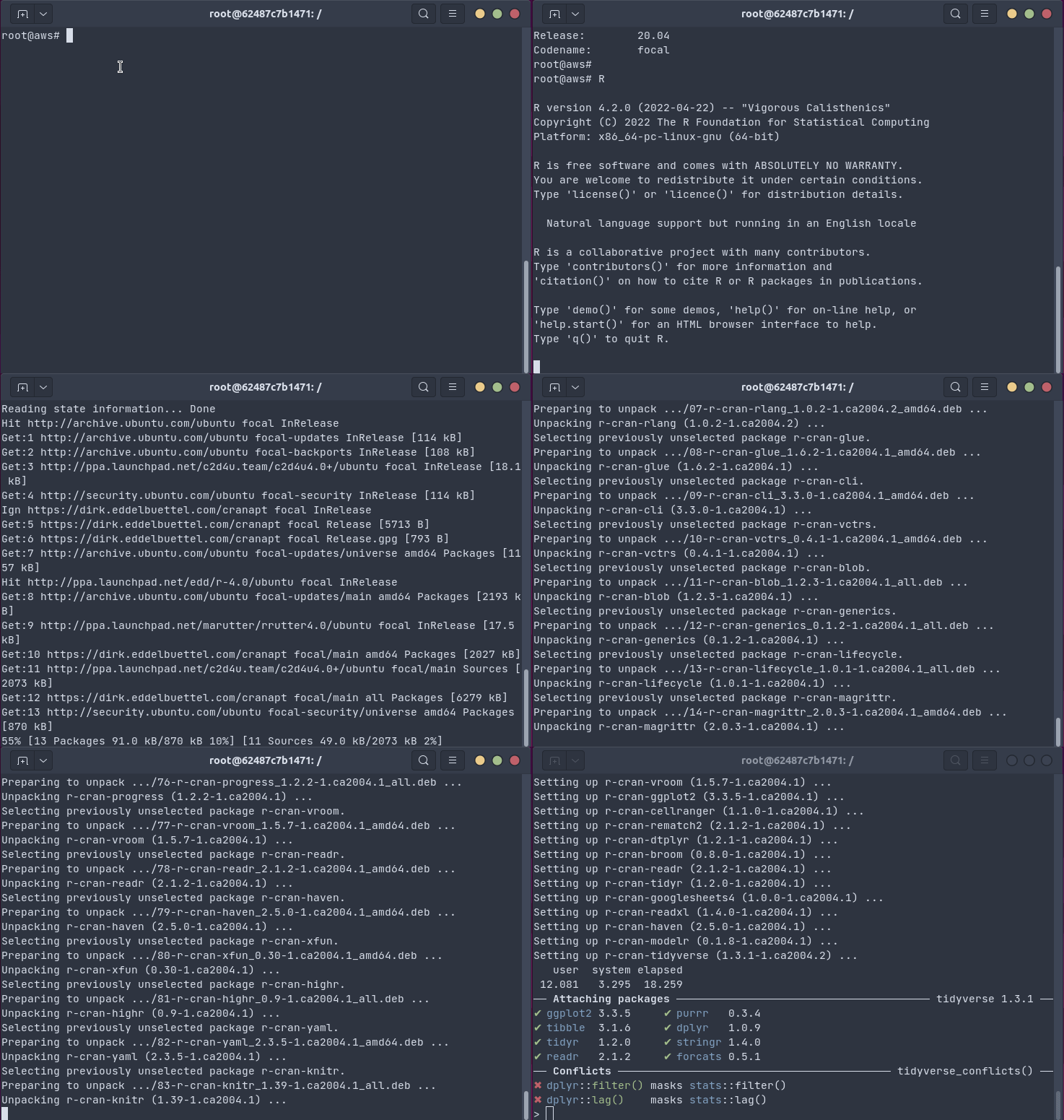
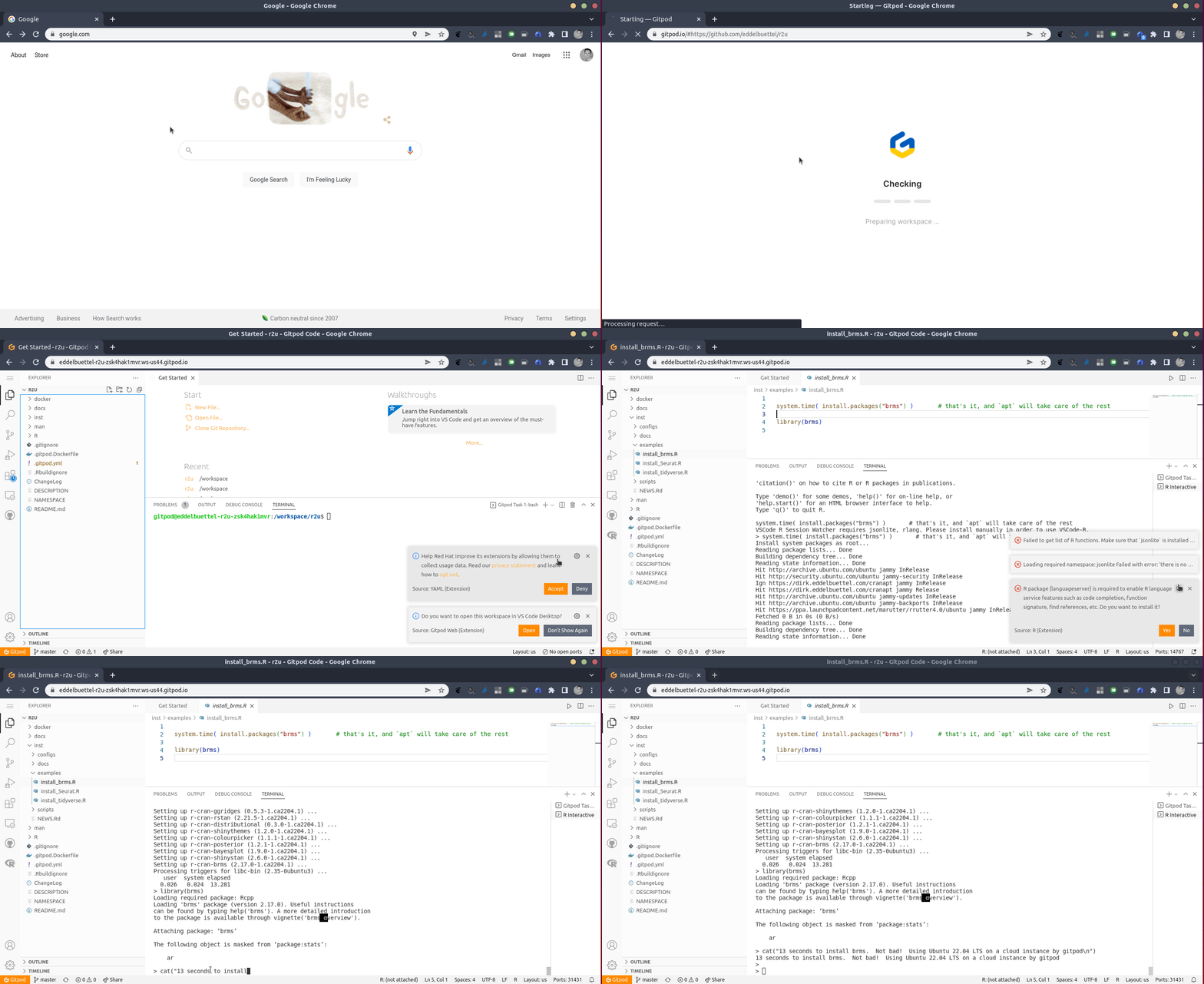
One month ago I started work on a new side project which is now up and running, and deserving on an introductory blog post: r2u. It was announced in two earlier tweets (first, second) which contained the two (wicked) demos below also found at the documentation site. So what is this about? It brings full and complete CRAN installability to Ubuntu LTS, both the focal release 20.04 and the recent jammy release 22.04. It is unique in resolving all R and CRAN packages with the system package manager. So whenever you install something it is guaranteed to run as its dependencies are resolved and co-installed as needed. Equally important, no shared library will be updated or removed by the system as the possible dependency of the R package is known and declared. No other package management system for R does that as only apt on Debian or Ubuntu can and this project integrates all CRAN packages (plus 200+ BioConductor packages). It will work with any Ubuntu installation on laptop, desktop, server, cloud, container, or in WSL2 (but is limited to Intel/AMD chips, sorry Raspberry Pi or M1 laptop). It covers all of CRAN (or nearly 19k packages), all the BioConductor packages depended-upon (currently over 200), and only excludes less than a handful of CRAN packages that cannot be built.

Usage Setup instructions approaches described concisely in the repo README.md and documentation site. It consists of just five (or fewer) simple steps, and scripts are provided too for focal (20.04) and jammy (22.04).

Demos Check out these two demos (also at the r2u site):

Installing the full tidyverse in one command and 18 seconds

Installing brms and its depends in one command and 13 seconds (and show gitpod.io)

Integration via bspm The r2u setup can be used directly with apt (or dpkg or any other frontend to the package management system). Once installed apt update; apt upgrade will take care of new packages. For this to work, all CRAN packages (and all BioConductor packages depended upon) are mapped to names like r-cran-rcpp and r-bioc-s4vectors: an r prefix, the repo, and the package name, all lower-cased. That works but thanks to the wonderful bspm package by I aki car we can do much better. It connects R s own install.packages() and update.packages() to apt. So we can just say (as the demos above show) install.packages("tidyverse") or install.packages("brms") and binaries are installed via apt which is fantastic and it connects R to the system package manager. The setup is really only two lines and described at the r2u site as part of the setup.

History and Motivation Turning CRAN packages into .deb binaries is not a new idea. Albrecht Gebhardt was the first to realize this about twenty years ago (!!) and implemented it with a single Perl script. Next, Albrecht, Stefan Moeller, David Vernazobres and I built on top of this which is described in this useR! 2007 paper. A most excellent generalization and rewrite was provided by Charles Blundell in an superb Google Summer of Code contribution in 2008 which I mentored. Charles and I described it in this talk at useR! 2009. I ran that setup for a while afterwards, but it died via an internal database corruption in 2010 right when I tried to demo it at CRAN headquarters in Vienna. This peaked at, if memory serves, about 5k packages: all of CRAN at the time. Don Armstrong took it one step further in a full reimplemenation which, if I recall correctly, coverd all of CRAN and BioConductor for what may have been 8k or 9k packages. Don had a stronger system (with full RAID-5) but it also died in a crash and was never rebuilt even though he and I could have relied on Debian resources (as all these approaches focused on Debian). During that time, Michael Rutter created a variant that cleverly used an Ubuntu-only setup utilizing Launchpad. This repo is still going strong, used and relied-upon by many, and about 5k packages (per distribution) strong. At one point, a group consisting of Don, Michael, G bor Cs rdi and myself (as lead/PI) had financial support from the RConsortium ISC for a more general re-implementation , but that support was withdrawn when we did not have time to deliver. We should also note other long-standing approaches. Detlef Steuer has been using the openSUSE Build Service to provide nearly all of CRAN for openSUSE for many years. I aki car built a similar system for Fedora described in this blog post. I aki and I also have a arXiv paper describing all this.

Details Please see the the r2u site for all details on using r2u.

Acknowledgements The help of everybody who has worked on this is greatly appreciated. So a huge Thank you! to Albrecht, David, Stefan, Charles, Don, Michael, Detlef, G bor, I aki and whoever I may have omitted. Similarly, thanks to everybody working on R, CRAN, Debian, or Ubuntu it all makes for a superb system. And another big Thank you! goes to my GitHub sponsors whose continued support is greatly appreciated.

This post by Dirk Eddelbuettel originated on his Thinking inside the box blog. Please report excessive re-aggregation in third-party for-profit settings.

20 May 2022

Wouter Verhelst: Faster tar

I have a new laptop. The new one is a Dell Latitude 5521, whereas the old one was a Dell Latitude 5590. As both the old and the new laptops are owned by the people who pay my paycheck, I'm supposed to copy all my data off the old laptop and then return it to the IT department. A simple way of doing this (and what I'd usually use) is to just rsync the home directory (and other relevant locations) to the new machine. However, for various reasons I didn't want to do that this time around; for one, my home directory on the old laptop is a bit of a mess, and a new laptop is an ideal moment in time to clean that up. If I were to just rsync over the new home directory, then, well. So instead, I'm creating a tar ball. The first attempt was quite slow:
tar cvpzf wouter@new-laptop:old-laptop.tar.gz /home /var /etc
The problem here is that the default compression algorithm, gzip, is quite slow, especially if you use the default non-parallel implementation. So we tried something else:
tar cvpf wouter@new-laptop:old-laptop.tar.gz -Ipigz /home /var /etc
Better, but not quite great yet. The old laptop now has bursts of maxing out CPU, but it doesn't even come close to maxing out the gigabit network cable between the two. Tar can compress to the LZ4 algorithm. That algorithm doesn't compress very well, but it's the best algorithm if "speed" is the most important consideration. So I could do that:
tar cvpf wouter@new-laptop:old-laptop.tar.gz -Ilz4 /home /var /etc
The trouble with that, however, is that the tarball will then be quite big. So why not use the CPU power of the new laptop?
tar cvpf - /home /var /etc   ssh new-laptop "pigz > old-laptop.tar.gz"
Yeah, that's much faster. Except, now the network speed becomes the limiting factor. We can do better.
tar cvpf - -Ilz4 /home /var /etc   ssh new-laptop "lz4 -d   pigz > old-laptop.tar.gz"
This uses about 70% of the link speed, just over one core on the old laptop, and 60% of CPU time on the new laptop. After also adding a bit of --exclude="*cache*", to avoid files we don't care about, things go quite quickly now: somewhere between 200 and 250G (uncompressed) was transferred into a 74G file, in 20 minutes. My first attempt hadn't even done 10G after an hour!

Louis-Philippe V ronneau: Introducing metalfinder

After going to an incredible Arch Enemy / Behemoth / Napalm Death / Unto Others concert a few weeks ago, I decided I wanted to go to more concerts. I like music, and I really enjoy concerts. Sadly, I often miss great performances because no one told me about it, or my local newspaper didn't cover the event enough in advance for me to get tickets. Some online services lets you sync your Spotify account to notify you when a new concert is announced, but I don't use Spotify. As a music geek, I have a local music collection and if I need to stream it, I have a supysonic server. Introducing metalfinder, a cli tool to find concerts using your local music collection! At the moment, it scans your music collection, creates a list of artists and queries Bandsintown for concerts in your town. Multiple output formats are supported, but I mainly use the ATOM one, as I'm a heavy feed reader user. Screenshot of the ATOM output in my feed reader The current metalfinder version (1.1.1) is a MVP: it works well enough, but I still have a lot of work to do... If you want to give it a try, the easiest way is to download it from PyPi. metalfinder is also currently in NEW and I'm planning to have something feature complete in time for the Bookworm freeze.

Reproducible Builds (diffoscope): diffoscope 213 released

The diffoscope maintainers are pleased to announce the release of diffoscope version 213. This version includes the following changes:
* Don't mask differences in .zip/.jar central directory extra fields.
* Don't show a binary comparison of .zip/.jar files if we have at least
  one observed nested difference.
* Use assert_diff in test_zip over get_data and separate assert.
You find out more by visiting the project homepage.

19 May 2022

Ulrike Uhlig: How do kids conceive the internet? - part 2

I promised a follow up to my post about interviews about how children conceptualize the internet. Here it is. (Maybe not the last one!)

The internet, it s that thing that acts up all the time, right? As said in my first post, I abandoned the idea to interview children younger than 9 years because it seems they are not necessarily aware that they are using the internet. But it turns out that some do have heard about the internet. My friend Anna, who has 9 younger siblings, tried to win some of her brothers and sisters for an interview with me. At the dinner table, this turned into a discussion and she sent me an incredibly funny video where two of her brothers and sisters, aged 5 and 6, discuss with her about the internet. I won t share the video for privacy reasons besides, the kids speak in the wondrous dialect of Vorarlberg, a region in western Austria, close to the border with Liechtenstein. Here s a transcription of the dinner table discussion:
  • Anna: what is the internet?
  • both children: (shouting as if it was a game of who gets it first) photo! mobile! device! camera!
  • Anna: But one can have a camera without the internet
  • M.: Internet is the mobile phone charger! Mobile phone full!
  • J.: Internet is internet is
  • M.: I know! Internet is where you can charge something, the mobile phone and
  • Anna: You mean electricity?
  • M.: Yeah, that is the internet, electricity!
  • Anna: (laughs), Yes, the internet works a bit similarly, true.
  • J.: It s the electricity of the house!
  • Anna: The electricity of the house
(everyone is talking at the same time now.)
  • Anna: And what s WiFi?
  • M.: WiFi it s the TV!
  • Anna (laughs)
  • M.: WiFi is there so it doesn t act up!
  • Anna (laughs harder)
  • J. (repeats what M. just said): WiFi is there so it doesn t act up!
  • Anna: So that what doesn t act up?
  • M.: (moves her finger wildly drawing a small circle in the air) So that it doesn t spin!
  • Anna: Ah?
  • M.: When one wants to watch something on Youtube, well then that the thing doesn t spin like that!
  • Anna: Ahhh! so when you use Youtube, you need the internet, right?
  • J.: Yes, so that one can watch things.
I really like how the kids associate the internet with a thing that works all the time, except for when it doesn t work. Then they notice: The internet is acting up! Probably, when that happens, parents or older siblings say: the internet is acting up or let me check why the internet acts up again and maybe they get up from the sofa, switch a home router on and off again, which creates this association with electricity. (Just for the sake of clarity for fellow multilingualist readers, the kids used the German word spinnen , which I translated to acting up . In French that would be d conner .)

WiFi for everyone! I interviewed another of Anna s siblings, a 10 year old boy. He told me that he does not really use the internet by himself yet, and does not own any internet capable device. He watches when older family members look up stuff on Google, or put on a video on Youtube, Netflix, or Amazon he knew all these brand names though. In the living room, there s Alexa, he told me, and he uses the internet by asking Alexa to play music.
Then I say: Alexa, play this song!
Interestingly, he knew that, in order to listen to a CD, the internet was not needed. When asked how a drawing would look like that explains the internet, he drew a scheme of the living room at home, with the TV, Alexa, and some kind of WiFi dongle, maybe a repeater. (Unfortunately I did not manage to get his drawing.) If he could ask a wise and friendly dragon one thing about the internet that he always wanted to know, he would ask How much internet can one have and what are all the things one can do with the internet? If he could change the internet for the better for everyone, he would build a gigantic building which would provide the entire world with WiFi.

Cut out the stupid stuff from the internet His slightly older sister does own a laptop and a smartphone. She uses the internet to watch movies, or series, to talk with her friends, or to listen to music. When asked how she would explain the internet to an alien, she said that
one can do a lot of things on the internet, but on the internet there can be stupid things, but also good things, one can learn stuff on the internet, for example how to do crochet.
Most importantly, she noticed that
one needs the internet nowadays.
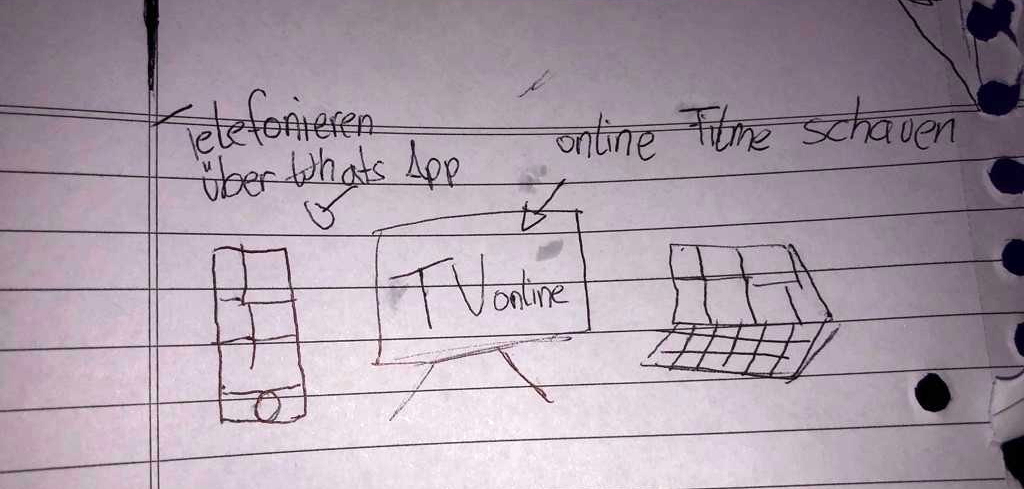
A child's drawing. On the left, a smartphone with WhatsApp, saying 'calls with WhatsApp'. In the middle a TV saying 'watching movies'. On the right, a laptop with lots of open windowns. Her drawing shows how she uses the internet: calls using WhatsApp, watching movies online, and a laptop with open windows on the screen. She would ask the dragon that can explain one thing she always wanted to know about the internet:
What is the internet? How does it work at all? How does it function?
What she would change has to do with her earlier remark about stupid things:
I would make it so that there are less stupid things. It would be good to use the internet for better things, but not for useless things, that one doesn t actually need.
When I asked her what she meant by stupid things , she replied:
Useless videos where one talks about nonsense. And one can also google stupid things, for example how long will i be alive? and stuff like that.

Patterns From the interviews I made until now, there seems to be a cut between then age where kids don t own a device and use the internet to watch movies, series or listen to music and the age where they start owning a device and then they start talking to their friends, and create accounts on social media. This seems to happen roughly at ages 9-10. I m still surprised at the amount of ideas that kids have, when asked what they would change on the internet if they could. I m sure there s more if one goes looking for it.

Thanks Thanks to my friends who made all these interviews possible either by allowing me to meet their children, or their younger siblings: Anna, Christa, Aline, Cindy, and Martina.

Agathe Porte: Status update, May 2022

Boing, time for another status update.
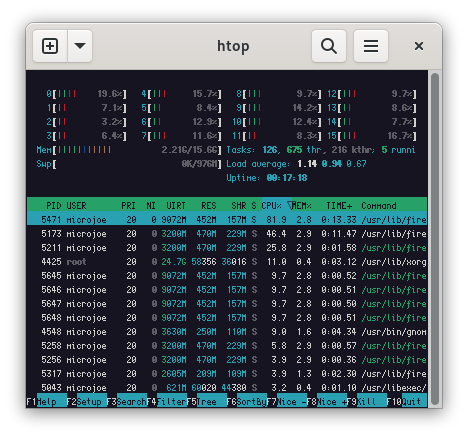
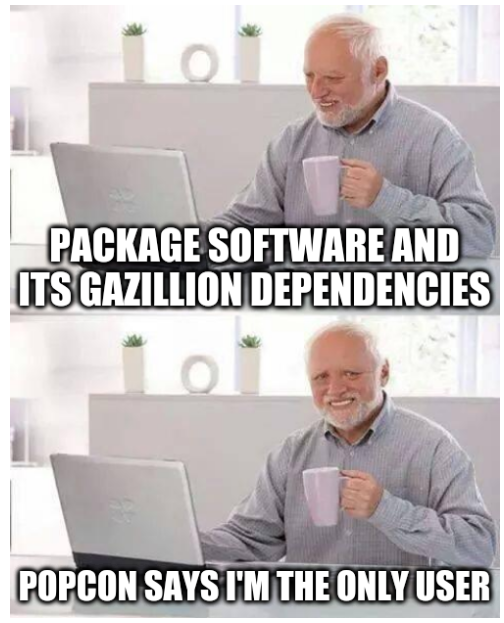
Debian work I have finally found how to make my fonts-creep2 package work on my Debian machines. The solution was to not use the TTF file that contains the Bitmap glyphs, but instead generate an OTB file, which is an OpenType format for Bitmap fonts. Creep2 font used in htop command This means that I can close the fonts-creep ITP bug altogether and rely on this fonts-creep2 package instead. Hopefully it will be reviewed and uploaded soon by a certified Debian Developer. This font is too small for daily usage, but imagine the quantity of data you could display on an auxiliary screen with poor resolution (and poor pixel density eventually). Here is a meme I created for the occasion: Hide the pain Harold meme. First: Package software and its gazillion dependencies. Second: Popcon says I'm the only user. Checks out.
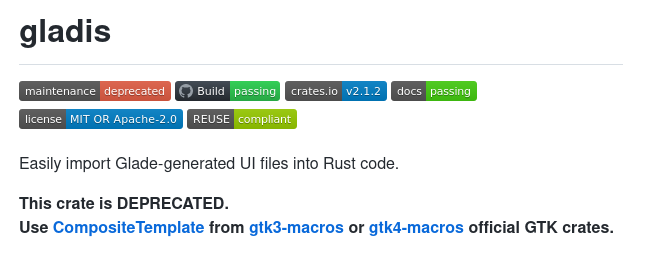
Rust work I have obsoleted my most popular Rust crate, gladis. Screenshot of the Gladis Github README Indeed, the GTK folks have managed to develop a similar solution named CompositeTemplate, that is available in both gtk3-macros and gtk4-macros crates. I did not investigate from how long this has been available before I created this crate. Hopefully it did not exist before I developed it. I have learnt a lot about Rust crates development with this crate, and managed to put in place a semi-automated release flow that I will surely use in other future crates. See ya.

Joerg Jaspert: Rust? Munin? munin-plugin

My first Rust crate: munin-plugin Sooo, some time ago I had to rewrite a munin plugin from Shell to Rust, due to the shell version going crazy after some runtime and using up a CPU all for its own. Sure, it only did that on Systems with Oracle Database installed, so that monster seems to be bad (who would have guessed?), but somehow I had to fixup this plugin and wasn t allowed to drop that wannabe-database. A while later I wrote a plugin to graph Fibre Channel Host data, and then Network interface statistics, all with a one-second resolution for the graphs, to allow one to zoom in and see every spike. Not have RRD round of the interesting parts. As one can imagine, that turns out to be a lot of very similar code - after all, most of the difference is in the graph config statements and actual data gathering, but the rest of code is just the same. As I already know there are more plugins (hello rsyslog statistics) I have to (sometimes re-)write in Rust, I took some time and wrote me a Rust library to make writing munin-plugins in Rust easier. Yay, my first crate on crates.io (and wrote lots of docs for it). By now I made my 1 second resolution CPU load plugin and the 1 second resolution Network interface plugin use this lib already. To test less complicated plugins with the lib, I took the munin default plugin load (Linux variant) and made a Rust version from it, but mostly to see that something as simple as that is also easy to implement: Munin load I got some idea on how to provide a useful default implementation of the fetch function, so one can write even less code, when using this library. It is my first library in Rust, so if you see something bad or missing in there, feel free to open issues or pull requests. Now, having done this, one thing missing: Someone to (re)write munin itself in something that is actually fast Not munin-node, but munin. Or maybe the RRD usage, but with a few hundred nodes in it, with loads of graphs, we had to adjust munin code and change some timeout or it would commit suicide regularly. And some other code change for not always checking for a rename, or something like it. And only run parts of the default cronjob once an hour, not on every update run. And switch to fetching data over ssh (and munin-async on the nodes). And rrdcached with loads of caching for the trillions of files (currently amounts to ~800G of data).. And it still needs way more CPU than it should. Soo, lots of possible optimizations hidden in there. Though I bet a non-scripting language rewrite might gain the most. (Except, of course, someone needs to do it :) )

18 May 2022

Gunnar Wolf: I do have a full face

I have been a bearded subject since I was 18, back in 1994. Yes, during 1999-2000, I shaved for my military service, and I briefly tried the goatee look in 2008 Few people nowadays can imagine my face without a forest of hair. But sometimes, life happens. And, unlike my good friend Bdale, I didn t get Linus to do the honors But, all in all, here I am: Turns out, I have been suffering from quite bad skin infections for a couple of years already. Last Friday, I checked in to the hospital, with an ugly, swollen face (I won t put you through that), and the hospital staff decided it was in my best interests to trim my beard. And then some more. And then shave me. I sat in the hospital for four days, getting soaked (medical term) with antibiotics and otherstuff, got my recipes for the next few days, and well, I really hope that s the end of the infections. We shall see! So, this is the result of the loving and caring work of three different nurses. Yes, not clean-shaven (I should not trim it further, as shaving blades are a risk of reinfection). Anyway I guess the bits of hair you see over the place will not take too long to become a beard again, even get somewhat respectable. But I thought some of you would like to see the real me PS- Thanks to all who have reached out with good wishes. All is fine!

Reproducible Builds: Supporter spotlight: Jan Nieuwenhuizen on Bootstrappable Builds, GNU Mes and GNU Guix

The Reproducible Builds project relies on several projects, supporters and sponsors for financial support, but they are also valued as ambassadors who spread the word about our project and the work that we do. This is the fourth instalment in a series featuring the projects, companies and individuals who support the Reproducible Builds project. We started this series by featuring the Civil Infrastructure Platform project and followed this up with a post about the Ford Foundation as well as a recent ones about ARDC and the Google Open Source Security Team (GOSST). Today, however, we will be talking with Jan Nieuwenhuizen about Bootstrappable Builds, GNU Mes and GNU Guix.
Chris Lamb: Hi Jan, thanks for taking the time to talk with us today. First, could you briefly tell me about yourself? Jan: Thanks for the chat; it s been a while! Well, I ve always been trying to find something new and interesting that is just asking to be created but is mostly being overlooked. That s how I came to work on GNU Guix and create GNU Mes to address the bootstrapping problem that we have in free software. It s also why I have been working on releasing Dezyne, a programming language and set of tools to specify and formally verify concurrent software systems as free software. Briefly summarised, compilers are often written in the language they are compiling. This creates a chicken-and-egg problem which leads users and distributors to rely on opaque, pre-built binaries of those compilers that they use to build newer versions of the compiler. To gain trust in our computing platforms, we need to be able to tell how each part was produced from source, and opaque binaries are a threat to user security and user freedom since they are not auditable. The goal of bootstrappability (and the bootstrappable.org project in particular) is to minimise the amount of these bootstrap binaries. Anyway, after studying Physics at Eindhoven University of Technology (TU/e), I worked for digicash.com, a startup trying to create a digital and anonymous payment system sadly, however, a traditional account-based system won. Separate to this, as there was no software (either free or proprietary) to automatically create beautiful music notation, together with Han-Wen Nienhuys, I created GNU LilyPond. Ten years ago, I took the initiative to co-found a democratic school in Eindhoven based on the principles of sociocracy. And last Christmas I finally went vegan, after being mostly vegetarian for about 20 years!
Chris: For those who have not heard of it before, what is GNU Guix? What are the key differences between Guix and other Linux distributions? Jan: GNU Guix is both a package manager and a full-fledged GNU/Linux distribution. In both forms, it provides state-of-the-art package management features such as transactional upgrades and package roll-backs, hermetical-sealed build environments, unprivileged package management as well as per-user profiles. One obvious difference is that Guix forgoes the usual Filesystem Hierarchy Standard (ie. /usr, /lib, etc.), but there are other significant differences too, such as Guix being scriptable using Guile/Scheme, as well as Guix s dedication and focus on free software.

Chris: How does GNU Guix relate to GNU Mes? Or, rather, what problem is Mes attempting to solve? Jan: GNU Mes was created to address the security concerns that arise from bootstrapping an operating system such as Guix. Even if this process entirely involves free software (i.e. the source code is, at least, available), this commonly uses large and unauditable binary blobs. Mes is a Scheme interpreter written in a simple subset of C and a C compiler written in Scheme, and it comes with a small, bootstrappable C library. Twice, the Mes bootstrap has halved the size of opaque binaries that were needed to bootstrap GNU Guix. These reductions were achieved by first replacing GNU Binutils, GNU GCC and the GNU C Library with Mes, and then replacing Unix utilities such as awk, bash, coreutils, grep sed, etc., by Gash and Gash-Utils. The final goal of Mes is to help create a full-source bootstrap for any interested UNIX-like operating system.
Chris: What is the current status of Mes? Jan: Mes supports all that is needed from R5RS and GNU Guile to run MesCC with Nyacc, the C parser written for Guile, for 32-bit x86 and ARM. The next step for Mes would be more compatible with Guile, e.g., have guile-module support and support running Gash and Gash Utils. In working to create a full-source bootstrap, I have disregarded the kernel and Guix build system for now, but otherwise, all packages should be built from source, and obviously, no binary blobs should go in. We still need a Guile binary to execute some scripts, and it will take at least another one to two years to remove that binary. I m using the 80/20 approach, cutting corners initially to get something working and useful early. Another metric would be how many architectures we have. We are quite a way with ARM, tinycc now works, but there are still problems with GCC and Glibc. RISC-V is coming, too, which could be another metric. Someone has looked into picking up NixOS this summer. How many distros do anything about reproducibility or bootstrappability? The bootstrappability community is so small that we don t need metrics, sadly. The number of bytes of binary seed is a nice metric, but running the whole thing on a full-fledged Linux system is tough to put into a metric. Also, it is worth noting that I m developing on a modern Intel machine (ie. a platform with a management engine), that s another key component that doesn t have metrics.

Chris: From your perspective as a Mes/Guix user and developer, what does reproducibility mean to you? Are there any related projects? Jan: From my perspective, I m more into the problem of bootstrapping, and reproducibility is a prerequisite for bootstrappability. Reproducibility clearly takes a lot of effort to achieve, however. It s relatively easy to install some Linux distribution and be happy, but if you look at communities that really care about security, they are investing in reproducibility and other ways of improving the security of their supply chain. Projects I believe are complementary to Guix and Mes include NixOS, Debian and on the hardware side the RISC-V platform shares many of our core principles and goals.
Chris: Well, what are these principles and goals? Jan: Reproducibility and bootstrappability often feel like the next step in the frontier of free software. If you have all the sources and you can t reproduce a binary, that just doesn t feel right anymore. We should start to desire (and demand) transparent, elegant and auditable software stacks. To a certain extent, that s always been a low-level intent since the beginning of free software, but something clearly got lost along the way. On the other hand, if you look at the NPM or Rust ecosystems, we see a world where people directly install binaries. As they are not as supportive of copyleft as the rest of the free software community, you can see that movement and people in our area are doing more as a response to that so that what we have continues to remain free, and to prevent us from falling asleep and waking up in a couple of years and see, for example, Rust in the Linux kernel and (more importantly) we require big binary blobs to use our systems. It s an excellent time to advance right now, so we should get a foothold in and ensure we don t lose any more.
Chris: What would be your ultimate reproducibility goal? And what would the key steps or milestones be to reach that? Jan: The ultimate goal would be to have a system built with open hardware, with all software on it fully bootstrapped from its source. This bootstrap path should be easy to replicate and straightforward to inspect and audit. All fully reproducible, of course! In essence, we would have solved the supply chain security problem. Our biggest challenge is ignorance. There is much unawareness about the importance of what we are doing. As it is rather technical and doesn t really affect everyday computer use, that is not surprising. This unawareness can be a great force driving us in the opposite direction. Think of Rust being allowed in the Linux kernel, or Python being required to build a recent GNU C library (glibc). Also, the fact that companies like Google/Apple still want to play us vs them , not willing to to support GPL software. Not ready yet to truly support user freedom. Take the infamous log4j bug everyone is using open source these days, but nobody wants to take responsibility and help develop or nurture the community. Not ecosystem , as that s how it s being approached right now: live and let live/die: see what happens without taking any responsibility. We are growing and we are strong and we can do a lot but if we have to work against those powers, it can become problematic. So, let s spread our great message and get more people involved!

Chris: What has been your biggest win? Jan: From a technical point of view, the full-source bootstrap has have been our biggest win. A talk by Carl Dong at the 2019 Breaking Bitcoin conference stated that connecting Jeremiah Orian s Stage0 project to Mes would be the holy grail of bootstrapping, and we recently managed to achieve just that: in other words, starting from hex0, 357-byte binary, we can now build the entire Guix system. This past year we have not made significant visible progress, however, as our funding was unfortunately not there. The Stage0 project has advanced in RISC-V. A month ago, though, I secured NLnet funding for another year, and thanks to NLnet, Ekaitz Zarraga and Timothy Sample will work on GNU Mes and the Guix bootstrap as well. Separate to this, the bootstrappable community has grown a lot from two people it was six years ago: there are now currently over 100 people in the #bootstrappable IRC channel, for example. The enlarged community is possibly an even more important win going forward.
Chris: How realistic is a 100% bootstrappable toolchain? And from someone who has been working in this area for a while, is solving Trusting Trust) actually feasible in reality? Jan: Two answers: Yes and no, it really depends on your definition. One great thing is that the whole Stage0 project can also run on the Knight virtual machine, a hardware platform that was designed, I think, in the 1970s. I believe we can and must do better than we are doing today, and that there s a lot of value in it. The core issue is not the trust; we can probably all trust each other. On the other hand, we don t want to trust each other or even ourselves. I am not, personally, going to inspect my RISC-V laptop, and other people create the hardware and do probably not want to inspect the software. The answer comes back to being conscientious and doing what is right. Inserting GCC as a binary blob is not right. I think we can do better, and that s what I d like to do. The security angle is interesting, but I don t like the paranoid part of that; I like the beauty of what we are creating together and stepwise improving on that.
Chris: Thanks for taking the time to talk to us today. If someone wanted to get in touch or learn more about GNU Guix or Mes, where might someone go? Jan: Sure! First, check out: I m also on Twitter (@janneke_gnu) and on octodon.social (@janneke@octodon.social).
Chris: Thanks for taking the time to talk to us today. Jan: No problem. :)


For more information about the Reproducible Builds project, please see our website at reproducible-builds.org. If you are interested in ensuring the ongoing security of the software that underpins our civilisation and wish to sponsor the Reproducible Builds project, please reach out to the project by emailing contact@reproducible-builds.org.

Louis-Philippe V ronneau: Clojure Team 2022 Sprint Report

This is the report for the Debian Clojure Team remote sprint that took place on May 13-14th. Looking at my previous blog entries, this was my first Debian sprint since July 2020! Crazy how fast time flies... Many thanks to those who participated, namely: Sadly, Utkarsh Gupta although having planned on participating ended up not being able to and worked on DebConf Bursary paperwork instead. rlb Rob mostly worked on creating a dh-clojure tool to help make packaging Clojure libraries easier. At the moment, most of the packaging is done manually, by invoking build tools by hand. Having a tool to automate many of the steps required to build Clojure packages would go a long way in making them more uniform. His work (although still very much a WIP) can be found here: https://salsa.debian.org/rlb/dh-clojure/ ehashman Elana: lavamind It was J r me's first time working on Clojure packages, and things went great! During the sprint, he: allentiak Leandro joined us on Saturday, since he couldn't get off work on Friday. He mostly continued working on replacing our in-house scripts for /usr/bin/clojure by upstream's, a task he had already started during GSoC 2021. Sadly, none of us were familiar with Debian's mechanism for alternatives. If you (yes you, dear reader) are familiar with it, I'm sure he would warmly welcome feedback on his development branch. pollo As for me, I: Overall, it was quite a productive sprint! Thanks to Debian for sponsoring our food during the sprint. It was nice to be able to concentrate on fixing things instead of making food :) Here's a bonus picture of the nice sushi platter I ended up getting for dinner on Saturday night: Picture of a sushi platter

16 May 2022

Matthew Garrett: Can we fix bearer tokens?

Last month I wrote about how bearer tokens are just awful, and a week later Github announced that someone had managed to exfiltrate bearer tokens from Heroku that gave them access to, well, a lot of Github repositories. This has inevitably resulted in a whole bunch of discussion about a number of things, but people seem to be largely ignoring the fundamental issue that maybe we just shouldn't have magical blobs that grant you access to basically everything even if you've copied them from a legitimate holder to Honest John's Totally Legitimate API Consumer.

To make it clearer what the problem is here, let's use an analogy. You have a safety deposit box. To gain access to it, you simply need to be able to open it with a key you were given. Anyone who turns up with the key can open the box and do whatever they want with the contents. Unfortunately, the key is extremely easy to copy - anyone who is able to get hold of your keyring for a moment is in a position to duplicate it, and then they have access to the box. Wouldn't it be better if something could be done to ensure that whoever showed up with a working key was someone who was actually authorised to have that key?

To achieve that we need some way to verify the identity of the person holding the key. In the physical world we have a range of ways to achieve this, from simply checking whether someone has a piece of ID that associates them with the safety deposit box all the way up to invasive biometric measurements that supposedly verify that they're definitely the same person. But computers don't have passports or fingerprints, so we need another way to identify them.

When you open a browser and try to connect to your bank, the bank's website provides a TLS certificate that lets your browser know that you're talking to your bank instead of someone pretending to be your bank. The spec allows this to be a bi-directional transaction - you can also prove your identity to the remote website. This is referred to as "mutual TLS", or mTLS, and a successful mTLS transaction ends up with both ends knowing who they're talking to, as long as they have a reason to trust the certificate they were presented with.

That's actually a pretty big constraint! We have a reasonable model for the server - it's something that's issued by a trusted third party and it's tied to the DNS name for the server in question. Clients don't tend to have stable DNS identity, and that makes the entire thing sort of awkward. But, thankfully, maybe we don't need to? We don't need the client to be able to prove its identity to arbitrary third party sites here - we just need the client to be able to prove it's a legitimate holder of whichever bearer token it's presenting to that site. And that's a much easier problem.

Here's the simple solution - clients generate a TLS cert. This can be self-signed, because all we want to do here is be able to verify whether the machine talking to us is the same one that had a token issued to it. The client contacts a service that's going to give it a bearer token. The service requests mTLS auth without being picky about the certificate that's presented. The service embeds a hash of that certificate in the token before handing it back to the client. Whenever the client presents that token to any other service, the service ensures that the mTLS cert the client presented matches the hash in the bearer token. Copy the token without copying the mTLS certificate and the token gets rejected. Hurrah hurrah hats for everyone.

Well except for the obvious problem that if you're in a position to exfiltrate the bearer tokens you can probably just steal the client certificates and keys as well, and now you can pretend to be the original client and this is not adding much additional security. Fortunately pretty much everything we care about has the ability to store the private half of an asymmetric key in hardware (TPMs on Linux and Windows systems, the Secure Enclave on Macs and iPhones, either a piece of magical hardware or Trustzone on Android) in a way that avoids anyone being able to just steal the key.

How do we know that the key is actually in hardware? Here's the fun bit - it doesn't matter. If you're issuing a bearer token to a system then you're already asserting that the system is trusted. If the system is lying to you about whether or not the key it's presenting is hardware-backed then you've already lost. If it lied and the system is later compromised then sure all your apes get stolen, but maybe don't run systems that lie and avoid that situation as a result?

Anyway. This is covered in RFC 8705 so why aren't we all doing this already? From the client side, the largest generic issue is that TPMs are astonishingly slow in comparison to doing a TLS handshake on the CPU. RSA signing operations on TPMs can take around half a second, which doesn't sound too bad, except your browser is probably establishing multiple TLS connections to subdomains on the site it's connecting to and performance is going to tank. Fixing this involves doing whatever's necessary to convince the browser to pipe everything over a single TLS connection, and that's just not really where the web is right at the moment. Using EC keys instead helps a lot (~0.1 seconds per signature on modern TPMs), but it's still going to be a bottleneck.

The other problem, of course, is that ecosystem support for hardware-backed certificates is just awful. Windows lets you stick them into the standard platform certificate store, but the docs for this are hidden in a random PDF in a Github repo. Macs require you to do some weird bridging between the Secure Enclave API and the keychain API. Linux? Well, the standard answer is to do PKCS#11, and I have literally never met anybody who likes PKCS#11 and I have spent a bunch of time in standards meetings with the sort of people you might expect to like PKCS#11 and even they don't like it. It turns out that loading a bunch of random C bullshit that has strong feelings about function pointers into your security critical process is not necessarily something that is going to improve your quality of life, so instead you should use something like this and just have enough C to bridge to a language that isn't secretly plotting to kill your pets the moment you turn your back.

And, uh, obviously none of this matters at all unless people actually support it. Github has no support at all for validating the identity of whoever holds a bearer token. Most issuers of bearer tokens have no support for embedding holder identity into the token. This is not good! As of last week, all three of the big cloud providers support virtualised TPMs in their VMs - we should be running CI on systems that can do that, and tying any issued tokens to the VMs that are supposed to be making use of them.

So sure this isn't trivial. But it's also not impossible, and making this stuff work would improve the security of, well, everything. We literally have the technology to prevent attacks like Github suffered. What do we have to do to get people to actually start working on implementing that?

comment count unavailable comments

15 May 2022

Dirk Eddelbuettel: RcppArmadillo 0.11.1.1.0 on CRAN: Updates

armadillo image Armadillo is a powerful and expressive C++ template library for linear algebra and scientific computing. It aims towards a good balance between speed and ease of use, has syntax deliberately close to Matlab and is useful for algorithm development directly in C++, or quick conversion of research code into production environments. RcppArmadillo integrates this library with the R environment and language and is widely used by (currently) 978 other packages on CRAN, downloaded over 24 million times (per the partial logs from the cloud mirrors of CRAN), and the CSDA paper (preprint / vignette) by Conrad and myself has been cited 469 times according to Google Scholar. This release brings a first new upstream fix in the new release series 11.*. In particular, treatment of ill-conditioned matrices is further strengthened. We once again tested this very rigorously via three different RC releases each of which got a full reverse-dependencies run (for which results are always logged here). A minor issue with old g++ compilers was found once 11.1.0 was tagged to this upstream release is now 11.1.1. Also fixed is an OpenMP setup issue where Justin Silverman noticed that we did not propagate the -fopenmp setting correctly. The full set of changes (since the last CRAN release 0.11.0.0.0) follows.

Changes in RcppArmadillo version 0.11.1.1.0 (2022-05-15)
  • Upgraded to Armadillo release 11.1.1 (Angry Kitchen Appliance)
    • added inv_opts::no_ugly option to inv() and inv_sympd() to disallow inverses of poorly conditioned matrices
    • more efficient handling of rank-deficient matrices via inv_opts::allow_approx option in inv() and inv_sympd()
    • better detection of rank deficient matrices by solve()
    • faster handling of symmetric and diagonal matrices by cond()
  • The configure script again propagates the'found' case again, thanks to Justin Silverman for the heads-up and suggested fix (Dirk and Justin in #376 and #377 fixing #375).

Changes in RcppArmadillo version 0.11.0.1.0 (2022-04-14)
  • Upgraded to Armadillo release 11.0.1 (Creme Brulee)
    • fix miscompilation of inv() and inv_sympd() functions when using inv_opts::allow_approx and inv_opts::tiny options

Courtesy of my CRANberries, there is a diffstat report relative to previous release. More detailed information is on the RcppArmadillo page. Questions, comments etc should go to the rcpp-devel mailing list off the R-Forge page. If you like this or other open-source work I do, you can sponsor me at GitHub.

This post by Dirk Eddelbuettel originated on his Thinking inside the box blog. Please report excessive re-aggregation in third-party for-profit settings.

13 May 2022

Antoine Beaupr : NVMe/SSD disk failure

Yesterday, my workstation (curie) was hung when I came in the office. After a "skinny elephant", the box rebooted, but it couldn't find the primary disk (in the BIOS). Instead, it booted on the secondary HDD drive, still running an old Fedora 27 install which somehow survived to this day, possibly because ?BTRFS is incomprehensible. Somehow, I blindly accepted the Fedora prompt asking me to upgrade to Fedora 28, not realizing that:
  1. Fedora is now at release 36, not 28
  2. major upgrades take about an hour...
  3. ... and happen at boot time, blocking the entire machine (I'll remember this next time I laugh at Windows and Mac OS users stuck on updates on boot)
  4. you can't skip more than one major upgrade
Which means that upgrading to latest would take over 4 hours. Thankfully, it's mostly automated and seems to work pretty well (which is not exactly the case for Debian). It still seems like a lot of wasted time -- it would probably be better to just reinstall the machine at this point -- and not what I had planned to do that morning at all. In any case, after waiting all that time, the machine booted (in Fedora) again, and now it could detect the SSD disk. The BIOS could find the disk too, so after I reinstalled grub (from Fedora) and fixed the boot order, it rebooted, but secureboot failed, so I turned that off (!?), and I was back in Debian. I did an emergency backup with ddrescue, from the running system which probably doesn't really work as a backup (because the filesystem is likely to be corrupt) but it was fast enough (20 minutes) and gave me some peace of mind. My offsites backup have been down for a while and since I treat my workstations as "cattle" (not "pets"), I don't have a solid recovery scenario for those situations other than "just reinstall and run Puppet", which takes a while. Now I'm wondering what the next step is: probably replace the disk anyways (the new one is bigger: 1TB instead of 500GB), or keep the new one as a hot backup somehow. Too bad I don't have a snapshotting filesystem on there... (Technically, I have LVM, but LVM snapshots are heavy and slow, and can't atomically cover the entire machine.) It's kind of scary how this thing failed: totally dropped off the bus, just not in the BIOS at all. I prefer the way spinning rust fails: clickety sounds, tons of warnings beforehand, partial recovery possible. With this new flashy junk, you just lose everything all at once. Not fun.

Antoine Beaupr : BTRFS notes

I'm not a fan of BTRFS. This page serves as a reminder of why, but also a cheat sheet to figure out basic tasks in a BTRFS environment because those are not obvious to me, even after repeatedly having to deal with them. Content warning: there might be mentions of ZFS.

Stability concerns I'm worried about BTRFS stability, which has been historically ... changing. RAID-5 and RAID-6 are still marked unstable, for example. It's kind of a lucky guess whether your current kernel will behave properly with your planned workload. For example, in Linux 4.9, RAID-1 and RAID-10 were marked as "mostly OK" with a note that says:
Needs to be able to create two copies always. Can get stuck in irreversible read-only mode if only one copy can be made.
Even as of now, RAID-1 and RAID-10 has this note:
The simple redundancy RAID levels utilize different mirrors in a way that does not achieve the maximum performance. The logic can be improved so the reads will spread over the mirrors evenly or based on device congestion.
Granted, that's not a stability concern anymore, just performance. A reviewer of a draft of this article actually claimed that BTRFS only reads from one of the drives, which hopefully is inaccurate, but goes to show how confusing all this is. There are other warnings in the Debian wiki that are quite scary. Even the legendary Arch wiki has a warning on top of their BTRFS page, still. Even if those issues are now fixed, it can be hard to tell when they were fixed. There is a changelog by feature but it explicitly warns that it doesn't know "which kernel version it is considered mature enough for production use", so it's also useless for this. It would have been much better if BTRFS was released into the world only when those bugs were being completely fixed. Or that, at least, features were announced when they were stable, not just "we merged to mainline, good luck". Even now, we get mixed messages even in the official BTRFS documentation which says "The Btrfs code base is stable" (main page) while at the same time clearly stating unstable parts in the status page (currently RAID56). There are much harsher BTRFS critics than me out there so I will stop here, but let's just say that I feel a little uncomfortable trusting server data with full RAID arrays to BTRFS. But surely, for a workstation, things should just work smoothly... Right? Well, let's see the snags I hit.

My BTRFS test setup Before I go any further, I should probably clarify how I am testing BTRFS in the first place. The reason I tried BTRFS is that I was ... let's just say "strongly encouraged" by the LWN editors to install Fedora for the terminal emulators series. That, in turn, meant the setup was done with BTRFS, because that was somewhat the default in Fedora 27 (or did I want to experiment? I don't remember, it's been too long already). So Fedora was setup on my 1TB HDD and, with encryption, the partition table looks like this:
NAME                   MAJ:MIN RM   SIZE RO TYPE  MOUNTPOINT
sda                      8:0    0 931,5G  0 disk  
 sda1                   8:1    0   200M  0 part  /boot/efi
 sda2                   8:2    0     1G  0 part  /boot
 sda3                   8:3    0   7,8G  0 part  
   fedora_swap        253:5    0   7.8G  0 crypt [SWAP]
 sda4                   8:4    0 922,5G  0 part  
   fedora_crypt       253:4    0 922,5G  0 crypt /
(This might not entirely be accurate: I rebuilt this from the Debian side of things.) This is pretty straightforward, except for the swap partition: normally, I just treat swap like any other logical volume and create it in a logical volume. This is now just speculation, but I bet it was setup this way because "swap" support was only added in BTRFS 5.0. I fully expect BTRFS experts to yell at me now because this is an old setup and BTRFS is so much better now, but that's exactly the point here. That setup is not that old (2018? old? really?), and migrating to a new partition scheme isn't exactly practical right now. But let's move on to more practical considerations.

No builtin encryption BTRFS aims at replacing the entire mdadm, LVM, and ext4 stack with a single entity, and adding new features like deduplication, checksums and so on. Yet there is one feature it is critically missing: encryption. See, my typical stack is actually mdadm, LUKS, and then LVM and ext4. This is convenient because I have only a single volume to decrypt. If I were to use BTRFS on servers, I'd need to have one LUKS volume per-disk. For a simple RAID-1 array, that's not too bad: one extra key. But for large RAID-10 arrays, this gets really unwieldy. The obvious BTRFS alternative, ZFS, supports encryption out of the box and mixes it above the disks so you only have one passphrase to enter. The main downside of ZFS encryption is that it happens above the "pool" level so you can typically see filesystem names (and possibly snapshots, depending on how it is built), which is not the case with a more traditional stack.

Subvolumes, filesystems, and devices I find BTRFS's architecture to be utterly confusing. In the traditional LVM stack (which is itself kind of confusing if you're new to that stuff), you have those layers:
  • disks: let's say /dev/nvme0n1 and nvme1n1
  • RAID arrays with mdadm: let's say the above disks are joined in a RAID-1 array in /dev/md1
  • volume groups or VG with LVM: the above RAID device (technically a "physical volume" or PV) is assigned into a VG, let's call it vg_tbbuild05 (multiple PVs can be added to a single VG which is why there is that abstraction)
  • LVM logical volumes: out of that volume group actually "virtual partitions" or "logical volumes" are created, that is where your filesystem lives
  • filesystem, typically with ext4: that's your normal filesystem, which treats the logical volume as just another block device
A typical server setup would look like this:
NAME                      MAJ:MIN RM   SIZE RO TYPE  MOUNTPOINT
nvme0n1                   259:0    0   1.7T  0 disk  
 nvme0n1p1               259:1    0     8M  0 part  
 nvme0n1p2               259:2    0   512M  0 part  
   md0                     9:0    0   511M  0 raid1 /boot
 nvme0n1p3               259:3    0   1.7T  0 part  
   md1                     9:1    0   1.7T  0 raid1 
     crypt_dev_md1       253:0    0   1.7T  0 crypt 
       vg_tbbuild05-root 253:1    0    30G  0 lvm   /
       vg_tbbuild05-swap 253:2    0 125.7G  0 lvm   [SWAP]
       vg_tbbuild05-srv  253:3    0   1.5T  0 lvm   /srv
 nvme0n1p4               259:4    0     1M  0 part
I stripped the other nvme1n1 disk because it's basically the same. Now, if we look at my BTRFS-enabled workstation, which doesn't even have RAID, we have the following:
  • disk: /dev/sda with, again, /dev/sda4 being where BTRFS lives
  • filesystem: fedora_crypt, which is, confusingly, kind of like a volume group. it's where everything lives. i think.
  • subvolumes: home, root, /, etc. those are actually the things that get mounted. you'd think you'd mount a filesystem, but no, you mount a subvolume. that is backwards.
It looks something like this to lsblk:
NAME                   MAJ:MIN RM   SIZE RO TYPE  MOUNTPOINT
sda                      8:0    0 931,5G  0 disk  
 sda1                   8:1    0   200M  0 part  /boot/efi
 sda2                   8:2    0     1G  0 part  /boot
 sda3                   8:3    0   7,8G  0 part  [SWAP]
 sda4                   8:4    0 922,5G  0 part  
   fedora_crypt       253:4    0 922,5G  0 crypt /srv
Notice how we don't see all the BTRFS volumes here? Maybe it's because I'm mounting this from the Debian side, but lsblk definitely gets confused here. I frankly don't quite understand what's going on, even after repeatedly looking around the rather dismal documentation. But that's what I gather from the following commands:
root@curie:/home/anarcat# btrfs filesystem show
Label: 'fedora'  uuid: 5abb9def-c725-44ef-a45e-d72657803f37
    Total devices 1 FS bytes used 883.29GiB
    devid    1 size 922.47GiB used 916.47GiB path /dev/mapper/fedora_crypt
root@curie:/home/anarcat# btrfs subvolume list /srv
ID 257 gen 108092 top level 5 path home
ID 258 gen 108094 top level 5 path root
ID 263 gen 108020 top level 258 path root/var/lib/machines
I only got to that point through trial and error. Notice how I use an existing mountpoint to list the related subvolumes. If I try to use the filesystem path, the one that's listed in filesystem show, I fail:
root@curie:/home/anarcat# btrfs subvolume list /dev/mapper/fedora_crypt 
ERROR: not a btrfs filesystem: /dev/mapper/fedora_crypt
ERROR: can't access '/dev/mapper/fedora_crypt'
Maybe I just need to use the label? Nope:
root@curie:/home/anarcat# btrfs subvolume list fedora
ERROR: cannot access 'fedora': No such file or directory
ERROR: can't access 'fedora'
This is really confusing. I don't even know if I understand this right, and I've been staring at this all afternoon. Hopefully, the lazyweb will correct me eventually. (As an aside, why are they called "subvolumes"? If something is a "sub" of "something else", that "something else" must exist right? But no, BTRFS doesn't have "volumes", it only has "subvolumes". Go figure. Presumably the filesystem still holds "files" though, at least empirically it doesn't seem like it lost anything so far. In any case, at least I can refer to this section in the future, the next time I fumble around the btrfs commandline, as I surely will. I will possibly even update this section as I get better at it, or based on my reader's judicious feedback.

Mounting BTRFS subvolumes So how did I even get to that point? I have this in my /etc/fstab, on the Debian side of things:
UUID=5abb9def-c725-44ef-a45e-d72657803f37   /srv    btrfs  defaults 0   2
This thankfully ignores all the subvolume nonsense because it relies on the UUID. mount tells me that's actually the "root" (? /?) subvolume:
root@curie:/home/anarcat# mount   grep /srv
/dev/mapper/fedora_crypt on /srv type btrfs (rw,relatime,space_cache,subvolid=5,subvol=/)
Let's see if I can mount the other volumes I have on there. Remember that subvolume list showed I had home, root, and var/lib/machines. Let's try root:
mount -o subvol=root /dev/mapper/fedora_crypt /mnt
Interestingly, root is not the same as /, it's a different subvolume! It seems to be the Fedora root (/, really) filesystem. No idea what is happening here. I also have a home subvolume, let's mount it too, for good measure:
mount -o subvol=home /dev/mapper/fedora_crypt /mnt/home
Note that lsblk doesn't notice those two new mountpoints, and that's normal: it only lists block devices and subvolumes (rather inconveniently, I'd say) do not show up as devices:
root@curie:/home/anarcat# lsblk 
NAME                   MAJ:MIN RM   SIZE RO TYPE  MOUNTPOINT
sda                      8:0    0 931,5G  0 disk  
 sda1                   8:1    0   200M  0 part  
 sda2                   8:2    0     1G  0 part  
 sda3                   8:3    0   7,8G  0 part  
 sda4                   8:4    0 922,5G  0 part  
   fedora_crypt       253:4    0 922,5G  0 crypt /srv
This is really, really confusing. Maybe I did something wrong in the setup. Maybe it's because I'm mounting it from outside Fedora. Either way, it just doesn't feel right.

No disk usage per volume If you want to see what's taking up space in one of those subvolumes, tough luck:
root@curie:/home/anarcat# df -h  /srv /mnt /mnt/home
Filesystem                Size  Used Avail Use% Mounted on
/dev/mapper/fedora_crypt  923G  886G   31G  97% /srv
/dev/mapper/fedora_crypt  923G  886G   31G  97% /mnt
/dev/mapper/fedora_crypt  923G  886G   31G  97% /mnt/home
(Notice, in passing, that it looks like the same filesystem is mounted in different places. In that sense, you'd expect /srv and /mnt (and /mnt/home?!) to be exactly the same, but no: they are entirely different directory structures, which I will not call "filesystems" here because everyone's head will explode in sparks of confusion.) Yes, disk space is shared (that's the Size and Avail columns, makes sense). But nope, no cookie for you: they all have the same Used columns, so you need to actually walk the entire filesystem to figure out what each disk takes. (For future reference, that's basically:
root@curie:/home/anarcat# time du -schx /mnt/home /mnt /srv
124M    /mnt/home
7.5G    /mnt
875G    /srv
883G    total
real    2m49.080s
user    0m3.664s
sys 0m19.013s
And yes, that was painfully slow.) ZFS actually has some oddities in that regard, but at least it tells me how much disk each volume (and snapshot) takes:
root@tubman:~# time df -t zfs -h
Filesystem         Size  Used Avail Use% Mounted on
rpool/ROOT/debian  3.5T  1.4G  3.5T   1% /
rpool/var/tmp      3.5T  384K  3.5T   1% /var/tmp
rpool/var/spool    3.5T  256K  3.5T   1% /var/spool
rpool/var/log      3.5T  2.0G  3.5T   1% /var/log
rpool/home/root    3.5T  2.2G  3.5T   1% /root
rpool/home         3.5T  256K  3.5T   1% /home
rpool/srv          3.5T   80G  3.5T   3% /srv
rpool/var/cache    3.5T  114M  3.5T   1% /var/cache
bpool/BOOT/debian  571M   90M  481M  16% /boot
real    0m0.003s
user    0m0.002s
sys 0m0.000s
That's 56360 times faster, by the way. But yes, that's not fair: those in the know will know there's a different command to do what df does with BTRFS filesystems, the btrfs filesystem usage command:
root@curie:/home/anarcat# time btrfs filesystem usage /srv
Overall:
    Device size:         922.47GiB
    Device allocated:        916.47GiB
    Device unallocated:        6.00GiB
    Device missing:          0.00B
    Used:            884.97GiB
    Free (estimated):         30.84GiB  (min: 27.84GiB)
    Free (statfs, df):        30.84GiB
    Data ratio:               1.00
    Metadata ratio:           2.00
    Global reserve:      512.00MiB  (used: 0.00B)
    Multiple profiles:              no
Data,single: Size:906.45GiB, Used:881.61GiB (97.26%)
   /dev/mapper/fedora_crypt  906.45GiB
Metadata,DUP: Size:5.00GiB, Used:1.68GiB (33.58%)
   /dev/mapper/fedora_crypt   10.00GiB
System,DUP: Size:8.00MiB, Used:128.00KiB (1.56%)
   /dev/mapper/fedora_crypt   16.00MiB
Unallocated:
   /dev/mapper/fedora_crypt    6.00GiB
real    0m0,004s
user    0m0,000s
sys 0m0,004s
Almost as fast as ZFS's df! Good job. But wait. That doesn't actually tell me usage per subvolume. Notice it's filesystem usage, not subvolume usage, which unhelpfully refuses to exist. That command only shows that one "filesystem" internal statistics that are pretty opaque.. You can also appreciate that it's wasting 6GB of "unallocated" disk space there: I probably did something Very Wrong and should be punished by Hacker News. I also wonder why it has 1.68GB of "metadata" used... At this point, I just really want to throw that thing out of the window and restart from scratch. I don't really feel like learning the BTRFS internals, as they seem oblique and completely bizarre to me. It feels a little like the state of PHP now: it's actually pretty solid, but built upon so many layers of cruft that I still feel it corrupts my brain every time I have to deal with it (needle or haystack first? anyone?)...

Conclusion I find BTRFS utterly confusing and I'm worried about its reliability. I think a lot of work is needed on usability and coherence before I even consider running this anywhere else than a lab, and that's really too bad, because there are really nice features in BTRFS that would greatly help my workflow. (I want to use filesystem snapshots as high-performance, high frequency backups.) So now I'm experimenting with OpenZFS. It's so much simpler, just works, and it's rock solid. After this 8 minute read, I had a good understanding of how ZFS worked. Here's the 30 seconds overview:
  • vdev: a RAID array
  • vpool: a volume group of vdevs
  • datasets: normal filesystems (or block device, if you want to use another filesystem on top of ZFS)
There's also other special volumes like caches and logs that you can (really easily, compared to LVM caching) use to tweak your setup. You might also want to look at recordsize or ashift to tweak the filesystem to fit better your workload (or deal with drives lying about their sector size, I'm looking at you Samsung), but that's it. Running ZFS on Linux currently involves building kernel modules from scratch on every host, which I think is pretty bad. But I was able to setup a ZFS-only server using this excellent documentation without too much problem. I'm hoping some day the copyright issues are resolved and we can at least ship binary packages, but the politics (e.g. convincing Debian that is the right thing to do) and the logistics (e.g. DKMS auto-builders? is that even a thing? how about signed DKMS packages? fun-fun-fun!) seem really impractical. Who knows, maybe hell will freeze over (again) and Oracle will fix the CDDL. I personally think that we should just completely ignore this problem (which wasn't even supposed to be a problem) and ship binary packages directly, but I'm a pragmatic and do not always fit well with the free software fundamentalists. All of this to say that, short term, we don't have a reliable, advanced filesystem/logical disk manager in Linux. And that's really too bad.

Bits from Debian: New Debian Developers and Maintainers (March and April 2022)

The following contributors got their Debian Developer accounts in the last two months: The following contributors were added as Debian Maintainers in the last two months: Congratulations!

Next.

Previous.