Search Results: "bod"

18 November 2008

Ingo Juergensmann: PPPoE, OpenVPN, DD-WRT and kernel 2.6.27.6

I'm somewhat known for triggering bugs nobody else hits. This was appreciated by several developers in good old days when I still used my Amiga as main machine (that's a decade ago in the meanwhile) where I was a betatester for some applications. But it seems I still got the talent to trigger strange bugs.

Today: Upgrading from kernel 2.6.26.2 to 2.6.27.6 breaks your OpenVPN tunnel for your DD-Wrt routers PPPoE session.

Yes, it's true. When using 2.6.27.6, DD-Wrt can't connect to the pppoe-server on my dedicated server anymore, instead it brings this kind of errors:


Jan 1 00:07:54 vpn daemon.err pppd[513]: Invalid PPPoE tag length (12117)
Jan 1 00:07:54 vpn daemon.err pppd[495]: Invalid PPPoE tag length (12117)
Jan 1 00:07:54 vpn daemon.err pppd[486]: Invalid PPPoE tag length (12117)
Jan 1 00:07:54 vpn daemon.err pppd[369]: Invalid PPPoE tag length (12117)
Jan 1 00:07:54 vpn daemon.err pppd[1176]: Invalid PPPoE tag length (12117)
Jan 1 00:07:54 vpn daemon.err pppd[1399]: Invalid PPPoE tag length (12117)
Jan 1 00:07:59 vpn daemon.err pppd[1384]: Invalid PPPoE tag length (12117)


The OpenVPN tunnel itself does work. I can see pppoe packets on both ends of the tunnel, alas the PPPoE session can't be started. When I reboot 2.6.26.2 again, everything works again.
Note: I booted into 2.6.27.6 because I wanted to try out if gphoto2 works better with a newer kernel because of maybe-fixed bugs in the USB stack.

Whee! Just another problem to deal with in the next days... ;-)

17 November 2008

Russell Coker: Other Reasons for not Censoring the Net

Currently there is a debate about censoring the Internet in Australia. Although debate might not be the correct word for a dispute where one party provides no facts and refuses to talk to any experts (Senator Conroy persistently refuses all requests to talk to anyone who knows anything about the technology or to have his office address any such questions). The failures of the technology are obvious to anyone who has worked with computers, here is an article in the Sydney Morning Herald about it [1] (one of many similar articles in the MSM). I don’t plan to mention the technological failures again because I believe that the only people who read my blog and don’t understand the technology are a small number of my relatives - I gave up on teaching my parents about IP protocols a long time ago. One of the fundamental problems with the current censorship idea is that they don’t seem to have decided what they want to filter and who they want to filter it from. The actions taken to stop pedophiles from exchanging files are quite different from what would be taken to stop children accidentally accessing porn on the net. I get the impression that they just want censorship and will say whatever they think will impress people. I have previously written about the safety issues related to mobile phones [2]. In that document I raised the issue of teenagers making their own porn (including videos of sexual assault). About four months after writing it a DVD movie was produced showing a gang of teenagers sexually assaulting a girl (they sold copies at their school). It seems that the incidence of teenagers making porn using mobile phones is only going to increase, while no-one has any plans to address the problem. The blog www.somebodythinkofthechildren.com has some interesting information on this issue. Two final reasons for opposing net censorship have been provided by the Sydney Anglicans [3]. They are:

  1. Given anti-vilification laws, could religious content be deemed illegal and be filtered out? Could Sydneyanglicans.net be blocked as illegal if it carries material deemed at some point now or in the future as vilifying other religions? If it s illegal in Vic say, and there isn t state-based filtering (there wont be), will the govt be inclined to ban it nation wide?

  2. Given anti-discrimination laws, if Sydneyanglicans.net runs an article with the orthodox line on homosexuality, will that be deemed illegal, and the site blocked? You can imagine it wouldn t be too hard for someone to lobby Labor via the Greens, for instance.

So the Sydney Anglicans seem afraid that their religious rights to discriminate against others (seriously - religious organisations do have such rights) will be under threat if filtering is imposed. I was a bit surprised when I saw this article, the Anglican church in Melbourne seems reasonably liberal and I had expected the Anglican church in the rest of Australia to be similar. But according to this article Peter Jensen (Sydney’s Anglican Archbishop) regards himself as one of the “true keepers of the authority of the Bible” [4]. It seems that the Anglican church is splitting over the issues related to the treatment of homosexuals and women (Peter believes that women should not be appointed to leadership positions in the church to avoid “disenfranchising” men who can’t accept them [5]). It will be interesting to see the fundamentalist Christians who want to protect their current legal rights to vilify other religions and discriminate against people on the basis of gender and sexual preference fighting the other fundamentalist Christians who want to prevent anyone from seeing porn. But not as interesting as it will be if the Anglican church finally splits and then has a fight over who owns the cathedrals. ;) A comment on my previous post about the national cost of slow net access suggests that Germany (where my blog is now hosted) has better protections for individual freedom than most countries [6]. If you want unrestricted net access then it is worth considering the options for running a VPN to another country (I have previously written a brief description of how to set up a basic OpenVPN link [7]).

Adrian von Bidder: Spam

As reported elsewhere, a small victory against the spammers had some impact. Going from 1.5 to 0.5 emails received per minute on this little server. The impact on spam that made it through all the filters is not noticeable, but I don't do statistics on that number. (I assume McColo ranges were blocked by blacklists anyway, so the drop should be mostly for the unfiltered spamtrap accounts. Anybody has opinions about Knujon?)

16 November 2008

Steve Kemp: We should just deal with nice people

For various reasons I've recently been thinking about forums. Many technical users dislike forums, because they are things that are hard to follow. Even with RSS feeds & etc you need to keep a login and remember to return to see if your post(s) have been answered. However non-technical users love forums, and from a community-building perspective they're very cheap and easy. Particularly if you manage to appoint moderators from within the comunity. I currently find myself in a position where I'd kinda like to have a forum package. Something that I can integrate into existing site easily. Unfortunately most of the "best" forum packages are PHP-based, and have their own complex login, group, and admin facilities. That makes it hard to update them to authenticate against my existing MySQL table(s). (We'll leave my PHP-allergy in the background) So, once more, I've been contemplating the bad route; create my own forum software. I'm well aware that down that path lies badness madnesss. Let us recap. What is a forum? Sound familiar? It should if you use email: So, the unthinkable, could we convert (bi/uni-directinally?) from a Maildir hierarchy to an online forum? Would that make sense? On the face of it. Yes. There are implementation details - the forum index would be essentially a list of Maildir folders (perhaps "~/Maildir/topic1/.title" would be require to give it a pretty name). Each thread topic would be a rendered display of the messages in the folder. So, what are the drawbacks? Well reading Maildir folders gives us threading, and subjects, bodies, etc. But it does mean a fair bit of overhead parsing messages. (Times like this I remember Hughe. Every time we've gotten together for beer & geekery the topic of an extensible perl-based IMAP server comes up. I'm sure it should be written ..) I'll wrap this up now. I'm sure I've made the point. There are some details which have impact - Should the forum accept new posts online? Or only via gated email-delivery? Will it work? Should it be Maildir, or IMAP based? Still at least filtering your SPAM would be easy ;) More questions. Some questions have no answers. Some answers we ignore because we don't like. I need to sleep. ObFilm: 007: Quantum of Solace Bad film. Don't waste your pennies.

Biella Coleman: Getting the attention of large organizations

A few years ago, I posted a story about my frustrations with Blue Cross Blue Shield. They were not coughing up the dough for a 4000 dollar bill and for the life of me, I could not get them to do it and I could not even get in touch with people in the organization to help me. After that post circulated, the Public Relations director wrote me and this helped me get the access I needed to eventually get all the money (it did take almost 3 years though and I should write about that but later). Though the ethical stakes and scenario are totally different, I have had equal problems contacting someone, a live body, a person who might reply to an email, a person who might return a phone call, from the American Anthropological Association. Next week is their Annual Meeting in San Francisco, CA and I am giving a presentation. I simply want to inquire whether there is A/V equipment in the room for if there is not, I need to do some serious shuffling of my talk because it is currently so dependent on the audio visual components. Given that I coughed up $ 400 bucks (and some change) to be a member and to attend the zoo that is this conference, given that it costs money to fly there, given that it is a member supported organization, one would think that one could just get a simple answer to a simple question. I realize they are not staffed to field endless inquiries but it is a conference they are putting on and thus, I do expect an answer or basic information about the A/V equipment (which we also requested when we signed up) especially after 1.5 months of trying. Anyhow, I am frustrated and I realize this is a really silly and small annoyance. But if no one ever calls them on it, there is no way for them to every change their archaic and pathetic ways.

15 November 2008

Matthew Garrett: Adventures in PCI hotplug

I played with an Eee for a bit last time I was in Boston, culminating in a patch to make the eeepc-laptop driver use standard interfaces rather than just having random files in /sys that people need to write custom scripts to use. The world became a better place.

However. Asus implemented the rfkill control on the Eee in a slightly odd way. Disabling the wifi actually causes the entire card to drop off the bus, similar to how Bluetooth is normally handled. The difference is that the Bluetooth dongles are almost exclusively USB, while the Eee's wifi is PCI. Linux supports hotplugging of PCI devices, but nothing seemed to work out of the box on the Eee. Another case of this was the SD reader in the Acer Aspire One. Unless a card was present in the slot during boot, it simply wouldn't appear on the PCI bus. It turned out that Acer have implemented things in such a way that removing the card results in the entire chip being unplugged. This was when I started looking more closely into how this functionality is implemented.

The two common cases of PCI hotplug are native PCIe hotplug and ACPI mediated hotplug. In the former case, the chipset generates an interrupt when a hotplug event occurs and the OS then rescans the bus. This is a mildly complicated operation, requiring enabling the slot, checking whether there's a card there, powering the card and all its functions up, waiting for the PCIe link to settle and then announcing the new PCI device to the rest of the OS. ACPI-mediated hotplugging puts more of the load on the firmware rather than the OS - the hotplug event generates a notify message that is caught by the ACPI interpreter in the OS, allowing the OS to check for device presence by calling another ACPI method. If the device is present it's then a simple matter of telling the PCI layer about it.

Native PCIe hotplug has the advantage that there's much less vendor code involved. ACPI is still involved to an extent - an _OSC method on the PCIe bridge is called to allow the OS to tell the firmware that it supports handling hotplug events. This allows the firmware to stop sending any ACPI notifications. ACPI hotplugging requires more support in the firmware, but can work for PCI as well as PCIe.

The general approach taken to getting the Eee's wifi hotplugging to work has been to load the pciehp driver with the pciehp_force=1 argument. This tells the driver to listen for hotplugging events even when there's no _OSC method to tell the firmware that the OS is handling things now. Since the hardware will generate the event anyway, things work. However, this is non-ideal. Some hardware exists where ACPI hotplugging will work, but due to quirks in the hardware design native PCIe hotplugging control will fail. This has been handled in their firmware by having the _OSC method fail, signalling to the pciehp driver that it shouldn't bind to the port. Using pciehp_force overrides that, leading to a situation where hardware could potentially be removed from a port that's powered up. Unfortunate.

My first approach was to add a new argument to pciehp called pciehp_passive. This would indicate to the pciehp driver that it should only listen for notifications from the hardware. User-triggered events would not be supported, avoiding the situation where anyone could remove the card by accident. This worked on my test machine (an Eee 901 somewhere in Ottawa, since I don't actually have one myself...) but was reported to work less well on a 700. Since the 700 didn't claim to have any support for power control, the code was forced to wait a second on every operation to see whether the link powered up or not. This resulted in long pauses during boot and suspend/resume operations.

The final issue that convinced me that this was the wrong approach was reading a document on Microsoft's site on how PCIe hotplugging is implemented in Windows. It turns out that XP doesn't support native PCIe hotplugging at all - that feature was added in Vista. Both the Eee and the Aspire One are available with XP, but things work there. So PCIe native hotplugging was clearly not the right answer. Time to look further.

Armed with a disassembly of the Aspire One's DSDT, I figured out why the ACPI hotplug driver didn't work on it. The first thing the driver does is walk the list of ACPI devices, looking for any that are removable. That was being implemented by looking for an _EJ0 method. _EJ0 indicates that the device can be ejected under the control of the OS. The Aspire One doesn't have an _EJ0 method on its SD readers. However, it did have an _RMV method. This can be used to indicate that a device is removable but not ejectable - that is, the device can be removed (by physically pulling it out or by the hardware taking it away itself), but there's no standard way to ask the OS to logically disconnect it. A quick patch to acpiphp later and the Aspire One now worked without any forcing or spec contravention. This also has the nice side effect of making expresscard hotplug work on a bunch of machines where it otherwise wouldn't.

But back to the Eee. acpiphp still wasn't binding, and a closer examination revealed why. There's nothing to indicate that the Eee's ports are hotpluggable, and there's no topological data in the ACPI tables that ties the wifi function to the PCIe root bridges. However, the Eee firmware was sending an ACPI notification on wifi hotplug. But it was only sending this to the PCIe root bridges, and there's no way to then tell which device had potentially appeared or vanished.

In the end, I gave up on trying to solve this generically. Instead I've got a patch that implements the hotplugging entirely in eeepc-laptop. In an ideal world nobody else will have implemented this in the same way as Asus and we can all be happy.

14 November 2008

Christoph Haas: screenshots.debian.net goes live

After just three days of beta operation I could already make screenshots.debian.net go live. Within the first day I fixed a few typos, optimized database queries and added proper HTTP headers for caching. We got a huge load spike after my announcement on debian-devel-announce. I’m very happy and proud to have this service running and appreciate the help from the SQLAlchemy, Pylons and Debian community. Michael Vogt has already added screenshots support to the Synaptic package manager. Martin Stigge has joined the admin team to speed up approving screenshots in the moderation queue. (It would nice if someone else volunteered who is from .us or .au to deal with uploads while we sleep.) And above all I’d like to thank ‘zepolen’ from car.gr for allowing me to host the web application on his server. I think neither of us estimated so much interest in the service. May his server not melt under the load. :) Honestly the first feedback wasn’t very motivating (developers tend to point out errors first) but I enjoy seeing how quickly the news is spreading. And thanks to everybody for uploading further screenshots. I’ll keep on watching the moderation queue and enjoy how others blog about it. :)

11 November 2008

Michal Čihař: Gammu test version 1.21.91

Good news everyone, new Gammu testing version is out. Fixes are there for everybody, starting in AT engine initialization, going through FBUS and Nokia drivers up to OBEX handling in Siemens phones. Full list of changes: You can download from usual place: http://cihar.com/gammu/, Debian users will find packages in experimental soon.

David Welton: "Enterprise Ruby" Developer Looking for Mac Access

http://groups.google.com/group/emm-ruby/browse_thread/thread/f34bc994d7a83522
That said, I still don't have stable access to a Mac. Does anybody have a 64-bit OS X server and can provide me with SSH access? Preferably something that I can have access to for a long time, so that I don't have to keep asking for OS X access. :)
He's in .nl if it makes any difference. I'm not that wild about "passenger" by itself (mod_fcgid does ok for what I need), but the "enterprise ruby" project, which is basically a reworking of how Ruby's garbage collection functions, is a useful and timely idea, given how much of a memory hog rails is.

10 November 2008

Matthew Garrett: Android

As a brief introduction to this - I first read through the Android code when interviewing with Google for an opening with the Android kernel team. I didn't get the job, and while I don't think anything that follows here is as a result of residual bitterness you might want to take some of it with a pinch of salt.

Anyway. Android is a Linux kernel with a heavily customised user layer that bears little resemblance to any traditional Linux system. I write in C because using pointer arithmetic lets people know that you're virile so this Java-like thing is of little interest to me and I'm going to ignore it and just look at the kernel, because after all that's what I'm paid to be good at.

The short summary of the rest of this post is that I'm not planning on giving up my iphone yet.

The Android kernel source lives in a git tree here. It can pretty much be logically split into two parts - the port to Qualcomm's MSM7xxx series chips and the special Android customisations. A bunch of the MSM7xxx port code has been merged through the ARM tree and is now upstream, and Brian Swetland seems to have been fairly active in looking after that. Full marks to Google there. This code is handy outside the Android world and benefits anyone wanting to run Linux on similar devices.

The Android-specific code is more... interesting.

As I mentioned, the Android application layer isn't Unix in any real sense. The kernel reflects this. It ranges from pragmatic (if hacky) approaches like encoding security policy and capabilities in group IDs that are hardcoded into the kernel through to implementing an in-kernel IPC mechanism (apparently related to the OpenBinder implementation from Palm, but judging by the copyrights a complete rewrite). To an extent, I'm fine with this. Something like Binder is pretty clearly not going upstream, so the fact that it engages in bizarre design decisions like sticking chunks of its interface in /proc is pretty irrelevant. What's more interesting is the code that should be generalisable.

I work on power management, so I'm always interested in what kind of power management functionality and interfaces people want. Plumbers included a nice discussion with someone from an embedded company I can't remember, culminating in us deciding that the existing cpufreq interface did what they wanted and so no new interfaces needed to be defined. Google was going to be an interesting case of a large company hiring people both from the embedded world and also the existing Linux development community and then producing an embedded device that was intended to compete with the very best existing platforms. I had high hopes that this combination of factors would result in the Linux community as a whole having a better idea what the constraints and requirements for high-quality power management in the embedded world were, rather than us ending up with another pile of vendor code sitting on an FTP site somewhere in Taiwan that implements its power management by passing tokenised dead mice through a wormhole.

To a certain extent, my hopes were fulfilled. We got a git server in California.

Android contains something called the android_power driver (ignore the references to CSMI, which is a piece of OMAP-specific hardware for communicating with the baseband - I'm not sure what they're doing in there). As far as I can tell, this is an interface that handles the device being locked and unlocked, and associated powering down of certain bits of hardware. Except it's shit. Devices register device handlers and a level where they wish to be suspended. There's no direct concept of intra-device dependencies so you end up with stuff like:
android_early_suspend_t early_suspend;
android_early_suspend_t slightly_earlier_suspend;
to deal with the fact that the MSM framebuffer driver depends on the MDDI driver having brought the link bank up and so needs its suspend method called before the MDDI driver but its resume method to be called after, and the only way to handle that is to register two methods - the "slightly earlier" one which has a suspend method but no resume, and the "early" one which has a resume method but no suspend one.

Of course, this also means that all of your device runtime power management policy ends up in the kernel. Userspace indicates what state it wants to go to and the kernel decides what's going to get powered down. This kind of coarse grained approach means that as your hardware setup becomes more complex you hit combinatorial explosion. Expressing all the useful combinations of hardware state simply becomes impractical if all you're exposing is a single variable. What would be more useful is the ability for userland to interact with individual pieces of hardware.

The amusing thing is that in many cases Linux already has this. Take a look at the backlight and LCD class drivers, for instance. They provide a trivial mechanism for userspace to indicate its desires and then modify the device power state. It's true that there are other pieces of hardware that don't currently have interfaces to provide this kind of information. And that's where cooperation with the existing community comes in. We've already successfully fleshed out interfaces for runtime power management for several hardware classes, with the main thing blocking us being a lack of awareness of what the use cases for the remaining classes are. But linux-pm has seen nobody from the Android team, and so we end up with a lump of code solving a problem that shouldn't exist.

When Robert Love gave his presentation on Android at Lugradio Live in SF back in April, he talked about how one of the reasons that Google weren't releasing the source for their userland stack until they shipped phones was to prevent it being seen as throwing unfinished code over the wall and then ignoring the community. It's unfortunate that this is almost exactly what's happened with their kernel. Right now the fact that Android is based on Linux is doing almost nothing to benefit the larger Linux community. What could have been a valuable opportunity for us to gain understanding of an interesting problem has instead ended up as yet another embedded vendor kernel, despite all the assurances I got from various people at Google.

Disappointing.

9 November 2008

Simon McVittie: Spec-writing On A Plane

(Written on Friday 16th, posted on Monday)

As I write this, I'm on a plane off the coast of the Netherlands, on the way back from a couple of days designing APIs with Rob McQueen and the RTCom people at NRC Helsinki (who we work with on the chat and VoIP functionality for Nokia internet tablets).

We've had a very useful couple of days, mainly designing the next-generation channel requesting and dispatch API for Telepathy (the same APIs I've been doing preparatory work for on the Telepathy mailing list in the last couple of weeks). API sketches for review and comment are either on are on Merge Monkey or on the way there.

Before even reaching Nokia, Rob and I did a lot of design on the plane over to Helsinki, and I took some notes: here they are, by way of a glimpse at how the Telepathy design process works when we don't have a whiteboard[1] :-)

  • Geoloc looks good in principle, needs some more work
    • add more docstrings
    • add a way to ask people for uncached info (RequestLocations)
    • move access control to Co.I.Presence, call it RichPresenceAccessControl?
  • DeliveryReporting looks good, ish
    • improve wording of delivery-echo and rationale
    • when sending a delivery report, add a reason for the status (using Channel_Text_Send_Error?)
  • Uniqueness requirement for (channel, handle_type != 0, handle) is in the way - let's drop it
  • MSN should use "authentic" 1-1 chats, and use Ch.I.UpgradeableToRoom (name tbd) to migrate the underlying switchboard to be a room
  • XMPP should use Ch.I.UpgradeableToRoom too, but the 1-1 channel may also stay open
  • Mutable handle => handle 0 must stay (for requestotron's benefit)
  • bundles ftw
  • renaming: we want SelfHandleChanged in the core
  • TpC* - add ability to subscribe to ifaces ay construct time (blocks Ready) or later
  • Dispatching: when registering a c'handler, specify everything it can handle
  • If a new bundle can be handled in its entirety by the same handler (call it 'the bundle handler'), do it. Otherwise split it up completely (there is no 'bundle handler').
  • If a channel in an existing bundle can be handled by the bundle handler, send it there, else send to the default handler.
  • Group - add SelfHandleChanged, maybe? Also Connection
  • Add HandleOwners: prop a uu , HandleOwnersChanged(a uu , au)
  • Use TargetHandleType, TargetHandle
  • Stringified initiator handle as a separate property
  • Maybe even a FirstMessage property, although this stretches the definition of "immutable"
  • org.freedesktop.Telepathy.Client interface

Nokia's Mikhail Zabaluev kindly took notes for some further discussion we had with him and Alberto Mardegan about the dispatch API, which he already posted to the mailing list.

We hope this API will make it possible to integrate Telepathy into the desktop better - it should make it a lot easier to share connections between processes in a useful way and hand out incoming channels to the appropriate handlers, which was always a major goal for Telepathy. It should also let us and others implement exciting new notification mechanisms (hi to the people on IRC and the mailing list wanting to patch their media players to integrate with Telepathy! :-)
[1]When we do have a whiteboard, the design process is: "Robot101 scribbles on a whiteboard, smcv writes down <tp:rationale> elements"

Simon McVittie: \o/

I'm now a full Debian developer! Slightly too late to vote for my landlord as project leader, but it's OK, he got in anyway :-)

Thanks to the NM team, the newly delegated keyring maintainer, and the previous DPL's eleventh-hour redelegation for making this happen!

Simon McVittie: Implementing D-Bus services with telepathy-glib

(Part 1 of an ongoing series: shiny things in telepathy-glib)
16:46 < epmf> tp-glib is made of magic

—#telepathy, 2008-04-15

Rob pointed out today that I'd been promising to blog about telepathy-glib for several months and still haven't done so. I think there's too much to cover in one blog post, so I'll start with the oldest part - implementing a service (typically a Telepathy connection manager).

While telepathy-glib is (obviously) intended for Telepathy implementors, I think the ideas we've been implementing are likely to be useful for any D-Bus API, particularly flexible/complex APIs where an object implements many interfaces.

Introduction to telepathy-glib telepathy-glib started out as a collection of code extracted from our XMPP connection manager, telepathy-gabble, but at some point it grew beyond that into a wrapper around/partial replacement for dbus-glib. We've been quite pleased with it, really :-) My first major round of work on telepathy-glib, during the first half of 2007, was to split it out from telepathy-gabble (versions up to 0.5.9 were released as part of Gabble 0.5.x tarballs, in fact), leading to the release of the 0.6.x stable branch in late September. This was very helpful for implementing connection managers - Salut, Idle and telepathy-sofiasip (our connection managers for link-local XMPP, IRC and SIP) all started off by forking/cargo-culting from Gabble, and achieved huge code reductions by porting to telepathy-glib. Also, Will Thompson used it in his Summer of Code project, telepathy-haze, to go from nothing to a working and useful Telepathy implementation based on libpurple in a matter of a few months. The second major round of work, which I'll discuss in a later article, added client code to telepathy-glib, obsoleting the older/worse libtelepathy and allowing client programs like Empathy and telepathy-stream-engine to be written using telepathy-glib. In the process, I accidentally reinvented DBusGProxy :-) More details to come later!
Some background: service-side code generation
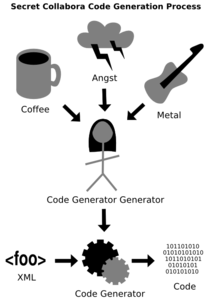
The secret Collabora code-generation process

(credit: daf)

Supporting D-Bus in the GObject world has always involved quite a lot of code generation. The core API of dbus-glib is heavily reliant on varargs functions, which aren't type-safe and are easy to get wrong. dbus-glib contains a program called dbus-binding-tool, which is meant to generate reasonably sane GObject APIs for D-Bus objects. Unfortunately, it seems to be intended to generate a whole GObject at a time. Early versions of telepathy-gabble used dbus-binding-tool plus a script called gengobject.py to generate API stubs for the exported objects; developers then filled in the blanks, and hey presto, we had a GObject on D-Bus. This was fine up to a point, but had a couple of major drawbacks. Whenever we changed the D-Bus API (quite common during the early development of Telepathy), there was a very laborious and error-prone merging process. We ended up with the following process:
  • copy the D-Bus introspection XML from the telepathy-spec repository into a directory xml/pristine (actually, the canonical form for the spec was Python for a while, and we had a script that exported a contrived object onto D-Bus and introspected itself to get the XML - but that's another story!)
  • preprocess the introspection XML to add the dbus-glib CFunctionName annotation, resulting in a directory xml/modified
  • run dbus-binding-tool and a Python script gengobject.py to generate C source in xml/src
  • three-way-diff the old version of xml/src, the new version of xml/src, and the real C code in src to create a new version of src
  • pray that the diff process hadn't randomly exchanged functions' implementations
  • update the resulting code in src so it worked
  • check the whole mess back into darcs
  • hope that nobody else had made changes that would result in darcs conflicts
If you haven't yet gathered, this was a bit of a nightmare. Also, it was very easy to return the wrong thing from a method without noticing - because all the APIs were varargs, the compiler didn't notice, and the first we'd know about it was a mysterious segfault under certain circumstances.
How telepathy-glib fixes code generation telepathy-glib improves on this by taking advantage of this innocuous-looking feature in dbus-glib:
commit 355ef78d98d6fc65715845d56232199162cab12a
Author: Steve Fr cinaux <steve istique net>
Date:   Thu Aug 17 11:48:20 2006 +0200
    Interface support for bindings.
Instead of running dbus-binding-tool or creating GObjects with D-Bus interfaces, we put the entire Telepathy spec through glib-ginterface-gen.py, a distant descendant of Gabble's gengobject.py. For each interface in the spec, we generate a GInterface that mirrors the D-Bus interface. Any GObject that implements the GInterface automatically gets the D-Bus interface if it's exported onto D-Bus. There are a few non-obvious refinements, though:
  • The signature of the method implementation is always in the mode that dbus-glib calls "asynchronous", where the method implementation can either send a reply message before or after it returns. For "slow" methods, this is the only thing you can do. For instance, many Telepathy D-Bus methods can't return anything until some TCP round-trips to the server have happened. This is also the only thing you can do if you want to extract extra information, like the sender's unique name, from the method-call message (dbus-glib's "synchronous" API doesn't allow this to be done). For "fast" methods, sending a reply message before returning is just as easy as using the "synchronous" API (it's just a difference of syntax), and has an API consistent with that of the "slow" methods, making it easier for service authors.

  • The layout of the GInterface vtable is private, and (auto-generated) accessor functions are used to fill in implementations. This means our ABI doesn't change just because we re-ordered functions in the spec.

  • If no implementation is provided for a method, we just raise an appropriate error (org.freedesktop.Telepathy.Errors.NotImplemented), rather than suffering an assertion failure. This means we can safely add methods to an interface.

  • While we're generating code anyway, we generate some static inline wrapper functions which wrap dbus_g_method_return(), to have type-safe method returns. You can easily check that a method replies with correct types, by checking that the implementation of Foo() replies by calling tp_svc_some_interface_return_from_foo().

  • Similarly, we generate wrapper functions to emit signals, to get type-safe signal emission.

Not all interfaces are stable enough to be included in telepathy-glib's stable API and ABI, so some of our other projects include a copy of the telepathy-glib code-generation tools, and generate their own "mini-telepathy-glib" (traditionally in a /extensions/ directory) for their implementation-specific (drafts of) interfaces. This isn't yet as polished as it ought to be (mainly because we don't want to freeze the augmented-introspection-XML format that we write the Telepathy spec in, because it's rather ad-hoc and hackish in places) but it works quite well in practice. To see what this looks like in practice, have a look at the examples in telepathy-glib, or at a Telepathy connection manager like telepathy-gabble.
Mixins and base classes Another feature of telepathy-glib which makes life easier for connection manager authors is that it provides "mixins" and base classes which implement some of the GInterfaces. There's absolutely nothing magic about the base classes - they don't have any access to private implementation details of the GInterfaces, they just implement them like everyone else does. The "mixins" are only slightly more magical - they store some extra state inside the structures representing GObjects and their classes, and use it to provide default implementations of some or all of the methods on a particular interface (or two interfaces, in the case of the new TpMessageMixin). I'll leave it up to Rob to explain those in greater detail, since I seem to remember that he invented them :-P The examples and regression tests in telepathy-glib are quite good examples of how these work in practice.

Simon McVittie: Here's how it works

Daf recently described a large part of my job, in diagrammatic form: The secret Collabora code-generation process

(source)

Simon McVittie: A magical xrandr incantation

Here's a handy incantation I use with the Intel X.org graphics driver on my laptop.

Put this script somewhere convenient:

#!/bin/sh
if xrandr   grep '^VGA connected' >/dev/null
then
    #echo "VGA connected"
    xrandr --output VGA --above LVDS --auto
    xrandr --output LVDS --auto
else
    #echo "VGA not connected"
    xrandr --auto
fi 2>&1   logger -t xrandr-hotkey

and bind it to your "switch video mode" key, e.g. Fn+F7 on my Thinkpad X60s. For instance, I run xbindkeys, so I saved it as autoxrandr and put this in ~/xbindkeysrc:

"exec /home/smcv/bin/autoxrandr"
    XF86Display

Now if you press the "switch video mode" key with a monitor plugged in, you'll get the external monitor appearing above the laptop panel (my preferred configuration - I've balanced my monitor on an N800 box to get the bottom of the screen level with the top of my laptop's screen). If you press that key again after unplugging the VGA cable, the laptop will turn off the VGA output and pull all the windows onto the built-in screen.

8 November 2008

Steve McIntyre: 3rd Free Software Congress in Valencia

I spent much of this week in Alicante. It was wonderful to have a few days away from the beginnings of Winter in Cambridge - Alicante's in South West Spain, right on the Mediterranean. It's a lovely city, although it was very quiet due to the time of year. I was invited down to Alicante by organisers of the Congr s de Programari Lliure, Comunitat Valenciana, to present a talk about Debian. That I did, and as always my slides and photos are available in case people are interested. I wasn't too sure about what level to aim the talk, so I deliberately went for a general introduction to Debian. That seems to have been the correct level - nobody threw anything at me, and nobody was visibly falling asleep. *grin* It's also the first time I've ever given a talk with official translators, which is a weird experience! The main topic for the conference was the new release of Lliurex, Valencia's own GNU/Linux distribution targeted primarily at use in schools. The conference was massive; I was told there were about 1500 attendees in all, most of whom were teachers who wanted to come and learn more about Free Software. There was a good spread of talks and workshops, covering topics from development through to deployment in the classroom. The level of enthusiasm for Free Software here was immense - lots of people were keen to learn more about it and get involved. I was told that out of the 15 regions/states of Spain, 11 of them have now started their own distributions to use in schools! Extremadura were the first region to experiment with Free Software like this, and their success with LinEx was a clear inspiration to their neighbours elsewhere in Spain. As well as the obvious cost advantages of moving from proprietary to Free Software, the local governments also love the freedom to use and modify their software however they like - including the ability to provide their own translations. Conference welcome I met up with a lot of cool people at the conference too. The local education minister (Alejandro Font de Mora) was keen to talk with all the speakers and very enthusiastic about the future of Free Software in his schools. As is increasingly common at FS events around the world, there were of course quite a few Debian people around too. Luciano and Miriam were also giving talks, and I bumped into Rene and Miguel and a whole bunch of others whose names I'm too crap to remember - sorry! I also spoke a lot with Kurt Gramlich, the mega-enthusiastic Skolelinux developer who was also happy to push Debian to everybody he spoke to *grin*. Jon "Maddog" Hall had some excellent ideas that I'm sure we'll all hear more about soon, and his talk was excellent. He did a very good job of explaining how Free Software makes such a difference, including how it helps people to make money. He also explained that due to travel he had missed Halloween at home and he wanted to share the experience of scary masks with the people at the conference: Maddog Bush I had a great time in Alicante, and I'm very grateful for the invitation to go there. I wish that the UK was as far as advanced as Spain in the use of Free Software in education - they've done a huge amount of good work in this area and I'm glad we can help them.

7 November 2008

John Goerzen: Wow

People often talk about "memorable moments" -- times where pretty much everybody in the country remembers where they were at that exact time.

There are probably only two of those moments I can remember: the 1989 earthquake during the World Series and the time 9/11 happened. My car was in for service that day, and I was sitting in the lobby of the mechanics watching it on TV.

So now I have a third: watching Barack Obama win the presidency.

We were installing some new blinds in the kitchen while listening to the coverage on NPR, periodically going over to the office to watch the TV coverage on the computer. (Our TV is upstairs right now, so that was more convenient.)

A few minutes before the election was called, I remember Brian Williams saying something like "We're going to go to local stations now, but you better not walk away. We'll have some amazing news at the top of the hour."

We watched that announcement, then saw McCain's speech, and finally Obama's speech (missed the first minute or two of it actually). What an amazing evening.

Then seeing the stories of people celebrating all around the country and around the world: the impromptu party in front of the White House Tuesday night, the small gathering at the Lincoln Memorial Wednesday morning, the Obama parties all around the world. And we watched it on TV in our house while Jacob slept. I feel like I missed out somehow.

6 November 2008

Steve Kemp: It's in your nature to destroy yourselves.

Elections I've said this elsewhere, but it bears repeating:
Anybody who expects a nation to turnaround overnight, due to a changing government, hasn't watched/read enough documentaries.
Television
Who is going to make documentaries when David Attenborough dies?
ObFilm: Terminator 2

Mike Hommey: Emptying a deleted file

Yesterday, at work, we had the typical case where df would say there is (almost) no space left on some device, while du doesn’t see as much data present as you would expect from this situation. This happens when you delete a file that another process has opened (and, obviously, not yet closed). In typical UNIX filesystems, files are actually only entries in a directory, pointing (linking) to the real information about the content, the inode. The inode contains the information about how many such links exist on the filesystem, the link count. When you create a hard link (ln without -s), you create another file entry in some directory, linking to the same inode as the “original” file. You also increase the link count for the inode. Likewise, when removing a file, the entry in the directory is removed (though most of the time, really only skipped, but that’s another story), and the link count decreased. When the link count is zero, usually, the inode is marked as deleted. Except when the usage count is not zero. When a process opens a file, the kernel keeps a usage count for the corresponding inode in memory. When some process is reading from a file, it doesn’t really expect it to disappear suddenly. So, as long as the usage count is not null, even when the link count in the inode is zero, the content is kept on the disk and still takes space on the filesystem. On the other hand, since there is no entry left in any directory linking to the inode, the size for this content can’t be added to du’s total. Back to our problem, the origin was that someone had to free some space on a 1GB filesystem, and thought a good idea would be to delete that 860MB log file that nobody cares about. Except that it didn’t really remove it, but he didn’t really check. Later, the “filesystem full” problem came back at someone else, who came to ask me what files from a small list he could remove. But the files were pretty small, and that wouldn’t have freed enough space. That gave me the feeling that we probably were in this typical case I introduced this post with, which du -sk confirmed: 970MB used on the filesystem according to df, but only 110MB worth of data… Just in case you would need to find the pid of the process having the deleted file still opened, or even better, get access to the file itself, you can use the following command:
find -L /proc/*/fd -type f -links 0
(this works on Linux ; remove -L on recent Solaris ; on other OSes, you can find the pid with lsof) Each path this command returns can be opened and its content accessed with a program, such as cat. That will give access to the deleted content. I already adressed how to re-link such a file, which somehow works under Linux, but in my case, all that mattered was to really remove the file, this time. But we didn’t know if it was safe to stop the process still holding the file, nor how to properly restart it. We were left without a possible resolution, but still needed to come up with something before the filesystem gets really full while waiting to be able to deal with the root of the problem. The first crazy idea I had was to attach a debugger to the process, and use it to close the file descriptor and open a new file instead (I think you can find some examples with google). But there was no debugger installed. So, I had this other crazy idea: would truncate() work on these /proc/$pid/fd files? You know what? It does work. So I bought us some time by running:
perl -e 'truncate("/proc/$pid/fd/$fd", 0);'
(somehow, there is no standard executable to do a truncate(), so I always resort to perl) Afterwards, I also verified the same works under Linux (where you wouldn’t really know what it’d do with these files that are symbolic links to somewhere that doesn’t exist). The even simpler following command works, too.
> /proc/$pid/fd/$fd
It doesn’t truncate() but open() with O_WRONLY O_CREAT O_TRUNC, and close() right after (to simplify), which has the same effect. Good to know, isn’t it?

Eddy Petri&#537;or: Coordinating localization via git

Note: this is quite long and might not be interesting for people not involved with /in either of: debian i18n, debian l10n, git, shell scripting.


For some time now I have been the de-facto coordinator of the Romanian localization team. During this time I was faced multiple times with problems related to motivation of the team members, setting goals for a release, coordination of the changes inside the team, integration of new translators in the team, loosing team members, my lack of time on some occasions and other problems.

I thought a lot about how to improve on those points and I was never satisfied with the answers I got. What I think was the worst problem in the team was the inability to set clear goals, especially during lenny's development cycle.

During sarge's and etch's development cycles we were in an infancy state and setting as the goal to have a fully translated installation process was really enough to keep people motivated. For sarge we missed by a small margin, but the translations were of poor quality, while for etch we worked more on improving the translations.


But during lenny it was bad, really bad. My free time had been shrinking for a while, starting with etch's release, and we were unable to set clear goal, since for etch we managed to have the installation process fully translated and a few other translations. There was no way for us to reach 100% translations during lenny's development cycle, so setting that as a goal was really unrealistic. Percents by themselves don't mean anything for people, and as long as there's no substance to those numbers, there's no motivation to reach for one arbitrary percent.

I tried to set as a goal translating the packages installed by default in a new installation, but that hit the eternal question How do we know easily which are those packages?. This remained sometimes unanswered or got an unsatisfying answer. Also, there was a goal to have correct diacritics for Romanian in lenny, to have aspell-ro that uses the correct diacritics.

I even got to a point that I, myself, lost my motivation and set myself a personal goal of overrunning the level the translations that the language just above Romanian had in the po-debconf l10n statistics (ranking between languages). This was nice way for me to keep myself motivated, but I had my reserves in making this motivation public out of fear of being misinterpreted, because, by a strange coincidence, that next language was Hungarian, and in Romania's history there was some friction between Hungaria and Romania, while there are still some tensions with the Hungarian minority in Romania, in areas where they represent the local majority.

I managed to reach my personal goal, but this wasn't addressing the big picture.


So, sometime around the start of this year I started thinking about ways to coordinate the Romanian localization team in order to have:
For short, a tool that would allow the team to work more efficiently while having the possibility to set clear goals in order to keep people motivated.


So after some pondering, I thought that creating a repository with the translations and the helper tools that would do the funky sync, checks, stats would be the best way to do that. So I started hacking on that somewhere around July-August and I published the result, but without much publicity, since it is still incomplete.

Some of the technical details are still in a haze, but I have a general idea and I got some basic functionality.


Today I decided that I should announce this semi-officially though my blog, maybe I get some input, ideas, or even contributions (I really should write a TODO).


I give you the Debian L10n Romanian coordination repository.

This is a git repository that has some tools to facilitate translation coordination and the translations that are current in the distro for the team.


Can be cloned with:

git clone git://git.debian.org/git/users/eddyp-guest/debian-ro-repo.git

or, if you're behind a restrictive firewall:

git clone http://git.debian.org/git/users/eddyp-guest/debian-ro-repo.git


Currently the work flow for updating a translation is as follows:
  1. source _bin/polibs (. _bin/polibs)
  2. cd foo
  3. po_refresh
  4. complete the translation
  5. po_rearrange "ro.po"
  6. git add "ro.po" && git commit -m "updated translation for foo"
  7. send the translation ("git format-patch origin" and send the patches by mail, or, alternatively, just "git push")


Features:
Planned features:

Problems:

I was hoping that the release notes for lenny would facilitate from this infrastructure, but unfortunately I was lately in a really inactive period wrt Debian.


Questions, suggestions, ideas are welcome.

Next.

Previous.