Search Results: "agi"

9 April 2011

DebConf team: DebConf11: Registrations and Call for Contributions (Posted by Vedran Omeragic)

Registrations for DebConf11 are now open!

Dear guests, attendees and contributors, we are happy to announce that registrations for this year s Conference are now open. The instructions for registration process can be found under Register page. While the basic registrations will not close until the end of the Conference, sponsored registrations however, have the deadline. If you would like to apply for sponsored attendance, then it is imperative that you do it before 8th May! Should you have any further questions regarding registrations, please mail them at registration@debconf.org.

Call for Contributions!

We invite submissions of proposals for papers, presentations, discussion sessions and tutorials for Debconf11. Submissions don t have to be limited to traditional talks, you could propose a performance, art installation, debate, or anything else. Official submissions will be accepted until May 8th 2011, 23:59 UTC. For more information, please visit Call for contributions page.

6 April 2011

Lars Wirzenius: Blackmail as an argumentation technique

Imagine a conversation where some people would like to try to make Debian better, and several people say things like this:
as soon as you make this particular change, I will stop using Debian and all my customers will stop using Debian too
Quite a number of different possible responses pop up in my head immediately. More seriously: should this kind of behavior be acceptable on the Debian mailing lists? Not only is it insulting and anti-social, but trying to influence purely technical decisions by threats is not going to make Debian better.

Jon Dowland: aero

aero snap was one of the launch features of Windows 7 that was quickly copied into other desktop systems (most recently, gnome 3). I've written about it before. Essentially, dragging windows to hot regions of the screen resizes those windows to occupy some area of the screen. To the top: the whole window area (maximize). To the left or right, 50% of the width of the window area, all of the height. This is a pretty useful feature that I wanted to steal for myself. There is a somewhat fragile-looking (but functional) way of achieving this using compiz and some embedded shell scripts which I used for a while, but has several drawbacks: there's no visual indication that resizing will occur; resizing occurs after a time interval and not in response to you releasing the window from its drag; it's therefore very easy to accidentally resize windows (focussing a window adjacent to an edge and parking the mouse pointer in the edge region is sufficient). Aero snap is not without its own shortcomings: whilst having side-by-side windows is great for comparing two documents, you can't arrange two windows top-to-bottom, each occupying half of the vertical height of the screen. This is very useful for working on two spreadsheets. A less interactive but more functional way of achieving this is the grid plugin for compiz and keyboard shortcuts. The grid plugin can be found in the Debian package compiz-fusion-plugins-extra.

3 April 2011

Raphaël Hertzog: March 2011 wrap up

Since I m soliciting donations to support my Debian work, the least I can do is explain what I do. You can thus expect to see an article like this one every month. Multi-Arch work I updated the code to use another layout for the control files stored in /var/lib/dpkg/info/. Instead of using a sub-directory per architecture (arch/package.type), we decided to use package:arch.type but only for packages which are Multi-Arch: same. dpkg is taking care to rename the files the first time it is executed with write rights and then updates /var/lib/dpkg/info/format to remember that the upgrade has been done and that we can rely on the new structure. I filed a few bugs on packages that are improperly accessing those internal files instead of using the appropriate dpkg-query interface. I sent a heads-up mail on -devel to make other people aware of those problems in the hope to discover most of them as early as possible. After that, the work stalled because Guillem went away for 2 weeks and thus stopped his review of my work. I hope he will quickly resume the review and that we will get something final this month. With the arrival of dpkg 1.16.0, it s now possible to start converting libraries to multi-arch even if full multi-arch support has not yet landed in dpkg proper. See http://wiki.debian.org/Multiarch/Bootstrapping for the detailed plan. If you re curious about Multi-Arch, you might want to read this article of Steve Langasek as well. Bug triage for dpkg in launchpad At the start of the month, there was close to 500 bugs reported against the dpkg package in Launchpad. Unfortunately most of it is noise many of the reported bugs are misfiled, they show an upgrade problem of a random package and that upgrade problem confuses update-manager which tries to configure an already configured package. This generates a second error that apport attributes to dpkg and the resulting bug report is thus filed on dpkg. There are literally hundreds of those that have to be reclassified. Michael Vogt and Brian Murray did some triaging, and I also spend quite some hours on this task. It s a bit frustrating as I tend to mark many reports Incomplete because there s no way they can be acted upon and many of them are so old that the reporter is unlikely to be able to provide supplementary information. But in the middle of this noise, there are some useful bug reports, like LP#739179 which enabled me to fix a regression even before it reached Debian Unstable (because Ubuntu runs a snapshot of dpkg with multiarch support). I subscribed to the Launchpad bugs for dpkg via the Debian Package Tracking System (thanks to the derivatives-bugs keyword) and will try to keep up with the incoming reports. Misc dpkg work The ftpmasters came up with a request for a new field (see 619131) in source packages. After a quick discussion and a round of review on debian-policy@l.d.o, I implemented the new Package-List field. This should allow the ftpmasters to save some time in NEW processing, but we deferred the change for the next dpkg version (1.16.1) to ponder a bit more on the design of the field. I also fixed a bunch of bugs (#619541, #605719, #598922, #616096) and merged a patch of Mark Hymers to recognize the new Built-Using field. Developers-reference work The review process for changes to the developers-reference is not working as it should. And I suffered from it while trying to integrate the patch I wrote for the Developer duties chapter (see #548867). We purposely changed the maintainer field from debian-doc to debian-policy in the hope to have more reviews of suggested changes and to seek some sort of consensus before committing anything. But we don t get more reviews and deciding to commit a patch is now even harder than it was (except for trivial stuff where personal opinions can t interfere). In my case, I only got the feedback of Charles Plessy which was very mixed to say the least. I tried to improve my patch based on what he expressed but I also clearly disagreed with some of his assertions and was convinced that my wording was in line with the dominant point of view within Debian. We tried to involve the release team in the discussion because most of what I documented was about helping making stable release happen, but nobody of the team answered. Instead of letting the situation (and my patch) rot, I solicited feedback from the DPL and from another developers-reference editor to see whether my patch was an improvement or not. After some more time, I went ahead and committed it. It was not pleasant for anyone. I don t know how we can improve this. Contrary to the policy, the developers-reference is a document that is not normative, I believe the result is better when we put some soul into it. But it s a real challenge when you seek a consensus and that the interest in reviewing changes is so low. DVD shop listed on debian.org In February, I launched a DVD shop whose benefits are used to fund my Debian work. Shortly after the launch I used the official form to be added to the official listing of Debian CD vendors and offered a few suggestions to deal with vendors who are selling unofficial images (with firmware in my case). A few weeks later, I got no answers: neither for my request nor for my suggestions, I mailed the cdvendors@debian.org team directly asking for a status update and quickly got an answer suggesting that Simon Paillard usually does the work and can t process the backlog due to some injury. At this point no concerns had been raised about adding me to the list. To save some time and some work for the team, I added myself to the list since I had commit rights and I informed them that I did it, so that they can review it. Shortly after I did that, Martin Zobel Helas objected to my addition. I cleared some misunderstandings but the discussion also lead to some changes to please everybody: the listing now indicates that some images are unofficial and I have prepared a special landing page for people coming from the Debian website through this listing. Debian column on OMG! Ubuntu I have always been a firm believer that it s important for Debian to reach out to the widest public with its message of freedom. Thus when Benjamin Humphrey contacted the debian-publicity team to find volunteers to write a Debian column on OMG! Ubuntu, I immediately jumped in. I wrote 4 articles over there. The tone is very different from my articles on my blog and I like that duality. Check out Debian is dying! Oh my word!, Debian or Ubuntu, which is the best place to contribute?, Are you contributing your share? and Ubuntu s CTO reveals DEX: an effort to close the gap with Debian. It s a great win-win situation, OMG! Ubuntu benefits from my articles, Debian s values are relayed further, and OMG! Ubuntu s large audience also helps me develop my own blog. Work on my book I had lots of paperwork to do this month (annual accounting stuff for my company) and I did not have as much time as I hoped for my book. Still I have a updated a few more chapters of my French book and I certainly hope to complete the update during April. This means that the work on the English translation could start in may. Work on my blog Just like for my book, it has been relatively difficult for me to cope with my policy of two articles every week. But I still managed to get quite some good stuff out. I interviewed Christian Perrier (Debian s translation coordinator) and also Bdale Garbee (chair of Debian s technical committee). I finished my series of Debian Cleanup Tips with 2 supplementary articles: The removal of firmware is causing troubles to quite some users so I wrote an article explaining how to deal with the problem. A regular reader also asked me to write an article about Jigdo, I executed myself because it was a good idea and that he has been very nice with me: Download ISO images of Debian CD/DVD at light speed with Jigdo. Last but not least, I shared my package maintainer pledge which inspired my developers-reference patch (see discussion above). Thanks Many thanks to all the people who showed their appreciation of my work. The 324.37 EUR that you gave me in February represented 2 days and a half of my time that I have spent working on the above projects. See you next month for a new summary of my activities.

2 comments Liked this article? Click here. My blog is Flattr-enabled.

1 April 2011

Josselin Mouette: GNOME.Asia distribution collaboration session

Today we gathered the representatives of different distributions that are present at GNOME.Asia to discuss what GNOME could do to improve its support for distributions that distribute it, especially in matters of long-term support. It is kind of sad that there weren t any representatives from Canonical nor Red Hat, but the discussion turned out really interesting and we learned a lot about the packaging habits of each other. Furthermore, there were several concrete leads that were explored, which will lead to proposals from the GNOME foundation to all distributions. Helping with long-term support The most widespread GNOME version in the LTS releases that happened recently is 2.30, which is used by Debian squeeze, Ubuntu LTS 10.04, RHEL 6, and Solaris 11. It looks like an accident, but on the other hand: In the future, a decision to use a common GNOME release could, anyway, only come from the distributions themselves, not from GNOME. A proposal that many people agreed upon was to give distribution maintainers commit access to old branches that GNOME module maintainers don t touch anymore. This way they could share their patches more easily and make new releases of these old branches. This would imply, of course, setting up rules about what changes are allowed, that distributions would have to agree upon (how to treat feature additions for example). Managing bugs Currently it is hard to tell, for a distributor, whether other distributions are affected too and whether they have released a fix for that. It was agreed upon that Launchpad s feature of linking bugs between distributions, including version tracking, would exactly fill that need. One of the solutions would then be to add such a feature to Bugzilla, but it is a lot of work since currently it doesn t have any kind of version tracking. Another proposal was to deploy a new Launchpad instance to do serve as a hub between downstream bug systems and the GNOME Bugzilla. The condition for this to work would be to make it extremely easy to clone bugs between it and Bugzilla, and also if possible from the downstream bug systems. On the side-related topic of how not to crawl under bugs, it might be possible to get bugs forwarded with a single command from the Debian BTS to Bugzilla, using the XML-RPC interface. Upstream also considers that bugs sent to Debian are generally of higher quality than those from e.g. Ubuntu, and would be OK with us routing some of them directly to upstream (like we already do for Evolution). Communicating about the availability of patches Currently distributors are hardly ever informed that patches relevant for their distribution have been committed. They often learn of them by sheer luck while lurking on Bugzilla. The distributors-list ML is clearly the relevant media for that purpose, but it is clearly not used enough. It would need to be advertised more among both GNOME module maintainers, and among downstream maintainers as well. On this matter, the disappearance of the x.y.3 GNOME releases (starting with 2.28) was evoked. The problem was that most of those releases were about insufficient changes to justify e.g. stable updates in distributions. The proposed solution is to encourage maintainers of modules with bugs to fix to release new versions (through an annoucement on desktop-devel-announce), and to send a list of modules with new versions to downstream distributors so that they can integrate them. This avoids the GNOME release team the hassle of making a new release, while still giving distributions that use them some bugfixes. Providing a new service to LTS distributions The idea of having the GNOME foundation employ a person to gather, on the GNOME side, all changes that are relevant to older GNOME versions, and prepare new stable versions, was discussed. This would be a new service for which commercial distributions would need to pay a fee. It s not clear how this information would be privately disclosed and the impact on non-commercial distributions. But it doesn t seem likely that e.g. Red Hat would be interested since they employ a lot of core GNOME hackers who are already doing this job.
I don t know what impact these proposals can have on GNOME packaging in Debian, but apart from the last one that I find dubious, it seems that they could greatly improve our support of GNOME in stable Debian releases, be it by having more versions to upload during the freeze, or by having more stuff in point releases. Fr d ric Muller promised to come back to us with more concrete stuff.

Josselin Mouette: GNOME.Asia 2011 hackfest

For the whole week, I ve been in Bangalore for the GNOME.Asia 2011 hackfest. I ve been delegated by Stefano to represent Debian here, and my employer EDF has agreed to cover for travel costs since they are very interested in first-hand information the future of the Linux desktop and sharing our work on scientific computing. It s been a really exciting week; I ve spent quite some time packaging missing pieces of GNOME 3.0 (well, the release candidate versions of course) in experimental, together with Fred Peters. I think it s reaching a usable state now, so we ll probably soon provide metapackages to make it easily installable. The latest developments of the Shell make it a very exciting piece of software, with a strong focus on usability. Many things were written about it, but in the end my main criticism would be that it lacks some functionality - for example, the combined clock/weather/locations applet will be greatly missed. The good news is that it is extremely customizable, and with all the libraries being made accessible through GObject introspection, there are many features that are accessible from it. If you know how to write JavaScript, now is the time to write your favorite extension. On the good news front, Vincent Untz also spent a lot of time improving the so-called legacy mode , which is more and more starting to look like the Shell without special effects, and with all the features from gnome-panel 2.x that are still here. We will try in Debian to cover all uses cases that there were for GNOME 2 with GNOME 3 technology, so that panel lovers are not left behind. I ve also proposed an update to the dh_gsettings proposal, which will provide the same functionality as dh_gconf and allow to easily set distribution-specific overrides. It is still missing a way to set mandatory settings, which might come as a problem for some corporate users, but this is planned for a future version of GSettings. Today, we re having a business track where I and representatives of other companies (Oracle, Lanedo, Dexxa) are sharing experiences about making money with free software. Unfortunately the local organizers didn t manage to gather many people, despite our being in a city with an incredible number of IT industries. Tomorrow, the public conference starts, and this should be the opposite: we re expecting around 1000 people, which is a great achievement for a free software conference. For an unrelated topic, being around so many GNOME hackers has some interesting side effects; I ve been added to Planet GNOME. So, hey, hello Planet GNOME readers!

31 March 2011

Jordi Mallach: A tale of Trist nia and its Quadrennial Royal Ball

In one of the corners of what is now know as Europa, there was a rich, prosperous and beautiful kingdom known as Trist nia. In the past, not that long ago, it had been a number of smaller kingdoms and caliphates, all with their own cultures, religions and ways of life. Wars, and series of marriages of convenience eventually configured what ended up being the united kingdom of Trist nia. Throughout the years, some of the unified cultures grew and flourished, while others struggled to survive in their ever-shrinking areas of influence. A required introduction Sometimes, the minor cultures would suffer due to oppression coming from the delegates of the King, who would ban any expression of these cultures, as they were seen as a potential threat to the kingdom's stability and unity. For example, just a few decades before the main subject of this tale, the predecessor of the incumbent King took power by force, after crushing everyone who opposed his uprise during a bloody and hard civil war. His reign was ruthless and he imposed draconian laws uppon his people: usage and teaching of the minor languages was banned, and everyone was forced to use the language of the Centr lia region, in public or private. After four decades, the majority of the Tristanian people were sick enough of the situation to consider standing against their fear of the regime and demand freedom, but repression prevailed until the old general died. His place was taken by the King's grandson even if the people had expressed, just before the Great War, that they had had enough kings and demanded a ruler they could choose directly. Of course, the new King seemed a lot nicer than who they had been suffering for ages, so when asked if they accepted the new situation, an overwhelming majority said yes . However, there was a region, Verd lia, where the majority said no . Things were actually more complicated. Verdalians formed a traditional, proud society, and while the years of oppression had undoubtedly weakened it, they had managed to preserve their very unique culture, language and traditions healthy. The Verdal language was really weird to the ears of Centr lians and even other minor cultures of the Kingdom, and erudites struggled to find its real origins, not being able to reach plausible conclusions. Verdanians, as we already know, were a traditional society, living in a land of deep and poorly connected valleys. Little they knew or cared about the complicated matters of Centr lia and other regions. What made them happy was to take care their sheep and cows, keep a good fire in their living room and, every now and then, enjoy one of their log cutting contests. The impositions of the former dictator were too much for them, and some of them started sabotaging, assaulting and killing some of the dictator's soldiers, agents and officers. This was a huge risk at the time; getting caught meant death penalty for sure, and at first, even people from other regions were in favour of these actions. However, this popular support greatly diminished when the new King took the throne, as these minority continued with the killings, while most of the people saw it was no longer justified. The Royal Ball One of the very first measures the young King introduced was to organise the Royal Ball of Trist nia , a major event through which the people of the different regions would be able to elect their delegates to the Crown. Every four years, a Great Ball contest would happen in Centr lia, and the winners would be able to decide by their own on some of the matters that affected their region. Verdanians would send a few teams of dancers, each of which came from different towns or areas. Some Verdanian teams were happy about the King and the new political situation, but other teams weren't so much. And some others, while being simple non-violent dancers, were known to be supporters of the violent minority who kept on harassing, assaulting and even killing in their struggle for freedom of Verd nia . The Verdanian groups aligned with the different culture of Verd nia (including those who were said to support the violent) tended to get a lot more points in the dancing contest, and a majority of the elected delegates were appointed by them, making it easier to pass laws and edicts that favoured protection of their ways, traditions and language. No matter how hard they tried, the dancing groups closer to Centr lia kept losing to the majority. After many years of dance contests, these groups used their closeness to the King's court to pass the Ball Law of Tristanian, that would ban any dancing group which didn't condemn the assaults and killings that kept happening in Verd nia. The unsurprising result was that, with less dancing groups participating in the following Royal Ball, the Verdanian majority was broken and new delegates, friendly of the Centralian officers, were elected. Many people who had been in favour of assaults and killings began to question this strategy, and this political movement's unity started to break. In the end, the dancers decided to part ways with the violent; they wanted to dance in the next ball, and to do so, they wrote a letter to the King, in which they explicitly expressed their rejection of violent ways, and their embracing of dancing as the only means to drive their political agenda. An objective reading of the new Ball Law clearly showed that this was enough: the text only said the requisite for a dancing group was to disavow all kinds of violence. This wasn't really expected in Centr lia, so they started to add new requirements in an attempt to keep this group from the contest: their decisive majority in Verd nia was at stake. The Royal Ball was nearing and registrations for the contest would soon close. The Centralian government first argued that the dancing group should reject the violence coming from the Verdanian extremists in particular. The dancers did it. Then they argued that the dancers were the same people who had been supporting violence in Verd nia for years, and obviously their violence rejection statement was a lie. The dancers struggled to find new dancers who had not been involved in past dances. But it was not enough. They then claimed that this dance group should be quarantined for four years, until they could prove they really were serious about their new non-violent ideas. The dance group made a plea to the Trist nian Supreme Counsel, a group of sixteen experts in law of the Kingdom, and argued that all of these draconian requirements were not part of the law that was being enforced by the King. Their appeal to the elder counselors was in vain, though. They ruled this dancing group was as criminal as the violent minority they had once supported, and should by no means take part in the Royal Ball. As a last, desperate measure, the dancing group reached an agreement with other Verdanian dancers to join forces. They would adopt a new name and new dancing costume colours. Many feared this would only end up in the ban of the other dancing group. Unfortunately, the end of this story has not been written yet, but it will be completed very soon. Only time will tell if things continue being very sad and unfair in Trist nia, or if the dance contest will once again be impartial, with legitimate results.

Pau Garcia i Quiles: A wish a day 7: make emerge a generic package manager for Windows

A while ago I said Koen from Emweb made an interesting proposal at FOSDEM about emerge, the KDE Windows build tool. Yesterday, Jaros aw Staniek and I reaffirmed our commitment to emerge . Today, I d like to go a bit further: let s bring more developers to emerge by opening it up to other projects. Keep reading! What is emerge, why is it important and what was Koen s proposal? Fact: Microsoft Windows is very different to Unix in regards to development. On Unix platforms -that includes Linux and Mac OS X-, software is usually installed to /usr: applications in /usr/bin and /usr/sbin, libraries in /usr/lib, headers in /usr/include, common resources in /usr/share, etc. Also, dependency management is usually something you can count on: when you install kdelibs5-dev in Ubuntu, it will automatically install libqt4-dev, kdelibs5-data, libfreetype (runtime), etc That makes setting up a development environment a very easy task: look for shared libraries, header files, etc in the common places and you will probably find them. On Windows there is nothing like that. When you want to compile an application, you need to provide (build and install) all its dependencies, and you need to tell Visual Studio where to find everything. Even CMake usually needs some help in the form of a hint for CMAKE_PREFIX_PATH. As you may imagine, building KDE, which has more than 200 third party dependencies and tens of modules (and with the move + split to git, many more) becomes an almost insurmountable task. Emerge to the rescue: inspired by Gentoo s emerge, Ralf Habacker, Christian Ehrlicher, Patrick Spendrin and others (yours faithfully included) developed a tool which downloads the source, configures, builds, installs and packages KDE and its dependencies. It makes a world of difference when building KDE. Actually, it makes building KDE on Windows possible. Once more: thank you very much guys, impressive tool. There are two well-differentiated parts in emerge, the engine and the recipes . The engine takes care of downloading the sources (tarballs, checkouts from Subversion and git clones, etc) , configuring and building for the usual build systems (QMake, CMake, NMake makefiles, etc), installing, bundling packages together and much more. All that for four compilers (MSVC2008, MSVC2010, MinGW32 and MinGW-W64). It s the equivalent to Gentoo s emerge, Debian s dpkg + debhelper/cdbs or Homebrew and MacPorts for Macintosh. The recipes are the package-specific instructions a particular piece of software needs to build: what s the name of the tarball? URL to download from? What versions are available? What build system to use to configure and build? Does it need any Windows-specific patch? They are written in Python using some helper modules emerge provides (the debhelper-like part I mentioned above). Currently, there are about 70 recipes in emerge, organized in our portage tree (bear in mind the names are taken from Gentoo but the internals of the tool are completely different). With those 70 recipes, we are able to build most KDE modules. Problem is to provide all the optional features, we are missing probably 200 to 250 more recipes. Given that KDE on Windows is quite short on developers, we have to decide: either we fix bugs and improve the integration of KDE on Windows, or we keep track of the dependencies. I won t lie: for KDE on Windows, I d rather focus on development than on packaging. Given that writing and maintaining recipes does not strictly require programming skills (although they help :-) ), during my talk at FOSDEM I kept asking people to join the KDE on Windows team as packagers, even if you know little to nothing about software development. If you think about it, that s what we have in Linux distributions: there are hundreds (thousands?) of packagers in Debian, Fedora, openSuse, etc which take care of the recipes to build software developed by someone else ( upstream , in the parlance). What we have in KDE on Windows, where we are the KDE packagers, the KDE developers (upstream) and the emerge developers, is actually an anomaly. Then Koen took the microphone and said: why don t you open emerge to other projects? And I there I realized he was damn right We have developed an awesome tool to download, configure, build, package and install third party software on Windows, to manage dependencies, to update, etc. For four compilers, no less. The engine of emerge is not really tied to KDE. We already have a lot of recipes for software which is not KDE specific: openssl, Qt, bzip2, libpng, mysql, etc. I see no actual reason to disallow Gnome, GStreamer, OpenSceneGraph, LibreOffice and many others in (assuming someone wants to take care of them, of course no, do not look at me! I don t have time!). Currently, the only barrier preventing those recipes in is emerge is developed in the KDE repository and you need a KDE developer account to commit your recipes. That s about it. There is also a perception problem: if emerge is developed in KDE, it s because it s a KDE-thingy, right? . Well, no. One way to avoid that would be to graduate emerge from KDE and make it an independent project, one in which the current developers have accounts, and new developers get an emerge project account instead of a KDE account to commit recipes. Please note graduating does not mean expelling , firing or anything peyorative. It does not mean that emerge developers (engine and recipes) are worse than KDE developers, or less KDE developers than our god David Faure: in KDE, we consider Debian, Fedora, openSuse, etc KDE packagers as equals, they are also KDE developers and many of them are in the KDE eV (funny thing is I am not). My wish for today: think of one application or library you d like to see in Windows and become its maintainer in emerge for Windows. For now, let s do this in the kde-windows mailing list and if this idea succeeds, then we ll talk about graduating. You could also try to add support for a new compiler (OpenWatcom, Intel C++, etc) but that s a lot more more and it s not a priority now. PS: Yes, I know about CoApp, Microsoft s similar effort, with some magic involved. I ve been watching and trying it since day 1. I m really interested. It s just not there yet and I do not have spare time to help Garrett (hey Microsoft, hire me and I ll have all the time in the world! :-) )

Russell Coker: Links March 2011

Cory Doctorow wrote an interesting article for The Guardian about Harper-Collins attempts to make self-destructing books [1]. They claim that a traditional book falls apart after being read 26 times (a claim that Cory disputes based on personal experience working at libraries) and want ebooks to be deleted after being borrowed so often. Really the copy-right fascists are jumping the shark here.Socialogical Images has an interesting archive of adverts for supposed treatments for autism, obsessive-compulsive disorder, asperger syndrome, and attention deficit and hyperactivity disorder [2]. The New York University Child Study Center conducted the campaign of fake ransom notes to describe a psychological difference as something that kidnaps a child. The possibility that parents should to some extent learn to adapt to their child s nature rather than fixing them with medication is something that most people can t seem to understand.William Cronon has written an interesting analysis of the way Conservative , lobby groups work [3]. They are more organised than I expected.The Reid Report has a good summary of some of the corporat issues related to the Japanese nuclear melt-down [4], apparently the company that runs the reactors decided to delay using sea-water in the hope that their investment could be salvaged and thus put everyone at increased risk. I think that this proves that reactors shouldn t be privately owned.Ian Lowe wrote a good summary of the reasons why Australia should not be using nuclear power when we believed that the Fukushima disaster was over [5]. But it turns out that the Fukushima problems were worse than we thought and the melt-down is getting worse.Christopher Smart wrote a good analysis of Microsoft s latest attempt to extort money from Linux users where they assert patent claims over Android [6]. He points out that .NET/Mono is a risk to Linux.Major Keary wrote a positive review of Snip Burn Solder Shred which is a book about Seriously geeky stuff to make with your kids [7]. Sounds like a fun book.The internal network of RSA has been cracked in some way that apparently weakens the security of SecureID, Bruce Schneier s blog comments section has an interesting discussion of the possibilities [8]. I expect that it s a fairly bad attack, if the attack was minor then surely the RSA people would have told us all the details.Hans Rosling gave an interesting TED talk about The Magic Washing Machine [9]. He describes how his family benefited when his mother first got a washing machine and how this resulted in better education as his mother had more time to get library books for her children. It seems that deploying more electric washing machines should be a priority for improving education and food supplies in third-world countries.Paul Root Wolpe gave an interesting and disturbing TED talk about bio-engineering [10]. He catalogues the various engineered animals and talks about the potential for future developments.Ron Rosenbaum wrote an interesting and insightful article for Slate about Maj. Harold Hering who s military career ended after he asked how to determine whether a nuclear launch order is lawful, legitimate, and comes from a sane president [11]. The question never received a good answer, this is a good reason for moving towards nuclear disarmament and for Americans to vote for the sanest and most intelligent candidate in the presidential elections.Eythor Bender gave an inspiring TED talk about human exoskeletons [12]. He had live demonstrations on stage of a soldier using an exo-skeleton to carry a heavy backpack and a woman who suffered a severe spinal-cord injury walking after being in a wheel-chair for 19 years.

27 March 2011

Jonathan Wiltshire: A little civil disobedience

For many months I ve wondered what would happen if one completed half a census return online and half on paper. Tonight, finally, I get to find out. (for international readers: it s the night of the U.K. census, which with a little imagination has the potential for all sorts of fun.)
Comments
A little civil disobedience is a post from: jwiltshire.org.uk Flattr

26 March 2011

Thorsten Glaser: Various joys

I m online again. (In case you didn t notice, duh ) Seems as if we (the Telco/ISP guy and me) just needed to look at it hard enough for it to go away first he could dial in, using my account data, which I probably should change now, then herc with ppp(8) and pppoe(8) was working (although at about 50 KiB/s down, he showed me 508 KiB/s a rate I had never achieved with his WiXP), then I took my notebook, which worked with pppoe(4). Now herc s working again. (Maybe altq(9) can explain the slowdown? Hm, from debian.netcologne.de I get 500 so it looks okay.)
But eurynome isn t, oh the joy. Luckily, gecko2 who administers its host system just woke up. Things we do want to see: the Telco/ISP guy accepting that I run MirBSD on a P-233MMX box with Hercules graphics card and a 9 monitor with no comment other than considering its age (and that it usually runs 24/7) as partial cause for the bug. Thanks, Netcologne! Things we don t want to see:
Mar 26 10:40:02 blau /bsd: signal 11 received by (screen:16857) UID(2999) EUID(2999), parent (screen:19111) UID(2999) EUID(2999)
Suddenly the Dungeon collapses!! - You die... (luckily, I get it about once a year only) ObCoffeeSpices: Marrakech (Cumin, Allspice, Cumin Aroma) though, due to its relative strength compared to the others, the only coffee spice I have left. And another hint: pre-warming the coffee cup with hot water, so it doesn t cool down too fast with the amounts of milk I put in, rocks. I just wore the Squeeze Release (FOSDEM, Spacefun) T-Shirt to the bakery and got asked by a neighbour: Oh, a Debian fan? Developer, even now imagine the typical informed interested guy talk for a conference booth of your OS of choice here. How proud he was to get his wife and himself Windows -free at home; how he likes to tinker a bit (if he s got any time left), which has become harder with Windows; how his time constraints have him at OpenSuSE currently but asked how squeeze is; and the usual complaints at places like $ork where they have to use Windows and MSIE (apparently you can t centrally manage Firefox, eh, good someone tells me, because that s what we do ). Wow. Anyway, it s spring, so people, wear your shirts. (Hrm, what do I make of the fact that this is my only Debian shirt although I m thinking how to get Tartan Trousers if money were no issue and nobody had ever commented on my various BSD, FOSDEM, FrOSCon, etc. wear )

25 March 2011

Dirk Eddelbuettel: R inside Qt: A simple RInside application

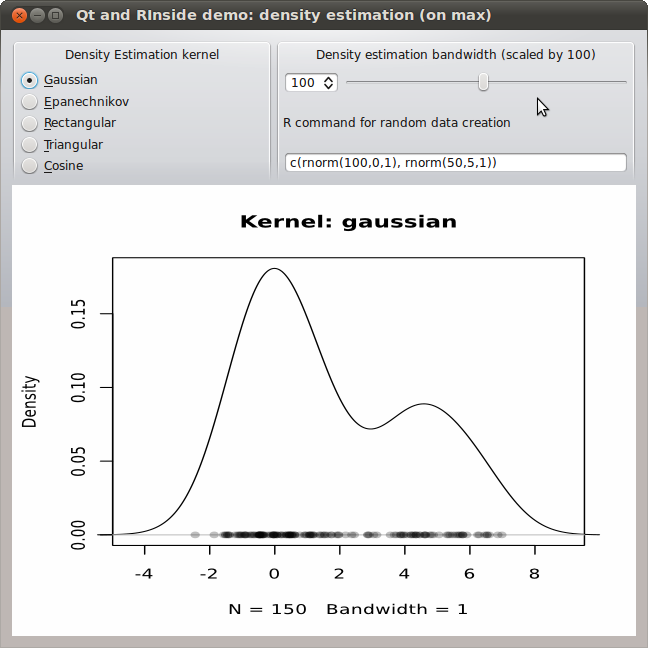
The RInside package makes it pretty simple and straightforward to embed R, the wonderful statistical programming environment and language, inside of a C++ application. This uses both the robust embedding API provided by R itself, and the higher-level abstractions from our Rcpp package. A number of examples are shown on this blog both here and here as well as on the RInside page; and the source package actually contains well over a dozen complete examples which cover anything from simple examples to parallel use via MPI for parallel computing. Beginning users sometimes ask about how to use RInside inside larger projects. And as I had meant to experiment with embedding inside of the powerful Qt framework anyway, I started to dabble a little. A first result is now in the SVN sources of RInside. My starting point was the classic tkdensity demo that comes with R itself. It is a good point of departure as Tcl/Tk makes it very portable---in fact it should run on every platform that runs R---and quite expressive. And having followed some of the GUI experiments around R over the years, I have also seen various re-implementations using different GUI frameworks. And so I am adding mine to this body of work: Example of embedding R via RInside into a Qt C++ application: density estimation for a mixture The problem I addressed first was actual buildability. For the RInside examples, Romain and I provide a Makefile that just works by making calls to R itself to learn about flags for R, Rcpp and RInside such that all required headers and libraries are found. That is actually relatively straightforward (and documented in our vignettes) but a little intimidating at first---which is why a ready-made Makefile is a good thing. Qt of course uses qmake and the .pro files to encode / resolve dependencies. So task one was to map what our Makefile does into its variables. Turns out that wasn't all that hard:
## -*- mode: Makefile; c-indent-level: 4; c-basic-offset: 4;  tab-width: 8; -*-
##
## Qt usage example for RInside, inspired by the standard 'density
## sliders' example for other GUI toolkits
##
## Copyright (C) 2011  Dirk Eddelbuettel and Romain Francois
TEMPLATE =              app
HEADERS =               qtdensity.h 
SOURCES =               qtdensity.cpp main.cpp
QT +=                   svg
## comment this out if you need a different version of R, 
## and set set R_HOME accordingly as an environment variable
R_HOME =                $$system(R RHOME)
## include headers and libraries for R 
RCPPFLAGS =             $$system($$R_HOME/bin/R CMD config --cppflags)
RLDFLAGS =              $$system($$R_HOME/bin/R CMD config --ldflags)
RBLAS =                 $$system($$R_HOME/bin/R CMD config BLAS_LIBS)
RLAPACK =               $$system($$R_HOME/bin/R CMD config LAPACK_LIBS)
## if you need to set an rpath to R itself, also uncomment
#RRPATH =               -Wl,-rpath,$$R_HOME/lib
## include headers and libraries for Rcpp interface classes
RCPPINCL =              $$system($$R_HOME/bin/Rscript -e \'Rcpp:::CxxFlags\(\)\')
RCPPLIBS =              $$system($$R_HOME/bin/Rscript -e \'Rcpp:::LdFlags\(\)\')
## for some reason when building with Qt we get this each time
## so we turn unused parameter warnings off
RCPPWARNING =           -Wno-unused-parameter 
## include headers and libraries for RInside embedding classes
RINSIDEINCL =           $$system($$R_HOME/bin/Rscript -e \'RInside:::CxxFlags\(\)\')
RINSIDELIBS =           $$system($$R_HOME/bin/Rscript -e \'RInside:::LdFlags\(\)\')
## compiler etc settings used in default make rules
QMAKE_CXXFLAGS +=       $$RCPPWARNING $$RCPPFLAGS $$RCPPINCL $$RINSIDEINCL
QMAKE_LFLAGS +=         $$RLDFLAGS $$RBLAS $$RLAPACK $$RCPPLIBS $$RINSIDELIBS
## addition clean targets
QMAKE_CLEAN +=          qtdensity Makefile
The double dollar signs and escaping of parentheses are a little tedious, but hey it works and expands the compiler and linker flags such that everything <emjust works="Works">. The code itself is pretty straightforward too. We instantiate the RInside object as well as the main Qt application object. We then instantiate a new object of class QtDensity that will launch the main widget; it is given a reference to the RInside object.
// -*- mode: C++; c-indent-level: 4; c-basic-offset: 4;  tab-width: 8; -*-
//
// Qt usage example for RInside, inspired by the standard 'density
// sliders' example for other GUI toolkits
//
// Copyright (C) 2011  Dirk Eddelbuettel and Romain Francois
#include <QApplication>
#include "qtdensity.h"
int main(int argc, char *argv[])
 
    RInside R(argc, argv);  		// create an embedded R instance
    QApplication app(argc, argv);
    QtDensity qtdensity(R);
    return app.exec();
 
The definition of the main object is pretty simple: a few private variables, and a few functions to interact with the GUI and get values from the radio buttons, slider or input field---as well as functions to update the chart or re-draw the random variables.
// -*- mode: C++; c-indent-level: 4; c-basic-offset: 4;  tab-width: 8; -*-
//
// Qt usage example for RInside, inspired by the standard 'density
// sliders' example for other GUI toolkits
//
// Copyright (C) 2011  Dirk Eddelbuettel and Romain Francois
#ifndef QTDENSITY_H
#define QTDENSITY_H
#include <RInside.h>
#include <QMainWindow>
#include <QHBoxLayout>
#include <QSlider>
#include <QSpinBox>
#include <QLabel>
#include <QTemporaryFile>
#include <QSvgWidget>
class QtDensity : public QMainWindow
 
    Q_OBJECT
public:
    QtDensity(RInside & R);
private slots:
    void getBandwidth(int bw);
    void getKernel(int kernel);
    void getRandomDataCmd(QString txt);
    void runRandomDataCmd(void);
private:
    void setupDisplay(void);    // standard GUI boilderplate of arranging things
    void plot(void);            // run a density plot in R and update the
    void filterFile(void);      // modify the richer SVG produced by R
    QSvgWidget *m_svg;          // the SVG device
    RInside & m_R;              // reference to the R instance passed to constructor
    QString m_tempfile;         // name of file used by R for plots
    QString m_svgfile;          // another temp file, this time from Qt
    int m_bw, m_kernel;         // parameters used to estimate the density
    QString m_cmd;              // random draw command string
 ;
#endif
Lastly, no big magic in the code either (apart from the standard magic provided by RInside). A bit of standard GUI layouting, and then some functions to pick values from the inputs as well as to compute / update the output. One issue is worth mentioning. The screenshot and code show the second version of this little application. I built a first one using a standard portable network graphics (png) file. That was fine, but not crisp as png is a pixel format so I went back and experimented with scalable vector graphics (svg) instead. One can create svg output with R in a number of ways, one of which is the cairoDevice package by Michael Lawrence (who also wrote RGtk2 and good chunks of Ggobi). Now, it turns out that Qt displays the so-called SVG tiny standard whereas R creates a fuller SVG format. Some discussion with Michael reveals that one can modify the svg file suitably (which is what the function filterFile below does) and it all works. Well: almost. There is a bug (and Michael thinks it is the SVG rendering) in which the density estimate does not get clipped to the plotting region.
// -*- mode: C++; c-indent-level: 4; c-basic-offset: 4;  tab-width: 8; -*-
//
// Qt usage example for RInside, inspired by the standard 'density
// sliders' example for other GUI toolkits -- this time with SVG
//
// Copyright (C) 2011  Dirk Eddelbuettel and Romain Francois
#include <QtGui>
#include "qtdensity.h"
QtDensity::QtDensity(RInside & R) : m_R(R)
 
    m_bw = 100;                 // initial bandwidth, will be scaled by 100 so 1.0
    m_kernel = 0;               // initial kernel: gaussian
    m_cmd = "c(rnorm(100,0,1), rnorm(50,5,1))"; // simple mixture
    m_R["bw"] = m_bw;           // pass bandwidth to R, and have R compute a temp.file name
    m_tempfile = QString::fromStdString(Rcpp::as<std::string>(m_R.parseEval("tfile <- tempfile()")));
    m_svgfile = QString::fromStdString(Rcpp::as<std::string>(m_R.parseEval("sfile <- tempfile()")));
    m_R.parseEvalQ("library(cairoDevice)");
    setupDisplay();
 
void QtDensity::setupDisplay(void)   
    QWidget *window = new QWidget;
    window->setWindowTitle("Qt and RInside demo: density estimation");
    QSpinBox *spinBox = new QSpinBox;
    QSlider *slider = new QSlider(Qt::Horizontal);
    spinBox->setRange(5, 200);
    slider->setRange(5, 200);
    QObject::connect(spinBox, SIGNAL(valueChanged(int)), slider, SLOT(setValue(int)));
    QObject::connect(slider, SIGNAL(valueChanged(int)), spinBox, SLOT(setValue(int)));
    spinBox->setValue(m_bw);
    QObject::connect(spinBox, SIGNAL(valueChanged(int)), this, SLOT(getBandwidth(int)));
    QLabel *cmdLabel = new QLabel("R command for random data creation");
    QLineEdit *cmdEntry = new QLineEdit(m_cmd);
    QObject::connect(cmdEntry,  SIGNAL(textEdited(QString)), this, SLOT(getRandomDataCmd(QString)));
    QObject::connect(cmdEntry,  SIGNAL(editingFinished()), this, SLOT(runRandomDataCmd()));
    QGroupBox *kernelRadioBox = new QGroupBox("Density Estimation kernel");
    QRadioButton *radio1 = new QRadioButton("&Gaussian");
    QRadioButton *radio2 = new QRadioButton("&Epanechnikov");
    QRadioButton *radio3 = new QRadioButton("&Rectangular");
    QRadioButton *radio4 = new QRadioButton("&Triangular");
    QRadioButton *radio5 = new QRadioButton("&Cosine");
    radio1->setChecked(true);
    QVBoxLayout *vbox = new QVBoxLayout;
    vbox->addWidget(radio1);
    vbox->addWidget(radio2);
    vbox->addWidget(radio3);
    vbox->addWidget(radio4);
    vbox->addWidget(radio5);
    kernelRadioBox->setMinimumSize(260,140);
    kernelRadioBox->setMaximumSize(260,140);
    kernelRadioBox->setSizePolicy(QSizePolicy::Fixed, QSizePolicy::Fixed);
    kernelRadioBox->setLayout(vbox);
    QButtonGroup *kernelGroup = new QButtonGroup;
    kernelGroup->addButton(radio1, 0);
    kernelGroup->addButton(radio2, 1);
    kernelGroup->addButton(radio3, 2);
    kernelGroup->addButton(radio4, 3);
    kernelGroup->addButton(radio5, 4);
    QObject::connect(kernelGroup, SIGNAL(buttonClicked(int)), this, SLOT(getKernel(int)));
    m_svg = new QSvgWidget();
    runRandomDataCmd();         // also calls plot()
    QGroupBox *estimationBox = new QGroupBox("Density estimation bandwidth (scaled by 100)");
    QHBoxLayout *spinners = new QHBoxLayout;
    spinners->addWidget(spinBox);
    spinners->addWidget(slider);
    QVBoxLayout *topright = new QVBoxLayout;
    topright->addLayout(spinners);
    topright->addWidget(cmdLabel);
    topright->addWidget(cmdEntry);
    estimationBox->setMinimumSize(360,140);
    estimationBox->setMaximumSize(360,140);
    estimationBox->setSizePolicy(QSizePolicy::Fixed, QSizePolicy::Fixed);
    estimationBox->setLayout(topright);
    QHBoxLayout *upperlayout = new QHBoxLayout;
    upperlayout->addWidget(kernelRadioBox);
    upperlayout->addWidget(estimationBox);
    QHBoxLayout *svglayout = new QHBoxLayout;
    svglayout->addWidget(m_svg);
    QVBoxLayout *outer = new QVBoxLayout;
    outer->addLayout(upperlayout);
    outer->addLayout(svglayout);
    window->setLayout(outer);
    window->show();
 
void QtDensity::plot(void)  
    const char *kernelstrings[] =   "gaussian", "epanechnikov", "rectangular", "triangular", "cosine"  ;
    m_R["bw"] = m_bw;
    m_R["kernel"] = kernelstrings[m_kernel]; // that passes the string to R
    std::string cmd1 = "Cairo(width=6,height=6,pointsize=10,surface='svg',filename=tfile); "
                       "plot(density(y, bw=bw/100, kernel=kernel), xlim=range(y)+c(-2,2), main=\"Kernel: ";
    std::string cmd2 = "\"); points(y, rep(0, length(y)), pch=16, col=rgb(0,0,0,1/4));  dev.off()";
    std::string cmd = cmd1 + kernelstrings[m_kernel] + cmd2; // stick the selected kernel in the middle
    m_R.parseEvalQ(cmd);
    filterFile();               // we need to simplify the svg file for display by Qt 
    m_svg->load(m_svgfile);
 
void QtDensity::getBandwidth(int bw)  
    if (bw != m_bw)  
        m_bw = bw;
        plot();
     
 
void QtDensity::getKernel(int kernel)  
    if (kernel != m_kernel)  
        m_kernel = kernel;
        plot();
     
 
void QtDensity::getRandomDataCmd(QString txt)  
    m_cmd = txt;
 
void QtDensity::runRandomDataCmd(void)  
    std::string cmd = "y <- " + m_cmd.toStdString();
    m_R.parseEvalQ(cmd);
    plot();                     // after each random draw, update plot with estimate
 
void QtDensity::filterFile()  
    // cairoDevice creates richer SVG than Qt can display
    // but per Michaele Lawrence, a simple trick is to s/symbol/g/ which we do here
    QFile infile(m_tempfile);
    infile.open(QFile::ReadOnly);
    QFile outfile(m_svgfile);
    outfile.open(QFile::WriteOnly   QFile::Truncate);
    
    QTextStream in(&infile);
    QTextStream out(&outfile);
    QRegExp rx1("<symbol"); 
    QRegExp rx2("</symbol");    
    while (!in.atEnd())  
        QString line = in.readLine();
        line.replace(rx1, "<g"); // so '<symbol' becomes '<g ...'
        line.replace(rx2, "</g");// and '</symbol becomes '</g'
        out << line << "\n";
     
    infile.close();
    outfile.close();
 
What the little application does is actually somewhat neat for the few lines. One key features is that the generated data can be specified directly by an R expression which allows for mixtures (as shown, and as is the default). With that it easy to see how many points are needed in the second hump to make the estimate multi-modal, and how much of a distance between both centers is needed and so on. Obviously, the effect of the chosen kernel and bandwidth can also be visualized. And with the chart the being a support vector graphics display, we can resize and scale at will and it still looks crisp. The code (for both the simpler png variant and the svg version shown here) is in the SVN repository for RInside and will be in the next release. Special thanks to Michael Lawrence for patiently working through some svg woes with me over a few emails.

Update: Some typos fixed.

Update 2: Two URLs corrected.

Joey Hess: getting out of cell phone contracts, redux

Exactly a year after I switched from pre to droid, I broke another cell phone contract. So there seem to be three fool-proof ways to get out of a cell phone contract in the US, despite all the hype about them involving signing away your firstborn.
  1. Switch to a different US cell phone company, and do it by going into a store and finding a hungry salesman in person, and making his sale contingent on him finding a way to break your old contract. What I did last year.
  2. Simply move to a part of the map that doesn't have cell phone coverage. (You will have seen these parts of the map from a plane.) It probably helps to have your cell phone drop off the edge of their map repeatedly for some months, presumably they can look this stuff up. Call up technical support, go thru some mild rigamarole as they try to configure your phone to magically see cell towers that have several mountains and/or the curvature of the Earth blocking line of site to you. Magic words: "please note on account: no cell service"
  3. Sell your contract on one of the existing cell contract exchanges, to someone who wants cell service with a shorter than usual contract. (Means giving up your number.) I haven't tried this one, maybe next time?
Unlike my Palm Pre which didn't survive being cut off the cell net, my Android phone is still fairly happy. While I'd really like to turn it into a proper Debian box, with X etc, I may just use it as a camera, web browsing (on wifi) and emergency 911 system. Pity though about the GPS stuff needing an internet connection when the phone has many gigabytes of free space that could hold a useful map. (If you want to phone me now, the number is 1-423-IKIWIKI. I only receive voice mail, and your call data and transcript will be absorbed by the Google Borg.)

24 March 2011

Neil Williams: Qt-embedded [armel] for Emdebian

I'm experimenting with building Qt Embedded for armel using Emdebian toolchains and Debian packaging/patches. Initially, I've just "got it to build" with a few too many things nobbled and disabled - the results (using the package from Squeeze) are in Emdebian SVN - and the next task is to enable the missing bits and get closer to the standard Qt4-X11 binaries. Certain packages will simply not exist, even when finished, but it's been fun working out how to create a qmake.conf to map the Emdebian toolchain to what Qt expects from toolchains like CodeSourcery.

If it continues to work, it may be worth pushing upstream - but it may be better to wait until Multi-Arch supports cross-building, I'd only have to submit a different qmake.conf with updated paths otherwise.

I've also got a basic qmake.conf to help Qt applications cross-build using the Emdebian toolchains. This also needs updating once we finally get Multi-Arch-Cross.

The way I see this working is that the Qt Embedded packages would have to kept entirely separate from the Debian Qt4-X11 binaries from the KDE/Qt team because they use the same package names. That's relatively simple if the embedded packages are kept for cross-building only, either as -armel-cross packages generated by dpkg-cross or (eventually) as Multi-Arch packages. What won't work is having Qt-X11 and Qt-Embedded installed on the same architecture, without using a chroot or similar.

Initially, I hoped to keep the changes small enough that the Debian package could include the tweaks in a conditional part of debian/rules via a DEB_BUILD_OPTION. The current diff is a little too awkward (mainly in the .install files) but that's still worth keeping as a goal.

No warranty, created in the hope it's useful etc. etc., nothing to say it'll build on your system, no support for anything except the Debian armel port and only tested with the Emdebian toolchains from Lenny, not coming to a distribution near you anytime soon, don't blame me if it messes up your entire Qt-X11 installation on your desktop.... yada, yada.

It's just a bit of tinkering really, although it would be more fun if Qt didn't take quite so many hours to build each time I want to test a change....

23 March 2011

Matthew Garrett: HTC are still incredible fuckheads

Update: Despite another email yesterday reasserting the 90-120 days lie, the source code has now landed on HTC's site.

As has been discussed before, HTC have a somewhat "interesting" interpretation of the GPL that allows them to claim they don't need to provide source code until between 90 and 120 days after the release of binaries. It's probably noteworthy that the FSF (who, you know, wrote the license and all) disagree with this interpretation, as do the kernel copyright holders (who, you know, wrote the code that the license covers) I've talked to about it. Anyway, after a pile of screaming and shouting from all sides HTC have tended to release their source code in a timely manner. So things seemed better.

HTC released the Thunderbolt last week and we're back to the 90-120 day song and dance. It's probably worth remembering that by behaving in this way HTC gain a competitive advantage over any vendors who obey the terms of their license - HTC can incorporate improvements made by others without releasing their own until through a significant portion of the lifecycle of their phone.

As far as I'm concerned, every single Thunderbolt sold so far embodies a copyright infringement. Wilfully engaging in copyright infringement for commercial benefit is typically frowned upon by courts, especially if by doing so a foreign company is gaining commercial advantage over a domestic one. If you think Microsoft's patent assault on Android is a problem, just imagine what they could do if they hired one significant Linux kernel developer and used their copyrights to attack the overwhelming majority of Android vendors who fail to comply with the GPL. It probably wouldn't be industry ending (companies would merely have improve their compliance procedures) but it'd do a huge deal of damage in the short term. It's insane for companies to behave this way. Don't reward them by giving them your money.

I'll be talking about this at the Linux Foundation Collaboration Summit next month, along with an update on my study of the compliance of Android tablets. I'm hoping that there'll be further developments after that.

(comment count unavailable Comments Comment on this)

Kumar Appaiah: Review of "Linux Shell Scripting Cookbook"

I have been reading Linux Shell Scripting Cookbook by Sarath Lakshman, published by Packt, for a while. While most people I know learn shell scripts themselves, I was looking to refresh my concepts a little as well as have a reference lying around on the table for fast access. Since I was asked to review it for someone else, I thought I might as well post the review here.First of all, let me remark by saying that shell scripting is something learned more on a need basis than as a tool to solve the main problem. People would seldom write shell scripts as standalone programs (exceptions exist). However, what makes shell scripting invaluable to know is the fact that knowing some tricks can save several minutes, or hours, of work by automating and simplifying certain tasks, generally (but not restricted to) file management and data processing. Linux Shell Scripting Cookbook does go quite far in pursuing this goal, and is appropriate for both beginners who are looking to gain dexterity in shell scripting, as well as intermediate users who wish to polish their skills. The book also can double up as a quick reference, though I would argue that the "Advanced Bash Scripting Guide" would suit that more.At the outset, the author clarifies that the focus will be on Bash. This, people may or may not like, but the fact that bash has become ubiquitous in terms of the available shells on Unix-like systems today, starting out with bash is not a bad thing to do. Besides, learning other shell scripting languages while knowing bash isn't too hard, since the paradigm remains the same.Let's go through the books from the aspects I found most relevant.OrganizationThe book is organized into chapters based more on utility than scripting concepts themselves, although the language aspects are brought onto the reader gradually. For instance, the examples in the first chapter focus more on the basic data elements (variables, arrays, functions etc.) as well as operators (for numbers, files etc.), and all the examples demonstrate simple usage of these concepts, and he further chapters build upon these in a gradual manner.At the same time, if the reader has some familiarity with shell scripting and needs to only refresh or learn a certain concept, he/she needs to just read the relevant chapter. It is not too difficult to grasp the examples of the later chapters, provided some basic shell knowledge is assumed.Content and PresentationA positive trait in the presentation of this book is that it is all based on practical everyday examples which, with minor adaptation, can be used by many for their own daily tasks. For instance, there are several examples which describe searching for and processing files, which, I'd imagine, many users would want to do on a regular basis. Thus, providing realistic examples allows the book to double its utility. The language and approach used is simple and conversational, and the presentation is very clear, with each idea being described as a problem statement followed by a "How to do it" section with the actual code, and ending with a discussion of the nitty-gritties of the code. It is easy to go for a quick scan for those in a hurry, while those who with to read in more detail will not be disappointed either.The book also covers a wide array of applications. For instance, there are examples on automating fetching web pages and processing them, demonstrations of parsing and simplifying and even some queries around databases wrapped around in shell. It also spans to utilities and tasks connected to statistics, backups, compression, version control and many more.Breadth and DepthThe book goes into a fair amount of detail in terms of describing the shell scripting concept under consideration. The examples used go into a fair amount of detail in order to describe to the user all the aspects involved in the method or command being used. The concepts described are fairly complete, and would be sufficient for the reader to use immediately or with just a little bit of fine tuning. In terms of breadth, the book covers most of the features of shell scripting while also describing the various facilities the shell provides access to in a Unix-like environment. Thus, the book does not disappoint in this front either.In summary...In summary, probably the only thing I'd have liked to see more of is some emphasis on how to write more efficient shell scripts. Granted, most of the shell scripts described in the book are very simple and succinct, but a some words on how loops can be made better, or how to spot situations where pipes are not needed to solve a problem etc. might have been a nice addition. Some explanation of differences with dash, tcsh, zsh etc. might also have been nice, since a lot of users have different default shells. But all this isn't going to prevent me from giving this book a high rating, since it delivers quite well on the promises it makes at the beginning.This is definitely a good book to have near your desk, and kudos to the author for having taken the effort to put it together. I would highly recommend it to the beginner and occasional shell user for a thorough read, and to an intermediate to have on his/her desk for borrowing the cool scripting ideas and applications the author has written in this book.

22 March 2011

Axel Beckert: Different Flavours of Planet Commandline

Since there were quite some requests for a Planet Commandline feed without the microblogging feeds included, I splitted Planet Commandline into different flavours. I m quite happy with that solution, because I must admit that the amount of microblogging postings in relation to normal blog postings was indeed higher than initially expected So from now on Planet Commandline has a basic flavour at http://planet-commandline.org/ and one with the microblogging feeds (climagic and commandlinefu) included at http://planet-commandline.org/+snippets/. For making this possible I hacked our Planet Venus wrapper to accept arbitary configuration snippets to be added at the end of the configuration as well as as sed-based modifications to the concatenated configuration before Planet Venus is run on them. This also allowed me to create further flavours of Planet Commandline: I hope nobody minds this diversification of Planet Commandline. Currently no combination of flavours is supported, but if there s a relevant demand for the one or the other combination of flavours I may have a look if that can be automated, too.

Adrian von Bidder: On Bad Lenses

I, and maybe some others, wondered why people would (have to) send new lenses back claiming that they got a bad copy so often. I couldn't imagine quality control being so bad that two out of three (at least that's the impression I got from reading the occasional foto discussion forum) lenses are bad. It turns out that it is not only people needing to be pampered and having the impression that their second (identical) copy of the expensive new lens is better. Nor is it bad QA by the manufacturers alone. Fact is that todays high megapixel cameras are at the limit of the manufacturing precision that can be achieved at a reasonable price. Roger Cicala (LensRentals.com, so he occasionally does have a lens or two at his place) wrote some very interesting articles about this topic which I discovered just now as they were featured on canonrumors (In case you're wondering: No, I don't see any issues with my new 70-200mm, just coincidence that I'm reading this just after getting a new lens. When I upgrade my camera body to something like a 5D MkII I will take a very close look at my Tokina 11-16 though, where I don't trust the AF 100%. On the 10MP Canon 40D it's a great lens, so I'm quite happy for now, but it seems strange that when I release and half-press the shutter again after having focused, the focus will sometimes move a tiny bit again. Haven't noticed this behaviour on the other lenses.)

20 March 2011

Christian Perrier: Current work in Debian

Now that I sent an update about my running activities, I have to report about what I'm doing these weeks in Debian to try keeping a fair balance for those of you who read this blog through Planet Debian. Most January was spent in preparing the release of squeeze. Of course, I didn't work directly on the release, not being involved in the release team. However, last bits of preparation for Debian Installer as well as rushing out the last remaining bits of localization work took most of my time. After the release of squeeze, time came to resume back some activities. First of all, on the l10n front, I resumed the work on "l10n NMUs", trying to get old l10n bugs fixed. I restarted proposing NMUs or, more precisely, help to perform translation updates rounds to these maintainers. Most of them had "old" l10n bugs because of the freeze. So, I indeed did not end up in doing many NMUs...but got several l10n bugs closed anyway. Work being resumed in unstable also lead to many changes in packages' debconf templates (new packages using debconf, packages introducing new templates, etc.). As these are the trigger for Smith reviews (reviews of English in debconf templates and packages' description, this activity, which was very low during the freeze, resumed again (we'll soon celebrate the 4th anniversary of this project). I also decided to invest more time in D-I again. The D-I team is currently more active than it was last years. Thanks to a few individual, work resumed in some areas and bug triaging has been very active. I recently resyned a nice improvement which had been contributed by a user to iso-scan, then polished by Frans Pop. This will allow to choose among several different ISO images when installing Debian from a USB stick while, previously, only the first found was being used. I also worked with a new translator, to prepare the activation of Uyghur translation in D-I. Some work happend in the pkg-fonts team. I had a few fonts adopted by the team, as part of the general effort to get rid of defoma. I sent patches for a few others, but many remain. If you maintain font packages, please help us in getting rid of defoma. Changes are easy to do; ask the team if you need help (pkg-fonts-devel@lists.alioth.debian.org). Samba packages also ate a significant part of my time. First of all, DSA-2175 lead to prepare fixes for samba in squeeze and lenny. Then, upstream released samba 3.5.8 which I uploaded to unstable. I briefly considered trying to get the Stable Release managers approval to push that version in squeeze, but the number of fixes made by upstream was discouraging. So, I chose to examine them slowly and cherry-pick those I consider important enough to warrant an upload for squeeze. More git wizardry learned doing so (thanks to Julien Cristau for his help). And I now have a pending proposal for three of these fixes (that represent 14 atomic patches from upstream) to be included in squeeze.

Christian Perrier: [life] [running] Updates on running plans

The first two months of this year have seen me quite busy preparing for my March-April peak of activity. So, most of these were spent accumulating kilometers, mostly on trail runs with mud, slope, obstacles, etc. January was meant to accumulate kilometers, which succeeded quite well..:-). Not as crazy as November 2010 (close to 300km) but the point was also testing a few long runs, over 25km and up to 32. February saw my first official race, with Bullion half-marathon. This is a nice race which I already ran last year. It features small roads in the Rambouillet Forest. Not the best place to achieve a personal best because the race is not flat, with two hills in the first half. Moreover, I was just recovering from a small flu, so I wasn't really planning to achieve a PB. Still, I managed to do it in 1h39'49", two minutes more than my PB. Moreover, I managed to do it in a small negative split, with first half in 50'38" and second half in 49'11". More encouraging, I ran a 35km solo trail the next week-end after this and completed it fairly well with the pace I plan for the 50km Eco-Trail. Still, that flu introduced some minor perturbation in this preparation and, thus, I included more activity in early March. I was originally planning to run Paris half-marathon on 6th, but an invitation for a friends 50th birthday made me cancel that one. So, most of the first 3 weeks of March were spent in 15-18km style runs, plus running daily to go to and back from work. The last preparation was today with a short 12km run with all equipment needed for Eco-Trail (backpack, 2lit. waterbag) and the targeted pace (10km/h). So, on Saturday, will be the Paris Eco-trail 50km race from Versailles Castle to Eiffel Tower....through woods in the South and South-West neighbourhood, with 1000m positive slope. This will be my first ultra race, so I'm a little bit in a grey area, here. As a consequence, the only ambition is finishing. I expect it to be in aroung 5h30 or so. Most importantly, I have to keep reserves, as, two weeks later, I'll run my yearly Paris marathon. Two long distance races in two weeks...we'll see if I'm crazy or not..:-) Now, I'm heading for a quiet week: grow glucides reserves, eat pasta, do one or two footings...and wait for Saturday! You may want to watch my blog on Sunday to see whether I survived this first stage.

Next.

Previous.


