Search Results: "zack"

9 August 2008

Stefano Zacchiroli: PTS integrated with mentors and gifts

more PTS hacking: mentors.d.n and gift/help bugs Some more PTS hacking at DebConf8. Among about 20 bugs triaged/fixed thus far, 2 are peculiar and integrate some more info in PTS package pages. A minor glitch is currently affecting this though: when pending uploads on mentors.d.n are not uploaded, but rather superseded by new versions in unstable, they are currently not removed automatically from mentors.d.n and will thus show up in the PTS. Apparently this is going to be fixed soon on mentors.d.n, so hopefully this bug won't have time to bother anyone. Bugs (user-)tagged gift on the other hand are a rather new (and thus far neglected) QA feature proposed by Lucas. Packages with gift bugs have now them shown as an extra line in the bug summary box. The idea is to point contributors to PTS pages to discover if some of the packages they are interested in have gifts for them. As an extra gift (pun, intended) I've written for the PTS a tiny Python script to retrieve bug summaries via SOAP. The lookup is via tag, supporting both official tags and usertags. In case it can be useful to someone else, I'm putting it up for download. The PTS is using tagged bugs.py it as follows:
$ tagged_bugs.py "gift" "debian-qa@lists.debian.org" > bugs.gift.txt
$ tagged_bugs.py "help" > bugs.gift.txt

8 August 2008

Stefano Zacchiroli: improved integration among PTS and Lintian

DebConf8 hacks: better PTS/Lintian integration Yesterday nigh hack: better integration of the PTS with Lintian.d.o. Quoting from the filed misc developer news:
=== Lintian and the PTS ===
The integration between lintian and the PTS has been improved. On one hand
now the hyperlink to the Lintian will be shown for a source package only if
Lintian had something "to say" about that package. On the other hand, if
there were warnings or errors in the last Lintian ran, they will be shown as
TODO items in the appropriate part of the PTS web interface.
The display logics is as follows:
 * if there is 1 or more amongst errors and warnings they will be shown as TODO items
 * if there is 1 or more amongst errors, warnings, and information messages, the hyperlink to the Lintian report will be shown

Some more info are available in the bug logs (bug #458329, bug #243729); if you want a sample page have a look at ocaml, but I'm pretty sure that most random package pages will show at least 1 lintian warning in need of your love :-)

6 August 2008

Stefano Zacchiroli: yay from debcamp8

DebCamp8, shakiness, planes, python-debian Well, not unexpected news, but since I've been rather quite lately it is worth reminding that I'm now at DebConf8, enjoying the DebCamp. I've arrived today after a quite long trip made of unexpected extra plane stops in Madrid (thanks Iberia for not declaring it and letting me ponder about how can it possibly take 16 hours from Barcelona to Buenos Aires, now I know the reason ...) and shaky bus hours. First tiny teeny achievement of DebCamp (among a handful of beers already) is an upload of python-debian 0.1.11, implementing among other things support for parsed dependencies and a major overhaul changelog parsing (thanks to James Westby). Unfortunately we are going to miss Lenny with this release, but after all it is a package mostly meant for Debian Developers, so it is probably not a big deal.

22 July 2008

Stefano Zacchiroli: reminder: Homepage pseudo fields are GONE

go fix your ancient Homepage pseudo-fields, you lazy maintainer! ... or I'll kill a kitten for each homepage URL I found in long package descriptions. Homepage pseudo-fields are gone since long, the proper way to document upstream homepage is now to use a real Homepage field in the source stanza of debian/control. Still, as a page of mine has been documenting, we still have more than 1100 packages (dd-list) which are using the old pseudo-field which clutters the long description, is often badly rendered, and stays in the way of who works on long descriptions (e.g. translators). The transition from the old pseudo-field to the new field is being monitored on our wiki. Please, pretty please, take some time to convert your old pseudo-fields: it's quick, easy, and helpful.

20 July 2008

Stefano Zacchiroli: debconf8 dangerous cheese party

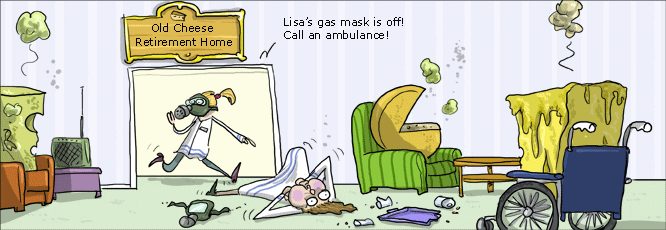
When seeing this: wulffmorgenthaler-cheese.gif ... I couldn't help thinking at the forthcoming cheese and wine party at debconf8 (which I love, but still the strip is hilarious :) ) strip from wulffmorgenthaler, see it in its original context

17 July 2008

Stefano Zacchiroli: paper about mancoosi at debconf8

Mancoosi paper for DebConf8 now available As previously announced, I'll be attending DebConf this year, as I did for the past 3 years. Beside the usual projects and ideas one carries with himself on his way to a DebConf, this time I will also be there to present part of my everyday work in the Mancoosi project. Very briefly (and a bit too simplistic) Mancoosi is working on pushing forward the research and technology needed to deliver better package managers to the users of open source software distributions. The project presentation event proposed by me and Ralf Treinen has been accepted in the DebConf main track. The presentation will discuss what the former EDOS project did, what Mancoosi is doing right now, trying to focus on their relationships with Debian. In case you are interested I suggest to attend the talk which will be delivered by yours truly (what else can I suggest? :) ) In the meantime, the accompanying paper is now available, you can take a sneak peek if you are interested in knowing more about Mancoosi right ahead. The paper is available in .pdf format from both my homepage and from the Pentabarf event page as an attachment (the latter, as all Pentabarf events, needs login for reasons that I still fail to understand ...). Download

16 July 2008

Stefano Zacchiroli: updating w3-recs

revamping w3-recs: new specs, misc improvements After quite a lot from my initial adoption, I've spent some time to update w3-recs. Beside the long overdue update of shipped recommendations (quite a few new specification was released, mostly related to SPARQL, but a few more have been edited, including CSS 1 and 2), I've also uploaded some pending improvements. A couple of bug fixes were about dangling links and registration of recommendations with the GNOME devhelp stuff. Additionally, I've also moved all the documents registered with doc-base under the new Help/Standards section of doc-base, which seems to be fit for W3C Recommendations. Apparently we have finally managed to have a proper section tree for doc-base, the decoupling of that tree from the Debian menu one will not be missed (at least not by me). During the process I've also discovered a (recent?) change in debhelper semantics. Thus far I used to have broken doc-base document IDs in w3-recs, as they contained uppercase letters, which are prohibited according to /usr/share/doc/doc-base/doc-base.txt.gz. My fault, I concur, but in the past the documents got installed anyhow without any problem. On the contrary, with the latest debhelper all documents got written to the very same file, apparently stripping away the part of their names which do not match the used lowercase regular expression. Well, not too bad, I fixed one more bug, but with a warning fixing that would have been quicker. Also, /me wonders, if everything (but package build :-) ) worked properly with uppercase document IDs, why the heck one should forbid them in the doc-base specification?

1 July 2008

Stefano Zacchiroli: python-debian w dependency parsing

New python-debian feature: Dependency Parsing Since my merge commit of this afternoon python-debian has grown dependency parsing support. (But first things first: you know about python-debian, don't you? If you don't, and you always wanted to program with Debian-related files with Python, then shame on you!) Thus far, playing with Packages-like files using dictionary-like objects was already as simple as (quoting from /usr/share/doc/python-debian/examples/deb822/grep-maintainer):
for pkg in deb822.Packages.iter_paragraphs(file('/var/lib/dpkg/status')):
    if pkg.has_key('Maintainer') and maint_RE.search(pkg['maintainer']):
        print pkg['package']

However, it was a bit unfortunate that Depends-like fields were only returned as strings. Now each package (as iterated upon in the above snippet) is equipped with a .relations property returning a dictionary of inter-package relationship fields. Looking up keys like "depends" you will get back a conjunctive normal form (CNF) representation of dependencies, together with parsed constraints on version or architectures, if any. A simple example is shipped as /usr/share/doc/python-debian/examples/deb822/depgraph, which outputs a labeled Graphviz script of all inter-package dependencies extracted from a Packages file. Here is its most relevant snippet:
name = pkg['package']
rels = pkg.relations
for deps in rels['depends']:
    if len(deps) == 1:
        emit_arc(name, deps[0]['name'])
    else:   # output an OR node
        or_node = get_id()
        emit_arc(name, or_node)
        emit_node(or_node, 'OR')
        for dep in deps:
            emit_arc(or_node, dep['name'].lower())

The appropriate sub-classes of Deb822 have been customized with the knowledge of which inter-package relationship fields are supported in their stanzas (e.g. Build-Depends are supported by Sources, but not by Packages; the other way around for Recommends). Testing from the git repo is more than welcome.

30 June 2008

Stefano Zacchiroli: fancy bibliography entry

sooner or later in a bibliography I should add ... Quoting from the bibliography of a paper from the ACM SIGMOD conference:
[11] Sergio Leone, Clint Eastwood, Eli Wallach, and Lee Van
     Cleef. The Good, the Bad and the Ugly / Il Buono, il Brutto,
     Il Cattivo (The Man with No Name). Produzioni Europee
     Associate (Italy) Production, Distributed by United Artists
     (USA) 1966.

... one of the things I would have killed for having written by myself.

27 June 2008

MJ Ray: Firefox 3, day 10: security flaw 2, more banks, looking for a new browser

Well, I was hoping to get Yet Another Blog Reorg done before posting this, but it just hasn't happened, so here are a few more thoughts on Firefox 3 on this ol' blog. In fact, I'll probably finish the FF3 series here before I switch over. I was in central London on Tuesday and suffered both the rudeness and the black snot (which no-one else I know seems to suffer) so maybe that's why I've been underachieving this week. I've had London lethargy. I had a report about online banking that doesn't work with FF3. NPBS will move into the hall of shame, sadly. I'm almost certain I warned them months ago that their online banking was doing Javascript stunts that aren't going to work forever. I emailed them and haven't heard back since. Back to the browser: I share the contempt for the Firefox 3 and SSL problems and I like the new URL bar too. However, I am finding the FF3 seems to use more CPU (and so power) than FF1.5 and there seems to be some frustrating delays in FF-clipboard communications, so I'm looking at other browsers. Conkeror looks interesting. Still Gecko (useful for work) but stripped down. I spotted another post about microformats, which I mentioned in my last post, about the BBC dropping support for microformats [John Resig] and I also noticed just how good SVG and Minimalist Markup looks in FF3 [Sam Ruby] - I'd love to try it, but my IE-using clients probably wouldn't understand and I hate making single-browser special editions.

26 June 2008

Pierre Habouzit: firefox3 and SSL

Yes Stefano, I too believe that the SSL certificate thingy in Iceweasel 3 is just a bad joke. I mean WHAT THE FUCK WERE THEY THINKING ? At least in the RCs it improved, and the logo isn't the same as 404, it took me 10 refresh the first time I saw it to understand that it was not a 404 but an untrusted self-signed certificate. And the whole "exception" thing is absurd. NO I DON'T WANT TO ADD AN EXCEPTION you morons. Here would be a good UI, that I never saw implemented in any browser but would make sense: It's enough for 99.9% of the users. Then, some of us really care about importing some untrusted certificates (for our own webmails e.g.). Then well, a small button that allows advanced users to check, import, and mark an untrusted certificate as trusted is just what one needs. One can even hide that in some menu, it would be fine. I for example, have only checked the SSL certificate from my webmail and something like 3 or 4 websites. I do NOT want to be bugged for the other. But no, instead we have this completely delirious interface that no-one can sanely call User Interface. They're on crack. Anyways, here is a way to make your pain easier, either in about:config or in your $ HOME /.mozilla/firefox/$ profile-with-name-on-crack-id /user.prefs set the following values this way[1]:
 user_pref("browser.ssl_override_behavior", 2);
 user_pref("browser.xul.error_pages.expert_bad_cert", true);
It makes validating a certificate two clicks away (one of the settings shows the 'add exception' buttons instead of showing a link to make them visible, the other settings makes firefox download the certificate for you so that you don't have to ASK HIM to do so[2]. And you know the worst thing ? I'm sure the guy(s) who wrote this fucking dialog is(are) very proud of it.
Notes [1] Thanks to glandium for the hints [2] WTF people, WTF do you need us to make you download the certificate. This is nonsensical, the user had already 3 clicks to have the add exception dialog, and you need one to download the certificate ? WTF are you thinking!!!

Stefano Zacchiroli: firefox 3 un-ranting

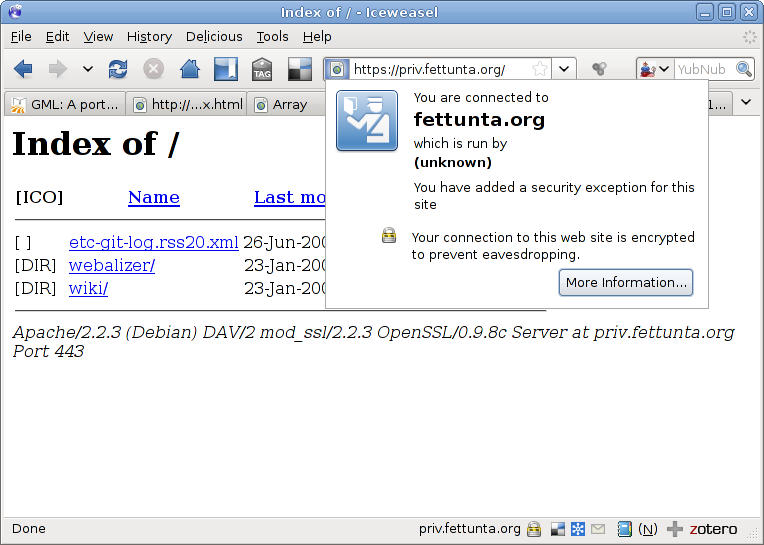
Gunnar, have a look at this: iceweasel-ssl.png. So your example using the Penta website was just a bad one, and I personally agree with the "INVALID" resolution of your bug report. In fact, showing a partially encrypted connection as an insecure one is an overall advantage for (l)user securities, as with the browser interfaces we are used to use, we don't know which parts are actually sent encrypted and which are not. As you can see in the example above a fully encrypted connection is properly reported as such by Firefox 3.0. FWIW: I'm overall satisfied with Firefox 3.0, especially about the new URL bar Wouther is disliking. Yes it is a bit slower than before, but even on my 4-year old laptop it is perfectly usable. The HTML title shown there? Well, it is rather handy when I start typing bugs.debian.org and then I've to discriminate among tons of almost identical bug report URLs ... Is the about:config hand-holding dialog worst than the pop-up the first time you "have provided unencrypted information" in a random form? It is not, we have probably just forgot about the first time we unchecked the corresponding checkbox. All in all, the only "feature" of the new Firefox I found incredibly stupid is the SSL certificate exception mechanism. Installing the untrusted certificate is what? ... 5 click-away from the initial page? That is just dumb. (And as it is well-known that habits form anyhow, getting the habits harder to form is just a way to piss-off users.)

24 June 2008

Romain Francoise: Updated Debian Vcs-* statistics

Not much has changed since my previous post, Subversion and Git are still growing.

Zack has a similar graph with a logarithmic y-axis which shows that arch is losing users. Who would have thought? :)

9 June 2008

Stefano Zacchiroli: debian weather is back

What's the weather like in Debian? One of the cool things developed during EDOS (now Mancoosi) has been edos-debcheck. Using it it is possible to check (incredibly quickly) whether some package in a given distribution cannot be installed according to its dependencies. When there are such packages it usually means that the distro is buggy s it is shipping uninstallable packages (there are some corner cases, but they are rare). In fact, edos-debcheck has been run daily (as a service maintained by Ralf) on Debian's main suites and some derivatives for years now. The resulting list of uninstallable packages is linked from http://edos.debian.net and is being used by the QA team; I've no idea if it is being used by the Release Managers too, but it probably should be. A cool toy built on top of edos-debcheck was the Debian weather (part of a more generic service called Anla, I'll blog about it sooner or later ...). Debian weather basically used to present the status of a given Debian-based distro in term of how many uninstallable packages were shipped using the weather metaphor: the fewer the uninstallable packages, the better the weather. I wrote "used to" because Anla was stopped about 1 year ago, and is being re-engineered these days. In the meantime it was a pity not to have the Debian weather (as Enrico pointed out with me), so I spent some time to resurrect it on top of edos-debcheck daily runs: Debian weather is back, enjoy!

1 June 2008

Stefano Zacchiroli: ocaml 3.10.2 is in testing

OCaml 3.10.2 meets Lenny As per title: OCaml 3.10.2 (... and friends of course) today has entered testing, as such it will be released with Debian Lenny. Yay. This transition was the second binNMU-based and went flawlessly (while the first one was hit by a bug in the script generating binNMU/dep-wait requests automatically). This way transitions are way easier to handle, and would probably be real PITAs now that we have about 120 OCaml-related source packages to care about. Kudos to all who helped, Luk -release side, and the other fellow Debian camlers.

27 May 2008

Stefano Zacchiroli: on maintainer script sizes

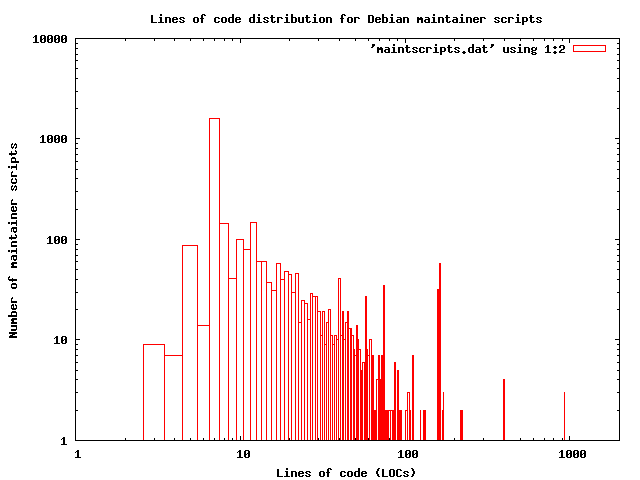
Measurnig maintainer scripts LOCs After some discussions which touched them in various (Debian and non-Debian) mailing lists, I got interested in having a closer look to maintainer scripts. The first question I was asking myself is how big they are? . As an absolutely empirical, non-scientific test, I hacked a couple of scripts to graph the distribution of maintainer script lengths (measured as LOCs). I just run them on /var/lib/dpkg/info/*. post,pre inst,rm on my laptop, which contains ATM 3612 scripts. Here is the result: maintscripts.png The obvious (though, I repeat, absolutely empirically obtained) point is that, as expected, most of the scripts are really short, with 1/3 of them being just 7 LOCs. And I guess you can guess (sorry) what the 7 lines are about:
    #!/bin/sh
    set -e
    # Automatically added by dh_makeshlibs
    if [ "$1" = "configure" ]; then
            ldconfig
    fi
    # End automatically added section

dear old debhelper boilerplate. The longest script, not shown properly in the graph due to my low gnuplot karma, is 1905 LOCs (and the winner is: /var/lib/dpkg/info/xserver-xorg.postinst). The shortest scripts are 5 LOCs, but they are structurally equivalent to the 7 LOCs above, sometimes invoking some other idempotent update-bla tool, and sporting less newlines.

Stefano Zacchiroli: debian ocaml news

Catching up: some OCaml in Debian news Hei, it looks like I stopped giving updates about OCaml news in Debian, time to catch up. 2 hot news basically:
  1. OCaml 3.10.2 transition is ongoing. Release managers did not forget about our old request of transitioning OCaml to 3.10.2 in time for Lenny, and as soon as the last Perl transition was other they pinged us about the transition. Together with Luk we are now working on it. After some initial issues on arm which was unable to run docbook2html on our poor little policy document without segfaulting(!), it now looks like is not going too bad ... get ready for OCaml 3.10.2 in Debian Lenny!
  2. the "core" OCaml library by Jane St Capital (which I consider a really good replacement for the legacy standard library FWIW) has entered testing a few days ago. It will be released with Debian Lenny, no matter if with 3.10.1 or 3.10.2
Stay tuned!

8 May 2008

Stefano Zacchiroli: vcs distribution stats for packaging

Some more stats: $VCS distribution for Debian packaging I've set up yet another stat page, this time it's about the distribution of $VCS for Debian packaging. It's as trivial as you can imagine: it gets all the Vcs-XXX fields out of unstable Sources and plot how many packages are using a given $VCS. I've got no surprises in the relative popularity of $VCS: subversion is clearly the most widespread (with about 2700 packages on a total of about 13000) and git is growing (700 packages); with the exception of bzr (90 packages), all the other are used by less then 50 packages. Thanks to Lucas I've also included graphs in the page, as I think it would be interesting to monitor the evolution. (Probably as everybody) I'm confident to see an increasing trend for git balanced by a decrease of subversion, we'll see. The total number of packages using some $VCS is encouraging, we are at about 29% of the archive (you know that if your package is not declearing some Vcs- headers in its source stanza I'm not counting it, right? Go add the headers!). Interesting side effect: as I'm now maintaining a handful of these stat pages, I was pondering hey, we should create a wiki page with pointers to all the stat pages about Debian we have . Well, in fact it already exists: Statistics on wiki.d.o.

4 May 2008

Stefano Zacchiroli: core has landed in Debian

Jane St. (OCaml) Core in Debian As recently announced, core has landed. It is an alternative/extended OCaml standard library developed by Jane Street Capital. At first sight it looks like ground breaking: a well-engineered standard library fixing several shortcomings of OCaml legacy standard library, both in terms of missing functionalities and syntactic sugar (e.g. the monadic operators which everybody was basically re-defining from scratch in their own code). After a day-n-half of work I'm proud to announce that core is now available in Debian. It took me a while as we were missing several of core dependencies. Overall, the resulting new 5 source packages are bin-prot, ocaml-res, janest-core, type-conv, sexplib310. All of them as been uploaded to experimental; beside sexplib (which went through NEW in just a few hours!!), the other 4 are sitting in NEW. In the meantime you can take the packages from my people.d.o space. I haven't yet uploaded them to unstable because some more audit is required for dependencies (e.g. I haven't build them in cowbuilder due to some annoyance related to the current Perl 5.10 transition). The only annoying aspect of the whole business is that bin-prot is ATM supported only little endian architectures, and this is inherited by core ...

28 April 2008

Stefano Zacchiroli: pts testing transitions

PTS bit of the day: show testing transitions Tiny teeny PTS bit of the day: the PTS now provides information about testing transitions. If your package is part of an ongoing transition its uploads to unstable will be blocked by DAK. The PTS informs you about that and points to extra information and upload alternatives. At the time of writing a couple of examples are: aubio and dballe. Though now that we have such powerful tools, Debian will be so fast at completing the python2.5 transition that you won't have time to see the new PTS messages ;-)

Next.

Previous.