Search Results: "radu"

21 April 2008

Tore S. Bekkedal: GNU Screen/vim love

When I code, one of the tools I use which I like the most is GNU screen. My current project involves the editing of a bunch of different source files, and often jumping frequently between them. I was spawning windows and trying to edit files that I had already opened in a previous screen, and often ending up with a bunch of windows with files I wasn’t using much at the time. So I did some research on how to optimize use of vim and screen together. The first thing I came up with was getting screen to display a nice bar at the bottom by adding this to my .screenrc: (Thanks, Red Hat Magazine!) hardstatus alwayslastline
hardstatus string '% = kG [ % G %H % g ][%= % = kw %?%-Lw%?% r (% W %n*%f %t%?(%u)%?% r )% w %?%+Lw%?%?%= % g ][% B %Y-%m-%d % W %c % g ]'
This gives you a neat and coloured (mmmm… colours…) status bar at the bottom of your screen display, including some info on whether other terminals are attached to that window and such. One thing which would vastly improve the usefulness of this would be if I could get vim to set the screen window title. The escape sequence for doing this is the same as for other terminals, but vim’s terminal information database does not include the relevant entry for the “screen” termtype. So (with help from “frogonwheels” and “godlygeek” in #vim) I put an entry in my .vimrc specifying the escape codes for setting screen’s window title. In addition, I abbreviated the window title string to contain only the file. Here is the relevant snippet from my .vimrc: if $TERM=='screen'
exe "set title titlestring=vim:%f"
exe "set title t_ts=\<ESC>k t_fs=\<ESC>\\"
endif
A casual glance at my school grades chart will immediately reveal that I am not a structured learner; I’m not the type of user who will, when adopting a tool, begin by reading the manuals. I’m more of a gradual, ad-hoc learner, and I tend to prefer to stick to the defaults whenever possible. Since vim and screen are probably my primary tools for doing work, I should probably do some more research on things like this. These suggestions may be somewhat trivial, but I’ve found them to be quite useful, so I thought it might be useful to someone. Please leave a comment if it was, or if you have any comments (duh!) or suggestions.

19 April 2008

Evan Prodromou: 30 Germinal CCXVI

So, I'm really getting into the podcasts lately. I got myself a personal music player (one of these) in winter, and I've been using it to listen to podcasts while I run. Earideas has been a huge help in finding new podcasts to listen to. I've kind of graduated from the best of earideas feed, which covers a wide variety of podcasts, and I'm trying to dig into things that really matter to me. Three things in particular, of course: wine, parenting, and Open Source/Open Content. I've found a good number of podcasts on the first two subjects, but only a few on the last. Right now I listen to: So, what else is out there for Free, Libre, Open kinda people? Any podcast suggestions? tags:

27 March 2008

Andrew Pollock: [tech] Mutt configuration find of the year

I switched from Pine to Mutt as my primary email client around the time I decided to become a Debian developer, because Pine's PGP support was abysmal (it also beat building Pine packages by hand all the time). The other bonus feature was it threaded emails, which made it easier to follow mailing lists. It's been a very gradual learning process since I switched, and I certainly don't consider myself to be a Mutt power user. I initially really hated it, I think largely because of the concept of "old, unseen" messages, versus "new" messages, and the behaviour of the Tab key. Once I unset the mark_old variable, it got a lot more tolerable. I think at some point I either plagiarised someone's .muttrc from the Internet, or sat down with the manual (or possibly a bit of both) and came up with a config that I could live with, and it's been workable ever since. One problem I (more recently) started having was that when I had 200-odd unread emails in my inbox, which has been pretty common occurrence in the last couple of years, and someone replied to an email in an old thread, because I wasn't necessary scrolling through all 200-odd emails (as new, unthreaded emails usually sorted chronologically at the bottom of my inbox), I'd miss the fact that the email had arrived, often for extended periods of time. I was lamenting this problem to Sarah over dinner last night, and saying how I preferred Gmail's behaviour, where the position of a thread in the inbox was determined by the date of the most recent email in the thread. I figured Mutt must have a sort option to be able to deal with this, and so I went rummaging in the manual last night, and discovered the sort_aux configuration variable. I've set that to last-date-received, and now I'm very pleased. I should never miss an email again. Of course, I should really try practising Inbox Zero, then it wouldn't be an issue.

24 March 2008

David Nusinow: Little Things

Still putting most all of my brain and time in to trying to graduate. This has left me shockingly little time for things like working on Debian.

Part of the reason why I haven't been working on more visible things (X, Debian) is that I haven't had the solid blocks of time to devote to reading email. I think I need to unsubscribe from all but two or three lists so I don't end up paralyzed by the email onslaught the way I am now. I need to get back to slinging code.

My iPod completely crapped out on me a week and a half ago. I plug it in to my computer and it's totally dead. It was only a little over a year old. Massive fail. Fuck you Apple. I've purchased a 4GB Cowon U3 which plays oggs natively and explicitly "supports" linux. We'll see how that goes, but after one day of use I'm pretty happy.

The entry of Squeak in to Debian and my own realization that GNU Smalltalk exists for those of us who might not want to live inside the smalltalk environment has prompted me to look at the language for the first time. A half hour a night (about a third of the time it takes me to read my email on a very good night) has only made me more excited about this language. If you haven't taken a serious look at Smalltalk yet, it's worth your while. It's like all sorts of things that we can approximate and dream about not only are a reality, but they were invented back in the 70's and have been here all along. It's made me seriously question some of the directions that Linux and Debian have gone in.

18 March 2008

Adam Rosi-Kessel: Bridge Year

This, from my alma mater, is a good idea:
Group to explore creation of ‘bridge year’ program
Princeton President Shirley M. Tilghman has appointed a working group to explore the creation of a “bridge year” program that would allow newly admitted undergraduates to spend a year of public service abroad before beginning their freshman year. The program would enable students to pursue a tuition-free, pre-collegiate enrichment year outside their home country with support from the University.
I finished my high school requirements early and spent a year abroad before college in Li ge, Belgium. It was an excellent decision. There would have been practically no benefit to starting college early, and having living abroad without my parents for a year was as important to my university experience as most of what I learned in high school. I propose that some sort of “bridge year” become something like a default option before higher education. This is much more common outside the United States. Indeed, depending on whom you believe, only seven to twenty-five percent of Americans own passports. My completely unscientific survey of Australians, by contrast, suggests that every last one of them travels abroad as young adults. (I have to admit that this survey is not only unscientific but fatally biased, inasmuch as I’ve only met Australians traveling abroad, not having been there myself). While I’m praising Princeton, this, too, is good news:
Aggressive goals set for sustainability initiatives
Princeton has committed to reduce its carbon dioxide emissions to 1990 levels by 2020 as part of a comprehensive Sustainability Plan that sets ambitious goals in the areas of greenhouse gas emissions reduction, resource conservation, and research, education and civic engagement.
I’ve a big fan of Shirley Tilghman, Princeton’s first non-male non-alum president. She has been working to fix a lot of what was wrong when I was student, despite some stiff resistance from the old guard. Technorati Tags: , , ,

16 March 2008

John Goerzen: The Power of Love

A few years ago, Elvera Voth, a musician that grew up a few miles from here was back in the area. Her specialty is vocal music, and one evening, she led a hymn sing at our church.

During the event, she talked about how much music can touch the heart. Elvera remembered many years ago that a woman in the church was leaving for a service trip to India. She would be gone for 7 years straight. None of her family or friends would be able to see her during that entire time.

The day she was to depart, friends, family, and church members went with her to the Santa Fe station in Newton, KS. While waiting for her train, at some point, the group started singing. Elvera remembered that they sang So nimm denn meine H nde (Take thou my hand, O Father) and Ich bete an die Macht der Liebe (O Power of Love).

Elvera remembered they sang in the station, and the high, wood ceilings made it sound like the music filled the whole building. I can't think of a better goodbye than that.

Elvera remembered so many details about the event, but two things she didn't remember were who was leaving and what year this happened. So I remembered this story for awhile, but didn't really follow up on it.

Then last December, our neighbor Hildred called. Hildred and her sister live on their old family farm about a mile from us. They're some of the older members of our church, and I believe both of them have lived on that farm their entire lives. Hildred heard that I am gathering photos for a book about the centennial of our church, and she offered to bring some of them over. Knowing that it was cold and dark outside, the roads were snowy, and that Hildred drives a car at least 40 years old (because "Daddy said this is a good car"), I offered to drive to their place. "Oh no," she said, "it's no trouble. I like to get out. Besides, I haven't seen your house since it's been remodeled!" So she came over.

Hildred had stacks of amazing old photos from the church and the community. And she had a stack of photos and letters from India, where her aunt Augusta Schmidt was a nurse for 14 years. She was very proud of her aunt's service to the needy there. I started to put things together in my head and asked her if she remembered singing at the train station when Augusta left for India. "Oh sure," said Hildred, as if everyone knew about that.

So that's how it happened that the "historical moment" on Feb. 10 was about Augusta Schmidt. Each month during church, leading up to our centennial in October, we have a brief time where we highlight some interesting story from the church's past. I happened to mention this one at a historical committee meeting.

So, on that Sunday in February, someone got up and told everyone about Augusta's life. She was born in 1894 and graduated from college with a nursing degree in 1927. She heard about India at a conference, and quickly felt that God wanted her to serve there. She left for India in the fall of 1927, and would serve two 7-year terms there.

She wrote that India was a beautiful land, contrary to things she had heard. The city where she worked (I believe it was Bombay, but I'm not positive) had hallmarks of a wealthy city, such as educational institutions, hotels, etc. However, it saddened her greatly to learn that 80% of the people in the city were homeless and slept on the street. No doubt this played a role in her dedication to service there.

After we learned about Augusta, the choir sang So nimm denn meine H nde -- one of the songs that Augusta heard at the train station back in 1927. Imagine you were there, 81 years ago, seeing a friend off on a trip across continents, not to see her again for 7 years. Then the people there start singing a cappella...

So nimm denn meine H nde
und f hre mich
Bis an mein selig Ende
und ewiglich!
Ich kann allein nicht gehen,
nicht einen Schritt;
Wo du wirst gehn und stehen,
da nimm micht mit.
Take thou my hand, O Father,
and lead thou me,
until my journey endeth
eternally.
Alone I will not wander
one single day.
Be thou my true companion
and with me stay.


You probably weren't there that day in 1927, or even the day in February when the choir sang the song. I wasn't either because I had the flu that day. But I borrowed the cassette recording of that day's service, recorded using the best we have right now -- the wrong type of microphone pointed the wrong way, onto a cassette tape that has certainly been reused way more times than anybody knows.

Click here to listen.

The choir sang the first verse in German, verse 2 in English, and the whole church joined in on verse 3. I'm told there weren't many dry eyes in the church after that. After all, how could you keep a straight face singing "Take, then, my hand, O Father, and lead thou me, until my journey endeth eternally" right after the narrator read about Augusta's retirement and death, saying, "there, I was surrounded by friends, but most of all, by the sovereign love of God who had been with me my entire life."

Postscript

Remember Elvera Voth, from whom I first learned this story? In 1961, she moved to Alaska. Elvera taught at several universities; founded the Anchorage Opera; directed the Alaska Festival of Music, Anchorage Boys Choir, and Alaska Chamber Singers; and there is Elvera Voth Hall at the Alaska Center for the Performing Arts.

But her best work, I think, happened after she retired and moved back to Kansas in 1995. In 1998, Elvera founded the East Hill Singers, a choir composed mainly of minimum-security prison inmates, plus volunteers from the community. Elvera has inspired so many people, taught them that they have value, that they can succeed and make themselves better. One of the said:

Can you imagine what a standing ovation feels like after being told all your life that you are worthless?


And another inmate commented:

It made me feel like maybe I'm not just being punished. I mean, I am being punished for what I did. But being in this program made me think that I can also come out well, better a better person.


It all makes me think. What an amazing thing these two women with love in their hearts have done to make this planet a better place. Is it even possible to do that by using weapons that kill and power to frighten?

As Elvera puts it, "many of the men in prison will be back in the community soon. I'd rather have them as a neighbor with hope in their hearts than with hate in their eyes."

15 March 2008

Daniel Burrows: The power of self-delusion

Groklaw has a link up to an interesting interview regarding behavioral economics. I haven't listened to the podcast, but the posted text is quite interesting. This line, in particular, struck a chord with me:
Feeling that your work is useful, even if you know it's an illusion, has motivational power with respect to that work.
This resonates with some thoughts I've been turning over in my head lately. Back when I was in college, I thought my work in Debian was useful and I was really excited to work on it. I'd sit around thinking up new ways to improve the system and spend all my spare time hacking code to implement my ideas. Then I graduated, and went into the real world, and got a job, and suddenly I discovered that working on Debian was not so much useful as it was worthless self-indulgence with no value to anyone but a small and marginal group of individuals. This sent me into a funk for a good year or so, during which time I released a few bugfix uploads for aptitude but didn't do much else free-software-related. I spent my time on the bus reading science fiction novels and computer science textbooks. However, at some point last year I realized a couple things:
  1. In the grand scheme of things, the work I do for pay is no more important than the work I do for free. It might be more important to the people who pay for it, but to most of the world I simply don't matter no matter what hat I'm wearing, and I need to learn to live with it.
  2. At the end of your life, you're dead and no-one asks you whether you made yourself miserable enough by doing useful stuff, so you might as well do things you enjoy instead.
  3. The only practical effect of my delusions regarding Debian was that I spent my spare time hacking code and enjoying it, instead of playing video games and feeling like a loser.
  4. If there's any chance that I might ever have a kid, I certainly want to write free software now, while I don't have one. Based on observing my coworkers who have kids, it's pretty much impossible to be both a free software hacker and a parent: after the paid job and the kid, there isn't much time left over for writing code.
So, I decided to try deliberately believing a false thing: namely that my Debian work is valuable and worthwhile. And hey, it worked! I still know that what I'm doing is worthless, but I can convince myself otherwise for stretches of time, and I have enough fun while I'm working on the project that I consider it worth a small amount of unreality. It sure beats the heck out of computer games (which I still spend a distressingly large amount of time on). The doublethink aspect of it creeps me out, but I can't argue with the results. The one problem is that this state of deluded motivation seems to be a bit fragile and is vulnerable to being popped by rude shocks. In December, I found myself mentally composing a letter in which I resigned from Debian to go spend my free time on stuff that was more gratifying, or at least where the expectations and (more importantly) level of abuse were commensurate with the pay and hours. As usual, I had enough sense to not follow through, and everything seemed less dire in the morning, but it was still weeks before I could bring myself to begin to think about spending my free time working on Debian. Presumably the only way to avoid this is to find something to do in my spare time that I enjoy and that is actually meaningful to the world. But since I don't know of any activity that meets these criteria, I'll keep my self-delusion for the time being, thank you very much. At least I know I'm doing it -- I suspect that most people don't.

10 March 2008

Dirk Eddelbuettel: PGApack 1.1: Almost as good as new

PGAPack is rather nice and fairly small library for 'parallel' optimisation via generic algorithms using the MPI message passing protocol. PGAPack 1.0 was written by David Levine while doing graduate work during the mid-1990s at Argonne Labs / University of Chicago. PGAPack has also been in or around Debian for a rather long time, but it suffered from benign neglect in the last few years. Some of this came to the fore in this bugreport which lead to my offer to the then-maintainer Andreas to help on the relicencing request. After all, Argonne Labs is just a few miles from where I live, and I had already spent a little bit of time polishing and upgrading the package for my own exploratory use. So I called Rusty Lust, head of the Mathematics and Computer Science section at Argonne to try to sort this out. He was sympathetic and put me in email contact with David Levine. As we are all somewhat busy, this dragged on for a little longer than we thought --- but as of today, about and a half years later, we have a new and shiny PGAPack 1.1 release, or around twelve years after the initial 1.0 version came out. I have done a fair amount of polishing: there are now two library packages for serial use (i.e. for debugging) as well as parallel use via MPI. We use Open MPI where available and LAM where not. All open Debian bugs have been addressed. One minor issue in the postscript documentation remains as David can no longer locate his LaTeX sources; I may just have to extract the text and re-latex this from scratch to update it. One day. Anyway, for full reference, the changelog entry is below. The package is currently in the NEW queue (as the new sub-package require manual inspection and approval) but should hit mirrors in a couple of days. My thanks to the two previous Debian maintainers; to Rusty Lusk for helping with the from the end MSC department at Argonne Labs and for suggesting the rather liberal and easy MPICH2 license (and he happens to be one of the MPICH2 authors); and of course to David Levine for writing PGAPack in the first place, for agreeing to relicense it and giving valuable feedback on my repackaging of what is now version 1.1 on the MCS ftp server at Argonne --- this library has held up really well over the years; let's hope it will find more good use going forward.
pgapack (1.1-1) unstable; urgency=low
  * Really good news:  The MCS divsion of Argonne National Laboratories has
    agreed to relicense pgapack using the MPICH2 license. So pgapack
    is now Free Software and can move into Debian's main archive!
  
    Our thanks go to David Levine and Rusty Lusk to make this possible.
  
  * New maintainer, following Andreas' offer dated 2006-10-04 in #379388
  * debian/control: Change section to math		(Closes: #379388)
  
  * Added new brinary packages libpgapack-mpi1 and libpgapack-serial1
  * The MPI package is configured using Open MPI where available and LAM
    where not. 
  * debian/control: Changed Build-Depends: to use OpenMPI where available, 
    and LAM otherwise.
 
  * Finally acknowledges old NMUs 		(Closes: #379168,#359549)
  * source/integer.c: Apply patch for one-off error 	(Closes: #333381)
  * source/report.c:  Do not unconditionally print at generation 1
  
  * debian/rules: Remove a bashism 			(Closes: #379168)
  * debian/rules: Install examples directly 		(Closes: #134331)
  * debian/control: libpgapack-lam1 Depends on lam4 	(Closes: #60376)
  * debian/rules: Rewritten using debhelper
  * debian/control: Added Build-Depends: section for debhelper
  * No longer install mpi.h in /usr/include		(Closes: #404027)
    
  * debian/control: Updated Standards-Version: to current version
  * man/man1/PGAGetCharacterAllele.1: fix whatis entry 		(lintian)
  
 -- Dirk Eddelbuettel   Mon, 10 Mar 2008 18:03:34 -0500

6 March 2008

Anthony Towns: The second half...

Continuing from where we left off… The lower bound for me becoming a DD was 8th Feb ‘98 when I applied; for comparison, the upper bound as best I can make out was 23rd Feb, when I would have received this mail through the debian-private list:
Resent-Date: 23 Feb 1998 18:18:57 -0000
From: Martin Schulze 
To: Debian Private 
Subject: New accepted maintainers
Hi folks,
I wish you a pleasant beginning of the week.  Here are the first good
news of the week (probably).
This is the weekly progress report about new-maintainers.  These people
have been accepted as new maintainer for Debian GNU/Linux within the
last week.
[...]
Anthony Towns <ajt@debian.org>
    Anthony is going to package the personal proxy from
    distributed.net - we don't have the source... He may adopt the
    transproxy package, too.
Regards,
        Joey
I never did adopt transproxy – apparently Adam Heath started fixing bugs in it a few days later anyway, and it was later taken over by Bernd Eckenfels (ifconfig upstream!) who’s maintained it ever since. Obviously I did do other things instead, which brings us back to where we left off…
Geez, this was meant to be briefer...

1 March 2008

Anthony Towns: Been a while...

So, sometime over the past few weeks I clocked up ten years as a Debian developer:
From: Anthony Towns <aj@humbug.org.au>
Subject: Wannabe maintainer.
Date: Sun, 8 Feb 1998 18:35:28 +1000 (EST)
To: new-maintainer@debian.org
Hello world,
I'd like to become a debian maintainer.
I'd like an account on master, and for it to be subscribed to the
debian-private list.
My preferred login on master would have been aj, but as that's taken
ajt or atowns would be great.
I've run a debian system at home for half a year, and a system at work
for about two months. I've run Linux for two and a half years at home,
two years at work. I've been active in my local linux users' group for
just over a year. I've written a few programs, and am part way through
packaging the distributed.net personal proxy for Debian (pending
approval for non-free distribution from distributed.net).
I've read the Debian Social Contract.
My PGP public key is attached, and also available as
<http://azure.humbug.org.au/~aj/aj_key.asc>.
If there's anything more you need to know, please email me.
Thanks in advance.
Cheers,
aj
-- 
Anthony Towns <aj@humbug.org.au> <http://azure.humbug.org.au/~aj/>
I don't speak for anyone save myself. PGP encrypted mail preferred.
On Netscape GPLing their browser:  How can you trust a browser that
ANYONE can hack? For the secure choice, choose Microsoft.''
        -- <oryx@pobox.com> in a comment on slashdot.org
Apparently that also means I’ve clocked up ten and a half years as a Debian user; I think my previous two years of Linux (mid-95 to mid-97) were split between Slackware and Red Hat, though I couldn’t say for sure at this point. There’s already been a few other grand ten-year reviews, such as Joey Hess’s twenty-part serial, or LWN’s week-by-week review, or ONLamp’s interview with Bruce Perens, Eric Raymond and Michael Tiemann on ten years of “open source”. I don’t think I’m going to try matching that sort of depth though, so here are some of my highlights (after the break).
Hrm, this is going on longer than I’d hoped. Oh well, to be continued!

21 February 2008

David Nusinow: Where I've Been, Where I'm Going

After about two weeks I'm finally able to come back to Debian, which feels good. After my last package upload was botched (and gracefully recovered by my teammates) I realized that I needed to step away for a little bit.

I'm currently in my fifth year of my PhD program. For those who don't know how such things work in the US, I have a small committee of people (my thesis committee) who act as advisors and gatekeepers on my work. They're the ones who gauge my progress, and ultimately give me permission to write my thesis and receive my doctorate. I'm supposed to meet with them every 6 months, and it had been over a year since my last meeting. Because I'd like to actually graduate one day, I was rather nervous about having the meeting. I was more nervous than I realized, and the botched upload reflected that.

Anyway, to make a long story short, the meeting went as well as I could have hoped for and my committee seems to be happy with my progress. I'm looking to get a paper out in the spring, and they'd like to meet with me again in three months time (which will absolutely fly by) to assess where that paper is at, and how things are going. At that point, I wouldn't be surprised if they tell me to write my thesis and graduate.

What I do after my dissertation work has been weighing on my mind for years and years, and it's obviously coming to a head. My boss will let me stay on as a post-doc in the lab for a while, which I may do depending on other job opportunities and progress on my projects. Ultimately though I need to make a decision that's familiar to a few others in my position. Do I stay in science or go try and work on free software for a living? I honestly don't have an answer yet, because I love them both.

I see tons of incredible opportunities in my field right now, and while I'm not the only coder interested in synthetic biology, I'm one who's positioned to get in on the ground floor of the science in a very real way and have a significant hand in shaping its future. On the other hand I spend my free time devouring computing literature, not biology literature, as well as producing software and things related to it. I do this because I enjoy it, and I know I enjoy it on a deeper level than the biology. Would I enjoy it this way if I did it for a living? I've got no idea, since I've never coded professionally.

I'm coming up to the fork quite fast now, and I'll have to choose soon. I know I'm lucky because I do have the chance to choose for myself, but that doesn't make it any easier.

25 January 2008

Filip Van Raemdonck: Phased migration

Wouter, I wonder why you didn't just rsync the whole filesystem over and used it as a chroot, while gradually rolling over services to the actual new system?

9 January 2008

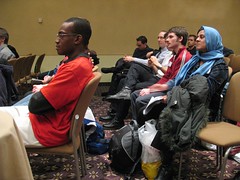
Simon Law: DemoCamp CUSEC 2


Audience
Originally uploaded by sfllaw.
It s been a long time since I ve written about our local unconferences, but a neat one coming up is DemoCamp CUSEC 2. It s attached to the Canadian Undergraduate Software Engineering Conference, which is being held in Montr al again. Last year, I did a demonstration on how to cook an omelette, with it being a metaphor for software engineering. This year, I m going to do something more prosaic and run a round of Powerpoint karaoke, under the guise of getting people to practise their presentation skills. Or it will be a convincing argument against its use. Show up if you can! Present something you ve been working on! (There are still some slots left.) It ll be exciting. DemoCamp CUSEC 2
Thursday, 17 January 2008
19:00 21:00
Centre Mont-Royal
2200 rue Mansfield
Free admission
( Sign up Google Maps )

16 December 2007

Biella Coleman: From serenity to offense in 5 miles or less

When you live in NYC and have a demanding job, you tend to ignore the city (at least I do), that is until guests descend upon your place. And since a Large Family Clan has recently landed in my apt, I have spent the last few days trekking north, south, east, and west, across bridges, in parks, and memorials, eating, drinking, and passing out at night after the constant flurry of activity. Yesterday we headed pretty much as far north as you can go to pay a visit to the lovely Cloisters sitting high on a cliff. The Cloisters provides stellar views of the Hudson at the same time as it transports you back in time when a lot of energy was put into scribbling religious material on paper in really stunning and ornate ways. I have not paid a visit to the Cloisters since my undergraduate days and after yesterday’s stroll, I am sorry I waited until the frigid winter to do so. It is an *incredibly* serene place, especially the inner courtyard gardens, and if you need serenity (and I think anyone who lives in NYC, needs to counter the low-grade and high-grade exposure to constant noise with some noiseless environments), this is the place to go. We then made our way to the Columbia area to check out the campus, St. John the Divine (currently under renovation), and so I could pick up a book being held for me at the Book Culture bookstore (which I wish was a lot closer to me than it is)… It was nice to escape the blustering winter conditions and browse the rows of books in a warm and well lit environment. But after purchasing Information Please: Culture and Politics in the Digital Age, parts of which I am hoping to teach next semester, and flipping through the book, my new found serenity was replaced by some serious offense when the only index I could find was an author index. There was no subject index in sight, which at the time left me totally surprised!! Anyone who is in the business of using books as research tools knows the index is —-> indispensable. And a well indexed book is much appreciated (never mind what a non-existent index does). In fact, I felt like I stumbled on some rare object because I don’t think I have ever seen an academic book published in the last 30 years not sporting this useful tool and I wonder if 1) I have a bunk copy 2) The editors/authors forgot to include it and just pushed out the book anyway 3) This was a willful choice made for reasons hidden to the reader. I think I may have to contact Duke University Press and let me know they momentarily robbed me of my serenity :-)

25 November 2007

Roland Mas: Gforge news, November 2007

Apparently some people worry that Gforge may be abandoned, or on the verge of being superseded with the proprietary "Gforge Advanced Server" rewrite. Let it be known that I for one have no plans to switch to Gforge AS, for all the reasons you'd expect from a free software user and advocate: I don't have access to the source code (it's made illegible by some sort of industrial PHP obfuscator), I can't hack it because the license doesn't allow me to, I can't audit it for security flaws, I can't adapt it to particular needs, etc. Since a significant part of my income comes from maintaining Gforge instances for clients, with local modifications for their particular needs, it's an economical necessity that Gforge stays free. And evolving. Right. Having said that, I guess I have to show concrete evolutions in addition to principles and ideals. So what changed recently? All this has committed and uploaded to Debian. As usual, please test and report failures. Plans for my foreseeable future include: Places where help would be most welcome: There. That was the news. Now for a bit of trivia: it's amazing how having a metric of one's productivity gives an incentive to increase it. I found mine on Ohloh, which provides code and license analyses and statistics on free software projects, as well as statistics on commits by contributors. They even have a shiny widget with a scrollable timeline showing commits over time, as well as comparative commit graphs. My obvious personal goal is to get up to the first position among the contributors, but of course I wouldn't complain if the current top committer stayed ahead by springing back into activity.

14 November 2007

Eddy Petri&#537;or: Linux: plain weird network behaviour; Windows is OK

Update: problem fixed, thanks for the comments; it was MTU related issues.

Note: This is a long post, but I expect it to bring in some questions for many Linux people; I advise you to read this when you have enough time.


After the last events related to connectivity at home which have been lasting since Thursday evening and the weird fact that it seems that NAT doesn't work at home, but does at work for the same setup, I called the ISP's support and wasted 15 minutes trying to convince them at least to send a technical team with another modem just to test if that is the reason for the breakage.

Of course, talking to the ISP support and trying to convince them that there might be a problem on their side since NAT works with another provider but doesn't with them, was fruitless.

Tonight I was stuck and tried another approach, convinced I would confirm my suspicion that there is something wrong on ISP's side. Still I am not yet sure what to conclude from what happened.


So, to get a better view of what is going on, I'll describe the setup I have and what are its limitations and characteristics. People in a hurry can skip to the paragraph starting with "I tested" and stare in wonder at will.


So the connection I have is done through a DSL modem which gets the MAC of the network card connected to it and exposes that as its own to the ISP's network. This MAC seems to be quite persistent and special measures must be taken in order to be able to use another NIC to connect. The modem (or probably some machine in ISP's; the IP is 10.10.0.1) offers a DHCP address and everything should work fine.

Because of this "your MAC is my MAC" issue, when I connected the first time, I used an USB NIC since a broken router or some temporary failure would have allowed me to use the Internet connection directly from my laptop. I can say this decision has proven in time to be wise.

The router I used until now is a NSLU2 with Debian installed on it. The built in network interface always faced the internal network.

The router (which I call ritter) served as a NAT router for two machines inside the network, my laptop and my apartment mate's laptop. All until last Thursday, after which it never got back properly.


I tested (doing NAT on my laptop; the laptop shouldn't have been affected by the power problems):

Of course, I have n-checked that /proc/sys/net/ipv4/ip_forward was set to 1, the tables had policy ACCEPT and there were no extra rules, except the basic NAT-ting stuff, the routes were correctly set on both the clients and the machine doing the NAT.


All I could see is that:
  1. the machine doing the NAT was always working fine
  2. at work all NAT clients worked fine
  3. at home any of the NAT "clients" were
    1. able to resolve addresses while the DNS server was in ISP territory and another LAN
    2. ping the outside world (if ping was available - in D-I is not)
    3. hanging when trying to get a http page
    4. telnet-ting directly to the port 80 was ok (but I didn't try to "GET / HTTP/1.0")

So after all of this, I was thinking of trying to see if a new client (the laptop of my apartment mate, a Windows XP machine) would work using the connection at home. It didn't work.

Then I thought of trying to do "Internet Connection Sharing" as is called in Windows. Of course, there was some pain to find Windows XP drivers for the ASIX AX88172 network card (remember, the modem needed to see the MAC of that NIC), but I managed to find the proper one.


And, almost sure the NAT wouldn't work for this case either, I configured the new connection as a shared one. I didn't even disabled the firewall, as I was thinking I could take those down gradually.

I wasn't expecting this, not even by pure chance, but my laptop which was a NAT "client" now was able to browse, ping and do whatever was normal through NAT, while the Windows machine was doing the "Connection sharing".

I was utterly flabbergasted. And that was just the beginning.


I was expecting that the problem coincidentally went away, but after a minute I was proven otherwise. It still didn't work with Linux as the NAT-ting machine. I connected back the USB NIC to the Windows machine and I saw the same thing. NAT was just working.


At that point I was to observe an even more shocking fact: the IP that the Windows machine got was different from the one the Linux machine received, in spite of the fact that the network card was the same, so it would have made sense to get the same one. More than that, the IP that the Windows machine got was from an entirely different network, although it was a valid IP belonging to my ISP.

I was thinking that one reason why it works with Windows might be that there could be some TCP protocol twist that is differently implemented in Windows and the equipment from my ISP gets along better with the Windows network stack.


As a way to test that, I am thinking of forcing somehow the IP on the Linux machine to see if anything changes. But before doing that, I felt the urge to post these, maybe some kind soul will shed some light on this issue for me or drop a hint.

Another reason might be different DHCP servers answering, but I don't know how I can see in Windows who offered the lease.


If anyone has any clue why these weird things happen, please drop a line. I would greatly appreciate it. TIA.

9 November 2007

Wouter Verhelst: Public Transportation

Christian Perrier blogs about how he uses public transportation to go to work, how that works well, and how that has positively affected his Debian productivity. Personally, I couldn't agree more. I've graduated from school in 2001; and the only time when I commuted to work by car was when I worked at template, where I had a company car because I had to make customer visits. Today, as an entrepreneur, I do everything by public transportation. It is my intention to, eventually, make sure I have a car because doing customer visits by public transportation isn't easy; but it's not impossible, either; you just need to make sure you're prepared. If I have an appointment at a customer, what I usually do is to go to the de lijn website, of the flemish public transportation company that handles buses and trams; they have a schedule online, and a route planner that allows me to do much of what Google Maps does for cars, but then for public transportation—including trains. If I do that on time (that is, earlier than half an hour or so before the appointment), I hardly ever have problems reaching my destination in time. Of course there are days when the system fails, and I'm stuck in a train station for longer than I'd like; but these are the exception, not the rule, especially outside rush hour. And like Christian mentions, the absense of having to pay attention to the road while commuting is a real bonus, in that it allows you to actually get some work done. Or sleep, if it's been a short night. Or look outside the window, if you have nothing better to do. Or hack. In fact, at DebConf7 in Edinburgh, I had a little discussion with Ian Jackson about how the train provides the perfect environment for hacking: nobody around to disturb you (except, occasionally, people to check your tickets, but you can just put your ticket in plain view all the time and they'll be happy without you getting out of deep hack mode), and the view out the window is just perfect to stay concentrated: no still image to get distracted by, but nothing boring either. We theorized that it'd be nice if you could just go to the train station and state "I need a ticket. The destination isn't important, but I want to be waiting as little as possible and end up here again in about 2 hours". The only problem with that, of course, is that train rides aren't free, and that office rent is much more affordable...

3 November 2007

Biella Coleman: Nadia Abu El-Haj Tenure

It is nice to read the New York Times and get some good news. Nadia Abu El-Haj was granted tenure after a bitter public battle opposing her appointment. As someone who has taken graduate courses with her in Chicago and who was advised by her, I know Columbia and Barnard made the right choice.

19 October 2007

Ian Haken: Long Time, No Update

So I've clearly neglected giving frequent updates, so I'll try to summarize everything that's been going on and maybe try to post more frequently in the future (I feel like I've said that many times before).

The summer ended very well, I think. My GSoC project vlosuts concluded with a fully working version, and so hopefully some guys over at Quality Assurance can be goaded into giving it a try. Once Lars and I find some time (it seems like both our lives have been quite hectic) we'll be submitting it to the unstable branch. I intend to continue supporting and developing it; in fact last night I just checked in the first update for VirtualBox support, as recommended by Jon in my comments. It does seem to work faster than QEMU and Innotek did a quality job (in my opinion at least) of packaging it. The biggest kink is that it does not support raw disk images, and so vlosuts gets slowed down by having to convert to VMDK and back, for which I am using qemu-img (and does anyone know why VBoxManage unregisterimage doesn't seem to be working for VMDKs?). If it's possible to do a loopback mount of VMDK (without VMware's utility) it would probably make more sense to use VMDK instead of a raw image to begin with, but I'm not familiar with any way to do this. At any rate, first version of VirtualBox is there for anyone who'd like to give it a shot.

Anyone not concerned with the personal going-ons of my life should stop reading right about now. Since my semester started up again at the end of August, I've pretty much hit the ground running. I'm taking 20 units (I think the average is around 15), one of which is a mathematics graduate course. I'm also doing a research project in computer science, working a part time job (which I try to do for about 10 hours a week), and getting my graduate school applications taken care of. For anyone who is curious, the GRE is a terrible thing. Graduate school and fellowship applications have been a particular headache, but fortunately I'm just about finished up with the essays. For the curious I'll be applying to mathematics departments with an emphasis in logic and foundations at the following universities (list subject to change frequently): MIT, Berkeley, Stanford, Carnegie Mellon, Urbana-Champaign, UMich.

16 October 2007

Biella Coleman: Topics in Digital Media

Next semester I am teaching one (yay one) course and it is a graduate course on digital media. This is the description I have so far and I will post the tentative syllabus in the next few week.
Computers, especially in their networked dimension, have sparked a series of ethical, political, and social debates that often revolve around a series of stark and connected dualities: control and freedom; pleasure and exploitation; creativity and constraint. In this course we will approach topics in digital media via an historical angle that squarely addresses these dualities. To this end, we will often cross-cut readings on similar topics and material whose conclusion about the nature of computing will often vary considerably. The goal, however, is not to determine the correct or right side of these dualities but have students come away with a firm understanding of the following: 1) the history of computing and networking in light of the ways the authors as well as technologists/inventors construct or understand these dualities; 2) the various sources technological, social, and political that may shape or drive any of these elements; 3) unpack the political and social relationships, if any, between them and the stakes involved in how these authors represent the nature of computing and networking. The course primarily concentrates on computers and networks and is roughly chronological, starting with the first digital computers and ending with our digital present. Particular topics we address are: cybernetics and liberalism; networks and the cold war; personal computers and online communities; hackers, the free software movement and intellectual property; labor, development, and computers; peer-to-peer knowledge production; computer gaming; and counter-globalization and computer networking.

Next.

Previous.