Search Results: "pm"

20 November 2024

Ian Jackson: The Rust Foundation's 2nd bad draft trademark policy

tl;dr: The Rust Foundation s new trademark policy still forbids unapproved modifications: this would forbid both the Rust Community s own development work(!) and normal Free Software distribution practices. Background In April 2023 I wrote about the Rust Foundation s ham-fisted and misguided attempts to update the Rust trademark policy. This turned into drama. The new draft Recently, the Foundation published a new draft. It s considerably less bad, but the most serious problem, which I identified last year, remains. It prevents redistribution of modified versions of Rust, without pre-approval from the Rust Foundation. (Subject to some limited exceptions.) The people who wrote this evidently haven t realised that distributing modified versions is how free software development works. Ie, the draft Rust trademark policy even forbids making a github branch for an MR to contribute to Rust! It s also very likely unacceptable to Debian. Rust is still on track to repeat the Firefox/Iceweasel debacle. Below is a copy of my formal response to the consultation. The consultation closes at 07:59:00 UTC tomorrow (21st November), ie, at the end of today (Wednesday) US Pacific time, so if you want to reply, do so quickly. My consultation response
Hi. My name is Ian Jackson. I write as a Rust contributor and as a Debian Developer with first-hand experience of Debian s approach to trademarks. (But I am not a member of the Debian Rust Packaging Team.) Your form invites me to state any blocking concerns. I m afraid I have one: PROBLEM The policy on distributing modified versions of Rust (page 4, 8th bullet) is far too restrictive. PROBLEM - ASPECT 1 On its face the policy forbids making a clone of the Rust repositories on a git forge, and pushing a modified branch there. That is publicly distributing a modified version of Rust. I.e., the current policy forbids the Rust s community s own development workflow! PROBLEM - ASPECT 2 The policy also does not meet the needs of Software-Freedom-respecting downstreams, including community Linux distributions such as Debian. There are two scenarios (fuzzy, and overlapping) which provide a convenient framing to discuss this: Firstly, in practical terms, Debian may need to backport bugfixes, or sometimes other changes. Sometimes Debian will want to pre-apply bugfixes or changes that have been contributed by users, and are intended eventually to go upstream, but are not included upstream in official Rust yet. This is a routine activity for a distribution. The policy, however, forbids it. Secondly, Debian, as a point of principle, requires the ability to diverge from upstream if and when Debian decides that this is the right choice for Debian s users. The freedom to modify is a key principle of Free Software. This includes making changes that the upstream project disapproves of. Some examples of this, where Debian has made changes, that upstream do not approve of, have included things like: removing user-tracking code, or disabling obsolescence timebombs that stop a particular version working after a certain date. Overall, while alignment in values between Debian and Rust seems to be very good right now, modifiability it is a matter of non-negotiable principle for Debian. The 8th bullet point on page 4 of the PDF does not give Debian (and Debian s users) these freedoms. POSSIBLE SOLUTIONS Other formulations, or an additional permission, seem like they would be able to meet the needs of both Debian and Rust. The first thing to recognise is that forbidding modified versions is probably not necessary to prevent language ecosystem fragmentation. Many other programming languages are distributed under fully Free Software licences without such restrictive trademark policies. (For example, Python; I m sure a thorough survey would find many others.) The scenario that would be most worrying for Rust would be embrace - extend - extinguish . In projects with a copyleft licence, this is not a concern, but Rust is permissively licenced. However, one way to address this would be to add an additional permission for modification that permits distribution of modified versions without permission, but if the modified source code is also provided, under the original Rust licence. I suggest therefore adding the following 2nd sub-bullet point to the 8th bullet on page 4:
  • changes which are shared, in source code form, with all recipients of the modified software, and publicly licenced under the same licence as the official materials.
This means that downstreams who fear copyleft have the option of taking Rust s permissive copyright licence at face value, but are limited in the modifications they may make, unless they rename. Conversely downstreams such as Debian who wish to operate as part of the Free Software ecosystem can freely make modifications. It also, obviously, covers the Rust Community s own development work. NON-SOLUTIONS Some upstreams, faced with this problem, have offered Debian a special permission: ie, said that it would be OK for Debian to make modifications that Debian wants to. But Debian will not accept any Debian-specific permissions. Debian could of course rename their Rust compiler. Debian has chosen to rename in the past: infamously, a similar policy by Mozilla resulted in Debian distributing Firefox under the name Iceweasel for many years. This is a PR problem for everyone involved, and results in a good deal of technical inconvenience and makework. Debian could seek approval for changes, and the Rust Foundation would grant that approval quickly . This is unworkable on a practical level - requests for permission do not fit into Debian s workflow, and the resulting delays would be unacceptable. But, more fundamentally, Debian rightly insists that it must have the freedom to make changes that the Foundation do not approve of. (For example, if a future Rust shipped with telemetry features Debian objected to.) Debian and Rust could compromise . However, Debian is an ideological as well as technological project. The principles I have set out are part of Debian s Foundation Documents - they are core values for Debian. When Debian makes compromises, it does so very slowly and with great deliberation, using its slowest and most heavyweight constitutional governance processes. Debian is not likely to want to engage in such a process for the benefit of one programming language. Users will get Rust from upstream . This is currently often the case. Right now, Rust is moving very quickly, and by Debian standards is very new. As Rust becomes more widely used, more stable, and more part of the infrastructure of the software world, it will need to become part of standard, stable, reliable, software distributions. That means Debian.
(The consultation was a Google Forms page with a single text field, so the formatting isn t great. I have edited the formatting very lightly to avoid rendering bugs here on my blog.)

comment count unavailable comments

19 November 2024

Melissa Wen: Display/KMS Meeting at XDC 2024: Detailed Report

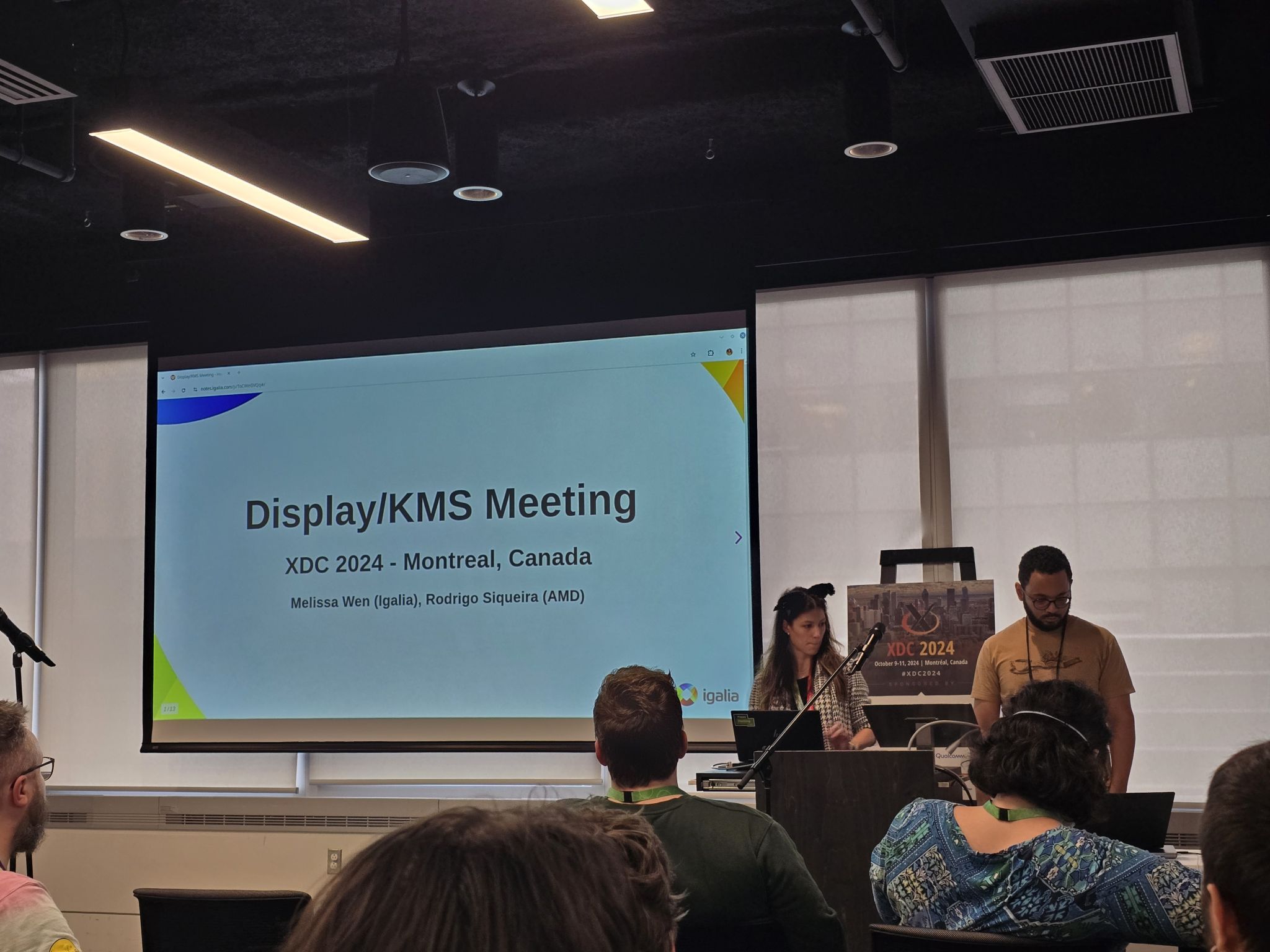
XDC 2024 in Montreal was another fantastic gathering for the Linux Graphics community. It was again a great time to immerse in the world of graphics development, engage in stimulating conversations, and learn from inspiring developers. Many Igalia colleagues and I participated in the conference again, delivering multiple talks about our work on the Linux Graphics stack and also organizing the Display/KMS meeting. This blog post is a detailed report on the Display/KMS meeting held during this XDC edition. Short on Time?
  1. Catch the lightning talk summarizing the meeting here (you can even speed up 2x):
  1. For a quick written summary, scroll down to the TL;DR section.

TL;DR This meeting took 3 hours and tackled a variety of topics related to DRM/KMS (Linux/DRM Kernel Modesetting):
  • Sharing Drivers Between V4L2 and KMS: Brainstorming solutions for using a single driver for devices used in both camera capture and display pipelines.
  • Real-Time Scheduling: Addressing issues with non-blocking page flips encountering sigkills under real-time scheduling.
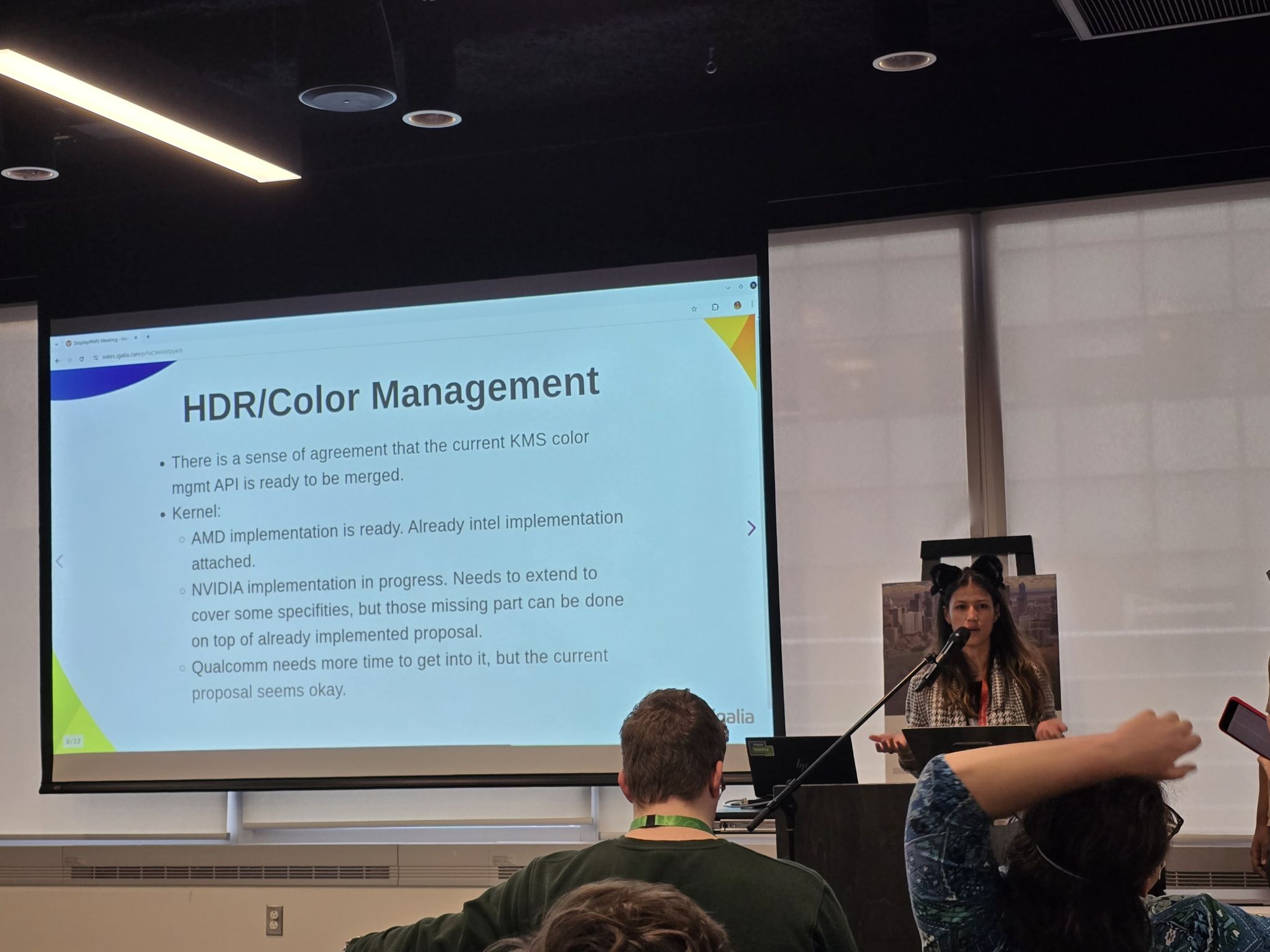
  • HDR/Color Management: Agreement on merging the current proposal, with NVIDIA implementing its special cases on VKMS and adding missing parts on top of Harry Wentland s (AMD) changes.
  • Display Mux: Collaborative design discussions focusing on compositor control and cross-sync considerations.
  • Better Commit Failure Feedback: Exploring ways to equip compositors with more detailed information for failure analysis.

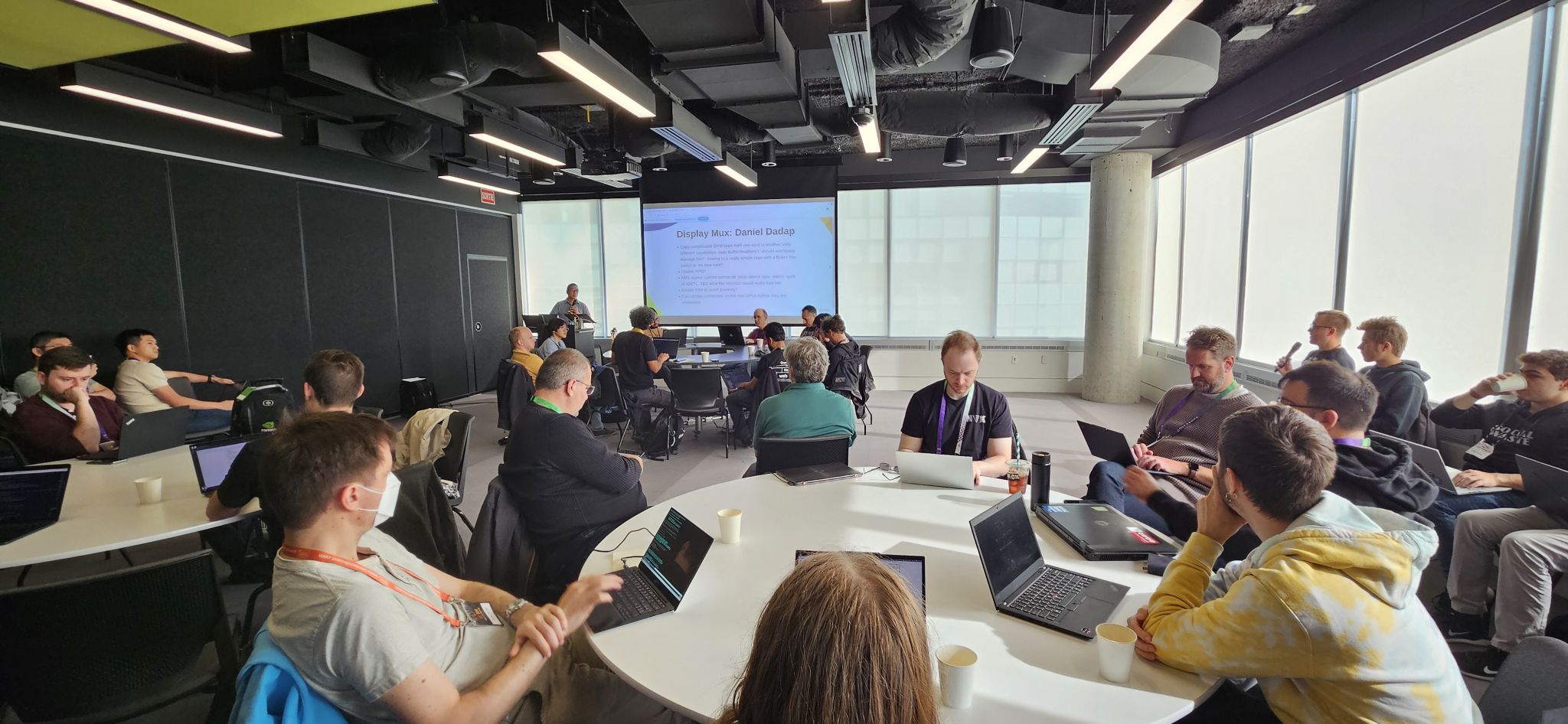
Bringing together Linux display developers in the XDC 2024 While I didn t present a talk this year, I co-organized a Display/KMS meeting (with Rodrigo Siqueira of AMD) to build upon the momentum from the 2024 Linux Display Next hackfest. The meeting was attended by around 30 people in person and 4 remote participants. Speakers: Melissa Wen (Igalia) and Rodrigo Siqueira (AMD) Link: https://indico.freedesktop.org/event/6/contributions/383/ Topics: Similar to the hackfest, the meeting agenda was built over the first two days of the conference and mixed talks follow-up with new ideas and ongoing community efforts. The final agenda covered five topics in the scheduled order:
  1. How to share drivers between V4L2 and DRM for bridge-like components (new topic);
  2. Real-time Scheduling (problems encountered after the Display Next hackfest);
  3. HDR/Color Management (ofc);
  4. Display Mux (from Display hackfest and XDC 2024 talk, bringing AMD and NVIDIA together);
  5. (Better) Commit Failure Feedback (continuing the last minute topic of the Display Next hackfest).

Unpacking the Topics Similar to the hackfest, the meeting agenda evolved over the conference. During the 3 hours of meeting, I coordinated the room and discussion rounds, and Rodrigo Siqueira took notes and also contacted key developers to provide a detailed report of the many topics discussed. From his notes, let s dive into the key discussions!

How to share drivers between V4L2 and KMS for bridge-like components. Led by Laurent Pinchart, we delved into the challenge of creating a unified driver for hardware devices (like scalers) that are used in both camera capture pipelines and display pipelines.
  • Problem Statement: How can we design a single kernel driver to handle devices that serve dual purposes in both V4L2 and DRM subsystems?
  • Potential Solutions:
    1. Multiple Compatible Strings: We could assign different compatible strings to the device tree node based on its usage in either the camera or display pipeline. However, this approach might raise concerns from device tree maintainers as it could be seen as a layer violation.
    2. Separate Abstractions: A single driver could expose the device to both DRM and V4L2 through separate abstractions: drm-bridge for DRM and V4L2 subdev for video. While simple, this approach requires maintaining two different abstractions for the same underlying device.
    3. Unified Kernel Abstraction: We could create a new, unified kernel abstraction that combines the best aspects of drm-bridge and V4L2 subdev. This approach offers a more elegant solution but requires significant design effort and potential migration challenges for existing hardware.

Real-Time Scheduling Challenges We have discussed real-time scheduling during this year Linux Display Next hackfest and, during the XDC 2024, Jonas Adahl brought up issues uncovered while progressing on this front.
  • Context: Non-blocking page-flips can, on rare occasions, take a long time and, for that reason, get a sigkill if the thread doing the atomic commit is a real-time schedule.
  • Action items:
    • Explore alternative backtraces during the busy wait (e.g., ftrace).
    • Investigate the maximum thread time in busy wait to reproduce issues faced by compositors. Tools like RTKit (mutter) can be used for better control (Michel D nzer can help with this setup).

HDR/Color Management This is a well-known topic with ongoing effort on all layers of the Linux Display stack and has been discussed online and in-person in conferences and meetings over the last years. Here s a breakdown of the key points raised at this meeting:
  • Talk: Color operations for Linux color pipeline on AMD devices: In the previous day, Alex Hung (AMD) presented the implementation of this API on AMD display driver.
  • NVIDIA Integration: While they agree with the overall proposal, NVIDIA needs to add some missing parts. Importantly, they will implement these on top of Harry Wentland s (AMD) proposal. Their specific requirements will be implemented on VKMS (Virtual Kernel Mode Setting driver) for further discussion. This VKMS implementation can benefit compositor developers by providing insights into NVIDIA s specific needs.
  • Other vendors: There is a version of the KMS API applied on Intel color pipeline. Apart from that, other vendors appear to be comfortable with the current proposal but lacks the bandwidth to implement it right now.
  • Upstream Patches: The relevant upstream patches were can be found here. [As humorously notes, this series is eagerly awaiting your Acked-by (approval)]
  • Compositor Side: The compositor developers have also made significant progress.
    • KDE has already implemented and validated the API through an experimental implementation in Kwin.
    • Gamescope currently uses a driver-specific implementation but has a draft that utilizes the generic version. However, some work is still required to fully transition away from the driver-specific approach. AP: work on porting gamescope to KMS generic API
    • Weston has also begun exploring implementation, and we might see something from them by the end of the year.
  • Kernel and Testing: The kernel API proposal is well-refined and meets the DRM subsystem requirements. Thanks to Harry Wentland effort, we already have the API attached to two hardware vendors and IGT tests, and, thanks to Xaver Hugl, a compositor implementation in place.
Finally, there was a strong sense of agreement that the current proposal for HDR/Color Management is ready to be merged. In simpler terms, everything seems to be working well on the technical side - all signs point to merging and shipping the DRM/KMS plane color management API!

Display Mux During the meeting, Daniel Dadap led a brainstorming session on the design of the display mux switching sequence, in which the compositor would arm the switch via sysfs, then send a modeset to the outgoing driver, followed by a modeset to the incoming driver.
  • Context:
  • Key Considerations:
    • HPD Handling: There was a general consensus that disabling HPD can be part of the sequence for internal panels and we don t need to focus on it here.
    • Cross-Sync: Ensuring synchronization between the compositor and the drivers is crucial. The compositor should act as the drm-master to coordinate the entire sequence, but how can this be ensured?
    • Future-Proofing: The design should not assume the presence of a mux. In future scenarios, direct sharing over DP might be possible.
  • Action points:
    • Sharing DP AUX: Explore the idea of sharing DP AUX and its implications.
    • Backlight: The backlight definition represents a problem in the mux switch context, so we should explore some of the current specs available for that.

Towards Better Commit Failure Feedback In the last part of the meeting, Xaver Hugl asked for better commit failure feedback.
  • Problem description: Compositors currently face challenges in collecting detailed information from the kernel about commit failures. This lack of granular data hinders their ability to understand and address the root causes of these failures.
To address this issue, we discussed several potential improvements:
  • Direct Kernel Log Access: One idea is to directly load relevant kernel logs into the compositor. This would provide more detailed information about the failure and potentially aid in debugging.
  • Finer-Grained Failure Reporting: We also explored the possibility of separating atomic failures into more specific categories. Not all failures are critical, and understanding the nature of the failure can help compositors take appropriate action.
  • Enhanced Logging: Currently, the dmesg log doesn t provide enough information for user-space validation. Raising the log level to capture more detailed information during failures could be a viable solution.
By implementing these improvements, we aim to equip compositors with the necessary tools to better understand and resolve commit failures, leading to a more robust and stable display system.

A Big Thank You! Huge thanks to Rodrigo Siqueira for these detailed meeting notes. Also, Laurent Pinchart, Jonas Adahl, Daniel Dadap, Xaver Hugl, and Harry Wentland for bringing up interesting topics and leading discussions. Finally, thanks to all the participants who enriched the discussions with their experience, ideas, and inputs, especially Alex Goins, Antonino Maniscalco, Austin Shafer, Daniel Stone, Demi Obenour, Jessica Zhang, Joan Torres, Leo Li, Liviu Dudau, Mario Limonciello, Michel D nzer, Rob Clark, Simon Ser and Teddy Li. This collaborative effort will undoubtedly contribute to the continued development of the Linux display stack. Stay tuned for future updates!

18 November 2024

Dirk Eddelbuettel: RcppArmadillo 14.2.0-1 on CRAN: New Upstream Minor

armadillo image Armadillo is a powerful and expressive C++ template library for linear algebra and scientific computing. It aims towards a good balance between speed and ease of use, has a syntax deliberately close to Matlab, and is useful for algorithm development directly in C++, or quick conversion of research code into production environments. RcppArmadillo integrates this library with the R environment and language and is widely used by (currently) 1191 other packages on CRAN, downloaded 37.2 million times (per the partial logs from the cloud mirrors of CRAN), and the CSDA paper (preprint / vignette) by Conrad and myself has been cited 603 times according to Google Scholar. Conrad released a minor version 14.2.0 a few days ago after we spent about two weeks with several runs of reverse-dependency checks covering corner cases. After a short delay at CRAN due to a false positive on a test, a package failing tests we also failed under the previous version, and some concern over new deprecation warnings _whem using the headers directly as _e.g. mlpack R package does we are now on CRAN. I noticed a missing feature under large 64bit word (for large floating-point matrices) and added an exporter for icube going to double to support the 64-bit integer range (as we already did, of course, for vectors and matrices). Changes since the last CRAN release are summarised below.

Changes in RcppArmadillo version 14.2.0-1 (2024-11-16)
  • Upgraded to Armadillo release 14.2.0 (Smooth Caffeine)
    • Faster handling of symmetric matrices by inv() and rcond()
    • Faster handling of hermitian matrices by inv(), rcond(), cond(), pinv(), rank()
    • Added solve_opts::force_sym option to solve() to force the use of the symmetric solver
    • More efficient handling of compound expressions by solve()
  • Added exporter specialisation for icube for the ARMA_64BIT_WORD case

Courtesy of my CRANberries, there is a diffstat report relative to previous release. More detailed information is on the RcppArmadillo page. Questions, comments etc should go to the rcpp-devel mailing list off the Rcpp R-Forge page. If you like this or other open-source work I do, you can sponsor me at GitHub.

This post by Dirk Eddelbuettel originated on his Thinking inside the box blog. Please report excessive re-aggregation in third-party for-profit settings.

C.J. Collier: Managing HPE SAS Controllers

Notes to self. And anyone else who might find them useful. Following are some ssacli commands which I use infrequently enough that they fall out of cache. This may repeat information in other blogs, but since I search my posts first when commands slip my mind, I thought I d include them here, too. hpacucli is the wrong command. Use ssacli instead.
$ KR='/usr/share/keyrings/hpe.gpg'
$ for fingerprint in \
  882F7199B20F94BD7E3E690EFADD8D64B1275EA3 \
  57446EFDE098E5C934B69C7DC208ADDE26C2B797 \
  476DADAC9E647EE27453F2A3B070680A5CE2D476 ; do \
    curl "https://keyserver.ubuntu.com/pks/lookup?op=get&search=0x$ fingerprint " \
        gpg --no-default-keyring --keyring "$ KR " --import ; \
  done
$ gpg --list-keys --no-default-keyring --keyring "$ KR " 
/usr/share/keyrings/hpe.gpg
---------------------------
pub   rsa2048 2012-12-04 [SC] [expired: 2022-12-02]
      476DADAC9E647EE27453F2A3B070680A5CE2D476
uid           [ expired] Hewlett-Packard Company RSA (HP Codesigning Service)
pub   rsa2048 2014-11-19 [SC] [expired: 2024-11-16]
      882F7199B20F94BD7E3E690EFADD8D64B1275EA3
uid           [ expired] Hewlett-Packard Company RSA (HP Codesigning Service) - 1
pub   rsa2048 2015-12-10 [SCEA] [expires: 2025-12-07]
      57446EFDE098E5C934B69C7DC208ADDE26C2B797
uid           [ unknown] Hewlett Packard Enterprise Company RSA-2048-25 
$ echo "deb [signed-by=$ KR ] http://downloads.linux.hpe.com/SDR/repo/mcp bookworm/current non-free" \
    sudo dd of=/etc/apt/sources.list.d status=none
$ sudo apt-get update
$ sudo apt-get install -y -qq ssacli > /dev/null 2>&1
$ sudo ssacli ctrl all show status
HPE Smart Array P408i-p SR Gen10 in Slot 3
   Controller Status: OK
   Cache Status: OK
   Battery/Capacitor Status: OK
$ sudo ssacli ctrl all show detail
HPE Smart Array P408i-p SR Gen10 in Slot 3
   Bus Interface: PCI
   Slot: 3
   Serial Number: PFJHD0ARCCR1QM
   RAID 6 Status: Enabled
   Controller Status: OK
   Hardware Revision: B
   Firmware Version: 2.65
   Firmware Supports Online Firmware Activation: True
   Driver Supports Online Firmware Activation: True
   Rebuild Priority: High
   Expand Priority: Medium
   Surface Scan Delay: 3 secs
   Surface Scan Mode: Idle
   Parallel Surface Scan Supported: Yes
   Current Parallel Surface Scan Count: 1
   Max Parallel Surface Scan Count: 16
   Queue Depth: Automatic
   Monitor and Performance Delay: 60  min
   Elevator Sort: Enabled
   Degraded Performance Optimization: Disabled
   Inconsistency Repair Policy: Disabled
   Write Cache Bypass Threshold Size: 1040 KiB
   Wait for Cache Room: Disabled
   Surface Analysis Inconsistency Notification: Disabled
   Post Prompt Timeout: 15 secs
   Cache Board Present: True
   Cache Status: OK
   Cache Ratio: 10% Read / 90% Write
   Configured Drive Write Cache Policy: Disable
   Unconfigured Drive Write Cache Policy: Default
   Total Cache Size: 2.0
   Total Cache Memory Available: 1.8
   Battery Backed Cache Size: 1.8
   No-Battery Write Cache: Disabled
   SSD Caching RAID5 WriteBack Enabled: True
   SSD Caching Version: 2
   Cache Backup Power Source: Batteries
   Battery/Capacitor Count: 1
   Battery/Capacitor Status: OK
   SATA NCQ Supported: True
   Spare Activation Mode: Activate on physical drive failure (default)
   Controller Temperature (C): 53
   Cache Module Temperature (C): 43
   Capacitor Temperature  (C): 40
   Number of Ports: 2 Internal only
   Encryption: Not Set
   Express Local Encryption: False
   Driver Name: smartpqi
   Driver Version: Linux 2.1.18-045
   PCI Address (Domain:Bus:Device.Function): 0000:11:00.0
   Negotiated PCIe Data Rate: PCIe 3.0 x8 (7880 MB/s)
   Controller Mode: Mixed
   Port Max Phy Rate Limiting Supported: False
   Latency Scheduler Setting: Disabled
   Current Power Mode: MaxPerformance
   Survival Mode: Enabled
   Host Serial Number: 2M20040D1Q
   Sanitize Erase Supported: True
   Sanitize Lock: None
   Sensor ID: 0
      Location: Capacitor
      Current Value (C): 40
      Max Value Since Power On: 42
   Sensor ID: 1
      Location: ASIC
      Current Value (C): 53
      Max Value Since Power On: 55
   Sensor ID: 2
      Location: Unknown
      Current Value (C): 43
      Max Value Since Power On: 45
   Sensor ID: 3
      Location: Cache
      Current Value (C): 43
      Max Value Since Power On: 44
   Primary Boot Volume: None
   Secondary Boot Volume: None
$ sudo ssacli ctrl all show config
HPE Smart Array P408i-p SR Gen10 in Slot 3  (sn: PFJHD0ARCCR1QM)
   Internal Drive Cage at Port 1I, Box 2, OK
   Internal Drive Cage at Port 2I, Box 2, OK
   Port Name: 1I (Mixed)
   Port Name: 2I (Mixed)
   Array A (SAS, Unused Space: 0  MB)
      logicaldrive 1 (1.64 TB, RAID 6, OK)
      physicaldrive 1I:2:1 (port 1I:box 2:bay 1, SAS HDD, 300 GB, OK)
      physicaldrive 1I:2:2 (port 1I:box 2:bay 2, SAS HDD, 1.2 TB, OK)
      physicaldrive 1I:2:3 (port 1I:box 2:bay 3, SAS HDD, 300 GB, OK)
      physicaldrive 1I:2:4 (port 1I:box 2:bay 4, SAS HDD, 1.2 TB, OK)
      physicaldrive 2I:2:5 (port 2I:box 2:bay 5, SAS HDD, 300 GB, OK)
      physicaldrive 2I:2:6 (port 2I:box 2:bay 6, SAS HDD, 300 GB, OK)
      physicaldrive 2I:2:7 (port 2I:box 2:bay 7, SAS HDD, 1.2 TB, OK)
      physicaldrive 2I:2:8 (port 2I:box 2:bay 8, SAS HDD, 1.2 TB, OK)
   SEP (Vendor ID HPE, Model Smart Adapter) 379  (WWID: 51402EC013705E88, Port: Unknown)
$ sudo ssacli ctrl slot=3 pd 2I:2:7 show detail
HPE Smart Array P408i-p SR Gen10 in Slot 3
   Array A
      physicaldrive 2I:2:7
         Port: 2I
         Box: 2
         Bay: 7
         Status: OK
         Drive Type: Data Drive
         Interface Type: SAS
         Size: 1.2 TB
         Drive exposed to OS: False
         Logical/Physical Block Size: 512/512
         Rotational Speed: 10000
         Firmware Revision: U850
         Serial Number: KZGN1BDE
         WWID: 5000CCA01D247239
         Model: HGST    HUC101212CSS600
         Current Temperature (C): 46
         Maximum Temperature (C): 51
         PHY Count: 2
         PHY Transfer Rate: 6.0Gbps, Unknown
         PHY Physical Link Rate: 6.0Gbps, Unknown
         PHY Maximum Link Rate: 6.0Gbps, 6.0Gbps
         Drive Authentication Status: OK
         Carrier Application Version: 11
         Carrier Bootloader Version: 6
         Sanitize Erase Supported: False
         Shingled Magnetic Recording Support: None
         Drive Unique ID: 5000CCA01D247238
2024-12-09 update I was experiencing a disk failure or predictive failure when I walked into my office this afternoon. I checked this blog post and found the command I used to check the status of the sas array.
cjac@server0:~$ sudo ssacli ctrl all show config
HPE Smart Array P408i-p SR Gen10 in Slot 3  (sn: PFJHD0ARCCR1QM)
   Internal Drive Cage at Port 1I, Box 2, OK
   Internal Drive Cage at Port 2I, Box 2, OK
   Port Name: 1I (Mixed)
   Port Name: 2I (Mixed)
   Array A (SAS, Unused Space: 0  MB)
      logicaldrive 1 (1.64 TB, RAID 6, OK)
      physicaldrive 1I:2:1 (port 1I:box 2:bay 1, SAS HDD, 300 GB, OK)
      physicaldrive 1I:2:2 (port 1I:box 2:bay 2, SAS HDD, 1.2 TB, Predictive Failure)
      physicaldrive 1I:2:3 (port 1I:box 2:bay 3, SAS HDD, 300 GB, OK)
      physicaldrive 1I:2:4 (port 1I:box 2:bay 4, SAS HDD, 1.2 TB, OK)
      physicaldrive 2I:2:5 (port 2I:box 2:bay 5, SAS HDD, 300 GB, OK)
      physicaldrive 2I:2:6 (port 2I:box 2:bay 6, SAS HDD, 300 GB, OK)
      physicaldrive 2I:2:7 (port 2I:box 2:bay 7, SAS HDD, 1.2 TB, OK)
      physicaldrive 2I:2:8 (port 2I:box 2:bay 8, SAS HDD, 300 GB, OK)
   SEP (Vendor ID HPE, Model Smart Adapter) 379  (WWID: 51402EC013705E88, Port: Unknown)
At this point I engaged the under-study to have the flashing disk replaced
cjac@server0:~$ sudo ssacli ctrl all show config
[sudo] password for cjac: 
HPE Smart Array P408i-p SR Gen10 in Slot 3  (sn: PFJHD0ARCCR1QM)
   Internal Drive Cage at Port 1I, Box 2, OK
   Internal Drive Cage at Port 2I, Box 2, OK
   Port Name: 1I (Mixed)
   Port Name: 2I (Mixed)
   Array A (SAS, Unused Space: 0  MB)
      logicaldrive 1 (1.64 TB, RAID 6, Recovering, 56.43% complete)
      physicaldrive 1I:2:1 (port 1I:box 2:bay 1, SAS HDD, 300 GB, OK)
      physicaldrive 1I:2:2 (port 1I:box 2:bay 2, SAS HDD, 300 GB, Rebuilding)
      physicaldrive 1I:2:3 (port 1I:box 2:bay 3, SAS HDD, 300 GB, OK)
      physicaldrive 1I:2:4 (port 1I:box 2:bay 4, SAS HDD, 1.2 TB, OK)
      physicaldrive 2I:2:5 (port 2I:box 2:bay 5, SAS HDD, 300 GB, OK)
      physicaldrive 2I:2:6 (port 2I:box 2:bay 6, SAS HDD, 300 GB, OK)
      physicaldrive 2I:2:7 (port 2I:box 2:bay 7, SAS HDD, 1.2 TB, OK)
      physicaldrive 2I:2:8 (port 2I:box 2:bay 8, SAS HDD, 300 GB, OK)
   SEP (Vendor ID HPE, Model Smart Adapter) 379  (WWID: 51402EC013705E88, Port: Unknown)
In the next and future output, I will elide duplicate lines
cjac@server0:~$ date ; sudo ssacli ctrl all show config
Mon Dec  9 07:36:44 PM PST 2024 ... logicaldrive 1 (1.64 TB, RAID 6, Recovering, 66.85% complete)...
Mon Dec  9 07:39:25 PM PST 2024 ... logicaldrive 1 (1.64 TB, RAID 6, Recovering, 68.97% complete) ...
cjac@server0:~$ date ; sudo ssacli ctrl all show config   grep Recovering
Mon Dec  9 07:43:05 PM PST 2024 ... logicaldrive 1 (1.64 TB, RAID 6, Recovering, 71.85% complete)
Mon Dec  9 07:43:57 PM PST 2024 ... logicaldrive 1 (1.64 TB, RAID 6, Recovering, 72.55% complete)
cjac@server0:~$ sleep 5m ; date ; sudo ssacli ctrl all show config   grep Recovering
Mon Dec  9 07:49:43 PM PST 2024 ... logicaldrive 1 (1.64 TB, RAID 6, Recovering, 77.00% complete)
cjac@server0:~$ date ; sudo ssacli ctrl all show config   grep -e 1I:2:2 -e logicaldrive
Mon Dec  9 11:36:14 PM PST 2024 ... logicaldrive 1 (1.64 TB, RAID 6, OK)
physicaldrive 1I:2:2 (port 1I:box 2:bay 2, SAS HDD, 300 GB, OK)

Russ Allbery: Review: Delilah Green Doesn't Care

Review: Delilah Green Doesn't Care, by Ashley Herring Blake
Series: Bright Falls #1
Publisher: Jove
Copyright: February 2022
ISBN: 0-593-33641-0
Format: Kindle
Pages: 374
Delilah Green Doesn't Care is a sapphic romance novel. It's the first of a trilogy, although in the normal romance series fashion each book follows a different protagonist and has its own happy ending. It is apparently classified as romantic comedy, which did not occur to me while reading but which I suppose I can see in retrospect. Delilah Green got the hell out of Bright Falls as soon as she could and tried not to look back. After her father died, her step-mother lavished all of her perfectionist attention on her overachiever step-sister, leaving Delilah feeling like an unwanted ghost. She escaped to New York where there was space for a queer woman with an acerbic personality and a burgeoning career in photography. Her estranged step-sister's upcoming wedding was not a good enough reason to return to the stifling small town of her childhood. The pay for photographing the wedding was, since it amounted to three months of rent and trying to sell photographs in galleries was not exactly a steady living. So back to Bright Falls Delilah goes. Claire never left Bright Falls. She got pregnant young and ended up with a different life than she expected, although not a bad one. Now she's raising her daughter as a single mom, running the town bookstore, and dealing with her unreliable ex. She and Iris are Astrid Parker's best friends and have been since fifth grade, which means she wants to be happy for Astrid's upcoming wedding. There's only one problem: the groom. He's a controlling, boorish ass, but worse, Astrid seems to turn into a different person around him. Someone Claire doesn't like. Then, to make life even more complicated, Claire tries to pick up Astrid's estranged step-sister in Bright Falls's bar without recognizing her. I have a lot of things to say about this novel, but here's the core of my review: I started this book at 4pm on a Saturday because I hadn't read anything so far that day and wanted to at least start a book. I finished it at 11pm, having blown off everything else I had intended to do that evening, completely unable to put it down. It turns out there is a specific type of romance novel protagonist that I absolutely adore: the sarcastic, confident, no-bullshit character who is willing to pick the fights and say the things that the other overly polite and anxious characters aren't able to get out. Astrid does not react well to criticism, for reasons that are far more complicated than it may first appear, and Claire and Iris have been dancing around the obvious problems with her surprise engagement. As the title says, Delilah thinks she doesn't care: she's here to do a job and get out, and maybe she'll get to tweak her annoying step-sister a bit in the process. But that also means that she is unwilling to play along with Astrid's obsessively controlling mother or her obnoxious fiance, and thus, to the barely disguised glee of Claire and Iris, is a direct threat to the tidy life that Astrid's mother is trying to shoehorn her daughter into. This book is a great example of why I prefer sapphic romances: I think this character setup would not work, at least for me, in a heterosexual romance. Delilah's role only works if she's a woman; if a male character were the sarcastic conversational bulldozer, it would be almost impossible to avoid falling into the gender stereotype of a male rescuer. If this were a heterosexual romance trying to avoid that trap, the long-time friend who doesn't know how to directly confront Astrid would have to be the male protagonist. That could work, but it would be a tricky book to write without turning it into a story focused primarily on the subversion of gender roles. Making both protagonists women dodges the problem entirely and gives them so much narrative and conceptual space to simply be themselves, rather than characters obscured by the shadows of societal gender rules. This is also, at it's core, a book about friendship. Claire, Astrid, and Iris have the sort of close-knit friend group that looks exclusive and unapproachable from the outside. Delilah was the stereotypical outsider, mocked and excluded when they thought of her at all. This, at least, is how the dynamics look at the start of the book, but Blake did an impressive job of shifting my understanding of those relationships without changing their essential nature. She fleshes out all of the characters, not just the romantic leads, and adds complexity, nuance, and perspective. And, yes, past misunderstanding, but it's mostly not the cheap sort that sometimes drives romance plots. It's the misunderstanding rooted in remembered teenage social dynamics, the sort of misunderstanding that happens because communication is incredibly difficult, even more difficult when one has no practice or life experience, and requires knowing oneself well enough to even know what to communicate. The encounter between Delilah and Claire in the bar near the start of the book is cornerstone of the plot, but the moment that grabbed me and pulled me in was Delilah's first interaction with Claire's daughter Ruby. That was the point when I knew these were characters I could trust, and Blake never let me down. I love how Ruby is handled throughout this book, with all of the messy complexity of a kid of divorced parents with her own life and her own personality and complicated relationships with both parents that are independent of the relationship their parents have with each other. This is not a perfect book. There's one prank scene that I thought was excessively juvenile and should have been counter-productive, and there's one tricky question of (nonsexual) consent that the book raises and then later seems to ignore in a way that bugged me after I finished it. There is a third-act breakup, which is not my favorite plot structure, but I think Blake handles it reasonably well. I would probably find more niggles and nitpicks if I re-read it more slowly. But it was utterly engrossing reading that exactly matched my mood the day that I picked it up, and that was a fantastic reading experience. I'm not much of a romance reader and am not the traditional audience for sapphic romance, so I'm probably not the person you should be looking to for recommendations, but this is the sort of book that got me to immediately buy all of the sequels and start thinking about a re-read. It's also the sort of book that dragged me back in for several chapters when I was fact-checking bits of my review. Take that recommendation for whatever it's worth. Content note: Reviews of Delilah Green Doesn't Care tend to call it steamy or spicy. I have no calibration for this for romance novels. I did not find it very sex-focused (I have read genre fantasy novels with more sex), but there are several on-page sex scenes if that's something you care about one way or the other. Followed by Astrid Parker Doesn't Fail. Rating: 9 out of 10

13 November 2024

Russell Coker: Modern Sleep

Julius wrote an insightful blog post about the modern sleep issue with Windows [1]. Basically Microsoft decided that the right way to run laptops is to never entirely sleep, which uses more battery but gives better options for waking up and doing things. I agree with Microsoft in concept and this is something that is a problem that can be solved. A phone can run for 24+ hours without ever fully sleeping, a laptop has a more power hungry CPU and peripherals but also has a much larger battery so it should be able to do the same. Some of the reviews for Snapdragon Windows laptops claim up to 22 hours of actual work without charging! So having suspend not really stop the system should be fine. The ability of a phone to never fully sleep is a change in quality of the usage experience, it means that you can access it and immediately have it respond and it means that all manner of services can be checked for new updates which may require a notification to the user. The XMPP protocol (AKA Jabber) was invented in 1999 which was before laptops were common and Instant Message systems were common long before then. But using Jabber or another IM system on a desktop was a very different experience to using it on a laptop and using it on a phone is different again. The modern sleep allows laptops to act like phones in regard to such messaging services. Currently I have Matrix IM clients running on my Android phone and Linux laptop, if I get a notification that takes much typing for a response then I get out my laptop to respond. If I had an ARM based laptop that never fully shut down I would have much less need for Matrix on a phone. Making modern sleep popular will lead to more development of OS software to work with it. For Linux this will hopefully mean that regular Linux distributions (as opposed to Android which while running a Linux kernel is very different to Debian etc) get better support for such things and therefore become more usable on phones. Debian on a Librem 5 or PinePhonePro isn t very usable due to battery life issues. A laptop with an LTE card can be used for full mobile phone functionality. With modern sleep this is a viable option. I am tempted to make a laptop with LTE card and bluetooth headset a replacement for my phone. Some people will say what if someone tries to call you when it s not convenient to have your laptop with you , my response is what if people learn to not expect me to answer the phone at any time as they managed that in the 90s . Seriously SMS or Matrix me if you want an instant response and if you want a long chat schedule it via SMS or Matrix. Dell has some useful advice about how to use their laptops (and probably most laptops from recent times) in this regard [2]. You can t close the lid before unplugging the power cable you have to unplug first and then close. You shouldn t put a laptop in a sealed bag for travel either. This is a terrible situation, you can put a tablet in a bag and don t need to take any special precautions when unplugging and laptops should work the same. The end result of what Microsoft, Dell, Intel, and others are doing will be good but they are making some silly design choices along the way! I blame Intel mostly for selling laptop CPUs with TDPs >40W! For an amusing take on this Linus Tech Tips has a video about being forced to use MacBooks by Microsoft s implementation of Modern Sleep [3]. I ll try out some ARM laptops in the near future and blog about how well they work on Debian.

12 November 2024

Paul Tagliamonte: Complex for Whom?

In basically every engineering organization I ve ever regarded as particularly high functioning, I ve sat through one specific recurring conversation which is not a conversation about complexity . Things are good or bad because they are or aren t complex, architectures needs to be redone because it s too complex some refactor of whatever it is won t work because it s too complex. You may have even been a part of some of these conversations or even been the one advocating for simple light-weight solutions. I ve done it. Many times. Rarely, if ever, do we talk about complexity within its rightful context complexity for whom. Is a solution complex because it s complex for the end user? Is it complex if it s complex for an API consumer? Is it complex if it s complex for the person maintaining the API service? Is it complex if it s complex for someone outside the team maintaining it to understand? Complexity within a problem domain I ve come to believe, is fairly zero-sum there s a fixed amount of complexity in the problem to be solved, and you can choose to either solve it, or leave it for those downstream of you to solve that problem on their own. That being said, while I believe there is a lower bound in complexity to contend with for a problem, I do not believe there is an upper bound to the complexity of solutions possible. It is always possible, and in fact, very likely that teams create problems for themselves while trying to solve a problem. The rest of this post is talking to the lower bound. When getting feedback on an early draft of this blog post, I ve been informed that Fred Brooks coined a term for what I call lower bound complexity Essential Complexity , in the paper No Silver Bullet Essence and Accident in Software Engineering , which is a better term and can be used interchangeably.

Complexity Culture In a large enough organization, where the team is high functioning enough to have and maintain trust amongst peers, members of the team will specialize. People will begin to engage with subsets of the work to be done, and begin to have their efficacy measured against that part of the organization s problems. Incentives shift, and over time it becomes increasingly likely that two engineers may have two very different priorities when working on the same system together. Someone accountable for uptime and tasked with responding to outages will begin to resist changes. Someone accountable for rapidly delivering features will resist gates between them and their users. Companies (either wittingly or unwittingly) will deal with this by tasking engineers with both production (feature development) and operational tasks (maintenance), so the difference in incentives isn t usually as bad as it could be. When we get a bunch of folks from far-flung corners of an organization in a room, fire up a slide deck and throw up some aspirational to-be architecture diagram in order to get a sign-off to solve some problem (be it someone needs a credible promotion packet, new feature needs to get delivered, or the system has begun to fail and needs fixing), the initial reaction will, more often than I d like, start to devolve into a discussion of how this is going to introduce a bunch of complexity, going to be hard to maintain, why can t you make it less complex? Right around here is when I start to try and contextualize the conversation happening around me understand what complexity is that being discussed, and understand who is taking on that burden. Think about who should be owning that problem, and work through the tradeoffs involved. Is it best solved here, or left to consumers (be them other systems, developers, or users). Should something become an API call s optional param, taking on all the edge-cases and on, or should users have to implement the logic using the data you return (leaving everyone else to take on all the edge-cases and maintenance)? Should you process the data, or require the user to preprocess it for you? Frequently it s right to make an active and explicit decision to simplify and leave problems to be solved downstream, since they may not actually need to be solved or perhaps you expect consumers will want to own the specifics of how the problem is solved, in which case you leave lots of documentation and examples. Many other times, especially when it s something downstream consumers are likely to hit, it s best solved internal to the system, since the only thing that can come of leaving it unsolved are bugs, frustration and half-correct solutions. This is a grey-space of tradeoffs, not a clear decision tree. No one wants the software manifestation of a katamari ball or a junk drawer, nor does anyone want a half-baked service unable to handle the simplest use-case.

Head-in-sand as a Service Popoffs about how complex something is, are, to a first approximation, best understood as meaning complicated for the person making comments . A lot of the #thoughtleadership believe that an AWS hosted EKS k8s cluster running images built by CI talking to an AWS hosted PostgreSQL RDS is not complex. They re right. Mostly right. This is less complex less complex for them. It s not, however, without complexity and its own tradeoffs it s just complexity that they do not have to deal with. Now they don t have to maintain machines that have pesky operating systems or hard drive failures. They don t have to deal with updating the version of k8s, nor ensuring the backups work. No one has to push some artifact to prod manually. Deployments happen unattended. You click a button and get a cluster. On the other hand, developers outside the ops function need to deal with troubleshooting CI, debugging access control rules encoded in turing complete YAML, permissions issues inside the cluster due to whatever the fuck a service mesh is, everyone needs to learn how to use some k8s tools they only actually use during a bad day, likely while doing some x.509 troubleshooting to connect to the cluster (an internal only endpoint; just port forward it) not to mention all sorts of rules to route packets to their project (a single repo s binary being run in 3 containers on a single vm host). Beyond that, there s the invisible complexity complexity on the interior of a service you depend on. I think about the dozens of teams maintaining the EKS service (which is either run on EC2 instances, or alternately, EC2 instances in a trench coat, moustache and even more shell scripts), the RDS service (also EC2 and shell scripts, but this time accounting for redundancy, backups, availability zones), scores of hypervisors pulled off the shelf (xen, kvm) smashed together with the ones built in-house (firecracker, nitro, etc) running on hardware that has to be refreshed and maintained continuously. Every request processed by network ACL rules, AWS IAM rules, security group rules, using IP space announced to the internet wired through IXPs directly into ISPs. I don t even want to begin to think about the complexity inherent in how those switches are designed. Shitloads of complexity to solve problems you may or may not have, or even know you had. What s more complex? An app running in an in-house 4u server racked in the office s telco closet in the back running off the office Verizon line, or an app running four hypervisors deep in an AWS datacenter? Which is more complex to you? What about to your organization? In total? Which is more prone to failure? Which is more secure? Is the complexity good or bad? What type of Complexity can you manage effectively? Which threaten the system? Which threaten your users?

COMPLEXIVIBES This extends beyond Engineering. Decisions regarding what tools are we able to use be them existing contracts with cloud providers, CIO mandated SaaS products, a list of the only permissible open source projects will incur costs in terms of expressed complexity . Pinning open source projects to a fixed set makes SBOM production less complex . Using only one SaaS provider s product suite (even if its terrible, because it has all the types of tools you need) makes accreditation less complex . If all you have is a contract with Pauly T s lowest price technically acceptable artisinal cloudary and haberdashery, the way you pay for your compute is less complex for the CIO shop, though you will find yourself building your own hosted database template, mechanism to spin up a k8s cluster, and all the operational and technical burden that comes with it. Or you won t and make it everyone else s problem in the organization. Nothing you can do will solve for the fact that you must now deal with this problem somewhere because it was less complicated for the business to put the workloads on the existing contract with a cut-rate vendor. Suddenly, the decision to reduce complexity because of an existing contract vehicle has resulted in a huge amount of technical risk and maintenance burden being onboarded. Complexity you would otherwise externalize has now been taken on internally. With a large enough organizations (specifically, in this case, i m talking about you, bureaucracies), this is largely ignored or accepted as normal since the personnel cost is understood to be free to everyone involved. Doing it this way is more expensive, more work, less reliable and less maintainable, and yet, somehow, is, in a lot of ways, less complex to the organization. It s particularly bad with bureaucracies, since screwing up a contract will get you into much more trouble than delivering a broken product, leaving basically no reason for anyone to care to fix this. I can t shake the feeling that for every story of technical mandates gone awry, somewhere just out of sight there s a decisionmaker optimizing for what they believe to be the least amount of complexity least hassle, fewest unique cases, most consistency as they can. They freely offload complexity from their accreditation and risk acceptance functions through mandates. They will never have to deal with it. That does not change the fact that someone does.

TC;DR (TOO COMPLEX; DIDN T REVIEW) We wish to rid ourselves of systemic Complexity after all, complexity is bad, simplicity is good. Removing upper-bound own-goal complexity ( accidental complexity in Brooks s terms) is important, but once you hit the lower bound complexity, the tradeoffs become zero-sum. Removing complexity from one part of the system means that somewhere else maybe outside your organization or in a non-engineering function must grow it back. Sometimes, the opposite is the case, such as when a previously manual business processes is automated. Maybe that s a good idea. Maybe it s not. All I know is that what doesn t help the situation is conflating complexity with everything we don t like legacy code, maintenance burden or toil, cost, delivery velocity.
  • Complexity is not the same as proclivity to failure. The most reliable systems I ve interacted with are unimaginably complex, with layers of internal protection to prevent complete failure. This has its own set of costs which other people have written about extensively.
  • Complexity is not cost. Sometimes the cost of taking all the complexity in-house is less, for whatever value of cost you choose to use.
  • Complexity is not absolute. Something simple from one perspective may be wildly complex from another. The impulse to burn down complex sections of code is helpful to have generally, but sometimes things are complicated for a reason, even if that reason exists outside your codebase or organization.
  • Complexity is not something you can remove without introducing complexity elsewhere. Just as not making a decision is a decision itself; choosing to require someone else to deal with a problem rather than dealing with it internally is a choice that needs to be considered in its full context.
Next time you re sitting through a discussion and someone starts to talk about all the complexity about to be introduced, I want to pop up in the back of your head, politely asking what does complex mean in this context? Is it lower bound complexity? Is this complexity desirable? Is what they re saying mean something along the lines of I don t understand the problems being solved, or does it mean something along the lines of this problem should be solved elsewhere? Do they believe this will result in more work for them in a way that you don t see? Should this not solved at all by changing the bounds of what we should accept or redefine the understood limits of this system? Is the perceived complexity a result of a decision elsewhere? Who s taking this complexity on, or more to the point, is failing to address complexity required by the problem leaving it to others? Does it impact others? How specifically? What are you not seeing? What can change? What should change?

10 November 2024

Reproducible Builds: Reproducible Builds in October 2024

Welcome to the October 2024 report from the Reproducible Builds project. Our reports attempt to outline what we ve been up to over the past month, highlighting news items from elsewhere in tech where they are related. As ever, if you are interested in contributing to the project, please visit our Contribute page on our website. Table of contents:
  1. Beyond bitwise equality for Reproducible Builds?
  2. Two Ways to Trustworthy at SeaGL 2024
  3. Number of cores affected Android compiler output
  4. On our mailing list
  5. diffoscope
  6. IzzyOnDroid passed 25% reproducible apps
  7. Distribution work
  8. Website updates
  9. Reproducibility testing framework
  10. Supply-chain security at Open Source Summit EU
  11. Upstream patches

Beyond bitwise equality for Reproducible Builds? Jens Dietrich, Tim White, of Victoria University of Wellington, New Zealand along with Behnaz Hassanshahi and Paddy Krishnan of Oracle Labs Australia published a paper entitled Levels of Binary Equivalence for the Comparison of Binaries from Alternative Builds :
The availability of multiple binaries built from the same sources creates new challenges and opportunities, and raises questions such as: Does build A confirm the integrity of build B? or Can build A reveal a compromised build B? . To answer such questions requires a notion of equivalence between binaries. We demonstrate that the obvious approach based on bitwise equality has significant shortcomings in practice, and that there is value in opting for alternative notions. We conceptualise this by introducing levels of equivalence, inspired by clone detection types.
A PDF of the paper is freely available.

Two Ways to Trustworthy at SeaGL 2024 On Friday 8th November, Vagrant Cascadian will present a talk entitled Two Ways to Trustworthy at SeaGL in Seattle, WA. Founded in 2013, SeaGL is a free, grassroots technical summit dedicated to spreading awareness and knowledge about free source software, hardware and culture. Vagrant s talk:
[ ] delves into how two project[s] approaches fundamental security features through Reproducible Builds, Bootstrappable Builds, code auditability, etc. to improve trustworthiness, allowing independent verification; trustworthy projects require little to no trust. Exploring the challenges that each project faces due to very different technical architectures, but also contextually relevant social structure, adoption patterns, and organizational history should provide a good backdrop to understand how different approaches to security might evolve, with real-world merits and downsides.

Number of cores affected Android compiler output Fay Stegerman wrote that the cause of the Android toolchain bug from September s report that she reported to the Android issue tracker has been found and the bug has been fixed.
the D8 Java to DEX compiler (part of the Android toolchain) eliminated a redundant field load if running the class s static initialiser was known to be free of side effects, which ended up accidentally depending on the sharding of the input, which is dependent on the number of CPU cores used during the build.
To make it easier to understand the bug and the patch, Fay also made a small example to illustrate when and why the optimisation involved is valid.

On our mailing list On our mailing list this month:

diffoscope diffoscope is our in-depth and content-aware diff utility that can locate and diagnose reproducibility issues. This month, Chris Lamb made the following changes, including preparing and uploading versions 279, 280, 281 and 282 to Debian:
  • Ignore errors when listing .ar archives (#1085257). [ ]
  • Don t try and test with systemd-ukify in the Debian stable distribution. [ ]
  • Drop Depends on the deprecated python3-pkg-resources (#1083362). [ ]
In addition, Jelle van der Waa added support for Unified Kernel Image (UKI) files. [ ][ ][ ] Furthermore, Vagrant Cascadian updated diffoscope in GNU Guix to version 282. [ ][ ]

IzzyOnDroid passed 25% reproducible apps The IzzyOnDroid project has reached a good milestone by reaching over 25% of the ~1,200 Android apps provided by their repository (of official APKs built by the original application developers) having been confirmed to be reproducible by a rebuilder.

Distribution work In Debian this month:
  • Holger Levsen uploaded devscripts version 2.24.2, including many changes to the debootsnap, debrebuild and reproducible-check scripts. This is the first time that debrebuild actually works (using sbuild s unshare backend). As part of this, Holger also fixed an issue in the reproducible-check script where a typo in the code led to incorrect results [ ]
  • Recently, a news entry was added to snapshot.debian.org s homepage, describing the recent changes that made the system stable again:
    The new server has no problems keeping up with importing the full archives on every update, as each run finishes comfortably in time before it s time to run again. [While] the new server is the one doing all the importing of updated archives, the HTTP interface is being served by both the new server and one of the VM s at LeaseWeb.
    The entry list a number of specific updates surrounding the API endpoints and rate limiting.
  • Lastly, 12 reviews of Debian packages were added, 3 were updated and 18 were removed this month adding to our knowledge about identified issues.
Elsewhere in distribution news, Zbigniew J drzejewski-Szmek performed another rebuild of Fedora 42 packages, with the headline result being that 91% of the packages are reproducible. Zbigniew also reported a reproducibility problem with QImage. Finally, in openSUSE, Bernhard M. Wiedemann published another report for that distribution.

Website updates There were an enormous number of improvements made to our website this month, including:
  • Alba Herrerias:
    • Improve consistency across distribution-specific guides. [ ]
    • Fix a number of links on the Contribute page. [ ]
  • Chris Lamb:
  • hulkoba
  • James Addison:
    • Huge and significant work on a (as-yet-merged) quickstart guide to be linked from the homepage [ ][ ][ ][ ][ ]
    • On the homepage, link directly to the Projects subpage. [ ]
    • Relocate dependency-drift notes to the Volatile inputs page. [ ]
  • Ninette Adhikari:
    • Add a brand new Success stories page that highlights the success stories of Reproducible Builds, showcasing real-world examples of projects shipping with verifiable, reproducible builds . [ ][ ][ ][ ][ ][ ]
  • Pol Dellaiera:
    • Update the website s README page for building the website under NixOS. [ ][ ][ ][ ][ ]
    • Add a new academic paper citation. [ ]
Lastly, Holger Levsen filed an extensive issue detailing a request to create an overview of recommendations and standards in relation to reproducible builds.

Reproducibility testing framework The Reproducible Builds project operates a comprehensive testing framework running primarily at tests.reproducible-builds.org in order to check packages and other artifacts for reproducibility. In October, a number of changes were made by Holger Levsen, including:
  • Add a basic index.html for rebuilderd. [ ]
  • Update the nginx.conf configuration file for rebuilderd. [ ]
  • Document how to use a rescue system for Infomaniak s OpenStack cloud. [ ]
  • Update usage info for two particular nodes. [ ]
  • Fix up a version skew check to fix the name of the riscv64 architecture. [ ]
  • Update the rebuilderd-related TODO. [ ]
In addition, Mattia Rizzolo added a new IP address for the inos5 node [ ] and Vagrant Cascadian brought 4 virt nodes back online [ ].

Supply-chain security at Open Source Summit EU The Open Source Summit EU took place recently, and covered plenty of topics related to supply-chain security, including:

Upstream patches The Reproducible Builds project detects, dissects and attempts to fix as many currently-unreproducible packages as possible. We endeavour to send all of our patches upstream where appropriate. This month, we wrote a large number of such patches, including:

Finally, If you are interested in contributing to the Reproducible Builds project, please visit our Contribute page on our website. However, you can get in touch with us via:

9 November 2024

Jonathan Dowland: Progressively enhancing CGI apps with htmx

I was interested in learning about htmx, so I used it to improve the experience of posting comments on my blog. It seems much of modern web development is structured around having a JavaScript program on the front-end (browser) which exchanges data encoded in JSON asynchronously with the back-end servers. htmx uses a novel (or throwback) approach: it asynchronously fetches snippets of HTML from the back-end, and splices the results into the live page. For example, a htmx-powered button may request a URI on the server, receive HTML in response, and then the button itself would be replaced by the resulting HTML, within the page. I experimented with incorporating it into an existing, old-school CGI web app: IkiWiki, which I became a co-maintainer of this year, and powers my blog. Throughout this project I referred to the excellent book Server-Driven Web Apps with htmx. Comment posting workflow I really value blog comments, but the UX for posting them on my blog was a bit clunky. It went like this:
  1. you load a given page (such as this blog post), which is a static HTML document. There's a link to add a comment to the page.
  2. The link loads a new page which is generated dynamically and served back to you via CGI. This contains a HTML form for you to write your comment.
  3. The form submits to the server via HTTP POST. IkiWiki validates the form content. Various static pages (in particular the one you started on, in Step 1) are regenerated.
  4. the server response to the request in (3) is a HTTP 302 redirect, instructing the browser to go back to the page in Step 1.
First step: fetching a comment form First, I wanted the "add a comment" link to present the edit box in the current page. This step was easiest: add four attributes to the "comment on this page" anchor tag:
hx-get="<CGI ENDPOINT GOES HERE>"
suppresses the normal behaviour of the tag, so clicking on it doesn't load a new page.
issues an asynchronous HTTP GET to the CGI end-point, which returns the full HTML document for the comment edit form
hx-select=".editcomment form"
extract the edit-comment form from within that document
hx-swap=beforeend and hx-target=".addcomment"
append (courtesy of beforeend) the form into the source page after the "add comment" anchor tag (.addcomment)
Now, clicking "comment on this page" loads in the edit-comment box below it without moving you away from the source page. All that without writing any new code! Second step: handling previews
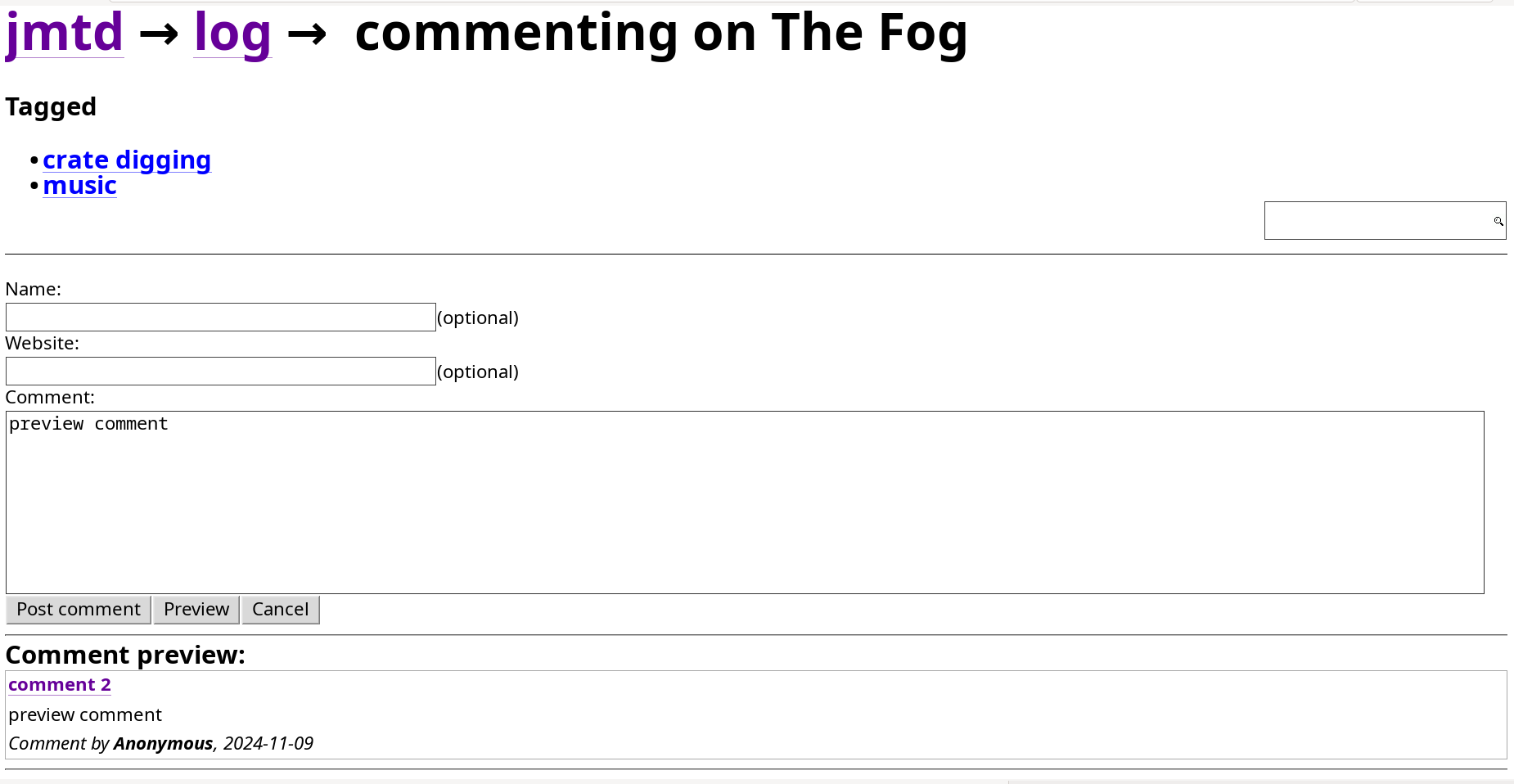
The old Preview Comment page The old Preview Comment page
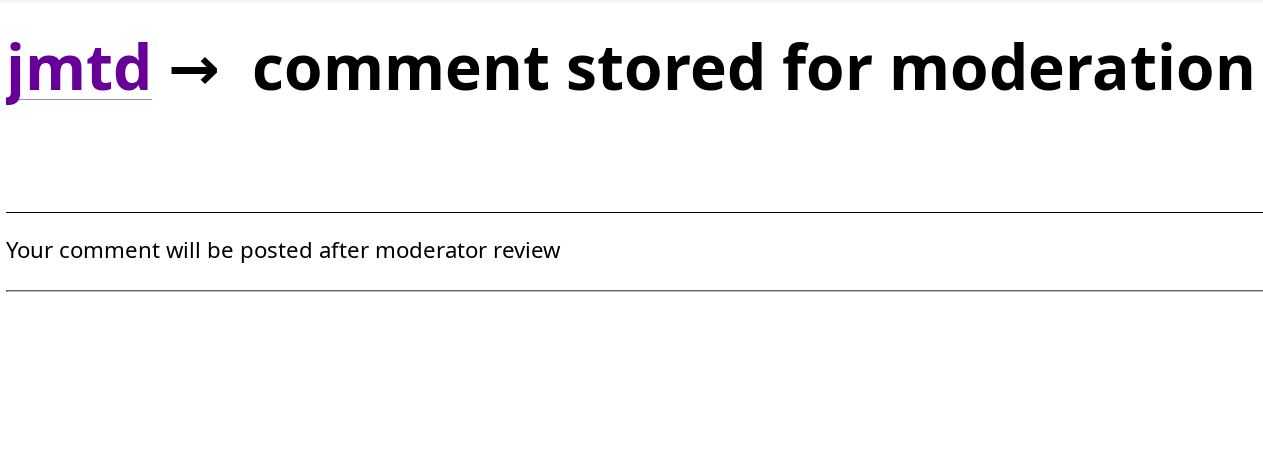
In the traditional workflow, clicking on "Preview" loaded a new page containing the edit form (but not the original page or any existing comments) with a rendering of the comment-in-progress below it. I wasn't originally interested in supporting the "Preview" feature, but I needed to for reasons I'll explain later. Rather than load new pages, I wanted "Preview" to insert a rendering of the comment-in-progress being inserted into the current page's list of comments, marked up to indicate that it's a preview. IkiWiki provides some templates which you can override to customise your site. I've long overridden page.tmpl, the template used for all pages. I needed to add a new empty div tag in order to have a "hook" to target with the previewed comment. The rest of this was achieved with htmx attributes on the "Preview" button, similar to in the last step: hx-post to define a target URI when you click the button (and specify HTTP POST); hx-select to filter the resulting HTML and extract the comment; hx-target to specify where to insert it. Now, clicking "Preview" does not leave the current page, but fetches a rendering of your comment-in-progress, and splices it into the comment list, appropriately marked up to be clear it's a preview. Third step: handling submitted comments IkiWiki is highly configurable, and many different things could happen once you post a comment. On my personal blog, all comments are held for moderation before they are published. The page you were served after submitting a comment was rather bare-bones, a status message "Your comment will be posted after moderator review", without the original page content or comments. I wanted your comment to appear in the page immediately, albeit marked up to indicate it was awaiting review. Since the traditional workflow didn't render or present your comment to you, I had to cheat. handling moderated comments
Moderation message upon submitting a comment Moderation message upon submitting a comment
One of my goals with this project was not to modify IkiWiki itself. I had to break this rule for moderated comments. When returning the "comment is moderated" page, IkiWiki uses HTTP status code 200, the same as for other scenarios. I wrote a tiny patch to return HTTP 202 (Accepted, but not processed) instead. I now have to write some actual JavaScript. htmx emits the htmx:beforeSwap event after an AJAX call returns, but before the corresponding swap is performed. I wrote a function that is triggered on this event, filters for HTTP 202 responses, triggers the "Preview" button, and then alters the result to indicate a moderated, rather than previewed, comment. (That's why I bothered to implement previews). You can read the full function here: jon.js. Summary I've done barely any front-end web development for years and I found working with htmx to be an enjoyable experience. You can leave a comment on this very blog post if you want to see it in action. I couldn't resist adding an easter egg: Brownie points if you can figure out what it is. Adding htmx to an existing CGI-based website let me improve one of the workflows in a gracefully-degrading way (without JavaScript, the old method will continue to work fine) without modifying the existing application itself (well, almost) and without having to write very much code of my own at all: nearly all of the configuration was declarative.

6 November 2024

Bits from Debian: Bits from the DPL

Dear Debian community, this is Bits from DPL for October. In addition to a summary of my recent activities, I aim to include newsworthy developments within Debian that might be of interest to the broader community. I believe this provides valuable insights and foster a sense of connection across our diverse projects. Also, I welcome your feedback on the format and focus of these Bits, as community input helps shape their value. Ada Lovelace Day 2024 As outlined in my platform, I'm committed to increasing the diversity of Debian developers. I hope the recent article celebrating Ada Lovelace Day 2024 featuring interviews with women in Debian will serve as an inspiring motivation for more women to join our community. MiniDebConf Cambridge This was my first time attending the MiniDebConf in Cambridge, hosted at the ARM building. I thoroughly enjoyed the welcoming atmosphere of both MiniDebCamp and MiniDebConf. It was wonderful to reconnect with people who hadn't made it to the last two DebConfs, and, as always, there was plenty of hacking, insightful discussions, and valuable learning. If you missed the recent MiniDebConf, there's a great opportunity to attend the next one in Toulouse. It was recently decided to include a MiniDebCamp beforehand as well. FTPmaster accepts MRs for DAK At the recent MiniDebConf in Cambridge, I discussed potential enhancements for DAK to make life easier for both FTP Team members and developers. For those interested, the document "Hacking on DAK" provides guidance on setting up a local DAK instance and developing patches, which can be submitted as MRs. As a perfectly random example of such improvements some older MR, "Add commands to accept/reject updates from a policy queue" might give you some inspiration. At MiniDebConf, we compiled an initial list of features that could benefit both the FTP Team and the developer community. While I had preliminary discussions with the FTP Team about these items, not all ideas had consensus. I aim to open a detailed, public discussion to gather broader feedback and reach a consensus on which features to prioritize. Sometimes, packages are rejected not because of DFSG-incompatible licenses but due to other issues that could be resolved within an existing package (as discussed in my DebConf23 BoF, "Chatting with ftpmasters"[1]). During the "Meet the ftpteam" BoF (Log/transcription of the BoF can be found here), for the moment until the MR gets accepted, a new option was proposed for FTP Team members reviewing packages in NEW:

Accept + Bug Report This option would allow a package to enter Debian (in unstable or experimental) with an automatically filed RC bug report. The RC bug would prevent the package from migrating to testing until the issues are addressed. To ensure compatibility with the BTS, which only accepts bug reports for existing packages, a delayed job (24 hours post-acceptance) would file the bug.

When binary package names change, currently the package must go through the NEW queue, which can delay the availability of updated libraries. Allowing such packages to bypass the queue could expedite this process. A configuration option to enable this bypass specifically for uploads to experimental may be useful, as it avoids requiring additional technical review for experimental uploads. Previously, I believed the requirement for binary name changes to pass through NEW was due to a missing feature in DAK, possibly addressable via an MR. However, in discussions with the FTP Team, I learned this is a matter of team policy rather than technical limitation. I haven't found this policy documented, so it may be worth having a community discussion to clarify and reach consensus on how we want to handle binary name changes to get the MR sensibly designed. When a developer requests the removal of a package whether entirely or for specific architectures RM bugs must be filed for the package itself as well as for each package depending on it. It would be beneficial if the dependency tree could be automatically resolved, allowing either:
a) the DAK removal tooling to remove the entire dependency tree
   after prompting the bug report author for confirmation, or
b) the system to auto-generate corresponding bug reports for all
   packages in the dependency tree.
The latter option might be better suited for implementation in an MR for reportbug. However, given the possibility of large-scale removals (for example, targeting specific architectures), having appropriate tooling for this would be very beneficial. In my opinion the proposed DAK enhancements aim to support both FTP Team members and uploading developers. I'd be very pleased if these ideas spark constructive discussion and inspire volunteers to start working on them--possibly even preparing to join the FTP Team. On the topic of ftpmasters: an ongoing discussion with SPI lawyers is currently reviewing the non-US agreement established 22 years ago. Ideally, this review will lead to a streamlined workflow for ftpmasters, removing certain hurdles that were originally put in place due to legal requirements, which were updated in 2021. Contacting teams My outreach efforts to Debian teams have slowed somewhat recently. However, I want to emphasize that anyone from a packaging team is more than welcome to reach out to me directly. My outreach emails aren't following any specific orders--just my own somewhat na ve view of Debian, which I'm eager to make more informed. Recently, I received two very informative responses: one from the Qt/KDE Team, which thoughtfully compiled input from several team members into a shared document. The other was from the Rust Team, where I received three quick, helpful replies one of which included an invitation to their upcoming team meeting. Interesting readings on our mailing lists I consider the following threads on our mailing list some interesting reading and would like to add some comments. Sensible languages for younger contributors Though the discussion on debian-devel about programming languages took place in September, I recently caught up with it. I strongly believe Debian must continue evolving to stay relevant for the future. "Everything must change, so that everything can stay the same." -- Giuseppe Tomasi di Lampedusa, The Leopard I encourage constructive discussions on integrating programming languages in our toolchain that support this evolution. Concerns regarding the "Open Source AI Definition" A recent thread on the debian-project list discussed the "Open Source AI Definition". This topic will impact Debian in the future, and we need to reach an informed decision. I'd be glad to see more perspectives in the discussions particularly on finding a sensible consensus, understanding how FTP Team members view their delegated role, and considering whether their delegation might need adjustments for clarity on this issue. Kind regards Andreas.

3 November 2024

Guido G nther: Free Software Activities October 2024

Another short status update of what happened on my side last month. Besides a phosh bugfix release improving text input and selection was a prevalent pattern again resulting in improvements in the compositor, the OSK and some apps. phosh phoc phosh-mobile-settings libphosh-rs phosh-osk-stub phosh-osk-data xdg-desktop-portal-phosh Debian ModemManager Calls GTK feedbackd Chatty libcmatrix phosh-ev git-buildpackage Unified push specification swipeGuess wlr-clients iotas (Note taking app) Flare (Signal app) xdg-desktop-portal Reviews This is not code by me but reviews on other peoples code. The list is fairly incomplete, hope to improve on this in the upcoming months: Help Development If you want to support my work see donations. This includes a list of hardware we want to improve support for. Thanks a lot to all current and past donors.

2 November 2024

Dirk Eddelbuettel: Rcpp 1.0.13-1 on CRAN: Hot Fix

rcpp logo A hot-fix release 1.0.13-1, consisting of two small PRs relative to the last regular CRAN release 1.0.13, just arrived on CRAN. When we prepared 1.0.13, we included a change related to the tightening of the C API of R itself. Sadly, we pinned an expected change to comes with next (minor) release 4.4.2 rather than now next (normal aka major) release 4.5.0 . And now that R 4.4.2 is out (as of two days ago) we accidentally broke building against the header file with that check. Whoops. Bugs happen, and we are truly sorry but this is now addressed in 1.0.13-1. The normal (bi-annual) release cycle will resume with 1.0.14 slated for January. As you can see from the NEWS file of the development branch, we have a number of changes coming. You can safely access that release candidate version, either off the default branch at github or via r-universe artifacts. The list below details all changes, as usual. The only other change concerns the now-mandatory use of Authors@R.

Changes in Rcpp release version 1.0.13-1 (2024-11-01)
  • Changes in Rcpp API:
    • Use read-only VECTOR_PTR and STRING_PTR only with with R 4.5.0 or later (Kevin in #1342 fixing #1341)
  • Changes in Rcpp Deployment:
    • Authors@R is now used in DESCRIPTION as mandated by CRAN

Thanks to my CRANberries, you can also look at a diff to the previous release Questions, comments etc should go to the rcpp-devel mailing list off the R-Forge page. Bugs reports are welcome at the GitHub issue tracker as well (where one can also search among open or closed issues). If you like this or other open-source work I do, you can sponsor me at GitHub.

This post by Dirk Eddelbuettel originated on his Thinking inside the box blog. Please report excessive re-aggregation in third-party for-profit settings.

30 October 2024

Russell Coker: Links October 2024

Dacid Brin wrote an interesting article about AI ecosystems and how humans might work with machines on creative projects [1]. Also he s right about influencers being like funghi. Cory Doctorow wrote an interesting post about DRM, coalitions, and cheating [2]. It seems that people like me who want trusted computing to secure their own computers don t fit well in any of the coalitions. The CHERI capability system for using extra hardware to validate jump addresses is an interesting advance in computer science [3]. The lecture is froim the seL4 Summit, this sort of advance in security goes well with a formally proven microkernel. I hope that this becomes a checkbox when ordering a custom RISC-V design. Bunnie wrote an insightful blog post about how the Mossad might have gone about implementing the exploding pager attack [4]. I guess we will see a lot more of this in future, it seems easy to do. Interesting blog post about Control Flow Integrity in the V8 engine of Chrome [5]. Interesting blog post about the new mseal() syscall which can be used by CFI among other things [6]. This is the Linux kernel documentation about the Control-flow Enforcement Technology (CET) Shadow Stack [7]. Unfortunately not enabled in Debian/Unstable yet. ARM added support for Branch Target Identification in version 8.5 of the architecture [8]. The CEO of Automatic has taken his dispute with WPEngine to an epic level, this video catalogues it, I wonder what is wrong with him [9]. NuShell is an interesting development in shell technology which runs on Linux and Windows [10]. Interesting article about making a computer game without coding using ML [11]. I doubt that it would be a good game, but maybe educational for kids. Krebs has an insightful article about location tracking by phones which is surprisingly accurate [12]. He has provided information on how to opt out of some of it on Android, but we need legislative action! Interesting YouTube video about how to make a 20kW microwave oven and what it can do [13]. Don t do this at home, or anywhere else! The Void editor is an interesting project, a fork of VSCode that supports DIRECT connections to LLM systems where you don t have their server acting as a middle-man and potentially snooping [14].

25 October 2024

Jonathan Dowland: Behringer Model-D (synths I didn't buy)

Whilst researching what synth to buy, I learned of the Behringer1 Model-D2: a 2018 clone of the 1970 Moog Minimoog, in a desktop form factor.
Behringer Model-D Behringer Model-D
In common with the original Minimoog, it's a monophonic analogue synth, featuring three audible oscillators3 , Moog's famous 12-ladder filter and a basic envelope generator. The model-d has lost the keyboard from the original and added some patch points for the different stages, enabling some slight re-routing of the audio components.
1970 Moog Minimoog 1970 Moog Minimoog
Since I was focussing on more fundamental, back-to-basics instruments, this was very appealing to me. I'm very curious to find out what's so compelling about the famous Moog sound. The relative lack of features feels like an advantage: less to master. The additional patch points makes it a little more flexible and offer a potential gateway into the world of modular synthesis. The Model-D is also very affordable: about 200 GBP. I'll never own a real Moog. For this to work, I would need to supplement it with some other equipment. I'd need a keyboard (or press the Micron into service as a controller); I would want some way of recording and overdubbing (same as with any synth). There are no post-mix effects on the Model-D, such as delay, reverb or chorus, so I may also want something to add those. What stopped me was partly the realisation that there was little chance that a perennial beginner, such as I, could eek anything novel out of a synthesiser design that's 54 years old. Perhaps that shouldn't matter, but it gave me pause. Whilst the Model-D has patch points, I don't have anything to connect to them, and I'm firmly wanting to avoid the Modular Synthesis money pit. The lack of effects, and polyphony could make it hard to live-sculpt a tone. I started characterizing the Model-D as the "heart" choice, but it seemed wise to instead go for a "head" choice. Maybe another day!

  1. There's a whole other blog post of material I could write about Behringer and their clones of classic synths, some long out of production, and others, not so much. But, I decided to skip on that for now.
  2. taken from the fact that the Minimoog was a productised version of Moog's fourth internal prototype, the model D.
  3. 2 oscillators is more common in modern synths

23 October 2024

Jonathan Dowland: Arturia Microfreak

Arturia Microfreak. [  CC-BY-SA 4](https://commons.wikimedia.org/wiki/File:MicroFreak.jpg) Arturia Microfreak. CC-BY-SA 4
I nearly did, but ultimately I didn't buy an Arturia Microfreak. The Microfreak is a small form factor hybrid synth with a distinctive style. It's priced at the low end of the market and it is overflowing with features. It has a weird 2-octave keyboard which is a stylophone-style capacitive strip rather than weighted keys. It seems to have plenty of controls, but given the amount of features it has, much of that functionality is inevitably buried in menus. The important stuff is front and centre, though. The digital oscillators are routed through an analog filter. The Microfreak gained sampler functionality in a firmware update that surprised and delighted its owners.
I watched a load of videos about the Microfreak, but the above review from musician Stimming stuck in my mind because it made a comparison between the Microfreak and Teenage Engineering's OP-1.
The Teenage Engineering OP-1. The Teenage Engineering OP-1.
I'd been lusting after the OP-1 since it appeared in 2011: a pocket-sized1 music making machine with eleven synthesis engines, a sampler, and less conventional features such as an FM radio, a large colour OLED display, and a four track recorder. That last feature in particular was really appealing to me: I loved the idea of having an all-in-one machine to try and compose music. Even then, I was not keen on involving conventional computers in music making. Of course in many ways it is a very compromised machine. I never did buy a OP-1, and by now they've replaced it with a new model (the OP-1 field) that costs 50% more (but doesn't seem to do 50% more) I'm still not buying one. Framing the Microfreak in terms of the OP-1 made the penny drop for me. The Microfreak doesn't have the four-track functionality, but almost no synth has: I'm going to have to look at something external to provide that. But it might capture a similar sense of fun; it's something I could use on the sofa, in the spare room, on the train, during lunchbreaks at work, etc. On the other hand, I don't want to make the same mistake as with the Micron: too much functionality requiring some experience to understand what you want so you can go and find it in the menus. I also didn't get a chance to audition the unusual keyboard: there's only one music store carrying synths left in Newcastle and they didn't have one. So I didn't buy the Microfreak. Maybe one day in the future once I'm further down the road. Instead, I started to concentrate my search on more fundamental, back-to-basics instruments

  1. Big pockets, mind

20 October 2024

Bits from Debian: Ada Lovelace Day 2024 - Interview with some Women in Debian

Alt Ada Lovelace portrait Ada Lovelace Day was celebrated on October 8 in 2024, and on this occasion, to celebrate and raise awareness of the contributions of women to the STEM fields we interviewed some of the women in Debian. Here we share their thoughts, comments, and concerns with the hope of inspiring more women to become part of the Sciences, and of course, to work inside of Debian. This article was simulcasted to the debian-women mail list. Beatrice Torracca 1. Who are you? I am Beatrice, I am Italian. Internet technology and everything computer-related is just a hobby for me, not my line of work or the subject of my academic studies. I have too many interests and too little time. I would like to do lots of things and at the same time I am too Oblomovian to do any. 2. How did you get introduced to Debian? As a user I started using newsgroups when I had my first dialup connection and there was always talk about this strange thing called Linux. Since moving from DR DOS to Windows was a shock for me, feeling like I lost the control of my machine, I tried Linux with Debian Potato and I never strayed away from Debian since then for my personal equipment. 3. How long have you been into Debian? Define "into". As a user... since Potato, too many years to count. As a contributor, a similar amount of time, since early 2000 I think. My first archived email about contributing to the translation of the description of Debian packages dates 2001. 4. Are you using Debian in your daily life? If yes, how? Yes!! I use testing. I have it on my desktop PC at home and I have it on my laptop. The desktop is where I have a local IMAP server that fetches all the mails of my email accounts, and where I sync and back up all my data. On both I do day-to-day stuff (from email to online banking, from shopping to taxes), all forms of entertainment, a bit of work if I have to work from home (GNU R for statistics, LibreOffice... the usual suspects). At work I am required to have another OS, sadly, but I am working on setting up a Debian Live system to use there too. Plus if at work we start doing bioinformatics there might be a Linux machine in our future... I will of course suggest and hope for a Debian system. 5. Do you have any suggestions to improve women's participation in Debian? This is a tough one. I am not sure. Maybe, more visibility for the women already in the Debian Project, and make the newcomers feel seen, valued and welcomed. A respectful and safe environment is key too, of course, but I think Debian made huge progress in that aspect with the Code of Conduct. I am a big fan of promoting diversity and inclusion; there is always room for improvement. Ileana Dumitrescu (ildumi) 1. Who are you? I am just a girl in the world who likes cats and packaging Free Software. 2. How did you get introduced to Debian? I was tinkering with a computer running Debian a few years ago, and I decided to learn more about Free Software. After a search or two, I found Debian Women. 3. How long have you been into Debian? I started looking into contributing to Debian in 2021. After contacting Debian Women, I received a lot of information and helpful advice on different ways I could contribute, and I decided package maintenance was the best fit for me. I eventually became a Debian Maintainer in 2023, and I continue to maintain a few packages in my spare time. 4. Are you using Debian in your daily life? If yes, how? Yes, it is my favourite GNU/Linux operating system! I use it for email, chatting, browsing, packaging, etc. 5. Do you have any suggestions to improve women's participation in Debian? The mailing list for Debian Women may attract more participation if it is utilized more. It is where I started, and I imagine participation would increase if it is more engaging. Kathara Sasikumar (kathara) 1. Who are you? I'm Kathara Sasikumar, 22 years old and a recent Debian user turned Maintainer from India. I try to become a creative person through sketching or playing guitar chords, but it doesn't work! xD 2. How did you get introduced to Debian? When I first started college, I was that overly enthusiastic student who signed up for every club and volunteered for anything that crossed my path just like every other fresher. But then, the pandemic hit, and like many, I hit a low point. COVID depression was real, and I was feeling pretty down. Around this time, the FOSS Club at my college suddenly became more active. My friends, knowing I had a love for free software, pushed me to join the club. They thought it might help me lift my spirits and get out of the slump I was in. At first, I joined only out of peer pressure, but once I got involved, the club really took off. FOSS Club became more and more active during the pandemic, and I found myself spending more and more time with it. A year later, we had the opportunity to host a MiniDebConf at our college. Where I got to meet a lot of Debian developers and maintainers, attending their talks and talking with them gave me a wider perspective on Debian, and I loved the Debian philosophy. At that time, I had been distro hopping but never quite settled down. I occasionally used Debian but never stuck around. However, after the MiniDebConf, I found myself using Debian more consistently, and it truly connected with me. The community was incredibly warm and welcoming, which made all the difference. 3. How long have you been into Debian? Now, I've been using Debian as my daily driver for about a year. 4. Are you using Debian in your daily life? If yes, how? It has become my primary distro, and I use it every day for continuous learning and working on various software projects with free and open-source tools. Plus, I've recently become a Debian Maintainer (DM) and have taken on the responsibility of maintaining a few packages. I'm looking forward to contributing more to the Debian community Rhonda D'Vine (rhonda) 1. Who are you? My name is Rhonda, my pronouns are she/her, or per/pers. I'm 51 years old, working in IT. 2. How did you get introduced to Debian? I was already looking into Linux because of university, first it was SuSE. And people played around with gtk. But when they packaged GNOME and it just didn't even install I looked for alternatives. A working colleague from back then gave me a CD of Debian. Though I couldn't install from it because Slink didn't recognize the pcmcia drive. I had to install it via floppy disks, but apart from that it was quite well done. And the early GNOME was working, so I never looked back. 3. How long have you been into Debian? Even before I was more involved, a colleague asked me whether I could help with translating the release documentation. That was my first contribution to Debian, for the slink release in early 1999. And I was using some other software before on my SuSE systems, and I wanted to continue to use them on Debian obviously. So that's how I got involved with packaging in Debian. But I continued to help with translation work, for a long period of time I was almost the only person active for the German part of the website. 4. Are you using Debian in your daily life? If yes, how? Being involved with Debian was a big part of the reason I got into my jobs since a long time now. I always worked with maintaining Debian (or Ubuntu) systems. Privately I run Debian on my laptop, with occasionally switching to Windows in dual boot when (rarely) needed. 5. Do you have any suggestions to improve women's participation in Debian? There are factors that we can't influence, like that a lot of women are pushed into care work because patriarchal structures work that way, and don't have the time nor energy to invest a lot into other things. But we could learn to appreciate smaller contributions better, and not focus so much on the quantity of contributions. When we look at longer discussions on mailing lists, those that write more mails actually don't contribute more to the discussion, they often repeat themselves without adding more substance. Through working on our own discussion patterns this could create a more welcoming environment for a lot of people. Sophie Brun (sophieb) 1. Who are you? I'm a 44 years old French woman. I'm married and I have 2 sons. 2. How did you get introduced to Debian? In 2004 my boyfriend (now my husband) installed Debian on my personal computer to introduce me to Debian. I knew almost nothing about Open Source. During my engineering studies, a professor mentioned the existence of Linux, Red Hat in particular, but without giving any details. I learnt Debian by using and reading (in advance) The Debian Administrator's Handbook. 3. How long have you been into Debian? I've been a user since 2004. But I only started contributing to Debian in 2015: I had quit my job and I wanted to work on something more meaningful. That's why I joined my husband in Freexian, his company. Unlike most people I think, I started contributing to Debian for my work. I only became a DD in 2021 under gentle social pressure and when I felt confident enough. 4. Are you using Debian in your daily life? If yes, how? Of course I use Debian in my professional life for almost all the tasks: from administrative tasks to Debian packaging. I also use Debian in my personal life. I have very basic needs: Firefox, LibreOffice, GnuCash and Rhythmbox are the main applications I need. Sruthi Chandran (srud) 1. Who are you? A feminist, a librarian turned Free Software advocate and a Debian Developer. Part of Debian Outreach team and DebConf Committee. 2. How did you get introduced to Debian? I got introduced to the free software world and Debian through my husband. I attended many Debian events with him. During one such event, out of curiosity, I participated in a Debian packaging workshop. Just after that I visited a Tibetan community in India and they mentioned that there was no proper Tibetan font in GNU/Linux. Tibetan font was my first package in Debian. 3. How long have you been into Debian? I have been contributing to Debian since 2016 and Debian Developer since 2019. 4. Are you using Debian in your daily life? If yes, how? I haven't used any other distro on my laptop since I got introduced to Debian. 5. Do you have any suggestions to improve women's participation in Debian? I was involved with actively mentoring newcomers to Debian since I started contributing myself. I specially work towards reducing the gender gap inside the Debian and Free Software community in general. In my experience, I believe that visibility of already existing women in the community will encourage more women to participate. Also I think we should reintroduce mentoring through debian-women. T ssia Cam es Ara jo (tassia) 1. Who are you? T ssia Cam es Ara jo, a Brazilian living in Canada. I'm a passionate learner who tries to push myself out of my comfort zone and always find something new to learn. I also love to mentor people on their learning journey. But I don't consider myself a typical geek. My challenge has always been to not get distracted by the next project before I finish the one I have in my hands. That said, I love being part of a community of geeks and feel empowered by it. I love Debian for its technical excellence, and it's always reassuring to know that someone is taking care of the things I don't like or can't do. When I'm not around computers, one of my favorite things is to feel the wind on my cheeks, usually while skating or riding a bike; I also love music, and I'm always singing a melody in my head. 2. How did you get introduced to Debian? As a student, I was privileged to be introduced to FLOSS at the same time I was introduced to computer programming. My university could not afford to have labs in the usual proprietary software model, and what seemed like a limitation at the time turned out to be a great learning opportunity for me and my colleagues. I joined this student-led initiative to "liberate" our servers and build LTSP-based labs - where a single powerful computer could power a few dozen diskless thin clients. How revolutionary it was at the time! And what an achievement! From students to students, all using Debian. Most of that group became close friends; I've married one of them, and a few of them also found their way to Debian. 3. How long have you been into Debian? I first used Debian in 2001, but my first real connection with the community was attending DebConf 2004. Since then, going to DebConfs has become a habit. It is that moment in the year when I reconnect with the global community and my motivation to contribute is boosted. And you know, in 20 years I've seen people become parents, grandparents, children grow up; we've had our own child and had the pleasure of introducing him to the community; we've mourned the loss of friends and healed together. I'd say Debian is like family, but not the kind you get at random once you're born, Debian is my family by choice. 4. Are you using Debian in your daily life? If yes, how? These days I teach at Vanier College in Montr al. My favorite course to teach is UNIX, which I have the pleasure of teaching mostly using Debian. I try to inspire my students to discover Debian and other FLOSS projects, and we are happy to run a FLOSS club with participation from students, staff and alumni. I love to see these curious young minds put to the service of FLOSS. It is like recruiting soldiers for a good battle, and one that can change their lives, as it certainly did mine. 5. Do you have any suggestions to improve women's participation in Debian? I think the most effective way to inspire other women is to give visibility to active women in our community. Speaking at conferences, publishing content, being vocal about what we do so that other women can see us and see themselves in those positions in the future. It's not easy, and I don't like being in the spotlight. It took me a long time to get comfortable with public speaking, so I can understand the struggle of those who don't want to expose themselves. But I believe that this space of vulnerability can open the way to new connections. It can inspire trust and ultimately motivate our next generation. It's with this in mind that I publish these lines. Another point we can't neglect is that in Debian we work on a volunteer basis, and this in itself puts us at a great disadvantage. In our societies, women usually take a heavier load than their partners in terms of caretaking and other invisible tasks, so it is hard to afford the free time needed to volunteer. This is one of the reasons why I bring my son to the conferences I attend, and so far I have received all the support I need to attend DebConfs with him. It is a way to share the caregiving burden with our community - it takes a village to raise a child. Besides allowing us to participate, it also serves to show other women (and men) that you can have a family life and still contribute to Debian. My feeling is that we are not doing super well in terms of diversity in Debian at the moment, but that should not discourage us at all. That's the way it is now, but that doesn't mean it will always be that way. I feel like we go through cycles. I remember times when we had many more active female contributors, and I'm confident that we can improve our ratio again in the future. In the meantime, I just try to keep going, do my part, attract those I can, reassure those who are too scared to come closer. Debian is a wonderful community, it is a family, and of course a family cannot do without us, the women. These interviews were conducted via email exchanges in October, 2024. Thanks to all the wonderful women who participated in this interview. We really appreciate your contributions in Debian and to Free/Libre software.

15 October 2024

Andrew Cater: Mini-DebConf Cambridge 20241013 1300

LATE NEWS I haven't blogged until now: I should have done from Thursday onwards.

It's a joy to be here in Cambridge at ARM HQ. Lots of people I recognise from last year here: lots *not* here because this mini-conference is a month before the next one in Toulouse and many people can't attend both.

Two days worth of chatting, working on bits and pieces, chatting and informal meetings was a very good and useful way to build relationships and let teams find some space for themselves.

Lots of quiet hacking going on - a few loud conversations. A new ARM machine in mini-ITX format - see Steve McIntyre's blog on planet.debian.org about Rock 5 ITX.

Two days worth of talks for Saturday and Sunday. For some people, this is a first time. Lightning talks are particularly good to break down barriers - three slides and five minutes (and the chance for a bit of gamesmanship to break the rules creatively).

Longer talks: a couple from Steve Capper of ARM were particularly helpful to those interested in upcoming development. A couple of the talks in the schedule are traditional: if the release team are here, they tell us what they are doing, for example.

ARM are main sponsors and have been very generous in giving us conference and facilities space. Fast network, coffee and interested people - what's not to like :)[EDIT/UPDATE - And my talk is finished and went fairly well: slides have now been uploaded and the talk is linked from the Mini-DebConf pages]

11 October 2024

Steve McIntyre: Rock 5 ITX

It's been a while since I've posted about arm64 hardware. The last machine I spent my own money on was a SolidRun Macchiatobin, about 7 years ago. It's a small (mini-ITX) board with a 4-core arm64 SoC (4 * Cortex-A72) on it, along with things like a DIMM socket for memory, lots of networking, 3 SATA disk interfaces. The Macchiatobin was a nice machine compared to many earlier systems, but it took quite a bit of effort to get it working to my liking. I replaced the on-board U-Boot firmware binary with an EDK2 build, and that helped. After a few iterations we got a new build including graphical output on a PCIe graphics card. Now it worked much more like a "normal" x86 computer. I still have that machine running at home, and it's been a reasonably reliable little build machine for arm development and testing. It's starting to show its age, though - the onboard USB ports no longer work, and so it's no longer useful for doing things like installation testing. :-/ So... I was involved in a conversation in the #debian-arm IRC channel a few weeks ago, and diederik suggested the Radxa Rock 5 ITX. It's another mini-ITX board, this time using a Rockchip RK3588 CPU. Things have moved on - the CPU is now an 8-core big.LITTLE config: 4*Cortex A76 and 4*Cortex A55. The board has NVMe on-board, 4*SATA, built-in Mali graphics from the CPU, soldered-on memory. Just about everything you need on an SBC for a small low-power desktop, a NAS or whatever. And for about half the price I paid for the Macchiatobin. I hit "buy" on one of the listed websites. :-) A few days ago, the new board landed. I picked the version with 24GB of RAM and bought the matching heatsink and fan. I set it up in an existing case borrowed from another old machine and tried the Radxa "Debian" build. All looked OK, but I clearly wasn't going to stay with that. Onwards to running a native Debian setup! I installed an EDK2 build from https://github.com/edk2-porting/edk2-rk3588 onto the onboard SPI flash, then rebooted with a Debian 12.7 (Bookworm) arm64 installer image on a USB stick. How much trouble could this be? I was shocked! It Just Worked (TM) I'm running a standard Debian arm64 system. The graphical installer ran just fine. I installed onto the NVMe, adding an Xfce desktop for some simple tests. Everything Just Worked. After many years of fighting with a range of different arm machines (from simple SBCs to desktops and servers), this was without doubt the most straightforward setup I've ever done. Wow! It's possible to go and spend a lot of money on an Ampere machine, and I've seen them work well too. But for a hobbyist user (or even a smaller business), the Rock 5 ITX is a lovely option. Total cost to me for the board with shipping fees, import duty, etc. was just over 240. That's great value, and I can wholeheartedly recommend this board! The two things that are missing compared to the Macchiatobin? This is soldered-on memory (but hey, 24G is plenty for me!) It also doesn't have a PCIe slot, but it has sufficient onboard network, video and storage interfaces that I think it will cover most people's needs. Where's the catch? It seems these are very popular right now, so it can be difficult to find these machines in stock online. FTAOD, I should also point out: I bought this machine entirely with my own money, for my own use for development and testing. I've had no contact with the Radxa or Rockchip folks at all here, I'm just so happy with this machine that I've felt the need to shout about it! :-) Here's some pictures... Rock 5 ITX top view Rock 5 ITX back panel view Rock 5 EDK2 startuo Rock 5 xfce login Rock 5 ITX running Firefox
Freexian Collaborators: Monthly report about Debian Long Term Support, September 2024 (by Roberto C. S nchez)

Like each month, have a look at the work funded by Freexian s Debian LTS offering.

Debian LTS contributors In September, 18 contributors have been paid to work on Debian LTS, their reports are available:
  • Abhijith PA did 7.0h (out of 0.0h assigned and 14.0h from previous period), thus carrying over 7.0h to the next month.
  • Adrian Bunk did 51.75h (out of 9.25h assigned and 55.5h from previous period), thus carrying over 13.0h to the next month.
  • Arturo Borrero Gonzalez did 10.0h (out of 0.0h assigned and 10.0h from previous period).
  • Bastien Roucari s did 20.0h (out of 20.0h assigned).
  • Ben Hutchings did 20.0h (out of 12.0h assigned and 12.0h from previous period), thus carrying over 4.0h to the next month.
  • Chris Lamb did 18.0h (out of 18.0h assigned).
  • Daniel Leidert did 23.0h (out of 26.0h assigned), thus carrying over 3.0h to the next month.
  • Emilio Pozuelo Monfort did 23.5h (out of 22.25h assigned and 37.75h from previous period), thus carrying over 36.5h to the next month.
  • Guilhem Moulin did 22.25h (out of 20.0h assigned and 2.5h from previous period), thus carrying over 0.25h to the next month.
  • Lucas Kanashiro did 10.0h (out of 5.0h assigned and 15.0h from previous period), thus carrying over 10.0h to the next month.
  • Markus Koschany did 40.0h (out of 40.0h assigned).
  • Ola Lundqvist did 6.5h (out of 14.5h assigned and 9.5h from previous period), thus carrying over 17.5h to the next month.
  • Roberto C. S nchez did 24.75h (out of 21.0h assigned and 3.75h from previous period).
  • Santiago Ruano Rinc n did 19.0h (out of 19.0h assigned).
  • Sean Whitton did 0.75h (out of 4.0h assigned and 2.0h from previous period), thus carrying over 5.25h to the next month.
  • Sylvain Beucler did 16.0h (out of 42.0h assigned and 18.0h from previous period), thus carrying over 44.0h to the next month.
  • Thorsten Alteholz did 11.0h (out of 11.0h assigned).
  • Tobias Frost did 17.0h (out of 7.5h assigned and 9.5h from previous period).

Evolution of the situation In September, we have released 52 DLAs. September marked the first full month of Debian 11 bullseye under the responsibility of the LTS Team and the team immediately got to work, publishing more than 4 dozen updates. Some notable updates include ruby2.7 (denial-of-service, information leak, and remote code execution), git (various arbitrary code execution vulnerabilities), firefox-esr (multiple issues), gnutls28 (information disclosure), thunderbird (multiple issues), cacti (cross site scripting and SQL injection), redis (unauthorized access, denial of service, and remote code execution), mariadb-10.5 (arbitrary code execution), cups (arbitrary code execution). Several LTS contributors have also contributed package updates which either resulted in a DSA (a Debian Security Announcement, which applies to Debian 12 bookworm) or in an upload that will be published at the next stable point release of Debian 12 bookworm. This list of packages includes cups, cups-filters, booth, nghttp2, puredata, python3.11, sqlite3, and wireshark. This sort of work, contributing fixes to newer Debian releases (and sometimes even to unstable), helps to ensure that upgrades from a release in the LTS phase of its lifecycle to a newer release do not expose users to vulnerabilities which have been closed in the older release. Looking beyond Debian, LTS contributor Bastien Roucari s has worked with the upstream developers of apache2 to address regressions introduced upstream by some recent vulnerability fixes and he has also reached out to the community regarding a newly discovered security issue in the dompurify package. LTS contributor Santiago Ruano Rinc n has undertaken the work of triaging and reproducing nearly 4 dozen CVEs potentially affecting the freeimage package. The upstream development of freeimage appears to be dormant and some of the issues have languished for more than 5 years. It is unclear how much can be done without the aid of upstream, but we will do our best to provide as much help to the community as we can feasibly manage. Finally, it is sometimes necessary to limit or discontinue support for certain packages. The transition of a release from being under the responsibility of the Debian Security Team to that of the LTS Team is an occasion where we assess any pending decisions in this area and formalize them. Please see the announcement for a complete list of packages which have been designated as unsupported.

Thanks to our sponsors Sponsors that joined recently are in bold.

10 October 2024

Freexian Collaborators: Debian Contributions: Packaging Pydantic v2, Reworking of glib2.0 for cross bootstrap, Python archive rebuilds and more! (by Anupa Ann Joseph)

Debian Contributions: 2024-09 Contributing to Debian is part of Freexian s mission. This article covers the latest achievements of Freexian and their collaborators. All of this is made possible by organizations subscribing to our Long Term Support contracts and consulting services.

Pydantic v2, by Colin Watson Pydantic is a useful library for validating data in Python using type hints: Freexian uses it in a number of projects, including Debusine. Its Debian packaging had been stalled at 1.10.17 in testing for some time, partly due to needing to make sure everything else could cope with the breaking changes introduced in 2.x, but mostly due to needing to sort out packaging of its new Rust dependencies. Several other people (notably Alexandre Detiste, Andreas Tille, Drew Parsons, and Timo R hling) had made some good progress on this, but nobody had quite got it over the line and it seemed a bit stuck. Colin upgraded a few Rust libraries to new upstream versions, packaged rust-jiter, and chased various failures in other packages. This eventually allowed getting current versions of both pydantic-core and pydantic into testing. It should now be much easier for us to stay up to date routinely.

Reworking of glib2.0 for cross bootstrap, by Helmut Grohne Simon McVittie (not affiliated with Freexian) earlier restructured the libglib2.0-dev such that it would absorb more functionality and in particular provide tools for working with .gir files. Those tools practically require being run for their host architecture (practically this means running under qemu-user) which is at odds with the requirements of architecture cross bootstrap. The qemu requirement was expressed in package dependencies and also made people unhappy attempting to use libglib2.0-dev for i386 on amd64 without resorting to qemu. The use of qemu in architecture bootstrap is particularly problematic as it tends to not be ready at the time bootstrapping is needed. As a result, Simon proposed and implemented the introduction of a libgio-2.0-dev package providing a subset of libglib2.0-dev that does not require qemu. Packages should continue to use libglib2.0-dev in their Build-Depends unless involved in architecture bootstrap. Helmut reviewed and tested the implementation and integrated the necessary changes into rebootstrap. He also prepared a patch for libverto to use the new package and proposed adding forward compatibility to glib2.0. Helmut continued working on adding cross-exe-wrapper to architecture-properties and implemented autopkgtests later improved by Simon. The cross-exe-wrapper package now provides a generic mechanism to a program on a different architecture by using qemu when needed only. For instance, a dependency on cross-exe-wrapper:i386 provides a i686-linux-gnu-cross-exe-wrapper program that can be used to wrap an ELF executable for the i386 architecture. When installed on amd64 or i386 it will skip installing or running qemu, but for other architectures qemu will be used automatically. This facility can be used to support cross building with targeted use of qemu in cases where running host code is unavoidable as is the case for GObject introspection. This concludes the joint work with Simon and Niels Thykier on glib2.0 and architecture-properties resolving known architecture bootstrap regressions arising from the glib2.0 refactoring earlier this year.

Analyzing binary package metadata, by Helmut Grohne As Guillem Jover (not affiliated with Freexian) continues to work on adding metadata tracking to dpkg, the question arises how this affects existing packages. The dedup.debian.net infrastructure provides an easy playground to answer such questions, so Helmut gathered file metadata from all binary packages in unstable and performed an explorative analysis. Some results include: Guillem also performed a cursory analysis and reported other problem categories such as mismatching directory permissions for directories installed by multiple packages and thus gained a better understanding of what consistency checks dpkg can enforce.

Python archive rebuilds, by Stefano Rivera Last month Stefano started to write some tooling to do large-scale rebuilds in debusine, starting with finding packages that had already started to fail to build from source (FTBFS) due to the removal of setup.py test. This month, Stefano did some more rebuilds, starting with experimental versions of dh-python. During the Python 3.12 transition, we had added a dependency on python3-setuptools to dh-python, to ease the transition. Python 3.12 removed distutils from the stdlib, but many packages were expecting it to still be available. Setuptools contains a version of distutils, and dh-python was a convenient place to depend on setuptools for most package builds. This dependency was never meant to be permanent. A rebuild without it resulted in mass-filing about 340 bugs (and around 80 more by mistake). A new feature in Python 3.12, was to have unittest s test runner exit with a non-zero return code, if no tests were run. We added this feature, to be able to detect tests that are not being discovered, by mistake. We are ignoring this failure, as we wouldn t want to suddenly cause hundreds of packages to fail to build, if they have no tests. Stefano did a rebuild to see how many packages were affected, and found that around 1000 were. The Debian Python community has not come to a conclusion on how to move forward with this. As soon as Python 3.13 release candidate 2 was available, Stefano did a rebuild of the Python packages in the archive against it. This was a more complex rebuild than the others, as it had to be done in stages. Many packages need other Python packages at build time, typically to run tests. So transitions like this involve some manual bootstrapping, followed by several rounds of builds. Not all packages could be tested, as not all their dependencies support 3.13 yet. The result was around 100 bugs in packages that need work to support Python 3.13. Many other packages will need additional work to properly support Python 3.13, but being able to build (and run tests) is an important first step.

Miscellaneous contributions
  • Carles prepared the update of python-pyaarlo package to a new upstream release.
  • Carles worked on updating python-ring-doorbell to a new upstream release. Unfinished, pending to package a new dependency python3-firebase-messaging RFP #1082958 and its dependency python3-http-ece RFP #1083020.
  • Carles improved po-debconf-manager. Main new feature is that it can open Salsa merge requests. Aiming for a lightning talk in MiniDebConf Toulouse (November) to be functional end to end and get feedback from the wider public for this proof of concept.
  • Carles helped one translator to use po-debconf-manager (added compatibility for bullseye, fixed other issues) and reviewed 17 package templates.
  • Colin upgraded the OpenSSH packaging to 9.9p1.
  • Colin upgraded the various YubiHSM packages to new upstream versions, enabled more tests, fixed yubihsm-shell build failures on some 32-bit architectures, made yubihsm-shell build reproducibly, and fixed yubihsm-connector to apply udev rules to existing devices when the package is installed. As usual, bookworm-backports is up to date with all these changes.
  • Colin fixed quite a bit of fallout from setuptools 72.0.0 removing setup.py test, backported a large upstream patch set to make buildbot work with SQLAlchemy 2.0, and upgraded 25 other Python packages to new upstream versions.
  • Enrico worked with Jakob Haufe to get him up to speed for managing sso.debian.org
  • Rapha l did remove spam entries in the list of teams on tracker.debian.org (see #1080446), and he applied a few external contributions, fixing a rendering issue and replacing the DDPO link with a more useful alternative. He also gave feedback on a couple of merge requests that required more work. As part of the analysis of the underlying problem, he suggested to the ftpmasters (via #1083068) to auto-reject packages having the too-many-contacts lintian error, and he raised the severity of #1076048 to serious to actually have that 4 year old bug fixed.
  • Rapha l uploaded zim and hamster-time-tracker to fix issues with Python 3.12 getting rid of setuptools. He also uploaded a new gnome-shell-extension-hamster to cope with the upcoming transition to GNOME 47.
  • Helmut sent seven patches and sponsored one upload for cross build failures.
  • Helmut uploaded a Nagios/Icinga plugin check-smart-attributes for monitoring the health of physical disks.
  • Helmut collaborated on sbuild reviewing and improving a MR for refactoring the unshare backend.
  • Helmut sent a patch fixing coinstallability of gcc-defaults.
  • Helmut continued to monitor the evolution of the /usr-move. With more and more key packages such as libvirt or fuse3 fixed. We re moving into the boring long-tail of the transition.
  • Helmut proposed updating the meson buildsystem in debhelper to use env2mfile.
  • Helmut continued to update patches maintained in rebootstrap. Due to the work on glib2.0 above, rebootstrap moves a lot further, but still fails for any architecture.
  • Santiago reviewed some Merge Request in Salsa CI, such as: !478, proposed by Otto to extend the information about how to use additional runners in the pipeline and !518, proposed by Ahmed to add support for Ubuntu images, that will help to test how some debian packages, including the complex MariaDB are built on Ubuntu. Santiago also prepared !545, which will make the reprotest job more consistent with the result seen on reproducible-builds.
  • Santiago worked on different tasks related to DebConf 25. Especially he drafted the fundraising brochure (which is almost ready).
  • Thorsten Alteholz uploaded package libcupsfilter to fix the autopkgtest and a dependency problem of this package. After package splix was abandoned by upstream and OpenPrinting.org adopted its maintenance, Thorsten uploaded their first release.
  • Anupa published posts on the Debian Administrators group in LinkedIn and moderated the group, one of the tasks of the Debian Publicity Team.
  • Anupa helped organize DebUtsav 2024. It had over 100 attendees with hand-on sessions on making initial contributions to Linux Kernel, Debian packaging, submitting documentation to Debian wiki and assisting Debian Installations.

Next.

Previous.