Search Results: "oku"

19 June 2011

Leo 'costela' Antunes: Importing an Outlook PST into IMAP

Well, every once in a while we re forced to do something that isn t particularly interesting or pleasant. Last week it happened again: I had to import a few pretty big PSTs (most 2Gig, one 10Gig, with about 100.000 emails) into our dovecot IMAP. Doing this with Outlook itself was out of the question: it took way too long, even on the local network (many hours for a 1G file) and was prone to hanging and crashes, which were obviously a pain to debug and start over.
Thunderbird was unfortunately not much better, since at least in our tests it didn t import the read status of the emails (they were all marked as unread) and also wasn t particularly good at handling folders with strange names, containing . , / or some more obscure characters. We had used it before for smaller files, where manually dealing with the problems was acceptable, but this time it required something a bit more elaborate, if we were to keep our sanity. Enter libpst. It includes the handy readpst utility which dumps all emails in usable formats in a directory tree, one directory per folder. Unfortunately the Debian version is somewhat outdated and doesn t support the newer Outlook formats, so I did some packaging and even a little bit of patching. It seems Thunderbird also uses this library, which would explain why it didn t handle the Read-Status (haven t confirmed this though; just read it somewhere). The last step was this not-so-little script, which uses the dumped directories from readpst and imports them in IMAP. It would have probably been a bit more elegant to use libpst directly, but I unfortunately didn t have the time to mess around with that. I did have to mess around a lot with encodings though, ergo the unholy chaos with unicode()s and str.encode()s thrown around like rice at a wedding (I could never really wrap my head around charset problems; the subject boggles my mind to this very day).
#!/usr/bin/env python2.7
#-*- encoding: utf-8 -*-
 
import os, sys, time
import re
 
from argparse import ArgumentParser
from getpass import getpass
 
import imaplib
from email.header import decode_header
from mailbox import mbox
 
from twisted.mail import imap4 # for their imap4-utf7 implementation
 
parser = ArgumentParser(description="""Recursively import mbox files in a directory 
                                        structure to an IMAP server.\n
                                        The expected structure is that generated by 
                                        'readpst -r'.""")
parser.add_argument('-s', dest='imap_server', default='localhost', help='IMAP server to import emails to')
parser.add_argument('-u', dest='imap_user', required=True, help='user for logging in to IMAP')
parser.add_argument('-p', dest='imap_passwd', help="will be prompted for if not provided")
parser.add_argument('-c', dest='charset', default='utf8', help='charset in which the folders are stored (for versions older than 2003)')
parser.add_argument('-f', dest='force', action='store_true', help='import mail even if we think it might be a duplicate')
parser.add_argument('-m', dest='mappings', help='a JSON file with mappings between folder names and mailbox names (no slashes or dots)')
parser.add_argument('folder', nargs='+', help="the base folders to import")
 
args = parser.parse_args()
 
if not args.imap_passwd:
    args.imap_passwd = getpass()
 
 
if args.mappings:
    import json
    folderToMailbox = json.load(open(args.mappings,'r'))
else:
    folderToMailbox =   


def mailboxFromPath(path):
    paths = []
    for p in path.split(os.path.sep):
        p = folderToMailbox.get(p, p)
 
        # only other invalid char besides '/', which can't be created by readpst anyway
        p = p.replace('.','')
 
        paths.append(p)
 
    return '.'.join(paths)
 
def imapFlagsFromMbox(flags):
    # libpst only sets R and O
    f = []
    if 'R' in flags or 'O' in flags:
        f.append(r'\Seen')
    if 'D' in flags:
        f.append(r'\Deleted')
    if 'A' in flags:
        f.append(r'\Answered')
    if 'F' in flags:
        f.append(r'\Flagged')
    return '('+' '.join(f)+')'
 
def utf7encode(s):
    return imap4.encoder(s)[0]
 
def headerToUnicode(s):
    h = decode_header(s)[0]
    try:
        if h[1]: # charset != None
            try:
                return unicode(*h)
            except LookupError:
                return unicode(h[0],'utf8','replace')
        else:
            return unicode(h[0], 'utf8')
    except UnicodeDecodeError:
        try:
            return unicode(h[0], 'cp1252') # the usual culprits for malformed headers
        except UnicodeDecodeError:
            pass
 
        try:
            return unicode(h[0], 'latin1') # the usual culprits for malformed headers
        except UnicodeDecodeError:
            pass
 
        return unicode(h[0], 'ascii', 'ignore') # give up...
 
def main():
    imap = imaplib.IMAP4_SSL(args.imap_server)
    imap.login(args.imap_user, args.imap_passwd)
 
    imap.select()
    for base in args.folder:
        print "importing folder "+base
        for root, dirs, files in os.walk(base):
            if 'mbox' in files:
                folder = unicode(os.path.relpath(root, base), args.charset)
                mailbox = mailboxFromPath(folder)
                print u'importing mbox in  0  to  1 '.format(folder, mailbox)
                mailbox_encoded = utf7encode(mailbox)
                m = mbox(os.path.join(root, 'mbox'), create=False)
                for msg in m:
                    if imap.select(mailbox_encoded)[0] != 'OK':
                        print "creating mailbox "+mailbox
                        r = imap.create(mailbox_encoded)
                        if r[0] != 'OK':
                            sys.stderr.write("Could not create mailbox: "+str(r))
                            continue
                        imap.subscribe(mailbox_encoded)
                        imap.select(mailbox_encoded)
 
 
                    # skip possibly duplicated msgs
                    query = 'FROM " 0 " SUBJECT " 1 "'.format(
                                utf7encode(headerToUnicode(msg['from']).replace('"','')),
                                utf7encode(headerToUnicode(msg['subject']).replace('"',r'\"'))
                            )
                    if msg.has_key('date'):
                        query += ' HEADER DATE " 0 "'.format(utf7encode(msg['date']))
                    if msg.has_key('message-id') and msg['message-id']:
                        query += ' HEADER MESSAGE-ID " 0 "'.format(utf7encode(msg['message-id']))
 
                    r = imap.search(None, '( 0 )'.format(query))
                    if r[1][0] and not args.force:
                        print "skipping "+mailbox+": '"+headerToUnicode(msg['subject'])[:20]+"' (mid: "+str(msg['message-id'])+")"
                        continue
 
                    r = imap.append(mailbox_encoded, '', imaplib.Time2Internaldate(time.time()), str(msg))
                    if r[0] != 'OK':
                        sys.stderr.write("failed to import  0  ( 1 ):  2 ".format(msg['message-id'], msg['date'], r[1]))
                        continue
                    num = re.sub(r'.*APPENDUID \d+ (\d+).*', r'\1', r[1][0])
                    r = imap.uid('STORE', str(num), "FLAGS", imapFlagsFromMbox(msg.get_flags()))
 
                    if r[0] != 'OK':
                        sys.stderr.write("failed to set flags for msg  0  in  1 ".format(num, mailbox))
 
    imap.logout()
 
if __name__ == '__main__':
    main()
Another useful automation is using the mappings file, which looks something like
 
"Deleted items": "Trash",
"Sent items": "Sent"
 
to automatically import in the right destinations, in case you have a standardized structure.

10 June 2011

Axel Beckert: How to move a git submodule

If you try to move a git submodule with git mv, you ll get the following error message:
$ git mv old/submodule new/submodule
fatal: source directory is empty, source=old/submodule, destination=new/submodule
There s a patch against git to supoort submodule moving, but it doesn t seem to be applied yet, at least not in the version which is currently in Debian Sid. What worked for me to solve this issue was the following (as posted on StackOverflow):
  1. Edit .gitmodules and change the path of the submodule appropriately, and put it in the index with git add .gitmodules.
  2. If needed, create the parent directory of the new location of the submodule: mkdir new.
  3. Move all content from the old to the new directory: mv -vi old/submodule new/submodule.
  4. Remove the old directory with git rm --cached old/submodule.
Looked like this for me afterwards:
 # On branch master
 # Changes to be committed:
 #   (use "git reset HEAD <file>..." to unstage)
 #
 #       modified:   .gitmodules
 #       renamed:    var/lib/dokuwiki/tpl -> var/lib/dokuwiki/lib/tpl
 #
Finally commit the changes. HTH.

7 June 2011

Lars Wirzenius: TDDD systest tool proof of concept

Continuing my earlier musings about test driven distro development, and the tools that would require. I imagine something like this: We might also want this scenario: There might be other scenarios that would be useful to test as well. Even from these two, it's clear there's a need for at least three separate tools: I've written a rudimentary version of the first tool: vmdebootstrap. I've since learned there's a bunch of others that might also work. There's room for more: someone should write (or find) a tool to make a snapshot of a real system and create a VM image that mimicks it, for example. Anyway, for now, I'll assume that one of the existing tools is good enough to get started. For the second tool, I wrote a quick-and-dirty proof-of-concept thing, see systest.py. Here's a sample of how it might be used:
liw@havelock$ ./systest -v --target 192.168.122.139 --user tomjon
test 1/6: cat
test 2/6: only-ssh-port
ERROR: Assertion failed: ['22/tcp', '139/tcp', '445/tcp'] != ['22/tcp']
[status 1]
liw@havelock$ ./systest -v --target 192.168.122.139 --user tomjon \
    cat ping6-localhost ping-localhost simple-dns-lookup ssh-login
test 1/5: cat
test 2/5: ping6-localhost
test 3/5: ping-localhost
test 4/5: simple-dns-lookup
test 5/5: ssh-login
liw@havelock$ 
The first run failed, because the VM I'm testing against has some extra ports open. Some of the tests will require logging into the machine, via ssh, and for that one needs to specify the user to use. systool may overlap heavily on system monitoring tools, and possibly the production implementation should be based on those. I think it's best to design such a tool for the more general purpose of testing whether a system currently works rather than as an integrated part of a more specific larger tool. This lets the tool be useful for other things than just testing specific things about Debian. (The production implementation would then need to not have all the tests hardcoded, of course. SMOP.) The third tool I have not spent a lot of time on yet. One thing at a time. Given these tools, one would then need to decide how to use them. The easiest way would be to use them like lintian and piuparts: run them frequently on whatever packages happen to be in testing or unstable or experimental, and put links to the test reports to the PTS, and hope that people fix things. That is the easiest way to start things. Once there's a nice set of test cases and scenarios, it may be interesting to think about more aggressive ways: for example, preventing packages from migrating to testing unless the test suite passes with them. If the tests do not pass, one of four things is broken: If things are set up properly, the last one should be rare. The other three always require manual inspection: it is not possible to automatically know whether the test itself, or the code it tests, is at fault. it is, however, enough to know that something is wrong. If the tests are written well, they should be robust enough to not be the culprits very often. (Someone wanting to make a rolling distrbution, or even better, making a monthly mini-release, might benefit from this sort of automated testing.)

3 June 2011

Guillaume Mazoyer: Status report Jigsaw num. 1 for GSoC 2011

code.pngThe beginning of this Google Summer of Code has been busy and pretty cool. Not a lot of code was produced but I did learn a lot of things.

During this GSoC I will work on the next generation JDK. This means that I will (and I already have) compile the JDK. That s pretty awesome but it requires a lot of power. That s why Tom Marble created me an account on his 8 CPUs machine to help me.
Since I m probably going to sign some packages, I created a new GPG key with a 4096 RSA strength.
My old key was:

pub 1024D/F144A319 2008-10-18

And the new key is:

pub 4096R/EE2BBBC7 2011-05-03

I cross signed my keys using this great tutorial.

I read some documentation about Jigsaw and watched Tom s talk at DebConf 10.
I have spent a little more than a week to understand the current OpenJDK packaging to be able to rebuild it. I have learnt from where do the sources come from. The current packaging is a little hard to understand. There are sources that come from IcedTea, OpenJDK, and more.

After being able to rebuild the OpenJDK 6 package, I have downloaded the source of the OpenJDK 8 and Jigsaw. I used the Mercurial forest to get the sources.

For OpenJDK 8:
hg clone http://hg.openjdk.java.net/jdk8/jdk8 jdk8
cd jdk8 && sh get_sources.sh

For Jigsaw:
hg clone http://hg.openjdk.java.net/jigsaw/jigsaw jigsaw
cd jigsaw && sh get_sources.sh

I have managed to build the sources of OpenJDK 8 and Jigsaw using the same steps:
cd jigsaw
. jigbuild
. jdk/make/jdk_generic_profile.sh
export ALLOW_DOWNLOADS=true
make sanity
make all

Jigsaw specific:
make modules-sanity
make modules

Each build took several minutes. But they were successful. Tom helped me a lot to build OpenJDK 8 and Jigsaw by giving me a solution. For example, after getting the Mercurial forest, there were still missing source files and the build failed. Tom told me that I needed to export a environement variable: ALLOW_DOWNLOADS=true.
After building Jigsaw, I was able to see that the version string is not legal in Debian and that is a real problem.
I have written some simple Hello World examples to compile and run with Jigsaw. To modularize a program, it needs to contain a module-info.java files. This file includes the modules needed to run the program and the main class to run. For a classic hello world, the module-info.java files looks like:

module test.hello @ 1
requires jdk.base @ 7-ea;
class test.hello.Main;


Tom gave me some packages to build: jtharness and jtreg. I succesfully built jtharness using CDBS and its Ant helper but I ll have to repackage it to use javahelper instead of CDBS. I still didn t try to build jtreg because it requires jtharness.

My next plan is to get jtharness and jtreg packaged with javahelper soon and understand what modules does what in Jigsaw. Understaning modules will help me to write some more complex examples. I hope to start working on Jigsaw a little more soon (when I my internship will end [next week]).

22 May 2011

Thomas Girard: Introducing CORBA

What is CORBA? The wikipedia page says it all:
The Common Object Request Broker Architecture (CORBA) is a standard
defined by the Object Management Group (OMG) that enables software
components written in mutiple computer languages and running on
multiple computers to work together (i.e., it supports mutiple
platforms).
The standard was created twenty years ago, in 1991. The technology can be used in many programming languages: Python, Java, C++, C, etc. Hence you can write a software in your favorite programming language, exposing services that others will be able to call using a different language. (Nowadays you can do the same with WebServices. This article is about CORBA.) All CORBA specifications are available on [OMGSPEC]; latest version is [CORBA3.1]. [MCHALE] book is a very good way to learn CORBA.
How does it work? CORBA is language agnostic because it relies on its own language: the Interface Definition Language (IDL for short). The IDL defines the contract between the client (software calling the service) and the server (software implementing the service). The service is exposed through a remote object. IDL is used to define:
  • modules, which are called namespaces in C++ (or packages in Java)
  • structs, which are like C structs: they can contain data only (the data part of the contract)
  • interfaces, which contain methods specification (the service part of the contract)
  • exceptions that can be raised by a method
  • typedefs which are type aliases
  • unions, la C
  • enums, enumerations
  • constants
IDL comes with existing types:
  • char, octet
  • string, wstring
  • short, long, long long (signed if unspecified, unsigned if prefixed with unsigned)
  • float, double, long double
  • arrays
  • sequences
  • any which can be any existing or user-defined type
From this contract, the following code will be generated using a dedicated tool:
  • client-side code, called stubs
  • server-side code, called skeletons
So to call a CORBA remote service in a given programming language, we will generate stubs from the IDL, then write code relying on these stubs. To provide a CORBA service in a given progamming language, we will generate skeletons from the IDL, then extend them with our implementation. The dispatching and networking machinery is handled by the Object Request Broker (ORB for short). That's the most important part of the CORBA system: it's the component that hides away remoting aspects to make distant objects appear as if they were embedded within the local, client-side code.
Telecom Log Service example The Telecom Log Service [TLOG] is an OMG specified service that defines two interfaces:
  • Log, to add, search and delete records
  • LogMgr, a Log container to lookup a given log, or list all contained logs
The specification details five sub-interfaces of the log service, grouped into three different approaches:
  • basic implementation. This is the service depicted below.
  • event-based implementation. The Event Service [EVENT] is another CORBA service specification. Combining both services means that software emitting events can be plugged to an Event Log without modification.
  • notify-based implementation. The Notification Service [NOTIF] is another CORBA service specification, built on top of the Event Service, with added filtering facility. Again, combining these two services provide easier integration with existing software.
Here is the UML representation of key base interfaces (in yellow), basic implementation (in blue) and important date structures (in green): http://thomas.g.girard.free.fr/CORBA/tls.png Here is the simplified IDL for these parts:
#include <TimeBase.idl>  // IDL can include each other
#pragma prefix "omg.org" // extra prefix to use in front of type names

// DsLogAdmin definition
// Because of the #pragma prefix above, the complete name of this module
// is omg.org/DsLogAdmin
module DsLogAdmin
 
        // E X C E P T I O N --------------------------------------------------
        exception InvalidGrammar  ;                    // empty exception
        exception InvalidConstraint  ;                 // empty exception
        exception LogFull   short n_records_written;  ; // one attribute
        exception LogOffDuty  ;                        // empty exception
        exception LogLocked  ;                         // empty exception
        exception LogDisabled  ;                       // empty exception

        // T Y P E   A L I A S ------------------------------------------------
        typedef unsigned long LogId;
        typedef sequence<LogId> LogIdList; // LogIdList is a sequence of LogId
        typedef unsigned long long RecordId;
        typedef string Constraint;
        typedef TimeBase::TimeT TimeT; // TimeT type defined in TimeBase module
        typedef sequence<any> Anys;    // Anys is the name of a sequence of any

        // S T R U C T U R E S ------------------------------------------------
        struct NVPair  
                string name;
                any    value;
         ; // <-- Mandatory semi-colon
        typedef sequence<NVPair> NVList; // Give a name to a sequence of NVPair

        struct LogRecord  
                RecordId id;
                TimeT    time;
                NVList   attr_list;
                any      info;
         ;
        typedef sequence<LogRecord> RecordList;
        // I N T E R F A C E S ------------------------------------------------
        // Iterator interface specification
        interface Iterator  
                // get() method:
                // - two input parameters
                // - returning a list of LogRecord
                // - possibly raising InvalidParam exception
                RecordList get(in  unsigned long position,
                               in  unsigned long how_many)
                        raises (InvalidParam);
                void destroy();
         ;  // <-- Mandatory semi-colon

        // Forward declaration
        interface LogMgr;
        interface Log
         
                LogMgr my_factory();
                LogId id();
                // retrieve() method:
                // - two input parameters
                // - one output parameter
                // - returning a list of LogRecord
                // This method will actually return two objects: the
                // RecordList and the Iterator
                RecordList retrieve(in  TimeT from_time,
                                    in  long how_many,
                                    out Iterator i);
                RecordList query(in  string grammar,
                                 in  Constraint c,
                                 out Iterator i)
                        raises (InvalidGrammar, InvalidConstraint);
                unsigned long delete_records(in  string grammar,
                                             in  Constraint c)
                        raises (InvalidGrammar, InvalidConstraint);
                void write_records(in  Anys records) 
                        raises (LogFull, LogOffDuty, LogLocked, LogDisabled);
         ;
        typedef sequence<Log> LogList; // Give name LogList to sequence of Log

        // inteface BasicLog derives from interface Log
        interface BasicLog : Log  
                void destroy();
         ;
        interface LogMgr
         
                LogList list_logs();
                Log find_log(in LogId id);
                LogIdList list_logs_by_id();
         ;
        // inteface BasicLogFactory derives from interface LogMgr
        interface BasicLogFactory : LogMgr
         
                BasicLog create(
                        in  LogFullActionType full_action,
                        in  unsigned long long max_size,
                        out LogId id)
                        raises (InvalidLogFullAction);
                BasicLog create_with_id(
                        in  LogId id,
                        in  LogFullActionType full_action,
                        in  unsigned long long max_size)
                        raises (LogIdAlreadyExists, InvalidLogFullAction);
         ;
 ; // <-- Mandatory semi-colon
The complete IDL file for the Basic Telecom Log Service is available here.
[CORBA3.1] http://www.omg.org/spec/CORBA/3.1/
[MCHALE] http://www.ciaranmchale.com/corba-explained-simply/
[OMGSPEC] http://www.omg.org/technology/documents/spec_catalog.htm#Middleware
[TLOG] http://www.omg.org/spec/TLOG/
[EVENT] http://www.omg.org/spec/EVNT/
[NOTIF] http://www.omg.org/spec/NOT/

16 May 2011

Lars Wirzenius: TDDD, more thoughts

My previous blog entry about Test Driven Distro Development (TDDD) was rather rambling. Here is the condensed version, plus some further thoughts. I would like to automatically determine whether "testing" is minimally ready to be released, at any given point in time. To implement this, I would like to see Debian get tools that would allow us to define specific minimal functionality that should work in a Debian release, and automatically verify that it does. I would like us to use these tools to determine whether a release is ready for release, with manual override from the release team. Ideally, we would use the tools to prevent breakages from moving into "testing", so that it gets closer to always being releasable. Getting test coverage sufficiently high that we can replace the release team's judgement abour releasablity will never happen: Debian is rather too large and and complex for that. However, we can reap much benefit from even relatively small coverage. Here is my initial suggestion for the minimal criteria that should be satisfied, at all times, in "testing". They are aimed at making sure that even if something else breaks, at least the basic stuff works well enough that one can log in and fix things. These are minimal criteria. They're not meant to verify that everything in Debian works. After these work, adding more coverage is not just possible, but reasonably easy in many cases. Want to make sure DNS gets configured right? Write a test that logs in and does a lookup inside the test system. After the tools have evolved, writing a simple test like that should be only a line or two. The tests I am talking here are system tests, or acceptance tests for the whole system, not just for individual packages. Unit tests would test individual functions or methods or classes; integration tests would test groups of them, or possibly entire programs; system tests test groups of programs/packages. The point is not to verify that every package works in every possible case, but that the system as a whole works. Most package-specific functional tests should be part of the package's own test suite. We should also run those, but that's somewhat orthogonal to the vision I'm trying to articulate here. At least the following scenarios should be tested (the above tests should be run after each scenario): It may be useful to run the tests against "unstable" as well as "testing". However, rejecting an upload to "unstable" may be less wise than preventing packages from being copied from "unstable" to "testing". Exactly how this the development processes should adopt TDDD is an interesting question, but a reasonable toolset should be adaptable to anything we want to do. (Indeed, it would be possible to structure the toolset so that it isn't specific to developing a distro: a "system-test" tool that a sysadmin could use to verify that a server works would probably be useful to some people. Perhaps such a tool exists and could be adapted for TDDD?) Running these tests for security updates to "stable" would obviously also be a possibility that should perhaps be considered. Running these tests would happen something like this: I would further like to see Debian make it possible to have isolated branches for development. This would help with, for example, large transitions that take a long time. The transition could be prepared in a branch of its own, and when it's ready to be pushed into unstable, the automatic tests outlined above could be used to verify the transition doesn't break anything too critical. (If the tests fail, the push fails; if necessary, that can be overridden manually, but that should be rare.) In my view, branches would greatly benefit Debian development, but they're not necessary for starting to implement TDDD. My condensed versions are still too long.

12 May 2011

Matthew Palmer: Websites and Accessability

Is there something a little odd about the Deaf Society of NSW having a website with a frontpage, and other rather crucial bits like course information lookup forms, that are built entirely using flash. Given that, as far as I know, screen reading software and flash aren't best of friends? I guess they figure that as long as people are catering to their disability, everyone else can fend for themselves. A slightly more charitable interpretation might be that blind people aren't going to be real keen to learn sign language, but I would have thought that a bit of consideration might be shown, for the purposes of solidarity or something.

11 May 2011

Julian Andres Klode: Project APT2: new cache format and small things

I did not write much code or merge much of my prototype code, but some things happened since the last blog post about APT2 specific things in August and I forgot to write about them. First of all, I dropped the GVariant-based cache. The format strings were simply getting ugly long and were not very understandable, performance was just much too slow (needing more than a few nanoseconds for a package lookup is obviously too slow for solving dependency problems); furthermore, building the cache was also slow and complicated because we needed all attributes of an object at once to pass them to GVariant, leading to ugly API. I replaced the GVariant cache with one that can be easily mmap()ed and is described completely in C. It s derived from APT s cache design (but more robust, as it includes the size of the cache and we can thus detect to small files, although that s scheduled for the next ABI break in APT as well), but has fewer duplicate data, and uses arrays where APT uses linked lists. The reason for arrays is simple: They take up less space and can be represented naturally in Python and other languages using array-based lists. The cache also contains a coalesced hash table which does use a linked list, but that one is a bit different, as it is for searching only and not exposed. Everything non-stringy is 64-bit aligned in order to keep things as simple as possible. All integers are fixed size, thus the format is architecture-independent if you fix byte orders. The format is described at http://people.debian.org/~jak/apt2-doc/apt-Cache-Format.html. I stole one more idea from cupt and changed the configuration system to verify types of variables. APT2 s configuration system knows more types than cupt s, though, including regular expressions, directory and filenames (i.e. it does not let you store a value /d/ in a file variable), strings (which store everything), unsigned and signed integers, and boolean options; all of which are checked when parsing files (producing warnings) or command-line options (producing errors). I have also simplified the type world by removing all iterator types except for one, replacing them with get_thing() and n_things() functions in the objects holding the arrays. Makes cool bindings slightly harder, but makes the C API much easier to use from C. Most things expected from a package manager are still missing, but what is there looks good in most cases (especially AptConfiguration has a nice API, and no complaints from valgrind anywhere). Currently I am working on Python bindings so I can interact with the functions easily and check things in an interactive fashion; and I am also writing a document explaining the concepts behind APT2, drafts at http://people.debian.org/~jak/midlevel.pdf. I also have some more code pending further thoughts (including complete index parsing), but it might still take some time before I have something usable in the wild. On other package managers: From time to time I also use Cupt, look at Cupt code, hack Cupt code, and report bugs against Cupt. I still do not really understand the (extreme) nesting of directory structures in the source code, why there are so (extremely) many source files split all over them, or the general concepts of Cupt, but I can hack together what I need for my personal testing. I also play with yum whenever I end up on a Fedora system (which happens from time to time).
Filed under: APT2

10 May 2011

Ian Wienand: PLT and GOT - the key to code sharing and dynamic libraries

(this post was going to be about something else, but after getting this far, I think it stands on its own as an introduction to dynamic linking) The shared library is an integral part of a modern system, but often the mechanisms behind the implementation are less well understood. There are, of course, many guides to this sort of thing. Hopefully this adds another perspective that resonates with someone. Let's start at the beginning - relocations are entries in binaries that are left to be filled in later -- at link time by the toolchain linker or at runtime by the dynamic linker. A relocation in a binary is a descriptor which essentially says "determine the value of X, and put that value into the binary at offset Y" each relocation has a specific type, defined in the ABI documentation, which describes exactly how "determine the value of" is actually determined. Here's the simplest example:
$ cat a.c
extern int foo;
int function(void)  
    return foo;
 
$ gcc -c a.c 
$ readelf --relocs ./a.o  
Relocation section '.rel.text' at offset 0x2dc contains 1 entries:
 Offset     Info    Type            Sym.Value  Sym. Name
00000004  00000801 R_386_32          00000000   foo
The value of foo is not known at the time you make a.o, so the compiler leaves behind a relocation (of type R_386_32) which is saying "in the final binary, patch the value at offset 0x4 in this object file with the address of symbol foo". If you take a look at the output, you can see at offset 0x4 there are 4-bytes of zeros just waiting for a real address:
$ objdump --disassemble ./a.o
./a.o:     file format elf32-i386
Disassembly of section .text:
00000000 <function>:
   0:	 55			push   %ebp
   1:	 89 e5                	mov    %esp,%ebp
   3:	 a1 00 00 00 00       	mov    0x0,%eax
   8:	 5d                   	pop    %ebp
   9:	 c3                   	ret    
That's link time; if you build another object file with a value of foo and build that into a final executable, the relocation can go away. But there is a whole bunch of stuff for a fully linked executable or shared-library that just can't be resolved until runtime. The major reason, as I shall try to explain, is position-independent code (PIC). When you look at an executable file, you'll notice it has a fixed load address
$ readelf --headers /bin/ls
[...]
ELF Header:
[...]
  Entry point address:               0x8049bb0
Program Headers:
  Type           Offset   VirtAddr   PhysAddr   FileSiz MemSiz  Flg Align
[...]
  LOAD           0x000000 0x08048000 0x08048000 0x16f88 0x16f88 R E 0x1000
  LOAD           0x016f88 0x0805ff88 0x0805ff88 0x01543 0x01543 RW  0x1000
This is not position-independent. The code section (with permissions R E; i.e. read and execute) must be loaded at virtual address 0x08048000, and the data section (RW) must be loaded above that at exactly 0x0805ff88. This is fine for an executable, because each time you start a new process (fork and exec) you have your own fresh address space. Thus it is a considerable time saving to pre-calculate addresses from and have them fixed in the final output (you can make position-independent executables, but that's another story). This is not fine for a shared library (.so). The whole point of a shared library is that applications pick-and-choose random permutations of libraries to achieve what they want. If your shared library is built to only work when loaded at one particular address everything may be fine until another library comes along that was built also using that address. The problem is actually somewhat tractable you can just enumerate every single shared library on the system and assign them all unique address ranges, ensuring that whatever combinations of library are loaded they never overlap. This is essentially what prelinking does (although that is a hint, rather than a fixed, required address base). Apart from being a maintenance nightmare, with 32-bit systems you rapidly start to run out of address-space if you try to give every possible library a unique location. Thus when you examine a shared library, they do not specify a particular base address to be loaded at:
$ readelf --headers /lib/libc.so.6
Program Headers:
  Type           Offset   VirtAddr   PhysAddr   FileSiz MemSiz  Flg Align
[...]
  LOAD           0x000000 0x00000000 0x00000000 0x236ac 0x236ac R E 0x1000
  LOAD           0x023edc 0x00024edc 0x00024edc 0x0015c 0x001a4 RW  0x1000
Shared libraries also have a second goal code sharing. If a hundred processes use a shared library, it makes no sense to have 100 copies of the code in memory taking up space. If the code is completely read-only, and hence never, ever, modified, then every process can share the same code. However, we have the constraint that the shared library must still have a unqiue data instance in each process. While it would be possible to put the library data anywhere we want at runtime, this would require leaving behind relocations to patch the code and inform it where to actually find the data destroying the always read-only property of the code and thus sharability. As you can see from the above headers, the solution is that the read-write data section is always put at a known offset from the code section of the library. This way, via the magic of virtual-memory, every process sees its own data section but can share the unmodified code. All that is needed to access data is some simple maths; address of thing I want = my current address + known fixed offset. Well, simple maths is all relative! "My current address" may or may not be easy to find. Consider the following:
$ cat test.c
static int foo = 100;
int function(void)  
    return foo;
 
$ gcc -fPIC -shared -o libtest.so test.c
So foo will be in data, at a fixed offset from the code in function, and all we need to do is find it! On amd64, this is quite easy, check the disassembly:
000000000000056c <function>:
 56c:		 55			push   %rbp
 56d:		 48 89 e5             	mov    %rsp,%rbp
 570:		 8b 05 b2 02 20 00    	mov    0x2002b2(%rip),%eax        # 200828 <foo>
 576:		 5d                   	pop    %rbp
This says "put the value at offset 0x2002b2 from the current instruction pointer (%rip) into %eax. That's it we know the data is at that fixed offset so we're done. i386, on the other hand, doesn't have the ability to offset from the current instruction pointer. Some trickery is required there:
0000040c <function>:
 40c:	 55			push   %ebp
 40d:	 89 e5                	mov    %esp,%ebp
 40f:	 e8 0e 00 00 00       	call   422 <__i686.get_pc_thunk.cx>
 414:	 81 c1 5c 11 00 00    	add    $0x115c,%ecx
 41a:	 8b 81 18 00 00 00    	mov    0x18(%ecx),%eax
 420:	 5d                   	pop    %ebp
 421:	 c3                   	ret    
00000422 <__i686.get_pc_thunk.cx>:
 422:	 8b 0c 24		mov    (%esp),%ecx
 425:	 c3                   	ret    
The magic here is __i686.get_pc_thunk.cx. The architecture does not let us get the current instruction address, but we can get a known fixed address the value __i686.get_pc_thunk.cx pushes into cx is the return value from the call, i.e in this case 0x414. Then we can do the maths for the add instruction; 0x115c + 0x414 = 0x1570, the final move goes 0x18 bytes past that to 0x1588 ... checking the disassembly
00001588 <global>:
    1588:       64 00 00                add    %al,%fs:(%eax)
i.e., the value 100 in decimal, stored in the data section. We are getting closer, but there are still some issues to deal with. If a shared library can be loaded at any address, then how does an executable, or other shared library, know how to access data or call functions in it? We could, theoretically, load the library and patch up any data references or calls into that library; however as just described this would destroy code-sharability. As we know, all problems can be solved with a layer of indirection, in this case called global offset table or GOT. Consider the following library:
$ cat test.c
extern int foo;
int function(void)  
    return foo;
 
$ gcc -shared -fPIC -o libtest.so test.c
Note this looks exactly like before, but in this case the foo is extern; presumably provided by some other library. Let's take a closer look at how this works, on amd64:
$ objdump --disassemble libtest.so
[...]
00000000000005ac <function>:
 5ac:		 55			push   %rbp
 5ad:		 48 89 e5             	mov    %rsp,%rbp
 5b0:		 48 8b 05 71 02 20 00 	mov    0x200271(%rip),%rax        # 200828 <_DYNAMIC+0x1a0>
 5b7:		 8b 00                	mov    (%rax),%eax
 5b9:		 5d                   	pop    %rbp
 5ba:		 c3                   	retq   
$ readelf --sections libtest.so
Section Headers:
  [Nr] Name              Type             Address           Offset
       Size              EntSize          Flags  Link  Info  Align
[...]
  [20] .got              PROGBITS         0000000000200818  00000818
       0000000000000020  0000000000000008  WA       0     0     8
$ readelf --relocs libtest.so
Relocation section '.rela.dyn' at offset 0x418 contains 5 entries:
  Offset          Info           Type           Sym. Value    Sym. Name + Addend
[...]
000000200828  000400000006 R_X86_64_GLOB_DAT 0000000000000000 foo + 0
The disassembly shows that the value to be returned is loaded from an offset of 0x200271 from the current %rip; i.e. 0x0200828. Looking at the section headers, we see that this is part of the .got section. When we examine the relocations, we see a R_X86_64_GLOB_DAT relocation that says "find the value of symbol foo and put it into address 0x200828. So, when this library is loaded, the dynamic loader will examine the relocation, go and find the value of foo and patch the .got entry as required. When it comes time for the code loads to load that value, it will point to the right place and everything just works; without having to modify any code values and thus destroy code sharability. This handles data, but what about function calls? The indirection used here is called a procedure linkage table or PLT. Code does not call an external function directly, but only via a PLT stub. Let's examine this:
$ cat test.c
int foo(void);
int function(void)  
    return foo();
 
$ gcc -shared -fPIC -o libtest.so test.c
$ objdump --disassemble libtest.so
[...]
00000000000005bc <function>:
 5bc:		 55			push   %rbp
 5bd:		 48 89 e5             	mov    %rsp,%rbp
 5c0:		 e8 0b ff ff ff       	callq  4d0 <foo@plt>
 5c5:		 5d                   	pop    %rbp
$ objdump --disassemble-all libtest.so
00000000000004d0 <foo@plt>:
 4d0:   ff 25 82 03 20 00       jmpq   *0x200382(%rip)        # 200858 <_GLOBAL_OFFSET_TABLE_+0x18>
 4d6:   68 00 00 00 00          pushq  $0x0
 4db:   e9 e0 ff ff ff          jmpq   4c0 <_init+0x18>
$ readelf --relocs libtest.so
Relocation section '.rela.plt' at offset 0x478 contains 2 entries:
  Offset          Info           Type           Sym. Value    Sym. Name + Addend
000000200858  000400000007 R_X86_64_JUMP_SLO 0000000000000000 foo + 0
So, we see that function makes a call to code at 0x4d0. Disassembling this, we see an interesting call, we jump to the value stored in 0x200382 past the current %rip (i.e. 0x200858), which we can then see the relocation for the symbol foo. It is interesting to keep following this through; let's look at the initial value that is jumped to:
$ objdump --disassemble-all libtest.so
Disassembly of section .got.plt:
0000000000200840 <.got.plt>:
  200840:       98                      cwtl   
  200841:       06                      (bad)  
  200842:       20 00                   and    %al,(%rax)
        ...
  200858:       d6                      (bad)  
  200859:       04 00                   add    $0x0,%al
  20085b:       00 00                   add    %al,(%rax)
  20085d:       00 00                   add    %al,(%rax)
  20085f:       00 e6                   add    %ah,%dh
  200861:       04 00                   add    $0x0,%al
  200863:       00 00                   add    %al,(%rax)
  200865:       00 00                   add    %al,(%rax)
        ...
Unscrambling 0x200858 we see its initial value is 0x4d6 i.e. the next instruction! Which then pushes the value 0 and jumps to 0x4c0. Looking at that code we can see it pushes a value from the GOT, and then jumps to a second value in the GOT:
00000000000004c0 <foo@plt-0x10>:
 4c0:   ff 35 82 03 20 00       pushq  0x200382(%rip)        # 200848 <_GLOBAL_OFFSET_TABLE_+0x8>
 4c6:   ff 25 84 03 20 00       jmpq   *0x200384(%rip)        # 200850 <_GLOBAL_OFFSET_TABLE_+0x10>
 4cc:   0f 1f 40 00             nopl   0x0(%rax)
What's going on here? What's actually happening is lazy binding by convention when the dynamic linker loads a library, it will put an identifier and resolution function into known places in the GOT. Therefore, what happens is roughly this: on the first call of a function, it falls through to call the default stub, which loads the identifier and calls into the dynamic linker, which at that point has enough information to figure out "hey, this libtest.so is trying to find the function foo". It will go ahead and find it, and then patch the address into the GOT such that the next time the original PLT entry is called, it will load the actual address of the function, rather than the lookup stub. Ingenious! Out of this indirection falls another handy thing the ability to modify the symbol binding order. LD_PRELOAD, for example, simply tells the dynamic loader it should insert a library as first to be looked-up for symbols; therefore when the above binding happens if the preloaded library declares a foo, it will be chosen over any other one provided. In summary code should be read-only always, and to make it so that you can still access data from other libraries and call external functions these accesses are indirected through a GOT and PLT which live at compile-time known offsets. In a future post I'll discuss some of the security issues around this implementation, but that post won't make sense unless I can refer back to this one :)

29 April 2011

Ian Wienand: Toolchains, libc and interesting interactions

When building a user space binary, the -lc that gcc inserts into the final link seems pretty straight forward link the C library. As with all things system-library related there is more to investigate. If you look at /usr/lib/libc.so; the "library" that gets linked when you specify -lc, it is not a library as such, but a link script which specifies the libraries to link, which also includes the dynamic linker itself:
$ cat /usr/lib/libc.so
/* GNU ld script
   Use the shared library, but some functions are only in
   the static library, so try that secondarily.  */
OUTPUT_FORMAT(elf64-x86-64)
GROUP ( /lib/libc.so.6 /usr/lib/libc_nonshared.a  AS_NEEDED ( /lib/ld-linux-x86-64.so.2 ) )
On very old glibc's the AS_NEEDED didn't appear; so every binary really did have a DT_NEEDED entry for the dynamic linker itself. This can be somewhat confusing if you're ever doing forensics on an old binary which seems to have these entries for not apparent reason. However, we can see that that /lib/libc.so itself does actually require symbols from the dynamic linker:
$ readelf --dynamic /lib/libc.so.6   grep NEEDED
 0x0000000000000001 (NEEDED)             Shared library: [ld-linux-x86-64.so.2]
Although you're unlikely to encounter it, a broken toolchain can cause havoc if it gets the link order wrong here, because the glibc dynamic linker defines minimal versions of malloc and friends -- you've got a chicken-and-egg problem using libc's malloc before you've loaded it! You can simulate this havoc with something like:
$ cat foo.c
#include <stdio.h>
#include <syslog.h>
int main(void)
 
   syslog(LOG_DEBUG, "hello, world!");
   return 0;
 
$ cat libbroken.so
GROUP ( /lib/ld-linux-x86-64.so.2 )
$ gcc -o -Wall -Wl,-rpath=. -L. -lbroken -g -o foo foo.c
$ ./foo
Inconsistency detected by ld.so: dl-minimal.c: 138: realloc: Assertion  ptr == alloc_last_block' failed!
Depending on various versions of things, you might see that assert or possibly just strange, corrupt output in your logs as syslog calls the wrong malloc. You could debug something like this by asking the dynamic linker to show you its bindings as it resolves them:
$ LD_DEBUG_OUTPUT=foo.txt LD_DEBUG=bindings ./foo
Inconsistency detected by ld.so: dl-minimal.c: 138: realloc: Assertion  ptr == alloc_last_block' failed!
$ cat foo.txt.11360   grep "\ malloc'"
     11360:	binding file /lib/libc.so.6 [0] to /lib64/ld-linux-x86-64.so.2 [0]: normal symbol  malloc' [GLIBC_2.2.5]
     11360:	binding file /lib64/ld-linux-x86-64.so.2 [0] to /lib64/ld-linux-x86-64.so.2 [0]: normal symbol  malloc' [GLIBC_2.2.5]
     11360:	binding file /lib/libc.so.6 [0] to /lib64/ld-linux-x86-64.so.2 [0]: normal symbol  malloc' [GLIBC_2.2.5]
Above, because the dynamic loader comes first in the link order, libc.so.6's malloc has bound to the minimal implementation it provides, rather the full-featured one it provides internally. As an aside, AFAICT, there is really only one reason why a normal library will link against the dynamic loader -- for the thread-local storage support function __tls_get_addr. You can try this yourself:
$ cat tls.c
char __thread *foo;
char* moo(void)  
	return foo;
 
$ gcc -fPIC -o libtls.so -shared tls.c
$ readelf -d ./libtls.so    grep NEED
 0x00000001 (NEEDED)                     Shared library: [libc.so.6]
 0x00000001 (NEEDED)                     Shared library: [ld-linux.so.2]
 0x6ffffffe (VERNEED)                    0x314
 0x6fffffff (VERNEEDNUM)                 2
Thread-local storage is worthy of a book of its own, but the gist is that this support function says "hey, give me an address of foo in libtls.so", the magic being that if the current thread has never accessed foo then it may not actually have any storage for foo yet, so the dynamic linker can allocate some memory for it lazily and then return the right thing. Otherwise, every thread that started would need to reserve room for foo "just in case", even if it never cares about moo. But looking a little closer at the symbols of libc.so is also interesting. libc.so doesn't actually have many functions you can override. You can see what it is possible to override by checking the relocations against the procdure-lookup table (PLT).
Relocation section '.rela.plt' at offset 0x1e770 contains 8 entries:
  Offset          Info           Type           Sym. Value    Sym. Name + Addend
00000035b000  084600000007 R_X86_64_JUMP_SLO 00000000000a2100 sysconf + 0
00000035b008  02e000000007 R_X86_64_JUMP_SLO 0000000000075e50 calloc + 0
00000035b010  01dd00000007 R_X86_64_JUMP_SLO 0000000000077910 realloc + 0
00000035b018  029300000007 R_X86_64_JUMP_SLO 00000000000661c0 feof + 0
00000035b020  046f00000007 R_X86_64_JUMP_SLO 00000000000768c0 malloc + 0
00000035b028  000400000007 R_X86_64_JUMP_SLO 0000000000000000 __tls_get_addr + 0
00000035b030  01b400000007 R_X86_64_JUMP_SLO 0000000000076dd0 memalign + 0
00000035b038  086000000007 R_X86_64_JUMP_SLO 00000000000767e0 free + 0
i.e. instead of jumping directly to the malloc defined in the libc code section, any internal calls will jump to this stub which, the first time, asks the dynamic linker to go out and find the address of malloc (it then saves it, so the second time the stub just jumps to the saved location). This is an interesting list, seemingly without much order. feof, for example, stands out as worth checking out a bit closer why would that be there when fopen isn't, say? We can track down where it comes from with a bit of detective work; knowing that the value of the symbol feof will be placed into 0x35b018 we can disassemble libc.so to see that this address is used by the feof PLT stub at 0x1e870 (luckily, objdump has done the math to offest from the rip for us; i.e. 0x1e876 + 0x33c7a2 = 0x35b018)
000000000001e870 <feof@plt>:
   1e870:       ff 25 a2 c7 33 00       jmpq   *0x33c7a2(%rip)        # 35b018 <_IO_file_jumps+0xb18>
   1e876:       68 03 00 00 00          pushq  $0x3
   1e87b:       e9 b0 ff ff ff          jmpq   1e830 <h_errno+0x1e7dc>
From there we can search for anyone jumping to that address, and find out the caller:
$ objdump --disassemble-all /lib/libc.so.6   grep 1e870
000000000001e870 <feof@plt>:
   1e870:	ff 25 a2 c7 33 00    	jmpq   *0x33c7a2(%rip)        # 35b018 <_IO_file_jumps+0xb18>
   f19f7:	e8 74 ce f2 ff       	callq  1e870 <feof@plt>
$ addr2line -e /lib/libc.so.6 f19f7
/home/aurel32/eglibc/eglibc-2.11.2/sunrpc/bindrsvprt.c:70
Which turns out to be part of a local patch which probably gets things a little wrong, as described below. The sysconf relocation is from a similar add-on patch (being used to find the page size, it seems). libc, like all sensible libraries, uses the hidden attribute on symbols to restrict what is exported by the library. The benefit of this is that when the linker knows you are referencing a hidden symbol it knows that the value can never be overridden, and thus does not need to emit extra code to do indirection just in case you ever wish to redirect the symbols. In the above, it appears that feof has never been marked as hidden, probably because no internal glibc functions used it until that add-on patch, and since it is not considered an internal function the linker must allow for the possibility that it will be overridden at run time and provide a PLT slot for it. There are consequences; if this was on a fast-path then the extra jumps required to go via the PLT may matter for performance and it may also cause strange behaviour if somebody had preloaded something that took over feof. Note, this is different from saying that your library can override symbols provided by libc.so; such as when you LD_PRELOAD a library to wrap an open call. What you can not override is the open call that say, the internal libc.so function getusershell does to read /etc/shells. Having the malloc related calls as preemptable seems intentional and sane; although I can not find a comment to the effect of "we deliberately leave these like this so that users may use alternative malloc implementations", it makes sense so that libc.so is internally using the same malloc as everything else if you choose to use something such as tc-malloc. tl;dr? Digging into your system libraries is always interesting. Be careful with your link order when creating toolchains, and be careful about symbol visibility when you're working with libraries.

28 April 2011

Patrick Schoenfeld: Directory-dependent shell configuration with zsh (Update)

For a while I've been struggling with a little itch. I'm using my company notebook for company work and for Debian related stuff. Now, whenever I switch between those two contexts, I had to manually fix the environment configuration. This is mostly related to environment variables, because tools like dch et cetera rely on some, which need to be different for the different contexts, like DEBEMAIL.
A while ago I had the idea to use directory dependent configuration for that purpose, but I never found the time and mood to actually fix my itch.
Somewhere in the meanwhile I applied a quick hack ("case $PWD in ...; do export...; esac") to my zsh configuration to ease the pain, but it still did not feel right.


For the impatient: Below you find a way to just use whats described here. The rest of the article just contains detailed information on how to implement something like this.


The other day I were cleaning up and extending my zsh configuration and it came to my mind again. I then thought about what my requirements are and how I could solve it. First I thought about using a ready solution, like the one in the Grml Zsh configuration, but at that point I did not remember it (it needed a hint by a co-worker *after* I finished the first version of my solution). Then I came up with my requirements:

It lead to a configuration approach as a first start. When thinking about how to represent the configuration I looked into the supported data types in zsh. zsh supports arrays, which is perfect for my need. I came up with something like that:
typeset -A EMAILS ENV_DEBIAN ENV_COMPANY
EMAILS=(
"private" "foo@bar.org"
"company" "baz@foo.org"
"debian" "schoenfeld@debian.org"
)
ENV_DEBIAN=(
"DEBEMAIL" "$EMAILS[debian]"
"EMAIL" "$EMAILS[debian]"
)
ENV_COMPANY=(
"DEBEMAIL" "$EMAILS[company]"
)
The next part was selecting the right profile. In the first version I used the old case logic, but it was breaking my separate logic and configuration paradigm. Approximate at this point the co-worker lead me to the grml approach, which I borrowed an idea from:


# Configure profile mappings
zstyle ':chpwd:profiles:*company*' profile company
zstyle ':chpwd:profiles:*debian*' profile debian

and the following code to lookup profile based on $PWD:

1 function detect_env_profile
2 local profile
3 zstyle -s ":chpwd:profiles:$ PWD " profile profile profile='default'
4 profile=$ (U)profile
5 if [ "$profile" != "$ENV_PROFILE" ]; then
6 print "Switching to profile: $profile"
7 fi
8 ENV_PROFILE="$profile"
9

For an explanation: zstyle is a zsh-builtin which is used to "define and lookup styles", as the manpage says, or put different: Another way to store and lookup configuration values.
Its nice for my purpose, because it allows storing patterns instead of plain configuration values which can be compared against $PWD easily with all of the zsh globbing magic. This is basically whats done in line 3. zstyle then sets $profile to the matching zstyle configuration in the :chpwd:profiles: context or to 'default' if no matching zstyle is found.

The (almost) last part is putting it together with code to switch the profile:

1 function switch_environment_profiles
2 detect_env_profile
3 config_key="ENV_$ENV_PROFILE"
4 for key value in $ (kvP)config_key ; do
5 export $key=$value
6 done
7
The only non-obvious part in this are lines 3 and 4. Remember, the profiles were defined as ENV_PROFILE, where PROFILE is the name of the profile. We cannot know that key in advance, therefore we have to construct the right environment variable from the result of detect_env_profile. We do that in line 3 and lookup this environment variable in line 4.
The deciding aspect for that is the P-flag in the parameter expansion. It tells zsh that we do not want the value of $config_key, but instead the value of $WHATEVER_CONFIG_KEY_EXPANDS_TO.
The other flags k and v tell zsh that, from the array, we want both: keys and values. If we'd omitted those flags it would have given us the values only.
We then loop over that to configure the environment. Easy, hu?

We would be finished, if this would do anything. The code above needs to be called. Lucky for us thats pretty easy to achieve, as zsh has a hook for when a directory is changed. Making all this work is simply a matter of adding something like this:

function chpwd()
switch_environment_profiles

Now, one could say, that the solution in the grml configuration has an advantage. It allows calling arbitrary commands on profile changing, which might be useful to *unset* variables in a given profile or whatever you could think of.
Well, its a matter of three lines to extend the above code for that feature:


# Taken from grml zshrc, allow chpwd_profile_functions()
if (( $ +functions[chpwd_profile_$ENV_PROFILE] )) ; then
chpwd_profile_$ ENV_PROFILE
fi

to the end of switch_environment_profiles and now its possible to additionally add a function chpwd_profile_PROFILE which is called whenever the profile is changed to that profile.


USAGE: I have put the functions into a file which can be included into your zsh configuration, which can be found on github.
Please see this README and the comments in the file itself on further usage instructions.

9 April 2011

Cyril Brulebois: Debian XSF News #9

This is the ninth Debian XSF News issue. As can be seen below, I m not yet decided how to present various items. This time, I ll try to gather all updated packages since the previous issue, grouped by category, with a single line summary. Lengthy comments come after that list of updated packages.
  1. Here come the updated packages, with contributors/uploaders between square brackets (Timo = Timo Aaltonen, JVdG = Julien Viard de Galbert, Robert = Robert Hooker). Protocol:
    • [KiBi] x11proto-core: new upstream release, bringing Sinhala support experimental.
    Libraries:
    • [Timo,KiBi] libx11: new upstream release, fixing some hang issues unstable.
    • [KiBi] libxi: new upstream release unstable.
    • [KiBi] libxkbcommon: finally accepted by ftpmasters, needed for wayland experimental.
    Server:
    • [KiBi] xorg-server: stable release 1.9.5, unlikely to cause regressions from the previous release candidate; in other words: a good candidate for testing if the Linux kernel migrates some day unstable.
    • [KiBi] xorg-server: first release candidate for the first stable bugfix release in the 1.10 series, which finally builds experimental.
    Drivers: Others:
    • [KiBi] xorg: originally a few tweaks to make it possible to install X on Hurd unstable
    • [KiBi] xorg: but wkhtmltopdf failed on several buildds, so I disabled PDF generation, and completed the switch to asciidoc mentioned in DXN#8 unstable.
    • [KiBi] xorg-sgml-doctools: new upstream release, adds support for docbook external references unstable.
    • [Robert,KiBi] xutils-dev: new util-macros release, and a version lookup file unstable.
  2. Why am I carefully uploading video driver packages to experimental only? Because bad regressions happen, on a regular basis; so it seems quite nice to keep well-tested versions in unstable for now. Once the X stack has migrated to testing (which as explained in DXN#7 and DXN#8 is waiting for the Linux kernel to migrate), new versions in unstable are welcome, so that one can tell easily whether bugs with those versions are regressions from the versions available in testing. In the meanwhile, one can build packages from the git repositories, using the debian-unstable branch (which is the default).
  3. Why am I so rash then, uploading input drivers to unstable as they are released? First of all, our waiting for the kernel means we have no issues on the 10-day delay front. Second of all, input bugs are usually fixed very quickly upstream (you can go there and thank Peter Hutterer in particular). So staying very close to whatever upstream ships makes some sense.
  4. Why am I uploading drivers twice? Since it isn t specific to the current situation, but a general question when it comes to supporting two versions of the server in parallel, I decided to document that in an handling multiple server versions thanks to experimental page. The answer to this specific question is available in the note at the bottom of that page.
See you in a few days for a follow-up Debian XSF News issue.

8 April 2011

Wouter Verhelst: Blocking newsletter spam

It's incredible how many people are of the misguided belief that just because I happen to run a company, I am automatically interested in their newsletter about whatever it is that they are doing, no matter how far it is removed from the kinds of things my company actually does. Are these people spammers? Yes, definitely, and I don't want to do business with them. But there's a major difference between this kind of mails and your common nigerian scammer or counterfeit blue pill "salesperson". Unlike the latter, some newsletter spammers are interested in forming a genuine business relationship with my company. They're going about it the wrong way, but that doesn't necessarily mean they're trying to trick me into doing something that would not be in my best interest they're not just after my money. Although their methods are wrong, that does not mean they're entirely clueless. Some of these unwanted newsletters are sent with VERP-style return paths, which suggests that if the mail bounces at SMTP time, I would no longer receive their junk. So bouncing them is what I do. Exim makes this very easy:

acl_check_mail:
  deny
	message = Your domain has been blacklisted
	log_message = domain blacklisted
	condition = $ 
			lookup $sender_address_domain 
			wildlsearch /etc/exim4/blacklist-domains 
			 true 
			 false 
		      
  accept
What this does is use a wildlsearch lookup to verify whether the domain of the envelope sender (i.e., as specified in the MAIL FROM: SMTP command) exists in the /etc/exim4/blacklist-domains file. Since we use a wildlsearch, we can use the * as a wildcard *grep.be would mean 'grep.be, or any of its subdomains', whereas *.grep.be would mean 'any of the grep.be subdomains'. This is because at least one of the people I've blacklisted that way sends their newsletter through a distributed service, and the VERP-style header is based upon the server that actually communicates with my system; and others have a subdomain for the newsletter, but don't use it (or use a different one) for regular mail. If I'm not interested in their spam, I'm probably also not interested in their other mail, so therefore the wildcard (is this overkill? Maybe, but I don't care I don't do business with spammers). This ACL is then activated for the SMTP MAIL FROM: command (search for acl_smtp_mail variable in the exim specification). This makes it impossible for the spammer to reach postmaster@ from the same domain, too, but that doesn't matter; they can always use a different address. One might be wondering why I'm using this kind of domain-based blacklisting rather than a regular bayesian spamfilter, or anything of the sorts. The reason is fairly simple: because the general format of these newsletters is distinctly different from regular spam. For instance, some of these newsletter spammers are in fact competitors who didn't bother to check who they're sending mail to. As a result, their newsletters would contain key words that would appear in mails which I send to my regular customers, too; if I were to classify them as spam in my bayesian classifier, that would increase the chance of the classifier misclassifying a mail from an actual customer as spam. Most of these are very similar in format to newsletters that I did consciously subscribe to, and which are therefore not spam, etc. Finally, bouncing mail rather than blackholing it or filing it in a separate folder (as I have spamassassin do) has the added advantage of making it clear to a newsletter spammer that their junk is not wanted. Most (though certainly not all) will then remove me from their newsletter, saving me bandwith and processing power. And since we do this at MAIL FROM: time, rather than upon completion of the RCPT TO: or DATA commands, I'm not actually giving away any information that they don't have, either.

6 April 2011

Thomas Koch: Debconf and other travel plans

If you're going to Debconf and would like to take a train, please have a look at the Arrivals page in the debconf wiki! These are my travel plans for the next months: mai: BarCamp Kirche 2.0, Linuxtag, Fernuni june: Kirchentag, Ruhrgebiet
  • we, june 1st, Dresden for Kirchentag
  • su, june 5th, to Berlin for BerlinBuzzwords (talking about ZooKeeper)
  • we, june 8th to D sseldorf for university and meeting on "church - situation, outlook"
  • mo, june 13th backo home to Constance/Kreuzlingen
juli: Fernuni, Debconf (Bosnia)
  • juli 13 - 19: Hagen (Ruhrgebiet) for university stuff
  • fr, juli 22th Zurich 20:40 to Novska or Okucani
  • su, juli 31th Novska or Nova Gradiska 15:51 to Z rich
outlook: Froscon in Bonn, august 20th, Linuxtag Oberhausen november 12th

8 March 2011

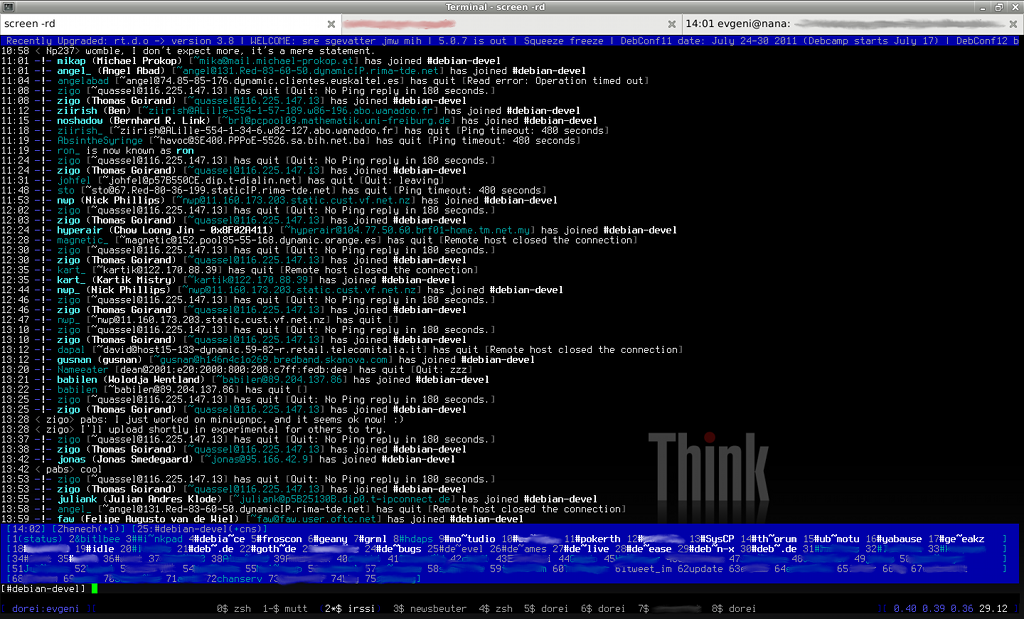
Evgeni Golov: Desktop in a shell: irssi

Continuing my series about my desktop in a shell, in this chapter I will present you my irssi setup.Irssi is the most customized part of my setup, using many scripts from the irssi-scripts Debian package and some from the internet , handling 6 irc networks with a total of 34 channels plus JabberXMPP, ICQ, Twitter and identi.ca. My custom irssi settingsI like my conversations to look like Buddy, you rock instead of Buddy: you rock , so:
/set completion_char ,I also like *long highlighted text*, so:
/set emphasis_multiword onHide mIRC and ANSI colors when turned on. This can be used to eliminate angry fruit salad syndrome in some channels. (Quote from irssi.org/documentation/settings, do I have to say more?):
/set hide_colors onWhen talking in more than one channel, it sometimes comes handy to repeat something from the past said in THAT channel, not searching though all:
/set window_history onTell irssi to shutup when away, noone will hear/see the beep anyways:
/set beep_when_away offI want my screen to inform me about new messages, so I need this:
/set bell_beeps onBeep for query text, notices, dcc, dcc text and hilight:
/set beep_msg_level MSGS NOTICES DCC DCCMSGS HILIGHMy used irssi scriptsactive_notice.pl (from irssi-scripts)Show notices in the active window or the corresponding query instead of the status-window.
No further configuration needed.adv_windowlist.pl (from anti.teamidiot.de)Some really smart windowlist, see my previous post about adv_windowlist.pl, I won t explain its features and settings here again.autorealname.pl (from irssi-scripts)Show peoples real-name when they join (my $nick $name memory is poor :()
No further configuration needed.chansort.pl (from irssi-scripts)Automatically sort my channels alphabetically, grouped by network.
Enable via /set chansort_autosort on<Update>kaimi asked me yesterday, whether chansort could ignore the network and just sort ALL channels in alphabetical order. Well, it could not, until yesterday ;) Fetch either the patch against chansort.pl or my chansort-ng.pl and set chansort_ignore_network to ON. You can also set chansort_ignore_windowtype to mix channels and queries if you like to.</Update>hack-whois-in-current-window.pl (from dgl.cx)Display /whois in the current window or the corresponding query instead of the status-window.
No further configuration needed.keepnick.pl (from irssi-scripts)Restore my nick after it is free again (like after a ping timepout).
Set the nick via /keepnick [-net chatnet] [nick]nickserv.pl (from irssi-scripts)Automatically authorize me on networks with NickServ.
Enable by settings services address, nick and password via:
/nickserv addnet freenode NickServ@services.
/nickserv addnick freenode Zhenech mypass
screen_away.pl (from irssi-scripts)Set away when screen is detached.
Will be enabled automatically, but you maybe want to tweak screen_away_message :)seen.pl (from irssi-scripts)Add a /seen nick command to lookup when and where nick was online the last time.
No further configuration needed.trackbar.pl (from irssi-scripts)Draw a line when you switch irssi windows so you can see which part of the conversation you have already seen.
No further configuration needed.BitlBeeI m using BitlBee as my irssi-to-every-im gateway of choice ;) But while it sounds easy, my setup isn t. I am using BitlBee only to connect to jabber.die-welt.net, my Jabber/XMPP server. There I have a pyICQt instance running, to connect to ICQ via Jabber (yes, BitlBee would support that directly, but that would fail on me when I would like to connect from a different Jabber-client). Twitter and identi.ca are handled via Jabber too: identi.ca does support this by themself, for Twitter I use the tweet.im service.
But besides of my strange setup, BitlBee is easy: apt-get install bitlbee, connect irssi to localhost:6667, you will be force-joined to &bitlbee, where you do:
register somepassword
account add Jabber you@jabberserber.example.com jabberpassword
account on 0
and done, you@jabberserver.example.com is online :)The all awaited screenshot (from my last irssi-post):

And the whole ~/.irssi/config: http://files.die-welt.net/irssi-config.txt, read it carefully while waiting for the next post about newsbeuter :)

5 February 2011

Ian Wienand: Comcast self-setup with Netgear routers

I just got a Zoom 5341 modem to replace a very sketchy old Motorola model and so far it seems to work fine. However, the Comcast self-install switch process was not seamless. After you plug your new modem in the process starts fine, capturing your session and prompting you for your account. However at the next step it prompts you to download the Windows or Mac only client, directing you to an address http://cdn/.... It is at this point you can get stuck if you're behind a Netgear router (I have a WNDR3700) and probably others. The simple problem is that, for whatever reason, the factory firmware in this router does not pass on the domain search suffix through its inbuilt DHCP client. Without that, cdn doesn't resolve to anything, so you can't download the self-help tool and you're effectively stuck at a "can not find this page" screen. If you google at this point you can find many people who have hit this problem, and various information from erroneous suggestions that you've been hacked (?) to most people just giving up and moving into Comcast phone support hell. Assuming you now don't have internet access, you can complete the process with a quick swizzle. Somebody might be able to correct me on this, but I don't think you want to run the self-install tool from an actual computer plugged directly into the modem if you have a router in the picture, because the wrong MAC address will get registered. So, your best solution is to turn everything off, plug your computer directly into the modem, turn it on, get an address, download the tool, turn everything off, plug the router back-in to the modem and then run the self install tool. At this point, everything just worked fine for me. Netgear should probably fix this by correctly passing through the domain search suffixes in their routers. Comcast should probably fix this by doing some sort of geo-ip lookup to give clients a fully-qualified address in that webpage to download the tool even if their router is broken (or really, does downloading that file really require a content-delivery network?). You can probably fix this by running Openwrt on your router before you start. Otherwise, the Zoom modem and the Netgear WNDR3700 seem to make a very nice combination which I would reccommend.

Craig Small: JFFNMS and IPv6

ipv6-google-rrt.png One of the many Free Software projects I work on is JFFNMS, which is a network management system written in PHP. In light that the last IPv4 address blocks have now been allocated to APNIC it s probably timely to look at how to manage network devices in a new IPv6 world. First you need to get the basics sorted out and for that it is best to use the net-snmp command line utilities to check all is well. Then its onto what to do in JFFNMS itself. Now fixed with proper markup, I hope.
    strlcpy(hostname, a1, sizeof(hostname));
        if ((pptr = strchr (hostname, ':')))  
            remote_port = strtol (pptr + 1, NULL, 0);
         
Special Agent 6 All devices that are capable of being managed with SNMP have an agent. It s basically the SNMP server on the router, switch or server. The first step is to make sure it can accept and send traffic using IPv6. Depending on what the device is, it can be real simple. For example, my little Juniper router its a matter of setting the community and access control, just like IPv4 settings:
csmall@juniper1# set snmp community public clients 2001:db8:62:d0::/64
And then run snmpget on the command line to check
csmall@elmo$ snmpget -v 1 -c public udp6:2001:44b8:62:d0::4 system.sysObjectID.0
SNMPv2-MIB::sysObjectID.0 = OID: SNMPv2-SMI::enterprises.2636.1.1.1.2.41
We have success! For Linux systems that use net-snmp you will need to make the snmp daemon listen on UDPv6 ports as well as adjusting the access control. Access control is a matter of adding com2sec6 lines to /etc/snmp/snmpd.conf They are the same format as com2sec lines and are reasonably straight forward. Next, get the daemon to listen to requests on the IPv6 ports as well. The snmpd(8) man page says:
By default, snmpd listens for incoming SNMP requests on UDP port 161 on all IPv4 interfaces. However, it is possible to modify this behaviour by specifying one or more listening addresses as arguments to snmpd.
It wouldn t of killed them to put comma separated list somewhere, now would it? My /etc/default/snmpd file now looks like:
SNMPDOPTS= -Lf /dev/null -u snmp -g snmp -I -smux -p /var/run/snmpd.pid udp:127.0.0.1,udp6:[::1]:161
The bits in bold are the changes. Then its a quick check:
csmall@elmo$ snmpget -v 1 -c public udp6:[::1] system.sysObjectID.0
SNMPv2-MIB::sysObjectID.0 = OID: NET-SNMP-MIB::netSnmpAgentOIDs.10
And we have working agents! JFFNMS Changes OK, we have a working IPv6 network and snmp works across our network so we can query devices. JFFNMS uses PHP so all should be well, shouldn t it? Database Tables This is an almost classic problem with converting IPv4 to IPv6. You have 15 bytes for a IP address string 111.222.333.444 . Ipv6 can be much larger than that. JFFNMS has things like
  CREATE TABLE  hosts (
    [...]
   ip  char(20) NOT NULL default '',
A simple fix to use a char(39) or varchar(39) will do the trick. Fixing the JFFNMS code One of the most troubling problems with the host entries is that the values entered by a user can be a hostname, IP address or IP address and port separated by a colon. There are lots of bits of code that separate out the port or address by just finding the colon or use non-IPv6 aware functions like gethostbyname() that will need to be fixed. I ve got a function to check for an IPv6 address, using the inet_pton() function.
  function is_ipv6($addr)
 
  $net_addr = @inet_pton($addr);
  if ($net_addr === FALSE   strlen($net_addr) < 16)
    return FALSE;
  return TRUE;
 
PHP functions PHP still has the old IPv4 only functions, but unlike libc does not have the Address Family independent functions. The most significant absence is the replacement functions for gethostbyname(). There is dnsgetrecord() but it is quite low-level (it won t recurse lookups if you get alias or CNAME results). It s a little hit and miss in PHP-land with what functions work with IPv6 addresses and what ones do not. fsockopen() and file() do work with IPv6. PHP and SNMP To query remote devices using SNMP, JFFNMS uses the PHP SNMP functions. Unfortunately, while there is some IPv6 support in PHP, it doesn t extend to the SNMP functions. The library does it, as the net-snmp command lines use the same library, it is just that the small shim between the script and net-snmp that is PHP gets in the way. Looking at the PHP code itself you find things like
    strlcpy(hostname, a1, sizeof(hostname));
        if ((pptr = strchr (hostname, ':')))  
            remote_port = strtol (pptr + 1, NULL, 0);
         
which definitely need to be fixed for IPv6. There is also some simple address lookup going on somewhere as well which will also need to fixed. In short, JFFNMS won t be doing SNMP based queries over IPv6 until php5-snmp can do it. Reachability JFFNMS also has a different sort of query called a reachability type. It s essentially a ping from the server running JFFNMS out to the device being managed. It uses fping to do this work, but there is also a program called fping6. It s a simple matter of checking the address type and then selecting fping or fping6 to do the reachability work. The JFFNMS code soon to be pushed into git has this change in it now. Anything Else? The next stage is to find anything else that will work with IPv6. A likely candidate is the TCP and UDP port types as they use nmap to discover the ports and the fsockopen() function call to poll it. fsockopen() does handle IPv6 addresses if you escape them in square brackets.

22 January 2011

Matthew Palmer: Debugging Debian Installer

I've been doing a bit of work recently on the netcfg portion of Debian Installer, with the largest work so far being adding IPv6 support. Unlike most of the rest of d-i, netcfg is written in C, and as such suffers from some difficulties in the realm of debugging. Worse, the whole d-i environment is rather bereft of the usual debugging tools (strace, lsof, etc) -- but most importantly, in this case, gdb. Thanks to some hints from Julien Cristau, I was reminded of the existence of gdbserver, a small part of gdb that allows you to debug a program running on a remote machine, using a copy of gdb running on your local machine. It's designed for debugging embedded systems, I think, because all of the heavy lifting (symbol lookups, etc) happens on your local machine, not where gdbserver is running. Here are the steps I took to get a useful gdbserver session inside d-i:
  1. Get the gdb sources (apt-get source gdb) and drop into the gdbserver tree (cd gdb-x.y.z/gdb/gdbserver)
  2. Configure gdbserver to build a static binary (LDFLAGS=-static ./configure). This is necessary because you don't want to have to faff around with library dependencies inside the d-i environment. Then build gdbserver (make).
  3. Copy gdbserver over to your d-i machine/VM (I like using netcat; nc -l -p 31310 >/bin/gdbserver on the d-i machine, and nc IPADDR 31310 <gdbserver where you built gdbserver), then make it executable (chmod /bin/gdbserver)
  4. Fire up gdbserver in d-i, attaching it to the process you wish to debug: gdbserver host:31337 --attach PID
  5. Now things get a little trickier... on your local machine, you need to have an unstripped copy of the binary you're debugging. For me, this is easy, because I'm building netcfg myself (to keep the symbols, I just run DEB_BUILD_OPTIONS=noopt dpkg-buildpackage -b -rfakeroot) but I'm not sure what you'd do if you were just tracing around for fun.
  6. Once you've got your binary, just run gdb BINARY on your host machine to start gdb running.
  7. For the "even trickier" part of the show, your local machine also needs copies of all the libraries your binary is linked against. If you don't have this, when you try to debug you'll get all sorts of "wrong library or version mismatch?" errors, and your backtraces will likely break (amongst other things). Again, for me, this is easy, because I'm only running the d-i initrd, but if you're debugging something later in the installation process you might need to unpack some udebs somewhere. All I have to do is keep the initrd build tree around (which lives in the installer tree, under build/tmp/netboot/tree). Once you've got your tree of libraries, you can continue.
  8. You need to tell gdb about that tree of libraries, by running the following in gdb: set solib-absolute-prefix /path/to/library/tree
  9. Now, tell gdb to connect to your gdbserver: target remote IPADDR:31337 -- gdb should tell you "Remote debugging using IPADDR:31337", and the gdbserver should say "Remote debugging from host LOCALIP:31337".
  10. Now, you should be able to interact with the program being debugged just like any other. Enjoy!

Enrico Zini: Match package names across distributions

Match package names across distributions What would happen if we had a quick and reliable way to match package names across distributions? These ideas came up at the appinstaller2011 meeting: We thought they were good ideas, so we started hacking. To try it, you need to get the code and build the index first:
git clone git://git.debian.org/users/enrico/distromatch.git
cd distromatch
# Careful: 90Mb
wget http://people.debian.org/~enrico/dist-info.tar.gz
tar zxf dist-info.tar.gz
# Takes a long time to do the indexing
./distromatch --reindex --verbose
Then you can query it this way:
./distromatch $DISTRO $PKGNAME [$PKGNAME1 ...]
This would give you, for the package $PKGNAME in $DISTRO, the corresponding package names in all other distros for which we have data. If you do not provide package names, it automatically shows output for all packages in $DISTRO. For example:
$ time ./distromatch debian libdigest-sha1-perl
debian:libdigest-sha1-perl fedora:perl-Digest-SHA1
debian:libdigest-sha1-perl mandriva:perl-Digest-SHA1
debian:libdigest-sha1-perl suse:perl-Digest-SHA1
real    0m0.073s
user    0m0.056s
sys 0m0.016s
Yes it's quick. It builds a Xapian index with the information it needs, and then it reuses it. As soon as I find a moment, I intend to deploy an instance of it on DDE. It is using a range of different heuristics: This list may get obsolete soon as more heuristics get implemented. Euristics will never cover all corner cases we surely have, but the idea is that if we can match a sizable amout of packages, the rest can be somehow fixed by hand as needed. The data it requires for a distribution should be rather straightforward to generate:
  1. a file which maps binary package names to source package names
  2. a file with the list of files in all the packages
For example:
$ ls -l dist-debian/
total 39688
-rw-r--r--  1 enrico enrico  1688249 Jan 20 17:37 binsrc
drwxr-xr-x  2 enrico enrico     4096 Jan 21 19:12 db
-rw-r--r--  1 enrico enrico 29960406 Jan 21 10:02 files.gz
-rw-r--r--  1 enrico enrico  8914771 Jan 21 18:39 interesting-files
$ head dist-debian/binsrc 
openoffice.org-dev openoffice.org
ext4-modules-2.6.32-5-4kc-malta-di linux-kernel-di-mipsel-2.6
linux-headers-2.6.30-2-common linux-2.6
libnspr4 nspr
ipfm ipfm
libforks-perl libforks-perl
med-physics debian-med
libntfs-3g-dev ntfs-3g
libguppi16 guppi
selinux selinux
$ zcat dist-debian/files.gz   head
memstat etc/memstat.conf
memstat usr/bin/memstat
memstat usr/share/doc/memstat/changelog.gz
memstat usr/share/doc/memstat/copyright
memstat usr/share/doc/memstat/memstat-tutorial.txt.gz
memstat usr/share/man/man1/memstat.1.gz
libdirectfb-dev usr/bin/directfb-config
libdirectfb-dev usr/bin/directfb-csource
libdirectfb-dev usr/include/directfb-internal/core/clipboard.h
libdirectfb-dev usr/include/directfb-internal/core/colorhash.h
interesting-files and db are generated when indexing. To prove the usefulness of the idea (but does it need proving?), you can find in the same git repo a little example app (it took me 10 minutes to write it), that uses the distromatch engine to export Debtags tags to other distributions:
$ ./exportdebtags fedora   head
memstat: admin::benchmarking, interface::commandline, role::program, use::monitor
libdirectfb-dev: devel::lang:c, devel::library, implemented-in::c, interface::framebuffer, role::devel-lib
libkonqsidebarplugin4a: implemented-in::c++, role::shared-lib, suite::kde, uitoolkit::qt
libemail-simple-perl: devel::lang:perl, devel::library, implemented-in::perl, role::devel-lib, role::shared-lib, works-with::mail
libpoe-component-pluggable-perl: devel::lang:perl, devel::library, implemented-in::perl, role::shared-lib
manpages-ja: culture::japanese, made-of::man, role::documentation
libhippocanvas-dev: devel::library, qa::low-popcon, role::devel-lib
libexpat-ocaml-dev: devel::lang:ocaml, devel::library, implemented-in::c, implemented-in::ocaml, role::devel-lib, works-with-format::xml
libgnutls-dev: devel::library, role::devel-lib, suite::gnu
Just in case this made you itch to play with Debtags in a non-Debian distribution, I've generated the full datasets for Fedora, Mandriva and OpenSUSE. Others have been working on the same matching problem. After we started writing code we started to become aware of existing work: I'd like to make use of those efforts, maybe to cross-validate results, maybe even better as yet another heuristics.

12 January 2011

Dirk Eddelbuettel: RProtoBuf 0.2.2

Thanks to two patches by Murray Stokely, we have a nice new minor release 0.2.2 of RProtoBuf out on CRAN. RProtoBuf provides GNU R bindings for the Google Protobuf data encoding library used and released by Google. The NEWS file entry follows below:
0.2.2   2011-01-11
   o    Applied two patches by Murray Stokely which 
         - correct a typo preventing some functions from being called, 
         - add bounds checking in call to google protobuf library, 
         - add a new name method 
         - add a tiny unit test for the above
         - add more graceful error handling
         - add support for import patterns other than .proto$, 
         - add simple reading file that does not exist (exception) test
         - add simple repeated field unit test
And courtesy of CRANberries, here is the diff to the previous release 0.2.1:
 ChangeLog                                               35 
 DESCRIPTION                                              8 
 R/00classes.R                                           11 
 R/internals.R                                            7 
 R/wrapper_EnumDescriptor.R                               6 
 inst/NEWS                                               12 
 inst/THANKS                                          only
 inst/doc/Makefile                                        4 
 inst/doc/RProtoBuf-quickref.pdf                      binary
 inst/doc/RProtoBuf-unitTests.pdf                     binary
 inst/doc/RProtoBuf.pdf                                2362 +++++++++-----------
 inst/doc/unitTests-results/RProtoBuf-unitTests.html     20 
 inst/doc/unitTests-results/RProtoBuf-unitTests.txt      23 
 inst/unitTests/runit.addressbook.R                      11 
 inst/unitTests/runit.enums.R                         only
 inst/unitTests/runit.golden.message.R                    7 
 inst/unitTests/runit.import.R                        only
 man/EnumDescriptor-class.Rd                             42 
 man/EnumValueDescriptor-class.Rd                        23 
 man/readProtoFiles.Rd                                    3 
 src/DescriptorPoolLookup.cpp                            26 
 src/S4_classes.h                                         6 
 src/wrapper_EnumDescriptor.cpp                          25 
 src/wrapper_EnumValueDescriptor.cpp                     25 
 24 files changed, 1357 insertions(+), 1299 deletions(-)
As always, there is more information at the RProtoBuf page which has a draft package vignette, a 'quick' overview vignette and a unit test summary vignette. Questions, comments etc should go to the rprotobuf mailing list off the RProtoBuf page at R-Forge.

Next.

Previous.