Search Results: "nate"

19 May 2025

Simon Quigley: Toolboxes and Hammers Be You

Toolboxes and Hammers Be YouEveryone has a story. We all started from somewhere, and we re all going somewhere.Ten years ago this summer, I first heard of Ubuntu. It took me time to learn how to properly pronounce the word, although I m glad I learned that early on. I was less fortunate when it came to the pronunciation of the acronym for the Ubuntu Code of Conduct. I had spent time and time again breaking my computer, and I d wanted to start fresh.I ve actually talked about this in an interview before, which you can find here (skip to 5:02 6:12 for my short explanation, I m in orange):https://medium.com/media/ad59becdbd06d230b875fb1512df1921/hrefI ve also done a few interviews over the years, here are some of the more recent ones:https://medium.com/media/83bda448d5f2a979f848e17f04376aa6/hrefAsk Noah Show 377Lastly, I did a few talks at SCaLE 21x (which the Ubuntu community donation funds helped me attend, thank you for that!):https://medium.com/media/0fbde7ef0ed83c2272a8653a5ea38b67/hrefhttps://medium.com/media/4d18f1770dc7eed6c7a9d711ff6a6e89/hrefMy story is fairly simple to summarize, if you don t have the time to go through all the clips.I started in the Ubuntu project at 13 years old, as a middle school student living in Green Bay, WI. I m now 23 years old, still living in Green Bay, but I became an Ubuntu Core Developer, Lubuntu s Release Manager, and worked up to a very great and comfortable spot.So, Simon, what advice would you give to someone at 13 who wants to do the same thing? Here are a few tips * Don t be afraid to be yourself. If you put on a mask, it hinders your growth, and you ll end up paying for it later anyway.
* Find a mentor. Someone who is okay working with someone your age, and ideally someone who works well with people your age (quick shoutout to Aaron Prisk and Walter Lapchynski for always being awesome to me and other folks starting out at high school.) This is probably the most important part.
* Ask questions. Tons of them. Ask questions until you re blue in the face. Ask questions until you get a headache so bad that your weekend needs to come early. Okay, maybe don t go that far, but at the very least, always stay curious.
* Own up to your mistakes. Even the most experienced people you know have made tons of mistakes. It s not about the mistake itself, it s about how you handle it and grow as a person.Now, after ten years, I ve seen many people come and go in Ubuntu. I was around for the transition from upstart to systemd. I was around for the transition from Unity to GNOME. I watched Kubuntu as a flavor recover from the arguments only a few years before I first started, only to jump in and help years later when the project started to trend downwards again.I have deep love, respect, and admiration for Ubuntu and its community. I also have deep love, respect, and admiration for Canonical as a company. It s all valuable work. That being said, I need to recognize where my own limits are, and it s not what you d think. This isn t some big burnout rant.Some of you may have heard rumors about an argument between me and the Ubuntu Community Council. I refuse to go into the private details of that, but what I ll tell you is this in retrospect, it was in good faith. The entire thing, from both my end and theirs, was to try to either help me as a person, or the entire community. If you think any part of this was bad faith from either side, you re fooling yourself. Plus, tons of great work and stories actually came out of this.The Ubuntu Community Council really does care. And so does Mark Shuttleworth.Now, I won t go into many specifics. If you want specifics, I d direct you to the Ubuntu Community Council who would be more than happy to answer any questions (actually they d probably stay silent. Nevermind.) That being said, I can t really talk about any of this without mentioning how great Mark has become.Remember, I was around for a few different major changes within the project. I ve heard and seen stories about Mark that actually match what Reddit says about him. But in 2025, out of the bottom of my heart, I m here to tell you that you re all wrong now.See, Mark didn t just side with somebody and be done with it. He actually listened, and I could tell, he cares very very deeply. I really enjoyed reading ogra s recent blog post, you should seriously check it out. Of course, I m only 23 years old, but I have to say, my experiences with Mark match that too.Now, as for what happens from here. I m taking a year off from Ubuntu. I talked this over with a wide variety of people, and I think it s the right decision. People who know me personally know that I m not one to make a major decision like this without a very good reason to. Well, I d like to share my reasons with you, because I think they d help.People who contribute time to open source find it to be very rewarding. Sometimes so rewarding, in fact, that no matter how many economics and finance books they read, they still haven t figured out how to balance that with a job that pays money. I m sure everyone deeply involved in this space has had the urge to quit their job at least once or twice to pursue their passions.Here s the other element too I ve had a handful of romantic relationships before, and they ve never really panned out. I found the woman that I truly believe I m going to marry. Is it going to be a rough road ahead of us? Absolutely, and to be totally honest, there is still a (small, at this point) chance it doesn t work out.That being said I remain optimistic. I m not taking a year off because I m in some kind of trouble. I haven t burned any bridge here except for one.You know who you are. You need help. I d be happy to reconnect with you once you realize that it s not okay to do what you did. An apology letter is all I want. I don t want Mutually Assured Destruction, I don t want to sit and battle on this for years on end. Seriously dude, just back off. Please.I hate having to take out the large hammer. But sometimes, you just have to do it. I ve quite enjoyed Louis Rossmann s (very not-safe-for-work) videos on BwE.https://medium.com/media/ab64411c41e65317f271058f56bb2aba/hrefI genuinely enjoy being nice to people. I want to see everyone be successful and happy, in that order (but with both being very important). I m not perfect, I m a 23-year-old who just happened to stumble into this space at the right time.To this specific person only, I tell you, please, let me go take my year off in peace. I don t wish you harm, and I won t make anything public, including your name, if you just back off.Whew. Okay. Time to be happy again.Again, I want to see people succeed. That goes for anyone in Ubuntu, Lubuntu, Kubuntu, Canonical, you name it. I m going to remain detached from Ubuntu for at least a year. If circumstances change, or if I feel the timing just isn t right, I ll wait longer. My point is, I ll be back, the when of it will just never be public before it happens.In the meantime, you re welcome to reach out to me. It ll take me some time to bootstrap things, more than I originally thought, but I m hoping it ll be quick. After all, I ve had practice.I m also going to continue writing. About what? I don t know yet.But, I ll just keep writing. I want to share all of the useful tips I ve learned over the years. If you actually liked this post, or if you ve enjoyed my work in the Ubuntu project, please do subscribe to my personal blog, which will be here on Medium (unless someone can give me an open source alternative with a funding model). This being said, while I d absolutely take any donations people would like to provide, at the end of the day, I don t do this for the money. I do this for the people just like me, out of love.So you, just like me, can make your dreams happen.Don t give up, it ll come. Just be patient with yourself.As for me, I have business to attend to. What business is that, exactly? Read Walden, and you ll find out.I wish you all well, even the person I called out. I sincerely hope you find what you re looking for in life. It takes time. Sometimes you have to listen to some music to pass the time, so I created a conceptual mixtape if you want to listen to some of the same music as me.I ll do another blog post soon, don t worry.Be well. Much, much more to come.
13 May 2025

Ravi Dwivedi: KDE India Conference 2025

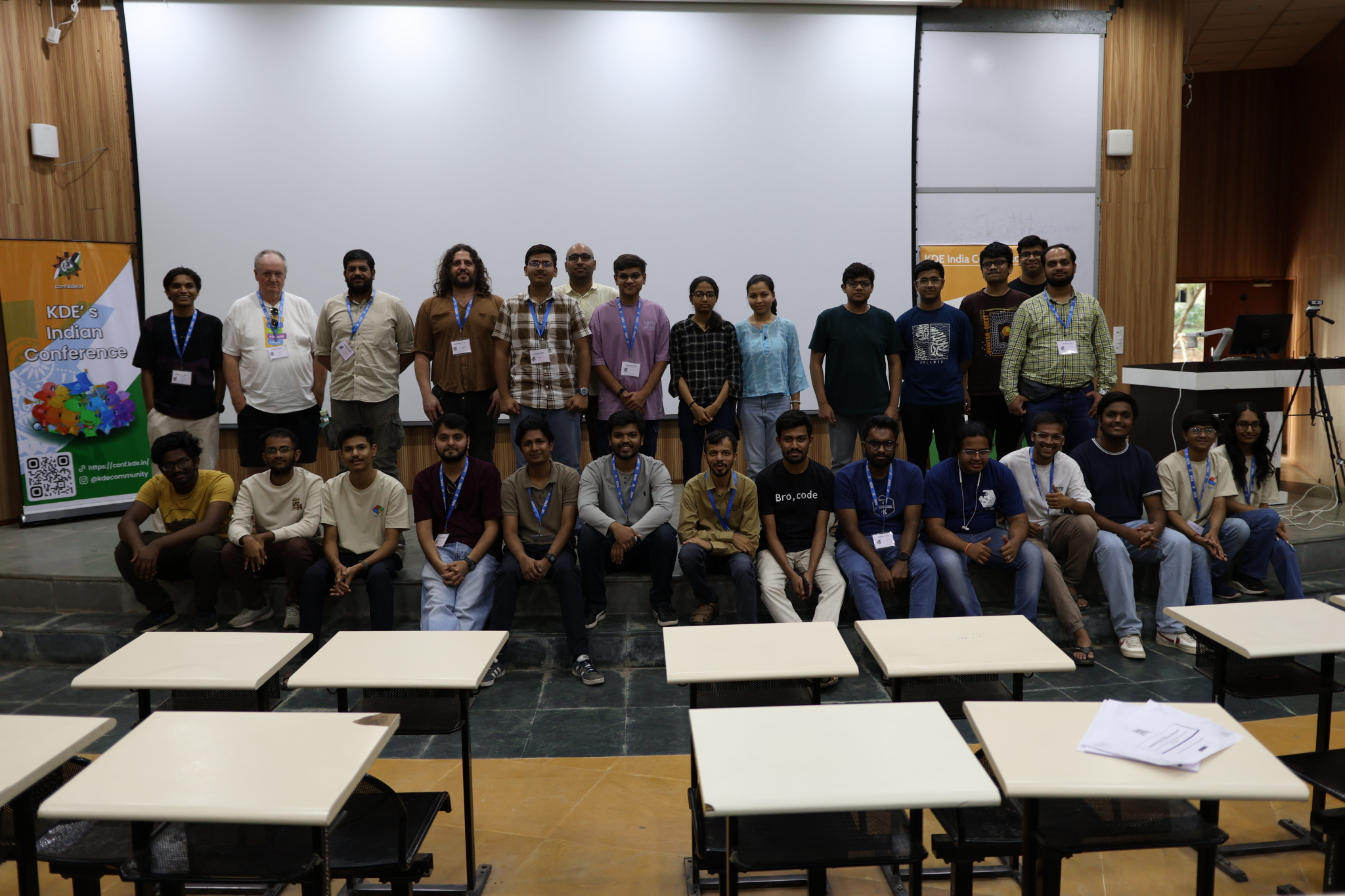
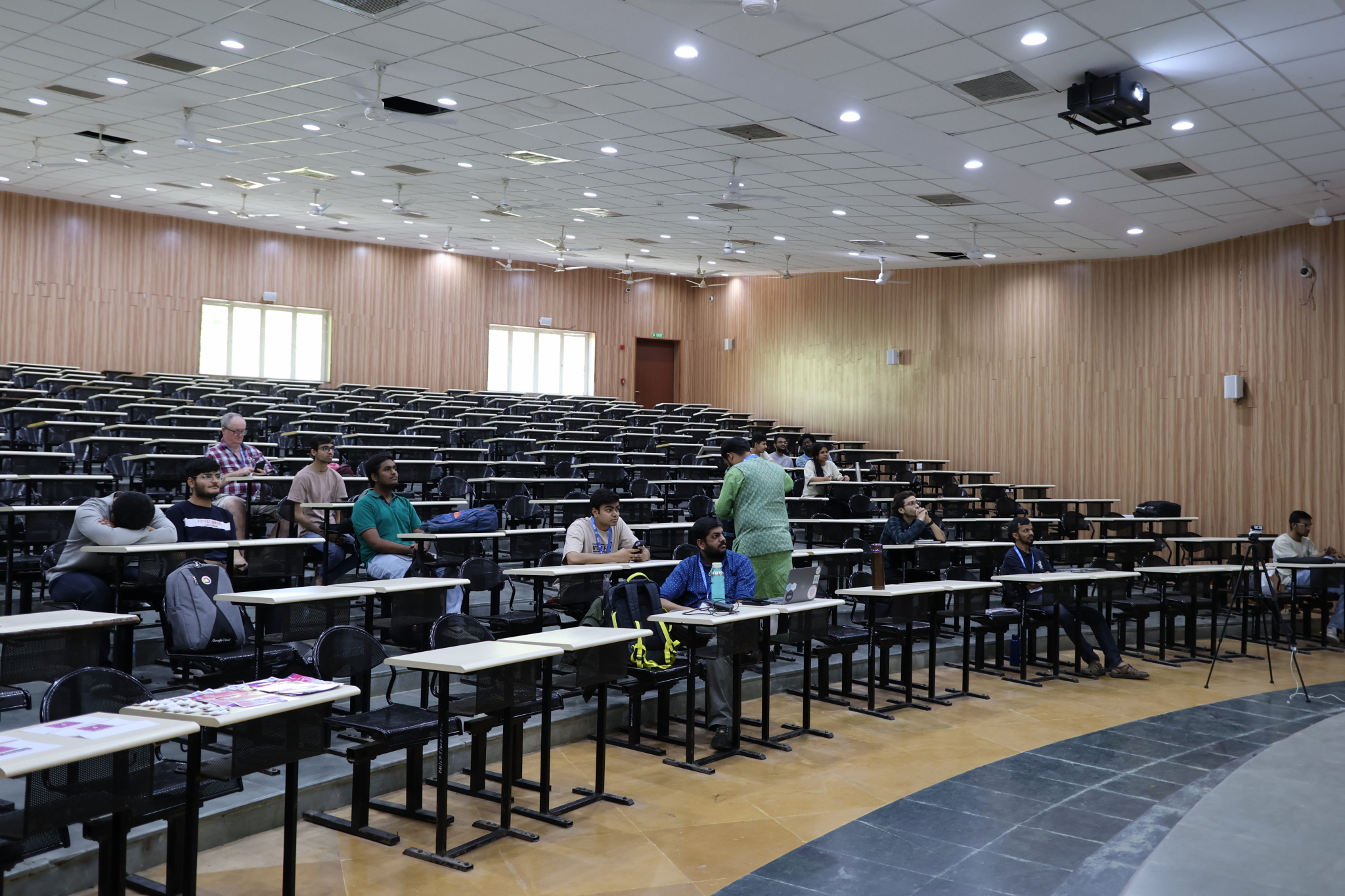
Last month, I attended the KDE India conference in Gandhinagar, Gujarat from the 4th to the 6th of April. I made my mind to attend when Sahil told me about his plans to attend and giving a talk. A day after my talk submission, the organizer Bhushan contacted me on Matrix and informed me that my talk had been accepted. I was also informed that KDE will cover my travel and accommodation expenses. So, I planned to attend the conference at this point. I am a longtime KDE user, so why not ;) I arrived in Ahmedabad, the twin city of Gandhinagar, a day before the conference. The first thing that struck me as soon as I came out of the Ahmedabad airport was the heat. I felt as if I was being cooked exactly how Bhushan put it earlier in the group chat. I took a taxi to get to my hotel, which was close to the conference venue. Later that afternoon, I met Bhushan and Joseph. Joseph lived in Germany. Bhushan was taking him to get a SIM card, so I tagged along and got to roam around. Joseph was unsure about where to go after the conference, so I asked him what he wanted out of his trip and had conversations along that line. Later, Vishal convinced him to go to Lucknow. Since he was adamant about taking the train, I booked a Tatkal train ticket for him to Lucknow. He was curious about how Tatkal booking works and watched me in amusement while I was booking the ticket. The 4th of April marked the first day of the conference, with around 25 attendees. Bhushan started the day with an overview of KDE conferences in India, followed by Vishal, who discussed FOSS United s activities. After the lunch, Joseph gave an overview of his campaign to help people switch from Windows to GNU/Linux due to environmental and security reasons. He continued his session in detail the next day.
Conference hall Conference hall
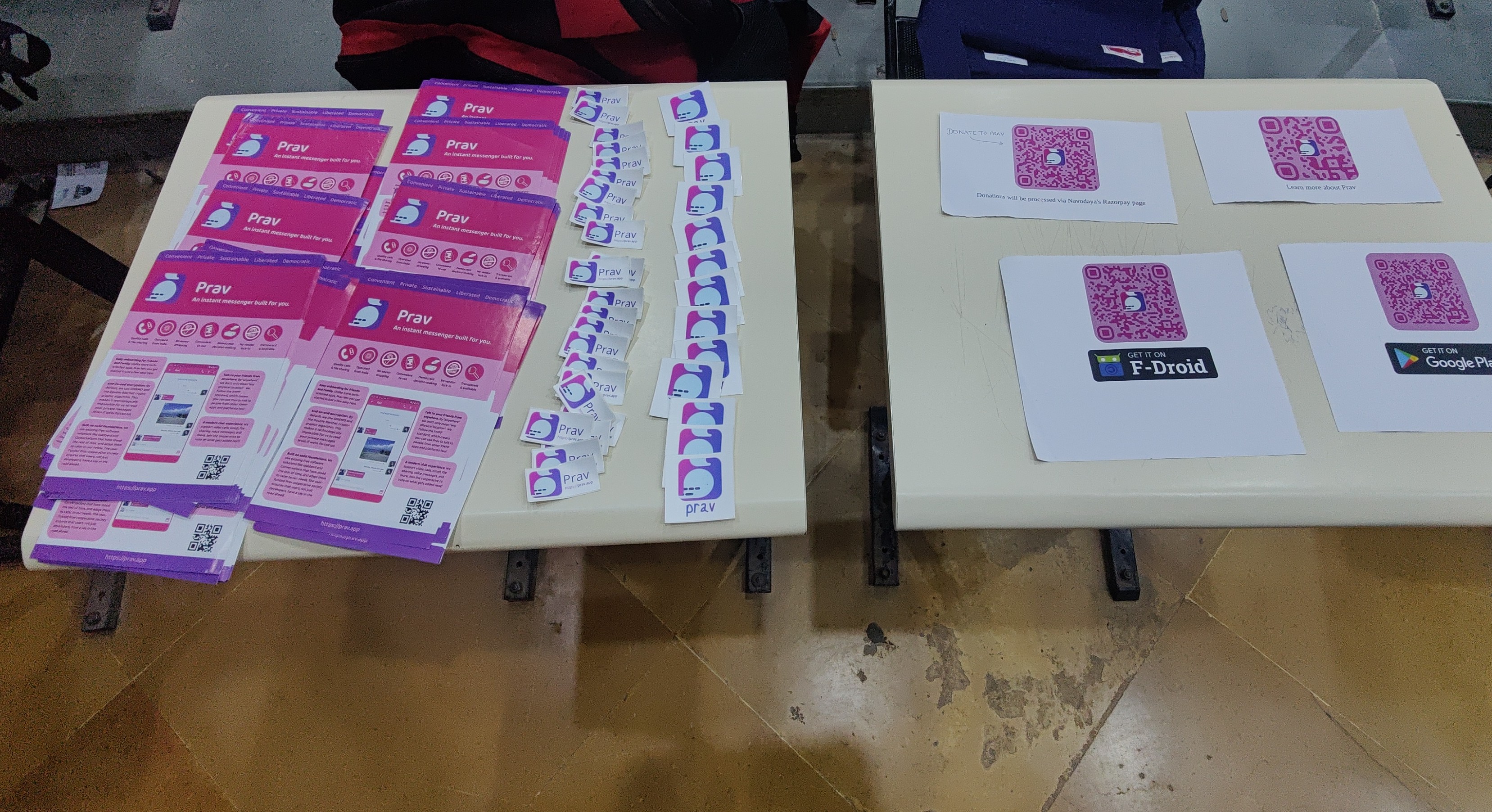
A key takeaway for me from Joseph s session was the idea pointed out by Adwaith: marketing GNU/Linux as a cheap alternative may not attract as much attention as marketing it as a status symbol. He gave the example of how the Tata Nano didn t do well in the Indian market due to being perceived as a poor person s car. My talk was scheduled for the evening of the first day. I hadn t prepared any slides because I wanted to make my session interactive. During my talk, I did an activity with the attendees to demonstrate the federated nature of XMPP messaging, of which Prav is a part. After the talk, I got a lot of questions, signalling engagement. The audience was cooperative (just like Prav ;)), contrary to my expectations (I thought they will be tired and sleepy). On the third day, I did a demo on editing OpenStreetMap (referred to as OSM in short) using the iD editor. It involved adding points to OSM based on the students suggestions. Since my computer didn t have an HDMI port, I used Subin s computer, and he logged into his OSM account for my session. Therefore, any mistakes I made will be under Subin s name. :) On the third day, I attended Aaruni s talk about backing up a GNU/Linux system. This was the talk that resonated with me the most. He suggested formatting the system with the btrfs file system during the installation, which helps in taking snapshots of the system and provides an easy way to roll back to a previous version if, for example, a file is accidentally deleted. I have tried many backup techniques, including this one, but I never tried backing up on the internal disk. I ll certainly give this a try. A conference is not only about the talks, that s why we had a Prav table as well ;) Just kidding. What I really mean is that a conference is more about interactions than talks. Since the conference was a three-day affair, attendees got plenty of time to bond and share ideas.
Prav stall at the conference Prav stall at the conference
Conference group photo Conference group photo

After the conference, Bhushan took us to Adalaj Stepwell, an attraction near Gandhinagar. Upon entering the complex, we saw a park where there were many langurs. Going further, there were stairs that led down to a well. I guess this is why it is called a stepwell.
Adalaj Stepwell Adalaj Stepwell
Later that day, we had Gujarati Thali for dinner. It was an all-you-can-eat buffet and was reasonably priced at 300 rupees per plate. Aamras (Mango juice) was the highlight for me. This was the only time we had Gujarati food during this visit. After the dinner, Aaruni dropped Sahil and I off at the airport. The hospitality was superb - for instance, in addition to Aaruni dropping us, Bhushan also picked up some of the attendees from the airport. Finally, I would like to thank KDE for sponsoring my travel and accommodation costs. Let s wrap up this post here and meet you in the next one. Thanks to contrapunctus and Joseph for proofreading.

12 May 2025

Reproducible Builds: Reproducible Builds in April 2025

Welcome to our fourth report from the Reproducible Builds project in 2025. These monthly reports outline what we ve been up to over the past month, and highlight items of news from elsewhere in the increasingly-important area of software supply-chain security. Lastly, if you are interested in contributing to the Reproducible Builds project, please visit our Contribute page on our website. Table of contents:
  1. reproduce.debian.net
  2. Fifty Years of Open Source Software Supply Chain Security
  3. 4th CHAINS Software Supply Chain Workshop
  4. Mailing list updates
  5. Canonicalization for Unreproducible Builds in Java
  6. OSS Rebuild adds new TUI features
  7. Distribution roundup
  8. diffoscope & strip-nondeterminism
  9. Website updates
  10. Reproducibility testing framework
  11. Upstream patches

reproduce.debian.net The last few months have seen the introduction, development and deployment of reproduce.debian.net. In technical terms, this is an instance of rebuilderd, our server designed monitor the official package repositories of Linux distributions and attempt to reproduce the observed results there. This month, however, we are pleased to announce that reproduce.debian.net now tests all the Debian trixie architectures except s390x and mips64el. The ppc64el architecture was added through the generous support of Oregon State University Open Source Laboratory (OSUOSL), and we can support the armel architecture thanks to CodeThink.

Fifty Years of Open Source Software Supply Chain Security Russ Cox has published a must-read article in ACM Queue on Fifty Years of Open Source Software Supply Chain Security. Subtitled, For decades, software reuse was only a lofty goal. Now it s very real. , Russ article goes on to outline the history and original goals of software supply-chain security in the US military in the early 1970s, all the way to the XZ Utils backdoor of 2024. Through that lens, Russ explores the problem and how it has changed, and hasn t changed, over time. He concludes as follows:
We are all struggling with a massive shift that has happened in the past 10 or 20 years in the software industry. For decades, software reuse was only a lofty goal. Now it s very real. Modern programming environments such as Go, Node and Rust have made it trivial to reuse work by others, but our instincts about responsible behaviors have not yet adapted to this new reality. We all have more work to do.

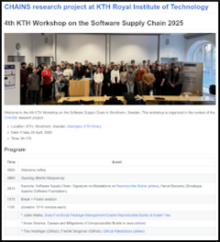
4th CHAINS Software Supply Chain Workshop Convened as part of the CHAINS research project at the KTH Royal Institute of Technology in Stockholm, Sweden, the 4th CHAINS Software Supply Chain Workshop occurred during April. During the workshop, there were a number of relevant workshops, including: The full listing of the agenda is available on the workshop s website.

Mailing list updates On our mailing list this month:
  • Luca DiMaio of Chainguard posted to the list reporting that they had successfully implemented reproducible filesystem images with both ext4 and an EFI system partition. They go on to list the various methods, and the thread generated at least fifteen replies.
  • David Wheeler announced that the OpenSSF is building a glossary of sorts in order that they consistently use the same meaning for the same term and, moreover, that they have drafted a definition for reproducible build . The thread generated a significant number of replies on the definition, leading to a potential update to the Reproducible Build s own definition.
  • Lastly, kpcyrd posted to the list with a timely reminder and update on their repro-env tool. As first reported in our July 2023 report, kpcyrd mentions that:
    My initial interest in reproducible builds was how do I distribute pre-compiled binaries on GitHub without people raising security concerns about them . I ve cycled back to this original problem about 5 years later and built a tool that is meant to address this. [ ]

Canonicalization for Unreproducible Builds in Java Aman Sharma, Benoit Baudry and Martin Monperrus have published a new scholarly study related to reproducible builds within Java. Titled Canonicalization for Unreproducible Builds in Java, the article s abstract is as follows:
[ ] Achieving reproducibility at scale remains difficult, especially in Java, due to a range of non-deterministic factors and caveats in the build process. In this work, we focus on reproducibility in Java-based software, archetypal of enterprise applications. We introduce a conceptual framework for reproducible builds, we analyze a large dataset from Reproducible Central and we develop a novel taxonomy of six root causes of unreproducibility. We study actionable mitigations: artifact and bytecode canonicalization using OSS-Rebuild and jNorm respectively. Finally, we present Chains-Rebuild, a tool that raises reproducibility success from 9.48% to 26.89% on 12,283 unreproducible artifacts. To sum up, our contributions are the first large-scale taxonomy of build unreproducibility causes in Java, a publicly available dataset of unreproducible builds, and Chains-Rebuild, a canonicalization tool for mitigating unreproducible builds in Java.
A full PDF of their article is available from arXiv.

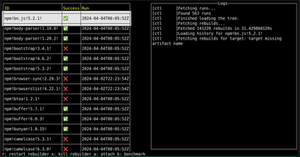
OSS Rebuild adds new TUI features OSS Rebuild aims to automate rebuilding upstream language packages (e.g. from PyPI, crates.io and npm registries) and publish signed attestations and build definitions for public use. OSS Rebuild ships a text-based user interface (TUI) for viewing, launching, and debugging rebuilds. While previously requiring ownership of a full instance of OSS Rebuild s hosted infrastructure, the TUI now supports a fully local mode of build execution and artifact storage. Thanks to Giacomo Benedetti for his usage feedback and work to extend the local-only development toolkit. Another feature added to the TUI was an experimental chatbot integration that provides interactive feedback on rebuild failure root causes and suggests fixes.

Distribution roundup In Debian this month:
  • Roland Clobus posted another status report on reproducible ISO images on our mailing list this month, with the summary that all live images build reproducibly from the online Debian archive .
  • Debian developer Simon Josefsson published another two reproducibility-related blog posts this month, the first on the topic of Verified Reproducible Tarballs. Simon sardonically challenges the reader as follows: Do you want a supply-chain challenge for the Easter weekend? Pick some well-known software and try to re-create the official release tarballs from the corresponding Git checkout. Is anyone able to reproduce anything these days? After that, they also published a blog post on Building Debian in a GitLab Pipeline using their multi-stage rebuild approach.
  • Roland also posted to our mailing list to highlight that there is now another tool in Debian that generates reproducible output, equivs . This is a tool to create trivial Debian packages that might Depend on other packages. As Roland writes, building the [equivs] package has been reproducible for a while, [but] now the output of the [tool] has become reproducible as well .
  • Lastly, 9 reviews of Debian packages were added, 10 were updated and 10 were removed this month adding to our extensive knowledge about identified issues.
The IzzyOnDroid Android APK repository made more progress in April. Thanks to funding by NLnet and Mobifree, the project was also to put more time into their tooling. For instance, developers can now easily run their own verification builder in less than 5 minutes . This currently supports Debian-based systems, but support for RPM-based systems is incoming.
  • The rbuilder_setup tool can now setup the entire framework within less than five minutes. The process is configurable, too, so everything from just the basics to verify builds up to a fully-fledged RB environment is also possible.
  • This tool works on Debian, RedHat and Arch Linux, as well as their derivates. The project has received successful reports from Debian, Ubuntu, Fedora and some Arch Linux derivates so far.
  • Documentation on how to work with reproducible builds (making apps reproducible, debugging unreproducible packages, etc) is available in the project s wiki page.
  • Future work is also in the pipeline, including documentation, guidelines and helpers for debugging.
NixOS defined an Outreachy project for improving build reproducibility. In the application phase, NixOS saw some strong candidates providing contributions, both on the NixOS side and upstream: guider-le-ecit analyzed a libpinyin issue. Tessy James fixed an issue in arandr and helped analyze one in libvlc that led to a proposed upstream fix. Finally, 3pleX fixed an issue which was accepted in upstream kitty, one in upstream maturin, one in upstream python-sip and one in the Nix packaging of python-libbytesize. Sadly, the funding for this internship fell through, so NixOS were forced to abandon their search. Lastly, in openSUSE news, Bernhard M. Wiedemann posted another monthly update for their work there.

diffoscope & strip-nondeterminism diffoscope is our in-depth and content-aware diff utility that can locate and diagnose reproducibility issues. This month, Chris Lamb made the following changes, including preparing and uploading a number of versions to Debian:
  • Use the --walk argument over the potentially dangerous alternative --scan when calling out to zipdetails(1). [ ]
  • Correct a longstanding issue where many >-based version tests used in conditional fixtures were broken. This was used to ensure that specific tests were only run when the version on the system was newer than a particular number. Thanks to Colin Watson for the report (Debian bug #1102658) [ ]
  • Address a long-hidden issue in the test_versions testsuite as well, where we weren t actually testing the greater-than comparisons mentioned above, as it was masked by the tests for equality. [ ]
  • Update copyright years. [ ]
In strip-nondeterminism, however, Holger Levsen updated the Continuous Integration (CI) configuration in order to use the standard Debian pipelines via debian/salsa-ci.yml instead of using .gitlab-ci.yml. [ ]

Website updates Once again, there were a number of improvements made to our website this month including:
  • Aman Sharma added OSS-Rebuild s stabilize tool to the Tools page. [ ][ ]
  • Chris Lamb added a configure.ac (GNU Autotools) example for using SOURCE_DATE_EPOCH. [ ]. Chris also updated the SOURCE_DATE_EPOCH snippet and move the archive metadata to a more suitable location. [ ]
  • Denis Carikli added GNU Boot to our ever-evolving Projects page.

Reproducibility testing framework The Reproducible Builds project operates a comprehensive testing framework running primarily at tests.reproducible-builds.org in order to check packages and other artifacts for reproducibility. In April, a number of changes were made by Holger Levsen, including:
  • reproduce.debian.net-related:
    • Add armel.reproduce.debian.net to support the armel architecture. [ ][ ]
    • Add a new ARM node, codethink05. [ ][ ]
    • Add ppc64el.reproduce.debian.net to support testing of the ppc64el architecture. [ ][ ][ ]
    • Improve the reproduce.debian.net front page. [ ][ ]
    • Make various changes to the ppc64el nodes. [ ][ ]9[ ][ ]
    • Make various changes to the arm64 and armhf nodes. [ ][ ][ ][ ]
    • Various changes related to the rebuilderd-worker entry point. [ ][ ][ ]
    • Create and deploy a pkgsync script. [ ][ ][ ][ ][ ][ ][ ][ ]
    • Fix the monitoring of the riscv64 architecture. [ ][ ]
    • Make a number of changes related to starting the rebuilderd service. [ ][ ][ ][ ]
  • Backup-related:
    • Backup the rebuilder databases every week. [ ][ ][ ][ ]
    • Improve the node health checks. [ ][ ]
  • Misc:
    • Re-use existing connections to the SSH proxy node on the riscv64 nodes. [ ][ ]
    • Node maintenance. [ ][ ][ ]
In addition:
  • Jochen Sprickerhof fixed the risvc64 host names [ ] and requested access to all the rebuilderd nodes [ ].
  • Mattia Rizzolo updated the self-serve rebuild scheduling tool, replacing the deprecated SSO -style authentication with OpenIDC which authenticates against salsa.debian.org. [ ][ ][ ]
  • Roland Clobus updated the configuration for the osuosl3 node to designate 4 workers for bigger builds. [ ]

Upstream patches The Reproducible Builds project detects, dissects and attempts to fix as many currently-unreproducible packages as possible. We endeavour to send all of our patches upstream where appropriate. This month, we wrote a large number of such patches, including:

Finally, if you are interested in contributing to the Reproducible Builds project, please visit our Contribute page on our website. However, you can get in touch with us via:

11 May 2025

Bits from Debian: Bits from the DPL

Dear Debian community, This is bits from the DPL for April. End of 10 I am sure I was speaking in the interest of the whole project when joining the "End of 10" campaign. Here is what I wrote to the initiators:
Hi Joseph and all drivers of the "End of 10" campaign, On behalf of the entire Debian project, I would like to say that we proudly join your great campaign. We stand with you in promoting Free Software, defending users' freedoms, and protecting our planet by avoiding unnecessary hardware waste. Thank you for leading this important initiative.
Andreas Tille Debian Project Leader
I have some goals I would like to share with you for my second term. Ftpmaster delegation This splits up into tasks that can be done before and after Trixie release. Before Trixie: 1. Reducing Barriers to DFSG Compliance Checks Back in 2002, Debian established a way to distribute cryptographic software in the main archive, whereas such software had previously been restricted to the non-US archive. One result of this arrangement which influences our workflow is that all packages uploaded to the NEW queue must remain on the server that hosts it. This requirement means that members of the ftpmaster team must log in to that specific machine, where they are limited to a restricted set of tools for reviewing uploaded code. This setup may act as a barrier to participation--particularly for contributors who might otherwise assist with reviewing packages for DFSG compliance. I believe it is time to reassess this limitation and work toward removing such hurdles. In October last year, we had some initial contact with SPI's legal counsel, who noted that US regulations around cryptography have been relaxed somewhat in recent years (as of 2021). This suggests it may now be possible to revisit and potentially revise the conditions under which we manage cryptographic software in the NEW queue. I plan to investigate this further. If you have expertise in software or export control law and are interested in helping with this topic, please get in touch with me. The ultimate goal is to make it easier for more people to contribute to ensuring that code in the NEW queue complies with the DFSG. 2. Discussing Alternatives My chances to reach out to other distributions remained limited. However, regarding the processing of new software, I learned that OpenSUSE uses a Git-based workflow that requires five "LGTM" approvals from a group of trusted developers. As far as I know, Fedora follows a similar approach. Inspired by this, a recent community initiative--the Gateway to NEW project--enables peer review of new packages for DFSG compliance before they enter the NEW queue. This effort allows anyone to contribute by reviewing packages and flagging potential issues in advance via Git. I particularly appreciate that the DFSG review is coupled with CI, allowing for both license and technical evaluation. While this process currently results in some duplication of work--since final reviews are still performed by the ftpmaster team--it offers a valuable opportunity to catch issues early and improve the overall quality of uploads. If the community sees long-term value in this approach, it could serve as a basis for evolving our workflows. Integrating it more closely into DAK could streamline the process, and we've recently seen that merge requests reflecting community suggestions can be accepted promptly. For now, I would like to gather opinions about how such initiatives could best complement the current NEW processing, and whether greater consensus on trusted peer review could help reduce the burden on the team doing DFSG compliance checks. Submitting packages for review and automated testing before uploading can improve quality and encourage broader participation in safeguarding Debian's Free Software principles. My explicit thanks go out to the Gateway to NEW team for their valuable and forward-looking contribution to Debian. 3. Documenting Critical Workflows Past ftpmaster trainees have told me that understanding the full set of ftpmaster workflows can be quite difficult. While there is some useful documentation thanks in particular to Sean Whitton for his work on documenting NEW processing rules many other important tasks carried out by the ftpmaster team remain undocumented or only partially so. Comprehensive and accessible documentation would greatly benefit current and future team members, especially those onboarding or assisting in specific workflows. It would also help ensure continuity and transparency in how critical parts of the archive are managed. If such documentation already exists and I have simply overlooked it, I would be happy to be corrected. Otherwise, I believe this is an area where we need to improve significantly. Volunteers with a talent for writing technical documentation are warmly invited to contact me--I'd be happy to help establish connections with ftpmaster team members who are willing to share their knowledge so that it can be written down and preserved. Once Trixie is released (hopefully before DebConf): 4. Split of the Ftpmaster Team into DFSG and Archive Teams As discussed during the "Meet the ftpteam" BoF at DebConf24, I would like to propose a structural refinement of the current Ftpmaster team by introducing two different delegated teams:
  1. DFSG Team
  2. Archive Team (responsible for DAK maintenance and process tooling, including releases)
(Alternative name suggestions are, of course, welcome.) The primary task of the DFSG team would be the processing of the NEW queue and ensuring that packages comply with the DFSG. The Archive team would focus on maintaining DAK and handling the technical aspects of archive management. I am aware that, in the recent past, the ftpmaster team has decided not to actively seek new members. While I respect the autonomy of each team, the resulting lack of a recruitment pipeline has led to some friction and concern within the wider community, including myself. As Debian Project Leader, it is my responsibility to ensure the long-term sustainability and resilience of our project, which includes fostering an environment where new contributors can join and existing teams remain effective and well-supported. Therefore, even if the current team does not prioritize recruitment, I will actively seek and encourage new contributors for both teams, with the aim of supporting openness and collaboration. This proposal is not intended as criticism of the current team's dedication or achievements--on the contrary, I am grateful for the hard work and commitment shown, often under challenging circumstances. My intention is to help address the structural issues that have made onboarding and specialization difficult and to ensure that both teams are well-supported for the future. I also believe that both teams should regularly inform the Debian community about the policies and procedures they apply. I welcome any suggestions for a more detailed description of the tasks involved, as well as feedback on how best to implement this change in a way that supports collaboration and transparency. My intention with this proposal is to foster a more open and effective working environment, and I am committed to working with all involved to ensure that any changes are made collaboratively and with respect for the important work already being done. I'm aware that the ideas outlined above touch on core parts of how Debian operates and involve responsibilities across multiple teams. These are not small changes, and implementing them will require thoughtful discussion and collaboration. To move this forward, I've registered a dedicated BoF for DebConf. To make the most of that opportunity, I'm looking for volunteers who feel committed to improving our workflows and processes. With your help, we can prepare concrete and sensible proposals in advance--so the limited time of the BoF can be used effectively for decision-making and consensus-building. In short: I need your help to bring these changes to life. From my experience in my last term, I know that when it truly matters, the Debian community comes together--and I trust that spirit will guide us again. Please also note: we had a "Call for volunteers" five years ago, and much of what was written there still holds true today. I've been told that the response back then was overwhelming--but that training such a large number of volunteers didn't scale well. This time, I hope we can find a more sustainable approach: training a few dedicated people first, and then enabling them to pass on their knowledge. This will also be a topic at the DebCamp sprint. Dealing with Dormant Packages Debian was founded on the principle that each piece of software should be maintained by someone with expertise in it--typically a single, responsible maintainer. This model formed the historical foundation of Debian's packaging system and helped establish high standards of quality and accountability. However, as the project has grown and the number of packages has expanded, this model no longer scales well in all areas. Team maintenance has since emerged as a practical complement, allowing multiple contributors to share responsibility and reduce bottlenecks--depending on each team's internal policy. While working on the Bug of the Day initiative, I observed a significant number of packages that have not been updated in a long time. In the case of team-maintained packages, addressing this is often straightforward: team uploads can be made, or the team can be asked whether the package should be removed. We've also identified many packages that would fit well under the umbrella of active teams, such as language teams like Debian Perl and Debian Python, or blends like Debian Games and Debian Multimedia. Often, no one has taken action--not because of disagreement, but simply due to inattention or a lack of initiative. In addition, we've found several packages that probably should be removed entirely. In those cases, we've filed bugs with pre-removal warnings, which can later be escalated to removal requests. When a package is still formally maintained by an individual, but shows signs of neglect (e.g., no uploads for years, unfixed RC bugs, failing autopkgtests), we currently have three main tools:
  1. The MIA process, which handles inactive or unreachable maintainers.
  2. Package Salvaging, which allows contributors to take over maintenance if conditions are met.
  3. Non-Maintainer Uploads (NMUs), which are limited to specific, well-defined fixes (which do not include things like migration to Salsa).
These mechanisms are important and valuable, but they don't always allow us to react swiftly or comprehensively enough. Our tools for identifying packages that are effectively unmaintained are relatively weak, and the thresholds for taking action are often high. The Package Salvage team is currently trialing a process we've provisionally called "Intend to NMU" (ITN). The name is admittedly questionable--some have suggested alternatives like "Intent to Orphan"--and discussion about this is ongoing on debian-devel. The mechanism is intended for situations where packages appear inactive but aren't yet formally orphaned, introducing a clear 21-day notice period before NMUs, similar in spirit to the existing ITS process. The discussion has sparked suggestions for expanding NMU rules. While it is crucial not to undermine the autonomy of maintainers who remain actively involved, we also must not allow a strict interpretation of this autonomy to block needed improvements to obviously neglected packages. To be clear: I do not propose to change the rights of maintainers who are clearly active and invested in their packages. That model has served us well. However, we must also be honest that, in some cases, maintainers stop contributing--quietly and without transition plans. In those situations, we need more agile and scalable procedures to uphold Debian's high standards. To that end, I've registered a BoF session for DebConf25 to discuss potential improvements in how we handle dormant packages. These discussions will be prepared during a sprint at DebCamp, where I hope to work with others on concrete ideas. Among the topics I want to revisit is my proposal from last November on debian-devel, titled "Barriers between packages and other people". While the thread prompted substantial discussion, it understandably didn't lead to consensus. I intend to ensure the various viewpoints are fairly summarised--ideally by someone with a more neutral stance than myself--and, if possible, work toward a formal proposal during the DebCamp sprint to present at the DebConf BoF. My hope is that we can agree on mechanisms that allow us to act more effectively in situations where formerly very active volunteers have, for whatever reason, moved on. That way, we can protect both Debian's quality and its collaborative spirit. Building Sustainable Funding for Debian Debian incurs ongoing expenses to support its infrastructure--particularly hardware maintenance and upgrades--as well as to fund in-person meetings like sprints and mini-DebConfs. These investments are essential to our continued success: they enable productive collaboration and ensure the robustness of the operating system we provide to users and derivative distributions around the world. While DebConf benefits from generous sponsorship, and we regularly receive donated hardware, there is still considerable room to grow our financial base--especially to support less visible but equally critical activities. One key goal is to establish a more constant and predictable stream of income, helping Debian plan ahead and respond more flexibly to emerging needs. This presents an excellent opportunity for contributors who may not be involved in packaging or technical development. Many of us in Debian are engineers first--and fundraising is not something we've been trained to do. But just like technical work, building sustainable funding requires expertise and long-term engagement. If you're someone who's passionate about Free Software and has experience with fundraising, donor outreach, sponsorship acquisition, or nonprofit development strategy, we would deeply value your help. Supporting Debian doesn't have to mean writing code. Helping us build a steady and reliable financial foundation is just as important--and could make a lasting impact. Kind regards Andreas. PS: In April I also planted my 5000th tree and while this is off-topic here I'm proud to share this information with my fellow Debian friends.

Dirk Eddelbuettel: RcppSMC 0.2.8 on CRAN: Maintenance

Release 0.2.8 of our RcppSMC package arrived at CRAN yesterday. RcppSMC provides Rcpp-based bindings to R for the Sequential Monte Carlo Template Classes (SMCTC) by Adam Johansen described in his JSS article. Sequential Monte Carlo is also referred to as Particle Filter in some contexts. The package now also features the Google Summer of Code work by Leah South in 2017, and by Ilya Zarubin in 2021. This release is somewhat procedural and contains solely maintenance, either for items now highlighted by the R and CRAN package checks, or to package internals. We had made those changes at the GitHub repo over time since the last release two years ago, and it seemed like a good time to get them to CRAN now. The release is summarized below.

Changes in RcppSMC version 0.2.8 (2025-05-10)
  • Updated continuous integration script
  • Updated package metadata now using Authors@R
  • Corrected use of itemized list in one manual page

Courtesy of my CRANberries, there is also a diffstat report detailing changes. More information is on the RcppSMC page and the repo. Issues and bugreports should go to the GitHub issue tracker.

This post by Dirk Eddelbuettel originated on his Thinking inside the box blog. If you like this or other open-source work I do, you can sponsor me at GitHub.

10 May 2025

Taavi V n nen: Wikimedia Hackathon Istanbul 2025

It's that time of the year again: the Wikimedia Hackathon 2025 happened last weekend in Istanbul. This year was my third time attending what has quickly become one of my favourite events of the year simply due to the concentration of friends and other like-minded nerds in a single location.1 Valerio, Lucas, me and a shark.
Image by Chlod Alejandro is licensed under CC BY-SA 4.0.
This year I did a short presentation about the MediaWiki packages in Debian (slides), which is something I do but I suspect is fairly obscure to most people in the MediaWiki community. I was hoping to do some work on reproducibility of MediaWiki releases, but other interests (plus lack of people involved in the release process at the hackathon) meant that I didn't end up getting any work done on that (assuming this does not count). Other long-standing projects did end up getting some work done! MusikAnimal and I ended up fixing the Commons deletion notification bot, which had been broken for well over two years at that point (and was at some point in the hackathon plans for last year for both of us). Other projects that I made progress on include supporting multiple types of two-factor devices, and LibraryUpgrader which gained support for rebasing and updating existing patches2. In addition to hacking, the other highlight of these events is the hallway track. Some of the crowd is people who I've seen at previous events and/or interact very frequently with, but there are also significant parts of the community and the Foundation that I don't usually get to interact with outside of these events. (Although it still feels extremely weird to heard from various mostly-WMF people with whom I haven't spoken with before that they've heard various (usually positive) rumours stories about me.) Unfortunately we did not end up having a Cuteness Association meetup this year, but we had an impromptu PGP key signing party which is basically almost as good, right? However, I did continue a tradition from last year: I ended up nominating Chlod, a friend of mine, to receive +2 access to mediawiki/* during the hackathon. The request is due to be closed sometime tomorrow. (Usual disclosure: My travel was funded by the Wikimedia Foundation. Thank you! This is my personal blog and these are my own opinions.) Now that you've read this post, maybe check out posts from others?

  1. Unfortunately you can never have absolutely everyone attending :(
  2. Amir, I still have not forgiven you about this.

9 May 2025

Dirk Eddelbuettel: RcppSpdlog 0.0.22 on CRAN: New Upstream

Version 0.0.22 of RcppSpdlog arrived on CRAN today and has been uploaded to Debian. RcppSpdlog bundles spdlog, a wonderful header-only C++ logging library with all the bells and whistles you would want that was written by Gabi Melman, and also includes fmt by Victor Zverovich. You can learn more at the nice package documention site. This release updates the code to the version 1.15.3 of spdlog which was released this morning, and includes version 1.12.0 of fmt. The NEWS entry for this release follows.

Changes in RcppSpdlog version 0.0.22 (2025-05-09)
  • Upgraded to upstream release spdlog 1.15.3 (including fmt 11.2.0)

Courtesy of my CRANberries, there is also a diffstat report detailing changes. More detailed information is on the RcppSpdlog page, or the package documention site.

This post by Dirk Eddelbuettel originated on his Thinking inside the box blog. If you like this or other open-source work I do, you can sponsor me at GitHub.

8 May 2025

Thorsten Alteholz: My Debian Activities in April 2025

Debian LTS This was my hundred-thirtieth month that I did some work for the Debian LTS initiative, started by Raphael Hertzog at Freexian. During my allocated time I uploaded or worked on: This month I did a week of FD duties. I also started to work on libxmltok. Adrian suggested to also check the CVEs that might affect the embedded version of expat. Unfortunately these are a bunch of CVEs to check and the month ended before the upload. I hope to finish this in May. Last but not least I continued to work on the second batch of fixes for suricata CVEs. Debian ELTS This month was the eighty-first ELTS month. During my allocated time I uploaded or worked on: This month I did a week of FD duties.
I also started to work on libxmltok. Normally I work on machines running Bullseye or Bookworm. As the Stretch version of libxmltok needs a debhelper version of 5, which is no longer supported on Bullseye, I had to create a separate Buster VM. Yes, Stretch is becoming old. As well as with LTS I need to also check the CVEs that might affect the embedded version of expat.
Last but not least I started to work on the second batch of fixes for suricata CVEs. Debian Printing This month I uploaded new packages or new upstream or bugfix versions of: This work is generously funded by Freexian! misc This month I uploaded new packages or new upstream or bugfix versions of: bottlerocket was my first upload via debusine. It is a really cool tool and I can only recommend everybody to give it at least a try.
I finally filed an RM bug for siggen. I don t think that fixing all the gcc-14 issues is really worth the hassle. I finally filed an RM bug for siggen. I don t think that fixing all the gcc-14 issues is really worth the hassle. FTP master This month I accepted 307 and rejected 55 packages. The overall number of packages that got accepted was 308.

4 May 2025

Dirk Eddelbuettel: #47: r2u at its Third Birthday

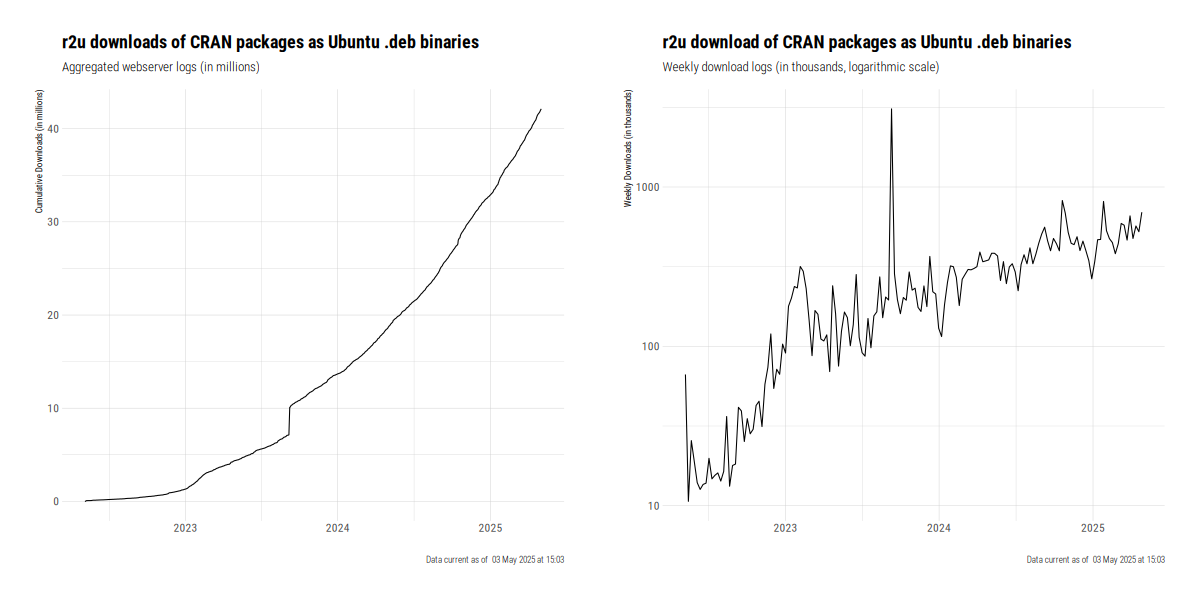
Welcome to post 47 in the $R^4 series! r2u provides Ubuntu binaries for all CRAN packages for the R system. It started three years ago, and offers for Linux users on Ubuntu what windows and macOS users already experience: fast, easy and reliable installation of binary packages. But by integrating with the system package manager (which is something that cannot be done on those other operating systems) we can fully and completely integrate it with underlying system. External libraries are resolved as shared libraries and handled by the system package manager. This offers fully automatic installation both at the initial installation and all subsequent upgrades. R users just say, e.g., install.packages("sf") and spatial libraries proj, gdal, geotiff (as well as several others) are automatically installed as dependencies in the correct versions. And they remain installed along with sf as the system manager now knows of the dependency. Work on r2u began as a quick weekend experiment in March 2022, and by May 4 a first release was marked in the NEWS file after a few brave alpha testers kicked tires quite happily. This makes today the third anniversary of that first release, and marks a good time to review where we are. This short post does this, and stresses three aspects: overall usage, current versions, and new developments.

Steadily Growing Usage at 42 Million Packages Shipped r2u ships from two sites. Its main repository is at the University of Illinois campus providing ample and heavily redundant bandwidth. We remain very grateful for the sponsorship from Atlas. It also still ships from my own server though that may be discontinued or could be spotty as it is on retail fiber connectivity. As we have access to the both sets of server logs, we can tabulate and chart usage. As of yesterday, total downloads were north of 42 million with current weekly averages around 500 thousand. These are quite staggering numbers for what started as a small hobby project, and are quite humbling. Usage is driven by deployment in continuous integration (as for example the Ubuntu-use at GitHub makes this both an easy and obvious choice), cloud computing (as it is easy to spin up Ubuntu instances, it is as easy to add r2u via four simple commands or one short script), explorative use (for example on Google Colab) or of course in general laptop, desktop, or server settings.

Current Versions Since r2u began, we added two Ubuntu LTS releases, three annual R releases as well as multiple BioConductor releases. BioConductor support is on a best-efforts basis motivated primarily to support the CRAN packages having dependencies. It has grown to around 500 packages and includes the top-250 by usage. Right now, current versions R 4.5.0 and BioConductor 3.21, both released last month, are supported.

New Development: arm64 A recent change is the support of the arm64 platform. As discussed in the introductory post, it is a popular and increasingly common CPU choice seen anywhere from the Raspberry Pi 5 and it Cortex CPU to in-house cloud computing platforms (called, respectively, Graviton at AWS and Axiom at GCS), general server use via Ampere CPUs, Cortex-based laptops that start to appears and last but not least on the popular M1 to M4-based macOS machines. (For macOS, one key appeal is in use of lighterweight Docker use as these M1 to M4 cpus can run arm64-based containers without a translation layer making it an attractive choice.) This is currently supported only for the noble aka 24.04 release. GitHub Actions, where we compile these packages, now also supports jammy aka 22.04 but it may not be worth it to expand there as the current latest release is available. We have not yet added BioConductor support but may do so. Drop us a line (maybe via an issue) if this of interest. With the provision of arm64 binaries, we also started to make heavier use of GitHub Actions. The BioConductor 3.21 release binaries were also created there. This makes the provision more transparent as well as the configuration repo as well as the two builder repos (arm64, bioc) are public, as is of course the main r2u repo.

Summing Up This short post summarised the current state of r2u along with some recent news. If you are curious, head over to the r2u site and try it, for example in a rocker/r2u container.

This post by Dirk Eddelbuettel originated on his Thinking inside the box blog. If you like this or other open-source work I do, you can now sponsor me at GitHub.

Colin Watson: Free software activity in April 2025

About 90% of my Debian contributions this month were sponsored by Freexian. You can also support my work directly via Liberapay. Request for OpenSSH debugging help Following the OpenSSH work described below, I have an open report about the sshd server sometimes crashing when clients try to connect to it. I can t reproduce this myself, and arm s-length debugging is very difficult, but three different users have reported it. For the time being I can t pass it upstream, as it s entirely possible it s due to a Debian patch. Is there anyone reading this who can reproduce this bug and is capable of doing some independent debugging work, most likely involving bisecting changes to OpenSSH? I d suggest first seeing whether a build of the unmodified upstream 10.0p2 release exhibits the same bug. If it does, then bisect between 9.9p2 and 10.0p2; if not, then bisect the list of Debian patches. This would be extremely helpful, since at the moment it s a bit like trying to look for a needle in a haystack from the next field over by sending instructions to somebody with a magnifying glass. OpenSSH I upgraded the Debian packaging to OpenSSH 10.0p1 (now designated 10.0p2 by upstream due to a mistake in the release process, but they re the same thing), fixing CVE-2025-32728. This also involved a diffoscope bug report due to the version number change. I enabled the new --with-linux-memlock-onfault configure option to protect sshd against being swapped out, but this turned out to cause test failures on riscv64, so I disabled it again there. Debugging this took some time since I needed to do it under emulation, and in the process of setting up a testbed I added riscv64 support to vmdb2. In coordination with the wtmpdb maintainer, I enabled the new Y2038-safe native wtmpdb support in OpenSSH, so wtmpdb last now reports the correct tty. I fixed a couple of packaging bugs: I reviewed and merged several packaging contributions from others: dput-ng Since we added dput-ng integration to Debusine recently, I wanted to make sure that it was in good condition in trixie, so I fixed dput-ng: will FTBFS during trixie support period. Previously a similar bug had been fixed by just using different Ubuntu release names in tests; this time I made the tests independent of the current supported release data returned by distro_info, so this shouldn t come up again. We also ran into dput-ng: override doesn t override profile parameters, which needed somewhat more extensive changes since it turned out that that option had never worked. I fixed this after some discussion with Paul Tagliamonte to make sure I understood the background properly. man-db I released man-db 2.13.1. This just included various small fixes and a number of translation updates, but I wanted to get it into trixie in order to include a contribution to increase the MAX_NAME constant, since that was now causing problems for some pathological cases of manual pages in the wild that documented a very large number of terms. debmirror I fixed one security bug: debmirror prints credentials with progress. Python team I upgraded these packages to new upstream versions: In bookworm-backports, I updated these packages: I dropped a stale build-dependency from python-aiohttp-security that kept it out of testing (though unfortunately too late for the trixie freeze). I fixed or helped to fix various other build/test failures: I packaged python-typing-inspection, needed for a new upstream version of pydantic. I documented the architecture field in debian/tests/autopkgtest-pkg-pybuild.conf files. I fixed other odds and ends of bugs: Science team I fixed various build/test failures:

Russ Allbery: Review: The Book That Held Her Heart

Review: The Book That Held Her Heart, by Mark Lawrence
Series: Library Trilogy #3
Publisher: ACE
Copyright: 2025
ISBN: 0-593-43799-3
Format: Kindle
Pages: 367
The Book That Held Her Heart is the third and final book of the Library fantasy trilogy and a direct sequel to The Book That Broke the World. Lawrence provides a much-needed summary of the previous volumes at the start of this book (thank you to every author who does this!), but I was still struggling a bit with the blizzard of character names. I recommend reading this series entry in relatively close proximity to the other two. At the end of the previous book, and following some rather horrific violence, the cast split into four groups. Three of those are pursuing different resolutions to the moral problem of the Library's existence. The fourth group opens the book still stuck with the series villains, who were responsible for the over-the-top morality that undermined my enjoyment of The Book That Broke the World. Lawrence follows all four groups in interwoven chapters, maintaining that complex structure through most of this book. I thought this was a questionable structural decision that made this book feel choppy, disconnected, and unnecessarily confusing. The larger problem, though, is that this is the payoff book, the book where we find out if Lawrence is equal to the tricky ethical questions he's raised and the world-building masterpiece that The Book That Wouldn't Burn kicked off. The answer, unfortunately, is "not really." This is not a total failure; there are some excellent set pieces and world-building twists, and the characters remain likable and enjoyable to read about (although the regrettable sidelining of Livira continues). But the grand finale is weirdly conservative and not particularly grand, and Lawrence's answer to the moral questions he raised is cliched and wholly unsatisfying. I was really hoping Lawrence was going somewhere more interesting than "Nazis bad." I am entirely sympathetic to this moral position, but so is every other likely reader of this series, and we all know how that story goes. What a waste of a compelling setup. Sadly, "Nazis bad" isn't even a metaphor for the black-and-white morality that Lawrence first introduced at the end of the previous book. It's a literal description of the main moral thrust of this book. Lawrence introduces yet another new character and timeline so that he can write about thinly-disguised Nazis persecuting even more thinly-disguised Jews, and this conflict is roughly half this book. It's also integral to the ending, which uses obvious, stock secular sainthood as a sort of trump card to resolve ideological conflicts at the heart of the series. This is one of the things I was worried about after I read the short stories that Lawrence published between the volumes of this series. All of them were thuddingly trite, which did not make me optimistic that Lawrence would find a sufficiently interesting answer to his moral trilemma to satisfy the high expectations created by the build-up. That is, I am sad to report, precisely the failure mode of this book. The resolution of the moral question of the series is arguably radical within the context of the prior world-building, but in a way that effectively reduces it to the boring, small-c conservative bromides of everyday reality. This is precisely the opposite of why I read fantasy, and I did not find Lawrence's arguments for it at all convincing. Neither, I think, did Lawrence, given that the critical debate takes place off camera so that he could avoid having to present the argument. This is, unfortunately, another series where the author's reach exceeded their grasp. The world-building of The Book That Wouldn't Burn is a masterpiece that created one of the most original and compelling settings that I have read in fantasy for a long time, but unfortunately Lawrence did not have an equally original plan for how to use the setting. This is a common problem and I'm not going to judge it too harshly; it's much harder to end a series than it is to start one. I thought the occasional flashes of brilliance was worth the journey, and they continue into this book with some elaborations on the Library's mythic structure that are going to stick in my mind. You can sense the story slipping away from the hoped-for conclusion as you read, though. The story shifts more and more away from the setting and the world-building and towards character stories, and while Lawrence's characters are fine, they're not that novel. I am happy to read about Clovis and Arpix, but I can read variations of that story in a lot of places. Livira never recovers her dynamism and drive from the first book, and there is much less beneath Yute's thoughtful calm than I was hoping to find. I think Lawrence knows that the story was not entirely working because the narrative voice becomes more strident as the morality becomes less interesting. I know of only one fantasy author who can make this type of overbearing and freighted narrative style work, and Lawrence is sadly not Guy Gavriel Kay. This is not a bad book. It is an enjoyable adventure story on its own terms, with some moments of real beauty and awe and a handful of memorable characters, somewhat undermined by a painfully obvious and unoriginal moral frame. It's only a disappointment in the context of what came before it, and it is far from the first series conclusion that doesn't quite live up to the earlier volumes. I'm glad that I read it, and the series as a whole, and I do appreciate that Lawrence brought the whole series to a firm and at least somewhat satisfying conclusion in the promised number of volumes. But I do wish the series as a whole had been as special as the first book. Rating: 6 out of 10

2 May 2025

Daniel Lange: Compiling and installing the Gentoo Linux kernel on emerge without genkernel (part 2)

The first install of a Gentoo kernel needs to be somewhat manual if you want to optimize the kernel for the (virtual) system it boots on. In part 1 I laid out how to improve the subsequent emerges of sys-kernel/gentoo-sources with a small drop in script to build the kernel as part of the ebuild. Since end of last year Gentoo also supports a less manual way of emerging a kernel: The following kernel blends are available: So a quick walk-through for the gentoo-kernel variant: 1. Set up the correct package USE flags We do not want an initrd and we want our own config to be re-used so:
echo "sys-kernel/gentoo-kernel -initramfs savedconfig" >> /etc/portage/package.use/gentoo-kernel
2. Preseed the saved config The current kernel config needs to be saved as the initial savedconfig so it is found and applied for our emerge below:
mkdir -p /etc/portage/savedconfig/sys-kernel
cp -n "/usr/src/linux-$(uname -r)/.config" /etc/portage/savedconfig/sys-kernel/gentoo-kernel
3. Emerge the new kernel
emerge sys-kernel/gentoo-kernel
4. Update grub and reboot Unfortunately this ebuild does not update grub, so we have to run grub-mkconfig manually. This can again be automated via a post_pkg_postinst() script. See the step 7 below. But for now, let's do it manually:
grub-mkconfig -o /boot/grub/grub.cfg
# All fine? Time to reboot the machine:
reboot
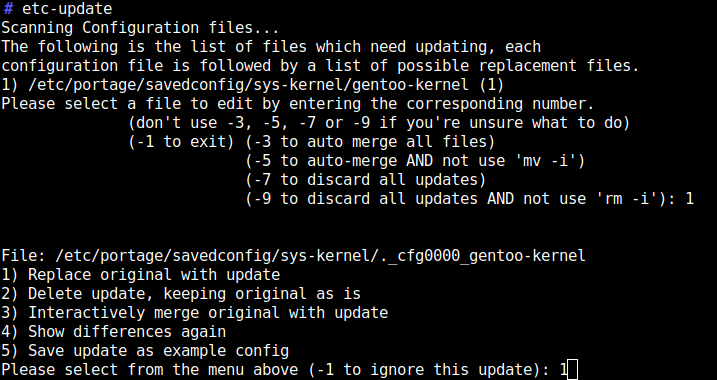
5. (Optional) Prepare for the next kernel build Run etc-update and merge the new kernel config entries into your savedconfig. Screenshot of etc-update The kernel should auto-build once new versions become available via portage. Again the etc-update can be automated if you feel that is sufficiently safe to do in your environment. See step 7 below for details. 6. (Optional) Remove the old kernel sources If you want to switch from the method based on gentoo-sources to the gentoo-kernel one, you can remove the kernel sources:

emerge -C "=sys-kernel/gentoo-sources-5*"
Be sure to update the /usr/src/linux symlink to the new kernel sources directory from gentoo-kernel, e.g.:
rm /usr/src/linux; ln -s "/usr/src/$(uname -r)" /usr/src/linux
This may be a good time for a bit more house-keeping: Clean up a bit in /usr/src/ to remove old build artefacts, /boot/ to remove old kernels and /lib/modules/ to get rid of old kernel modules. 7. (Optional) Further automate the ebuild In part 1 we automated the kernel compile, install and a bit more via a helper function for post_pkg_postinst(). We can do the similarly for what is (currently) missing from the gentoo-kernel ebuilds: Create /etc/portage/env/sys-kernel/gentoo-kernel with the following:
post_pkg_postinst()
etc-update --automode -5 /etc/portage/savedconfig/sys-kernel
grub-mkconfig -o /boot/grub/grub.cfg
The upside of gentoo-kernel over gentoo-sources is that you can put "config override files" in /etc/kernel/config.d/. That way you theoretically profit from config improvements made by the upstream developers. See the Gentoo distribution kernel documentation for a sample snippet. I am fine with savedconfig for now but it is nice that Gentoo provides the flexibility to support both approaches.

Daniel Lange: The Stallman wars

So, 2021 isn't bad enough yet, but don't despair, people are working to fix that:

Welcome to the Stallman wars Team Cancel: https://rms-open-letter.github.io/ (repo) Team Support: https://rms-support-letter.github.io/ (repo) Current Final stats are:

Team Cancel:  3019 signers from 1415 individual commit authors
Team Support: 6853 signers from 5418 individual commit authors
Git shortlog (Top 10):
rms_cancel.git (Last update: 2021-08-16 00:11:15 (UTC))
  1230  Neil McGovern
   251  Joan Touzet
    99  Elana Hashman
    73  Molly de Blanc
    36  Shauna
    19  Juke
    18  Stefano Zacchiroli
    17  Alexey Mirages
    16  Devin Halladay
    14  Nader Jafari
rms_support.git (Last update: 2021-09-29 07:14:39 (UTC))
  1821  shenlebantongying
  1585  nukeop
  1560  Ivanq
  1057  Victor
   880  Job Bautista
   123  nekonee
   101  Victor Gridnevsky
    41  Patrick Spek
    25  Borys Kabakov
    17  KIM Taeyeob
(data as of 2021-10-01) Technical info:
Signers are counted from their "Signed / Individuals" sections. Commits are counted with git shortlog -s.
Team Cancel also has organizational signatures with Mozilla, Suse and X.Org being among the notable signatories. The 16 original signers of the Cancel petition are added in their count. Neil McGovern, Juke and shenlebantongying need .mailmap support as they have committed with different names. Further reading: 12.04.2021 Statements from the accused 18.04.2021 Debian General Resolution The Debian General Resolution (GR) vote of the developers has concluded to not issue a public statement at all, see https://www.debian.org/vote/2021/vote_002#outcome for the results.
It is better to keep quiet and seem ignorant than to speak up and remove all doubt.
See Quote Investigator for the many people that rephrased these words over the centuries. They still need to be recalled more often as too many people in the FLOSS community have forgotten about that wisdom... 01.10.2021 Final stats It seems enough dust has settled on this unfortunate episode of mob activity now. Hence I stopped the cronjob that updated the stats above regularly. Team Support has kept adding signature all the time while Team Cancel gave up very soon after the FSF decided to stand with Mr. Stallman. So this battle was decided within two months. The stamina of the accused and determined support from some dissenting web devs trumped the orchestrated outrage of well known community figures and their publicity power this time. But history teaches us that does not mean the war is over. There will a the next opportunity to call for arms. And people will call. Unfortunately. 01.11.2024 Team Cancel is opening a new round; Team Support responds with exposing the author of "The Stallman report" I hate to be right. Three years later than the above: An anonymous member of team Cancel has published https://stallman-report.org/ [local pdf mirror, 504kB] to "justify our unqualified condemnation of Richard Stallman". It contains a detailed collection of quotes that are used to allege supporting (sexual) misconduct. The demand is again that Mr. Stallman "step[s] down from all positions at the FSF and the GNU project". Addressing him: "the scope and extent of your misconduct disqualifies you from formal positions of power within our community indefinitely". Team Support has not issues a rebuttal (yet?) but has instead identified the anonymous author as Drew "sircmpwn" DeVault, a gifted software developer, but also a vocal and controversial figure in the Open Source / Free Software space. Ironically quite similar to Richard "rms" Stallman. Their piece is published at https://dmpwn.info/ [local pdf mirror, 929kB]. They also allege a proximity of Mr. DeVault to questionable "Lolita" anime preferences and societal positions to disqualify him.

Russ Allbery: Review: Sixteen Ways to Defend a Walled City

Review: Sixteen Ways to Defend a Walled City, by K.J. Parker
Series: Siege #1
Publisher: Orbit
Copyright: April 2019
ISBN: 0-316-27080-6
Format: Kindle
Pages: 349
Sixteen Ways to Defend a Walled City is... hm, honestly, I'm not sure what the genre of this novel is. It is a story about medieval engineering and siege weapons in a Rome-inspired secondary world that so far as I can tell is not meant to match ours. There is not a hint of magic. It's not technically a fantasy, but it's marketed like a fantasy, and it's not historical fiction nor is it attempting to be alternate history. The most common description is a fantasy of logistics, so I guess I'll go with that, as long as you understand that the fantasy here is of the non-magical sort. K.J. Parker is a pen name for Tom Holt. Orhan is Colonel-in-Chief of the Engineers for the Robur empire, even though he's a milkface, not a blueskin like a proper Robur. (Both of those racial terms are quite offensive.) He started out as a slave, learned a trade, joined the navy as a shipwright, and worked his way up the ranks through luck and enemy action. He's canny, practical, highly respected by his men, happy to cheat and steal to get material for his projects and wages for his people, and just wants to build literal bridges. Nice, sturdy bridges that let people get from one place to another the short way. When this book opens, Orhan is in Classis trying to requisition some rope. He is saved from discovery of his forged paperwork by pirates burning down the warehouse that held all of the rope, and then saved from the pirates by the sorts of coincidences that seem to happen to Orhan all the time. A few subsequent discoveries about what the pirates were after, and news of another unexpected attack on the empire, make Orhan nervous enough that he takes his men to do a job as far away from the City at the heart of the empire as possible. It's just his luck to return in time to find slaughtered troops and to have to sneak his men into a City already under siege. Sixteen Ways to Defend a Walled City is told in the first person by Orhan, with an internal justification that the reader only discovers at the end of the book. That means your enjoyment of this book is going to depend a lot on how much you like Orhan's voice. This mostly worked for me; his voice is an odd combination of chatty, self-deprecating, and brusque, and it took a bit for me to get used to it, but I came around. This book is clearly competence porn nearly all the fun of this book is seeing what desperate plan Orhan will come up with next so it helps that Orhan does indeed come across as competent. The part that did not work for me was the morality. You would think from the title that would be straightforward: The City is under siege, people want to capture it and kill everyone, Orhan is on the inside, and his job is to keep them out. That would have been the morality of simplistic military fiction, but most of the appeal was in watching the problem-solving anyway. That's how the story starts, but then Parker started dropping hints of more complexity. Orhan is a disfavored minority and the Robur who run the empire are racist assholes, even though Orhan mostly gets along with the ones who work with him closely. Orhan says a few things that make the reader wonder whether the City warrants defending, and it becomes less clear whether Orhan's loyalties were as solid as they appeared to be. Parker then offers a few moral dilemmas and has Orhan not follow them in the expected directions, making me wonder where Parker was going with the morality of this story. And then we find out that the answer is nowhere. Parker is going nowhere. None of that setup has a payoff, and the ending is deeply unsatisfying and arguably pointless. I am not sure this is an objective analysis. This is one of those books where I would not be surprised to see someone else praise its realism. Orhan is in some ways a more likely figure than the typical hero of a book. He likes accomplishing things, he's a cheat and a liar when that serves his purposes, he's loyal to the people he considers friends in a way that often doesn't involve consulting them about what they want, and he makes decisions mostly on vibes and stubbornness. Both his cynicism and his idealism are different types of masks; beneath both, he's an incoherent muddle. You could argue that we're all that sort of muddle, deep down, and the consistent idealists are the unrealistic (and frightening) ones, and I think Parker may be attempting exactly that argument. I know some readers like this sort of fallibly human incoherence. But wow did I ever loathe this ending because I was not reading this book for a realistic psychological profile of an average guy. I was here for the competence porn, for the fantasy of logistics, for the experience of watching someone have a plan and get shit done. Apparently that extends to needing him to be competent at morality as well, or at least think about it as hard as he thinks about siege weapons. One of the reasons why I am primarily a genre reader is that I don't read books for depressing psychological profiles. There are enough of those in the news. I read books to spend some time in a world better than mine, where things work out the way that they are supposed to, or at least in a way that's satisfying. The other place where this book interfered with my vibes is that it's about a war, and a lot of Orhan's projects are finding more efficient ways to kill people. Parker takes a "war is hell" perspective, and Orhan gets deeply upset at the graphic sights of mangled human bodies that are the frequent results of his plans. I feel weird complaining about this because yes, it's good to be aware of the horrific things that we do to other people in wars, but man, I just wanted to watch some effective project management. I want to enjoy unexpected lateral thinking, appreciate the friendly psychological manipulation involved in getting a project to deliver on deadline, and watch someone solve logistical problems. Battlefields provide an endless supply of interesting challenges, but then Parker feels compelled to linger on the brutal consequences of Orhan's ideas and now I'm depressed and sickened rather than enjoying myself. I really wanted to like this book, and for a lot of the book I did, but that ending was a bottomless pit that sucked away all my enjoyment and retroactively made the rest of the book feel worse. I so wanted Parker to be going somewhere clever and surprising, and the disappointment when none of that happened was intense. This is probably an excessively negative reaction, and I will not be surprised when other people get along with this book better than I did, but not only will I not be recommending it, I'm now rather dubious about reading any more Parker. Followed by How to Rule an Empire and Get Away With It. Rating: 5 out of 10

1 May 2025

Ian Jackson: Free Software, internal politics, and governance

There is a thread of opinion in some Free Software communities, that we shouldn t be doing politics , and instead should just focus on technology. But that s impossible. This approach is naive, harmful, and, ultimately, self-defeating, even on its own narrow terms. Today I m talking about small-p politics In this article I m using politics in the very wide sense: us humans managing our disagreements with each other. I m not going to talk about culture wars, woke, racism, trans rights, and so on. I am not going to talk about how Free Software has always had explicitly political goals; or how it s impossible to be neutral because choosing not to take a stand is itself to take a stand. Those issues are all are important and Free Software definitely must engage with them. Many of the points I make are applicable there too. But those are not my focus today. Today I m talking in more general terms about politics, power, and governance. Many people working together always entails politics Computers are incredibly complicated nowadays. Making software is a joint enterprise. Even if an individual program has only a single maintainer, it fits into an ecosystem of other software, maintained by countless other developers. Larger projects can have thousands of maintainers and hundreds of thousands of contributors. Humans don t always agree about everything. This is natural. Indeed, it s healthy: to write the best code, we need a wide range of knowledge and experience. When we can t come to agreement, we need a way to deal with that: a way that lets us still make progress, but also leaves us able to work together afterwards. A way that feels OK for everyone. Providing a framework for disagreement is the job of a governance system. The rules say which people make which decisions, who must be consulted, how the decisions are made, and, how, if any, they can be reviewed. This is all politics. Consensus is great but always requiring it is harmful Ideally a discussion will converge to a synthesis that satisfies everyone, or at least a consensus. When consensus can t be achieved, we can hope for compromise: something everyone can live with. Compromise is achieved through negotiation. If every decision requires consensus, then the proponents of any wide-ranging improvement have an almost insurmountable hurdle: those who are favoured by the status quo and find it convenient can always object. So there will never be consensus for change. If there is any objection at all, no matter how ill-founded, the status quo will always win. This is where governance comes in. Governance is like backups: we need to practice it Governance processes are the backstop for when discussions, and then negotiations, fail, and people still don t see eye to eye. In a healthy community, everyone needs to know how the governance works and what the rules are. The participants need to accept the system s legitimacy. Everyone, including the losing side, must be prepared to accept and implement (or, at least not obstruct) whatever the decision is, and hopefully live with it and stay around. That means we need to practice our governance processes. We can t just leave them for the day we have a huge and controversial decision to make. If we do that, then when it comes to the crunch we ll have toxic rows where no-one can agree the rules; where determined people bend the rules to fit their outcome; and where afterwards people feel like the whole thing was horrible and unfair. So our decisionmaking bodies and roles need to be making decisions, as a matter of routine, and we need to get used to that. First-line decisionmaking bodies should be making decisions frequently. Last-line appeal mechanisms (large-scale votes, for example) are naturally going to be exercised more rarely, but they must happen, be seen as legitimate, and their outcomes must be implemented in full. Governance should usually be routine and boring When governance is working well it s quite boring. People offer their input, and are heard. Angles are debated, and concerns are addressed. If agreement still isn t reached, the committee, or elected leader, makes a decision. Hopefully everyone thinks the leadership is legitimate, and that it properly considered and heard their arguments, and made the decision for good reasons. Hopefully the losing side can still get their work done (and make their own computer work the way they want); so while they will be disappointed, they can live with the outcome. Many human institutions manage this most of the time. It does take some knowledge about principles of governance, and ideally some experience. Governance means deciding, not just mediating By making decisions I mean exercising their authority to rule on an actual disagreement: one that wasn t resolved by debate or negotiation. Governance processes by definition involve deciding, not just mediating. It s not governance if we re advising or cajoling: in that case, we re back to demanding consensus. Governance is necessary precisely when consensus is not achieved. If the governance systems are to mean anything, they must be able to (over)rule; that means (over)ruling must be normal and accepted. Otherwise, when the we need to overrule, we ll find that we can t, because we lack the collective practice. To be legitimate (and seen as legitimate) decisions must usually be made based on the merits, not on participants status, and not only on process questions. On the autonomy of the programmer Many programmers seem to find the very concept of governance, and binding decisionmaking, deeply uncomfortable. Ultimately, it means sometimes overruling someone s technical decision. As programmers and maintainers we naturally see how this erodes our autonomy. But we have all seen projects where the maintainers are unpleasant, obstinate, or destructive. We have all found this frustrating. Software is all interconnected, and one programmer s bad decisions can cause problems for many of the rest of us. We exasperate, why won t they just do the right thing . This is futile. People have never just ed and they re not going to start just ing now. So often the boot is on the other foot. More broadly, as software developers, we have a responsibility to our users, and a duty to write code that does good rather than ill in the world. We ought to be accountable. (And not just to capitalist bosses!) Governance mechanisms are the answer. (No, forking anything but the smallest project is very rarely a practical answer.) Mitigate the consequences of decisions retain flexibility In software, it is often possible to soften the bad social effects of a controversial decision, by retaining flexibility. With a bit of extra work, we can often provide hooks, non-default configuration options, or plugin arrangements. If we can convert the question from how will the software always behave into merely what should the default be , we can often save ourselves a lot of drama. So it is often worth keeping even suboptimal or untidy features or options, if people want to use them and are willing to maintain them. There is a tradeoff here, of course. But Free Software projects often significantly under-value the social benefits of keeping everyone happy. Wrestling software even crusty or buggy software is a lot more fun than having unpleasant arguments. But don t do decisionmaking like a corporation Many programmers experience of formal decisionmaking is from their boss at work. But corporations are often a very bad example. They typically don t have as much trouble actually making decisions, but the actual decisions are often terrible, and not just because corporations goals are often bad. You get to be a decisionmaker in a corporation by spouting plausible nonsense, sounding confident, buttering up the even-more-vacuous people further up the chain, and sometimes by sabotaging your rivals. Corporate senior managers are hardly ever held accountable typically the effects of their tenure are only properly felt well after they ve left to mess up somewhere else. We should select our leaders more wisely, and base decisions on substance. If you won t do politics, politics will do you As a participant in a project, or a society, you can of course opt out of getting involved in politics. You can opt out of learning how to do politics generally, and opt out of understanding your project s governance structures. You can opt out of making judgements about disputed questions, and tell yourself there s merit on both sides . You can hate politicians indiscriminately, and criticise anyone you see doing politics. If you do this, then you are abdicating your decisionmaking authority, to those who are the most effective manipulators, or the most committed to getting their way. You re tacitly supporting the existing power bases. You re ceding power to the best liars, to those with the least scruples, and to the people who are most motivated by dominance. This is precisely the opposite of what you wanted. If enough people won t do politics, and hate anyone who does, your discussion spaces will be reduced to a battleground of only the hardiest and the most toxic. If you don t see the politics, it s still happening If your governance systems don t work, then there is no effective redress against bad or even malicious decisions. Your roleholders and subteams are unaccountable power centres. Power radically distorts every human relationship, and it takes great strength of character for an unaccountable power centre not to eventually become an unaccountable toxic cabal. So if you have a reasonable sized community, but don t see your formal governance systems working people debating things, votes, leadership making explicit decisions that doesn t mean everything is fine, and all the decisions are great, and there s no politics happening. It just means that most of your community have given up on the official process. It also probably means that some parts of your project have formed toxic and unaccountable cabals. Those who won t put up with that will leave. The same is true if the only governance actions that ever happen are massive drama. That means that only the most determined victim of a bad decision, will even consider using such a process. Conclusions

comment count unavailable comments

Jonathan McDowell: Local Voice Assistant Step 2: Speech to Text and back

Having setup an ATOM Echo Voice Satellite and hooked it up to Home Assistant we now need to actually do something with the captured audio. Home Assistant largely deals with voice assistants using the Wyoming Protocol, which describes itself as essentially JSONL + PCM audio. It works nicely in terms of meaning everything can exist as separate modules that then just communicate over network sockets, and there are a whole bunch of Python implementations of the pieces necessary. The first bit I looked at was speech to text; how do I get what I say to the voice satellite into something that Home Assistant can try and parse? There is a nice self contained speech recognition tool called whisper.cpp, which is a low dependency implementation of inference using OpenAI s Whisper model. This is wrapped up for Wyoming as part of wyoming-whisper-cpp. Here we get into something that unfortunately seems common in this space; the repo contains a forked copy of whisper.cpp with enough differences that I couldn t trivially make it work with regular whisper.cpp. That means missing out on new development, and potential improvements (the fork appears to be at v1.5.4, upstream is up to v1.7.5 at the time of writing). However it was possible to get up and running easily enough. [I note there is a Wyoming Whisper API client that can use the whisper.cpp server, and that might be a cleaner way to go in the future, especially if whisper.cpp ends up in Debian.] I stated previously I wanted all of this to be as clean an installed on Debian stable as possible. Given most of this isn t packaged, that s meant I ve packaged things up as I go. I m not at the stage anything is suitable for upload to Debian proper, but equally I ve tried to make them a reasonable starting point. No pre-built binaries available, just Salsa git repos. https://salsa.debian.org/noodles/wyoming-whisper-cpp in this case. You need python3-wyoming from trixie if you re building for bookworm, but it doesn t need rebuilt. You need a Whisper model that s been converts to ggml format; they can be found on Hugging Face. I ve ended up using the base.en model. I found small.en gave more accurate results, but took a little longer, when doing random testing, but it doesn t seem to make much of a difference for voice control rather than plain transcribing. [One of the open questions about uploading this to Debian is around the use of a prebuilt AI model. I don t know what the right answer is here, and whether the voice infrastructure could ever be part of Debian proper, but the current discussion on the interpretation of the DFSG on AI models is very relevant.] I run this in the same container as my Home Assistant install, using a systemd unit file dropped in /etc/systemd/system/wyoming-whisper-cpp.service:
[Unit]
Description=Wyoming whisper.cpp server
After=network.target
[Service]
Type=simple
DynamicUser=yes
ExecStart=wyoming-whisper-cpp --uri tcp://localhost:10030 --model base.en
MemoryDenyWriteExecute=false
ProtectControlGroups=true
PrivateDevices=false
ProtectKernelTunables=true
ProtectSystem=true
RestrictRealtime=true
RestrictNamespaces=true
[Install]
WantedBy=multi-user.target
It needs the Wyoming Protocol integration enabled in Home Assistant; you can Add Entry and enter localhost + 10030 for host + port and it ll get added. Then in the Voice Assistant configuration there ll be a whisper.cpp option available. Text to speech turns out to be weirdly harder. The right answer is something like Wyoming Piper, but that turns out to be hard on bookworm. I ll come back to that in a future post. For now I took the easy option and used the built in Google Translate option in Home Assistant. That needed an extra stanza in configuration.yaml that wasn t entirely obvious:
media_source:
With this, and the ATOM voice satellite, I could now do basic voice control of my Home Assistant setup, with everything except the text-to-speech piece happening locally! Things such as Hey Jarvis, turn on the study light work out of the box. I haven t yet got into defining my own phrases, partly because I know some of the things I want ( What time is it? ) are already added in later Home Assistant versions than the one I m running. Overall I found this initially complicated to setup given my self-imposed constraints about actually understanding the building blocks and compiling them myself, but I ve been pretty impressed with the work that s gone into it all. Next step, running a voice satellite on a Debian box.

Russ Allbery: Review: Beyond Pain

Review: Beyond Pain, by Kit Rocha
Series: Beyond #3
Publisher: Kit Rocha
Copyright: December 2013
ASIN: B00GIA4GN8
Format: Kindle
Pages: 328
Beyond Pain is a science fiction dystopian erotic romance novel and a direct sequel to Beyond Control. Following the romance series convention, each book features new protagonists who were supporting characters in the previous book. You could probably start here if you wanted, but there are significant spoilers here for earlier books in the series. I read this book as part of the Beyond Series Bundle (Books 1-3), which is what the sidebar information is for. Six has had a brutally hard life. She was rescued from an awful situation in a previous book and is now lurking around the edges of the Sector Four gang, oddly fascinated (as are we all) with their constant sexuality and trying to decide if she wants to, and can, be part of their world. Bren is one of the few people she lets get close: a huge bruiser who likes cage fights and pain but treats Six with a protective, careful respect that she finds comforting. This book is the story of Six and Bren getting to the bottom of each other's psychological hangups while the O'Kanes start taking over Six's former sector. Yes, as threatened, I read another entry in the dystopian erotica series because I keep wondering how these people will fuck their way into a revolution. This is not happening very quickly, but it seems obvious that is the direction the series is going. It's been a while since I've reviewed one of these, so here's another variation of the massive disclaimer: I think erotica is harder to review than any other genre because what people like is so intensely personal and individual. This is not even an attempt at an erotica review. I'm both wholly unqualified and also less interested in that part of the book, which should lead you to question my reading choices since that's a good half of the book. Rather, I'm reading these somewhat for the plot and mostly for the vibes. This is not the most competent collection of individuals, and to the extent that they are, it's mostly because the men (who are, as a rule, charismatic but rather dim) are willing to listen to the women. What they are good at is communication, or rather, they're good about banging their heads (and other parts) against communication barriers until they figure out a way around them. Part of this is an obsession with consent that goes quite a bit deeper than the normal simplistic treatment. When you spend this much time trying to understand what other people want, you have to spend a lot of time communicating about sex, and in these books that means spending a lot of time communicating about everything else as well. They are also obsessively loyal and understand the merits of both collective action and in making space for people to do the things that they are the best at, while still insisting that people contribute when they can. On the surface, the O'Kanes are a dictatorship, but they're run more like a high-functioning collaboration. Dallas leads because Dallas is good at playing the role of leader (and listening to Lex), which is refreshingly contrary to how things work in the real world right now. I want to be clear that not only is this erotica, this is not the sort of erotica where there's a stand-alone plot that is periodically interrupted by vaguely-motivated sex scenes that you can skim past. These people use sex to communicate, and therefore most of the important exchanges in the book are in the middle of a sex scene. This is going to make this novel, and this series, very much not to the taste of a lot of people, and I cannot be emphatic enough about that warning. But, also, this is such a fascinating inversion. It's common in media for the surface plot of the story to be full of sexual tension, sometimes to the extent that the story is just a metaphor for the sex that the characters want to have. This is the exact opposite of that: The sex is a metaphor for everything else that's going on in the story. These people quite literally fuck their way out of their communication problems, and not in an obvious or cringy way. It's weirdly fascinating? It's also possible that my reaction to this series is so unusual as to not be shared by a single other reader. Anyway, the setup in this story is that Six has major trust issues and Bren is slowly and carefully trying to win her trust. It's a classic hurt/comfort setup, and if that had played out in the way that this story often does, Bren would have taken the role of the gentle hero and Six the role of the person he rescued. That is not at all where this story goes. Six doesn't need comfort; Six needs self-confidence and the ability to demand what she wants, and although the way Beyond Pain gets her there is a little ham-handed, it mostly worked for me. As with Beyond Shame, I felt like the moral of the story is that the O'Kane men are just bright enough to stop doing stupid things at the last possible moment. I think Beyond Pain worked a bit better than the previous book because Bren is not quite as dim as Dallas, so the reader doesn't have to suffer through quite as many stupid decisions. The erotica continues to mostly (although not entirely) follow traditional gender roles, with dangerous men and women who like attention. Presumably most people are reading these books for the sex, which I am wholly unqualified to review. For whatever it's worth, the physical descriptions are too mechanical for me, too obsessed with the precise structural assemblage of parts in novel configurations. I am not recommending (or disrecommending) these books, for a whole host of reasons. But I think the authors deserve to be rewarded for understanding that sex can be communication and that good communication about difficult topics is inherently interesting in a way that (at least for me) transcends the erotica. I bet I'm going to pick up another one of these about a year from now because I'm still thinking about these people and am still curious about how they are going to succeed. Followed by Beyond Temptation, an interstitial novella. The next novel is Beyond Jealousy. Rating: 6 out of 10

29 April 2025

Petter Reinholdtsen: OpenSnitch 1.6.8 is now in Trixie

After some days of effort, I am happy to report that the great interactive application firewall OpenSnitch got a new version in Trixie, now with the Linux kernel based ebpf sniffer included for better accuracy. This new version made it possible for me to finally track down the rule required to avoid a deadlock when using it on a machine with the user home directory on NFS. The problematic connection originated from the Linux kernel itself, causing the /proc based version in Debian 12 to fail to properly attribute the connection and cause the OpenSnitch daemon to block while waiting for the Python GUI, which was unable to continue because the home directory was blocked waiting for the OpenSnitch daemon. A classic deadlock reported upstream for a more permanent solution. I really love the control over all the programs and web pages calling home that OpenSnitch give me. Just today I discovered a strange connection to sb-ssl.google.com when I pulled up a PDF passed on to me via a Mattermost installation. It is some times hard to know which connections to block and which to go through, but after running it for a few months, the default rule set start to handle most regular network traffic and I only have to have a look at the more unusual connections. If you would like to know more about what your machines programs are doing, install OpenSnitch today. It is only a apt install opensnitch away. :) I hope to get the 1.6.9 version in experimental into Trixie before the archive enter hard freeze. This new version should have no relevant changes not already in the 1.6.8-11 edition, as it mostly contain Debian patches, but will give it a few days testing to see if there are any surprises. :) As usual, if you use Bitcoin and want to show your support of my activities, please send Bitcoin donations to my address 15oWEoG9dUPovwmUL9KWAnYRtNJEkP1u1b.

28 April 2025

Scarlett Gately Moore: KDE Snaps and life. Spirits are up, but I need a little help please

I was just released from the hospital after a 3 day stay for my ( hopefully ) last surgery. There was concern with massive blood loss and low heart rate. I have stabilized and have come home. Unfortunately, they had to prescribe many medications this round and they are extremely expensive and used up all my funds. I need gas money to get to my post-op doctors appointments, and food would be cool. I would appreciate any help, even just a dollar! I am already back to work, and continued work on the crashy KDE snaps in a non KDE env. ( Also affects anyone using kde-neon extensions such as FreeCAD) I hope to have a fix in the next day or so. Fixed kate bug https://bugs.kde.org/show_bug.cgi?id=503285 Thanks for stopping by.

27 April 2025

Valhalla's Things: Stickerses

Posted on April 27, 2025
Tags: madeof:atoms, madeof:bits, craft:graphics, topic:stickers
After just a few years of procrastination, I ve given a wash of git-filter-repo to the repository where I keep my hexagonal sticker designs, removed a few failed experiments and stuff with dubious licensing and was able to finally publish it among my public git repositories This repo includes the template I m using, most of the stickers I ve had printed, some that have been published elsewhere and have been printed by other people, as well as some that have never been printed and I may or may not print in the future. The licensing details are in the metadata of each file, and mostly depend on the logos or cliparts used. Most, but not all, are under a free culture license. My server is not setup to correctly serve the SVG files, yet: downloading them (from the plain links) should work, but I need to fix the content type that is provided. I will probably procrastinate doing it for quite some time, but eventually it will be done. Of course cloning the repository from the public https URL also works. BRB, need to add MOAR stickerses.

Next.

Previous.