Search Results: "matthew"

8 June 2012

Matthew Garrett: The security of Secure Boot

The other complaint about UEFI Secure Boot is that it doesn't add any security. There's two aspects to this - people either think it'll be quickly broken, or people think that the public availability of signing services will render it useless.
Will Secure Boot be broken?Almost certainly, yes. I'd put a significant amount of money on it. The most obvious avenue of attack is probably a malformed FAT on a USB stick, or alternatively a programmable USB device that can trigger undesired behaviour in the USB stack. If you're really lucky then you might be able to corrupt the filesystem on the EFI system partition in such a way that this happens on every boot, even if there's no USB hardware connected. It's possible that there'll be a bug in the binary validation process and a cleverly designed binary may be able to validate even though it contains unsigned code. Various vendors will probably manage to produce signed option ROMs that rely on unsigned data in such a way that they can be forced to misbehave. But most of these attacks will either involve physical access or depend on the target machine having a specific piece of hardware installed, and I'd also put money on each of them being quickly fixed once they're found. And, eventually, people will run out of new attacks.

People desperately want to believe that the Secure Boot implementation is fundamentally broken, and that's just not true. It's based on well-tested encryption technology. You calculate a SHA256 of the binary you want to sign. You encrypt that hash with the private half of a 2048-bit RSA key. You embed the encrypted hash in the binary. When someone tries to run the binary you decrypt the hash with the public key in your firmware. You then calculate the hash of the binary and compare the two. If they match then you know that (a) whoever signed the binary had access to the private half of a key you trust, and (b) the binary hasn't been modified since then.

The difference between Secure Boot and things like CSS or WEP is that Secure Boot uses existing cryptographic techniques and has been designed by people who actually understand how they work. Precisely the same technology is used in Microsoft's driver signing, and people decided it was easier to steal a key from Realtek than it was to break the underlying technology. Unless there's a crippling bug in the implementation that nobody's noticed yet, the only real way to attack this is to either force a SHA256 collision (achievable with current technology, as long as you're willing to spend many orders of magnitude more time than the universe has existed) or break RSA (which would also mean that SSL is broken). If anyone can do either of these things then we are so unbelievably fucked that Secure Boot should not be the thing you're most worried about.

So, in summary: Yes, Secure Boot will be broken. And then it will be fixed. And after this happens a few times, there will be no further breaks.
Everyone can sign, so what's the pointAnyone can pay $99 and get their binaries signed. So why won't malware authors just do that? For starters, you'll need to provide some form of plausible ID for Verisign to authenticate you and hand over access. So, sure, you provide some sort of fake ID. That's the kind of thing that tends to irritate local authorities - not only are you talking about breaking into a bunch of computers, you're talking about committing the sort of crime that results in genuinely bad things happening to you if you get caught. And secondly, the only way you get access to the system is using some physical smartcards that Verisign send you. So you've also had to hand over an actual physical address, and even if you've used some sort of redirection service that's still going to make it easier to track you down. You're taking some fairly significant real-world risks.

But ok, you're willing to do that and you obtain a signing key and you sign some malware. You'll infect some number of machines. But eventually you'll be noticed, and then Microsoft produce a key revocation blob and vendors push it out via their OS update mechanisms. If your malware was basically harmless then that's probably the end of it, but if you were using it as the basis for an attack on people's banking details then a lot of people are suddenly going to be very interested in the person who bought that key, and also your malware isn't going to be able to infect any more machines.

To put this in perspective - Windows is the dominant desktop operating system. If you want to run a botnet or steal people's bank details then Windows is the obvious thing to attack. Windows security has now improved to the point where it's not massively straightforward to do that from userspace, so the logical thing to do would be to run your malware in the kernel. The easiest way to do that would be to load a driver, but Windows won't load unsigned drivers. So you'd need a signed driver. How do you get one? With the same $99 access to the Microsoft signing service that you'd use for signing an EFI binary.

Anyone could already use the signing service to attack Windows. But people haven't. The Stuxnet authors thought it was easier to steal a key from a real hardware vendor than it was to buy their own key. So, yes, in theory an attacker could obtain signing services. But the real world evidence suggests that that's not how they behave.
SummarySecure Boot is unlikely to be broken via fundamental flaws in its implementation, and there's no evidence that public availability of the signing service will result in an explosion of boot level malware.

comment count unavailable comments

6 June 2012

Matthew Garrett: "Why not just use Coreboot?"

Why not just avoid the entire Secure Boot problem by using Coreboot? Because the reason we have the Secure Boot problem is because Microsoft's Windows 8 certification requirements mean vendors have to ship a UEFI implementation with Secure Boot. You could satisfy that by using Coreboot with a Tiano payload, but it'll still have Secure Boot enabled so you still have the same set of problems. But maybe you could just reflash your system with Coreboot? No, because another part of the requirements states that all firmware updates have to be cryptographically signed now. The only way to reflash will be to attach a flash programmer directly to your motherboard.

So why not just use Coreboot? Because it doesn't help solve this problem in any way.

comment count unavailable comments

31 May 2012

Russell Coker: Links May 2012

Vijay Kumar gave an interesting TED talk about autonomous UAVs [1]. His research is based on helicopters with 4 sets of blades and his group has developed software to allow them to develop maps, fly in formation, and more. Hadiyah wrote an interesting post about networking at TED 2012 [2]. It seems that giving every delegate the opportunity to have their bio posted is a good conference feature that others could copy. Bruce Schneier wrote a good summary of the harm that post-911 airport security has caused [3]. Chris Neugebauer wrote an insightful post about the drinking culture in conferences, how it excludes people and distracts everyone from the educational purpose of the conference [4]. Matthew Wright wrote an informative article for Beyond Zero Emissions comparing current options for renewable power with the unproven plans for new nuclear and fossil fuel power plants [5]. The Free Universal Construction Kit is a set of design files to allow 3D printing of connectors between different types of construction kits (Lego, Fischer Technic, etc) [6]. Jay Bradner gave an interesting TED talk about the use of Open Source principles in cancer research [7]. He described his research into drugs which block cancer by converting certain types of cancer cell into normal cells and how he shared that research to allow the drugs to be developed for clinical use as fast as possible. Christopher Priest wrote an epic blog post roasting everyone currently associated with the Arthur C. Clarke awards, he took particular care to flame Charles Stross who celebrated The Prestige of such a great flaming by releasing a t-shirt [8]. For a while I ve been hoping that an author like Charles Stross would manage to make more money from t-shirt sales than from book sales, Charles is already publishing some of his work for free on the Internet and it would be good if he could publish it all for free. Erich Schubert wrote an interesting post about the utility and evolution of Favebook likes [9]. Richard Hartmann wrote an interesting summary of the problems with Google products that annoy him the most [10]. Sam Varghese wrote an insightful article about the political situation in China [11]. The part about the downside of allowing poorly educated people to vote seems to apply to the US as well. Sociological Images has an article about the increased rate of Autism diagnosis as social contagion [12]. People who get their children diagnosed encourage others with similar children to do the same. Vivek wrote a great little post about setting up WPA on Debian [13]. It was much easier than expected once I followed that post. Of course I probably could have read the documentation for ifupdown, but who reads docs when Google is available? Related posts:
  1. Links March 2012 Washington s Blog has an informative summary of recent articles about...
  2. Links April 2012 Karen Tse gave an interesting TED talk about how to...
  3. Links February 2012 Sociological Images has an interesting article about the attempts to...

Richard Hartmann: Potpourri II

Traffic jams suck; but they do give you a chance to think and blog. Truckers hams are telling me that four trucks are totalled and need to be removed by the THW. As the trucker next to me just broke out his gas grill and several people are joining him in a spontaneous BBQ, I don't expect to be moving any time soon. Kicking things along This is coming along nicely RAID 4 Unless you are forced to support legacy systems or playing RAIDemon and gotta try them all, there is no valid use case for RAID 4. So doing so is a patently bad idea. RAID 5 is always the better option as you are not relying on a single disk which contains the checksums, but use striping to distribute them. RAID 4 has a chance of 1/n that a failed disk will force all remaining disks to read all respective sectors and then the controller/CPU to XOR everything. There is a reason why RAID 3 was replaced with RAID 4; just as there's a reason why RAID 4 was replaced by RAID 5. Don't use RAID 4. Seriously. Tom Tom vs OSM In case you have been following the news in the GPS circles, you will have noticed that TomTom pretty gave up on innovating and resigned themselves to dying a slow death. Well that and to start a nice amount of FUD. While they have been rebuked pretty thoroughly already, I wanted to add my own POV. There is a kernel of truth in what TomTom said inasmuch they state that pedestrian paths are better than car paths. Of course, while they got the relative quality right, they are wrong about the absolute quality of the data. They claim pedestrian is OK and motorized is bad. In my experience, maps for motorized traffic are good while pedestrian tracks are mind-boggingly great. These days, most people (and probably all who read this) will be at least somewhat familiar with the quality of OSM in the random cities they visit over the year. The common verdict is usually "very nice". But that's not where OSM shines. It's in the lesser-known places where you don't expect too many tech-minded people to come along where it starts to really impress me. While I found a few stubs on a dead-end street in Akureyri which were not mapped, every foot trail I ever walked along in Iceland has been mapped. ski-doo tracks on Svalbard? Check. Backyard in Novosibirsk? Check, as well. And we are talking "packed earth track in between garages opening up into a 'playground' where a man and a pregnant women are passing a bottle back and forth while smoking and watching over their two kids who play next to a middle-aged man who is lying on the ground wasted, using a rock as a pillow all the while an extremely blingy Mercedes with two muscle-packed thugs is cruising by, all in the time it took us to walk through". Mapped. Horse tracks and hiking trails in Mongolia? Yep. Hutongs in Beijing including alleys so narrow you have to walk single file? Of course. Richard Fairhurst is right that the plural of anecdote is not data, but OSM is good. TomTom is afraid for a reason. As an aside, I find the picture used in TomTom's newsletter extremely funny; I am sure they didn't intend this, but hey. Windows 100-300 MiB for any random driver installation package is par for the course. Be it GFX, audio, or network card. If you plug in a different USB mouse, Windows 7 will take several seconds while "setting up" a standard USB HID device. And hitting ctrl-alt-del in the login screen or while logged in does not give you a quick way to shut down or reboot the machine. As I am breaking out the Windows installation every month to install updates and every six months to actually use this does not affect me a lot. Still, it's amazing that so many people are putting up with this. UEFI It's nice to see that Matthew Garrett is still going strong. I am not sure if this is the best way, but it seems to be a workable solution while in between a rock and a hard place. Not sure about the requirements of GPLv3 with regards to the keys Fedora will use to sign GRUB 2 with. From what I remember without rereading the license, as long as Fedora is not selling a system on which you can not disable secure boot they should be in the clear. IANAL, IIRC, etc. Wrapping up And I have not moved a single meter, other than making way to a police motorbike, in over an hour. Pity I don't have anything to BBQ with me; smells delicious over there.

Matthew Garrett: Implementing UEFI Secure Boot in Fedora

Edit 16:17EDT 31/5/12: Clarification of who gets the $99
Edit 02:10EDT 01/6/12: Clarification that it's a one-off payment

(Brief disclaimer - while I work for Red Hat, I'm only going to be talking about Fedora here. Anything written below represents only my opinions and my work on Fedora, not Red Hat's opinions or future plans)

Fedora 17 was released this week. It's both useful and free, and serves as a welcome addition to any family gathering. Do give it a go. But it's also noteworthy for another reason - it's the last Fedora release in the pre-UEFI secure boot era. Fedora 18 will be released at around the same time as Windows 8, and as previously discussed all Windows 8 hardware will be shipping with secure boot enabled by default. While Microsoft have modified their original position and all x86 Windows machines will be required to have a firmware option to disable this or to permit users to enrol their own keys, it's not really an option to force all our users to play with hard to find firmware settings before they can run Fedora. We've been working on a plan for dealing with this. It's not ideal, but of all the approaches we've examined we feel that this one offers the best balance between letting users install Fedora while still permitting user freedom.

Getting the machine booted
Most hardware you'll be able to buy towards the end of the year will be Windows 8 certified. That means that it'll be carrying a set of secure boot keys, and if it comes with Windows 8 pre-installed then secure boot will be enabled by default. This set of keys isn't absolutely fixed and will probably vary between manufacturers, but anything with a Windows logo will carry the Microsoft key[1].

We explored the possibility of producing a Fedora key and encouraging hardware vendors to incorporate it, but turned it down for a couple of reasons. First, while we had a surprisingly positive response from the vendors, there was no realistic chance that we could get all of them to carry it. That would mean going back to the bad old days of scouring compatibility lists before buying hardware, and that's fundamentally user-hostile. Secondly, it would put Fedora in a privileged position. As one of the larger distributions, we have more opportunity to talk to hardware manufacturers than most distributions do. Systems with a Fedora key would boot Fedora fine, but would they boot Mandriva? Arch? Mint? Mepis? Adopting a distribution-specific key and encouraging hardware companies to adopt it would have been hostile to other distributions. We want to compete on merit, not because we have better links to OEMs.

An alternative was producing some sort of overall Linux key. It turns out that this is also difficult, since it would mean finding an entity who was willing to take responsibility for managing signing or key distribution. That means having the ability to keep the root key absolutely secure and perform adequate validation of people asking for signing. That's expensive. Like millions of dollars expensive. It would also take a lot of time to set up, and that's not really time we had. And, finally, nobody was jumping at the opportunity to volunteer. So no generic Linux key.

The last option wasn't hugely attractive, but is probably the least worst. Microsoft will be offering signing services through their sysdev portal. It's not entirely free (there's a one-off $99 fee to gain access edit: The $99 goes to Verisign, not Microsoft - further edit: once paid you can sign as many binaries as you want), but it's cheaper than any realistic alternative would have been. It ensures compatibility with as wide a range of hardware as possible and it avoids Fedora having any special privileges over other Linux distributions. If there are better options then we haven't found them. So, in all probability, this is the approach we'll take. Our first stage bootloader will be signed with a Microsoft key.

Bootloaders
We've decided to take a multi-layer approach to our signing for a fairly simple reason. Signing through the Microsoft signing service is a manual process, and that's a pain. We don't want to have bootloader updates delayed because someone needs to find a copy of Internet Explorer and a smartcard and build packages by hand. Instead we're writing a very simple bootloader[2]. This will do nothing other than load a real bootloader (grub 2), validate that it's signed with a Fedora signing key and then execute it. Using the Fedora signing key there means that we can build grub updates in our existing build infrastructure and sign them ourselves. The first stage bootloader should change very rarely, and we don't envisage updating it more than once per release cycle. It shouldn't be much of a burden on release management.

What about grub? We've already switched Fedora 18 over to using grub 2 by default on EFI systems, but it still needs some work before it's ready for secure boot. The first thing is that we'll be disabling the module loading. Right now you can load arbitrary code into grub 2 at runtime, and that defeats the point of secure boot. So that'll be disabled. Next we'll be adding support for verifying that the kernel it's about to boot is signed with a trusted key. And finally we'll be sanitising the kernel command line to avoid certain bits of functionality that would permit an attacker to cause even a signed kernel to launch arbitrary code. These restrictions will all vanish if secure boot is disabled.

Kernel
Secure boot is built on the idea that all code that can touch the hardware directly is trusted, and any untrusted code must go through the trusted code. This can be circumvented if users can execute arbitrary code in the kernel. So, we'll be moving to requiring signed kernel modules and locking down certain aspects of kernel functionality. The most obvious example is that it won't be possible to access PCI regions directly from userspace, which means all graphics cards will need kernel drivers. Userspace modesetting will be a thing of the past. Again, disabling secure boot will disable these restrictions.

Signed modules are obviously troubling from a user perspective. We'll be signing all the drivers that we ship, but what about out of tree drivers? We don't have a good answer for that yet. As before, we don't want any kind of solution that works for us but doesn't work for other distributions. Fedora-only or Ubuntu-only drivers are the last thing anyone wants, and this really needs to be handled in a cross-distribution way.

Wait signed what
Secure boot is designed to protect against malware code running before the operating system. This isn't a hypothetical threat. Pre-boot malware exists in the wild, and some of it is nastier than you expect. So obviously bootloaders need to be signed, since otherwise you'd just replace the signed bootloader with an unsigned one that installed malware and booted your OS.

But what about the kernel? The kernel is just code. If I take a signed Linux bootloader and then use it to boot something that looks like an unsigned Linux kernel, I've instead potentially just booted a piece of malware. And if that malware can attack Windows then the signed Linux bootloader is no longer just a signed Linux bootloader, it's a signed Windows malware launcher and that's the kind of thing that results in that bootloader being added to the list of blacklisted binaries and suddenly your signed Linux bootloader isn't even a signed Linux bootloader. So kernels need to be signed.

And modules? Again, modules are just code. It's a little trickier, but if your signed kernel loads an unsigned module then that unsigned module can set up a fake UEFI environment and chain into a compromised OS bootloader. Now the attacker just has to include a signed kernel and a minimal initramfs that loads their malware module. It'd slow down boot by a couple of seconds, but other than that it'd be undetectable. X? If you can access the registers on a GPU then you can get the GPU to DMA over the kernel and execute arbitrary code. Trickier again, but still achievable - and if you've locked down every other avenue of attack, it's even attractive.

If we produce signed code that can be used to attack other operating systems then those other operating systems are justified in blacklisting us. That doesn't seem like a good outcome.

Customisation
A lot of our users want to build their own kernels. Some even want to build their own distributions. Signing our bootloader and kernel is an impediment to that. We'll be providing all the tools we use for signing our binaries, but for obvious reasons we can't hand out our keys. There's three approaches here. The first is for a user to generate their own key and enrol it in their system firmware. We'll trust anything that's signed with a key that's present in the firmware. The second is to rebuild the shim loader with their own key installed and then pay $99 and sign that with Microsoft. That means that they'll be able to give copies to anyone else and let them install it without any fiddling. The third is to just disable secure boot entirely, at which point the machine should return to granting the same set of freedoms as it currently does.

But I don't trust Microsoft
A system in custom mode should allow you to delete all existing keys and replace them with your own. After that it's just a matter of re-signing the Fedora bootloader (like I said, we'll be providing tools and documentation for that) and you'll have a computer that will boot Fedora but which will refuse to boot any Microsoft code. It may be a little more awkward for desktops because you may have to handle the Microsoft-signed UEFI drivers on your graphics and network cards, but this is also solvable. I'm looking at ways to implement a tool to allow you to automatically whitelist the installed drivers. Barring firmware backdoors, it's possible to configure secure boot such that your computer will only run software you trust. Freedom means being allowed to run the software you want to run, but it also means being able to choose the software you don't want to run.

You've sold out
We've been working on this for months. This isn't an attractive solution, but it is a workable one. We came to the conclusion that every other approach was unworkable. The cause of free software isn't furthered by making it difficult or impossible for unskilled users to run Linux, and while this approach does have its downsides it does also avoid us ending up where we were in the 90s. Users will retain the freedom to run modified software and we wouldn't have accepted any solution that made that impossible.

But is this a compromise? Of course. There's already inequalities between Fedora and users - trademarks prevent the distribution of the Fedora artwork with modified distributions, and much of the Fedora infrastructure is licensed such that some people have more power than others. This adds to that inequality. It's not the ideal outcome for anyone, and I'm genuinely sorry that we weren't able to come up with a solution that was better. This isn't as bad as I feared it would be, but nor is it as good as I hoped it would be.

What about ARM
Microsoft's certification requirements for ARM machines forbid vendors from offering the ability to disable secure boot or enrol user keys. While we could support secure boot in the same way as we plan to on x86, it would prevent users from running modified software unless they paid money for a signing key. We don't find that acceptable and so have no plans to support it.

Thankfully this shouldn't be anywhere near as much of a problem as it would be in the x86 world. Microsoft have far less influence over the ARM market, and the only machines affected by this will be the ones explicitly designed to support Windows. If you want to run Linux on ARM then there'll be no shortage of hardware available to you.

Is this all set in stone?
No. We've spent some time thinking about all of this and are happy that we can implement it in the Fedora 18 timescale, but there's always the possibility that we've missed something or that a new idea will come up. If we can increase user freedom without making awful compromises somewhere else then we'll do it.

[1] In fact, chances are that everything will carry the Microsoft key. Secure boot requires that UEFI drivers also be signed. The signing format only permits a single signature per binary. For compatibility, approximately all add-on hardware shipped will be signed with Microsoft's key, and that means that all system vendors have to recognise Microsoft's key in order to permit that hardware to run on their systems.
[2] Current source is here. It relies on a port of the UEFI crypto library and OpenSSL that I have building with some handholding, and which I'll upload as soon as possible.

comment count unavailable comments

25 May 2012

Matthew Garrett: Fedora 17 and Mac support

Fedora 17 will be shipping next week. It's got a bunch of new features, none of which I contributed to in the slightest. What I did work on was improving our support for installation on x86 Apple hardware. There's still a few shortcomings in this so it's not an announced or supported feature, but it's sufficient progress that it's worth writing about.

There's a few ways that Apple platforms differs from normal PC hardware. The first is that Apples are very much intended to be EFI first and BIOS second, while that's still not really true for commodity PC hardware. Apple launched Boot Camp shortly after they started shipping x86 Macs (and shortly after I'd got Ubuntu running on one for the first time[1]) but the focus of Boot Camp has always been to be good enough to boot Windows and not much else[2]. The other is the integration with the boot environment. You can boot Linux easily enough by setting the standard EFI boot variables, but if you ever boot back into OS X it's easy to trigger deletion of those. There's then no straightforward way of resetting them, and you're left having to recover your installation.

The other difficult bit has been actually starting the installer at all. If you're happy to use BIOS emulation than this can be done without too much misery, but you're then left with dealing with Apple's custom synchronised GPT/MBR. More modern Macs will boot via the standard EFI mechanisms, but there's a range of problems that can be caused that way. Fedora 17 is the first Linux distribution to ship install media that will EFI boot a Mac when either written to optical media or a USB stick[3]. Put the install media in your system and then either select it in the OS X Startup Disk preferences menu and reboot, or reboot and hold down the alt key. In the latter case there'll be a nice Fedora logo. Click on it and it'll boot.

The biggest difference between Apple hardware and anyone else is that we'd normally put the bootloader in a FAT partition that's shared with any other installed operating systems. That does actually work on Apples, but then you run into the earlier point I mentioned. The Apple startup picker that you get by holding down the alt key doesn't pay any attention to the standard EFI boot variables, so it won't show a FAT partition merely because it's got an EFI bootloader on it. The same is true of the OS X Startup Disk preferences. The best way to get a drive to appear in the menu is to make it look like an OS X drive.

This was problematic in a few ways, due to the requirement for an OS X drive to be HFS+. The first was that we didn't have any support for that in our installer, so work had to be done there. The second was that the state of HFS+ was woefully poor in Linux[4]. Linux will refuse to write to an HFS+ filesystem if it hasn't been cleanly unmounted or fscked, and since we can't rely on everyone always shutting their machine down cleanly that means a working fsck.hfsplus. In theory we were shipping one of those. In practice, it reliably segfaulted on 64-bit systems[5]. So I had to package the latest version of Apple's code, and doing that involved dealing with the fact that Apple now use blocks almost as much as Grub 2 uses nested functions, and that meant using Clang and that meant dealing with a bug where Clang segfaulted if it had been built with gcc 4.7[6], but finally once all of those yaks had been shaven we could trust our filesystem.

Of course, more problems existed. You can't just drop a bootloader onto an HFS+ partition and expect it to work. You need to write its inode value into the superblock. Trivial, except that if you do this from userspace then the kernel kindly overwrites your update when you unmount the disk and it updates the superblock. That required a mechanism for updating that data via the kernel, which meant adding an ioctl. This would have been fine, except the OS X Startup Disk preference looks for a bootloader in a location other than where Fedora installs it. Changing our bootloader install path wasn't a great option, so the easiest thing to do was just to link them together. Except HFS+ doesn't really support hardlinks. When you hardlink something the original file gets moved into a magic directory in the filesystem root and the links are special files that refer to it. And it turns out that it's not actually the inode that the firmware wants when finding the bootloader, it's the catalogue ID, and these aren't the same when hardlinks are involved. So, another kernel patch.

All that was left for the boot partition then was adding an icon and a drive label. We already had code for generating the icon, and the drive label wasn't that difficult. Hurrah!

Ok, so we can construct a filesystem that (a) appears in the bootpicker, and (b) appears in the OS X Startup Disk preferences. We can even put a bootloader on it. This led to the next problem. The bootloader started without any trouble. But the bootloader couldn't read any files off the boot partition, including its configuration. This should have been obvious with hindsight - the problem was simply that grub legacy[7] doesn't support HFS+. Writing an HFS+ driver seemed like an excessive amount of work, especially since the firmware already supported reading HFS+, so instead I wrote a simple grub filesystem driver that uses the UEFI interfaces to read files.

A working bootloader! One more problem there. grub looks in its startup directory to find its configuration file. We have two "copies" of grub hardlinked to each other, each looking in a different directory for configuration. Hardlinking the config files together worked fine, except that most tools that update config files have this irritating habit of writing to a temporary file and moving that over the original, thus breaking the hardlink. Easily solved by using a symlink instead, except that the UEFI filesystem semantics don't really support symlinks because UEFI only really envisaged using FAT. If you use Apple's UEFI HFS+ driver to open a symlink, you get a short file containing the target path of the symlink. Rather less than ideal, and a rather gross hack to cope with it.

All set now, other than a bug in some older Mac firmware where read would return BUFFER_TOO_SMALL without returning the real buffersize and the odd way that Apple treat CDs. Oh, and a bug in Apple's Broadcom wifi driver that could overwrite the kernel, and case-sensitivity, something that obviously isn't something you often hit on UEFI when all you usually see is FAT.

Kernel-side, we had a couple of things. Obviously there the bugs I'd mentioned in the past, but those had already been dealt with. New issues included the fact that we were frequently picking the wrong framebuffer address, especially on machines with multiple GPUs. Fixed now, along with another issue where we'd sometimes get confused by models with different GPU configurations. And at that point, most of the implementation work was done.

Of course, there was also the work of integrating this into the tools that we use to generate our install media, and I'd like to thank Will Woods, Brian Lane and Dennis Gilmore for the work they put into that, along with anyone I've forgotten. Tom Calloway handled getting the device label graphics generated right before deadline. A cast of thousands helped with testing.

So why did I mention shortcomings? First, this only works on machines with 64-bit firmware. Early 64-bit Apples still had 32-bit firmware. In theory we can support that case - in practice it's a moderate amount of writing, including some mildly awkward kernel code. But anything later than mid-2007 should have 64-bit firmware, so it's not a massive concern. Second, we seem to have fairly significant trouble with Radeon hardware on a lot of Macs. We fixed one bug there, but something's still going wrong in setup and you'll frequently end up with a black screen. And thirdly, I'm sure there's some other machines that still don't work for (as yet) undetermined reasons.

With luck we'll get these things dealt with by Fedora 18. But even with these flaws, Fedora 17 will work fine on a lot of Apple hardware, and testing it is as simple as downloading and booting a live image. Bugs go in the usual place.

[1] Note my charming belief that the Ubuntu installer would fully support this hardware via EFI in the near future. 6 years ago. It still doesn't.
[2] This can be fairly easily seen from little things like the name "Windows" being hardcoded into every UI that sees a Boot Camp drive.
[3] I cover this in more depth here
[4] To be fair, it mostly still is - there's plenty of work to be done there.
[5] Approximately nobody had noticed this, which is all kinds of unreassuring.
[6] Thanks to Kalev Lember for dealing with that
[7] Still the EFI bootloader in Fedora 17. We've already swapped Fedora 18 over to grub 2.

comment count unavailable comments

23 May 2012

Matthew Palmer: Unhealthy Obsessions

This morning, I nearly missed getting off at my train station to go to work because I was too engrossed in writing documentation for the company s leave accounting system. I wonder if there s a 12-step program for people like me. It can t be healthy.

22 May 2012

Matthew Garrett: I've been a terrible person (and so have most of you)

John Scalzi recently wrote a piece on straight white male privilege. If you haven't read it already, go and do so. No rush. I'll wait.

So. Some facts:

(If you disagree with any of these then that's absolutely your right. You're wrong, but that's ok. But please do me a favour and stop reading here. Otherwise you'll just get angry and then you'll write something ill-tempered and still wrong in the comments and then I'll have to delete it and why not just save everybody the time and effort and go and eat ice cream or something instead)

I know I've said this before, but inappropriate and marginalising behaviour is rife in our community, and at all levels of our community. There's the time an open source evangelist just flat out told a woman that her experiences didn't match his so she must be an outlier. There's the time a leading kernel developer said that most rape statistics were basically made up. There's the time that I said the most useful thing Debian could do with its money would be to buy prostitutes for its developers, simultaneously sexualising the discussion, implying that Debian developers were all straight men and casting sex workers as property. These aren't the exceptions. It's endemic. Almost all of us have been part of the problem, and in doing so we've contributed to an environment that has at best driven away capable contributors. You probably don't want to know what it's done at worst.

But what people have done in the past isn't important. What's important is how we behave in the future. If you're not angry about social injustice like this then you're doing it wrong. If you're reading this then there's a pretty high probability that you're a white male. So, it's great that you're angry. You should be! As a straight white male born into a fairly well-off family, a native English speaker in an English speaking country, I have plenty of time to be angry before going back to my nice apartment and living my almost entirely discrimination-free life. So if it makes me angry, I have absolutely no way of comprehending how angry it must make the people who actually have to live with this shit on a daily basis.


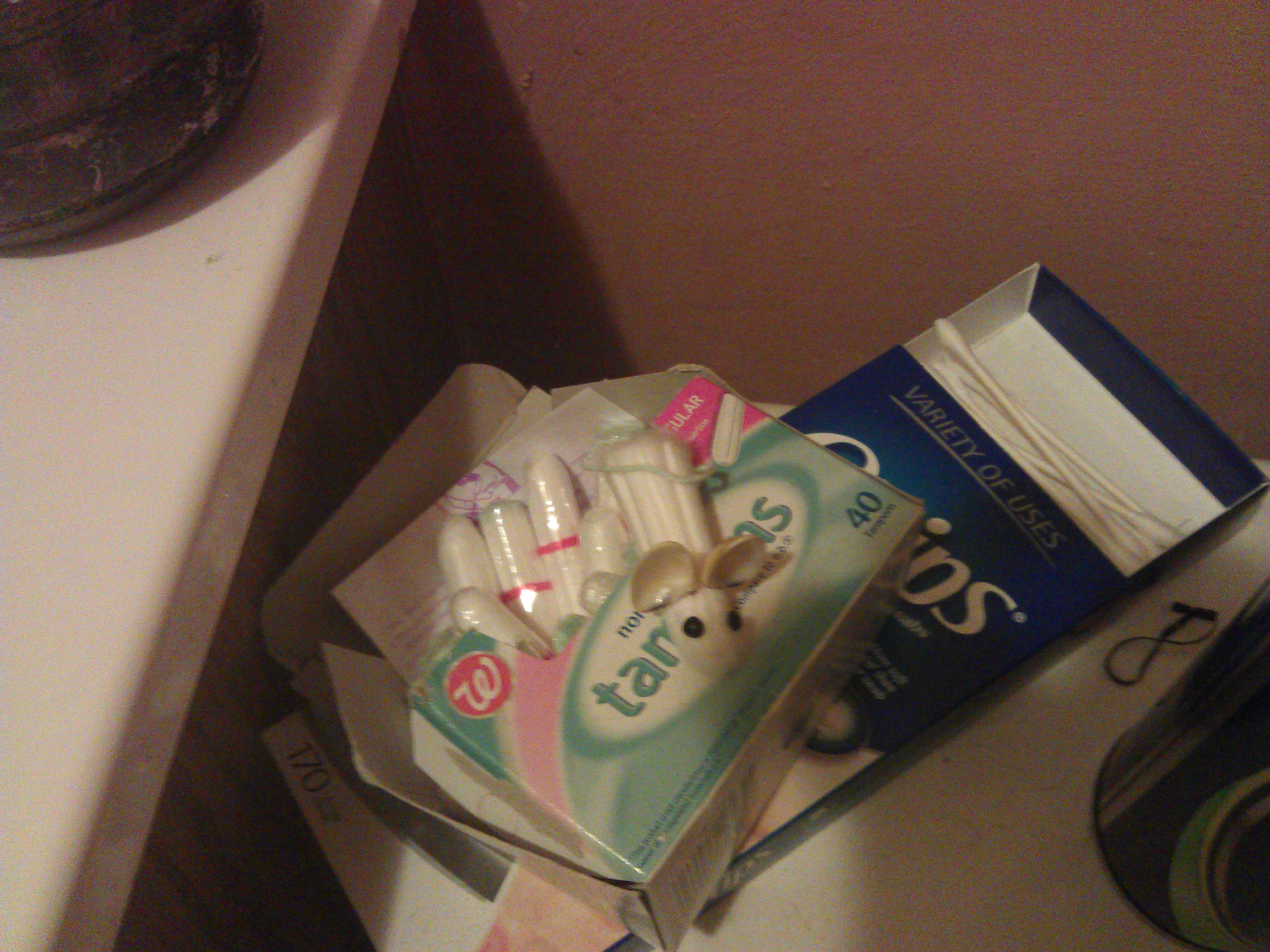
(Were tampon mouse able to form and express coherent thoughts, tampon mouse would not put up with this shit)

The point isn't to be smugly self aware of our own shortcomings and the shortcomings of others. The point is to actually do something about it. If you're not already devoting some amount of your resources to improving fairness in the world, then why not? It doesn't have to be about women in technology - if you're already donating to charity or helping out at schools or engaging in local politics or any of the countless other ways an individual can help make the world a better place, large or small, then keep on doing that. But do consider that many of us have done things in the past that contributed to the alienation of an astounding number of potential community members, and if you can then please do do something to make up for it. It might be donating to groups like The Ada Initiative. It might be mentoring students for projects like the GNOME Outreach Program for Women, or working to create similar programs. Even just making our communities less toxic by pointing out unacceptable behaviour when you see it makes a huge difference.

But most importantly, be aware that it was people like me who were responsible for this problem in the first place and people like me who need to take responsibility for solving it. We can't demand the victims do that for us.

comment count unavailable comments

19 May 2012

Matthew Garrett: Fixing Asus UX21e unexpected power off

Edit: Sigh, some further testing shows that it seems better, but not fixed. If you unplug the power while the CPU is over 80 degrees C, the machine will power off. I can't find any way of avoiding this - it seems to be handled at the embedded controller or SMM level, since as far as I can tell Linux isn't surviving long enough to even be aware that the event occurred.

Original entry:

The Asus UX21e (and maybe the UX31e?) has the irritating misfeature that it reloads the CPU thermal tables when you unplug the power. One consequence of this is that it'll automatically throttle itself much more aggressively on battery (reducing performance) but the more serious one is that the new critical power off temperature may then be lower than the temperature the CPU is currently operating at, resulting in the machine turning itself off. As far as I can tell from debugging, this is completely OS-independent - it still happens even if I stub out all the ACPI code for power supply events and there are reports of the same thing occurring on Windows. The good news is that it seems to be fixed in newer firmware versions. The even better news is that you can flash it without Windows. Just download the BIOS image from the Asus website, copy it onto a FAT formatted USB stick, insert that, go into the firmware (hit F2 on the splash screen) and start the flash program from there.

comment count unavailable comments

13 May 2012

Matthew Palmer: vmdksync helps you escape from VMware

When I wrote lvmsync late last year, I didn t realise I was being typecast. Before too long, I realised that the logic that I d implemented for lvmsync would also help me with a separate migration project I d been dreading getting the day job off VMware. Back in the early days of virtualisation, management made the decision to run VMware, for all the usual reasons ( commercially supported! , industry standard! , and so on). Unsurprisingly (to me, anyway) it didn t take too long for management to realise that it wasn t the best choice for us. When you ve got umpty-billion dollars to spend on hardware, software, and support, VMware might be the right option (although Amazon doesn t seem to think so). Anchor s company culture, on the other hand, is build around smart staff, simple systems over dumb staff, smart vendors , because no vendor is ever going to care about our customers as much as we do. So VMware was never going to work for us. Unfortunately, as happens all too often, once VMware was in place, there was very little motivation to get rid of it and move those customers onto the chosen replacement (that we were deploying all new customers on). I happen to think this is a terrible attitude in general one that makes life so much harder in the long term. I believe strongly in retrofitting old systems to keep them up-to-date with the current state of the art, and keeping technical debt under control. But, I wasn t running the show back when we stopped putting new customers on VMware, so the few VMware servers we had stayed around far longer than they should have. Recently, though, bad things started to happen. The VMware servers were starting to fall apart. The Windows machine we had to keep around to use the VMware management console started crapping out, and when the choice was between doing unspeakable things to Windows, and just ditching VMware well, it wasn t much of a choice. The only remaining question was how to do the migration off VMware with the least amount of downtime to our customers. I was really quite surprised that nobody out in Internet land appeared to have come up with a simple, robust tool to do this. Sure, some vendors had all-singing, all-dancing toolkits that cost ridiculous amounts of money, required you to install their agent on the machine involved, and promised the earth, but it all smelt of snakeoil and bullshit. In true hacker style, then, I decided to write something myself. The model I came up with mirrored lvmsync s quite closely because that one worked, and it turned out to be surprisingly easy to implement once I managed to reverse-engineer the file format (VMware has a PDF spec of a bunch of it s file formats, but whoever wrote it was enough of an evil genius to make it utterly incomprehensible to anyone who doesn t already know the file format, whilst making perfect sense to anyone who already does). The result: vmdksync. It is nothing but 80-odd lines of ruby whose sole purpose is to take a delta.vmdk file and write the changes that are stored in that file to a file or block device that is a copy of the flat.vmdk file that you can copy while the VM is still running (after you ve made a snapshot, of course). It helped me provide a painless migration path away from VMware, and I d be really pleased if it helped some other people do the same. Share and enjoy!

2 May 2012

Matthew Garrett: Anatomy of a Fedora 17 ISO image

My spare time has been limited lately, so progress on producing Mac-bootable Fedora install images has been a bit slow. Thankfully it looks like everything's gong to land in time for Fedora 17[1] so hurrah for that - all that's missing right now are the last couple of patches that make sure the boot picker displays useful labels on the drives.

So how is this accomplished? Here's a hex dump of the first few K of the image.
00000000  45 52 08 00 00 00 90 90  00 00 00 00 00 00 00 00   ER.............. 
00000010  00 00 00 00 00 00 00 00  00 00 00 00 00 00 00 00   ................ 
00000020  33 ed fa 8e d5 bc 00 7c  fb fc 66 31 db 66 31 c9   3...... ..f1.f1. 
00000030  66 53 66 51 06 57 8e dd  8e c5 52 be 00 7c bf 00   fSfQ.W....R.. .. 
00000040  06 b9 00 01 f3 a5 ea 4b  06 00 00 52 b4 41 bb aa   .......K...R.A.. 
00000050  55 31 c9 30 f6 f9 cd 13  72 16 81 fb 55 aa 75 10   U1.0....r...U.u. 
00000060  83 e1 01 74 0b 66 c7 06  f1 06 b4 42 eb 15 eb 00   ...t.f.....B.... 
00000070  5a 51 b4 08 cd 13 83 e1  3f 5b 51 0f b6 c6 40 50   ZQ......?[Q...@P 
00000080  f7 e1 53 52 50 bb 00 7c  b9 04 00 66 a1 b0 07 e8   ..SRP.. ...f.... 
00000090  44 00 0f 82 80 00 66 40  80 c7 02 e2 f2 66 81 3e   D.....f@.....f.> 
000000a0  40 7c fb c0 78 70 75 09  fa bc ec 7b ea 44 7c 00   @ ..xpu.... .D . 
000000b0  00 e8 83 00 69 73 6f 6c  69 6e 75 78 2e 62 69 6e   ....isolinux.bin 
000000c0  20 6d 69 73 73 69 6e 67  20 6f 72 20 63 6f 72 72    missing or corr 
000000d0  75 70 74 2e 0d 0a 66 60  66 31 d2 66 03 06 f8 7b   upt...f f1.f... 
000000e0  66 13 16 fc 7b 66 52 66  50 06 53 6a 01 6a 10 89   f... fRfP.Sj.j.. 
000000f0  e6 66 f7 36 e8 7b c0 e4  06 88 e1 88 c5 92 f6 36   .f.6. .........6 
00000100  ee 7b 88 c6 08 e1 41 b8  01 02 8a 16 f2 7b cd 13   . ....A...... .. 
00000110  8d 64 10 66 61 c3 e8 1e  00 4f 70 65 72 61 74 69   .d.fa....Operati 
00000120  6e 67 20 73 79 73 74 65  6d 20 6c 6f 61 64 20 65   ng system load e 
00000130  72 72 6f 72 2e 0d 0a 5e  ac b4 0e 8a 3e 62 04 b3   rror...^....>b.. 
00000140  07 cd 10 3c 0a 75 f1 cd  18 f4 eb fd 00 00 00 00   ...<.u.......... 
00000150  00 00 00 00 00 00 00 00  00 00 00 00 00 00 00 00   ................ 
This is the boot sector. One of the fun things about ISO9660 is that it doesn't have a boot sector in the usual x86 sense - firmwares are expected to read enough of the filesystem that they can find the bootloader in it and run it directly. x86 isn't really smart enough to manage that, so it uses something called El Torito[2]. In any case, this is usually empty space on an x86 CD. But with an increasing number of systems shipping without optical drives, real CD installs are decreasing in popularity. We use a piece of software called isohybrid that allows the building of ISO9660 images that can be written directly onto a USB stick. Asking a machine to boot off them will execute the boot sector located here, which then loads a real bootloader that's capable of reading ISO and booting the OS. It'll just be ignored when it's on a real CD.

There's one difference here, though. The isohybrid bootsector has been modified so that the first 32 bytes are just noops, and this has been inserted:
00000000  45 52 08 00 00 00 90 90  00 00 00 00 00 00 00 00   ER.............. 
45 52 ("ER") indicates the presence of an Apple partition map. This will become important later. 0800 indicates that it's using 2048-byte sectors. The 9090 is a lie to convince the firmware that it's not a zero-sized disk without representing dangerous code. We need an Apple partition map because some older Macs won't boot off CD unless the CD has one. But it's sitting right at the start of the boot sector, and this code is going to be executed. Thankfully, the entire Apple header decodes to
00000000  45                inc bp
00000001  52                push dx
00000002  0800              or [bx+si],al
00000004  0000              add [bx+si],al
00000006  90                nop
00000007  90                nop
00000008  0000              add [bx+si],al
0000000A  0000              add [bx+si],al
0000000C  0000              add [bx+si],al
0000000E  0000              add [bx+si],al
00000010  0000              add [bx+si],al
00000012  0000              add [bx+si],al
00000014  0000              add [bx+si],al
00000016  0000              add [bx+si],al
00000018  0000              add [bx+si],al
0000001A  0000              add [bx+si],al
0000001C  0000              add [bx+si],al
0000001E  0000              add [bx+si],al
which is completely harmless - we can execute all these instructions without any interesting changes in state. They'll all be undone by the rest of the boot sector.
000001b0  14 05 00 00 00 00 00 00  4c 1e ed 76 00 00 80 00   ........L..v.... 
000001c0  01 00 00 3f a0 89 00 00  00 00 00 50 14 00 00 fe   ...?.......P.... 
000001d0  ff ff ef fe ff ff a4 00  00 00 70 04 00 00 00 fe   ..........p..... 
000001e0  ff ff 00 fe ff ff 44 05  00 00 c0 08 00 00 00 00   ......D......... 
000001f0  00 00 00 00 00 00 00 00  00 00 00 00 00 00 55 aa   ..............U. 
This is the MBR partition table. The aim here was to produce media that would boot via BIOS just as well as it does via EFI, and it turns out that there are some systems that refuse to BIOS-boot off GPT media. So we need an MBR partition map. The first entry covers the entire disk and is of type 0. This is important, because some EFI implementations are strict about MBR parsing - if there's an MBR with overlapping partitions, the entire MBR will be ignored. Inconvenient. Fortunately, we've got the source code to this code, and it turns out that partitions of type 0 are ignored when performing this check. So, there's a partition of type 0.

Why does it cover the entire disk? Once we've booted the OS, we need to be able to read the ISO image contained on the USB stick. That means the kernel needs to be able to mount it, which means we need a partition entry that covers the entire disk. Linux is perfectly happy mounting a filesystem from a partition of type 0.

So, the next partition. This is an EFI boot partition that points at the embedded VFAT El-Torito image. Some firmware will decide that we've got an MBR and so will only boot off a partition that exists in it. So, here's an MBR partition to keep them happy.

The final partition covers the embedded HFS+ image. It's there purely for convenience - it means we can access it under Linux in order to update its contents for testing purposes.
00000200  45 46 49 20 50 41 52 54  00 00 01 00 5c 00 00 00   EFI PART....\... 
00000210  09 27 93 7e 00 00 00 00  01 00 00 00 00 00 00 00   .'.~............ 
00000220  fe 4f 14 00 00 00 00 00  30 00 00 00 00 00 00 00   .O......0....... 
00000230  de 4f 14 00 00 00 00 00  2a 26 0f 37 23 c9 7f 4f   .O......*&.7#..O 
00000240  90 df 5e fe 0a 60 1c b0  10 00 00 00 00 00 00 00   ..^.. .......... 
00000250  80 00 00 00 80 00 00 00  ec 70 63 c1 00 00 00 00   .........pc..... 
00000260  00 00 00 00 00 00 00 00  00 00 00 00 00 00 00 00   ................ 
And here we have the GPT header. Nothing complicated here, other than it indicates that the first partition descriptor is at LBA 0x10, ie byte 0x2000 - that's further into the disk than normal. That leaves us enough space to fit the Apple partition entries.

Why have a GPT at all? The EFI spec says that machines should boot fine from an MBR partition. Sadly, not all seem to. It also lets us represent the HFS+ partition in a way that makes the Mac firmware happy.
00000800  50 4d 00 00 00 00 00 03  00 00 00 01 00 00 00 10   PM.............. 
00000810  41 70 70 6c 65 00 00 00  00 00 00 00 00 00 00 00   Apple........... 
00000820  00 00 00 00 00 00 00 00  00 00 00 00 00 00 00 00   ................ 
00000830  41 70 70 6c 65 5f 70 61  72 74 69 74 69 6f 6e 5f   Apple_partition_ 
00000840  6d 61 70 00 00 00 00 00  00 00 00 00 00 00 00 00   map............. 
00000850  00 00 00 00 00 00 00 0a  00 00 00 03 00 00 00 00   ................ 
00000860  00 00 00 00 00 00 00 00  00 00 00 00 00 00 00 00   ................ 
2K into the disk, here's an Apple partition map. It's 2K into the disk because we set the sector size to 2K in the partition map header. Why did we do that? Because the default is 512 bytes, and if we'd put the partition map at 512 bytes it would have been on top of the GPT header. Why 2K rather than 1K? A couple of reasons. First, the Apple partition map is only used when we boot off an actual CD, and the CD sector size is genuinely 2K. Secondly, because CDs have a sector size of 2K, 2K is a value that's actually been tested in the real world. It's nice to avoid tempting fate.
00001000  50 4d 00 00 00 00 00 03  00 00 00 29 00 00 04 70   PM.........)...p 
00001010  45 46 49 00 00 00 00 00  00 00 00 00 00 00 00 00   EFI............. 
00001020  00 00 00 00 00 00 00 00  00 00 00 00 00 00 00 00   ................ 
00001030  41 70 70 6c 65 5f 48 46  53 00 00 00 00 00 00 00   Apple_HFS....... 
00001040  00 00 00 00 00 00 00 00  00 00 00 00 00 00 00 00   ................ 
00001050  00 00 00 00 00 00 04 70  00 00 00 33 00 00 00 00   .......p...3.... 
00001060  00 00 00 00 00 00 00 00  00 00 00 00 00 00 00 00   ................ 
*
00001800  50 4d 00 00 00 00 00 03  00 00 01 51 00 00 08 c0   PM.........Q.... 
00001810  45 46 49 00 00 00 00 00  00 00 00 00 00 00 00 00   EFI............. 
00001820  00 00 00 00 00 00 00 00  00 00 00 00 00 00 00 00   ................ 
00001830  41 70 70 6c 65 5f 48 46  53 00 00 00 00 00 00 00   Apple_HFS....... 
00001840  00 00 00 00 00 00 00 00  00 00 00 00 00 00 00 00   ................ 
00001850  00 00 00 00 00 00 08 c0  00 00 00 33 00 00 00 00   ...........3.... 
00001860  00 00 00 00 00 00 00 00  00 00 00 00 00 00 00 00   ................ 
The Apple partition map entries. One partition covers the entire disk, the other the embedded HFS+ filesystem. Why do this? Because not all Macs understand EFI El Torito, so won't EFI boot a CD unless there's an Apple partition map. Why have an HFS+ partition at all? Because the same Macs won't boot off FAT.
00002000  a2 a0 d0 eb e5 b9 33 44  87 c0 68 b6 b7 26 99 c7   ......3D..h..&.. 
00002010  d0 84 a5 d4 aa 89 e0 40  81 f9 fc e4 04 e9 c2 99   .......@........ 
00002020  00 00 00 00 00 00 00 00  10 4b 14 00 00 00 00 00   .........K...... 
00002030  00 00 00 00 00 00 00 00  49 53 4f 48 79 62 72 69   ........ISOHybri 
00002040  64 20 49 53 4f 00 49 53  4f 48 79 62 72 69 64 00   d ISO.ISOHybrid. 
00002050  41 70 70 6c 00 00 00 00  00 00 00 00 00 00 00 00   Appl............ 
00002060  00 00 00 00 00 00 00 00  00 00 00 00 00 00 00 00   ................ 
*
00002080  a2 a0 d0 eb e5 b9 33 44  87 c0 68 b6 b7 26 99 c7   ......3D..h..&.. 
00002090  68 d5 e0 27 72 83 c6 4c  a7 ae 92 dd ed 6c 89 71   h..'r..L.....l.q 
000020a0  a4 00 00 00 00 00 00 00  13 05 00 00 00 00 00 00   ................ 
000020b0  00 00 00 00 00 00 00 00  49 53 4f 48 79 62 72 69   ........ISOHybri 
000020c0  64 00 41 70 70 6c 65 00  41 70 70 6c 00 00 00 00   d.Apple.Appl.... 
000020d0  00 00 00 00 00 00 00 00  00 00 00 00 00 00 00 00   ................ 
*
00002100  00 53 46 48 00 00 aa 11  aa 11 00 30 65 43 ec ac   .SFH.......0eC.. 
00002110  68 d5 e0 27 72 83 c6 4c  a7 ae 92 dd ed 6c 89 71   h..'r..L.....l.q 
00002120  44 05 00 00 00 00 00 00  03 0e 00 00 00 00 00 00   D............... 
00002130  00 00 00 00 00 00 00 00  49 53 4f 48 79 62 72 69   ........ISOHybri 
00002140  64 00 41 70 70 6c 65 00  41 70 70 6c 00 00 00 00   d.Apple.Appl.... 
00002150  00 00 00 00 00 00 00 00  00 00 00 00 00 00 00 00   ................ 
Three GPT entries - one covers the entire CD, one covers the embedded FAT filesystem, one covers the embedded EFI filesystem. That ensures that they're all accessible to the firmware.
00008000  01 43 44 30 30 31 01 00  4c 49 4e 55 58 20 20 20   .CD001..LINUX    
00008010  20 20 20 20 20 20 20 20  20 20 20 20 20 20 20 20                    
00008020  20 20 20 20 20 20 20 20  46 65 64 6f 72 61 2d 4c           Fedora-L 
00008030  69 76 65 43 44 20 20 20  20 20 20 20 20 20 20 20   iveCD            
00008040  20 20 20 20 20 20 20 20  00 00 00 00 00 00 00 00           ........ 
00008050  c4 12 05 00 00 05 12 c4  00 00 00 00 00 00 00 00   ................ 
00008060  00 00 00 00 00 00 00 00  00 00 00 00 00 00 00 00   ................ 
00008070  00 00 00 00 00 00 00 00  01 00 00 01 01 00 00 01   ................ 
00008080  00 08 08 00 40 00 00 00  00 00 00 40 15 00 00 00   ....@......@.... 
00008090  00 00 00 00 00 00 00 17  00 00 00 00 22 00 1d 00   ............"... 
000080a0  00 00 00 00 00 1d 00 08  00 00 00 00 08 00 70 05   ..............p. 
000080b0  01 09 30 36 f0 02 00 00  01 00 00 01 01 00 20 20   ..06..........   
000080c0  20 20 20 20 20 20 20 20  20 20 20 20 20 20 20 20                    
The ISO9660 superblock. This is completely standard. From here on there's nothing terribly surprising - the CD filesystem itself is entirely normal. The only slight oddity is that we have three embedded El Torito images. The first of these is a BIOS-bootable disk image. That'll be executed whenever the CD is put in a non-EFI machine. The second is a VFAT EFI boot image. That's used for the majority of EFI systems. The third is an HFS+ EFI boot image. There's no strict requirement for the HFS+ one to be an El Torito image - CD booting on Macs is already handled by the Apple partition map. Storing it as an El Torito is purely for convenience, since it guarantees correct alignment and avoids us having to parse the entire ISO9660 image to find its location when generating the partition maps.

In summary: Three partition maps, three bootable images, support for BIOS, UEFI and Mac platforms, works whether it's burned to a CD or written directly to a USB stick. I'm pretty pleased with that.

[1] Other than an awkward bug where something goes horribly wrong during Radeon graphics init, so Radeon-based Macs aren't working too well at the moment. We're working on it.

[2] The world decided that writing a real ISO9660 driver for BIOS was hard, so came up with El Torito. El Torito is a spec for embedding disk images inside ISO9660. There's a pointer to the disk image in the Cd header, so the BIOS simply reads a few blocks off CD, finds that pointer and then sets up a bunch of disk i/o interrupts to point at the embedded filesystem rather than a real disk. From that point on, the El Torito image simply behaves like a floppy or hard drive. This was a reasonable compromise given how resource limited older BIOS implementations were.

For reasons that aren't entirely clear, UEFI doesn't mandate that implementations support ISO9660. So even though our firmware is now sufficiently capable that the only thing standing between it and emacs is someone being sufficiently bored, we still use El Torito. Fortunately the spec allows multiple El Torito images to be embedded, so we can include one that's bootable by BIOS systems and another that's bootable by UEFI systems.

comment count unavailable comments

22 March 2012

Russell Coker: Links March 2012

Washington s Blog has an informative summary of recent articles about corporate psychopaths [1]. Including the fact that some banks deliberately hire psychopaths. Anu Partanen wrote an insightful article for The Atlantic about the difference between Finnish and American education systems [2]. It seems that Finland has achieved great educational success by aiming for equality with no private schools and giving the teachers and principals enough responsibility to do the job properly. Ramona Pierson gave an interesting TED talk about how she recovered from being run over by a drunk driver with the help of the residents of a senior citizens home [3]. Quyen Nguyen gave a very interesting TED talk about the use of fluorescent dyes in cancer surgery [4]. They can make cancer glow one color and nerves glow with a different color which makes it a much easier task to remove ALL the cancer without cutting the smaller nerves. James Fallows wrote an interesting article for The Atlantic about the experience of having his wife s Gmail account cracked [5]. She stored EVERYTHING in her Gmail account so this was a lot worse for her than for the typical Geek who doesn t use such accounts for storing much. James describes what the attacker did, how they did it, and what needed to be done to recover. When running a mail server it s worth considering what you would do to help a user who was attacked in that way. Charles Stross has written an interesting blog post trying to predict some future psychological and social changes [6]. Matthew Wright of Beyond Zero Emissions has written an informative article about how solar panels on home roofs save everyone money [7]. Mikko Hypponen gave an interesting TED talk about different types of online attack and how they can affect us [8]. Among other things he describes how online attacks can result in people dying. Scott Rickard gave an interesting TED talk about using maths to create SONAR pings without repitition and also the worst music ever created [9]. I found it entertaining to watch Michael Lindel (the director of chamber music for the New York Symphony) play the music, he obviously didn t enjoy that performance. Sheena Iyengar gave an interesting TED talk about the way people make choices [10]. It s useful for anyone who is going to prepare a set of options for someone else to choose from. ASD Aid is a project that uses Lego to encourage kids on the Autism Spectrum to socialise [11]. They have training manuals for using Lego in therapy. Unfortunately they have not been supported by the Lego corporation. Bilal Bomani gave an interesting and informative TED talk about NASA research into renewable aviation fuel [12]. The most interesting thing to me was the way that they were aiming for a sustainable lifecycle that didn t use resources that coule be used for food and which required minimal input once it was started. Alain de Botton gave an interesting TED talk about Atheism 2.0 [13]. He suggests that we adopt some ideas from religious organisations including lectures (sermons), celebrations, and rituals. It s interesting to think of a technology conference as a pilgrimage. Homaro Cantu and Ben Roche from Moto restaurant in Chicago gave an interesting talk about some of the unusual foods that they have produced [14]. If I visit the US again I will try and go to Chicago to eat there! Related posts:
  1. Links March 2009 Cory Doctorow has written a column for The Guardian titled...
  2. Links February 2012 Sociological Images has an interesting article about the attempts to...
  3. Links January 2012 Cops in Tennessee routinely steal cash from citizens [1]. They...

17 March 2012

Matthew Garrett: More ways for firmware to screw you

Some of my recent time has been devoted to making our boot media more Mac friendly, which has entailed rather a lot of rebooting. This would have been fine, if tedious, except that some number of boots would fall over with either a clearly impossible kernel panic or userspace segfaulting in places that made no sense. Something was clearly wrong. Crashes that shouldn't happen are generally an indication of memory corruption. The question is how that corruption is being triggered. Hunting that down wasn't terribly easy.

My first thought was that we were possibly managing to load the kernel over a region used by UEFI code. UEFI defines two types of code - boot services and runtime services. While runtime services code and data must be preserved by the OS, in theory boot services code and data is available to the OS once the firmware has exited. In practice, that's not true. It seemed entirely possible that the kernel might be ending up on top of some of that boot services code or data and getting trodden on. Grub now has code to avoid putting the kernel on boot services, so testing the latest code seemed like a good plan. But no, crashes still happened.

That pretty much ruled out the bootloader. My next thought was that executing some of the firmware code was triggering a write to some other memory that contained the kernel. Josh Boyer suggested the next trick, which was to try marking the kernel read-only to see whether anything was hitting it. x86 lets you mark pages as read-only - any attempt to write to them should take a fault. UEFI functions are executed in the context of the kernel, so share the same page tables. That let me rule this out, since everything still went just as wrong and I wasn't taking an extra fault first.

However, at this point I was reasonably happy that it wasn't the kernel itself being overwritten - faults were occurring in userspace code as well. That was a pretty strong indication that what was happening was continuing to happen once userspace had started, so it wasn't a direct response to a firmware call. I made sure of that by stubbing out all the calls that could be triggered after kernel initialisation, and saw the same failures. Once all attempts to be clever have failed, it's time to just start using brute force. The kernel lets you reserve areas of RAM by passing arguments like memmap=0xlength$0xstart to block length bytes starting at start from being used. It took a while, but I finally found a 256MB range that made a difference - reserving it resulted in the machine booting reliably, letting the OS use it resulted in occasional crashes.

Definite progress. Comparing that memory range to the EFI memory map was helpful. There were several blocks of UEFI boot services data present there, which really seemed like too much of a coincidence. By reserving each of them in turn, I'd traced it down to a single 31MB region of boot service data - that is, memory reserved by the firmware for use by the UEFI boot services. Per spec, this is available to the OS once the boot environment has been exited. Nothing other than the OS should be touching this after boot, but something clearly was. Tracking down what was far easier than I expected, although the first attempt was a failure. Setting it read-only should have triggered a fault, but didn't. That was rather confusing. But, rather than give up, I patched the kernel to fill the region with 0xff at kernel init. Then I booted the system, read it back and looked for values that weren't 0xff. I got this:
00000000  ff ff ff ff ff ff ff ff  ff ff ff ff ff ff ff ff   ................ 
*
001568a0  ff ff ff ff ff ff ff ff  ff ff ff ff 84 00 00 00   ................ 
001568b0  00 20 a7 ac 46 00 00 00  00 00 00 00 00 00 06 01   . ..F........... 
001568c0  c2 0b 0c 00 ff ff ff ff  ff ff ff ff ff ff ff ff   ................ 
001568d0  ff ff 0a 04 f0 03 82 0d  40 00 00 00 ff ff ff ff   ........@....... 
001568e0  ff ff 00 21 00 36 9a 80  ff ff ff ff ff ff 00 7e   ...!.6.........~ 
001568f0  00 09 43 48 41 2d 47 75  65 73 74 01 04 02 04 0b   ..CHA-Guest..... 
00156900  16 32 08 0c 12 18 24 30  48 60 6c 2d 1a 0e 18 1a   .2....$0H l-.... 
00156910  ff ff 00 00 00 00 00 00  00 00 00 00 00 00 00 00   ................ 
00156920  00 00 00 00 00 00 00 dd  09 00 10 18 02 00 10 01   ................ 
00156930  00 00 dd 1e 00 90 4c 33  0e 18 1a ff ff 00 00 00   ......L3........ 
00156940  00 00 00 00 00 00 00 00  00 00 00 00 00 00 00 00   ................ 
00156950  00 00 bd ea f8 b3 ff ff  ff ff ff ff ff ff ff ff   ................ 
00156960  ff ff ff ff ff ff ff ff  ff ff ff ff ff ff ff ff   ................ 
*
022fb000
That's a lot of 0xffs (around 31MB of them) with one small section that contains an 802.11 probe packet with the SSID of the hospital across the road from my house. Apple support network booting off wireless networks. It seems that the firmware brought up the wireless card, associated with this network (it's the only public one nearby) and then left the card DMAing packets into RAM. The read-only page attribute only applies to CPU-initiated accesses, so it could do this without triggering a page fault. It also explained why it was so random - whether memory corruption occurred would depend on whether a packet appeared between that memory being used by the OS and the kernel reinitialising the wireless card. It certainly explains why I couldn't reproduce it when I left the machine repeatedly rebooting on the bus home.

How do we fix this? Unsure. With luck disconnecting the UEFI driver in the bootloader should quiesce the hardware, but without testing I'm not sure of that yet. For now it's just another example of firmware managing to break expectations in deeply strange ways.

comment count unavailable comments

12 February 2012

Matthew Garrett: Some things you may have heard about Secure Boot which aren't entirely true

Talking about Secure Boot again, I'm afraid. One of the things that's made discussion of this difficult is that, while the specification isn't overly complicated, some of the outcomes aren't obvious at all until you spend a long time thinking about it. So here's some clarification on a few points.
Secure Boot provides no additional securityUntrue. Attacks against the pre-boot environment are real and increasingly common - this is a recent proof of concept, and this has been seen in the wild. Once something has got into the MBR, all bets are off. It can modify your bootloader or kernel, inserting its own code to return valid results whenever any kind of malware checker scans for it. The only way to reliably identify it is to either move the disk to another system or to cold boot off verified media. By restricting pre-OS code to something that's been signed, Secure Boot does provide enhanced security.
Secure Boot is just another name for Trusted BootUntrue. Trusted Boot requires the ability to measure the entire boot process, which gives the OS the ability to figure out everything that's been run before OS startup. The root of trust is in the hardware and a TPM is required. Secure Boot is simply a way to limit the applications that are run before the OS. Once booted, there is no way for the OS to identify what was previously booted, or even if the system was booted securely.
Microsoft are just requiring that vendors implement the specificationUntrue. Quoting from the Windows 8 Hardware Certification Requirements:

MANDATORY: No in-line mechanism is provided whereby a user can bypass Secure Boot failures and boot anyway Signature verification override during boot when Secure Boot is enabled is not allowed. A physically present user override is not permitted for UEFI images that fail signature verification during boot. If a user wants to boot an image that does not pass signature verification, they must explicitly disable Secure Boot on the target system.

Section 27.7.3.3 of version 2.3.1A of the UEFI spec explicitly permits implementations to provide a physically present user override. Whether this is a good thing or not is obviously open to argument, but the fact remains that Microsoft forbid behaviour that the specification permits.
Secure Boot can be used to implement DRMUntrue. The argument here is that Secure Boot can be used to restrict the software that a machine can run, and so can limit a system to running code that implements effective copy protection mechanisms. This isn't the case. For that to be true, there would need to be a mechanism for the OS to identify which code had been run in the pre-OS environment. There isn't. The only communication channel between the firmware and the OS is via a single UEFI variable called "SecureBoot", which may be either "1" or "0". Additionally, the firmware may provide a table to the OS containing a list of UEFI executables that failed to authenticate. It is not required to provide any information about the executables that authenticated correctly.

In both these cases, the OS is required to trust the firmware. If the firmware has been compromised in any way (such as the user turning off Secure Boot), the data provided by the firmware can be trivially modified and the OS told that everything is fine. As long as machines exist where users are permitted to disable Secure Boot, Secure Boot is not any kind of DRM scheme.
Secure Boot provides physical securityUntrue. Secure Boot does not in any way claim to improve security against attackers who have physical access, for the same reasons as the DRM case. The OS has no way to determine that the firmware's behaviour has been modified. A physically-present attacker can simply disable Secure Boot and install a piece of malware that lies to the OS about platform security. The "Evil Maid" attack still exists.
Secure Boot only defines the interaction between the firmware and the bootloader. It doesn't specify any higher policyMisleading. It's true that Secure Boot only specifies the authentication of pre-OS code. However, if you implement Secure Boot it's because you want to ensure that only authenticated code has run before your OS. If there is any way for unauthenticated code to touch the hardware before your OS starts, you can't ensure that. If an authenticated Linux kernel is booted and then loads an unsigned driver, that unsigned driver can fabricate a fake UEFI environment and then launch Windows from it. Windows would falsely believe that it has booted securely. If that authenticated Linux kernel were widely distributed, attackers could use it as an attack vector for Windows. The logical response from Microsoft would be to blacklist that kernel.

The inevitable outcome of implementing Secure Boot is that every component that can touch hardware must be signed. Anyone who implements Secure Boot without requiring that is adding no additional security whatsoever.
Only machines that want to boot Windows need to carry Microsoft's keysAgain, misleading. Microsoft only require one signing key to be installed, and the Windows bootloader will be signed with a key that chains back to this one. However, the bootloader is not the only component that must be signed. Any drivers that are carried on ROMs on plug-in cards must also be signed. One approach here would have been for all hardware vendors to have their own keys. This would have been unscalable - any shipped machine would have to carry keys for every vendor who produces PCI cards. If a machine carried an nvidia key but not an AMD one, swapping a geforce for a radeon would have resulted in the firmware graphics driver failing to load. Instead, Microsoft are providing a signing service. Vendors will be able to sign up for WHQL membership and have their UEFI drivers signed by Microsoft.

This leads to the problem. The Authenticode format used for signing UEFI objects only allows for a single signature. If a driver is signed by Microsoft, it can't be signed by anybody else. Therefore, if a system vendor wants to support off-the-shelf PCI devices with Microsoft-signed drivers, the system must carry Microsoft's key. If the same key is used as the root of trust for the driver signing and for the bootloader signing, that also means that the system will boot Windows.
This is only a problem for clients, not serversNot strictly true. While Microsoft's current requirements don't mandate the presence of Secure Boot on server hardware, if present it must be enabled and locked down as it is for clients. It's not valid for servers to ship with disabled Secure Boot support, or for it to be shipped in a mode allowing users to make automated policy modifications at OS install time.
Secure Boot is required by NISTThis is one that I've heard from multiple people working on Secure Boot. It's amazingly untrue. The document they're referring to is NIST SP800-147, which is a document that describes guidelines for firmware security - that is, what has to be done to ensure that the firmware itself is secure. This includes making sure that the OS can't overwrite the firmware and that firmware updates must be signed. It says absolutely nothing about the firmware only running signed software. Secure Boot depends upon the firmware being trusted, so these guidelines are effectively a required part of Secure Boot. But Secure Boot is not within the scope of SP800-147 at all.
It's easy for Linux to implement Secure BootMisleading. From a technical perspective, sure. From a practical perspective, not at all. I wrote about the details here.
It's only a problem for hobbyist Linux, not the real Linux marketUntrue. It's unclear whether even the significant Linux vendors can implement Secure Boot in a way that meets the needs of their customers and still allows them to boot on commodity hardware. A naive implementation removes many of the benefits of Linux for enterprise customers, such as the ability to use local modifications to micro-optimise systems for specific workloads. One of the key selling points of Linux is the ability to make use of local expertise when adapting the product for your needs. Secure Boot makes that more difficult.

ConclusionMuch reporting on the issues surrounding Secure Boot so far has been inaccurate, leading to misunderstandings about the (genuine) benefits and the (genuine) drawbacks. Any useful discussion must be based around an accurate understanding of the specification rather than statements from analysts with no real understanding of the Linux market or security.

comment count unavailable comments

9 February 2012

Matthew Garrett: Is GPL usage really declining?

Matthew Aslett wrote about how the proportion of projects released under GPL-like licenses appears to be declining, at least as far as various sets of figures go. But what does that actually mean? In absolute terms, GPL use has increased - any change isn't down to GPL projects transitioning over to liberal licenses. But an increasing number of new projects are being released under liberal licenses. Why is that?

The figures from Black Duck aren't a great help here, because they tell us very little about the software they're looking at. FLOSSmole is rather more interesting. I pulled the license figures from a few sites and found the following proportion of GPLed projects:

RubyForge: ~30%
Google Code: ~50%
Launchpad: ~70%

I've left the numbers rough because there's various uncertainties - should proprietary licenses be included in the numbers, is CC Sharealike enough like the GPL to count it there, that kind of thing. But what's clear is that these three sites have massively different levels of GPL use, and it's not hard to imagine why. They all attract different types of developer. The RubyForge figures are obviously going to be heavily influenced by Ruby developers, and that (handwavily) implies more of a bias towards web developers than the general developer population. Launchpad, on the other hand, is going to have a closer association with people with an Ubuntu background - it's probably more representative of Linux developers. Google Code? The 50% figure is the closest to the 56.8% figure that Black Duck give, so it's probably representative of the more general development community.

The impression gained from this is that the probability of you using one of the GPL licenses is influenced by the community that you're part of. And it's not a huge leap to believe that an increasing number of developers are targeting the web, and the web development community has never been especially attached to the GPL. It's not hard to see why - the benefits of the GPL vanish pretty much entirely when you're never actually obliged to distribute the code, and while Affero attempts to compensate from that it also constrains your UI and deployment model. No matter how strong a believer in Copyleft you are, the web makes it difficult for users to take any advantage of the freedoms you'd want to offer. It's as easy not to bother.
So it's pretty unsurprising that an increase in web development would be associated with a decrease in the proportion of projects licensed under the GPL.

This obviously isn't a rigorous analysis. I have very little hard evidence to back up my assumptions. But nor does anyone who claims that the change is because the FSF alienated the community during GPLv3 development. I'd be fascinated to see someone spend some time comparing project type with license use and trying to come up with a more convincing argument.

(Raw data from FLOSSmole: Howison, J., Conklin, M., & Crowston, K. (2006). FLOSSmole: A collaborative repository for FLOSS research data and analyses. International Journal of Information Technology and Web Engineering, 1(3), 17 26.)

comment count unavailable comments

30 January 2012

Matthew Garrett: The ongoing fight against GPL enforcement

GPL enforcement is a surprisingly difficult task. It's not just a matter of identifying an infringement - you need to make sure you have a copyright holder on your side, spend some money sending letters asking people to come into compliance, spend more money initiating a suit, spend even more money encouraging people to settle, spend yet more money actually taking them to court and then maybe, at the end, you have some source code. One of the (tiny) number of groups involved in doing this is the Software Freedom Conservancy, a non-profit organisation that offers various services to free software projects. One of their notable activities is enforcing the license of Busybox, a GPLed multi-purpose application that's used in many embedded Linux environments. And this is where things get interesting

GPLv2 (the license covering the relevant code) contains the following as part of section 4:

Any attempt otherwise to copy, modify, sublicense or distribute the Program is void, and will automatically terminate your rights under this License.

There's some argument over what this means, precisely, but GPLv3 adds the following paragraph:

However, if you cease all violation of this License, then your license from a particular copyright holder is reinstated (a) provisionally, unless and until the copyright holder explicitly and finally terminates your license, and (b) permanently, if the copyright holder fails to notify you of the violation by some reasonable means prior to 60 days after the cessation

which tends to support the assertion that, under V2, once the license is terminated you've lost it forever. That gives the SFC a lever. If a vendor is shipping products using Busybox, and is found to be in violation, this interpretation of GPLv2 means that they have no license to ship Busybox again until the copyright holders (or their agents) grant them another. This is a bit of a problem if your entire stock consists of devices running Busybox. The SFC will grant a new license, but on one condition - not only must you provide the source code to Busybox, you must provide the source code to all other works on the device that require source distribution.

The outcome of this is that we've gained access to large bodies of source code that would otherwise have been kept by companies. The SFC have successfully used Busybox to force the source release of many vendor kernels, ensuring that users have the freedoms that the copyright holders granted to them. Everybody wins, with the exception of the violators. And it seems that they're unenthusiastic about that.

A couple of weeks ago, this page appeared on the elinux.org wiki. It's written by an engineer at Sony, and it's calling for contributions to rewriting Busybox. This would be entirely reasonable if it were for technical reasons, but it's not - it's explicitly stated that companies are afraid that Busybox copyright holders may force them to comply with the licenses of software they ship. If you ship this Busybox replacement instead of the original Busybox you'll be safe from the SFC. You'll be able to violate licenses with impunity.

What can we do? The real problem here is that the SFC's reliance on Busybox means that they're only able to target infringers who use that Busybox code. No significant kernel copyright holders have so far offered to allow the SFC to enforce their copyrights, with the result that enforcement action will grind to a halt as vendors move over to this Busybox replacement. So, if you hold copyright over any part of the Linux kernel, I'd urge you to get in touch with them. The alternative is a strangely ironic world where Sony are simultaneously funding lobbying for copyright enforcement against individuals and tools to help large corporations infringe at will. I'm not enthusiastic about that.

comment count unavailable comments

23 January 2012

Matthew Garrett: UEFI and bugs

I gave a presentation on UEFI at LCA 2012 - you can watch it here, with the bonus repeat (and different jokes) here. It's a gentle introduction to UEFI, followed by some discussion of the problems we've faced in dealing with implementation bugs.

The fundamental problem is that UEFI is a lot of code. And I really do mean a lot of code. Ignoring drivers, the x86 Linux kernel is around 30MB of code. A comparable subset of the UEFI tree is around 35MB. UEFI is of a comparable degree of complexity to the Linux kernel. There's no reason to assume that the people who've actually written this code are significantly more or less competent than an average Linux developer, so all else being equal we'd probably expect somewhere around the same number of bugs per line. Of course, not all else is equal.

Even today, basically all hardware is shipping with BIOS by default. The only people to enable UEFI are enthusiasts. Various machines will pop up all kinds of dire warnings if you try to turn it on. UEFI has had very little real world testing. And it really does show. In the few months I've been working on UEFI I've discovered machines where SetVirtualAddressMap() calls code that has already been (per spec) discarded. I've seen cases where it was possible to create variables, but not to delete them. I've seen a machine that would irreparably corrupt its firmware when you tried to set a variable. I've tripped over code that fails to parse invalid boot variables, bricking the hardware. Many vendors independently fail to report the correct framebuffer stride. And those are just the ones that have ended up on hardware which crosses my desk, which means I haven't even tested the majority of consumer-grade hardware with UEFI.

The problems with UEFI have very little to do with its design or the ability of the people implementing it. After a few years of iterative improvements it stands a good chance of being more reliable and useful than BIOS. Increased commonality of code between vendors is a blessing and a curse - in the long term it means that these bugs can be shaken out, but in the short term it means that at least one hardware-destroying bug has ended up carried by multiple vendors. Right now we're still in the short term and it's likely that we'll find yet more UEFI bugs that cause all sorts of problems. The next few years will probably be a bumpy ride.

comment count unavailable comments

18 January 2012

Matthew Garrett: Why UEFI secure boot is difficult for Linux

I wrote about the technical details of supporting the UEFI secure boot specification with Linux. Despite me pretty clearly saying that this was ignoring issues of licensing and key distribution and the like, people are now using it to claim that Linux could support secure boot with minimal effort. In a sense, they're right. The technical implementation details are fairly straightforward. But they're not the difficult bit.
Secure boot requires that all code that can touch hardware be trustedRight now, if you can run unstrusted code before the OS then you can subvert the OS. Secure boot gives you a mechanism for making sure you only run trusted code, which protects against that. So your UEFI drivers have to be signed, your bootloader has to be signed, and your bootloader must only load a signed kernel. If you've only booted trusted code then you know that your OS is safe. But, unlike trusted boot, secure boot provides no way for you to know that only trusted code was executed. That has to be ensured by OS policy.

This doesn't sound like too much of a problem. But it is. Imagine we have a signed Linux bootloader and a signed Linux kernel, and that these signatures are made with a globally trusted key. These will boot on any hardware using secure boot. Now imagine that an attacker writes a kernel module that sets up a fake UEFI environment, stops the kernel from running code and then executes the Windows bootloader - kind of like kexec, but a little more fiddly. The Windows bootloader believes that it's performing a secure boot, but in fact everything that it believes is trustworthy is the attacker's fake UEFI code. The user's encryption passphrase is logged, the Windows kernel is modified to hide the Linux code and despite everything looking fine your credit card details are on their way to China. In this scenario, the signed Linux kernel is simply used as a malware loader. The only sign that anything is wrong is that boot will be slightly slowed down.

Signing the kernel isn't enough. Signed Linux kernels must refuse to load any unsigned kernel modules. Virtualbox on Linux? Dead. Nvidia binary driver on Linux? Dead. All out of tree kernel modules? Utterly, utterly dead. Building an updated driver locally? Not going to happen. That's going to make some people fairly unhappy.

(The same applies to Windows, of course. Windows 7 allows you to disable driver integrity checks. Windows 8 will have to forbid that when the system's using secure boot)
LicensingGPLv3 has various requirements for signing keys to be available. Microsoft's new requirement that systems support the installation of user keys would let users boot their own modified bootloaders, so that may end up being sufficient to satisfy the license. But we're then beholden on Microsoft - if they remove that requirement then users lose that freedom, and suddenly we're in an awkward licensing situation. There are ongoing conversations about exactly what we're able to do here, but it's not a solved problem.
Key distributionThe UEFI spec doesn't describe or mandate a central certifying authority. Microsoft require that everyone carry their key. We could generate our own, but we have much less sway with vendors. There's no way to guarantee that all hardware vendors will generate our key. And, obviously, if we generate a key, we can't just hand the private half out to others. That means that it becomes impossible for people to produce derivative versions of Linux distributions without getting their own key. The kind of identity verification that would be required for getting such a key is likely to be expensive, and also fairly likely to require that the distribution have a legally registered company in order to facilitate the identity verification. Think Extended Validation certificates, not Startssl Free. Hobbyist Linux distributions will be a thing of the past.
Doesn't custom mode fix this?Microsoft's certification requirements now state that all systems must support a custom mode, implying that it will be possible for a user to install their own keys. Linux vendors would then be able to ship with their own keys on the install media and impose their own policies. Everyone's happy. It's not really good enough, though. People have spent incredible amounts of time and effort making it easy to install Linux by doing little more than putting a CD in a drive. Asking them to go into the firmware and reconfigure things adds an extra barrier that restricts the ability to install Linux to more technically skilled users. And it's even worse than that. This is the full description of the requirement for custom mode:
  1. It shall be possible for a physically present user to use the Custom Mode firmware setup option to modify the contents of the Secure Boot signature databases and the PK.
  2. If the user ends up deleting the PK then, upon exiting the Custom Mode firmware setup, the system will be operating in Setup Mode with Secure Boot turned off.
  3. The firmware setup shall indicate if Secure Boot is turned on, and if it is operated in Standard or Custom Mode. The firmware setup must provide an option to return from Custom to Standard Mode which restores the factory defaults.

There's a few things missing from this, namely:

So no, custom mode doesn't make everything ok. Custom mode with a mandated UI and a documented key format would be much closer, but it wouldn't solve the problem of unattended automated installs.
SummaryWe can write the code required to support secure boot on Linux in a minimal amount of time - in fact, most of it's now done. But significant practical problems remain, and so far we have no workable solutions for any of them.

comment count unavailable comments

6 January 2012

Matthew Garrett: Firmware bugs considered enraging

Part of our work to make it possible to use UEFI Secure Boot on Linux has been to improve our EFI variable support code. Right now this has a hardcoded assumption that variables are 1024 bytes or smaller, which was true in pre-1.0 versions of the EFI spec. Modern implementations allow the maximum variable size to be determined by the hardware, and with implementations using large key sizes and hashes 1024 bytes isn't really going to cut it. My first attempt at this was a little ugly but also fell foul of the fact that sysfs only allows writes of up to the size of a page - so 4KB on most of the platforms we're caring about. So I've now reimplemented it as a filesystem[1], which is trickier but avoids this problem nicely.

Things were almost working fine - I could read variables of arbitrary sizes, and I could write to existing variables. I was just finishing hooking up new variable creation, but in the process accidentally set the contents of the Boot0002 variable to 0xffffffff 0xffffffff 0x00000000. Boot* variables provide the UEFI firmware with the different configured boot devices on the system - they can point either at a raw device or at a bootloader on a device, and they can do so using various different namespaces. They have a defined format, as documented in chapter 9 of the UEFI spec. At boot time the boot manager reads the variables and attempts to boot from them in a configured order as found in the BootOrder variable.

Now, obviously, 0xffffffff 0x00000000 is unlikely to conform to the specification. And when I rebooted the machine, it gave me a flashing cursor and did nothing. Fair enough - I should be able to choose another boot path from the boot manager. Except the boot manager behaves identically, and I get a flashing cursor and nothing else.

I reported this to the EDK2 development list, and Andrew Fish (who invented EFI back in the 90s) pointed me at the code that's probably responsible. It's in the BDS (Boot Device Selection) library that's part of the UEFI reference implementation from Intel, and you can find it here. The relevant function is BdsLibVariableToOption, which is as follows (with irrelevant bits elided):
BdsLibVariableToOption (
  IN OUT LIST_ENTRY                   *BdsCommonOptionList,
  IN  CHAR16                          *VariableName
  )
 
  UINT16                    FilePathSize;
  UINT8                     *Variable;
  UINT8                     *TempPtr;
  UINTN                     VariableSize;
  VOID                      *LoadOptions;
  UINT32                    LoadOptionsSize;
  CHAR16                    *Description;
  //
  // Read the variable. We will never free this data.
  //
  Variable = BdsLibGetVariableAndSize (
              VariableName,
              &gEfiGlobalVariableGuid,
              &VariableSize
              );
  if (Variable == NULL)  
    return NULL;
   
So so far so good - we read the variable from flash and put it in Variable, Variable is now 0xffffffff 0xffffffff 0x00000000. If it hadn't existed we'd have skipped over and continued. VariableSize is 12.
  //
  // Get the option attribute
  //
  TempPtr   =  Variable;
  Attribute =  *(UINT32 *) Variable;
  TempPtr   += sizeof (UINT32);
Attribute is now 0xffffffff and TempPtr points to Variable + 4.
  //
  // Get the option's device path size
  //
  FilePathSize =  *(UINT16 *) TempPtr;
  TempPtr      += sizeof (UINT16);
FilePathSize is 0xffff, TempPtr points to Variable + 6.
  //
  // Get the option's description string size
  //
  TempPtr     += StrSize ((CHAR16 *) TempPtr);
TempPtr points to 0xffff 0x0000, so StrSize (which is basically strlen) will be 4. TempPtr now points to Variable + 10.
  //
  // Get the option's device path
  //
  DevicePath =  (EFI_DEVICE_PATH_PROTOCOL *) TempPtr;
  TempPtr    += FilePathSize;
TempPtr now points to Variable + 65545 (FilePathSize is 0xffff).
  LoadOptions     = TempPtr;
  LoadOptionsSize = (UINT32) (VariableSize - (UINTN) (TempPtr - Variable));
LoadOptionsSize is now 12 - (Variable + 65545 - Variable), or 12 - 65545, or -65533. But it's cast to an unsigned 32 bit integer, so it's actually 4294901763.
  Option->LoadOptions = AllocateZeroPool (LoadOptionsSize);
  ASSERT(Option->LoadOptions != NULL);
We attempt to allocate just under 4GB of RAM. This probably fails - if it does the boot manager exits. This probably means game over. But if it somehow succeeds:
CopyMem (Option->LoadOptions, LoadOptions, LoadOptionsSize);
we then proceed to read almost 4GB of content from uninitialised addresses, and since Variable was probably allocated below 4GB that almost certainly includes all of your PCI space (which is typically still below 4GB) and bits of your hardware probably generate very unhappy signals on the bus and you lose anyway.

So now I have a machine that won't boot, and the clear CMOS jumper doesn't clear the flash contents so I have no idea how to recover from it. And because this code is present in the Intel reference implementation, doing the same thing on most other UEFI machines would probably have the same outcome. Thankfully, it's not something people are likely to do by accident - using any of the standard interfaces will always generate a valid entry, so you could only trigger this when modifying variables by hand. But now I need to set up another test machine.

[1] All code in Linux will evolve until the point where it's implemented as a filesystem.

comment count unavailable comments

4 January 2012

Matthew Garrett: The economic incentive to violate the GPL

My post yesterday on how Google gains financial benefit from vendor GPL violations contained an assertion that some people have questioned - namely, "unscrupulous hardware vendors save money by ignoring their GPL obligations". And, to be fair, as written it's true but not entirely convincing. So instead, let's consider "unscrupulous hardware vendors have economic incentives to ignore their GPL obligations".

The direct act of compliance costs money
Complying with the GPL means having the source code that built the binaries you ship. This is easy if your workflow involves putting source in at one end and getting binaries out at the other, but getting to that workflow means having a certain degree of engineering rigour. If your current build process involves mixing a bunch of known good binaries you got from somewhere but you can't remember where with a hacked up source tree that exists on someone's hard drive and then pushing all of these into a tool that only runs on Windows ME, before taking the resulting image and replacing chunks of it by hand, compliance is effectively impossible.

We all know that this is against all kinds of best practices and probably causes so many problems that it's more expensive in the long term, but retooling and hiring someone to oversee all of this takes time and money, and given the margins on many of these devices that's probably enough to make you uncompetitive for a couple of product cycles. Maybe you'll be in a better position afterwards, but you don't know that there'll be an afterwards.

Suppliers who don't provide you with the source code may be cheaper than those who do
You can't be in compliance if you don't have the source code in the first place. The same arguments that apply to the hardware vendors also apply to the people selling you your chips, so there's also an economic incentive for them to avoid complying. And there's an obvious incentive for you to choose the cheaper chipset, even if they don't comply.

Getting the source may cost money
Buying a chipset doesn't necessarily get you the software that makes it work - several silicon vendors will charge you for the SDK. But many of these devices are effectively reference platforms, so are basically identical from a hardware perspective. So if one of your competitors paid for the SDK, you can just dump the binaries off their machine, flash them onto your own boards and save yourself a decent amount of money. You obviously don't get the source, and nor do you have the standing to insist that the vendor whose binaries you misappropriated give you the source.

In the absence of enforcement, GPL compliance only works if it's the norm
Let's imagine two companies, A and B. Both build a tablet device, and buy the full SDK including source code. Both find a bunch of bugs in the vendor SDK and fix a different subset of them. They ship. A provides source code. B doesn't. B can now take A's bugfixes and incorporate them, resulting in a more compelling product without any significant extra cost. You now have two products that can sell for the same price, but B's is better. A would need to prove that B copied their bugfixes rather than simply fixing them themselves , which probably isn't going to happen.

In a larger market, if B is the only vendor who does this then their advantage isn't large - some of A's work is misappropriated by B, but A does benefit from the engineering work contributed by C, D, E, F and G. A combination of social pressure and legal threats may bring B into compliance. But if infringement is the norm, A has no incentive at all to release the source - by doing so they'll be helping not only B, but also C, D, E, F and G. Everyone undercuts A and they go out of business quite quickly.

Moral: In the absence of enforcement, if everyone else is infringing, a single company who complies is at a disadvantage.

If compliance cost nothing then everyone would do it
You can argue that cheap tablets from China are infringing simply because nobody knows better. But what's HTC's excuse? They've clearly decided that there's a benefit in holding back their source code releases[1], balancing this against the risk of being sued. They know full well what they're doing. If compliance was free they'd ship the source at the same time as they shipped the binaries. Other significant vendors are also fully aware of their obligations but choose to ignore them anyway.

Summary
There are economic incentives to infringe the GPL, and therefore (all else being equal) an infringing device can be sold for less money. All else being equal, a cheaper device will sell more units. More sales means more devices selling adverts for Google. Google makes more money because Android vendors infringe the GPL.

Edited to add:

But don't just take my word for it - Jean-Baptiste Queru says the same here (search for "scrubbing" - is there any way to link directly to a Google plus comment?)

[1] The usual argument is "We will release the source code within 120 days", implying that it's a process that takes time and we should just be patient. Every single time I've started making threatening noises, the source has appeared within a week.

comment count unavailable comments

Next.

Previous.