Search Results: "mats"

21 January 2012

Steve Kemp: So mega-upload is gone

So the site http://megaupload.com/ has been taken offline, amidst allegations of knowingly conducting in piracy. There are probably a lot of legitimate users who have lost access to their uploaded files, even if they were offsite backups you can imagine a user owning a website which now has a million dead-links. This reminds me of a conversation I overheard on Jon Dowlands blog - the summary is that he'd written a (useful) tool to extract attachments from Maildir folders and was wondering how to store and access those attachments. The upshot seemed to be magical URLs of the form:
  • https://file.example.com/sha1/509c2fe2eba509e93987c3024a74d74583c274bd
The comments covered an alternative which was hash:///sha1/xxxxxxxxxxxxxxxx, which then becomes close to the magnet:// schema. I've not yet thought things through, but I can't help thinking that with the redundency already present in the internet we should be looking at non-server-specific links. Yes there are times right now when you might want to address a specific file on a specific server - but otherwise? Wouldn't it be nice if you could just access a file from "anywhere" which happened to have the right contents? Already my nonporn-but-definitely-adult-site makes its images available as /img/$md5sum.jpg - and similarly the storage at the back-end of my random image upload site uses SHA1 hashes to store the actual files. To make this more complete what we need is something that crawls the internet to find files by hash; then add support in browsers. Obviously this must be async and could introduce timing issues, but fundamentally it seems like a reasonable approach to the problem of a single host going offline. (Consider what happens if imgur.com disappears. All those links would die, yet 99% of the images would still be available somewhere.) I'm tempted to suggest microformat format but I need to consider the matter. Right now I'm going to immediately update my current image hosts to use, at the very least:
 <a href="/foo" rel="sha1:xxxxx md5sum:xxxx">
  <img src="foo.jpg" alt="img name">
 </a>
The unfortunate thing is you cannot have a 'rel="xx"' attribute for an image. So you either have to encode it in the parent link, or add it to the alt attribute which is suboptimal. ObQuote: "Now, they tell me I paid my debt to society." - Oceans Eleven (2001)

14 January 2012

Ben Hutchings: IGMP denial of service in Linux (CVE-2012-0207)

The bug report Simon McVittie reported in Debian bug #654876 that his laptop running Linux 3.0 or 3.1 would sometimes crash (panic) while idle. He initially suspected a driver bug, but the screen did not show any information about where the original fault occurred. However, using netconsole, he was able to capture a full log of the crash. This showed that a packet received through the wireless interface was being processed by IGMP, which then divided by zero. IGMP IGMP is part of the IPv4 protocol suite, supporting multicast routing. Every multicast address corresponds to a dynamic set of hosts, called a multicast group. Multicast routers can send query messages asking which hosts belong to which groups, and hosts using multicast report back at intervals. Routers can then limit forwarding of multicast packets to the interfaces where the group has members. More sophisticated switches can also snoop IGMP and use it to limit their multicast forwarding. There are unfortunately three different versions with semi-compatible message formats. In version 1, the maximum reporting interval (Max Response Time) is fixed as 10 seconds, but from version 2 it is specified in query messages. The Linux IGMP implementation supports all three versions. It distinguishes query messages as specified in RFC 3376 section 7.1: v3 messages are longer than v1 or v2; v2 messages have a non-zero Max Response Time whereas v1 messages always have zero. It is possible to force use of a specific protocol version, but normally if there are multiple multicast routers using different protocol versions it will respond according to the earliest protocol version in use so that all routers can understand its responses. Source and fix for the bug Linux 2.6.36 included two fixes to the version selection logic. Unfortunately, the second of these introduced the bug in question. While v2 query messages cannot possibly have zero Max Response Time (as that would make them v1), v3 query messages can. What this means is unspecified, but the Linux IGMP code previously treated it as the minimum valid value of 1/10 second. But in the case where a v3 query is received and a v2 query has also recently been received, this is no longer done. This results in a reporting interval of 0 seconds and a division by zero when deciding the initial random delay. The fix for this is pretty obvious. It is included in Linux 3.0.17, 3.1.9, 3.2.1, and the Debian package version 3.1.8-2. Security impact This is easily exploitable for denial of service within a local network. Linux does not check the destination address of IGMP queries, so it may also be possible to attack a target through its unicast address from several hops away. The attacker only needs to send a single IGMPv2 query followed by a single IGMPv3 query with zero Max Response Time. All systems running Linux 2.6.36 or later (up to the above fixed versions) with any active IPv4 multicast listeners (other than for the 'all hosts' address) are vulnerable.

6 January 2012

Mark Brown: regmap updates in 3.2

Version 3.1 of the Linux kernel was the first release to include regmap support and only included a bare minimum of features in order to ease review so version 3.2 has been a pretty big one for regmap development with some pretty major features being built on top of the core code.

3 January 2012

Russell Coker: Standardising Android

Don Marti wrote an amusing post about the lack of standards for Android phones and the fact that the iPhone has a better accessory market as a result [1]. I d like to see some Android phones get standardised in a similar manner to the PC. The big thing about the IBM PC compatible market was that they all booted the same way, ran the same OS and applications, had the same expansion options, connectors, etc. The early PCs sucked in many ways (there were many other desktop computers in the 80 s that were better in various ways) but the larger market made the PC win. The PC even killed the Mac! This is something we should remember now when discussing the iPhone. I d like to see different Android phones that can run the same OS with the same boot loader. Having HTC, LG, Samsung, and others all sell phones that can run the same version of CyanogenMod and have the same recovery options if a mistake is made when loading CyanogenMod shouldn t be any more difficult than having IBM, Compaq, HP, DEC, Dell, and others selling PCs that run the same versions of all the OSs of the day and had the same recovery options. Then there should be options for common case sizes. From casual browsing in phone stores it seems that most phones on sale in Australia are of a tablet form without a hardware keyboard, they have a USB/charger socket, an audio socket, and hardware buttons for power, volume up/down, and home with the settings and back buttons being through the touch-screen on the Galaxy S but hardware in most others. A hardware button to take a picture is available in some phones. The variation in phone case design doesn t seem to be that great and there seems to be a good possibility for a few standards for common formats, EG large tablet, small tablet, and large tablet with hardware keyboard. The phone manufacturers are currently competing on stupid things like how thin a phone can be while ignoring real concerns of users such as having a phone that can last for 24 hours without being charged! But they could just as easily compete on ways of filling a standard case size, with options for screen resolution, camera capabilities, CPU, GPU, RAM, storage, etc. There could also be ways of making a standard case with several options, EG having an option for a camera that extends from the back of the case for a longer focal length such an option wouldn t require much design work for a second version of anything that might connect to the phone. Also standards would need to apply for a reasonable period of time. One advantage that Apple has is that it has only released a few versions of the iPhone and each has been on sale for a reasonable amount of time (3 different sizes of case in 4 years). Some of the Android phones seem to only be on sale in mass quantities for a few months before being outdated, at which time many of the stores will stop getting stock of matching accessories. Finally I d be a lot happier if there was good support for running multiple Android phones with the same configuration. Then I could buy a cheap waterproof phone for use at the beach and synchronise all the configuration before leaving home. This is a feature that would be good for manufacturers as it would drive the average rate of phone ownership to something greater than 1 phone per person.

28 December 2011

Dirk Eddelbuettel: Rcpp 0.9.9

Release 0.9.9 of Rcpp is now on CRAN and getting into Debian too. This is mainly a bug fix release: our addition of int64 support in 0.9.8 came at the expense of support for long and unsigned long which broke some packages using Rcpp, and expecting those types. Ooops. The complete NEWS entry for 0.9.9; more details are in the ChangeLog file in the package and on the Rcpp Changelog page.
0.9.9   2012-12-25
    o   Reverting the 'int64' changes from release 0.9.8 which adversely
        affect packages using Rcpp: We will re-apply the 'int64' changes in a 
        way which should cooperate more easily with 'long' and 'unsigned long'.
    o   Unit test output directory fallback changed to use Rcpp.Rcheck
    o   Conditioned two unit tests to not run on Windows where they now break
        whereas they passed before, and continue to pass on other OSs
Thanks to CRANberries, you can also look at a diff to the previous release 0.9.8. As always, even fuller details are on the Rcpp Changelog page and the Rcpp page which also leads to the downloads, the browseable doxygen docs and zip files of doxygen output for the standard formats. A local directory has source and documentation too. Questions, comments etc should go to the rcpp-devel mailing list off the R-Forge page

22 December 2011

Dirk Eddelbuettel: Rcpp 0.9.8

A new release 0.9.8 of Rcpp is now on CRAN and will also get into Debian shortly (once I finish building R 2.14.1). This release contains a few incremental changes. Romain, sponsored by by the Open Source Programs Office at Google, had released a new package int64 bringing larger integers to R, and this is now supported by Rcpp as well. John Chambers contributed some code to have Reference Classes extend existing C++ classes (typically brought in via Rcpp Modules). Jelmer Ypma sent us a patch to add a Rcout device not unlike cout, but aligned with R's io buffering. We added some more unit tests, and made a few small fixes here or there. The complete NEWS entry is below; more details are in the ChangeLog file in the package and on the Rcpp Changelog page.
0.9.8   2011-12-21
    o   wrap now handles 64 bit integers (int64_t, uint64_t) and containers 
        of them, and Rcpp now depends on the int64 package (also on CRAN).
        This work has been sponsored by the Google Open Source Programs
        Office.
    o   Added setRcppClass() function to create extended reference classes 
        with an interface to a C++ class (typically via Rcpp Module) which
        can have R-based fields and methods in addition to those from the C++.
    o   Applied patch by Jelmer Ypma which adds an output stream class
        'Rcout' not unlike std::cout, but implemented via Rprintf to
        cooperate with R and its output buffering.
        
    o   New unit tests for pf(), pnf(), pchisq(), pnchisq() and pcauchy()
    o   XPtr constructor now checks for corresponding type in SEXP
    o   Updated vignettes for use with updated highlight package
    o   Update linking command for older fastLm() example using external 
        Armadillo
Thanks to CRANberries, you can also look at a diff to the previous release 0.9.7. As always, even fuller details are on the Rcpp Changelog page and the Rcpp page which also leads to the downloads, the browseable doxygen docs and zip files of doxygen output for the standard formats. A local directory has source and documentation too. Questions, comments etc should go to the rcpp-devel mailing list off the R-Forge page

15 December 2011

Rapha&#235;l Hertzog: 3.0 (quilt) is the most widely used Debian source package format

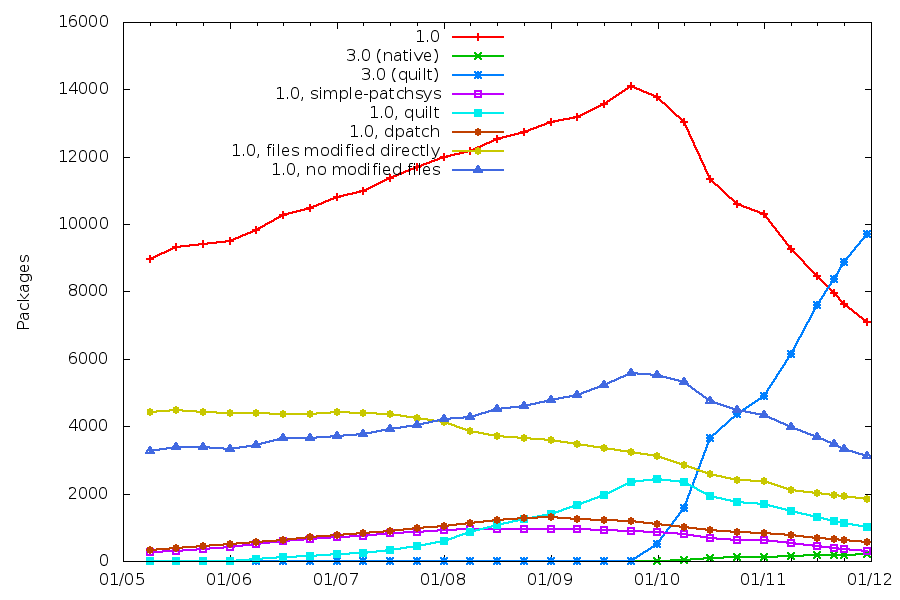
My goal with the 3.0 (quilt) source format has always been to standardize the patch management in Debian source packages. This message seems to have been well understood. dbs and dpatch have been deprecated by their respective maintainers. I made numerous efforts to make this source format useful in as many use cases as possible (but some improvements are still possible) and I have added hints to encourage maintainers to switch. Thanks to this, the adoption rate of this new source format has been very good and it s now the most widely used source package format in Debian only two years after its introduction in Debian unstable. With 9829 source package using 3.0 (quilt) , it surpassed the number of source package still using 1.0 (7368). (Those numbers have been taken from http://upsilon.cc/~zack/stuff/dpkg-v3/ on december 13th 2011.) The number of source packages using 3.0 (quilt) doubled this year.

(Click on the picture to see it full size) Of the 7368 packages using the old format, 6816 packages trigger the missing-debian-source-format lintian tag. This means that only 552 source packages have explicitly opted to keep using the old format and that the bulk of the remaining packages are rarely updated packages that have not been switched yet.

3 comments Liked this article? Click here. My blog is Flattr-enabled.

11 December 2011

Stefano Zacchiroli: bits from the DPL for November 2011

Mako's IronBlogger is a great idea. I often find myself postponing blog posts for a very long time, simply out of laziness. IronBlogger provides a nice community incentive to counter (my) laziness and blogging more often. As a related challenge, we have to face the fact that different subsets of our communities use different media to stay informed: mailing lists, blog (aggregators), social media, IRC, etc. Disparities in how they stay informed are a pity and can be countered using multiple medias at a time. Although I haven't blogged very often as of lately, I managed to keep the Debian (Developer) community informed of what happens in "DPL land" on a monthly basis, by the means of bits from the DPL mails sent to d-d-a. While the target of bits mails perfectly fits d-d-a, there is no reason to exclude a broader public from them. After all, who knows, maybe we'll find the next DPL victim^W candidate among Planet readers! Bonus point: blogging this also helped me realize that my mails are not as markdown-clean as I thought they were. I still have no IronBlogger squad, though. (And sharing beers with folks in the Boston area is not terribly handy for me ). Anyone interested in setting up a BloggeurDeFer in the Paris area? (SCNR)
Dear Project Members,
another month has passed, it's time to bother you again about what has happened in DPL land in November (this time, with even less delay than the last one, ah!). Call for Help: press/publicity team I'd like to highlight the call for help by the press / publicity teams. They are "hiring" and have sent out a call for new members a couple of weeks ago. The work they do is amazing and is very important for Debian, as important as maintaining packages or fixing RC bugs during a freeze. It is only by letting the world know what Debian is and what we do, that we can keep the Project thriving. And letting the world know is exactly what the publicity and press teams do. If you're into writing, blogging, or simply have a crush for social media, please read the call and "apply"! Interviews November has apparently been the "let's interview the DPL" month. I've spent quite some time giving interviews to interested journalists about various topics. For both my embarrassment and transparency on what I've said on behalf of Debian, here are the relevant links: Assets Legal advice (work in progress) Relationships with others Miscellanea Thanks for reading thus far,
and happy hacking.
PS as usual, the boring day-to-day activity log is available at master:/srv/leader/news/bits-from-the-DPL.*

14 November 2011

Vincent Bernat: A quick look at Typekit

Back in the dark ages of the web, before the introduction of CSS 3, browsers could only display fonts available on the client system. Thanks to the introduction of @font-face and its now widespread support, this is over. Now, Web designers have access to a large selection of fonts and most users will be able to appreciate them. Typekit provides a subscription-based library of hosted, high-quality fonts to use on websites. I expose here my own, mostly uneducated1 on the typographic side, look on this service.

Fonts embedding 101 There are several ways to embed fonts for the Web. Let s have a look at the most common ones.

Self-hosting and @font-face A first possibility is to host fonts yourself and provide a CSS file with the appropriate @font-face declarations. There are five important things to know:
  1. There is no common format. You will need to host different versions of the same font to support most browsers.
  2. Of course, Internet Explorer comes with its own quirks that you need to work around.
  3. Most browsers enforce a same origin policy. You need to serve your fonts from the same domain as the requesting page. You can circumvent such a limitation by enabling cross-origin resource sharing: add an Access-Control-Allow-Origin header when serving fonts.
  4. Fonts are unlikely to change. To leverage caching, configure an explicit expiration date far in the future. Something like 30 days.
  5. There is no MIME types registered for fonts. Don t bother setting one, even if Google Chrome likes to complain about them in the console.
One great resource is Font Squirrel which provides kits with fonts and the appropriate CSS declarations. You choose your font family (or upload one of your own), the formats that you want to use (check them all) and you will get a ZIP archive with all fonts and a CSS file. You may want to tweak it a bit to enable automatic use of the bold variant when needed and to use a local copy if available. For example, if you choose Crimson, an oldstyle typeface, you may want to declare the bold version with font-weight: bold and add local names:
@font-face  
    font-family: 'Crimson';
    src: url('Crimson-Bold-webfont.eot');
    src: local('Crimson Bold'), local('Crimson Text Bold'),
         url('Crimson-Bold-webfont.eot?#iefix') format('embedded-opentype'),
         url('Crimson-Bold-webfont.woff') format('woff'),
         url('Crimson-Bold-webfont.ttf') format('truetype'),
         url('Crimson-Bold-webfont.svg#CrimsonBold') format('svg');
    font-weight: bold;
    font-style: normal;
 

Google Web Fonts For open-source fonts, you can also use Google Web Fonts instead of hosting the files yourself. Build a collection of fonts and choose the variants that you want to use for each of them. You will then be provided with a code snippet to paste in the <head> element of your page. For example, for Crimson:
<link href='http://fonts.googleapis.com/css?family=Crimson+Text:400,700,400italic'
      rel='stylesheet' type='text/css'>
Why choose this solution over self-hosting?
  1. You don t use your own bandwith to serve fonts. This may be important if you pay for it.
  2. Google uses its own CDN to serve fonts. If you don t use a CDN yourself, this can be a major performance improvement.
  3. Caching is more efficient since many sites will use the same font.
  4. It s easier to do it right.
Unless you are concerned about Google tracking your users2, I think this is a better solution than self-hosting. Quick delivery of fonts is pretty important since content rendering can be delayed by them.

Typekit: the good parts So, why choose Typekit? First, there is the very large choice of fonts. The first paid plan comes with more than 500 fonts from about 80 foundries. There are about a hundred serif fonts and a couple hundred sans serif ones. Typekit provides a convenient interface to browse fonts. You can either search fonts by name or by characteristics. In the last case, you can filter on properties like the classification (serif, sans serif, decorative, etc.), weight, width, contrast, x-height, recommended use or language support. Once a font is selected and added to your kit, you can easily choose what variants you want. The kit total size is displayed. If you happen to meet any problem or have some questions, Typekit support is very responsive. I got clear and crisp answers in less than a few hours in the week-end.

and the bad ones Unfortunately, Typekit has also some shortcomings. One of the most commonly cited is that Javascript is mandatory. No Javascript, no fonts. If you want to display the appropriate fonts for users without Javascript, you should just not use Typekit.

Not free, nor free While Typekit offers some open-source fonts, most of them are not. Moreover, only a few of them are available in the free plan. While I would prefer to use open-source fonts, I don t consider this a strong requirement: if you are dissatisfied for some reason, switching back to open-source fonts (or another service) is fast and easy. I like serif fonts a lot and they get less attention from the FLOSS world: it is difficult to find one whose readability on screen is excellent. Droid Serif is a nice font but is a bit too black for me. Maybe Cardo would be a good match. You may disagree and in this case, Google Web Fonts or self-hosting seem the perfect match.

Difficulty to choose and test fonts While browsing fonts is easy and smooth, choosing and testing them is another matter. For example, Typekit is missing some interface to compare font rendering for whole paragraphs at a given size. It also misses a way to check how two fonts render together, one for headings and one for paragraphs. Here, Google Web Fonts is more versatile. Things become really difficult when you want to test your selected fonts for real. Except if you have invested into one of the expensive plans, you can only include a limited number of fonts in your kit. Each time you want to try another set of fonts, you need to modify your kit and wait for it to be distributed across Typekit network. You may have to wait five or ten minutes between each change! Another inconvenient thing is that once you publish your site, any change to the kit will affect the published version. Therefore, you need to use a second kit for development and play back and forth with those two kits. What would be convenient here is a special kit with all fonts from the library with restricted access to some IP to avoid abuse. This is something done by Fontdeck, a competitor.

Poor subset support Because you want to keep the font size small (about 30 kB for each variant), Typekit usually proposes two subsets: the default one contains only latin characters and the complete one with all glyphs. If some glyph is absent from the default subset, you need to use the complete one which is roughly two to four times the size of the default one. This is a bit huge for only one character. What would be nice is to have subsets for each language. In my case, I would take a French subset because I need the glyph which appears in French in words like c ur (heart or core) or il (eye). I don t want to select the complete subset just for this character. When a glyph is absent, the next font in the CSS stack is used. For example, if the selected font is FF Tisa Web Pro and the next font in the stack is Droid Serif, here is how the word c ur may be rendered. On the first line, FF Tisa Web Pro contains the appropriate glyph. On the second line, the glyph is absent and taken from Droid Serif. Since x-height and contrast are a bit different, the replaced glyph seems out of tone. At small sizes, the difference accounts for more than 10%. Various rendering of word "c ur" I have also added a third line where the ligature is built from o and e and the following style is applied to e :
.lf-ligature  
    margin-left: -0.172em;
    zoom: 1; /* Here to trigger hasLayout on IE7 */
 
As you can see, the result seems good. I have a piece of Javascript turning a ligature into the appropriate markup. It can be extended to handle more ligatures and could be adapted to handle other composed characters (like the ones in Anton n Dvo k ).

Defective caching Because a document can only be rendered after the fonts have been loaded3, it is pretty important to deliver fonts as fast as possible. Typekit uses Edgecast as a CDN and DynECT for DNS hosting. Two files are downloaded. Both of them are hosted on use.typekit.com. The first one is a script that will act as a loader. Based on the characteristics of your browser, it will choose how to download the requested fonts for best rendering. The second file is generally a big CSS file containing the fonts. Here are the headers returned for the first file:
HTTP/1.1 200 OK
Accept-Ranges: bytes
Cache-Control: max-age=300
Content-Encoding: gzip
Content-Type: text/javascript
Date: Tue, 08 Nov 2011 18:34:16 GMT
ETag: "388467610+gzip"
Expires: Tue, 08 Nov 2011 18:39:16 GMT
Last-Modified: Sat, 05 Nov 2011 09:31:57 GMT
Server: ECS (cdg/D624)
Vary: Accept-Encoding
X-Cache: HIT
Content-Length: 7440
First, notice that the content is served compressed. Good point. The next headers to look at are Cache-Control, Date, ETag and Expires: the server requests the content to be cached for 5 minutes. When the browser notices that its copy is out-of-date, it will issue a new request including a If-None-Match: 388467610+gzip header. Unless the kit has been modified, the server will answer with 304 Not Modified and no content. The copy of the browser will be valid for another 5 minutes. This means that after 5 minutes, at least 3 round-trips are needed to check if our fonts are up-to-date. Worse, sometimes, Typekit servers may be just slow. They can wait one second before answering, just to send a 304. Since the first file is a script embedded in <head>, the whole page is blocked until you get the answer. Here is an illustrative example with Chromium 14 where a page using Typekit is loaded while all static assets are in the navigator cache and things have gone wrong (which is pretty rare): Screenshot of Chromium Inspector Since fonts are needed, the rendering has been paused for 3.5 seconds until Typekit was fully loaded. If we look more closely, we may also notice we got a status 200 from the server instead of 304. Here is an excerpt of the browser request:
GET /tyt0atd.js HTTP/1.1
Host: use.typekit.com
Connection: keep-alive
Accept-Encoding: gzip,deflate,sdch
If-None-Match: "2200251225+gzip"
If-Modified-Since: Thu, 10 Nov 2011 11:38:11 GMT
And here is an excerpt of the answer headers:
HTTP/1.1 200 OK
Accept-Ranges: bytes
Cache-Control: max-age=300
Content-Type: text/javascript
Date: Fri, 11 Nov 2011 17:10:03 GMT
ETag: "2200251225"
Expires: Fri, 11 Nov 2011 17:15:03 GMT
Last-Modified: Thu, 10 Nov 2011 11:38:11 GMT
Server: EOS (lax001/54E5)
Content-Length: 25755
What happened? For some unknown reason, the server denied the access to the compressed version of the resource: there is no Content-Encoding: gzip while the browser did send Accept-Encoding: gzip. The tag provided by the browser (2200251225+gzip) came obviously from the compressed resource and therefore does not match. RFC 2616 requests If-Modified-Since header to be ignored if the tag does not match. Consequently, the server answers with 200 OK and resend the whole file. The same problem happened with the CSS file. Let me stress again how important the problem is: we had to download again the two files but we also downloaded the non-compressed version. Now, let s suppose that we did not run into this problem and the server answered with 304 Not Modified. The result is still not satisfactory: we would have waited 1.3 seconds to get both answers from the server. Keep in mind that most of the time, Typekit is pretty fast. Here is how I think this should have been done: each time you modify your font kit, you get a new URL to use (containing the version of the font kit for example). This resource and the associated fonts (whose URL is also versioned) are requested to be cached for several days. As a sidenote, this also enables to modify a kit for your development environment without modifying the kit for your production site. I suspect that Typekit did not go this way to track kit usage more accurately and enforce the appropriate pricing. Having multiple versions of the same kit would also allow us to use more fonts that we are paying for. UPDATED: Typekit support knows the problem and is working on it:
You ve identified a small bug in our CDN provider that we re working with them to fix. Hopefully I can give an explanation of what s happening. The CDN edge servers have a cache of recently served kits on them. Any request that is served from that cache will be correctly Gzipped and handle ETags. Unfortunately, if the content isn t already in cache and needs to be fetched from the master origin server then the request won t be gzipped correctly which has the side effect of breaking ETags. [ ] We are working to on getting this bug fixed, but any change to a globally distributed CDN will take some time. We re also working on having our content cached longer than 5 minutes whilst still allowing people to quickly update their site.

Conclusion I have mixed feelings about Typekit. While the difficulty to test fonts and the lack of language-related subsets are annoying, I have been able to work around them. However, the caching problem is more annoying. I am still considering going back to Google Web Fonts just because of this.

  1. While I have a high interest in typography, have my own copy of The Elements of Typographic Style by Robert Bringhurst and have throughly read The Elements of Typographic Style Applied to the Web , I am still fairly novice on this matter.
  2. Google serves fonts from a cookie-less domain. Technically, they could still do some kind of tracking but I believe they don t.
  3. In fact, browsers have different strategies on how to render before fonts availability. Paul Irish wrote a comprehensive article on FOUT. One common strategy is to render a blank space until downloaded fonts are available. If this takes too much time, fallback fonts may be used.

13 November 2011

Axel Beckert: grep everything

During the OpenRheinRuhr I noticed that a friend of mine didn t know about zgrep and friends. So I told him what other grep variations I know and he told me about some grep variations I didn t know about. So here s our collection of grep wrappers, derivatives and variations. First I ll list programs which search for text in different file formats:
grep through whatFixed StringsWildcards / Basic RegExpsExtended RegExpsDebian package
uncompressed text filesfgrepgrepegrepgrep
gzip-compressed text fileszfgrepzgrepzegrepzutils, gzip
bzip2-compressed text filesbzfgrepbzgrepbzegrepbzip2
xz-compressed text filesxzfgrepxzgrepxzegrepxz-utils
uncompressed text files in installed Debian packagesdfgrepdgrepdegrepdebian-goodies
gzip-compressed text files in installed Debian packages-dzgrep-debian-goodies
PDF documents--pdfgreppdfgrep
POD textspodgrep--pmtools
E-Mail folder (mbox, MH, Maildir)-mboxgrep -Gmboxgrep -Emboxgrep
Patches-grepdiffgrepdiff -Epatchutils
Process list--pgrepprocps
Gnumeric spreadsheetsssgrep -Fssgrep?gnumeric
Files in ZIP archives--zipgrepunzip
ID3 tags in MP3s--taggreppertaggrepper
Network packets--ngrepngrep
Tar archives--targrep / ptargrepperl (Experimental only for now)
And then there are also greps for special patterns on more or less normal files:
grep for whatuncompressed filescompressed filesDebian package
PCRE (Perl Compatible Regular Expression)pcregrep (see also the grep -P option)zpcregreppcregrep
IP Address in a given CIDR rangegrepcidr-grepcidr
XPath expressionxml_grep-xml-twig-tools
One question is though still unanswered for us: Is there some kind of meta-grep which chooses per file the right grep from above by looking at the MIME type of the according files, similar to xdg-open. Other tools which have grep in their name, but are too special to properly fit into the above lists: Includes contributions by Frank Hofmann and Faidon Liambotis.

4 November 2011

Paul Wise: Migrating from Galeon to Iceweasel/Firefox

I have been a long-time user of the Galeon web browser, which, while powerful for its time, is getting a bit long in the teeth and has been abandoned for a long time. As a result I need to find something new. As Galeon uses the Mozilla engine I figure switching to Iceweasel/Firefox will be the least amount of pain since they share similar formats for lots of the user configuration and data (with the exception of history). Switching to Firefox also gives me access to a lot of configurability and a vast sea of extensions all written in RDF, JavaScript and zoooool (ahem, XUL). Another plus was that I was already using Firebug for the occasional web development project. Looking at the Mozilla addons site is like entering someone's shed. There will be the few beautiful unfinished projects still being worked on, one polished finished scuplture gathering dust but still admirable, things with power plugs from a bygone era, some things that have a coin slot on them, some cryptic machines with no visible screws or manuals, some spiders and their cobwebs and a few rats and mice chewing through things. A place where you can find some excellent, well documented, useful and Free Software extensions alongside lots of crud. Luckily for me the good stuff that I wanted to use was already in Debian or the friendly Debian Mozilla extension maintainers team was willing to package them for me. In my quest for freedom from Galeon I first noticed that there is no up button in Iceweasel. Bummer, I use that a lot so I went searching for extensions. I soon found one extension, but it hadn't kept up with the ever-changing Mozilla APIs so it fell by the wayside. Thanks to the leavers of breadcrumbs I picked up the trail to a new shiny and working extension. Lo-and-behold I found Uppity, which was all about going up and as it turns out, much better at that than Galeon. Thanks to MozExt team, thats solved, next! The next glaring problem was the lack of Galeon-style smart bookmarks. Before you ask, yes, Firefox smart keyword bookmarks are not the same thing. This was rediculously hard to search for due to the wording used by both projects being same same but different. Some folks switched to Epiphany to get the extra search boxes on their toolbars. Like this guy I was not interested in that, mainly due to the addons I would be missing out on. I tried a few different tacks, even searching for a way to have multiple search boxes in the Firefox toolbars. I soon gave up on finding an extension that would do this like Galeon does so I figured its time to roll up the sleeves and learn some zzzoooool. I already know a little bit about JavaScript and CSS so... First slap a dash of a tutorial about adding toolbar buttons, add a slither of adding extensions without installing them, stare down some Mozilla reference manuals, thrown in a pinch of favicons, give up on a wild goose chase or two, add a big fat blob of zoooool and sautee in fugly hacks. Soon enough you will have something hardcoded that works like Galeon smart bookmarks but looks even better. A screenshot of hacky galeon smart bookmarks in Iceweasel I may eventually turn this into a proper and functionally equivalent extension for Galeon-stlye smart bookmarks but for now it will remain a useful hack. If you want to get your hands dirty with zzzoooooool and try this out after modifying it to use your personal search URLs, please feel free to contact me. For now the only remaining issue I can see is that the forward/back buttons in Iceweasel don't have the explict menu buttons. This is a minor issue for me so now it is time for me to figure out how to migrate my data and config1 before permanently switching away from Galeon. Wish me luck! 1. Of course the data and config are fugly, but that is a something for another, much broader and more complicated hack

30 October 2011

Vincent Sanders: Software that adds another dimension to things

I think that it will come as no surprise to my fellow software engineers if I note that I almost never write new software any more. I maintain, I augment, I refactor, I debug but very, very rarely do I start something new.

This probably has something to do with my maturity as a code monkey, my immediate reaction is to seek out a solution to a problem that already exists and perhaps extend it to fulfil my requirements.

Partially this comes from my innate laziness but also over time I have discovered that I am a "finisher" the role I invariably end up in involves doing all the final bits to make the client accept a project. Because I know my reaction is to always finish something I start, I avoid starting things.

Anyhow, enough introspection, a couple of months ago I was talking on IRC about my 3D printer and was asked "can you print the Debian logo?". So I hunted around for software that would let me convert a bitmap into a suitable 3d format. The result was rather disappointing, the few tools I could find were generally python scripts which simply generated a matrix of cuboids, one for each pixel their heights corresponding to the pixel value.

I used one such script to generate a file for the Debian swirl and imported it into the OpenScad 3d modelling application. I got an inkling of the issues involved after the scene render took over half an hour. The resulting print was blocky and overall I was not terribly happy with the outcome.

So I decided I would write a program to convert images into a 3D representation. I asked myself, how hard can it be?

Sometimes starting from an utterly naive approach with no knowledge of a problem can lead to new insights. In this case I have spent all my free coding time for a month producing a program which I am now convinced has barely even scratched the surface of the possible solutions.

Having said that I have started from a blank editor window and a manual gcc command line compilation and progressed to an actually useful tool and, arguably, of more import to me I have learned and implemented a load of new algorithms which has actually been mentally stimulating and fun!

The basic premise of the tool is to take a PNG image, quantise it into a discrete number of levels , convert that as a height map into a triangle mesh, index that mesh (actually a very hard problem to solve efficiently), simplify the indexed mesh and output the result in a selection of 3D file formats.

The mesh generation alone is a complex field which it appears often devolves into the marching cubes algorithm simply out of despair of anything better ;-) I have failed to implement marching cubes so far (though I have partially implemented marching squares, an altogether simpler algorithm)

The mesh indexing creates an indexed list of vertices from the generated mesh and back annotates it with which faces are connected to which vertices. This effectively generates a useful representation of the meshes topology which can then be used to reduce the complexity of the mesh, or at least describe it. To gain efficiency I implemented my first ever bloom filter as part of my solution. I also learned that generating a plausible hash for said filter is a lot harder than it would seem. In the end I simply used the FNV hash which produces excellent results for very little computation cost.

The mesh simplification area is awash with academic research, most of which I ended up skipping and simply went for the absolute simplest edge removal algorithm. Implementing even this and maintaining a valid mesh topology was challenging.

By comparison the output of the various formats was positively trivial, mainly littered with head scratching over the bizzare de-facto "extensible" formats where only one trivial corner is ever actually implemented.

All in all I have had fun creating the PNG23D project and have actually used it to generate some useful output. I have even printed some of it to generate a lithophane of Turing. I now look forward to several years of maintaining and debugging it and doing all the other things I do instead of writing new software ;-)

13 October 2011

John Goerzen: An Incredible Story From Soviet Times

This was written by Tom Dailey, and I ve lightly edited it:
In 1965, I was stationed at the Fleet Anti-Submarine Warfare Center in San Diego. I was a Radioman 2nd. Class in the USN, at the time. One evening, at our radio club station (W6DCM different license holder, now), I called CQ and got UA KKC (it s no longer around), with Ivan at the mic. After a time of the usual signal reports and such, we asked what each did in their lives I said that I was US Navy radio operator. He answered that HE ALSO was a Navy radio operator in the Soviet navy. Then we discovered that his station was at the SUBMARINE base at Vladivostok, and I of course was his DIRECT opponent. Yes we really DID laugh at that, and I shall never forget what he said (that I heartily agreed with): Thomas, isn t it shame that we re supposed to hate each other? Yes, Ivan, it is someday we ll share a vodka, da? Da , he replied.
We re often told we should hate people. Messages I have heard on the media over the last 10 years have said we ought to hate illegal immigrants, CEOs, radical Muslims, the French, Iranians, Mexicans, presidents, UN diplomats, climate scientists, oil company employees, Chinese people, conservatives, liberals, religious people, atheists, and oh yes, still Russians. But I get to choose who to hate, and in fact, I choose NO HATE. Not only does it keep my stress level way lower, but it also lets me enjoy life more, and makes the world a better place. We can all talk to people in other countries and with other backgrounds and viewpoints so easily thanks to the Internet. Sadly we rarely have very deep online conversations to the point of getting to know people. For whatever reason, ham radio lends itself to that better. Even better: visit other places. I wonder how many people that say they hate some group of people have visited them and made an effort to make a connection? It is, after all, really hard to hate someone that is kind to you. Perhaps they re afraid to let go of their hate. Think also about this: for whom is it convenient if you hate people? There is usually a reason that hatred is stoked, and it doesn t usually lead to good things for individual people. Tom W0EAJ added:
I actually tried to locate him and the station, but both appear to have vanished. Ivan (his name was pronounced Eee-von) could have, it occured to me later, gotten into trouble for saying such things. I think both of us realized AT THE TIME, what an astounding counterpoint each of us was to the other. Proof that if it were left up to the simple little guys like us, and not to the politicians, we might actually pull off living in peace.

6 October 2011

Craig Small: @ 0 28

It doesn t look so old in hex; Zero, x, Two, Eight but I finally got there. So on this day, what other landmarks am I up to? Some people get a little sad hitting this age, but it really is only a number, wether it is 0 28, \050 or even 40. As the saying goes: only the dead don t age.

30 September 2011

Dirk Eddelbuettel: Rcpp 0.9.7

A fresh maintenance release version 0.9.7 of Rcpp went onto CRAN and into Debian earlier today. This release contains two contributed fixes. The first, suggested by Darren Cook via the rcpp-devel mailing list, corrects how we had set up exceptions specifications, reflecting a bit of Java-think on our part. The idiom is generally discouraged in C++, and we now conform. The second came in two excellent patches by R Core member Martyn Plummer which finally get us compilation on Solaris. This is much appreciated as our hands were tied here for lack of access to such a box. Otherwise, two new examples and a new unit test were added. The complete NEWS entry is below; more details are in the ChangeLog file in the package and on the Rcpp Changelog page.
0.9.7   2011-09-29
    o   Applied two patches kindly provided by Martyn Plummer which provide
        support for compilation on Solaris using the SunPro compiler
    o   Minor code reorganisation in which exception specifiers are removed;
        this effectively only implements a run-time (rather than compile-time) 
        check and is generally seen as a somewhat depreated C++ idiom. Thanks
        to Darren Cook for alerting us to this issue.
    o   New example 'OpenMPandInline.r' in the OpenMP/ directory, showing how
        easily use OpenMP by modifying the RcppPlugin output
    o   New example 'ifelseLooped.r' showing Rcpp can accelerate loops that may
        be difficult to vectorise due to dependencies
    o   New example directory examples/Misc/ regrouping the new example as
        well as the fibonacci example added in Rcpp 0.9.6
    o   New Rcpp-FAQ example warning of lossy conversion from 64-bit long
        integer types into a 53-bit mantissa which has no clear fix yet.
    o   New unit test for accessing a non-exported function from a namespace
Thanks to CRANberries, you can also look at a diff to the previous release 0.9.6. As always, even fuller details are on the Rcpp Changelog page and the Rcpp page which also leads to the downloads, the browseable doxygen docs and zip files of doxygen output for the standard formats. A local directory has source and documentation too. Questions, comments etc should go to the rcpp-devel mailing list off the R-Forge page

20 September 2011

Kai Wasserb ch: TNEF or how to lock-up your e-mails

As the administrator for several MTAs I've received my fair share of support requests for "unreadable" e-mails. They generally have an attachment called winmail.dat. This is what all (for exceptions see the rest of this blog post) non-Outlook MUAs can display, when they receive an e-mail with the application/ms-tnef (or application/vnd.ms-tnef) MIME type. TNEF is a propietary format cooked up in Redmond. When chosen, the e-mail in question isn't sent as text/plain or at least text/html, but the entire e-mail is put into an TNEF-encoded attachment, most often called winmail.dat, in which you (most commonly) find the content of the e-mail in RTF, possible attachments are also put into the winmail.dat. The easieast solution for all involved parties is to convince the sender, that her Outlook and/or Exchange setup needs fixing (disabling TNEF in Outlook and Exchange 2003). Sadly this won't work all the time. The other solutions are to either filter the e-mails on your e-mail server and run them through something like ytnef_smtpd.py (please note, that this might be legally problematic for you as a service provider, opening an e-mail, even automatically, is a violation of communication privacy rights in many jurisdictions). Or, if the legal problem is too big or can't be solved through an local server installation (e.g. because there is no server running 24/7), you're left with either using Outlook (probably what Microsoft intended) or you can use a plug-in/add-on for your client. I've tested the LookOut add-on for icedove and it seems to work well. There are of course plug-ins for many other clients, but I can't honestly tell whether they work or not. [UPDATE 2011-09-20]: Fellow Debian Developer Josselin Mouette wrote me, that Evolution is capable of reading TNEF-encoded e-mails out of the box, but he also said that [TNEF e-mails should] be banned by all means.[/UPDATE 2011-09-20] Now, before I close, please always try to convince the sender/postmaster to fix their setup. It has only advantages: text/plain e-mails are smaller, they're less likely to contain malicious code (i.e. no parts hidden away from the virus scanner on the mail server (amavis can read TNEF e-mails, if libconvert-tnef-perl is installed)) and all recipients can open the e-mails with the client of their choice.

18 September 2011

Biella Coleman: Birds of a Feather for Academics (aka how to study digital media)

lol-bird-watch There is nothing more dispiriting for a scholar of digital media to see the astounding plurality of forms, formats, and politics reduced to one of a handful of tepid categories such as 1) network society 2) peer to peer production 3) digital activism and 4) the absolute most vacuous terms ever, Web 2.0. The problem is summed up rather nicely by a bunch of folks who published an article by the name of Birds of the Internet that every scholar interested in digital media should read: Observing participation without any guide to its diversity is like watching birds with no sense of what distinguishes them other than that they fly and squawk (when of course, many do neither). Rather than
lumping every instance of Internet-mediated participation into boxes labeled digital
culture , virtual reality , online community or network society , a field guide could aid in observing differences and testing, rather than proliferating classifications.

3 September 2011

Tanguy Ortolo: Repacking ZIP-based containers

An open package showing two egg-like objects Several modern complex file formats are based on a ZIP container: this is at least the case of OpenDocument and EPUB. However, they are not simply a bunch of files joined into an archive, but they follow some rules in order to be easily recognized by tools such as file. As I had to unpack, modify and repack such a container, here is a recipe to do that.The zip command is flexible enough to allow you to work in place (I am not sure that it is really in place) to add, remove and replace files in the archive, however I find it more convenient to work on the unpacked tree and repack later. Unpack and work To unpack, just unzip, being aware that these containers do not have a root directory, so it is better to extract them to a dedicated directory. Modify as you wish; if you add, remove or replace files, remember that there is a file list to modify accordingly: META-INF/manifest.xml for OpenDocument, OEBPS/content.opf and possibly OEBPS/toc.ncx for EPUB. Repack To repack, you must create a ZIP archive without extra file attributes, and put the file mimetype uncompressed in first position. Its goal is to be visible as plain text at a fixed position, to serve as a magic file type indication. The remaining files can be stored compressed and in random order. For an EPUB, for instance, this gives the following commands:
% zip --no-extra --compression-method store ../book.epub mimetype
% zip --recurse-paths ../book.epub META-INF OEBPS
This could be automated by a dedicated script, but I felt no need to write one yet. By the way, these options can be abbreviated as -X0 and -r.

18 August 2011

Thorsten Glaser: How not to create DEB files

Once upon a time, there was Deb and Ian. That was about exactly 18 years ago. We don t talk about the 0.939000 format any more, but they eventually settled on:

	$ ar rc pkg_1.0_all.deb debian-binary control.tar.gz data.tar.gz
	$ hexdump -C pkg_1.0_all.deb   head
	00000000  21 3c 61 72 63 68 3e 0a  64 65 62 69 61 6e 2d 62   !<arch>.debian-b 
	00000010  69 6e 61 72 79 20 20 20  31 33 31 33 36 38 33 35   inary   13136835 
	00000020  32 39 20 20 31 30 30 36  20 20 32 30 30 20 20 20   29  1006  200    
	00000030  31 30 30 36 34 34 20 20  34 20 20 20 20 20 20 20   100644  4        
	00000040  20 20 60 0a 32 2e 30 0a  63 6f 6e 74 72 6f 6c 2e      .2.0.control. 
	00000050  74 61 72 2e 67 7a 20 20  31 33 31 33 36 38 33 35   tar.gz  13136835 
	00000060  32 39 20 20 31 30 30 36  20 20 32 30 30 20 20 20   29  1006  200    
	00000070  31 30 30 36 34 34 20 20  31 33 39 31 20 20 20 20   100644  1391     
	00000080  20 20 60 0a 1f 8b 08 00  00 00 00 00 00 03 ed 59      ............Y 
	00000090  eb 6f db 36 10 f7 d7 f0  af b8 3a 5e 9b 74 b1 f5   .o.6......:^.t.. 
 

By then, systems were a.out(5), and everything was good. (Of course, if you look at the mtimes, you ll notice I faked this. But it s really equivalent to the real thing.

But oh horror! GNU binutils, not always everyone s friend, switched from using BSD style Unix Archiver libraries in ar(1) to SYSV style libraries on elf(5) systems:

	$ ar rc on-elf debian-binary control.tar.gz data.tar.gz
	$ hexdump -C on-elf   head
	00000000  21 3c 61 72 63 68 3e 0a  64 65 62 69 61 6e 2d 62   !<arch>.debian-b 
	00000010  69 6e 61 72 79 2f 20 20  31 33 31 33 36 38 33 35   inary/  13136835 
	00000020  32 39 20 20 31 30 30 36  20 20 32 30 30 20 20 20   29  1006  200    
	00000030  31 30 30 36 34 34 20 20  34 20 20 20 20 20 20 20   100644  4        
	00000040  20 20 60 0a 32 2e 30 0a  63 6f 6e 74 72 6f 6c 2e      .2.0.control. 
	00000050  74 61 72 2e 67 7a 2f 20  31 33 31 33 36 38 33 35   tar.gz/ 13136835 
	00000060  32 39 20 20 31 30 30 36  20 20 32 30 30 20 20 20   29  1006  200    
	00000070  31 30 30 36 34 34 20 20  31 33 39 31 20 20 20 20   100644  1391     
	00000080  20 20 60 0a 1f 8b 08 00  00 00 00 00 00 03 ed 59      ............Y 
	00000090  eb 6f db 36 10 f7 d7 f0  af b8 3a 5e 9b 74 b1 f5   .o.6......:^.t.. 
 

Can you spot the difference?

Of course, ELF is what you want , so there is little choice. Unix Archiver libraries are system dependent, and no format has ever been normed, but DEB files use it as format so what is one to do?

	$ GNUTARGET=a.out-i386-linux ar rc with-aout \
	> debian-binary control.tar.gz data.tar.gz
	$ md5sum pkg_1.0_all.deb with-aout on-elf
	248f78d42f8ca8f2a3560f9800b2bf01  pkg_1.0_all.deb
	248f78d42f8ca8f2a3560f9800b2bf01  with-aout
	09eca70c9b11b6b55bbadcab5c3201fb  on-elf
 

OK, and what do I do on my Debian/m68k system?

ar(1) uses bfd, and GNU binutils can not only forcibly set the target emulation but also show them:

debian_m68k$ ar -h 2>&1 grep '^ar: supported targets'
ar: supported targets: elf32-m68k a.out-m68k-linux elf32-little elf32-big plugin srec symbolsrec verilog tekhex binary ihex trad-core
debian_i386$ ar -h 2>&1 grep '^ar: supported targets'
ar: supported targets: elf32-i386 a.out-i386-linux pei-i386 elf32-little elf32-big elf64-x86-64 elf32-x86-64 pei-x86-64 elf64-l1om elf64-k1om elf64-little elf64-big plugin srec symbolsrec verilog tekhex binary ihex trad-core
debian_i386$ ar -h 2>&1 grep '^ar: supported targets' # binutils-multiarch
ar: supported targets: elf32-i386 a.out-i386-linux pei-i386 elf32-little elf32-big elf64-alpha ecoff-littlealpha elf64-little elf64-big elf32-littlearm elf32-bigarm elf32-hppa-linux elf32-hppa elf64-x86-64 elf32-x86-64 elf64-l1om elf64-k1om elf64-ia64-little elf64-ia64-big pei-ia64 elf32-m68k a.out-m68k-linux coff-m68k versados ieee a.out-zero-big elf32-tradbigmips elf32-tradlittlemips ecoff-bigmips ecoff-littlemips elf32-ntradbigmips elf64-tradbigmips elf32-ntradlittlemips elf64-tradlittlemips elf32-powerpc aixcoff-rs6000 elf32-powerpcle ppcboot elf64-powerpc elf64-powerpcle aixcoff64-rs6000 aix5coff64-rs6000 elf32-s390 elf64-s390 elf32-shbig-linux elf32-sh-linux elf32-sh64-linux elf32-sh64big-linux elf64-sh64-linux elf64-sh64big-linux elf32-sparc a.out-sparc-linux elf64-sparc a.out-sunos-big pei-x86-64 elf32-m32r-linux elf32-m32rle-linux elf32-spu plugin srec symbolsrec verilog tekhex binary ihex trad-core
mirbsd_i386$ ar -h 2>&1 grep '^ar: supported targets'
ar: supported targets: elf32-i386 coff-a29k-big a.out.adobe aix5coff64-rs6000 a.out-zero-big a.out-mips-little epoc-pe-arm-big epoc-pe-arm-little epoc-pei-arm-big epoc-pei-arm-little coff-arm-big coff-arm-little a.out-arm-netbsd pe-arm-big pe-arm-little pei-arm-big pei-arm-little b.out.big b.out.little efi-app-ia32 efi-app-ia64 elf32-avr elf32-big elf32-bigarc elf32-bigarm elf32-bigarm-symbian elf32-bigarm-vxworks elf32-bigmips elf32-cr16c elf32-cris elf32-crx elf32-d10v elf32-d30v elf32-dlx elf32-fr30 elf32-frv elf32-frvfdpic elf32-h8300 elf32-hppa-linux elf32-hppa-netbsd elf32-hppa elf32-i370 elf32-i386-freebsd elf32-i386-vxworks elf32-i860-little elf32-i860 elf32-i960 elf32-ia64-hpux-big elf32-ip2k elf32-iq2000 elf32-little elf32-littlearc elf32-littlearm elf32-littlearm-symbian elf32-littlearm-vxworks elf32-littlemips elf32-m32r elf32-m32rle elf32-m32r-linux elf32-m32rle-linux elf32-m68hc11 elf32-m68hc12 elf32-m68k elf32-m88k elf32-mcore-big elf32-mcore-little elf32-mn10200 elf32-mn10300 elf32-msp430 elf32-nbigmips elf32-nlittlemips elf32-ntradbigmips elf32-ntradlittlemips elf32-openrisc elf32-or32 elf32-pj elf32-pjl elf32-powerpc elf32-powerpc-vxworks elf32-powerpcle elf32-s390 elf32-sh elf32-shbig-linux elf32-shl elf32-shl-symbian elf32-sh-linux elf32-shl-nbsd elf32-sh-nbsd elf32-sh64 elf32-sh64l elf32-sh64l-nbsd elf32-sh64-nbsd elf32-sh64-linux elf32-sh64big-linux elf32-sparc elf32-tradbigmips elf32-tradlittlemips elf32-us-cris elf32-v850 elf32-vax elf32-xstormy16 elf32-xtensa-be elf32-xtensa-le elf64-alpha-freebsd elf64-alpha elf64-big elf64-bigmips elf64-hppa-linux elf64-hppa elf64-ia64-big elf64-ia64-hpux-big elf64-ia64-little elf64-little elf64-littlemips elf64-mmix elf64-powerpc elf64-powerpcle elf64-s390 elf64-sh64 elf64-sh64l elf64-sh64l-nbsd elf64-sh64-nbsd elf64-sh64-linux elf64-sh64big-linux elf64-sparc elf64-tradbigmips elf64-tradlittlemips elf64-x86-64 mmo pe-powerpc pei-powerpc pe-powerpcle pei-powerpcle a.out-cris demo64 ecoff-bigmips ecoff-biglittlemips ecoff-littlemips ecoff-littlealpha coff-go32 coff-go32-exe coff-h8300 coff-h8500 a.out-hp300hpux a.out-i386 a.out-i386-bsd coff-i386 a.out-i386-freebsd a.out-i386-lynx coff-i386-lynx msdos a.out-i386-netbsd i386os9k pe-i386 pei-i386 coff-i860 coff-Intel-big coff-Intel-little ieee coff-m68k coff-m68k-un a.out-m68k-lynx coff-m68k-lynx a.out-m68k-netbsd coff-m68k-sysv coff-m88kbcs a.out-m88k-mach3 a.out-m88k-openbsd mach-o-be mach-o-le mach-o-fat coff-maxq pe-mcore-big pe-mcore-little pei-mcore-big pei-mcore-little pe-mips pei-mips a.out-newsos3 nlm32-alpha nlm32-i386 nlm32-powerpc nlm32-sparc coff-or32-big a.out-pc532-mach a.out-ns32k-netbsd a.out-pdp11 pef pef-xlib ppcboot aixcoff64-rs6000 aixcoff-rs6000 coff-sh-small coff-sh coff-shl-small coff-shl pe-shl pei-shl coff-sparc a.out-sparc-little a.out-sparc-linux a.out-sparc-lynx coff-sparc-lynx a.out-sparc-netbsd a.out-sunos-big sym a.out-tic30 coff-tic30 coff0-beh-c54x coff0-c54x coff1-beh-c54x coff1-c54x coff2-beh-c54x coff2-c54x coff-tic80 a.out-vax-bsd a.out-vax-netbsd a.out-vax1k-netbsd versados vms-alpha vms-vax coff-w65 coff-we32k coff-z8k elf32-am33lin elf32-ms1 srec symbolsrec tekhex binary ihex netbsd-core

Wow. While binutils share no single supported working target, they can be built multiarch, or (on MirBSD) with --enable-targets=all --enable-64-bit-bfd. Doesn t help if you want to stay portable: GNUTARGET=srec is common on all Debian (sid) binutils versions (single or multiarch), but errors out on older binutils. The a.out-* targets are not common. Sure, you could hack around things, but this is tedious. If you follow things or know me a little, you might already have guessed that I wouldn t let that stand.

pax(1) to the rescue. On MirBSD, we use paxtar, which has cpio(1) and tar(1) front-ends and supports multiple formats (4 cpio and 2 tar variants) and has already been extended a lot and is lovingly called paxmirabilis (mirabilos peace in Latin) it has options to anonymise archives: set uid and gid to zero, set mtime to zero, (for ustar) only write the numeric uid and gid to the archive, (for cpio formats) serialise inodes and device information, write content of hardlinked files only once (breaks partial extraction but saves a lot of space, e.g. 2 MiB off the Grml initrd.gz). And, recently, the ability to append a trailing slash to pathnames of ustar members which are directories (GNU tar does it and I thought some Debian utilities check for it). So why not (the -M dist and fakeroot set the uid/gid to 0)

	$ find debian-binary control.tar.gz data.tar.gz   \
	> mircpio -oHar -Mdist >with-mircpio
	$ mirpax -w -M dist -f with-mirpax -x ar \
	> debian-binary control.tar.gz data.tar.gz
	$ mirtar -M dist -A -cf with-mirtar \
	> debian-binary control.tar.gz data.tar.gz
	$ GNUTARGET=a.out-i386-linux fakeroot ar rc with-aout-ar \
	> debian-binary control.tar.gz data.tar.gz
	$ md5sum with-*
	a466e2fd57cdee141fe585a43245548f  with-aout-ar
	a466e2fd57cdee141fe585a43245548f  with-mircpio
	a466e2fd57cdee141fe585a43245548f  with-mirpax
	a466e2fd57cdee141fe585a43245548f  with-mirtar
 

Voil . I got it, and even appending is possible. It supports the BSD format with special focus on DEB files, and deals with long filenames, but not symbol or filename tables (used by ranlib(1) or strange formats, respectively, but since we don t create *.a files to use with some native linker/binder/loader, we don t need that anyway).

On extraction (oh, and listing!) it deals with SYSV style filenames as well.

	$ mirtar tvf on-elf
	-rw-r--r--  1 tg       tg          4 Aug 18 16:05 debian-binary
	-rw-r--r--  1 tg       tg       1391 Aug 18 16:05 control.tar.gz
	-rw-r--r--  1 tg       tg      18135 Aug 18 16:05 data.tar.gz
	$ mirtar tvf with-aout
	-rw-r--r--  1 tg       tg          4 Aug 18 16:05 debian-binary
	-rw-r--r--  1 tg       tg       1391 Aug 18 16:05 control.tar.gz
	-rw-r--r--  1 tg       tg      18135 Aug 18 16:05 data.tar.gz
 

One of the real benefits is that you can use the front-ends interchangably for example, mirtar tzf foo.cpio.gz would work (which GNU tar can t do), and mircpio s ustar implementation, unlike GNU cpio s, is not horribly broken. Of course, there are some drawbacks: it s not GNU tar or GNU cpio, so there are absolutely zero --long-options. Some of their features are missing (but tar s -O is implemented now), so it s no replacement (but very well usable alongside it). The format called pax, committee-designed to replace ustar, isn t yet supported ironically, but that s on the TODO.

So, what do you think?

	tg@frozenfish:~/Debs/dists/sid/wtf/Pkgs/mircpio $ ll *.deb
	-rw-r--r-- 2 tg freewrt 78140 Aug 17 11:04 mircpio_20110817-0wtf2_amd64.deb
	-rw-r--r-- 3 tg freewrt 72262 Aug 17 11:00 mircpio_20110817-0wtf2_i386.deb
	-rw-r--r-- 1 tg freewrt 67446 Aug 17 18:21 mircpio_20110817-0wtf2_m68k.deb
 

Should I upload this to Debian proper? As for the licence: 3-clause UCB (and 2-clause BSD, which is a subset of it), so no problem. I m asking because the other package which I had been using for a long time and not uploaded, jupp, got uploaded recently (during DebConf) on user input (people wondered why it did not yet exist in Debian proper). I guess the old saying if it s not in Debian, it doesn t exist holds true in many parts of the OSS world. It s up to date wrt. standards btw, and lintian-clean save for two pedantic-class warnings (no upstream changelog file, no homepage link) which aren t fulfillable (could link this wlog entry as homepage). If you know Alioth you re familiar with the software formerly known as SourceForge, formerly known as GForge, currently known as FusionForge. My employer both uses it and contributes to it, we run an adapted (mostly themed, prototyping new functions that often end up in FusionForge itself, and backporting functions from FF to our production codebase ) version.

I ve backported the extratabs plugin to appease project managers and other non-technical people while we move our codebase to FF 5.1, and I did so on an installed version of the plugin rather than the source because the latter was tightly integrated with rather heavy packaging style changes.

	[ ]
	dh_builddeb
	# create fusionforge-plugin-extratabs binary package
	toplev=$$(pwd); cd plugins/fusionforge-plugin-extratabs; \
	p=$$(print -r -- $$(sed -n '/^Package: /s///p' C/control   head -1)); \
	v=$$(print -r -- $$(sed -n '/^Version: /s///p' C/control   head -1)); \
	a=$$(print -r -- $$(sed -n '/^Architecture: /s///p' C/control   head -1)); \
	d=$$ p _$$ v _$$ a .deb; \
	rm -f $$toplev/../$$d control.tar.gz data.tar.gz; \
	(cd control; find .   fgrep -v /.svn   sort   \
	    mircpio -oC512 -Hustar -M0x0B -Mgslash)   gzip -n9 >control.tar.gz; \
	(cd data; find .   fgrep -v /.svn   sort   \
	    mircpio -oC512 -Hustar -M0x0B -Mgslash)   gzip -n9 >data.tar.gz; \
	mirtar -M dist -Acf $$toplev/../$$d debian-binary cont*gz dat*gz; \
	rm -f control.tar.gz data.tar.gz; \
	cd $$toplev; dpkg-distaddfile $$d non-free/devel optional
 

The hardest part of extending debian/rules with that was to get the autobuild and dpkg-distaddfile call right. This works, even though I d call it a temporary kludge. (No need to tell me I should have used && I know. And I only shell out to mksh(1) because the inner part was already there from before, when I still used ar(1). This was slightly edited for the wlog.) In the meanwhile, apt-extracttemplates can deal with SYSV style filenames in DEB files on Debian sid, but not on Kubuntu hardy, which some people are using as Desktop OS still

11 August 2011

Michal &#268;iha&#345;: New features in phpMyAdmin

As our GSoC students are approaching quite well, we've already numerous features included in current master, which are worth mentioning. You can try all bellow mentioned features on our demo server. Grid editing provides really simple way of editing data, by simply clicking on it while browsing table. Just try it on some table. Performance suggestions are part of completely reworked server status and can give you valuable information how to tune your server. You can see it on demo server. Another nice addition to server status page is live monitor, which charts basic server information in real time. Again, try it on demo server (you need to press start for now, this will probably go away soon). Other big, thought not that fancy change is complete support for routines. This includes stored procedures/functions, triggers and events. For example see routines in sakilla database. Of course there is much more to mention, like improving of AJAX in lot of places, GIS support. On the other side, we've also recently decided to remove support for Microsoft Excel import and export as used PHPExcel library seems to suffer some licensing issues, which prevented phpMyAdmin from being included in Fedora. You can still use CSV or OpenDocument formats though.

Filed under: English Phpmyadmin 0 comments Flattr this!

Next.

Previous.