Search Results: "lucas"

18 August 2008

Jurij Smakov: DebConf8 impressions

What I liked What I did not like What I did

16 August 2008

Andrew Pollock: [debian] On hypothetical alternative freeze policies

I, for one, like Lucas' idea.

15 August 2008

Stefano Zacchiroli: edos-builddebcheck

Statically detecting FTBFS with edos-builddebcheck Here at DebConf8, after my talk about Mancoosi, I got in touch with several people interested in the QA implication of the EDOS/Mancoosi tools. Me and Ralf have for example been contacted by Ubuntu people which are setting up theirs equivalent of http://edos.debian.net. A guy working on a mirroring tool made an interesting hack using edos-debcheck: out of a mirror with broken dependencies he can mirrors a subset of packages which do not suffer of the same problem. But now to the more interesting development, following a bug report by Atomo and discussions with Lucas (the RC-bug-filing-master), me and Ralf implemented edos-builddebcheck. You can invoke it on a pair of Packages/Sources package list, and it will check whether some packages will FTBFS due to unsatisfiable dependencies. The results on Lenny main/amd64 as of today are, ... erm ..., scary : 49 packages will FTBFS. The RC-bug-filing-master and Ralf are working on filing them, "don't worry". You can find edos-builddebcheck in the edos-debcheck package, starting from version 1.0-7 (in incoming at the time of writing). Update yes, ATM edos-builddebcheck does not know anything about P-A-S packages, so there are some false positive. Still, 33 source packages are proper hits.

12 August 2008

Lucas Nussbaum: Debian s Freeze

Debian’s freeze sounds like a technical hack to address a social problem, and that disturbs me a bit. The social problem is: At some point, we need everybody in Debian to make only non-disruptive changes, so everything can converge very fast into a releasable state. The “solution” we are using is that we are blocking all packages from migrating to testing, and requiring manual review from someone on the release team. Consequences are:
- many people feel that you need to be very convincing to fix a small, not RC bug, even if fixing that bug definitely increases your package’s quality.
- the release team is completely overwhelmed by unblock requests during the freeze
- many people just stop trying to fix things during the freeze (which definitely doesn’t improve Debian’s quality), both because they think it’s hard to get a fix in, and because they don’t want to bother the release team I wonder if we really need such a strict policy. Are there other Free Software projects that use such a technical measure to prevent software from disrupting stable releases? I am the impression that most other projects rely on social pressure instead of technical measures for that, except maybe during the last few hours before the release. Couldn’t we act on the social level? We could default to allow everyone’s package to migrate to testing, and, when someone fucks up and uploads something that should not have been uploaded, block all his packages (switching to manual review mode) until the release. Of course, that require the release team to make decisions about _people_, which is harder than making decisions about _packages_. But if the rules are clearly stated, couldn’t this work?

10 August 2008

Stefano Zacchiroli: PTS and package descriptions

PTS, package descriptions (and more than a bit of UDD) After delivering my talk at DebConf, I went back to some (more) PTS hacking ... apparently I'm in the mood for it :) An apparently trivial feature request (showing package descriptions) provided for interesting thoughts. First of all the PTS is mostly source-based, but in Debian we have no source package descriptions (issue which probably deserves fixing by its own). Rough consensus has then been to add tooltips on binary package hyperlinks, to show short descriptions. Still, adding the import of Packages sounded like overkilling, not mentioning duplicated wrt packages.d.o. Hence I decided to be the first jumping on the UDD boat (wonderful GSOC project which I had the pleasure to co-mentor together with Lucas and HE) for routinely usage. Retrieving the most recent short description of each binary package at each PTS run is as easy as:
select distinct packages.package, packages.description
from packages,
  (select package, max(version) from packages group by package)
    as latest (package, version)
where packages.package = latest.package
  and packages.version = latest.version ;

To solve the more generic problem of the PTS missing a generic description (or, if you want, to mitigate the problem that in Debian we are missing a source package description), Lucas came up with the intriguing idea of showing the description of the most popular binary package, according to popocon. Piece of cake:
select distinct packages.package, popcon.insts, packages.description
from packages, popcon,
  (select package, max(version) from packages group by package)
    as latest (package, version)
where packages.package = latest.package
  and packages.version = latest.version 
  and packages.package = popcon.package ;

(same as before, but adding popularity: one has both all short descriptions, and a way to spot the "canonical" one) Long life to UDD. (BTW if you are interested in UDD, and you happen to be at DebConf8, do not miss tomorrow's QA BOF.)

9 August 2008

Lucas Nussbaum: Code for Debian versions comparison?

Do you know code that compare versions of debian packages (for example, that knows if 2:23.2.3~rc1-1 is lower than 2:23.2.3-2?), besides dpkg –compare-versions? If yes, please write a comment to this blog post, preferably with a link to the code. Also, did someone already write a test suite for that? Who would be interested in such a test suite? I’m considering writing a function in PL/SQL to compare debian versions (for the Ultimate Debian Database project). If someone already wrote that, I’m interested as well.

Stefano Zacchiroli: PTS integrated with mentors and gifts

more PTS hacking: mentors.d.n and gift/help bugs Some more PTS hacking at DebConf8. Among about 20 bugs triaged/fixed thus far, 2 are peculiar and integrate some more info in PTS package pages. A minor glitch is currently affecting this though: when pending uploads on mentors.d.n are not uploaded, but rather superseded by new versions in unstable, they are currently not removed automatically from mentors.d.n and will thus show up in the PTS. Apparently this is going to be fixed soon on mentors.d.n, so hopefully this bug won't have time to bother anyone. Bugs (user-)tagged gift on the other hand are a rather new (and thus far neglected) QA feature proposed by Lucas. Packages with gift bugs have now them shown as an extra line in the bug summary box. The idea is to point contributors to PTS pages to discover if some of the packages they are interested in have gifts for them. As an extra gift (pun, intended) I've written for the PTS a tiny Python script to retrieve bug summaries via SOAP. The lookup is via tag, supporting both official tags and usertags. In case it can be useful to someone else, I'm putting it up for download. The PTS is using tagged bugs.py it as follows:
$ tagged_bugs.py "gift" "debian-qa@lists.debian.org" > bugs.gift.txt
$ tagged_bugs.py "help" > bugs.gift.txt

8 August 2008

Lucas Nussbaum: Of popular packages removed from testing, and the Ultimate Debian Database GSOC project

Some time ago, there was some flamewars^H^Hdebate about the Release Team’s removals of RC-buggy packages from testing. Basically, some people claimed that popular packages shouldn’t be removed, even if RC-buggy. But, do we really miss popular packages in testing? It’s difficult to know. You could get the popcon data, and compare it with the Packages files for testing and unstable. Or work with source packages (which removes a lot of noise), but then, you have to convert the popcon data (which uses binary packages names) to source packages. Not completely trivial. That’s where the Ultimate Debian Database GSOC project comes to the rescue. The goal of Christian von Essen’s project is to gather data from various sources in Debian into a single SQL DB, so queries that combine all those data sources can easily be written. For example, here is the query that lists the source packages that are in unstable, but not in testing, sorted by their popcon (using the number of insts of the most popular binary package of the source package as value for the source package):
SELECT DISTINCT unstable.package, insts
FROM (SELECT DISTINCT package FROM sources
WHERE distribution = 'debian' and release = 'sid') AS unstable, popcon_src
WHERE unstable.package NOT IN (
   SELECT package FROM sources
   WHERE distribution = 'debian' AND release = 'lenny')
AND popcon_src.source = unstable.package ORDER BY insts DESC;

And the results are available on the web! Top packages (> 1000 insts):
lzo	64962
gnome-cups-manager	32346
db4.6	20708
ffmpeg-debian	12908
freetype1	10569
flashplugin-nonfree	7116
perlftlib	6769
nvidia-graphics-drivers	3864
wxwindows2.4	3640
dvi2tty	2239
kdebase-runtime	1725
easytag	1717
g-wrap	1582
yaird	1507
slocate	1499
youtube-dl	1390
hugin	1275
w3c-libwww	1058
Interested in UDD? Join #debian-qa or debian-qa@lists.d.o (or talk to me @DebConf!)

7 August 2008

Lucas Nussbaum: Exporting logs from Suunto X6HR watches on Linux

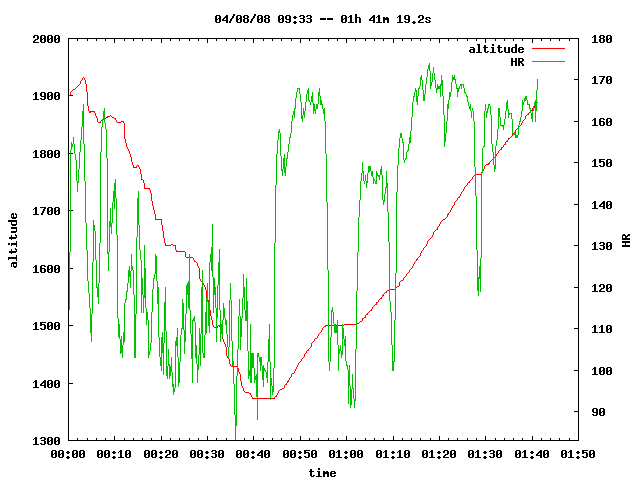
I’m the happy owner of a nice geeky toy: a Suunto X6HR watch, that includes an altimeter and an heart rate monitor, which I use mainly for moutain biking and hiking. During outings, the watch can log the altitude and heart rate every 2, 10 or 60 seconds, and the data can be transfered to a PC using a serial interface. The problem is that Suunto only provides software for Windows. I got tired of using virtualbox to connect to the watch (qemu doesn’t work, Suunto Activity Manager apparently does strange things with the serial port), so I reverse-engineered the protocol (using skimanager and J rome Kieffer’s work as a basis) and implemented a script to fetch the logs, and export them in a format suitable for gnuplot. Of course, Suuntux is publicly available. I’d be happy to hear from you if it works for you too. Also, if you own a Suunto X6 (similar watch, without HRM), I’d be interested in supporting it too (if it’s not supported already). Below is a example graph, from a short mountain bike ride just before leaving for Debconf. example suuntux output

11 July 2008

Lucas Nussbaum: 3G Internet access using mobile phone + laptop in France

In France, we only have 3 mobile network operators: Orange, SFR, and Bouygues Telecom. They usually discuss their rates together to make sure that one of them doesn’t break the market by creating too interesting rates (that’s why it would be so cool if Free.fr could get a 3G license, and why the governement can tell them “do what we want, or we will give Free a 3G license” - source). I’ve long been interested in using my mobile phone with my laptop to access the Internet. With the 3 operators, you can get a contract for a 3G USB key, but that’s not really interesting: it’s expensive, and there’s a limit on volume of data, so you have to monitor your bandwidth. Also, I only need to use my mobile phone as modem a few times a month. So I’m not really interested in paying an expensive monthly fee for that. What do french MNOs offer? Most of them have rather interesting offers when you want to get unlimited internet access from your mobile, but that doesn’t cover the case of using your phone as a modem, to access the internet on another device (e.g laptop). I’m not sure how they can see the difference, but apparently they do. (It seems that there are hacks making use of those unlimited rates, using your phone as a router between the Wifi network (but your phone has to support Wifi) and the 3G network, using apps like WMWiFiRouter. Another hack is to use the same HTTP proxy on the laptop than on the phone, which seems to give unlimited HTTP access.) But offers for using your phone as a modem are clearly less interesting (probably because they want to push their USB 3G cards offers): Bouygues:
Apparently, you are billed only based on the volume (see page 46 of this document), with a progressive rate. 5 MB/month costs 9 EUR, 100 MB costs 20 EUR, and over 100 MB, you pay 1 EUR/MB (!). SFR:
See page 40-41 of this document. You pay 0.50 EUR for a 30 minutes session, with 2 MB of data included. After those 2 MB of data, you pay 1 EUR/MB. Those rates are really crazy. Using a mobile phone on an HSDPA network (called “3G+” in France), you can easily reach 1 Mbps. (and I did see this rate while fetching files using rsync, so I was not particularly aiming at performance!). 1 Mbps translates to 7.5 EUR/min using the 1 EUR/MB rate. Or 12.5 cts/sec!!! Surprisingly, Orange (ex-France Telecom), which is usually not the most innovative MNO and ISP in France, saves us. With Orange, you pay 0.5 EUR for a 20 mins session, with unlimited volume (sessions called “session multim dia” by Orange). I was so surprised that I called the assistance to check. And after trying it yesterday, I was a bit anxious when checking my online bill this morning. But it works! Important note before you try (from Orange website):
La session multim dia est une tarification valable pour les clients forfaits mobile Orange (hors forfaits Orange pour iPhone, Mobicarte et cartes pr pay es). Pour les clients Classique, Intense, Pro, Click le forfait et Initial dont la souscription ou le r engagment est ant rieur au 14 juin 2007, pour les clients forfaits bloqu s dont la souscription ou le r engagement est ant rieur au 16 ao t 2007 et pour les clients b n ficiant d une offre blackberry, l accord expr s de l abonn b n ficier de la session multim dia est n cessaire. Les autres clients b n ficient de la tarification au volume.

10 July 2008

Rob Bradford: Patchsquad BOF [Updated]

Since Kristian’s excellent GTK State of the Union talk was today his slot is now available for a Patchsquad BOF. So that’s tomorrow at 11am. Thanks Behdad for allowing us to grab this. A little background on the idea of a Patchsquad: Primarily the idea is to reduce the workload of maintainers by commenting, not reviewing, patches that are waiting in Bugzilla. This may include testing, checking for obvious issues and gentle pestering of maintainers. Lucas held a BOF last year to introduce the idea that was well attended and a lot said but interest seems to have twindled. Myself and Diego want to try reinvigorate the idea! Update: Whoops! Looks like we haven’t got that slot afterall. If you’re interested in the Patchsquad pleas some along and speak to either Diego or myself.

26 June 2008

Neil Williams: Migrating Emdebian changes into Debian, not Ubuntu

During the Emdebian Worksession at TCl, various improvements were made to dpkg-cross, apt-cross and emdebian-tools packages. After a few delays caused by (what turned out to be) a 4 extension cable that blew up 300 of equipment, I'm finally merging those changes into the Debian packages - yet I don't have any control over the same changes in Ubuntu.

I really don't like Launchpad (I have quite enough web-logins thank you very much) or the PTS link that shows Ubuntu bugs that I cannot close from Debian. Lucas' assurance that "I don't expect Debian maintainers to reply to bugs on launchpad", makes it even harder to see the point of the bug listed in the emdebian-tools PTS.


Makes me wonder if a Not-For-Ubuntu field could be used in debian/control to force the removal of Debian packages from Ubuntu Universe where the Ubuntu setup is simply incompatible with the Debian package. This isn't something that the MOTD can "patch-up" in Ubuntu - it is a fundamental difference between Debian and Ubuntu that goes right back to the roots of why Ubuntu was created in the first place.

Yes, I can ignore Ubuntu (already do) but it is still annoying that there are bugs that simply cannot be fixed (and that the Debian PTS reminds me of that fact).

Maybe if someone who does care about such things and has a Ubuntu launchpad login wants to close the bug as "wontfix" or equivalent . . .
https://bugs.launchpad.net/ubuntu/+source/emdebian-tools/+bug/121369 - just to clear it off my radar?

(Oh and why does LP insist on https??? I'm not logged in, that's the entire POINT!) Bah.

24 June 2008

Lucas Nussbaum: question to Git (power)users

I’m slowly switching to Git for my personal projects, and I like it more and more. And it seems that I can only find nice things to read about it. So, I’m wondering: what are the things that you dislike with Git? That make you regret/prefer another VCS? If Git was redesigned from scratch, what should be changed?

19 June 2008

Raphael Geissert: Re: Ubuntu divergence

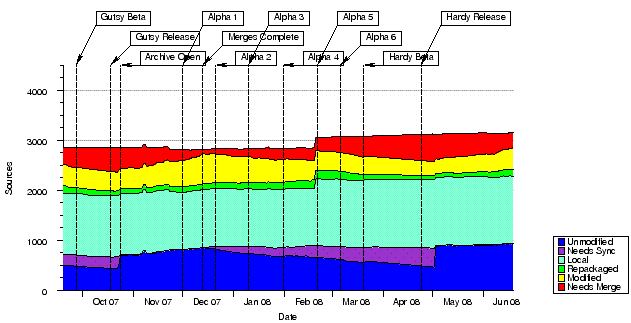
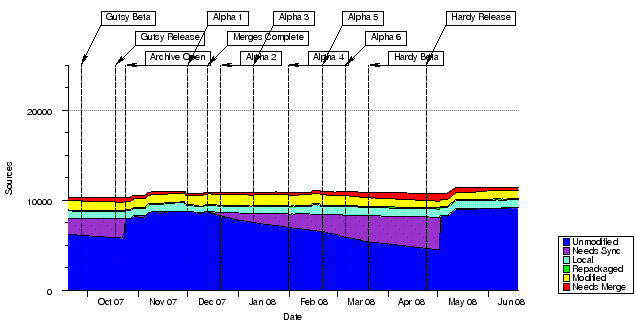
Lucas Nussbaum recently posted some graphics showing the number of packages that are grabbed from Debian and kept untouched, modified, out of sync, etc, etc.

But, "statistics are tricky":


$ wget http://patches.ubuntu.com/p/php5/php5_5.2.6-1ubuntu3.patch
--2008-06-19 22:25:03-- http://patches.ubuntu.com/p/php5/php5_5.2.6-1ubuntu3.patch
Resolving patches.ubuntu.com... 91.189.90.149
Connecting to patches.ubuntu.com 91.189.90.149 :80... connected.
HTTP request sent, awaiting response... 200 OK
Length: 441869 (432K) [text/plain]
Saving to: php5_5.2.6-1ubuntu3.patch'

100%[======================================================================>] 441,869 62.3K/s in 7.3s

2008-06-19 22:25:11 (59.4 KB/s) - php5_5.2.6-1ubuntu3.patch' saved [441869/441869]


$ lsdiff -i '*out' php5_5.2.6-1ubuntu3.patch wc -l
44


I believe people familiar with test suites know what that means...

Update: it means that the test suite files (outputs, expected results, and so on) are on the .diff.gz, thus contaminating it

Oh, and:


$ out=$(mktemp); filterdiff -i '*tests*' php5_5.2.6-1ubuntu3.patch > $out
$ du -h php5_5.2.6-1ubuntu3.patch $out
436K php5_5.2.6-1ubuntu3.patch
372K /tmp/tmp.eAxRv20298

...what a waste of space

Lucas Nussbaum: Ubuntu divergence

in main:
divergence in Ubuntu main
in universe:
Divergence in Ubuntu universe Those graphs (found on http://merges.ubuntu.com/) show the number of unmodified vs modified packages in Ubuntu main and universe. Interesting.

15 June 2008

Christian Perrier: On getting Ubuntu bug reports for our packages

Lucas pointed that the Package Tracking System now links to Ubuntu bug reports in Launchpad, for Debian packages. This is of course an interresting feature, which I immediately tried on geneweb, my pet package. Indeed, the only bug I found there comes from a user who was apparently not able to read a damn README.Debian file, which nicely explains what people are expected to do if they want to share the genealogical databases with Geneweb with the system-wide daemon. Maybe they should renamed README.Debian to README.Debian-but-readme-also-if-you-use-Ubuntu. In short, the only bug is user error. Now I really wonder how I could close that thing (yes, I did log in into Launchpad) and be able to claim that I have zero bugs on my pet package. I should do the same for samba, but I guess that Steve Langasek is more or less monitoring things there (LP is apparently Yet Another Thing You Have To Be Online To Use, which is a no-no for me).

Lucas Nussbaum: Ubuntu information on the Debian Package Tracking System and the Developer Packages Overview

Users of Debian derivatives sometimes report bugs that are not reported in the
Debian BTS, but that also affect Debian. It already happened a few times that
looking at the Ubuntu bugs for my packages allowed me to fix an unreported bug
in my Debian packages. But it’s difficult to keep track of the status of our packages in Ubuntu, since
Launchpad doesn’t provide a per-Debian-maintainer summary <insert here a rant
about closed-source software and how it restricts users>. Since it’s always fun to abuse proprietary software, I fetched all the bug data from Launchpad and inserted it in an SQLite DB (takes about 30 mins at 1200 HTTP requests/minute — it would be so much easier if the Launchpad devs added a text export of all bugs). The result is that there’s now an “Ubuntu” box on the Packages Tracking System, giving the current version in Ubuntu, a link to the Ubuntu patch (if any), and the number of open bugs. An Ubuntu column has also been added to the Debian Developer Packages Overview by Christoph Berg, with the current version in Ubuntu and the number of open bugs. It’s hidden by default: click on Display Configuration to enable it (then it’s stored in a cookie). I hope that this will help Debian maintainers to track what has been reported/fixed in Ubuntu. Also, if other Debian derivatives want to export the same kind of information, don’t hesitate to contact us. See for example: PS: the data might be slightly outdated, as it is processed on merkel.d.o, which was offline until recently. Expect it to be up-to-date in the next 24 hours.

14 June 2008

Brice Goglin: Debian X.org notes - X.org in Lenny (and more)

Xserver 1.4.2 for Lenny We originally planned to ship Xorg 7.4 and Xserver 1.5 since they were expected in February. However, Xserver 1.5 (and Mesa 7.1) are not released yet, so we are going to keep some updated X.org 7.3 for Lenny. A new Xserver 1.4 snapshot with some security fixes will enter testing soon. Once this is done, the final Xserver 1.4.2 will be uploaded. It is not perfect but it is the one you will get for Lenny. Many people suffered from Xserver 1.4 bugs in the last months, especially on the input side. Fortunately, many of them have been fixed. Lots of them were also caused by obsolete config files (that have to be manually fixes unfortunately). So we hope this Xserver 1.4.2 will be good enough for Lenny. XaaNoOffscreenPixmaps by default It is worth noting that XaaNoOffscreenPixmaps will now be the default (when XAA is enabled, i.e. by default for all drivers but Intel). It helps Compiz and seems to prevent various rendering problems from happening. Ubuntu and Fedora have been running such a patch for a while, so it looks like we are going to do the same for Lenny. To revert to the old behavior, use Option XaaOffscreenPixmaps in the Device section of your xorg.conf. ATI 6.8.191, Intel 2.3.2, Mesa 7.0.3++ Apart from the server, some big components are getting updated these days: A new Mesa has been uploaded so that it enters testing before the libs are frozen. It contains the latest Mesa 7.0.x git snapshot, including lots of bugfixes, especially for Intel hardware. Mesa 7.0.3 was already pretty solid, this new one (7.0.3-2) will be even better. ATI is still getting a lot of work upstream as usual. 6.8.191 (aka 6.9-rc1) has been released this week. It brings r6xx support, acceleration for r5xx, EXA Composite for r3xx/r4xx/r500, textured video support, ... It also fixes many bugs everywhere. Given the big testing that we had in experimental in the last months, I consider it much better than 6.8.0, so I decided to put it in unstable even if it's only a release candidate. This new ATI does not include the r128 and mach64 drivers anymore. So the new xserver-xorg-video-r128 and -mach64 packages finally entered unstable as well. Due to unexpected upstream version numbers for mach64 and r128 and me messing up with epochs, they have a lower version number (6.8.0-1) than the previous snapshots from experimental (1:6.8.1~git...). There's almost no code difference though, but people might want to install the unstable packages anyway. The old snapshots will be removed from experimental soon. On the Intel side, a new 2.3.2 is expected soon, without many big improvements from what I have seen. X.org post-Lenny Future Xorg 7.4/Xserver 1.5 prereleases should arrive in experimental soon. It requires Mesa 7.1, which still needs some build fix and requires a new yet-to-be-released libdrm. Once all these are properly fixed and released, you should for instance be able to experience some interesting improvement in EXA. It may finally make XAA useless for real. Also, Xorg 7.4 will simplify the Xserver package maintenance since its build won't need the whole Mesa source anymore (the GLcore module that AIGLX uses will be built/shipped within Mesa). Stop build-depending on xutils! Also, we've been trying to cleanup the dependency mess in many X packages for a while. We removed the obsolete dependency from xutils to xutils-dev which was only needed for Sarge->Etch upgrade (xutils-dev was split out of xutils). However, many packages still wrongly build-depend on xutils. Lucas reported that removing this useless dependency in the latest Xorg upload caused 84 FTBFS. So, we're going to revert the change to avoid adding 84 RC bugs. However, everybody build-depending on xutils, please check whether you actually need xutils or xutils-dev so that we can quickly fix this after Lenny.
(Permanent link) 

13 June 2008

Adeodato Sim : Text normalizer, not

Lucas asks about how he hates reformatting paragraphs in text documents he keeps in Git, because it creates unnecessary noise in the diffs. He also hates, though, not reformatting the paragraphs, because lines can become very long then, and he wants some kind of “smart formatter”. My take on this is that you shouldn’t change your preferred workflow to adapt it to how your tools work, but to adapt your tools to work well with your preferred workflow (here, reformatting paragraphs). Or, even better, reading the manual page to discover that your tools can already adapt to it. In particular, for this problem, I recommend reading diffs for text documents with git’s --color-words. A couple screenshots to show it in action:

9 June 2008

Lucas Nussbaum: Text normalizer, anyone?

When I write text documents (using LaTeX or Docbook), I like to wrap lines, as it makes them easier to edit (less things moving on the screen), and allow to have easy-to-read diffs. However, I always hesitate before rewrapping paragraphs (using vim’s gqap): this mean that I will add noise to my git history. So I only do that from time to time, making “rewrapping-only commits”. But that sucks, since in the meantime, I sometimes make a lot of changes, and my lines grow long again. Of course, I could rewrap my paragraphs before each commit, but if I simply add a word to a paragraph, it might cause all the lines to be rewrapped. So I what I would need is some kind of “text normalizer” that will: I’ve looked at plasTeX: I could use it to parse a LaTeX document, and export it as LaTeX. But then it would be a LaTeX-only solution. Does anyone have a better solution?

Next.

Previous.