Search Results: "gio"

21 May 2017

Adnan Hodzic: Automagically deploy & run containerized WordPress (PHP7 FPM, Nginx, MariaDB) using Ansible + Docker on AWS

In this blog post, I ve described what started as simple migration of WordPress blog to AWS, ended up as automation project consisting of publishing multiple Ansible roles deploying and running multiple Docker images. If you re not interested in reading about my entire journey, cognition gains and how this process came to be, please skim down to Birth of: containerized-wordpress-project (TL;DR) section. Migrating WordPress blog to AWS (EC2, Lightsail?) Since I ve been sold on Amazon s AWS idea of cloud computing services for couple of years now. I ve wanted, and been trying to migrate this (WordPress) blog to AWS, but somehow it never worked out. Moving it to EC2 instance, with its own ELB volumes, AMI, EIP, Security Group it just seemed as an overkill. When AWS Lightsail was first released, it seemed that was an answer to all my problems. But it wasn t, disregarding its bit restrictive/dumbed down versions of original features. Living in Amsterdam, my main problem with it was that it was only available in a single US region. Regardless, I thought it had everything I needed for WordPress site, and as a new service, it had great potential. Its regional limitations were also good in a sense that they made me realize one important thing. And that s once I migrate my blog to AWS, I want to be able to seamlessly move/migrate it across different EC2 s and different regions once they were available. If done properly, it meant I could even have it moved across different clouds (I m talking to you Google Cloud). P.S: AWS Lightsail is now available in couple of different regions across Europe. Rollout which was almost smoothless. Fundamental problem of every migration is migration

Phase 1: Don t reinvent the wheel? When you have a WordPress site that s not self hosted. You want everything to work, but yet you really don t want to spend any time managing infrastructure it s on. And as soon as I started looking what could fit this criteria, I found that there were pre-configured, running out of box WordPress EC2 images available on AWS Marketplace, great! But when I took a look, although everything was running out of box, I wasn t happy with software stack it was all built on. Namely Ubuntu 14.04 and Apache, and all of the services were started using custom scripts. Yuck. With this setup, when it was time to upgrade (and it s already that time) you wouldn t be thinking about upgrade. You d only be thinking about another migration. Phase 2: What if I built everything myself? Installing and configuring everything manually, and then writing huge HowTo which I would follow when I needed to re-create whole stack was not an option. Same case with was scripting whole process, as overhead of changes that had to be tracked was too way too big. Being a huge Ansible fan, automating this step was a natural next step. I even found an awesome Ansible role which seemed like it s going to do everything I need. Except, I realized I needed to update all software that s deployed with it, and customize it since configuration it was deployed on wasn t as generic. So I forked it and got to work. But soon enough, I was knee deep in making and fiddling with various system changes. Something I was trying to get away in this case, and most importantly something I was trying to avoid when it was time for next update. Phase 3: Marriage made in heaven: Ansible + Docker + AWS Idea to have everything Dockerized was around from very start. However, it never made a lot of sense until I put Ansible into same picture. And it was at this point where my final idea and requirements become crystal clear. Use Ansible to configure and setup host ready for Docker ecosystem. Ecosystem consisting of multiple separate containers for each required service (WordPress + Nginx + MariaDB). Link them all together as a single service using Docker Compose. Idea was backed by thought to spend minimum to no time (and effort) on manual configuration of anything on the server. Level of attachment to this server was so low that I didn t even want to SSH to it. If there was something wrong, I could just nuke the whole thing and deploy code on a new healthy rolled out server with everything working out of box. After it was clear what needed to be done, I got to work.

Birth of: containerized-wordpress-project (TL;DR)

After a lot of work, end result is project which allows you to automagically deploy & run containerized WordPress instance which consists of 3 separate containers running:

Once run, containerized-wordpress playbook will guide you through interactive setup of all 3 containers, after which it will run all Ansible roles created for this project. End result is that host you have never even SSH-ed to will be fully configured and running containerized WordPress instace out of box.

Most importantly, this whole process will be completed in <= 5 minutes and doesn t require any Docker or Ansible knowledge! containerized-wordpress demo Console output of running containerized-wordpress Ansible Playbook: Console output of running "containerized-wordpress" Ansible Playbook

Accessing WordPress instance created from containerized-wordpress Ansible Playbook:

Accessing WordPress instance created from "containerized-wordpress" Ansible Playbook Did I end up migrating to AWS in the end? You bet. Thanks to efforts made in containerized-wordpress-project, I m happy to report my whole WordPress migration to AWS was completed in matter of minutes and that this blog is now running on Docker and on AWS! I hope this same project will help you take a leap in your migration. Happy hacking!

17 May 2017

Daniel Pocock: Hacking the food chain in Switzerland

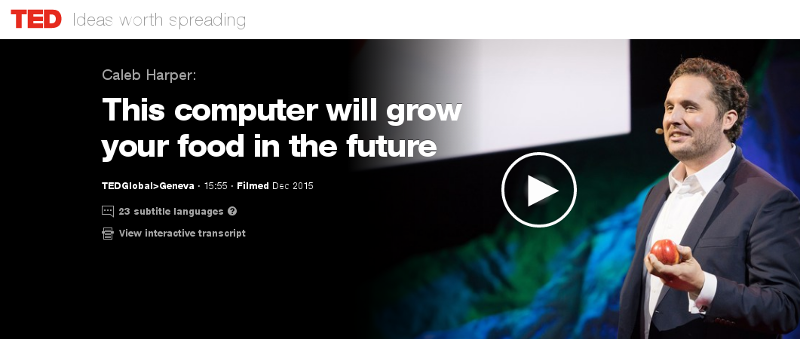
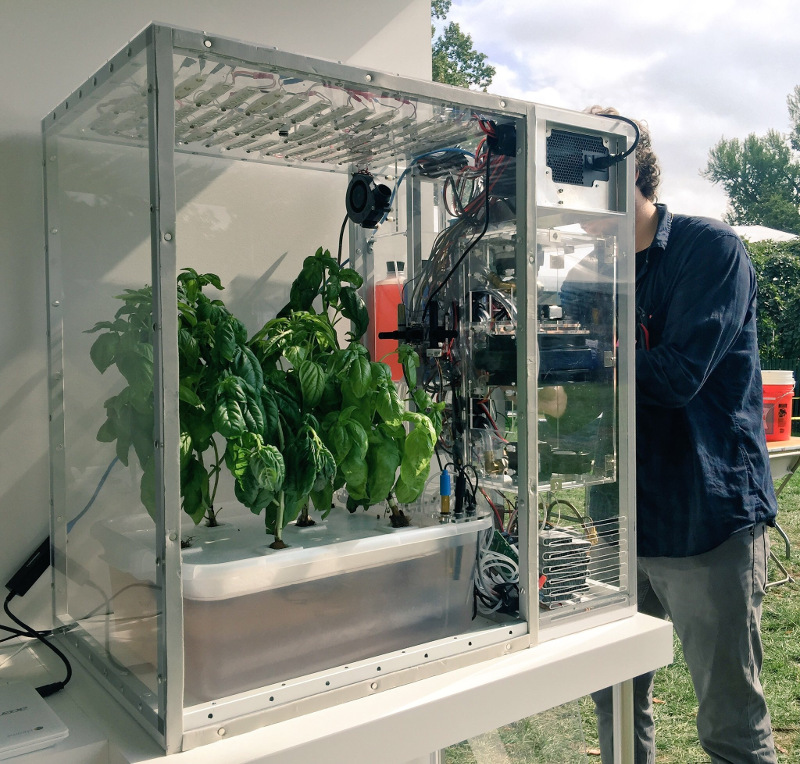
A group has recently been formed on Meetup seeking to build a food computer in Zurich. The initial meeting is planned for 6:30pm on 20 June 2017 at ETH, (Zurich Centre/Zentrum, R mistrasse 101). The question of food security underlies many of the world's problems today. In wealthier nations, we are being called upon to trust a highly opaque supply chain and our choices are limited to those things that major supermarket chains are willing to stock. A huge transport and storage apparatus adds to the cost and CO2 emissions and detracts from the nutritional value of the produce that reaches our plates. In recent times, these problems have been highlighted by the horsemeat scandal, the Guacapocalypse and the British Hummus crisis. One interesting initiative to create transparency and encourage diversity in our diets is the Open Agriculture (OpenAg) Initiative from MIT, summarised in this TED video from Caleb Harper. The food produced is healthier and fresher than anything you might find in a supermarket and has no exposure to pesticides. An open source approach to food An interesting aspect of this project is the promise of an open source approach. The project provides hardware plans, a a video of the build process, source code and the promise of sharing climate recipes (scripts) to replicate the climates of different regions, helping ensure it is always the season for your favour fruit or vegetable. Do we need it? Some people have commented on the cost of equipment and electricity. Carsten Agger recently blogged about permaculture as a cleaner alternative. While there are many places where people can take that approach, there are also many overpopulated regions and cities where it is not feasible. Some countries, like Japan, have an enormous population and previously productive farmland contaminated by industry, such as the Fukushima region. Growing our own food also has the potential to reduce food waste, as individual families and communities can grow what they need. Whether it is essential or not, the food computer project also provides a powerful platform to educate people about food and climate issues and an exciting opportunity to take the free and open source philosophy into many more places in our local communities. The Zurich Meetup group has already received expressions of interest from a diverse group including professionals, researchers, students, hackers, sustainability activists and free software developers. Next steps People who want to form a group in their own region can look in the forum topic "Where are you building your Food Computer?" to find out if anybody has already expressed interest. Which patterns from the free software world can help more people build more food computers? I've already suggested using Debian's live-wrapper to distribute a runnable ISO image that can boot from a USB stick, can you suggest other solutions like this? Can you think of any free software events where you would like to see a talk or exhibit about this project? Please suggest them on the OpenAg forum. There are many interesting resources about the food crisis, an interesting starting point is watching the documentary Food, Inc. If you are in Switzerland, please consider attending the meeting on at 6:30pm on 20 June 2017 at ETH (Centre/Zentrum), Zurich. One final thing to contemplate: if you are not hacking your own food supply, who is?
15 May 2017

intrigeri: GNOME and Debian usability testing, May 2017

During the Contribute your skills to Debian event that took place in Paris last week-end, we conducted a usability testing session. Six people were tasked with testing a few aspects of the GNOME 3.22 desktop environment and of the Debian 9 (Stretch) operating system. A number of other people observed them and took notes. Then, two observers and three testers analyzed the results, that we are hereby presenting: we created a heat map visualization, summed up the challenges met during the tests, and wrote this blog post together. We will point the relevant upstream projects to our results. A couple of other people also did some usability testing but went in much more depth: their feedback is much more detailed and comes with a number of improvement ideas. I will process and publish their results as soon as possible. Missions Testers were provided a laptop running GNOME on a a Debian 9 (Stretch) Live system. A quick introduction (mostly copied from the one we found in some GNOME usability testing reports) was read. Then they were asked to complete the following tasks. A. Nautilus Mission A.1 Download and rename file in Nautilus
  1. Download a file from the web, a PDF document for example.
  2. Open the folder in which the file has been downloaded.
  3. Rename the dowloaded file to SUCCESS.pdf.
  4. Toggle the browser window to full screen.
  5. Open the file SUCCESS.pdf.
  6. Go back to the File manager.
  7. Close the file SUCCESS.pdf.
Mission A.2 Manipulate folders in Nautilus
  1. Create a new folder named cats in your user directory.
  2. Create a new folder named to do in your user directory.
  3. Move the cats folder to the to do folder.
  4. Delete the cats folder.
Mission A.3 Create a bookmark in Nautilus
  1. Create a folder named unicorns in your personal directory.
  2. This folder is important. Add a bookmark for unicorns in order to find it again in a few weeks.
Mission A.4 Nautilus display settings Folders and files are usually listed as icons, but they can also be displayed differently.
  1. Configure the File manager to make it show items as a list, with one file per line.
  2. You forgot your glasses and the font size is too small for you to see the text: increase the size of the text.
B. Package management Introduction On Debian, each application is available as a "package" which contains every file needed for the software to work. Unlike in other operating systems, it is rarely necessary and almost never a good idea, to download and install software from the authors website. We can rather install it from an online library managed by Debian (like an appstore). This alternative offers several advantages, such as being able to update all the software installed in one single action. Specific tools are available to install and update Debian packages. Mission B.1 Install and remove packages
  1. Install the vlc package.
  2. Start VLC.
  3. Remove the vlc package.
Mission B.2 Search and install a package
  1. Find a piece of software which can download files with BitTorrent in a graphical interface.
  2. Install the corresponding package.
  3. Launch that BitTorrent software.
Mission B.3 Upgrade the system Make sure the whole system (meaning all installed packages) is up to date. C. Settings Mission C.1 Change the desktop background
  1. Download an image you like from the web.
  2. Set the downloaded image as the desktop wallpaper.
Mission C.2 Tweak temporary files management Configure the system so that temporary files older than three days are deleted automatically. Mission C.3 Change the default video player
  1. Install VLC (ask for help if you could not do it during the previous mission).
  2. Make VLC the default video player.
  3. Download a video file from the web.
  4. Open the downloaded video, then check if it opens with VLC.
Mission C.4 Add and remove world clocks When you click the time and date in the top bar, a menu pops-up. There, you can display clocks in several time-zones.
  1. Add a clock with Rio de Janeiro timezone, then another showing the current time in Boston.
  2. Check that the time and date menu now displays these two additional clocks.
  3. Remove the Boston clock.
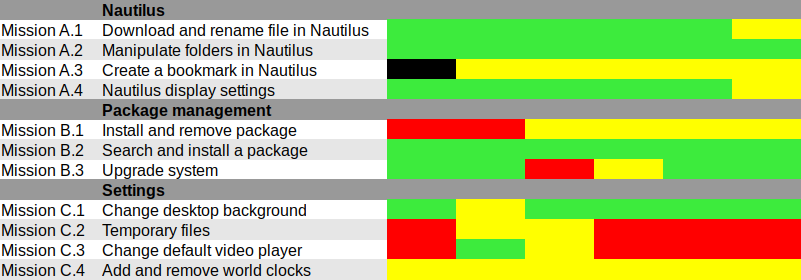
Results and analysis Heat map We used Jim Hall's heat map technique to summarize our usability test results. As Renata puts it, it is "a great way to see how the users performed on each task. The heat map clarifies how easy or difficult it was for the participant to accomplish a certain task.
  1. Scenario tasks (from the usability test) are arranged in rows.
  2. Test participants (for each tester) are arranged in columns.
  3. The colored blocks represent each tester s difficulty with each scenario task.
Green blocks represent the ability of the participant to accomplish the tasks with little or no difficulty. Yellow blocks indicate the tasks that the tester had significant difficulties accomplishing. Red blocks indicate that testers experienced extreme difficulty or where testers completed the tasks incorrectly. Black blocks indicate tasks the tester was unable to complete." Alternatively, here is the spreadsheet that was used to create this picture, with added text to avoid relying on colors only. Most tasks were accomplished with little or no difficulty so we will now focus on the problematic parts. What were the challenges? The heat map shows several "hot" rows, that we will now be looking at in more details. Mission A.3 Create a bookmark in Nautilus Most testers right-clicked the folder first, and eventually found they could simply drag'n'drop to the bookmarks location in the sidebar. One tester thought that he could select a folder, click the hamburger icon, and from there use the "Bookmark this folder" menu item. However, this menu action only works on the folder one has entered, not on the selected one. Mission B.1 Install and remove a package Here we faced a number of issues caused by the fact that Debian Live images don't include package indices (with good reason), so no package manager can list available software. Everyone managed to start a graphical package manager via the Overview (or via the CLI or Alt-F2 for a couple power users). Some testers tried to use GNOME Software, which listed only already installed packages (Debian bug #862560) and provided no way we could find to refresh the package indices. That's arguably a bug in Debian Live, but still: GNOME Software might display some useful information when it detects this unusual situation. We won't list here all the obstacles that were met in Synaptic: it's no news its usability is rather sub-optimal and better alternatives (such as GNOME Software) are in the works. Mission C.2 Tweak temporary files management The mission was poorly phrased: some observers had to clarify that it was specifically about GNOME, and not generic Linux system administration: some power-users were already searching the web for command-line tools to address the task at hand. Even with this clarification, no tester would have succeeded without being told they were allowed to use the web with a search query including the word "GNOME", or use the GNOME help or the Overview. Yet eventually all testers succeeded. It's interesting to note that regular GNOME users had the same problem as others: they did not try searching "temporary" in the Overview and did not look-up the GNOME Help until they were suggested to do so. Mission C.3 Change the default video player One tester configured one single video file format to be opened by default with VLC, via right-click in Nautilus Open with etc. He believed this would be enough to make VLC the default video player, missing the subtle difference between "default video player" and "default player for one single video format". One tester tried to complete this task inside VLC itself and then needed some help to succeed. It might be that the way web browsers ask "Do you want ThisBrowser to become the default web browser?" gave a hint an application GUI is the right place to do it. Two testers searched "default" in the Overview (perhaps the previous mission dealing with temporary files was enough to put them in this direction). At least one tester was confused since the only search result (Details View information about your system), which is the correct one to get there, includes the word View, which suggests that one cannot modify settings there, but only view them. One long-term GNOME user looked in Tweak Tool first, and then used the Overview. Here again, GNOME users experienced essentially the same issues as others. Mission C.4 Add and remove world clocks One tester tried to look for the clock on the top right corner of the screen, then realized it was in the middle. Other than this, all testers easily found a way to add world clocks. However, removing a world clock was rather difficult; although most testers managed to do it, it took them a number of attempts to succeed:
  1. Several testers left-clicked or right-clicked the clock they wanted to remove, expecting this would provide them with a way to remove it (which is not the case).
  2. After a while, all testers noticed the Select button (that has no text label nor tooltip info), which allowed them to select the clock they wanted to remove; then, most testers clicked the 1 selected button, hoping it would provide a contextual menu or some other way to act on the selected clocks (it doesn't).
  3. Eventually, everyone managed to locate the Delete button on the bottom right corner of the window; some testers mentioned that it is less visible and flashy than the blue bar that appears on the top of the screen once they had entered "Selection" mode.
General notes and observations

30 April 2017

Paul Wise: FLOSS Activities April 2017

Changes

Issues

Review

Administration
  • Debian systems: quiet a logrotate warning, investigate issue with DNSSEC and alioth, deploy fix on our first stretch buildd, restore alioth git repo after history rewrite, investigate iptables segfaults on buildd and investigate time issues on a NAS
  • Debian derivatives census: delete patches over 5 MiB, re-enable the service
  • Debian wiki: investigate some 403 errors, fix alioth KGB config, deploy theme changes, close a bogus bug report, ping 1 user with bouncing email, whitelist 9 email addresses and whitelist 2 domains
  • Debian QA: deploy my changes
  • Debian mentors: security upgrades and service restarts
  • Openmoko: debug mailing list issue, security upgrades and reboots

Communication
  • Invite Wazo to the Debian derivatives census
  • Welcome ubilinux, Wazo and Roopa Prabhu (of Cumulus Linux) to the Debian derivatives census
  • Discuss HP/ProLiant wiki page with HPE folks
  • Inform git history rewriter about the git mailmap feature

Sponsors The libconfig-crontab-perl backports and pyvmomi issue were sponsored by my employer. All other work was done on a volunteer basis.

29 April 2017

Russ Allbery: Review: Neverness

Review: Neverness, by David Zindell
Publisher: Bantam Spectra
Copyright: May 1988
Printing: July 1989
ISBN: 0-553-27903-3
Format: Mass market
Pages: 552
Mallory Ringess is a Pilot, one of the people who can guide a lightship through interstellar space from inside the dark cocoon and biotech interface that allows visualization of the mathematics of interstellar travel. At the start of the book, he's young, arrogant, impulsive, and has a deeply unhealthy relationship with Leopold Soli, the Lord Pilot and supposedly his uncle by marriage (although they share a remarkable physical resemblance). An encounter with his uncle in a bar provokes a rash promise, and Ringess finds himself promising to attempt to map the Solid State Entity in search of the Elder Eddas, a secret of life from the mythical Ieldra that might lead to mankind's immortality. The opening of Neverness is Ringess's initial voyage and brash search, in which he proves to be a capable mathematician who can navigate a region of space twisted and deformed by becoming part of a transcendent machine intelligence. The knowledge he comes away with, though, is scarcely more coherent than the hints Soli relates at the start of the story: the secret of mankind is somehow hidden in its deepest past. That, in turn, provokes a deeply bizarre trip into the ice surrounding his home city of Neverness to attempt to steal biological material from people who have recreated themselves as Neanderthals. Beyond that point, I would say that things get even weirder, but weird still implies some emotional connection with the story. I think a more accurate description is that the book gets more incoherently mystical, more hopelessly pretentious, and more depressingly enthralled by childish drama. It's the sort of thing that one writes if one is convinced that the Oedipal complex is the height of subtle characterization. I loathed this book. I started loathing this book partway through Ringess's trip through the Solid State Entity, when Zindell's prose reached for transcendent complexity, tripped over its own shoelaces, and fell headlong into overwrought babbling. I continued reading every page because there's a perverse pleasure in hate-reading a book one dislikes this intensely, and because I wanted to write a review on the firm foundation of having endured the entire experience. The paperback edition I have has a pull quote from Orson Scott Card on the cover, which includes the phrase "excellent hard science fiction." I'm not sure what book Card read, because if this is hard science fiction, Lord of the Rings is paranormal romance. Even putting aside the idea that one travels through interstellar space by proving mathematical theorems in artificially dilated time (I don't think Zindell really understands what a proof is or why you write one), there's the whole business with stopping time with one's mind, reading other people's minds, and remembering one's own DNA. The technology, such as it is, makes considerably less sense than Star Wars. The hard SF requirement to keep technology consistent with extrapolated science is nowhere to be found here. The back-cover quote from the St. Louis Post-Dispatch is a bit more on-target: "Reminiscent of Gene Wolfe's New Sun novels... really comes to life among the intrigues of Neverness." This is indeed reminiscent of Gene Wolfe, in that it wouldn't surprise me at all if Zindell fell in love with the sense of antiquity, strangeness, and hints of understood technology that Wolfe successfully creates and attempted to emulate Wolfe in his first novel. Sadly, Zindell isn't Wolfe. Almost no one is, which is why attempting to emulate the extremely difficult feat Wolfe pulls off in the Book of the New Sun in your first novel is not a good idea. The results aren't pretty. There is something to be said for resplendent descriptions, rich with detail and ornamental prose. That something is "please use sparingly and with an eye to the emotional swings of the novel." Wolfe does not try to write most of a novel that way, which is what makes those moments of description so effective. Wolfe is also much better at making his mysteries and allusions subtle and unobtrusive, rather than having the first-person protagonist beat the reader over the head with them for pages at a time. This is a case where showing is probably better than telling. Let me quote a bit of description from the start of the book:
She shimmers, my city, she shimmers. She is said to be the most beautiful of all the cities of the Civilized Worlds, more beautiful even than Parpallaix or the cathedral cities of Vesper. To the west, pushing into the green sea like a huge, jewel-studded sleeve of city, the fragile obsidian cloisters and hospices of the Farsider's Quarter gleamed like black glass mirrors. Straight ahead as we skated, I saw the frothy churn of the Sound and their whitecaps of breakers crashing against the cliffs of North Beach and above the entire city, veined with purple and glazed with snow and ice, Waaskel and Attakel rose up like vast pyramids against the sky. Beneath the half-ring of extinct volcanoes (Urkel, I should mention, is the southernmost peak, and though less magnificent than the others, it has a conical symmetry that some find pleasing) the towers and spires of the Academy scattered the dazzling false winter light so that the whole of the Old City sparkled.
That's less than half of that paragraph, and the entire book is written like that, even in the middle of conversations. Endless, constant words piled on words about absolutely everything, whether important or not, whether emotionally significant or not. And much of it isn't even description, but philosophical ponderings that are desperately trying to seem profound. Here's another bit:
Although I knew I had never seen her before, I felt as if I had known her all my life. I was instantly in love with her, not, of course, as one loves another human being, but as a wanderer might love a new ocean or a gorgeous snowy peak he has glimpsed for the first time. I was practically struck dumb by her calmness and her beauty, so I said the first stupid thing which came to mind. "Welcome to Neverness," I told her.
Now, I should be fair: some people like this kind of description, or at least have more tolerance for it than I do. But that brings me to the second problem: there isn't a single truly likable character in this entire novel. Ringess, the person telling us this whole story, is a spoiled man-child, the sort of deeply immature and insecure person who attempts to compensate through bluster, impetuousness, and refusing to ever admit that he made a mistake or needed to learn something. He spends a good portion of the book, particularly the deeply bizarre and off-putting sections with the fake Neanderthals, attempting to act out some sort of stereotyped toxic masculinity and wallowing in negative emotions. Soli is an arrogant, abusive asshole from start to finish. Katherine, Ringess's love interest, is a seer who has had her eyes removed to see the future (I cannot express how disturbing I found Zindell's descriptions of this), has bizarre and weirdly sexualized reactions to the future she never explains, and leaves off the ends of all of her sentences, which might be be the most pointlessly irritating dialogue quirk I've seen in a novel. And Ringess's mother is a man-hating feminist from a separatist culture who turns into a master manipulator (I'm starting to see why Card liked this book). I at least really wanted to like Bardo, Ringess's closest friend, who has a sort of crude loyalty and unwillingness to get pulled too deep into the philosophical quicksand lurking underneath everything in this novel. Alas, Zindell insists on constantly describing Bardo's odious eating, belching, and sexual habits every time he's on the page, thus reducing him to the disgusting buffoon who gets drunk a lot and has irritating verbal ticks. About the only person I could stand by the end of the book was Justine, who at least seems vaguely sensible (and who leaves the person who abuses her), but she's too much of a non-entity to carry sustained interest. (There is potential here for a deeply scathing and vicious retelling of this story from Justine's point of view, focusing on the ways she was belittled, abused, and ignored, but I think Zindell was entirely unaware of why that would be so effective.) Oh, and there's lots of gore and horrific injury and lovingly-described torture, because of course there is. And that brings me back to the second half of that St. Louis Post-Dispatch review quote: "... really comes to life among the intrigues of Neverness." I would love to know what was hiding behind the ellipses in this pull quote, because this half-sentence is not wrong. Insofar as Neverness has any real appeal, it's in the intrigues of the city of Neverness and in the political structure that rules it. What this quote omits is that these intrigues start around page 317, more than halfway through the novel. That's about the point where faux-Wolfe starts mixing with late-career Frank Herbert and we get poet-assassins, some revelations about the leader of the Pilot culture, and some more concrete explanations of what this mess of a book is about. Unfortunately, you have to read through the huge and essentially meaningless Neanderthal scenes to get there, scenes that have essentially nothing to do with the interesting content of this book. (Everything that motivates them turns out to be completely irrelevant to the plot and useless for the characters.) The last 40% of the book is almost passable, and characters I cared about might have even made it enjoyable. Still, a couple of remaining problems detract heavily, chief among them the lack of connection of the great revelation of the story to, well, anything in the story. We learn at the very start of the novel that the stars of the Vild are mysteriously exploding, and much of the novel is driven by uncovering an explanation and solution. The characters do find an explanation, but not through any investigation. Ringess is simply told what is happening, in a wad of exposition, as a reward for something else entirely. It's weirdly disconnected from and irrelevant to everything else in the story. (There are some faint connections to the odd technological rules that the Pilot society lives under, but Zindell doesn't even draw attention to those.) The political intrigue in Neverness is similar: it appears out of nowhere more than halfway through the book, with no dramatic foundation for the motives of the person who has been keeping most of the secrets. And the final climax of the political machinations involves a bunch of mystical nonsense masquerading as science, and more of the Neanderthal bullshit that ruins the first half of the book. This is a thoroughly bad book: poorly plotted, poorly written, clotted and pretentious in style, and full of sociopaths and emotionally stunted children. I read the whole thing because I'm immensely stubborn and make poor life choices, but I was saying the eight deadly words ("I don't care what happens to these people") by a hundred pages in. Don't emulate my bad decisions. (Somehow, this novel was shortlisted for the Arthur C. Clarke award in 1990. What on earth could they possibly have been thinking?) Neverness is a stand-alone novel, but the ending sets up a subsequent trilogy that I have no intention of reading. Followed by The Broken God. Rating: 2 out of 10

28 April 2017

Russ Allbery: Review: Small Gods

Review: Small Gods, by Terry Pratchett
Series: Discworld #13
Publisher: Harper
Copyright: February 1994
Printing: March 2008
ISBN: 0-06-109217-7
Format: Mass market
Pages: 357
Small Gods is the thirteenth Discworld novel, but it features new characters and is unrelated to any of the previous books. Some reading order guides show it as following Pyramids in an "ancient civilizations" track, but its only relationship with that book is some minor thematic similarities. You could start here with Discworld if you wanted to. Brutha is a novice in the hierarchy of the church of the Great God Om, and his elders are convinced he'll probably die a novice. He's just not particularly bright, you see. But he is very obedient, and he doesn't mind doing hard work, and there's nothing exactly wrong with him, except that he looks at people with startling intensity when they're talking to him. Almost as if he's listening. All that seems about to change, however, when the Great God Om himself approaches Brutha and starts talking to him. Not that Brutha is at all convinced at first that this is happening, particularly given that Om appears in the form of a small, battered, one-eyed tortoise who was dropped into the church garden by an eagle attempting to break his shell. Small Gods is, as you might have guessed, a parody of religion, at least large, organized religion with fixed hierarchies, organizations called the Quisition that like to torture people, and terrifyingly devout deacons who are certain of themselves in ways that no human ever should be. It's also an interesting bit of Discworld metaphysics: gods gain power from worship (a very old idea in fantasy), and when they don't get enough worship, they end up much diminished and even adrift in the desert. Or trapped in the form of a small tortoise. One might wonder how Om ended up in his present condition given the vast and extremely authoritarian church devoted to his worship, but that's the heart of Pratchett's rather pointed parody: large religious organizations end up being about themselves, rather than about the god they supposedly worship, to such an extent that they don't provide any worship at all. Brutha is not thinking of things like this. Once he's finally convinced that Om is who he claims to be, he provides worship and belief of a very practical but wholehearted and unshakable sort, just as he does everything else in life. That makes him the eighth prophet of Om as prophecy foretold, but it's far from clear how that will be of any practical use. Or how Om will come back into power. And meanwhile, Brutha has come to the attention of Vorbis, the head of the Exquisitors, who does not know about the tortoise (and wouldn't believe if he did), but who has a use for Brutha's other talent: his eidetic memory. In typical Pratchett fashion, the story expands to include a variety of other memorable characters from the neighboring city of Ephebe, a country full of gods and philosophers. Vorbis's aims here are unclear at the start of the book, but Vorbis being who he is, they can't be good. Brutha is drawn along in his wake. Meanwhile, Om is constantly watching for an opportunity to regain his lost power and worshipful following, and also to avoid being eaten. Despite the humorous components, Small Gods is rather serious about religion and about its villain. It's also a touch repetitive; Om's lack of power and constant fretting about it, Brutha's earnest but naive loyalty, and Vorbis's malevolent determination are repeatedly stressed and get a little old. Some bits in Ephebe are quite fun, but the action is a bit disjointed, partly because the protagonist is rarely the motive force in the plot. There are also some extended scenes of trudging through the desert that I thought dragged a bit. But Pratchett hits some powerful notes in his critique of religion, and there are a few bits with Death at the end of the book that I thought were among the better pieces of Discworld philosophy. And when Brutha gets a chance to use his one talent of memory, I greatly enjoyed the resulting scenes. He hits just the right combination of modesty, capability, and earnestness. I know a lot of Pratchett readers really like Small Gods. I'm not one of those; I thought it was about average for the Discworld series (at least among the books I've read so far). But average for Discworld is still pretty good, and its new setting makes it a plausible place to start (or to take a break from the other Discworld plot threads). Followed, in publication order, by Lords and Ladies. I don't believe it has a direct plot sequel. Rating: 7 out of 10

25 April 2017

Daniel Pocock: FSFE Fellowship Representative, OSCAL'17 and other upcoming events

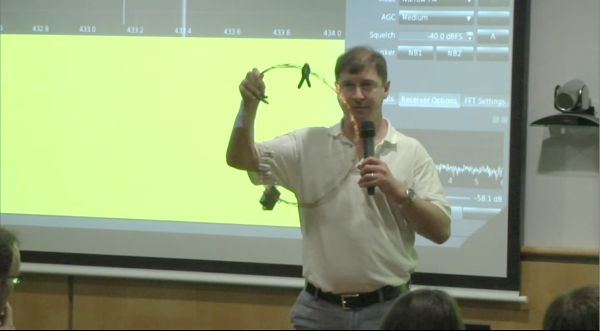
The Free Software Foundation of Europe has just completed the process of electing a new fellowship representative to the General Assembly (GA) and I was surprised to find that out of seven very deserving candidates, members of the fellowship have selected me to represent them on the GA. I'd like to thank all those who voted, the other candidates and Erik Albers for his efforts to administer this annual process. Please consider becoming an FSFE fellow or donor The FSFE runs on the support of both volunteers and financial donors, including organizations and individual members of the fellowship program. The fellowship program is not about money alone, it is an opportunity to become more aware of and involved in the debate about technology's impact on society, for better or worse. Developers, users and any other supporters of the organization's mission are welcome to join, here is the form. You don't need to be a fellow or pay any money to be an active part of the free software community and FSFE events generally don't exclude non-members, nonetheless, becoming a fellow gives you a stronger voice in processes such as this annual election. Attending OSCAL'17, Tirana During the election period, I promised to keep on doing the things I already do: volunteering, public speaking, mentoring, blogging and developing innovative new code. During May I hope to attend several events, including OSCAL'17 in Tirana, Albania on 13-14 May. I'll be running a workshop there on the Debian Hams blend and Software Defined Radio. Please come along and encourage other people you know in the region to consider attending. What is your view on the Fellowship and FSFE structure? Several candidates made comments about the Fellowship program and the way individual members and volunteers are involved in FSFE governance. This is not a new topic. Debate about this topic is very welcome and I would be particularly interested to hear any concerns or ideas for improvement that people may contribute. One of the best places to share these ideas would be through the FSFE's discussion list. In any case, the fellowship representative can not single-handedly overhaul the organization. I hope to be a constructive part of the team and that whenever my term comes to an end, the organization and the free software community in general will be stronger and happier in some way.

10 April 2017

Daniel Pocock: If Alan Turing was born today, would he be a Muslim?

Alan Turing's name and his work are well known to anybody with a theoretical grounding in computer science. Turing developed his theories well before anybody invented file sharing, overclocking or mass surveillance. In fact, Turing was largely working in the absence of any computers at all: the transistor was only invented in 1947 and the microchip, the critical innovation that has made computing both affordable and portable, only came in 1960, four years after Turing's death. To this day, the Turing Test remains a well known challenge in the field of Artificial Intelligence. The most prestigious prize in computing, the A.M. Turing Award from the ACM, equivalent to the Nobel Prize in other fields of endeavour, is named in Turing's honour. (This year's award is another British scientist, Sir Tim Berners-Lee, inventor of the World Wide Web).
Potentially far more people know of Alan Turing for his groundbreaking work at Bletchley Park and the impact it had on cracking the Nazi's Enigma machines during World War 2, giving the allies an advantage against Hitler. While in his lifetime, Turing exposed the secret communications of the Nazis, in his death, he exposed something manifestly repugnant about his own society. Turing's challenges with his sexuality (or Britain's challenge with it) are just as well documented as his greatest scientific achievements. The 2014 movie The Imitation Game tells Turing's story, bringing together the themes from his professional and personal life. Had Turing chosen to flee British persecution by going abroad, he would be a refugee in the same sense as any person who crossed the seas to reach Europe today to avoid persecution elsewhere. Please prove me wrong In March, I blogged about the problem of racism that plagues Britain today. While some may have felt the tone of the blog was quite strong, I was in no way pleased to find my position affirmed by the events that occurred in the two days after the blog appeared. Two days and two more human beings (both immigrants and both refugees) subjected to abhorrent and unnecessary acts of abuse in Great Britain. Both cases appear to be fuelled directly by the evil that has been oozing out of number 10 Downing Street since they decided to have a referendum on "Brexit". What stands out about these latest crimes is not that they occurred (this type of thing has been going on for months now) but certain contrasts between their circumstances and to a lesser extent, the fact they occurred immediately after Theresa May formalized Britain's departure from the EU. One of the victims was almost beaten to death by a street gang, while the other was abused by men wearing uniforms. One was only a child, while the other is a mature adult who has been in the UK almost three decades, completely assimilated into British life, working and paying taxes. Both were doing nothing out of the ordinary at the time the abuse occurred: one had engaged in a conversation at a bus stop, the other was on a routine visit to a Government office. There is no evidence that either of them had done anything to provoke or invite the abhorrent treatment meted out to them by the followers of Theresa May and Nigel Farage. The first victim, on 30 March, was Stojan Jankovic, a refugee from Yugoslavia who has been in the UK for 26 years. He had a routine meeting at an immigration department office where he was ambushed, thrown in the back of a van and sent to rot in a prison cell by Theresa May's gestapo. On Friday, 31 March, it was Reker Ahmed, a 17 year old Kurdish-Iranian beaten to the brink of death by a crowd in south London. One of the more remarkable facts to emerge about these two cases is that while Stojan Jankovic was basically locked up for no reason at all, the street thugs who the police apprehended for the assault on Ahmed were kept in a cell for less than 48 hours and released again on bail. While the harmless and innocent Jankovic was eventually released after a massive public outcry, he spent more time locked up than that gang of violent criminals who beat Reker Ahmed. In other words, Theresa May and Nigel Farage's Britain has more concern for the liberty of violent criminals than somebody like Jankovic who has been working and paying taxes in the UK since before any of those street thugs were born. A deeper insight into Turing's fate With gay marriage having been legal in the UK for a number of years now, the rainbow flag flying at the Tate and Sir Elton John achieving a knighthood, it becomes difficult for people to relate to the world in which Turing and many other victims were collectively classified by their sexuality, systematically persecuted by the state and ultimately died far sooner than they should have. (Turing was only 41 when he died). In fact, the cruel and brutal forces that ripped Turing apart (and countless other victims too) haven't dissipated at all, they have simply shifted their target. The slanderous comments insinuating that immigrants "steal" jobs or that Islam is about terrorism are eerily reminiscent of suggestions that gay men abduct young boys or work as Soviet spies. None of these lies has any basis in fact, but repeat them often enough in certain types of newspaper and these ideas spread like weeds. In an ironic twist, Turing's groundbreaking work at Bletchley Park was founded on the contributions of Polish mathematicians, their own country having been the first casualty to Hitler, they were also both immigrants and refugees in Britain. Today, under the Theresa May/Nigel Farage leadership, Polish citizens have been subjected to regular vilification by the media and some have even been killed in the street. It is said that a picture is worth a thousand words. When you compare these two pieces of propaganda: a 1963 article in the Sunday Mirror advising people "How to spot a possible homo" and a UK Government billboard encouraging people to be on the lookout for people who look different, could you imagine the same type of small-minded and power-hungry tyrants crafting them, singling out a minority so as to keep the public's attention in the wrong place?
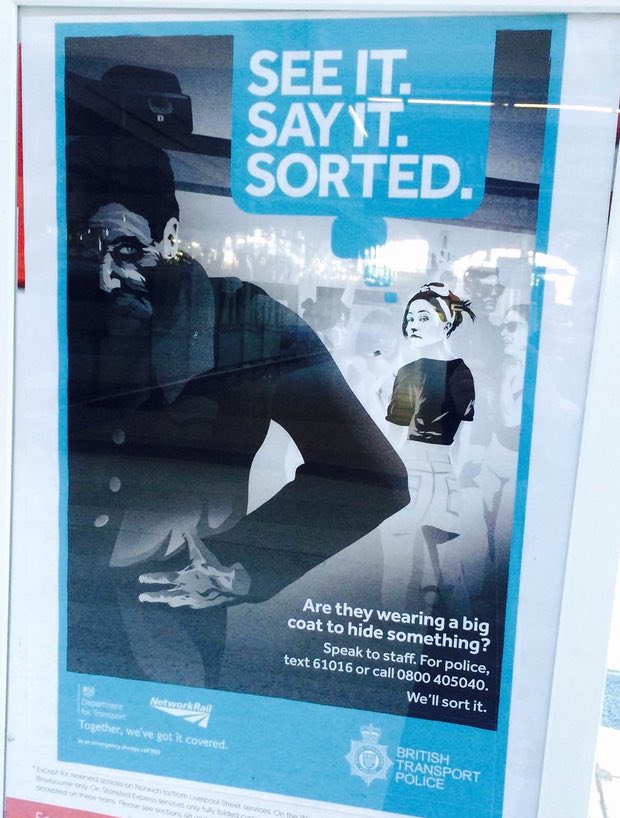
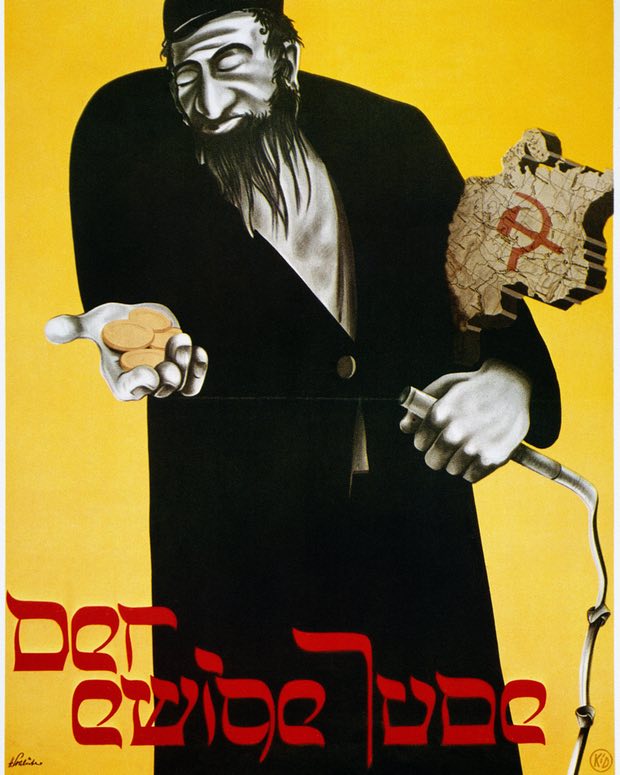
Many people have noticed that these latest UK Government posters portray foreigners, Muslims and basically anybody who is not white using a range of characteristics found in anti-semetic propaganda from the Third Reich: Do the people who create such propaganda appear to have any concern whatsoever for the people they hurt? How would Alan Turing have felt when he encountered propaganda like that from the Sunday Mirror? Do posters like these encourage us to judge people by their gifts in science, the arts or sporting prowess or do they encourage us to lump them all together based on their physical appearance? It is a basic expectation of scientific methodology that when you repeat the same experiment, you should get the same result. What type of experiment are Theresa May and Nigel Farage conducting and what type of result would you expect? Playing ping-pong with children If anybody has any doubt that this evil comes from the top, take a moment to contemplate the 3,000 children who were baited with the promise of resettlement from the Calais "jungle" camp into the UK under the Dubs amendment. When French authorities closed the "jungle" in 2016, the children were lured out of the camp and left with nowhere to go as Theresa May and French authorities played ping-pong with them. Given that the UK parliament had already agreed they should be accepted, was there any reason for Theresa May to dig her heels in and make these children suffer? Or was she just trying to prove her credentials as somebody who can bastardize migrants just the way Nigel Farage would do it? How do British politicians really view migrants? Parliamentarian Keith Vaz, former chair of the Home Affairs Select Committee (responsible for security, crime, prostitution and similar things) was exposed with young men from eastern Europe, encouraging them to take drugs before he ordered them "Take your shirt off. I'm going to attack you.". How many British MP's see foreigners this way? Next time you are groped at an airport security checkpoint, remember it was people like Keith Vaz and his committee who oversee those abuses, writing among other things that "The wider introduction of full-body scanners is a welcome development". No need to "take your shirt off" when these machines can look through it as easily as they can look through your children's underwear. According to the World Health Organization, HIV/AIDS kills as many people as the September 11 attacks every single day. Keith Vaz apparently had no concern for the possibility he might spread this disease any further: the media reported he doesn't use any protection in his extra-marital relationships. While Britain's new management continue to round up foreigners like Stojan Jankovic who have done nothing wrong, they chose not to prosecute Keith Vaz for his antics with drugs and prostitution. Who is Britain's next Alan Turing? Britain's next Alan Turing may not be a homosexual. He or she may have been a child turned away by Theresa May's spat with the French at Calais, a migrant bundled into a deportation van by the gestapo (who are just following orders) or perhaps somebody of Muslim appearance who is set upon by thugs in the street who have been energized by Nigel Farage. If you still have any uncertainty about what Brexit really means, this is it. A country that denies itself the opportunity to be great by subjecting itself to be ruled under the "divide and conquer" mantra of the colonial era. Throughout the centuries, Britain has produced some of the most brilliant scientists of their time. Newton, Darwin and Hawking are just some of those who are even more prominent than Turing, household names around the world. One can only wonder what the history books will have to say about Theresa May and Nigel Farage however. Next time you see a British policeman accosting a Muslim, whether it is at an airport, in a shopping centre, keeping Manchester United souvenirs or simply taking a photograph, spare a thought for Alan Turing and the era when homosexuals were their target of choice.
9 April 2017

Antoine Beaupr : Contribute your skills to Debian in Montreal, April 14 2017

Join us in Montreal, on April 14 2017, and we will find a way in which you can help Debian with your current set of skills! You might even learn one or two things in passing (but you don't have to). Debian is a free operating system for your computer. An operating system is the set of basic programs and utilities that make your computer run. Debian comes with dozens of thousands of packages, precompiled software bundled up for easy installation on your machine. A number of other operating systems, such as Ubuntu and Tails, are based on Debian. The upcoming version of Debian, called Stretch, will be released later this year. We need you to help us make it awesome :) Whether you're a computer user, a graphics designer, or a bug triager, there are many ways you can contribute to this effort. We also welcome experience in consensus decision-making, anti-harassment teams, and package maintenance. No effort is too small and whatever you bring to this community will be appreciated. Here's what we will be doing:

Goals and principles This is a work in progress, and a statement of intent. Not everything is organized and confirmed yet. We want to bring together a heterogeneous group of people. This goal will guide our handling of sponsorship requests, and will help us make decisions if more people want to attend than we can welcome properly. In other words: if you're part of a group that is currently under-represented in computer communities, we would like you to be able to attend. We are committed to providing a friendly, safe and welcoming environment for all, regardless of level of experience, gender, gender identity and expression, sexual orientation, disability, personal appearance, body size, race, ethnicity, age, religion, nationality, or other similar personal characteristic. Attending this event requires reading and respecting the Debian Code of Conduct, that sets the standards in terms of behaviour for the whole event, including communication (public and private) before, while and after. The space where this event will take place is unfortunately not accessible to wheelchairs. Food (including vegetarian options) should be provided for lunch. If you have any specific needs regarding food, please let us know when registering, and we will do our best.

What we will be doing This will be an informal session to confirm and fix bugs in Debian. If you have never worked with Debian packages, this is a good opportunity to learn about packaging and bugtracker usage. Bugs flagged as Release Critical are blocking the release of the upcoming version of Debian. To fix them, it helps to make sure the bug report documents the up-to-date status of the bug, and of its resolution. One does not need to be a programmer to do this work! For example, you can try and reproduce bugs in software you use... or in software you will discover. This helps package maintainers better focus their work. We will also try to actually fix bugs by testing patches and uploading fixes into Debian itself. Antoine Beaupr , a seasoned Debian developer, will be available to sponsor uploads and teach people about basic Debian packaging skills.

Where? When? How to register? See https://wiki.debian.org/BSP/2017/04/ca/Montreal for the exact address and time.

29 March 2017

Daniel Pocock: Brexit: If it looks like racism, if it smells like racism and if it feels like racism, who else but a politician could argue it isn't?

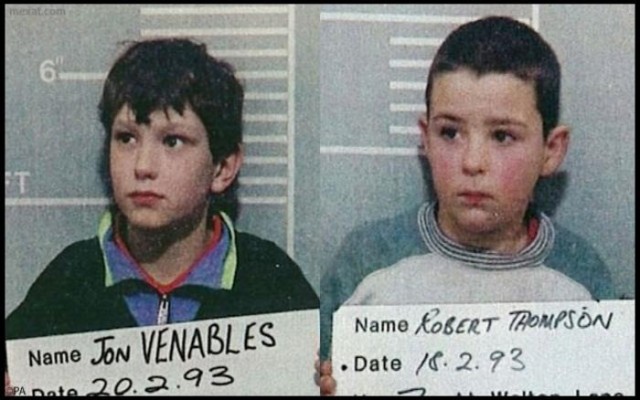
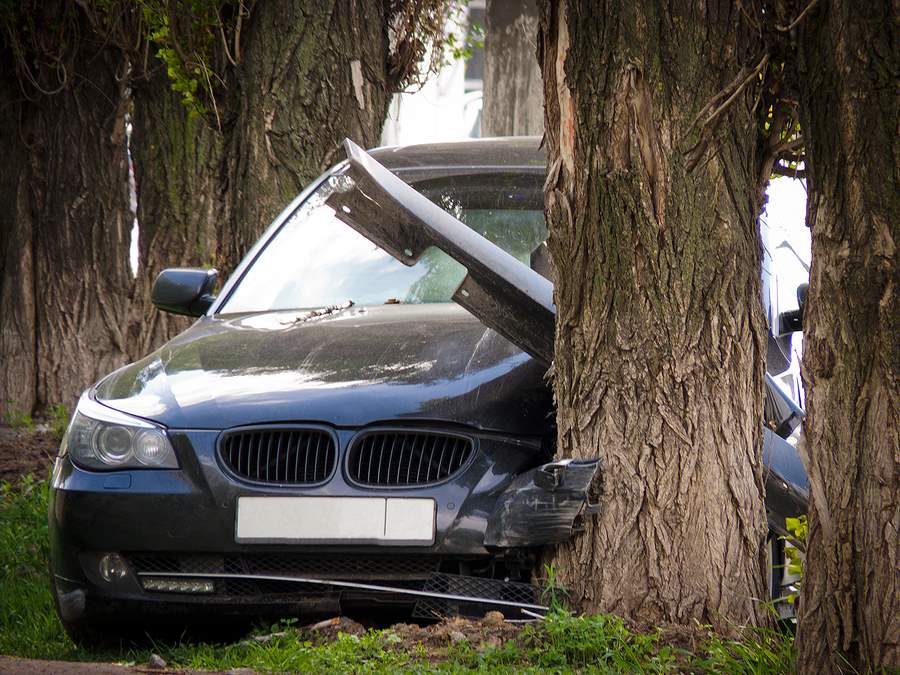
Since the EU referendum got under way in the UK, it has become almost an everyday occurence to turn on the TV and hear some politician explaining "I don't mean to sound racist, but..." (example) Of course, if you didn't mean to sound racist, you wouldn't sound racist in the first place, now would you? The reality is, whether you like politics or not, political leaders have a significant impact on society and the massive rise in UK hate crimes, including deaths of Polish workers, is a direct reflection of the leadership (or profound lack of it) coming down from Westminster. Maybe you don't mean to sound racist, but if this is the impact your words are having, maybe it's time to shut up? Choosing your referendum Why choose to have a referendum on immigration issues and not on any number of other significant topics? Why not have a referendum on nuking Mr Putin to punish him for what looks like an act of terrorism against the Malaysian Airlines flight MH17? Why not have a referendum on cutting taxes or raising speed limits, turning British motorways into freeways or an autobahn? Why choose to keep those issues in the hands of the Government, but invite the man-in-a-white-van from middle England to regurgitate Nigel Farage's fears and anxieties about migrants onto a ballot paper? Even if David Cameron sincerely hoped and believed that the referendum would turn out otherwise, surely he must have contemplated that he was playing Russian Roulette with the future of millions of innocent people? Let's start at the top For those who are fortunate enough to live in parts of the world where the press provides little exposure to the antics of British royalty, an interesting fact you may have missed is that the Queen's husband, Prince Philip, Duke of Edinburgh is actually a foreigner. He was born in Greece and has Danish and German ancestry. Migration (in both directions) is right at the heart of the UK's identity. Queen and Prince Philip Home office minister Amber Rudd recently suggested British firms should publish details about how many foreign people they employ and in which positions. She argued this is necessary to help boost funding for training local people. If that is such a brilliant idea, why hasn't it worked for the Premier League? It is a matter of public knowledge how many foreigners play football in England's most prestigious division, so why hasn't this caused local clubs to boost training budgets for local recruits? After all, when you consider that England hasn't won a World Cup since 1966, what have they got to lose? Kevin Pietersen All this racism, it's just not cricket. Or is it? One of the most remarkable cricketers to play for England in recent times, Kevin Pietersen, dubbed "the most complete batsman in cricket" by The Times and "England's greatest modern batsman" by the Guardian, was born in South Africa. In the five years he was contracted to the Hampshire county team, he only played one match, because he was too busy representing England abroad. His highest position was nothing less than becoming England's team captain. Are the British superior to every other European citizen? One of the implications of the rhetoric coming out of London these days is that the British are superior to their neighbours, entitled to have their cake and eat it too, making foreigners queue up at Paris' Gare du Nord to board the Eurostar while British travelers should be able to walk or drive into European countries unchallenged. This superiority complex is not uniquely British, you can observe similar delusions are rampant in many of the places where I've lived, including Australia, Switzerland and France. America's Donald Trump has taken this style of politics to a new level. Look in the mirror Theresa May: after British 10-year old schoolboys Robert Thompson and Jon Venables abducted, tortured, murdered and mutilated 2 year old James Bulger in 1993, why not have all British schoolchildren fingerprinted and added to the police DNA database? Why should "security" only apply based on the country where people are born, their religion or skin colour? Jon Venables and Robert Thompson In fact, after Brexit, people like Venables and Thompson will remain in Britain while a Dutch woman, educated at Cambridge and with two British children will not. If that isn't racism, what is? Running foreigner's off the roads Theresa May has only been Prime Minister for less than a year but she has a history of bullying and abusing foreigners in her previous role in the Home Office. One example of this was a policy of removing driving licenses from foreigners, which has caused administrative chaos and even taken away the licenses of many people who technically should not have been subject to these regulations anyway. Shouldn't the DVLA (Britain's office for driving licenses) simply focus on the competence of somebody to drive a vehicle? Bringing all these other factors into licensing creates a hostile environment full of mistakes and inconvenience at best and opportunities for low-level officials to engage in arbitrary acts of racism and discrimination. Of course, when you are taking your country on the road to nowhere, who needs a driving license anyway? Run off the road What does "maximum control" over other human beings mean to you? The new British PM has said she wants "maximum control" over immigrants. What exactly does "maximum control" mean? Donald Trump appears to be promising "maximum control" over Muslims, Hitler sought "maximum control" over the Jews, hasn't the whole point of the EU been to avoid similar situations from ever arising again? This talk of "maximum control" in British politics has grown like a weed out of the UKIP. One of their senior figures has been linked to kidnappings and extortion, which reveals a lot about the character of the people who want to devise and administer these policies. Similar people in Australia aspire to jobs in the immigration department where they can extort money out of people for getting them pushed up the queue. It is no surprise that the first member of Australia's parliament ever sent to jail was put there for obtaining bribes and sexual favours from immigrants. When Nigel Farage talks about copying the Australian immigration system, he is talking about creating jobs like these for his mates. Even if "maximum control" is important, who really believes that a bunch of bullies in Westminster should have the power to exercise that control? Is May saying that British bosses are no longer competent to make their own decisions about who to employ or that British citizens are not reliable enough to make their own decisions about who they marry and they need a helping hand from paper-pushers in the immigration department? maximum control over Jewish people Echoes of the Third Reich Most people associate acts of mass murder with the Germans who lived in the time of Adolf Hitler. These are the stories told over and and over again in movies, books and the press. Look more closely, however, and it appears that the vast majority of Germans were not in immediate contact with the gas chambers. Even Gobels' secretary writes that she was completely oblivious to it all. Many people were simply small cogs in a big bad machine. The clues were there, but many of them couldn't see the big picture. Even if they did get a whiff of it, many chose not to ask questions, to carry on with their comfortable lives. Today, with mass media and the Internet, it is a lot easier for people to discover the truth if they look, but many are still reluctant to do so. Consider, for example, the fingerprint scanners installed in British post offices and police stations to fingerprint foreigners and criminals (as if they have something in common). If all the post office staff refused to engage in racist conduct the fingerprint scanners would be put out of service. Nonetheless, these people carry on, just doing their job, just following orders. It was through many small abuses like this, rather than mass murder on every street corner, that Hitler motivated an entire nation to serve his evil purposes. Technology like this is introduced in small steps: first it was used for serious criminals, then anybody accused of a crime, then people from Africa and next it appears they will try and apply it to all EU citizens remaining in the UK. How will a British man married to a French woman explain to their children that mummy has to be fingerprinted by the border guard each time they return from vacation? The Nazis pioneered biometric technology with the tracking numbers branded onto Jews. While today's technology is electronic and digital, isn't it performing the same function? There is no middle ground between "soft" and "hard" brexit An important point for British citizens and foreigners in the UK to consider today is that there is no compromise between a "soft" Brexit and a "hard" Brexit. It is one or the other. Anything less (for example, a deal that is "better" for British companies and worse for EU citizens) would imply that the British are a superior species and it is impossible to imagine the EU putting their stamp on such a deal. Anybody from the EU who is trying to make a life in the UK now is playing a game of Russian Roulette - sure, everything might be fine if it morphs into "soft" Brexit, but if Theresa May has her way, at some point in your life, maybe 20 years down the track, you could be rounded up by the gestapo and thrown behind bars for a parking violation. There has already been a five-fold increase in the detention of EU citizens in British concentration camps and they are using grandmothers from Asian countries to refine their tactics for the efficient removal of EU citizens. One can only wonder what type of monsters Theresa May has been employing to run such inhumane operations. This is not politics Edmund Burke's quote "The only thing necessary for the triumph of evil is for good men to do nothing" comes to mind on a day like today. Too many people think it is just politics and they can go on with their lives and ignore it. Barely half the British population voted in the referendum. This is about human beings treating each other with dignity and respect. Anything less is abhorrent and may well come back to bite.

22 March 2017

Arturo Borrero Gonz lez: IPv6 and CGNAT

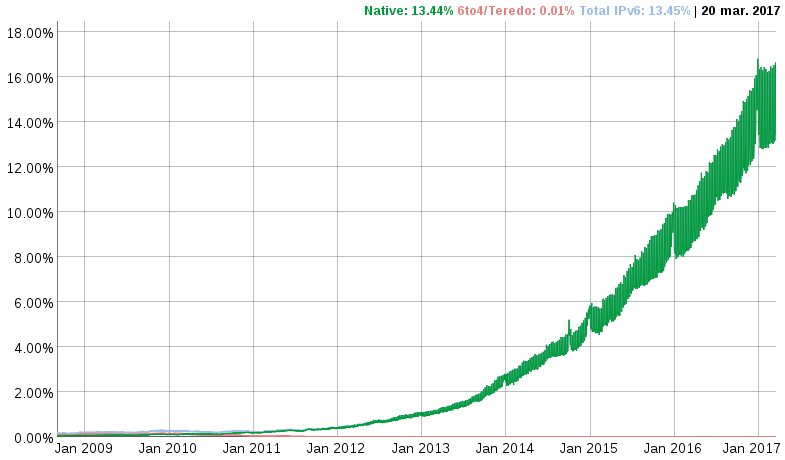
IPv6 Today I ended reading an interesting article by the 4th spanish ISP regarding IPv6 and CGNAT. The article is in spanish, but I will translate the most important statements here. Having a spanish Internet operator to talk about this subject is itself good news. We have been lacking any news regarding IPv6 in our country for years. I mean, no news from private operators. Public networks like the one where I develop my daily job has been offering native IPv6 since almost a decade The title of the article is What is CGNAT and why is it used . They start by admiting that this technique is used to address the issue of IPv4 exhaustion. Good. They move on to say that IPv6 was designed to address IPv4 exhaustion. Great. Then, they state that the internet network is not ready for IPv6 support . Also that IPv6 has the handicap of many websites not supporting it . Sorry? That is not true. If they refer to the core of internet (i.e, RIRs, interexchangers, root DNS servers, core BGP routers, etc) they have been working with IPv6 for ages now. If they refer to something else, for example Google, Wikipedia, Facebook, Twitter, Youtube, Netflix or any random hosting company, they do support IPv6 as well. Hosting companies which don t support IPv6 are only a few, at least here in Europe. The traffic to/from these services is clearly the vast majority of the traffic traveling in the wires nowaday. And they support IPv6. The article continues defending CGNAT. They refer to IPv6 as an alternative to CGNAT. No, sorry, CGNAT is an alternative to you not doing your IPv6 homework. The article ends by insinuing that CGNAT is more secure and useful than IPv6. That s the final joke. They mention some absurd example of IP cams being accessed from the internet by anyone. Sure, by using CGNAT you are indeed making the network practically one-way only. There exists RFC7021 which refers to the big issues of a CGNAT network. So, by using CGNAT you sacrifice a lot of usability in the name of security. This supposed security can be replicated by the most simple possible firewall, which could be deployed in Dual Stack IPv4/IPv6 using any modern firewalling system, like nftables. (Here is a good blogpost of RFC7021 for spanish readers: Midiendo el impacto del Carrier-Grade NAT sobre las aplicaciones en red) By the way, Google kindly provides some statistics regarding their IPv6 traffic. These stats clearly show an exponential growth: Google IPv6 traffic Others ISP operators are giving IPv6 strong precedence over IPv4, that s the case of Verizon in USA: Verizon Static IP Changes IPv4 to Persistent Prefix IPv6. My article seems a bit like a rant, but I couldn t miss the oportunity to claim for native IPv6. None of the major spanish ISP have IPv6.
20 March 2017

Shirish Agarwal: Tale of two countries, India and Canada

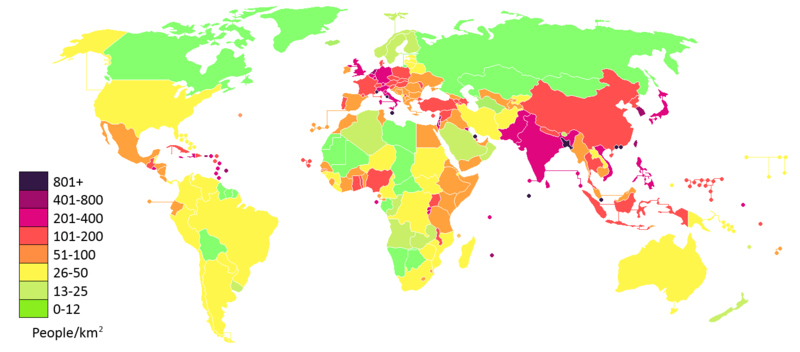
Apologies the first blog post got sent out by mistake. Weather comparisons between the two countries Last year, I had come to know that this year s debconf is happening in Canada, a cold country. Hence, few weeks/month back, I started trying to find information online when I stumbled across few discussion boards where people were discussing about Innerwear and Outerwear and I couldn t understand what that was all about. Then somehow stumbled across this Video, which is of a game called the Long Dark and just seeing couple of episodes it became pretty clear to me why the people there were obsessing with getting the right clothes and everything about it. Couple of Debconf people were talking about the weather in Montreal, and surprise, surprise it was snowing there, in fact supposed to be near the storm of the century. Was amazed to see that they have a website to track how much snow has been lifted. If we compare that to Pune, India weather-wise we are polar opposites. There used to be a time, when I was very young, maybe 5 yrs. old that once the weather went above 30 degree celsius, rains would fall, but now its gonna touch 40 degrees soon. And April and May, the two hottest months are yet to come. China Gate Before I venture further, I was gifted the book China Gate written by an author named William Arnold. When I read the cover and the back cover, it seemed the story was set between China and Taiwan, later when I started reading it, it shares history of Taiwan going back 200 or so odd years. This became relevant as next year s Debconf, Debconf 2018 will be in Taiwan, yes in Asia very much near to India. I am ashamed to say that except for the Tiananmen Square Massacre and the Chinese High-Speed Rail there wasn t much that I knew. According to the book, and I m paraphrasing here the gist I got was that for a long time, the Americans promised Taiwan it will be an Independent country forever, but due to budgetary and other political constraints, the United States took the same stand as China from 1979. Interestingly, now it seems Mr. Trump wants to again recognize Taiwan as a separate entity from China itself but as is with Mr. Trump you can t be sure of why he does, what he does. Is it just a manoeuvrer designed to out-smart the chinese and have a trade war or something else, only time will tell. One thing which hasn t been shared in the book but came to know via web is that Taiwan calls itself Republic of China . If Taiwan wants to be independent then why the name Republic of China ? Doesn t that strengthen China s claim that Taiwan is an integral part of China. I don t understand it. The book does seduce you into thinking that the events are happening in real-time, as in happening now. That s enough OT for now. null Population Density As well in the game and whatever I could find on the web, Canada seems to be on the lower side as far as population is concerned. IIRC, few years back, Canadians invited Indian farmers and gave them large land-holdings for over 100 years on some small pittance. While the link I have shared is from 2006, I read it online and in newspapers even as late as in 2013/2014. The point being there seems to be lot of open spaces in Canada, whereas in India we fight for even one inch literally, due to overpopulation. This sharing reminded me of Mark of Gideon . While I was young, I didn t understand the political meaning of it and still struggle to understand about whom the show was talking about. Was it India, Africa or some other continent they were talking about ? This also becomes obvious when you figure out the surface area of the two countries. When I had started to learn about Canada, I had no idea, nor a clue that Canada is three times the size of India. And this is when I know India is a large country. but seeing that Canada is thrice larger just boggled my mind. As a typical urbanite, would probably become mad if in a rural area in Canada. Montreal, however seems to be something like Gwalior or Bangalore before IT stormed in, seems to be a place where people can work, play and have quite a few gardens as well. Rail This is one thing that is similar in both the great countries. India has Indian Railways and while the Canadians have their own mountain railway called viarail. India chugs on its 68k kilometre network, Canada is at fourth position with 52k network. With thrice the land size, it should have been somewhere where Russia is or even better than them. It would be interesting if a Canadian/s comment about their railway network and why it is so bad in terms of reach. As far as food is concerned, somebody shared this Also, have no idea if Canadian trains are as entertaining as Indian ones, in terms of diverse group of people as well as variety of food to eat as also shared a bit in the video. I am not aware whether Via Rail is the only network operator and there are other network operators unlike Indian Railways which has monopoly on most of the operations. Countries which have first past the post system - Wikipedia Business houses, Political Families This is again something that is similar in both the countries, it seems (from afar) that its only few business houses and more importantly political families which have governed for years. From what little I could understand, both India and Canada have first past the post system which as shared by its critics is unfair to new and small parties. It would be interesting to see if Canada does a re-think. For India, it would need a massive public education outreach policy and implementation. We just had elections in 5 states of India with U.P. (with respect to area-size and population density) and from the last several years, the EVM s (Electronic Voting Machines) tries to make sure that nobody could know which area which party got the most votes. This is to make sure the winning party is not able to take revenge on people or areas which did not vote for them. Instead you have general region counting of votes with probably even the Election Commission not knowing which EVM went to what area and what results are there in sort of double-blind methodology. As far as Business houses are concerned, I am guessing it s the same world-over, only certain people hold the wealth while majority of us are in hard-working, non-wealthy status. Northern Lights - Aurora Borealis Northern Lights, Aurora Borealis Apart from all the social activities that Montreal is famous for, somebody told/shared with me that it is possible to see the Northern Lights, Aurora Borealis can be seen in Canada. I dunno how true or not it is, while probably in Montreal it isn t possible to see due to light pollution, but maybe around 40-50 kms. from the city ? Can people see it from Canada ? IF yes, how far would you have to go ? Are there any companies or people who take people to see the Northern Lights. While I still have to apply for bursary, and if that gets ok, then try getting the visa, but if that goes through, apart from debconf and social activities happening in and around Montreal, Museums, Music etc. , this would be something I would like to experience if it s possible. While I certainly would have to be prepared for the cold that would be, if it s possible, no offence to debconf or anybody else but it probably would be the highlight of the entire trip if its possible. This should be called/labelled as the greatest show on earth TM.
Filed under: Miscellenous Tagged: # Population Density, #Area size, #Aurora Borealis, #Canada, #Trains, DebConf, India, politics

17 March 2017

Shirish Agarwal: Science Day at GMRT, Khodad 2017

The whole team posing at the end of day 2 The above picture is the blend of the two communities from foss community and mozilla India. And unless you were there you wouldn t know who is from which community which is what FOSS is all about. But as always I m getting a bit ahead of myself. Akshat, who works at NCRA as a programmer, the standing guy on the left shared with me in January this year that this year too, we should have two stalls, foss community and mozilla India stalls next to each other. While we had the banners, we were missing stickers and flyers. Funds were and are always an issue and this year too, it would have been emptier if we didn t get some money saved from last year minidebconf 2016 that we had in Mumbai. Our major expenses included printing stickers, stationery and flyers which came to around INR 5000/- and couple of LCD TV monitors which came for around INR 2k/- as rent. All the labour was voluntary in nature, but both me and Akshat easily spending upto 100 hours before the event. Next year, we want to raise to around INR 10-15k so we can buy 1 or 2 LCD monitors and we don t have to think for funds for next couple of years. How will we do that I have no idea atm. Printing leaflets Me and Akshat did all the printing and stationery runs and hence had not been using my lappy for about 3-4 days. Come to the evening before the event and the laptop would not start. Coincidentally, or not few months or even last at last year s Debconf people had commented on IBM/Lenovo s obsession with proprietary power cords and adaptors. I hadn t given it much thought but when I got no power even after putting it on AC power for 3-4 hours, I looked up on the web and saw that the power cord and power adaptors were all different even in T440 and even that under existing models. In fact I couldn t find mine hence sharing it via pictures below. thinkpad power cord male thinkpad power adaptor female I knew/suspected that thinkpads would be rare where I was going, it would be rarer still to find the exact power cord and I was unsure whether it was the power cord at fault or adaptor or whatever goes for SMPS in laptop or memory or motherboard/CPU itself. I did look up the documentation at support.lenovo.com and was surprised at the extensive documentation that Lenovo has for remote troubleshooting. I did the usual take out the battery, put it back in, twiddle with the little hole in the bottom of the laptop, trying to switch on without the battery on AC mains, trying to switch on with battery power only but nothing worked. Couple of hours had gone by and with a resigned thought went to bed, convincing myself that anyways it s good I am not taking the lappy as it is extra-dusty there and who needs a dead laptop anyways. Update After the event was over, I did contact Lenovo support and within a week, with one visit from a service engineer, he was able to identify that it was a faulty cable which was at fault and not the the other things which I was afraid of. Another week gone by and lenovo replaced the cable. Going by service standards that I have seen of other companies, Lenovo deserves a gold star here for the prompt service they provided. I probably would end up subscribing to their extended 2-year warranty service when my existing 3 year warranty is about to be over. Next day, woke up early morning, two students from COEP hostel were volunteering and we made our way to NCRA, Pune University Campus. Ironically, though we were under the impression that we would be the late arrivals, it turned out we were the early birds. 5-10 minutes passed by and soon enough we were joined by Aniket and we played catch-up for a while. We hadn t met each other for a while so it was good to catch-up. Then slowly other people starting coming in and around 07:10-07:15 we started for GMRT, Khodad. Now I had been curious as had been hearing for years that the Pune-Nashik NH-50 highway would be concreted and widened to six-lane highways but the experience was below par. Came back and realized the proposal has now been pushed back to 2020. From the mozilla team, only Aniket was with us, the rest of the group was coming straight from Nashik. Interestingly, all the six people who came, came on bikes which depending upon how you look at it was either brave or stupid. Travelling on bikes on Indian highways you either have to be brave or stupid or both, we have more than enough accidents due to quality of road construction, road design, lane-changing drivers and many other issues. This is probably not the place for it hence will use some other blog post to rant about that. We reached around 10:00 hrs. IST and hung around till lunch as Akshat had all the marketing material, monitors etc. The only thing we had were couple of lappies and couple of SBC s, an RPI 3 and a BBB. Aarti Kashyap sharing something about SBC Our find for the event was Aarti Kashyap who you can see above. She is a third-year student at COEP and one of the rare people who chose to interact with hardware rather than software. From last several years, we had been trying, successfully and unsuccessfully to get more Indian women and girls interested into technology. It is a vicious circle as till a girl/woman doesn t volunteer we are unable to share our knowledge to the extent we can which leads them to not have much interest in FOSS or even technology in general. While there are groups are djangogirls, Pyladies and railgirls and even Outreachy which tries to motivate getting girls into computing but it s a long road ahead. We are short of both funds and ideas as to how to motivate more girls to get into computing and then to get into playing with hardware. I don t know where to start and end for whoever wants to play with hardware. From SBC s, routers to blade servers the sky is the limit. Again this probably isn t the place for it, hence probably we can chew it on more at some other blog post. This year, we had a lowish turnout due to the fact that the 12th board exams 1st paper was on the day we had opened. So instead of 20-25k, we probably had 5-7k fewer people pass through. There were two-three things that we were showing, we were showing Debian on one of the systems, we were showing the output from the SBC s on the other monitor but the glare kept hitting the monitors. While the organizers had done exemplary work over last year. They had taped the carpets on the ground so there was hardly any dust moving around. However, I wished the organizers had taken the pains to have two cloth roofs over our head instead of just one, the other roof head could be say 2 feet up, this would have done two things a. It probably would have cooled the place a bit more as b. We could get diffused sunlight which would have lessened the glare and reflection the LCD s kept throwing back. At times we also got people to come to our side as can be seen in Aarti s photo as can be seen above. If these improvements can be made for next year, this would result in everybody in our Pandal would benefit, not just us and mozilla. This would be benefiting around 10-15 organizations which were within the same temporary structure. Of course, it depends very much on the budget they are able to have and people who are executing, we can just advise. The other thing which had been missing last year and this year is writing about Single Board Computers in Marathi. If we are to promote them as something to replace a computer or something for a younger brother/sister to learn computing upon at a lower cost, we need leaflets written in their language to be more effective. And this needs to be in the language and mannerisms that people in that region understand. India, as probably people might have experienced is a dialect-prone country. Which means every 2-5 kms, the way the language is spoken is different from anywhere else. The Marathi spoken by somebody who has lived in Ravivar Peth for his whole life and a person who has lived in say Kothrud are different. The same goes from any place and this place, Khodad, Narayangaon would have its own dialect, its own mini-codespeak. Just to share, we did have one in English but it would have been a vast improvement if we could do it in the local language. Maybe we can discuss about this and ask for help from people. Outside, Looking in Mozillians helping FOSS community and vice-versa What had been interesting about the whole journey were the new people who were bringing all their passion and creativity to the fore. From the mozilla community, we had Akshay who is supposed to be a wizard on graphics, animation, editing anything to do with the visual medium. He shared some of the work he had done and also shared a bit about how blender works with people who wanted to learn about that. Mayur, whom you see in the picture pointing out something about FOSS and this was the culture that we strove to have. I know and love and hate the browser but haven t been able to fathom the recklessness that Mozilla has been doing the last few years, which has just been having one mis-adventure after another. For instance, mozstumbler was an effort which I thought would go places. From what little I understood, it served/serves as a user-friendly interface to a potential user while still sharing all the data with OSM . They (Mozilla) seems/seemed to have a fatalistic take as it provided initial funding but then never fully committing to the project. Later, at night we had the whole free software and open-source sharings where I tried to emphasize that without free software, the term open-source would not have come into existence. We talked and talked and somewhere around 02:00 I slept, the next day was an extension of the first day itself where we ribbed each other good-naturedly and still shared whatever we could share with each other. I do hope that we continue this tradition for great many years to come and engage with more and more people every passing year.

Filed under: Miscellenous Tagged: #budget, #COEP< #volunteering, #debian, #Events, #Expenses, #mozstumbler, #printing, #SBC's, #Science Day 2017, #thinkpad cable issue, FOSS, mozilla

4 March 2017

intrigeri: Contribute your skills to Debian in Paris, May 13-14 2017

(There is a French translation of this announcement.) Join us in Paris, on May 13-14 2017, and we will find a way in which you can help Debian with your current set of skills! You might even learn one or two things in passing (but you don't have to). Debian is a free operating system for your computer. An operating system is the set of basic programs and utilities that make your computer run. Debian comes with dozens of thousands of packages, precompiled software bundled up for easy installation on your machine. A number of other operating systems, such as Ubuntu and Tails, are based on Debian. The upcoming version of Debian, called Stretch, will be released later this year. We need you to help us make it awesome :) Whether you're a computer user, a graphics designer, or a bug triager, there are many ways you can contribute to this effort. We also welcome experience in consensus decision-making, anti-harassment teams, and package maintenance. No effort is too small and whatever you bring to this community will be appreciated. Here's what we will be doing: Goals and principles Before diving into the exact content of this event, a few words from the organization team. This is a work in progress, and a statement of intent. Not everything is organized and confirmed yet. We want to bring together a heterogeneous group of people. This goal will guide our handling of sponsorship requests, and will help us make decisions if more people want to attend than we can welcome properly. In other words: if you're part of a group that is currently under-represented in computer communities, we would like you to be able to attend. We are committed to providing a friendly, safe and welcoming environment for all, regardless of level of experience, gender, gender identity and expression, sexual orientation, disability, personal appearance, body size, race, ethnicity, age, religion, nationality, or other similar personal characteristic. Attending this event requires reading and respecting our Code of Conduct, that sets the standards in terms of behaviour for the whole event, including communication (public and private) before, while and after. There will be a team ready to act if you feel you have been or are being harassed or made uncomfortable by an attendee. We believe that money should not be a blocker for contributing to Debian. We will sponsor travel and find a place to sleep for as many enthusiastic attendees as possible. The space where this event will take place is accessible to wheelchairs. We are trying to organize a translation into (probably French) sign language. Vegan food should be provided for lunch. If you have any specific needs regarding food, please let us know when registering, and we will do our best. What we will be doing There will be a number of stations, i.e. physical space dedicated to people with a given set of skills, hosted by someone who is ready to make this space welcoming and productive. A few stations are already organized, and are described below. If you want to host a station yourself, or would like us to organize another one, please let us know. For example, you may want to assess the state of Debian Stretch for a specific field of interest, be it audio editing, office work, network auditing or whatever you are doing with Debian :) Test the upcoming version of Debian We will test Debian Stretch and gather feedback. We are particularly interested in: Experienced Debian contributors will be ready to relay this feedback to the relevant teams so it is put to good use. Hypra collaborators will be there to bring a focus on universal access technologies. Design and graphics Truth be told, Debian lacks people who are good at design and graphics. There are definitely a good number of low-hanging fruits that can be tackled in a week-end, either in Debian per-se, or in upstream) projects, or in Debian derivatives. This station will be hosted by Juliette Belin. She designed the themes for the last two versions of Debian. Triage Release Critical bugs Bugs flagged as Release Critical are blocking the release of the upcoming version of Debian. To fix them, it helps to make sure the bug report documents the up-to-date status of the bug, and of its resolution. One does not need to be a programmer to do this work! For example, you can try and reproduce bugs in software you use... or in software you will discover. This helps package maintainers better focus their work. This station will be hosted by Solveig. She has experience in bug triaging, in Debian and elsewhere. Cyril Brulebois, a long-time Debian developer, will provide support and advice upon request. Fix Release Critical bugs There will be a Bug Squashing Party. Where? When? How to register? See https://wiki.debian.org/BSP/2017/05/fr/Paris for the exact address and time. Please register by the end of March if you want to attend this event! If you have any questions, please get in touch with us.

1 March 2017

Paul Wise: FLOSS Activities February 2017

Changes

Issues

Review

Administration
  • Debian: do the samhain dance, ask for new local contacts at one site, ask local admins to reset one machine, powercycle 2 dead machines, redirect 1 user to the support channels, redirect 1 user to a service admin, redirect 1 spam reporter to the right mechanisms, investigate mail logs for a missing bug report, ping bugs-search.d.o service admin about moving off glinka and remove data, poke cdimage-search.d.o service admin about moving off glinka, update a cron job on denis.d.o for the rename of letsencrypt.sh to dehydrated, debug planet.d.o issue and remove stray cron job lock file, check if ftp is used on a couple of security.d.o mirrors, discuss storage upgrade for LeaseWeb for snapshot.d.o/deriv.d.n/etc, investigate SSD SMART error and ignore the unknown attribute, ask 9 users to restart their processes, investigate apt-get update failure in nagios, swapoff/swapon a swap file to drain it, restart/disable some failed services, help restore the backup server, debug stretch /dev/log issue,
  • Debian QA: deploy merged PTS/tracker patches,
  • Debian wiki: answer 1 IP-blocked VPN user, pinged 1 user on IRC about their bouncing mail, disabled 4 accounts due to bouncing mail, redirect 1 person to documentation/lists, whitelist 5 email addresses, forward 1 password reset token, killed 1 spammer account, reverted 1 spammer edit,
  • Debian mentors: security upgrades, check which email a user signed up with
  • Openmoko: security upgrades, daemon restarts, reboot

Debian derivatives
  • Turned off the census cron job because it ran out of disk space
  • Update Armbian sources.list
  • Ping siduction folks about updating their sources.list
  • Start a discussion about DebConf17
  • Notify the derivatives based on jessie or older that stretch is frozen
  • Invite Rebellin Linux (again)

Sponsors The libesedb Debian backport was sponsored by my employer. All other work was done on a volunteer basis.

21 February 2017

Shirish Agarwal: The Indian elections hungama

a person showing s(he) showing s(he) Before I start, I would like to point out #855549 . This is a normal/wishlist bug I have filed against apt, the command-line package manager. I sincerely believe having a history command to know what packages were installed, which were upgraded, which were purged should be easily accessible, easily understood and if the output looks pretty, so much the better. Of particular interest to me is having a list of new packages I have installed in last couple of years after jessie became the stable release. It probably would make for some interesting reading. I dunno how much efforts would be to code something like that, but if it works, it would be the greatest. Apt would have finally arrived. Not that it s a bad tool, it s just that it would then make for a heck of a useful tool. Coming back to the topic on hand, Now for the last couple of weeks we don t have water or rather pressure of water. Water crisis has been hitting Pune every year since 2014 with no end in sight. This has been reported in newspapers addendum but it seems it has been felling on deaf ears. The end result of it is that I have to bring buckets of water from around 50 odd metres. It s not a big thing, it s not like some women in some villages in Rajasthan who have to walk in between 200 metres to 5 odd kilometres to get potable water or Darfur, Western Sudan where women are often kidnapped and sold as sexual slaves when they get to fetch water. The situation in Darfur has been shown quite vividly in Darfur is Dying . It is possible that I may have mentioned about Darfur before. While unfortunately the game is in flash as a web resource, the most disturbing part is that the game is extremely depressing, there is a no-win scenario. So knowing and seeing both those scenarios, I can t complain about 50 metres. BUT .but when you extrapolate the same data over some more or less 3.3-3.4 million citizens, 3.1 million during 2011 census with a conservative 2.3-2.4 percent population growth rate according to scroll.in. Fortunately or unfortunately, Pune Municipal Corporation elections were held today. Fortunately or unfortunately, this time all the political parties bought majorly unknown faces in these elections. For e.g. I belong to ward 14 which is spread over quite a bit of area and has around 10k of registered voters. Now the unfortunate part of having new faces in elections, you don t know anything about them. Apart from the affidavits filed, the only thing I come to know is whether there are criminal cases filed against them and what they have shown as their wealth. While I am and should be thankful to ADR which actually is the force behind having the collated data made public. There is a lot of untold story about political push-back by all the major national and regional political parties even when this bit of news were to be made public. It took major part of a decade for such information to come into public domain. But for my purpose of getting clean air and water supply 24 7 to each household seems a very distant dream. I tried to connect with the corporators about a week before the contest and almost all of the lower party functionaries hid behind their political parties manifestos stating they would do the best without any viable plan. For those not knowing, India has been blessed with 6 odd national parties and about 36 odd regional parties and every election some 20-25 new parties try their luck every time. The problem is we, the public, don t trust them or their manifestos. First of all the political parties themselves engage in mud-slinging as to who s copying whom with the manifesto.Even if a political party wins the elections, there is no *real* pressure for them to follow their own manifesto. This has been going for many a year. OF course, we the citizens are to also blame as most citizens for one reason or other chose to remain aloof of the process. I scanned/leafed through all the manifestos and all of them have the vague-wording we will make Pune tanker-free without any implementation details. While I was unable to meet the soon-to-be-Corporators, I did manage to meet a few of the assistants but all the meetings were entirely fruitless. Diagram of Rain Water Harvesting I asked why can t the city follow the Chennai model. Chennai, not so long ago was at the same place where Pune is, especially in relation to water. What happened next, in 2001 has been beautifully chronicled in Hindustan Times . What has not been shared in that story is that the idea was actually fielded by one of Chennai Mayor s assistants, an IAS Officer, I have forgotten her name, Thankfully, her advise/idea was taken to heart by the political establishment and they drove RWH. Saying why we can t do something similar in Pune, I heard all kinds of excuses. The worst and most used being Marathas can never unite which I think is pure bullshit. For people unfamiliar to the term, Marathas was a warrior clan in Shivaji s army. Shivaji, the king of Marathas were/are an expert tactician and master of guerilla warfare. It is due to the valor of Marathas, that we still have the Maratha Light Infantry a proud member of the Indian army. Why I said bullshit was the composition of people living in Maharashtra has changed over the decades. While at one time both the Brahmins and the Marathas had considerable political and population numbers, that has changed drastically. Maharashtra and more pointedly, Mumbai, Pune and Nagpur have become immigrant centres. Why just a decade back, Shiv Sena, an ultra right-wing political party used to play the Maratha card at each and every election and heckle people coming from Uttar Pradesh and Bihar, this has been documented as the 2008 immigrants attacks and 9 years later we see Shiv Sena trying to field its candidates in Uttar Pradesh. So, obviously they cannot use the same tactics which they could at one point of time. One more reason I call it bullshit, is it s a very lame excuse. When the Prime Minister of the country calls for demonetization which affects 1.25 billion people, people die, people stand in queues and is largely peaceful, I do not see people resisting if they bring a good scheme. I almost forgot, as an added sweetener, the Chennai municipality said that if you do RWH and show photos and certificates of the job, you won t have to pay as much property tax as otherwise you would, that also boosted people s participation. And that is not the only solution, one more solution has been outlined in Aaj Bhi Khade hain talaab written by just-deceased Gandhian environmental activist Anupam Mishra. His Book can be downloaded for free at India Water Portal . Unfortunately, the said book doesn t have a good English translation till date. Interestingly, all of his content is licensed under public domain (CC-0) so people can continue to enjoy and learn from his life-work. Another lesson or understanding could be taken from Israel, the father of the modern micro-drip irrigation for crops. One of the things on my bucket lists is to visit Israel and if possible learn how they went from a water-deficient country to a water-surplus one. India labor Which brings me to my second conundrum, most of the people believe that it s the Government s job to provide jobs to its people. India has been experiencing jobless growth for around a decade now, since the 2008 meltdown. While India was lucky to escape that, most of its trading partners weren t hence it slowed down International trade which slowed down creation of new enterprises etc. Laws such as the Bankruptcy law and the upcoming Goods and Services Tax . As everybody else, am a bit excited and a bit apprehensive about how the actual implementation will take place. null Even International businesses has been found wanting. The latest example has been Uber and Ola. There have been protests against the two cab/taxi aggregators operating in India. For the millions of jobless students coming out of schools and Universities, there aren t simply enough jobs for them, nor are most (okay 50%) of them qualified for the jobs, these 50 percent are also untrainable, so what to do ? In reality, this is what keeps me awake at night. India is sitting on this ticking bomb-shell. It is really, a miracle that the youths have not rebelled yet. While all the conditions, proposals and counter-proposals have been shared before, I wanted/needed to highlight it. While the issue seems to be local, I would assert that they are all glocal in nature. The questions we are facing, I m sure both developing and to some extent even developed countries have probably been affected by it. I look forward to know what I can learn from them. Update 23/02/17 I had wanted to share about Debian s Voting system a bit, but that got derailed. Hence in order not to do, I ll just point towards 2015 platforms where 3 people vied for DPL post. I *think* I shared about DPL voting process earlier but if not, would do in detail in some future blog post.
Filed under: Miscellenous Tagged: #Anupam Mishra, #Bankruptcy law, #Chennai model, #clean air, #clean water, #elections, #GST, #immigrant, #immigrants, #Maratha, #Maratha Light Infantry, #migration, #national parties, #Political party manifesto, #regional parties, #ride-sharing, #water availability, Rain Water Harvesting

16 February 2017

Craig Sanders: New D&D Cantrip

Name: Alternative Fact
Level: 0
School: EN
Time: 1 action
Range: global, contagious
Components: V, S, M (one racial, cultural or religious minority to blame)
Duration: Permanent (irrevocable)
Classes: Cleric, (Grand) Wizard, Con-man Politician The caster can tell any lie, no matter how absurd or outrageous (in fact, the more outrageous the better), and anyone hearing it (or hearing about it later) with an INT of 10 or less will believe it instantly, with no saving throw. They will defend their new belief to the death theirs or yours. This belief can not be disbelieved, nor can it be defeated by any form of education, logic, evidence, or reason. It is completely incurable. Dispel Magic does not work against it, and Remove Curse is also ineffectual. New D&D Cantrip is a post from: Errata

8 February 2017

Shirish Agarwal: Sex, death and nature

Yin-Yang-Balance

Yin-Yang-Balance

There is/was a somewhat controversial book by Osho which I read long back Sambhog se Samadhi Ki Aur or the English version From Sex to Superconsciousness While I can t say I understand or understood it all, read it about a decade back, the main point shared in the book was that if you are able to achieve bliss/orgasm during sex, you might be able to have a glimpse of super-consciousness. I had to share the above context as I had gone to a meetup couple of weeks back had gone to a meetup where a friend, Dr. Swati Shome is attempting to write an educational book for teenagers to talk about sex. I did help her a bit in the past I tried to share some of the concerns I had as my generation didn t have any guidance from parents or teachers. Most of us were left to our own devices which is similar to today s children as well with the exception that they have the web. You look at both the books, both written in Pune (my home-town) and both talking about the same subject but from so different a view-point. If you see the comments on the meetup page, it really pains to see people s concerns. I don t know if there is any solution to the widespread ignorance, myth-making etc. and hence felt a bit sad  . Sharing a small clip I had seen few months back. Just to give a bit of context, the law as has been shared as passed in 2015 has happened after the 2012 Delhi Gang Rape. A part of it is also that the Indian society still frowns upon live-in relationships so in part it may also be a push-back from the conservatives. After all the BJP, a right of the center party has been in power for 2.5 years now so it s possible that they were part of it. As I don t have enough knowledge of what the actual case was, who were the litigants and the defendants, the lawyers and the judge involved, I cannot further speculate. If somebody has more info. or link please pass it on. It would be interesting to know if it was a single bench ruling or 3-5 judge bench. The yin-yan symbol I had shared becomes a bit more apt as in quite a few cultures, including Indian and Japanese, the two are seen as parts of the same coin. One life-giving, the other life-taking or not even taking but converting into something else.
Death

Death

That came few days later when I was reading an article about sleep. The purpose of sleep, is to forget . It was slightly strange and yet interesting article. What disturbed me though, was the bit about the mouse being killed and his brain being sliced. I tried to find many a justification for it, but none I could have peace with. And the crux of that is because the being, the creature s wilful consent hasn t been taken. In nature s eyes humans and mice are one and the same. We don t get any special passes due to the fact that we are human. A natural disaster doesn t care whether you are small or big, fat or strong, mouse or wo/man, coward or brave. It s sheer luck and after disaster preparedness that people and animals get saved or not. I thought quite a bit that instead of animals being used for scientific experiments, why don t we use actual humans. While I m sure PETA supporters probably may have spear-headed this idea for a long time, but it doesn t mean I can t come to this realization by myself. After all, it s not about pandering to a group but rather what I think is right. Passing the baton to humans does have its own knotty problems though. For any such kind of endeavour, people s participation and wilful consent would be needed. While humans can and do give wilful consent, it is difficult problem as you don t know the situation in which that consent has been taken. We all know about Organ trafficking . Many people especially from lower economic background may be enticed and cheated with the whole economics for science. In most Indian middle and higher-middle classes religion plays a part even though with death the body is cremated and is supposed to scatter among the Pancha Mahaboota, the five elements. I, for one have no hang-ups if some scientist were to slice my brain to find something, provided I m dead  or for that matter any part of the body. If more people thought like that, probably we wouldn t have to specially grow and then kill lab mice and guinea-pigs to test out theories. Possibly medical innovations would probably be a lot faster than now. Ironically, most medical innovations have happened during wars and continues to do so till date. Comments, ideas, suggestions and criticisms all are welcome.
Filed under: Miscellenous Tagged: #Death, #Innocence, #Medical Innovatiion, #Medicine, #Murder, #PETA, #Sex, #sleep, #war, education, exploitation, nature

28 January 2017

Noah Meyerhans: Call for testing: Stretch cloud images on AWS

Following up on Steve McIntyre's writeup of the Debian Cloud Sprint that took place in Seattle this past November, I'm pleased to announce the availability of preliminary Debian stretch AMIs for Amazon EC2. Pre-generated images are available in all public AWS regions, or you can use FAI with the fai-cloud-images configuration tree to generate your own images. The pre-generated AMIs were created on 25 January, shortly after Linux 4.9 entered stretch, and their details follow:
ami-6d017002 ap-south-1
ami-cc5540a8 eu-west-2
ami-43401925 eu-west-1
ami-870edfe9 ap-northeast-2
ami-812266e6 ap-northeast-1
ami-932e4aff sa-east-1
ami-34ce7350 ca-central-1
ami-9f6dd8fc ap-southeast-1
ami-829295e1 ap-southeast-2
ami-42448a2d eu-central-1
ami-98c9348e us-east-1
ami-57361332 us-east-2
ami-03386563 us-west-1
ami-7a27991a us-west-2
As with the current jessie images, these use a default username of 'admin', with access controlled by the ssh key named in the ec2 run-instances invocation. They're intended to provide a reasonably complete Debian environment without too much bloat. IPv6 addressing should be supported in an appropriately configured VPC environment. These images were build using Thomas Lange's FAI, which has been used for over 15 years for provisioning all sorts of server, workstation, and VM systems, but which only recently was adapted for use generating cloud disk images. It has proven to be well suited to this task though, and image creation is straightforward and flexible. I'll describe in a followup post the steps you can follow to create and customize your own AMIs based on our recipes. In the meantime, please do test these images! You can submit bug reports to the cloud.debian.org metapackage, and feedback is welcome via the debian-cloud mailing list or #debian-cloud on IRC.

26 January 2017

John Goerzen: What is happening to America?

I still remember vividly my first visit to Europe, back in 2010. I had just barely gotten off a plane in Hamburg and on to a bus to Lubeck, and struck up a conversation with a friendly, well-educated German classical musician next to me. We soon started to discuss politics and religion. Over the course of the conversation, in response to his questions, I explained I had twice voted against George W. Bush, that I opposed the war in Iraq for many reasons, that I did thought there was an ethical imperative to work to defeat climate change, that I viewed health care as an important ethical and religious issue, that I thought evolution was well-established, and that I am a Christian. Finally, without any hint of insult intended, and rather a lot of surprise written all over his face, he said: Wow. You re an American, and a Christian, and you re so . normal! This, it seems to me, has a lot to do with Trump. Ouch It felt like a punch to the gut. The day after the election, having known that a man that appeared to stand for everything that honorable people are against won the election, like people all around the world, I was trying to make sense of how could this happen? As I ve watched since, as he stacks government with wealthy cronies with records nearly as colorful as his own, it is easy to feel even more depressed. Based on how Trump spoke and acted, it would be easy to conclude that the deplorables won the day that he was elected by a contingent of sexists or racists ascendent in power. But that would be too simple an explanation. This is, after all, the same country that elected Barack Obama twice. There are a many people that voted twice for a black man, and then for Trump. Why? Racism, while doubtless a factor, can t explain it all. How Trump could happen Russ Allbery made some excellent points recently:
[Many Americans are] hurt, and they re scared, and they feel like a lot of the United States just slammed the door in their faces. The status quo is not working for people. Technocratic government by political elites is not working for people. Business as usual is not working for people. Minor tweaks to increasingly arcane systems is not working for people. People are feeling lost in bureaucracy, disaffected by elections that do not present a clear alternate vision, and depressed by a slow slide into increasingly dismal circumstances. Government is not doing what we want it to do for us. And people are getting left behind. The left in the United States (of which I m part) has for many years been very concerned about the way blacks and other racial minorities are systematically pushed to the margins of our economy, and how women are pushed out of leadership roles. Those problems are real. But the loss of jobs in the industrial heartland, the inability of a white, rural, working-class man to support his family the way his father supported him, the collapse of once-vibrant communities into poverty and despair: those problems are real too. The status quo is not working for anyone except for a few lucky, highly-educated people on the coasts. People, honestly, like me, and like many of the other (primarily white and male) people who work in tech. We are one of the few beneficiaries of a system that is failing the vast majority of people in this country.
Russ is, of course, right. The Democrats have been either complicit in policies damaging to many, or ineffective in preventing them. They have often appeared unconcerned with the plight of people outside cities (even if that wasn t really the case). And it goes deeper. When s the last time you visited Kansas? I live in Kansas. The nearest paved road is about a 3-mile drive from my home. The nearest town, population 600, is a 6-mile drive. My governor whom I did not vote for cut taxes on the wealthy so much that our excellent local schools have been struggling for years. But my community is amazing, full of loving and caring people, the sort of people who you know you ll be living with for 40 years, and so you make sure you get along well with. I have visited tourist sites in Berlin, enjoyed an opera and a Broadway show in New York, taken a train across the country to Portland, explored San Francisco. I ve enjoyed all of them. Many rural people do get out and experience the world. I have been in so many conversations where I try to explain where I live to people that simply cannot fathom it. I have explained how the 18 acres I own is a very small amount where I am. How, yes, I do actually have electricity and Internet. How a bad traffic day is one where I have to wait for three cars to go past before turning onto the paved road. How I occasionally find a bull in my front yard, how I can walk a quarter mile and be at the creek on the edge of my property, how I can get to an airport faster than most New Yorkers and my kids can walk out the front door and play in a spot more peaceful than Central Park, and how all this is way cheaper than a studio apartment in a bad part of San Francisco. It is rare indeed to see visitors actually traveling to Kansas as a destination. People have no concept of the fact that my mechanic would drop everything and help me get my broken-down car to the shop for no charge, that any number of neighbors or uncles would bring a tractor and come plow the snow off my 1/4-mile driveway out of sheer kindness, that people around here really care for each other in a way you don t see in a city. There are people that I know see politics way differently than me, but I know them to be good people. They would also do anything for a person in need, no matter who they are. I may find the people that they vote for to be repugnant, but I cannot say I ve looked this person in the eyes and they are nothing but deplorable. And so, people in rural areas feel misunderstood. And they are right. Some perspectives on Trump As I ve said, I do find Trump to be deplorable, but not everyone that voted for him is. How, then, do people wind up voting for him? The New Yorker had an excellent story about a man named Mark Frisbie, owner of a welding and fab shop. The recession had been hard on his business. His wife s day-care center also closed. Health care was hard to find, and the long, slow decline had spanned politicians of every stripe. Mark and his wife supposedly did everything they were supposed to: they worked hard, were honest, were entrepreneurial, and yet he had lost his business, his family house, his health coverage, everything. He doesn t want a handout. He wants to be able to earn a living. Asked who he d vote for, he said, Is none of the above an option? The Washington Post had another insightful article, about a professor from Madison, WI interviewing people in rural areas. She said people would often say: All the decisions are made in Madison and Milwaukee and nobody s listening to us. Nobody s paying attention, nobody s coming out here and asking us what we think. Decisions are made in the cities, and we have to abide by them. She pushed back, hard, on the idea that Trump supporters are ignorant, and added that liberals that push that line of thinking are only making the problem worse. I would agree; seeing all the talk about universities dis-inviting speakers that don t hew to certain political views doesn t help either. A related article talks about the lack of empathy for Trump voters. And then we have a more recent CNN article: Where Tump support and Obamacare use soar together, explaining in great detail how it can be logical for someone to be on Obamacare but not like it. We can all argue that the Republicans may have as much to do with that as anything, but the problem exists. And finally, a US News article makes this point:
His supporters realize he s a joke. They do not care. They know he s authoritarian, nationalist, almost un-American, and they love him anyway, because he disrupts a broken political process and beats establishment candidates who ve long ignored their interests. When you re earning $32,000 a year and haven t had a decent vacation in over a decade, it doesn t matter who Trump appoints to the U.N., or if he poisons America s standing in the world, you just want to win again, whoever the victim, whatever the price. According to the Republican Party, the biggest threat to rural America was Islamic terrorism. According to the Democratic Party it was gun violence. In reality it was prescription drug abuse and neither party noticed until it was too late.
Are we leaving people out? All this reminded me of reading about Donald Knuth, the famous computer scientist and something of the father of modern computing, writing about his feelings of trepidation about sharing with his university colleagues that he was working on a project related to the Bible. I am concerned about the complaints about the PC culture , because I think it is good that people aren t making racist or anti-semitic jokes in public anymore. But, as some of these articles point out, in many circles, making fun of Christians and conservatives is still one of the accepted targets. Does that really help anything? (And as a Christian that is liberal, have all of you that aren t Christians so quickly forgotten how churches like the Episcopals blazed the way for marriage equality many years ago already?) But they don t get a free pass I have found a few things, however, absolutely scary. One was an article from December showing that Trump voters actually changed their views on Russia after Trump became the nominee. Another one from just today was a study on how people reacted when showed inauguration crowd photos. NPR ran a story today as well, on how Trump is treating journalists like China does. Chilling stuff indeed. Conclusion So where does this leave us? Heading into uncertain times, for sure, but perhaps just maybe with a greater understanding of our neighbors. Perhaps we will all be able to see past the rhetoric and polarization, and understand that there is something, well, normal about each other. Doing that is going to be the only way we can really take our country back.

Next.

Previous.