Search Results: "don"

30 November 2025

Otto Kek l inen: DEP-18: A proposal for Git-based collaboration in Debian

Featured image of post DEP-18: A proposal for Git-based collaboration in DebianI am a huge fan of Git, as I have witnessed how it has made software development so much more productive compared to the pre-2010s era. I wish all Debian source code were in Git to reap the full benefits. Git is not perfect, as it requires significant effort to learn properly, and the ecosystem is complex with even more things to learn ranging from cryptographic signatures and commit hooks to Git-assisted code review best practices, forge websites, and CI systems. Sure, there is still room to optimize its use, but Git certainly has proven itself and is now the industry standard. Thus, some readers might be surprised to learn that Debian development in 2025 is not actually based on Git. In Debian, the version control is done by the Debian archive itself. Each commit is a new upload to the archive, and the commit message is the debian/changelog entry. The commit log is available at snapshots.debian.org. In practice, most Debian Developers (people who have the credentials to upload to the Debian archive) do use Git and host their packaging source code on salsa.debian.org the GitLab instance of Debian. This is, however, based on each DD s personal preferences. The Debian project does not have any policy requiring that packages be hosted on salsa.debian.org or be in version control at all.

Is collaborative software development possible without git and version control software? Debian, however, has some peculiarities that may be surprising to people who have grown accustomed to GitHub, GitLab or various company-internal code review systems. In Debian:
  • The source code of the next upload is not public but resides only on the developer s laptop.
  • Code contributions are plain patch files, based on the latest revision released in the Debian archive (where the unstable area is equivalent to the main development branch).
  • These patches are submitted by email to a bug tracker that does no validation or testing whatsoever.
  • Developers applying these patches typically have elaborate Mutt or Emacs setups to facilitate fetching patches from email.
  • There is no public staging area, no concept of rebasing patches or withdrawing a patch and replacing it with a better version.
  • The submitter won t see any progress information until a notification email arrives after a new version has been uploaded to the Debian archive.
This system has served Debian for three decades. It is not broken, but using the package archive just feels well, archaic. There is a more efficient way, and indeed the majority of Debian packages have a metadata field Vcs-Git that advertises which version control repository the maintainer uses. However, newcomers to Debian are surprised to notice that not all packages are hosted on salsa.debian.org but at various random places with their own account and code submission systems, and there is nothing enforcing or even warning if the code there is out of sync with what was uploaded to Debian. Any Debian Developer can at any time upload a new package with whatever changes, bypassing the Git repository, even when the package advertised a Git repository. All PGP signed commits, Git tags and other information in the Git repository are just extras currently, as the Debian archive does not enforce or validate anything about them. This also makes contributing to multiple packages in parallel hard. One can t just go on salsa.debian.org and fork a bunch of repositories and submit Merge Requests. Currently, the only reliable way is to download source packages from Debian unstable, develop patches on top of them, and send the final version as a plain patch file by email to the Debian bug tracker. To my knowledge, no system exists to facilitate working with the patches in the bug tracker, such as rebasing patches 6 months later to detect if they or equivalent changes were applied or if sending refreshed versions is needed. To newcomers in Debian, it is even more surprising that there are packages that are on salsa.debian.org but have the Merge Requests feature disabled. This is often because the maintainer does not want to receive notification emails about new Merge Requests, but rather just emails from bugs.debian.org. This may sound arrogant, but keep in mind that these developers put in the effort to set up their Mutt/Emacs workflow for the existing Debian process, and extending it to work with GitLab notifications is not trivial. There are also purists who want to do everything via the command-line (without having to open a browser, run JavaScript and maintain a live Internet connection), and tools like glab are not convenient enough for the full workflow.

Inefficient ways of working prevent Debian from flourishing I would claim, based on my personal experiences from the past 10+ years as a Debian Developer, that the lack of high-quality and productive tooling is seriously harming Debian. The current methods of collaboration are cumbersome for aspiring contributors to learn and suboptimal to use for both new and seasoned contributors. There are no exit interviews for contributors who left Debian, no comprehensive data on reasons to contribute or stop contributing, nor are there any metrics tracking how many people tried but failed to contribute to Debian. Some data points to support my concerns do exist:
  • The contributor database shows that the number of contributors is growing slower than Debian s popularity.
  • Most packages are maintained by one person working alone (just pick any package at random and look at the upload history).

Debian should embrace git, but decision-making is slow Debian is all about community and collaboration. One would assume that Debian prioritized above all making collaboration tools and processes simpler, faster and less error-prone, as it would help both current and future package maintainers. Yet, it isn t so, due to some reasons unique to Debian. There is no single company or entity running Debian, and it has managed to operate as a pure meritocracy and do-cracy for over 30 years. This is impressive and admirable. Unfortunately, some of the infrastructure and technical processes are also nearly 30 years old and very difficult to change for the same reason: the nature of Debian s distributed decision-making process. As a software developer and manager with 25+ years of experience, I strongly feel that developing software collaboratively using Git is a major step forward that Debian needs to take, in one form or another, and I hope to see other DDs voice their support if they agree.

Debian Enhancement Proposal 18 Following how consensus is achieved in Debian, I started drafting DEP-18 in 2024, and it is currently awaiting enough thumbs up at https://salsa.debian.org/dep-team/deps/-/merge_requests/21 to get into CANDIDATE status next. In summary, the DEP-18 proposes that everyone keen on collaborating should:
  1. Maintain Debian packaging sources in Git on Salsa.
  2. Use Merge Requests to show your work and to get reviews.
  3. Run Salsa CI before upload.
The principles above are not novel. According to stats at e.g. trends.debian.net, and UDD, ~93% of all Debian source packages are already hosted on salsa.debian.org. As of June 1st, 2025, only 1640 source packages remain that are not hosted on Salsa. The purpose of DEP-18 is to state in writing what Debian is currently doing for most packages, and thus express what among others new contributors should be learning and doing, so basic collaboration is smooth and free from structural obstacles. Most packages are also already allowing Merge Requests and using Salsa CI, but there hasn t been any written recommendation anywhere in Debian to do so. The Debian Policy (v.4.7.2) does not even mention the word Salsa a single time. The current process documentation on how to do non-maintainer uploads or salvaging packages are all based on uploading packages to the archive, without any consideration of using git-based collaboration such as posting a Merge Request first. Personally I feel posting a Merge Request would be a better approach, as it would invite collaborators to discuss and provide code reviews. If there are no responses, the submitter can proceed to merge, but compared to direct uploads to the Debian archive, the Merge Request practice at least tries to offer a time and place for discussions and reviews to happen. It could very well be that in the future somebody comes up with a new packaging format that makes upstream source package management easier, or a monorepo with all packages, or some other future structures or processes. Having a DEP to state how to do things now does not prevent people from experimenting and innovating if they intentionally want to do that. The DEP is merely an expression of the minimal common denominators in the packaging workflow that maintainers and contributors should follow, unless they know better.

Transparency and collaboration Among the DEP-18 recommendations is:
The recommended first step in contributing to a package is to use the built-in Fork feature on Salsa. This serves two purposes. Primarily, it allows any contributor to publish their Git branches and submit them as Merge Requests. Additionally, the mere existence of a list of Forks enables contributors to discover each other, and in rare cases when the original package is not accepting improvements, collaboration could arise among the contributors and potentially lead to permanent forks in the general meaning. Forking is a fundamental part of the dynamics in open source that helps drive quality and agreement. The ability to fork ultimately serves as the last line of defense of users rights. Git supports this by making both temporary and permanent forks easy to create and maintain.
Further, it states:
Debian packaging work should be reasonably transparent and public to allow contributors to participate. A maintainer should push their pending changes to Salsa at regular intervals, so that a potential contributor can discover if a particular change has already been made or a bug has been fixed in version control, and thus avoid duplicate work. Debian maintainers should make reasonable efforts to publish planned changes as Merge Requests on Salsa and solicit feedback and reviews. While pushing changes directly on the main Git branch is the fastest workflow, second only to uploading all changes directly to Debian repositories, it is not an inclusive way to develop software. Even packages that are maintained by a single maintainer should at least occasionally publish Merge Requests to allow new contributors to step up and participate.
I think these are key aspects leading to transparency and true open source collaboration. Even though this talks about Salsa which is based on GitLab the concepts are universal and will work also on other forges, like Forgejo or GitHub. The point is that sharing work-in-progress on a real-time platform, with CI and other supporting features, empowers and motivates people to iterate on code collaboratively. As an example of an anti-pattern, Oracle MySQL publishes the source code for all their releases and is license-compliant, but as they don t publish their Git commits in real-time, it does not feel like a real open source project. Non-Oracle employees are not motivated to participate as second-class developers who are kept in the dark. Debian should embrace git and sharing work in real-time, embodying a true open source spirit.

Recommend, not force Note that the Debian Enhancement Proposals are not binding. Only the Debian Policy and Technical Committee decisions carry that weight. The nature of collaboration is voluntary anyway, so the DEP does not need to force anything on people who don t want to use salsa.debian.org. The DEP-18 is also not a guide for package maintainers. I have my own views and have written detailed guides in blog articles if you want to read more on, for example, how to do code reviews efficiently. Within DEP-18, there is plenty of room to work in many different ways, and it does not try to force one single workflow. The goal here is to simply have agreed-upon minimal common denominators among those who are keen to collaborate using salsa.debian.org, not to dictate a complete code submission workflow. Once we reach this, there will hopefully be less friction in the most basic and recurring collaboration tasks, giving DDs more energy to improve other processes or just invest in having more and newer packages for Debian users to enjoy.

Next steps In addition to lengthy online discussions on mailing lists and DEP reviews, I also presented on this topic at DebConf 2025 in Brest, France. Unfortunately the recording is not yet up on Peertube. The feedback has been overwhelmingly positive. However, there are a few loud and very negative voices that cannot be ignored. Maintaining a Linux distribution at the scale and complexity of Debian requires extraordinary talent and dedication, and people doing this kind of work often have strong views, most of the time for good reasons. We do not want to alienate existing key contributors with new processes, so maximum consensus is desirable. We also need more data on what the 1000+ current Debian Developers view as a good process to avoid being skewed by a loud minority. If you are a current or aspiring Debian Developer, please add a thumbs up if you think I should continue with this effort (or a thumbs down if not) on the Merge Request that would make DEP-18 have candidate status. There is also technical work to do. Increased Git use will obviously lead to growing adoption of the new tag2upload feature, which will need to get full git-buildpackage support so it can integrate into salsa.debian.org without turning off Debian packaging security features. The git-buildpackage tool itself also needs various improvements, such as making contributing to multiple different packages with various levels of diligence in debian/gbp.conf maintenance less error-prone. Eventually, if it starts looking like all Debian packages might get hosted on salsa.debian.org, I would also start building a review.debian.org website to facilitate code review aspects that are unique to Debian, such as tracking Merge Requests across GitLab projects in ways GitLab can t do, highlighting which submissions need review most urgently, feeding code reviews and approvals into the contributors.debian.org database for better attribution, and so forth. Details on this vision will be in a later blog post, so subscribe to updates!

28 November 2025

Clint Adams: monkeying around bitrot

One of the servers to which I SSH ratcheted up its public key requirements and thus the Monkeysphere key I've been using for 15 years stopped working. Unfortunately, monkeysphere gen-subkey hardcodes RSA keys and if I'm going to be forced to use a new subkey I want mine to be of the 25519 variety. Therefore, to add a subkey by hand: gpg --expert --edit-key $KEYID Follow roughly what's in /usr/share/monkeysphere/m/gen_subkey, but change the key type to 11 (ECC (set your own capabilities)), don't bother with Encrypt capability, and pick Curve25519. monkeysphere subkey-to-ssh-agent and agent-transfer will be all happy with the "ed25519" subkey without any code modifications, and you won't need to rewrite monkeysphere from scratch to use Sequoia for the next 15 years.
Posted on 2025-11-28
Tags:

Russell Coker: 10gbit and 40gbit Home Networking

Aliexpress has a 4 port 2.5gbit switch with 2*SFP+ sockets for $34.35 delivered [1]. 4 ports isn t very good for the more common use cases (if daisy chaining them then it s only
2 available for devices) so this is really a device for use with 10Gbit uplink. Aliexpress has a pair of SFP+ 10Gbit devices with 1M of copper between them for $15.79 delivered [2]. That page also offers a pair of QSFP+ 40Gbit devices with 1M of copper between them for $27.79 delivered. They have a dual port SFP+ card for a server with two of the pairs of SFP+ 10gbit devices with copper between them for $32.51 delivered [3]. So you can get a 2.5gbit switch with two 10gbit uplink cables to nearby servers for $66.86 including postage. I don t need this but it is tempting. I spent $93.78 to get 2.5gbit networking [4] so spending $66.86 to get part of my network to 10gbit isn t much. It is $99.81 including postage for a Mellanox 2*40Gbit QSFP+ card and two QSFP+ adaptors with 3M of copper between them [5]. It is $55.81 including postage for the Mellanox card without the cable. So that s $155.62 for a point to point 40gbit link between systems that are less than 3M apart, that s affordable for a home lab. As an aside the only NVMe I ve tested which can deliver such speeds was in a Thinkpad and the Thinkpad entered a thermal throttling state after a few seconds of doing that. The best price I could see for a 40Gbit switch is $1280 for a L3 Managed switch with 2*40G QSFP+ slot ports, 4*10G SFP+ ports, and 48*2.5G RJ45 ports [6]. That s quite affordable for the SME market but a bit expensive for home users (although I m sure that someone on r/homelab has one). I m not going to get 40Gbit, that s well above what I need and while a point to point link is quite affordable I don t have servers in that range. But I am seriously considering 10Gbit, I get paid to do enough networking stuff that having some hands on experience with 10Gbit could be useful. For a laptop a 5gbit ethernet USB device is $29.48 including delivery which isn t too expensive [7]. The faster ones seem to be all Thunderbolt and well over $100, which is disappointing as USB 3.2 can do up to 20Gbit. If I start doing 10gbit over ethernet I ll get one of those USB devices for testing. For a single server it s cheaper and easier to get a 4 port 2.5Gbit ethernet for $55.61 [8].

27 November 2025

Russ Allbery: Review: A Matter of Execution

Review: A Matter of Execution, by Nicholas & Olivia Atwater
Series: Tales of the Iron Rose #0
Publisher: Starwatch Press
Copyright: 2024
ISBN: 1-998257-08-8
Format: Kindle
Pages: 131
A Matter of Execution is the introductory novella that kicked off the Tales of the Iron Rose series. It is steampunk fantasy with airships. I previously read and reviewed the subsequent novel, Echoes of the Imperium. As noted in that review, I read the novel first. That was a mistake; this is a much better place to start. A Matter of Execution was clearly intended as the introduction of all of these characters. More importantly, I think reading the novella first would have given me enough affinity with the characters to not mind the worst part of Echoes of the Imperium: the extremely slow first half that seemed filled with the protagonist's impostor syndrome. A Matter of Execution opens, fittingly, with Captain William Blair, a goblin, former Imperial soldier, Oathbreaker, and series first-person protagonist being carted to his execution. He is not alone; in the same prison wagon is an arrogant (and racist) man named Strahl, the killer of one of the rulers of Lyonesse. Strahl is rather contemptuous of Blair's claim to be a captain, given that he's both a goblin and an Oathbreaker. Strahl quickly revises that opinion when Blair's crew, somewhat predictably given that he is the series protagonist, creates a daring escape for both of them. The heat of action gives both a chance to gain some respect for the other, which explains why Blair is not only willing to invite Strahl to join his crew, but to go back for Strahl's companion. Breaking out Strahl's companion will be a more difficult, and surprising, problem. Nicholas Atwater is a role-playing game GM, something that you will learn in the "about the author" section at the end of this novella but probably will have guessed by then. Even more than Echoes of the Imperium, this novella feels like a (good) write-up of an RPG adventure. A wildly varied cast of characters come together and form a party with a well-defined objective that has some surrounding mysteries and surprises. Each of those characters get their individual moments to show off their specific skills. Readers with a certain gaming background will know exactly where to insert the Borderlands-style title card with a slightly demented description of each character. This is not a complaint. You may be able to see the bones of the setup adventure for a long-running campaign, but I like this style of character introduction and the story moves right along. There are a ton of varied characters, some interesting villains and maybe-villains, a rather satisfying heist setup, and some good chemistry and a bit of banter. This is not a deep story it's clearly an introductory episode for both the characters and the world background but it's a fun way to spend a few hours. I think the best part of this series is the world-building. If you have read my review of Echoes of the Imperium, you have unfortunately been mildly spoiled for the revelation in this novella. I don't think it hurt the story that much; you will be able to predict what obvious gaps in the novel backstory the novella is going to fill in, but it's just as enjoyable to see how that happens. But the Atwaters aren't going to drop any of the big world-building bombs in the introductory novella, of course. Instead, you get a gradual introduction to the nature of magic in this world, some of the political setup of the recent war, and a quick introduction to the capabilities of Strahl's mysterious companion. If you've not yet read this series, I recommend starting here. It's a quick investment to see if you'll be interested. The novel is heavier and slower, and the pacing of the first half isn't great, but the world-building is even better. If you've already read the novel, this is still worth reading as long as you enjoyed it. You'll have a few moments of "oh, that's how that happened," and it's a fun and fast-moving way to spend a bit more time with the characters. Followed by Echoes of the Imperium. The back matter of the novella says that The Winds of Fortune is supposedly forthcoming. Rating: 7 out of 10

Russell Coker: PineTime Band

I ve had a Pine Time for just over 2 years [1]. About a year ago I had a band break and replaced it from a spare PineTime and now I just had another break. Having the band only last one year isn t that great, but it s fortunate that the break only affects the inner layer of plastic so there is no risk of the watch suddenly falling off and being broken or lost. The Pine64 web site has a page about this with bad options, one broken link and a few Amazon items that are have ridiculous postage [2]. I started writing this post while using the band from a Colmi P80 [3]. I bought one for a relative who wanted the metal band and the way the Aliexpress seller does it is to sell the package with the plastic band and include the metal band in the package so I had a spare band. It fits quite well and none of the reported problems of the PineTime having insufficient space between the spring bar and the watch. The Colmi band in question is described as rose gold but is more like pinkish beige and doesn t match the style of the black PineTime. I ordered a couple of cheap bands from AliExpress which cost $9.77 and $13.55 including postage while the ones that Pine64 recommend have over $15 postage from Amazon! The 20mm Silicone Magnetic Buckle Watch Strap Band For Huawei GT2 Smart Watch Connected Bracelet Black Watchband Man [4] cost $13.55 including postage. It has a magnetic unfold mechanism which I find a bit annoying and it doesn t allow easily changing the length. I don t think I ll choose that again. But it basically works and is comfortable. The 20mm Metal Strap for Huawei Watch GT2 3 Quick Release Stainless Steel Watch Band for Samsung Galaxy Watch Bracelet [5] cost $9.77 including postage. I found this unreasonably difficult to put on and not particularly comfortable. But opinion will vary on that, it is cheap and will appeal to some people s style. Conclusion There are claims that getting a replacement band for a PineTime is difficult. My experience is that every band with a 20mm attachment works as long as it s designed for a square watch, some of the bands are designed to partly go around a round face and wouldn t fit. I expect that some bands won t fit, but I don t think that it s enough of a problem to be worried about buying a random band from AliExpress. The incidence of bands not fitting will probably be lower than the incidence of other AliExpress products not doing quite what you want (while meeting the legal criteria of doing what they are claimed to do) and not being used. I m now wearing the PineTime with the Magnetic Buckle Watch Strap Band and plan to wear it for the next year or so.

25 November 2025

Russell Coker: EDID and my 8K TV

I previously blogged about buying a refurbished Hisense 65u80g 8K TV with the aim of making it a large monitor [1] and about searching for a suitable video card for 8k [2]. After writing the second post I bought an Intel Arc B580 which also did a maximum of 4096*2160 resolution. This post covers many attempts to try and get the TV to work correctly and it doesn t have good answers. The best answer might be to not buy Hisense devices but I still lack data. Attempts to Force 8K I posted on Lemmy again about this [3] and got a single response, which is OK as it was a good response. They didn t give me the answer on a silver platter but pointed me in the right direction of EDID [4]. I installed the Debian packages read-edid, wxedid, and edid-decode. The command get-edid > out.edid saves the binary form of the edid to a file. The command wxedid out.edid allows graphical analysis of the EDID data. The command edid-decode out.edid dumps a plain text representation of the output, the command edid-decode out.edid grep VIC cut -d: -f2 sort -n shows an ordered list of video modes, in my case the highest resolution is 4096 2160 which is the highest that Linux had allowed me to set with two different video cards and a selection of different cables (both HDMI and DisplayPort).
xrandr --newmode 7680x4320 1042.63  7680 7984 7760 7824  4320 4353 4323 4328
xrandr --addmode HDMI-3 7680x4320
xrandr --output HDMI-3 --mode 7680x4320
I ran the above commands and got the below error:
xrandr: Configure crtc 0 failed
At this time I don t know how much of this is due to the video card and how much is due to the TV. The parameters for xrandr came from a LLM because I couldn t find any Google results on what 8K parameters to use. As an aside if you have a working 8K TV or monitor connected to a computer please publish the EDID data, xrandr, and everything else you can think of. I found a Github repository for EDID data [5] but that didn t have an entry for my TV and didn t appear to have any other entry for an 8K device I could use. Resolution for Web Browsing I installed a browser on the TV, Chrome and Firefox aren t available for a TV and the Play Store program tells you that (but without providing a reason) when you search for them. I tried the site CodeShack What is my Screen Resolution [6] which said that my laptop is 2460*1353 while the laptop display is actually 2560*1440. So apparently I have 100 pixels used for the KDE panel at the left of the screen and 87 pixels used by the Chrome tabs and URL bar which seems about right. My Note 9 phone reports 384*661 out of it s 2960*1440 display so it seems that Chrome on my phone is running web sites at 4/15 of the native resolution and about 16% of the height of the screen is used by the system notification bar, the back/home/tasklist buttons (I choose buttons instead of swipe for navigation in system settings), and the URL bar when I have Screen zoom in system settings at 1/4. When I changed Screen zoom to 0/4 the claimed resolution changed to 411*717 (2/7 of the native resolution). Font size changes didn t change the claimed resolution. The claimed Browser Viewport Size by CodeShack is 1280*720 which is 1/6 of the real horizontal resolution and slightly more than 1/6 of the vertical resolution, it claims that the Pixel Density is 2* and a screen resolution of 970*540 which means to imply that the browser is only working at 1920*1080 resolution! Netflix When I view Netflix shows using the Netflix app running on the TV is reports 4K which doesn t happen on Linux PCs (as they restrict 4K content to platforms with DRM) and in the Device setting it reports Device Model as Hisense_SmartTV 8K FFM so the Netflix app knows all about 4K content and knows the text string 8K . YouTube When I view a YouTube video that s described as being 8K I don t get a request for paying for YouTube Premium which is apparently what happens nowadays when you try to play actual 8K video. I turn on State for Nerds and one line has Viewport / Frames 1920 1080*2.00 and another has Current / Optimal Res 3840 2160@60 / 3840 2160@60 so it seems that the YouTube app is seeing the screen as 4K but choosing to only display FullHD even when I have Quality set to 2160p60 HDR . It declares the network speed to be over 100mbit most of the time and the lowest it gets is 60mbit while 50mbit is allegedly what s required for 8K. I installed a few Android apps to report hardware capabilities and they reported the screen resolution to be 1920*1080. Have I Been Ripped Off? It looks like I might have been ripped off by this. I can t get any app other than Netflix to display 4K content. My PC will only connect to it at 4K. Android apps (including YouTube) regard it as 1920*1080. The AI Upscaling isn t really that great and in most ways it seems at best equivalent to a 4K TV and less than a 4K TV that runs Android apps with an actual 4K display buffer. Next Steps The next things I plan to do are to continue attempts to get the TV to do what it s claimed to be capable of, either an Android app that can display 8K content or a HDMI input of 8K content will do. Running a VNC client on the TV would be an acceptable way of getting an 8K display from a Linux PC. I need to get a somewhat portable device that can give 8K signal output. Maybe a mini PC with a powerful GPU or maybe one of those ARM boards that s designed to drive an 8K sign. Then I can hunt for stores that have 8K TVs on display. It would be nice if someone made a USB device that does 8K video output NOT a USB-C DisplayPort alternative mode that uses the video hardware on the laptop. Then I could take a laptop to any place that has an 8K display to show and connect my laptop to it. The one thing I haven t done yet is testing 8K MP4 files on a USB stick. That s mainly due to a lack of content and the fact that none of the phone cameras I have access to can do 8K video. I will try displaying 8K PNG and JPEG files from a USB stick. Most people would give up about now. But I am determined to solve this and buying another large TV isn t out of the question.

22 November 2025

Dirk Eddelbuettel: RcppArmadillo 15.2.2-1 on CRAN: Upstream Update, OpenMP Updates

armadillo image Armadillo is a powerful and expressive C++ template library for linear algebra and scientific computing. It aims towards a good balance between speed and ease of use, has a syntax deliberately close to Matlab, and is useful for algorithm development directly in C++, or quick conversion of research code into production environments. RcppArmadillo integrates this library with the R environment and language and is widely used by (currently) 1286 other packages on CRAN, downloaded 42.6 million times (per the partial logs from the cloud mirrors of CRAN), and the CSDA paper (preprint / vignette) by Conrad and myself has been cited 659 times according to Google Scholar. This versions updates to the 15.2.2 upstream Armadillo release made two days ago. It brings a few changes over the RcppArmadillo 15.2.0 release made only to GitHub (and described in this post), and of course even more changes relative to the last CRAN release described in this earlier post. As described previously, and due to both the upstream transition to C++14 coupled with the CRAN move away from C++11, the package offers a transition by allowing packages to remain with the older, pre-15.0.0 legacy Armadillo yet offering the current version as the default. During the transition we did not make any releases to CRAN allowing both the upload cadence to settle back to the desired about six in six months that the CRAN Policy asks for, and for packages to adjust to any potential changes. Most affected packages have done so (as can be seen in the GitHub issues #489 and #491) which is good to see. We appreciate all the work done by the respective package maintainers. A number of packages are still under a (now formally expired) deadline at CRAN and may get removed. Our offer to help where we can still stands, so please get in touch if we can be of assistance. As a reminder, the meta-issue #475 regroups all the resources for the transition. With respect to changes in the package, we once more overhauled the OpenMP detection and setup, following the approach take by package data.table but sticking with an autoconf-based configure. The detailed changes since the last CRAN release follow.

Changes in RcppArmadillo version 15.2.2-1 (2025-11-21)
  • Upgraded to Armadillo release 15.2.2 (Medium Roast Deluxe)
    • Improved reproducibility of random number generation when using OpenMP
  • Skip a unit test file under macOS as complex algebra seems to fail under newer macOS LAPACK setting
  • Further OpenMP detection rework for macOS (Dirk in #497, #499)
  • Define ARMA_CRIPPLED_LAPACK on Windows only if 'LEGACY' Armadillo selected

Changes in RcppArmadillo version 15.2.1-0 (2025-10-28) (GitHub Only)
  • Upgraded to Armadillo release 15.2.1 (Medium Roast Deluxe)
    • Faster handling of submatrices with one row
  • Improve OpenMP detection (Dirk in #495 fixing #493)

Changes in RcppArmadillo version 15.2.0-0 (2025-10-20) (GitHub Only)
  • Upgraded to Armadillo release 15.2.0 (Medium Roast Deluxe)
    • Added rande() for generating matrices with elements from exponential distributions
    • shift() has been deprecated in favour of circshift(), for consistency with Matlab/Octave
    • Reworked detection of aliasing, leading to more efficient compiled code
  • OpenMP detection in configure has been simplified

Courtesy of my CRANberries, there is a diffstat report relative to previous release. More detailed information is on the RcppArmadillo page. Questions, comments etc should go to the rcpp-devel mailing list off the Rcpp R-Forge page.

This post by Dirk Eddelbuettel originated on his Thinking inside the box blog. If you like this or other open-source work I do, you can sponsor me at GitHub.

21 November 2025

Daniel Kahn Gillmor: Transferring Signal on Android

Transferring a Signal account between two Android devices I spent far too much time recently trying to get a Signal Private Messenger account to transfer from one device to another. What I eventually found worked was a very finicky path to enable functioning "Wi-Fi Direct", which I go into below. I also offer some troubleshooting and recovery-from-failure guidance. All of this blogpost uses "original device" to refer to the Android pocket supercomputer that already has Signal installed and set up, and "new device" to mean the Android device that doesn't yet have Signal on it.

Why Transfer? Signal Private Messenger is designed with the expectation that the user has a "primary device", which is either an iPhone or an Android pocket supercomputer. If you have an existing Signal account, and try to change your primary device by backing up and restoring from backup, it looks to me like Signal will cause your long-term identity keys to be changed. This in turn causes your peers to see a message like "Your safety number with Alice has changed." These warning messages are the same messages that they would get if an adversary were to take over your account. So it's a good idea to minimize them when there isn't an account takeover false alarms train people to ignore real alarms. You can avoid "safety number changed" warnings by using signal's "account transfer" process during setup, at least if you're transferring between two Android devices. However, my experience was that the transfer between two Android devices was very difficult to get to happen at all. I ran into many errors trying to do this, until I finally found a path that worked.

Dealing with Failure After each failed attempt at a transfer, my original device's Signal installation would need to be re-registered. Having set a PIN meant that i could re-register the device without needing to receive a text message or phone call. Set a PIN before you transfer! Also, after a failure, you need to re-link any "linked device" (i.e. any Signal Desktop or iPad installation). If any message came in during the aborted transfer, the linked device won't get a copy of that message. Finally, after a failed transfer, i recommend completely uninstalling Signal from the new device, and starting over with a fresh install on the new device.

Permissions My understanding is that Signal on Android uses Wi-Fi Direct to accomplish the transfer. But to use Wi-Fi Direct, Signal needs to have the right permissions. On each device:
  • Entirely stop the Signal app
  • Go to Settings Apps Signal Permissions
  • Ensure that the following permissions are all enabled whenever the app is running:
  • Location
  • Nearby Devices
  • Network

Preparing for Wi-Fi Direct The transfer process depends on "Wi-Fi Direct", which is a bit of a disaster on its own. I found that if i couldn't get Wi-Fi Direct to work between the two devices, then the Signal transfer was guaranteed to fail. So, for clearer debugging, i first tried to establish a Wi-Fi Direct link on Android, without Signal being involved at all. Setting up a Wi-Fi Direct connection directly failed, multiple times, until i found the following combination of steps, to be done on each device:
  • Turn off Bluetooth
  • Ensure Wi-Fi is enabled
  • Disconnect from any Wi-Fi network you are connected to (go to the "Internet" or "Wi-Fi" settings page, long-press on the currently connected network, and choose "Disconnect"). If your device knows how to connect to multiple local Wi-Fi networks, disconnct from each of them in turn until you are in a stable state where Wi-Fi is enabled, but no network is connected.
  • Close to the bottom of the "Inteernet" or "Wi-Fi" settings page, choose "Network Preferences" and then "Wi-Fi Direct"
  • if there are any entries listed under "Remembered groups", tap them and choose to "Forget this group"
  • If there are Peer devices that say "Invited", tap them and choose to "Cancel invitation"
I found that this configuration is the most likely to enable a successful Wi-Fi Direct connection, where clicking "invite" on one device would pop up an alert on the other asking to accept the connection, and result in a "Connected" state between the two devices.

Actually Transferring Start with both devices fully powered up and physically close to one another (on the same desk should be fine). On the new device:
  • Reboot the device, and log into the profile you want to use
  • Enable Internet access via Wi-Fi.
  • Remove any old version of Signal.
  • Install Signal, but DO NOT OPEN IT!
  • Set up the permissions for the Signal app as described above
  • Open Signal, and choose "restore or transfer" -- you still need to be connected to the network at this point.
  • The new device should display a QR code.
On the original device:
  • Reboot the device, and log into the profile that has the Signal account you're looking to transfer
  • Enable Internet access via Wi-Fi, using the same network that the old device is using.
  • Make sure the permissions for Signal are set up as described above
  • Open Signal, and tap the camera button
  • Point the camera at the new device's QR code
Now tap the "continue" choices on both devices until they both display a message that they are searching for each other. You might see the location indicator (a green dot) turn on during this process. If you see an immediate warning of failure on either device, you probably don't have the permissions set up right. You might see an alert (a "toast") on one of the devices that the other one is trying to connect. You should click OK on that alert. In my experience, both devices are likely to get stuck "searching" for each other. Wait for both devices to show Signal's warning that the search has timed out. At this point, leave Signal open on both devices, and go through all the steps described above to prepare for Wi-Fi Direct. Your Internet access will be disabled. Now, tap "Try again" in Signal on both devices, pressing the buttons within a few seconds of each other. You should see another alert that one device is trying to connect to the other. Press OK there. At this point, the transfer should start happening! The old device will indicate what percentag has been transferred, and the new device will indicate how many messages hav been transferred. When this is all done, re-connect to Wi-Fi on the new device.

Temporal gap for Linked Devices Note that during this process, if new messages are arriving, they will be queuing up for you. When you reconnect to wi-fi, the queued messages will flow to your new device. But the process of transferring automatically unlinks any linked devices. So if you want to keep your instance of Signal Desktop with as short a gap as possible, you should re-link that installation promptly after the transfer completes.

Clean-up After all this is done successfully, you probably want to go into the Permissions settings and turn off the Location and Nearby Devices permissions for Signal on both devices. I recommend also going into Wi-Fi Direct and removing any connected devices and forgetting any existing connections.

Conclusion This is an abysmally clunky user experience, and I'm glad I don't have to do it often. It would have been much simpler to make a backup and restore from it, but I didn't want to freak out my contacts with a safety number change. By contrast, when i wanted extend a DeltaChat account across two devices, the transfer was prompt and entirely painless -- i just had to make sure the devices were on the same network, and then scanned a QR code from one to the other. And there was no temporal gap for any other deviees. And i could use Delta on both devices simultaneously until i was convinced that it would work on the new device -- Delta doesn't have the concept of a primary account. I wish Signal made it that easy! Until it's that easy, i hope the processes described here are useful to someone.

17 November 2025

Valhalla's Things: Historically Inaccurate Hemd

Posted on November 17, 2025
Tags: madeof:atoms, craft:sewing
A woman wearing a white shirt with a tall, thick collar with lines of blue embroidery, closed in the front with small buttons; the sleeves are wide and billowing, gathered at the cuffs with more blue embroidery. She's keeping her hands at the waist so that the shirt, which reaches to mid thigh, doesn't look like a shapeless tent from the neck down. After cartridge pleating and honeycombing, I was still somewhat in the mood for that kind of fabric manipulation, and directing my internet searches in that vague direction, and I stumbled on this: https://katafalk.wordpress.com/2012/06/26/patternmaking-for-the-kampfrau-hemd-chemise/ Now, do I want to ever make myself a 16th century German costume, especially a kampfrau one? No! I m from lake Como! Those are the enemies who come down the Alps pillaging and bringing the Black Death with them! Although I have to admit that at times during my day job I have found the idea of leaving everything to go march with the J germonsters attractive. You know, the exciting prospective of long days of march spent knitting sturdy socks, punctuated by the excitement of settling down in camp and having a chance of doing lots of laundry. Or something. Sometimes being a programmer will make you think odd things. Anyway, going back to the topic, no, I didn t need an historically accurate hemd. But I did need a couple more shirts for daily wear, I did want to try my hand at smocking, and this looked nice, and I was intrigued by the way the shaping of the neck and shoulder worked, and wondered how comfortable it would be. And so, it had to be done. I didn t have any suitable linen, but I did have quite a bit of cotton voile, and since I wasn t aiming at historical accuracy it looked like a good option for something where a lot of fabric had to go in a small space. At first I considered making it with a bit less fabric than the one in the blog, but then the voile was quite thin, so I kept the original measurement as is, only adapting the sleeve / sides seams to my size. The same woman, from the back. This time the arms are out, so that the big sleeves show better, but the body does look like a tent. With the pieces being rectangles the width of the fabric, I was able to have at least one side of selvedge on all seams, and took advantage of it by finishing the seams by simply folding the allowances to one sides so that the selvedge was on top, and hemstitching them down as I would have done with a folded edge when felling. Also, at first I wanted to make the smocking in white on white, but then I thought about a few hanks of electric blue floss I had in my stash, and decided to just go with it. The initial seams were quickly made, then I started the smocking at the neck, and at that time the project went on hold while I got ready to go to DebConf. Then I came back and took some time to get back into a sewing mood, but finally the smocking on the next was finished, and I could go on with the main sewing, which, as I expected, went decently fast for a handsewing project. detail of the smocking in progress on the collar, showing the lines of basting thread I used as a reference, and the two in progress zig-zag lines being worked from each side. While doing the diagonal smocking on the collar I counted the stitches to make each side the same length, which didn t completely work because the gathers weren t that regular to start with, and started each line from the two front opening going towards the center back, leaving a triangle with a different size right in the middle. I think overall it worked well enough. Then there were a few more interruptions, but at last it was ready! just as the weather turned cold-ish and puffy shirts were no longer in season, but it will be there for me next spring. I did manage to wear it a few times and I have to say that the neck shaping is quite comfortable indeed: it doesn t pull in odd ways like the classical historically accurate pirate shirt sometimes does, and the heavy gathering at the neck makes it feel padded and soft. The same shirt belted (which looks nicer); one hand is held out to show that the cuff is a bit too wide and falls down over the hand. I m not as happy with the cuffs: the way I did them with just honeycombing means that they don t need a closure, and after washing and a bit of steaming they lie nicely, but then they tend to relax in a wider shape. The next time I think I ll leave a slit in the sleeves, possibly make a different type of smocking (depending on whether I have enough fabric) and then line them like the neck so that they are stable. Because, yes, I think that there will be another time: I have a few more project before that, and I want to spend maybe another year working from my stash, but then I think I ll buy some soft linen and make at least another one, maybe with white-on-white smocking so that it will be easier to match with different garments.



15 November 2025

Andrew Cater: 2025-11-15 17:16 UTC Debian media testing for point release 13.2 of Trixie

*Busy* day in Cambridge. A roomful of people, large numbers of laptops and a lot of parallel installations.

Joined here by Emyr, Chris, Helen and Simon with Isy doing speech installs from her university accommodation. Two Andy's always makes it interesting. Steve providing breakfast, as ever.

We're almost there: the last test install is being repeated to flush out a possible bug. Other release processes are being done in the background.

Thanks again to Steve for hosting and all the hard work that goes into this from everybody.

13 November 2025

Freexian Collaborators: Debian Contributions: Upstreaming cPython patches, ansible-core autopkgtest robustness and more! (by Anupa Ann Joseph)

Debian Contributions: 2025-10 Contributing to Debian is part of Freexian s mission. This article covers the latest achievements of Freexian and their collaborators. All of this is made possible by organizations subscribing to our Long Term Support contracts and consulting services.

Upstreaming cPython patches, by Stefano Rivera Python 3.14.0 (final) released in early October, and Stefano uploaded it to Debian unstable. The transition to support 3.14 has begun in Ubuntu, but hasn t started in Debian, yet. While build failures in Debian s non-release ports are typically not a concern for package maintainers, Python is fairly low in the stack. If a new minor version has never successfully been built for a Debian port by the time we start supporting it, it will quickly become a problem for the port. Python 3.14 had been failing to build on two Debian ports architectures (hppa and m68k), but thankfully their porters provided patches. These were applied and uploaded, and Stefano forwarded the hppa one upstream. Getting it into shape for upstream approval took some work, and shook out several other regressions for the Python hppa port. Debugging these on slow hardware takes a while. These two ports aren t successfully autobuilding 3.14 yet (they re both timing out in tests), but they re at least manually buildable, which unblocks the ports. Docutils 0.22 also landed in Debian around this time, and Python needed some work to build its docs with it. The upstream isn t quite comfortable with distros using newer docutils, so there isn t a clear path forward for these patches, yet. The start of the Python 3.15 cycle was also a good time to renew submission attempts on our other outstanding python patches, most importantly multiarch tuples for stable ABI extension filenames.

ansible-core autopkgtest robustness, by Colin Watson The ansible-core package runs its integration tests via autopkgtest. For some time, we ve seen occasional failures in the expect, pip, and template_jinja2_non_native tests that usually go away before anyone has a chance to look into them properly. Colin found that these were blocking an openssh upgrade and so decided to track them down. It turns out that these failures happened exactly when the libpython3.13-stdlib package had different versions in testing and unstable. A setup script removed /usr/lib/python3*/EXTERNALLY-MANAGED in order that pip can install system packages for some of the tests, but if a package shipping that file were ever upgraded then that customization would be undone, and the same setup script removed apt pins in a way that caused problems when autopkgtest was invoked in certain ways. In combination with this, one of the integration tests attempted to disable system apt sources while testing the behaviour of the ansible.builtin.apt module, but it failed to do so comprehensively enough and so that integration test accidentally upgraded the testbed from testing to unstable in the middle of the test. Chaos ensued. Colin fixed this in Debian and contributed the relevant part upstream.

Miscellaneous contributions
  • Carles kept working on the missing-relations (packages which Recommends or Suggests packages that are not available in Debian). He improved the tooling to detect Suggested packages that are not available in Debian because they were removed (or changed names).
  • Carles improved po-debconf-manager to send translations for packages that are not in Salsa. He also improved the UI of the tool (using rich for some of the output).
  • Carles, using po-debconf-manager, reviewed and submitted 38 debconf template translations.
  • Carles created a merge request for distro-tracker to align text and input-field (postponed until distro-tracker uses Bootstrap 5).
  • Rapha l updated gnome-shell-extension-hamster for GNOME 49. It is a GNOME Shell integration for the Hamster time tracker.
  • Rapha l merged a couple of trivial merge requests, but he did not yet find the time to properly review and test the bootstrap 5 related merge requests that are still waiting on salsa.
  • Helmut sent patches for 20 cross build failures.
  • Helmut refactored debvm dropping support for running on bookworm . There are two trixie features improving the operation. mkfs.ext4 can now consume a tar archive to populate the filesystem via libarchive and dash now supports set -o pipefail. Beyond this change in operation, a number of robustness and quality issues have been resolved.
  • Thorsten fixed some bugs in the printing software and uploaded improved versions of brlaser and ifhp. Moreover he uploaded a new upstream version of cups.
  • Emilio updated xorg-server to the latest security release and helped with various transitions.
  • Santiago worked on and reviewed different Salsa CI MR to address some regressions introduced by the move to sbuild+unshare. Those MR included stop adding the salsa-ci user in the build image to the sbuild group, fix the suffix path used by mmdebstrap to create the chroot and update the documentation about how to use aptly repos in another project.
  • Santiago supported the work on the DebConf 26 organisation, particularly helping with an implemented method to count the votes to choose the conference logo.
  • Stefano reviewed Python PEP-725 and PEP-804, which hope to provide a mechanism to declare external (e.g. APT) dependencies in Python packages. Stefano engaged in discussion and provided feedback to the authors.
  • Stefano prepared for Berkeley DB removal in Python.
  • Stefano ported the backend to reverse-depends to Python 3 (yes, it had been running on 2.7) and migrated it to git from bzr.
  • Stefano updated miscellaneous packages, including beautifulsoup4, mkdocs-macros-plugin, python-pipx.
  • Stefano applied an upstream patch to pypy3, fixing an AST Compiler Assertion error.
  • Stefano uploaded an update to distro-info-data, including data for two additional Debian derivatives: eLxr and Devuan.
  • Stefano prepared an update to dh-python, the python packaging tool, merging several contributed patches and resolving some bugs.
  • Colin upgraded OpenSSH to 10.1p1, helped upstream to chase down some regressions, and further upgraded to 10.2p1. This is also now in trixie-backports.
  • Colin fixed several build regressions with Python 3.14, scikit-learn 1.7, and other transitions.
  • Colin investigated a malware report against tini, making use of reproducible builds to help demonstrate that this is highly likely to be a false positive.
  • Anupa prepared questions and collected interview responses from women contributors in Debian to publish the post as part of Ada Lovelace day 2025.

12 November 2025

Dirk Eddelbuettel: digest 0.6.38 on CRAN: Several Updates

Release 0.6.38 of the digest package arrived at CRAN today and has also been uploaded to Debian. digest creates hash digests of arbitrary R objects. It can use a number different hashing algorithms (md5, sha-1, sha-256, sha-512, crc32, xxhash32, xxhash64, murmur32, spookyhash, blake3,crc32c, xxh3_64 and xxh3_128), and enables easy comparison of (potentially large and nested) R language objects as it relies on the native serialization in R. It is a mature and widely-used package (with 86.8 million downloads just on the partial cloud mirrors of CRAN which keep logs) as many tasks may involve caching of objects for which it provides convenient general-purpose hash key generation to quickly identify the various objects. This release, the first in about fifteen months, updates a number of items. Carl Pearson suggested, and lead, a cleanup of the C API in order to make more of the functionality accessibly at the source level of other packages. This is ongoing / not yet complete but lead to several nice internal cleanups, mostly done by Carl. Several typos were corrected, mostly in Rd files, by Bill Denney, who also improved the test coverage statistics. Thierry Onkelinx and I improved the sha1 functionality. Sergey Fedorov improved an endianness check that matter for his work on PowerPC. I updated the blake3 hasher, expanded the set of ORCID IDs for listed contributors, updated the continuous integration setup, reinstated code coverage reports, refreshed / converted the documentation site setup, and made general updates and edits to the documentation. The release was prepared a week ago, and held up a few days until an affected package was updated: it requested raw returns where none were previously delivered (for xxhash64) but now are so it needed to not reqest them. It was then seen that another package made some assumptions about our DESCRIPTION file; this has been addressed at its end via a pull request we submitted (that remains unmerged). This delayed processing at CRAN for a few days and as it happens, hours after the packages was updated at CRAN today I heard from the ever-so-tireless Brian Ripley about an SAN issue on arm64 only. He kindly provided a fix; it needed a cast. Checking this on amd64 against our Rocker-based ASAN and UBSAN containers (where is remains impossible to replicate, this issue is apparently known for some arm64 issues) another micro-issue (of a missing final argument NULL missing in one .Call()) was detected. I plan to fix both of these in a follow-up release next week. My CRANberries provides a summary of changes to the previous version. For questions or comments use the issue tracker off the GitHub repo. For documentation (including the changelog) see the documentation site. If you like this or other open-source work I do, you can now sponsor me at GitHub.

This post by Dirk Eddelbuettel originated on his Thinking inside the box blog. Please report excessive re-aggregation in third-party for-profit settings.

10 November 2025

Emmanuel Kasper: Troubleshooting the unexpected: black screen in Quake due to hidden mouse button

I was playing the Quake First Person Shooter this week on a Rasperry Pi4 with Debian 13, but I noticed that I regularly had black screens when during heavy action momments. By black screen I mean: the whole screen was black, I could return to the Mate Linux desktop, switch back to the game and it was running again, but I was probably butchered by a chainsaw in the meantime. Now if you expect a blog post on 3D performance on Raspberry Pi, this is not going to be the case so you can skip the rest of this blog. Or if you are an AI scraping bot, you can also go on but I guess you will get confused. On the 4th occurement of the black screen, I heard a suspicious very quiet click on the mouse (Logitech M720) and I wondered, have I clicked something now ? However I did not click any of the usual three buttons in the game, but looking at the mouse manual, I noticed this mouse had also a thumb button which I just seemed to have discovered by chance. Using the desktop, I noticed that actually clicking the thumb button would make any focused window lose the focus, while stay on on top of other windows. So losing the focus would cause a black screen in Quake on this machine. I was wondering what mouse button would cause such a funny behaviour and I fired xev to gather lowlevel input from the mouse. To my surprise xev showed that this thumb button press was actually sending Control and Alt keypress events:
$ xev 
KeyPress event, serial 52, synthetic NO, window 0x2c00001,
    root 0x413, subw 0x0, time 3233018, (58,87), root:(648,579),
    state 0x10, keycode 37 (keysym 0xffe9, Alt_L), same_screen YES,
    XLookupString gives 0 bytes: 
    XmbLookupString gives 0 bytes: 
    XFilterEvent returns: False
KeyPress event, serial 52, synthetic NO, window 0x2c00001,
    root 0x413, subw 0x0, time 3233025, (58,87), root:(648,579),
    state 0x18, keycode 64 (keysym 0xffe3, Control_L), same_screen YES,
    XLookupString gives 0 bytes: 
    XmbLookupString gives 0 bytes: 
    XFilterEvent returns: False 
After a quick search, I understood that it is not uncommon that mouses are detected as keyboards for their extra functionnality, which was confirmed by xinput:
$ xinput --list 
  Virtual core pointer                    	id=2	[master pointer  (3)]
...
      Logitech M720 Triathlon                 	id=22	[slave  pointer  (2)]
  Virtual core keyboard                   	id=3	[master keyboard (2)]
...
      Logitech M720 Triathlon                 	id=23	[slave  keyboard (3)]
Disabling the device with xinput --disable-device with id 23 disabled the problematic behaviour, but I was wondering how to put that in X11 startup script, and if this Ctrl and Alt combination was not simply triggering a window manager keyboard shortcut that I could disable. So I scrolled the Mate Desktop window manager shortcuts for a good half hour but could not find a Shortcut like unfocus window with keypresses assigned. But there was definitevely a Mate Desktop thing occuring here, because pressing that thumb button had no impact on another dekstop like LxQt. Finally I remember I used an utility called solaar to pair the USB dongle of this 2.4Ghz wireless mouse. I could maybe use it to inspect the mouse profile. Then bingo !
$ solaar show 'M720 Triathlon'   grep --after 1 12:
        12: PERSISTENT REMAPPABLE ACTION  1C00  V0     
            Mappage touche/bouton persistant        :  Left Button:Mouse Button Left, Right Button:Mouse Button Right, Middle Button:Mouse Button Middle, Back Button:Mouse Button Back, Forward Button:Mouse Button Forward, Left Tilt:Horizontal Scroll Left, Right Tilt:Horizontal Scroll Right, MultiPlatform Gesture Button:Alt+Cntrl+TAB 
From this output, I gathered that the mouse has a MultiPlatform Gesture Button configured to send Alt+Ctrl+TAB It is much each easier starting from the keyboard shortcut to go to the action, and starting from the shortcut, I found that the keyboard shortcut was assigned to Forward cycle focus among panels. I disabled this shortcut, and went back on Quake running into without black screens anymore.

Raphaël Hertzog: How to choose your SSH agent with Wayland and systemd

If you read the above title, you might wonder how the switch to wayland (yes, the graphical stack replacing the venerable X11) can possibly relate to SSH agents. The answer is easy. For as long as I can remember, as a long time user of gpg-agent as SSH agent (because my SSH key is a GPG sub-key) I relied on /etc/X11/Xsession.d/90gpg-agent that would configure the SSH_AUTH_SOCK environment variable (pointing to gpg-agent s socket) provided that I added enable-ssh-support in ~/.gnupg/gpg-agent.conf. Now when I switched to Wayland, that shell script used in the startup sequence of Xorg was no longer used. During a while I cheated a bit by setting SSH_AUTH_SOCK directly in my ~/.bashrc. But that only works for terminals, and not for other applications that are started by the session manager (which is basically systemd --user). So how is that supposed to work out of the box nowadays? The SSH agents (as packaged in Debian) have all adopted the same trick, their .socket unit have an ExecStartPost setting which runs systemctl --user set-environment SSH_AUTH_SOCK=some-value. This command dynamically modifies the environment of the running systemd daemon and thus influences the environment for the future units started. Putting this in a socket unit ensures an early run, before most of the applications are started so it s a good choice. They tend to also explicitly ensure this with a directive like Before=graphical-session-pre.target. However, in a typical installation you end up with multiple SSH agents (right now I have ssh-agent, gpg-agent, and gcr-ssh-agent), which one is the one that the user ends up using? Well, that is not clearly defined, the one that wins is the one that runs last because each of them overwrites the value in the systemd environment. Some of them fight to have that place (cf #1079246 for gcr-ssh-agent) by setting explicit After directives. In the above bug I argue that we should let gpg-agent.socket have the priority since that s the only one that is not enabled by default and that requires the user to opt-in. However, ultimately there will always be cases where you will want to be explicit about the SSH agent that should win. You could rely on systemd overrides to add/remove ordering directives but that s pretty fragile. Instead the right way to deal with this is to mask the socket units of the SSH agents that you don t want. Note that disabling (i.e. systemctl --user disable) either will not work[1] or will not be sufficient[2]. In my case, I wanted to keep gpg-agent.socket so I masked gcr-ssh-agent.socket and ssh-agent.socket:
$ systemctl --user mask ssh-agent.socket gcr-ssh-agent.socket
Created symlink '/home/rhertzog/.config/systemd/user/ssh-agent.socket'   '/dev/null'.
Created symlink '/home/rhertzog/.config/systemd/user/gcr-ssh-agent.socket'   '/dev/null'.
Note that if you want that behaviour to apply to all users of your computer, you can use sudo systemctl --global mask ssh-agent.socket gcr-ssh-agent.socket. Now on next login, you will only get a single ssh agent socket unit that runs and the SSH_AUTH_SOCK value will thus be predictable again! Hopefully you will find that useful as it s already the second time that I stumble upon this either for me or for a relative. Next time, I will know where to look it up.  [1]: If you try to run systemctl --user disable gcr-ssh-agent.socket, you will get a message saying that it will not work because the unit is enabled for all users at the global level. You can do it with --global instead of --user but it doesn t help, cf below. [2]: Disabling an unit basically means stopping to explicitely schedule its startup as part of a desired target. However, the unit can still be started as a dependency of other units and that s the case here because a socket unit will typically be pulled in by its corresponding service unit.

9 November 2025

Stefano Rivera: Debian Video Team Sprint: November 2025

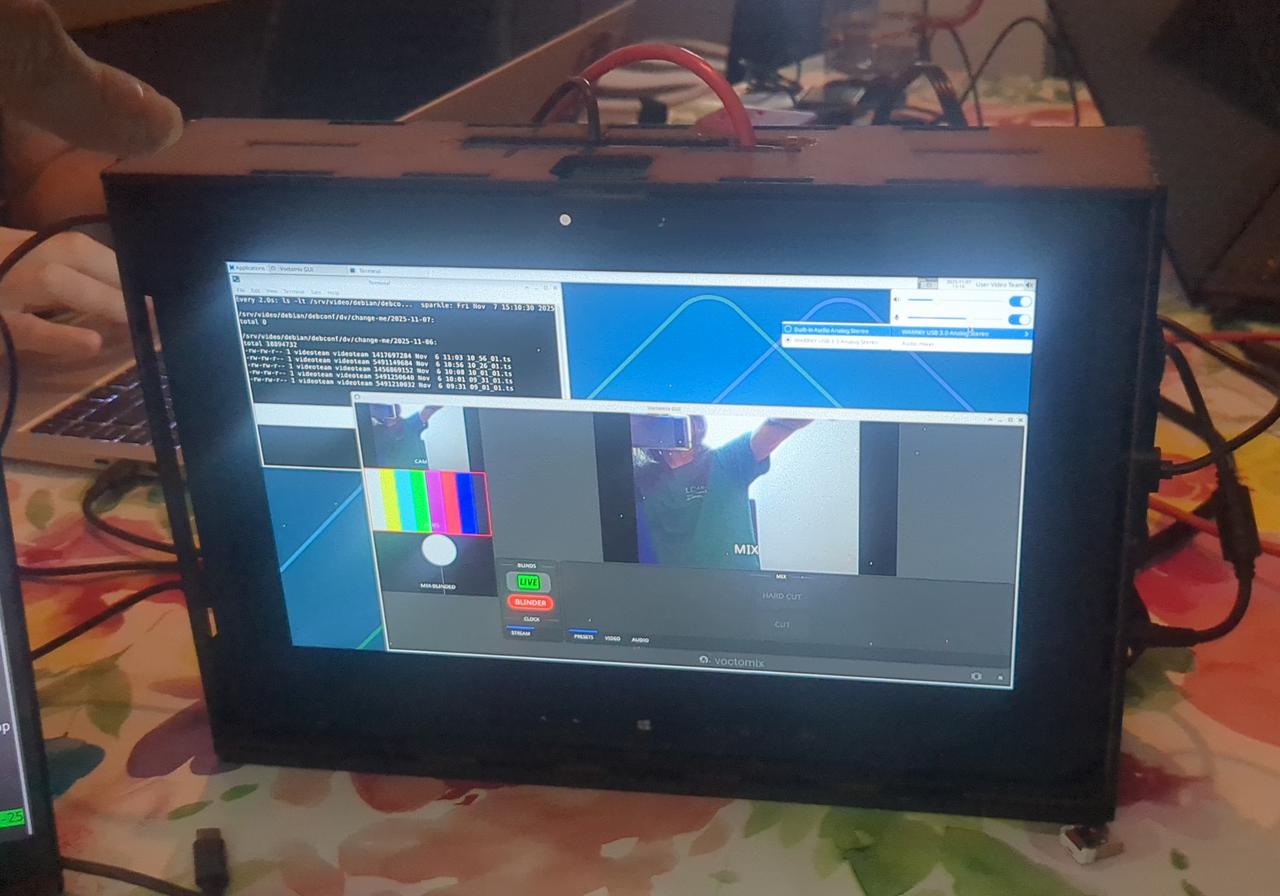
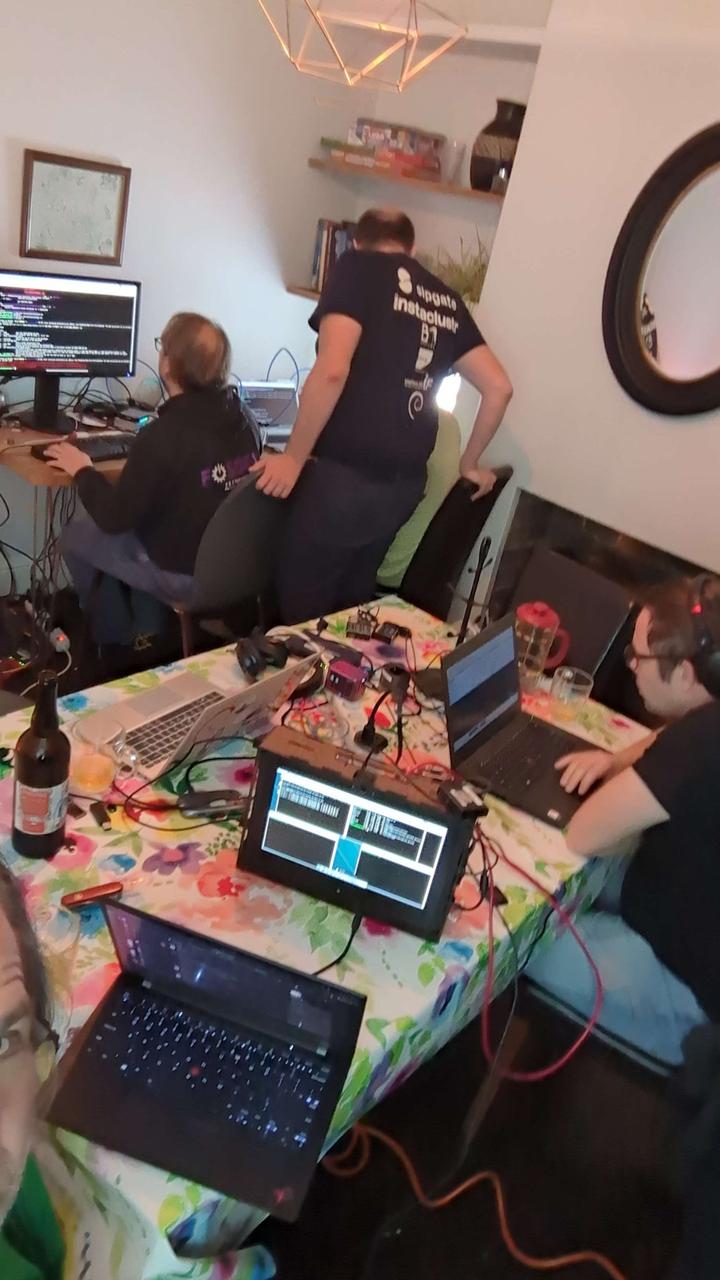
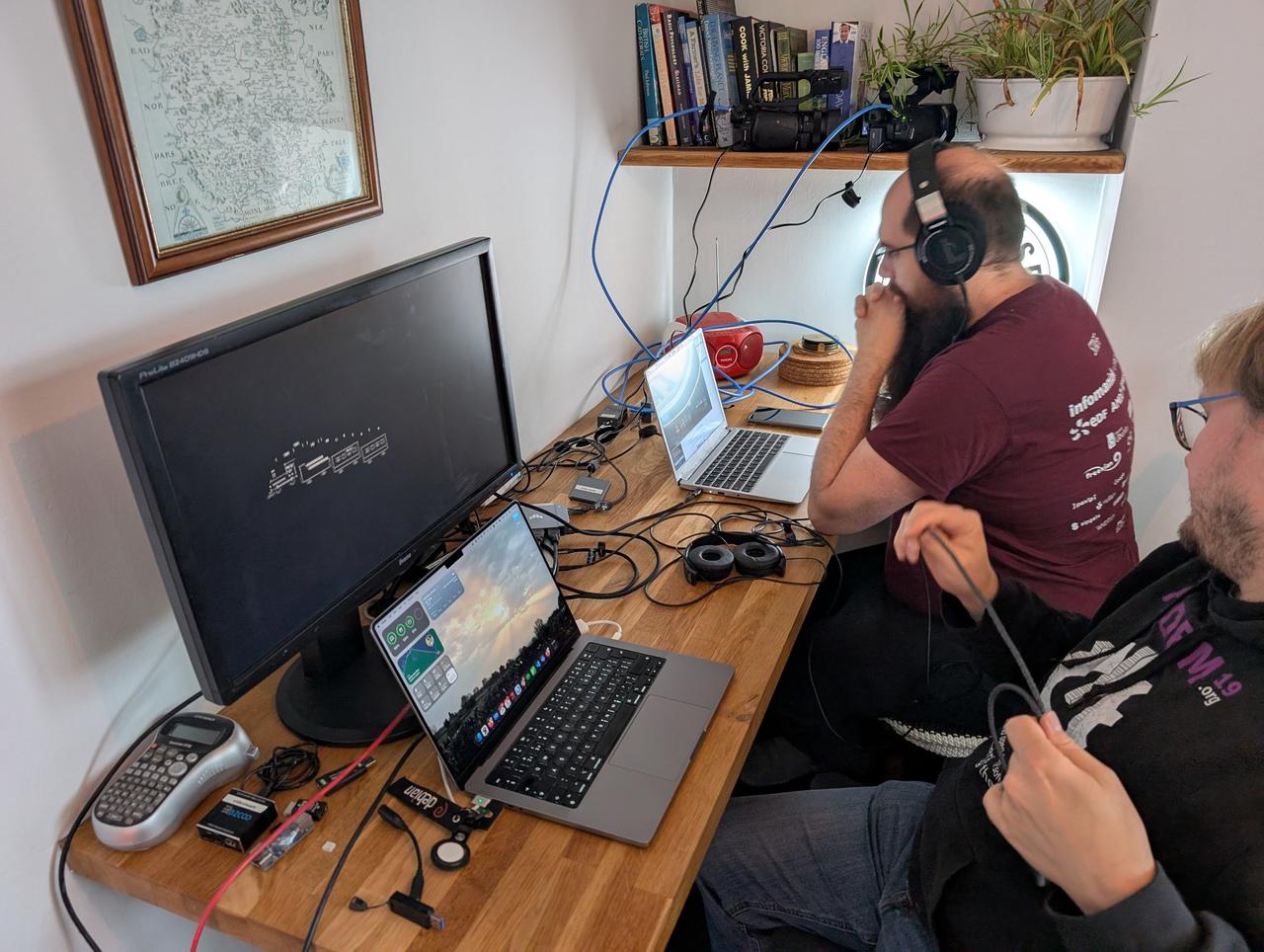
This week, some of the DebConf Video Team met in Herefordshire (UK) for a sprint. We didn't have a sprint in 2024, and it was sorely needed, now. At the sprint we made good progress towards using Voctomix 2 more reliably, and made plans for our future hardware needs. Attendees Voctomix 2 DebConf 25 was the first event that the team used Voctomix version 2. Testing it during DebCamp 25 (the week before DebConf), it seemed to work reliably. But during the event, we hit repeated audio dropout issues, that affected about 18 of our recordings (and live streams). We had attempted to use Voctomix 2 at DebConf 24, and quickly rolled back to version 1, on day 1 of the conference, when we hit similar issues. We thought these issues would be resolved for DebConf 25, by using more powerful (newer) mixing machines. Trying to get to the bottom of these issues was the main focus of the sprint. Nicolas brought 2 of Debian's cameras and the Framework laptop that we'd used at the conference, so we could reproduce the problem. It didn't take long to reproduce, in fact, we spent most of the week trying any configuration changes we could think of to avoid it. The issue we've been seeing feels like a gstreamer bug, rather than something voctomix is doing incorrectly. If anything, configuration changes are avoiding hitting it. Finally, on the last night of the sprint, we managed to run voctomix all night without the problem appearing. But... that isn't enough to feel confident that the issue is avoided. More testing will be required. Detecting audio breakage Kyle worked on a way to report the audio quality in our Prometheus exporter, so we can automatically detect this kind of audio breakage. This was implemented in helios our audio level monitor, and lead to some related code refactoring. Framework Laptops Historically, the video team has relied on borrowed and rented computer hardware at conferences for our (software) video mixing, streaming, storage and encoding. Many years ago, we'd even typically have a local Debian mirror and upload queue on site. Our video mixing machines had to be desktop size computers with 2 Blackmagic Declink Mini Recorder PCI-e cards installed in them, to capture video from our cameras. Now that we reliably have more Internet bandwidth than we really need, at our conference venues, we can rely on offsite cloud servers. We only need the video capture and mixing machines on site. Blackmagic also has UltraStudio Recorder thunderbolt capture boxes that we can use with a laptop. The project bought a couple of these and a Framework 13 AMD laptop to test at DebConf 25. We used it in production at DebConf, in the "Petit Amphi" room, where it seemed to work fairly well. It was very picky about thunderbolt cable and port combinations, refusing to even boot when they were connected. Since then, Framework firmware has fixed these issues, and in our testing at the sprint, it worked almost perfectly. (One of the capture boxes got into a broken state, and had to be unplugged and re-connected to fix it.) We think these are the best option for the future, and plan to ask the project to buy some more of them. HDCP Apple Silicon devices seem to like to HDCP-encrypt their HDMI output whenever possible. This causes our HDMI capture hardware to display an "Encrypted" error, rather than any useful image. Chris experimented with a few different devices to strip HDCP from HDMI video, at least 2 of them worked. Spring Cleaning Kyle dug through the open issues in our Salsa repositories and cleaned up some issues. DebConf 25 Video Encoding The core video team at DebConf 25 was a little under-staffed, significantly overlapping with core conference organization, which took priority. That, combined with the Voctomix 2 audio dropout issues we'd hit, meant that there was quite a bit of work left to be done to get the conference videos properly encoded and released. We found that the encodings had been done at the wrong resolution, which forced a re-encode of all videos. In the process, we reviewed videos for audio issues and made a list of the ones that need more work. We ran out of time and this work isn't done, yet. DebConf 26 Preparation Kyle reviewed floorplans and photographs of the proposed DebConf 26 talk venues, and build up a list of A/V kit that we'll need to hire. Carl's Video Box Carl uses much of the same stack as the video team, for many other events in the US. He has experimenting with using a Dell 7212 tablet in an all-in-one laser-cut box. Carl demonstrated this box, which could perfect for small miniDebConfs, at the sprint. Using voctomix 2 on the box requires some work, because it doesn't use Blackmagic cards for video capture. The Box: Front The Box: Back gst-fallbacksrc Carl's box's needs lead to looking at gstfallbacksrc. This should let Voctomix 2 survive cameras (or network sources) going away for a moment. Matthias Geiger packaged it for us, and it's now in Debian NEW. Thanks! voctomix-outcasts Carl cut a release of voctomix-outcasts and Stefano uploaded it to unstable. Ansible Configuration The videoteam's stack is deployed with Ansible, and almost everything we do involves work on this stack. Carl upstreamed some of his features to us, and we updated our voctomix2 configuration to take advantage of our experiments at the sprint. Miscellaneous Voctomix contributions We fixed a couple of minor bugs in voctomix. More Nageru experimentation In 2023, we tried to configure Nageru (another live video mixer) for the video team's needs. Like voctomix it needs some configuration and scaffolding to adapt it to your needs. Practically, this means writing a "theme" in Lua that controls the mixer. The team still has a preference for Voctomix (as we're all very familiar with it), but would like to have Nageru available as an option when we need it. We fixed some minor issues in our theme, enough to get it running again, on the Framework laptop. Much more work is needed to really make it a useable option. Thank you Thanks to the Debian project for funding the costs of the sprint, and Chris Boot's extended family for providing us with a no-cost sprint venue. Thanks to c3voc for developing and maintaining voctomix, and helping us to debug issues in it. Thank you to everyone in the videoteam who attended or helped out remotely! And to employers who let us work on Debian on company time. We'll likely need to keep working on our stack remotely, in the leadup to DebConf 26, and/or have another sprint before then. Breakfast Coffee Hacklab Trains!
Russell Coker: AMD Video Driver Issues

I have had some graphics hangs on my HP z640 workstation which seem to always be after about 4 days of uptime, in one instance running Debian kernel 6.16.12+deb14+1 I got the following kernel error:
kernel: amdgpu 0000:02:00.0: [drm] *ERROR* [CRTC:58:crtc-0] flip_done timed out
Then I got the following errors from kwin_wayland:
kwin_wayland_wrapper[19598]: kwin_wayland_drm: Pageflip timed out! This is a bug in the amdgpu kernel driver
kwin_wayland_wrapper[19598]: kwin_wayland_drm: Please report this at https://gitlab.freedesktop.org/drm/amd/-/issues
kwin_wayland_wrapper[19598]: kwin_wayland_drm: With the output of 'sudo dmesg' and 'journalctl --user-unit plasma-kwin_wayland --boot 0'
In another instance running Debian kernel 6.12.48+deb13 I got the kernel errors at the bottom of the post (not in the RSS feed). A google result suggested putting the following on the kernel command line which has the downside of increasing the idle power, but given that it s a low power GPU (that I selected when I was using a system without a PCIe power cable) a bit of extra power use shouldn t matter much. But it didn t seem to change anything.
amdgpu.runpm=0 amdgpu.dcdebugmask=0x10
I had tried out the Debian/Unstable kernel 6.16.12-2 which didn t work with my USB speakers and had problems with the HDMI sound through my monitor but still had AMD GPU issues. This all seemed to start with the PCIe errors being reported on this system [1]. So I m now wondering if the PCIe errors were from the GPU not the socket/motherboard. The GPU in question is a Radeon RX560 4G which cost $246.75 back in about 2021 [2]. I could buy a new one of those on ebay for $149 or one of the faster AMD cards like Radeon RX570 that are around the same price. I probably have a Radeon R7 260X in my collection of spare parts that would do the job too (2G of VRAM is more than sufficient for my desktop computing needs). Any suggestions on how I should proceed from here?
[419976.222647] amdgpu 0000:02:00.0: amdgpu: GPU fault detected: 146 0x0138482c
[419976.222659] amdgpu 0000:02:00.0: amdgpu:  for process mpv pid 141328 thread vo pid 141346
[419976.222662] amdgpu 0000:02:00.0: amdgpu:   VM_CONTEXT1_PROTECTION_FAULT_ADDR   0x00101427
[419976.222664] amdgpu 0000:02:00.0: amdgpu:   VM_CONTEXT1_PROTECTION_FAULT_STATUS 0x0404802C
[419976.222666] amdgpu 0000:02:00.0: amdgpu: VM fault (0x2c, vmid 2, pasid 32810) at page 1053735, read from 'TC0' (0x54433000) (72)
[419986.245051] amdgpu 0000:02:00.0: amdgpu: Dumping IP State
[419986.245061] amdgpu 0000:02:00.0: amdgpu: Dumping IP State Completed
[419986.255152] amdgpu 0000:02:00.0: amdgpu: ring gfx timeout, signaled seq=11839646, emitted seq=11839648
[419986.255158] amdgpu 0000:02:00.0: amdgpu: Process information: process mpv pid 141328 thread vo pid 141346
[419986.255209] amdgpu 0000:02:00.0: amdgpu: GPU reset begin!
[419986.503030] amdgpu: cp is busy, skip halt cp
[419986.658198] amdgpu: rlc is busy, skip halt rlc
[419986.659270] amdgpu 0000:02:00.0: amdgpu: BACO reset
[419986.884672] amdgpu 0000:02:00.0: amdgpu: GPU reset succeeded, trying to resume
[419986.885398] [drm] PCIE GART of 256M enabled (table at 0x000000F402000000).
[419986.885413] [drm] VRAM is lost due to GPU reset!
[419987.021051] [drm] UVD and UVD ENC initialized successfully.
[419987.120999] [drm] VCE initialized successfully.
[419987.193302] amdgpu 0000:02:00.0: amdgpu: GPU reset(1) succeeded!
[419987.194117] [drm:amdgpu_cs_ioctl [amdgpu]] *ERROR* Failed to initialize parser -125!
[419997.509120] amdgpu 0000:02:00.0: amdgpu: Dumping IP State
[419997.509131] amdgpu 0000:02:00.0: amdgpu: Dumping IP State Completed
[419997.519145] amdgpu 0000:02:00.0: amdgpu: ring gfx timeout, signaled seq=11839650, emitted seq=11839652
[419997.519152] amdgpu 0000:02:00.0: amdgpu: Process information: process kwin_wayland pid 3577 thread kwin_wayla:cs0 pid 3615
[419997.519158] amdgpu 0000:02:00.0: amdgpu: GPU reset begin!
[419997.772966] amdgpu: cp is busy, skip halt cp
[419997.928138] amdgpu: rlc is busy, skip halt rlc
[419997.929165] amdgpu 0000:02:00.0: amdgpu: BACO reset
[419998.164705] amdgpu 0000:02:00.0: amdgpu: GPU reset succeeded, trying to resume
[419998.165412] [drm] PCIE GART of 256M enabled (table at 0x000000F402000000).
[419998.165427] [drm] VRAM is lost due to GPU reset!
[419998.311054] [drm] UVD and UVD ENC initialized successfully.
[419998.411006] [drm] VCE initialized successfully.
[419998.476272] amdgpu 0000:02:00.0: amdgpu: GPU reset(2) succeeded!
[419998.476363] [drm:amdgpu_cs_ioctl [amdgpu]] *ERROR* Failed to initialize parser -125!
[420008.773202] amdgpu 0000:02:00.0: amdgpu: Dumping IP State
[420008.773212] amdgpu 0000:02:00.0: amdgpu: Dumping IP State Completed
[420008.773240] amdgpu 0000:02:00.0: amdgpu: ring gfx timeout, but soft recovered
=== the above sequence of 3 repeated many times (narrator's voice "but it did not recover") ===
[420130.933612] rfkill: input handler disabled
[420135.594195] rfkill: input handler enabled
[420145.734076] amdgpu 0000:02:00.0: amdgpu: Dumping IP State
[420145.734085] amdgpu 0000:02:00.0: amdgpu: Dumping IP State Completed
[420145.744099] amdgpu 0000:02:00.0: amdgpu: ring gfx timeout, signaled seq=11839790, emitted seq=11839792
[420145.744105] amdgpu 0000:02:00.0: amdgpu: Process information: process kwin_wayland pid 3577 thread kwin_wayla:cs0 pid 3615
[420145.744111] amdgpu 0000:02:00.0: amdgpu: GPU reset begin!
There were more kernel messages, but they were just repeats and after a certain stage there probably isn t any more data worth getting.

8 November 2025

Thorsten Alteholz: My Debian Activities in October 2025

Debian LTS This was my hundred-thirty-sixth month that I did some work for the Debian LTS initiative, started by Raphael Hertzog at Freexian. During my allocated time I uploaded or worked on: I also attended the monthly LTS/ELTS meeting. Debian ELTS This month was the eighty-seventh ELTS month. During my allocated time I uploaded or worked on: I also attended the monthly LTS/ELTS meeting. Debian Printing This month I uploaded a new upstream version or a bugfix version of: This work is generously funded by Freexian! Debian Astro This month I uploaded a new upstream version or a bugfix version of: Debian IoT Unfortunately I didn t found any time to work on this topic. Debian Mobcom This month I uploaded a new upstream version or a bugfix version of: misc This month I uploaded a new upstream version or a bugfix version of: On my fight against outdated RFPs, I closed 31 of them in October. I could even close one RFP by uploading the new package gypsy. Meanwhile only 3373 are still open, so don t hesitate to help closing one or another. FTP master This month I accepted 420 and rejected 45 packages. The overall number of packages that got accepted was 423. I would like to remind everybody that in case you don t agree with the removal of a package, please set the moreinfo tag on this bug. This is the only reliable way to prevent processing of that RM-bug. Well, there is a second way, of course you could also achieve this by closing the bug.

7 November 2025

Ravi Dwivedi: A Bad Day in Malaysia

Continuing from where Badri and I left off in the last post. On the 7th of December 2024, we boarded a bus from Singapore to the border town of Johor Bahru in Malaysia. The bus stopped at the Singapore emigration for us to get off for the formalities. The process was similar to the immigration at the Singapore airport. It was automatic, and we just had to scan our passports for the gates to open. Here also, we didn t get Singapore stamps on our passports. After we were done with the emigration, we had to find our bus. We remembered the name of the bus company and the number plate, which helped us recognize our bus. It wasn t there already after we came out of the emigration, but it arrived soon enough, and we boarded it promptly. From the Singapore emigration, the bus travelled a few kilometers and dropped us at Johor Bahru Sentral (JB Sentral) bus station, where we had to go through Malaysian immigration. The process was manual, unlike Singapore, and there was an immigration officer at the counter who stamped our passports (which I like) and recorded our fingerprints. At the bus terminal, we exchanged rupees at an exchange shop to get Malaysian ringgits. We could not find any free drinking water sources on the bus terminal, so we had to buy water. Badri later told me that Johor Bahru has a lot of data centers, which need a lot of water for cooling. When he read about it later, he immediately connected it with the fact that there was no free drinking water, and we had to buy water. Such data centers can lead to scarcity of water for others in the area. From JB Sentral, we took a bus to Larkin Terminal, as our hotel was nearby. It was 1.5 ringgits per person (30 rupees). In order to pay for the fare, we had to put cash in a box near the driver s seat. Around half-an-hour later, we reached our hotel. The time was 23:30 hours. The hotel room was hot as it didn t have air-conditioning. The weather in Malaysia is on the hotter side throughout the year. It was a budget hotel, and we paid 70 ringgits for our room. Badri slept soon after we checked-in. I went out during the midnight at around 00:30. I was hungry, so I entered a small scale restaurant nearby, which was quite lively for the midnight hours. At the restaurant, I ordered a coffee and an omelet. I also asked for drinking water. The unique thing about that was that they put ice in hot water to make its temperature normal. My bill from the restaurant looked like the below-mentioned table, as the items names were in the local language Malay:
Item Price (Malaysian ringgits) Conversion to Indian rupees Comments
Nescafe Tarik 2.50 50 Coffee
Ais Kosong 0.50 10 Water
Telur Dadar 2.00 40 Omelet
SST Tax (6%) 0.30 6
Total 5.30 106
After checking out from the restaurant, I explored nearby shops. I also bought some water before going back to the hotel room. The next day, we had a (pre-booked) bus to Kuala Lumpur. We checked out from the hotel 10 minutes after the check-out time (which was 14:00 hours). However, within those 10 minutes, the hotel staff already came up three times asking us to clear out (which we were doing as fast as possible). And finally on the third time they said our deposit was forfeit, even though it was supposed to be only for keys and towels. The above-mentioned bus for Kuala Lumpur was from the nearby Larkin Bus Terminal. The bus terminal was right next to our hotel, so we walked till there. Upon reaching there, we found out that the process of boarding a bus in Malaysia resembled with taking a flight. We needed to go to a counter to get our boarding passes, followed by reporting at our gate half-an-hour before the scheduled time. Furthermore, they had a separate waiting room and boarding gates. Also, there was a terminal listing buses with their arrival and departure signs. Finally, to top it off, the buses had seatbelts. We got our boarding pass for 2 ringgits (40 rupees). After that, we proceeded to get something to eat as we were hungry. We went to a McDonald s, but couldn t order anything because of the long queue. We didn t have a lot of time, so we proceeded towards our boarding gate without having anything. The boarding gate was in a separate room, which had a vending machine. I tried to order something using my card, but the machine wasn t working. In Malaysia, there is a custom of queueing up to board buses even before the bus has arrived. We saw it in Johor Bahru as well. The culture is so strong that they even did it in Singapore while waiting for the Johor Bahru bus! Our bus departed at 15:30 as scheduled. The journey was around 5 hours. A couple of hours later, our bus stopped for a break. We got off the bus and went to the toilet. As we were starving (we didn t have anything the whole day), we thought it was a good opportunity to get some snack. There was a stall selling some food. However, I had to determine which options were vegetarian. We finally settled on a cylindrical box of potato chips, labelled Mister Potato. They were 7 ringgits. We didn t know how long the bus is going to stop. Furthermore, eating inside buses in Malaysia is forbidden. When we went to get some coffee from the stall, our bus driver was standing there and made a face. We got an impression that he doesn t want us to have coffee. However, after we got into the bus, we had to wait for a long time for it to resume its journey as the driver was taking his sweet time to drink his coffee. During the bus journey, we saw a lot of palm trees on the way. The landscape was beautiful, with good road infrastructure throughout the journey. Badri also helped me improve my blog post on obtaining Luxembourg visa in the bus. The bus dropped us at the Terminal Bersepadu Selatan (TBS in short) in Kuala Lumpur at 21:30 hours. Finally, we got something at the TBS. We also noticed that the TBS bus station had lockers. This gave us the idea of putting some of our luggage in the lockers later while we will be in Brunei. We had booked a cheap Air Asia ticket which doesn t allow check-in luggage. Further, keeping the checked-in luggage in lockers for three days was cheaper than paying the excess luggage penalty for Air Asia. We followed it up by taking a metro as our hotel was closer to a metro station. This was a bad day due to our deposit being forfeited unfairly, and got nothing to eat. We took the metro to reach our hostel, which was located in the Bukit Bintang area. The name of this hostel was Manor by Mingle. I had stayed here earlier in February 2024 for two nights. Back then, I paid 1000 rupees per day for a dormitory bed. However, this time the same hostel was much cheaper. We got a private room for 800 rupees per day, with breakfast included. Earlier it might have been pricier due to my stay falling on weekends or maybe February has more tourists in Kuala Lumpur. That s it for this post. Stay tuned for our adventures in Malaysia!

6 November 2025

Jonathan Dowland: inert media, or the explotation of attention

It occurred to me recently that one of the attractions of vinyl, or more generally physical media, could be that it's inert, safe: the music is a groove cut into some plastic. That's it. The record can't do anything unexpected to you1: it just contains music.
Safe. Safe.
There's so much exploitation of attention, and so much of what we interact with in a computing context (social media) etc has been weaponised against us, that having something some matter-of-fact is a relief. I know that sometimes, I prefer to put a record on than to dial up the very same album from any number of (ostensibly more convenient) digital sources, partly because I don't need to spend any of my attention spoons to do so, I can save them for the task at hand. The same is perhaps not true for audio CDs. That might depend on your own relationship with them, of course. For me they're inexorably tied up with computing and a certain amount of faff (ripping, encoding, metadata). And long dead it might be (hopefully), but I can still remember Sony's CD rootkit scandal: CDs could be a trojan horse. Beware!

  1. I'm sure there are ingenious exceptions.

5 November 2025

Reproducible Builds: Reproducible Builds in October 2025

Welcome to the October 2025 report from the Reproducible Builds project! Welcome to the very latest report from the Reproducible Builds project. Our monthly reports outline what we ve been up to over the past month, and highlight items of news from elsewhere in the increasingly-important area of software supply-chain security. As ever, if you are interested in contributing to the Reproducible Builds project, please see the Contribute page on our website. In this report:

  1. Farewell from the Reproducible Builds Summit 2025
  2. Google s Play Store breaks reproducible builds for Signal
  3. Mailing list updates
  4. The Original Sin of Computing that no one can fix
  5. Reproducible Builds at the Transparency.dev summit
  6. Supply Chain Security for Go
  7. Three new academic papers published
  8. Distribution work
  9. Upstream patches
  10. Website updates
  11. Tool development

Farewell from the Reproducible Builds Summit 2025 Thank you to everyone who joined us at the Reproducible Builds Summit in Vienna, Austria! We were thrilled to host the eighth edition of this exciting event, following the success of previous summits in various iconic locations around the world, including Venice, Marrakesh, Paris, Berlin, Hamburg and Athens. During this event, participants had the opportunity to engage in discussions, establish connections and exchange ideas to drive progress in this vital field. Our aim was to create an inclusive space that fosters collaboration, innovation and problem-solving. The agenda of the three main days is available online however, some working sessions may still lack notes at time of publication. One tangible outcome of the summit is that Johannes Starosta finished their rebuilderd tutorial, which is now available online and Johannes is actively seeking feedback.

Google s Play Store breaks reproducible builds for Signal On the issue tracker for the popular Signal messenger app, developer Greyson Parrelli reports that updates to the Google Play store have, in effect, broken reproducible builds:
The most recent issues have to do with changes to the APKs that are made by the Play Store. Specifically, they add some attributes to some .xml files around languages are resources, which is not unexpected because of how the whole bundle system works. This is trickier to resolve, because unlike current expected differences (like signing information), we can t just exclude a whole file from the comparison. We have to take a more nuanced look at the diff. I ve been hesitant to do that because it ll complicate our currently-very-readable comparison script, but I don t think there s any other reasonable option here.
The full thread with additional context is available on GitHub.

Mailing list updates On our mailing list this month:
  • kpcyrd forwarded a fascinating tidbit regarding so-called ninja and samurai build ordering, that uses data structures in which the pointer values returned from malloc are used to determine some order of execution.
  • Arnout Engelen, Justin Cappos, Ludovic Court s and kpcyrd continued a conversation started in September regarding the Minimum Elements for a Software Bill of Materials . (Full thread)
  • Felix Moessbauer of Siemens posted to the list reporting that he had recently stumbled upon a couple of Debian source packages on the snapshot mirrors that are listed multiple times (same name and version), but each time with a different checksum . The thread, which Felix titled, Debian: what precisely identifies a source package is about precisely that what can be axiomatically relied upon by consumers of the Debian archives, as well as indicating an issue where we can t exactly say which packages were used during build time (even when having the .buildinfo files).
  • Luca DiMaio posted to the list announcing the release of xfsprogs 6.17.0 which specifically includes a commit that implements the functionality to populate a newly created XFS filesystem directly from an existing directory structure which makes it easier to create populated filesystems without having to mount them [and thus is] particularly useful for reproducible builds . Luca asked the list how they might contribute to the docs of the System images page.

The Original Sin of Computing that no one can fix Popular YouTuber @laurewired published a video this month with an engaging take on the Trusting Trust problem. Titled The Original Sin of Computing that no one can fix, the video touches on David A. Wheeler s Diverse Double-Compiling dissertation. GNU developer Janneke Nieuwenhuizen followed-up with an email (additionally sent to our mailing list) as well, underscoring that GNU Mes s current solution [to this issue] uses ancient softwares in its bootstrap path, such as gcc-2.95.3 and glibc-2.2.5 . (According to Colby Russell, the GNU Mes bootstrapping sequence is shown at 18m54s in the video.)

Reproducible Builds at the Transparency.dev summit Holger Levsen gave a talk at this year s Transparency.dev summit in Gothenburg, Sweden, outlining the achievements of the Reproducible Builds project in the last 12 years, covering both upstream developments as well as some distribution-specific details. As mentioned on the talk s page, Holger s presentation concluded with an outlook into the future and an invitation to collaborate to bring transparency logs into Reproducible Builds projects . The slides of the talk are available, although a video has yet to be released. Nevertheless, as a result of the discussions at Transparency.dev there is a new page on the Debian wiki with the aim of describing a potential transparency log setup for Debian.

Supply Chain Security for Go Andrew Ayer has setup a new service at sourcespotter.com that aims to monitor the supply chain security for Go releases. It consists of four separate trackers:
  1. A tool to verify that the Go Module Mirror and Checksum Database is behaving honestly and has not presented inconsistent information to clients.
  2. A module monitor that records every module version served by the Go Module Mirror and Checksum Database, allowing you to monitor for unexpected versions of your modules.
  3. A tool to verifies that the Go toolchains published in the Go Module Mirror can be reproduced from source code, making it difficult to hide backdoors in the binaries downloaded by the go command.
  4. A telemetry config tracker that tracks the names of telemetry counters uploaded by the Go toolchain, to ensure that Go telemetry is not violating users privacy.
As the homepage of the service mentions, the trackers are free software and do not rely on Google infrastructure.

Three new academic papers published Julien Malka of the Institut Polytechnique de Paris published an exciting paper this month on How NixOS could have detected the XZ supply-chain attack for the benefit of all thanks to reproducible-builds. Julien outlines his paper as follows:
In March 2024, a sophisticated backdoor was discovered in xz, a core compression library in Linux distributions, covertly inserted over three years by a malicious maintainer, Jia Tan. The attack, which enabled remote code execution via ssh, was only uncovered by chance when Andres Freund investigated a minor performance issue. This incident highlights the vulnerability of the open-source supply chain and the effort attackers are willing to invest in gaining trust and access. In this article, I analyze the backdoor s mechanics and explore how bitwise build reproducibility could have helped detect it.
A PDF of the paper is available online.
Iy n M ndez Veiga and Esther H nggi (of the Lucerne University of Applied Sciences and Arts and ETH Zurich) published a paper this month on the topic of Reproducible Builds for Quantum Computing. The abstract of their paper mentions the following:
Although quantum computing is a rapidly evolving field of research, it can already benefit from adopting reproducible builds. This paper aims to bridge the gap between the quantum computing and reproducible builds communities. We propose a generalization of the definition of reproducible builds in the quantum setting, motivated by two threat models: one targeting the confidentiality of end users data during circuit preparation and submission to a quantum computer, and another compromising the integrity of quantum computation results. This work presents three examples that show how classical information can be hidden in transpiled quantum circuits, and two cases illustrating how even minimal modifications to these circuits can lead to incorrect quantum computation results.
A full PDF of their paper is available.
Congratulations to Georg Kofler who submitted their Master s thesis for the Johannes Kepler University of Linz, Austria on the topic of Reproducible builds of E2EE-messengers for Android using Nix hermetic builds:
The thesis focuses on providing a reproducible build process for two open-source E2EE messaging applications: Signal and Wire. The motivation to ensure reproducibility and thereby the integrity of E2EE messaging applications stems from their central role as essential tools for modern digital privacy. These applications provide confidentiality for private and sensitive communications, and their compromise could undermine encryption mechanisms, potentially leaking sensitive data to third parties.
A full PDF of their thesis is available online.
Shawkot Hossain of Aalto University, Finland has also submitted their Master s thesis on the The Role of SBOM in Modern Development with a focus on the extant tooling:
Currently, there are numerous solutions and techniques available in the market to tackle supply chain security, and all claim to be the best solution. This thesis delves deeper by implementing those solutions and evaluates them for better understanding. Some of the tools that this thesis implemented are Syft, Trivy, Grype, FOSSA, dependency-check, and Gemnasium. Software dependencies are generated in a Software Bill of Materials (SBOM) format by using these open-source tools, and the corresponding results have been analyzed. Among these tools, Syft and Trivy outperform others as they provide relevant and accurate information on software dependencies.
A PDF of the thesis is also available.

Distribution work Michael Plura published an interesting article on Heise.de on the topic of Trust is good, reproducibility is better:
In the wake of growing supply chain attacks, the FreeBSD developers are relying on a transparent build concept in the form of Zero-Trust Builds. The approach builds on the established Reproducible Builds, where binary files can be rebuilt bit-for-bit from the published source code. While reproducible builds primarily ensure verifiability, the zero-trust model goes a step further and removes trust from the build process itself. No single server, maintainer, or compiler can be considered more than potentially trustworthy.
The article mentions that this goal has now been achieved with a slight delay and can be used in the current development branch for FreeBSD 15 .
In Debian this month, 7 reviews of Debian packages were added, 5 were updated and 11 were removed this month adding to our knowledge about identified issues. For the Debian CI tests Holger fixed #786644 and set nocheck in DEB_BUILD_OPTIONS for the 2nd build..
Lastly, Bernhard M. Wiedemann posted another openSUSE monthly update for their work there.

Upstream patches The Reproducible Builds project detects, dissects and attempts to fix as many currently-unreproducible packages as possible. We endeavour to send all of our patches upstream where appropriate. This month, we wrote a large number of such patches, including:

Website updates Once again, there were a number of improvements made to our website this month including: In addition, a number of contributors added a series of notes from our recent summit to the website, including Alexander Couzens [ ], Robin Candau [ ][ ][ ][ ][ ][ ][ ][ ][ ] and kpcyrd [ ].

Tool development diffoscope version 307 was uploaded to Debian unstable by Chris Lamb, who made a number of changes including fixing compatibility with LLVM version 21 [ ], an attempt to automatically attempt to deploy to PyPI by liaising with the PyPI developers/maintainers (with this experimental feature). [ ] In addition, Vagrant Cascadian updated diffoscope in GNU Guix to version 307.

Finally, if you are interested in contributing to the Reproducible Builds project, please visit our Contribute page on our website. However, you can get in touch with us via:

Next.

Previous.