I m finishing typing up this blog entry hours before my last 13 hour leg back home, after I spent 2 weeks in Busan, South Korea for DebCamp24 and DebCamp24. I had a rough year and decided to take it easy this DebConf. So this is the first DebConf in a long time where I didn t give any talks. I mostly caught up on a bit of packaging, worked on DebConf video stuff, attended a few BoFs and talked to people. Overall it was a very good DebConf, which also turned out to be more productive than I expeced it would.
In the welcome session on the first day of DebConf, Nicolas Dandrimont mentioned that a benefit of DebConf is that it provides a sort of caffeine for your Debian motivation. I could certainly feel that affect swell as the days went past, and it s nice to be excited about some ideas again that would otherwise be fading.
Recovering DPL
It s a bit of a gear shift being DPL for 4 years, and DebConf Committee for nearly 5 years before that, and then being at DebConf while some issue arise (as it always does during a conference). At first I jump into high alert mode, but then I have to remind myself it s not your problem anymore and let others deal with it.
It was nice spending a little in-person time with Andreas Tille, our new DPL, we did some more handover and discussed some current issues. I still have a few dozen emails in my DPL inbox that I need to collate and forward to Andreas, I hope to finish all that up by the end of August.
During the Bits from the DPL talk, the usual question came up whether Andreas will consider running for DPL again, to which he just responded in a slide Maybe . I think it s a good idea for a DPL to do at least two terms if it all works out for everyone, since it takes a while to get up to speed on everything.
Also, having been DPL for four years, I have a lot to say about it, and I think there s a lot we can fix in the role, or at least discuss it. If I had the bandwidth for it I would have scheduled a BoF for it, but I ll very likely do that for the next DebConf instead!
Video team
I set up the standby loop for the video streaming setup. We call it loopy, it s a bunch of OBS scenes that provide announcements, shows sponsors, the schedule and some social content. I wrote about it back in 2020, but it s evolved quite a bit since then, so I m probably due to write another blog post with a bunch of updates on it. I hope to organise a video team sprint in Cape Town in the first half of next year, so I ll summarize everything before then.
It would ve been great if we could have some displays in social areas that could show talks, the loop and other content, but we were just too pressed for time for that. This year s DebConf had a very compressed timeline, and there was just too much that had to be done and that had to be figured out on the last minute. This put quite a lot of strain on the organisers, but I was glad to see how, for the most part, most attendees were very sympathetic to some rough edges (but I digress ).
I added more of the OBS machine setup to the videoteam s ansible repository, so as of now it just needs an ansible setup and the OBS data and it s good to go. The loopy data is already in the videoteam git repository, so I could probably just add a git pull and create some symlinks in ansible and then that machine can be installed from 0% to 100% by just installing via debian-installer with our ansible hooks.
This DebConf I volunteered quite a bit for actual video roles during the conference, something I didn t have much time for in recent DebConfs, and it s been fun, especially in a session or two where nearly none of the other volunteers showed up. Sometimes chaos is just fun :-)
Baekyongee is the university mascot, who s visible throughout the university. So of course we included this four legged whale creature on the loop too!
Packaging
I was hoping to do more packaging during DebCamp, but at least it was a non-zero amount:
Uploaded gdisk 1.0.10-2 to unstable (previously tested effects of adding dh-sequence-movetousr) (Closes: #1073679).
Worked a bit on bcachefs-tools (updating git to 1.9.4), but has a build failure that I need to look into (we might need a newer bindgen) update: I m probably going to ROM this package soon, it doesn t seem suitable for packaging in Debian.
Calamares: Tested a fix for encrypted installs, and uploaded it.
Calamares: Uploaded (3.3.8-1) to backports (at the time of writing it s still in backports-NEW).
Pixelorama 1.0 I did some initial packaging for Pixelorama back when we did the MiniDebConf Gaming Edition, but it had a few stoppers back then. Version 1.0 seems to fix all of that, but it depends on Godot 4.2 and we re still on the 3 series in Debian, so I ll upload this once Godot 4.2 hits at least experimental. Godot software/games is otherwise quite easy to run, it s basically just source code / data that is installed and then run via godot-runner (godot3-runner package in Debian).
BoFs
Python Team BoF
Link to the etherpad / pad archive link and video can be found on the talk page: https://debconf24.debconf.org/talks/31-python-bof/
The session ended up being extended to a second part, since all the issues didn t fit into the first session.
I was distracted by too many thing during the Python 3.12 transition (to the point where I thought that 3.11 was still new in Debian), so it was very useful listening to the retrospective of that transition.
There was a discussion whether Python 3.13 could still make it to testing in time for freeze, and it seems that there is consensus that it can, although, likely with new experimental features like disabling the global interpreter lock and the just in time compiler disabled.
I learned for the first time about the dead batteries project, PEP-0594, which removes ancient modules that have mostly been superseded, from the Python standard library.
There was some talk about the process for changing team policy, and a policy discussion on whether we should require autopkgtests as a SHOULD or a MUST for migration to testing. As with many things, the devil is in the details and in my opinion you could go either way and achieve a similar result (the original MUST proposal allowed exceptions which imho made it the same as the SHOULD proposal).
There s an idea to do some ongoing remote sprints, like having co-ordinated days for bug squashing / working on stuff together. This is a nice idea and probably a good way to energise the team and also to gain some interest from potential newcomers.
Louis-Philipe V ronneau was added as a new team admin and there was some discussion on various Sphinx issues and which Lintian tags might be needed for Python 3.13. If you want to know more, you probably have to watch the videos / read the notes :)
Debian.net BoF
Link to the etherpad / pad archive link can be found on the talk page: https://debconf24.debconf.org/talks/37-debiannet-team-bof
Debian Developers can set up services on subdomains on debian.net, but a big problem we ve had before was that developers were on their own for hosting those services. This meant that they either hosted it on their DSL/fiber connection at home, paid for the hosting themselves, or hosted it at different services which became an accounting nightmare to claim back the used funds. So, a few of us started the debian.net hosting project (sometimes we just call it debian.net, this is probably a bit of a bug) so that Debian has accounts with cloud providers, and as admins we can create instances there that gets billed directly to Debian.
We had an initial rush of services, but requests have slowed down since (not really a bad thing, we don t want lots of spurious requests). Last year we did a census, to check which of the instances were still used, whether they received system updates and to ask whether they are performing backups. It went well and some issues were found along the way, so we ll be doing that again.
We also gained two potential volunteers to help run things, which is great.
Debian Social BoF
Link to the etherpad / pad archive link can be found on the talk page: https://debconf24.debconf.org/talks/34-debiansocial-bof
We discussed the services we run, you can view the current state of things at: https://wiki.debian.org/Teams/DebianSocial
Pleroma has shown some cracks over the last year or so, and there are some forks that seem promising. At the same time, it might be worth while considering Mastodon too. So we ll do some comparison of features and maintenance and find a way forward. At the time when Pleroma was installed, it was way ahead in terms of moderation features.
Pixelfed is doing well and chugging along nicely, we should probably promote it more.
Peertube is working well, although we learned that we still don t have all the recent DebConf videos on there. A bunch of other issues should be fixed once we move it to a new machine that we plan to set up.
We re removing writefreely and plume. Nice concepts, but it didn t get much traction yet, and no one who signed up for these actually used it, which is fine, some experimentation with services is good and sometimes they prove to be very popular and other times not.
The WordPress multisite instance has some mild use, otherwise haven t had any issues.
Matrix ended up to be much, much bigger than we thought, both in usage and in its requirements. It s very stateful and remembers discussions for as long as you let it, so it s Postgres database is continuously expanding, this will also be a lot easier to manage once we have this on the new host.
Jitsi is also quite popular, but it could probably be on jitsi.debian.net instead (we created this on debian.social during the initial height of COVID-19 where we didn t have the debian.net hosting yet), although in practice it doesn t really matter where it lives.
Most of our current challenges will be solved by moving everything to a new big machine that has a few public IPs available for some VMs, so we ll be doing that shortly.
Debian Foundation Discussion BoF
This was some brainstorming about the future structure of Debian, and what steps might be needed to get there. It s way too big a problem to take on in a BoF, but we made some progress in figuring out some smaller pieces of the larger puzzle. The DPL is going to get in touch with some legal advisors and our trusted organisations so that we can aim to formalise our relationships a bit more by the time it s DebConf again.
I also introduced my intention to join the Debian Partners delegation. When I was DPL, I enjoyed talking with external organisations who wanted to help Debian, but helping external organisations help Debian turned out to be too much additional load on the usual DPL roles, so I m pursuing this with the Debian Partners team, more on that some other time.
This session wasn t recorded, but if you feel like you missed something, don t worry, all intentions will be communicated and discussed with project members before anything moves forward. There was a strong agreement in the room though that we should push forward on this, and not reach another DebConf where we didn t make progress on formalising Debian s structure more.
Social
Conference Dinner
Conference Dinner Photo from Santiago
The conference dinner took place in the university gymnasium. I hope not many people do sports there in the summer, because it got HOT. There was also some interesting observations on the thermodynamics of the attempted cooling solutions, which was amusing. On the plus side, the food was great, the company was good, and the speeches were kept to a minimum, so it was a great conference dinner, even though it was probably cut a bit short due to the heat.
Cheese and Wine
Cheese and Wine happened on 1 August, which happens to be the date I became a DD at DebConf17 in Montr al seven years before, so this was a nice accidental celebration of my Debiversary :)
Since I m running out of time, I ll add some more photos to this post some time after publishing it :P
Group Photo
As per DebConf tradition, Aigars took the group photo. You can find the high resolution version on Debian s GitLab instance.
Debian annual conference Debconf 24, Busan, South Korea Photography: Aigars Mahinovs aigarius@debian.org License: CC-BYv3+ or GPLv2+
Talking
Ah yes, talking to people is a big part of DebConf, but I didn t keep track of it very well.
I mostly listened to Alper a bit about his ideas for his talk about debian installer.
I talked to Rhonda a bit about ActivityPub and MQTT and whether they could be useful for publicising Debian activity.
Listened to Gunnar and Julian have a discussion about GPG and APT which was interesting.
We had the usual continuous keysigning party. Besides it s intended function, this is always a good ice breaker and a way to for shy people to meet other shy people.
and many other fly-by discussions.
Stuff that didn t happen this DebConf
loo.py A simple Python script that could eventually replace the obs-advanced-scene-switcher sequencer in OBS. It would also be extremely useful if we d ever replace OBS for loopy. I was hoping to have some time to hack on this, and try to recreate the current loopy in loo.py, but didn t have the time.
toetally This year videoteam had to scramble to get a bunch of resistors to assemble some tally light. Even when assembled, they were a bit troublesome. It would ve been nice to hack on toetally and get something ready for testing, but it mostly relies on having something like a rasbperry pi zero with an attached screen in order to work on further. I ll try to have something ready for the next mini conf though.
extrepo on debian live I think we should have extrepo installed by default on desktop systems, I meant to start a discussion on this, but perhaps it s just time I go ahead and do it and announce it.
Live stream to peertube server It would ve been nice to live stream DebConf to PeerTube, but the dependency tree to get this going got a bit too huge. Following our plans discussed in the Debian Social BoF, we should have this safely ready before the next MiniDebConf and should be able to test it there.
Desktop Egg there was this idea to get a stand-in theme for Debian testing/unstable until the artwork for the next release is finalized (Debian bug: #1038660), I have an idea that I meant to implement months ago, but too many things got in the way. It s based on Juliette Taka s Homeworld theme, and basically transforms the homeworld into an egg. Get it? Something that hasn t hatched yet? I also only recently noticed that we never used the actualhomeworld graphics (featuring the world image) in the final bullseye release. lol.
So, another DebConf and another new plush animal. Last but not least, thanks to PKNU for being such a generous and fantastic host to us! See you again at DebConf25 in Brest, France next year!
This is one of those posts that s more for my own reference than likely to be helpful for others. If you re unlucky it ll have some useful tips for you. If I m lucky then I ll get a bunch of folk pointing out some optimisations.
First, what I m trying to achieve. I want a virtual machine environment where I can manually do tests on random kernels, and also various TPM related experiments. So I don t want something as fixed as a libvirt setup. I d like the following:
It to be fairly lightweight, so I can run it on a laptop while usefully doing other things
I need a TPM 2.0 device to appear to the guest OS, but it doesn t need to be a real TPM
Block device discard should work, so I can back it with a qcow2 image and use fstrim to keep the actual on disk size small, without constraining my potential for file system expansion should I need it
I ve no need for graphics, in fact a serial console would be better as it eases copy & paste, especially when I screw up kernel changes
That turns out to be possible, but it took a bunch of trial and error to get there. So I m writing it down. I generally do this on a Fedora based host system (FC40 at present, but this all worked with FC38 + FC39 too), and I run Debian 12 (bookworm) as the guest. At present I m using qemu 8.2.2 and swtpm 0.9.0, both from the FC40 packages.
One other issue I spent too long tracking down is that the version of grub 2.06 in bookworm does not manage to pass the TPMEventLog through to the guest kernel properly. The events get measured and the PCRs updated just fine, but /sys/kernel/security/tpm0/binary_bios_measurements doesn t even get created. Using either grub 2.06 from FC40, or the 2.12 backport in bookworm-backports, makes this work just fine.
Anyway, for reference, the following is the script I use to start the swtpm, and then qemu. The debugcon line can be dropped if you re not interested in OVMF debug logging. This needs the guest OS to be configured up for a serial console, but avoids the overhead of graphics emulation.
As I said at the start, I m open to any hints about other options I should be passing; as long as I get acceptable performance in the guest I care more about reducing host load than optimising for the guest.
Review: The Book That Wouldn't Burn, by Mark Lawrence
Series:
Library Trilogy #1
Publisher:
Ace
Copyright:
2023
ISBN:
0-593-43793-4
Format:
Kindle
Pages:
561
The Book That Wouldn't Burn is apparently high fantasy, but of the
crunchy sort that could easily instead be science fiction. It is the
first of a trilogy.
Livira is a young girl, named after a weed, who lives in a tiny settlement
in the Dust. She is the sort of endlessly curious and irrepressible girl
who can be more annoying than delightful to adults who are barely keeping
everyone alive. Her settlement is not the sort of place that's large
enough to have a name; only their well keeps them alive in the desert and
the ever-present dust. There is a city somewhere relatively near, which
Livira dreams of seeing, but people from the settlement don't go there.
When someone is spotted on the horizon approaching the settlement, it's
the first time Livira has ever seen a stranger. It's also not a good
sign. There's only one reason for someone to seek them out in the Dust:
to take. Livira and the other children are, in short order, prisoners of
the humanoid dog-like sabbers, being dragged off to an unknown fate.
Evar lives in the library and has for his entire life. Specifically, he
lives in a square room two miles to a side, with a ceiling so high that it
may as well be a stone sky. He lived there with his family before he was
lost in the Mechanism. Years later, the Mechanism spit him out alongside
four other similarly-lost kids, all from the same library in different
times. None of them had apparently aged, but everyone else was dead.
Now, years later, they live a strange and claustrophobic life with way too
much social contact between way too few people.
Evar's siblings, as he considers them, were each in the Mechanism with a
book. During their years in the Mechanism they absorbed that book until
it became their focus and to some extent their personality. His brothers
are an assassin, a psychologist, and a historian. His sister, the last to
enter the Mechanism and a refugee from the sabber attack that killed
everyone else, is a warrior. Evar... well, presumably he had a book,
since that's how the Mechanism works. But he can't remember anything
about it except the feeling that there was a woman.
Evar lives in a library in the sense that it's a room full of books, but
those books are not on shelves. They're stacked in piles and massive
columns, with no organizational system that any of them could discern.
There are four doors, all of which are closed and apparently impenetrable.
In front of one of them is a hundred yards of char and burned book
remnants, but that door is just as impenetrable as the others. There is a
pool in the center of the room, crops surrounding it, and two creatures
they call the Soldier and the Assistant. That is the entirety of Evar's
world.
As you might guess from the title, this book is about a library. Evar's
perspective of the library is quite odd and unexplained until well into
the book, and Livira's discovery of the library and subsequent
explorations are central to her story, so I'm going to avoid going into
too many details about its exact nature. What I will say is that I have
read a lot of fantasy novels that are based around a library, but I don't
think I've ever read one that was this satisfying.
I think the world of The Book That Wouldn't Burn is fantasy, in
that there are fundamental aspects of this world that don't seem amenable
to an explanation consistent with our laws of physics. It is, however,
the type of fantasy with discoverable rules. Even better, it's the type
of fantasy where discovering the rules is central to the story, for both
the characters and the readers, and the rules are worth the effort. This
is a world-building tour de force: one of the most engrossing and
deeply satisfying slow revelations that I have read in a long time. This
book is well over 500 pages, the plot never flags, new bits of
understanding were still slotting into place in the last chapter, and
there are lots of things I am desperately curious about that Lawrence left
for the rest of the series. If you like puzzling out the history and
rules of an invented world and you have anything close to my taste in
characters and setting, you are going to love this book.
(Also, there is at least one C.S. Lewis homage that I will not spoil but
that I thought was beautifully done and delightfully elaborated, and I am
fairly sure there is a conversation happening between this book and Philip
Pullman's His Dark Materials series that I didn't quite untangle
but that I am intrigued by.)
I do need to offer a disclaimer: Livira is precisely the type of character
I love reading about. She's stubborn, curious, courageous, persistent,
egalitarian, insatiable, and extremely sharp. I have a particular soft
spot for exactly this protagonist, so adjust the weight of my opinion
accordingly. But Lawrence also makes excellent use of her as a spotlight
to illuminate the world-building. More than anything else in the world,
Livira wants to understand, and there is so much here to
understand.
There is an explanation for nearly everything in this book, and those
explanations usually both make sense and prompt more questions. This is
such a tricky balance for the writer to pull off! A lot of world-building
of this sort fails either by having the explanations not live up to the
mysteries or by tying everything together so neatly that the stakes of the
world collapse into a puzzle box. Lawrence avoids both failures. This
world made sense to me but remained sufficiently messy to feel like humans
were living in it. I also thought the pacing and timing were impeccable:
I figured things out at roughly the same pace as the characters, and
several twists and turns caught me entirely by surprise.
I do have one minor complaint and one caveat. The minor complaint is that
I thought one critical aspect of the ending was a little bit too neat and
closed. It was the one time in the book where I thought Lawrence
simplified his plot structure rather than complicated it, and I didn't
like the effect it had on the character dynamics. There is, thankfully,
the promise of significant new complications in the next book.
The caveat is a bit harder to put my finger on, but a comparison to Alaya
Dawn Johnson's The Library of Broken
Worlds might help. That book was also about a library, featured a
protagonist thrown into the deep end of complex world-building, and put
discovery of the history and rules at the center of the story. I found
the rules structure of The Book That Wouldn't Burn more
satisfyingly complicated and layered, in a way that made puzzle pieces fit
together in my head in a thoroughly enjoyable way. But Johnson's book is
about very large questions of identity, history, sacrifice, and pain, and
it's full of murky ambiguity and emotions that are only approached via
metaphor and symbolism. Lawrence's book is far more accessible, but the
emotional themes are shallower and more straightforward. There is a
satisfying emotional through-line, and there are some larger issues at
stake, but it won't challenge your sense of morality and justice the way
that The Library of Broken Worlds might. I think which of those
books one finds better will depend on what mood you're in and what reading
experience you're looking for.
Personally, I was looking for a scrappy, indomitable character who would
channel her anger into overcoming every obstacle in the way of thoroughly
understanding her world, and that's exactly what I got. This was my most
enjoyable reading experience of the year to date and the best book I've
read since Some Desperate Glory.
Fantastic stuff, highly recommended.
Followed by The Book That Broke the World, and the ending is a bit
of a cliffhanger so you may want to have that on hand. Be warned that the
third book in the series won't be published until 2025.
Rating: 9 out of 10
The Combatants
In the red corner, weighing in at nah, I m not going to do that schtick.
The plaintiff in the case is Alegeus Technologies, LLC, a Delaware Corporation that, according to their filings, is a leading provider of a business-tobusiness, white-label funding and payment platform for healthcare carriers and third-party administrators to administer consumer-directed employee benefit programs .
Not being subject to the US bonkers health care system, I have only a passing familiarity with the sorts of things they do, but presumably it involves moving a lot of money around, which is sometimes important.
The defendant is DigiCert, a CA which, based on analysis I ve done previously, is the second-largest issuer of WebPKI certificates by volume.
The History
According to a recently opened Mozilla CA bug, DigiCert found an issue in their domain control validation workflow, that meant it may have been possible for a miscreant to have certificates issued to them that they weren t legitimately entitled to.
Given that validating domain names is basically the YOU HAD ONE JOB! of a CA, this is a big deal.
The CA/Browser Forum Baseline Requirements (BRs) (which all CAs are required to adhere to, by virtue of their being included in various browser and OS trust stores), say that revocation is required within 24 hours when [t]he CA obtains evidence that the validation of domain authorization or control for any Fully Qualified Domain Name or IP address in the Certificate should not be relied upon (section 4.9.1.1, point 5).
DigiCert appears to have at least tried to do the right thing, by opening the above Mozilla bug giving some details of the problem, and notifying their customers that their certificates were going to be revoked.
One may quibble about how fast they re doing it, but they re giving it a decent shot, at least.
A complicating factor in all this is that, only a touch over a month ago, Google Chrome announced the removal of another CA, Entrust, from its own trust store program, citing a pattern of compliance failures, unmet improvement commitments, and the absence of tangible, measurable progress in response to publicly disclosed incident reports .
Many of these compliance failures were failures to revoke certificates in a timely manner.
One imagines that DigiCert would not like to gain a reputation for tardy revocation, particularly at the moment.
The Legal Action
Now we come to Alegeus Technologies.
They ve opened a civil case whose first action is to request the issuance of a Temporary Restraining Order (TRO) that prevents DigiCert from revoking certificates issued to Alegeus (which the court has issued).
This is a big deal, because TROs are legal instruments that, if not obeyed, constitute contempt of court (or something similar) and courts do not like people who disregard their instructions.
That means that, in the short term, those certificates aren t getting revoked, despite the requirement imposed by root stores on DigiCert that the certificates must be revoked.
DigiCert is in a real rock / hard place situation here: revoke and get punished by the courts, or don t revoke and potentially (though almost certainly not, in the circumstances) face removal from trust stores (which would kill, or at least massively hurt, their business).
The reasons that Alegeus gives for requesting the restraining order is that [t]o
Reissue and Reinstall the Security Certificates, Alegeus must work with and
coordinate with its Clients, who are required to take steps to rectify the
certificates. Alegeus has hundreds of such Clients. Alegeus is generally
required by contract to give its clients much longer than 24 hours notice
before executing such a change regarding certification.
In the filing, Alegeus does acknowledge that DigiCert is a voluntary member of the Certification Authority Browser Forum (CABF), which has bylaws stating that certificates with an issue in their domain validation must be revoked within 24 hours.
This is a misstatement of the facts, though.
It is the BRs, not the CABF bylaws, that require revocation, and the BRs apply to all CAs that wish to be included in browser and OS trust stores, not just those that are members of the CABF.
In any event, given that Alegeus was aware that DigiCert is required to revoke certificates within 24 hours, one wonders why Alegeus went ahead and signed agreements with their customers that required a lengthy notice period before changing certificates.
What complicates the situation is that there is apparently a Master Services Agreement (MSA) that states that it constitutes the entire agreement between the parties and that MSA doesn t mention certificate revocation anywhere relevant.
That means that it s not quite so cut-and-dried that DigiCert does, in fact, have the right to revoke those certificates.
I d expect a lot of update to your Master Services Agreement emails to be going out from DigiCert (and other CAs) in the near future to clarify this point.
Not being a lawyer, I can t imagine which way this case might go, but there s one thing we can be sure of: some lawyers are going to able to afford that trip to a tropical paradise this year.
The Security Issues
The requirement for revocation within 24 hours is an important security control in the WebPKI ecosystem.
If a certificate is misissued to a malicious party, or is otherwise compromised, it needs to be marked as untrustworthy as soon as possible.
While revocation is far from perfect, it is the best tool we have.
In this court filing, Alegeus has claimed that they are unable to switch certificates with less than 24 hours notice (due to contractual SLAs ).
This is a pretty big problem, because there are lots of reasons why a certificate might need to be switched out Very Quickly.
As a practical example, someone with access to the private key for your SSL certificate might decide to use it in a blog post.
Letting that sort of problem linger for an extended period of time might end up being a Pretty Big Problem of its own.
An organisation that cannot respond within hours to a compromised certificate is playing chicken with their security.
The Takeaways
Contractual obligations that require you to notify anyone else of a certificate (or private key) changing are bonkers, and completely antithetical to the needs of the WebPKI.
If you have to have them, you re going to want to start transitioning to a private PKI, wherein you can do whatever you darn well please with revocation (or not).
As these sorts of problems keep happening, trust stores (and hence CAs) are going to crack down on this sort of thing, so you may as well move sooner rather than later.
If you are an organisation that uses WebPKI certificates, you ve got to be able to deal with any kind of certificate revocation event within hours, not days.
This basically boils down to automated issuance and lifecycle management, because having someone manually request and install certificates is terrible on many levels.
There isn t currently a completed standard for notifying subscribers if their certificates need premature renewal (say, due to needing to be revoked), but the ACME Renewal Information Extension is currently being developed to fill that need.
Ask your CA if they re tracking this standards development, and when they intend to have the extension available for use.
(Pro-tip: if they say we ll start doing development when the RFC is published , run for the hills; that s not how responsible organisations work on the Internet).
The Givings
If you ve found this helpful, consider shouting me a refreshing beverage.
Reading through legal filings is thirsty work!
Recently, Ola started rolling out Ola Maps in their main mobile app, replacing Google Maps, while also offering maps as a service to other organizations. The interesting part for me was the usage of OpenStreetMap data as base map with Ola s proprietary data sources. I ll mostly about talk about map data part here.
Screenshot of Ola App. OpenStreetMap attribution is shown after clicking the Ola Map icon.
OpenStreetMap (OSM) for starters, is a community owned and edited map data resource which gives freedom to use map data for any purpose. This includes the condition that attribution is given back to OSM which in turn ideally would encourage other users to contribute, correct and edit, helping everyone in turn. Due to this, OSM is also regarded as Wikipedia of maps. OSM data is not just used by Ola. Many others use it for various purposes like Wikipedia Maps, Strava Maps, Snapchat Map, bus tracking in GoIbibo/Redbus.
OSM India community has been following Ola map endeavor to use and contribute to OSM since they went public. As required by OSM for organized mapping efforts, Ola created wiki entry with information regarding their editors, usage, policy and mentions following as their data usage case:
OSM data is used for the road network, traffic signs and signals, buildings, natural features, landuse polygons and some POIs.
Creating a map product is a task in itself, an engineering hurdle creating the tech stack for collection, validation, import and serving the map and the map data part. Ola has done a good job describing the development of tech stack in their blog post. Ola holds an enormous corpus of live and constantly updated GPS trace data. Their drivers, users, and delivery partners generate those, which they harness to validate, correct and add missing map data. Ola employees now regularly contribute new or missing roads (including adding dual carriageway to existing ones), fix road geometry, classification, road access type and restrictions pan India. They have been active and engaging in OSM India community channels, though community members have raised some concerns on their OSM edit practices.
Ola s venture into the map industry isn t something out of the ordinary. Grab, a South East Asian company which has business interests in food deliveries, ride hailing and a bunch of other services too switched to their in-house map based on OpenStreetMap, followed by launching of their map product. Grab too contributed back data like Ola. Both Ola and Grab heavily rely on map for their business operations and seem to chose to go independent for it, bootstrapping the products on OSM.
In India too, a bunch of organizations contribute to OSM like Swiggy, Stackbox, Amazon, Apple. Microsoft, Meta/Facebook and many others. Everyone wants a better map (data), so everyone works together.
Ola could have gone their own route, bootstrapping map data from scratch, which would have been a gargantuan task when you re competing against the likes of Google Maps and Bing Maps, which have been into this since many years. Deciding to use OSM and actively giving back to make data better for everyone deserves accolades. Now I m waiting to for their second blog post, which they mention would be on map data.
If you re an Ola map user through Ola Electric or Ola app, and find some road unmapped, you can always edit them in OSM. What I have heard from their employee, they import new OSM data weekly, which means your changes should start reflecting for you (and everyone else) by next week. If you re new, follow Beginners guide and join OSM India community community.osm.be/resources/asia/india/ for any doubts and participating in various mapping events.
PS You can see live OSM edits in India subcontinent here.
Here comes the 3rd article of the 5-episode blog post series on Polis, written by Guido Berh rster, member of staff at my company Fre(i)e Software GmbH.Enjoy also this read on Guido's work on Polis,
Mike
Table of Contents of the Blog Post Series
Issues extending Polis and adjusting our goals (this article)
Creating (a) new frontend(s) for Polis
Current status and roadmap
Polis - Issues extending Polis and adjusting our Goals
After the initial implementation of limited branding support, user
feedback and the involvement of an UX designer lead to the conclusion that we
needed more far-reaching changes to the user interface in order to reduce
visual clutter, rearrange and improve UI elements, and provide better
integration with the websites in which conversations are embedded.
Challenges when visualizing Data in Polis
Polis visualizes groups using a spatial projection of users based on
similarities in voting behavior and places them in two to five groups
using a clustering algorithm.
During our testing and evaluation users were rarely able to interpret the
visualization and often intuitively made incorrect assumptions e.g. by
associating the filled area of a group with its significance or size. After
consultation with a member of the Multi-Agent Systems (MAS) Group at the
University of Groningen we chose to temporarily replace the visualization
offered by Polis with simple bar charts representing agreement or disagreement
with statements of a group or the majority. We intend to revisit this and
explore different forms of visualization at a later point in time.
The different factors playing into the weight attached to statements which
determine the pseuodo-random order in which they are presented for voting
( comment routing ) proved difficult to explain to stakeholders and users and
the admission of the ad-hoc and heuristic nature of the used algorithm1 by
Polis authors lead to the decision to temporarily remove this feature.
Instead, statements should be placed into three groups, namely
metadata questions,
seed statements,
and participant statements
Statements should then be sorted by group but in a fully randomized order
within the group so that metadata questions would be presented before seed
statements which would be presented before participant s statements. This
simpler method was deemed sufficient for the scale of our pilot projects,
however we intend to revisit this decision and explore different methods of
comment routing in cooperation with our scientific partners at a later point
in time.
An evaluation of the requirements for implementing mandatory authentication and
adding support for additional authentication methods to Polis showed that
significant changes to both the administration and participation frontend were
needed due to a lack of an abstraction layer or extension mechanism and the
current authentication providers being hardcoded in many parts of the code
base.
A New Frontend is born: Particiapp
Based on the implementation details of the participation frontend, the invasive
nature of the changes required, and the overhead of keeping up with active
upstream development it became clear that a different, more flexible approach
to development was needed. This ultimately lead to the creation of
Particiapp, a new Open Source project providing the building blocks and
necessary abstraction layers for rapid protoyping and experimentation with
different fontends which are compatible with but independent from Polis.
Small, Christopher T., Bjorkegren, Michael, Erkkil , Timo, Shaw, Lynette and Megill, Colin (2021). Polis: Scaling deliberation by mapping high dimensional opinion spaces. Recerca. Revista de Pensament i An lisi, 26(2), pp. 1-26.
The recent issue of Windows security software killing computers has reminded me about the issue of management software for Dell systems. I wrote policy for the Dell management programs that extract information from iDRAC and store it in Linux. After the break I ve pasted in the policy. It probably needs some changes for recent software, it was last tested on a PowerEdge T320 and prior to that was used on a PowerEdge R710 both of which are old hardware and use different management software to the recent hardware. One would hope that the recent software would be much better but usually such hope is in vain. I deliberately haven t submitted this for inclusion in the reference policy because it s for proprietary software and also it permits many operations that we would prefer not to permit.
The policy is after the break because it s larger than you want on a Planet feed. But first I ll give a few selected lines that are bad in a noteworthy way:
sys_admin means the ability to break everything
dac_override means break Unix permissions
mknod means a daemon creates devices due to a lack of udev configuration
sys_rawio means someone didn t feel like writing a device driver, maintaining a device driver for DKMS is hard and getting a driver accepted upstream requires writing quality code, in any case this is a bad sign.
self:lockdown is being phased out, but used to mean bypassing some integrity protections, that would usually be related to sys_rawio or similar.
dev_rx_raw_memory is bad, reading raw memory allows access to pretty much everything and execute of raw memory is something I can t imagine a good use for, the Reference Policy doesn t use this anywhere!
dev_rw_generic_chr_files usually means a lack of udev configuration as udev should do that.
storage_raw_write_fixed_disk shouldn t be needed for this sort of thing, it doesn t do anything that involves managing partitions.
Now without network access or other obvious ways of remote control this level of access while excessive isn t necessarily going to allow bad things to happen due to outside attack. But if there are bugs in the software there s nothing to stop it from giving the worst results.
The best thing that Dell could do for their customers is to make this free software and allow the community to fix some of these issues.
Here is dellsrvadmin.te:
The Initial Encounter:
I recently started to work with Nginx to explore the requirements on how to
configure a then so called server block. It s quite different than within
Apache. But there are a tons of good websites out there which do explain the
different steps and options quite well. I also realized quickly that I need to
be able to configure my Nginx setups in a way so the content is delivered
through https with some automatic redirection from http URLs.
Let s install Nginx
Installing Nginx
$ sudo apt update
$ sudo apt install nginx
Checking your Web Server
We can check now nginx service is active or inactive
Output
  nginx.service - A high performance web server and a reverse proxy server
     Loaded: loaded (/lib/systemd/system/nginx.service; enabled; vendor preset: enabled)
     Active: active (running) since Tue 2024-02-12 09:59:20 UTC; 3h ago
       Docs: man:nginx(8)
   Main PID: 2887 (nginx)
      Tasks: 2 (limit: 1132)
     Memory: 4.2M
        CPU: 81ms
     CGroup: /system.slice/nginx.service
              2887 nginx: master process /usr/sbin/nginx -g daemon on; master_process on;
              2890 nginx: worker process
Now we successfully installed nginx and it in running state.
How To Secure Nginx with Let s Encrypt on Debian 12
In this documentation, you will use Certbot to obtain a free SSL certificate
for Nginx on Debian 12 and set up your certificate.
Certbot is now ready to use, but in order for it to automatically configure
SSL for Nginx, we need to verify some of Nginx s configuration.
Step 2 Confirming Nginx s Configuration
Certbot needs to be able to find the correct server block in your Nginx
configuration for it to be able to automatically configure SSL. Specifically,
it does this by looking for a server_name directive that matches the domain you
request a certificate for. To check, open the configuration file for your
domain using nano or your favorite text editor.
Fillup above data your project wise and then save the file, quit your editor,
and verify the syntax of your configuration edits.
$ sudo nginx -t
Step 3 Obtaining an SSL Certificate
Certbot provides a variety of ways to obtain SSL certificates through
plugins. The Nginx plugin will take care of reconfiguring Nginx and reloading
the config whenever necessary. To use this plugin, type the following command
line.
$ sudo certbot --nginx -d example.com
The configuration will be updated, and Nginx will reload to pick up the new
settings. certbot will wrap up with a message telling you the process was
successful and where your certificates are stored.
Output
IMPORTANT NOTES:
 - Congratulations! Your certificate and chain have been saved at:
   /etc/letsencrypt/live/example.com/fullchain.pem
   Your key file has been saved at:
   /etc/letsencrypt/live/example.com/privkey.pem
   Your cert will expire on 2024-05-12. To obtain a new or tweaked
   version of this certificate in the future, simply run certbot again
   with the "certonly" option. To non-interactively renew *all* of
   your certificates, run "certbot renew"
 - If you like Certbot, please consider supporting our work by:
   Donating to ISRG / Let's Encrypt:   https://letsencrypt.org/donate
   Donating to EFF:                    https://eff.org/donate-le
Your certificates are downloaded, installed, and loaded. Next check the
syntax again of your configuration.
$ sudo nginx -t
If you get an error, reopen the server block file and check for any typos or
missing characters. Once your configuration file s syntax is correct, reload
Nginx to load the new configuration.
$ sudo systemctl reload nginx
Try reloading your website using https:// and notice your browser s security
indicator. It should indicate that the site is properly secured, usually with
a lock icon.
While I was living in Argentina, we (my family) found ourselves checking for
weather forecasts almost constantly weather there can be quite unexpected,
much more so that here in Mexico. So it took me a bit of tinkering to come up
with a couple of simple scripts to show the weather forecast as part of my
Waybar setup. I haven t cared to share
with anybody, as I believe them to be quite trivial and quite dirty.
But today, V ctor was asking for some slightly-related
things, so here I go. Please do
remember I warned: Dirty.
I am using OpenWeather s open
API. I had to register to get an APPID, and it
allows me for up to 1,000 API calls per day, more than plenty for my uses, even
if I am logged in at my desktops at three different computers (not an uncommon
situation). Having that, I set up a file named /etc/get_weather/, that
currently reads:
# Home, Mexico City
LAT=19.3364
LONG=-99.1819
# # Home, Paran , Argentina
# LAT=-31.7208
# LONG=-60.5317
# # PKNU, Busan, South Korea
# LAT=35.1339
#LONG=129.1055
APPID=SomeLongRandomStringIAmNotSharing
Then, I have a simple script, /usr/local/bin/get_weather, that fetches the
current weather and the forecast, and stores them as /run/weather.json and
/run/forecast.json:
#!/usr/bin/bashCONF_FILE=/etc/get_weather
if[-e"$CONF_FILE"];then."$CONF_FILE"else
echo"Configuration file $CONF_FILE not found"exit 1
fi
if[-z"$LAT"-o-z"$LONG"-o-z"$APPID"];then
echo"Configuration file must declare latitude (LAT), longitude (LONG) "echo"and app ID (APPID)."exit 1
fi
CURRENT=/run/weather.json
FORECAST=/run/forecast.json
wget -q"https://api.openweathermap.org/data/2.5/weather?lat=$ LAT&lon=$ LONG&units=metric&appid=$ APPID"-O"$ CURRENT"
wget -q"https://api.openweathermap.org/data/2.5/forecast?lat=$ LAT&lon=$ LONG&units=metric&appid=$ APPID"-O"$ FORECAST"
This script is called by the corresponding systemd service unit, found at
/etc/systemd/system/get_weather.service:
[Unit]
Description=Get the current weather
[Service]
Type=oneshot
ExecStart=/usr/local/bin/get_weather
And it is run every 15 minutes via the following systemd timer unit,
/etc/systemd/system/get_weather.timer:
[Unit]
Description=Get the current weather every 15 minutes
[Timer]
OnCalendar=*:00/15:00
Unit=get_weather.service
[Install]
WantedBy=multi-user.target
(yes, it runs even if I m not logged in, wasting some of my free API
calls but within reason)
Then, I declare a "custom/weather" module in the desired position of my
~/.config/waybar/waybar.config, and define it as:
This script basically morphs a generic weather JSON description into another set
of JSON bits that display my weather in the way I prefer to have it displayed
as:
#!/usr/bin/rubyrequire'json'Sources=:weather=>'/run/weather.json',:forecast=>'/run/forecast.json'Icons='01d'=>' ',# d day'01n'=>' ',# n night'02d'=>' ','02n'=>' ','03d'=>' ','03n'=>' ','04d'=>' ','04n'=>' ','09d'=>' ','10n'=>' ','10d'=>' ','13d'=>' ','50d'=>' 'ret='text':nil,'tooltip':nil,'class':'weather','percentage':100# Current weather report: Main text of the modulebeginweather=JSON.parse(open(Sources[:weather],'r').read)loc_name=weather['name']icon=Icons[weather['weather'][0]['icon']]' '+f['weather'][0]['icon']+f['weather'][0]['main']temp=weather['main']['temp']sens=weather['main']['feels_like']hum=weather['main']['humidity']wind_vel=weather['wind']['speed']wind_dir=weather['wind']['deg']portions=portions[:loc]=loc_nameportions[:temp]='%s %2.2f C (%2.2f)'%[icon,temp,sens]portions[:hum]=' %2d%%'%humportions[:wind]=' %2.2fm/s %d '%[wind_vel,wind_dir]ret['text']=[:loc,:temp,:hum,:wind].mappportions[p] .join(' ')rescue=>errret['text']='Could not process weather file (%s %s: %s)'%[Sources[:weather],err.class,err.to_s]end# Weather prevision for the following hours/daysbegincast=[]forecast=JSON.parse(open(Sources[:forecast],'r').read)min=''max=''day=Time.now.strftime('%Y.%m.%d')by_day=forecast['list'].each_with_indexdof,iby_day[day] =[]time=Time.at(f['dt'])time_lbl='%02d:%02d'%[time.hour,time.min]icon=Icons[f['weather'][0]['icon']]' '+f['weather'][0]['icon']+f['weather'][0]['main']by_day[day]<<f['main']['temp']iftime.hour==0min='%2.2f'%by_day[day].minmax='%2.2f'%by_day[day].maxcast<<' min: <b>%s C</b> max: <b>%s C</b>'%[min,max]day=time.strftime('%Y.%m.%d')cast<<' <b>%04d.%02d.%02d</b> '%[time.year,time.month,time.day]endcast<<'%s %2.2f C %2d%% %s %s'%[time_lbl,f['main']['temp'],f['main']['humidity'],icon,f['weather'][0]['description']]endcast<<' min: <b>%s</b> C max: <b>%s C</b>'%[min,max]ret['tooltip']=cast.join("\n")rescue=>errret['tooltip']='Could not process forecast file (%s %s)'%[Sources[:forecast],err.class,err.to_s]end# Print out the result for Waybar to processputsret.to_json
The end result? Nothing too stunning, but definitively something I find useful
and even nicely laid out:
Do note that it seems OpenWeather will return the name of the closest available
meteorology station with (most?) recent data for my home, I often get Ciudad
Universitaria, but sometimes Coyoac n or even San ngel Inn.
Twenty years ago, it was easy to dislike Microsoft. It was the quintessential evil MegaCorp that was quick to squash competition, often ruthlessly, but in some cases slowly through a more insidious process of embracing, extending, and exterminating anything that got in the way. This was the signature personality of Ballmer-era Microsoft that also inspired and united the software freedom fighting forces that came together to safeguard things that mattered to them and were at risk.I remember the era when the Novell, SCO, and Microsoft saga cast fear, uncertainty, and doubt on the future of open Unix and Linux and on what would happen to the operating systems that we loved if the suits of Redmond prevailed. Looking back, I&aposm glad that the arc of this story has bent towards justice, and I shudder at the possibilities had it worked out differently.Looking at today&aposs Microsoft, I&aposm amazed at how much change a leader with the right vision can make to the trajectory of a company that even makes an old-school software freedom advocate as me admire and even applaud the strides it has taken in the last 10 or so years that has dramatically shifted the perception of Microsoft. The personality of the Satya-era Microsoft is one to behold. While it will take more time to win back the trust, we see the tides changing and the positivity is important for the entire industry.For Microsoft, it was TypeScript and VS Code that helped change the narrative internally which led to its internal resurgence and acceptance of open source. Its acquisition of GitHub propelled it forward within the community overnight. Its contributions to the Linux kernel and other major software projects have also been consequential in changing its public perceptions.It takes a while to claw back trust and is very easy to breach. This time, however, Microsoft seems to understand this dynamic more than it did 20 years ago. All it took was the right leadership.
Welcome to the June 2024 report from the Reproducible Builds project!
In our reports, we outline what we ve been up to over the past month and highlight news items in software supply-chain security more broadly. As always, if you are interested in contributing to the project, please visit our Contribute page on our website.
Table of contents:
Next Reproducible Builds Summit dates announced
We are very pleased to announce the upcoming Reproducible Builds Summit, set to take place from September 17th 19th 2024 in Hamburg, Germany.
We are thrilled to host the seventh edition of this exciting event, following the success of previous summits in various iconic locations around the world, including Venice, Marrakesh, Paris, Berlin and Athens. Our summits are a unique gathering that brings together attendees from diverse projects, united by a shared vision of advancing the Reproducible Builds effort. During this enriching event, participants will have the opportunity to engage in discussions, establish connections and exchange ideas to drive progress in this vital field. Our aim is to create an inclusive space that fosters collaboration, innovation and problem-solving.
If you re interesting in joining us this year, please make sure to read the event page which has more details about the event and location. We are very much looking forward to seeing many readers of these reports there.
GNU Guix patch review session for reproducibility
Vagrant Cascadian will be holding a Reproducible Builds session as part of the monthly Guix patch review series on July 11th at 17:00 UTC.
These online events are intended to encourage everyone everyone becoming a patch reviewer and the goal of reviewing patches is to help Guix project accept contributions while maintaining our quality standards and learning how to do patch reviews together in a friendly hacking session.
New reproducibility-related academic papers
Multiple scholarly papers related to Reproducible Builds were published this month:
An Industry Interview Study of Software Signing for Supply Chain Security was published by Kelechi G. Kalu, Tanmay Singla, Chinenye Okafor, Santiago Torres-Arias and James C. Davis of Electrical and Computer Engineering department of Purdue University, Indiana, USA, and is concerned with:
To understand software signing in practice, we interviewed 18 high-ranking industry practitioners across 13 organizations. We provide possible impacts of experienced software supply chain failures, security standards, and regulations on software signing adoption. We also study the challenges that affect an effective software signing implementation.
Code signing enables software developers to digitally sign their code using cryptographic keys, thereby associating the code to their identity. This allows users to verify the authenticity and integrity of the software, ensuring it has not been tampered with. Next-generation software signing such as Sigstore and OpenPubKey simplify code signing by providing streamlined mechanisms to verify and link signer identities to the public key. However, their designs have vulnerabilities: reliance on an identity provider introduces a single point of failure, and the failure to follow the principle of least privilege on the client side increases security risks. We introduce Diverse Identity Verification (DiVerify) scheme, which strengthens the security guarantees of next-generation software signing by leveraging threshold identity validations and scope mechanisms.
[ ] resulted in an extension of GNU make which is called rmake, where diffoscope a tool for detecting differences between a large number of file types was integrated into the workflow of make. rmake was later used to answer the posed research questions for this thesis. We found that different build paths and offsets are a big problem as three out of three tested Free and Open Source Software projects all contained these variations. The results also showed that gcc s optimisation levels did not affect reproducibility, but link-time optimisation embeds a lot of unreproducible information in build artefacts. Lastly, the results showed that build paths, build ID s and randomness are the three most common groups of variations encountered in the wild and potential solutions for some variations were proposed.
The thesis serves as an introduction to the concept of reproducibility in software engineering, offering a comprehensive overview of formalizations using mathematical notations for key concepts and an empirical evaluation of several key tools. By exploring various case studies, methodologies and tools, the research aims to provide actionable insights for practitioners and researchers alike.
Development news
In Debian this month, 4 reviews of Debian packages were added, 11 were updated and 14 were removed this month adding to our knowledge about identified issues. Only one issue types was updated, though, explaining that we don t vary the build path anymore.
On our mailing list this month, Bernhard M. Wiedemann wrote that whilst he had previously collected issues that introduce non-determinism he has now moved on to discuss about mitigations , in the sense of how can we avoid whole categories of problem without patching an infinite number of individual packages . In addition, Janneke Nieuwenhuizen announced the release of two versions of GNU Mes. [][]
In openSUSE news, Bernhard M. Wiedemann published another report for that distribution.
In NixOS, with the 24.05 release out, it was again validated that our minimal ISO is reproducible by building it on a virtual machine with no access to the binary cache.
What s more, we continued to write patches in order to fix specific reproducibility issues, including Bernhard M. Wiedemann writing three patches (for qutebrowser, samba and systemd), Chris Lamb filing Debian bug #1074214 against the fastfetch package and Arnout Engelen proposing fixes to refind and for the Scala compiler [.
Lastly, diffoscope is our in-depth and content-aware diff utility that can locate and diagnose reproducibility issues. This month, Chris Lamb uploaded two versions (270 and 271) to Debian, and made the following changes as well:
Drop Build-Depends on liblz4-tool in order to fix Debian bug #1072575. []
Update tests to support zipdetails version 4.004 that is shipped with Perl 5.40. []
Website updates
There were a number of improvements made to our website this month, including Akihiro Suda very helpfully making the <h4> elements more distinguishable from the <h3> level [][] as well as adding a guide for Dockerfile reproducibility []. In addition Fay Stegerman added two tools, apksigcopier and reproducible-apk-tools, to our Tools page.
Reproducibility testing framework
The Reproducible Builds project operates a comprehensive testing framework running primarily at tests.reproducible-builds.org in order to check packages and other artifacts for reproducibility. In June, a number of changes were made by Holger Levsen, including:
Marking the virt(32 64)c-armhf nodes as down. []
Granting a developer access to the osuosl4 node in order to debug a regression on the ppc64el architecture. []
Granting a developer access to the osuosl4 node. [][]
In addition, Mattia Rizzolo re-aligned the /etc/default/jenkins file with changes performed upstream [] and changed how configuration files are handled on the rb-mail1 host. [], whilst Vagrant Cascadian documented the failure of the virt32c and virt64c nodes after initial investigation [].
If you are interested in contributing to the Reproducible Builds project, please visit our Contribute page on our website. However, you can get in touch with us via:
Looking further afield to the broader Debian ecosystem, LTS contributor Bastien Roucari s also patched sendmail in Debian 12 (bookworm) and 11 (bullseye) in order to fix the previously mentioned SMTP smuggling vulnerability. Furthermore, LTS contributor Thorsten Alteholz provided fixes for the cups packages in Debian 12 (bookworm) and 11 (bullseye) in order to fix the aforementioned arbitrary remote code execution vulnerability.
Additionally, LTS contributor Ben Hutchings has commenced work on an updated backport of Linux kernel 6.1 to Debian 11 (bullseye), in preparation for bullseye transitioning to the responsibility of the LTS (and the associated closure of the bullseye-backports repository). LTS Lucas Kanashiro also began the preparatory work of backporting parts of the rust/cargo toolchain to Debian 11 (bullseye) in order to make future updates of the clamav virus scanner possible.
June was the final month of LTS for Debian 10 (as announced on the
debian-lts-announce
mailing list). No additional Debian 10 security updates will be made available
on security.debian.org.
However, Freexian and its team of paid Debian contributors will continue
to maintain Debian 10 going forward for the customers of the
Extended LTS offer. Subscribe right
away if you sill have Debian 10 which must be kept secure (and which
cannot yet be upgraded).
Thanks to our sponsors
Sponsors that joined recently are in bold.
In
April, I started migrating orphaned Debian packages without any
version control system listed in debian/control to git. This morning,
my Debian QA page finally reached 200 QA packages migrated. In
reality there are a few more, as the packages uploaded by someone else
after my initial upload have disappeared from my QA uploads list. As
I am running out of steam and will most likely focus on other parts of
Debian moving forward, I hope someone else will find time to continue
the migration to bring the number of orphaned packages without any
version control system down to zero. Here is the updated recipe if
someone want to help out.
To locate packages to work on, the following one-liner can be used:
PGPASSWORD="udd-mirror" psql --port=5432 --host=udd-mirror.debian.net \
  --username=udd-mirror udd -c "select source from sources \
   where release = 'sid' and (vcs_url ilike '%anonscm.debian.org%' \
   OR vcs_browser ilike '%anonscm.debian.org%' or vcs_url IS NULL \
   OR vcs_browser IS NULL) AND maintainer ilike '%packages@qa.debian.org%' \
   order by random() limit 10;"
Pick a random package from the list and run the latest edition of
the script
debian-snap-to-salsa
with the package name as the argument to prepare a git repository with
the existing packaging. This will download old Debian packages from
snapshot.debian.org. Note that very recent uploads will not
be included, so check out the package on tracker.debian.org.
Next, run gbp buildpackage --git-ignore-new to verify that
the package build as it should, and then visit
https://salsa.debian.org/debian/
and make sure there is not already a git repository for the package
there. I also did git log -p debian/control and look for vcs
entries to check if the package used to have a git repository on
Alioth, and see if it can be a useful starting point moving forward.
If all this check out, I created a new gitlab project below the Debian
group on salsa, push the package source there and upload a new version.
I tend to also ensure build hardening is enabled, if it prove to be
easy, and check if I can easily fix any lintian issues or bug reports.
If the process took more than 20 minutes, I dropped it and moved on to
another package.
If I found patches in debian/patches/ that were not yet passed
upstream, I would send an email to make sure upstream know about them.
This has proved to be a valuable step, and caused several new releases
for software that initially appeared abandoned. :)
As usual, if you use Bitcoin and want to show your support of my
activities, please send Bitcoin donations to my address
15oWEoG9dUPovwmUL9KWAnYRtNJEkP1u1b.
Raising Steam is the 40th Discworld novel and the third Moist von
Lipwig novel, following Making Money.
This is not a good place to start reading the series.
Dick Simnel is a tinkerer from a line of tinkerers. He has been obsessed
with mastering the power of steam since the age of ten, when his father
died in a steam accident. That pursuit took him deeper into mathematics
and precision, calculations and experiments, until he built Iron Girder:
Discworld's first steam-powered locomotive. His early funding came from
some convenient family pirate treasure, but turning his prototype into
something more will require significantly more resources. That is how he
ends up in the office of Harry King, Ankh-Morpork's sanitation magnate.
Simnel's steam locomotive has the potential to solve some obvious
logistical problems, such as getting fish from the docks of Quirm to the
streets of Ankh-Morpork before it stops being vaguely edible. That's not
what makes railways catch fire, however. As soon as Iron Girder is
huffing and puffing its way around King's compound, it becomes the most
popular attraction in the city. People stand in line for hours to ride it
over and over again for reasons that they cannot entirely explain. There
is something wild and uncontrollable going on.
Vetinari is not sure he likes wild and uncontrollable, but he knows the
lap into which such problems can be dumped: Moist von Lipwig, who is
already getting bored with being a figurehead for the city's banking
system.
The setup for Raising Steam reminds me more of
Moving Pictures than the other Moist von
Lipwig novels. Simnel himself is a relentlessly practical engineer, but
the trains themselves have tapped some sort of primal magic. Unlike
Moving Pictures, Pratchett doesn't provide an explicit fantasy
explanation involving intruding powers from another world. It might have
been a more interesting book if he had. Instead, this book expects the
reader to believe there is something inherently appealing and fascinating
about trains, without providing much logic or underlying justification. I
think some readers will be willing to go along with this, and others
(myself included) will be left wishing the story had more world-building
and fewer exclamation points.
That's not the real problem with this book, though. Sadly, its true
downfall is that Pratchett's writing ability had almost completely
collapsed by the time he wrote it.
As mentioned in my review of Snuff,
we're now well into the period where Pratchett was suffering the effects
of early-onset Alzheimer's. In that book, his health issues mostly
affected the dialogue near the end of the novel. In this book, published
two years later, it's pervasive and much worse. Here's a typical passage
from early in the book:
It is said that a soft answer turneth away wrath, but this assertion
has a lot to do with hope and was now turning out to be patently
inaccurate, since even a well-spoken and thoughtful soft answer could
actually drive the wrong kind of person into a state of fury if wrath
was what they had in mind, and that was the state the elderly dwarf
was now enjoying.
One of the best things about Discworld is Pratchett's ability to drop
unexpected bits of wisdom in a sentence or two, or twist a verbal knife in
an unexpected and surprising direction. Raising Steam still shows
flashes of that ability, but it's buried in run-on sentences, drowned in
cliches and repetition, and often left behind as the containing sentence
meanders off into the weeds and sputters to a confused halt. The idea is
still there; the delivery, sadly, is not.
This is the first Discworld novel that I found mentally taxing to read.
Sentences are often so overpacked that they require real effort to
untangle, and the untangled meaning rarely feels worth the effort. The
individual voice of the characters is almost gone. Vetinari's monologues,
rather than being a rare event with dangerous layers, are frequent,
rambling, and indecisive, often sounding like an entirely different
character than the Vetinari we know. The constant repetition of the name
any given character is speaking to was impossible for me to ignore. And
the momentum of the story feels wrong; rather than constructing the events
of the story in a way that sweeps the reader along, it felt like Pratchett
was constantly pushing, trying to convince the reader that trains were the
most exciting thing to ever happen to Discworld.
The bones of a good story are here, including further development of dwarf
politics from The Fifth Elephant and
Thud! and the further fallout of the
events of Snuff. There are also
glimmers of Pratchett's typically sharp observations and turns of phrase
that could have been unearthed and polished. But at the very least this
book needed way more editing and a lot of rewriting. I suspect it
could have dropped thirty pages just by tightening the dialogue and
removing some of the repetition.
I'm afraid I did not enjoy this. I am a bit of a hard sell for the magic
fascination of trains I love trains, but my model railroad days are
behind me and I'm now more interested in them as part of urban
transportation policy. Previous Discworld books on technology and social
systems did more of the work of drawing the reader in, providing character
hooks and additional complexity, and building a firmer foundation than
"trains are awesome." The main problem, though, was the quality of the
writing, particularly when compared to the previous novels with the same
characters.
I dragged myself through this book out of a sense of completionism and
obligation, and was relieved when I finished it.
This is the first Discworld novel that I don't recommend. I think the
only reason to read it is if you want to have read all of Discworld.
Otherwise, consider stopping with Snuff and letting it be the
send-off for the Ankh-Morpork characters.
Followed by The Shepherd's Crown, a Tiffany Aching story and the
last Discworld novel.
Rating: 3 out of 10
FTP master
This month I accepted 270 and rejected 23 packages. The overall number of packages that got accepted was 279.
Debian LTS
This was my hundred-twentieth month that I did some work for the Debian LTS initiative, started by Raphael Hertzog at Freexian.
During my allocated time I uploaded or worked on:
[DLA 3826-1] cups security update for one CVE to prevent arbitrary chmod of files
[#1073519] bullseye-pu: cups/2.3.3op2-3+deb11u7 to fix one CVE
[#1073518] bookworm-pu: cups/2.4.2-3+deb12u6 to fix one CVE
This month handling of the CVE of cups was a bit messy. After lifting the embargo of the CVE, a published patch did not work with all possible combinations of the configuration. In other words, in cases of having only one local domain socket configured, the cupsd did not start and failed with a strange error. Anyway, upstream published a new set of patches, which made cups work again. Unfortunately this happended just before the latest point release for Bullseye and Bookworm, so that the new packages did not make it into the release, but stopped in the corresponding p-u-queues: stable-p-u and old-p-u.
I also continued to work on tiff and last but not least did a week of FD and attended the monthly LTS/ELTS meeting.
Debian ELTS
This month was the seventy-first ELTS month. During my allocated time I tried to upload a new version of cups for Jessie and Stretch. Unfortunately this was stopped due to an autopkgtest error, which I could not reproduce yet.
I also wanted to finally upload a fixed version of exim4. Unfortunately this was stopped due to lots of CI-jobs for Buster. Updates for Buster are now also availble from ELTS, so some stuff had to prepared before the actual switch end of June. Additionally everything was delayed due to a crash of the CI worker. All in all this month was rather ill-fated. At least the exim4 upload will happen/already happened in July.
I also continued to work on an update for libvirt, did a week of FD and attended the LTS/ELTS meeting.
Debian Printing
This month I uploaded new upstream or bugfix versions of:
Welcome to Boy.Net is a science fiction novel with cyberpunk vibes,
the first of a possible series.
Earth is a largely abandoned wasteland. Humanity has survived in the rest
of the solar system and spread from Earth's moon to the outer planets.
Mars is the power in the inner system, obsessed with all things Earth and
effectively run by the Earth Nations' Peacekeeping Force, the ENForcers.
An ENForcer soldier is raised in a creche from an early age, implanted
with cybernetic wetware and nanite enhancements, and extensively trained
to be an elite fighting unit. As befits a proper military, every ENForcer
is, of course, male.
The ENForcers thought Lucia Del Toro was a good, obedient soldier. They
also thought she was a man. They were wrong about those and many other
things. After her role in an atrocity that named her the Scourge of New
Shanghai, she went AWOL and stole her command ship. Now she and her
partner/girlfriend Hawk, a computer hacker from Luna, make a living with
bounty hunting jobs in the outer system. The ENForcers rarely cross the
asteroid belt; the United Miners see to that.
The appearance of an F-class ENForcer battle cruiser in Jupiter orbit is a
very unpleasant surprise. Lucia and Hawk hope it has nothing to do with
them. That hope is dashed when ENForcers turn up in the middle of their
next job: a bounty to retrieve an AI eye.
I first found Lyda Morehouse via her AngeLINK
cyberpunk series, the last of which was published in 2011. Since then,
she's been writing paranormal romance and urban fantasy as Tate Hallaway.
This return to science fiction is an adventure with trickster hackers,
throwback anime-based cowboy bars, tense confrontations with fascist
thugs, and unexpected mutual aid, but its core is a cyberpunk look at the
people who are unwilling or unable to follow the rules of social
conformity. Gender conformity, specifically.
Once you understand what this book is about, Welcome to Boy.Net is
a great title, but I'm not sure it serves its purpose as a marketing tool.
This is not the book that I would have expected from that title in
isolation, and I'm a bit worried that people who would like it might pass
it by.
Inside the story, Boy.Net is the slang term for the cybernetic network
that links all ENForcers. If this were the derogatory term used by people
outside the ENForcers, I could see it, but it's what the ENForcers
themselves call it. That left me with a few suspension of disbelief
problems, since the sort of macho assholes who are this obsessed with male
gender conformance usually consider "boys" to be derogatory and wouldn't
call their military cybernetic network something that sounds that
belittling, even as a joke. It would be named after some sort of
Orwellian reference to freedom, or something related to violence,
dominance, brutality, or some other "traditional male" virtue.
But although this term didn't work for me as world-building, it's a
beautiful touch thematically.
What Morehouse is doing here is the sort of concretized metaphor that
science fiction is so good at: an element of world-building that is both
an analogy for something the reader is familiar with and is also a
concrete piece of world background that follows believable rules and can
be manipulated by the characters. Boy.Net is trying to reconnect to Lucia
against her will. If it succeeds, it will treat the body modifications
she's made as damage and try to reverse all of them, attempting to convert
her back to the model of an ENForcer. But it is also a sharp metaphor for
how gender roles are enforced in our world: a child assigned male is
connected to a pervasive network of gender expectations and is programmed,
shaped, and monitored to match the social role of a boy. Even if they
reject those expectations, the gender role keeps trying to reconnect and
convert them back.
I really enjoyed Morehouse's handling of the gender dynamics. It's an
important part of the plot, but it's not the only thing going on or the
only thing the characters think about. Lucia is occasionally caught by
surprise by well-described gender euphoria, but mostly gender is something
other people keep trying to impose on her because they're obsessed with
forcing social conformity.
The rest of the book is a fun romp with a few memorable characters and a
couple of great moments with unexpected allies. Hawk and Lucia have an
imperfect but low drama relationship that features a great combination of
insight and the occasional misunderstanding. It's the kind of believable
human relationship that I don't see very much in science fiction, written
with the comfortable assurance of an author with over a dozen books under
her belt. Some of the supporting characters are also excellent, including
a non-binary deaf hacker that I wish had been a bit more central to the
story.
This is not the greatest science fiction novel I've read, but it was
entertaining throughout and kept me turning the pages. Recommended if you
want some solar-system cyberpunk in your life.
Welcome to Boy.Net reaches a conclusion of sorts, but there's an
obvious hook for a sequel and a lot of room left for more stories. I hope
enough people buy this book so that I can read it.
Rating: 7 out of 10
Here comes the 2nd article of the 5-episode blog post series written by Guido Berh rster, member of staff at my company Fre(i)e Software GmbH.Enjoy also this read on Guido's work on Polis,
Mike
Table of Contents of the Blog Post Series
Polis - Initial evaluation and adaptation
The Polis code base consists of a number of components, the administration
and participation interfaces, a common web backend, and a statistics processing
server. Both frontends and the backend are written in a mixture of JavaScript
and TypeScript, only the statistics processing server is written in Clojure.
In case of self hosting the preferred method of deployment is via Docker
containers using Docker Compose or any other orchestrator. The participation
frontend for conversations can either be used as a standalone web page or be
embedded via an iframe.
For our planned use case we initially defined the following goals:
custom branding and the integration into different content management systems
(CMS)
better support for mobile devices
mandatory authentication and support for a broader range of authentication
methods, including self-hosted solutions and DigiD
support for alternative email sending services
GDPR compliance
After a preliminary evaluation of our own and consulting with Policy Lab
UK who were also evaluating and testing Polis and had already made a
range of improvements related to self-hosting as well as bug fixes and
modernization changes we decided to take their work as a base for our
adaptations with the intent of submitting generally useful changes back to the
Polis project.
Subsequently, a number of changes were implemented, including the removal of
hardcoded domain names, the elimination of unnecessary cookies and third-party
requests, support for an alternative email sending service, and the option of
disabling Facebook and X integration.
For the branding our approach was to add an option allowing websites which are
embedding conversations in an iframe to load an alternative stylesheet for
overriding the native Polis branding. For this to be practical we intended to
use CSS custom properties for defining branding-related styles such as colors
and fonts. That approach turned out to be problematic because although the
Polis participation frontend stylesheet is generated via SCSS and some of the
colors are parameterized, however, they are not used consistently throughout the SCSS
stylesheets, unfortunately. In addition the frontend templates contain a large amount of
hardcoded style attributes. While we succeeded in implementing
user-defined stylesheets, it took a disproportionate amount of development
resources to parameterize all used colors and fonts via CSS custom properties
aggravated by the fact that the SCSS and template files are huge and contain
many unused rules and code.
I became interested in Network Time Protocol (NTP) last year after learning how fundamental this protocol is to the functioning of the global Internet. NTP helps synchronize clocks on devices over the Internet, which is essential for secure browsing, timestamping, keeping everyone in sync or just checking what time it is. Computers usually have a hardware real-time clock (RTC) but that deviates over time, so an occasional sync over NTP is required to keep the time accurate. Many network and IoT devices don t have hardware RTC so have even more reliance on NTP.
Accurate time keeping starts with reference clocks like atomic clocks, GPS etc. Multiple government standard agencies host these reference clocks, which are regarded as Stratum 0. Stratum 1 servers are known as primary servers, and directly connect to Stratum 0 clocks for time. Stratum 1 servers then distribute time to Stratum 2 and further down the hierarchy. Computers typically connects to one or more Stratum 1/2/3 servers to get their time.
Someone has to host these public Stratum 1,2,3 NTP servers. That s what NTP pool, a global effort by volunteers does. They provide NTP servers for the public to use. As of today, there are 4700+ servers in the pool which are free to use for anyone.
Now let s come to the reason for writing this post. Indian Computer Emergency Response Team (CERT-In) in April 2022 released a set of cybersecurity directions which set the alarm bells ringing. Internet Society (and almost everyone else) wrote about it.
And then there was this specific section about NTP:
All service providers, intermediaries, data centres, body corporate and Government organisations shall connect to the Network Time Protocol (NTP) Server of National Informatics Centre (NIC) or National Physical Laboratory (NPL) or with NTP servers traceable to these NTP servers, for synchronisation of all their ICT systems clocks. Entities having ICT infrastructure spanning multiple geographies may also use accurate and standard time source other than NPL and NIC, however it is to be ensured that their time source shall not deviate from NPL and NIC.
CSIR-National Physical Laboratory (NPL) is the official timekeeper for India and hosts the only public Stratum 1 clock in India, according to NTP pool website. So I was naturally curious to know what kind of infrastructure they re running for NTP. India has a Right to Information (RTI) Act which, like the Freedom of Information Act (FOIA) in the United States, gives citizens rights to request information from governmental entities, to which they have to respond in under 30 days. So last year, I filed two sets of RTI (one after the first reply came) inquiring about NPL s public NTP server setup.
The first RTI had some generic questions:
Feel free to make your conclusions from it now. Bear in mind these were filled last year so things might have changed. Do let me know if you have more information about it.
Update (07/07/2024): Found an article from Medianama about Indian government time servers with information sourced through RTI.
The setup
Imagine you are living on a riverbank. Every now and then, the river swells and you have high water. The first few times this may come as a surprise, but soon you learn that such floods are a recurring occurrence at that river, and you make suitable preparation. Let s say you feel well-prepared against any flood that is no higher than the highest one observed so far. The more floods you have seen, the higher that mark is, and the better prepared you are. But of course, eventually a higher flood will occur that surprises you.
Of course such new record floods are happening rarer and rarer as you have seen more of them. I was wondering though: By how much do the new records exceed the previous high mark? Does this excess decrease or increase over time?
A priori both could be. When the high mark is already rather high, maybe new record floods will just barley pass that mark? Or maybe, simply because new records are so rare events, when they do occur, they can be surprisingly bad?
This post is a leisurely mathematical investigating of this question, which of course isn t restricted to high waters; it could be anything that produces a measurement repeatedly and (mostly) independently weather events, sport results, dice rolls.
The answer of course depends on the distribution of results: How likely is each possible results.
Dice are simple
With dice rolls the answer is rather simple. Let our measurement be how often you can roll a die until it shows a 6. This simple game we can repeat many times, and keep track of our record. Let s say the record happens to be 7 rolls. If in the next run we roll the die 7 times, and it still does not show a 6, then we know that we have broken the record, and every further roll increases by how much we beat the old record.
But note that how often we will now roll the die is completely independent of what happened before!
So for this game the answer is: The excess with which the record is broken is always the same.
Mathematically speaking this is because the distribution of rolls until the die shows a 6 is memoryless. Such distributions are rather special, its essentially just the example we gave (a geometric distribution), or its continuous analogue (the exponential distributions, for example the time until a radioactive particle decays).
Mathematical formulation
With this out of the way, let us look at some other distributions, and for that, introduce some mathematical notations. Let X be a random variable with probability density function (x) and cumulative distribution function (x), and a be the previous record. We are interested in the behavior of
Y(a) = XaX > x
i.e. by how much X exceeds a under the condition that it did exceed a. How does Y change as a increases? In particular, how does the expected value of the excess e(a) = E(Y(a)) change?
Uniform distribution
If X is uniformly distributed between, say, 0 and 1, then a new record will appear uniformly distributed between a and 1, and as that range gets smaller, the excess must get smaller as well. More precisely,
e(a) = E(XaX > a) = E(XX > a) a = (1 a)/2
This not very interesting linear line is plotted in blue in this diagram:
The expected record surpass for the uniform distribution
The orange line with the logarithmic scale on the right tries to convey how unlikely it is to surpass the record value a: it shows how many attempts we expect before the record is broken. This can be calculated by n(a) = 1/(1 (a)).
Normal distribution
For the normal distribution (with median 0 and standard derivation 1, to keep things simple), we can look up the expected value of the one-sided truncated normal distribution and obtain
e(a) = E(XX > a) a = (a)/(1 (a)) a
Now is this growing or shrinking? We can plot this an have a quick look:
The expected record surpass for the normal distribution
Indeed it is, too, a decreasing function!
(As a sanity check we can see that e(0) = (2/), which is the expected value of the half-normal distribution, as it should.)
Could it be any different?
This settles my question: It seems that each new surprisingly high water will tend to be less surprising than the previously assuming high waters were uniformly or normally distributed, which is unlikely to be helpful.
This does raise the question, though, if there are probability distributions for which e(a) is be increasing?
I can try to construct one, and because it s a bit easier, I ll consider a discrete distribution on the positive natural numbers, and consider at g(0) = E(X) and g(1) = E(X 1 X > 1). What does it take for g(1) > g(0)? Using E(X) = p + (1 p)E(XX > 1) for p = P(X = 1) we find that in order to have g(1) > g(0), we need E(X) > 1/p.
This is plausible because we get equality when E(X) = 1/p, as it precisely the case for the geometric distribution. And it is also plausible that it helps if p is large (so that the next first record is likely just 1) and if, nevertheless, E(X) is large (so that if we do get an outcome other than 1, it s much larger).
Starting with the geometric distribution, where P(X > nXn) = pn = p (the probability of again not rolling a six) is constant, it seems that these pn is increasing, we get the desired behavior. So let p1 < p2 < pn < be an increasing sequence of probabilities, and define X so that P(X = n) = p1pn 1 (1 pn) (imagine the die wears off and the more often you roll it, the less likely it shows a 6). Then for this variation of the game, every new record tends to exceed the previous more than previous records. As the p increase, we get a flatter long end in the probability distribution.
Gamma distribution
To get a nice plot, I ll take the intuition from this and turn to continuous distributions. The Wikipedia page for the exponential distribution says it is a special case of the gamma distribution, which has an additional shape parameter , and it seems that it could influence the shape of the distribution to be and make the probability distribution have a longer end. Let s play around with = 2 and = 0.5, 1 and 1.5:
The expected record surpass for the gamma distribution
For = 1 (dotted) this should just be the exponential distribution, and we see that e(a) is flat, as predicted earlier.
For larger (dashed) the graph does not look much different from the one for the normal distribution not a surprise, as for , the gamma distribution turns into the normal distribution.
For smaller (solid) we get the desired effect: e(a) is increasing. This means that new records tend to break records more impressively.
The orange line shows that this comes at a cost: for a given old record a, new records are harder to come by with smaller .
Conclusion
As usual, it all depends on the distribution. Otherwise, not much, it s late.
 I m finishing typing up this blog entry hours before my last 13 hour leg back home, after I spent 2 weeks in Busan, South Korea for DebCamp24 and DebCamp24. I had a rough year and decided to take it easy this DebConf. So this is the first DebConf in a long time where I didn t give any talks. I mostly caught up on a bit of packaging, worked on DebConf video stuff, attended a few BoFs and talked to people. Overall it was a very good DebConf, which also turned out to be more productive than I expeced it would.
In the welcome session on the first day of DebConf, Nicolas Dandrimont mentioned that a benefit of DebConf is that it provides a sort of caffeine for your Debian motivation. I could certainly feel that affect swell as the days went past, and it s nice to be excited about some ideas again that would otherwise be fading.

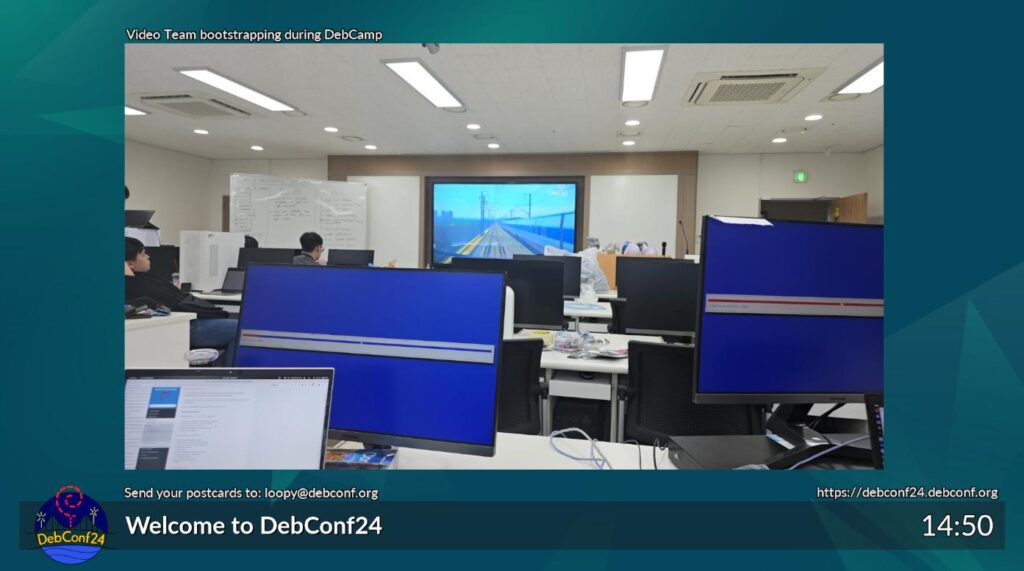

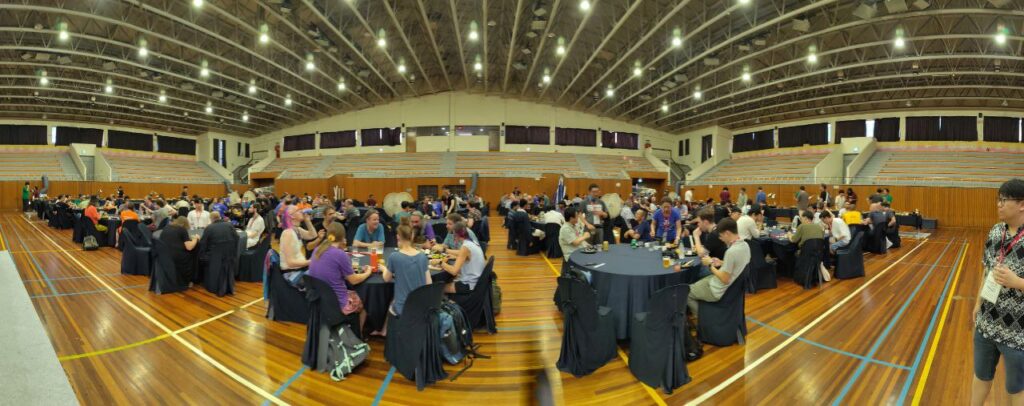 Conference Dinner Photo from Santiago
 Debian annual conference Debconf 24, Busan, South Korea

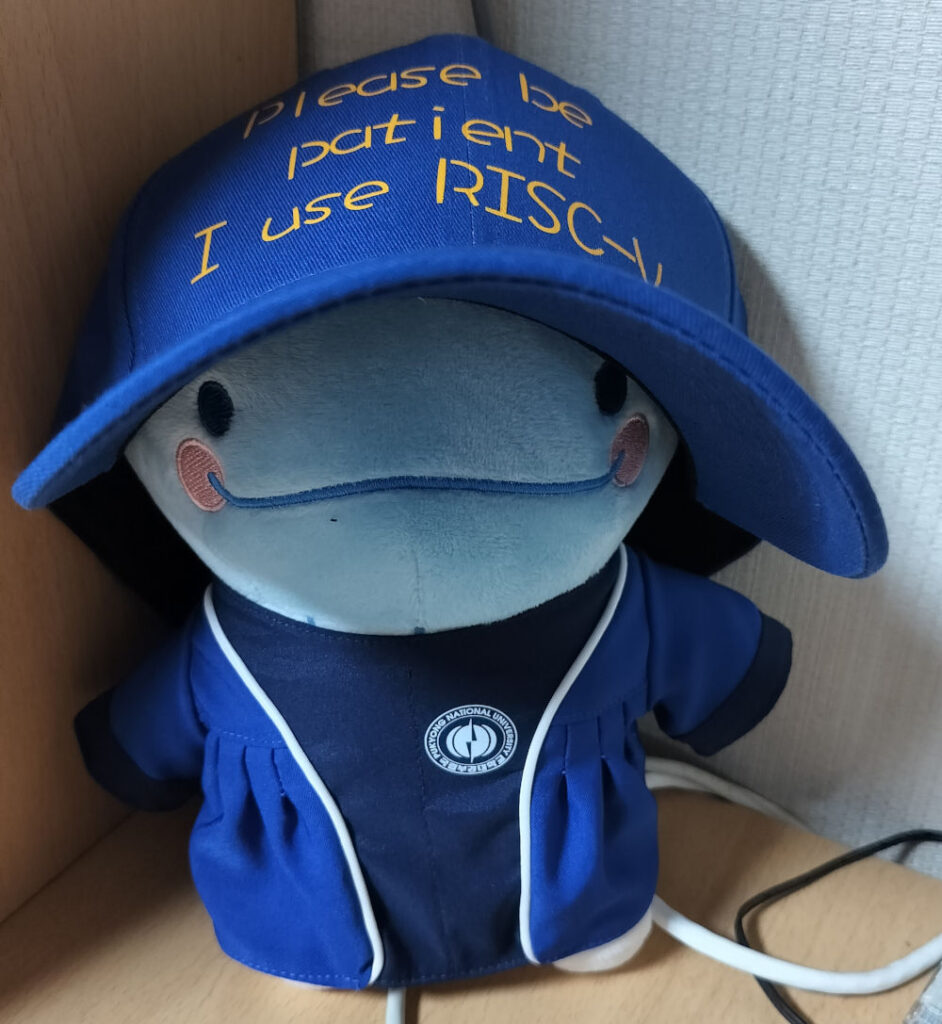
 Debian annual conference Debconf 24, Busan, South Korea
 This is one of those posts that s more for my own reference than likely to be helpful for others. If you re unlucky it ll have some useful tips for you. If I m lucky then I ll get a bunch of folk pointing out some optimisations.
First, what I m trying to achieve. I want a virtual machine environment where I can manually do tests on random kernels, and also various TPM related experiments. So I don t want something as fixed as a
 It s not often that a company is willing to make
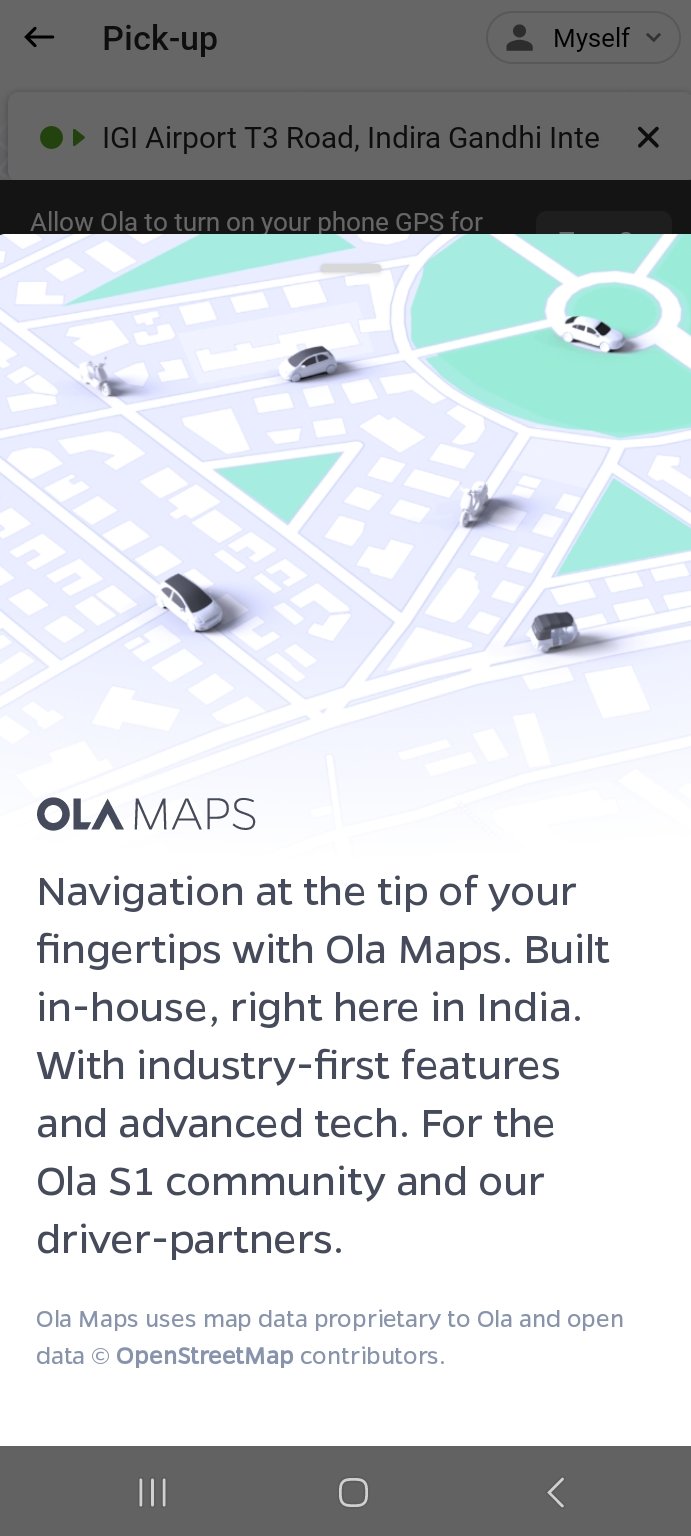
 Here comes the 3rd article of the 5-episode blog post series on Polis, written by Guido Berh rster, member of staff at my company Fre(i)e Software GmbH.
Enjoy also this read on Guido's work on Polis,

 While I was living in Argentina, we (my family) found ourselves checking for
weather forecasts almost constantly weather there can be quite unexpected,
much more so that here in Mexico. So it took me a bit of tinkering to come up
with a couple of simple scripts to show the weather forecast as part of my
 I am using
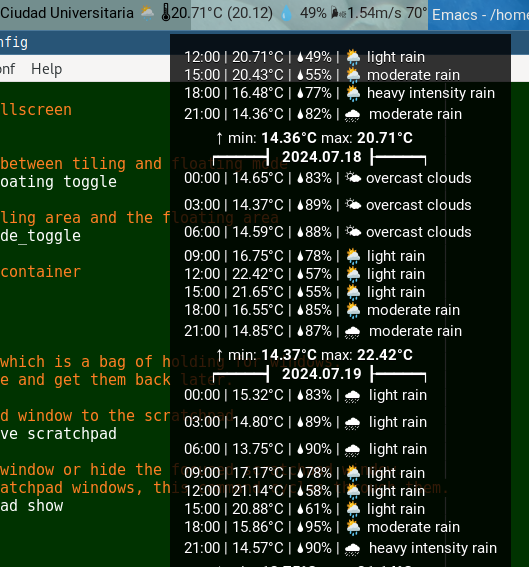 Do note that it seems OpenWeather will return the name of the closest available
meteorology station with (most?) recent data for my home, I often get Ciudad
Universitaria, but sometimes Coyoac n or even San ngel Inn.
 Twenty years ago, it was easy to dislike Microsoft. It was the quintessential evil MegaCorp that was quick to squash competition, often ruthlessly, but in some cases slowly through a more insidious process of embracing, extending, and exterminating anything that got in the way. This was the signature personality of Ballmer-era Microsoft that also inspired and united the software freedom fighting forces that came together to safeguard things that mattered to them and were at risk.I remember the era when the Novell, SCO, and Microsoft saga cast fear, uncertainty, and doubt on the future of open Unix and Linux and on what would happen to the operating systems that we loved if the suits of Redmond prevailed. Looking back, I&aposm glad that the arc of this story has bent towards justice, and I shudder at the possibilities had it worked out differently.Looking at today&aposs Microsoft, I&aposm amazed at how much change a leader with the right vision can make to the trajectory of a company that even makes an old-school software freedom advocate as me admire and even applaud the strides it has taken in the last 10 or so years that has dramatically shifted the perception of Microsoft. The personality of the Satya-era Microsoft is one to behold. While it will take more time to win back the trust, we see the tides changing and the positivity is important for the entire industry.For Microsoft, it was TypeScript and VS Code that helped change the narrative internally which led to its internal resurgence and acceptance of open source. Its acquisition of GitHub propelled it forward within the community overnight. Its contributions to the Linux kernel and other major software projects have also been consequential in changing its public perceptions.It takes a while to claw back trust and is very easy to breach. This time, however, Microsoft seems to understand this dynamic more than it did 20 years ago. All it took was the right leadership.










 Like each month, have a look at the work funded by
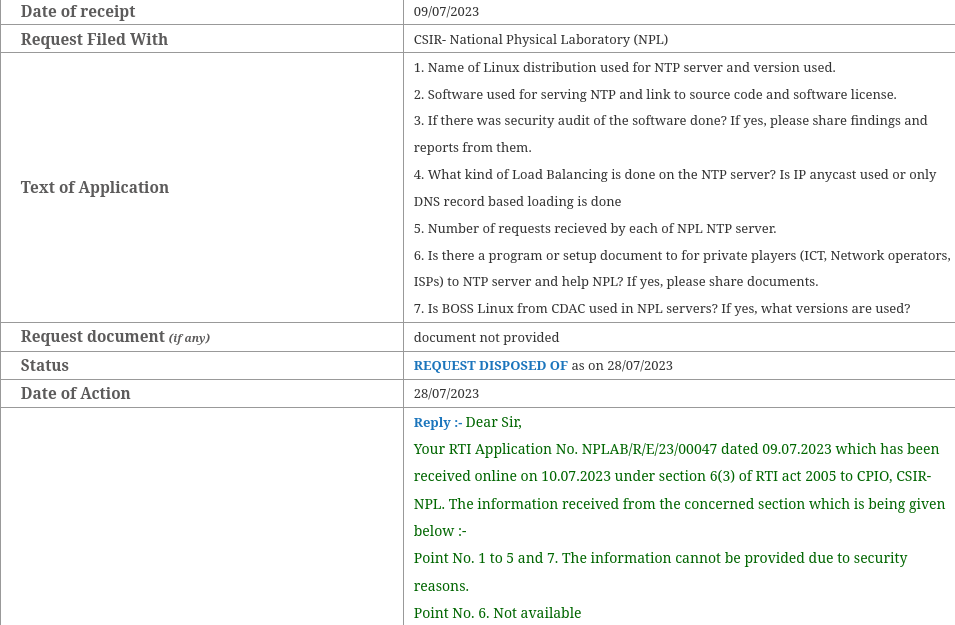

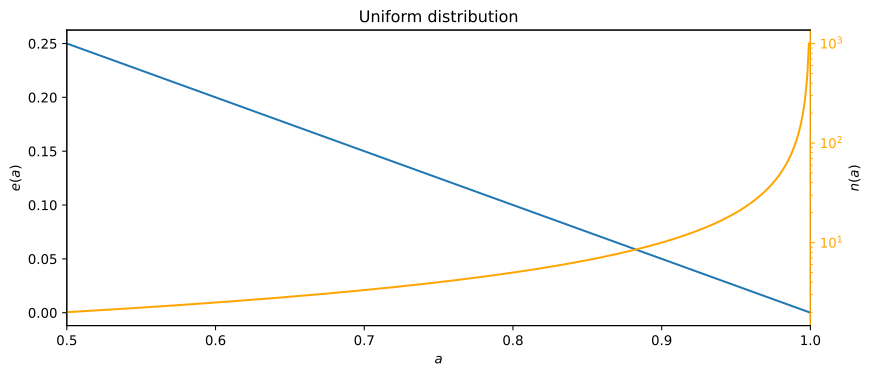 The expected record surpass for the uniform distribution
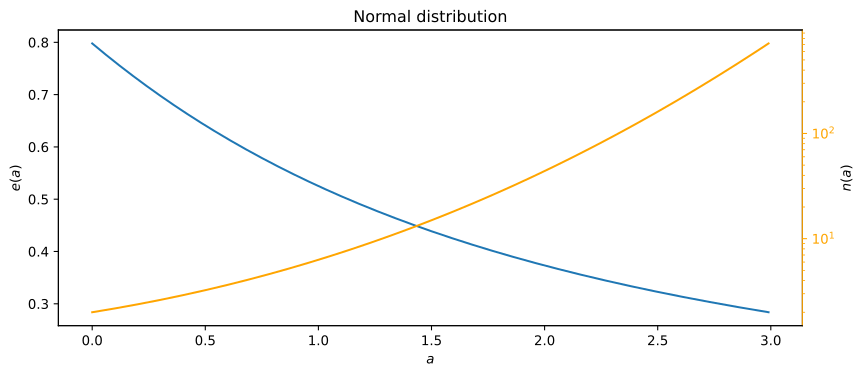 The expected record surpass for the normal distribution
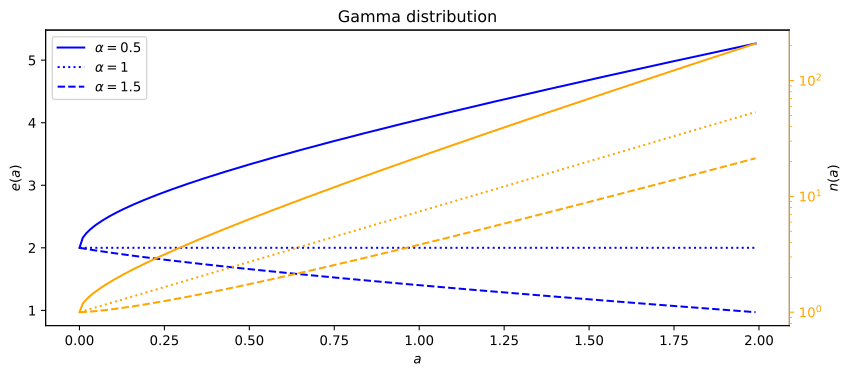 The expected record surpass for the gamma distribution