Search Results: "Dirk Eddelbuettel"

5 August 2022

Dirk Eddelbuettel: RcppXts 0.0.5 on CRAN: Routine Refreshment

A full eight and half years (!!) since its 0.0.4 release, version 0.0.5 of RcppXts is now on CRAN. The RcppXts package demonstrates how to access the export C API of xts which we contributed a looong time ago. This release contains an accumulated small set of updates made as the CRAN Policies evolved. We now register and use the shared library routines (updates in both src/init.c and NAMESPACE), turned on continuous integration, switched it from the now disgraces service to another, adopted our portable r-ci along with r2, added badges to the README.md, updated to https URLs, and made sure the methods package (from base R) was actually imported (something Rcpp has a need for at startup). That latter part now triggered a recent email from the CRAN maintainers which prompted this release. The NEWS entries follow.

Changes in version 0.0.5 (2022-08-05)
  • Depends on xts 0.9-6 now on CRAN
  • Exports (and documents) a number of additional functions
  • Switch CI use to r-ci and r2u
  • README.md, DESCRIPTION and NEWS.Rd were updated and expanded
  • NAMESPACE import of the shared library uses registration

Courtesy of my CRANberries, there is also a diffstat report for this release. A bit more information about the package is available here as well as at the GitHub repo. If you like this or other open-source work I do, you can now sponsor me at GitHub.

This post by Dirk Eddelbuettel originated on his Thinking inside the box blog. Please report excessive re-aggregation in third-party for-profit settings.
13 July 2022

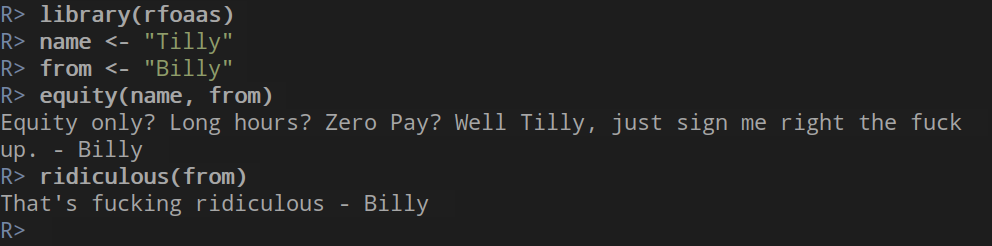
Dirk Eddelbuettel: rfoaas 2.3.2: New upstream accessors

rfoaas greed example FOAAS by now moved to version 2.3.2 in its repo. This releases 2.3.2 of rfoaas catches up, and brings the first release in about two and a half years. This 2.3.2 release of FOAAS brings us six new REST access points: absolutely(), dense(), dumbledore(), lowpoly(), understand(), and yeah(). Along with these new functions, documentation and tests were updated. My CRANberries service provides a diff to the previous CRAN release. Questions, comments etc should go to the GitHub issue tracker. More background information is on the project page as well as on the github repo If you like this or other open-source work I do, you can sponsor me at GitHub.

This post by Dirk Eddelbuettel originated on his Thinking inside the box blog. Please report excessive re-aggregation in third-party for-profit settings.
9 July 2022

Dirk Eddelbuettel: Rcpp 1.0.9 on CRAN: Regular Updates

rcpp logo The Rcpp team is please to announce the newest release 1.0.9 of Rcpp which hit CRAN late yesterday, and has been uploaded to Debian as well. Windows and macOS builds should appear at CRAN in the next few days, as will builds in different Linux distribution and of course at r2u. The release was prepared om July 2, but it took a few days to clear a handful of spurious errors as false positives with CRAN this can when the set of reverse dependencies is so large, and the CRAN team remains busy. This release continues with the six-months cycle started with release 1.0.5 in July 2020. (This time, CRAN had asked for an interim release to silence a C++ warning; we then needed a quick follow-up to tweak tests.) As a reminder, interim dev or rc releases should generally be available in the Rcpp drat repo. These rolling release tend to work just as well, and are also fully tested against all reverse-dependencies. Rcpp has become the most popular way of enhancing R with C or C++ code. Right now, around 2559 packages on CRAN depend on Rcpp for making analytical code go faster and further, along with 252 in BioConductor. On CRAN, 13.9% of all packages depend (directly) on CRAN, and 58.5% of all compiled packages do. From the cloud mirror of CRAN (which is but a subset of all CRAN downloads), Rcpp has been downloaded 61.5 million times. This release is incremental and extends Rcpp with a number of small improvements all detailed in the NEWS file as well as below. We want to highlight the external contributions: a precious list tag is cleared on removal, and a move constructor and assignment for strings has been added (thanks to Dean Scarff), and (thanks to Bill Denney and Marco Colombo) two minor errors are corrected in the vignette documentation. A big Thank You! to everybody who contributed pull request, opened or answered issues, or questions at StackOverflow or on the mailing list. The full list of details follows.

Changes in Rcpp hotfix release version 1.0.9 (2022-07-02)
  • Changes in Rcpp API:
    • Accomodate C++98 compilation by adjusting attributes.cpp (Dirk in #1193 fixing #1192)
    • Accomodate newest compilers replacing deprecated std::unary_function and std::binary_function with std::function (Dirk in #1202 fixing #1201 and CRAN request)
    • Upon removal from precious list, the tag is set to null (I aki in #1205 fixing #1203)
    • Move constructor and assignment for strings have been added (Dean Scarff in #1219).
  • Changes in Rcpp Documentation:
    • Adjust one overflowing column (Bill Denney in #1196 fixing #1195)
    • Correct a typo in the FAQ (Marco Colombo in #1217)
  • Changes in Rcpp Deployment:
    • Accomodate four digit version numbers in unit test (Dirk)
    • Do not run complete test suite to limit test time to CRAN preference (Dirk in #1206)
    • Small updates to the CI test containers have been made
    • Some of changes also applied to an interim release 1.0.8.3 made for CRAN on 2022-03-14.

Thanks to my CRANberries, you can also look at a diff to the previous release. Questions, comments etc should go to the rcpp-devel mailing list off the R-Forge page. Bugs reports are welcome at the GitHub issue tracker as well (where one can also search among open or closed issues); questions are also welcome under rcpp tag at StackOverflow which also allows searching among the (currently) 2886 previous questions. If you like this or other open-source work I do, you can sponsor me at GitHub.

This post by Dirk Eddelbuettel originated on his Thinking inside the box blog. Please report excessive re-aggregation in third-party for-profit settings.

19 June 2022

Dirk Eddelbuettel: #38: Faster Feedback Systems

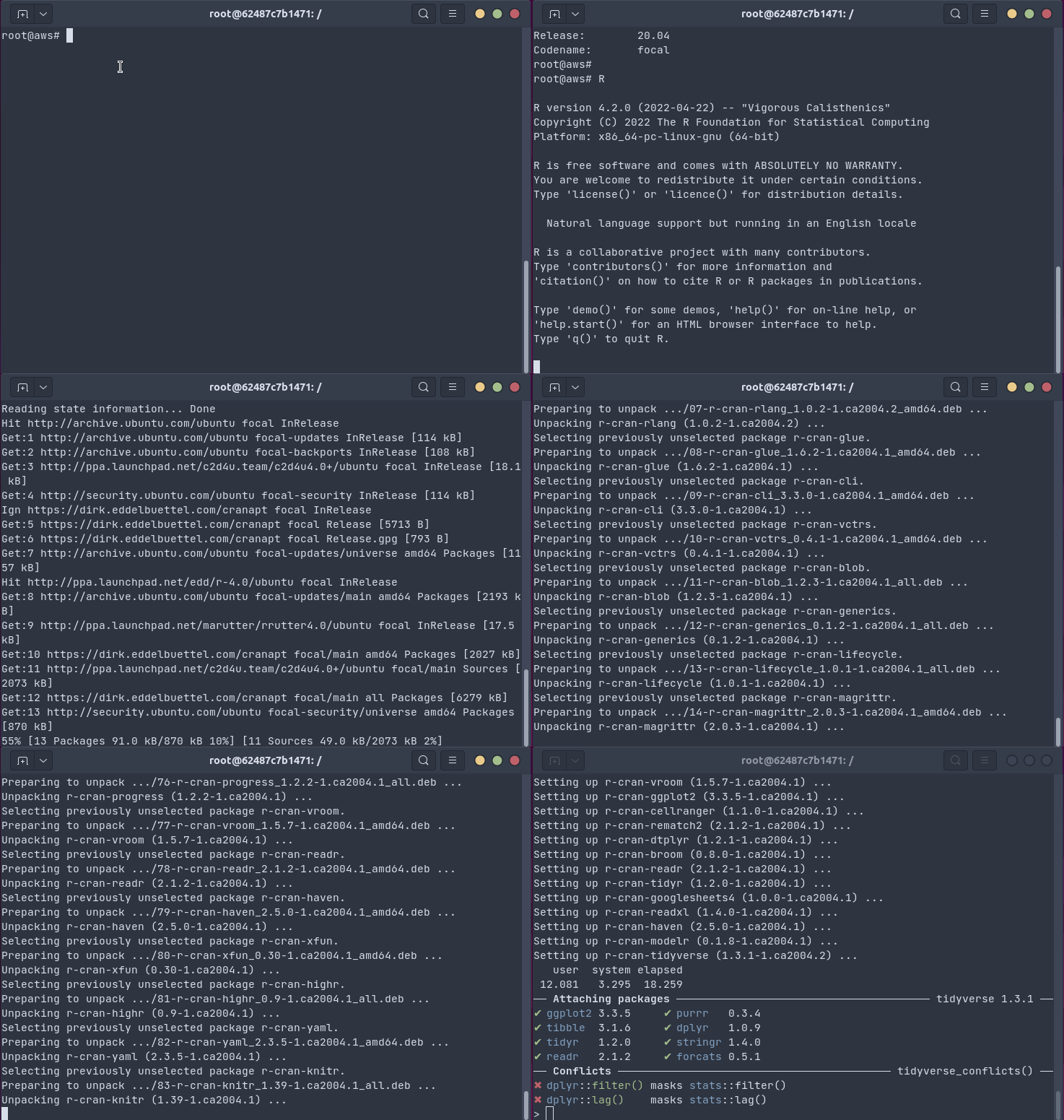
Engineers build systems. Good engineers always stress and focus efficiency of these systems. Two recent examples of engineering thinking follow. One was in a video / podcast interview with Martin Thompson (who is a noted high-performance code expert) I came across recently. The overall focus of the hour-long interview is on managing software complexity . Around minute twenty-two, the conversation turns to feedback loops and systems, and a strong preference for simple and fast systems for more immediate feedback. An important topic indeed. The second example connects to this and permeates many tweets and other writings by Erik Bernhardsson. He had an earlier 2017 post on Optimizing for iteration speed , as well as a 17 May 2022 tweet on minimizing feedback loop size, another 28 Mar 2022 tweet reply on shorter feedback loops, then a 14 Feb 2022 post on problems with slow feedback loops, as well as a 13 Jan 2022 post on a priority for tighter feedback loops, and lastly a 23 Jul 2021 post on fast feedback cycles. You get the idea: Erik really digs faster feedback loops. Nobody likes to wait: immediatecy wins each time. A few years ago, I had touched on this topic with two posts on how to make (R) package compilation (and hence installation) faster. One idea (which I still use whenever I must compile) was in post #11 on caching compilation. Another idea was in post #13: make it faster by not doing it, in this case via binary installation which skip the need for compilation (and which is what I aim for with, say, CI dependencies). Several subsequent posts can be found by scrolling down the r^4 blog section: we stressed the use of the amazing Rutter PPA c2d4u for CRAN binaries (often via Rocker containers, the (post #28) promise of RSPM, and the (post #29) awesomeness of bspm. And then in the more recent post #34 from last December we got back to a topic which ties all these things together: Dependencies. We quoted Mies van der Rohe: Less is more. Especially when it comes to dependencies as these elongate the feedback loop and thereby delay feedback. Our most recent post #37 on r2u connects these dots. Access to a complete set of CRAN binaries with full-dependency resolution accelerates use and installation. This of course also covers testing and continuous integration. Why wait minutes to recompile the same packages over and over when you can install the full Tidyverse in 18 seconds or the brms package and all it needs in 13 seconds as shown in the two gifs also on the r2u documentation site. You can even power up the example setup of the second gif via this gitpod link giving you a full Ubuntu 22.04 session in your browser to try this: so go forth and install something from CRAN with ease! The benefit of a system such our r2u CRAN binaries is clear: faster feedback loops. This holds whether you work with few or many dependencies, tiny or tidy. Faster matters, and feedback can be had sooner. And with the title of this post we now get a rallying cry to advocate for faster feedback systems: FFS .

This post by Dirk Eddelbuettel originated on his Thinking inside the box blog. Please report excessive re-aggregation in third-party for-profit settings.

16 June 2022

Dirk Eddelbuettel: RcppArmadillo 0.11.2.0.0 on CRAN: New Upstream

armadillo image Armadillo is a powerful and expressive C++ template library for linear algebra and scientific computing. It aims towards a good balance between speed and ease of use, has a syntax deliberately close to Matlab, and is useful for algorithm development directly in C++, or quick conversion of research code into production environments. RcppArmadillo integrates this library with the R environment and language and is widely used by (currently) 991 other packages on CRAN, downloaded over 25 million times (per the partial logs from the cloud mirrors of CRAN), and the CSDA paper (preprint / vignette) by Conrad and myself has been cited 476 times according to Google Scholar. This release brings a second upstream fix by Conrad in the release series 11.*. We once again tested this very rigorously via a complete reverse-depedency check (for which results are always logged here). It so happens that CRAN then had a spurious error when re-checking on upload, and it took a fews days to square this as everybody remains busy but the release prepared on June 10 is now on CRAN. The full set of changes (since the last CRAN release 0.11.1.1.0) follows.

Changes in RcppArmadillo version 0.11.2.0.0 (2022-06-10)
  • Upgraded to Armadillo release 11.2 (Classic Roast)
    • faster handling of sparse submatrix column views by norm(), accu(), nonzeros()
    • extended randu() and randn() to allow specification of distribution parameters
    • internal refactoring, leading to faster compilation times

Courtesy of my CRANberries, there is a diffstat report relative to previous release. More detailed information is on the RcppArmadillo page. Questions, comments etc should go to the rcpp-devel mailing list off the R-Forge page. If you like this or other open-source work I do, you can sponsor me at GitHub.

This post by Dirk Eddelbuettel originated on his Thinking inside the box blog. Please report excessive re-aggregation in third-party for-profit settings.

15 June 2022

Dirk Eddelbuettel: AsioHeaders 1.22.1-1 on CRAN

An updated version of the AsioHeaders package arrived at CRAN yesterday (in one of those pleasant fully-automated uploads and transitions). Asio provides a cross-platform C++ library for network and low-level I/O programming. It is also included in Boost but requires linking when used as part of Boost. This standalone version of Asio is a header-only C++ library which can be used without linking (just like our BH package with parts of Boost). This release brings a new upstream version, following a two-year period without updated. This was tickled by OpenSSL 3.0 header changes as seen in a package using both AsioHeaders and OpenSSL.

Changes in version 1.22.1-1 (2022-06-14)
  • Upgraded to Asio 1.22.1 (Dirk in #7 fixing #6).

Thanks to my CRANberries, there is also a diffstat report relative to the previous release. Comments and suggestions about AsioHeaders are welcome via the issue tracker at the GitHub GitHub repo. If you like this or other open-source work I do, you can now sponsor me at GitHub.

This post by Dirk Eddelbuettel originated on his Thinking inside the box blog. Please report excessive re-aggregation in third-party for-profit settings.

25 May 2022

Dirk Eddelbuettel: RcppAPT 0.0.9: Minor Update

A new version of the RcppAPT package with the R interface to the C++ library behind the awesome apt, apt-get, apt-cache, commands and their cache powering Debian, Ubuntu and the like arrived on CRAN earlier today. RcppAPT allows you to query the (Debian or Ubuntu) package dependency graph at will, with build-dependencies (if you have deb-src entries), reverse dependencies, and all other goodies. See the vignette and examples for illustrations. This release updates the code to the Apt 2.5.0 release this makes. It makes a cleaner distinction between public and private components of the API. We adjusted one access point to a pattern we already used, and while at it, simplified some of the transition from the pre-Apt 2.0.0 interface. No new features. The NEWS entries follow.

Changes in version 0.0.9 (2022-05-25)
  • Simplified and standardized to only use public API
  • No longer tests and accomodates pre-Apt 2.0 API

Courtesy of my CRANberries, there is also a diffstat report for this release. A bit more information about the package is available here as well as at the GitHub repo. If you like this or other open-source work I do, you can now sponsor me at GitHub.

This post by Dirk Eddelbuettel originated on his Thinking inside the box blog. Please report excessive re-aggregation in third-party for-profit settings.

21 May 2022

Dirk Eddelbuettel: #37: Introducing r2u with 2 x 19k CRAN binaries for Ubuntu 22.04 and 20.04

One month ago I started work on a new side project which is now up and running, and deserving on an introductory blog post: r2u. It was announced in two earlier tweets (first, second) which contained the two (wicked) demos below also found at the documentation site. So what is this about? It brings full and complete CRAN installability to Ubuntu LTS, both the focal release 20.04 and the recent jammy release 22.04. It is unique in resolving all R and CRAN packages with the system package manager. So whenever you install something it is guaranteed to run as its dependencies are resolved and co-installed as needed. Equally important, no shared library will be updated or removed by the system as the possible dependency of the R package is known and declared. No other package management system for R does that as only apt on Debian or Ubuntu can and this project integrates all CRAN packages (plus 200+ BioConductor packages). It will work with any Ubuntu installation on laptop, desktop, server, cloud, container, or in WSL2 (but is limited to Intel/AMD chips, sorry Raspberry Pi or M1 laptop). It covers all of CRAN (or nearly 19k packages), all the BioConductor packages depended-upon (currently over 200), and only excludes less than a handful of CRAN packages that cannot be built.

Usage Setup instructions approaches described concisely in the repo README.md and documentation site. It consists of just five (or fewer) simple steps, and scripts are provided too for focal (20.04) and jammy (22.04).

Demos Check out these two demos (also at the r2u site):

Installing the full tidyverse in one command and 18 seconds

Installing brms and its depends in one command and 13 seconds (and show gitpod.io)

Integration via bspm The r2u setup can be used directly with apt (or dpkg or any other frontend to the package management system). Once installed apt update; apt upgrade will take care of new packages. For this to work, all CRAN packages (and all BioConductor packages depended upon) are mapped to names like r-cran-rcpp and r-bioc-s4vectors: an r prefix, the repo, and the package name, all lower-cased. That works but thanks to the wonderful bspm package by I aki car we can do much better. It connects R s own install.packages() and update.packages() to apt. So we can just say (as the demos above show) install.packages("tidyverse") or install.packages("brms") and binaries are installed via apt which is fantastic and it connects R to the system package manager. The setup is really only two lines and described at the r2u site as part of the setup.

History and Motivation Turning CRAN packages into .deb binaries is not a new idea. Albrecht Gebhardt was the first to realize this about twenty years ago (!!) and implemented it with a single Perl script. Next, Albrecht, Stefan Moeller, David Vernazobres and I built on top of this which is described in this useR! 2007 paper. A most excellent generalization and rewrite was provided by Charles Blundell in an superb Google Summer of Code contribution in 2008 which I mentored. Charles and I described it in this talk at useR! 2009. I ran that setup for a while afterwards, but it died via an internal database corruption in 2010 right when I tried to demo it at CRAN headquarters in Vienna. This peaked at, if memory serves, about 5k packages: all of CRAN at the time. Don Armstrong took it one step further in a full reimplemenation which, if I recall correctly, coverd all of CRAN and BioConductor for what may have been 8k or 9k packages. Don had a stronger system (with full RAID-5) but it also died in a crash and was never rebuilt even though he and I could have relied on Debian resources (as all these approaches focused on Debian). During that time, Michael Rutter created a variant that cleverly used an Ubuntu-only setup utilizing Launchpad. This repo is still going strong, used and relied-upon by many, and about 5k packages (per distribution) strong. At one point, a group consisting of Don, Michael, G bor Cs rdi and myself (as lead/PI) had financial support from the RConsortium ISC for a more general re-implementation , but that support was withdrawn when we did not have time to deliver. We should also note other long-standing approaches. Detlef Steuer has been using the openSUSE Build Service to provide nearly all of CRAN for openSUSE for many years. I aki car built a similar system for Fedora described in this blog post. I aki and I also have a arXiv paper describing all this.

Details Please see the the r2u site for all details on using r2u.

Acknowledgements The help of everybody who has worked on this is greatly appreciated. So a huge Thank you! to Albrecht, David, Stefan, Charles, Don, Michael, Detlef, G bor, I aki and whoever I may have omitted. Similarly, thanks to everybody working on R, CRAN, Debian, or Ubuntu it all makes for a superb system. And another big Thank you! goes to my GitHub sponsors whose continued support is greatly appreciated.

This post by Dirk Eddelbuettel originated on his Thinking inside the box blog. Please report excessive re-aggregation in third-party for-profit settings.

15 May 2022

Dirk Eddelbuettel: RcppArmadillo 0.11.1.1.0 on CRAN: Updates

armadillo image Armadillo is a powerful and expressive C++ template library for linear algebra and scientific computing. It aims towards a good balance between speed and ease of use, has syntax deliberately close to Matlab and is useful for algorithm development directly in C++, or quick conversion of research code into production environments. RcppArmadillo integrates this library with the R environment and language and is widely used by (currently) 978 other packages on CRAN, downloaded over 24 million times (per the partial logs from the cloud mirrors of CRAN), and the CSDA paper (preprint / vignette) by Conrad and myself has been cited 469 times according to Google Scholar. This release brings a first new upstream fix in the new release series 11.*. In particular, treatment of ill-conditioned matrices is further strengthened. We once again tested this very rigorously via three different RC releases each of which got a full reverse-dependencies run (for which results are always logged here). A minor issue with old g++ compilers was found once 11.1.0 was tagged to this upstream release is now 11.1.1. Also fixed is an OpenMP setup issue where Justin Silverman noticed that we did not propagate the -fopenmp setting correctly. The full set of changes (since the last CRAN release 0.11.0.0.0) follows.

Changes in RcppArmadillo version 0.11.1.1.0 (2022-05-15)
  • Upgraded to Armadillo release 11.1.1 (Angry Kitchen Appliance)
    • added inv_opts::no_ugly option to inv() and inv_sympd() to disallow inverses of poorly conditioned matrices
    • more efficient handling of rank-deficient matrices via inv_opts::allow_approx option in inv() and inv_sympd()
    • better detection of rank deficient matrices by solve()
    • faster handling of symmetric and diagonal matrices by cond()
  • The configure script again propagates the'found' case again, thanks to Justin Silverman for the heads-up and suggested fix (Dirk and Justin in #376 and #377 fixing #375).

Changes in RcppArmadillo version 0.11.0.1.0 (2022-04-14)
  • Upgraded to Armadillo release 11.0.1 (Creme Brulee)
    • fix miscompilation of inv() and inv_sympd() functions when using inv_opts::allow_approx and inv_opts::tiny options

Courtesy of my CRANberries, there is a diffstat report relative to previous release. More detailed information is on the RcppArmadillo page. Questions, comments etc should go to the rcpp-devel mailing list off the R-Forge page. If you like this or other open-source work I do, you can sponsor me at GitHub.

This post by Dirk Eddelbuettel originated on his Thinking inside the box blog. Please report excessive re-aggregation in third-party for-profit settings.

6 May 2022

Dirk Eddelbuettel: RProtoBuf 0.4.19 on CRAN: Updates

A new release 0.4.19 of RProtoBuf arrived on CRAN earlier today. RProtoBuf provides R with bindings for the Google Protocol Buffers ( ProtoBuf ) data encoding and serialization library used and released by Google, and deployed very widely in numerous projects as a language and operating-system agnostic protocol. This release contains a pull request contribution by Michael Chirico to add support for the TextFormat API, a minor maintenance fix ensuring (standard) string are referenced as std::string to avoid a hickup on Arch builds, some repo updates, plus reporting of (package and library) versions on startup. The following section from the NEWS.Rd file has more details.

Changes in RProtoBuf version 0.4.19 (2022-05-06)
  • Small cleanups to repository
  • Raise minimum Protocol Buffers version to 3.3 (closes #83)
  • Update package version display, added to startup message
  • Expose TextFormat API (Michael Chirico in #88 closing #87)
  • Add missing explicit std:: on seven string instances in one file (closes #89)

Thanks to my CRANberries, there is a diff to the previous release. The RProtoBuf page has copies of the (older) package vignette, the quick overview vignette, and the pre-print of our JSS paper. Questions, comments etc should go to the GitHub issue tracker off the GitHub repo. If you like this or other open-source work I do, you can now sponsor me at GitHub.

This post by Dirk Eddelbuettel originated on his Thinking inside the box blog. Please report excessive re-aggregation in third-party for-profit settings.

Dirk Eddelbuettel: RQuantLib 0.4.16 on CRAN: Small Updates

A new release 0.4.16 of RQuantLib arrived at CRAN earlier today, and has been uploaded to Debian as well. QuantLib is a very comprehensice free/open-source library for quantitative finance; RQuantLib connects it to the R environment and language. The release of RQuantLib comes agaain about four months after the previous release, and brings a a few small updates for daycounters, all thanks to Kai Lin, plus a small parameter change to avoid an error in an example, and small updates to the Docker files.

Changes in RQuantLib version 0.4.16 (2022-05-05)
  • Documentationn for daycounters was updated and extended (Kai Lin)
  • Deprecated daycounters were approtiately updated (Kai Lin)
  • One example parameterization was changed to avoid error (Dirk)
  • The Docker files were updated

Courtesy of my CRANberries, there is also a diffstat report for the this release. As always, more detailed information is on the RQuantLib page. Questions, comments etc should go to the new rquantlib-devel mailing list. Issue tickets can be filed at the GitHub repo. If you like this or other open-source work I do, you can now sponsor me at GitHub.

This post by Dirk Eddelbuettel originated on his Thinking inside the box blog. Please report excessive re-aggregation in third-party for-profit settings.

14 April 2022

Dirk Eddelbuettel: drat 0.2.3 on CRAN: Arm M1 Support

drat user A new minor release of drat arrived on CRAN today. drat stands for drat R Archive Template, and helps with easy-to-create and easy-to-use repositories for R packages. Since its inception in early 2015 it has found widespread adoption among R users because repositories with marked releases is the better way to distribute code. See below for a few custom reference examples. Because for once it really is as your mother told you: Friends don t let friends install random git commit snapshots. Properly rolled-up releases it is. Just how CRAN shows us: a model that has demonstrated for two-plus decades how to do this. And you can too: drat is easy to use, documented by six vignettes and just works. Detailed information about drat is at its documentation site. This release adds support for the macOS Arm M1 architecture, initially supplied in a PR last fall and now finalized with additional tests. The NEWS file summarises the release as follows:

Changes in drat version 0.2.3 (2022-04-13)
  • Arm M1 repos are now supported (#126 and #131 fixing #125)
  • A vignette typo has been fixed (#130)

Courtesy of my CRANberries, there is a comparison to the previous release. More detailed information is on the drat page as well as at the documentation site. If you like this or other open-source work I do, you can now sponsor me at GitHub.

This post by Dirk Eddelbuettel originated on his Thinking inside the box blog. Please report excessive re-aggregation in third-party for-profit settings.

10 April 2022

Dirk Eddelbuettel: RcppRedis 0.2.1: Maintenance

A month after the major release 0.2.0 bringing pub/sub and other goodies to our RcppRedis package, a new version 0.2.1 arrived on CRAN yesterday. RcppRedis is one of several packages connecting R to the fabulous Redis in-memory datastructure store (and much more). RcppRedis does not pretend to be feature complete, but it may do some things faster than the other interfaces, and also offers an optional coupling with MessagePack binary (de)serialization via RcppMsgPack. The package has carried production loads for several years now. This release updated the rredis suggestion by adding an Additional_repositories entry as Bryan decided to retire the rredis package. You can still install it via install.packages("rredis") by setting the addtional repo, for example repos=c("https://ghrr.github.io/drat", getOption("repos")) as documented in package and at our ghrr drat repo. The detailed changes list follows.

Changes in version 0.2.1 (2022-04-09)
  • The rredis package can be installed via the repo listed in Additional_repositories; the pubsub.R test file makes rredis optional and conditional; all demos now note that the optional rredis package is installable via the drat listed in Additional_repositories.
  • The fallback-compilation of hiredis has been forced to override compilation flags because CRAN knows better than upstream.
  • The GLOBEX pub/sub example has small updates.

Courtesy of CRANberries, there is also a diffstat report for this release. More information is on the RcppRedis page. If you like this or other open-source work I do, you can now sponsor me at GitHub.

This post by Dirk Eddelbuettel originated on his Thinking inside the box blog. Please report excessive re-aggregation in third-party for-profit settings.

8 April 2022

Dirk Eddelbuettel: RcppEigen 0.3.3.9.2 on CRAN: Maintenance

A new release 0.3.3.9.2 of RcppEigen arrived on CRAN today (and already went to Debian). Eigen is a C++ template library for linear algebra: matrices, vectors, numerical solvers, and related algorithms. This update was (as it happens) requested by CRAN as R aims to bring the Fortran / C interface to best practices. We call dgesdd twice in one example and use a character argument, and the-powers-that-be now prefer better control over that character argument. So we did. Another change, kindly contributed by Mikael Jagan, switches row and column indices for R_xlen_t allowing for greater range. Plus some more small tweaks mostly to CI, see the NEWS entry below for full details. And again as we said for the previous three releases:
One additional and recent change was the accomodation of a recent CRAN Policy change to not allow gcc or clang to mess with diagnostic messages. A word of caution: this may make your compilation of packages using RcppEigen very noisy so consider adding -Wno-ignored-attributes to the compiler flags added in your ~/.R/Makevars.
We still find this requirement rather annoying. Eigen is only usable if you set, say,
-Wno-deprecated-declarations -Wno-parentheses -Wno-ignored-attributes -Wno-unused-function
asoptions in~/.R/Makevars . But CRAN makes the rules. Maybe if a few of us gently and politely nudge them they may relent one day. One can only hope. The complete NEWS file entry follows.

Changes in RcppEigen version 0.3.3.9.2 (2022-04-05)
  • Added test coverage in continuous integration
  • Added new tests to increase test coverage
  • Small improvement to the RcppEigen.package.skeleton() code
  • Small updates and edits to README.md and inst/CITATION
  • Use R_xlen_t for vector rows and columns (by Mikael Jagan)
  • Support USE_FC_LEN_T by adding FCONE to two dgesdd calls

Courtesy of CRANberries, there is also a diffstat report for the most recent release. If you like this or other open-source work I do, you can sponsor me at GitHub.

This post by Dirk Eddelbuettel originated on his Thinking inside the box blog. Please report excessive re-aggregation in third-party for-profit settings.

5 April 2022

Dirk Eddelbuettel: RcppSpdlog 0.0.8 on CRAN: Upstream Update

A new version 0.0.8 of RcppSpdlog is now on CRAN. RcppSpdlog bundles spdlog, a wonderful header-only C++ logging library with all the bells and whistles you would want that was written by Gabi Melman, and also includes fmt by Victor Zverovich. This release brings a new upstream release 1.10.0 of spdlog. The (minimal) NEWS entry for this release follows.

Changes in RcppSpdlog version 0.0.8 (2022-04-04)
  • Upgraded to upstream releases spdlog 1.10.0

Courtesy of my CRANberries, there is also a diffstat report. More detailed information is on the RcppSpdlog page, or the package documention site. If you like this or other open-source work I do, you can sponsor me at GitHub.

This post by Dirk Eddelbuettel originated on his Thinking inside the box blog. Please report excessive re-aggregation in third-party for-profit settings.

Dirk Eddelbuettel: RcppArmadillo 0.11.0.0.0 on CRAN: Upstream Updates

armadillo image Armadillo is a powerful and expressive C++ template library for linear algebra aiming towards a good balance between speed and ease of use with a syntax deliberately close to a Matlab. RcppArmadillo integrates this library with the R environment and language and is widely used by (currently) 972 other packages on CRAN, downloaded over 24 million times (per the partial logs from the cloud mirrors of CRAN), and the CSDA paper (preprint / vignette) by Conrad and myself has been cited 465 times according to Google Scholar. This release brings a new upstream release 11.0.0. We tested this very rigorously via three different RC release each of which got a full reverse-dependencies run (for which results are always logged here). The full set of changes (since the last CRAN release 0.10.8.1.0) follows.

Changes in RcppArmadillo version 0.11.0.0 (2022-04-04)
  • Upgraded to Armadillo release 11.0.0 (Creme Brulee)
    • added variants of inv() and inv_sympd() that provide rcond (reciprocal condition number)
    • expanded inv() and inv_sympd() with options inv_opts::tiny and inv_opts::allow_approx
    • stricter handling of singular matrices by inv() and inv_sympd()
    • stricter handling of non-sympd matrices by inv() and inv_sympd()
    • stricter handling of non-finitie matrices by pinv()
    • more robust handling of rank deficient matrices by solve()
    • faster handling of diagonal matrices by rcond()
    • changed eigs_sym() and eigs_gen() to use higher quality RNG
    • quantile() and median() will now throw an exception if given matrices/vectors have NaN elements
    • workaround for yet another bug in Intel MKL
  • Until May 2022, protect correction to Field behavior via define of RCPP_ARMADILLO_FIX_Field
  • If a LAPACK installation with missing complex routines is found (as e.g. Ubuntu using 3.9.0) then the LAPACK unit test is skipped.

Changes in RcppArmadillo version 0.10.8.2.0 (2022-02-01)
  • Upgraded to Armadillo release 10.8.2 (Realm Raider)
    • fix potential speed regression in pinv() and rank()

Courtesy of my CRANberries, there is a diffstat report relative to previous release. More detailed information is on the RcppArmadillo page. Questions, comments etc should go to the rcpp-devel mailing list off the R-Forge page. If you like this or other open-source work I do, you can sponsor me at GitHub.

This post by Dirk Eddelbuettel originated on his Thinking inside the box blog. Please report excessive re-aggregation in third-party for-profit settings.

1 April 2022

Dirk Eddelbuettel: RInside 0.2.17

A new release 0.2.17 of RInside arrived on CRAN and in Debian today. This is the first release in two years since the 0.2.16 release. RInside provides a set of convenience classes which facilitate embedding of R inside of C++ applications and programs, using the classes and functions provided by Rcpp. This release brings a minor update for R 4.2.0, due out later this month, and kindly provided by Tomas Kalibera. It updates one function declaration; we wrapped some conditioning around so that RInside continues to build with older releases too. Besides that minor updates were made to continuous integration and some of the package files. The short list of changes since the last release were:

Changes in RInside version 0.2.17 (2022-03-31)
  • A Windows-only patch for R 4.2.0 kindly provided by Tomas Kalibera was applied, and also conditioned on R (>= 4.2.0)
  • Continuous Integration setup was updated and now uses r-ci.
  • Several updates were made to README.md (badges etc) and DESCRIPTION

My CRANberries also provides a short report with changes from the previous release. More information is on the RInside page. Questions, comments etc should go to the rcpp-devel mailing list off the Rcpp R-Forge page, or to issues tickets at the GitHub repo. If you like this or other open-source work I do, you can now sponsor me at GitHub.

This post by Dirk Eddelbuettel originated on his Thinking inside the box blog. Please report excessive re-aggregation in third-party for-profit settings.

29 March 2022

Dirk Eddelbuettel: RcppBDT 0.2.5: Maintenance

A minor maintenance release for the RcppBDT package is now on CRAN. The RcppBDT package is an early adopter of Rcpp and was one of the first packages utilizing Boost and its Date_Time library. The now more widely-used package anytime is a direct descentant of RcppBDT. Thanks again for the heads-up! This release mostly deals with a one-definition rule violation detected by link-time optimisation (which can be enable when configuring R itself at build time with --enable-lto). I confused myself into thinking Rcpp Modules may be at fault, but I aki was a little more awake than myself and noticed that I only needed to carry the (common) header RcppBDT.h to the file toPOSIXct.cpp added last summer. The NEWS entry follows:

Changes in version 0.2.5 (2022-03-29)
  • Ensure consistent compilation by ensuring RcppBDT.h is included in all files, this addresses an LTO/ODR issue
  • Correct one declaration in init.c
  • Minor additional cleanups

Courtesy of my CRANberries, there is also a diffstat report for this release. If you like this or other open-source work I do, you can now sponsor me at GitHub.

This post by Dirk Eddelbuettel originated on his Thinking inside the box blog. Please report excessive re-aggregation in third-party for-profit settings.

28 March 2022

Dirk Eddelbuettel: RcppCNPy 0.2.11

A minor maintenance release of the RcppCNPy package arrived on CRAN three days ago, but we skipped announcing it right then. RcppCNPy provides R with read and write access to NumPy files thanks to the cnpy library by Carl Rogers along with Rcpp for the glue to R. One of the vignettes created an issue at CRAN with one of the Python modules used, so we simply switched to pre-made vignettes just as we do for a few other packages. Other small changes that had accumulated since the previous release were a new section in the reticulate vignette as well as some more documentation on types as well as some updates to continuous integration and bdages.

Changes in version 0.2.11 (2022-03-24)
  • The reticulate vignette has new section on 3d-arrays.
  • Added clarification to the manual page that the default types are 32-bit integer and 64-bit double (as we are working with R here).
  • Several updates have been made to the CI system; it now runs r-ci.
  • The README.md was updated with some new badges.
  • The vignettes are now pre-made to avoid any external dependencies.

CRANberries also provides a diffstat report for the latest release. As always, feedback is welcome and the best place to start a discussion may be the GitHub issue tickets page.

This post by Dirk Eddelbuettel originated on his Thinking inside the box blog. Please report excessive re-aggregation in third-party for-profit settings.

17 March 2022

Dirk Eddelbuettel: Rcpp 1.0.8.3: Hotfixing Hotfix

rcpp logo An even newer hot-fix release 1.0.8.3 of Rcpp follows the 1.0.8.2 release of a few days ago and got to CRAN this morning. A Debian upload will follow shortly, and Windows and macOS binaries will appear at CRAN in the next few days. This release again breaks with the six-months cycle started with release 1.0.5 in July 2020. When we addressed the CRAN request in 1.0.8.2 we forgot to dial testing down to their desired level (as three-part release numbers do automagically for us, whereas four-part do not). This is now taken care of, along with the hot-fix that was in 1.0.8.2 already. Rcpp has become the most popular way of enhancing R with C or C++ code. Right now, around 2522 packages on CRAN depend on Rcpp for making analytical code go faster and further, along with 239 in BioConductor. The full list of details for these two interim releases (and hence all changes accumulated since the last regular release, 1.0.8 in January) follows.

Changes in Rcpp hotfix release version 1.0.8.3 (2022-03-14)
  • Changes in Rcpp API:
    • Accomodate C++98 compilation by adjusting attributes.cpp (Dirk in #1193 fixing #1192)
    • Accomodate newest compilers replacing deprecated std::unary_function and std::binary_function with std::function (Dirk in #1202 fixing #1201 and CRAN request)
  • Changes in Rcpp Documentation:
    • Adjust one overflowing column (Bill Denney in #1196 fixing #1195)
  • Changes in Rcpp Deployment:
    • Accomodate four digit version numbers in unit test (Dirk)
    • Do not run complete test suite to limit test time to CRAN preference (Dirk)

Thanks to my CRANberries, you can also look at a diff to the previous release. Questions, comments etc should go to the rcpp-devel mailing list off the R-Forge page. Bugs reports are welcome at the GitHub issue tracker as well (where one can also search among open or closed issues); questions are also welcome under rcpp tag at StackOverflow which also allows searching among the (currently) 2843 previous questions. If you like this or other open-source work I do, you can sponsor me at GitHub.

This post by Dirk Eddelbuettel originated on his Thinking inside the box blog. Please report excessive re-aggregation in third-party for-profit settings.

Next.

Previous.