Search Results: "zed"

22 May 2007

Daniel Jacobowitz: New hosting

The machine (formerly) hosting this blog was a dedicated server. I’ve got nothing bad to say about the hosting company, but it had the usual pitfalls of dedicated hosting. It was very expensive, which is why I split the service with two friends. We underutilized it. They didn’t provide backup services, so I ran my own using rdiff-backup - I won’t tell you how long I ran it before I bothered to set that up, though. And when something went wrong it could take quite a while to get the machine fixed and running again. Fortunately that only happened twice in all the time we were there. Anyway, our contract with them was up in February, and we decided not to renew. Since all of us were insanely busy at the time we decided to pay the higher monthly rate for three months to give us some time to migrate off. Which of course I left to the last minute. This blog is one of the first services I’ve moved to my new hosting at Slicehost. I don’t have a lot to say about these guys yet, since I haven’t had any trouble. The only downside was catching them at a somewhat turbulent and resource-starved time as they dealt with a wait list for orders, so it took a month for me to get one. They’re working on that problem, though. Towards the end I was checking every two days or so how long it said I’d have to wait. Note to everyone, progress bars that don’t progress are just infuriating. But I happened to check one day during the five minute window between when they sent me confirmation and when my mail client checked for new mail, and poof there it was. This is virtual hosting - Etch on Xen - thus the “slice” naming. They’re a heavy on automation shop, which fits right in with my style. And there is something so viscerally awesome about entering your credit card number, clicking OK, having their software allocate and create a virtualized disk, bootstrapping Etch onto it, and showing you its IP and root password. It doesn’t get much better than that. So far I’m happy. I took the opportunity to move to WordPress, away from my old hacked up Blosxom installation. WordPress imported entries easily, although I had to manually fudge the RSS file to prevent it from inserting a log of bogus <br> tags that I didn’t want in the middle of my paragraphs. I probably could have gotten comments imported too, but I didn’t bother - sorry folks, well, it’s not like there were a whole lot of them. The Debian WordPress packages work fine, although the configuration is a bit messy; my biggest complaints were the centralized upload and themes directories so that I had to mess around with symlinks in /usr to get everything going. Maybe I’ll actually use it more :-) I hacked up the GUIDs a bit by hand, so this shouldn’t flood planet, but here’s hoping. Next step: migrating email service to the new system. Always a joy.

Bernd Zeimetz: playing german lotto

playing german lotto update: sorry for the broken feed, I hope I ve kicked this piece of php hard enough so it works as it s supposed to work. Tomorrow I ll replace it by something maintainable, written in python. Stefano, I have no clue how the lottery in Italy works, but I ll play the numbers generated by this little program on Wednesday and Saturday:
#!/usr/bin/python
 
numbers = ["09", "F9", "11", "02", "9D", "74", "E3", "5B",
           "D8", "41", "56", "C5", "63", "56", "88", "C0"]
 
#in germany all lotto numbers x must be 1 <= x <= 49
numbers_int = [ (int(num, 16) % 49) + 1 for num in numbers ]
 
#unfortunately 16 numbers are not enough for 3 fields in
#the german lottery, so let's add the current year
#(of course, you can add 2 other numbers, if you don't like this year)
numbers_int += [20, 07]
 
print "your numbers for the german lotto:"
print numbers_int[0:6], numbers_int[6:12], numbers_int[12:18]

21 May 2007

Bernd Zeimetz: hi, planet // iso8859-15 to utf8 with netatalk magic

<div xmlns='http://www.w3.org/1999/xhtml'> <h1><a name="hi_planet_iso8859-15_to_utf8_with_netatalk_magic" id="hi_planet_iso8859-15_to_utf8_with_netatalk_magic">hi, planet // iso8859-15 to utf8 with netatalk magic</a></h1> <p> <em><strong>Hi, Planet!</strong> <br/> Welcome to my blog, and thanks to <a href="http://blog.zobel.ftbfs.de/" title="http://blog.zobel.ftbfs.de/" rel="nofollow">Martin</a> for subscribing me. I m not going to bother you with any details about me, if you have any questions feel free to ask me on <a href="http://freenode.net/" title="http://freenode.net/" rel="nofollow">freenode</a> or <a href="http://www.oftc.net/" title="http://www.oftc.net/" rel="nofollow">oftc</a> (in case you re wondering: my nick is bzed).</em> <br/> <br/> After a longer time of planning we ve upgraded our main file server at <a href="http://www.architektur.tu-darmstadt.de" title="http://www.architektur.tu-darmstadt.de" rel="nofollow">work</a>: New machine, new storage (7TB - woohoo!), Etch instead of Sarge and <a href="http://en.wikipedia.org/wiki/UTF-8" title="http://en.wikipedia.org/wiki/UTF-8">UTF-8</a> for file names instead of <a href="http://en.wikipedia.org/wiki/ISO8859-15" title="http://en.wikipedia.org/wiki/ISO8859-15">ISO8859-15</a>. Everything not a too complicated thing, except for renaming the about 10,000,000 files from ISO8859-15 to UTF-8 in a proper way. <br/> In theory this is easy, as <a href="http://packages.debian.org/unstable/utils/convmv" title="http://packages.debian.org/unstable/utils/convmv" rel="nofollow">convmv</a> happily takes care of the problem. But this did not work for us unfortunately, as we re not only providing NFS and Samba services, but also AFP (<a href="http://en.wikipedia.org/wiki/Apple_Filing_Protocol" title="http://en.wikipedia.org/wiki/Apple_Filing_Protocol">Apple_Filing_Protocol</a>) via netatalk. Years ago you had to choose ISO8859-15 if you wanted to allow your Apple and Windows users to see the same, non-broken file names - not only because AFP didn t support UTF8 before version 3, which came out with OSX<a href="#fn__1" name="fnt__1" id="fnt__1">1)</a>. Normally you d think that a server would not allow a client to write a file with a file name which includes not supported characters - again, OSX and netatalk go their own way here:<br/> Characters which are not supported by the underlying file system are character(!)-wise encoded using the <a href="http://netatalk.sourceforge.net/2.0/htmldocs/configuration.html#id2898845" title="http://netatalk.sourceforge.net/2.0/htmldocs/configuration.html#id2898845" rel="nofollow">CAP encoding</a>. So we had to find a way to </p> <ul> <li> convert file names from ISO8859-15 to UTF-8 </li> <li> replace CAP encoded characters by the appropriate UTF-8 character </li> </ul> <p> Luckily netatalk ships the <a href="http://netatalk.sourceforge.net/2.0/htmldocs/uniconv.1.html" title="http://netatalk.sourceforge.net/2.0/htmldocs/uniconv.1.html" rel="nofollow">uniconv(1)</a> util<a href="#fn__2" name="fnt__2" id="fnt__2">2)</a> which is able to take care of this problem. It also updates the CNID<a href="#fn__3" name="fnt__3" id="fnt__3">3)</a> Database at the same time. There s two things you need to take care of in case you re using the dbd <a href="http://netatalk.sourceforge.net/2.0/htmldocs/configuration.html#CNID-backends" title="http://netatalk.sourceforge.net/2.0/htmldocs/configuration.html#CNID-backends" rel="nofollow">CNID backend</a>: </p> <ul> <li> uniconv assumes that <em>cnid_metad</em> is listening on port 4700, you need to start it first. Don t run afpd at the same time! </li> <li> If you ve specified external CNID dbpaths in your <em>AppleVolumes.default</em> (normally they re located in the root of each volume, prone to be deleted by users accidentally), you need to move the .AppleDB directory into your volume s root directory, otherwise uniconv will create a new CNID database. Just move it back as soon as uniconv is finished. </li> </ul> <p> Be careful: uniconv assumes that all colons in a file name are part of a CAP encoded character. That s not a problem as long as you have only Mac and Windows clients accessing your server, as both systems do not allow colons in file names. In our case we found a number of cache files from Nautilus (which is running on our sunray/Solaris web-surf terminals as default browser) with colons in the file name. I hope no user will miss them <img src="http://bzed.de/lib/images/smileys/icon_wink.gif" alt=";-)" /> </p> <p> Including a final synchronisation of all files to the new storage, about two hours it took uniconv to convert the file names and a aunch break, we were finished after about 14 hours of work. Until now it seems that our users didn t notice the change at all, except for those who realized that they have much more free space now. Looks like a successful weekend so far! <img src="http://bzed.de/lib/images/smileys/icon_biggrin.gif" alt=":-D" /> </p> <p> <strong>update:</strong> full html in the feed. </p> <div class="tags"><span> <a href="http://bzed.de/tags/debian" class="wikilink1" title="tags:debian" rel="tag">debian</a>, <a href="http://bzed.de/tags/linux" class="wikilink1" title="tags:linux" rel="tag">linux</a> </span></div> <a href="#fnt__1" id="fn__1" name="fn__1">1)</a> and uses a NFD variant of Unicode normalization (<a href="http://en.wikipedia.org/wiki/UTF-8%23Mac_OS_X" title="http://en.wikipedia.org/wiki/UTF-8%23Mac_OS_X">UTF-8#Mac_OS_X</a>), but netatalk takes care of this and translates it into the NFC form, which is used on most other platforms <a href="#fnt__2" id="fn__2" name="fn__2">2)</a> it s called netatalk-uniconv in Debian and shipped with <a href="http://packages.debian.org/stable/net/netatalk" title="http://packages.debian.org/stable/net/netatalk" rel="nofollow">netatalk</a> <a href="#fnt__3" id="fn__3" name="fn__3">3)</a> Catalog Node ID, another crust from old Mac <acronym title="Operating System">OS</acronym> versions </div>

20 May 2007

Julien Blache: Fixing SANE s SCSI interface in 32/64bit mixed environments

I’ve just uploaded to unstable a new revision of SANE which fixes the longstanding SCSI interface problem in 32/64bit mixed environments. If you own a SCSI scanner, please read on and give it a go. For the past several years, it wasn’t possible to scan using a SCSI scanner if you were running a 64bit kernel and a 32bit userland. The sg_hdr struct, which is the base of the Linux SG3 interface, contains pointers (you see that coming, right?) so its size obviously differs in 32bit and 64bit mode; and a 32bit pointer is kind of useless as-is for a 64bit kernel. The SG3 asynchronous interface (read/write calls on /dev/sgX) does not handle the 32/64bit conversion and returns an error while sanity checking the sg_hdr struct passed to it. Hopefully, the SG_IO ioctl interface, also part of SG3 and now generalized to every SCSI device (not limited to /dev/sgX), uses the same sg_hdr struct with the added bonus that the ioctl 32bit compat layer built into the kernel converts the 32bit sg_hdr it gets from userland to a 64bit sg_hdr it passes on to the 64bit ioctl handler, and back again. Only difference, the SG_IO ioctl interface is synchronous, whereas the read/write interface is asynchronous and thus allows command queueing. So SANE (sanei_scsi) now has lost its command queueing feature but it looks like (after testing) it wasn’t making any difference anymore. This problem affects users on the following architectures, when running a 64bit kernel with a 32bit userland: i386/amd64, MIPS, MIPSel, SPARC, PowerPC, ia64. That makes for an important part of our supported architectures. If you own a SCSI scanner, here’s a test you can do: scan using the current version of SANE in unstable (1.0.19~cvs20070505-2), then with the new, patched version (1.0.19~cvs20070505-3) and report back if: If all goes well, this patch will make it into SANE upstream RSN.

Steve Kemp: When the light begins to change

All being well I now have a blog working using Typo, instead of Wordpress 2 and no broken links! We ll see. Now to make sure that my server load doesn t rise through the roof this time. For future reference importing entries from Wordpress2 -> Typo will almost certainly give you this error:
1
2
3
4
5
const_missing': uninitialized constant TestRequest (NameError)
        from ./db/converters/../../config/../app/models/blog.rb
...
..
.
This can be fixed by changing:
1
2
3
4
5
def really_send_pings(serverurl = blog.server_url, articleurl = nil)
   return unless blog.send_outbound_pings
   ...
   ...
end
To this:
1
2
3
def really_send_pings(serverurl = blog.server_url, articleurl = nil) 
   return
end

Kartik Mistry: 3 years

* I just realized that I have completed 3 years in Magnet on 10th May. I have seen people coming, staying and living like they were never been part of team! /me thanks himself for keeping faith :)

19 May 2007

Evan Prodromou: 29 Flor al CCXV

Busy day yesterday; the first day of RoCoCoCamp, and the first day seeing a lot of friends and friendly faces from out of town. I was out of bed at 6AM yesterday. I stopped at St. Viateur Bagel on Mont Royal and got 10 dozen bagels -- enough for our expected crowd. I got to SAT at about 8AM, just in time to start the coffee machines. The big percolators I rented for the event require about an hour to make coffee, so if people were going to be coming in at 9AM, I really wanted to get them started by 8. Alain Bernardeau from computation.to got there soon after, and set up the spare computers his organization is lending us. Brandon Sanders, Mark Dilley and Nathan R also came in early, looking for work to do. I got them all into the job of setting up the food for breakfast. By 9AM we were trucking along, and I figured I'd go try a cup of joe, which should be ready. But all I got from the carafe was cold water. The percolators draw so much current that they'd blown a circuit. Guillaume, the SAT tech, and I tried about 8 different ways to keep them running, but nothing worked. Finally he put them on the 220V industrial circuit, which they didn't blow. Awesome, but at 9:30AM, with almost everyone there, we had no expectation of coffee for another hour. Yikes! But by the time people started filtering into the circle for starting the event proper, coffee was rolling and I was much relieved. Our facilitator, Deborah Hartmann, gave a great bilingual introduction to Open Space Technology and got the ball rolling. I always have a moment of dread during the beginning of a Open Space event: what if this is the time that Open Space doesn't work? But it did, again, which is great. The first session I went to was Zach Copley's, about consensus-supporting software features. Brandon Sanders had some great cases from AboutUs's adult content policy. We shared a lot of Wikitravel's culture, too. I also stopped in to talk about Wikitravel:RDF with Reini Urban, who was demoing Semantic MediaWiki. It's a neat project, and it's a different tack than I've taken with Wikitravel. I'd like to see the two approaches harmonized at some time in the future. Lunch came quickly, and we had far too much to eat. I spent a lot of time talking to Simon Law about possibly using Open Space in some way for BarCampMontreal. I think it's a good idea -- it's growing to a point where our current format is straining under the load. We also talked about ubiquitous wikis and the cool browser Amaya, where Web pages are in edit mode by default. It's a good idea. After lunch I had a chance to hang out with Earle Martin of Open Guides and talk about wiki and the geospatial web. Mark Jarowski of Wikevent was there, and together we've decided to hammer out a RDF vocabulary for exchanging RDF data about business listings. It's the kind of productive talk I like having. I also spent some time with Jack Herrick talking about wiki entrepreneurship. Jack had a prepared presentation about wikiHow's business experience, which was really great, and provided a great case study for talking about commercialization of wikis in general. With Angela Beesley and Ray King around us, we had most of the interesting wiki content businesses represented. Pretty neat. It was a really productive first day, but by the time we got around to 5PM I was exhausted. Maj, Zach, Mark, Niko and I all went to our new house at 4690 rue Pontiac to meet Allegra and their two daughters, No ma and baby Anoushka. We got pizza and had beers and sat on our new couch and had a good old time. Technorati's rocococamp tag shows a lot of other positive responses on the Web: Matt Forsythe's sketches from RoCoCoCamp, NathanR's continuing paranoia, CITIZENShift (which quotes me, when I was talking about wiki entrepreneurship), and Patrick Tanguay.
 
I'm off to SAT again this morning. Should be a fun one, and I hope to get a little more time to myself before the event starts today. tags:

18 May 2007

Michael Prokop: docbook2odf

docbook2odf is a toolkit that automatically converts DocBook to OASIS OpenDocument (ODF, the ISO standardized format used for texts, spreadsheets and presentations). Conversion is based on a XSLT which makes it easy to convert DocBook->ODF, ODT, ODS and ODP as all these documents are XML based. This piece of software is pretty rocking for example if you write your docs in AsciiDoc and want to provide a document for use within OO:
% cp /usr/share/doc/asciidoc/examples/website/manpage.txt .
% a2x -f odt manpage.txt
% ooffice manpage.odt
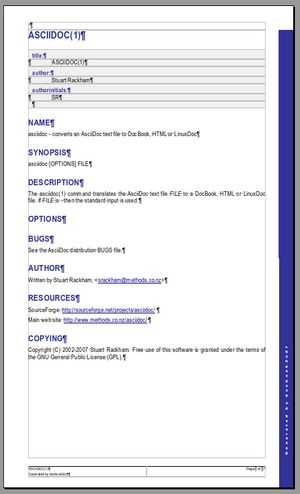
Just to get an idea how the result looks like in OpenOffice: Screnshot of docbook2odt result in OpenOffice Just ‘apt-get install docbook2odf’ if you are using Debian/unstable, thanks to the work of formorer we could include the toolchain in the upcoming grml release.

Eddy Petri&#537;or: (Not) Getting Carbide C++ to run on your amd64 Debian Etch. But you get CodeWarrior!

A while ago I decided I wanted to make a couple of nice little apps for my Nokia 6600.
After my successful adventure with pys60 I decided/realized that the Python API does not contain appropriate functions for what I need in my apps, so I decided to setup the development environment for C++ with Carbide C/C++ (the recommended IDE for S60 development for Nokia).

Of course, the IDE is a Windows application and the reason for which Nokia doesn't provide an IDE for Linux (is expected since they are developing maemo and are so into OS) eludes me.
On top of that, I have an Debian Etch amd64 installation[1], so that's more fun.

Fortunately, thanks to Robert Millan and Ove Kaaven, wine is installable from unstable on amd64 and a chroot is not needed[2] anymore.


Now let's see the dependency tree:
Yes, that is all ... summarized. And you can imagine I went though leaps and bounds and wasted a night with this to find out the hard way.

If you don't care about the reasons/story, you can skip to the paragraph where I ran into license issues.

So, first Carbide needs Active Perl. Not any version, but ActivePerl-5.6.1.635. You will find out after you install Carbide c++.

Active Perl, by default, will refuse to install in wine. It relies on some Script Host support.
Good news: it is available on Microsoft's support pages. Bad news: the file is not provided until you go through some crazy scheme[3] to certify you have a genuine Windows installation.

Of course, the genuine stuff failed to work in wine, duh, but having a windows XP OS in qemu was really useful... to try to go further.

Now that I mentioned the Windows XP machine in qemu you might be wondering 'why didn't you installed Carbide c++ in there and start hacking in qemu?' . Well, I wish it was that simple! Believe it or not, the installation in the Windows virtual machine failed in a muuuuch earlier stage it initially did in Wine! It failed in the unpacking phase of the installation, while in Wine that part worked without problems (default config is for Windows XP emulation). Talk about irony!

After a while of trying, I took the risky path (maybe I should install an antivirus, as suggested by wine) and downloaded the kit for the script host stuff from some site on the net (shhh!). Good. I don't remember if I used cabextract or if it worked quite straight forward, but the special configuration entry in Wine Configurator suggests otherwise.

Back to Active-Perl. Now we can try again to install it.

wine msiexec ActivePerl-5.6.1.635-MSWin32-x86.msi

Guess what? The installation failed now, too. After some time of poking, I realised the bastard was looking for mfc42.dll in the installation. There was no word about that in the error message, only in the wine logs there were some hints. No wonder Windows users learn very early to ignore error messages (the error message was plain uninformative).

Where to get mfc42.dll from? The virtual machine! I tried to send them via email, but the link was too slow. Now I realised I could have used winscp, but I didn't thought of that at the time.

The rescue did come this time from M$, but with some effort. It appears that mfc42.dll is by default present on XP, so you only find it for download in some kit (vc6redistsetup_enu.exe) for Windows 9x. That works (lost some time to figure that out, too) since the kit contains a mix of 9x, NT and independent dlls. I think this installation didn't work and I had to cabextract the files by hand and copy them in system32. I registered the mfc42.dll module, after copying it in windows/system32.

wine msiexec /y mfc42.dll

Well, now I have everything installed Carbide should start... Well, no! License issues! I got a message about not having a license for the installation. Ain't that great? I just installed the thing and is the free/handicapped version. What gives? Well, in Carbide C++ 1.2, the Express part of the kit is broken and doesn't install the license file.

So, I installed the professional version since it had a longer trial period, hoping that now I'll be able to see the IDE and start working.

After this, I tried several times to start Carbide itself, but it failed at different points in time. I "just"[4] configured wine for this app to set the order to 'native,builtin' for msvcrt, ole32, oleacc and shdocw and got further.

Hopeless attempts follow....

At this point I got stuck. There was still some error from ole32.dll (apparently), but I couldn't go further.

I tried to install the 1.1 trial version. Got stuck. In any way I couldn't start Carbide c++ :-(( .

GRAND FINALE!

In the end, I also tried the deprecated CodeWarior. Guess what? It installed and ran immediately. Although I am not sure if any of the previous poking had anything to do with it.


[1] I have some packages from unstable
[2] although I had one, I wanted to get rid of it, since gnash started to perform better in the latest versions - still not satisfactory, but OK
[3] some browser plugin WPGInstall.exe, iirc and some app which should send your privat^W^W^Wanalise your system to generate some code that should identify your system as genuine
[4] this also took me some time... start, identify the dll, change the order, restart...

17 May 2007

Simon Law: RoCoCoCamp 2007


Evan Prodromou
Originally uploaded by sfllaw.
Tomorrow is the beginning of RoCoCoCamp 2007, a three-day unconference held right here in Montr al. It starts at 9:30 on Friday at the SAT and runs until Sunday evening. It's for all who are interested in wikis, weblogs, and creators interested in collaborating in on-line spaces. RoCoCoCamp is organized with OpenSpace Technology, where we collectively decide on an agenda where everybody has a chance to speak. There's no artifical divide between speakers and audience, so you can lead your own session if you have something to say. Think of RoCoCoCamp as a real-life wiki, where anybody can contribute. A detailed explaination of what RoCoCoCamp is about can be found on this invitation. I'm inviting you because I'm flying out on Saturday and can't make the whole conference, but I really hope you come. There will be discussions on: So how can you attend? I thought you'd never ask!
RoCoCoCamp 2007
Friday, 18 May 2007 at 9:30
     until Sunday, 20 May 2007 at 18:00
Societ des arts technologiques
     1195 boul. St-Laurent
Free admission
( Sign up Upcoming Google Maps )
See you there!

16 May 2007

Piotr Roszatycki: Sun Java and alternatives

I maintain the HenPlus interface for databases. The tool is written in Java but it didn't work with non-Sun implementation of Java. The reason was sun.misc.Signal class. It is used for trapping Ctrl+C in application. I wonder why the GNU Classpath does not support this class. Does it mean the Sun Java is not really standarized? I've found the workaround. I unpacked some of sun/misc/*.java files from official Sun Java sources. Fortunatelly they was published under GPL license. The trick made possible to compile the HenPlus with GCJ+ECJ, so I could change the build-time dependency to java-gcj-compat-dev. It really worked! Even if the signal couldn't be handled with GCJ or SableVM, the application started with non-Sun Java runtime:
Hen*Plus> system-info
----------------------------------------+---------------------------------------------+
            System Property                                  Value                     
----------------------------------------+---------------------------------------------+
 Diff. of used memory (now-before) [KB]                                      1.932,00  
 Java VM                                     GNU libgcj 4.1.2 (Ubuntu 4.1.2-0ubuntu5)  
 Java Vendor                                           Free Software Foundation, Inc.  
 Java Home                                /usr/lib/jvm/java-1.4.2-gcj-4.1-1.4.2.0/jre  
[...]
I've found that the GCJ and Kaffe doesn't work with Oracle JDBC driver. I'm suprised that SableVM works without problems. It's good to see that there is a reasonable alternative for Sun's imlementation.

15 May 2007

Russell Coker: Planet feed polling frequency

From reading my web stats yesterday it seems that one Planet has polled by blog feed 1693 times over the first 14.25 days of this month. This is about 5 polls per hour. Another Planet has polled my blog 994 times for an average of about 3 hits per hour. How frequently does it make sense to poll blogs? Speaking for myself I think that waiting an extra 10 minutes to see my latest blog post isn’t going to hurt anyone, and encouraging Planet readers to reload the page so frequently probably isn’t doing them a favour either. For my own personal Planet installation (which mainly aggregates other Linux Planets for my own personal use) I have it poll the feeds every four hours. For a Planet installation designed for general readership it would make sense to have it poll more frequently. Maybe once every hour or once every half-hour. When I initially set up my own planet installation I aggregated the entire feed list of Planet Debian and Planet Linux Australia and it generally took between 10 and 30 minutes to poll all the feeds with 20 minutes being common (Planet does not support parallel downloads). So for a moderate sized Planet with frequent polling you might have one poll end after the next cron job for a poll has begun. It’s a pity that Planet doesn’t support pings. Will the next version do so? I would rather have my blog ping the Planets that I know of that aggregate my content and save thousands of needless polls while also giving a faster update. Finally if you need a fast response for a dialogue then probably blogs and Planets are not the communication mechanism to use, a mailing list would probably be more appropriate.

Adrian von Bidder: Told you so

People were calling it futile when I asked back in last July for people to kick AMD to open up ATI's graphics drivers. Myself, I sent one email to ATI and, to my surprise, actually got a reply from a person at ATI who knew what a license is and what Open Source/Free Software is and who actually took the time to reply to my email. That was already a positive signal. And now they're really doing it: releasing drivers for ATI graphics chips under an Free license. At least they announced it, and I guess by now companies have realized that announcements like that not only are applauded to, but also get followed up on. So thanks AMD, and thanks Intel for putting up the pressure by supporting their own graphics chips. And now everybody turn their heads towards Santa Clara, CA, USA and give them a wake up call. And of course lets hope that AMD will go ahead with this project soon, and pick a sensible license. (Damn. The laptop I've got here still hasn't magically changed its graphics chip. No, I didn't buy it myself.)

Adam Rosi-Kessel: Grimmelmann on PrawfsBlawg

Not to be missed: well-known enfant terrible James Grimmelmann is guest-blogging on PrawfsBlawg. His opening commentary on the relationship between law practice and computer science:
Practicing lawyers, like practicing programmers, are professional pragmatists. Both must make their cases (and case mods) out of the materials they have available; both starve or eat steak depending on whether their creations work. The day-to-day practice of law is unlikely ever to require much high theory. We can mourn that fact because it means that they look at us with suspicion, or celebrate it because it frees us to chase Truth and Beauty and it will remain a fact either way.
Aside from the fact that I don’t eat steak, I think this is correct. Via a commenter on James’ entry, I learned that the 7th Circuit Court of Appeals is implementing a wiki (the entry page could surely use some more content). Surprisingly, it was not Posner but Easterbrook who spearheaded the effort. This is a very interesting development, but I expect it will be quite a while before any other circuit takes up the idea. Finally, I have been meaning to write about this New York Times story describing Jonathan Coulton’s success as a musician breaking with the traditional distribution /promotional channels (via 43 folders, a productivity blog that is still on my “probation” list). Unfortunately, slashdot beat me to it. I first re-discovered Jonathan Coulton during his guest episode of the Show with Ze Frank. In any event, the article is well worth reading:
More than 3,000 people, on average, were visiting his site every day, and his most popular songs were being downloaded as many as 500,000 times; he was making what he described as a reasonable middle-class living between $3,000 and $5,000 a month by selling CDs and digital downloads of his work on iTunes and on his own site Coulton realized he could simply poll his existing online audience members, find out where they lived and stage a tactical strike on any town with more than 100 fans, the point at which he d be likely to make $1,000 for a concert. It is a flash-mob approach to touring: he parachutes into out-of-the-way towns like Ardmore, Pa., where he recently played to a sold-out club of 140 . In total, 41 percent of Coulton s income is from digital-music sales, three-quarters of which are sold directly off his own Web site. Another 29 percent of his income is from CD sales; 18 percent is from ticket sales for his live shows. The final 11 percent comes from T-shirts, often bought online

14 May 2007

David Welton: mailmodel rails plugin

Here is the first cut at a plugin I created, called Mailmodel. It's pretty simple, you install it, configure the email sender/destination addresses, and then, in your ActiveRecord objects:
after_save :mail_model
For those objects that you want to be notified of when they change. Think of it as 'scaffolding' for email notification of changes in your database (new comments, new users, new payments) when you aren't quite ready to set up notification for each individual thing. Available from: http://svn.dedasys.com/public/mailmodel/ Some improvements that could be made:

MJ Ray: Freesat and Eurovision

Alexander wrote:

"You know, a lot of people here in Ukraine are offended by Danilko's image; He looks glare (in bad sense) and his lyrics are nonsense. But IMHO he is artisis Eurovision deserves. People need show, even stupid one. So I'm quite surprized he isn't winner."
I'm surprised too. Thankful, but surprised. zii kell wrote:
"Freesat consultation - organisations' responses Text only BBC Trust final conclusions on Freesat Text only Other interesting docs about this can be found in ascii and PDF formats."

Kai Hendry: Customized Web kiosk

Hannux alpha screenshot One of the most requested features for Webconverger is a “customization kit”. Before I pointed enquirers to Debian Live and a guide, which didn’t seem to satisfy the “easy to use” crowd. Now I’ve created a Web form where you can easily tell me what customized homepage you would like and I will go away and build it for you. For 20GBP. I just need 25 orders a month and I can pay my rent. ;) Since Webconverger is a collection of free software Debian packages, feel free to become a competitor. :)

13 May 2007

Brett Parker: New bpgallery available, and xmms-scrobbler work...

I've taken over upstream development of xmms-scrobbler, it's now hosted at http://xmms-scrobbler.sommitrealweird.co.uk/ and has a public readonly git repository for the code. Since taking over development I've dropped a lot of the tag parsing code and replaced it with taglib, found some "interesting" locking issues and am now looking at making it so that we don't need to restart it when adding username/password. It'd also be good to get it to actually report a username/password breakage at least once rather than being totally silent about it! In other news, I've just released a new version of bpgallery, this version adds in medium sized pages - i.e. you can have the index page, the index page links to pages that have a resized image on the page, and has next/previous links. If you also generate full sized pages then the link from the image on the medium sized page goes to the full sized page, otherwise it'll go straight to the origional image. Also thinking about making a last.fm "client" for xmms so that I can keep all my music playing in the one place (lastfmproxy appears to have stopped working for me :/)

11 May 2007

Edd Dumbill: Up close and personal at XTech

It's been a long time since I last wrote, mostly because we've been pulling out all the stops for XTech. Next week is set to be stimulating and challenging. I'm amazed at the collection of thinkers and innovators we've drawn together, and am looking forward to getting a boost of energy and inspiration from the conference.
Browser summit On Tuesday next week, Molly Holzschlag and I are sponsoring a Web Browser, Standards and Interop Summit. This is an opportunity for browser vendors, standards advocates, W3C and related standards supporters to talk in a vendor (and standards-body) neutral atmosphere about tackling the problem of browser interoperability. As the full announcement mentions, we're also throwing open the doors to interested bloggers and journalists to get involved in and cover the discussion. The summit came about after Molly and I got talking about our desire to provide a forum for effective exchange between the people shaping the future of HTML. This is something that spawned the vision of the Browser Track and XTech in the first place three years ago. I don't know how much we'll solve at the first summit, but it puts down a marker and a challenge for participation. I am not the only one concerned at the increasing fragmentation of the HTML landscape, the breakdown in communication, and the ultimate ill-effects for web developers and users. Personal scheduler and evaluations As my conference software Expectnation nears its public launch, we'll be using some of its fun features at XTech. Normally, the bulk of the work is done behind the scenes, so it's nice to have a feature to show off to attendees and the wider public. Personal scheduler The personal scheduling feature lets you compose your own timetable for the conference, just by clicking on the stars throughout the schedule. As a bonus, you can subscribe to your personal schedule as iCal, allowing you to take it with you on your phone or PDA. In addition, we'll be allowing attendees to submit evaluations of sessions online. If you're using the personal scheduler, it gets even neater as you can quickly find links to submit your evaluations, and review ones you've already submitted. Behind the scenes, I can see which sessions are the most popular and get advance warning if we're likely to need to move rooms to avoid overcrowding. I'm pretty excited about this. Features like this aren't exactly new, but now we've made them a standard feature for every conference. We're looking forward to adding more social software facilities to enhance the conference experience.Submitting session evaluations 

Evan Prodromou: 20 Flor al CCXV

Another beautiful day here in Paradise. Montreal is fantastic in the late Spring/early Summer -- it's a great time to be here in the city. Yesterday, Amita June and I went to Parc Jean Drapeau, the beautiful park on an island in the St. Lawrence, the former site of Expo 67. We played at the (really cool) new playground, ran around in the grass, and looked at the river rushing by. Today I rolled out a new table-of-contents layout on Wikitravel; you can see an example on our page about France. It's the culmination of about 11 months of debate and compromise amongst Wikitravellers, me, Maj, Internet Brands, and pretty much everyone else under the sun. It took a looong time, but we eventually got something that most people could live with and (shock!) some people actually liked. It wasn't easy, and my earlier unilateral decisions about it were so upsetting to people that it produced our current Wikitravel:Technical infrastructure policy. It's been great to finally reach some closure on this particular issue, since it was such a source of learning for me. tags:

RoCoCo -- one week and counting We've got about one week before RoCoCoCamp starts. It's going to be pretty exciting; we've had a lot of responses and the list of participants is growing strong. But there are still a lot of infrastructure things to be done -- I'm going to be really impressed if we get them all done before next Friday. I'm getting more and more amazed that the folks in Portland (Oregon) manage to put on RecentChangesCamp there. It's pretty hard to do a three-day unconference. tags:

Kanren So, I've just finished re-reading The Reasoned Schemer, the sequel to The Little Schemer and The Seasoned Schemer by Daniel P. Friedman and Matthias Felleisen. Reasoned is a really nice introduction into what seems to be a classic compulsion for Scheme freaks: re-implementing the logic language Prolog more-or-less in Scheme. The little language that unfolds in Reasoned is elegant, simple, and best of all, extremely Scheme-y. There's a really long digression into binary mathematics and deriving bitwise operations for arithmetical functions, which all seems to be the long way around the block since it's unlikely that users of their system would use anything but the math system built into the host language, Scheme. The implementation in TRS is laid out at the back of the book. It's a learning version of a bigger project, called Kanren. I've been fiddling with the system, which has re-inspired my dream of creating a declarative language framework for Web applications. I'd like to see what Web programming in Kanren would be like... I'll see how it goes. tags:

Domains Another way I spent my time today was that we've finally gotten around to transferring the wikitravel.org/.net/.com domains to IB. IB's owned the site for a while, but we've never really had a reason to switch the domains over, so it's gone undone for a long time. And I'm kind of glad. It sucks transferring domains between registrars. wikitravel.org was on Joker. which used to be my registrar of choice, but which has been superseded by Godaddy. Transferring a single domain took 6 Web forms (on two different sites), 3 security codes, and 4 email confirmations. Thankfully, this also gave me a chance to transfer over my speculative domains phonojournalist.com (for telephone photos) and phrygiancap.org, for general freedom issues. I like the phrygian cap, what can I say? All right, so I have a lot of domains that I'm unlikely to ever exploit. If that's so wrong, I don't want to be right. tags:

Next.

Previous.