Search Results: "tb"

13 August 2010

Alexander Reichle-Schmehl: Release Critical Bug report for Week 32

The unofficial rc bug tracker currently knows about the following bugs:
In Total:448
Affecting Squeeze:329
Squeeze only:108
Remaining to be fixed in Squeeze:221
Of these 221 bugs, the following tags are set:
Pending in Squeeze:24
Patched in Squeeze:43
Duplicates in Squeeze:19
Contrib or non-free in Squeeze:11
Claimed in Squeeze:2
Delayed in Squeeze:8
Can fixed in a security Update:12
Otherwise fixed in Squeeze:21
Ignoring all the above (multiple tags possible), 121 bugs need to be fixed by Debian Contributers to get Debian 6.0 Squeeze released. However, with the view of the Release Managers, 271 need to be dealt with for the release to happen. Please see my older post for an explanation of the different numbers.

12 August 2010

Kartik Mistry: Report from MiniDebConf India 2010

* So, here is late report! Sometime back Praveen started discussion at DebianIndia mailing list about having MiniDebConf kind of conference here in India. MiniDebConfs are generally focused on development rather than at introduction to Debian . But, since this was our first attempt, out focus was more on to introduce Debian to student community and after writing this after 5 days I realize that we ve done good job! Many thanks to Joerg Jaspert for setting up Mini website: http://in2010.mini.debconf.org/ Praveen got bunch of sponsors, many thanks to CDAC and other sponsors for making event happen with testy food and tea that kept me awake. Now what really happened at Pune? My flight was nice. I went to guest house of COEP (the host college, 2nd old engineering college in India) and took some rest and called Praveen. He was already at computer lab and setting up Virtualbox and other things. We had two places hall and lab. Unfortunately, both were at different buildings and subway between them :) I discussed with couple of students and we went to dinner at late night. Pro. Abhijit who was kindly give permission to use lab and college hall was another source of energy. He is handling many FOSS events in college and probably only faculty who encourage students to use and learn FOSS. The Day 1 started with long lines of registration process. As we had around 200 registration, turn out of students were 100% on first day. Hall was almost full. Dr. Shashikumar from CDAC gave nice lecture about contribution which was well received. Praveen and Onkar then took the stage and gave nice introduction about Debian. I met Onkar first time. We had really nice discussion ranging from becoming Ubuntu MOTU to his Powerbook s adapter. After that Vikram took lively session on i18n and l10n in Debian and I took boring session on Contributing to Debian . Yet another boring session from me was Developer Toolbox . Packaging workshop by me at hall made many faces to yawn heavily while Onkar and Praveen handled it nicely at Lab. Main reason for yawning was Wifi and my Macbook s capacity to deal with ndiswrapper and crappy broadcom s drivers. (Note: I should get nice machine.) I met Sham first time. I met Kushal once again and felt energetic again! Day 2 As we expected number was very low compared to Day 1. So, we closed hall and moved entire stuffs to Lab only. Vikram took again nice session on Debian Edu . It was very interactive and I should learn something from his act of presentation. Another nice thing from Day 2 was discussion with BOSS Linux team. Hold on. Lets keep some old woes aside. They are basically doing what their bosses are telling. Developers were clueless about Sending patches to upstream. Their bugzilla had Zorro bug reported. I made promise to follow-up on this and set-up patches from boss at somewhere depending upon their response. That mail is my draft let me finish it by weekend. Pavi and others took video from session. It will be nice if someone will post it somewhere :) We then continued on discussing bugs and packaging area. It was amazing to see Praveen become DM during conference and also to see: upstream, maintainer and sponsor in one room. I really had nice food at dinners. Mango Mastani was nice. Beer was nice. How can I forget discussion with Ramki, Ninad, Pro.Abhijit, Praveen, Pavi and others after dinner? So lets work for MiniDebConf 2011 now!

Olivier Berger: My report after the BOF on distributed bugtrackers at DebConf

Here are my notes about the very insteresting BOF on distributed bugtrackers held at DebConf This is just some elements of report (some taken from the gobby edits, and written down by me after watching the video (unfortunately missing 2 mins of sound in the beginning of the video stream/recording)). This is not a full report of all the discussions, as some discussed elements weren t of interest IMHO. You ll find here many ideas of mine, links and pointers (resulting of our work in the context of the Helios project on similar topics), so this is in no way a report of what was said exactly during the BOF. Aspects of interest: Note that these topics may in principle be discussed on the Distributed bug trackers mailing list: http://kitenet.net/cgi-bin/mailman/listinfo/dist-bugs Tools / implementation ideas : Storage of repositories / databases of remote bugs : About such storage, and the RDF store option, here s a prototype of ours that exposes UDD s bug facts through a SPARQL interface, allowing to publish bug facts as RDF (setup in the frame of the Helios project). It includes both Debian and Ubuntu bugs, and allows interlinking them in a standard way (with Semantically described links in RDF). See http://testforge.int-evry.fr/d2r-server/resource/spackage/evolution for an example. The problem is not how to distribute (distributed database systems exist), but the semantics of bug properties, and the different implementations of interfaces of different tools : which standard to implement, or how many converters are necessary if no standard ? We believe that navigation/referencing/tracking of external bugs would be much easier if bugs were LinkedData citizens, i.e. they would be exposed with (standard) formats like Semantic Web ontologies served with Semantic Web standards (like RDF). The worst case is currently to have to perform web scraping on bugtracker interfaces. How to avoiding scraping ? A solution could be to publish RDFa / microformats using common standard semantics, directly from the bugtracker pages at bugs URLs (see my wishlist for debbugs on that subject : 590931: Would be great to integrate RDFa metadata into debbugs pages). Now some pointers to historical details on the same subject and Debian (old posts by Lars Wirzenius) : Overall, the discussion was quite interesting, but didn t reach any sensitive progress regarding the state of the art. Much needs to be worked on, mainly on standardizing APIs, semantic descriptions of bugs, and implementation in tools like SD for instance. Stay tuned for more progress.

11 August 2010

Russell Coker: Ethernet Interface Naming

As far as I recall the standard for naming Linux Ethernet devices has always been ethX where X is a number starting at 0. Until fairly recently the interface names were based on the order that device drivers were loaded or the order in which the PCI bus was scanned. This meant that after hardware changes (replacing network cards or changing the BIOS settings related to the PCI bus) it was often necessary to replace Ethernet cables or change the Linux network configuration to match the renumbering. It was also possible for a hardware failure to cause an Ethernet card to fail to be recognised on boot and thus change the numbers of all the others! In recent times udev has managed the interface naming. In Debian the file /etc/udev/rules.d/70-persistent-net.rules can be edited to change the names of interfaces, so no matter the scanning order as long as an interface retains it s MAC address it will get the correct name or at least the name it initially had. One of the down-sides to the way this operates is that if you remove an old Ethernet card and replace it with a new one then you might find that eth1 is your first interface and there is no eth0 on the system this is annoying for many humans but computers work quite well with that type of configuration. I ve just renamed the interfaces on one of my routers by editing the /etc/udev/rules.d/70-persistent-net.rules file and rebooting (really we should have a utility like /sbin/ip with the ability to change this on a running system). I have decided to name the Ethernet port on the motherboard mb0. The PCI slots are named A, B, and C with A being the bottom one and when there are two ports on a PCI card the one closest to the left side of the system (when viewed from the front the right side when viewed from the read) is port 0 on that card. So I have interfaces pcia0, pcia1, pcib0, pcib1, and pcic0. Now when I see a kernel message about the link going down on one of my ports I won t have to wonder which port has the interface name eth4. I did idly consider naming the Ethernet devices after their service, in which case I could have given names such as adsl and voip (appending a digit is not required). Also as the names which are permitted are reasonably long I could have used names such as mb0-adsl, although a hyphen character might cause problems with some of the various utilities and boot scripts I haven t tested out which characters other than letters and digits work. I may use interface names such as adsl for systems that run at client sites, if a client phoned me to report Internet problems and messages on the console saying things like adsl NIC Link is Down then my process of diagnosing the problem would become a lot easier! Does anyone else have any good ideas for how to rename interfaces to make things easier to manage? I have filed Debian bug report #592607 against ppp requesting that it support renaming interfaces. I have also filed Debian bug report #592608 against my Portslave package requesting that provide such support although it may be impossible for me to fix the bug against Portslave without fixing pppd first (I haven t looked at the pppd code in question for a while). Thanks to Rusty for suggesting this feature during the Q/A part of my talk about Portslave for the Debian mini-conf in LCA 2002 [1].

10 August 2010

Andrew Pollock: [tech] Farewell, Sonic.net, hello Comcast Business

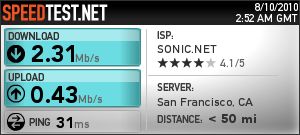
In all my born days, I never thought I'd be saying that. I've been a happy customer of Sonic.net for the entire time I've been in the US, but I recently became aware of an offer through work with Comcast Business that I couldn't refuse. So I've gone from Speedtest.net results for Sonic.net showing 2.31 Mb/s down and 0.43 Mb/s up to this Speedtest.net results for Comcast Business showing 72.35 Mb/s down and 10.34 Mb/s up You really can't beat it. I'll still recommend Sonic to all and sundry, but if you want some real speed (and with baby photos and videos galore to upload, I was really more interested in additional upload capacity), it's time to give DSL the flick.
Russell Coker: Cyborgs solving Protein Folding problems

Arstechnica has an interesting article about protein folding problems being solved by a combination of brute-force software and human pattern recognition in the form of a computer game [1]. Here is a link to the primary source which also mentions the fact that players can design their own proteins which could potentially cure some diseases [2]. This is very similar to Garry Kasparov s observations about ideal methods for playing chess given computers and humans [3]. It is also similar to Jane McGoningal s ideas about using online gaming to make a better world [4] which inspired my post about choosing a free software mission [5]. What other serious problems can we solve via computer games and screen-savers?

9 August 2010

Gerfried Fuchs: On BTS usage

You might remember that I started to work on closing RC bugs for stable. This effort hasn't died off so I joined the RC Bug Squashing Contest that was going on during the Debian conference (which I was unable to attend). The rules did permit it, even though I was aware that it can't (and shouldn't) be compared to the unstable/testing squashers and thus it was split of into its own Special category. There still seems to be a lot of confusion on how our BTS works, especially with respect to version tracking. I was even accused of falsely claiming bug closing because the bug has been closed by someone else already. This wasn't the case, otherwise the bugs would had been archived a long time ago already[1] given that I had expected that person to know how bug archival works and also given the sheer amount of bugs that I simply had closed for stable, I guess it is needed to shine a light upon why some bugs won't get archived as expected. If you followed my IRC talk on BTS usage last month you might already have an idea of what's going on. There might be several different reasons why bugs aren't marked for archival yet. I'll try to explain them as I understand it (given that I neither have taken a look at the debbugs code nor am involved with its development) through my working on bugs over the last 10 years. I hope this will get others also interested to fix stuff for stable. Actually when I see something that potential falls into the last group I ping the maintainers of those packages to let them know about having them fixed. Some of you might already have received such a ping and I am thankful for those that received them well and actually already fixed some of those, too. Thanks for making stable a better place! Coming back to the RCBC, it was an interesting small competition (if only in my brain) between myself and the testing/unstable RC squashers going on. It would had been nice to get at least as many bugs in stable addressed as in testing/unstable because the amount is still a lot higher, but I can still be happy about the things done. And it is good to know that not everything seems to think that it's wasted effort to work on getting the RC count lower for stable, too (like I also was told about my effort). So thanks from that point of view!
[1] There are currently 2688 bugs still unarchived that were closed last year already! This UDD query helps you:
select count(*) from bugs where status = 'done' and last_modified <= '2009-12-31';

/debian permanent link Comments: 0 Flattr this

Russell Coker: The Lord of the Fries

Today I bought a box of fries from The Lord of the Fries [1]. I bought it from their new stand at Flinders St station because I was going past and saw no queue. In the past I had considered buying from their store on Elizabeth St but the queues were too long. The fries were nice probably among the best fries that I ve had from local fish and chip shops. Way better than any other fries that you can find in the center of Melbourne. The range of sauces is quite good if you like that thing (I just like vinegar on mine). However it should be noted that the quantity of chips that you would get for the same price at a local fish and chip shop is usually a lot greater. Overall I was a bit disappointed, sure it s nice to have someone hand-cut fresh potatoes and to actually care about making a quality product. But when compared to the other options for relatively fast food in the CBD it didn t seem that great to me. I m never going to join a queue that has more than 20 people to buy them! But I probably will buy from them on occasion if they don t have big queues. It seems to me that the best thing that they have done is to create a strong commitment to food quality and document it on their web site. I hope that this will inspire other fast-food companies to do the same thing and result in an overall increase in the food quality. On a related note Jamie Oliver has an IDEO project running with the aim of getting kids into fresh food [2].

John Goerzen: Being A Butterfly

Well, I m back in Kansas after a bit over a week in New York for Debconf. I didn t have time to write much, so I ll probably be posting about it a few times. I already wrote about the trip to New York, and now will say just a bit about the time there and trip back home. I have to start with a quote from Jacob. We went on the Q train from Coney Island a few stops down to Brighton Beach. It s elevated, and provides an excellent view of the amusement park. Jacob s excited comment, face pressed to window, was: Wow! I see lots of everything! Which, come to think of it, sums up NYC itself pretty well. Speaking of faces pressed to windows: this was Jacob s default mode of operating in NYC. Get into any subway car, bus, whatever and he wants to stand on the seat nearest the window and look out it. It s a real problem if no such seats are available. More than once, though, we ll get on the subway and he ll run to the nearest window seat to claim it, no matter who will be his neighbors for the next few minutes. And after a few days of this, Oliver started picking up on it. Pretty soon both boys wanted to be pressed to the windows watching interesting things (to me, it was a dark tunnel with occasional lights, but interesting to them) go by. Which brings me to today. Today was Oliver s first time flying, and Jacob s second though he was an infant the first time he flew and doesn t remember it. Jacob has been perhaps cautiously optimistic about flying. The idea of it was exciting, but then again it s something completely new, which he doesn t care for so much. So we had no idea what to expect. What was got was excitement. And lots of it. From the La Guardia terminal, Dad, is this our plane? No, not that one. Well, is THIS our plane? No, not that one either. Well, is *THIS* our plane? At this point, a parent has to confront the question: which is worse, causing serious disappointment to a 3-year-old and possibly inviting a meltdown in the middle of the D concourse, or a bit of harmless encouragement that might not be 100% literally true? Uhmm . that might be it (Ah, so I went for the literally true but still exciting route ) YAY!! *jumping and clapping* Terah reminds me at this point of our security adventure. I, wearing socks, carried Oliver (1 year old) through the security checkpoint at La Guardia. But oh! I failed to remove his shoes (not really shoes). TSA made me go back through, put them in the bowl, and run them through the scanner. A nearby pilot, getting screened, noticed this and made this ironic comment well within TSA earshot: Look at his face! He s gonna get us all! Good thing you re checking his shoes! Terah and the pilot both just about bust up laughing. Meanwhile, I m carrying Oliver through, and the agent that made me take off his shoes had this look of I m sorry, I know this is stupid, but I have to. (For an excellent pilot s rant about TSA, read this). Anyhow, we got on the plane, and of course Jacob nabbed the window seat. IMG_4458.JPG There was plenty interesting to see. At each step of the way, I told him what was going to happen next, so there wouldn t be any surprises. I told him once we got in the air, and got a breathy Woooooooow .. I told him, Jacob, we are flying! And his reply has to be his best quote of the week:
Dad, I don t know that I ve ever been a butterfly before!
I pointed out that we were above the clouds, which was also exciting. About every 5 minutes, he d poke me, and say, Dad, look out the window. Look down. WE ARE UP IN THE SKY! Meanwhile, Oliver slept. IMG_4461.JPG On the second flight, Jacob slept (and was in a very foul mood when he woke up on the ground) while Oliver tried his best to squirm out of the seat and onto the ground. Now, to wind up this post, I would like to leave you with some statistics and photos comparing my home with New York.
Item NYC Marion County, KS
Land Area 469 sq mi 954 sq mi
Population 8,391,881 12,952 (6871 excluding the 3 largest towns quite some distance away)
Population Density 27,532/sq mi 14/sq mi (7 if excluding large towns)
I think of this as a wonderful difference! I ve said before how much fun it is to spend some time in NYC, where we can just walk to a fruit stand, any number of grocery stores, restaurants, etc. And finally, I leave you with two street scenes. The first is from our hotel s front door. IMG_4352.JPG That s our fruit guy there, and the bagel and roll place is across the street by the RadioShack. Now, the street view from our front door after we got home: IMG_4466.JPG OK, so that s sort of misleading. You can t actually see the street scene because it s on the other side of the hill. That s just our driveway to get to the street. (Not that the street looks much different. It has the weeds growing on the sides instead of in the middle, as one notable difference.) We loved New York and I m certain we ll go back again. It s also nice to be home and enjoy the peace of the countryside. Thanks to Debconf for a wonderful conference a topic I ll have more to say about in the coming days.

8 August 2010

Joey Hess: bye bye, ny ny

view of Manhatten, Statue of Liberty, and Ellis Island from helicopter
In a few hours I will be catching the train for home. It's been a great DebConf, and a thrilling visit to New York. I'm especially happy with how well my CUT BoF went, and that we launched Branchable. As usual, DebConf is inspiring. I'm leaving with a scary new todo list:
my foot at 1000 feet

6 August 2010

Matthew Garrett: AE_AML_BUFFER_LIMIT in \_SB_._OSC

If you get messages like this:

ACPI Error (psparse-0537): Method parse/execution failed [\_SB_._OSC] (Node ffff8801e8c62b30), AE_AML_BUFFER_LIMIT

then you've fallen foul of one of the less appealing aspects of ACPI. _OSC methods are defined as methods to allow the operating system and the firmware to handshake over their support of optional features. Different _OSC methods apply to different types of hardware. CPU _OSC methods allow the operating system to inform the firmware that it supports ACPI 3.0 throttling states, while PCIe _OSC methods allow the operating system to indicate that it can manage native PCIe hotplug. The firmware can choose whether or not to give up control of these features, and the OS then has to cope.

The problem arises when we get to the _OSC method on the system bus. This wasn't specified until ACPI 4.0, leaving an attractive mechanism for vendors to add OS/firmware integration. To that end, we now have at least three different _SB_._OSC methods in the wild:
  1. The ACPI specified _OSC. This exists purely for the OS to tell the firmware what it supports, without the firmware having the opportunity to disagree. As such it passes 8 bytes of data to the method.
  2. The Microsoft WHEA _OSC. This exists to allow the firmware and Windows to handshake over whether or not the firmware supports Microsoft's hardware error reporting.
  3. HP's PCC _OSC method, designed to allow handshaking between the OS and the firmware in order to determine whether they support OS interaction with the firmware-level CPU scaling


This wouldn't be enough to be a problem in itself. The ACPI spec requires _OSC methods to have GUIDs in order to protect users from exactly this kind of situation - Windows can attempt to enable WHEA on a machine with a spec-compliant _OSC, and the _OSC method will return an immediate failure because the GUID doesn't match. Except that the WHEA and PCC versions of _SB_._OSC pass 12 bytes of data in the third argument, against the ACPI spec version's 8. And many _OSC implementations attempt to access the region between bytes 9 and 12 before checking the GUID, resulting in the AE_AML_BUFFER_LIMIT error.

This is made even more annoying due to the fact that argument 2 contains the number of parameters being passed in argument 3, making it straightforward to avoid this kind of failure. Firmware authors, tbh.

Alexander Reichle-Schmehl: Release Critical Bug report for Week 31

The unofficial rc bug tracker currently knows about the following bugs:
In Total:433
Affecting Squeeze:314
Squeeze only:69
Remaining to be fixed in Squeeze:245
Of these 245 bugs, the following tags are set:
Pending in Squeeze:18
Patched in Squeeze:45
Duplicates in Squeeze:28
Contrib or non-free in Squeeze:10
Claimed in Squeeze:2
Delayed in Squeeze:7
Can fixed in a security Update:9
Otherwise fixed in Squeeze:32
Ignoring all the above (multiple tags possible), 145 bugs need to be fixed by Debian Contributers to get Debian 6.0 Squeeze released. However, with the view of the Release Managers, 220 need to be dealt with for the release to happen. Please see my older post for an explanation of the different numbers.

4 August 2010

Russell Coker: Why Clusters Usually Don t Work

It s widely regarded that to solve reliability problems you can just install a cluster. It s quite obvious that if instead of having one system of a particular type you have multiple systems of that type and a cluster configured such that broken systems aren t used then reliability will increase. Also in the case of routine maintenance a cluster configuration can allow one system to be maintained in a serious way (EG being rebooted for a kernel or BIOS upgrade) without interrupting service (apart from a very brief interruption that may be needed for resource failover). But there are some significant obstacles in the path of getting a good cluster going. Buying Suitable Hardware If you only have a single server that is doing something important and you have some budget for doing things properly then you really must do everything possible to keep it going. You need RAID storage with hot-swap disks, hot-swap redundant PSUs, and redundant ethernet cables bonded together. But if you have redundant servers then the requirement for making one server reliable is slightly reduced. Hardware is getting cheaper all the time, a Dell R300 1RU server configured with redundant hot-plug PSUs, two 250G hot-plug SATA disks in a RAID-1 array, 2G of RAM, and a dual-core Xeon Pro E3113 3.0GHz CPU apparently costs just under $2,800AU (when using Google Chrome I couldn t add some necessary jumper cables to the list so I couldn t determine the exact price). So a cluster of two of them would cost about $5,600 just for the servers. But a Dell R200 1RU server with no redundant PSUs, a single 250G SATA disk, 2G of RAM, and a Core 2 Duo E7400 2.8GHz CPU costs only $1,048.99AU. So if a low end server is required then you could buy two R200 servers that have no redundancy built in which cost less than a single server that has hardware RAID and redundant PSUs. Those two servers have different sets of CPU options and probably other differences in the technical specs, but for many applications they will probably both provide more than adequate performance. Using a server that doesn t even have RAID is a bad idea, a minimal RAID configuration is a software RAID-1 array which only requires an extra disk per server. That takes the price of a Dell R200 to $1,203. So it seems that two low-end 1RU servers from Dell that have minimal redundancy features will be cheaper than a single 1RU server that has the full set of features. If you want to serve static content then that s all you need, and a cluster can save you money on hardware! Of course we can debate whether any cluster node should be missing redundant hot-plug PSUs and disks. But that s not an issue I want to address in this post. Also serving static content is the simplest form of cluster, if you have a cluster for running a database server then you will need a dual-attached RAID array which will make things start to get expensive (or software for replicating the data over the network which is difficult to configure and may be expensive), so while a trivial cluster may not cost any extra money a real-world cluster deployment is likely to add significant expense. My observation is that most people who implement clusters tend to have problems getting budget for decent hardware. When you have redundancy via the cluster you can tolerate slightly less expected uptime from the individual servers. While we can debate about whether a cluster member should have redundant PSUs and other expensive features it does seem that using a cheap desktop system as a cluster node is a bad idea. Unfortunately some managers think that a cluster solves the reliability problem and therefore you can just use recycled desktop systems as cluster nodes, this doesn t give a good result. Even if it is agreed that server class hardware is used for all servers so features such as ECC RAM are used you will still have problems if someone decides to use different hardware specs for each of the cluster nodes. Testing a Cluster Testing a non-clustered server or some servers that use a load-balancing device at the front-end isn t that difficult in concept. Sure you have lots of use cases and exception conditions to test, but they are all mostly straight-through tests. With a cluster you need to test node failover at unexpected times. When a node is regarded as having an inconsistent state (which can mean that one service it runs could not be cleanly shutdown when it was due to be migrated) it will need to be rebooted which is sometimes known as a STONITH. A STONITH event usually involves something like IPMI to cut the power or a command such as reboot -nf , this loses cached data and can cause serious problems for any application which doesn t call fsync() as often as it should. It seems likely that the vast majority of sysadmins run programs which don t call fsync() often enough, but the probability of losing data is low and the probability of losing data in a way that you will notice (IE it doesn t get automatically regenerated) is even lower. The low probability of data loss due to race conditions combined with the fact that a server with a UPS and redundant PSUs doesn t unexpectedly halt that often means that problems don t get found easily. But when clusters have problems and start calling STONITH the probability starts increasing. Getting cluster software to work in a correct manner isn t easy. I filed Debian bug #430958 about dpkg (the Debian package manager) not calling fsync() and thus having the potential to leave systems in an inconsistent or unusable state if a STONITH happened at the wrong time. I was inspired to find this problem after finding the same problem with RPM on a SUSE system. The result of applying a patch to call fsync() on every file was bug report #578635 about the performance of doing so, the eventual solution was to call sync() after each package is installed. Next time I do any cluster work on Debian I will have to test whether the sync() code seems to work as desired. Getting software to work in a cluster requires that not only bugs in system software such as dpkg be fixed, but also bugs in 3rd party applications and in-house code. Please someone write a comment claiming that their favorite OS has no such bugs and the commercial and in-house software they use is also bug-free I could do with a cheap laugh. For the most expensive cluster I have ever installed (worth about 4,000,000 UK pounds back when the pound was worth something) I was not allowed to power-cycle the servers. Apparently the servers were too valuable to be rebooted in that way, so if they did happen to have any defective hardware or buggy software that would do something undesirable after a power problem it would become apparent in production rather than being a basic warranty or patching issue before the system went live. I have heard many people argue that if you install a reasonably common OS on a server from a reputable company and run reasonably common server software then the combination would have been tested before and therefore almost no testing is required. I think that some testing is always required (and I always seem to find some bugs when I do such tests), but I seem to be in a minority on this issue as less testing saves money unless of course something breaks. It seems that the need for testing systems before going live is much greater for clusters, but most managers don t allocate budget and other resources for this. Finally there is the issue of testing issues related to custom code and the user experience. What is the correct thing to do with an interactive application when one of the cluster nodes goes down and how would you implement it at the back-end? Running a Cluster Systems don t just sit there without changing, you have new versions of the OS and applications and requirements for configuration changes. This means that the people who run the cluster will ideally have some specialised cluster skills. If you hire sysadmins without regard to cluster skills then you will probably end up not hiring anyone who has any prior experience with the cluster configuration that you use. Learning to run a cluster is not like learning to run yet another typical Unix daemon, it requires some differences in the way things are done. All changes have to be strictly made to all nodes in the cluster, having a cluster fail-over to a node that wasn t upgraded and can t understand the new data is not fun at all! My observation is that the typical experience of having a team of sysadmins who have no prior cluster experience being hired to run a cluster usually involves learning experiences for everyone. It s probably best to assume that every member of the team will break the cluster and cause down-time on at least one occasion! This can be alleviated by only having one or two people ever work on the cluster and having everyone else delegate cluster work to them. Of course if something goes wrong when the cluster experts aren t available then the result is even more downtime than might otherwise be expected. Hiring sysadmins who have prior experience running a cluster with the software that you use is going to be very difficult. It seems that any organisation that is planning a cluster deployment should plan a training program for sysadmins. Have a set of test machines suitable for running a cluster and have every new hire install the cluster software and get it all working correctly. It s expensive to buy extra systems for such testing, but it s much more expensive to have people who lack necessary skills try and run your most important servers! The trend in recent years has been towards sysadmins not being system programmers. This may be a good thing in other areas but it seems that in the case of clustering it is very useful to have a degree of low level knowledge of the system that you can only gain by having some experience doing system coding in C. It s also a good idea to have a test network which has machines in an almost identical configuration to the production servers. Being able to deploy patches to test machines before applying them in production is a really good thing. Conclusion Running a cluster is something that you should either do properly or not at all. If you do it badly then the result can easily be less uptime than a single well-run system. I am not suggesting that people avoid running clusters. You can take this post as a list of suggestions for what to avoid doing if you want a successful cluster deployment.

Russell Coker: WordPress Maintainability

For a while I ve been maintaining my own WordPress packages. I use quite a few plugins that weren t included in Debian, some of them have unclear licenses so they can t go in Debian while the rest would have to go in Volatile at best because they update regularly and often have little or no information in the changelog to describe the reason for the update so we have to assume there is a potential security issue and update it reasonably quickly. As I m maintaining plugin packages it seems most reasonable to keep maintaining my own packages of WordPress itself which I started doing some time ago then the version in Debian became outdated. Now WordPress isn t a convenient package to maintain, the design of it is that a user will upload it to their web space via FTP or whatever, it s not designed to be managed by a packaging system with the option of rolling back upgrades that don t work, tracking dependencies, etc. One example of this is the fact that it comes with a couple of plugins included in the package, of which Akismet is widely used. The Akismet package is periodically updated asynchronously from the updates to the WordPress package with the apparent expectation that you can just FTP the files. Of course I have to build a new WordPress package whenever Akismet is changed. Now there is a new default theme for WordPress called TwentyTen [1]. This theme ships with WordPress and again has updates asynchronously. Just over a week ago my blog prompting me for an update to the theme even though I hadn t consciously installed it I have to update because I don t know whether one of the other users on the same system has chosen it and because having a message about an update being required is annoying. The Themes update page has no option for visiting the web site for the theme and only offered to send it to my server via FTP or SFTP, of course I m not going to give WordPress access to change it s own PHP files (and thus allow a trojan to be installed). So I had to do some Google searching to find the download page for TewntyTen which happens to not be in the first few results from a Google search (even though those pages look like they should have a link to it and thus waste the time of anyone who just wants to download it). After downloading the theme I had to build a new WordPress package containing it I could have split it out into a separate package and have the WordPress package depend on it, but I ve got enough little WordPress packages already. It doesn t seem worth-while to put too much effort into my private repository of WordPress packages that possibly aren t used by anyone other than me. Plugins aren t as bad, the list of plugins gives you a link to the main web page for each plugin which allows you to download it. I wonder what portion of the WordPress user-base install via FTP to a server that they don t understand and what portion of them use servers that are maintained properly with a packaging system, my guess is that with the possible exception of WordPress.com most bloggers are running on packaged code. It seems to me that optimising for Debian and CentOS is the smart thing to do for anyone who is developing a web service nowadays. That includes files managed by the packaging system, an option to downgrade (as well as upgrade) the database format (which changes with almost every release), and an option for upgrading the database from the command-line (so it can be done once for dozens or hundreds of users). deb http://www.coker.com.au lenny wordpress I have a repository of WordPress packages that anyone can use with the above APT sources.list line. There is no reason why they shouldn t work with Testing or Unstable (the packaging process mostly involves copying PHP files to the correct locations) but I only test them on Lenny.

3 August 2010

Russell Coker: Pre-Meeting Lightning Talks

This evening I arrived at the LUV [1] meeting half an hour before it started. I was one of about a dozen people sitting in the room waiting, some of us had laptops and were reading email but others just sat quietly the venue is sometimes open as much as an hour before the event starts and in bad weather some people arrive early because it s more comfortable than anywhere else that they might hang out. So I went to the front and suggested that instead of just doing nothing we get some short talks about random Linux things to fill the time. This seems to be a good opportunity for people to practice their public speaking skills, share things that interest them with a small and friendly audience, and keep everyone else entertained. With some prompting a few members of the audience got up and spoke about Linux things that they were doing or had recently read about. They were all interesting and I learned a few things. I considered giving a talk myself (my plan B was to just speak for 15 minutes about random Linux stuff I m doing) but decided that it would be best if I just encouraged other people to give talks. I have suggested to the committee that we plan to do this in future and maybe have a mention of it on the web site to encourage people who are interested in such things (either speaking or listening) to attend early enough. I think that this concept has been demonstrated to work and should also work well in most other user group meetings of a suitable size. At LUV we typically have about 60 people attend the main meeting and maybe a dozen arrive really early so people who would be nervous about speaking to an audience of 60 may feel more comfortable. For a significantly larger group (where you have maybe 300 people attend the main meeting and 60 arrive early) the dynamic would be quite different, instead of having more nervous people give talks you might find that a membership of 300 gives a significant number of people who have enough confidence to give an impromptu short lecture to an audience of 60. As an aside the Connected Community Hackerspace [2] is having a meeting tonight to decide what to do about an office in a central Melbourne area. One of the many things that a Hackerspace can be used for is a meeting venue for lightning talks etc.

2 August 2010

Christine Spang: lolbikeride to debconf

DebConf being in New York City this year, clearly the right way to get there was to bike, together with Molly and Daf. Being touring newbs, there were a few mishaps.

Day 1 We aimed to catch the 10:00 commuter rail train from Boston to Providence, Rhode Island, but we ran late (predictable) and had problems with the bicycle rack for my racing bike, which attaches without frame mounts (also predictable, since Mako and Mika test-rode it earlier in the week), so we didn't make it in to the station until around 10:20. We used the extra time to eat and fix up the bikes, though, so it's not clear how much of a setback that was. Here are our bikes ready to go at the Providence commuter rail station. bikes at Providence We then had some problems with Molly's brakes, and it took a long time to navigate out of the city, but eventually we found ourself on the "Washington Secondary Trail" a wonderful bike path along an old rail line. Every couple miles there'd be an old covered rail bridge over the river, and it was a well-paved straight shot for about ten miles, with no cars and no need to navigate. Molly on a train bridge Just as we were getting into things after the bike trail ended, something completely unexpected happened. This is Daf's derailleur after it sheared off in the middle as we attempted to start after a red light outside Tractor Supply Co. broken derailleur Luckily, John and his son Chris lent us a hand and hauled Daf and his bike to the nearest bicycle shop in the back of their pickup truck. They'd just come from there, where John had bought Chris a new helmet. Greenway Cycles, the only bike shop in a twenty mile radius, was three miles away. We got there an hour before it closed and Rick replaced the derailleur and straightened the hanger in a jiffy. Due to all these things, we didn't get as far as we'd planned in the first day and ended up camping in Seaport Campground in Mystic, Connecticut, rolling in at around 22:00. We did about 65 miles, including six due to the detour to the cycle shop. Carrying camping gear is heavy! Several delicious peanut butter and jelly bagels and some wheatberry and couscous salad later, we were passed out.



Day 2 Molly at the campground The second day included less bike trouble, but was no less eventful, and we were tired from the previous day's riding. The highlights included taking a tiny sidewalk path that I'm baffled how Google knows about up onto a sidewalk alongside the I-95 bridge across the Thames to New London, Connecticut. the Thames bridge The 13:00 ferry from New London to Orient Point, New York, where we got some remarkably good veggie burgers (whole edamame visible!) for lunch. Cross Sound Ferry And a vineyard on the north fork of Long Island, where we stopped for a quick tasting and ended up picking up a bottle of barrel-fermented chardonnay. The vineyard was small 23 acres, with 11 acres of grapes and the proprietors were friendly and extremely interested in our trip. They gave us a dollar off on the bottle due to our method of transport. The Old Field Vineyard It turns out there are only two trains a day on the Long Island rail, and we just barely caught the 18:52 return from Riverhead. We had mere seconds in the station and ended up without enough cash to pay for tickets onboard, but the conductor just took what we had and gave us tickets to Penn Station anyway. Outside Penn, a girl with a mohawk and a messenger bag overheard us talking about biking up Broadway and told us to bike up 8th Avenue instead. "Always bike up 8th and down Broadway because they have bike lanes in those directions." Thus, we didn't die dodging taxis in the dark. So basically, due to various people being extremely nice to us for no good reason, we made it to Columbia University around 22:30, on the correct day. Warm fuzzies for humanity all around. :)



1 August 2010

Rapha&#235;l Hertzog: First Flattr FOSS Suggestions

Flattr FLOSS LogoThe Flattr FOSS project is quite young so very few free software are currently listed in the dedicated directories. It s still advocacy time: if there are free software that you d like to flattr, please tell them and point them to Flattr FOSS. It s too early for any conclusion, but the feedback from users is good and it looks like that people using flattr to support free software are more generous than the average flattr user. You re great people! :-) Anyway, it s time for me to give a few suggestions of projects to flattr.
  1. My first recommendation is Project Hamster, it s a time-tracking application for GNOME but it has come a long way thanks to the work of Toms Bau is. I use everyday and it rocks.
  2. My second recommendation is verallt, it s a Firefox extension that allows usage of Flattr even in places where it was not designed to be used: forums, mailing list archives, etc. The persons using Flattr just put [Flattr=20693] in their signature and the Firefox extension automatically replaces this text with a real Flattr button ready to be clicked. Thanks to Paul Da Silva for the nice idea and the first implementation!
  3. My third recommendation is Mustard, it s a StatusNet client for the Android platform. More concretely you can install it on your Android phone to send updates to identi.ca while traveling. I have no Android phone but Mustard seems to be popular among owners of such phones!
  4. My fourth recommendation is moreutils from Joey Hess. It s set of unix (command line) tools that nobody else thought of writing when unix was young (according to Joey himself). They are all very useful, I use more or less regularly isutf8 (verify if a file is UTF-8 compliant), combine (logical operations on lines of two files), pee (send standard input to two programs, very useful in git hooks when you want to run two programs that both consume the same data), sponge (ever tried grep -v foo file >file and lost your data? now you can use grep -v foo file sponge file ). And Joey is a long time Debian developer who has truly shaped Debian, he s behind several major Debian projects (debconf, debian-installer, debhelper, ). Big kudos to him!
  5. My last recommendation is to flattr Andreas Gohr for his work as dokuwiki lead developer. There s no flattr button on dokuwiki s website but you ll find some in Andreas blog, just pick a dokuwiki related article like this one: Dokuwiki Birthday Bughunting Weekend. Dokuwiki is a simple wiki that works without any database (the pages are stored in flat files) and it s even commonly used to setup simple websites thanks to the numerous themes available.
Okay, that s it for this month. I ll try to keep a broad panel of software (desktop, command line, mobile, web, etc.). Since I have promoted a GNOME desktop application, I would like to be able to promote a KDE or XFCE application next month but I did not discover any KDE/XFCE project using Flattr do you know any? Please share in the comments if you find some. Also I wonder if you have decided of a flattr strategy Personally I m likely to flattr my favorites projects/persons each month and to flattr a few other occasionally as I discover them. What s your own strategy? Flattr this Share/Bookmark 4 comments Support my work

Thibaut Girka: Sixth GSoC report

Hi! First, sorry not to have posted anything in the last two weeks! I was on vacation, and so, did less work on the project. But in no means it is dead, and development continues! First week of my vacation was (apart from resting, and vacation stuff) almost entirely dedicated to make my build environment work without internet access. Here, I was lucky to have made a complete debian/main mirror using reprepro before leaving! However, I had to fight a bit with debian-installer: first, for an unknown reason (if someone knows why, speak up!) it didn't search for the debian-installer section and I had to specify 'main/debian-installer' instead of 'main' in sources.list.udeb.local. Second, because I'm lazy, my reprepo repo isn't signed, and so, I had to pass some apt options to make when building d-i. After this first week, I've been able to work on uboot-installer, that you can find in pkg-fso/d-i.git. Originally written by my co-mentor Per, this package/script is meant to update the device's U-Boot env so it can boot Debian. It installs the uboot-envtools package, tries to read the U-Boot environment to make sure everything is ok, determines the new boot command, and shows/write it in the uboot env. When working on uboot env modification, I ran in a strange issue: I can read the env without problem using fwprintenv, modify it, and read it back, but U-Boot then fails, saying the environment is corrupted. In fact, this is because I've enabled CONFIGMTDNANDS3C2410_HWECC in config.s3c24xx, and it appears to cause invalid ECC values to be written on the flash. Switching it off solved the issue. Apart from that, I've made some minor modifications in the installation script, and I've (re)installed Debian countless times on my FR, and everything seems to work fine so far (although my kernel is non-installable at the moment because of version mismatch with what's in my repo). Building d-i for the FR So, you're welcome to test! Everything is available in the three (pkg-fso/d-i.git, pkg-fso/linux-2.6.git, and usbboot (hg)) repositories. You can rebuild the d-i image and packages the following way:
mkdir ~/incoming/
cd d-i.git/packages/
cd flash-kernel && debuild -uc -us && cd .. && mv *.*deb ~/incoming
cd base-installer && debuild -uc -us && cd .. && mv *.*deb ~/incoming
cd hw-detect && debuild -uc -us && cd .. && mv *.*deb ~/incoming
cd libdebian-installer && autoreconf -i -v && debuild -uc -us && cd .. && mv *.*deb ~/incoming
cd partman/partman-auto && debuild -uc -us && cd .. && mv *.*deb ~/incoming && cd ..
cd arch/armel/uboot-installer && debuild -uc -us && cd .. && mv *.*deb ~/incoming && cd ../..
# For some reason, I had to rebuild installation-locale too
cd installation-locale && debuild -uc -us && cd .. && mv *.*deb ~/incoming
Then, copy everything that is in ~/incoming to your repo. Alternatively, you can use localudebs and add the following lines to pkg-lists/netboot/network-console/armel/s3c24xx.cfg:
mmc-modules-$ kernel:Version 
mmc-core-modules-$ kernel:Version 
crc-modules-$ kernel:Version 
md-modules-$ kernel:Version 
ext2-modules-$ kernel:Version 
ext3-modules-$ kernel:Version 
flash-kernel-installer
base-installer
hw-detect
libdebian-installer4-udeb
partman-auto
uboot-installer
installation-locale
# For some reason, flash-kernel-installer brings live-installer in,
# disable it explicitly as we don't want it
live-installer -
Now that you have built every needed package, you can build the d-i image:
make clean_s3c24xx_network-console
# The SECOPTS thing is only needed if you are using an unsigned repository
make build_s3c24xx_network-console SECOPTS="--allow-unauthenticated"
Now, you can find the ready-to-use u-boot image in dest/s3c24xx/network-console/uImage-multi! There are a few differences between the pre-built image and the one you have generated. Those differences are: the kernel in use (2.6.32 for the pre-built image, 2.6.34 if you follow the steps above), the network config (192.168.42.202 for the pre-built image, 192.168.0.202 for your own), security (unauthenticated repositories are allowed in the pre-built image!), and uboot-installer (some changes are still staging on my local working copy). Testing d-i on your FR Beware, those images are only for testing (especially the pre-built one, which accepts unauthenticated repositories). It should not harm your device, but use with care anyway. Now that you have built your u-boot image multi (if you don't want to, you can use the pre-built one), you are welcome to follow the steps described in the How to Boot article. Now, follow the instructions that appears on the FR screen and you should be able to install Debian like you would on any machine. The equivalent of grub-installer is divided into two steps (the two are needed, but each provides bootable-system, yes, that's a bug): flash-kernel ("Make the system bootable") and uboot-installer ("Modify U-Boot environment on flash"). (Note: SSH password is "install") What's coming next/has to be done? I've just arrived at DebConf 10, and some intensive testing should be done here. Apart from that, there are quite a few things left to do (right now, or in a distant future):

Chris Lamb: screen-message prompt for Awesome

The following snippet adds a screen-message prompt to the Awesome window manager:
mypromptbox = widget( 
  type = "textbox",
  name = "mypromptbox",
  align = "left"
 )
globalkeys = awful.util.table.join(
  -- [..]
  awful.key(  "Mod1"  , "F6", function ()
    awful.prompt.run(
        prompt = "Msg: "  ,
      mypromptbox,
      function (msg)
        awful.util.spawn_with_shell(
          'echo ' .. msg .. '   sm - -b Black -f White'
        )
      end
  ) end)
)
root.keys(globalkeys)
(The default colour scheme of black-on-white is painful.)

31 July 2010

Jaldhar Vyas: PreventaCamp Day 2

The hacklab is so cold I'm going to lose some of my toes to frostbite. Today I spent most of my time trying to track down the DHCP problem. Phil Kern suggested it might be due to the output of Columbias DHCP server which certainly sounds plausible but without tools such as strace I'm rather at a loss as to how to figure out what exactly is going on. If anyone would like to look at the source to the Minix DNS caching thingy which is where the hang actually occurs, I would appreciate it. Other than that I also ported iconv, gettext, and grep.

Next.

Previous.