Search Results: "ed"

1 April 2022

Russ Allbery: Review: Princess Floralinda and the Forty-Flight Tower

Review: Princess Floralinda and the Forty-Flight Tower, by Tamsyn Muir
Publisher: Subterranean Press
Copyright: 2020
ISBN: 1-59606-992-9
Format: Kindle
Pages: 111
A witch put Princess Floralinda at the top of a forty-flight tower, but it wasn't personal. This is just what witches do, particularly with princesses with butter-coloured curls and sapphire-blue eyes. Princes would come from miles around to battle up the floors of the tower and rescue the princess. The witch even helpfully provided a golden sword, in case a prince didn't care that much about princesses. Floralinda was provided with water and milk, two loaves of bread, and an orange, all of them magically renewing, to sustain her while she waited. In retrospect, the dragon with diamond-encrusted scales on the first floor may have been a mistake. None of the princely endeavors ever saw the second floor. The diary that Floralinda found in her room indicated that she may not be the first princess to have failed to be rescued from this tower. Floralinda finally reaches the rather astonishing conclusion that she might have to venture down the tower herself, despite the goblins she was warned were on the 39th floor (not to mention all the other monsters). The result of that short adventure, after some fast thinking, a great deal of luck, and an unforeseen assist from her magical food, is a surprising number of dead goblins. Also seriously infected hand wounds, because it wouldn't be a Tamsyn Muir story without wasting illness and body horror. That probably would have been the end of Floralinda, except a storm blew a bottom-of-the-garden fairy in through the window, sufficiently injured that she and Floralinda were stuck with each other, at least temporarily. Cobweb, the fairy, is neither kind nor inclined to help Floralinda (particularly given that Floralinda is not a child whose mother is currently in hospital), but it is an amateur chemist and finds both Floralinda's tears and magical food intriguing. Cobweb's magic is also based on wishes, and after a few failed attempts, Floralinda manages to make a wish that takes hold. Whether she'll regret the results is another question. This is a fairly short novella by the same author as Gideon the Ninth, but it's in a different universe and quite different in tone. This summary doesn't capture the writing style, which is a hard-to-describe mix of fairy tale, children's story, and slightly archaic and long-winded sentence construction. This is probably easier to show with a quote:
"You are displaying a very small-minded attitude," said the fairy, who seemed genuinely grieved by this. "Consider the orange-peel, which by itself has many very nice properties. Now, if you had a more educated brain (I cannot consider myself educated; I have only attempted to better my situation) you would have immediately said, 'Why, if I had some liquor, or even very hot water, I could extract some oil from this orange-peel, which as everyone knows is antibacterial; that may well do my hands some good,' and you wouldn't be in such a stupid predicament."
On balance, I think this style worked. It occasionally annoyed me, but it has some charm. About halfway through, I was finding the story lightly entertaining, although I would have preferred a bit less grime, illness, and physical injury. Unfortunately, the rest of the story didn't work for me. The dynamic between Floralinda and Cobweb turns into a sort of D&D progression through monster fights, and while there are some creative twists to those fights, they become all of a sameness. And while I won't spoil the ending, it didn't work for me. I think I see what Muir was trying to do, and I have some intellectual appreciation for the idea, but it wasn't emotionally satisfying. I think my root problem with this story is that Muir sets up a rather interesting world, one in which witches artistically imprison princesses, and particularly bright princesses (with the help of amateur chemist fairies) can use the trappings of a magical tower in ways the witch never intended. I liked that; it has a lot of potential. But I didn't feel like that potential went anywhere satisfying. There is some relationship and characterization work, and it reached some resolution, but it didn't go as far as I wanted. And, most significantly, I found the end point the characters reached in relation to the world to be deeply unsatisfying and vaguely irritating. I wanted to like this more than I did. I think there's a story idea in here that I would have enjoyed more. Unfortunately, it's not the one that Muir wrote, and since so much of my problem is with the ending, I can't provide much guidance on whether someone else would like this story better (and why). But if the idea of taking apart a fairy-tale tower and repurposing the pieces sounds appealing, and if you get along better with Muir's illness motif than I do, you may enjoy this more than I did. Rating: 5 out of 10

Russ Allbery: Updated eyrie Debian archive keyring

For anyone who uses my personal Debian repository (there are fewer and fewer reasons to do that, but there are still some Debian packages there that aren't available anywhere else), I've (finally) refreshed the archive signing key. The new key is available through the eyrie-archive-keyring package as normal. Both the new and the old keys were provided in that package for a while. As of today, the old key has been removed. The key can also be downloaded from my web site.

Russell Coker: Converting to UEFI

When I got my HP ML110 Gen9 working as a workstation I initially was under the impression that boot wasn t supported on NVMe and booted it from USB. I found USB booting with legacy boot to be unreliable so decided to try EFI booting and noticed that the NVMe devices were boot candidates with UEFI. Making one of them bootable was more complex than expected because no-one seems to have documented such things. So here s my documentation, it s not great but this method has worked once for me. Before starting major partitioning work it s best to run parted -l and save the output to a file, that can allow you to recreate partitions if you corrupt them. One thing I m doing on systems I manage is putting @reboot /usr/sbin/parted -l > /root/parted.log in the root crontab, then when the system is backed up the backup server gets any recent changes to partitioning (I don t backup /var/log on all my systems). Firstly run parted on the device to create the EFI and /boot partitions, note that if you want to copy and paste from this you must do so one line at a time, a block paste seemed to confuse parted.
mklabel gpt
mkpart EFI fat32 1 99
mkpart boot ext3 99 300
toggle 1 boot
toggle 1 esp
p
# Model: CT1000P1SSD8 (nvme)
# Disk /dev/nvme1n1: 1000GB
# Sector size (logical/physical): 512B/512B
# Partition Table: gpt
# Disk Flags: 
#
# Number  Start   End     Size    File system  Name  Flags
#  1      1049kB  98.6MB  97.5MB  fat32        EFI   boot, esp
#  2      98.6MB  300MB   201MB   ext3         boot
q
Here are the commands needed to create the filesystems and install the necessary files. This is almost to the stage of being scriptable. Some minor changes need to be made to convert from NVMe device names to SATA/SAS but nothing serious.
mkfs.vfat /dev/nvme1n1p1
mkfs.ext3 -N 1000 /dev/nvme1n1p2
file -s /dev/nvme1n1p2   sed -e s/^.*UUID/UUID/ -e "s/ .*$/ \/boot ext3 noatime 0 1/" >> /etc/fstab
file -s /dev/nvme1n1p1   tr "[a-f]" "[A-F]"  sed -e s/^.*numBEr.0x/UUID=/ -e "s/, .*$/ \/boot\/efi vfat umask=0077 0 1/" >> /etc/fstab
# edit /etc/fstab to put a hyphen between the 2 groups of 4 chars for the VFAT filesystem UUID
mount /boot
mkdir -p /boot/efi /boot/grub
mount /boot/efi
mkdir -p /boot/efi/EFI/debian
apt install efibootmgr shim-unsigned grub-efi-amd64
cp /usr/lib/shim/* /usr/lib/grub/x86_64-efi/monolithic/grubx64.efi /boot/efi/EFI/debian
file -s /dev/nvme1n1p2   sed -e "s/^.*UUID=/search.fs_uuid /" -e "s/ .needs.*$/ root hd0,gpt2/" > /boot/efi/EFI/debian/grub.cfg
echo "set prefix=(\$root)'/boot/grub'" >> /boot/efi/EFI/debian/grub.cfg
echo "configfile \$prefix/grub.cfg" >> /boot/efi/EFI/debian/grub.cfg
grub-install
update-grub
If someone would like to make a script that can handle the different partition names of regular SCSI/SATA disks, NVMe, CCISS, etc then that would be great. It would be good to have a script in Debian that creates the partitions and sets up the EFI files. If you want to have a second bootable device then the following commands will copy a GPT partition table and give it new UUIDs, make very certain that $DISKB is the one you want to be wiped and refer to my previous mention of parted -l . Also note that parted has a rescue command which works very well.
sgdisk /dev/$DISKA -R /dev/$DISKB 
sgdisk -G /dev/$DISKB
To backup a GPT partition table run a command like this. Note that if sgdisk is told to backup a MBR partitioned disk it will say Found invalid GPT and valid MBR; converting MBR to GPT forma which is probably a viable way of converting MBR format to GPT.
sgdisk -b sda.bak /dev/sda

Antoine Beaupr : Salvaged my first Debian package

I finally salvaged my first Debian package, python-invoke. As part of ITS 964718, I moved the package from the Openstack Team to the Python team. The Python team might not be super happy with it, because it's breaking some of its rules, but at least someone (ie. me) is actively working (and using) the package.

Wait what People not familiar with Debian will not understand anything in that first paragraph, so let me expand. Know-it-all Debian developers (you know who you are) can skip to the next section. Traditionally, the Debian project (my Linux-based operating system of choice) has prided itself on the self-managed, anarchistic organisation of its packaging. Each package maintainer is the lord of their little kingdom. Some maintainers like to accumulate lots of kingdoms to rule over. (Yes, it really doesn't sound like anarchism when you put it like that. Yes, it's complicated: there's a constitution and voting involved. And yes, we're old.) Therefore, it's really hard to make package maintainers do something they don't want. Typically, when things go south, someone makes a complaint to the Debian Technical Committee (CTTE) which is established by the Debian constitution to resolve such conflicts. The committee is appointed by the Debian Project leader, elected each year (and there's an election coming up if you haven't heard). Typically, the CTTE will then vote and formulate a decision. But here's the trick: maintainers are still free to do whatever they want after that, in a sense. It's not like the CTTE can just break down doors and force maintainers to type code. (I won't go into the details of the why of that, but it involves legal issues and, I think, something about the Turing halting problem. Or something like that.) Anyways. The point is all that is super heavy and no one wants to go there... (Know-it-all Debian developers, I know you are still reading this anyways and disagree with that statement, but please, please, make it true.) ... but sometimes, packages just get lost. Maintainers get distracted, or busy with something else. It's not that they want to abandon their packages. They love their little fiefdoms. It's just there was a famine or a war or something and everyone died, and they have better things to do than put up fences or whatever. So clever people in Debian found a better way of handling such problems than waging war in the poor old CTTE's backyard. It's called the Package Salvaging process. Through that process, a maintainer can propose to take over an existing package from another maintainer, if a certain set of condition are met and a specific process is followed. Normally, taking over another maintainer's package is basically a war declaration, rarely seen in the history of Debian (yes, I do think it happened!), as rowdy as ours is. But through this process, it seems we have found a fair way of going forward. The process is basically like this:
  1. file a bug proposing the change
  2. wait three weeks
  3. upload a package making the change, with another week delay
  4. you now have one more package to worry about
Easy right? It actually is! Process! It's magic! It will cure your babies and resurrect your cat!

So how did that go? It went well! The old maintainer was actually fine with the change because his team wasn't using the package anymore anyways. He asked to be kept as an uploader, which I was glad to oblige. (He replied a few months after the deadline, but I wasn't in a rush anyways, so that doesn't matter. It was polite for him to answer, even if, technically, I was already allowed to take it over.) What happened next is less shiny for me though. I totally forgot about the ITS, even after the maintainer reminded me of its existence. See, the thing is the ITS doesn't show up on my dashboard at all. So I totally forgot about it (yes, twice). In fact, the only reason I remembered it was that got into the process of formulating another ITS (1008753, trocla) and I was trying to figure out how to write the email. Then I remembered: "hey wait, I think I did this before!" followed by "oops, yes, I totally did this before and forgot for 9 months". So, not great. Also, the package is still not in a perfect shape. I was able to upload the upstream version that was pending 1.5.0 to clear out the ITS, basically. And then there's already two new upstream releases to upload, so I pushed 1.7.0 to experimental as well, for good measure. Unfortunately, I still can't enable tests because everything is on fire, as usual. But at least my kingdom is growing.

Appendix Just in case someone didn't notice the hyperbole, I'm not a monarchist promoting feudalism as a practice to manage a community. I do not intend to really "grow my kingdom" and I think the culture around "property" of "packages" is kind of absurd in Debian. I kind of wish it would go away. (Update: It has also been pointed out that I might have made Debian seem more confrontational than it actually is. And it's kind of true: most work and interactions in Debian actually go fine, it's only a minority of issues that degenerate into conflicts. It's just that they tend to take up a lot of space in the community, and I find that particularly draining. And I think think our "package ownership" culture is part of at least some of those problems.) Team maintenance, the LowNMU process, and low threshold adoption processes are all steps in the good direction, but they are all opt in. At least the package salvaging process is someone a little more ... uh... coercive? Or at least it allows the community to step in and do the right thing, in a sense. We'll see what happens with the coming wars around the recent tech committee decision, which are bound to touch on that topic. (Hint: our next drama is called "usrmerge".) Hopefully, LWN will make a brilliant article to sum it up for us so that I don't have to go through the inevitable debian-devel flamewar to figure it out. I already wrecked havoc on the #debian-devel IRC channel asking newbie questions so I won't stir that mud any further for now. (Update: LWN, of course, did make an article about usrmerge in Debian. I will read it soon and can then tell you know if it's brilliant, but they are typically spot on.)

Paul Wise: FLOSS Activities March 2022

Focus This month I didn't have any particular focus. I just worked on issues in my info bubble.

Changes

Issues

Review
  • Spam: reported 3 Debian bug reports and 53 Debian mailing list posts
  • Debian wiki: RecentChanges for the month
  • Debian BTS usertags: changes for the month
  • Debian screenshots:

Administration
  • Debian servers: investigate wiki mail delivery issue, restart backup director
  • Debian wiki: unblock IP addresses, approve accounts

Communication
  • Forward python-plac test failure issue upstream
  • Participate in Debian Project Leader election discussions
  • Respond to queries from Debian users and contributors on the mailing lists and IRC

Sponsors The oci-python-sdk and plac work was sponsored. All other work was done on a volunteer basis.

31 March 2022

Matthew Garrett: ZTA doesn't solve all problems, but partial implementations solve fewer

Traditional network access controls work by assuming that something is trustworthy based on some other factor - for example, if a computer is on your office network, it's trustworthy because only trustworthy people should be able to gain physical access to plug something in. If you restrict access to your services to requests coming from trusted networks, then you can assert that it's coming from a trusted device.

Of course, this isn't necessarily true. A machine on your office network may be compromised. An attacker may obtain valid VPN credentials. Someone could leave a hostile device plugged in under a desk in a meeting room. Trust is being placed in devices that may not be trustworthy.

A Zero Trust Architecture (ZTA) is one where a device is granted no inherent trust. Instead, each access to a service is validated against some policy - if the policy is satisfied, the access is permitted. A typical implementation involves granting each device some sort of cryptographic identity (typically a TLS client certificate) and placing the protected services behind a proxy. The proxy verifies the device identity, queries another service to obtain the current device state (we'll come back to that in a moment), compares the state against a policy and either pass the request through to the service or reject it. Different services can have different policies (eg, you probably want a lax policy around whatever's hosting the documentation for how to fix your system if it's being refused access to something for being in the wrong state), and if you want you can also tie it to proof of user identity in some way.

From a user perspective, this is entirely transparent. The proxy is made available on the public internet, DNS for the services points to the proxy, and every time your users try to access the service they hit the proxy instead and (if everything's ok) gain access to it no matter which network they're on. There's no need to connect to a VPN first, and there's no worries about accidentally leaking information over the public internet instead of over a secure link.

It's also notable that traditional solutions tend to be all-or-nothing. If I have some services that are more sensitive than others, the only way I can really enforce this is by having multiple different VPNs and only granting access to sensitive services from specific VPNs. This obviously risks combinatorial explosion once I have more than a couple of policies, and it's a terrible user experience.

Overall, ZTA approaches provide more security and an improved user experience. So why are we still using VPNs? Primarily because this is all extremely difficult. Let's take a look at an extremely recent scenario. A device used by customer support technicians was compromised. The vendor in question has a solution that can tie authentication decisions to whether or not a device has a cryptographic identity. If this was in use, and if the cryptographic identity was tied to the device hardware (eg, by being generated in a TPM), the attacker would not simply be able to obtain the user credentials and log in from their own device. This is good - if the attacker wanted to maintain access to the service, they needed to stay on the device in question. This increases the probability of the monitoring tooling on the compromised device noticing them.

Unfortunately, the attacker simply disabled the monitoring tooling on the compromised device. If device state was being verified on each access then this would be noticed before too long - the last data received from the device would be flagged as too old, and the requests would no longer satisfy any reasonable access control policy. Instead, the device was assumed to be trustworthy simply because it could demonstrate its identity. There's an important point here: just because a device belongs to you doesn't mean it's a trustworthy device.

So, if ZTA approaches are so powerful and user-friendly, why aren't we all using one? There's a few problems, but the single biggest is that there's no standardised way to verify device state in any meaningful way. Remote Attestation can both prove device identity and the device boot state, but the only product on the market that does much with this is Microsoft's Device Health Attestation. DHA doesn't solve the broader problem of also reporting runtime state - it may be able to verify that endpoint monitoring was launched, but it doesn't make assertions about whether it's still running. Right now, people are left trying to scrape this information from whatever tooling they're running. The absence of any standardised approach to this problem means anyone who wants to deploy a strong ZTA has to integrate with whatever tooling they're already running, and that then increases the cost of migrating to any other tooling later.

But even device identity is hard! Knowing whether a machine should be given a certificate or not depends on knowing whether or not you own it, and inventory control is a surprisingly difficult problem in a lot of environments. It's not even just a matter of whether a machine should be given a certificate in the first place - if a machine is reported as lost or stolen, its trust should be revoked. Your inventory system needs to tie into your device state store in order to ensure that your proxies drop access.

And, worse, all of this depends on you being able to put stuff behind a proxy in the first place! If you're using third-party hosted services, that's a problem. In the absence of a proxy, trust decisions are probably made at login time. It's possible to tie user auth decisions to device identity and state (eg, a self-hosted SAML endpoint could do that before passing through to the actual ID provider), but that's still going to end up providing a bearer token of some sort that can potentially be exfiltrated, and will continue to be trusted even if the device state becomes invalid.

ZTA doesn't solve all problems, and there isn't a clear path to it doing so without significantly greater industry support. But a complete ZTA solution is significantly more powerful than a partial one. Verifying device identity is a step on the path to ZTA, but in the absence of device state verification it's only a step.

comment count unavailable comments

Russell Coker: AMT/MEBX on Debian

I ve just been playing with Intel s Active Management Technology (AMT) [1] which is also known as Management Engine Bios Extension (MEBX). Firstly a disclaimer, using this sort of technology gives remote access to your system at a level that allows in some ways overriding the OS. If this gets broken then you have big problems. Also all the code that matters is non-free. Please don t comment on this post saying that AMT is bad, take it as known that it has issues and that people are forced to use it anyway. I tested this out on a HP Z420 workstation. The first thing it to enable AMT via Intel MEBX , the default password is admin . On first use you are compelled to set a new password which must be 8+ characters containing upper and lower case, number, and punctuation characters. The Debian package amtterm (which needs the package libsoap-lite-perl ) has basic utilities for AMT. The amttool program connects to TCP port 16992 and the amtterm program connects to TCP port 16994. Note that these programs seem a little rough, you can get Perl errors (as opposed to deliberate help messages) if you enter bad command-line parameters. They basically work but could do with some improvement. If you use DHCP for the IP address the DHCP hostname will be DESKTOP-$AssetID and you can find the IP address by requesting an alert be sent to the sysadmin. Here are some examples of amttool usage:
# get AMT info
AMT_PASSWORD="$PASS" amttool $IP
# reset the system and redirect BIOS messages to serial over lan
AMT_PASSWORD="$PASS" amttool reset bios
# access serial over lan console
amtterm -p "$PASS" $IP
The following APT configuration enables the Ubuntu package wsmancli which had some features not in any Debian packages last time I checked.
deb http://us.archive.ubuntu.com/ubuntu/ bionic-updates universe
deb http://us.archive.ubuntu.com/ubuntu/ bionic universe
This Cyberciti article has information on accessing KVM over AMT [2], I haven t tried to do that yet.

Russell Coker: Links March 2022

Anarcat wrote a great blog post about switching from OpenNTP to Chrony which gives a good overview of how NTP works and how accurate the different versions are [1]. Bleeping Computer has an amusing article about criminals who copied a lot of data from NVidia servers including specs of their latest products [2], they are threatening to release all the data if NVidia doesn t stop crippling their GPUs to make them unsuitable for crypto currency mining. I don t support these criminals, but I think NVidia should allow people who buy hardware to use their property as they choose. If cryptocurrency miners buy all the NVidia products then NVidia still makes the sales, they could even auction them to make more money. NPR has a disturbing article about the way execution by lethal injection works in the US [3]. It seems that most people die in an extremely unpleasant way. It makes the North Korean execution by anti-aircraft gun seem civilised. The DirtyPipe vulnerability is the latest serious security issue in the Linux kernel [4]. The report of how it was discovered is very interesting and should be read by all sysadmins. SE Linux will not save you from this as the vulnerability allows writing to read-only files like /etc/passwd. Politico has an insightful analysis of Putin, it s not good news he wants to conquer all territory that had ever been part of a Russian empire at any time in history [5]. The Guardian has an informative article about the EU s attempts to debunk Russian propaganda about Covid19 [6]. Fortunately the sanctions are reducing Russia s ability to do such things now. The Guardian has in interesting article about a project to use literary analysis to predict wars [7]. Funded by the German military but funding was cut after it was proven to work. The Fact Act is a proposal by David Brin for political changes in the US to involve scientists and statisticians in an official advisory role in the legislative process [8], it s an idea with a lot of potential. Technology Review has an interesting interview with the leader of the NSA s Research Directorate [9]. In 2008 the EFF posted a long and informative article about the RIAA s war against music fans [10]. I had followed a lot of the news about this when it was happening, but I still learnt some things from this article that I hadn t known at the time. Also considering past legal battles in the context of the current situation is useful. As an aside all the music I want to listen to is now on YouTube and youtube-dl works really well for me. The 1952 edition of Psychiatry: Journal of Interpersonal Relations has an interesting article On Cooling the Mark Out [11] which starts about how criminal gangs engaged in fraud try to make their victims come to terms with the loss in a way that doesn t involve the police. But it goes on to cover ways of dealing with loss of status in general. The layout is hacky with words broken by hyphens in the middle of lines as it appears to have been scanned from paper, converted to MS-Word, and from there to PDF. But it s worth it. The Internet Heist by Cory Doctorow is an insightful series of 3 articles about the MPAA (MAFIAA) attempts to take over all TV distribution in the US [12]. Wired has an interesting exerpt from the book Spies, Lies, and Algorithms: The History and Future of American Intelligence , by Amy B. Zegart [13]. Interesting summary of the open source intelligence systems (which have nothing to do with open source as free software). But it would be interesting to have an open source intelligence organisation along similar lines to open source software. The guy who tracks billionaire s private jets is an example of this.

30 March 2022

Ulrike Uhlig: How do kids conceive the internet?

I wanted to understand how kids between 10 and 18 conceive the internet. Surely, we have seen a generation that we call digital natives grow up with the internet. Now, there is a younger generation who grows up with pervasive technology, such as smartphones, smart watches, virtual assistants and so on. And only a few of them have parents who work in IT or engineering

Pervasive technology contributes to the idea that the internet is immaterial With their search engine website design, Google has put in place an extremely simple and straightforward user interface. Since then, designers and psychologists have worked on making user interfaces more and more intuitive to use. The buzzwords are usability and user experience design . Besides this optimization of visual interfaces, haptic interfaces have evolved as well, specifically on smartphones and tablets where hand gestures have replaced more clumsy external haptic interfaces such as a mouse. And beyond interfaces, the devices themselves have become smaller and slicker. While in our generation many people have experienced opening a computer tower or a laptop to replace parts, with the side effect of seeing the parts the device is physically composed of, the new generation of end user devices makes this close to impossible, essentially transforming these devices into black boxes, and further contributing to the idea that the internet they are being used to access with would be something entirely intangible.

What do kids in 2022 really know about the internet? So, what do kids of that generation really know about the internet, beyond purely using services they do not control? In order to find out, I decided to interview children between 10 and 18. I conducted 5 interviews with kids aged 9, 10, 12, 15 and 17, two boys and three girls. Two live in rural Germany, one in a German urban area, and two live in the French capital. I wrote the questions in a way to stimulate the interviewees to tell me a story each time. I also told them that the interview is not a test and that there are no wrong answers. Except for the 9 year old, all interviewees possessed both, their own smartphone and their own laptop. All of them used the internet mostly for chatting, entertainment (video and music streaming, online games), social media (TikTok, Instagram, Youtube), and instant messaging. Let me introduce you to their concepts of the internet. That was my first story telling question to them:

If aliens had landed on Earth and would ask you what the internet is, what would you explain to them? The majority of respondents agreed in their replies that the internet is intangible while still being a place where one can do anything and everything . Before I tell you more about their detailed answers to the above question, let me show you how they visualize their internet.

If you had to make a drawing to explain to a person what the internet is, how would this drawing look like? Each interviewee had some minutes to come up with a drawing. As you will see, that drawing corresponds to what the kids would want an alien to know about the internet and how they are using the internet themselves.

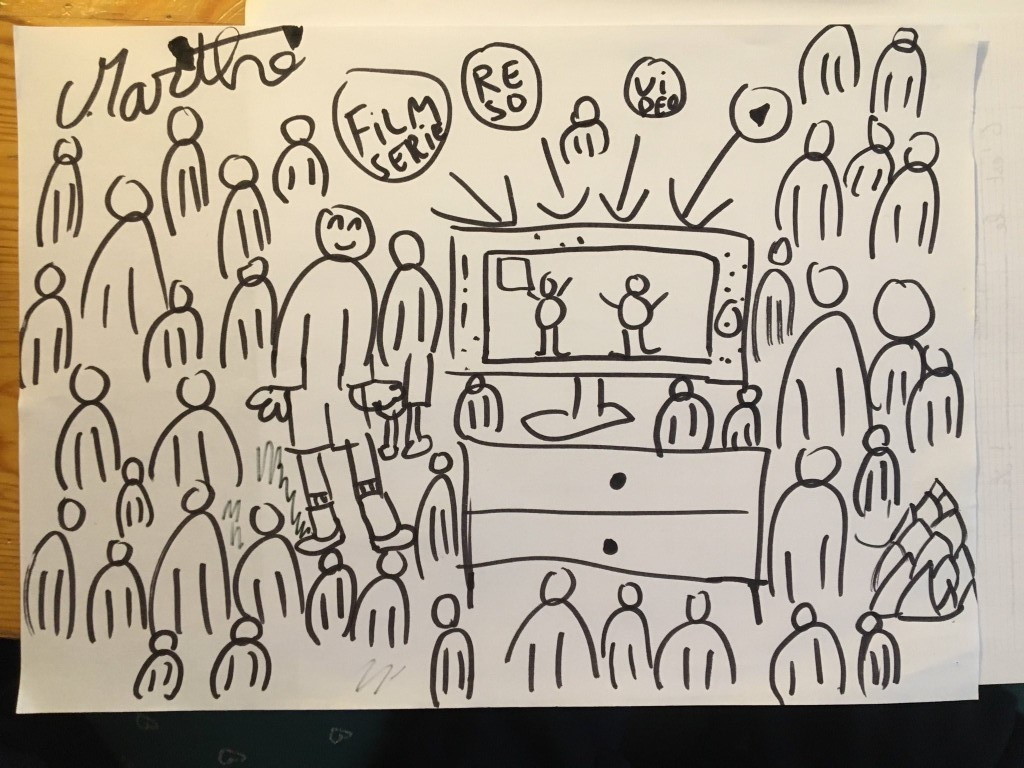
Movies, series, videos A child's drawing. In the middle, there is a screen, on the screen a movie is running. Around the screen there are many people, at least two dozens. The words 'film', 'series', 'network', 'video' are written and arrows point from these words to the screen. There's also a play icon. The youngest respondent, a 9 year old girl, drew a screen with lots of people around it and the words film, series, network, video , as well as a play icon. She said that she mostly uses the internet to watch movies. She was the only one who used a shared tablet and smartphone that belonged to her family, not to herself. And she would explain the net like this to an alien:
"Internet is a er one cannot touch it it s an, er [I propose the word idea ], yes it s an idea. Many people use it not necessarily to watch things, but also to read things or do other stuff."

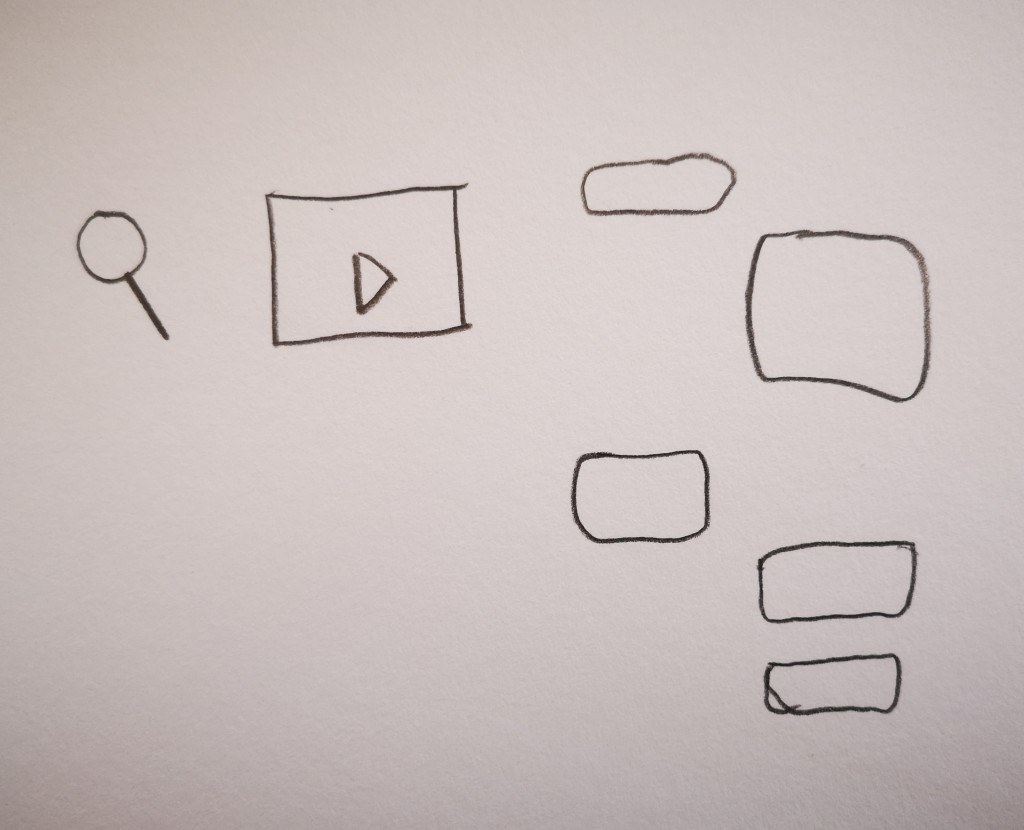
User interface elements There is a magnifying glass icon, a play icon and speech bubbles drawn with a pencil. A 10 year old boy represented the internet by recalling user interface elements he sees every day in his drawing: a magnifying glass (search engine), a play icon (video streaming), speech bubbles (instant messaging). He would explain the internet like this to an alien:
"You can use the internet to learn things or get information, listen to music, watch movies, and chat with friends. You can do nearly anything with it."

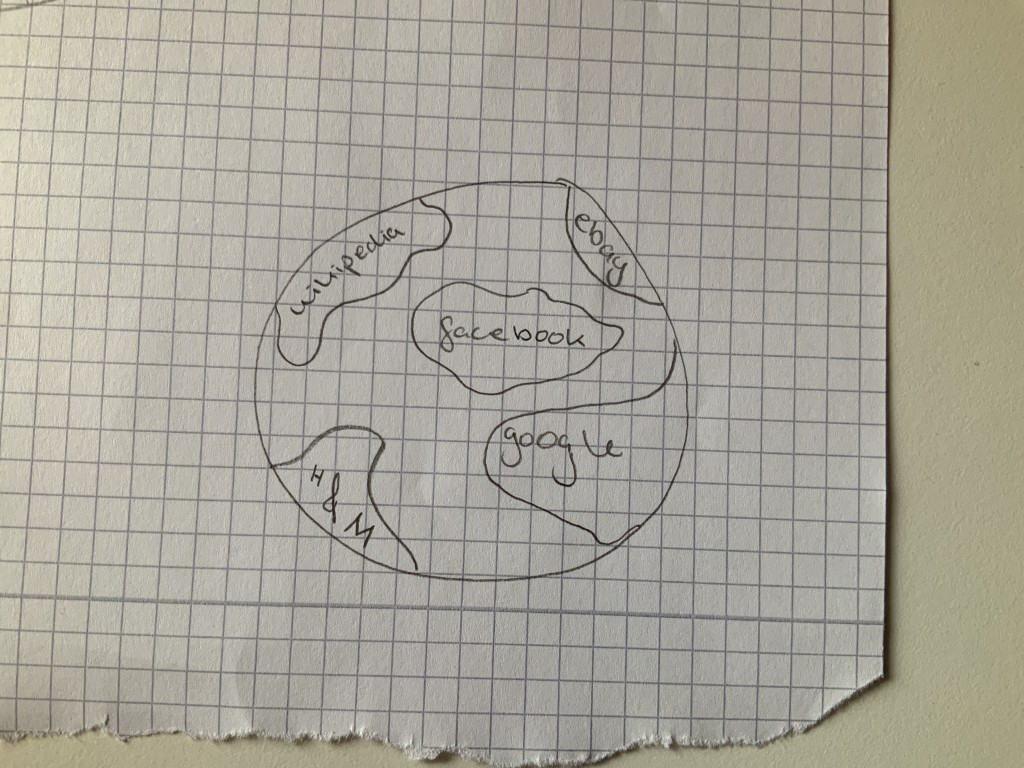
Another planet Pencil drawing that shows a planet with continents. The continents are named: H&M, Ebay, Google, Wikipedia, Facebook. A 12 year old girl imagines the internet like a second, intangible, planet where Google, Wikipedia, Facebook, Ebay, or H&M are continents that one enters into.
"And on [the] Ebay [continent] there s a country for clothes, and ,trousers , for example, would be a federal state in that country."
Something that was unique about this interview was that she told me she had an email address but she never writes emails. She only has an email account to receive confirmation emails, for example when doing online shopping, or when registering to a service and needing to confirm one s address. This is interesting because it s an anti-spam measure that might become outdated with a generation that uses email less or not at all.

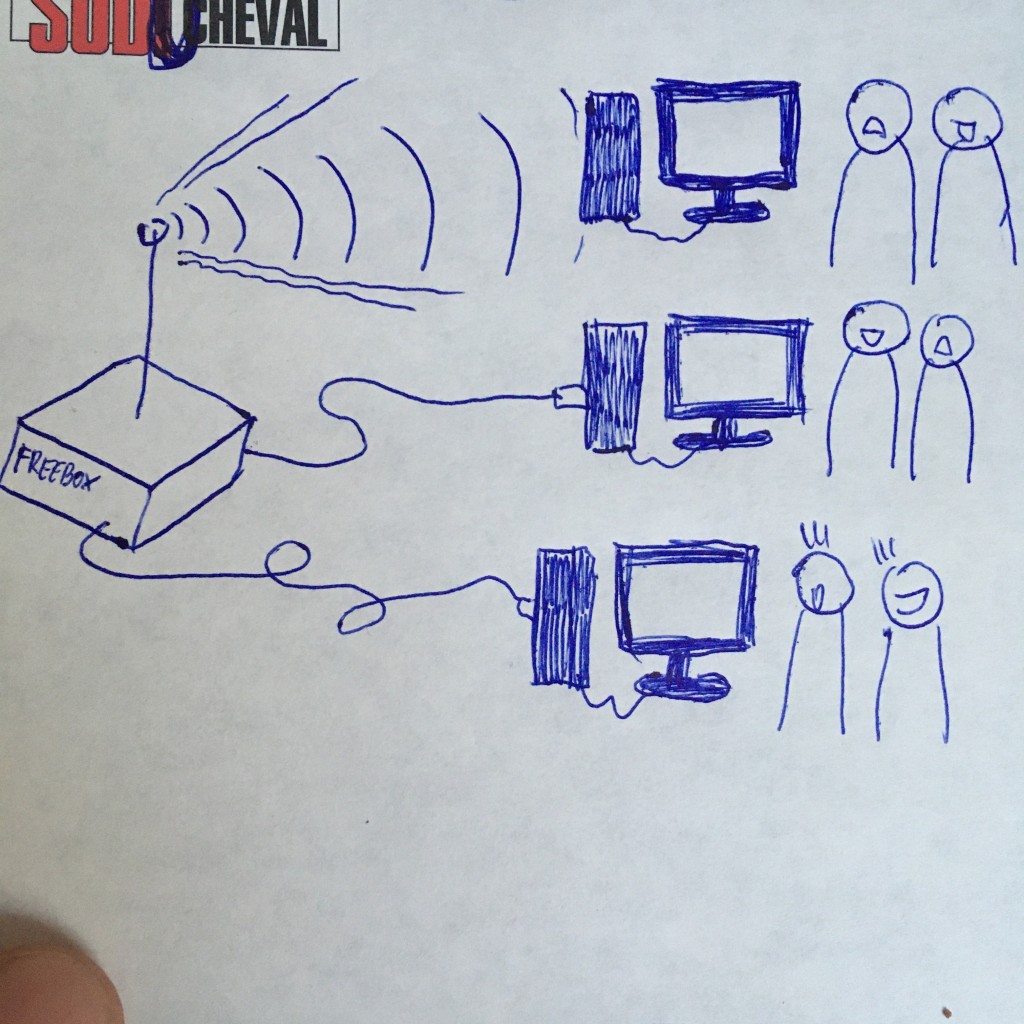
Home network Kid's drawing: there are three computer towers and next to each there are two people. The first couple is sad, the seconf couple is smiling, the last one is suprised. Each computer is connected to a router, two of them by cable, one by wifi. A 15 year old boy knew that his family s devices are connected to a home router (Freebox is a router from the French ISP Free) but lacked an imagination of the rest of the internet s functioning. When I asked him about what would be behind the router, on the other side, he said what s behind is like a black hole to him. However, he was the only interviewee who did actually draw cables, wifi waves, a router, and the local network. His drawing is even extremely precise, it just lacks the cable connecting the router to the rest of the internet.

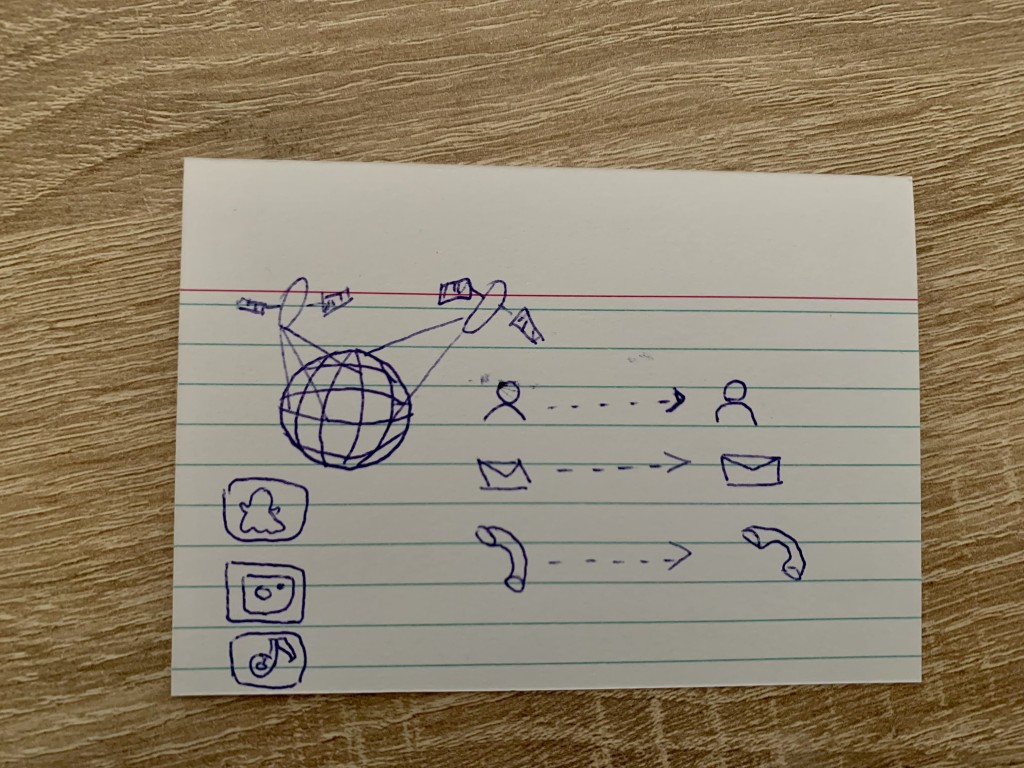
Satellite internet This is another very simple drawing: On top left, there's planet Earth an there are lines indicating that earth is a sphere. Around Earth there are two big satellites reaching most of Earth. on the left, below, there are three icons representing social media services on the internet: Snapchat, Instagram, TikTok. On the right, there are simplified drawings of possibilities which the internet offers: person to person connection, email (represented by envelopes), calls (represented by an old-style telephone set). A 17 year old girl would explain the internet to an alien as follows:
"The internet goes around the entire globe. One is networked with everyone else on Earth. One can find everything. But one cannot touch the internet. It s like a parallel world. With a device one can look into the internet. With search engines, one can find anything in the world, one can phone around the world, and write messages. [The internet] is a gigantic thing."
This interviewee stated as the only one that the internet is huge. And while she also is the only one who drew the internet as actually having some kind of physical extension beyond her own home, she seems to believe that internet connectivity is based on satellite technology and wireless communication.

Imagine that a wise and friendly dragon could teach you one thing about the internet that you ve always wanted to know. What would you ask the dragon to teach you about? A 10 year old boy said he d like to know how big are the servers behind all of this . That s the only interview in which the word server came up. A 12 year old girl said I would ask how to earn money with the internet. I always wanted to know how this works, and where the money comes from. I love the last part of her question! The 15 year old boy for whom everything behind the home router is out of his event horizon would ask How is it possible to be connected like we are? How does the internet work scientifically? A 17 year old girl said she d like to learn how the darknet works, what hidden things are there? Is it possible to get spied on via the internet? Would it be technically possible to influence devices in a way that one can listen to secret or telecommanded devices? Lastly, I wanted to learn about what they find annoying, or problematic about the internet.

Imagine you could make the internet better for everyone. What would you do first? Asked what she would change if she could, the 9 year old girl advocated for a global usage limit of the internet in order to protect the human brain. Also, she said, her parents spend way too much time on their phones and people should rather spend more time with their children. Three of the interviewees agreed that they see way too many advertisements and two of them would like ads to disappear entirely from the web. The other one said that she doesn t want to see ads, but that ads are fine if she can at least click them away. The 15 year old boy had different ambitions. He told me he would change:
"the age of access to the internet. More and more younger people access the internet ; especially with TikTok there is a recommendation algorithm that can influcence young people a lot. And influencing young people should be avoided but the internet does it too much. And that can be negative. If you don t yet have a critical spirit, and you watch certain videos you cannot yet moderate your stance. It can influence you a lot. There are so many things that have become indispensable and that happen on the internet and we have become dependent. What happens if one day it doesn t work anymore? If we connect more and more things to the net, that s not a good thing."

The internet - Oh, that s what you mean! On a sidenote, my first interview tentative was with an 8 year old girl from my family. I asked her if she uses the internet and she denied, so I abandoned interviewing her. Some days later, while talking to her, she proposed to look something up on Google, using her smartphone. I said: Oh, so you are using the internet! She replied: Oh, that s what you re talking about? I think she knows the word Google and she knows that she can search for information with this Google thing. But it appeared that she doesn t know that the Google search engine is located somewhere else on internet and not on her smartphone. I concluded that for her, using the services on the smartphone is as natural as switching on a light in the house: we also don t think about where the electricity comes from when we do that.

What can we learn from these few interviews? Unsurprisingly, social media, streaming, entertainment, and instant messaging are the main activities kids undertake on the internet. They are completely at the mercy of advertisements in apps and on websites, not knowing how to get rid of them. They interact on a daily basis with algorithms that are unregulated and known to perpetuate discrimination and to create filter bubbles, without necessarily being aware of it. The kids I interviewed act as mere service users and seem to be mostly confined to specific apps or websites. All of them perceived the internet as being something intangible. Only the older interviewees perceived that there must be some kind of physical expansion to it: the 17 year old girl by drawing a network of satellites around the globe, the 15 year old boy by drawing the local network in his home. To be continued

Bits from Debian: Lenovo Platinum Sponsor of DebConf22

lenovologo We are very pleased to announce that Lenovo has committed to supporting DebConf22 as a Platinum sponsor. This is the fourth year in a row that Lenovo is sponsoring The Debian Conference with the higher tier! As a global technology leader manufacturing a wide portfolio of connected products, including smartphones, tablets, PCs and workstations as well as AR/VR devices, smart home/office and data center solutions, Lenovo understands how critical open systems and platforms are to a connected world. With this commitment as Platinum Sponsor, Lenovo is contributing to make possible our annual conference, and directly supporting the progress of Debian and Free Software, helping to strengthen the community that continues to collaborate on Debian projects throughout the rest of the year. Thank you very much Lenovo, for your support of DebConf22! Become a sponsor too! DebConf22 will take place from July 17th to 24th, 2022 at the Innovation and Training Park (ITP) in Prizren, Kosovo, and will be preceded by DebCamp, from July 10th to 16th. And DebConf22 is still accepting sponsors! Interested companies and organizations may contact the DebConf team through sponsors@debconf.org, and visit the DebConf22 website at https://debconf22.debconf.org/sponsors/become-a-sponsor. DebConf22 banner open registration

29 March 2022

Dirk Eddelbuettel: RcppBDT 0.2.5: Maintenance

A minor maintenance release for the RcppBDT package is now on CRAN. The RcppBDT package is an early adopter of Rcpp and was one of the first packages utilizing Boost and its Date_Time library. The now more widely-used package anytime is a direct descentant of RcppBDT. Thanks again for the heads-up! This release mostly deals with a one-definition rule violation detected by link-time optimisation (which can be enable when configuring R itself at build time with --enable-lto). I confused myself into thinking Rcpp Modules may be at fault, but I aki was a little more awake than myself and noticed that I only needed to carry the (common) header RcppBDT.h to the file toPOSIXct.cpp added last summer. The NEWS entry follows:

Changes in version 0.2.5 (2022-03-29)
  • Ensure consistent compilation by ensuring RcppBDT.h is included in all files, this addresses an LTO/ODR issue
  • Correct one declaration in init.c
  • Minor additional cleanups

Courtesy of my CRANberries, there is also a diffstat report for this release. If you like this or other open-source work I do, you can now sponsor me at GitHub.

This post by Dirk Eddelbuettel originated on his Thinking inside the box blog. Please report excessive re-aggregation in third-party for-profit settings.

Jeremy Bicha: How to install a bunch of debs

Recently, I needed to check if a regression in Ubuntu 22.04 Beta was triggered by the mesa upgrade. Ok, sounds simple, let me just install the older mesa version. Let s take a look. Oh, wow, there are about 24 binary packages (excluding the packages for debug symbols) included in mesa! Because it s no longer published in Ubuntu 22.04, we can t use our normal apt way to install those packages. And downloading those one by one and then installing them sounds like too much work. Step Zero: Prerequisites If you are an Ubuntu (or Debian!) developer, you might already have ubuntu-dev-tools installed. If not, it has some really useful tools!
$ sudo apt install ubuntu-dev-tools
Step One: Create a Temporary Working Directory Let s create a temporary directory to hold our deb packages. We don t want to get them mixed up with other things.
$ mkdir mesa-downgrade; cd mesa-downgrade
Step Two: Download All the Things One of the useful tools is pull-lp-debs. The first argument is the source package name. In this case, I next need to specify what version I want; otherwise it will give me the latest version which isn t helpful. I could specify a series codename like jammy or impish but that won t give me what I want this time.
$ pull-lp-debs mesa 21.3.5-1ubuntu2
By the way, there are several other variations on pull-lp-debs: I use the LP and Debian source versions frequently when I just want to check something in a package but don t need the full git repo. Step Three: Install Only What We Need This command allows us to install just what we need.
$ sudo apt install --only-upgrade --mark-auto ./*.deb
--only-upgrade tells apt to only install packages that are already installed. I don t actually need all 24 packages installed; I just want to change the versions for the stuff I already have. --mark-auto tells apt to keep these packages marked in dpkg as automatically installed. This allows any of these packages to be suggested for removal once there isn t anything else depending on them. That s useful if you don t want to have old libraries installed on your system in case you do manual installation like this frequently. Finally, the apt install syntax has a quirk: It needs a path to a file because it wants an easy way to distinguish from a package name. So adding ./ before filenames works. I guess this is a bug. apt should be taught that libegl-mesa0_21.3.5-1ubuntu2_amd64.deb is a file name not a package name. Step Four: Cleanup Let s assume that you installed old versions. To get back to the current package versions, you can just upgrade like normal.
$ sudo apt dist-upgrade
If you do want to stay on this unsupported version a bit longer, you can specify which packages to hold:
$ sudo apt-mark hold
And you can use apt-mark list and apt-mark unhold to see what packages you have held and release the holds. Remember you won t get security updates or other bug fixes for held packages! And when you re done with the debs we download, you can remove all the files:
$ cd .. ; rm -ri mesa-downgrade
Bonus: Downgrading back to supported What if you did the opposite and installed newer stuff than is available in your current release? Perhaps you installed from jammy-proposed and you want to get back to jammy ? Here s the syntax for libegl-mesa0 Note the /jammy suffix on the package name.
$ sudo apt install libegl-mesa0/jammy
But how do you find these packages? Use apt list Here s one suggested way to find them:
$ apt list --installed --all-versions  grep local] --after-context 1
Finally, I should mention that apt is designed to upgrade packages not downgrade them. You can break things by downgrading. For instance, a database could upgrade its format to a new version but I wouldn t expect it to be able to reverse that just because you attempt to install an older version.

Raphaël Hertzog: Join Freexian to help improve Debian

Freexian has set itself new ambitious goals in support of Debian and we would like to expand our team to help us reach those goals. We have drafted a mission statement to clarify our purpose and our values, and we hope to be able to attract talented software developers, entrepreneurs and Debian experts from our community.
Freexian s mission is to help Debian evolve to be the leading Linux distribution and a model to follow in the free software world.We want to achieve that by enabling passionate contributors to spend most of their time working on Debian and free software, combining lucrative work in support of enterprise customers, core contributions to Debian s processes, and personal goals.Extract from Freexian s mission statement
If Debian is an important part of your life, if improving Debian is something that you enjoy doing, if you have enough skills and Debian expertise to match some of the roles that we have described on our Join us page, then we would love to hear from you at gerants@freexian.com, so we can figure out a way to work together.

Jacob Adams: A Lesson in Shortcuts

(The below was written by Rob Pike, copied here for posterity from The Wayback Machine) Long ago, as the design of the Unix file system was being worked out, the entries . and .. appeared, to make navigation easier. I m not sure but I believe .. went in during the Version 2 rewrite, when the file system became hierarchical (it had a very different structure early on). When one typed ls, however, these files appeared, so either Ken or Dennis added a simple test to the program. It was in assembler then, but the code in question was equivalent to something like this:
   if (name[0] == '.') continue;
This statement was a little shorter than what it should have been, which is
   if (strcmp(name, ".") == 0   strcmp(name, "..") == 0) continue;
but hey, it was easy. Two things resulted. First, a bad precedent was set. A lot of other lazy programmers introduced bugs by making the same simplification. Actual files beginning with periods are often skipped when they should be counted. Second, and much worse, the idea of a hidden or dot file was created. As a consequence, more lazy programmers started dropping files into everyone s home directory. I don t have all that much stuff installed on the machine I m using to type this, but my home directory has about a hundred dot files and I don t even know what most of them are or whether they re still needed. Every file name evaluation that goes through my home directory is slowed down by this accumulated sludge. I m pretty sure the concept of a hidden file was an unintended consequence. It was certainly a mistake. How many bugs and wasted CPU cycles and instances of human frustration (not to mention bad design) have resulted from that one small shortcut about 40 years ago? Keep that in mind next time you want to cut a corner in your code. (For those who object that dot files serve a purpose, I don t dispute that but counter that it s the files that serve the purpose, not the convention for their names. They could just as easily be in $HOME/cfg or $HOME/lib, which is what we did in Plan 9, which had no dot files. Lessons can be learned.)

28 March 2022

Russell Coker: Feedburner Seems to be Dying

Many years ago Feedburner was a useful service. It proxied the RSS feed of your blog and gave you analytics of what happened with it. Now feeds using Feedburner randomly give HTTP error 404s. The Feedburner Twitter account is inactive and recommends that people Tweet at Google instead. It seems that Google wants to get rid of the service and random 404s probably aren t a high priority for them. I ve just gone through the config for Planet Linux Australia [1] and changed as many Feedburner URLs as possible to direct feed URLs. I did this by loading the Feedburner feed, getting the URL for the site, and then guessing the feed URL (usually just appending /feed to the domain name). I recommend that everyone abandon Feedburner, it s not reliable enough to use and doesn t seem to have any active support.

Antoine Beaupr : What is going on with web servers

I stumbled upon this graph recently, which is w3techs.com graph of "Historical yearly trends in the usage statistics of web servers". It seems I hadn't looked at it in a long while because I was surprised at many levels:
  1. Apache is now second, behind Nginx, since ~2022 (so that's really new at least)
  2. Cloudflare "server" is third ahead of the traditional third (Microsoft IIS) - I somewhat knew that Cloudflare was hosting a lot of stuff, but I somehow didn't expect to see it there at all for some reason
  3. I had to lookup what LiteSpeed was (and it's not a bike company): it's a drop-in replacement (!?) of the Apache web server (not a fork, a bizarre idea but which seems to be gaining a lot of speed recently, possibly because of its support for QUIC and HTTP/3
So there. I'm surprised. I guess the stats should be taken with a grain of salt because they only partially correlate with Netcraft's numbers which barely mention LiteSpeed at all. (But they do point at a rising share as well.) Netcraft also puts Nginx's first place earlier in time, around April 2019, which is about when Microsoft's IIS took a massive plunge down. That is another thing that doesn't map with w3techs' graphs at all either. So it's all lies and statistics, basically. Moving on. Oh and of course, the two first most popular web servers, regardless of the source, are package in Debian. So while we're working on statistics and just making stuff up, I'm going to go ahead and claim all of this stuff runs on Linux and that BSD is dead. Or something like that.

Dirk Eddelbuettel: RcppCNPy 0.2.11

A minor maintenance release of the RcppCNPy package arrived on CRAN three days ago, but we skipped announcing it right then. RcppCNPy provides R with read and write access to NumPy files thanks to the cnpy library by Carl Rogers along with Rcpp for the glue to R. One of the vignettes created an issue at CRAN with one of the Python modules used, so we simply switched to pre-made vignettes just as we do for a few other packages. Other small changes that had accumulated since the previous release were a new section in the reticulate vignette as well as some more documentation on types as well as some updates to continuous integration and bdages.

Changes in version 0.2.11 (2022-03-24)
  • The reticulate vignette has new section on 3d-arrays.
  • Added clarification to the manual page that the default types are 32-bit integer and 64-bit double (as we are working with R here).
  • Several updates have been made to the CI system; it now runs r-ci.
  • The README.md was updated with some new badges.
  • The vignettes are now pre-made to avoid any external dependencies.

CRANberries also provides a diffstat report for the latest release. As always, feedback is welcome and the best place to start a discussion may be the GitHub issue tickets page.

This post by Dirk Eddelbuettel originated on his Thinking inside the box blog. Please report excessive re-aggregation in third-party for-profit settings.

Russell Coker: Hangouts Replacement

Google is currently in the process of killing Hangouts. Last year Hangouts was quite a nice IM system with integrated video chat and voice calling. Now they have decided to kill it and replace it with Google Chat and Google Meet both of which are integrated with the Gmail app on Android. To start getting people off the old platform they have disabled video and audio chats with more than 2 people in Hangouts. To do a video call you have to use Meet which has a worse user interface and isn t integrated with text chat, so if in a text discussion someone says let s have a video call you have to open a new app. Meet also doesn t appear to have a facility to notify group members that someone has joined a group call so it s required that Chat (or something else) is used to tell people they can join Meet. Many of my relatives use Hangouts because they are forced to have it installed on their Android phones and because it worked quite well. Now it doesn t work well and will soon be going away. So another option is needed. I m considering Matrix as a replacement. Matrix has a good feature set and is being worked on a lot. The video conferencing is through a connection to a Jitsi server and is well integrated giving functionality more like Hangouts than Chat/Meet. For the LUV Matrix server the URL https://luv.asn.au/.well-known/matrix/client has the following contents:
 
  "m.homeserver":  
    "base_url": "https://luv.asn.au"
   
  "jitsi":  
    "preferredDomain": "jitsi.perthchat.org"
   
  "im.vector.riot.jitsi":  
    "preferredDomain": "jitsi.perthchat.org"
   
 
This specifies the Jitsi server to be used for chats started from that Matrix server. The PerthChat.org people seem to be leading the way for self hosted Matrix in Australia. Note that other people shouldn t link to their Jitsi server without discussing it with them first. I only included real data because it s published on the web so there s no point in keeping it secret. The Flounder free software users group [1] uses Matrix a lot. We will probably discuss Matrix at the next meeting on Saturday. There is also Element Call [2] which is apparently more integrated with Matrix (and also newer and possibly buggier). Jitsi works and we can change to a different service easily enough at a later time.

Russell Coker: Reading Glasses

About 4 years ago at a routine eye check the optometrist recommended that I get reading glasses. Apparently I m old enough that my eyes are losing their ability to focus at different distances to having different glasses for close and remote objects (EG reading and driving) is necessary for good vision. The optometrist asked me the distance that I use for reading and I indicated a distance that is good for books and phones (about 20cm). So I got a pair of glasses that worked well for that but didn t work well for the vast majority of my close work which is computer monitors. I found that I could use my reading glasses with my laptop when lying in bed if I had the laptop on my chest with the keyboard touching my chin, which is a reasonable position for watching TV but not for much else. About 2 years ago I had another eye check which determined that the glasses for long distance were good and got reading glasses designed for objects about 80cm away which worked well for monitors and were usable for watching TV. Recently I accidentally broke my newer pair of reading glasses and discovered that the older pair now works for distances of about a meter. So it appears that I have become significantly more long sighted over the last 4 years.

27 March 2022

Russ Allbery: Review: A Song for a New Day

Review: A Song for a New Day, by Sarah Pinsker
Publisher: Berkley
Copyright: September 2019
ISBN: 1-9848-0259-3
Format: Kindle
Pages: 372
Luce Cannon was touring with a session band when the shutdown began. First came the hotel evacuation in the middle of the night due to bomb threats against every hotel in the state. Then came the stadium bombing just before they were ready to go on stage. Luce and most of the band performed anyway, with a volunteer crew and a shaken crowd. It was, people later decided, the last large stage show in the United States before the congregation laws shut down public gatherings. That was the end of Luce's expected career, and could have been the end of music, or at least public music. But Luce was stubborn and needed the music. Rosemary grew up in the aftermath: living at home with her parents well away from other people, attending school virtually, and then moving seamlessly into a virtual job for Superwally, the corporation that ran essentially everything. A good fix for some last-minute technical problems with StageHoloLive's ticketing system got her an upgraded VR hoodie and complimentary tickets to the first virtual concert she'd ever attended. She found the experience astonishing, prompting her to browse StageHoloLive job openings and then apply for a technical job and, on a whim, an artist recruiter role. That's how Rosemary found herself, quite nerve-wrackingly, traveling out into the unsafe world to look for underground musicians who could become StageHoloLive acts. A Song for a New Day was published in 2019 and had a moment of fame at the beginning of 2020, culminating in the Nebula Award for best novel, because it's about lockdowns, isolation, and the suppression of public performances. There's even a pandemic, although it's not a respiratory disease (it's some variety of smallpox or chicken pox) and is only a minor contributing factor to the lockdowns in this book. The primary impetus is random violence. Unfortunately, the subsequent two years have not been kind to this novel. Reading it in 2022, with the experience of the past two years fresh in my mind, was a frustrating and exasperating experience because the world setting is completely unbelievable. This is not entirely Pinsker's fault; this book was published in 2019, was not intended to be about our pandemic, and therefore could not reasonably predict its consequences. Still, it required significant effort to extract the premise of the book from the contradictory evidence of current affairs and salvage the pieces of it I still enjoyed. First, Pinsker's characters are the most astonishingly incurious and docile group of people I've seen in a recent political SF novel. This extends beyond the protagonists, where it could arguably be part of their characterization, to encompass the entire world (or at least the United States; the rest of the world does not appear in this book at all so far as I can recall). You may be wondering why someone bombs a stadium at the start of the book. If so, you are alone; this is not something anyone else sees any reason to be curious about. Why is random violence spiraling out of control? Is there some coordinated terrorist activity? Is there some social condition that has gotten markedly worse? Race riots? Climate crises? Wars? The only answer this book offers is a completely apathetic shrug. There is a hint at one point that the government may have theories that they're not communicating, but no one cares about that either. That leads to the second bizarre gap: for a book that hinges on political action, formal political structures are weirdly absent. Near the end of the book, one random person says that they have been inspired to run for office, which so far as I can tell is the first mention of elections in the entire book. The "government" passes congregation laws shutting down public gatherings and there are no protests, no arguments, no debate, but also no suppression, no laws against the press or free speech, no attempt to stop that debate. There's no attempt to build consensus for or against the laws, and no noticeable political campaigning. That's because there's no need. So far as one can tell from this story, literally everyone just shrugs and feels sad and vaguely compliant. Police officers exist and enforce laws, but changing those laws or defying them in other than tiny covert ways simply never occurs to anyone. This makes the book read a bit like a fatuous libertarian parody of a docile populace, but this is so obviously not the author's intent that it wouldn't be satisfying to read even as that. To be clear, this is not something that lasts only a few months in an emergency when everyone is still scared. This complete political docility and total incuriosity persists for enough years that Rosemary grows up within that mindset. The triggering event was a stadium bombing followed by an escalating series of random shootings and bombings. (The pandemic in the book only happens after everything is locked down and, apart from adding to Rosemary's agoraphobia and making people inconsistently obsessed with surface cleanliness, plays little role in the novel.) I lived through 9/11 and the Oklahoma City bombing in the US, other countries have been through more protracted and personally dangerous periods of violence (the Troubles come to mind), and never in human history has any country reacted to a shock of violence (or, for that matter, disease) like the US does in this book. At points it felt like one of those SF novels where the author is telling an apparently normal story and all the characters turn out to be aliens based on spiders or bats. I finally made sense of this by deciding that the author wasn't using sudden shocks like terrorism or pandemics as a model, even though that's what the book postulates. Instead, the model seems to be something implicitly tolerated and worked around: US school shootings, for instance, or the (incorrect but widespread) US belief in a rise of child kidnappings by strangers. The societal reaction here looks less like a public health or counter-terrorism response and more like suburban attitudes towards child-raising, where no child is ever left unattended for safety reasons but we routinely have school shootings no other country has at the same scale. We have been willing to radically (and ineffectually) alter the experience of childhood due to fears of external threat, and that's vaguely and superficially similar to the premise of this novel. What I think Pinsker still misses (and which the pandemic has made glaringly obvious) is the immense momentum of normality and the inability of adults to accept limitations on their own activities for very long. Even with school shootings, kids go to school in person. We now know that parts of society essentially collapse if they don't, and political pressure becomes intolerable. But by using school shootings as the model, I managed to view Pinsker's setup as an unrealistic but still potentially interesting SF extrapolation: a thought experiment that ignores countervailing pressures in order to exaggerate one aspect of society to an extreme. This is half of Pinsker's setup. The other half, which made less of a splash because it didn't have the same accident of timing, is the company Superwally: essentially "what if Amazon bought Walmart, Google, Facebook, Netflix, Disney, and Live Nation." This is a more typical SF extrapolation that left me with a few grumbles about realism, but that I'll accept as a plot device to talk about commercialization, monopolies, and surveillance capitalism. But here again, the complete absence of formal political structures in this book is not credible. Superwally achieves an all-pervasiveness that in other SF novels results in corporations taking over the role of national governments, but it still lobbies the government in much the same way and with about the same effectiveness as Amazon does in our world. I thought this directly undermined some parts of the end of the book. I simply did not believe that Superwally would be as benign and ineffectual as it is shown here. Those are a lot of complaints. I found reading the first half of this book to be an utterly miserable experience and only continued reading out of pure stubbornness and completionism. But the combination of the above-mentioned perspective shift and Pinsker's character focus did partly salvage the book for me. This is not a book about practical political change, even though it makes gestures in that direction. It's primarily a book about people, music, and personal connection, and Pinsker's portrayal of individual and community trust in all its complexity is the one thing the book gets right. Rosemary's character combines a sort of naive arrogance with self-justification in a way that I found very off-putting, but the pivot point of the book is the way in which Luce and her community extends trust to her anyway, as part of staying true to what they believe. The problem that I think Pinsker was trying to write about is atomization, which leads to social fragmentation into small trust networks with vast gulfs between them. Luce and Rosemary are both characters who are willing to bridge those gulfs in their own ways. Pinsker does an excellent job describing the benefits, the hurt, the misunderstandings, the risk, and the awkward process of building those bridges between communities that fundamentally do not understand each other. There's something deep here about the nature of solidarity, and how you need both people like Luce and people like Rosemary to build strong and effective communities. I've kept thinking about that part. It's also helpful for a community to have people who are curious about cause and effect, and who know how a bill becomes a law. It's hard to sum up this book, other than to say that I understand why it won a Nebula but it has deep world-building flaws that have become far more obvious over the past two years. Pinsker tries hard to capture the feeling of live music for both the listener and the performer and partly succeeded even for me, which probably means others will enjoy that part of the book immensely. The portrayal of the difficult dynamics of personal trust was the best part of the book for me, but you may have to build scaffolding and bracing for your world-building disbelief in order to get there. On the whole, I think A Song for a New Day is worth reading, but maybe not right now. If you do read it now, tell yourself at the start that this is absolutely not about the pandemic and that everything political in this book is a hugely simplified straw-man extrapolation, and hopefully you'll find the experience less frustrating than I found it. Rating: 6 out of 10

Next.

Previous.