Search Results: "ean"

16 November 2014

Bernhard R. Link: Enabling Change

Big changes are always a complicated thing to get done and can be the harder the bigger or more diverse an organization is it is taking place in. Transparency Ideally every change is well communicated early and openly. Leaving people in the dark about what will change and when means people have much less time to feeling comfortable about it or arranging with it mentally. Especially bad can be extending the change later or or shortening transition periods. Letting people think they have some time to transition only to force them to rush later will remove any credibility you have and severely reduce their ability to believe you are not crossing them. Making a new way optional is a great way to create security (see below), but making that obligatory before the change even arrives as optional with them will not make them very willing to embrace change. Take responsibility Every transformation means costs. Even if some change did only improve and did not make anything worse once implemented (the ideal change you will never meet in reality), the deployment of the change still costs: processes have adapted to it, people have to relearn how to do things, how to detect if something goes wrong, how to fix it, documentation has to be adopted and and and. Even as the change causes more good than costs in the whole organization (let's hope it does, I hope you wouldn't try to do something if the total benefit is negative), the benefits and thus the benefit to cost ratio will differ for the different parts of your organization or the different people within it. It's hardly avoidable that for some people there will not be much benefit, much less perceived benefit compared to the costs they have to burden for it. Those are the people whose good will you want to fight for, not the people you want to fight against. They have to pay with their labor/resources and thus their good will for your benefit the overall benefit. This is much easier if you acknowledge that fact. If you blame them for having the costs, claim their situation does not even exist or even ridicule them for not embracing change you only prepare yourself for frustration. You might be able to persuade yourself that everyone that is not willing to invest in the change is just acting out of malevolent self-interest. But you will hardly be able to persuade people that it is evil to not help your cause if you treat them as enemies. And once you ignored or played down costs that later actually happen, your credibility in being able to see the big picture will simply cease to exist at all for the next change. Allow different metrics People have different opinions about priorities, about what is important, about how much something costs and even about what is a problem. If you want to persuade them, try to take that into account. If you do not understand why something is a reason, it might be because the given point is stupid. But it might also be that you miss something. And often there is simple a different valuation of what is important, what the costs are and what are problems. If you want to persuade people, it is worth to try to understand those. If all you want to do is persuade some leader or some majority then ridiculing their concerns might get you somewhere. But how do you want to win people over if you do not even appear to understand their problems. Why should people trust you that their costs will be worth the overall benefits if you tell them the costs that they clearly see do not exist? How credible is referring to the bigger picture if the part of the picture they can see does not match what you say the bigger picture looks like? Don't get trolled and don't troll There will always be people that might be unreasonable or even try to provoke you. Don't allow being provoked. Remember that for successful changes you need to win broad support. Feeling personally attacked or feeling presented a large amount of pointless arguments easily results in not bringing proper responses or actually looking at arguments. If someone is only trolling and purely malevolent, they will tease you best if they bring actual concerns of people in a way you likely degrade your yourself and your point in answering. Becoming impertinent with the troll is like attacking the annoying little goblin hiding next to the city guards with area damage. When not being able to persuade people, it is also far to easy to consider them in bad faith and/or attacking them personally. This can only escalate even more. Worst case you frustrate someone in good faith. In most cases you poison the discussion so much that people actually in good faith will no longer contribute the discussion. It might be rewarding short term because after some escalation only obviously unreasonable people will talk against you, but it makes it much harder to find solutions together that could benefit anyone and almost impossible to persuade those that simply left the discussion. Give security Last but not least, remember that humans are quite risk-averse. In general they might invest in (even small) chances to win, but go a long way to avoid risks. Thus an important part of enabling change is to reduce risks, real and perceived ones and give people a feeling of security. In the end, almost every measure boils down to that: You give people security by giving them the feeling that the whole picture is considered in decisions (by bringing them early into the process, by making sure their concerns are understood and part of the global profit/cost calculation and making sure their experiences with the change are part of the evaluation). You give people security by allowing them to predict and control things (by transparency about plans, how far the change will go and guaranteed transitions periods, by giving them enough time so they can actually plan and do the transition). You give people security by avoiding early points of no return (by having wide enough tests, rollback scenarios,...). You give people security by not letting them alone (by having good documentation, availability of training, ...). Especially side-by-side availability of old and new is an extremely powerful tool, as it fits all of the above: It allows people to actually test it (and not some little prototype mostly but not quite totally unrelated to reality) so their feedback can be heard. It makes it more predictable as all the new ways can be tried before the old ones no longer work. It is the ultimate role-back scenario (just switch off the new). And allows for learning the new before losing the old. Of course giving the people a feeling of security needs resources. But it is a very powerful way to get people to embrace the chance. Also in my experience people only fearing for themselves will usually mostly be passive by not pushing forward and trying to avoid or escape the changes. (After all, working against something costs energy, so purely egoistic behavior is quite limiting in that regard). Most people actively pushing back do it because they fear for something larger than only them. And any measure to making them fear less that you ruin the overall organization, not only avoids unnecessary hurdles rolling out the change but also has some small chance to actually avoid running into disaster with closed eyes.

Vincent Bernat: Replacing Swisscom router by a Linux box

I have recently moved to Lausanne, Switzerland. Broadband Internet access is not as cheap as in France. Free, a French ISP, is providing an FTTH access with a bandwith of 1 Gbps1 for about 38 (including TV and phone service), Swisscom is providing roughly the same service for about 200 2. Swisscom fiber access was available for my appartment and I chose the 40 Mbps contract without phone service for about 80 . Like many ISP, Swisscom provides an Internet box with an additional box for TV. I didn t unpack the TV box as I have no use for it. The Internet box comes with some nice features like the ability to setup firewall rules, a guest wireless access and some file sharing possibilities. No shell access! I have bought a small PC to act as router and replace the Internet box. I have loaded the upcoming Debian Jessie on it. You can find the whole software configuration in a GitHub repository. This blog post only covers the Swisscom-specific setup (and QoS). Have a look at those two blog posts for related topics:

Ethernet The Internet box is packed with a Siligence-branded 1000BX SFP3. This SFP receives and transmits data on the same fiber using a different wavelength for each direction. Instead of using a network card with an SFP port, I bought a Netgear GS110TP which comes with 8 gigabit copper ports and 2 fiber SFP ports. It is a cheap switch bundled with many interesting features like VLAN and LLDP. It works fine if you don t expect too much from it.

IPv4 IPv4 connectivity is provided over VLAN 10. A DHCP client is mandatory. Moreover, the DHCP vendor class identifier option (option 60) needs to be advertised. This can be done by adding the following line to /etc/dhcp/dhclient.conf when using the ISC DHCP client:
send vendor-class-identifier "100008,0001,,Debian";
The first two numbers are here to identify the service you are requesting. I suppose this can be read as requesting the Swisscom residential access service. You can put whatever you want after that. Once you get a lease, you need to use a browser to identify yourself to Swisscom on the first use.

IPv6 Swisscom provides IPv6 access through the 6rd protocol. This is a tunneling mechanism to facilitate IPv6 deployment accross an IPv4 infrastructure. This kind of tunnel is natively supported by Linux since kernel version 2.6.33. To setup IPv6, you need the base IPv6 prefix and the 6rd gateway. Some ISP are providing those values through DHCP (option 212) but this is not the case for Swisscom. The gateway is 6rd.swisscom.com and the prefix is 2a02:1200::/28. After appending the IPv4 address to the prefix, you still get 4 bits for internal subnets. Swisscom doesn t provide a fixed IPv4 address. Therefore, it is not possible to precompute the IPv6 prefix. When installed as a DHCP hook (in /etc/dhcp/dhclient-exit-hooks.d/6rd), the following script configures the tunnel:
sixrd_iface=internet6
sixrd_mtu=1472                  # This is 1500 - 20 - 8 (PPPoE header)
sixrd_ttl=64
sixrd_prefix=2a02:1200::/28     # No way to guess, just have to know it.
sixrd_br=193.5.29.1             # That's "6rd.swisscom.com"
sixrd_down()  
    ip tunnel del $ sixrd_iface    true
 
sixrd_up()  
    ipv4=$ new_ip_address:-$old_ip_address 
    sixrd_subnet=$(ruby <<EOF
require 'ipaddr'
prefix = IPAddr.new "$ sixrd_prefix ", Socket::AF_INET6
prefixlen = $ sixrd_prefix#*/ 
ipv4 = IPAddr.new "$ ipv4 ", Socket::AF_INET
ipv6 = IPAddr.new (prefix.to_i + (ipv4.to_i << (64 + 32 - prefixlen))), Socket::AF_INET6
puts ipv6
EOF
)
    # Let's configure the tunnel
    ip tunnel add $ sixrd_iface  mode sit local $ipv4 ttl $sixrd_ttl
    ip tunnel 6rd dev $ sixrd_iface  6rd-prefix $ sixrd_prefix 
    ip addr add $ sixrd_subnet 1/64 dev $ sixrd_iface 
    ip link set mtu $ sixrd_mtu  dev $ sixrd_iface 
    ip link set $ sixrd_iface  up
    ip route add default via ::$ sixrd_br  dev $ sixrd_iface 
 
case $reason in
    BOUND REBOOT)
        sixrd_down
        sixrd_up
        ;;
    RENEW REBIND)
        if [ "$new_ip_address" != "$old_ip_address" ]; then
            sixrd_down
            sixrd_up
        fi
        ;;
    STOP EXPIRE FAIL RELEASE)
        sixrd_down
        ;;
esac
The computation of the IPv6 prefix is offloaded to Ruby instead of trying to use the shell for that. Even if the ipaddr module is pretty basic , it suits the job. Swisscom is using the same MTU for all clients. Because some of them are using PPPoE, the MTU is 1472 instead of 1480. You can easily check your MTU with this handy online MTU test tool. It is not uncommon that PMTUD is broken on some parts of the Internet. While not ideal, setting up TCP MSS will alievate any problem you may run into with a MTU less than 1500:
ip6tables -t mangle -A POSTROUTING -o internet6 \
          -p tcp --tcp-flags SYN,RST SYN \
          -j TCPMSS --clamp-mss-to-pmtu

QoS UPDATED: Unfortunately, this section is incorrect, including its premise. Have a look at Dave Taht comment for more details. Once upon a time, QoS was a tacky subject. The Wonder Shaper was a common way to get a somewhat working setup. Nowadays, thanks to the work of the Bufferbloat project, there are two simple steps to get something quite good:
  1. Reduce the queue of your devices to something like 32 packets. This helps TCP to detect congestion and act accordingly while still being able to saturate a gigabit link.
    ip link set txqueuelen 32 dev lan
    ip link set txqueuelen 32 dev internet
    ip link set txqueuelen 32 dev wlan
    
  2. Change the root qdisc to fq_codel. A qdisc receives packets to be sent from the kernel and decide how packets are handled to the network card. Packets can be dropped, reordered or rate-limited. fq_codel is a queuing discipline combining fair queuing and controlled delay. Fair queuing means that all flows get an equal chance to be served. Another way to tell it is that a high-bandwidth flow won t starve the queue. Controlled delay means that the queue size will be limited to ensure the latency stays low. This is achieved by dropping packets more aggressively when the queue grows.
    tc qdisc replace dev lan root fq_codel
    tc qdisc replace dev internet root fq_codel
    tc qdisc replace dev wlan root fq_codel
    

  1. Maximum download speed is 1 Gbps, while maximum upload speed is 200 Mbps.
  2. This is the standard Vivo XL package rated at CHF 169. plus the 1 Gbps option at CHF 80. .
  3. There are two references on it: SGA 441SFP0-1Gb and OST-1000BX-S34-10DI. It transmits to the 1310 nm wave length and receives on the 1490 nm one.

13 November 2014

Joey Hess: on leaving

I left Debian. I don't really have a lot to say about why, but I do want to clear one thing up right away. It's not about systemd. As far as systemd goes, I agree with my friend John Goerzen:
I promise you 18 years from now, it will not matter what init Debian chose in 2014. It will probably barely matter in 3 years.
read the rest And with Jonathan Corbet:
However things turn out, if it becomes clear that there is a better solution than systemd available, we will be able to move to it.
read the rest I have no problem with trying out a piece of Free Software, that might have abrasive authors, all kinds of technical warts, a debatable design, scope creep etc. None of that stopped me from giving Linux a try in 1995, and I'm glad I jumped in with both feet. It's important to be unafraid to make a decision, try it out, and if it doesn't work, be unafraid to iterate, rethink, or throw a bad choice out. That's how progress happens. Free Software empowers us to do this. Debian used to be a lot better at that than it is now. This seems to have less to do with the size of the project, and more to do with the project having aged, ossified, and become comfortable with increasing layers of complexity around how it makes decisions. To the point that I no longer feel I can understand the decision-making process at all ... or at least, that I'd rather be spending those scarce brain cycles on understanding something equally hard but more useful, like category theory. It's been a long time since Debian was my main focus; I feel much more useful when I'm working in a small nimble project, making fast and loose decisions and iterating on them. Recent events brought it to a head, but this is not a new feeling. I've been less and less involved in Debian since 2007, when I dropped maintaining any packages I wasn't the upstream author of, and took a year of mostly ignoring the larger project. Now I've made the shift from being a Debian developer to being an upstream author of stuff in Debian (and other distros). It seems best to make a clean break rather than hang around and risk being sucked back in. My mailbox has been amazing over the past week by the way. I've heard from so many friends, and it's been very sad but also beautiful.

Tanguy Ortolo: Re: About choice

This is a reply to Josselin Mouette's blog article About choice, since his blog does not seem to accept comments . Please note that this is not meant to be systemd-bashing, just a criticism base one a counter-example refutation of Josselin's implication that there is no use case better covered by SysV init: this is false, as there is at least one. And yes, there are probably many cases better covered by systemd, I am making no claims about that.A use case better covered by SysV init: encrypted block devices So, waiting for a use case better covered by SysV init? Rejoice, you will not die waiting, here is one: encrypted block devices. That case works just fine with SysV init, without any specific configuration, whereas systemd just sucks at it. There exist a way to make it work , but: If you know any better, I would be glad to try it. Believe me, I like the basic principles of systemd and I would be glad to have it working correctly on my system. Notes
  1. Well, it does accept comments, but marks them as span and does not show them, which is roughly equivalent.
  2. Installing an additional piece of software, Plymouth, is supposed to make systemd work correctly with encrypted block devices. Yes, this is additional configuration, as that piece of software does not come when you install systemd, and it is not even suggested so a regular user cannot guess it.
  3. Though I must say I hate the way it is pushed into the GNU/Linux desktop systems.

12 November 2014

Jonathan Wiltshire: A chilly week

It s finally become properly autumnal, in the real world and in Debian. One week ago, I announced (on behalf of the whole release team) that Debian 8 Jessie had successfully frozen on time. At 18:00 that evening we had 310 release critical bugs that is, the number that we must reduce to 0 before the release is ready. How does that number look now? Well, there are now 315 bugs affecting Jessie, at various stages of progression. That sounds like it s going in the wrong direction, but considering that over a hundred new bugs were filed just 8 hours after the freeze announcement, things are actually looking pretty good. Out of those 315 bugs, 91 have been fixed and the packages affected have already been unblocked by the release team. The fixed packages will migrate to Jessie in the next few days, if they continue to be bug-free. Thirty-four bugs are apparently fixed in unstable but are not cleared for migration yet. That means that the release team has not spotted the fix, or nobody has told us, or the fixed package is unsuitable for some other reason (like unrelated changes in the same upload). You can help by trying to find out which reason applies, and talking to us about it. Most likely nobody has asked us to unblock it yet. Speaking of unblocks, we currently have twenty-four requests that need to be looked at, and a further 20 which are awaiting more information from the maintainer. We already investigated and resolved 260 requests. Our response rate is currently pretty good, but it s unclear whether we can sustain it indefinitely. We all have day jobs, for example. One way you could help is to review the list of unchecked unblocks and gather up missing information, or look at the ones tagged moreinfo and see whether that s still the case (maybe the maintainer replied, but forgot to remove the tag). If you re confident, you might even try triaging some of the obvious requests and give some feedback to the maintainer, though the final decision will be made by a release team member. After all, the quicker this goes the sooner we can release and thaw up unstable again.
Footnote: the method used to determine RC bug counts last week and this week differ, and therefore so could the margin for error. Surprisingly enough, counting bugs is not an exact science. I m confident these numbers are close enough for broad comparison, even if they re out by one or two.
A chilly week is a post from: jwiltshire.org.uk Flattr

11 November 2014

Simon Josefsson: Dice Random Numbers

Generating data with entropy, or random number generation (RNG), is a well-known difficult problem. Many crypto algorithms and protocols assumes random data is available. There are many implementations out there, including /dev/random in the BSD and Linux kernels and API calls in crypto libraries such as GnuTLS or OpenSSL. How they work can be understood by reading the source code. The quality of the data depends on actual hardware and what entropy sources were available the RNG implementation itself is deterministic, it merely convert data with supposed entropy from a set of data sources and then generate an output stream. In some situations, like on virtualized environments or on small embedded systems, it is hard to find sources of sufficient quantity. Rarely are there any lower-bound estimates on how much entropy there is in the data you get. You can improve the RNG issue by using a separate hardware RNG, but there is deployment complexity in that, and from a theoretical point of view, the problem of trusting that you get good random data merely moved from one system to another. (There is more to say about hardware RNGs, I ll save that for another day.) For some purposes, the available solutions does not inspire enough confidence in me because of the high complexity. Complexity is often the enemy of security. In crypto discussions I have said, only half-jokingly, that about the only RNG process that I would trust is one that I can explain in simple words and implement myself with the help of pen and paper. Normally I use the example of rolling a normal six-sided dice (a D6) several times. I have been thinking about this process in more detail lately, and felt it was time to write it down, regardless of how silly it may seem. A dice with six sides produces a random number between 1 and 6. It is relatively straight forward to intuitively convinced yourself that it is not clearly biased: inspect that it looks symmetric and do some trial rolls. By repeatedly rolling the dice, you can generate how much data you need, time permitting. I do not understand enough thermodynamics physics to know how to estimate the amount of entropy of a physical process, so I need to resort to intuitive arguments. It would be easy to just assume that a dice produces 3 bits of entropy, because 2^3=6 which matches the number of possible outcomes. At least I find it easy to convince myself that 3 bits is the upper bound. I suspect that most dice have some form of defect, though, which leads to a very small bias that could be found with a large number of rolls. Thus I would propose that the amount of entropy of most D6 s are slightly below 3 bits on average. Further, to establish a lower bound, and intuitively, it seems easy to believe that if the entropy of particular D6 would be closer to 2 bits than to 3 bits, this would be noticeable fairly quickly by trial rolls. That assumes the dice does not have complex logic and machinery in it that would hide the patterns. With the tinfoil hat on, consider a dice with a power source and mechanics in it that allowed it to decide which number it would land on: it could generate seamingly-looking random pattern that still contained 0 bits of entropy. For example, suppose a D6 is built to produce the pattern 4, 1, 4, 2, 1, 3, 5, 6, 2, 3, 1, 3, 6, 3, 5, 6, 4, this would mean it produces 0 bits of entropy (compare the numbers with the decimals of sqrt(2)). Other factors may also influence the amount of entropy in the output, consider if you roll the dice by just dropping straight down from 1cm/1inch above the table. With this discussion as background, and for simplicity, going forward, I will assume that my D6 produces 3 bits of entropy on every roll. We need to figure out how many times we need to roll it. I usually find myself needing a 128-bit random number (16 bytes). Crypto algorithms and protocols typically use power-of-2 data sizes. 64 bits of entropy results in brute-force attacks requiring about 2^64 tests, and for many operations, this is feasible with today s computing power. Performing 2^128 operations does not seem possible with today s technology. To produce 128 bits of entropy using a D6 that produces 3 bits of entropy per roll, you need to perform ceil(128/3)=43 rolls. We also need to design an algorithm to convert the D6 output into the resulting 128-bit random number. While it would be nice from a theoretical point of view to let each and every bit of the D6 output influence each and every bit of the 128-bit random number, this becomes difficult to do with pen and paper. For simplicity, my process will be to write the binary representation of the D6 output on paper in 3-bit chunks and then read it up as 8-bit chunks. After 8 rolls, there are 24 bits available, which can be read up as 3 distinct 8-bit numbers. So let s do this for the D6 outputs of 3, 6, 1, 1, 2, 5, 4, 1:
3   6   1   1   2   5   4   1
011 111 001 001 010 101 010 001
01111100 10010101 01010001
124 0x7C 149 0x95 81 0x51
After 8 rolls, we have generated the 3 byte hex string 7C9551 . I repeat the process 5 more times, concatenating the strings, resulting in a hex string with 15 bytes of data. To get the last byte, I only need to roll the D6 three more times, where the two high bits of the last roll is used and the lowest bit is discarded. Let s say the last D6 outputs were 4, 2, 3, this would result in:
4   2   3
100 010 011
10001001
137 0x89
So the 16 bytes of random data is 7C9551..89 with .. replaced by the 5 pieces of 3-byte chunks of data. So what s the next step? Depends on what you want to use the random data for. For some purposes, such as generating a high-quality 128-bit AES key, I would be done. The key is right there. To generate a high-quality ECC private key, you need to generate somewhat more randomness (matching the ECC curve size) and do a couple of EC operations. To generate a high-quality RSA private key, unfortunately you will need much more randomness, at the point where it makes more sense to implement a PRNG seeded with a strong 128-bit seed generated using this process. The latter approach is the general solution: generate 128 bits of data using the dice approach, and then seed a CSPRNG of your choice to get large number of data quickly. These steps are somewhat technical, and you lose the pen-and-paper properties, but code to implement these parts are easier to verify compared to verifying that you get good quality entropy out of your RNG implementation. flattr this!

10 November 2014

Gustavo Noronha Silva: Yay, the left won! Or did it?

Originally published on politi.kov I have been asked by a bunch of friends from outside of Brazil for my opinion regarding the recent elections we had in Brazil, and it is a bit complicated to explain it without some background, so I decided to write this piece providing a bit of history so that people can understand my opinion. The elections this year were a rematch of our traditional polarization between the workers party (PT) and the social democracy party (PSDB), which has been going on since 1994. PT and PSDB used to be allies. In the 80s, when the dictatorship dropped the law that forbade more than 2 parties, the opposition party, MDB, began breaking up in several smaller ones. PSDB was founded by politicians and intelectuals who were inspired by Europe s social democracy and political systems. Parliamentarism, for instance, is one of the historical causes of the party. The workers party had a more grassroots origin, with union leaders, marxist intelectuals and marxist-inspired catholic priests being the main founders. They drew their inspiration from the USSR and Cuba, and were very close to social movements.
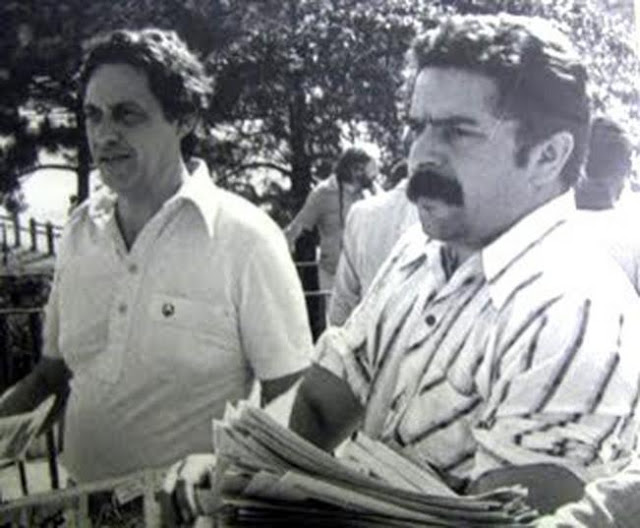
Lula and FHC campaigning together in 1981, by Cl vis Cranchi Sobrinho

Lula (PT) and FHC (PSDB) campaigning together in 1981, by Cl vis Cranchi Sobrinho

Some people have celebrated the reelection of Dilma Roussef as a victory of the left against the right. In my opinion that view is wrong for several reasons. First, because I disagree that PSDB and A cio Neves in particular are right-wing, both in terms of economics and social/moral issues. Second, because I believe Dilma s first government has taken a quite severe turn to the right in several topics that matter a lot to me. Since comparisons with PSDB s government during the 90s has been one of the main strategies of the campaign this year, I ll argue why I think it was actually a pretty good government with a lot of left in it. Unlike what happens in most other places, Brazil does not really have an actual right-wing party, economics-wise. Although we might see the birth of a couple in the near future, no current party is really against public health, education and social security being provided by the state as rights, or wants to decrease state size and lower taxes significantly. It should come as no surprise that even though it has undergone a lot of liberal reforms over the last 20 years, Brazil is still a very closed country, with very high import tariffs and a huge presence of the state in the economy. There is a certain consensus about all of that, with disagreements being essentially on implementation details, not goals. On the other hand, and contrary to popular belief, when it comes to social and moral issues we are a very conservative people. Ironically, the two parties which have been in power over the last 20 years are quite progressive, being historically proponents of diversity, minorities rights, reproductive rights. They have had to compromise on those causes to become viable alternatives, given the conservative nature of the majority of the voters. Despite their different origins and beliefs, both parties share socialist inclinations and were allies from the onset. That changed in 1992, when president Collor, who had been elected on a runoff against Lula (who PSDB supported), was impeached by Congress for corruption. With no formal political support and a chaotic situation in his hands, Itamar Franco, the vice president, called for a national union government to go through the last two years of his term. PSDB answered the call, but the workers party decided against being part of the government. Fernando Henrique Cardoso, a sociologist who was one of the leaders of PSDB was chosen to lead the Foreign Relations Ministry, but a few months later got nominated to the Economy. At the time, Brazil lived under hyperinflation of close to 1000% a year, and several stabilization plans had been attempted. Economy Ministers did not last very much in office at the time. FHC gathered a team of economists and sponsored their stabilization plan, which turned out to be highly successful: the Plano Real ( Real Plan ). In addition to introducing a new currency, something that was becoming pretty common to Brazilians by then, it also attacked the structural causes of inflation. Lula was counting on the failure of the Plano Real when he ran against FHC in 1994, but the plan succeeded, giving FHC two terms as president. During those two terms, FHC introduced several institutional changes that made Brazil a saner country. In addition to the hyperinflation, Brazil had lived a debt crises for decades and was still in default. FHC s team renegotiated the debts, reopened lines of credit, but most importantly, introduced reforms that made the Brazilian finances and financial system credible. The problem was not even that Brazil had a fiscal d ficit, it just did not have any control whatsoever of money supply and budget. Banks, regardless of whether they were private or public, had very little regulation and took advantage of the hyperinflation to hide monstrous holes in their balances. When inflation was gone and regulation became more strict, those became apparent, and it was pretty clear that the system would collapse if nothing was done. Some people like to say that FHC was a president who ruled for the rich and didn t care about the poor. I think the way the potential collapse of the banking system was handled is a great counter-example of that. The government passed laws that made the owners of the banks responsible for the financial problems, regardless of whether caused by mismanagement or fraud. If a bank went under, the central bank intervened and added enough money to protect the deposits, but that money was a loan that had to be repaid by the owners of the bank, and the owners properties were added as collateral to the loan. As a brazilian journalist once said, the people did not risk losing their deposits, the bankers did risk losing the banks, though. Today, we have a separate fund, filled with money from the banks, that does what the central bank did back then when required. Compare that to countries where the banking system was saved with tax payer money and executives kept getting huge bonuses regardless, while owners kept their profits. It is hard to find an initiative that is more focused on the public interest against the interest of the rich people who caused the problem. This legislation, called PROER, is still in place today, and it came along with solid regulation of the banking system. It should come as no surprise that Brazil went through the financial crisis of 2008 with not a single hiccup of the banking system and no fear of bank runs. Despite having been against PROER back in the day, Lula celebrated its existence in 2008, when it was clear it was one of the reasons we would not suffer much. He even advertised it as something that should be adopted by the US and Europe. It is also pretty common to hear that under FHC social questions were not a priority. I believe it is pretty simple to see that that was not the case both by inspecting the growth of social spending and the improvement of social indicators for the period, such as UN s human development index. One area in which people are particularly critical of the FHC government is the investment on higher education, and they are actually quite right. Brazil has free Federal universities and those did not get a lot of priority in the 90s. However, I would argue that while it is a matter of priorities, it is not one of education versus something else, but rather of what to invest on inside education. The reality is basic education was the priority. When FHC came to power, Brazil had a significant number of children who were not going to school at all. The goal was to make access to schools universal for young children, and that goal was reached. Every child has been going to school since the early 2000s, and that is a significant achievement which reaches the poorest. While the federal universities are attended essentially by the Brazilian elite, given the difficulty of passing the exams and the relative lack of quality of free public schools compared to private ones, which is still a reality to this day, investment on getting children to even go to school for the early years has a significant impact on the lives of the poorest. It is important to remember that getting every child to go to school is also what gave birth to one of the most celebrated programs from the Lula era: Bolsa Fam lia ( Family Allowance ) is a direct money transfer to poor families, particularly those who have children and has been an important contribution to lowering inequality and getting people out of extreme poverty. To get the money, the families need to ensure their children are 1) attending school and 2) getting vaccinated. That program comes from the FHC government, in which it was created with the name Bolsa Escola ( School Allowance ), in its turn inspired by a program of the same name by governor Cristovam Buarque, from PT. What Lula did, and he deserves a lot of credit for this, was to merge a series of smaller programs with Bolsa Escola, and then expand the program to ensure it got to more and more people. Interestingly, during the announcement of the program he credited the idea of doing that to a state governor from PSDB. You can see why I think these two should be allies again. When faced with all these arguments, people will eventually say that FHC was bad because he privatized companies and used orthodox economic policies. Well, if that is what it takes, then we ll have to take Lula down with him, because his first term was essentially a continuation of FHC s second term: orthodox economic policies to keep inflation down, along with privatization of several state-owned companies and banks. But Lula, whom I voted for and whose government I believe was a good one, is not my subject: Dilma is. On Lula s second term, Dilma gained a lot of power when other major leaders of PT went down for corruption. She became second in command and started leading several programs. A big believer in developmentalism, she started pushing for a bigger role of the state in the coordination of the productive sector, with a clear focus on growing the industrial base. One of the initiatives she sponsored was a sizable increase on the number and size of subsidized loans given out by the national development bank (BNDES). Brazil started an unnofficial national champions program, where the government elected a few big companies to get a huge amount of subsidized credit. The goal was for these selected firms to get big enough to be competitive on the global market. The criteria for the choices is completely opaque, if it even exists, and includes handing out milions in subsidized credit for Eike Batista, who became Brazil s richest enterpreneur for a while, and lost pretty much everything when it became clear the oil would not be pumping out of his camps after all, sinking with them a huge amount of public funds invested by BNDES. The way this policy was enacted, it is unclear how much it really costs in terms of public funds: the Brazilian treasury emits debt to capitalize, lends that money to BNDES with higher than market interest, and BNDES then lends it out to the big companies with a lower than market interest rate. Although it is obviously unsustainable, the problem does not yet show in the balance because the grace period for BNDES debt with the treasury is 2040. The fact that this has a cost and, perhaps more importantly, a huge opportunity cost is not clear because it is not part of the government budget. Why are we putting money in this rather than quadrupling Bolsa Fam lia, which studies show generates 1,78 reais in GDP for every 1 real invested? Worse, why are we not even updating Bolsa Fam lia enough to cover inflation? When Dilma got elected in 2010, the first signs were pretty bad. She was already seen as someone who did not care much for the environment, and on her first month in power she made good on that promise by pushing to get the Belo Monte Dam building started as soon as possible regardless of conditionalities being satisfied. To this day there are several issues with how the building of the dam is going: the handling of the indigenous people and the small city nearby are lacking, conditionalities are not met. Beyond Belo Monte, indigenous leaders are being assassinated, deforestation in the Amazon forest has increased by 122% in 2014 alone. Dilma s answer to people who question her on these kinds of issues is essentially: would you rather not have electric power? Her populist authoritarian nature and obsession with industry are also pretty evident when it comes to her policies in the energy area as a whole. She showed up in national tv on the eve of our independence day celebration to announce a reduction in electric tariffs, mainly for industry, but also for homes. Nobody really knew how. The following week she sent a fast-track project to Congress to automatically renew concessions of power grid operators, requiring those who accepted it to lower tariffs, instead of doing an auction, which was already necessary anyway because the concessions were up on 2015. There was no discussion with stakeholders, there was just a populist announcement and a great deal of rhethoric to paint anyone who opposed as being against the people. And now, everything went into the crapper because that represented a breach of contract that required indemnification, and we had a pretty bad drought that made power more expensive given the need to turn on the thermal generators. Combining the costs of the thermal generation, indemnity, and financial fallout that the grid operators suffered, we are already at 105 billion reais and counting, nobody knows how high the cost will reach. Any reduction in tariffs has long been invalidated. And the fact that industry has lowered production significantly ends up being good news, we would probably be under rationing already if that was not the case. You would expect someone who fought a dictatorship to be pretty good in terms of human and civil rights. What we see in reality is a lack of respect for those things. During the world cup, Dilma has put the army on the streets and has supported arbitrary behaviour from state polices throughout the country. They jailed a bunch of demonstrators preemptively. No shit. The would be demonstrators were kept in jail throghout the tournament under false accusations. Dilma s Minister of Justice said several times that the case against them was solid and that the arrests were legal, but it turned out the case simply did not exist. Just this week we had a number of executions orchestrated by policemen in the state of Par and there is zero reaction from the federal government. In the oil industry, Dilma has enacted a policy of subsidizing gas prices by using a fixed price that used to be lower than the international prices (it is no longer the case with the fall in international prices). That would not be a problem if Brazil was selfsufficient in oild and gas, which we are not: we had to import a significant amount of both. The implicit subsidy cost Petrobr s a huge amount of cash the more gas it sold, the bigger the losses. This lead not only to decreasing the company s market value (it is a state-controlled, but open company), but to reducing its capacity of investment as well. That is more problematic than it sounds because, with our current concession model, every single oil camp needs to have Petrobr s as a member of the consortium. Limiting the company s investment capacity limits the rate at which our pre-salt oil camps can be explored and thus the speed at which we can become selfsufficient. Chicken and egg anyone? To make things worse, Dilma has made policies that lowered taxes on car production, used to foster economic activity during the crisis in 2008-2010, essentially permanent. This lead to a significant increase in traffic and polution on Brazilian cities, while at the same time increasing the pressure on Petrobr s, which had to import more and more gas. Meanwhile, Brazilian cities suffer from a severe lack of mobility infrastructure. A recent study has shown that Brazil has spend almost twice as much subsidized money on pro-car policies than on pro-mass transit projects. Talk about good usage of public funds. One of the only remaining good news the government was still able to mention was the constant reduction in extreme poverty. Dilma was actually ellected promising to erradicate extreme poverty and changed the government s slogan to A rich country is a country with no poverty (Pa s rico pa s sem pobreza). Well, it turns out all of these policies caused inequality and extreme poverty both to stop falling as of 2013. And given the policies were actually deepened in 2014, I believe it is very likely we ll see an increase in both when we get the data for 2014, next year. Other than that, her policies ended up being a complete failure. Despite giving tax benefits to several sectors, investment has fallen, growth has fallen and inflation is quite high at 6,6% for the last 12 months. In terms of minorities, her government has been a severe set back, with the government going back on educational material against homophoby saying it would not do advertisement of sexual choice , and going back on a decree that allowed the public health system to perform abortions on the cases allowed by the law (essentially if the woman has been raped). Looking at Dilma s policies, I really can t see that much of the left, honestly. So why, you might ask, has this victory been deemed a victory of the left over the right? My explanation is the aura the workers party still manages to keep over itself. There s a notion that whatever PT does, it will still be more to the left than PSDB, which I think is just crazy. There is also a fair amount of idealizing Dilma just because she is Lula s proteg . People will forgive anything, provided it is the workers party doing it. Thankfully, the number of people aligned on the left that supported the candidate from PSDB this election tells me this is changing quite rapidly. Hopefully that leads to PT having to reinvent itself, and get in touch with the left again.

Neil Williams: On getting NEW packages into stable

There s a lot of discussion / moaning /arguing at this time, so I thought I d post something about how LAVA got into Debian Jessie, the work involved and the lessons I ve learnt. Hopefully, it will help someone avoid the disappointment of having their package missing the migration into a future stable release. This was going to be a talk at the Minidebconf-uk in Cambridge but I decided to put this out as a permanent blog entry in the hope that it will be a useful reference for the future, not just Jessie. Context LAVA relies on a number of dependencies which were at the time all this started NEW to Debian as well as many others already in Debian. I d been running LAVA using packages on my own system for a few months before the packages were ready for use on the main servers (I never actually installed LAVA using the old virtualenv method on my own systems, except in a VM). I did do quite a lot of this on my own but I also had a team supporting the effort and valuing the benefits of moving to a packaged system. At the time, LAVA was based on Ubuntu (12.04 LTS Precise Pangolin) and a new Ubuntu LTS was close (Trusty Tahr 14.04) but I started work on this in 2013. By the time my packages were ready for general usage, it was winter 2013 and much too close to get anything into Ubuntu in time for Trusty. So I started a local repo using space provided by Linaro. At the same time, I started uploading the dependencies to Debian. json-schema-validator, django-testscenarios and others arrived in April and May 2014. (Trusty was released in April). LAVA arrived in NEW in May, being accepted into unstable at the end of June. LAVA arrived in testing for the first time in July 2014. Upstream development continued apace and a regular monthly upload, with some hotfixes in between, continued until close to the freeze. At this point, note that although upstream is a medium sized team, the Debian packaging also has a team but all the uploads were made by me. I planned ahead. I knew that I would be going to Macau for Linaro Connect in February a critical stage in the finalisation of the packages and the migration of existing instances from the old methods. I knew that I would be on vacation from August through to the end of September 2014 including at least two weeks with absolutely no connectivity of any kind. Right at this time, Django1.7 arrived in experimental with the intent to go into unstable and hence into Jessie. This was a headache for me, I initially sought to delay the migration until after Jessie. However, we discussed it upstream, allocated time within the busy schedule and also sought help from within Debian with the RFH tag. Rapha l Hertzog contributed patches for django1.7 support and we worked on those patches upstream, once I was back from vacation. (The final week of my vacation was a work conference, so we had everyone together at one hacking table.) Still there was more to do, the django1.7 patches allowed the unit tests to complete but broke other parts of the lava-server package and needed subsequent tweaks and fixes. Even with all this, the auto-removal from testing for packages affected by RC bugs in their dependencies became very important to monitor (it still is). It would be useful if some packages had less complex dependency chains (I m looking at you, uwsgi) as the auto-removal also covers build-depends. This led to some more headaches with libmatheval. I m not good with functional programming languages, I did have some exposure to Scheme when working on Gnucash upstream but it wasn t pleasant. The thought of fixing a scheme problem in the test suite of libmatheval was daunting. Again though, asking for help, I found people in the upstream team who wanted to refresh their use of scheme and were able to help out. The fix migrated into testing in October. Just for added complications, lava-server gained a few RC bugs of it s own during that time too fixed upstream but awkward nonetheless. Achievement unlocked So that s how a complex package like lava-server gets into stable. With a lot of help. The main problem with top-level packages like this is the sheer weight of the dependency chain. Something seemingly unrelated (like libmatheval) can seriously derail the migrations. The package doesn t use the matheval support provided by uwsgi. The bug in matheval wasn t in the parts of matheval used by uwsgi. It wasn t in a language I am at all comfortable in fixing but it s my name on the changelog of the NMU. That happened because I asked for help. OK, when django1.7 was scheduled to arrive in Debian unstable and I knew that lava was not ready, I reacted out of fear and anxiety. However, I sought help, help was provided and that help was enough to get upstream to a point where the side-effects of the required changes could be fixed. Maintaining a top-level package in Debian is becoming more like maintaining a core package in Debian and that is a good thing. When your package has a lot of dependencies, those dependencies become part of the maintenance workload of your package. It doesn t matter if those are install time dependencies, build dependencies or reverse dependencies. It doesn t actually matter if the issues in those packages are in languages you would personally wish to be expunged from the archive. It becomes your problem but not yours alone. Debian has a lot of flames right now and Enrico encouraged us to look at what else is actually happening in Debian besides those arguments. Well, on top of all this with lava, I also did what I could to help the arm64 port along and I m very happy that this has been accepted into Jessie as an official release architecture. That s a much bigger story than LAVA yet LAVA was and remains instrumental in how arm64 gained the support in the kernel and various upstreams which allowed patches to be accepted and fixes to be incorporated into Debian packages. So a roll call of helpers who may otherwise not have been recognised via changelogs, in no particular order: Also general thanks to the Debian FTP and Release teams. Lessons learnt
  1. Allow time! None of the deadlines or timings involved in this entire process were hidden or unexpected. NEW always takes a finite but fairly lengthy amount of time but that was the only timeframe with any amount of uncertainty. That is actually a benefit it reminds you that this entire process is going to take a significant amount of time and the only loser if you try to rush it is going to be you and your package. Plan for the time and be sceptical about how much time is actually required.
  2. Ask for help! Everyone in Debian is a volunteer. Yes, the upstream for this project is a team of developers paid to work on this code (and largely only this code) but the upstream also has priorities, requirements, objectives and deadlines. It s no good expecting upstream to do everything. It s no good leaving upstream insufficient time to fit the required work into the existing upstream schedules. So ask for help within upstream and within Debian ask for help wherever you can. You don t know who may be able to help you until you ask. Be clear when asking for help how would someone test their proposed fix? Exactly what are you asking for help doing? (Hint: everything is not a good answer.)
  3. Keep on top of announcements and changes. The release team in Debian have made the timetable strict and have published regular updates, guidelines and status notes. As maintainer, it is your responsibility to keep up with those changes and make others in the upstream team aware of the changes and the implications. Upstream will rely on you to provide accurate information about these requirements. This is almost more important than actually providing the uploads or fixes. Without keeping people informed, even asking for help can turn out to be counter-productive. Communicate within Debian too talk to the teams, send status updates to bugs (even if the status is tag 123456 + help).
  4. Be realistic! Life happens around us, things change, personal timetables get torn up. Time for voluntary activity can appear and disappear (it tends to disappear far more often than extends, so take that into account too).
  5. Do not expect others to do the work for you asking for help is one thing, leaving the work to others is quite another. No complaining to the release team that they are blocking your work and avoid pleading or arguing when a decision is made. The policies and procedures within Debian are generally clear and there are quite enough arguments without adding more. Read the policies, read the guidelines, watch how other packages and other maintainers are handled and avoid those mistakes. Make it easy for others to help deliver what you want.
  6. Get to know your dependency chain follow the links on the packages.debian.org pages and get a handle on which packages are relevant to your package. Subscribe to the bug pages for some of the more high-risk packages. There are tools to help. rc-alert can help you spot problems with runtime dependencies (you do have your own package installed on a system running unstable if not, get that running NOW). Watching build-dependencies is more difficult, especially build-dependencies of a runtime dependency, so watch the RC bug lists for packages in your dependency chain.
Above all else, remember why you and upstream want the packages in Debian in the first place. Debian is a respected distribution and has an acknowledged reputation for stability and portability. The very qualities that you and your upstream desire from having your package in Debian have direct implications for the amount of work and the amount of time that will be required to get your packages into Debian and keep them there. Having your package in Debian will bring considerable benefits but you will be required to invest a considerable amount of time. It is this contribution which is valuable to Debian and it is this work which will deliver the benefits you seek. Being an expert in the one package is wildly inadequate. Debian is about the system, the whole distribution and sooner or later, you as the maintainer will be absolutely required to handle something which is so far out of your comfort zone it s untrue. The reality is that you are not expected to fix that problem you are expected to handle that problem and that includes seeking and acknowledging the help of others. The story isn t over until release day. Having your package in testing the day before the freeze is one step. It may be a large step, but it is only one. The status of that package still needs monitoring. That long dependency chain can still come back and bite. Don t wait for problems to surprise you. Finally One thing I do ask is that other upstream teams and maintainers think about the dependency chain they are creating. It may sound nice to have bindings for every interpreted language possible when releasing your compiled library but it does not help people using that library. Yes, it is more work releasing the bindings separately because a stable API is going to be needed to allow version 1.2.3 to work alongside 1.2.2 and 1.3.0 or the entire effort is pointless. Consider how your upstream package migrates. Consider how adding yet another build-dependency for an optional component makes things exponentially harder for those who need to rely on that upstream. If it is truly optional, release it separately and keep backwards compatibility on each side. It is more work but in reality, all that is happening is that the work is being transferred from the distribution (where it helps only that one distribution and causes duplication into other distributions) into the upstream (where it helps all distributions). Think carefully about what constitutes core functionality and release the rest separately. Combining bindings for php, ruby, python, java, lua and xslt into a single upstream release tarball is a complete nonsense. It simply means that the package gets blocked from new uploads by the constant churn of being involved in every transition that occurs in the distribution. There is a very real risk that the package will miss a stable release simply by having fingers in too many pies. That hurts not only this upstream but every upstream trying to use any part of your code. Every developer likes to think that people are using and benefiting from their effort. It s not nice to directly harm the interests of other developers trying to use your code. It is not enough for the binary packages to be discrete migrations happen by source package and the released tarball needs to not include the optional bindings. It must be this way because it is the source package which determines whether version 1.2.3 of plugin foo can work with version 1.2.0 of the library as well as with version 1.3.0. Maintainers regularly deal with these issues so talk to your upstream teams and explain why this is important to that particular team. Help other maintainers use your code and help make it easier to make a stable release of Debian. The quicker the freeze & release process becomes, the quicker new upstream versions can be uploaded and backported.

John Goerzen: Debian A plea to worry about what matters, and not take ourselves too seriously

I posted this on debian-devel today. I am also posting it here, because I believe it is important to more than just Debian developers. Good afternoon, This message comes on the heels of Sam Hartman s wonderful plea for compassion [1] and the sad news of Joey Hess s resignation from Debian [2]. I no longer frequently post to this list, but when you ve been a Debian developer for 18 years, and still care deeply about the community and the project, perhaps you have a bit of perspective to share. Let me start with this: Debian is not a Free Software project. Debian is a making-the-world-better project, a caring for people project, a freedom-spreading project. Free Software is our tool. As many of you, hopefully all of you, I joined Debian because I enjoyed working on this project. We all did, didn t we? We joined Debian because it was fun, because we were passionate about it, because we wanted to make the world a better place and have fun doing it. In short, Debian is life-giving, both to its developers and its users. As volunteers, it is healthy to step back every so often, and ask ourselves two questions: 1) Is this activity still life-giving for me? 2) Is it life-giving for others? I have my opinions about init. Strong ones, in fact. [3] They re not terribly relevant to this post. Because I can see that they are not really all that relevant. 14 years ago, I proposed what was, until now anyhow, one of the most controversial GRs in Debian history. It didn t go the way I hoped. I cared about it deeply then, and still care about the principles. I had two choices: I could be angry and let that process ruin my enjoyment of Debian. Or I could let it pass, and continue to have fun working on a project that I love. I am glad I chose the latter. Remember, for today, one way or another, jessie will still boot. 18 years ago when I joined Debian, our major concerns were helping newbies figure out how to compile their kernels, finding manuals for monitors so we could set the X modelines properly, finding some sort of Free web browser, finding some acceptable Office-type software. Wow. We WON, didn t we? Not just Debian, but everyone. Freedom won. I promise you 18 years from now, it will not matter what init Debian chose in 2014. It will probably barely matter in 3 years. This is not key to our goals of making the world a better place. Jessie will still boot. I say that even though my system runs out of memory every few days because systemd-logind has a mysterious bug [4]. It will be fixed. I say that even though I don t know what init system it will use, or how much choice there will be. I say that because it is simply true. We are Debian. We will make it work, one way or another. I don t post much on this list anymore because my personal passion isn t with posting on this list anymore. I make liberal use of my Delete Thread keybinding on -vote these days, because although I care about the GR, I don t care about it enough to read all the messages about it. I have not yet decided if I will spend the time researching it in order to vote. Instead of debating the init GR, sometimes I sit on the sofa with my wife. Sometimes I go out and fly the remote-control airplane I m learning to fly. Sometimes I repair my plane after a flight that was shorter than planned. Sometimes I play games with my boys, or help them with homework, or share my 8-year-old s delight as a text file full of facts about the Titanic that he wrote in Emacs comes spitting out of the printer. Sometimes I write code or play with the latest Linux filesystems or build a new server for my basement. All these things matter more to me than init. I have been using Debian at home for almost 20 years, at various workplaces for almost that long, and it is not going to stop being a part of my life any time soon. Perhaps I will have to learn how to administer a new init system. Well, so be it; I enjoy learning new things. Or perhaps I will have to learn to live with some desktop limitations with an old init system. Well, so be it; it won t bother me much anyhow. Either way, I m still going to be using what is, to me, the best operating system in the world, made by one of the world s foremost Freedom projects. My hope is that all of you may also have the sense of peace I do, that you may have your strong convictions, but may put them all in perspective. That we as a project realize that the enemy isn t the lovers of the other init, but the people that would use law and technology to repress people all over the world. We are but one shining beacon on a hill, but the world will be worse off if our beacon winked out. My plea is that we each may get angry at what matters, and let go of the smaller frustrations in life; that we may each find something more important than init/systemd to derive enjoyment and meaning from. [5] May you each find that airplane to soar freely in the skies, to lift your soul so that the joy of using Free Software to make the world a better place may still be here, regardless of what /sbin/init is. [1] https://lists.debian.org/debian-project/2014/11/msg00002.html [2] https://lists.debian.org/debian-devel/2014/11/msg00174.html [3] A hint might be that in my more grumpy moments, I realize I haven t ever quite figured out why the heck this dbus thing is on so many of my systems, or why I have to edit XML to configure it ;-) [4] #765870 [5] No disrespect meant to the init/systemd maintainers. Keep enjoying what you do, too!

9 November 2014

Antti-Juhani Kaijanaho: About to retire from Debian

I got involved with Debian development in, I think, 1998. In early 1999, I was accepted as a Debian developer. The next two or three years were a formative experience for me. I learned both software engineering and massively international collaboration; I also made two major contributions to Debian that are still around (of this, I am very proud). In consequence, being a Debian developer became a part of my identity. Even after my activity lessened more than a decade ago, after I no longer was a carefree student, it was very hard for me to let go. So I ve hung on. Until now. I created my 4096-bit GPG key (B00B474C) in 2010, but never got around to collecting signatures to it. I ve seen other people send me their key transition statements, but I have not signed any keys based on them. It just troubles me to endorse a better secured key based on the fact that I once verified a less secure key and I have a key signature chain to it. For this reason, I have not made any transition statements of my own. I ve been meaning to set up key signing meetings with Debian people in Finland. I never got around to that, either. That, my friends, was my wakeup call. If I can t be bothered to do that, what business do I have clinging on to my Debian identity? My conclusion is that there is none. Therefore, I will be retiring from Debian. This is not a formal notice; I will be doing the formal stuff (including disposing of my packages) separately in the appropriate forums in the near future. I agree with the sentiment that Joey Hess wrote elsewhere: It s become abundantly clear that this is no longer the project I originally joined . Unlike Joey, I think that is a good thing. Debian has grown, a lot. It s not perfect, but like my elementary-school teacher once said: A thing that is perfect was not made by people. Just remember to continue growing and getting better. And keep making the Universal Operating System. Thank you, all.

Erich Schubert: GR vote on init coupling

Overregulation is bad, and the project is suffering from the recent Anti-Systemd hate campaigning.
There is nothing balanced about the original GR proposal. It is bullshit from a policy point of view (it means we must remove software from Debian that would not work with other inits, such as gnome-journal, by policy).At the same time, it uses manipulative language like "freedom to select a different init system" (as if this would otherwise be impossible) and "accidentally locked in". It is exactly this type of language and behavior which has made Debian quite poisonous the last months.
In fact, the GR pretty much says "I don't trust my fellow maintainers to do the right thing, therefore I want a new hammer to force my opinion on them". This is unacceptable in my opinion, and the GR will only demotivate contributors. Every Debian developer (I'm not talking about systemd upstream, but about Debian developers!) I've met would accept a patch that adds support for sysvinit to a package that currently doesn't. The proposed GR will not improve sysvinit support. It is a hammer to kick out software where upstream doesn't want to support sysvinit, but it won't magically add sysvinit support anywhere.
What some supporters of the GR may not have realized - it may as well backfire on them. Some packages that don't yet work with systemd would violate policy then, too... - in my opinion, it is much better to make the support on a "as good as possible, given available upstream support and patches" basis, instead of a "must" basis. The lock-in may come even faster if we make init system support mandatory: it may be more viable to drop software to satisfy the GR than to add support for other inits - and since systemd is the current default, software that doesn't support systemd are good candidates to be dropped, aren't they? (Note that I do prefer to keep them, and have a policy that allows keeping them ...)
For these reasons I voted:
  1. Choice 4: GR not required
  2. Choice 3: Let maintainers do their work
  3. Choice 2: Recommended, but not mandatory
  4. Choice 5: No decision
  5. Choice 1: Ban packages that don't work with every init system
Fact is that Debian maintainers have always been trying hard to allow people to choose their favorite software. Until you give me an example where the Debian maintainer (not upstream) has refused to include sysvinit support, I will continue to trust my fellow DDs. I've been considering to place Choice 2 below "further discussion", but essentially this is a no-op GR anyway - in my opinion "should support other init systems" is present in default Debian policy already anyway...
Say no to the haters.
And no, I'm not being unfair. One of the most verbose haters going by various pseudonyms such as Gregory Smith (on Linux Kernel Mailing list), Brad Townshend (LKML) and John Garret (LKML) has come forward with his original alias - it is indeed MikeeUSA, a notorious anti-feminist troll (see his various youtube "songs", some of them include this pseudonym). It's easy to verify yourself.
He has not contributed anything to the open source community. His songs and "games" are not worth looking at, and I'm not aware of any project that has accepted any of his "contributions". Yet, he uses several sock puppets to spread his hate.
The anti-systemd "crowd" (if it acually is more than a few notorious trolls) has lost all its credibility in my opinion. They spread false information, use false names, and focus on hate instead of improving source code. And worse, they tolerate such trolling in their ranks.

Steve Kemp: How could you rationally fork Debian?

The topic of Debian forks has come up a lot recently, and as time goes on I've actually started considering the matter seriously: How would you fork Debian? The biggest stumbling block is that the Debian distribution contains thousands of packages, which are maintained by thousands of developers. A small team has virtually no hope of keeping up to date, importing changes, dealing with bug-reports, etc. Instead you have to pick your battle and decide what you care about. This is why Ubuntu split things into "main" and "universe". Because this way they didn't have to deal with bug reports - instead they could just say "Try again in six months. Stuff from that repository isn't supported. Sorry!" So if you were going to split the Debian project into "supported" and "unsupported" what would you use as the dividing line? I think the only sensible approach would be : On that basis you'd immediately drop the support burden of GNOME, KDE, Firefox, Xine, etc. All the big, complex, and user-friendly stuff would just get thrown away. What you'd end up with would be a Debian-Server fork, or derivative. Things you'd package and care about would include: Would that be a useful split? I suspect it would. It would also be manageable by a reasonably small team. That split would also mean if you were keen on dropping any particular init-system you'd not have an unduly difficult job - your server wouldn't be running GNOME, for example. Of course if you're thinking of integrating a kernel and server-only stuff then you might instead prefer a BSD-based distribution. But if you did that you'd miss out on Docker. Hrm.

8 November 2014

Martin-&#201;ric Racine: On the Joey debacle

Looking back, I cannot think of a single moment when Joey wouldn't have shown the utmost patience and courtesy towards anyone involved in Debian, even towards mere users filing sometimes senseless bug reports against his packages. From this perspective, I cannot help but venture that whatever chain of events lead to Joey's decisions essentially means one thing: Debian must have seriously gotten off-course for someone who has been involved for so long to call it quits. As for the current situation at hands, while I admittedly haven't followed too closely who or what caused Joey's decision, I nonetheless cannot help but feel that whoever pushed Joey's buttons so hard as to make him decide to leave Debian ought to be the one(s) kicked out of Debian instead.

7 November 2014

Russ Allbery: On tolerating personal abuse

While I don't consider myself part of the science fiction community directly (my con-going days are probably over), I do follow it across a wide variety of blogs. There are a lot of hard conversations and considerable soul-searching going on right now concerning an on-line commentator in that community who had been nasty and vicious to people, but originally for reasons that many people thought were good causes. (I had been one of those people. It's always very, very tempting to appreciate a good vitriolic rant from someone who shares your world view. And very easy to lose track of the people those rants are aimed at, or the excesses to which those rants go.) I'm not going to go into the details of the SF community issues here, since I have no context other than what I've read, and it's something to work out within that community. But I've been taking it as a useful reminder that abusive behavior is not acceptable, even if it comes from people who are arguably on your side. Anger is important. Anger is often how the world changes. But anger and abuse are not the same thing. I wrote something a little bit ago in a different context. Given that reminder, and given some of the arguments that are going on in the free software community as well, it seemed like a good idea to post a somewhat edited version of it in a more public place: None of us should be willing to continue to participate in a project in which we're expected to tolerate being abused and attacked, and all consequences of that abuse are our problem to deal with. It is simply not fun, and not motivating, and not interesting, and does not lead to us doing good work. I say this from lots of hard-won personal experience. I was deeply involved in Usenet governance for many years. I have made all the same arguments that I see today in favor of "blunt" speech, vitriol, and attacks. I have been a passionate advocate for the "free speech" approach. I have told other people to just filter and use killfiles. I have said that words aren't worth getting worked up about, and it's easy to ignore people. I was wrong. It took a long time for me to figure out that I was wrong, not just for other people, but for myself as well. It took me much longer to walk away from Usenet governance for good because the environment was too toxic. It remains one of the best decisions I have ever made in my life. It was the best bit of self-care that I ever did. I learned from that experience, and earlier this year, I walked away from a job for related reasons. I enjoyed the work, the job was much easier than the job that I have now, and I had a lot of time to work on free software and on Debian, but the emotional environment was toxic. (It was not as openly abusive, but it was an environment of disrespect, hierarchical dominance games, fear, blame, and emotional blackmail.) As a result, I've had to shift priorities considerably, but I'm a much happier person. It's worth having less time for things that I was previously enjoying to not to have to deal with an emotionally negative and confrontational environment. Life is too short, and I have the luxury of having choices. Both of those incidents taught me that it's very easy for me to leave that sort of situation to fester for too long, and that I underestimate how much of an improvement it is for my quality of life to walk away from abusive and negative emotional situations. I am belatedly learning how to be more ready and willing to do this. I very much understand the people who are concerned with ensuring there is space for strongly-worded opinions and heartfelt anger. But we have to draw a line, and that line needs to rule out emotional abuse of people in our community even in the name of passionate polemics about something that's important. We have to enforce that line, and if that means ejecting people from our community, that's what we have to do. Because, if we don't, we're also ejecting people from our community: the quiet people, the people who are just trying to get work done, or the people who have had past experience with abusive environments and understand the need to bail when an environment starts going in that direction. I'm not going to put up with the sort of environment I put up with when doing Big Eight newsgroup creation. I'm not saying this as some sort of threat -- I'm saying this to try to be very clear that not standing up for the members of our community and not supporting each other against abuse and emotional attacks also has consequences, and will destroy that community for a lot of us. I'm saying that I am not interested in living in an environment of fear and blame. And one should never underestimate the human power of giving people space and community in which they can be comfortable, relaxed, and truly happy. Walking the line between this stance and the "tone argument," in which people who are being abused or disenfranchised are attacked for being angry, is very difficult. There are some helpful rules of thumb, such as distinguishing between punching up and punching down, but those rules of thumb can fail or be distorted, as the SF community is learning. It's important that people be able to express anger. It's also important that people be able to name names and identify specific behaviors that they believe are worthy of that anger. But when that anger escalates into attacks, there is a real danger that passionate righteousness turns into passionate abusiveness, a danger of losing the sense of community in our own sense of righteousness. And that's not something we can or should accept. It's going to take a lot of hard work, a lot of open conversation, and a lot of empathy and care to find that line. There are many things in the world right now that should provoke anger, and with that anger comes power for good. But with that anger can also come a destructive blindness. The anger I want is the anger that drives us to change the world together, the anger that leads to confronting others with a reflection of their own better natures and challenging them to become better, more compassionate people. The anger that leads a man to feed the homeless in the true meaning of civil disobedience. Not the anger that crushes our enemies.

6 November 2014

Daniel Kahn Gillmor: GnuPG 2.1.0 in debian experimental

Today, i uploaded GnuPG 2.1.0 into debian's experimental suite. It's built for amd64 and i386 and powerpc already. You can monitor its progress on the buildds to see when it's available for your architecture. ChangesGnuPG 2.1 offers many new and interesting features, but one of the most important changes is the introduction of elliptic curve crypto (ECC). While GnuPG 2.1 discourages the creation of ECC keys by default, it's important that we have the ability to verify ECC signatures and to encrypt to ECC keys if other people are using this tech. It seems likely, for example, that Google's End-To-End Chrome OpenPGP extension will use ECC. GnuPG users who don't have this capability available won't be able to communicate with End-To-End users. There are many other architectural changes, including a move to more daemonized interactions with the outside world, including using dirmngr to talk to the keyservers, and relying more heavily on gpg-agent for secret key access. The gpg-agent change is a welcome one -- the agent now holds the secret key material entirely and never releases it -- as of 2.1 gpg2 never has any asymmetric secret key material in its process space at all. One other nice change for those of us with large keyrings is the new keybox format for public key material. This provides much faster indexed access to the public keyring. I've been using GnuPG 2.1.0 betas regularly for the last month, and i think that for the most part, they're ready for regular use. Timing for debian The timing between the debian freeze and the GnuPG upstream is unfortunate, but i don't think i'm prepared to push for this as a jessie transition yet, without more backup. I'm talking to other members of the GnuPG packaging team to see if they think this is worth even bringing to the attention of the release team, but i'm not pursuing it at the moment. If you really want to see this in debian jessie, please install the experimental package and let me know how it works for you. Long term migration concerns GnuPG upstream is now maintaining three branches concurrently: modern (2.1.x), stable (2.0.x), and classic (1.4.x). I think this is stretches the GnuPG upstream development team too thin, and we should do what we can to help them transition to supporting fewer releases concurrently. In the long-term, I'd ultimately like to see gnupg 2.1.x to replace all use of gpg 1.4.x and gpg 2.0.x in debian, but unlikely to to happen right now. In particular, the following two bugs make it impossible to use my current, common monkeysphere workflow: And GnuPG 2.1.0 drops support for the older, known-weak OpenPGPv3 key formats. This is an important step for simplification, but there are a few people who probably still need to use v3 keys for obscure/janky reasons, or have data encrypted to a v3 key that they need to be able to decrypt. Those people will want to have GnuPG 1.4 around. Call for testing Anyway, if you use debian testing or unstable, and you are interested in these features, i invite you to install gnupg2 and its friends from experimental. If you want to be sensibly conservative, i recommend backing up ~/.gnupg before trying to use it:
cp -aT .gnupg .gnupg.bak
sudo apt install -t experimental gnupg2 gnupg-agent dirmngr gpgsm gpgv2 scdaemon
If you find issues, please file them via the debian BTS as usual. I (or other members of the pkg-gnupg team) will help you triage them to upstream as needed. Tags: ecc, experimental, gnupg

Steve Kemp: Planning how to configure my next desktop

I recently setup a bunch of IPv6-only accessible hosts, which I mentioned in my previous blog post. In the end I got them talking to the IPv4/legacy world via the installation of an OpenVPN server - they connect over IPv6 get a private 10.0.0.0/24 IP address, and that is masqueraded via the OpenVPN-gateway. But the other thing I've been planning recently is how to configure my next desktop system. I generally do all development, surfing, etc, on one desktop system. I use virtual desktops to organize things, and I have a simple scripting utility to juggle windows around into the correct virtual-desktop as they're launched. Planning a replacement desktop means installing a fresh desktop, then getting all the software working again. These days I'd probably use docker images to do development within, along with a few virtual machines (such as the pbuilder host I used to release all my Debian packages). But there are still niggles. I'd like to keep the base system lean, with few packages, but you can't run xine remotely, similarly I need mpd/sonata for listening to music, emacs for local stuff, etc, etc. In short there is always the tendency to install yet-another package, service, or application on the desktop, which makes migration a pain. I'm not sure I could easily avoid that, but it is worth thinking about. I guess I could configure a puppet/slaughter/cfengine host and use that to install the desktop - but I've always done desktops "manually" and servers "magically" so it's a bit of a change in thinking.

Matthias Klumpp: The state of AppStream/GNOME-Software in Debian Jessie

or Why do I not see any update notifications on my brand-new Debian Jessie installation?? This is a short explanation of the status quo, and also explains the no update notifications issue in a slightly more detailed way, since I am already getting bug reports for that. As you might know, GNOME provides GNOME-Software for installation of applications via PackageKit. In order to work properly, GNOME-Software needs AppStream metadata, which is not yet available in Debian. There was a GSoC student working on the necessary code for that, but the code is not yet ready and doesn t produce good results yet. Therefore, I postponed AppStream integration to Jessie+1, with an option to include some metadata for GNOME and KDE to use via a normal .deb package. Then, GNOME was updated to 3.14. GNOME 3.14 moved lots of stuff into GNOME-Software, including the support for update-notifications (which have been in g-s-d before). GNOME-Software is also the only thing which can edit the application groups in GNOME-Shell, at least currently. So obviously, there was no a much stronger motivation to support GNOME-Software in Jessie. The appstream-glib library, which GNOME-Software uses exclusively to read AppStream metadata, didn t support the DEP-11 metadata format which Debian uses in place of the original AppSTream XML for a while, but does so in it s current development branch. So that component had to be packaged first. Later, GNOME-Software was uploaded to the archive as well, but still lacked the required metadata. That data was provided by me as a .deb package later, locally generated using the current code by my SoC student (the data isn t great, but better than nothing). So far with the good news. But there are multiple issues at time. First of all, the appstream-data package didn t pass NEW so far, due to it s complex copyright situation (nothing we can t resolve, since app-install-data, which appstream-data would replace, is in Debian as well). Also, GNOME-Software is exclusively using offline-updates (more information also on [1] and [2]) at time. This isn t always working at the moment, since I haven t had the time to test it properly and I didn t expect it to be used in Debian Jessie as well[3]. Furthermore, the offline-updates feature requires systemd (which isn t an issue in itself, I am quite fine with that, but people not using it will get unexpected results, unless someone does the work to implement offline-updates with sysvinit). Since we are in freeze at time, and obviously this stuff is not ready yet, GNOME is currently without update notifications and without a way to change the shell application groups. So, how can we fix this? One way would of course be to patch notification support back into g-s-d, if the new layout there allows doing that. But that would not give us the other features GNOME-Software provides, like application-group-editing. Implementing that differently and patching it to make it work would be more or at least the same amount of work like making GNOME-Software run properly. I therefore prefer getting GNOME-Software to run, at least with basic functionality. That would likely mean hiding things like the offline-update functionality, and using online-updates with GNOME-PackageKit instead. Obviously, this approach has it s own issues, like doing most of the work post-freeze, which kind of defeats the purpose of the freeze and would need some close coordination with the release-team. So, this is the status quo at time. It is kind of unfortunate that GNOME moved crucial functionality into a new component which requires additional integration work by the distributors so quickly, but that s something which isn t worth to talk about. We need a way forward to bring update-notifications back, and there is currently work going on to do that. For all Debian users: Please be patient while we resolve the situation, and sorry for the inconvenience. For all developers: If you would like to help, please contact me or Laurent Bigonville, there are some tasks which could use some help.
As a small remark: If you are using KDE, you are lucky Apper provides the notification support like it always did, and thanks to improvements in aptcc and PackageKit, it even is a bit faster now. For the Xfce and <other_desktop> people, you need to check if your desktop provides integration with PackageKit for update-checking. At least Xfce doesn t, but after GNOME-PackageKit removed support for it (which was moved to gnome-settings-daemon and now to GNOME-Software) nobody stepped up to implement it yet (so if you want to do it it s not super-complicated, but knowledge of C and GTK+ is needed). - [3]: It looks like dpkg tries to ask a debconf question for some reason, or an external tool like apt-listchanges is interfering with the process, which must run completely unsupervised. There is some debugging needed to resolve these Debian-specific issues.

Dirk Eddelbuettel: RPushbullet 0.1.1

A minor bugfix release 0.1.1 of the RPushbullet package (interfacing the neat Pushbullet service) landed on CRAN yesterday morning. It cleans up a small issue related to the ability to transfer files between devices via the Pushbullet service where the ability to select a (non-default) target device has now been restored. With that, allow me to borrow one excellent use case of RPushbullet from the blog of Karl Broman: how to use RPushbullet for error notifications from R:
options(error = function()  
    library(RPushbullet)
    pbPost("note", "Error", geterrmessage())
 )
This is very clever: should an error occur, you get immediate notification in browser or on your phone. Left as an exercise for the reader is to combine this with the equally excellent rfoaas package (github cran) to get appropriately colourful error messages... More details about the package are at the RPushbullet webpage and the RPushbullet GitHub repo. Courtesy of CRANberries, there is also a diffstat report for this release.

This post by Dirk Eddelbuettel originated on his Thinking inside the box blog. Please report excessive re-aggregation in third-party for-profit settings.

Lisandro Dami&aacute;n Nicanor P&eacute;rez Meyer: Early announce: Qt4 removal in Jessie+1

We the Debian Qt/KDE Team want to early-announce [maintainer warning] our decision to remove Qt4 from Jessie+1. This warning is mostly targeted at upstreams.

Qt4 has been deprecated since Qt5's first release on December 19th 2012, that means almost two years ago!

So far we had bugfixes-only releases, but upstream has announced that they will end this support on august 2015. This already means we will have to do a special effort from that point on for Jessie in case RC bugs appears, so having it in Jessie+1 is simply a non-go.

Some of us where involved in various Qt4 to Qt5 migrations [0] and we know for sure that porting stuff from Qt4 to Qt5 is much much easier and less painful than it was from Qt3 to Qt4.

We also understand that there is still a lot of software still using Qt4. In order to easy the transition time we have provided Wheezy backports for Qt5.

Don't forget to take a look at the C++ API change page [1] whenever you start porting your application.

[0] http://perezmeyer.blogspot.com.ar/2014/03/porting-qt-4-apps-to-qt-5-example-with.html
[1] http://qt-project.org/doc/qt-5.0/qtdoc/sourcebreaks.html

[maintainer warning] **Remember the freeze** and do not upload packages ported to Qt5 to unstable. The best thing you can do now is to ask your upstream if the code can be compiled against Qt5 and, why not, try it yourself.

Our first priority now is to release Jessie, and this is why this is an early announce.

5 November 2014

Carl Chenet: Send the same short message on Twitter, Pump.io, Diaspora* and a lot more

Follow me on Identi.ca or Twitter or Diaspora*diaspora-banner This is a feedback about installing a self hosted instance of Friendica on a Debian server (Jessie). If you re not interested in why I use Friendica, just go to Prerequisite for Friendica section below. Frustration about social networks Being a huge user of short messages, I was quite frustated to spend so much time on my Twitter account. To be quite honest, there is no much I like about this social network, except the huge population of people being potentially interested in what I write. twitter-logo I also have been using Identi.ca (now powered by Pump.io) for a while. But I tried for a while to manage both networks Pump.io and Twitter by hand and it was quite painful. And something was telling me another social network was going to appear from nowhere one of these days and I ll be just horrible to try to keep it up this way. identica-logo So I was looking for a scalable solution not asking too much personal investment. Subscribing to Diaspora* some days ago on the Framasphere pod, tintouli told me to try Friendica. Hmmm, what s Friendica ? f-intro Friendica is a content manager you can plug on almost anything: social networks (Facebook, Twitter, Pump.io, Diaspora*, ), but also WordPress, XMPP, emails I m in fact just discovering the power of this tool but to plug it on my different social network accounts was quite a good use case for me. And I guess if you re still reading, for you too. I tried to use some shared public servers but I was not quite happy with the result, one connector was still missing or public servers were really unstable. So I m at last self hosting my Friendica. Here is how. Prerequisite for Friendica You need to install the following packages: # apt-get install apache2 libapache2-mod-php5 php5 php5-curl php5-gd php5-mysql mysql-server git Having a already self-modified /etc/php5/apache2/php.ini, I encountered a small issue with libCurl and had to manually add the following line in the php.ini: extension=curl.so Setting up MySQL Connect to MySQL and create an empty database with a dedicated user: # mysql -u root -pV3rYS3cr3t -e create database friendica; GRANT ALL PRIVILEGES ON friendica.* TO friendica@localhost IDENTIFIED BY R3AlLyH4rdT0Gu3ss mysql Setting up Apache My server hosts several services, so I use a subdomain friendica.mydomain.com. If you use a subdomain, of course check you do have declared this subdomain in your DNS zone. apache-logo I use SSL encryption with a wildcard certificate for all my subdomains. My Friendica data are stored in /var/www/friendica. Here is my virtual host configuration for Friendica stored in the file /etc/apache2/sites-available/friendicassl.conf : <VirtualHost *:443>
ServerName friendica.mydomain.com
DocumentRoot /var/www/friendica/
DirectoryIndex index.php index.html
ErrorLog /var/log/apache2/friendica-error-ssl.log
TransferLog /var/log/apache2/friendica-access-ssl.log SSLEngine on
SSLCertificateFile /etc/ssl/certs/mydomain/mydomain.com.crt
SSLCertificateKeyFile /etc/ssl/private/mydomain.com.key
SSLVerifyClient None <Directory /var/www/friendica/>
AllowOverride All
Options FollowSymLinks
Order allow,deny
Allow from all
</Directory>
</VirtualHost> After writing the configuration file, just launch the following commands and it should be good for the Apache configuration: # a2ensite friendicassl && /etc/init.d/apache2 reload friendica-trust Setting up Friendica Get the master zip file of Friendica, copy it on your server and decompress it. Something like : # cd /var/www/ && wget https://github.com/friendica/friendica/archive/master.zip && unzip master.zip && mv friendica-master friendica You need to give www-data (Apache user) the rights to write in /var/www/friendica/view/smarty3/ : # chown -R www-data:www-data /var/www/friendica/view/smarty3 && chmod -R ug+w var/www/friendica/view/smarty3 Ok, I guess we re all set, lets launch the installation process! Using your web browser, connect to friendica.mydomain.com. First step you ll see the installation window which checks the prerequisite before installing. Complete if something is missing.
friendica-installation

First window of the Friendica installation process

Second step asks the host/user/password of the database, complete and the installation process starts. Hopefully all goes just fine. Next you ll have to create a /var/www/friendica/.htconfig.php with the content that the last page of the installation process provides. Just copy/paste, check the rights of this file and now you can connect again to see the register page of friendica at the url https://friendlica.mydomain.com/register . Pretty cool! Register a user That s a fairly easy step. You just need to check before that your server is able to send emails, because the password is going to be sent to you by email. If it is ok, you should now identify on the welcome page of friendica and access your account. That s a huge step to broadcast your short messages everywhere, but we have some last steps before being able to send your short messages on all the social networks we need. A small break, create an app for twitter on apps.twitter.com To send your short messages to Twitter, you need to create an app on apps.twitter.com. Just check you re logged in Twitter and connect to apps.twitter.com. Create an app called with a unique name (apparently), then go to the Keys and Access tokens page, note the consumer key and the consumer secret. You ll later need the name of the app, the consumer key and the consumer secret. friendica-decentralized-network Install and configure the addons Friendica uses an addon system in order to plug on the different third-parties it needs. We are going to configure Twitter, Pump.io and the Diaspora* plug. Let s go back to our server and launches some commands: # cd /tmp && git clone https://github.com/friendica/friendica-addons.git && cd friendica-addons # tar xvf twitter.tgz -C /var/www/friendica/addon # tar xvf pumpio.tgz -C /var/www/friendica/addon # cp -a diaspora /var/www/friendica/addon You need to modify your /var/www/friendica/.htconfig.php file and add the following content at the end: // names of your addons, separated by a comma $a->config['system']['addon'] = pumpio, twitter, diaspora ; // your Twitter consumer key
$a->config['twitter']['consumerkey'] = P4Jl2Pe4j7Lj91eIn0AR8vIl2 ; // your Twitter consumer secret
$a->config['twitter']['consumersecret'] = 1DnVkllPik9Ua8jW4fncxwtXZJbs9iFfI5epFzmeI8VxM9pqP1 ; // you Twitter app name $a->config['twitter']['application_name'] = whatever-twitter ; banner_friendica Connect again to Friendica. Go to settings => social networks, you will see the options for Twitter, Pump.io and Diaspora*. Complete the requested information for each of them. Important options you should not forget to check are: Pump.io Twitter Diaspora* Done? Now it s time to send your first broadcasted short message. Yay! Send a short message to your different social networks Connect to Friendica, click on the network page, write your short message in the Share box. Click on the lock lock, you ll see the following setup: friendica-post-default It means your short messages will be broadcasted to the three networks. Or more, it s up to you! That s my setup, feel free to modify. Now close the lock window and send your message. For me it takes some time to appear on Twitter and Diaspora* and it immediatly appears on Identi.ca. Last words friendica-stand Friendica offers to take back the control of your data, by broadcasting content on different media from a single source. While self hosting, you keep your data whatever happends and are not subject to companies losing your data like recently Twitpic. Moreover the philosophy behind Friendica pushed me to dig and test the solution What about you? How do you proceed to broadcast your short messages? Does Friendica offer a good solution in your opinion? Are you interested in the philosophy behind this project? Feel free to share your thoughs in the comments. LAST MINUTE: hey, this article is on Hacker News, don t hesitate to vote for it if you liked it!

Next.

Previous.