Search Results: "dom"

11 April 2009

Christine Spang: continued world domination

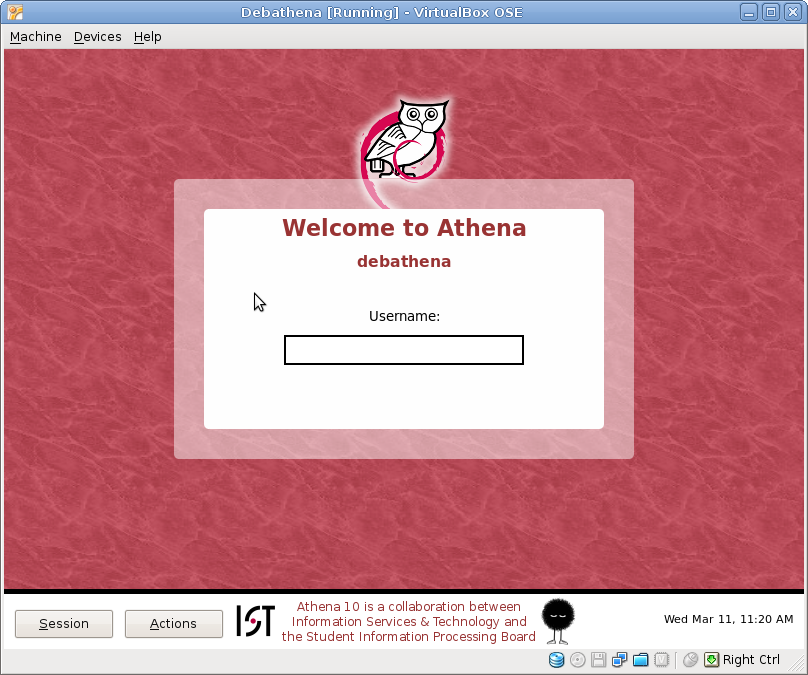
Debathena Beta was rolled out to something along the lines of 10% of formerly RHEL-based computing cluster machines about a month ago. I talked about the plans for this some time ago, and it's exciting to see it actually occurring on vaguely the intended schedule. Now I can tool on campus on Debian (well, almost), and thanks to a generous application of magic**, I can even install any package in Ubuntu's universe repository on cluster machines if I need it (the machine will be restored to a good state on session logout). Rock on.

** I hear it involves schroot and LVM snapshots, but at any rate it appears to be approximately indistinguishable from magic.

10 April 2009

Joey Hess: Racing the Beam

I devoured Racing the Beam last night. It does a great job at getting inside the Atari 3600 platform and explaining how it affected the early games that ran on it. Full of great examples, like Yars Revenge displaying its own code onscreen as a visual effect, to avoid needing a random number generator. Teaches how to analyse screenshots of 3600 games and see how the crazily limited hardware was coaxed into drawing them. Highly recommended, just wish it were twice as long. (I also enjoyed that the book itself is a nice recursive hack. Its (fairly cheap) printing process didn't allow reproducing the detailed color photos of the games needed for reference. So they printed them on the inside of the dust jacket instead.)
While I just missed out on the heyday of the Atari 3600, I was writing similar games on my 130XE a bit later, mostly limited by having to use slow BASIC. This was probably the first video game I ever wrote, judging by its filename ("VIDIO").
You're the green dot, zipping across the screen. Each time it reaches the right side, it wraps back to the left, leaving a wall behind. Crash into the wall and you lose a life.
As I've mentioned before, I still enjoy VIDIO, both its simplicity and gameplay. And the key to its gameplay is that the dot moves fast and the controls are not very precise, making it hard to go thru a given hole in the wall. And the controls are not very precise because of a limitation of the platform. The BASIC program can only sample the joystick position occasionally, and so there's little fine control. So, Racing the Beam has helped me realize that the platform made this game what it is.
BTW, here's the code to VIDIO. (more)

Obey Arthur Liu: Google Summer of Code 2009: Debian s Shortlist

Copy of http://lists.debian.org/debian-devel/2009/04/msg00421.html. Hi folks, We have been pretty busy these past few weeks with the whole Google Summer of Code 2009 student application process.
I can say that we have this year a very good set of proposals and I d like to thank all the students and mentors for this. I am going to present to you our shortlist of projects that we would like to be funded and believe we can reasonably manage to get funded. As always, remember that the number of slots is not final yet at this point so we can t promise anything. The first preliminary slot count given today was *10* (same as last year) and we hope to get *2* more (as we did last year). This shortlist is alphabetically ordered because we don t want to reveal the current internal rankings. I am inviting you to debate what you think is cool, what is useful, what is important to Debian, maybe give us pointers to resources or people that could be helpful for the projects. We will try to alter our current rankings to reflect the zeitgeist in Debian, while taking into account the personal information that we have about each student involved. The deadline for any modification is on the 15th, so get everything in by the 14th. The final selected projects will be announced by Google April 20th, ~12 noon PDT / 19:00 UTC. We ll have another announcement then. Three proposals need or may need a mentor, I indicated it. For more information about the projects or mentoring and how to talk to us directly, scroll down past the list. Debian s Shortlist : - Aptitude Package Management History Tracking
- Automatic Debug Packages Creation and Handling
- Debbugs Web UI: Amancay Strikes Back
- Control Files Parsing/Editing Library/Qt4-Debconf Qt4-Perl bindings
- Debian-Installer Support for GNU/kFreeBSD
- KDE/Qt4 Adept 3.0 Package Manager
- Large Scientific Dataset Package Management
- MIPS N32 ABI Port
- MTD Embedded Onboard flash Partitioning and Installation
- On-demand Cloud Computing with Amazon EC2 and Eucalyptus Integration
- Port back update-manager to Debian and all Derivatives
- Debian Autobuilding Infrastructure Rewrite And the details: Aptitude Package Management History Tracking Student: Cristian Mauricio Porras Duarte, Mentor: Daniel Burrows Aptitude currently does not track actions that the user has performed beyond a single session of the program. One of the most frequent requests from users is to find out when they made a change to a package, or why a package was changed; we want to store this information and expose it in the UI in convenient locations. As a side effect, this might also provide some ability to revert past changes. Automatic Debug Packages Creation and Handling Student: Emilio Pozuelo Monfort, Mentor: Marc Brockschmidt This proposal aims at providing debug binary packages for the packages in the Debian archive in an automatic manner, moving them away from the official Debian archive to an special one. This has the benefits of providing thousands of debug packages without any work needed from the developers, for all the architectures, without bloating
the archive. Debbugs Web UI: Amancay Strikes Back Student: Diego Escalante Urrelo, Mentor: Margarita Manterola The Amancay project aims to be a new read/write web frontend to Debian s BTS; allowing DDs and contributors to easily interact with bugs via an intuitive yet powerful interface, enabling new workflows and creating new contribution opportunities like triaging while upholding reporting quality. Control Files Parsing/Editing Library/Qt4-Debconf Qt4-Perl bindings Student: Jonathan Yu, Mentor: (probably) Dominique Dumont see below This project proposes a common library for parsing and manipulating Debian Control files, including control, copyright and changelog. Main ideas include validating and parsing of these files, with both Strict and Quirks modes for the parser. The second idea is a new frontend for Debconf using Qt4 (for which Perl bindings will be written). Debian-Installer Support for GNU/kFreeBSD Student: Luca Favatella, Mentor: Aurelien Jarno GNU/kFreeBSD is currently using a hacked version of the FreeBSD installer combined with crosshurd as its own installer. While this works more or less correctly for standard installations (read: the exact same installation as in the documentation), it does not allow any changes in the installation process except the hard disk partitioning. This project is about porting debian-installer on GNU/kFreeBSD, and to a bigger extent, make debian-installer less Linux dependant. KDE/Qt4 Adept 3.0 Package Manager Student: Mateusz Marek, Mentor: NEEDS MENTOR, see below. Finish Adept 3.0, a fully integrated package manager for Qt4/KDE4. Adept is currently the only viable path to a Debian native package manager on KDE that would support modern features such as tags, indexed search or good conflict resolving. With Aptitude-gtk still in development and only available for GTK+ and (K)PackageKit having fundamental problems, Debian needs this project to stay in control of its package management on KDE after much neglect in the recent years. Large Scientific Dataset Package Management Student: Roy Flemming Hvaara, Mentor: Charles Plessy Large public datasets, like databases for bioinformatics are typically too big and too volatile to fit the traditional source/binary packaging scheme of Debian. There are some programs that are distributed in Debian, like blast and emboss, that can index specialised databases, but Debian lacks a tool to install or update the datasets they need and keep their indexing in sync. MIPS N32 ABI Port Student: Sha Liu, Mentor: Anthony Fok This project first focuses on creating a new MIPS N32 ABI port for Debian. Different from O32 and N64, N32 is an address model which has most 64-bit capabilities but using 32-bit data structures to save space and process time. A second focus will be given on making such a mipsn32el arch fully optimized for the Loongson 2F CPU which gains more and more popularity in subnotebooks/netbooks in many countries. MTD Embedded Onboard flash Partitioning and Installation Student: Per Andersson, Mentor: Wookey Many embedded devices have MTD onboard flash as persistent storage like the Kurobox Pro NAS, the Neo Freerunner, the Sheeva Plug or the OLPC. With MTD flash being so popular and with increases in capacity, support for MTD partition/installation would make Debian even more interesting to a wide range of of devices, making it one step closer to being universal. On-demand Cloud Computing with Amazon EC2 and Eucalyptus Integration Student: David Wendt Jr, Mentor: (probably) Steffen Moeller see below In many academic fields, as well as commercial industries, people use clusters to distribute tasks among multiple machines. Many times this is done by packaging a whole operating system disk image, uploading it onto the cluster, and having the cluster run it in a VM. This project intends to make it easier for Debian to distribute prepared disk images templates like they distribute CD images now, for the users to recreate or customise these templates with Debian packages and for administrators to host such clusters with Debian. Port back update-manager to Debian and all Derivatives Student: Stephan Peijnik, Mentor: Michael Vogt The project would involve taking the distribution-(Ubuntu-)specific update-manager code, analyzing it, and creating a package with just its core functionality, decoupling the distribution-specific parts and thus making the core code extensible by distribution-specific add-ons. This in turn would remove the need of porting update-manager to Debian with every upstream release. An additional optional goal would be replacing the synaptics-backend with a python-apt based one. Debian Autobuilding Infrastructure Rewrite Student: Philipp Kern, Mentor: Luk Claes Rewrite the software that currently runs the Debian autobuilding infrastructure in a way that makes it more maintainable and robust. It will use Python as its programming language and PostgreSQL for the database backend. By harmonizing buildds, many build failures can be prevented and wasteful workload on buildd volunteers can be reduced. On mentoring: Petr Rockai, the original developer of Adept has offered help to anyone willing to adopt Adept. Sune Vuorela has offered help for any Qt4 and KDE related issues. *We really need a mentor here*. The student is quite competent but Google dictates that we provide a mentor to handle student management. Dominique Dumont, although not DD, has signaled interest in mentoring this, although it hasn t been confirmed yet. Sune Vuorela has offered to help co-mentor for the Qt4-Debconf and Qt4-Perl bindings part. Steffen Moeller has signaled interest in mentoring this, although it hasn t been formally confirmed yet. Charles Plessy of the Debian Med team will provide help for use cases related issues. Eric Hammond, developer of the original vmbuilder image creation tool and maintainer of a set of Debian and Ubuntu images will provide help for Amazon EC2 and image creation issues. Chris Grzegorczyk from the Eucalyptus team will provide help for Eucalyptus and Eucalyptus/Debian integration issues. Contacting us: Considering the tight schedule, most stuff happens live on IRC: #debian-soc on irc.debian.org You can also consult our wiki page for some additional information:
<http://wiki.debian.org/SummerOfCode2009> We have a mailing-list at:
<http://lists.alioth.debian.org/mailman/listinfo/soc-coordination> Keep this discussion on debian-devel@lists.debian.org while cc-ing soc-coordination@lists.alioth.debian.org. This thread is for debian-devel primarily.

7 April 2009

Manoj Srivastava: Manoj: Not your father's kernel-package

A few hours ago, a new version of kernel-package was uploaded to experimental. This is a major change,and I would appreciate it if folks took it out for a spin, kicked the tires, and provide feedback about where this version is lacking. This is only part of the way along in this development cycle. I would like to add a debug-info separation, either in a different directory than / in the image packages, or a separate package by itself. I would also like to create an overlay directory for /usr/share/kernel-package/, so people can inject code or override the defaults for kernel-package easily. I am also willing to make any changes to standardize the handling of hook scripts for kernel packages in Debian.
Table of Contents

./debian/ is ephemeral
make-kpkg removes and re-creates ./debian on every invocation. This started as an exercise to protect ourselves from the upstream builddep functionality, that randomly cleaned out ./debian whether or not it had created it, effectively making it impossible to run dpkg-buildpackage easily (which is ok, if all you care about is the image package) This does make the kernel-package far more nimble; we now offer less surprise to users who did not expect stampts that the kernel-packagge used to not do duplicate work. Now, if you edit a couple of files in the kernel source, and run make-kpkg, the kernel will build as expected. There are no more version mismatch errors, and the kernel version can be modified using localconfig as one desires. With this, kernel-package can routinely be used to build kernels out of the git tree. The con is that we no longer cater to official kernels, or to anyone who expected content in ./debian to persist. At some point, there are plans to implement an overlay directory that will shadow /usr/share/kernel-package/ruleset, but that is not yet implemented. In any case, the kernel team in Debian regards kernel-package to be broken, and have been bad mouthing it and deprecating it for a few years now, so this will not be a loss for them.

Get rid of the facility to patch kernel sources
The patch the kernel facility was adding complexity, and failing to provide the flexibility required for a generic patching facility. It used to be useful at one point, but in the modern parlance, witht he widespread use of distribute version control systems, and various facilities to manage source and patch them, the built in version was clunky. This means the --added-patches option of make-kpkg is gone, the work-around is to prepare the kernel sources before calling make-kpkg.

Remove special case code for official kernels
For the longest tine (well, ever since Herbert Xu too over building kernel images from me), kernel-package has carried specal case code for official images. This has caused some problems, recently, since the need to preserve ./debian has caused no end of problems when the version changed out from under ./debian, or when people wanted to edit a file and expected kernel-package to do a minimal recompile. However, sometime in the Etch release cycle, the kernel team deprecated kernel-package as the means of building official kernels. They have recently started saying they think kernel-package is broken, and have their own recommendation for how to build kernel packages. Therefore, a full release cycle later, we can get rid of the special case rules used for official packages. Also, this allows us to drop ./debian at the drop of a hat, and recreate it with an version that reflects the current state of the kernel sources.

Header package no longer create symbolic links in /usr/src
Instead, ship an example shell script that replicates the old behaviour. This script can then be deployed on the target machines, and could be a part of a locally created kernel configuration package, if one needs to deploy the same behavior across a cluster of machines.

The postinst no longer manipulates symlinks
This is a shift from previous behaviour. Any symbolic link manipulation must now be done with hook scripts in /etc/kernel/*.d directories. Firstly, modern boot loaders scan the boot directory for kernel images, and the user no longer has to code in the path to the symbolic links that the kernel image package used to manipulate. Secondly, hardcoding the behaviour into the postinst made for a very rigid policy; and user wanted more flexibility than that. There is an example shipped with the package that shows a more flexible scheme that kept two symbolic links for version 2.4 kernels, and two symbolic links for 2.6 kernels; it can be easily modified to keep two links for 2.9 kernels and two links for 2.8 kernels, or one of each, or whatever the user wants.

Image postinst no longer runs a boot loader
Please note that this was already the case for grub, one of the more popular boot loaders. Now that we have a mechanism for running arbitrary scripts when the image packages are manipulated, we can stop embedding the boot loader actions in the package itself. This means that lilo, elilo, etc will no longer be run directly by the post install script, and all the code related to detecting the boot loader, managing the configuration, and adding bits about bootloader documentation is all removed from the postinst. This allows the image package to be more flexible, since the end user is no longer restricted to the actions encoded in the image package. This is a fairly large change. It also opens the door for the user to easily use non-standard bootloaders, if they so desire.

The image postinst no longer creates an initramfs
Instead, there are example scripts provided that will perform the task. These scripts will work for official kernel images as well. The initramfs scripts provided work with the make-kpkg images as well as the official images, and are thus better than the script shipped with initramfs-tools themselves, as they offer a super set of functionality. This also demonstrates how the posts install script communicates with the initramfs creation scripts so that no initramfs is generated in case you do not want it.

Clint Adams: Too bad that part is single-threaded

As far as I am aware (and I am unanimous in this), ZOMG is the only released software that can scrobble tracks to both libre.fm and last.fm near-simultaneously.

6 April 2009

Biella Coleman: Does the patent system make you queasy?

Great research opportunity for PhD Students out there.
Peer to Patent Summer Research Fellowship
New York Law School
Summer 2009 Background
Peer to Patent is the groundbreaking program developed by New York Law School and run in cooperation with the U.S. Patent and Trademark Office and the United Kingdom Intellectual Property Office, along with the assistance of a number of private stakeholders. It harnesses the power of citizen-experts to assist patent examiners by searching for, identifying, and annotating prior art relevant to pending patent applications. A first Peer to Patent pilot was launched in June 2007. During the first year the project participants (peer reviewers) assisted in the prior art searches on 40 patent applications, generating 173 items of prior art. These items of prior art were the basis of rejection in over ten of the patent applications considered. In June 2008 the pilot was continued for a second year, and was recently extended to encompass a pilot program in the United Kingdom. Research Issue
Although Peer to Patent has attracted over 350 active peer reviewers, the project team has little or no idea as to the motivations that cause these individuals voluntarily to contribute their substantial time to the project. The average reviewer spent approximately six hours searching and annotating individual patent applications. The project team also does not fully understand the best means for attracting additional peer reviewers to the project. In order for the project to scale to larger volumes of applications, both of these points need to be understood and addressed. More generally and theoretically, the motivations of citizens in producing material for governmental use are not well-understood. This fellowship seeks to provide an account of this sort of activity, as well as generate a design for a controlled study of incentive mechanisms for these sorts of activities. Research Activity
The selected fellow will conduct interviews among a meaningful number of currently active peer reviewers to elicit their motivations for participating in the project and contributing their time. The fellow will review the non-profit motivation literature to provide a number of alternative methods of reward to determine whether any or all of them would induce the participants to continue their participation, increase their participation, encourage others to participate, or cease their participation altogether. Potential rewards may include: (a) basic recognition; (b) monetary interest; (c) cash awards; (d) prominent public recognition; (e) some other form of reward; or (f) no reward whatsoever. The fellow will develop a survey to be conducted among a wider segment of active and potential peer reviewers to test for validation of the data gathered in the initial sampling. From the results of the initial sampling, literature review, and survey, the fellow will develop findings on which to base an incentive program to attract and retain peer reviewers. The fellow will develop an experimental design to test the efficacy of each of these incentive possibilities. Term
The fellowship will commence on or about June 1, 2009 and will continue until on or about August 31, 2009. The fellowship is a full time position for the three months stipulated; but this is open to negotiation for an exceptional candidate.
Compensation The fellow will receive a monthly stipend of $3,000 (based on full time work status). Job Qualification
It is expected that the fellow will be pursuing (ABD) or have completed a PhD in psychology, economics, policy, or communications; or some other relevant field involving the motivation of content producers. Application Deadline April 30, 2009. Application Procedure
Applicants should send (1) a letter of application detailing their qualification for the position, (2) a resum , and (3) a list of three referees, to: Ms Naomi Allen Administrator, Institute for Information Law & Policy New York Law School 57 Worth Street New York NY 10013 Naomi.Allen@nyls.edu Questions relating to the scope and nature of the fellowship can be directed to: Prof. Mark Webbink,
Director, Center for Patent Innovations
New York Law School
mhwebbink@yahoo.com Prof. Dan Hunter
Director, Institute for Information Law & Policy
New York Law School
dhunter@nyls.edu New York Law School is an equal opportunity employer that encourages excellence through diversity. Women and minority candidates are encouraged to apply.

5 April 2009

Vincent Fourmond: HADOPI: a great blow to freedom of expression and justice in France

Here I am, utterly disgusted. Last Thursday, around 11pm, two dozens of members of Assembl e Nationale (one of the two parliament chambers in France) voted the infamous law nicknamed HADOPI. Great... For the record, this chamber in principle counts 577 members. This law is an awful blow to the Internet, the freedom of expression and the legal system in France. The official aim of this law is to put a stop to illegal file-sharing within France. With this law, specially appointed private companies will file accusations saying: this IP downloaded something illegal at this date to a central authority, and this authority will send two warnings before cutting the Internet connection of the alleged illegal downloader for up to a year. You will notice that there is no mention of what the incriminated person allegedly downloaded. There will be no possibility of appeal until the sanction is executed. This scares the hell out of me. This spits upon so many aspects of the French legal system that it is honestly impressive... What about the French principle that says that everyone is innocent until proven guilty ? Here, you are declared guilty based on a rather weak evidence (on IP address !), and you'll have to prove your innocence. What about the principle that there needs to be a fair trial before the execution of the sanction ? You'll have to prove you are innocent after the execution, with the additional fun that it will turn almost impossible to prove it. Not to mention the fact that the companies harvesting IP addresses of alleged offenders will have a great deal of access to data you're exchanging; what about privacy ? For the record, this privilege, violating the way justice works in France, had only ever be granted to anti-terrorist cells. The fun thing is that this law is useless, at least in terms of the its official goal: the day it comes into application, illegal file sharers will encrypt their exchanges or fake their IP addresses, or do whatever else they might want to do to guarantee their anonymity, and no company will ever be able to find out what it is they exchange. I won't even mention the number of false positive of these automatic accusations: many innocent French web surfers will have their connection cut without ever knowing why and without any possibility to fight back. So, what is the real goal ? Or what will be the use ? I can only speculate, of course, but it is tempting to think that this law could be used to regulate what is being expressed from France on the web. Someone is saying disturbing things ? Well, easy to shut him/her up: either fake downloads from his/her IP address or bribe a company into filing false accusations, and you'll effectively remove his/her connection while having the opportunity to further discredit the person by publicly disclosing that he/she is such a pirate that their connection was cut... Sounds neat, doesn't it ? In my childhood, teachers kept on saying that France is the country of human rights, but I can't help thinking this is less and less the case[1]. Well. That was a long rant. But I can't keep it inside: this is touching me too much. I'll add that I'm not downloading anything, and I don't have anything a priori against laws which would tend to regulate illegal file sharing. I just don't think that the (small) profits of a few justify spitting upon the freedom and the elementary rights of all people living in France. Further information, in French, can be found there. The full text of the project can be found on the website of Assembl e Nationale. [1] Please don't get me wrong. There are many countries where life is definitely more difficult than here, and where human rights are constantly scorned upon, which is fortunately not the case here yet.

4 April 2009

Christian Perrier: Forerunner

Yipee! Just the day before my first marathon, with No l K the (who's targetting 3h30, crazy No l) and Ralf Treinen (who's targetting 4h), I got a Garmin Forerunner 405 Sport GPS device as birthday gift. So, I'll apparently be able to enter the modern world and adapt my pace more easily than earlier (with my mechanical podometer and the stopwatch function of my cell phone). And that thing has even a Debian package, maintained by...Ralf and No l..:-) ...though I have no idea whether it works with a Forerunner 405 as the original author apparently owns a 305. We'll see. If you somehow happen to see blog posts of mine with the GPS track of the Paris Marathon, I made it work (or I cheated and used a Windows machine...).

1 April 2009

Nicolas Valc rcel: Guadalinex-Edu Beta Announcement

Guadalinex-EDU: New educational distribution based in Jaunty

Guadalinex Edu is a new GNU / Linux distribution developed by the Advanced Center for ICT Schools Management (CGA), initially created for use by the educational community of Andalucia, Spain which will be available for teachers and students within the domestic sphere. Guadalinex Edu distribution is equivalent to the future Guadalinex V6 citizen but oriented to the educational sector.

Looking for the highest possible level of stability in the distribution, the CGA will be releasing a beta version of the distribution, installable by anyone who wants it. The aim is to involve the educational community in the stabilization and development of Guadalinex Edu, before its deployment in local schools.

Guadalinex Edu Beta 1 is fully functional, but should not forget that this is a beta version which may contain errors from both: the applications included by the CGA in the distribution, and errors coming from the base distribution where it must be installed (Jaunty Jackalope Ubuntu 9.04), so it is not recommended for use in production computers and, in any case, it is recommend making a backup of important data before installation.

Within an ICT Center, Guadalinex Edu will take advantage of the network infrastructure and servers from the center to offer:

For domestic users, Guadalinex Edu is offered as a meta package to be installed on Ubuntu Jaunty and offers tons of applications like:

Plus all the benefits of Guadalinex:

And Ubuntu:

Installation instructions for home users are available here(In spanish)

If you have a Launchpad account, you can add comments and report bugs at the following addresses (if you do not have an account, you can register with Launchpad for one)

Comments:
https://launchpad.net/guadalinexedu/+addquestion

Bug reports:
https://bugs.launchpad.net/guadalinexedu

Original link in spanish here

31 March 2009

Gunnar Wolf: E-voting and paper-based-voting - UNAM teaches us how to achieve the worst of all worlds

As my Institute's sysadmin, I was appointed as the responsible for my Institute's certificate handling for today's voting session for the Universitary Council (Consejo Universitario). UNAM, Mexico's largest University, is moving towards an e-voting platform. I talked about this with our (sole) candidate for the Council, and she told me this has been used a couple of times already - And, as expected, it has led to having to repeat voting sessions, due in part to e-voting's inherent lackings: It is impossible to act on any kind of impugnation. The only thing we have is an electronic vote trail, no way to recount or to make sure that all votes got in. Besides, we had a perfectly antinatural and inadequate identification system, which means voter's identity have no way to be trusted. Besides, we still have all the traditional Universitary bureaucratic paper flow, which completely obscures any positive points this e-voting system might have had. Before going any further, if you are interested: There is a so-called security audit certificate for this system. In Spanish, yes. Take a look at it if you understand the language and want to crack some laughs. I will not make a detailed review of (what I could gather about) the setup. But to make things short: I had to go to the central administrative offices to get a CD-ROM with the monitoring station's SSL certificate. This certificate is tied to an IP address, so only one computer was able to be set up as a monitoring station. So far, so good. But, what is the monitoring station's real role? You will probably laugh. The voting session (at my Institute - Each dependency can specify its own opening and closing times) was from 10:00 and until 18:00. We were instructed to place this computer at a public location, from where: So, what is strange here? That there is a tremendous apparatus providing supposed security to... Information that is completely worthless. Just protecting a number that is, for all purposes, public. Oh, and the opening and closing of the booth - Of course, the system could have flaws during the process, or inject spurious votes along the way, or flip-flop the votes cast whichever way. But, did I mention votes? So far I have not mentioned how people are supposed to vote. Together with our last paycheck, we got a piece of paper with all of the needed information: A randomly generated, 10-character-long-with-mixed-case-and-symbols password, and the link to a web page2. This paper was folded, yes, but it was in no way secured - So, whoever wanted to have all of our passwords could just go through the bunch of papers and get them. Now, contrasting to the strong perception of physical security surrounding the oh-so-important monitoring stations, how can a person vote? Oh, sure, just fire up your favorite browser and go to https://www.jornadaelectoral.unam.mx/, produce your student number if you are a student or your full RFC3, select via checkboxes4, click on "submit", and voil , you have voted. From any location, from any machine. Yes, the University's population is largely itinerant, many people will be voting from abroad and all. It is good to give them a voice. But... At what price? Lets see... The security audit mentions the system is free from any malicious routine that can automatically alter the results and it has the minimum needed validations against spurious data injections from the most common Web browsers. However, if I am interested in modifying the results... I could put a trojan in a Faculty's laboratories, which modifies the votes sent by their users (students vote as well). Yes, I'd have to know how the system works, but lets accept security through obscurity does not work, and that this is a well-known system (as it has been used for over 3 years and is at version 3.5). PHP-based, for further points. Oh, and (if I recall correctly) a voter does not even get feedback as for which formula did he vote for, so no way of knowing if the computer really sent the information I requested. And given the low security for the password handling, I would not bet on it being worth much. Besides, this system was partly established to allow people voting from abroad - as long as they picked up their March 10 paycheck. That excludes anybody who has spent over three weeks away! Many other things can be said. Last detail: e-voting's main selling point is that the results are known instantaneously, and (if no paper trail exists) no tedious re-counting is ever done, right? Meet universitary bureaucracy. Technology changes, but processes don't. The Local Electoral Surveillance Commission has the responsability to enter once again the system after the vote has finished, and ask the server for the preliminary results. This consists of a tarball with the tally sheet (from the voters, who voted and who didn't), the total votes for each formula, and... one more file I don't remember. They also have to generate the signed legal documents where they testify to the received information. And then, ahem, they have to burn those files5 onto a CD-ROM, print them, and physically take them to the central administrative offices. Yes, take something from the server and get it to the server. For us it is not terrible (1.5Km can be readily done), but this same procedure must be done by people in other cities where there are University campii holding elections. How Nice! Anyway... Worst of both worlds. The inefficacies of a paper-based ellection, together with the unaccountability of an e-voting ellection, sprinkled with fake sense of security here and there. Bah.
  1. 1. Except that it didn't. I guess they didn't stress-test the server, so every couple of minutes it returned a connection error. Of course, the page would no longer self-update. And after noticing that, I (and nobody else but me) had to go and give the password and certificate for the system to continue to operate.
  2. 2. which is http://www.dgae-siae.unam.mx/ - The Schooling Administration General Direction (DGAE), an universitary body which has no relation with electoral issues. DGAE made available a poster detailing how to vote... But, again, lets ignore that fact for now
  3. 3. A nationwide ID number, largely derived from name and birth date data - Both numbers are often widely known, they cannot be considered private in any way.
  4. 4. Oh, for goodness sake... The "ballot" has 1..n options, and each has a checkbox, not a radio button. That means, you can select multiple options, which is of course invalid. Why? Because the electoral rules indicate that selecting more than one option in a ballot makes the ballot invalid, and thus, a way for making it invalid must be provided. Isn't logic beautiful?!
  5. 5. Want some more insight on what needs to be done? Take a look at the instructions. Don't forget paying attention to the lexicon used - We are still asked to count the votes, an impossible feat given the vote is 100% system-based - Quote: Los miembros de la CLVE realizar n, con base en el reporte del sistema, el c mputo de los votos depositados en la urna a favor de cada una de las f rmulas, declarando nulos los votos que procedan.

30 March 2009

John Goerzen: Kindle 2: How s It Going?

It s now been almost a month since I got my Kindle 2 and wrote about my first impressions of it. In that amount of time, I figure I have read, on the Kindle, the equivalent of 1500 to 2000 printed pages. I ll start with my personal reactions to the device, and then move on into some less subjective observations about it. What I ve Used It For To give you a quick idea of what I m reading: The Gut Reaction I want everything to be available on the Kindle, and I want to read everything on it. Whether that s just some excitement at a new device (still possible after a month, I guess), or something more lasting, I m still a little unclear about but I suspect it s something more lasting. I have read far, far more since I have had the Kindle than I had for quite some time prior, excepting a certain Hitchhiker s Guide to the Galaxy marathon one Christmas vacation. This leads me to think that the Kindle s main competitor isn t the Sony PRS-505, but rather the XBox, Wii, Netflix, and Hulu. Not that I watched that much TV to start with, but I haven t even been keeping up with the Daily Show since I got the Kindle. Not only that, but it prompted me to go to the local used bookstore (all proceeds go to charity) and buy a paper copy of David Copperfield for $10, so Terah could read it with me while I reread it on the Kindle. So it seems that Amazon s stats which show that people tend to read more once they get the Kindle, and don t cut down on paper book buying are about right in my case. Plus there s the fact that I ve loaded up the Kindle with over a hundred free books of all sorts of descriptions, some from Amazon s own free book catalog (extensive in itself), and others from Feedbooks, Gutenberg, or other places. That s taken up some time itself, and I now have achieved what I tend to achieve with all devices like this (iPod, MythTV, etc): more material than I can ever possibly get through. Why I Like It So, what exactly IS it about this thing that I like? Part of it has to be the size of the device. Granted, I wish the screen were larger, but even with the leather case, the device is a pretty nice size. I find that I keep two or three books that I m reading at the top of my list, and it s great to be able to carry around a single device and be able to select from a book as the mood strikes. Part of it is the built-in dictionary and search tools, which I ve already discussed. In the end, Amazon s execution of the concept is just done really, really well. It doesn t require some sort of proprietary Windows app like Sony s reader does. It doesn t even require a PC at all. It acts as reliable as a book, and that s something. The highlight/clippings feature is also pretty nice. You can highlight a section of text, which then causes it to be rendered with an underline on-screen just like you can underline something in a book. Better yet, when you re reading the book, you can call up a list of all such passages (as well as your bookmarks, etc), see them with an excerpt of text, and jump directly to them. No more need for millions of tiny pieces of paper marking a page that contains a marking. Even better than that, the Kindle creates a .txt (yes, plain text) file in the documents/ directory for you. Each time you bookmark or highlight a passage, it adds a little summary of the passage to that file, as well as information about the location of it. For highlights, the summary is the content of the highlight itself. So if you re going to go blog about the book later, there are a bunch of ready-made quotes you can cut-and-paste later. You can read that file both on the Kindle and on a PC. Sweet. So, I guess I would say that the Kindle makes it easier to read complex texts, and fun to read lighter ones. Availability of Content There are several ways you can get content onto the Kindle. The first, of course, is Amazon s own Kindle Store. Quite the clever bit of engineering there. You hit buy , and generally by the time you can walk over to the Kindle and pick it up, the book s on it, thanks to the integrated cell-network wireless modem. Subscriptions to newspapers and magazines work similarly each issue is automatically delivered in the middle of the night. However, it seems that the magazines such as New Yorker and Atlantic aren t exactly complete replicas of the print editions for some reason. The pricing of Kindle content is generally cheaper than paperback editions of books, but not by much. I think it should be more heavily discounted than it is, and part of that may be due to the large commission Amazon takes on things. Ironically, Amazon also has a tremendous array of free public domain and copyrighted books, and an equally staggering number of books available for under $1. For the classics, and other things out of copyright, my favorite place to turn is Feedbooks. They ve got ebooks available for download for just about any format, including Kindle, and generally do a good job of providing a real linked Table of Contents and the like. Kindle can read DRM-free content in .txt or .mobi format. I ve also built my own ebooks for the Kindle using Mobiperl. It takes an ePub source directory and makes a MobiPocket file out of it, which can be installed on the Kindle directly. For things I find on Project Gutenberg, GutenMark is a nice tool to create a good-looking HTML representation. I also use quote-fixer to help with my other pet peeve: straight quotes and lack of em-dashes on a device that can, and should, display both. Screen I m still of two minds about the screen. On the one hand, it doesn t give me eyestrain like reading on a PC, laptop, or cellphone screen does. Also, it looks remarkably book-like. A well-prepared Kindle etext feels so professional on the screen, so real, so lovingly-prepared, that it s fun to read. The Feedbooks David Copperfield is an excellent example of this, as is Houston Smith s Why Religion Matters. There are several things I don t like about the screen. One is that, while reading a book, it leaves a margin around the edge of the text. I can t figure out why it doesn t use all the available screen real-estate, especially since its built-in web browser does. Another is that, while not terribly reflective, it is still somewhat reflective, and glare from the sun or a light at a bad angle can make the screen unreadable unless you turn it a bit to a different angle. But my biggest gripe about the screen is that it s not as high-contrast as I d like. Still, I very much enjoy the Kindle, so I guess it s not as huge a problem as I think it could be sometimes. Pet Peeve I get really annoyed when I download content for the Kindle and discover that it doesn t have a linked Table of Contents (meaning I can click on a chapter and go directly to it). I m even more annoyed when it uses straight typewriter quotes instead of the angled typesetter s quotes or smart quotes . The Kindle is capable of beautifully rendering them, as well as things such as em dashes, and when I see what is obviously some cheap attempt at a conversion of some ancient ASCII document, rather than a proper attempt to make a good-looking book, I get annoyed. And so it was that I requested, and got, a $0.80 refund for my purchase of Sherlock Holmes: The Complete Collection and instead paid $3.60 for The Complete Sherlock Holmes. Yes, I could have spent a few hours converting all these from Gutenberg, but $3.60 is so cheap that it wasn t worth it. Customer Service Amazingly, Amazon s customer service for the Kindle is not their usual Asian form letter service. It s Americans, who seem to read, understand, and care about problems. I was pleasantly surprised. Too bad the rest of Amazon doesn t learn a thing or two from it. Conclusion I think the Kindle is worth it. It will pay for itself exceptionally quickly for people like me that don t live anywhere near a large library, and enjoy reading out-of-copyright material. Even if it doesn t pay for itself that quickly, the convenience of being able to carry several actively reading books with you on a single small device is pretty nice. No more pile of books in my suitcase for travel.

Wouter Verhelst: Cinelerra as an advocacy tool

This weekend, I was going to go to an acquaintance so that we could edit the material which we had filmed at the concert. Yes, we did use DVswitch, but due to me being somewhat late in proposing a video team, there was no team, and hence nobody switched anything. So instead we'll have to edit stuff now. Since I'd never done anything of the sort before, I guess it's fair to say that I'm not exactly the expert. As such, I installed samba, plugged the (LVM2/ext3 formatted) external hard disk containing the movie files to my laptop, and served them over a gigE link to his; the idea being that we could then do the editing on his system, using the software which he knew. After having copied those files (one 22G DV file, one 15G one, and a few much smaller ones), he loaded them into the editing software. Which promptly sat on its ass, making us wait, as it 'analyzed' the movie clip. This of course took ages. As said, I don't really know a lot about movie editing. However, in preparation to this, I had been playing with Cinelerra CV, and so I knew that this particular application does not require such an utterly useless delay. This I told Werner, who got interested. So we went over to Cinelerra's website, and had a look at the features list. That got him interested, and he suggested that it might be more interesting for me to install Linux and Cinelerra on his laptop, so that he could do the editing using that, rather than the Windows application that he wasn't entirely fond of anyway. So I did. A few hours later, everything was up and running, we had had lunch, and we were copying data from my external hard disk to his. As we were waiting on the data to be copied, I installed foobillard, and we had a bit of fun playing pool and snooker. Closing words, as we were wrapping up and he had a slightly more general look at the system: "sortof useful these days, isn't it?" Sure. I really believe that this kind of thing is the ideal way to do advocacy; rather than suggesting freedom for freedom's sake, one should suggest something people actually care about, and work from there. Of course, that doesn't always work.

28 March 2009

Ingo Juergensmann: Ubuntu, wireless and hex garbage in resolv.conf

For some days now I can't use my wireless on my Ubuntu (jaunty) laptop anymore. For whatever reason the domain-search option of my dhcpd causes the dhclient on the laptop to interpret the search list as hex values. For example I've the following line in my dhcpd.conf:

option domain-search "hro.localnet", "os.localnet", "localnet";


This line leads to the following on the client:

search hro.localnet 3:68:72:6f:8:6c:6f:63:61:6c:6e:65:74:0:2:6f:73:c0:4:6:62:65:72:6c:69:6e:c0:4:c0:4


So, my current work around is, to comment the option domain-search line out of my dhcpd.conf and to include a "append" line in my dhclient.conf - unfortunately I've to add this line on all clients I use.

Alastair McKinstry: Pkg-config and Modules

At ICHEC one of our tasks is to help users build their software on our supercomputers. Mostly we have to change paths, etc. in code bases that are used by a handful of scientists, and we don't want to exacerbate the hard-coded path problem. We also have multiple versions of certain libraries and compilers installed, which we select using modules: to do this, you select your software environment with e.g.
$ module load intel-fc/11.0.082  netcdf/4.0-intel
This selects the compiler version, and library version. Then, this places appropriate paths in $PATH, $LD_LIBRARY_PATH. While this is useful for selecting, eg. compilers, its often not great for many build processes that expect library paths, etc. hard-coded. I also dislike adding random environmental variables: it loses the Single Point Of Truth that describes the configuration. So I've come up with the following pattern. First, record the modules used (eg. library version) in config.log if configure is used. To do this, add the following to the autoconf file or system headers:
# AC_MODULES_OUTPUT
# -----------------
# Check if the system runs 'modules', and if so, record the modules environment in the config.log
AC_DEFUN([AC_MODULES_LIST],
[AC_CACHE_CHECK[modules output if present],[ac_modules_output],
(ac_modules_output= module list 2>&1 )
if test $? eq 0; then
 AC_MSG_RESULT([Output from 'module list' was:\n $ac_modules_output])
fi
])
Secondly, For all packages, ensure that a pkgconfig package file exists. For example, we have multiple MPI implementations on our SGI system. For MVAPICH, we have a modules file:
stokes2:~$ module show mvapich2-intel
-------------------------------------------------------------------
/ichec/modulefiles/mvapich2-intel/1.2p1:
module-whatis    MVAPICH2 1.2p1 (Intel 11.0.074) 
conflict         mvapich2-gnu mvapich2-intel 
prepend-path     PATH /ichec/packages/mvapich/1.2p1-intel/bin 
prepend-path     LD_LIBRARY_PATH /ichec/packages/mvapich/1.2p1-intel/lib 
prepend-path     MANPATH /ichec/packages/mvapich/1.2p1-intel/share/man 
prepend-path     INCLUDE /ichec/packages/mvapich/1.2p1-intel/include 
prepend-path     CPATH /ichec/packages/mvapich/1.2p1-intel/include 
prepend-path     FPATH /ichec/packages/mvapich/1.2p1-intel/include 
prepend-path     PKG_CONFIG_PATH /ichec/packages/mvapich/1.2p1-intel/share/pkgconfig 
-------------------------------------------------------------------
We add a file mpi.pc to the PKG_CONFIG_PATH for each MPI implementation. So, mpi.pc looks like:
# MPI pkgconfig file for mvapich2-intel
# Normally only used to get variables $prefix, etc.
prefix=/ichec/packages/mvapich/1.2p1-intel
exec_prefix=$ prefix 
libdir=$ prefix /lib
includedir=$ prefix /include
Name: mpi
Description: netCDF libraries, include files and development tools
Version: 1.2p1
Libs: -L$ libdir   -lmpichf90 -lmpich -lpthread -lrdmacm -libverbs -libumad -lrt
Cflags: -I$ includedir 
This then means we can add the following small patch to our target software (in this case a climate code COSMOS):
 #########################################################################
 #
 #  MPI message passing root directory of the chosen compiler
 
+  # Get default MPI ROOT from the pkgconfig file if possible
+  pkg-config mpi --variable=prefix 2> /dev/null > /dev/null
+  if [ $? -eq 0 ]; then
+    MPIROOT= pkg-config mpi --variable=prefix 
+  fi
+
   if   [ $compiler = ifort ]; then
     export cc=cc
     if [ $CHAN = MPI2 ]; then
-       export MPIROOT=/sw/sarge-ia32/mpich2-1.0.4p1-pgi
+       export MPIROOT=$ MPIROOT:-/sw/sarge-ia32/mpich2-1.0.4p1-pgi 
     elif [ $CHAN = MPI1 ]; then
Such a patch is generic enough to be useful outside our institution, and means the code can build out-of-the-box on many systems. Now to add mpi.pc to Debian ... Tags , , , ,

David Welton: Software Economics - Public Goods

To look at the economics of open source software, you have to start with the economics of software as a category, both proprietary and open source. Note: it should be perfectly obvious to everyone that open source software works, and works quite well for some things. This article is more about understanding the how and they why. Just to avoid any confusion... If you look at software as a product, it has a couple of defining characteristics:
  • It's difficult to keep people from sharing it. Not impossible, but not easy, either. It was already doable in the days of floppy disks, but with the rise of the internet, it has become nearly effortless. This means, in terms of economics, that it's "non excludable" - it's difficult to keep everyone from enjoying it once you've created it and started to distribute it.
  • If you give a copy of a program to a friend, it in no way detracts from your own use of the program. Quite the contrary, it may even make your use of it better, if, say, your friend discovers how to use a cool feature, or writes a handy extension. This is different from traditional goods like bicycles. If you loan me your bicycle, you can't use it to get around. In economics, things like software (or radio or over the air TV) are called 'non rivalrous' goods - many people can take advantage of them without ruining them.
What do you get when you combine something that's "non excludable" and "non rivalrous"? In economics, these are known as "public goods": http://en.wikipedia.org/wiki/Public_good - read the whole thing if you have a few minutes, it's what I'll be talking about. As per the article, "The Problem" as it were, is the free rider problem. Let's stop and look at a contrived example: Bob is an ex-dentist and really knows what it would take to write a great program for managing a dentist's office (or pick your own example... it's contrived, don't quibble about the details). He's also a good programmer, with the skills necessary to implement the program. He talks to a few of his dentist friends, and they're enthusiastic about the whole thing. Let's look at a few scenarios of how things might play out: Bob values his time at 10 dollars an hour, and it will take him 100 hours to complete the project, meaning the whole project would cost about 1000 dollars. One way things could work is that he could find a dentist friend who needs this program, and bill him 1000$ for his time and services, bang out the code, and release it as open source software. Bob gets his money, the dentist gets his code... and all the other dentists in town get it for free, which is bound to make the dentist who shelled out the money a bit irritated, given that he's a human, not a homo-economus, and doesn't like paying and see others get the same thing for free. Let's introduce another variable: the software is only really worth 200$ to the dentist - any more than that and yeah, it's helpful, but not worth that much money (And please stay with me, I know it's contrived, but keep in mind that the situation *is* possible, even if the numbers might be different). That means that if Bob wants 1000$ for his time, but the dentist will only pay 200$, then no transaction will occur! The software won't get written, Bob won't get any money, and the dentist will be worse off because he won't have the nice program, and neither will his dentist colleagues. One way things might still work is if the dentist rounds up some friends and they all contribute a bit, however, that's kind of a pain in the neck for everyone concerned - the dentist doesn't want to get into the software business and spend a bunch of time trying to chase his friends for money, and even if 10 dentists contribute, the ideal position to be in his the 11th guy, who pays nothing, and still gets the software for free. So it's in everyone's interests to not return the dentist's calls in the hope of being the 11th guy. Also, none of them gets the software until they're all on board. So, how to resolve this problem? The wikipedia page talks about introducing an exclusion mechanism, which in this case would be a copyright system so that Bob can sell a copy of his software for 100$ and be sure that it won't be open to everyone to use. This way, the dentists get the software for 100$ less than they value it at (200$), and as soon as Bob signs up an 11th dentist, he's making more than his time/materials costs, and is therefore coming out ahead! The dentists all know that they're paying the same price, so have no reason to grumble about free riders. In short, everyone is pretty happy. Of course, in the real world, things don't play out like that all the time. There are problems with the simplified example above, some of which are very evident: the cost of enforcing copyright laws, in an age when copying is extremely easy, is very high and potentially very intrusive. However, "intellectual property" is, by and large, a compromise solution that has had positive aspects, especially when you ignore the outliers like Microsoft, and look at all kinds of niche software vendors, who make a nice living, create good products, and have happy, satisfied customers. If you look at the other solutions to the free rider problem listed on the wikipedia page, we can see how they might be applied to the world of software.
  • Dominant assurance contracts
    Assurance contracts are contracts in which participants make a binding pledge to contribute to a contract for building a public good, contingent on a quorum of a predetermined size being reached. Otherwise their money is refunded. A dominant assurance contract is a variation in which an entrepreneur creates the contract and refunds the initial pledge plus an additional sum of money if the quorum is not reached. In game theory terms this makes pledging to build the public good a dominant strategy: the best move is to pledge to the contract regardless of the actions of others.
    This means that Bob goes out and gets a number of dentists to pledge 100$ to his dentist program, and if he doesn't raise at least 1000$, he'll give them each back 110$. So it's a clever solution that works out for everyone, but is still a lot fiddlier than the copyright system - Bob has to go sell the contracts and explain how things work to a bunch of people before he can get started. This might be doable with 10 dentists, but for a more mass-market sort of program, it would not be feasible.
  • Coasian solution
    a mechanism by which potential beneficiaries of a public good band together and pool their resources based on their willingness to pay to create the public good. Coase (1960) argued that if the transaction costs between potential beneficiaries of a public good are sufficiently low, and it is therefore easy for beneficiaries to find each other and pool their money based on the public good's value to them, then an adequate level of public goods production can occur even under competitive free market conditions.
    That sounds an awful lot like open source software, especially the kind espoused by groups like the Apache Software Foundation, where making free software is not a moral imperative, but a good way of producing something that is not necessarily a key business component. This has proven to work very well for infrastructure type code, as well as lots of developer tools. It is less proven as a way to develop end-user software - in the example above, it's not like Bob needs help to develop his system, or that the dentists really want to contribute - they just want a working program and don't want to get involved in its production.
  • Government provision This would mean that the government would be responsible for funding the production of open source software. I'm no free-market zealot, but I think the idea of the government being responsible for software products is not one I am entirely comfortable with. Of course, I do think the government has a role with places like universities, where people can do "research" in the sense of hacking on cool systems just to see what can be done, without necessarily having to be thinking of how to make a profit in the short to medium term. Software like BSD, Tcl, and plenty of other great stuff has come out of universities, meaning that in part it is ultimately funded by the government and taxes. The problem, though, is the process of refining those things down into something people are willing to buy. Would Bob go to a local government official to get a grant to produce his software? Why should Bob get the contract and not some other guy? Does the government official know enough about code or dentists to determine who should write the program?
  • Subsidies Subsidies might work to encourage software production, but would probably simply be abused. It's probably not as relevant as other potential solutions. What form would it take? 1$ off your taxes per line of code written? It would be difficult to place a value on anything, and might be quite difficult to implement.
  • Privileged group This, as the wikipedia page says, is an incomplete solution, and is less generally applicable. In terms of Bob, it might mean that instead of valuing his code at 200$, his wealthy dentist friend with a large practice really needs the code - it's worth 2000$ to him, and can pay Bob the full 1000$ to develop it out of pocket and still come out ahead, and he doesn't really care that much about the free riders because he's getting what he needs and the rest doesn't matter too much.
  • Social norms If Bob and the dentists live in a small town, and are all good friends, perhaps Bob could still release the software, and even though the other dentists could copy and use it for free, they don't, because they feel an obligation to Bob to help him out for the work he's done. Even though they could take advantage of it for free, they would feel bad about doing so, and so each chip in 100$, which after enough people contribute, is enough to cover Bob's costs. It's likely that anything distributed on a larger scale, however, will see more free-riding, and "please pay!" might not work out. And it's probably fairly distressful for a developer to make that jump, knowing he's at the mercy of other people's good will.
None of these solutions is perfect, and all, including exclusion in the form of intellectual property laws, or simply doing nothing at all, have problems of their own. Due to the very nature of software, this is somewhat inevitable, and the best we can do is come up with good compromises, and continue to reevaluate them as technology and society change (this is something that needs to happen with IP laws, for instance).

27 March 2009

David Welton: Software Economics - Public Goods

To look at the economics of open source software, you have to start with the economics of software as a category, both proprietary and open source. Note: it should be perfectly obvious to everyone that open source software works, and works quite well for some things. This article is more about understanding the how and they why. Just to avoid any confusion... If you look at software as a product, it has a couple of defining characteristics: What do you get when you combine something that's "non excludable" and "non rivalrous"? In economics, these are known as "public goods": http://en.wikipedia.org/wiki/Public_good - read the whole thing if you have a few minutes, it's what I'll be talking about. As per the article, "The Problem" as it were, is the free rider problem. Let's stop and look at a contrived example: Bob is an ex-dentist and really knows what it would take to write a great program for managing a dentist's office (or pick your own example... it's contrived, don't quibble about the details). He's also a good programmer, with the skills necessary to implement the program. He talks to a few of his dentist friends, and they're enthusiastic about the whole thing. Let's look at a few scenarios of how things might play out: Bob values his time at 10 dollars an hour, and it will take him 100 hours to complete the project, meaning the whole project would cost about 1000 dollars. One way things could work is that he could find a dentist friend who needs this program, and bill him 1000$ for his time and services, bang out the code, and release it as open source software. Bob gets his money, the dentist gets his code... and all the other dentists in town get it for free, which is bound to make the dentist who shelled out the money a bit irritated, given that he's a human, not a homo-economus, and doesn't like paying and see others get the same thing for free. Let's introduce another variable: the software is only really worth 200$ to the dentist - any more than that and yeah, it's helpful, but not worth that much money (And please stay with me, I know it's contrived, but keep in mind that the situation *is* possible, even if the numbers might be different). That means that if Bob wants 1000$ for his time, but the dentist will only pay 200$, then no transaction will occur! The software won't get written, Bob won't get any money, and the dentist will be worse off because he won't have the nice program, and neither will his dentist colleagues. One way things might still work is if the dentist rounds up some friends and they all contribute a bit, however, that's kind of a pain in the neck for everyone concerned - the dentist doesn't want to get into the software business and spend a bunch of time trying to chase his friends for money, and even if 10 dentists contribute, the ideal position to be in his the 11th guy, who pays nothing, and still gets the software for free. So it's in everyone's interests to not return the dentist's calls in the hope of being the 11th guy. Also, none of them gets the software until they're all on board. So, how to resolve this problem? The wikipedia page talks about introducing an exclusion mechanism, which in this case would be a copyright system so that Bob can sell a copy of his software for 100$ and be sure that it won't be open to everyone to use. This way, the dentists get the software for 100$ less than they value it at (200$), and as soon as Bob signs up an 11th dentist, he's making more than his time/materials costs, and is therefore coming out ahead! The dentists all know that they're paying the same price, so have no reason to grumble about free riders. In short, everyone is pretty happy. Of course, in the real world, things don't play out like that all the time. There are problems with the simplified example above, some of which are very evident: the cost of enforcing copyright laws, in an age when copying is extremely easy, is very high and potentially very intrusive. However, "intellectual property" is, by and large, a compromise solution that has had positive aspects, especially when you ignore the outliers like Microsoft, and look at all kinds of niche software vendors, who make a nice living, create good products, and have happy, satisfied customers. If you look at the other solutions to the free rider problem listed on the wikipedia page, we can see how they might be applied to the world of software. None of these solutions is perfect, and all, including exclusion in the form of intellectual property laws, or simply doing nothing at all, have problems of their own. Due to the very nature of software, this is somewhat inevitable, and the best we can do is come up with good compromises, and continue to reevaluate them as technology and society change (this is something that needs to happen with IP laws, for instance).

Daniel Stone: paypal an ting

Dom: Yeah, we used PayPal to accept payments for accommodation for the 2008 X Developers' Summit, but a combination of staggering US bank incompetence and PayPal being, well, PayPal, means that we lost about $US4500 we'll almost certainly never see again. The whole thing was a nightmare. After that, I switched to Google Checkout and didn't have a single problem, aside from it wanting to give me the whole interface in Finnish for a while and not offering a choice.

23 March 2009

Sami Haahtinen: Configuring split DNS

Since I enabled comments in this blog, I finally needed to configure a split DNS for my network. There are various reasons why one needs a split DNS and as it's usually pointed out, the reasons are usually non-technical. In my case the reasons are technical: I have a NAT in my local network that allows me to host this website locally. What causes problems is that the domain name ressukka.net points to the external IP address and that doesn't work from the inside. So split DNS it is. There are various ways of building a split DNS, one can use the views feature in bind9 or you can set up 2 separate DNS servers that provide different information (and redirect your local resolver to use the internal server). The latter is more secure if the internal zone is sensitive. I decided to use a hybrid solution. I already knew that PowerDNS Recursor was capable of serving authoritative zones (think pre-cached) so I decided to leverage on that. Setting this up turned out to be simpler than I expected. First I made a copy of the existing zone and edited it to fit my needs. I changed the IP address of ressukka.net to point to the IP address on the local network. I also adjusted some other entries that pointed to the local network. Next I modified bind to listen on the external IP address. This can be accomplished by adding a listen-on 1.2.3.4; ; to the options in the configuration. I also disabled the resolver by adding recursion no;, this forces the bind to work as authoritative only. Then I installed the PowerDNS Recursor (pdns-recursor package in debian) and configured it to listen on the internal address only (local-address=10.0.0.1) and added the pre-cached zone to the configuration with auth-zones=ressukka.net=/path/to/internal-zone Now, after restarting both daemons, I had a working split DNS with minimal configuration. I was also able to change the external DNS to authoritative only mode, which is a good idea in any case.

22 March 2009

Sami Haahtinen: XenServer and non citrix kernels

For some time I've suffered from the infamous clocksource problem with all Linux hosts that aren't running the Citrix provided kernels. I'm bit old fashioned and I want to run Debian provided kernels instead the Citrix ones, mostly because the Debian kernel receives security updates. During the fight with my own server last night, it finally dawned to me. The clocksource problem appears after you suspend a Linux host and the kernel in the virtual machine starts spewing this:
Mar  5 09:24:17 co kernel: [461562.007153] clocksource/0: Time went backwards: ret=f03d318c7db9 delta=-200458290723043 shadow=f03d1d566f4a offset=143675d9

I've been trying to figure out what is different with Citrix and Debian kernels, because the problem doesn't occur with the Citrix provided kernel. The final hint to solving this problem came from Debian wiki. The same issue is mentioned there, but the workaround is not something I like. I perfer making sure that the host server has the correct time and the virtual machine just follows that time. But the real clue was the clocksource line. It turns out that the Citrix kernel uses jiffies as the clocksource per default, while Debian uses the xen clocksource. It would make sense that the xen clocksource is more accurate since it's native to the hypervisor. So by just running this on the domU fixes the problem:
echo "jiffies"> /sys/devices/system/clocksource/clocksource0/current_clocksource

There is no need to decouple the clock from the host, which is exactly what I needed. To make this change permanent, you need to add clocksource=jiffies to the bootparameters of your domU kernel. You can do this by modifying grub configuration and adding clocksource=jiffies to the kopt line and running update-grub. Or you can use XenCenter and modify the virtual machine parameters and clocksource=jiffies to boot parameters. It's also worth noting that this problem does apply to plain vanilla Debian installations as well, so reading that whole wiki page is a good idea.

21 March 2009

Meike Reichle: Chemnitz Linux Days 2009

This is my fourth CLT report and they surely are becoming repetitive! But every good event deserves a good report, so here goes: Contrary to previous years we already arrived on Friday this year. Since we were also not up for another stint with the gym (Aaah the sissifying effects of marriage!) we booked a room with a nice little guesthouse about 15 bus-minutes from the venue. The conference was great as ever: I usually visit the CLT mostly for networking but I also managed to see a few talks. I moderated the session on High Performance and got to see three very nice talks on GPU programing, cluster computing and parallel programming. This year also featured the first talk on (the lack of) women in Free Software. Unusually enough this one was even given by a man. I was quite curious about that talk, which was (how fitting!) scheduled in direct succession to my own. I am kind of torn on that topic myself. On one hand women in Free Software is a topic that is very important to me and deserves any attention it can get. On the other hand instead of talking about how evenly capable women are in Free Software I'd rather just demonstrate it, for instance by giving a good Free Software related talk. And instead of talking about how there should be more women in Free Software I'd rather just be one and try to encourage others with my example. The usual quota of female speakers at linux events is somewhere between 2-4% and I just don't like the idea of having a conference with n men talking about Free Software and 1 woman talking about women. I've had these settings before and it just doesn't sit well with me. Because of this I was quite please to find the topic being tackled by a man this time.
The talk itself, in my impression, left a few open issues though. It was rather brief and focussed mainly on stating the usual numbers, asserting that the Women in FLOSS movement wasn't about affirmative action or discriminating men and explaining how women feel discriminated by sexist behaviour and advertising and how objection to such things should not be mistaken as prudery. It's general advice on how to improve the quota of women in FLOSS mostly boiled down to the linuxchix slogan "Be Polite. Be Helpful.". What I missed most was practical advice to projects wishing to attract more female contributors, such as mentoring programs or low-threshold entry points. Also I felt that the talk lacked a real motivation beyond "gender balance is a Good Thing". However, I was glad the topic finally found its way into the CLT as well and I had a couple of very interesting discussions afterwards. Concerning my own talk I was rather satisfied as well. Attendance was - as usually in Chemnitz - very good, according to the organisers I got around 200 people. Since I designed the talk as a collaborative project and its feedback was predominantly good I'll continue developing it with the feedback I got and submit it again to other events. I think the topic is very worthwile and there's still a lot in it. Some people asked for a more collaborative way of contributing their thoughts and ideas so I'll just create a wiki to collect the new ideas. I'll of course announce it here as soon as it's in place. The slides and audio recording (both German) are as usually available from the talks page at CLT or my own talks section.

Next.

Previous.