Search Results: "ah"

15 January 2008

Aigars Mahinovs: Freedom of information production and distribution

Bernhard It is possible that you are not alone but nether are defenders of freedom if information production and distribution and in particular of freedom of speech. Trying to restrict what words people can or can not use (by labeling them sexist, racist or obscene) is the bread and butter of modern day media censorship. It is censorship and not “just political correctness”. While I would not want people trying to limit contributions to Debian only to “smart and educated white people” (racism) or “logically thinking males” (sexism), going the other way and excluding people from Debian because their remarks or way of thinking might offend someone is just offensive to me. That is against the spirit of information freedom that free software is built upon. To summarize: no one should have the power to say what you can or can not say. You personally do not have to listen to what people say if you do not like what they are saying - there are technological measures that allow you to filter people out at your end. But denying them the right to speak (or segregating them to non-Debian communication channels) is clear and simple censorship that goes against the very principles of free software.
I do not agree with what you have to say, but I’ll defend to the death your right to say it.
— Voltaire

Andrew Pollock: [tech] zomg Zonbu!

Zonbu I've been quietly coveting the Zonbu for a number of months now. I finally caved in and ordered one when we got back from Australia, with the intention of using it to replace minotaur, the computer that exports my RAID10 via ATA over Ethernet to my MythTV box. minotaur is the old daedalus, which I bought back around 2000. It's a VA Linux Pentium III. It's old, noisy, and has no idea what power management is. The Zonbu has more grunt than it (in terms of BogoMIPS), and it's a fraction of the size. Our linen cupboard is now significantly quieter (and hopefully cooler). Heck, hopefully the power bill will be lower as well. Anyway, I put the order in when we returned from Australia, with the expectation that it'd turn up some time while Sarah was in hospital, or shortly afterwards, and I could use the rest of the month that I was off work to play with it. Well, I got an email on the 31st of December, telling me they were out of stock, and unless I wanted to pay $29 more for one with built-in WiFi, I'd have to wait until mid-January. As I just couldn't see the point of having WiFi (or spending more money) and not needing the thing in a hurry anyway, because I had more important things to worry about in the meantime, I opted to wait. This morning, I emailed them to enquire about whether or not more stock had arrived, and they emailed back to say that they were still waiting, but they'd found one they could sell to me anyway. The company happens to be close by in Menlo Park, so I picked it up today in our travels. Let me just say that it is a very cool little computer, just if you use it for its intended purpose. It's running a customised Gentoo Linux, with a 2.6.22 kernel. I'm a bit surprised about their choice of Gentoo. I think they'd be better off partnering with Canonical, given that Mark Shuttleworth is trying to make a Linux distribution easy enough for his grandmother to use. That'd take the work of engineering the operating system out of the equation, then they could just focus on the hardware and a bit of integration with Amazon's S3. The thing I have to give them mad props for is documenting how to hack the tripe out of the box. They tell you how to enable root. They tell you how to enable PXE booting. So once I figured out that the front USB port seems to get treated slightly differently for a USB keyboard than the back ones, it was very easy to PXE boot it and install Debian. I initially started with trying to install Etch, but I kept getting missed interrupts on the CompactFlash device, which resulted in the filesystems panicking. So I gave up and went with Lenny, and presumably because it also uses 2.6.22, everything seemed to go fine. The box comes with a 4Gb CompactFlash card, which is ample for my needs. It's running the 686-optimised kernel, which is probably not ideal, but works. We'll see how things go. Interestingly, I blew another hard drive power supply, exactly like last time. I've no idea if it's the act of plugging everything back in again that's causing the problem, or they're generally flaky, and they don't fail until they're powered off and back on again. Maybe that IEC Y-cable wasn't such a good idea after all. I've now run out of spare power supplies, so I'm going to have to get some more for when these two inevitably fry themselves. Overall, I'm very pleased with this purchase, but it's a bit early to see how it's going to perform. I can't imagine it's going to perform worse than the computer it's replacing, but it was probably never intended for what I'm using it for either... Oh, and I discovered vblade-persist, which seems to be a very nice framework for managing ATA over Ethernet exports. Now I just need to get my hands on a big tub of Lego to build a nice chassis for the whole thing.

13 January 2008

Andrew Pollock: [debian] Adding domain-search (option 119) support to DHCP

I've been a bit behind with the ISC DHCP v3 package of late. I've had a package of 3.1.0 for a few months, but I'm becoming more and more reluctant to make uploads of this package without giving it some rudimentary testing. Real life has been demanding of late, so I haven't had a chance to do that testing. Nothing's gone wrong with the package to date, I just feel negligent not giving it some basic testing before throwing it out there. So I chucked a spare QFE card in my workstation brutus, put unstable on the second hard drive, installed Debian unstable on the spare 10G partition of Sarah's old PowerBook, and lashed the two together with a bit of CAT-5, and voila, instant DHCP client/server testbed. So now that I'd verified that version 3.1.0 wasn't blatantly broken, I could have a fiddle with the new support for option 119 (domain-search) that has people at work very excited. I spent a bit of time off on a wild goose chase trying to figure out how to configure the DHCP server for this new option before I realised it was as simple as option domain-search "foo bar baz"; and then made the necessary tweaks to dhclient-script. I'm figuring that since one of the blokes who wrote the RFC works at Apple, and since Leopard supports option 119, the way they're doing it in Leopard must be approximately correct, so I've altered the behaviour of the DHCP client accordingly. All of this assumes you're not using resolvconf. Prior to 3.1.0, if you had the domain-name option set, the /etc/resolv.conf created by dhclient-script would set the search directive to the domain name. With 3.1.0, I've decided to make this set the domain option instead. The resolver behaviour remains the same, as best as I can determine. With 3.1.0, if the domain-search option is set, then the search directive is set to this. If the domain-name option is set, this is prepended to the list of domains in the domain-search option. This is consistent with what MacOS X 10.5 (Leopard) does. I'm not sure what Windows does (nor what version started honouring the domain-search DHCP option)), and since it doesn't have an /etc/resolv.conf equivalent, it's a bit hard to test. I'm going to hazard a guess and hope that since the other bloke who wrote the RFC works for Microsoft, that maybe, just maybe, Windows and MacOS X at least behave the same way. Currently, if resolvconf is in use, you get the old behaviour whereby the search directive is populated with the contents of the domain-name option, and the domain-search option is ignored completely. I've filed #460609 with a patch to fix this. Interestingly, resolvconf itself internally collapses the domain and search directives into the search directive of the /etc/resolv.conf it generates, so I can't quite get the same /etc/resolv.conf generated as would be generated without resolvconf being used. No big deal, the behaviour should be the same. The domain directive is largely unnecessary as I understand it. I have unearthed what I consider to be a bug with the domain-search option handling code in the client. It seems to be largely benign, apart from causing the client to emit some errors when it's obtaining a lease that contains the domain-search option, and possibly not splitting the domains in the domain-search option correctly. There's also another (I think unrelated) warning that gets emitted as well. I'm waiting to hear back from upstream about both. I'm not going to package the recently released 4.0 DHCP until I've figured out a transition plan to go from the old DHCP v2 packages to the v3 ones.

Neil Williams: Partially rescued from NVidia horrors by Mepis but still v.v.v.v.unhappy with HP.

What a disaster!
HP and NVidia making laptops unusable
I've been considering a new laptop for weeks - mainly to get more RAM, more space but without adding to the actual size of the machine (or weight). I know, I should have taken more time over the selection, I should have found out more about the hardware, etc.etc.
I've ended up with an HP Pavilion dv6000 (dv6615ea) for the 2Gb RAM, 15inch screen, 250Gb hard drive to replace my ageing iBook 12inch with 128Mb RAM and 30Gb hard drive - all for barely an inch extra depth and very similar weight (and it was cheaper than the original price of the iBook). I thought I'd made a good choice. Yes, it was "NVidia Graphics" according to the sticker and yes, I could have spent more time (and money) finding a pre-installed lappy but I was hasty. (Much the same way as you should never go food shopping whilst hungry). I've managed with NVidia graphics before without using the horrid proprietary rubbish and I was prepared to put up with less-than-perfect graphics (I never use 3D anyway) because the free driver is at least stable with the graphics that I actually need.
What I wasn't expecting was that the dv6615ea has a lot more NVidia stuff than just the graphics card - including the network card! This really trashes a normal install because eth0 simply does not exist. OK, I can work around that for a while but there's more - the graphics don't work with standard Debian kernels and the standard Debian 'nv' driver. Ubuntu managed some graphics with the restricted NV support but only in VESA-safe-mode. Next stop was Mepis.
Don't buy a HP Pavilion dv6000 (dv6615ea)!
Just to see if the graphics would work at all, I tried it. Aha - the non-free changes to the Mepis kernel solved both problems so at least I now have a working ethernet card and a working graphics card. That at least allows me to finish the rest of the setup to find a better way of getting the graphics to work without the non-free kernel.
I'm not happy though - I'm annoyed with myself that I got suckered into a non-free-only lappy. I'm annoyed with NVidia for being stupid about Linux support. I'm annoyed that this new lappy is just going to end up MORE unstable than my existing one because of all the proprietary crap. (I'll still need some firmware for the bcm43xx wireless card - and it is that firmware that made my previously ultra-reliable iBook into a flaky, power hungry psycho-beast.)
Currently, I'm still migrating this horrid little piece of rubbish from Mepis to Ubuntu (Hardy from Breezy) then from Hardy to Debian unstable.
GNOME doesn't yet work because of the proprietary crap but the Mepis GNOME packages are also v.old so I'm hoping that a genuine Sid installation of GNOME can actually start up but I suspect that the Mepis patches are KDE-specific and I hate KDE.
I've just wasted 500 and that's why I'm really annoyed.
I've wasted a day and a half too, making things worse.
I'm probably going to have to leave this new lappy behind and take my existing iBook to Fosdem in a few weeks and that makes me even more annoyed. Even worse, this is an amd64 machine but I'm stuck with a 32bit installation because of the proprietary crap. I doubt I'll be able to trust any packages built on this laptop - or even be able to report bugs from this machine without first replicating the bug on a genuine Debian box. There is just SO much proprietary pollution in this piece of crap. I didn't think companies were still producing crap of this pitiful standard - HP: you stink.
I'm not a happy bunny. Not even slightly.

On a lighter note - it just goes to show how I've been isolated from all this stuff until now. My other machines are fine and have no need for any non-free stuff. Nice that I don't have to deal with this every day but such a shock to the system when I'm confronted with such horrors.

Christian Perrier: [sports] Lauberhorn

Russisprung, Hundschopf, Minsch-Kante, Canadian Corner, Kernen-S, Wasserstation, Hanneggschuss, Silberhornsprung, sterreicherloch, Ziel-S. If that rings a bell, you know what I'm talking about. Today was *the* ski downhill race of the season, namely Lauberhorn in Wengen, Switzerland. The longest (2'30") and fastest (sometimes up to 160km/h) downhill races of the season. Wengen's scenery is among my favourite ones, with the Eigerwand, M nch and Jungfraujoch dominating the entire race (the image of racers in the S curve before the Hundshopf jump, with Eiger, M nch and Jungfrau at the back is usually the image of the year when it comes at ski competitions. And, this year again, the sun was brilliantly shining over Wengen so we spent a great time watching this (on TV...going there to see it live is one of my dreams). And, for this non standard downhill race, we again had a non standard winner with Mr Bode Miller, winning it for the second time in a row. Next week is the Hahnenkamm downhill in Kitzb hel, the ski Mekkah of Austria, on the Streif. Also coming, the Schladming night slalom, Chamonix downhill, Val d'Is re downhill.....January is always busy for those who enjoy competition ski. (and, as I do not only watch sports on TV, I also ran my second longest distance today, with 19.5km in just 2 hours. Yay)

12 January 2008

Aigars Mahinovs: Having a (pyro)blast with your new Ice Block

Here is something I wrote some while ago, hope this will be useful for some World of Warcraft p(l)ayers. Has no other relation to Linux or Debian, except it works on it flawlessly. Also note that 2.3.2 patch went live last week. It is not a secret anymore that mages of all talent specs will be getting a present when patch 2.3.2 hits the live realms - the Ice Block will be available from any friendly mage trainer for a nominal fee. Currently this spell requires a whopping 21 point investment into the Frost talent tree. With patch 2.3.2 Ice Block will become trainable to all mages, Ice Barrier will take it’s place in the talent tree and a new awesome talent - Icy Veins will take the place of the Ice Barrier, so that even frost mages have a new toy to gain in this 2.3.2 mage winterly fiesta. While there is a significant proportion of mages that are frost for PVP or grinding survival purposes, a large proportion of mage population have never used Ice Block or haven’t used it for a while. For that reason, the rest of this article (after the break) will explore all the great uses of Ice Block, that all of you can look forward when patch 2.3.2 hits the live realms (or sooner, if this article convinces you to re-spec frost :)). So, what does the Ice Block do? When you cast the Ice Block, it purges you from all debuffs and releases you from all snares, you get frozen solid into a large block of ice (same look as hunter’s ice trap) and for 10 seconds you are immune to all damage, but unable to do anything - no moving, casting anything, no bandages, nothing. Getting rid of: Ice Block is a buff, so you can get out of the Ice Block by right-clicking it off at any time. Another way for keyboard-addicted mages is to press Ice Block keybinding button again (after the global cooldown is done). Enemy shamans can purge it off you and priests can mass dispel your Ice Block in PVP. Cooldown: the Ice Block is on 5 minute cooldown, which can be ended early using the Cold Snap talent from the mage frost tree. To prevent mages casting two ice blocks back to back by using the Cold Snap, Blizzard added the Hypothermia debuff (in 2.1) that prevents you from casting the Ice Block 30 seconds after the last cast. The main use of Ice Block is to survive pulling aggro in groups. While we all know that “good mages don’t draw aggro”, experienced players can easily show situations when drawing aggro is not mages fault and surviving that can be the difference between a wipe and a win. When Ice Block is used, your threat is NOT reduced, so you need to stay inside the Ice Block at least until you are under 130% of the tanks threat. After you Ice Block, the mob will run to the next person on the threat list. If your tank is dead, Ice Block will send the mob to another DPS or healer giving you a couple seconds to nuke it when it will be running back to you again. I have seen a few bosses loose their last 2-3% of health running between mages with Ice Block and hunters with Feign Death after a unfortunate death of the main tank. Ice Block is a great way to get rid of almost all debuffs that exist in the game: warlock DoTs, stuns, snares, polymorph, mind control … Even boss debuffs go away in a snap - Garrote from Moroes, Demonic Chains from Illhoof and many more deadly debuffs are no threat to a mage with an Ice Block ready. Ice Block can be used as an alternative to Slow Fall if you’re out of Light Feathers. Just do not cast it too high in the air - if the 10 seconds tick by and you haven’t hit the land yet .. you could as well kiss 10% of your durability goodbye. When solo grinding there is noone to draw aggro from you, so the mobs will continue to beat on your personal icy sculpture, however during that time your Water Elemental or other battle pets could be dishing some damage, your cooldowns will tick down and also you will also regenerate some mana inside the Ice Block. The Ice Block could thus make the difference between your death and Frost Nova+Blink+Blizzard and their death. Have you had some fun experience with Ice Block? Leave a comment so that others could repeat it too!

Antti-Juhani Kaijanaho: A visit at the emergency room

At 9pm Thursday my heart went into overdrive. At the emergency room I was diagnosed with acute atrial fibrillation and was scheduled for electric cardioversion but the problem went away on its own (as it sometimes does) so I was discharged in late afternoon yesterday, after a 16 hours long hospitalisation with no food or drink (cardioversion requires anesthesia). A noninvasive echocardiogram detected no faults in my heart, and no reason for the attack was identified. I am told this is a good thing and means I have a very good prognosis (it is likely that the problem will never recur). I feel fine now. The hospital visit was educational. I learned stuff about hospital procedures and some things about the equipment they use there, and met various people. I’m glad I had to make the call (if you have to go to the ER, it’s best if it’s for something nontrivial so they don’t feel you’re wasting their time but still something relatively dangerless). A bit more detailed report in Finnish is available.

11 January 2008

Andrew Pollock: [life] I am legend

Sarah and I went to see I am legend with Shona today. How many more post-apocalyptic, zombies-created-by-a-virus movies can Hollywood possibly churn out? That said, it was a good watch. Will Smith did a really excellent job, and there were plenty of edge-of-the-seat suspense moments.

10 January 2008

Christine Spang: MIT Athena: Not Dead Yet

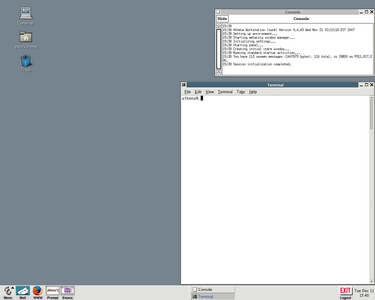
(Disclaimer: I work for MIT Information Services & Technology blah blah blah I am a student blah blah these are only my words and do not represent the opinion(s) of my employer.) Way back in the day in 1983, MIT started something it called Project Athena, which had the goal of investigating how computers could be used to enhance education at MIT. This project became the origin of such pieces of software as the X Window System and Kerberos, as well as a campus-wide network of workstations all running similar software. In 1991, Project Athena ended, but the Athena system continued on, taken over by MIT Information Systems. It’s 2008, and Athena still exists at MIT—walk into a computing cluster, and chances are all the machines will be running Athena software. (Unless that particular cluster has been taken over be Athena’s evil sibling, often referenced as “WinAthena”, which often seems to be maintained by no one, and whose existence is sometimes denied by those who maintain and support Real Athena. Not many machines have suffered this agonizing fate, luckily.) Unfortunately, as the years have progressed recently, fewer and fewer resources have been put into the development of Athena. In many ways it is no longer on the cutting edge of things as it has been in the past, though it is certainly still useful. Some students these days, however, even think of Athena as only “their MIT email” or maybe use it occasionally to print something in a cluster on the way to class. I’ve seen people grow frustrated and storm out of a cluster due to things like instructions for using a flash drive that involve more steps than just plugging it in. While on the one hand it’s easy to laugh at people for a lack of patience or being open to a computing system that is not either Windows or Mac and perhaps a bit more complicated on the surface, on the other hand, some of these things really should just work by now, and on other UNIX-based systems they do—but Athena has lagged behind. When you log into an Athena workstation for the first time, you are confronted with what looks like this: Clean MIT Athena login That’s GNOME 2.8, and it looks kind of like the GNOME 2.8 default but uglier. When you look under the hood, there are pieces of the system that obviously originated in a time where nothing better existed and so something new had to be created—the “xlogin” login system doesn’t support PAM, and the login path involves a hairy maze of scripts that perform various tasks. Under the hood, the base OS is currently RHEL 4 or Solaris 10. I still can’t remember what the right options are to feed RPM whenever I need some information that I think I should be able to get from it. These things were once necessary but today just look crufty. Some people have tossed around the idea that everyone has a laptop these days and thus clusters are uselessly expensive, but it’s been met with a lot of resistance. I’m all for progress, but I use clusters all the time! They’re one thing that makes it an easy choice for me to have a really portable laptop, because when I really need computing power or screen space on campus away from my room, there is always a cluster nearby. They’re also nice isolated places that can be associated with “work mode”, which is good for productivity. Beyond all this, Athena provides a common platform that all technical classes can depend on, from providing standard and specialized academic software to standing as a baseline of “make sure your code works on this before handing it in because that is how it will be graded”. At any rate, things are finally happening on this front. Athena can’t stay RHEL 4 forever—while AFS allows non-system software to be easily updated for all machines without requiring any OS release, hardware moves on and compatibility is lost, and the rest of the world is coming up with new awesome things that Athena machines are missing out on. A student group that I am vaguely involved with, SIPB, took the early initiative with this and created DebAthena, which takes stock Debian and Ubuntu and allows it to closely resemble an Athena environment. We even run a campus Linux dialup using the packages. (I won’t claim to have done much work on DebAthena myself because, well, I didn’t.) Amazingly, the Athena release team has decided to work with the SIPB on the next release of Athena. So, what I really just wasted over 600 words prepping for is to say that Athena 10 will be based on Ubuntu. This is only relatively new news, but I am lame about finishing blog posts. There are a variety of reasons why Ubuntu was chosen over Debian. Some of them are lame and some of them are not. Even so, I am excited about this prospect—and it should be possible to peripherally support Debian in such a way that was not possible with Athena 9.4. I really like Athena. Even coming to MIT with a background in Linux there has been a steep learning curve, though, and I think that things could be better. Lots of people here have their first encounter with a ‘nix system in the form of Athena, and we should strive to make that experience as good as possible. I’m kind of skeptical on the expected release date of this upcoming summer, but as long as it happens soon it will be a big step forward. In some ways it’s kind of sad that I’m excited about a big part of a research institution catching up with others—but inertia is a strong force, and dealing with thousands of workstations is no trivial task. I kind of long for the exciting days of creating new big pieces of free software like X. I bet I imagine those days as being better than they actually were.

Patrick Winnertz: Responsible behaviour with gpg keys

Yeah... this happens if you are drunken see a nice girl and try to sign a gpg key :) : Without any other comment. Thanks to madduck: this comic is of course from xkcd

Jordi Mallach: FOSDEM 2008

As part of a sad trend that pulls me away from my healthy travel habits, I just booked plane tickets to Brussels for February 22nd. Note this is 1.5 months of planning ahead. madduck, your turn! Additionally, two weeks ago I got tickets for a one week long trip around parts of Germany at the end of the month. The travel plan is totally undefined, so I don't know what cities I'll be visiting yet. Fun!

9 January 2008

Andrew Pollock: [life] Post-op, Day 6

Discharged! Sarah was discharged almost bang on 11am, the advertised discharge time, which is less than 6 full days after she got out of surgery. Pretty amazing stuff, and not a moment too soon, if you ask Sarah. She had a final chest x-ray this morning, and that was about it. We took a non-highway route home, and stopped via the supermarket to get a few things and get her prescriptions filled, so we got home at about 12:20pm. The rest of her recovery can be followed on her blog. We both feel forever indebted to the wonderful doctors and nursing staff at Stanford Hospital. Being in a hospital is certainly a lot better when you're not grieving, and the outcome is positive.

8 January 2008

Andrew Pollock: [life] Post-op, Day 5

Not a whole lot to report. Sarah's still yet to have a decent night's sleep. The cardiac rehab lady came by to go through the do's and don't's and answer any questions we had. They did an echocardiogram. I tagged along to watch. The Dacron looks a bit whiter on the ultrasound than the aortic tissue, other than that, there's not a lot to see. It's looking like she'll be discharged tomorrow.

Russell Coker: Weather in Melbourne

Some people have been asking about the weather in Melbourne in late-January in terms of what to wear for Linux.Conf.Au. It is probably impossible to predict weather for a particular day this far ahead. But predicting a range for the week is not difficult. I think that you should expect at least one day that is really hot with a peak of 37C or more and reasonable humidity with a possibility of another two days the same or similar. A day with a peak of 42C or more is not unlikely over the course of a week. You should expect a range of temperatures, one or two days that are reasonably cool with a maximum of 25C would not be unexpected. Some heavy rain in short bursts is a possibility (based on the past few weeks - prior to that there was little rain and it’s possible that there may be some time without rain again), there is probably no need for a rain-coat if you have the option of waiting ~30 mins for the rain to pass before going outside. I expect that if there is any rain at a time when conference delegates are about to go out somewhere then things will be delayed. I suggest that you wear jeans while on the plane but expect to wear shorts for your entire time in Australia. A t-shirt is a reasonable option but if you plan to be outside much then wear a long-sleeved shirt. As I don’t expect to be doing much work in traditional offices in the near future I’m wearing business shirts when I go outside, long sleeves with a collar is good for protecting against sun-burn and as they are light they keep me cool (t-shirts are tighter and thicker and keep you hot). However when at LCA I will be wearing t-shirts that I designed (which should be well suited to being inside and I don’t plan to do much outside during that week). A Scott e Vest [1] is a good thing to wear. It has heaps of pockets for your electronic gear, is reasonably light, and can be worn on top of a t-shirt. The Scott company also sells a TEC shirt which is a long-sleeved shirt with plenty of pockets. I’ve had a Scott e Vest for a number of years and I might have to get myself a TEC shirt.

Thijs Kinkhorst: All alone at the datacentre

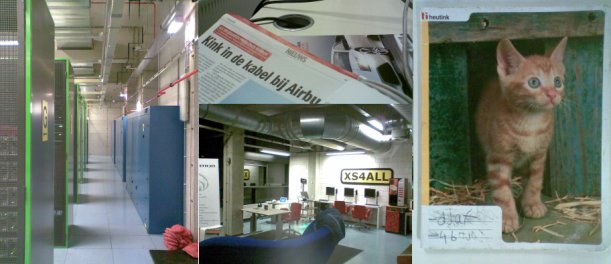
Datacentre Impression There's completely no one here. As it should be. Except for myself of course. klecker should be hosted here aswell. But which machine could it be? I'm not sure who left the [what's the English word for schrift/Heft/cahier] with the cat here? Seems to be an AFC Ajax fan. Hope he types better than he writes. This phone makes acceptable pictures for small resolutions. Back to work.

7 January 2008

Anthony Towns: Baby Got Bloat

With the whole incipient git obsession I’ve been cleaning out some of my scratch dirs. In one, last touched in mid-2006, I found:
Oh. My. God.
Becky, look at that bloat!
It's so big...
It looks like one of those Microsoft products...
Who understands those Microsoft guys anyway?
They only code that crap because they're paid by the line...
I mean the bloat...
It's just so slow...
I can't believe it's so laggy...
It's just bloated...
I mean, gross...
Look, that just ain't a Hack.
I like big apps and I cannot lie.
You other bruthas can't deny,
That when some perl comes by, not a symbol to waste
Like line-noise, cut and paste --
You're bewitched;
But now my context's switched,
Coz I notice that glest's got glitz.
Oh BABY! I wanna apt-get ya,
Coz you got pictures,
Those hackers tried to warn me,
But the bling you got
/Make me so horny/
Oooo, app fantastic,
You say you wanna fill up my drive?
Well, use me, use me, coz you ain't that average GUI.
I've seen them typing,
To hell with reciting,
I point, and click, and never miss a single trick.
I'm tired of tech websites,
Sayin' command lines are the thing.
Ask the average power user what makes them tick --
You gotta point and click.
So hackers! (Yeah!) Hackers! (Yeah!)
Has your UI got the G? (Hell Yeah!)
Well click it (click it), click it (click it), and use that healthy glitz,
Baby got bloat.
(vi code with a KDE UI...)
And before you ask, no, I don’t know what I was drinking…

Andrew Pollock: [life] Post-op, Day 4

Sarah slept better overnight, but still not great. She was certainly more lively this morning when I got in, than yesterday. She's resigned to the fact that you don't come to a hospital to get rest, which is kind of ironic. She did need to get put back on the oxygen overnight because her O2 saturation dropped. She was off it again by the time I got in. Today's big achievement was getting the external pacing wires removed. They were put in during the procedure as a precaution, I think because if her heart played up, they didn't want to have to use defibrillator paddles, and because they'd cracked her chest open, manual CPR wasn't an option. The wires could be attached to an external pacemaker if necessary (but it never was). I watched the removal quite closely, as I was pretty curious. Basically the physician's assistant just came in and yanked them out. Judging from the look on Sarah's face, it was an interesting sensation. We were both amazed at how long the wires were. There was probably 30 centimetres of wire under the skin. The last bit was loosely spiralled. I was just really surprised, because the PA's hand started off at Sarah's chest, and ended up at the PA's shoulder. It was just a lot longer than we both expected. All the extra length was because the wires wrap around the heart. The wires came out at about 2:30pm. Sarah had another chest x-ray and a CT scan today. The CT scan looked good. The x-ray showed some fluid in her lungs, and her lung capacity is still sub-par. It seems when she's fully horizontal, her breathing isn't so crash hot, but it's fine when she's sitting up or walking around. All Sarah's got left is one peripheral line now. There was some talk of her possibly going home on Wednesday. She has an echocardiogram tomorrow, and I guess it'll all hinge on how her lungs are going.

6 January 2008

Andrew Pollock: [life] Post-op, Day 3

Slow day today. I slept at home, and got in at around 9:40am. Sarah didn't sleep well again overnight, her O2 saturation levels kept dropping below 90% because she wasn't breathing deeply enough in her sleep, and that causes an alarm to go off. So she was pretty flat when I first got in, but she picked up as the day went along, and was fairly chirpy by around 11am. The doctor came by and explained the photos that we've been given, so I'll have to try and regurgitate all of it and update the captions. Her lungs are still looking a bit suboptimal. The third lobe on the right lung isn't inflating well apparently. They said something about there being some fluid as well, although the nurse said she can't hear anything. All that said, she spent a lot of time in a chair today, and her O2 saturation levels have been the best they've been since she was in the ICU. So good, that they're trialing having her off oxygen while she attempts to take a nap as I write. Her blood sugar levels are settling down. I think they're still slightly elevated, but not to the point that insulin is required. She only needed insulin with lunch yesterday, so it definitely looks like it's improving. She's already been on her three walks today, by 4pm. An occupational therapist came by, and went through the sternal precautions again, and showed us how to get in and out of bed without putting undue pressure on the sternum, and Sarah's been getting out of bed unassisted from horizontal since. Her pain has been quite manageable. So while today started out looking like it was going to be a small backward step, I think it's still a good move forward. Sarah's continuing her breathing exercises, so I'm sure her lungs will sort themselves out in the next day or two. I guess they'll take another chest x-ray this afternoon, although it's getting a bit late in the day. Sarah's starting to get a bit of cabin fever, but I think today's been pretty slow, in part because we deferred having visitors on account of her being not up to it in the morning.

5 January 2008

Andrew Pollock: [life] Post-op, Day 2

"Day Two Downers" be damned, Sarah's powering along like a freight train. Neither of us had a terribly fantastic night's sleep. Her chest drain is attached to this big box thing that has some sort of water seal in it, and with the suction going through it, it bubbles and makes noise like a massive aquarium. But she did get some sleep, and said she felt better this morning for it. The doctor came by at 8am, and took the incision dressing off, and we got our first good look at it. It's big (i.e. long). It runs from about the top of her breastbone to the bottom of her sternum. 20cm at my estimation. She said that she thought the chest tube could come out today, and sure enough it came out at about 12:30pm. They also took her urinary catheter out at that time, so now all she's hooked up to is oxygen. Her blood sugar levels were acceptable at breakfast time. Oh, the reason the incision ran so high was because they elected to do the bypass attachment to an artery in her neck, rather than further around the aorta, because the tissue was fragile and they didn't want to risk a dissection. Not doing the bypass in the aorta also left them the option of removing some of the transcending arch if they determined it still ended up being necessary. Sarah got up and had breakfast in a chair again, and was generally feeling pretty mobile. She moved between the chair and a wheelchair (and back) when they came to get her for another x-ray, without requiring any assistance. She took her first walk around the ward at 11am. I'd popped home for a shower and to check on the cats, and so I missed it. Doctor Miller dropped in at around 12:30pm to see how she was doing, and that was good as Sarah got a chance to talk directly to him about how the procedure had gone. He was very positive and said she could put this whole thing behind her now. At 2pm, she went for another walk, this time sans two thirds of the tubes from her first walk, and got in and out of bed unassisted. She took her last walk of the day at 4pm. Apparently her blood sugar is still on the high side, but within the range that they don't feel the need to give her insulin. Her chest is apparently looking better on the x-ray they took this morning. They took a second one after they removed the chest drain, but we haven't heard anything about how that looks yet. She's continuing to do extremely well, most of this less than 48 hours out of surgery.

Antti-Juhani Kaijanaho: What fiction I read in 2007

In rough chronological order, with capsule reviews. I don’t think I’ve missed any, but it is possible that I have. If you look through the list (behind the cut), you’ll see I read mostly Baen books nowadays. There’s a simple explanation: Baen is (almost) the only publisher that does real e-books, and I tend to avoid the inconvenience of paper books where I can. Still, there’s about a hundred titles on the list. (more…)

Next.

Previous.