Search Results: "sto"

10 July 2016

Joey Hess: twenty years of free software -- part 12 propellor

Propellor is my second big Haskell program. I recently described the motivation for it like this, in a proposal for a Linux.Conf.Au talk:
The configuration of Linux hosts has become increasingly declarative, managed by tools like puppet and ansible, or by the composition of containers. But if a server is a collection of declarative properties, how do you make sure that changes to that configuration make sense? You can test them, but eventually it's 3 AM and you have an emergency fix that needs to go live immediately. Data types to the rescue! While data types are usually used to prevent eg, combining an Int and a Bool, they can be used at a much more abstract level, for example to prevent combining a property that needs a Debian system with a property that needs a Red Hat system. Propellor leverages Haskell's type system to prove the consistency of the properties it will apply to a host.
The real origin story though, is that I wanted to finally start using configuration management, but the tools for it all seemed very complicated and built on shaky foundations (like piles of yaml), and it seemed it would be easier to write my own than deal with that. Meanwhile, I had Haskell burning a hole in my pocket, ready to be used in a second large project after git-annex. Propellor has averaged around 2.5 contributions per month from users since it got started, but increasing numbers recently. That's despite having many fewer users than git-annex, which remember gets perhaps 1 patch per month. Of course, I've "cheated" by making sure that propellor's users know Haskell, or are willing to learn some. And, propellor is very compositional; adding a new property to it is not likely to be complicated by any of the existing code. So it's easy to extend, if you're able to use it. At this point propellor has a small community of regular contributors, and I spend some pleasant weekend afternoons reviewing and merging their work. Much of my best work on propellor has involved keeping the behavior of the program the same while making its types better, to prevent mistakes. Propellor's core data types have evolved much more than in any program I worked on before. That's exciting! Next: twenty years of free software -- part 13 past and future

Simon D saulniers: [GSOC] Week 3&4 Report

I have finally made a version of the queries code that can viably be integrated into the master branch of OpenDHT. I am awaiting my mentor s approval and/or comments.

What s done Queries. The library will provide the additional following functions in its API:
void get(InfoHash id, GetCallbackSimple cb, DoneCallback donecb= , Value::Filter f = Value::AllFilter(), Where w =  )  
void query(const InfoHash& hash, QueryCallback cb, DoneCallback done_cb =  , Query q =  );
The structure Where in the first signature will allow the user to narrow the set of values received through the network those that verify the where statement. The Where actually encapsulates a statement of the following SQL-ish form: SELECT * WHERE <some_field>=<some_field_value>. Also, the DhtRunner::query function will let the user do something similar to what s explained in the last paragraph, but where the returned data is encapsulated in FieldValueIndex structure instead of Value. This structure has a std::map<Value::Field, FieldValue>. You can think of the FieldValueIndex as a subset of fields of a given Value. The Query structure then allows you to create both Select and Where statements .

What s next
  • Value pagination. I have begun working on this and I now have a more clear idea of the first step to accomplish. I have to redesign the get operation callbacks calling process by making a callback execution per SearchNode instead of per Search (list of SearchNode). This will let us properly write the value pagination code with node concurrency in mind. This will therefor make sure we don t request a value from a node if it doesn t stores it;
  • Optimizing announce operations;

Paul Tagliamonte: SNIff

A while back, I found myself in need of two webservers that would terminate TLS (with different rules). I wanted to run some custom code I d written (which uses TLS peer authentication), and also nginx on port 443. The best way I figured out how to do this was to write a tool to sit on port 443, and parse TLS Client Hello packets, and dispatch to the correct backend depending on the SNI name. SNI, or Server Name Indication allows the client to announce (yes over cleartext!) what server it s looking for, similar to the HTTP Host header. Sometimes, like in the case above, the Host header won t work, since you ve already done a TLS handshake by the time you figure out who they re looking for. I also spun the Client Hello parser out into its own importable package, just in case someone else finds themselves in this same boat. The code s up on github.com/paultag/sniff!

Michal &#268;iha&#345;: Weblate 2.7

Slightly later than on monthly schedule but Weblate 2.7 is out today. This release brings improvements to the API and is first to officially support wlc a command line client for Weblate. Full list of changes for 2.7: If you are upgrading from older version, please follow our upgrading instructions. You can find more information about Weblate on https://weblate.org, the code is hosted on Github. If you are curious how it looks, you can try it out on demo server. You can login there with demo account using demo password or register your own user. Weblate is also being used https://hosted.weblate.org/ as official translating service for phpMyAdmin, OsmAnd, Aptoide, FreedomBox, Weblate itself and many other projects. Should you be looking for hosting of translations for your project, I'm happy to host them for you or help with setting it up on your infrastructure. Further development of Weblate would not be possible without people providing donations, thanks to everybody who have helped so far! The roadmap for next release is just being prepared, you can influence this by expressing support for individual issues either by comments or by providing bounty for them.

Filed under: Debian English SUSE Weblate 0 comments

9 July 2016

Matthew Garrett: "I recieved a free or discounted product in return for an honest review"

My experiences with Amazon reviewing have been somewhat unusual. A review of a smart switch I wrote received enough attention that the vendor pulled the product from Amazon. At the time of writing, I'm ranked as around the 2750th best reviewer on Amazon despite having a total of 18 reviews. But the world of Amazon reviews is even stranger than that, and the past couple of weeks have given me some insight into it.

Amazon's success is fairly phenomenal. It's estimated that there's over 50 million people in the US paying $100 a year to get free shipping on Amazon purchases, and combined with Amazon's surprisingly customer friendly service there's a lot of people with a very strong preference for choosing Amazon rather than any other retailer. If you're not on Amazon, you're hurting your sales.

And if you're an established brand, this works pretty well. Some people will search for your product directly and buy it, leaving reviews. Well reviewed products appear higher up in search results, so people searching for an item type rather than a brand will still see your product appear early in the search results, in turn driving sales. Some proportion of those customers will leave reviews, which helps keep your product high up in the results. As long as your products aren't utterly dreadful, you'll probably maintain that position.

But if you're a brand nobody's ever heard of, things are more difficult. People are unlikely to search for your product directly, so you're relying on turning up in the results for more generic terms. But if you're selling a more generic kind of item (say, a Bluetooth smart bulb) then there's probably a number of other brands nobody's ever heard of selling almost identical objects. If there's no reason for anybody to choose your product then you're probably not going to get any reviews and you're not going to move up the search rankings. Even if your product is better than the competition, a small number of sales means a tiny number of reviews. By the time that number's large enough to matter, you're probably onto a new product cycle.

In summary: if nobody's ever heard of you, you need reviews but you're probably not getting any.

The old way of doing this was to send review samples to journalists, but nobody's going to run a comprehensive review of 3000 different USB cables and even if they did almost nobody would read it before making a decision on Amazon. You need Amazon reviews, but you're not getting any. The obvious solution is to send review samples to people who will leave Amazon reviews. This is where things start getting more dubious.

Amazon run a program called Vine which is intended to solve this problem. Send samples to Amazon and they'll distribute them to a subset of trusted reviewers. These reviewers write a review as normal, and Amazon tag the review with a "Vine Voice" badge which indicates to readers that the reviewer received the product for free. But participation in Vine is apparently expensive, and so there's a proliferation of sites like Snagshout or AMZ Review Trader that use a different model. There's no requirement that you be an existing trusted reviewer and the product probably isn't free. You sign up, choose a product, receive a discount code and buy it from Amazon. You then have a couple of weeks to leave a review, and if you fail to do so you'll lose access to the service. This is completely acceptable under Amazon's rules, which state "If you receive a free or discounted product in exchange for your review, you must clearly and conspicuously disclose that fact". So far, so reasonable.

In reality it's worse than that, with several opportunities to game the system. AMZ Review Trader makes it clear to sellers that they can choose reviewers based on past reviews, giving customers an incentive to leave good reviews in order to keep receiving discounted products. Some customers take full advantage of this, leaving a giant number of 5 star reviews for products they clearly haven't tested and then (presumably) reselling them. What's surprising is that this kind of cynicism works both ways. Some sellers provide two listings for the same product, the second being significantly more expensive than the first. They then offer an attractive discount for the more expensive listing in return for a review, taking it down to approximately the same price as the original item. Once the reviews are in, they can remove the first listing and drop the price of the second to the original price point.

The end result is a bunch of reviews that are nominally honest but are tied to perverse incentives. In effect, the overall star rating tells you almost nothing - you still need to actually read the reviews to gain any insight into whether the customer actually used the product. And when you do write an honest review that the seller doesn't like, they may engage in heavy handed tactics in an attempt to make the review go away.

It's hard to avoid the conclusion that Amazon's review model is broken, but it's not obvious how to fix it. When search ranking is tied to reviews, companies have a strong incentive to do whatever it takes to obtain positive reviews. What we're left with for now is having to laboriously click through a number of products to see whether their rankings come from thoughtful and detailed reviews or are just a mass of 5 star one liners.

comment count unavailable comments

Enrico Zini: Monthly link collections with staticsite

A year ago, I wrote:
Instead of keeping substantial tabs open until I have read all of them, or losing them in the jungle of browser bookmarks, I have written a script that collects them into a file per month, and turns them into markdown files for my blog.
That script turned out to be quirky and overengineered, so much so that I stopped using it myself. I've now rethought my approach, and downscaled it: instead of saving a copy of each page locally, I can blog a reference to https://archive.org or https://archive.is. I do not need to autogenerate a description from the site itself. The result has been a nicely minimal set of changes to staticsite that resulted in a new version where adding a link to a monthly collection is as easy as typing ssite new -a links. As long as I'll remember to rebuild the site 3 weeks from now, a new post should automagically appear in my blog.

Charles Plessy: Congratulations, Marga!

For the first time in our history, a woman joins the Technical Committee. Congratulations, Marga, and thanks for volunteering.

8 July 2016

Reproducible builds folks: Managing container and environment state

Author: ceridwen With some more help from Martin Pitt, it became clear to me that my previous mental model of how autopkgtest worked is very different from how it does work. I'll illustrate by borrowing my previous example. I know that schroot has the following behavior:
The default behaviour is as follows (all directory paths are inside the chroot). A login shell is run in the current working directory. If this is not available, it will try $HOME (when --preserve-environment is used), then the user's home directory, and / inside the chroot in turn. A command is always run in the current working directory inside the chroot. If none of the directories are available, schroot will exit with an error status.
I was naively thinking that the way autopkgtest would work is that it would set the current working directory of the schroot call and the ensuing subprocess call would thus take place in that directory inside the schroot. That is not how it works. If you want to change directories inside the virtual server, you have to use cd. The same is true of, at least, environment variables, which have their own specific handling in the adt_testbed.Testbed methods but have to be passed as strings, and umask. I'm assuming this is because the direct methods with qemu images or LXC containers don't work. What this means is that I was thinking about the problem the wrong way: what reprotest needs to do is generate shell scripts. This is how autopkgtest works. If this goes beyond laying out commands linearly one after another, for instance if it demands conditionals or other nested constructs, the right way to do it is to build an abstract syntax tree representation of the shell script and then convert it to code. Whether I need more complicated shell scripts depends on my approach to handling state in the containers. I need to know what state persists across separate command executions: if I call adt_testbed.Testbed.execute() twice, what if any changes I make to the container will carry forward from the first to the second? There are three categories here. First, some properties of a system aren't preserved even from one command execution to the next, like working directory and environment variables. (I thought working directory would be preserved, but it's not). The second is state that persists while the testbed is open and is then automatically reverted when it's closed, like files copied into temporary directories on the tesbed. The third is state that persists across different sessions on the same container and must be cleaned up by reprotest. It's worth noting that which state falls into which category may vary by the container in question, though for the most part I can either do unnecessary cleanup or issue unnecessary commands to handle the differences. autopkgtest itself has a very different approach to cleanup, as it relies almost entirely on the builtin reversion capabilities from some of its containers. I would prefer to avoid doing the same, partly because I know that some of the modifications I need to make, for instance creating new users or mounting disorderfs, can't be reverted by the faster, simpler containers like schroot. From discussions with Lunar, I think that the variations that correspond to environment variables (captures_environment, home, locales, path, and timezone) fall into the first category, but because of the special handling for them they don't require sending a separate command. The shell (bash foo) accepts a script or command as an argument so it also doesn't need a separate command. Setting the working directory and umask require separate commands that have to be joined. On Linux, setarch also accepts a command/script as an argument so can be handled like the shell, but there's no unified POSIX protocol for mocking uname so other OSes will require different approaches. Users, groups, file ordering, host, and domain will require cleanup in all containers except for (maybe) qemu. If I want to handle the cleanup in the shell scripts themselves, I need conditionals so that for instance the shell script only tries to unmount disorderfs if disorderfs was successfully mounted. This approach would simplify the error handling problems I've had before, where when a build crashes cleanup code run from Python doesn't get run until after the testbed stop accepting commands. Lunar suggested the Plumbum library to me, and I think I can use it to avoid writing my own shell AST library. It has a method that converts the Python representation of a shell script into a string that can be passed to Testbed.command(). Integrating Plumbum to generate the necessary scripts is where I'm going in the next week. Any feedback on any of this is welcome. I'm also curious what other projects are using autopkgtest code. Holger brought to my attention piuparts, which brings the list up to four that I'm aware of, autopkgtest itself, sbuild, piuparts, and now reprotest.

Mike Hommey: Are all integer overflows equal?

Background: I ve been relearning Rust (more about that in a separate post, some time later), and in doing so, I chose to implement the low-level parts of git (I ll touch the why in that separate post I just promised). Disclaimer: It s friday. This is not entirely(?) a serious post. So, I was looking at Documentation/technical/index-format.txt, and saw:
32-bit number of index entries.
What? The index/staging area can t handle more than ~4.3 billion files? There I was, writing Rust code to write out the index.
try!(out.write_u32::<NetworkOrder>(self.entries.len()));
(For people familiar with the byteorder crate and wondering what NetworkOrder is, I have a use byteorder::BigEndian as NetworkOrder) And the Rust compiler rightfully barfed:
error: mismatched types:
 expected  u32 ,
    found  usize  [E0308]
And there I was, wondering: mmmm should I just add as u32 and silently truncate or hey what does git do? And it turns out, git uses an unsigned int to track the number of entries in the first place, so there is no truncation happening. Then I thought but what happens when cache_nr reaches the max? Well, it turns out there s only one obvious place where the field is incremented. What? Holy coffin nails, Batman! No overflow check? Wait a second, look 3 lines above that:
ALLOC_GROW(istate->cache, istate->cache_nr + 1, istate->cache_alloc);
Yeah, obviously, if you re incrementing cache_nr, you already have that many entries in memory. So, how big would that array be?
        struct cache_entry **cache;
So it s an array of pointers, assuming 64-bits pointers, that s ~34.3 GB. But, all those cache_nr entries are in memory too. How big is a cache entry?
struct cache_entry  
        struct hashmap_entry ent;
        struct stat_data ce_stat_data;
        unsigned int ce_mode;
        unsigned int ce_flags;
        unsigned int ce_namelen;
        unsigned int index;     /* for link extension */
        unsigned char sha1[20];
        char name[FLEX_ARRAY]; /* more */
 ;
So, 4 ints, 20 bytes, and as many bytes as necessary to hold a path. And two inline structs. How big are they?

struct hashmap_entry  
        struct hashmap_entry *next;
        unsigned int hash;
 ;
struct stat_data  
        struct cache_time sd_ctime;
        struct cache_time sd_mtime;
        unsigned int sd_dev;
        unsigned int sd_ino;
        unsigned int sd_uid;
        unsigned int sd_gid;
        unsigned int sd_size;
 ;
Woohoo, nested structs.
struct cache_time  
        uint32_t sec;
        uint32_t nsec;
 ;
So all in all, we re looking at 1 + 2 + 2 + 5 + 4 32-bit integers, 1 64-bits pointer, 2 32-bits padding, 20 bytes of sha1, for a total of 92 bytes, not counting the variable size for file paths. The average path length in mozilla-central, which only has slightly over 140 thousands of them, is 59 (including the terminal NUL character). Let s conservatively assume our crazy repository would have the same average, making the average cache entry 151 bytes. But memory allocators usually allocate more than requested. In this particular case, with the default allocator on GNU/Linux, it s 156 (weirdly enough, it s 152 on my machine). 156 times 4.3 billion 670 GB. Plus the 34.3 from the array of pointers: 704.3 GB. Of RAM. Not counting the memory allocator overhead of handling that. Or all the other things git might have in memory as well (which apparently involves a hashmap, too, but I won t look at that, I promise). I think one would have run out of memory before hitting that integer overflow. Interestingly, looking at Documentation/technical/index-format.txt again, the on-disk format appears smaller, with 62 bytes per file instead of 92, so the corresponding index file would be smaller. (And in version 4, paths are prefix-compressed, so paths would be smaller too). But having an index that large supposes those files are checked out. So let s say I have an empty ext4 file system as large as possible (which I m told is 2^60 bytes (1.15 billion gigabytes)). Creating a small empty ext4 tells me at least 10 inodes are allocated by default. I seem to remember there s at least one reserved for the journal, there s the top-level directory, and there s lost+found ; there apparently are more. Obviously, on that very large file system, We d have a git repository. git init with an empty template creates 9 files and directories, so that s 19 more inodes taken. But git init doesn t create an index, and doesn t have any objects. We d thus have at least one file for our hundreds of gigabyte index, and at least 2 who-knows-how-big files for the objects (a pack and its index). How many inodes does that leave us with? The Linux kernel source tells us the number of inodes in an ext4 file system is stored in a 32-bits integer. So all in all, if we had an empty very large file system, we d only be able to store, at best, 2^32 22 files And we wouldn t even be able to get cache_nr to overflow. while following the rules. Because the index can keep files that have been removed, it is actually possible to fill the index without filling the file system. After hours (days? months? years? decades?*) of running
seq 0 4294967296   while read i; do touch $i; git update-index --add $i; rm $i; done
One should be able to reach the integer overflow. But that d still require hundreds of gigabytes of disk space and even more RAM. Ok, it s actually much faster to do it hundreds of thousand files at a time, with something like:
seq 0 100000 4294967296   while read i; do j=$(seq $i $(($i + 99999))); touch $j; git update-index --add $j; rm $j; done
At the rate the first million files were added, still assuming a constant rate, it would take about a month on my machine. Considering reading/writing a list of a million files is a thousand times faster than reading a list of a billion files, assuming linear increase, we re still talking about decades, and plentiful RAM. Fun fact: after leaving it run for 5 times as much as it had run for the first million files, it hasn t even done half more One could generate the necessary hundreds-of-gigabytes index manually, that wouldn t be too hard, and assuming it could be done at about 1 GB/s on a good machine with a good SSD, we d be able to craft a close-to-explosion index within a few minutes. But we d still lack the RAM to load it. So, here is the open question: should I report that integer overflow? Wow, that was some serious procrastination. Edit: Epilogue: Actually, oops, there is a separate integer overflow on the reading side that can trigger a buffer overflow, that doesn t actually require a large index, just a crafted header, demonstrating that yes, not all integer overflows are equal.

Russell Coker: Nexus 6P and Galaxy S5 Mini

Just over a month ago I ordered a new Nexus 6P [1]. I ve had it for over a month now and it s time to review it and the Samsung Galaxy S5 Mini I also bought. Security The first noteworthy thing about this phone is the fingerprint scanner on the back. The recommended configuration is to use your fingerprint for unlocking the phone which allows a single touch on the scanner to unlock the screen without the need to press any other buttons. To unlock with a pattern or password you need to first press the power button to get the phone s attention. I have been considering registering a fingerprint from my non-dominant hand to reduce the incidence of accidentally unlocking it when carrying it or fiddling with it. The phone won t complete the boot process before being unlocked. This is a good security feature. Android version 6 doesn t assign permissions to apps at install time, they have to be enabled at run time (at least for apps that support Android 6). So you get lots of questions while running apps about what they are permitted to do. Unfortunately there s no allow for the duration of this session option. A new Android feature prevents changing security settings when there is an overlay running . The phone instructs you to disable overlay access for the app in question but that s not necessary. All that is necessary is for the app to stop using the overlay feature. I use the Twilight app [2] to dim the screen and use redder colors at night. When I want to change settings at night I just have to pause that app and there s no need to remove the access from it note that all the web pages and online documentation saying otherwise is wrong. Another new feature is to not require unlocking while at home. This can be a convenience feature but fingerprint unlocking is so easy that it doesn t provide much benefit. The downside of enabling this is that if someone stole your phone they could visit your home to get it unlocked. Also police who didn t have a warrant permitting search of a phone could do so anyway without needing to compel the owner to give up the password. Design This is one of the 2 most attractive phones I ve owned (the other being the sparkly Nexus 4). I think that the general impression of the appearance is positive as there are transparent cases on sale. My phone is white and reminds me of EVE from the movie Wall-E. Cables This phone uses the USB Type-C connector, which isn t news to anyone. What I didn t realise is that full USB-C requires that connector at both ends as it s not permitted to have a data cable with USB-C at the device and and USB-A at the host end. The Nexus 6P ships with a 1M long charging cable that has USB-C at both ends and a ~10cm charging cable with USB-C at one end and type A at the other (for the old batteries and the PCs that don t have USB-C). I bought some 2M long USB-C to USB-A cables for charging my new phone with my old chargers, but I haven t yet got a 1M long cable. Sometimes I need a cable that s longer than 10cm but shorter than 2M. The USB-C cables are all significantly thicker than older USB cables. Part of that would be due to having many more wires but presumably part of it would be due to having thicker power wires for delivering 3A. I haven t measured power draw but it does seem to charge faster than older phones. Overall the process of converting to USB-C is going to be a lot more inconvenient than USB SuperSpeed (which I could basically ignore as non-SuperSpeed connectors worked). It will be good when laptops with USB-C support become common, it should allow thinner laptops with more ports. One problem I initially had with my Samsung Galaxy Note 3 was the Micro-USB SuperSpeed socket on the phone being more fiddly for the Micro-USB charging plug I used. After a while I got used to that but it was still an annoyance. Having a symmetrical plug that can go into the phone either way is a significant convenience. Calendars and Contacts I share most phone contacts with my wife and also have another list that is separate. In the past I had used the Samsung contacts system for the contacts that were specific to my phone and a Google account for contacts that are shared between our phones. Now that I m using a non-Samsung phone I got another Gmail account for the purpose of storing contacts. Fortunately you can get as many Gmail accounts as you want. But it would be nice if Google supported multiple contact lists and multiple calendars on a single account. Samsung Galaxy S5 Mini Shortly after buying the Nexus 6P I decided that I spend enough time in pools and hot tubs that having a waterproof phone would be a good idea. Probably most people wouldn t consider reading email in a hot tub on a cruise ship to be an ideal holiday, but it works for me. The Galaxy S5 Mini seems to be the cheapest new phone that s waterproof. It is small and has a relatively low resolution screen, but it s more than adequate for a device that I ll use for an average of a few hours a week. I don t plan to get a SIM for it, I ll just use Wifi from my main phone. One noteworthy thing is the amount of bloatware on the Samsung. Usually when configuring a new phone I m so excited about fancy new hardware that I don t notice it much. But this time buying the new phone wasn t particularly exciting as I had just bought a phone that s much better. So I had more time to notice all the annoyances of having to download updates to Samsung apps that I ll never use. The Samsung device manager facility has been useful for me in the past and the Samsung contact list was useful for keeping a second address book until I got a Nexus phone. But most of the Samsung apps and 3d party apps aren t useful at all. It s bad enough having to install all the Google core apps. I ve never read mail from my Gmail account on my phone. I use Fetchmail to transfer it to an IMAP folder on my personal mail server and I d rather not have the Gmail app on my Android devices. Having any apps other than the bare minimum seems like a bad idea, more apps in the Android image means larger downloads for an over-the-air update and also more space used in the main partition for updates to apps that you don t use. Not So Exciting In recent times there hasn t been much potential for new features in phones. All phones have enough RAM and screen space for all common apps. While the S5 Mini has a small screen it s not that small, I spent many years with desktop PCs that had a similar resolution. So while the S5 Mini was released a couple of years ago that doesn t matter much for most common use. I wouldn t want it for my main phone but for a secondary phone it s quite good. The Nexus 6P is a very nice phone, but apart from USB-C, the fingerprint reader, and the lack of a stylus there s not much noticeable difference between that and the Samsung Galaxy Note 3 I was using before. I m generally happy with my Nexus 6P, but I think that anyone who chooses to buy a cheaper phone probably isn t going to be missing a lot.

7 July 2016

Joey Hess: twenty years of free software -- part 10 shell-monad

shell-monad is a small project, done over a couple days and not needing many changes since, but I'm covering it separately because it was a bit of a milestone for me. As I learned Haskell, I noticed that the libraries were excellent and did things to guide their users that libraries in other languages don't do. Starting with using types and EDSLs and carefully constrained interfaces, but going well beyond that, as far as applying category theory. Using these libraries push you toward good solutions. shell-monad was a first attempt at building such a library. The shell script it generates should always be syntactically valid, and never forgets to quote a shell variable. That's only the basics. It goes further by making it impossible to typo the name of a shell variable or shell function. And it uses phantom types so that the Haskell type checker can check the types of shell variables and functions match up. So I think shell-monad is pretty neat, and I certianly learned a lot about writing Haskell libraries making it. Including how much I still have to learn! I have not used shell-monad much, but keep meaning to make propellor and git-annex use it for some of their shell script needs. And ponder porting etckeeper to generate its shell scripts using it. Next: twenty years of free software -- part 11 concurrent-output

6 July 2016

Daniel Pocock: Avoiding SMS vendor lock-in with SMPP

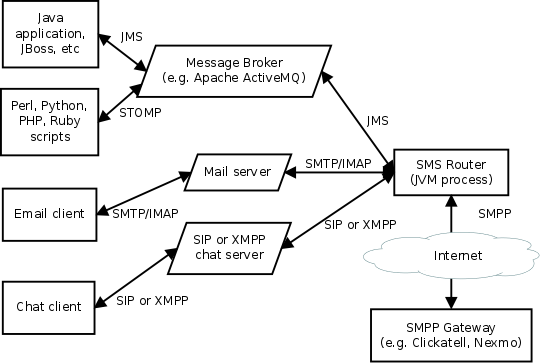
There is increasing demand for SMS notifications about monitoring alerts, trading notifications, flight delays and other events. Various companies are offering SMS transmission services to meet this demand and many of them aggressively pushing their own proprietary interfaces to the SMS world rather than using the more open and widely supported SMPP. There is good reason for this: if users write lots of of scripts to access the REST API of an SMS service, the users won't be able to change their service provider without having to change all their code. Well, that is good if you are an SMPP vendor but not if you are their customer. If an SMS gateway company goes out of business or has a system meltdown, the customers linked to their REST API will have a much bigger effort to migrate to a new provider than those using SMPP. The HTTP REST APIs offered by many vendors hide some details of the SMS protocol and payload. At first glance, this may feel easier. In fact, this leads to unpredictable results when delivering messages to users in different countries and different character sets/languages. It is better to start with SMPP from the beginning and avoid discovering those pitfalls later. The SMS Router free/open source software project helps overcome the SMPP learning curve by using APIs you are already familiar with. More troublesome for large organizations, some of the REST APIs offered by SMS gateways want to make callbacks to your own servers: this means your servers need public IP addresses accessible from the Internet. In some organizations that can take months to organize. SMPP works over one or more outgoing TCP connections initiated from your own server(s) and doesn't require any callback connections from the SMPP gateway. SMS Router lets SMS users have the best of both worlds: the flexibility of linking to any provider who supports SMPP and the convenience of putting messages into the system using any of the transports supported by an Apache Camel component. Popular examples include camel-jms (JMS) for Java and J2EE users, STOMP for scripting languages, camel-mail (SMTP and IMAP) for email integration and camel-sip (SIP) or camel-xmpp (XMPP) for chat/instant messaging systems. If you really want to, you can also create your own in-house HTTP REST API too using camel-restlet for internal applications. In all these cases, SMS Router always uses standard SMPP to reach any gateway of your choice. Architecture overview SMS Router is based on Apache Camel. Multiple instances can be operated in parallel for clustering, load balancing and high availability. It can be monitored using JMX solutions such as JMXetric. The SMPP support is based on the camel-smpp component which is in turn based on the jSMPP library, which comprehensively implements the SMPP protocol in Java. camel-smpp can be used with minimal configuration but for those who want to, many SMPP features can be tweaked on a per-message basis using various headers. The SMPP gateway settings can be configured and changed at will using the sms-router.properties file. The process doesn't require any other files or databases at runtime. The SMS Router is ready-to-run with one queue for sending messages and another queue for incoming messages. The routing logic can be customized by editing the RouteBuilder class to use other Camel components or any of Camel's wide range of functions for inspecting, modifying and routing messages. For example, you can extend it to failover to multiple SMPP gateways using Camel's load-balancer pattern. SMS Router based projects are already used successfully in production, for example, the user registration mechanism for the Lumicall secure VoIP app for Android. Getting started See the README for instructions. Feel free to ask questions about this project on the Camel users mailing list. Disclaimer SMS is not considered secure, the SMS Router developers and telecommunications industry experts discourage the use of this technology for two-factor authentication. Please see the longer disclaimer in the README file and my earlier blog about SMS logins: an illusion of security. The bottom line: if your application is important enough to need two-factor authentication, do it correctly using smart cards or tokens. There are many popular free software projects based on these full cryptographic solutions, for example, the oath-toolkit and dynalogin.

Mike Gabriel: [Arctica Project] Release of nx-libs (version 3.5.99.0)

Introduction NX is a software suite which implements very efficient compression of the X11 protocol. This increases performance when using X applications over a network, especially a slow one. NX (v3) has been originally developed by NoMachine and has been Free Software ever since. Since NoMachine obsoleted NX (v3) some time back in 2013/2014, the maintenance has been continued by a versatile group of developers. The work on NX (v3) is being continued under the project name "nx-libs". History Until January 2015, nx-libs was more mainly a redistribution approach of the original NX (v3) software. We (we as in mainly a group of X2Go developers) kept changes applied to the original NoMachine sources as minimal as possible. We also kept the original files and folders structure. Patches had been maintained via the quilt utility on top of a Git repository, the patches had always been kept separate. That was the 3.5.0.x series of nx-libs. In January 2015, the characteristics of nx-libs as maintained by the X2Go project between 2011 and 2015 changed. A decision was reached: This effort is now about to be released as "nx-libs 3.6.0.0". Contributors Since 2011, the nx-libs code base has to a great extent been maintained in the context of the X2Go Project [1]. Qindel Group joining in... In 2014, developers from the Qindel Group [2] joined the nx-libs maintenance. They found X2Go's work on nx-libs and suggested joining forces as best as possible on hacking nx-libs. The Arctica Project comming up... Starting in January 2015, the development on the 3.6.x branch of the project was moved into a new project called the Arctica Project [3]. Development Funding by Qindel In September 2015, a funding project was set up at Qindel. Since then, the Qindel group greatly supports the development of nx-libs 3.6.x monetarily and with provided man power. The funding project officially is a cooperation between Qindel and DAS-NETZWERKTEAM (business run by Mike Gabriel, long term maintainer of nx-libs). The funding is split into two subprojects and lasts until August 2017: The current nx-libs development effort is coordinated in the context of the Arctica Project (by Mike Gabriel), with use cases in Arctica, X2Go and TheQVD (VDI product worked on at Qindel) in mind. People involved There are various people involved in nx-libs 3.6.x maintenance and development, some of them shall be explicitly named here (in alphabetical order of surnames): Some other people have contributed, but have left the project already. Thanks for your work on nx-libs: A big thanks to everyone involved!!! Special thanks go to Stefan Baur for employing Mihai Moldovan and handling all the bureaucracy, so that Mihai can work on this project and get funded for his work. Achievements of nx-libs 3.5.99.0 We are very close to our self-defined release goal 3.6.0. The below tasks have already been (+/-) completed for version 3.5.99.0: In a previous blog post [4], the code reduction in nx-libs has already been discussed. With this announcement, we want to give a status update about our effort of shrinking the nx-libs code base:
    [mike@minobo nx-libs (3.6.x)]$ cloc --match-f '.*\.(c cpp h)' .
        1896 text files.
        1896 unique files.                                          
        7430 files ignored.
    http://cloc.sourceforge.net v 1.60  T=5.88 s (307.3 files/s, 143310.5 lines/s)
    -------------------------------------------------------------------------------
    Language                     files          blank        comment           code
    -------------------------------------------------------------------------------
    C                              958          68574          74891         419638
    C/C++ Header                   730          25683          33957         130418
    C++                            120          17007          11721          61292
    -------------------------------------------------------------------------------
    SUM:                          1808         111264         120569         611348
    -------------------------------------------------------------------------------
The previous statistics had these sums in the last line. First the nx-libs 3.5.0.x code tree (where we came from):
    -------------------------------------------------------------------------------
    SUM:                          5614         329279         382337        1757743
    -------------------------------------------------------------------------------
Then the nx-libs 3.6.x status as it was on May 9th 2016:
    -------------------------------------------------------------------------------
    SUM:                          1922         118581         126783         662635
    -------------------------------------------------------------------------------
Another 50.000 lines of code have been removed over the past two months. Work pending for the final 3.6.0 release goal Known Issues There are several open issues on the nx-libs Github project space, see https://github.com/ArcticaProject/nx-libs/issues. Testing the nx-libs 3.5.99.0 We are currently working on provisioning release builds and nightly builds of nx-libs for various recent Linux distributions. Please stay tuned and watch Mike Gabriel's blog [5]. We already have nightly builds of nx-libs for Debian and Ubuntu [6], but there are more to come soon. Until now, please use the build recipes provided in the README.md file of the nx-libs source tree [7]. References

4 July 2016

Benjamin Mako Hill: Studying the relationship between remixing & learning

With more than 10 million users, the Scratch online community is the largest online community where kids learn to program. Since it was created, a central goal of the community has been to promote remixing the reworking and recombination of existing creative artifacts. As the video above shows, remixing programming projects in the current web-based version of Scratch is as easy is as clicking on the see inside button in a project web-page, and then clicking on the remix button in the web-based code editor. Today, close to 30% of projects on Scratch are remixes. Remixing plays such a central role in Scratch because its designers believed that remixing can play an important role in learning. After all, Scratch was designed first and foremost as a learning community with its roots in the Constructionist framework developed at MIT by Seymour Papert and his colleagues. The design of the Scratch online community was inspired by Papert s vision of a learning community similar to Brazilian Samba schools (Henry Jenkins writes about his experience of Samba schools in the context of Papert s vision here), and a comment Marvin Minsky made in 1984:
Adults worry a lot these days. Especially, they worry about how to make other people learn more about computers. They want to make us all computer-literate. Literacy means both reading and writing, but most books and courses about computers only tell you about writing programs. Worse, they only tell about commands and instructions and programming-language grammar rules. They hardly ever give examples. But real languages are more than words and grammar rules. There s also literature what people use the language for. No one ever learns a language from being told its grammar rules. We always start with stories about things that interest us.
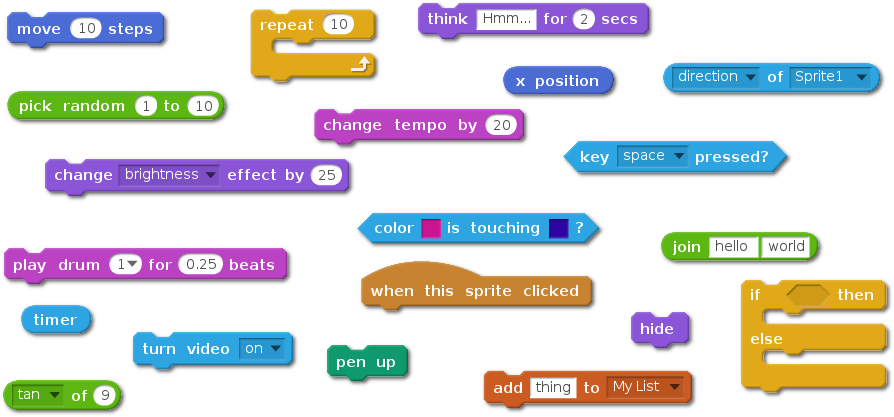
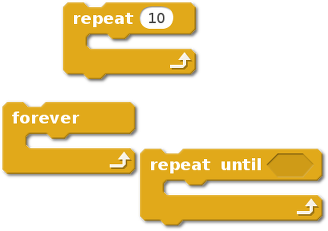
In a new paper titled Remixing as a pathway to Computational Thinking that was recently published at the ACM Conference on Computer Supported Collaborative Work and Social Computing (CSCW) conference, we used a series of quantitative measures of online behavior to try to uncover evidence that might support the theory that remixing in Scratch is positively associated with learning. scratchblocksOf course, because Scratch is an informal environment with no set path for users, no lesson plan, and no quizzes, measuring learning is an open problem. In our study, we built on two different approaches to measure learning in Scratch. The first approach considers the number of distinct types of programming blocks available in Scratch that a user has used over her lifetime in Scratch (there are 120 in total) something that can be thought of as a block repertoire or vocabulary. This measure has been used to model informal learning in Scratch in an earlier study. Using this approach, we hypothesized that users who remix more will have a faster rate of growth for their code vocabulary. Controlling for a number of factors (e.g. age of user, the general level of activity) we found evidence of a small, but positive relationship between the number of remixes a user has shared and her block vocabulary as measured by the unique blocks she used in her non-remix projects. Intriguingly, we also found a strong association between the number of downloads by a user and her vocabulary growth. One interpretation is that this learning might also be associated with less active forms of appropriation, like the process of reading source code described by Minksy. The second approach we used considered specific concepts in programming, such as loops, or event-handling. To measure this, we utilized a mapping of Scratch blocks to key programming concepts found in this paper by Karen Brennan and Mitchel Resnick. For example, in the image below are all the Scratch blocks mapped to the concept of loop . scratchblocksctWe looked at six concepts in total (conditionals, data, events, loops, operators, and parallelism). In each case, we hypothesized that if someone has had never used a given concept before, they would be more likely to use that concept after encountering it while remixing an existing project. Using this second approach, we found that users who had never used a concept were more likely to do so if they had been exposed to the concept through remixing. Although some concepts were more widely used than others, we found a positive relationship between concept use and exposure through remixing for each of the six concepts. We found that this relationship was true even if we ignored obvious examples of cutting and pasting of blocks of code. In all of these models, we found what we believe is evidence of learning through remixing. Of course, there are many limitations in this work. What we found are all positive correlations we do not know if these relationships are causal. Moreover, our measures do not really tell us whether someone has understood the usage of a given block or programming concept.However, even with these limitations, we are excited by the results of our work, and we plan to build on what we have. Our next steps include developing and utilizing better measures of learning, as well as looking at other methods of appropriation like viewing the source code of a project.

This blog post and the paper it describes are collaborative work with Sayamindu Dasgupta, Andr s Monroy-Hern ndez, and William Hale. The paper is released as open access so anyone can read the entire paper here. This blog post was also posted on Sayamindu Dasgupta s blog and on Medium by the MIT Media Lab.

Paul Wise: Check All The thingS!

check-all-the-things (aka cats, Meow!) is a tool that aims to make it easy to know which tools can be used to check a directory tree and to make it easy to run those tools on the directory tree. The tree could either be a source tree or a build tree or both. It aims to check as much of the tree as possible so the output can be very verbose and have many false positives. It is not for the busy, lazy or noise intolerant. It runs the checks by matching file names and MIME types against those registered for a list of checks. Each check has a set of dependencies, flags, filename wildcards, MIME type wildcards, comments and prerequisite commands. By default it: It runs all checks for the current distro/release except: There are command-line options to customise the behaviour and automatic bash shell completion via argcomplete. There are 177 checks (including TODO ones) in 73 different categories. There are an additional 224 not-well-specified TODO items for new checks in comments. It is exceptionally easy to add new checks once one knows how to use the tool one wants to add. At this point in time it is probably not a good idea to run it in an untrusted directory tree for several reasons: The project initially started as really hacky wiki page full of commands to run. At some point I figured it was time to make this actually be maintainable and started on a project to do that. At around the same time Jakub Wilk was working on maquack to replace the wiki page. Somehow I found out about it and talked to him about it. It was vastly less hacky than my version so I ended up taking it over and continuing it under the check-all-the-things name. I polished it for the last two years and finally released it into Debian unstable during DebCamp16.

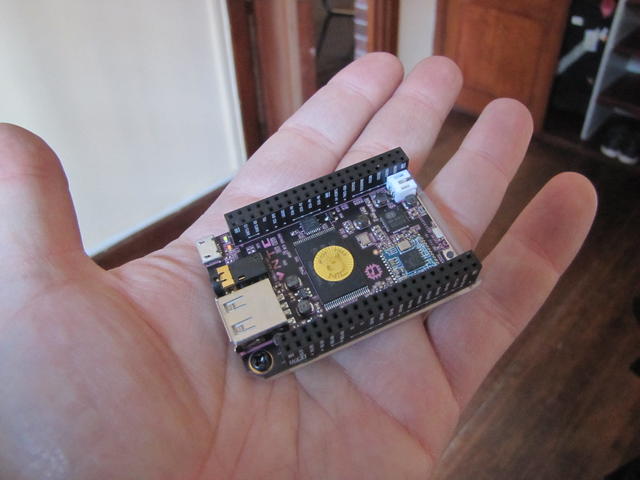
Gunnar Wolf: Got the C.H.I.P.s for DebConf!

I had my strong doubts as to whether the shipment would be allowed through customs, and was happily surprised by a smiling Graham today before noon. He handed me a smallish box that arrived to his office, containing... Our fifty C.H.I.P. computers, those I offered to give away at DebConf! The little machines are quite neat. They are beautiful little devices, including even a plastic back (so you can safely work with it over a conductive surface or things like that). Quite smaller than the usual Raspberry-like format. It has more than enough GPIO to make several of my friends around here drool about the possibilities. So, what's to this machine besides a nice small ARM CPU, 512MB RAM, wireless connectivity (Wifi and bluetooth)? Although I have not yet looked into them (but intend to do so very soon!), it promises to have the freest available hardware around, and is meant for high hackability! And not that it matters But we managed to import them all, legally and completely hassle-free, into South Africa! That's right We are all used to the declaring commercial value as one dollar mindset. But... The C.H.I.P.s are actually priced at US$9 a piece. The declared commercial value is US$450. South Africans said all their customs are very hard to clear But we were able receive 50 legally shipped computers, declared at their commercial value, without any hassles! (yes, we might have been extremely lucky as well) Anyway, stay tuned By Thursday I will announce the list of people that get to take one home. I still have some left, so feel free to mail me at gwolf+chip@gwolf.org.

3 July 2016

Daniel Stender: My work for Debian in June

At least a little much more time lst month for helping to improve the operating system we're working on. I've worked on a couple of package updates, mostly they are for PAPT, DPMT, Debian Science, or pkg-go (in order of completion): New packages: Sponsored Uploads: Again some further ahead with these ones. My "new package of the month" is going to be Theano. I'm still working on the introduction, it'll come hereafter very soon.

Joey Hess: twenty years of free software -- part 7 git-annex

My first Haskell program, and the only software I've written that was inspired by living in a particular place, git-annex has received the lion's share of my time for five years. It was written just to solve my own problem, but in a general way, that turned out to be useful in lots of other situations. So over the first half a year or so, it started attracting some early adopters who made some very helpful suggestions. Then I did the git-annex assistant kickstarter, and started blogging about each day I worked on it. Four years of funding and seven hundred and twenty one posts later, the git-annex devblog is still going. So, I won't talk about technical details in this post, they've all been covered. One thing I wondered when starting git-annex -- besides whether I would be able to write it in Haskell at all -- was would that prevent it from getting many patches. I count roughly 65 "thanks" messages in the changelog, so it gets perhaps one patch contributed per month. It's hard to say if that's a lot or a little. Part of git-annex is supporting various cloud storage systems via "special remotes". Of those not written by me, only 1 was contributed in Haskell. Compare with 13 that use the plugin system that lets other programming languages be used. The other question about using Haskell is, did it make git-annex a better program. I think it did. The strong type system did prevent plenty of bugs, although there have still been some real howlers. The code is still not taking full advantage of the power of Haskell's type system, on the other hand it uses many Haskell libraries that do leverage the type system more. I've done more small and large refactorings of git-annex than on any other program I've written, because the strong types and referential transparency makes refactoring easier and safer in Haskell. And the code has turned out to be much more flexible, for all its static types, than the kind of code I was writing before. Examples include building the git-annex assistant, which uses the rest of git-annex as a library, and making git-annex run actions concurrently, thanks to there being no global variables to complicate things (and excellent support for concurrency and parallelism in Haskell). So: Glad I wrote it, glad I used Haskell for it, estatic that many other people have found it useful, and astounded that I've been funded to work on it for four years. Next: twenty years of free software -- part 8 github-backup

Iustin Pop: A relaxation week

A (forced) relaxation week This was an interesting week, much more so than I expected. The start of the week was the usual: on Monday a run, although at an easier pace after Sunday's longer indoor bike ride, on Tuesday a 30Km outside bike ride (flat, on road, with a mountain bike so not fast at all). On Wednesday however, I had a planned "intervention" at my dentist bone reconstruction (or regeneration, not sure what the right term is for the implantation of scaffolding). The dentist told me I won't be allowed to do sports, especially in the first few days after the procedure, so I knew I will have to take it easy; easy bike rides are fine, but not anything more (e.g. especially not running). The procedure went well and after that I went to work (the dentist looked at me in a funny way when I mentioned I'm not going home but instead back to work). There was a bit of pain a couple of hours after the local anaesthesia went away, but the painkillers did work, so I was able to function somewhat OK. Laughing was the only thing that caused pain, so I tried to be very serious; didn't work well On Thursday morning however, I did feel funny and when I looked into the mirror, I got a shock. The affected side of my face was heavily swollen, and I was feeling as bad as I looked. I had a followup checkup at the dentist, so I went there, and they told me Oh, this is normal. Bone reconstruction is much more difficult on the body as opposed to extraction, since the body actually has to rebuild stuff, instead of just healing the wound. And yes, you should just go back home and take the day off! . OK, logically that explanation makes sense, but my dental extraction had a very predictable pain/recovery curve (spike right at the extraction, plateau for that day, then slow recovery that went to faster recovery after a few days). This procedure was very different, with the first day easy, and the second day much worse. The dentist continued Oh, and by the way, expect this to be worse in the morning, as the body can work all night; also, this should go away by itself over the weekend, so let's meet again on Monday. At this point I realised than I'm not allowed to do sports is not by doctor's orders, but rather my condition doesn't allow me to do sport . Sad panda Friday was even worse; my face was swollen in a different way, such that I looked even more like a monster from the Witcher games. I had to stay at home again, not being able to do much, as the painkillers I got were mostly ineffective. From my usual ~10K steps a day (or more if I run), my Friday was a paltry sub-2K step day. The only thing I was able to do was watch anime. I found Log Horizon to be a pretty interesting anime, much more so than what the synopsis said; the ramification on politics and how to interaction between the two cultures unfolded was much more in-depth than I presumed. Didn't finish it yet, so this is a partial but very strong recommendation for it. Besides watching stuff, I also went to the shop to buy some food, which turned out to be an excuse for "junk food foraging!". The pain took my willpower away and instead of the planned and short grocery list, I found myself with lots of chocolate and ice cream on my hands. Funny how the brain works On Saturday I was a bit better; the swelling went partially away, so if you squinted you could pretend I look my normal-ugly, not the monster-ugly from before. I was able to go outside of the house, do some shopping, etc. so I was able to go back to a ~9K steps day. I also stopped taking painkillers since anyway they weren't of much help, and kept myself entertained with movies and other stuff (cough cough Grim Dawn , since it's a mindless click-kill-loot-repeat ARPG that one can play even when only partially functional). Today (Sunday) was swelling was slightly worse; however, I was feeling well enough to try to go back on the bike trainer (the first three days of "no sports" were over), and planned to do a slow/relaxing one hour Zwift ride. Right, as all the people who ever tried this, it works as long as only fast people overtake you (since you can't catch them anyway), or as long as you don't get to sprint sections. I did slightly improve my Watopia 300m sprint personal record (29.20s 28.29s), which was good enough. After the first lap I took it easier as in had to, since I was not really in shape. I was in any case very glad about ending my 4 days long break from sports! So, my dentist was right indeed. The swelling did by and large clear up over the weekend (although I'll have to see how tomorrow will be), and was also right about how much more difficult this was. On one hand makes sense (growing bone does sound complex), on the other hand, I couldn't imagine that the body works so hard that it puts you out. The dentist was however slightly wrong with the you should not do any strenuous activity, especially in the first three days ; they should have said, ha ha, you'll be flat out for the first days, take it easy and enjoy the painkillers instead. Looking forward now to get back into my regular routine; relaxation is good, but only when done by choice like most things in life

Jonathan McDowell: Confirming all use of an SSH agent

For a long time I ve wanted an ssh-agent setup that would ask me before every use, so I could slightly more comfortably forward authentication over SSH without worrying that my session might get hijacked somewhere at the remote end (I often find myself wanting to pull authenticated git repos on remote hosts). I m at DebConf this week, which is an ideal time to dig further into these things, so I did so today. As is often the case it turns out this is already possible, if you know how. I began with a setup that was using GNOME Keyring to manage my SSH keys. This isn t quite what I want (eventually I want to get to the point that I can sometimes forward a GPG agent to remote hosts for signing purposes as well), so I set about setting up gpg-agent. I used Chris excellent guide to GnuPG/SSH Agent setup as a starting point and ended up doing the following:
$ echo use-agent >> ~/.gnupg/options
$ echo enable-ssh-support >> ~/.gnupg/gpg-agent.conf
$ sudo sed -i.bak "s/^use-ssh-agent/# use-ssh-agent/" /etc/X11/Xsession.options
$ sudo rm /etc/xdg/autostart/gnome-keyring-ssh.desktop
The first 2 commands setup my local agent, and told it to do SSH agent foo. The next stopped X from firing up ssh-agent, and the final one prevents GNOME Keyring from being configured to be the SSH agent, without having to remove libpam-gnome-keyring as Chris did. After the above I logged out of and into X again, and could see ~/.gnupg/S.gpg-agent.ssh getting created and env grep SSH showing SSH_AUTH_SOCK pointing to it (if GNOME Keyring is still handling things it ends up pointing to something like /run/user/1000/keyring/ssh). [Update: Luca Capello emailed to point out this was a bad approach; there s thankfully no need to do the last 2 commands that require root. #767341 removed the need to edit Xsession.options and you can prevent GNOME Keyring starting on a per user basis with:
(cat /etc/xdg/autostart/gnome-keyring-ssh.desktop ;
 echo 'X-GNOME-Autostart-enabled=false') > \
 ~/.config/autostart/gnome-keyring-ssh.desktop
] After this it turned out all I need to do was ssh-add -c <ssh keyfile>. The -c says confirm use and results in the confirm flag being appended to the end of ~/.gnupg/sshcontrol (so if you ve already done the ssh-add you can go and add the confirm if that s the behaviour you d like). Simple when you know how, but I ve had conversations with several people in the past who wanted the same thing and hadn t figured out how, so hopefully this is helpful to others.

Next.

Previous.