Search Results: "he"

15 June 2022

Edward Betts: Find link needs a rewrite, the visual editor broke it

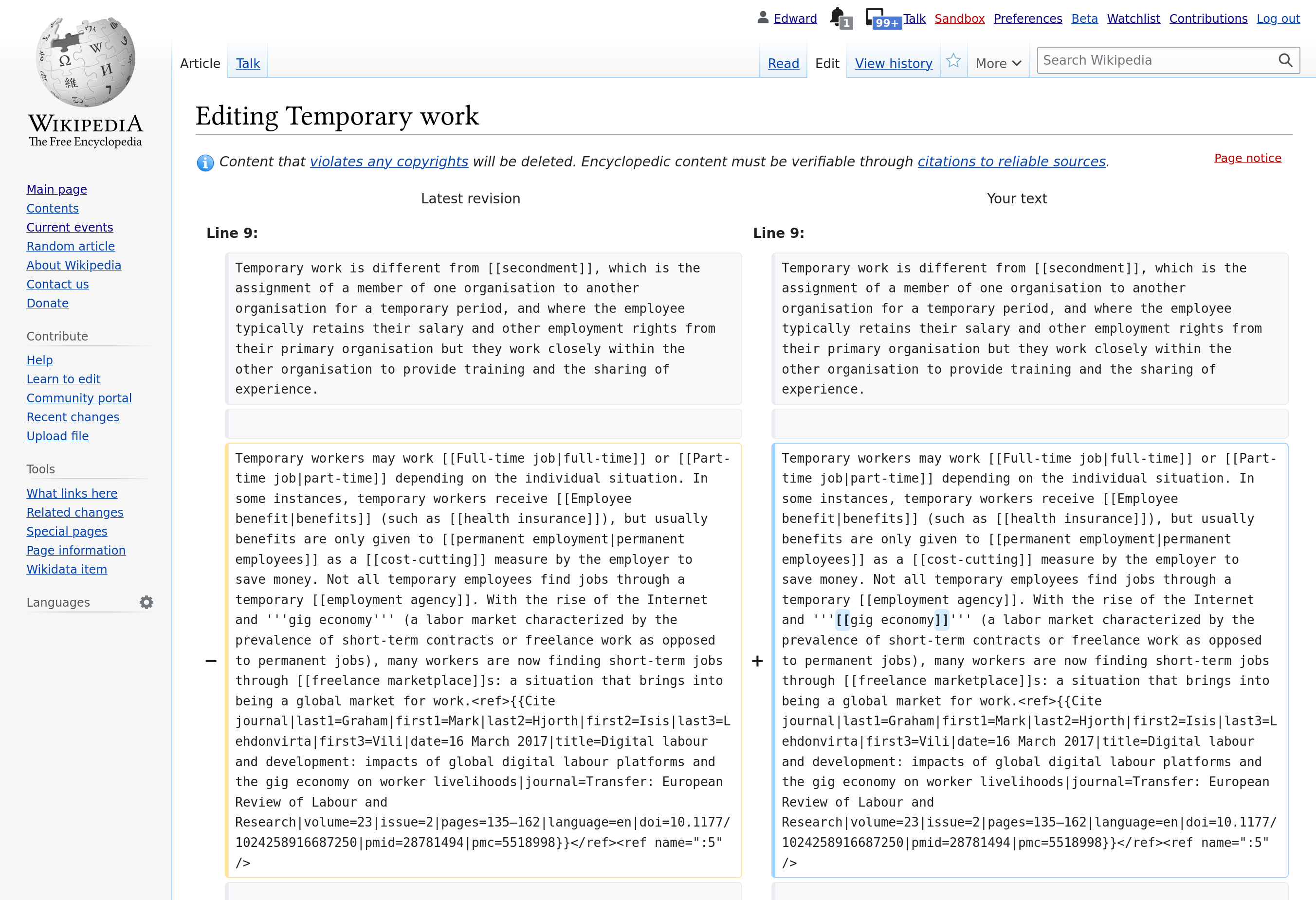
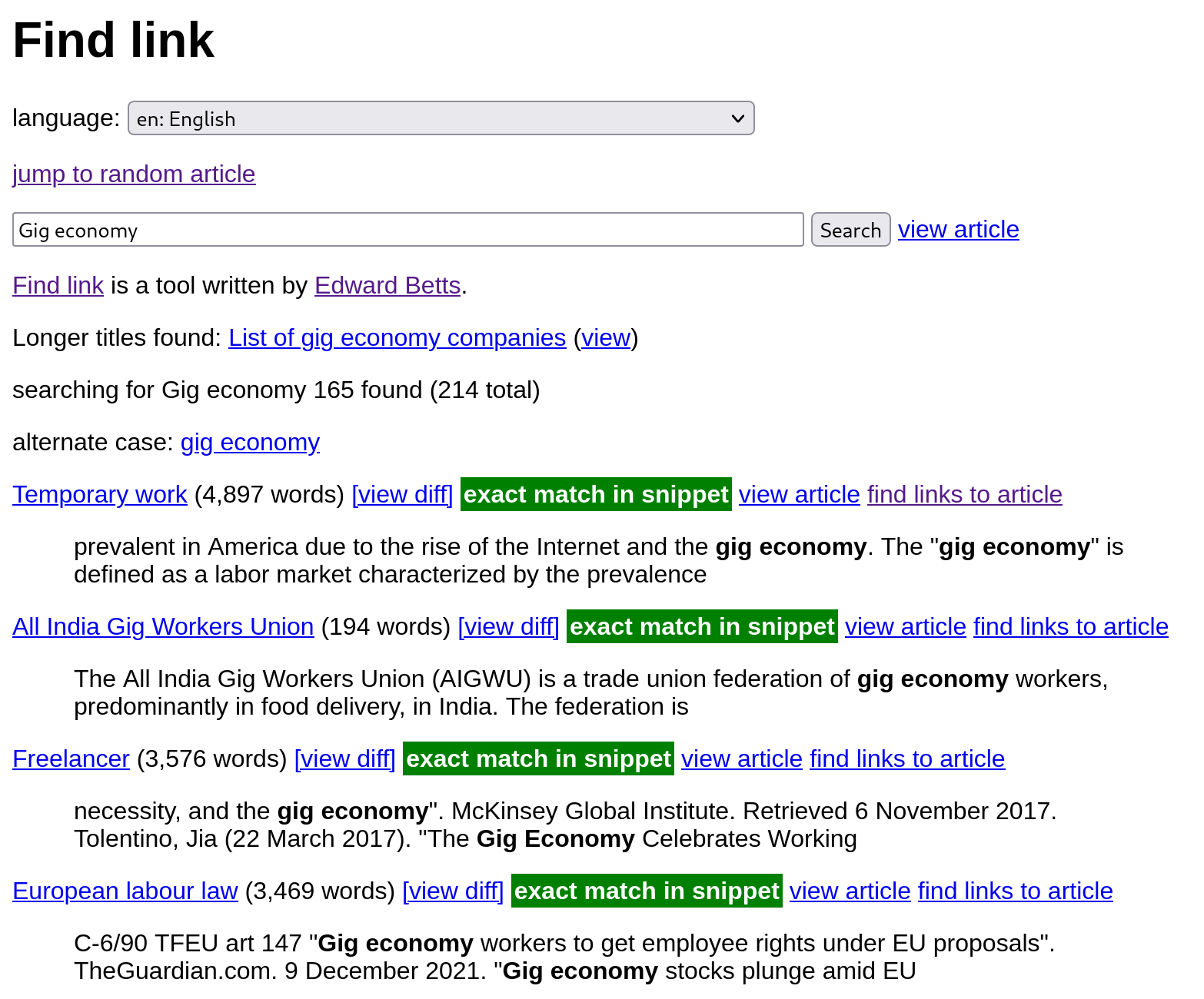
Find link is a tool that I wrote for adding links between articles in Wikipedia. Given an article title, find link will find other articles that include the entered article title but no link to the article. There is the option to edit the found articles and add the missing link. For example, you might want to find missing links to the gig economy article.
I originally wrote the tool in 2008 when the MediaWiki software didn't have a rich-text editor. Wikipedia articles were edited by writing wiki markup in MediaWiki syntax. Since then MediaWiki has evolved and now has rich-text editing via the visual editor. Users don't need to know how to write wiki markup to modify an article. Within MediaWiki there is a user preference to disable the visual editor and stick with editing via the original wiki markup. Find link edits articles by taking the article text, adding the missing link, and sending the user to the changes view of the modified article on Wikipedia, if they're happy with the change they hit save. This only works with the original editor, it doesn't work with the visual editor.
English Wikipedia has had the visual editor enabled by default since 2016. For somebody to use find link they need to disable the visual editor in their Wikipedia preferences first. Fixing this bug means quite a significant change to how the tool works. My plan is to rewrite find link to save edits directly without needing to send the user to Wikipedia article edit change view page to make the edits. Users will authenticate with their Wikipedia account via OAuth and give permission for find link to edit articles on their behalf. Some of my other tools use OAuth for editing OpenStreetMap and Wikidata, so I'm confident about using it to edit Wikipedia. The source code for find link is on GitHub. I'll post updates here as I make progress on the rewrite.

14 June 2022

John Goerzen: Really Enjoyed Jason Scott s BBS Documentary

Like many young programmers of my age, before I could use the Internet, there were BBSs. I eventually ran one, though in my small town there were few callers. Some time back, I downloaded a copy of Jason Scott s BBS Documentary. You might know Jason Scott from textfiles.com and his work at the Internet Archive. The documentary was released in 2005 and spans 8 episodes on 3 DVDs. I d watched parts of it before, but recently watched the whole series. It s really well done, and it s not just about the technology. Yes, that figures in, but it s about the people. At times, it was nostalgic to see people talking about things I clearly remembered. Often, I saw long-forgotten pioneers interviewed. And sometimes, such as with the ANSI art scene, I learned a lot about something I was aware of but never really got into back then. BBSs and the ARPANet (predecessor to the Internet) grew up alongside each other. One was funded by governments and universities; the other, by hobbyists working with inexpensive equipment, sometimes of their own design. You can download the DVD images (with tons of extras) or watch just the episodes on Youtube following the links on the author s website. The thing about BBSs is that they never actually died. Now I m looking forward to watching the Back to the BBS documentary series about modern BBSs as well.

13 June 2022

Edward Betts: Fixing spelling in GitHub repos using codespell

Codespell is a spell checker specifically designed for finding misspellings in source code. I've been using it to correct spelling mistakes in GitHub repos sine 2016. Most spell checkers use a list of valid words and highlighting any word in a document that is not in the word list. This method doesn't work for source code because code contains abbreviations and words joined together without spaces, a spell checker will generate too many false positives. Codespell uses a different approach, instead of a list of valid words it has a dictionary of common misspellings. Currently the codespell dictionary includes 34,466 known misspellings. I've contributed 300 misspellings to the dictionary. Whenever I find an interesting open source project I run codespell to check for spelling mistakes. Most projects have spelling mistakes and I can send a pull request to fix them. In 2019 Microsoft made the Windows calculator open source and uploaded it to GitHub. I used codespell to find some spelling mistakes, sent them a pull request and they accepted it. A great source for GitHub repos to spell check is Hacker News. Let's have a look.
Hacker News has a link to forum software called Flarum. I can use codespell to look for spelling mistakes. When I'm looking for errors in a GitHub repo I don't fork the project until I know there is a spelling mistake to fix.
edward@x1c9 ~/spelling> git clone git@github.com:flarum/flarum.git
Cloning into &aposflarum&apos...
remote: Enumerating objects: 1338, done.
remote: Counting objects: 100% (42/42), done.
remote: Compressing objects: 100% (23/23), done.
remote: Total 1338 (delta 21), reused 36 (delta 19), pack-reused 1296
Receiving objects: 100% (1338/1338), 725.02 KiB   1.09 MiB/s, done.
Resolving deltas: 100% (720/720), done.
edward@x1c9 ~/spelling> cd flarum/
edward@x1c9 ~/spelling/flarum (master)> codespell -q3
./public/web.config:13: sensitve ==> sensitive
edward@x1c9 ~/spelling/flarum (master)> gh repo fork
  Created fork EdwardBetts/flarum
? Would you like to add a remote for the fork? Yes
  Added remote origin
edward@x1c9 ~/spelling/flarum (master)> git checkout -b spelling
Switched to a new branch &aposspelling&apos
edward@x1c9 ~/spelling/flarum (spelling)> codespell -q3
./public/web.config:13: sensitve ==> sensitive
edward@x1c9 ~/spelling/flarum (spelling)> codespell -q3 -w
FIXED: ./public/web.config
edward@x1c9 ~/spelling/flarum (spelling)> git commit -am "Correct spelling mistakes"
[spelling bbb04c7] Correct spelling mistakes
 1 file changed, 1 insertion(+), 1 deletion(-)
edward@x1c9 ~/spelling/flarum (spelling)> git push -u origin
Enumerating objects: 7, done.
Counting objects: 100% (7/7), done.
Delta compression using up to 8 threads
Compressing objects: 100% (4/4), done.
Writing objects: 100% (4/4), 360 bytes   360.00 KiB/s, done.
Total 4 (delta 3), reused 0 (delta 0), pack-reused 0
remote: Resolving deltas: 100% (3/3), completed with 3 local objects.
remote: 
remote: Create a pull request for &aposspelling&apos on GitHub by visiting:
remote:      https://github.com/EdwardBetts/flarum/pull/new/spelling
remote: 
To github.com:EdwardBetts/flarum.git
 * [new branch]      spelling -> spelling
branch &aposspelling&apos set up to track &aposorigin/spelling&apos.
edward@x1c9 ~/spelling/flarum (spelling)> gh pr create 
Creating pull request for EdwardBetts:spelling into master in flarum/flarum
? Title Correct spelling mistakes
? Choose a template Open a blank pull request
? Body <Received>
? What&aposs next? Submit
https://github.com/flarum/flarum/pull/81
edward@x1c9 ~/spelling/flarum (spelling)> 
That worked. I found one spelling mistake, the word "sensitive" was spelled wrong. I forked the repo, fixed the spelling mistake and submitted the fix as a pull request.
The maintainer of Flarum accepted my pull request. Fixing spelling mistakes in Bootstrap helped me unlocked the Mars 2020 Contributor achievements on GitHub.
Why not try running codespell on your own codebase? You'll probably find some spelling mistakes to fix.

Ben Hutchings: Debian LTS work, May 2022

In May I was assigned 11 hours of work by Freexian's Debian LTS initiative and carried over 13 hours from April. I worked 8 hours, and will carry over the remaining time to June. I spent some time triaging security issues for Linux, working out which of them were fixed upstream and which actually applied to the versions provided in Debian 9 "stretch". I rebased the Linux 4.9 (linux) package on the latest stable update, but did not make an upload this month. I started backporting several security fixes to 4.9, but those still have to be tested and reviewed.

12 June 2022

Iustin Pop: Somewhat committing to a new sport

Quite a few years ago - 4, to be precise, so in 2018 - I did a couple of SUP trainings, organised by a colleague. That was enjoyable, but not really matching with me (asymmetric paddling, ugh!), so I also did learn some kayaking, which I really love, but that s way higher overhead - no sea around in Switzerland, and lakes are generally too small. So I basically postponed any more water sports , until sometime in the future when I ll finally decide what I want to do (and in what setup). I did a couple of one-off SUP rides in various places (2019, 2021), but I really was out of practice, so it wasn t really enjoyable. But with family, SUP offers a much easier way to carry a passenger (than a kayak), so slowly I started thinking more about doing it more seriously. So last week, after much deliberation, bought an inflatable board, paddle and various other accessories, and on Saturday went to try it out, on excellent weather (completely flat) and hot but not overly so. The board choosing in itself was something I like to do (research options), so for a bit I was concerned whether I m more interested in the gear, or the actual paddling itself To my surprise, it went way better than I feared - last time I tried it, paddled 30 minutes on my knees (knee-paddling?!), since I didn t dare stand up. But this time, I launched and then did stand up, and while very shaky, I didn t fall in. Neither by myself, nor with an extra passenger And hour later, and my initial shakiness went away, with the trainings slowly coming back to mind. Another half hour, and - for completely flat water - I felt quite confident. The view was awesome, the weather nice, the water cold enough to be refreshing and the only question on my mind was - why didn t I do this 2, 3 years ago? Well, Corona aside. I forgot how much I love just being on the water. It definitely pays off the cost of going somewhere, unpacking the stuff, pumping up the board (that s a bit of a sport in itself ), because the blue-green-light-blue colour palette is just how things should be:
Small lake, but beautiful view Small lake, but beautiful view
Well, approximately blue. This being a small lake, it s more blue-green than proper blue. That s next level, since bigger lakes mean waves, and more traffic. Of course, this could also turn up like many other things I tried (a device in a corner that s not used anymore), but at least for yesterday, I was a happy paddler!

Russ Allbery: Review: The Shattered Sphere

Review: The Shattered Sphere, by Roger MacBride Allen
Series: Hunted Earth #2
Publisher: Tor
Copyright: July 1994
Printing: September 1995
ISBN: 0-8125-3016-0
Format: Mass market
Pages: 491
The Shattered Sphere is a direct sequel to The Ring of Charon and spoils everything about the plot of the first book. You don't want to start here. Also be aware that essentially everything you can read about this book will spoil the major plot driver of The Ring of Charon in the first sentence. I'm going to review the book without doing that, but it's unlikely anyone else will try. The end of the previous book stabilized matters, but in no way resolved the plot. The Shattered Sphere opens five years later. Most of the characters from the first novel are joined by some new additions, and all of them are trying to make sense of a drastically changed and far more dangerous understanding of the universe. Humanity has a new enemy, one that's largely unaware of humanity's existence and able to operate on a scale that dwarfs human endeavors. The good news is that humans aren't being actively attacked. The bad news is that they may be little more than raw resources, stashed in a safe spot for future use. That is reason enough to worry. Worse are the hints of a far greater danger, one that may be capable of destruction on a scale nearly beyond human comprehension. Humanity may be trapped between a sophisticated enemy to whom human activity is barely more noticeable than ants, and a mysterious power that sends that enemy into an anxious panic. This series is an easily-recognized example of an in-between style of science fiction. It shares the conceptual bones of an earlier era of short engineer-with-a-wrench stories that are full of set pieces and giant constructs, but Allen attempts to add the characterization that those books lacked. But the technique isn't there; he's trying, and the basics of characterization are present, but with none of the emotional and descriptive sophistication of more recent SF. The result isn't bad, exactly, but it's bloated and belabored. Most of the characterization comes through repetition and ham-handed attempts at inner dialogue. Slow plotting doesn't help. Allen spends half of a nearly 500 page novel on setup in two primary threads. One is mostly people explaining detailed scientific theories to each other, mixed with an attempt at creating reader empathy that's more forceful than effective. The other is a sort of big dumb object exploration that failed to hold my attention and that turned out to be mostly irrelevant. Key revelations from that thread are revealed less by the actions of the characters than by dumping them on the reader in an extended monologue. The reading goes quickly, but only because the writing is predictable and light on interesting information, not because the plot is pulling the reader through the book. I found myself wishing for an earlier era that would have cut about 300 pages out of this book without losing any of the major events. Once things finally start happening, the book improves considerably. I grew up reading large-scale scientific puzzle stories, and I still have a soft spot for a last-minute scientific fix and dramatic set piece even if the descriptive detail leaves something to be desired. The last fifty pages are fast-moving and satisfying, only marred by their failure to convince me that the humans were required for the plot. The process of understanding alien technology well enough to use it the right way kept me entertained, but I don't understand why the aliens didn't use it themselves. I think this book falls between two stools. The scientific mysteries and set pieces would have filled a tight, fast-moving 200 page book with a minimum of characterization. It would have been a throwback to an earlier era of science fiction, but not a bad one. Allen instead wanted to provide a large cast of sympathetic and complex characters, and while I appreciate the continued lack of villains, the writing quality is not sufficient to the task. This isn't an awful book, but the quality bar in the genre is so much higher now. There are better investments of your reading time available today. Like The Ring of Charon, The Shattered Sphere reaches a satisfying conclusion but does not resolve the series plot. No sequel has been published, and at this point one seems unlikely to materialize. Rating: 5 out of 10

11 June 2022

Junichi Uekawa: What's in sid?

What's in sid? I wanted to check what version of libc was used in current Debian sid. I am lazy and I used podman to check. However I noticed that apt update is very slow for me, 20kB/s. Wondering if something is wrong.

Louis-Philippe V ronneau: Updating a rooted Pixel 3a

A short while after getting a Pixel 3a, I decided to root it, mostly to have more control over the charging procedure. In order to preserve battery life, I like my phone to stop charging at around 75% of full battery capacity and to shut down automatically at around 12%. Some Android ROMs have extra settings to manage this, but LineageOS unfortunately does not. Android already comes with a fairly complex mechanism to handle the charge cycle, but it is mostly controlled by the kernel and cannot be easily configured by end-users. acc is a higher-level "systemless" interface for the Android kernel battery management, but one needs root to do anything interesting with it. Once rooted, you can use the AccA app instead of playing on the command line to fine tune your battery settings. Sadly, having a rooted phone also means I need to re-root it each time there is an OS update (typically each week). Somehow, I keep forgetting the exact procedure to do this! Hopefully, I will be able to use this post as a reference in the future :) Note that these instructions might not apply to your exact phone model, proceed with caution! Extract the boot.img file This procedure mostly comes from the LineageOS documentation on extracting proprietary blobs from the payload.
  1. Download the latest LineageOS image for your phone.
  2. unzip the image to get the payload.bin file inside it.
  3. Clone the LineageOS scripts git repository: $ git clone https://github.com/LineageOS/scripts
  4. extract the boot image (requires python3-protobuf): $ mkdir extracted-payload $ python3 scripts/update-payload-extractor/extract.py payload.bin --output_dir extracted-payload
You should now have a boot.img file. Patch the boot image file using Magisk
  1. Upload the boot.img file you previously extracted to your device.
  2. Open Magisk and patch the boot.img file.
  3. Download the patched file back on your computer.
Flash the patched boot image
  1. Enable ADB debug mode on your phone.
  2. Reboot into fastboot mode. $ adb reboot fastboot
  3. Flash the patched boot image file: $ fastboot flash boot magisk_patched-foo.img
  4. Disable ADB debug mode on your phone.
Troubleshooting In an ideal world, you would do this entire process each time you upgrade to a new LineageOS version. Sadly, this creates friction and makes updating much more troublesome. To simplify things, you can try to flash an old patched boot.img file after upgrading, instead of generating it each time. In my experience, it usually works. When it does not, the device behaves weirdly after a reboot and things that require proprietary blobs (like WiFi) will stop working. If that happens:
  1. Download the latest LineageOS version for your phone.
  2. Reboot into recovery (Power + Volume Down).
  3. Click on "Apply Updates"
  4. Sideload the ROM: $ adb sideload lineageos-foo.zip

10 June 2022

Iustin Pop: Still alive, 2022 version

Still alive, despite the blog being silent for more than a year. Nothing bad happened, but there was always something more important (or interesting) to do than write a post. And I did say many, many times - Oh, I should write a post about this thing I just did or learned about , but I never followed up. And I was close to forgetting entirely about blogging (ahem, it s a bit much calling it blogging ), until someone I follow posted something along the lines I have this half-written post for many months that I can t finish, here s some pictures instead . And from that followed an interesting discussion, and the similarity between why I didn t blog recently were very interesting, despite different countries, continents/etc. So yes, I don t know what happened - beside the chaos that even the end of Covid caused in our lives, and the psychological impact of the Ukraine invasion, but all this is relatively recent - that I couldn t muster the energy to write posts again. I even had a half-written post in late June last year, never finished. Sigh. I won t even bring up open-source work, since I haven t done that either. Life. Sometimes things just happen. But yes, I did get many Garmin badges in the last 12 months Oh, and Top Gun: Maverick is awesome. A movie, but an awesome movie. See you!

Lisandro Dami n Nicanor P rez Meyer: Qt 6 in Debian bullseye

As announced some time ago on Debian Backport s mailing list I will be backporting Qt 6 to Debian 11 Bullseye . This comprises the (so far) 29 source packages that compose Qt 6 and libassimp. The Qt Company wanted to let us Debian users also enjoy Qt 6 on Bullseye, so they contacted me (and by extension my employer ICS) to bring this forward. As said in the mail I sent to the backports list I m making the commitment to maintain the packages myself, but I m really happy the Qt Company asked me for this. You can download Qt 6 for Debian Bullseye s backports by following the instructions. Also a big kudos to IOhannes m zm lnig, the assimp maintainer, who promptly helped me to get it backported. Enjoy!

Sam Hartman: Flailing to Replace Jack with Pipewire for DJ Audio

I could definitely use some suggestions here, both in terms of things to try or effective places to ask questions about Pipewire audio. The docs are improving, but are still in early stages. Pipewire promises to combine the functionality of PulseAudio and Jack. That would be great for me. I use Jack for my DJ work, and it s somewhat complicated and fragile. However, so far my attempts to replace Jack have been unsuccessful, and I might need to even use PulseAudio instead of Pipewire to get the DJ stuff working correctly. The Setup In the simplest setup I have a DJ controller. It s both a MIDI device and a sound card. It has 4 channel audio, but it s not typical surround sound. Two channels are the main speakers, and two channels are the headphones. Conceptually it might be better to model the controller as two sinks: one for the speakers and one for the headphones. At a hardware level they need to be one device for several reasons, especially including using a common clock. It s really important than only the main mix go out channel 1-2 (the speakers). Random beeps or sound from other applications going out the main speakers is disruptive and unprofessional. However, because I m blind, I need that sound. I especially need the output of Orca (my screen reader) and Emacspeak (another screen reader). So I need that output to go to the headphones. Under Pulse/Jack The DJ card is the Jack primary sound device (system:playback_1 through system:playback_4). I then use themodule-jack-sink Pulse module to connect Pulse to Jack. That becomes the default sink for Pulse, and I link front-left from that sink to system:playback_3. So, I get the system sounds and screen reader mixed into the left channel of my headphones and nowhere else. Enter Pipewire Initially Pipewire sees the DJ card as a 4-channel sound card and assumes it s surround4.0 (so front and rear left and right). It helpfully expands my stereo signal so that everything goes to the front and rear. So, exactly what I don t want to have happen happens: all my system sounds go out the main speakers (channel 1-2). It was easy to override Wireplumber s ALSA configuration and assign different channel positions. I tried assigning something like a1,a2,fl,fr hoping that Pipewire wouldn t mix things into aux channels that weren t part of the typical surround set. No luck. It did correctly reflect the channels in things like pacmd list sinks so my Pipewire config was being applied. But the sound was still wrong. * I tried turning off channelmix.upmix. That didn t help; that appears to be more about mixing stereo into center, rear and LFE. The basic approach of getting a stream to conform to the output node s channels appears to be hurting me here. I d love any ideas about how I can get this to work. I m sure it s simple I m just missing the right mental model or knowledge of how to configure things. Pipewire Not Talking to Jack I thought I could at least use Pipewire the same way I use Pulse. Namely, I can run a real jackd and connect up Pipewire to that server. According to the wiki, Pipewire can be a Jack client. It s disabled by default, because you need to make sure that Wireplumber is using the real Jack libraries rather than the Pipewire replacements. That s the case on Debian, so I enabled the feature. A Jack device appeared in wpctl status as did a Jack sink. Using jack_lsp on that device showed it was talking to the Jack server and connected to system:playback_*. Unfortunately, it doesn t work. The sink does not show up in pacmd list sinks, and pipewire-pulse gives an error about it not being ready. If I select it as the default sink in wpctl set-default I get no sound at all, at least from Pulse applications. Versions of things This is all on debian, approximately testing/bookworm or newer for the relevant libraries.

comment count unavailable comments

Reproducible Builds (diffoscope): diffoscope 216 released

The diffoscope maintainers are pleased to announce the release of diffoscope version 216. This version includes the following changes:
* Print profile output if we were called with --profile and we receive a
  TERM signal.
* Emit a warning if/when we are handling a TERM signal.
* Clarify in the code in what situations the main "finally" block gets
  called, especially in relation to handling TERM signals.
* Clarify and tidy some unconditional control flow in diffoscope.profiling.
You find out more by visiting the project homepage.

9 June 2022

Enrico Zini: Updating cbqt for bullseye

Back in 2017 I did work to setup a cross-building toolchain for QT Creator, that takes advantage of Debian's packaging for all the dependency ecosystem. It ended with cbqt which is a little script that sets up a chroot to hold cross-build-dependencies, to avoid conflicting with packages in the host system, and sets up a qmake alternative to make use of them. Today I'm dusting off that work, to ensure it works on Debian bullseye. Resetting QT Creator To make things reproducible, I wanted to reset QT Creator's configuration. Besides purging and reinstalling the package, one needs to manually remove: Updating cbqt Easy start, change the distribution for the chroot:
-DIST_CODENAME = "stretch"
+DIST_CODENAME = "bullseye"
Adding LIBDIR Something else does not work:
Test$ qmake-armhf -makefile
Info: creating stash file  /Test/.qmake.stash
Test$ make
[...]
/usr/bin/arm-linux-gnueabihf-g++ -Wl,-O1 -Wl,-rpath-link, /armhf/lib/arm-linux-gnueabihf -Wl,-rpath-link, /armhf/usr/lib/arm-linux-gnueabihf -Wl,-rpath-link, /armhf/usr/lib/ -o Test main.o mainwindow.o moc_mainwindow.o    /armhf/usr/lib/arm-linux-gnueabihf/libQt5Widgets.so  /armhf/usr/lib/arm-linux-gnueabihf/libQt5Gui.so  /armhf/usr/lib/arm-linux-gnueabihf/libQt5Core.so -lGLESv2 -lpthread
/usr/lib/gcc-cross/arm-linux-gnueabihf/10/../../../../arm-linux-gnueabihf/bin/ld: cannot find -lGLESv2
collect2: error: ld returned 1 exit status
make: *** [Makefile:146: Test] Error 1
I figured that now I also need to set QMAKE_LIBDIR and not just QMAKE_RPATHLINKDIR:
--- a/cbqt
+++ b/cbqt
@@ -241,18 +241,21 @@ include(../common/linux.conf)
 include(../common/gcc-base-unix.conf)
 include(../common/g++-unix.conf)
+QMAKE_LIBDIR +=  chroot.abspath /lib/arm-linux-gnueabihf
+QMAKE_LIBDIR +=  chroot.abspath /usr/lib/arm-linux-gnueabihf
+QMAKE_LIBDIR +=  chroot.abspath /usr/lib/
 QMAKE_RPATHLINKDIR +=  chroot.abspath /lib/arm-linux-gnueabihf
 QMAKE_RPATHLINKDIR +=  chroot.abspath /usr/lib/arm-linux-gnueabihf
 QMAKE_RPATHLINKDIR +=  chroot.abspath /usr/lib/
Now it links again:
Test$ qmake-armhf -makefile
Test$ make
/usr/bin/arm-linux-gnueabihf-g++ -Wl,-O1 -Wl,-rpath-link, /armhf/lib/arm-linux-gnueabihf -Wl,-rpath-link, /armhf/usr/lib/arm-linux-gnueabihf -Wl,-rpath-link, /armhf/usr/lib/ -o Test main.o mainwindow.o moc_mainwindow.o   -L /armhf/lib/arm-linux-gnueabihf -L /armhf/usr/lib/arm-linux-gnueabihf -L /armhf/usr/lib/  /armhf/usr/lib/arm-linux-gnueabihf/libQt5Widgets.so  /armhf/usr/lib/arm-linux-gnueabihf/libQt5Gui.so  /armhf/usr/lib/arm-linux-gnueabihf/libQt5Core.so -lGLESv2 -lpthread
Making it work in Qt Creator Time to try it in Qt Creator, and sadly it fails:
 /armhf/usr/lib/arm-linux-gnueabihf/qt5/mkspecs/features/toolchain.prf:76: Variable QMAKE_CXX.COMPILER_MACROS is not defined.
QMAKE_CXX.COMPILER_MACROS is not defined I traced it to this bit in armhf/usr/lib/arm-linux-gnueabihf/qt5/mkspecs/features/toolchain.prf (nonrelevant bits deleted):
isEmpty($$ target_prefix .COMPILER_MACROS)  
    msvc  
        #  
      else: gcc ghs  
        vars = $$qtVariablesFromGCC($$QMAKE_CXX)
     
    for (v, vars)  
        #  
        $$ target_prefix .COMPILER_MACROS += $$v
     
    cache($$ target_prefix .COMPILER_MACROS, set stash)
  else  
    #  
 
It turns out that qmake is not able to realise that the compiler is gcc, so vars does not get set, nothing is set in COMPILER_MACROS, and qmake fails. Reproducing it on the command line When run manually, however, qmake-armhf worked, so it would be good to know how Qt Creator is actually running qmake. Since it frustratingly does not show what commands it runs, I'll have to strace it:
strace -e trace=execve --string-limit=123456 -o qtcreator.trace -f qtcreator
And there it is:
$ grep qmake- qtcreator.trace
1015841 execve("/usr/local/bin/qmake-armhf", ["/usr/local/bin/qmake-armhf", "-query"], 0x56096e923040 /* 54 vars */) = 0
1015865 execve("/usr/local/bin/qmake-armhf", ["/usr/local/bin/qmake-armhf", " /Test/Test.pro", "-spec", "arm-linux-gnueabihf", "CONFIG+=debug", "CONFIG+=qml_debug"], 0x7f5cb4023e20 /* 55 vars */) = 0
I run the command manually and indeed I reproduce the problem:
$ /usr/local/bin/qmake-armhf Test.pro -spec arm-linux-gnueabihf CONFIG+=debug CONFIG+=qml_debug
 /armhf/usr/lib/arm-linux-gnueabihf/qt5/mkspecs/features/toolchain.prf:76: Variable QMAKE_CXX.COMPILER_MACROS is not defined.
I try removing options until I find the one that breaks it and... now it's always broken! Even manually running qmake-armhf, like I did earlier, stopped working:
$ rm .qmake.stash
$ qmake-armhf -makefile
 /armhf/usr/lib/arm-linux-gnueabihf/qt5/mkspecs/features/toolchain.prf:76: Variable QMAKE_CXX.COMPILER_MACROS is not defined.
Debugging toolchain.prf I tried purging and reinstalling qtcreator, and recreating the chroot, but qmake-armhf is staying broken. I'll let that be, and try to debug toolchain.prf. By grepping gcc in the mkspecs directory, I managed to figure out that: Sadly, I failed to find reference documentation for QMAKE_COMPILER's syntax and behaviour. I also failed to find why qmake-armhf worked earlier, and I am also failing to restore the system to a situation where it works again. Maybe I dreamt that it worked? I had some manual change laying around from some previous fiddling with things? Anyway at least now I have the fix:
--- a/cbqt
+++ b/cbqt
@@ -248,7 +248,7 @@ QMAKE_RPATHLINKDIR +=  chroot.abspath /lib/arm-linux-gnueabihf
 QMAKE_RPATHLINKDIR +=  chroot.abspath /usr/lib/arm-linux-gnueabihf
 QMAKE_RPATHLINKDIR +=  chroot.abspath /usr/lib/
-QMAKE_COMPILER          =  chroot.arch_triplet -gcc
+QMAKE_COMPILER          = gcc  chroot.arch_triplet -gcc
 QMAKE_CC                = /usr/bin/ chroot.arch_triplet -gcc
Fixing a compiler mismatch warning In setting up the kit, Qt Creator also complained that the compiler from qmake did not match the one configured in the kit. That was easy to fix, by pointing at the host system cross-compiler in qmake.conf:
 QMAKE_COMPILER          =  chroot.arch_triplet -gcc
-QMAKE_CC                =  chroot.arch_triplet -gcc
+QMAKE_CC                = /usr/bin/ chroot.arch_triplet -gcc
 QMAKE_LINK_C            = $$QMAKE_CC
 QMAKE_LINK_C_SHLIB      = $$QMAKE_CC
-QMAKE_CXX               =  chroot.arch_triplet -g++
+QMAKE_CXX               = /usr/bin/ chroot.arch_triplet -g++
 QMAKE_LINK              = $$QMAKE_CXX
 QMAKE_LINK_SHLIB        = $$QMAKE_CXX
Updated setup instructions Create an armhf environment:
sudo cbqt ./armhf --create --verbose
Create a qmake wrapper that builds with this environment:
sudo ./cbqt ./armhf --qmake -o /usr/local/bin/qmake-armhf
Install the build-dependencies that you need:
# Note: :arch is added automatically to package names if no arch is explicitly specified
sudo ./cbqt ./armhf --install libqt5svg5-dev libmosquittopp-dev qtwebengine5-dev
Build with qmake Use qmake-armhf instead of qmake and it works perfectly:
qmake-armhf -makefile
make
Set up Qt Creator Configure a new Kit in Qt Creator:
  1. Tools/Options, then Kits, then Add
  2. Name: armhf (or anything you like)
  3. In the Qt Versions tab, click Add then set the path of the new Qt to /usr/local/bin/qmake-armhf. Click Apply.
  4. Back in the Kits, select the Qt version you just created in the Qt version field
  5. In Compilers, select the ARM versions of GCC. If they do not appear, install crossbuild-essential-armhf, then in the Compilers tab click Re-detect and then Apply to make them available for selection
  6. Dismiss the dialog with "OK": the new kit is ready
Now you can choose the default kit to build and run locally, and the armhf kit for remote cross-development. I tried looking at sdktool to automate this step, and it requires a nontrivial amount of work to do it reliably, so these manual instructions will have to do. Credits This has been done as part of my work with Truelite.
Jonathan Dowland: Fight Club OST

the record packaging
I often listen to soundtracks when I'm concentrating. The Fight Club soundtrack, by the Dust Brothers, is not one I turn to very often. I do love the way it was packaged for vinyl. The cover design references IKEA, but the clever thing is it has a mailer-style pull-cord to open it up. You can't open the packaging using it without literally tearing the package in half. There is a secret, alternative way to get in with less damage, but if you try it the packaging has a surprise for you. This Image album summarizes most of the packaging secrets. The records themselves are a pleasant mottled pink colour, reminiscent of the soap bars in the movie. They're labelled "Paper Street Soap Company".
close up of the pink record

8 June 2022

Laura Arjona Reina: Moving to a faster but smaller disk, encrypted setup

My work computer runs Debian 11 bullseye (the current stable release) in a mechanical 500GB disk, and I was provided with a new SDD disk but its size was 480 GB. So I had to shrink my partitions before copying the data to the new disk. It turned out to be a bit difficult because my main partition was encrypted. I write here how I did, maybe there are other simpler ways but I couldn t find them. References: I had three partitions in my old 500GB disk: /dev/sda1 is the EFI partition, /dev/sda2 the boot partition and /dev/sda3 the root partition (encrypted, with LVM, the standard way the Debian installer proposes when you choose a simple encrypted setup). First of all, I made a disk image with Clonezilla to an external USB disk, just in case I mess up things, to be able to return to a safe point and start again. Then I started my computer with a Debian 11 live USB with KDE Plasma desktop and Spanish localisation environment. I opened the KDE Partition manager and copied the non encrypted partitions (sda1, EFI and sda2, /boot) to the new disk. I shrinked the encrypted partition from the terminal with the following commands (I had enough free space so reduced my partition to a total of 300GB): Removed the swap partition and re-created it:
sudo lvremove /dev/larjona-pc-vg/swap_1
sudo pvresize --setphysicalvolumesize 380G /dev/mapper/cryptdisk
sudo pvchange -x y /dev/mapper/cryptdisk
sudo lvcreate -L 4G -n swap_1 larjona-pc-vg
sudo mkswap -L swap_1 /dev/larjona-pc-vg/swap_1
Display information about the physical volume in order to shrink it:
sudo pvs -v --segments --units s /dev/mapper/cryptdisk
sudo cryptsetup -b 838860800 resize cryptdisk
sudo cryptsetup status cryptdisk
sudo vgchange -a n vgroup
sudo vgchange -an
sudo cryptsetup luksClose cryptdisk
Then reduced the sda3 partition with the KDE partition manager (it took a while), and copy it to the new disk. Turned off the computer and unplugged the old disk. Started the computer with the Debian 11 Live USB again, UEFI boot. Now, to make my system boot:
sudo cryptsetup luksOpen /dev/sda3 crypdisk
sudo vgscan --mknodes
sudo vgchange -ay
sudo mount /dev/mapper/larjona--pc--vg-root /mnt
sudo mount /dev/sda2 /mnt/boot
sudo mount /dev/sda1 /mnt/boot/efi
mount --rbind /sys /media/linux/sys
mount -t efivarfs none /sys/firmware/efi/efivars
for i in /dev /dev/pts /proc /run; do sudo mount -B $i /mnt$i; done
sudo chroot /mnt
Then edited /mnt/etc/crypttab to reflect the name of the new encrypted partition, edited /mnt/etc/fstab to paste the UUIDs of the new partitions.
Then ran grub-install and reinstalled the kernels as noted in the reference, rebooted and logged in my Plasma desktop  (Well, the actual process was not so smooth but after several tries and errors and searching for help I managed to get the needed commands to make my system boot from the new disk).

6 June 2022

Reproducible Builds: Reproducible Builds in May 2022

Welcome to the May 2022 report from the Reproducible Builds project. In our reports we outline the most important things that we have been up to over the past month. As ever, if you are interested in contributing to the project, please visit our Contribute page on our website.

Repfix paper Zhilei Ren, Shiwei Sun, Jifeng Xuan, Xiaochen Li, Zhide Zhou and He Jiang have published an academic paper titled Automated Patching for Unreproducible Builds:
[..] fixing unreproducible build issues poses a set of challenges [..], among which we consider the localization granularity and the historical knowledge utilization as the most significant ones. To tackle these challenges, we propose a novel approach [called] RepFix that combines tracing-based fine-grained localization with history-based patch generation mechanisms.
The paper (PDF, 3.5MB) uses the Debian mylvmbackup package as an example to show how RepFix can automatically generate patches to make software build reproducibly. As it happens, Reiner Herrmann submitted a patch for the mylvmbackup package which has remained unapplied by the Debian package maintainer for over seven years, thus this paper inadvertently underscores that achieving reproducible builds will require both technical and social solutions.

Python variables Johannes Schauer discovered a fascinating bug where simply naming your Python variable _m led to unreproducible .pyc files. In particular, the types module in Python 3.10 requires the following patch to make it reproducible:
--- a/Lib/types.py
+++ b/Lib/types.py
@@ -37,8 +37,8 @@ _ag = _ag()
 AsyncGeneratorType = type(_ag)
 
 class _C:
-    def _m(self): pass
-MethodType = type(_C()._m)
+    def _b(self): pass
+MethodType = type(_C()._b)
Simply renaming the dummy method from _m to _b was enough to workaround the problem. Johannes bug report first led to a number of improvements in diffoscope to aid in dissecting .pyc files, but upstream identified this as caused by an issue surrounding interned strings and is being tracked in CPython bug #78274.

New SPDX team to incorporate build metadata in Software Bill of Materials SPDX, the open standard for Software Bill of Materials (SBOM), is continuously developed by a number of teams and committees. However, SPDX has welcomed a new addition; a team dedicated to enhancing metadata about software builds, complementing reproducible builds in creating a more secure software supply chain. The SPDX Builds Team has been working throughout May to define the universal primitives shared by all build systems, including the who, what, where and how of builds:
  • Who: the identity of the person or organisation that controls the build infrastructure.
  • What: the inputs and outputs of a given build, combining metadata about the build s configuration with an SBOM describing source code and dependencies.
  • Where: the software packages making up the build system, from build orchestration tools such as Woodpecker CI and Tekton to language-specific tools.
  • How: the invocation of a build, linking metadata of a build to the identity of the person or automation tool that initiated it.
The SPDX Builds Team expects to have a usable data model by September, ready for inclusion in the SPDX 3.0 standard. The team welcomes new contributors, inviting those interested in joining to introduce themselves on the SPDX-Tech mailing list.

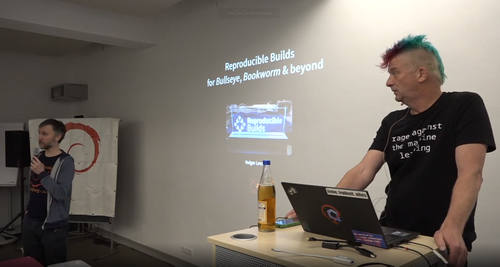
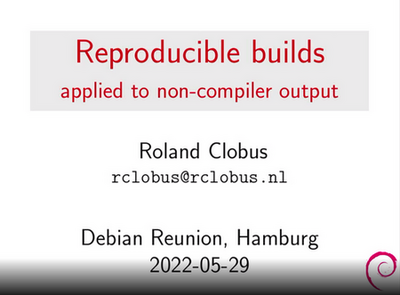
Talks at Debian Reunion Hamburg Some of the Reproducible Builds team (Holger Levsen, Mattia Rizzolo, Roland Clobus, Philip Rinn, etc.) met in real life at the Debian Reunion Hamburg (official homepage). There were several informal discussions amongst them, as well as two talks related to reproducible builds. First, Holger Levsen gave a talk on the status of Reproducible Builds for bullseye and bookworm and beyond (WebM, 210MB): Secondly, Roland Clobus gave a talk called Reproducible builds as applied to non-compiler output (WebM, 115MB):

Supply-chain security attacks This was another bumper month for supply-chain attacks in package repositories. Early in the month, Lance R. Vick noticed that the maintainer of the NPM foreach package let their personal email domain expire, so they bought it and now controls foreach on NPM and the 36,826 projects that depend on it . Shortly afterwards, Drew DeVault published a related blog post titled When will we learn? that offers a brief timeline of major incidents in this area and, not uncontroversially, suggests that the correct way to ship packages is with your distribution s package manager .

Bootstrapping Bootstrapping is a process for building software tools progressively from a primitive compiler tool and source language up to a full Linux development environment with GCC, etc. This is important given the amount of trust we put in existing compiler binaries. This month, a bootstrappable mini-kernel was announced. Called boot2now, it comprises a series of compilers in the form of bootable machine images.

Google s new Assured Open Source Software service Google Cloud (the division responsible for the Google Compute Engine) announced a new Assured Open Source Software service. Noting the considerable 650% year-over-year increase in cyberattacks aimed at open source suppliers, the new service claims to enable enterprise and public sector users of open source software to easily incorporate the same OSS packages that Google uses into their own developer workflows . The announcement goes on to enumerate that packages curated by the new service would be:
  • Regularly scanned, analyzed, and fuzz-tested for vulnerabilities.
  • Have corresponding enriched metadata incorporating Container/Artifact Analysis data.
  • Are built with Cloud Build including evidence of verifiable SLSA-compliance
  • Are verifiably signed by Google.
  • Are distributed from an Artifact Registry secured and protected by Google.
(Full announcement)

A retrospective on the Rust programming language Andrew bunnie Huang published a long blog post this month promising a critical retrospective on the Rust programming language. Amongst many acute observations about the evolution of the language s syntax (etc.), the post beings to critique the languages approach to supply chain security ( Rust Has A Limited View of Supply Chain Security ) and reproducibility ( You Can t Reproduce Someone Else s Rust Build ):
There s some bugs open with the Rust maintainers to address reproducible builds, but with the number of issues they have to deal with in the language, I am not optimistic that this problem will be resolved anytime soon. Assuming the only driver of the unreproducibility is the inclusion of OS paths in the binary, one fix to this would be to re-configure our build system to run in some sort of a chroot environment or a virtual machine that fixes the paths in a way that almost anyone else could reproduce. I say almost anyone else because this fix would be OS-dependent, so we d be able to get reproducible builds under, for example, Linux, but it would not help Windows users where chroot environments are not a thing.
(Full post)

Reproducible Builds IRC meeting The minutes and logs from our May 2022 IRC meeting have been published. In case you missed this one, our next IRC meeting will take place on Tuesday 28th June at 15:00 UTC on #reproducible-builds on the OFTC network.

A new tool to improve supply-chain security in Arch Linux kpcyrd published yet another interesting tool related to reproducibility. Writing about the tool in a recent blog post, kpcyrd mentions that although many PKGBUILDs provide authentication in the context of signed Git tags (i.e. the ability to verify the Git tag was signed by one of the two trusted keys ), they do not support pinning, ie. that upstream could create a new signed Git tag with an identical name, and arbitrarily change the source code without the [maintainer] noticing . Conversely, other PKGBUILDs support pinning but not authentication. The new tool, auth-tarball-from-git, fixes both problems, as nearly outlined in kpcyrd s original blog post.

diffoscope diffoscope is our in-depth and content-aware diff utility. Not only can it locate and diagnose reproducibility issues, it can provide human-readable diffs from many kinds of binary formats. This month, Chris Lamb prepared and uploaded versions 212, 213 and 214 to Debian unstable. Chris also made the following changes:
  • New features:
    • Add support for extracting vmlinuz Linux kernel images. [ ]
    • Support both python-argcomplete 1.x and 2.x. [ ]
    • Strip sticky etc. from x.deb: sticky Debian binary package [ ]. [ ]
    • Integrate test coverage with GitLab s concept of artifacts. [ ][ ][ ]
  • Bug fixes:
    • Don t mask differences in .zip or .jar central directory extra fields. [ ]
    • Don t show a binary comparison of .zip or .jar files if we have observed at least one nested difference. [ ]
  • Codebase improvements:
    • Substantially update comment for our calls to zipinfo and zipinfo -v. [ ]
    • Use assert_diff in test_zip over calling get_data with a separate assert. [ ]
    • Don t call re.compile and then call .sub on the result; just call re.sub directly. [ ]
    • Clarify the comment around the difference between --usage and --help. [ ]
  • Testsuite improvements:
    • Test --help and --usage. [ ]
    • Test that --help includes the file formats. [ ]
Vagrant Cascadian added an external tool reference xb-tool for GNU Guix [ ] as well as updated the diffoscope package in GNU Guix itself [ ][ ][ ].

Distribution work In Debian, 41 reviews of Debian packages were added, 85 were updated and 13 were removed this month adding to our knowledge about identified issues. A number of issue types have been updated, including adding a new nondeterministic_ordering_in_deprecated_items_collected_by_doxygen toolchain issue [ ] as well as ones for mono_mastersummary_xml_files_inherit_filesystem_ordering [ ], extended_attributes_in_jar_file_created_without_manifest [ ] and apxs_captures_build_path [ ]. Vagrant Cascadian performed a rough check of the reproducibility of core package sets in GNU Guix, and in openSUSE, Bernhard M. Wiedemann posted his usual monthly reproducible builds status report.

Upstream patches The Reproducible Builds project detects, dissects and attempts to fix as many currently-unreproducible packages as possible. We endeavour to send all of our patches upstream where appropriate. This month, we wrote a large number of such patches, including:

Reproducible builds website Chris Lamb updated the main Reproducible Builds website and documentation in a number of small ways, but also prepared and published an interview with Jan Nieuwenhuizen about Bootstrappable Builds, GNU Mes and GNU Guix. [ ][ ][ ][ ] In addition, Tim Jones added a link to the Talos Linux project [ ] and billchenchina fixed a dead link [ ].

Testing framework The Reproducible Builds project runs a significant testing framework at tests.reproducible-builds.org, to check packages and other artifacts for reproducibility. This month, the following changes were made:
  • Holger Levsen:
    • Add support for detecting running kernels that require attention. [ ]
    • Temporarily configure a host to support performing Debian builds for packages that lack .buildinfo files. [ ]
    • Update generated webpages to clarify wishes for feedback. [ ]
    • Update copyright years on various scripts. [ ]
  • Mattia Rizzolo:
    • Provide a facility so that Debian Live image generation can copy a file remotely. [ ][ ][ ][ ]
  • Roland Clobus:
    • Add initial support for testing generated images with OpenQA. [ ]
And finally, as usual, node maintenance was also performed by Holger Levsen [ ][ ].

Misc news On our mailing list this month:

Contact If you are interested in contributing to the Reproducible Builds project, please visit our Contribute page on our website. However, you can get in touch with us via:

Thorsten Alteholz: My Debian Activities in May 2022

FTP master This month I accepted 288 and rejected 45 packages. The overall number of packages that got accepted was 290. Debian LTS This was my ninety-fifth month that I did some work for the Debian LTS initiative, started by Raphael Hertzog at Freexian. This month my all in all workload has been 40h. During that time I did LTS and normal security uploads of: Further I continued working on libvirt and started to work on blender and ncurses. I also continued to work on security support for golang packages. Last but not least I did some days of frontdesk duties and took care of issues on security-master. Debian ELTS This month was the forty-seventh ELTS month. During my allocated time I uploaded: I also moved/refactored the current ELTS documentation to a new repository. Further I started to work on blender and ncurses in ELTS as well as in LTS. Last but not least I did some days of frontdesk duties. Debian Printing This month I uploaded new upstream versions or improved packaging of: The reason for the new upstream version of ipp-usb was a strange bug. Some HP printers claim to have fax support but fail to respond to corresponding IPP queries. I understand that nowadays sending a fax is no longer a main theme for quality assurance. But if one tries to advertise as much features as possible, all these features should basically work and not prevent the things a printer should normally do. The reason for the new upstream version of cups was a security issue. You now should have the latest version of cups installed (there have been updates in other Debian releases as well). Debian Astro This month I uploaded new upstream versions or improved packaging of: Other stuff This month I uploaded new packages:

5 June 2022

John Goerzen: Visiting Germany: Reflections on Schloss Charlottenburg

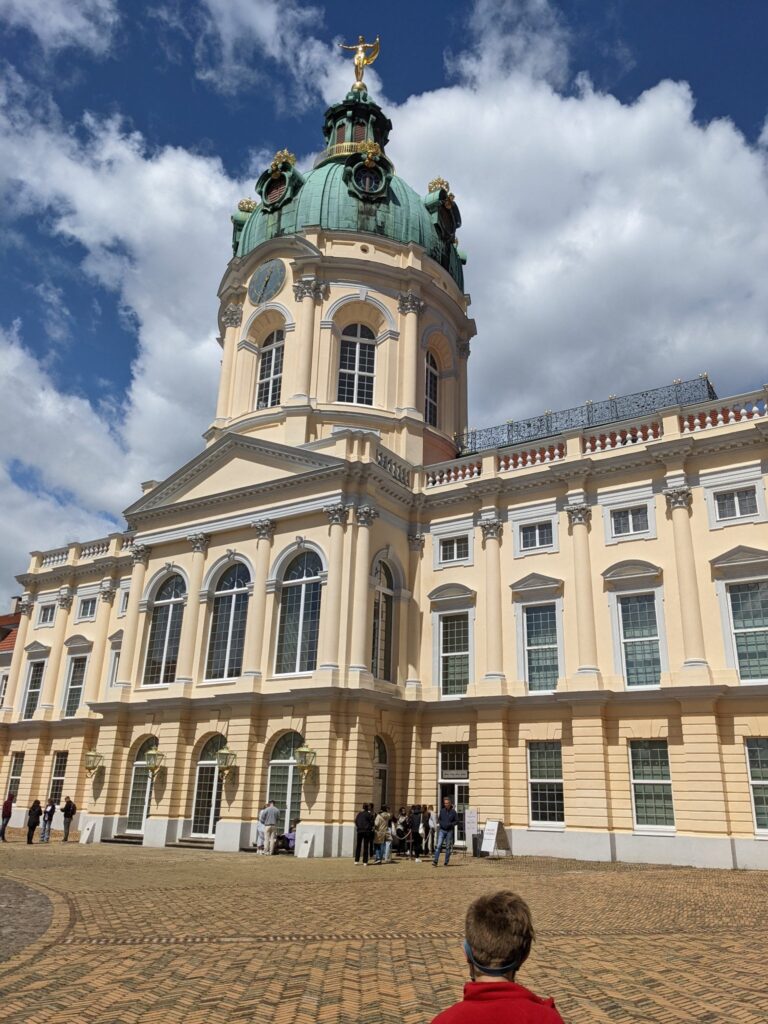
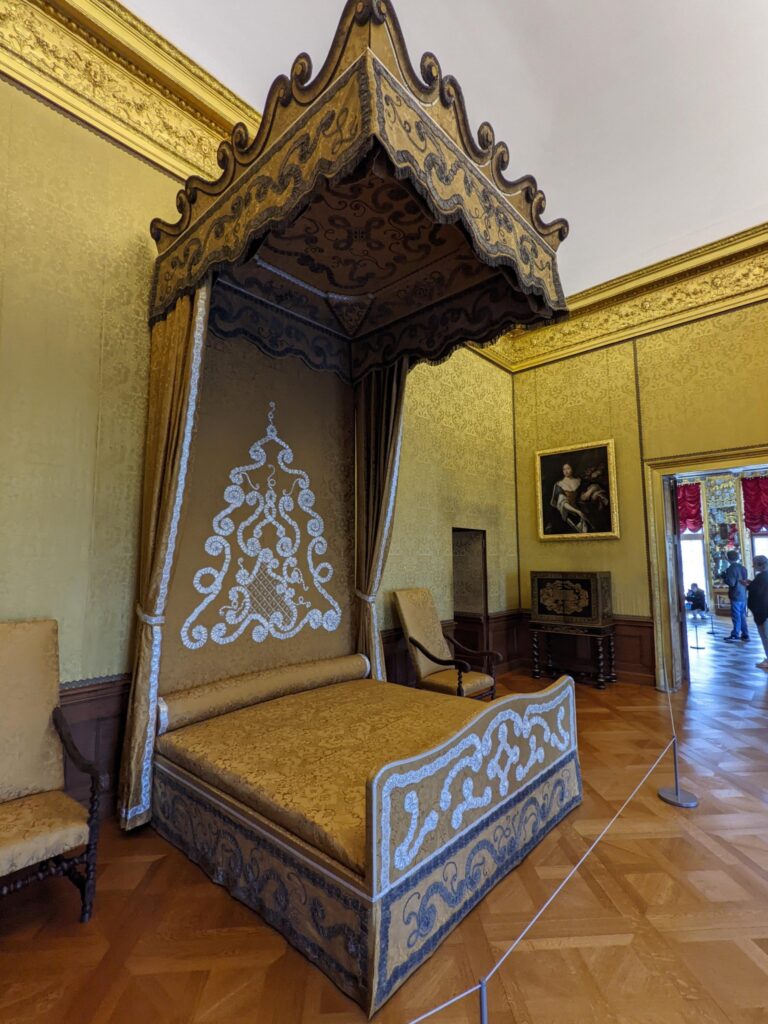
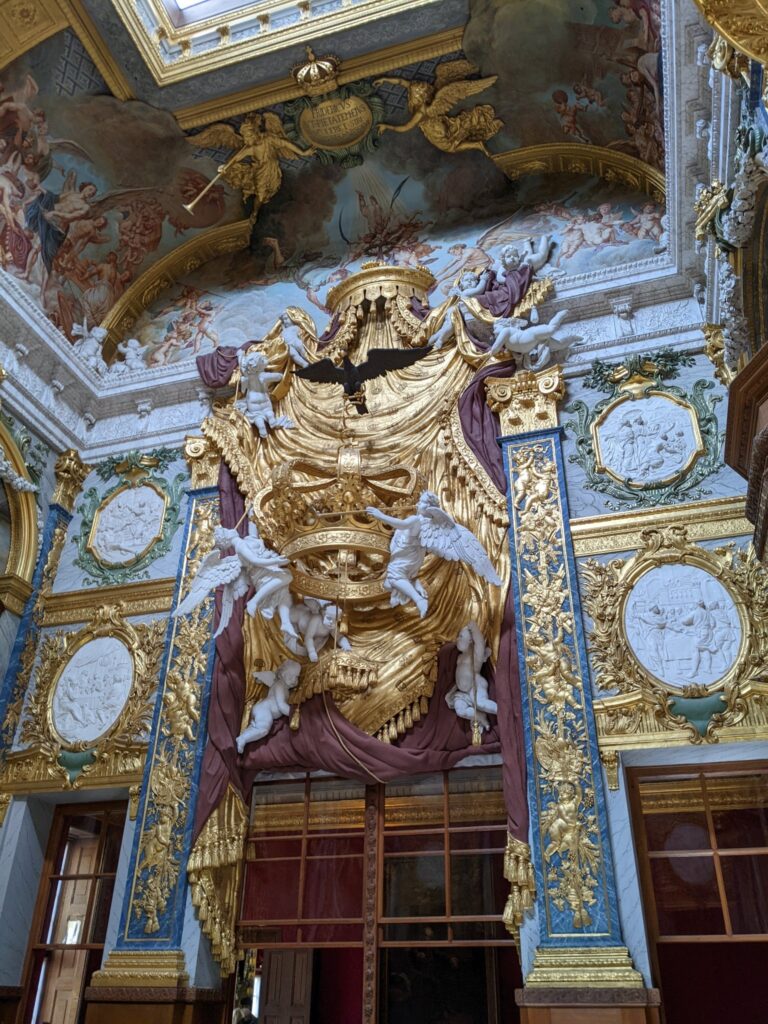
200 years ago, my ancestors migrated from Prussia to Ukraine. They left for many reasons, many of which boiled down to their strong pacifism in the midst of a highly militarized country. Last week, my wife, the boys, and I walked through the favorite palace of Friedrich Wilhelm III, the king of Prussia who was responsible for forcing my ancestors out Charlottenburg Palace in Berlin. Photos can t possibly convey the enormity and the riches of this place, even after being attacked during multiple wars (and used by Napoleon for a time). My ancestors would never have been able to get into to this place. We, on the other hand, walked right through the king s bedroom, audience room, and chapel. The chapel, incidentally, mixing church and state; a fine pipe organ along with a statue of an eagle holding the Prussian crown. I could pause and enjoy the beauty of the place; the oval rooms overlooking the acres of sculpted gardens outside and carefully tree-lined streets leading to the palace, the artwork no doubt worth many millions, the gold and silver place settings, the rare tapestries. And I could also reflect on the problems with such great wealth and power, and the many lives lost and refugees created by the wars the Prussian kings started. (First of several reflections on our wonderful recent trip to Germany with the boys)

4 June 2022

Junichi Uekawa: June came.

June came. I am still playing with rust these days. Learning more things every day.

3 June 2022

Petter Reinholdtsen: LinuxCNC translators life just got a bit easier

Back in oktober last year, when I started looking at the LinuxCNC system, I proposed to change the documentation build system make life easier for translators. The original system consisted of independently written documentation files for each language, with no automated way to track changes done in other translations and no help for the translators to know how much was left to translated. By using the po4a system to generate POT and PO files from the English documentation, this can be improved. A small team of LinuxCNC contributors got together and today our labour finally payed off. Since a few hours ago, it is now possible to translate the LinuxCNC documentation on Weblate, alongside the program itself. The effort to migrate the documentation to use po4a has been both slow and frustrating. I am very happy we finally made it. As usual, if you use Bitcoin and want to show your support of my activities, please send Bitcoin donations to my address 15oWEoG9dUPovwmUL9KWAnYRtNJEkP1u1b.

Next.

Previous.