Search Results: "edd"

8 July 2007

Mirco Bauer: Hello World, how small can you get?

Today I was checking how much diskspace is need when a small CLI (.NET) application like gfax is installed. The last 2 years I am optimizing the Mono packages in Debian to reduce dependency chains. Dependency chains can cause a small application to become very big (at least it looks that way) when they are installed, as modern Linux distributions automaticly install all required dependencies. So first I worked against GUI dependencies for non-GUI applications, those are annoying for servers, you don't want to install a X server or other GUI libraries when you only serve webpages using ASP.NET.
Splitting CLI 1.0/1.1 vs 2.0 also seemed to be a very good candidate to split apart, as applications usually are target at 1.0/1.1 or 2.0.
Then I split Base-Class-Libraries that have dependencies on native libraries (via P/Invoke), as those packages must depend on those native libraries, like DB drivers.
Last but not least I split debug symbols in a different package, as those are not needed for normal production usage, and embedded systems don't have much diskspace. The mono-dbg package is 28.2MB in size when installed, that's alot.
The Mono source package in Debian is now building 67 binary packages, but thanks to APT nobody has to care for that, every part is installed when needed. So today I was checking the results of it, how much will a small application download and install?
I am testing with a clean minimal Debian system, that way all dependency chains will show up very easily.
Installing GFax + required libraries today takes 43MB to download and 138MB on the harddisk. GFax is a small GNOME application, it uses libraries like: Mono, GTK#, GNOME#, Evolution#, GConf#.
So someone might say: "of course, it is based on that bloaty Mono virtual machine!", well let's check a different application.
What about a GTK# only application (no GNOME) like graphmonkey + required libraries? That will download 19.5MB and uses 56.4MB on the harddisk. That's alot less, isn't it? graphmonkey only uses Mono and GTK#.
So it's not Mono taking all no diskspace? Well after all my packaging optimizations, it's not Mono smile.png
So how big is a install of a minimal Mono runtime + all required libraries then?
Minimal as in enough to run famous the "Hello World".
It's 2.4MB to download and 7MB on the harddisk, yes you read it correctly, the super monster bloaty virtual machine just needs 7MB. Mono only has glib as dependency which will be replaced by the eglib library some day. After I had this great result, I wondered how big other runtimes are.... like.... Java and Python? The results are interesting...
A minimal Python install takes 3.9MB to download and 13.4MB on the harddisk. Yes, that's almost double the size of Mono, I was surprised too.
So and Java? Here it becomes a bit unfair as SUN's license is not allowing to ship parts of a Java runtime. So the Java package in a distribution is one package. 34.5MB to download and 95.2MB on the harddisk. Yes, that's alot, but thats the smallest install you can get when you want to run anything on it. So, if you want to run Hello World on a virtual machine: use Mono! tongue.png just kidding...
Small runtimes are important when it comes to acceptance and adaption of new technologies, as nobody wants to kill all his computer resources for it. And I often hear the replies on Linux IRC channels, when people ask which software they can use to do $task: "No I don't want o install 100MB just for $task" and they decide to try some other software with less dependencies and less resource usage.
Also for the embedded area, resources are very limited, every MB still counts there. For the completeness of my report, here the naked numbers of other available Java runtimes: sablevm 22.0MB (63.2MB), kaffe 52.2MB (118MB), jamvm 28.3MB (65.4MB), cocoa 28.8MB (66.0MB).
6 July 2007

Eddy Petrișor: RPMs, gaaaaaah!

Always when I have to deal with RPM systems I feel so handicapped and it feels so wrong from multiple PoV.

This is a rant and a dear lazyweb (not that lazy, actually) type of post.

I would like to be able to have a few things solved when dealing with RPMs:
  1. I would like a pbuilder like builder for specs
    • I know about mock, but
      • it accepts only src.rpm files (I know about rpmbuild -bs, but is broken, read further for the groovy details)
      • I have some specs that have %include directives for the maintainer scripts and when rpmbuild -bs is ran, guess what, the extra files are left outside the src.rpm;oh yes, the directives are processed correctly for the binary rpm
      • mock relies on bootstrapping a system using fedoralegacy.org, which was recently discontinued
      • I have a redhat-9 chroot tarball which I would like to use and tell mock to use that without caring about upgrades (since my packages are not at all that dependent on the build system)
      • mock fails to bootstrap even for fedora-devel-i386-core with the message "Cannot find a valid baseurl for repo: extras"
      • the older versions fail to bootstrap because, apparently, it "Could not find useradd in chroot, maybe the install failed?"
    • plague (how's that for irony?) relies on mock, which is broken
    • mach seems to be deprecated
  2. I would like a simple repo creation and maintainance tool, something in the line of mini-dinstall, which should have apt4rpm and yum support, but it seems that repos are still the "new shiny thing" which has no proper tools
  3. I would like to be able to know from which version I am upgrading from the current package, not only that I am upgrading (in case you didn't knew, the only way to know that you are upgrading in a post/pre install/remove script, is the wonderful $1 parameter which indicates the number of packages installed after the script finishes or something along that line..
So my question is, is there any way to fix any of the issues above in a sane way, without me reimplementing apt-like functionality in rpm land?

Russell Coker: Robots vs Sheep

Mark Greenaway writes about writes about robots being designed to remove weeds from farms. This seems like a bad idea given that we currently have an energy crisis due to CO2 emissions from power plants causing environment change (including reduced water supplies), and coal and nuclear power plants requiring water to produce electricity (pity about the reduced water supply). Introducing robots that require either electricity of petrol for operation and also maintenance (which probably requires plastic parts on occasion) seems to be more of a problem than a solution. Fortunately there is already work in progress on training sheep to eat weeds. Given that we already raise sheep for wool and food it makes more sense for them to eat unwanted vegetation (weeds in a vineyard is the example given) than to grow grass specially for them. Also Mark says that the recent increase in oil price is not good news. What would be ideal is a slow steady increase in petrol prices that allows individuals and companies to change to more efficient vehicles (smaller and slower vehicles, hybrid vehicles, and more use of public transport) and also allows governments to make changes (such as building new public transport infrastructure). Having the oil remain cheap until it starts to run out doesn’t do anyone any good (apart from the short-term interests of oil companies).

5 July 2007

Eddy Petrișor: required file ./config.rpath' not found

If you ever encounter this error:

eddy@twix:/tmp/wormux/wormux$ ./autogen.sh
[+] Clean files generated by autoconf, aclocal, automake and configure
[+] Run aclocal
[+] Run autoheader
[+] Run automake
configure.ac:25: required file ./config.rpath' not found

Try this simple fix:

eddy@twix:/tmp/wormux/wormux$ touch config.rpath
eddy@twix:/tmp/wormux/wormux$ ./autogen.sh
[+] Clean files generated by autoconf, aclocal, automake and configure
[+] Run aclocal
[+] Run autoheader
[+] Run automake
[+] Run autoconf

Now run ./configure


Now you can go on with your work. Credits go to Daniel P. Berrange: http://www.mail-archive.com/fedora-xen@redhat.com/msg01017.html


P.S.: Apparently this is an automake 1.10 issue and can be avoided by using automake 1.9

Eddy Petrișor: I've seen it from a Debian PoV

I have seen my life in the company of my GF, and is not bright, looking from my Debian work PoV.

Some early conclusions:
  1. do whatever you can to have two computers in the house, otherwise yours will be arrested
  2. using any spare moment will not gain your GF's simpathy
  3. if there is slacking, it should happen with your GF, you can't affort slacking on your own
  4. if you are, by nature, less needy for sleep, you should use those extra minutes you can get for free
  5. it would be sooooo cool to get her hooked into "FLOSS" ;-)

3 July 2007

John Goerzen: Mail Readers Still Stink

Five years ago, I started work on OfflineIMAP. I couldn't find any mail reader that offered good IMAP support and a good feature set. Rather than write my own mail reader, I simply wrote OfflineIMAP and used it with mutt. OfflineIMAP does a bi-directional sync between an IMAP server and local mailboxes. This lets you work offline, and also speeds up reading since each new message doesn't have to be downloaded from the network on the spot.

I kept hoping that OfflineIMAP would become obsolete soon, as mail readers got better. Back in 2004, two years after writing OfflineIMAP, I looked at mail readers. In 2005, after some more frustrations with mail readers, I wrote a comparison. I wound up sticking with mutt and OfflineIMAP each time.

I've gone out looking at mail readers again. Here's what I've found.

KMail
Overall a nice reader, KMail has almost every feature and setting I want. It has "disconnected IMAP" folders, which download every new message in folders to the local disk as part of the routine mail checking. It then caches local changes and syncs them to the remote on the next mail check. This boosts interactive performance and permits offline operation -- very similar to OfflineIMAP. KMail has keyboard shortcuts for most things, and keyboard shortcuts can be added or changed for most other things as well.

KMail also integrates with the KDE calendar and addressbook, which I already use. That's nice, too.

I have two big gripes about it though.

Back in 2004, I noticed that KMail crashes a lot. By 2005, it was worse. Sadly, KMail still has a tendency to crash. I've seen an average of 1-2 crashes per day, due to SIGFPE, SIGSEGV, and I think also SIGILL. This doesn't make me happy at all. Especially to see that it's no better on that in three years. Just don't try emptying trash while your mailbox is being synced, for one thing....

Gripe #2 is that there is absolutely no way to select a different alternative in a multipart message without using the mouse. Simply no way using the keyboard. It's also cumbersome, though possible, to view attachments using the keyboard -- you have to press Enter to open the message in its own window, then tab to the attachment.

KMail also sometimes works a bit sluggishly -- for instance, when you delete a message, you first see strikethrough through it, then it disappears. It doesn't feel very "snappy".

Evolution
Evolution has a decent core. It is easy to get set up and has an extensive set of keyboard shortcuts. It does IMAP downloading and syncing like Kmail, and it does it by default. It doesn't offer all that much flexibility in configuration, but probably enough.

Here's my gripe. There is no way for it to show a total message count next to each folder in the folder list. It will show an unread message count, but not a total message count. You have to click on each folder individually to see a total message count. I can't figure out why this is missing from Evolution. It's one of the main benefits to switching from mutt, and so I didn't bother looking at Evolution any more past there.

Thunderbird / Icedove
By default, it isn't all that capable of a mail reader. There aren't that many configuration options, and the keyboard shortcuts -- while existing for most things -- are cumbersome.

The Nostalgy extension helps with the keyboard shortcuts significantly. You still can't change some of them (Ctrl-L for forward, anyone) -- at least not without an extremely cumbersome process involving editing text files.

Thunderbird can do automatic IMAP downloading and syncing like KMail and Evolution, but for some inexplicible reason, only for your INBOX. In fact, Thunderbird won't even check for mail in folders other than INBOX unless you set an undocumented configuration option. It seems to assume that nobody does server-side mail filtering.

If you want IMAP downloading for offline use or performance, you have to manually invoke a download operation. There is a Sync on Arrival extension, but it isn't compatible with Thunderbird 2.0. From reading comments online, there are a lot of people frustrated about that.

So Thunderbird strikes out as well.

mutt + OfflineIMAP
The good thing about this combination is performace. mutt is extremely fast, and OfflineIMAP works faster than anything else for IMAP downloading. mutt is also far more configurable than anything else.

There are some annoyances about mutt.

#1 on that list is the lack of a folder list. There is just no way to see a list of folders along with new or total message counts. You can press c, Enter to go to the next folder with unread mail, which is something, but not enough. There have been numerous abortive projects over the years to address this, but for whatever reason, mutt itself doesn't have this yet. Probably the most promising current project is this one.

#2 is HTML mail. I don't mind the lack of default support for HTML mail. That's to be expected. There are some things that do bug me involving viewing HTML mail. First off, sometimes people attach graphics to messages that also have an HTML component. Viewing these graphics doesn't represent a security risk, but mutt doesn't make them available to a browser for viewing -- you have to manually save them if you want to view them. Also, you normally don't want to load graphics from the Internet for HTML mail. The only way to accomplish that with mutt is to set your browser to lynx or something; just using Firefox to view a HTML component will load all of that.

#3 is handling of embedded URLs. xterms can pass mouse clicks, and it would be nice if mutt made URLs clickable like other mail readers do.

#4 is the IMAP support. No support for caching, fragile, etc. That's why I use OfflineIMAP. That works, but it's a hassle.

#5 is printing. Printouts from mutt just spew the text of the message at the printer. No page numbers, formatting, nothing. muttprint makes that situation a bit better, but the integration is flaky and weird.

Conclusions
I'm not sure what I'll do. None of these are really where I want them to be, though mutt and KMail are probably the closest.

Dirk Eddelbuettel: More on 'nicer charts'

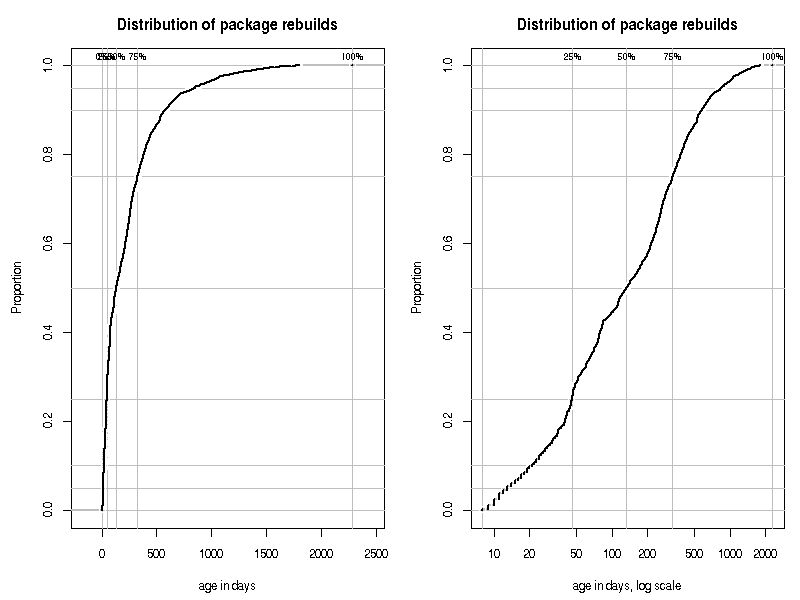
Via the Planet Debian aggregator and his blog, Sven followed up on my post regarding Lucas' plot of the package age distribution. As some of my points didn't seem to make it across, I will reiterate them more plainly: Sven also addresses the fact that what we really want is to see the quantiles of the data set. Quite right, and taking logs makes that easier. Consider the two charts below which plot the 'package age in days' as an empirical cumulative distribution function using built-in R functions ecdf and plot.stepfun (rather than redoing it ad-hoc as I had done), and also add explicitly quantiles. The two charts use the exact same instructions; however the second chart transforms the x-axis to a logarithmic scale. Debian Package Age-since-recompile Distributions charted two ways While it is close to impossible to find the 25 or 50 percentile on the first chart, it becomes a lot easier on the second chart because the x-axis is 'stretched' using the log transform. About one quarters of the distribution appears to be rebuild within 1.5 months old, and about half is younger than four months (as a quick call to summary(pkgAge) confirms). Reading these proprtions off the original chart, or the non-log chart, is much more difficult.
2 July 2007

Sven Mueller: Improving graphs

In Improving simple charts, Dirk Eddelbuettel wrote a nice little summary how to produce “nicer” charts using R. However, in my opinion, the charts he provided as alternate options to the original, purely linear graph are less readable for the average person. If anything, using a logarithmic scale on the original Y axis (number of packages not built after a specific date) would be of use, but the other graphs only hide the original point of the post Dirk replied to (How old are our (Debian’s) packages?). The point was that 94% of all packages had been rebuilt since the release of Sarge or, if you want to put it the other way around, 1264 (6%) were built before Sarge was released. This relationship is hidden from immediate recognition by the reader of the graphs. I admit though, that Dirk’s second graph (Number of packages against age in days with the age being on y logarithmic scale) is also insightful. The other two graphs he presents might make sense in a scientific publication if some point in the “more detailed” areas of the graph needs proving, but for this specific problem, they really don’t make sense to me. Actually, I would question their use even in scientific publications, since they distort the original data a lot. Scientists are pretty much used to logarithmic scales these days, but I couldn’t work out how the scales work on those two graphs. And another note on the second graph (logarithmic age): The way the X axis is labeled (10, 20, 50, 100,..) is also pretty non-intuitive to me. I’m much more used to something like 5, 10, 20, 40, 80, 160 and so on, which gives the same distance between each label and seems a lot more usable to me.. (edit: Fix spelling of Dirk’s surname)

Edd Dumbill: Nokia N800, the second time around

Nokia's N800 internet tablet is an intriguing device. When I originally got one a few months back I tried to treat it purely as a consumer object, just using the installed apps and things available through the obvious point-and-click channels.As a consequence it served mainly as a portable (and expensive) internet radio, streaming me the cricket commentary from the BBC. And when I upgraded my wireless network I somehow managed to make it WPA2 only, knocking the N800 offline. An offline N800 is an almost thoroughly useless device, so it went into the drawer and I forgot about it.Ultimately you can't leave something that expensive unused, so I dragged it out again, fiddled the wi-fi router into compliance, and decided not to deny my hacker nature this time. The N800 is Linux underneath, so who could resist?
The result is two-edged, really: I'm a lot happier with the device, but on the other hand must conclude that the N800 is still a bit far from being consumer-ready.Must-have softwareSo, what things did I install this time around that made the device happier?Claws Mail is a nice email client that works well with my IMAP accounts, which all use SSL and TLS, have lots of messages and a deep folder hierarchy. I don't really want to write much mail on the N800, but an easy reading interface is a bonus.The FM radio is something I can't believe I missed before. I had no idea this was in there, but plug some headphones into the N800 and they act as the antenna for an FM receiver. Desperately cute and old-world, a bit like when laptops still used to have parallel printer ports.I had previously ignored Maemo Mapper, thinking it was useless without a GPS, but it turns out to work very nicely as a dedicated client for Google Maps, as well as several other mapping sources. Must-do geeky bitsTry as I might to like the touch screen, the first thing I had to do with the device was find a way of not using the stylus to do sysadmin type tasks on it.So, first stop is to get a terminal up, figure out how to use the root account, install a SSH client and server, and get my pubkey onto the N800. Now I could shell into it and use a decent keyboard.On my local network I hate maintaining DNS if I don't have to, so the next thing I wanted was Zeroconf support in the shape of avahi. One of the quickest ways to get this going is to install the Canola media application, which uses Zeroconf to find shared music.With these basics in place, the N800 supports APT package repositories familiar to Debian and Ubuntu users, so the device becomes a lot less weird and much more manageable. I felt the same pleasant familiarity as I did with the NSLU2. Things to look forward toThe N800's video camera is neat, but nobody I know uses Google Talk for conferencing. Fortunately it seems that Skype for the N800 is just around the corner. Initially, video support is unlikely, but I imagine that if Skype on the N800 proves popular, it won't be far off.The N800 is something I don't mind having kicking around the kitchen or nursery, so staying in touch with my family while I'm travelling will become a lot more fun.
Also, I'd like to get NFS running on the N800, but that requires the installation of a new kernel, which I've not quite yet had the time to do. Once that's done, all my media, photos and storage will be handily available. 

30 June 2007

Dirk Eddelbuettel: Improving simple charts

Earlier today and via Planet Debian, Lucas blogged about the 'age distribution' of Debian packages, defined as the time since the last (re-)compilation. He illustrated his findings with an, umm, rather ugly chart. Having climbed onto the soap box once before, I would like to point out how easy it can be to create simple, informative, and, at to least to me, prettier charts using R. Lucas included a URL to the data. The first nice thing to note that we can read the data directly from the URL -- no need to copy the file:
pkgAge <- read.table(file="http://people.debian.org/~lucas/arch-age/arch-age.log", col.names=c("pkg","yyyymmdd"))
read the data into a data.frame which we have given two column names.
pkgAge[,"date"] <- as.Date(as.character(pkgAge[,"yyyymmdd"]), "%Y%m%d")
pkgAge[,"age"] <- as.numeric(difftime(Sys.Date(), pkgAge[,"date"], units="day"))
pkgAge[,"prop"] <- (1:nrow(pkgAge)) / nrow(pkgAge) * 100
We then create three new columns. First is a date, by parsing the (integer) dates (after first casting them into characters) by supplying the format in standard C notation: "%Y%m%d" for year, date and month without any separators or formatters. Now, having the date as an actual date object inside a real data analysis language we can do things as e.g. computing date differences. The difftime function does just that, using the current date as other point. We ask for the return to be in days, and cast this down to a purely numeric vector (instead of datediff object). Lastly, we quickly compute the date proportion in percentages. We can then view the date. Before we plot,
png("packageAges.png", quality=100, width=640, height=480, pointsize=10)
oldpar <- par(mfrow=c(2,2), mar=c(2.5,2.5,3,1))
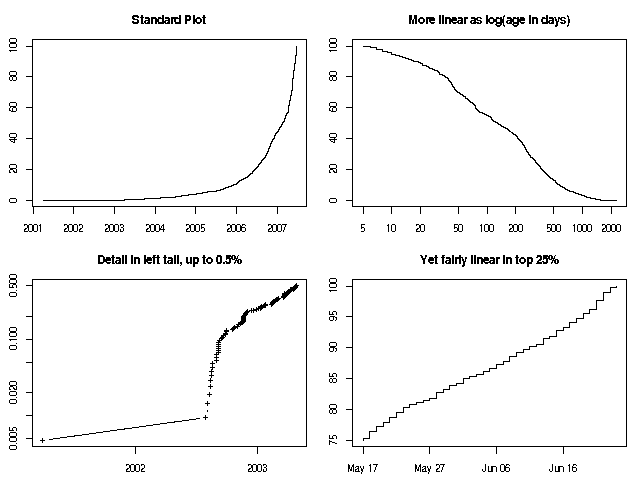
we direct the charts to a png file of given dimensions, and ask for all plots in one figure (using mfrow with two rows by two) with somewhat smaller figure margins using the mar argument to par. The first chart shows again proportion over date:
with(pkgAge, plot(date, prop, type='l', main="Standard Plot"))
(The with() function simply allows us to refer to the columns by their names without explicit subsetting. plot(pkgAge[,"date",], pkgAge[,"prop"]) is equivalent, but more cumbersome.) As it clear that the data has a fairly long tail in the older dates, we can also try to plot the plot over logarithmic time differences. This doesn't work for dates, but it works for our (positive-valued) age variable:
with(pkgAge, plot(age, prop, type='l', log="x", main="More linear as log(age in days)"))
The very far left tail below 0.5 percent is interesting as the one very old package is clearly an outlier within an outlier region. We use the subset function to take just one portion of the data, use logs, and explicit plotting symbols '+' in a points-and-lines plot:
with(subset(pkgAge, prop0.5), plot(date, prop, type='b', log="y", pch="+", main="Detail in left tail, up to 0.5%"))
Lastly, the upper quartile is fairly linear.
with(subset(pkgAge, prop>75), plot(date, prop, type='l', pch=".", main="Yet fairly linear in top 25%"))
At the end
oldpar <- par(mfrow=c(2,3))
dev.off()
we restore the graphics paramters and close the device (here the file). All this then yields the following chart: Debian Package Age-since-recompile Distributions Updated to correctly display the assignment operator <-
29 June 2007

Steve McIntyre: Photos!

Got back from Debconf and realised I'd not grabbed any of my photos from my camera since February! So, I've stuck up quite a few sets this week: FOSDEM 2007, Gabriel (Dave and Helena's new son), my day out at Duxford with Dad, Ben and Adelina's wedding, some photos of the kilts and ceilidh at Debconf and finally a visit to Stonehenge. Phew!

Eddy Petri&#537;or: fglrx issues

I know, I shouldn't be using it in the first place, but I had no alternative until recently.

I think I have a really precise image of the development process of the fglrx drivers since I nave been successfuly using sleep with 8.33.6. That went down the drane with 8.36.5. After a month of pain (I don't understand why it took me sooooo long) I decided to go back to the version that worked (which was a package I prepared myself).

Matthew Garrett told me at DebConf that the avivo driver should work for my video card, but it needs pciaccess which is not available in Etch and at that time was not available even in experimental.


At some point I'll probably use avivo, but until then I still want my laptop to be able to sleep... I hope AMD opens those drivers soon.

28 June 2007

Biella Coleman: Minimizing Lingusitic Drift for the Sake of Political Clarity and Integrity

I am finally catching up with the remarkably thick goulash of email and blogs entries that comes from traveling for well over a month and today I read one in particular When is Open Source not Open Source? that captivated my interest for it compellingly addresses the dangers that follow from diluting, or one might say hijacking, the term open source. When people learn that I study “free software” one of the most common questions I get asked is: why did I chose free software over open source? The answer is quite simple: given that the bread and butter of my research covers ethics, freedom, and liberalism, free software is the obvious path to follow, yet I also feel like a lot of my work is still relevant to the open source camp because of the affinities between the two. I have long maintained that the ideological gulf between open source and free software is not so great nor impassable, but more modest. As most know, both share a certain strong commitment to access and in a strict technical sense they refer to the same set of licenses. Philosophically there is agreement that openness and, especially, non-discrimination are essential for the quality of software and often by close extension, the vibrancy of community responsible for the software. Of course, when pontificating the ramifications and implications of openness, they do part company and enter into different territories. Free software tends to flag rights and freedoms, while open source meanders into a discussion of markets, business, and competition and in this regard they do craft different visions of the social world and human behavior, etc. But the case that Karl Fogel writes about, where OSI is strongly opposing the use of the term open source for licenses that don’t adhere to the definition demonstrates where the two positions join. As Michael Tiemann from the OSI succinctly put it:
The FSF may have got the orthodoxy wrong, and the OSI may have got the interpretation wrong, but we both agree that prohibition of commercial use without special permission is antithetical to both positions.
There is a unmistakable kernel of agreement and it is great to see the OSI taking such a strong stance in this regard. Now, David Richard’s response, who seeks, I think, to essentially dilute the term open source, is as (or perhaps even more) fascinating for in a nut shell, and using a lot of florid religious imagery, it accuses the OSI of being too rigid! In his own words:
I believe the OSI has a wonderful opportunity to continue being relevant and helping to lead the movement forward. If, however, y’all choose to define your denomination of this religion in a way that we don’t fit in, that’s fine. No hard feelings. It’s your choice. You’ll ultimately be excluding a large congregation and we for one will continue trying to build a church made up of others like ourselves.
In response, I would say that the goal of F/OSS is not to be inclusive of anyone who wants to release bits of source code, but to create the conditions under which software, as it has been defined by the community, can be created. Join the church if you would like to make free/open source software as defined and you can go elsewhere (i.e., create a different term) if you are creating something different, even if it is only slightly different. Integrity matters. And again inclusiveness, if it comes at the expense of the main goal, is not a boon but a danger to F/OSS. The OSI will remain relevant by halting the dilution of the term OSI, not by expanding the definition so that it is left with no substance. And in contradistinction to what David Richard maintains, however, there is a great degree of flexibility within this domain but it does not lie in the strict definition of F/OSS but in the realm of interpretation. You are also free, as Mako and I have argued elsewhere to interpret the significance of F/OSS in multiple ways. And I think this is where the political strength of free software lies. There is interplay between a well-defined goal (in this case for creating free software) and a more flexible realm of interpreting the significance of these technical practice. And we wold lose and I might add, a lot if we became flexible about the strict definition of F/OSS and inflexible about its political significance. I get irked with folks like David Richards who would like to bend open source rules to meet their (often commercial) interests and I find it pretty na ve when folks say the political significance of F/OSS is just x (or worse should be x) for in reality its political significance lies in the fact that it has spawned multiple types of political and economic projects. And there is something almost playfully ironic, (or at least it makes me smile) in this fact. Though there is strict definition contained withing F/OSS, this strictness has, at least to some extent, encouraged by an extreme and very healthy form of political proliferation and promiscuity. More than anyone else I know, Mako has most passionately and thoughtfully argued for the importance of what I would call political clarity and integrity. That is, the importance of having a well articulated definition for social movements, for they act, as he says a rallying point to realize a social movement. Urging the Creative Commons to learn from F/OSS and dare to simultaneously narrow and more clearly define their goals, he states it quite nicely in the following terms:
Free software advocates have been able to use the free software definition as the rallying point for a powerful social movement. Free software, like the concept of freedom in any freedom movement, is something that one can demand, something that one can protest for, and something that one can work toward. Working toward these goals, free and open source software movements have created the GNU/Linux operating system and billions of lines of freely available computer code.
In essence, a definition that people can abide by, respect, and perhaps eventually cherish is the condition of possibility to make working political code. And given how hard it is to make social change happen (at least in comparison to build computer code), we should learn from what F/OSS has to offer. And at the same time there is another lesson embedded in F/OSS. The Free Software Definition is well defined; but it must be emphasized, narrowly so. It does not try to do everything and have everyone pledge allegiance to an inordinately complex set of commitments. Clarity, narrowness, and well-defined goals –> these three attributes have powered it far and wide and I hope it remains so. Now, since the term open source is not trademarked, we are left with the problem of how to challenge the current hijacking of the term. For the solution, I will leave you with Karl Fogel, who I think proposes a good solution:
Note that the OSI s objection is not to the Zimbra license per se. The objection is just to Zimbra s calling that license open source . They can use any license they want, but they shouldn t call it open source unless it actually is. Freedom is freedom, and no amount of spin will change that. So what should we do about this? The term open source isn t trademarked. Years ago, the OSI tried to register it, but it was apparently too generic. …But there is public opinion. What Danese and Michael are proposing doing is organizing a lot of open source developers (and I mean open source according to the traditional definition, the one the OSI and I and most other open source developers I know adhere to) to stand up and, basically, say All of us agree on what the definition of open source is, and we reject as non-open source any license that does not comply with the letter and spirit of the Open Source Definition.

Eddy Petri&#537;or: My small contribution to pbuilder...

... is a patch that allows a decent default mirror selection via some heuristic and a debconf question.
This is bug number 333294.

The patch is part of the git repo at http://users.alioth.debian.org/~eddyp-guest/git/pbuilder/.git. Since it uses debconf it has po-debconf support and a Romanian translation. The language should be in line with the one used in other templates, but I don't mind if anyone from Project Smith suggests some changes.

25 June 2007

MJ Ray: Blogging from debconf7: 4. Sleepin ur BoF, hijakin ur sesh, climbin ur volkano

This has been delayed for a few days, for reasons I explain in another post, so my remaining debconf posts will be published quite quickly, every few hours. Monday started with me nearly asleep in the back of the Debian-Med session. Interesting stuff and I'm starting to get involved in supplying web apps to the health sector, but I must watch the session back. Then bureado's excellent debian in venezuela talk and a big shock for me when I got called out. The afternoon and evening were mentioned in the last post. Tuesday opened with me confused in the Xen session and then I went to a good-looking session on combining the debian-installer, ubuntu OEM bits, backuppc and openvpn but lkcl didn't show. (His diary suggests he was around. Wonder what happened.) I kicked the session along a bit and learned stuff from others about preseeding, FAI, backuppc, bacula, amanda and so on, but it didn't seem like anyone had plugged these together in quite the same way. At the end of the session, I bumped into Eddie Bleasdale who it seems is working with Phil Hands and lkcl on a very interesting project. He spoke more about it in a meeting the afternoon, hoping that Phil would arrive to handle the technical side. Phil timed his entry to perfection, about 30 minutes after the end of the talk. In between the hijacked talks, I went for a walk up to the top of Arthur's Seat and back with jumpula and someone else whose name I've forgotten - sorry! Oh, and what is it with all the loldebian posts this week?

24 June 2007

Eddy Petri&#537;or: Back home...

I am writing these words at my desk, at home, where currently there are 33 C and is a hot summer.

The good thing is that the bad feeling I had before the trip did not materialize into anything but a flight through a turbulent zone in the way from Bucharest to Edinburgh. Now I am tired and I need some sleep.

I know it sounds dry, but really, thanks to all the orga team and everyone who made this happen. This was my first DebConf and it was an unique experince.

Thanks also to Patty Langasek for organzing the day trip. It was worth visiting the island.

I hope to see you next year.

Dirk Eddelbuettel: New OpenMPI packages

Debian had OpenMPI package since early last year when Florian Ragwitz made some initial stabs at packaging. The package has seen a number of NMU and patches since then, but was generally getting cobwebs ... which was too bad because OpenMPI seems to have some wind behind its sails upstream. Unfortunately, little of that got packaged for Debian. After some discussions on and around the debian-science list, a new maintainer group was formed on Alioth under the pkg-openmpi name. Tilman Koschnick (who had already helped Florian with patches), Manuel Prinz, Sylvestre Ledru and myself have gotten things in good enough shape in reasonably short time. And I have just uploaded a lintian-clean package set openmpi_1.2.3-0 to Debian, where it is expected to sit in the NEW queue for a little bit before moving on to the archive proper. The changelog entry (which will appear here eventually) shows twelve bugs closed. Our plan is to provide a stable and well maintained MPI implementation for Debian. OpenMPI is the designated successor to LAM, and apart from MPICH2, everybody seems to have thrown their weight behind OpenMPI. So we will try to work with the other MPI maintainers to come up with sensible setups, alternatives priorities and the likes. If you are interested in MPI and would like to help, come join us at the Alioth project pkg-openmpi. Last but not least, thanks to Florian for the initial packaging, and to Clint Adams, Mark Hymers, Andreas Barth, and Steve Langasek (twice even) for NMUs.

22 June 2007

Edd Dumbill: Collecting minimal user information

Web applications are in constant competition for a user's attention. Unlike shrink-wrap software, there's often no captive audience, and web apps must gently guide and woo users to help them to the best experience of the software. This is particularly true when considering the problem of collecting personal details from a user. Collect too little information, and your app might not be able to function effectively. Collect too much information, and you raise the barrier for participation with your application. Users may either not be bothered, be alarmed at the apparent intrusion into their privacy, or fill out bogus information.  One size doesn't fit all
I originally stumbled on the issue in the development of Expectnation. The amount of information a conference speaker needs to give the organizers is significantly more than that of, say, a reviewer. An organizer will often want postal and phone details for a speaker, which are largely irrelevant to the review process. All conferences and events rely on the willingess of participants, so the path to participation needs to be as frictionless as possible.
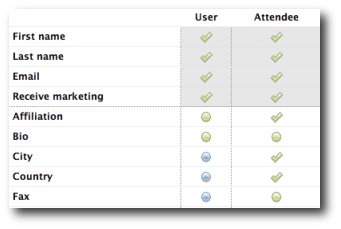
Thus, a one-size-fits-all personal details form didn't make sense for us. At best, we could have simply made more fields optional, but that would result in missing information that we really did need. Another solution would be to provide a dedicated personal details form per user type, e.g. different forms for speakers and reviewers. This is a non-starter, however, as users can take on many roles within a conference. So, we had a problem on our hands: different levels of interaction with our application requires different levels of personal information. We also had a second problem, which is that not all events and organizers want the same level of information. For example, a user group event is unlikely to need the same amount of information from speakers as an academic conference. Thus we have two axes on which the amount of information required varies: by role, and by event.  Our solution: progressive disclosure We concluded that we wanted to adhere to two principles in the collection of user information for Expectnation: The first objective was achieved by constructing a matrix of information items against user role, with the possible values of required, optional, unused for each item. We then achieved the second objective by allowing this matrix to be varied over each event. We've named this concept "progressive disclosure." What this means in practice is that a user is only ever asked for the information required to fulfil the roles they have within Expectnation. If they take on another role, they are asked for the additional information at that point, and not before. Implementation concerns Expectnation user disclosure editing
Extract from disclosure level editing UI It would be untrue to say that progressive disclosure is simple to implement. A user in our system will have disclosure requirements that are the union of all of their roles in all of the events they attend. Within Ruby on Rails, this means the conventional validation logic is useless to us, as it only deals with static requirements. Secondly, disclosure requirements are expensive to compute, so we need to cache them, with the inevitable addition of issues such as cache invalidation. Beyond the data model issues, the user interface issues are, if anything, more troublesome. From an end-user's point of view, the difficulty arises when we need extra information from them, and presenting this in a way that makes sense. From the event organizer's point of view, we have the challenge of presenting a controlling user interface for rather a complex concept. Organizers must be able to change the level of required information either globally, or per-event. We opted for a grid presentation, an extract from which is shown in the screenshot in this article. Over time we'll be able to see how effective this interface is, and what we can do to improve it. Finally, we have chosen sensible defaults for all disclosure levels, as the best result would be that organizers have little need to reconfigure the settings in the first place. Making it look easy Because Expectnation is a general application for organizing events, rather than targetting one specific one, we've had to construct a framework for minimizing user information collection, as opposed to simple implementation of known scenarios. At the end of the day we have added a fairly complicated subsystem and an extra degree of complexity to our codebase. However, the result from the user's point of view is increased simplicity and a streamlined experience. Every time you embark on something that wide-reaching and complex, you have to ask yourself whether the feature is really worth it. In this case, though, the answer is a resounding "yes". The user is the most important factor in our software, and making their life easier in an unobtrusive manner is a priority.

John Goerzen: Camping

img_2886.jpg

After my brother's wedding, a bunch of us Goerzens got together out at our creek. We had a hot dog roast, some smores, and then eight of us remained to camp out at the creek. That included Terah, Jacob, and me.

My uncle loves camping and has organized camping at the creek many times over the years. This was the first time it worked out for me to join them in quite awhile. Jacob slept well overnight, but woke up 5 minutes late -- 6:35. Never mind that he got to bed hours later than his usual time, he still woke up at the same time as always. He's funny that way.

My uncle brought with him supplies for making pancakes over the campfire in the morning. They were great. After breakfast, it was time to take down the tent and get back home to shower before going to church.

Now, a word about Terah and camping here. Terah had only gone camping with me once since we were married, and that was two years ago. This time, we had a larger tent, warmer weather, and most importantly, a complete lack of raccoon fights all around us.

I had visited a Coleman Factory Outlet store in Wichita in the morning, before the wedding, and bought a new Coleman Crestline tent (the one on the left above) and some other supplies. It's a very nice tent with a lot of ventilation options and plenty of little pockets to store things. Jacob slept in his car seat (which he likes to do) in the tent with us.

I think we might not have to wait two years before going camping again. Though I'm sure Terah will correct me if I'm wrong on that.

John Goerzen: Wedding

Wedding Prayer

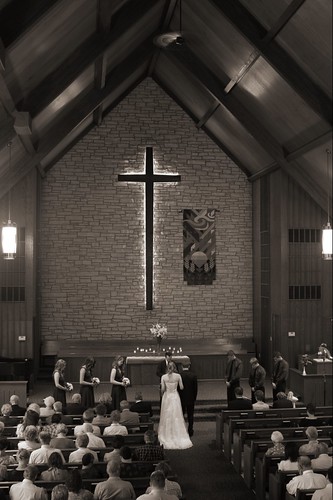
Last weekend, my brother Peter get married! It was a lot of fun to be around Peter and Katherine during the activities last week. They are a wonderful couple and it is great to see them so happy. It was also fun to watch them get their pictures taken, to watch the groomsmen trying to find a key to their car so they could decorate it, and to see all the family there.

But most of all, I'm happy for Peter and Katherine. I never knew how much happiness a wedding could bring until I got married myself. And I'm sure this was a moment they'll look back on fondly for many years.

Next.

Previous.