Search Results: "agi"

24 May 2011

Nathan Handler: Hello Planet Debian

Hello everyone. Per tradition, I will use my first post to Planet Debian as a bit of an introduction. My name is Nathan Handler. I am Ubuntu Developer and a member of freenode staff. Currently, I am participating as a student in the Google Summer of Code program with Debian. I am working on Backend Tools and Infrastructure for DEX (aka dextools ) with Matt Zimmerman as my mentor. To quote the project description:
DEX is a new program designed to help improve Debian and its derivatives by merging in changes made downstream and encouraging discussions between the various projects. As this is a new project, most of the infrastructure does not exist (or is rather hackish and incomplete). This project will create the necessary backend tools and infrastructure so that all Debian derivatives can easily make use of the DEX project.
While I have not been great with updating my blog in the past, I am going to try and produce regular posts about my Summer of Code work. If you have any questions about DEX or are interested in getting involved, please check out the Get Involved section on the website.

23 May 2011

Christian Perrier: 2011 week 20 Debian work

This week, I continued triaging bugs in the samba source package. The result is interesting Many bugs are tagged "moreinfo", most of them being old bugs, many likely to be user error....or something fixed for quite a while. So, I expect the bug count to decrease again. Moreover, I did a call for translations 10 days ago, so about 10 bugs are indeed transaltion updates which will be closed in next upload. Samba upstream also released their 3.6.0rc1 version this week, and 53 hours after the annoucement, it landed in Debian experimental. I pushed tasksel 3.02 in git. Indeed, I upload it quite a while ago and forgot to push the release and tags. I'm not entirely used to git, as it seems..:-) On l10n front, I launched a Smith review for ntfs-3g and launched a call for translations matlab-support (and got thanks from maintainer). Finally, after last week push, the French team completed to translation of package descriptions for the top500 packages in popcon. As a consequence, I moved the target further and we nos have "Popcon600" on the stats page. French now reached rank 3 in the DDTP.

John Goerzen: Baptism

Today I was baptized and joined the Mennonite Church. I imagine this might surprise some of you for various reasons, so let me provide a bit of background. I ve had a lot of people, both in person and in comments responding to my blog post, express surprise with statements I have made. The view of Christianity that many people have is of a group that devalues scientific inquiry and places a lot of emphasis on things like opposition to gay marriage, evolution, and abortion, and enjoys political leaders that say bring it on. While I know some Christians that fall into that mold, there are quite a few that don t as well. Some churches, such as the one we attend, have a surprisingly diverse set of people and yet still function and get along well. Today they accepted me with joy. Nobody was concerned that I started my statement with a reference to ancient Greek philosophy, wound up suggesting that the church ought to make sure to make illegal immigrants, gays and lesbians, and prostitutes feel welcome, and embraced both religion and scientific inquiry, feeling them complimentary. Mennonites practice adult baptism rather than infant baptism. A traditional age for people to be baptized is during high school, though emphasis is placed more on the individual than their age, so it s not unheard-of for someone to do so a bit later in life as I have. Part of the baptism involves the candidate sharing their faith story. These are typically intensely personal, widely varied, heartfelt, and honest. Some people s stories involve struggles with depression, physical disabilities, or the place of religion in their lives, while others reflect little struggle at all. Mine involves letting go of a lot of things, and also seeing some things, such as serious intellectual inquiry or existential questions about God (such as is there a god? ), as a positive rather than a negative feature of a Christian life. But it also involves a recognition and deep respect for those that don t approach things in this way. Though given publicly in a church, baptism testimonies are rarely published or shared more broadly. But I m going to share mine here. I have edited it only very lightly to remove a few local references that wouldn t make sense out of the context of this community. This was delivered in front of a rather different audience than is likely to be reading this post, so if you have questions, do feel free to ask in the comments. But before I begin, I just have to pass along a joke a friend told me: John, you picked quite a day for your baptism the day after the rapture. Baptism Testimony John Goerzen May 22, 2011 Those of you that know me well will probably not be surprised that I will begin my Christian baptism testimony with a story about an ancient Greek philosopher, and also touch on the philosophical nature of truth. These are key parts of my story. As legend goes, Socrates famously said, I know that I know nothing in other words, he believed that nothing could be known with absolute certainty. The Greek Oracle thought to be infallibly wise said that Socrates, the man that thought he knew nothing, was the wisest man in all Athens. An interesting paradox, and one that sheds light on my own religious story. My story involves coming to grips with the understanding that I know very little, that no person can ultimately know much about God, and finding a way to make peace with that situation. Growing up in this community, I thought I knew some things about faith and Christianity. At a certain age, it all seemed so simple. We took the Bible to be literally true. We marveled in Sunday School at how the apostles could sometimes appear so blind. And, modeled both implicitly and explicitly, was this notion: the stronger our faith, the fewer inner questions or doubt we have about the nature of God, the literal accuracy of the entire Bible, or our relationship to God. Those I perceived held up as examples never seemed to question any of these things, and showed outwardly, at least complete certainty about them. Moreover, holding certain intellectual beliefs was key to Christian identity, and even more importantly, to eternal life. This model has quite obviously worked well for many people for many years. The good that has happened, and continues to happen, from people that have that kind of certainty is manifest all around us. And yet, it didn t seem to work out for me. I m not the kind of person that accepts a lot of things at face value. It is helpful to be able to examine and challenge ideas and even more helpful to have other people challenge my ideas. From well before I was in high school, I was questioning some things about the Bible, God, and religion in general. My thoughts ranged from the impact of evolution on religion to the apparently vengeful God of the Old Testament to the very existence of God. In the Christian context, I perceived having these questions as a personal failing, something that I ought to repress. The more I tried to repress them, the more troublesome they became. Why, for instance, should a loving merciful God decide whether to let us into heaven based on whether we hold certain intellectual beliefs? In high school, I participated in the catechism class here at this church, and was frustrated because it didn t tackle deeper meanings or the kinds of questions I had. I wasn t yet able to articulate all my thoughts and questions very well, and I probably had an overactive case of teenage cynicism. As a result, I didn t get baptized like most others my age did. As I learned more about the early history of Judaism and Christianity, I only found more reasons to question the model of faith I thought I had received the one in which Biblical literalism and a divine guarantee of sorts was key. More recently, I gradually became aware that the model of Christianity I had in mind was one of many views. Christians, Mennonites, and even this church are incredibly diverse groups, and in retrospect, I am surprised that it took me so long to realize this. Three major steps led me to baptism. The first step was the realization that, whatever our understanding of the literal accuracy of the Bible, literal truth is often inferior to metaphorical truth. As an example, many of us have read the works of Shakespeare. They are fictional, but the reason they have been revered for so many centuries is that they are true. They teach us things about ourselves and our world in a way that no history book can. By placing such an emphasis on literal truth in the Bible, I was missing out on the message right there for me. By concerning myself with creationism or evolution, I missed out on thinking about what the story in Genesis meant for the Jews, and what it could mean for me. Evolution ceased to be a threat to religion; it became simply a tool for learning about a different sort of truth than we get from religion. N. T. Wright mentions an incident that illustrates this point. A woman attending a religious conference asked the speaker, a prominent theologian, Is it true that the serpent in Genesis actually spoke like you and I speak? The theologian answered, It doesn t matter whether the serpent could speak. What matters is what the serpent said. The second step I took towards being baptized was realizing where the real core of Christianity lies. It s not some debate about Genesis, but rather the death to one s old self, and the rebirth and continual remaking of oneself in the example of Jesus. Given that, a lot of questions seem unimportant or even irrelevant. Good can be expressed in many ways, and if one person achieves a remarkably Christian life via a literal understanding of the Bible, and another via a more metaphorical reading, then it is my place only to affirm both and say that they both got it right. If we say that the task of remaking ourselves is like climbing a mountain, then what matters is not how we are climbing the mountain, but simply that we are climbing it. I used to equate faith with an intellectual belief. I have come to see that was a narrow view. Faith, to me now, is more about vision: do we see the world like Christ did? Where do our loyalties and our trust lie in God or in human institutions? What are our goals in life? We humans have failed to understand God, and probably always will. I too share in that incomplete understanding, but I have come to accept that it is OK. I know enough to know that I want my loyalty to lie in Jesus, to know what kind of vision of the world I want to have, and I have learned to accept that intellectual questions can even be a form of meditation, enlightenment, and prayer. The third step toward baptism was moving past my own shortcomings. For a long time, I thought I didn t believe the right things, didn t believe them strong enough, wasn t certain enough about God, didn t pray enough, didn t read enough, didn t understand enough, didn t love enough and ultimately, that I wasn t good enough. I request baptism today understanding that, despite the various imperfections I still have, and we all have, everyone is good enough and deserving of love and peace. God s love is for everyone. No exceptions! Following Jesus boils down to this: I too must be an agent of love and peace to everyone, without exception. My vision must be centered around the fact that we are to emulate the God that loves the entire world, sinners all, and therefore I should as well. I hope I can show others the kind of love that has been shown me. I hope, too, to share with this congregation and the global church in the vision of love. I hope that we can continually strive to re-focus on Christ s vision. As an example, we all know that many different viewpoints about whether homosexuality is sinful exist in Mennonite Church USA. These opinions are deeply held and personal for many, and have been discussed over and over and over. But ultimately, they aren t terribly relevant to the church s mission. The example of Jesus unites us all: he embraced everyone. He accepted criminals and prostitutes and showed them love and kindness. Our difficult task, which is also my difficult task, is to show this same love to absolutely everyone, regardless of our varying opinions about them and their conduct. The forgotten and repressed of our day perhaps criminals, homeless, Muslims, addicts, gays and lesbians, illegal immigrants, ethnic minorities, and still prostitutes deserve the love of Christ s church and all its members. My hope is that any one of the earth s 7 billion people could step through the doors of our church, or any church, and immediately feel Christ s love, and the unconditional, non-judgmental, welcome and love of Christ s followers, no matter what. This prayer from Ephesians 3 sums up my hope and my vision, for myself and everyone:
I pray that out of his glorious riches he may strengthen you with power through his Spirit in your inner being. I pray that Christ may dwell in your hearts through faith. And I pray that you, being rooted and established in love, may have power, together with all the Lord s people, to grasp how wide and long and high and deep is the love of Christ. And I pray that you will know this love that surpasses knowledge that you may be filled to the measure of all the fullness of God. (3.16-19)

22 May 2011

Christian Perrier: 2011 week 20 Debian work

This week, I continued triaging bugs in the samba source package. The result is interesting Many bugs are tagged "moreinfo", most of them being old bugs, many likely to be user error....or something fixed for quite a while. So, I expect the bug count to decrease again. Moreover, I did a call for translations 10 days ago, so about 10 bugs are indeed transaltion updates which will be closed in next upload. Samba upstream also released their 3.6.0rc1 version this week, and 53 hours after the annoucement, it landed in Debian experimental. I pushed tasksel 3.02 in git. Indeed, I upload it quite a while ago and forgot to push the release and tags. I'm not entirely used to git, as it seems..:-) On l10n front, I launched a Smith review for ntfs-3g and launched a call for translations matlab-support (and got thanks from maintainer). Finally, after last week push, the French team completed to translation of package descriptions for the top500 packages in popcon. As a consequence, I moved the target further and we nos have "Popcon600" on the stats page. French now reached rank 3 in the DDTP.

21 May 2011

Vincent Bernat: Network lab with User Mode Linux

To setup a virtual network lab, you get a lot of alternatives. You can for example use GNS3, Netkit, Marionnet or VNUML. Some of those tools, like GNS3, allow to add some closed source equipments like a Cisco 7200 or a Juniper router. All those tools are a great way to setup your network lab. Look at them! If you want to setup a virtual network lab for educational purpose, one of those should fit your purpose. However, none of those solution were a perfect match for me. I did not want to maintain some root filesystem. I wanted my lab to start in a few seconds. I wanted to keep all configuration files (including the ones for the virtual hosts) into one subdirectory of my home and be able to modify them while the lab was running. I also wanted to be able to plug some Cisco router using Dynamips/Dynagen. None of the listed solution above matched all those criteria. Therefore, I setup my own lab script with User Mode Linux. This is not a complete solution, but is more like a home-made solution to match one particular need. You cannot use the final result without tweaking it. Again, look at the other solutions first. We will go step by step to understand how the lab was built. If you are in a hurry, you can look at the result which is published on GitHub.

User Mode Linux User Mode Linux (or UML) is a Linux kernel running as a process instead of running on top of some processor. With Debian, you can install it using apt-get install user-mode-linux. You get a linux command that will run your Linux kernel as a simple process. No need to be root.
 1
 2
 3
 4
 5
 6
 7
 8
 9
10
11
12
13
14
15
16
17
18
19
20
21
22
23
24
25
$ linux
Core dump limits :
    soft - 0
    hard - NONE
Checking that ptrace can change system call numbers...OK
Checking syscall emulation patch for ptrace...OK
Checking advanced syscall emulation patch for ptrace...OK
Checking for tmpfs mount on /dev/shm...nothing mounted on /dev/shm
Checking PROT_EXEC mmap in /tmp/user/500/...OK
Checking for the skas3 patch in the host:
  - /proc/mm...not found: No such file or directory
  - PTRACE_FAULTINFO...not found
  - PTRACE_LDT...not found
UML running in SKAS0 mode
Adding 5632000 bytes to physical memory to account for exec-shield gap
Initializing cgroup subsys cpuset
Linux version 2.6.32 (2.6.32) (root@tito) (gcc version 4.4.5 (Debian 4.4.5-10) ) #2 Thu Jan 27 12:49:46 UTC 2011
[...]
console [mc-1] enabled
Couldn't stat "root_fs" : err = 2
Failed to initialize ubd device 0 :Couldn't determine size of device's file
registered taskstats version 1
VFS: Cannot open root device "98:0" or unknown-block(98,0)
Please append a correct "root=" boot option; here are the available partitions:
Kernel panic - not syncing: VFS: Unable to mount root fs on unknown-block(98,0)
You get a Linux kernel that will just panic because it does not find a disk to mount to run init from it. Usually, you build some root file system and give it as an argument to your UML kernel.

Basic setup However, you can also use your host filesystem as a root filesystem. We also specify /bin/sh as init instead of /sbin/init. This will be the first process to be started by our UML kernel.
 1
 2
 3
 4
 5
 6
 7
 8
 9
10
11
12
13
$ linux init=/bin/sh rootfstype=hostfs
[...]
Linux version 2.6.32 (2.6.32) (root@tito) (gcc version 4.4.5 (Debian 4.4.5-10) ) #2 Thu Jan 27 12:49:46 UTC 2011
[...]
VFS: Mounted root (hostfs filesystem) readonly on device 0:12.
IRQ 3/console-write: IRQF_DISABLED is not guaranteed on shared IRQs
IRQ 2/console: IRQF_DISABLED is not guaranteed on shared IRQs
IRQ 10/winch: IRQF_DISABLED is not guaranteed on shared IRQs
/bin/sh: can't access tty; job control turned off
# uname -a
Linux (none) 2.6.32 #2 Thu Jan 27 12:49:46 UTC 2011 x86_64 GNU/Linux
# echo $$
1
You may want to setup a bit your environment:
1
2
3
4
5
6
7
8
9
# hostname -b R1
# export TERM=xterm
# export PATH=/usr/local/bin:/usr/bin:/bin:/sbin:/usr/local/sbin:/usr/sbin
# mount -t proc proc /proc
# mount -t sysfs sysfs /sys
# mount -t tmpfs tmpfs /var/run -o rw,nosuid,nodev
# mount -t tmpfs tmpfs /var/log -o rw,nosuid,nodev
# mount -o bind /usr/lib/uml/modules /lib/modules
# mount -t hostfs hostfs /home/bernat/mylab -o /home/bernat/mylab
We setup /proc and /sys correctly. We also turn /var/run and /var/log as tmpfs filesystems. This will allow most daemons to run correctly: they will be able to write runtime data in /var/run and to write logs in /var/log. You can even launch your favorite syslog daemon. The line about /lib/modules is to ensure that our UML kernel is able to access its kernel modules. For example, we can now use modprobe tun. The line about /home allows to mount the home directory of your host inside UML. This was already the case, but it was mounted as read-only. One important thing to notice is that while you seem to be root inside UML, you did not run linux as root. Therefore, when the UML kernel tries to write a file it will still be bound by the permissions granted by your host kernel. See this example:
1
2
3
4
# mount -o remount,rw /
# touch /tmp/test1
# touch /etc/test1
touch: cannot touch  /etc/test1': Permission denied
This is a great way to ensure that your lab will not destroy your host. Do not run linux as root. What is interesting with such a setup is that you share the filesystem with your host. You can modify some configuration file on your host and your UML will see the modification right away. You can also modify a file inside UML and see the modification on your host too.

Console & job control There is a slight problem with this environment. You may be used to it if you already started your own GNU/Linux system with init=/bin/sh. The problem is that you don t have job control. Job control allows you to put tasks in background and interrupt them while they are running. It is job control that allows you to stop a program with ^C. Here, you don t have job control. See:
1
2
# cat
^C^C^C^C
You are stuck. The only way to go out is to kill the linux process on your host. Job control is a great mystery for me. I don t know how to enable it by hand. However, getty is able to enable job control for you. Just type this command:
1
# exec getty -n -l /bin/sh 38400 /dev/tty0
You get job control. We keep /bin/sh, but you may prefer /bin/bash since on most systems, /bin/sh is rather basic.

Writable root filesystem Let s get back to our root filesystem. Most daemons can run just fine with our setup. For example, we can start Nginx, a popular web server:
1
2
3
# mkdir /var/log/nginx
# /etc/init.d/nginx start
Starting nginx: nginx.
However, it will use the configuration file in /etc/nginx. You don t want to modify this directory for all your labs. The best way to handle this is to start Nginx with a custom configuration file:
1
2
# /etc/init.d/nginx stop
# nginx -c /home/bernat/mylab/nginx.conf
While keeping the configuration files related to your lab in your home is an important objective (all your lab related files are in the same place and you can modify them at will), it may be more convenient to still use /etc/init.d/nginx script to control Nginx. Moreover, some daemons do not allow to specify a configuration file. You will then need to modify your root filesystem. This is a pretty common problem with Live CD and it is solved by using an union mount. This is a special kind of mount that will merge two filesystems into one. One of the two filesystems can be read-only and all the changes will be reported to the second one. We will use AUFS. Ensure that you have aufs-tools package installed. Let s start from scratch for this example.
 1
 2
 3
 4
 5
 6
 7
 8
 9
10
$ linux init=/bin/sh rootfstype=hostfs
[...]
# mount -n -t proc proc /proc
# mount -n -t sysfs sysfs /sys
# mount -o bind /usr/lib/uml/modules /lib/modules
# mount -n -t tmpfs tmpfs /tmp -o rw,nosuid,nodev
# mkdir /tmp/ro /tmp/rw /tmp/aufs
# mount -n -t hostfs hostfs /tmp/ro -o /,ro
# mount -n -t aufs aufs /tmp/aufs -o noatime,dirs=/tmp/rw:/tmp/ro=ro
# exec chroot /tmp/aufs /bin/bash
It seems that AUFS with hostfs is rather fragile. We could have merged our root filesystem with some directory in our lab using hostfs like this:
1
2
3
4
# mount -n -t hostfs hostfs /tmp/rw -o /home/bernat/mylab/root,rw
# mount -n -t hostfs hostfs /tmp/ro -o /,ro
# mount -n -t aufs aufs /tmp/aufs -o noatime,dirs=/tmp/rw:/tmp/ro=ro
# exec chroot /tmp/aufs /bin/bash
However, the kernel panics on most operations. Therefore, /tmp/rw stays in a tmpfs filesystem. This means that any change to the root filesystem will be lost. I also was unable to issue a correct pivot_root before chroot. This is not really important here. UPDATED: It seems that there are other drawbacks to this setup. For some reason, if you have a separate /usr partition on your host system, you won t be able to write to it until you specify the noxino option to AUFS. Another issue is that AUFS does not notice most changes on the hostfs filesystem. You can fix this with option udba=inotify. However, this is incompatible with the noxino option. Therefore, you need to choose what is best for your lab. You can also mount some parts of your home with hostfs (for example, the source directory of the piece of software that you would like to test). Let s consider that Nginx configuration is in /home/bernat/lab/nginx. We simply uses a symbolic link:
1
2
# rm -rf /etc/nginx
# ln -s /home/bernat/mylab/nginx /etc/nginx
Since we lose the modifications to the root filesystem, the symbolic link should be done each time we start the lab. However, we can modify directly the configuration files in the host or in the UML.

Networking We know how to start our UML. Let s see how we can add some wires to it. UML supports several network adapters. The two most useful are TAP and VDE backend.

TAP A TAP interface is a virtual network kernel device which can be used by userland applications to inject layer 2 frames in it. If the kernel sends frames in a TAP device, they will be received by the application listening to it. This also works the other way around. A TAP interface is a regular ethernet device for the kernel. This means that you can bridge it or use tcpdump on it. The drawback of such interfaces is that you need to be root to create them. The application using them does not need to be run as root. I usually use this nifty shell function to setup TAP interfaces:
 1
 2
 3
 4
 5
 6
 7
 8
 9
10
11
12
13
14
15
16
17
18
19
20
21
22
23
__add_to_bridge()  
    # Optionally, add it to given bridge
    [ -z "$2" ]    
        [ -f /sys/class/net/$2/brforward ]    
            sudo brctl addbr $2
            sudo brctl stp $2 off
            sudo ip link set $2 up
         
        [ -f /sys/class/net/$2/brif/$1 ]    
            # We need to check if it is in another bridge
            bridge=$(echo /sys/class/net/*/brif/$1 2> /dev/null   \
                sed 's+/sys/class/net/\([^/]*\)/.*+\1+') 2> /dev/null
            [ -n "$bridge" ] && \
                sudo brctl delif $bridge $1
            sudo brctl addif $2 $1


tap()  
    sudo tunctl -b -u $(whoami) -t $1 > /dev/null
    sudo ip link set up dev $1
    __add_to_bridge $1 $2
 
It will create the interface and put it into a bridge. For example, you can create two interfaces linked together through a bridge to allow two UML to talk each other:
1
2
$ tap tap-R1 br-R1R2
$ tap tap-R2 br-R1R2
We can setup two UML which will use those interfaces. The first one is setup like this:
1
2
3
4
$ linux init=/bin/sh rootfstype=hostfs eth0=tuntap,tap-R1
[...]
# ip link set up dev eth0
# ip addr add 192.168.0.1/24 dev eth0
The second one:
1
2
3
4
5
6
7
8
9
$ linux init=/bin/sh rootfstype=hostfs eth0=tuntap,tap-R2
[...]
# ip link set up dev eth0
# ip addr add 192.168.0.2/24 dev eth0
# ping 192.168.0.1
PING 192.168.0.1 (192.168.0.1) 56(84) bytes of data.
Warning: time of day goes back (-13832us), taking countermeasures.
64 bytes from 192.168.0.1: icmp_req=20 ttl=64 time=0.633 ms
64 bytes from 192.168.0.1: icmp_req=21 ttl=64 time=0.157 ms
If you are running a firewall on your host, ensure that you let your host forward those packets. By default, bridging code forwards the frames through Netfilter.

VDE A VDE switch is a software emulation of a regular network switch. It is a userland component and does not need to be run as root. You need to install vde2 package to make use of it. You can run a switch using vde_switch command. You will get a console by pressing Enter. From this console, you can configure the switch: add ports, configure VLAN, etc. Like for TAP interfaces, let s setup two UML connected to this switch. The first one is like this:
1
2
3
4
$ linux init=/bin/sh rootfstype=hostfs eth0=vde
[...]
# ip link set up dev eth0
# ip addr add 192.168.0.1/24 dev eth0
And the second one:
1
2
3
4
5
6
7
8
9
$ linux init=/bin/sh rootfstype=hostfs eth0=vde
[...]
# ip link set up dev eth0
# ip addr add 192.168.0.2/24 dev eth0
# ping 192.168.0.1
PING 192.168.0.1 (192.168.0.1) 56(84) bytes of data.
64 bytes from 192.168.0.1: icmp_req=1 ttl=64 time=2.93 ms
Warning: time of day goes back (-8101us), taking countermeasures.
64 bytes from 192.168.0.1: icmp_req=2 ttl=64 time=0.503 ms

The lab So far, we had a look at what can be used to setup a lab. We need to put everything together into some script to setup the lab in a quick way. For each lab that I want to setup, I copy my latest script to a new location and adapt to the topology I want. I have put everything described below in GitHub. Feel free to browse and fork. Our lab will be about setting up a redundant VPN between two remote sites of the same company. This company is using OSPF as an IGP on each site and we will use BGP to let each site know the routes advertised in the other site. We will only use VDE switches for the layer 2 part. Redundant VPN lab Let s implement this lab. You should grab the sources first:
1
2
$ git clone https://github.com/vincentbernat/network-lab.git
$ cd network-lab/lab-redundant-vpn
You have a setup script which will setup the whole lab for you. You also have one directory for each UML. Those directories only contain configuration for the various daemons used inside UML. To make this lab work, ensure that you have quagga (Quagga, an Internet routing daemon supporting both OSPF and BGP) and racoon packages.

UML configuration First look at the end of script. There is something like this:
 1
 2
 3
 4
 5
 6
 7
 8
 9
10
11
12
13
14
15
16
17
18
19
20
21
22
23
24
25
26
27
case $$ in
    1)
        # Inside UML. Three states:
        [...]
        ;;
    *)
        TMP=$(mktemp -d)
        trap "rm -rf $TMP" EXIT
        check_dependencies
        setup_screen
        # Setup switches
        setup_switch site1
        setup_switch site101
        setup_switch internet
        # Start VM
        start_vm R1 eth0=vde,$TMP/switch-site1.sock
        start_vm R2 eth0=vde,$TMP/switch-site101.sock
        start_vm V1 eth0=vde,$TMP/switch-site1.sock eth1=vde,$TMP/switch-internet.sock
        start_vm V2 eth0=vde,$TMP/switch-site1.sock eth1=vde,$TMP/switch-internet.sock
        start_vm V3 eth0=vde,$TMP/switch-site101.sock eth1=vde,$TMP/switch-internet.sock
        start_vm V4 eth0=vde,$TMP/switch-site101.sock eth1=vde,$TMP/switch-internet.sock
        start_vm I1 eth0=vde,$TMP/switch-internet.sock
        display_help
        cleanup
        screen -X quit
        ;;
esac
The script will check its PID ($$). If it is 1, this means it has been invoked as init. Otherwise, it means it has been launched by the user. We will see the init part later. When called, we first check some dependencies, then we setup screen. Everything is run inside a screen session. No multiple windows. The next step is to setup the various switches needed for our lab. We take one switch for each site and one switch for Internet . The function that setups the switch just invokes vde_switch with the help of start-stop-daemon to record the PID (to shutdown the lab properly). Then, we start our various UML. For each of them, we need to specify which network adapters we need. For R1 and R2, we don t use a network adapter to connect to the internal network. We will use a dummy0 interface. To emulate Internet, we use another UML, I1. For each UML, our script will be used as init. In this case, its PID will be 1. As we have seen earlier, the script checks if it is called as init. If it is the case, it will setup the UML. During this setup, host specific configuration will be applied:
 1
 2
 3
 4
 5
 6
 7
 8
 9
10
11
12
13
14
15
16
17
18
19
20
21
22
23
24
25
26
27
28
29
30
31
32
33
34
35
36
37
38
39
40
41
42
43
44
45
46
47
48
49
50
echo "[+] Setup UML"
sysctl -w net.ipv4.ip_forward=1
case $ uts  in
    R1)
        modprobe dummy
        ip link set up dev dummy0
        ip addr add 192.168.15.1/24 dev dummy0
        ip addr add 192.168.1.10/24 dev eth0
        setup_quagga
        ;;
    R2)
        modprobe dummy
        ip link set up dev dummy0
        ip addr add 192.168.115.1/24 dev dummy0
        ip addr add 192.168.101.10/24 dev eth0
        setup_quagga
        ;;
    V1)
        ip addr add 192.168.1.11/24 dev eth0
        ip addr add 1.1.2.1/24 dev eth1
        ip route add default via 1.1.2.10
        setup_quagga
        setup_racoon 1.1.2.1 1.1.1.1 192.168.0.0/19-192.168.100.0/19
        ;;
    V2)
        ip addr add 192.168.1.12/24 dev eth0
        ip addr add 1.1.2.2/24 dev eth1
        ip route add default via 1.1.2.10
        setup_quagga
        setup_racoon 1.1.2.2 1.1.1.2 192.168.0.0/19-192.168.100.0/19
        ;;
    V3)
        ip addr add 192.168.101.13/24 dev eth0
        ip addr add 1.1.1.1/24 dev eth1
        ip route add default via 1.1.1.10
        setup_quagga
        setup_racoon 1.1.1.1 1.1.2.1 192.168.100.0/19-192.168.0.0/19
        ;;
    V4)
        ip addr add 192.168.101.14/24 dev eth0
        ip addr add 1.1.1.2/24 dev eth1
        ip route add default via 1.1.1.10
        setup_quagga
        setup_racoon 1.1.1.2 1.1.2.2 192.168.100.0/19-192.168.0.0/19
        ;;
    I1)
        ip addr add 1.1.1.10/24 dev eth0
        ip addr add 1.1.2.10/24 dev eth0
        ;;
esac
After all this, we drop to a shell to allow you to issue additional commands interactively.

Testing We need to wait one minute after the lab has been started. We can then check the routing table of various equipments. For example, here is R1 routing table (you need to type vtysh to get Quagga console):
 1
 2
 3
 4
 5
 6
 7
 8
 9
10
11
R1# show ip route
Codes: K - kernel route, C - connected, S - static, R - RIP, O - OSPF,
       I - ISIS, B - BGP, > - selected route, * - FIB route
C>* 127.0.0.0/8 is directly connected, lo
O   192.168.1.0/24 [110/10] is directly connected, eth0, 00:25:42
C>* 192.168.1.0/24 is directly connected, eth0
O   192.168.15.0/24 [110/10] is directly connected, dummy0, 00:25:42
C>* 192.168.15.0/24 is directly connected, dummy0
O>* 192.168.115.0/24 [110/20] via 192.168.1.11, eth0, 00:02:24
  *                           via 192.168.1.12, eth0, 00:02:24
We can see that if this router wants to contact R2, it has learned a multipath route with OSPF and can then sends its packets through V1 or V2, as expected. Here is the routing table of V3:
 1
 2
 3
 4
 5
 6
 7
 8
 9
10
11
12
V3# show ip route
Codes: K - kernel route, C - connected, S - static, R - RIP, O - OSPF,
       I - ISIS, B - BGP, > - selected route, * - FIB route
K>* 0.0.0.0/0 via 1.1.1.10, eth1
C>* 1.1.1.0/24 is directly connected, eth1
C>* 127.0.0.0/8 is directly connected, lo
O   192.168.15.0/24 [110/20] via 192.168.101.14, eth0, 00:04:26
B>* 192.168.15.0/24 [20/20] via 192.168.1.11 (recursive via 1.1.1.10), 00:07:16
O   192.168.101.0/24 [110/10] is directly connected, eth0, 00:07:30
C>* 192.168.101.0/24 is directly connected, eth0
O>* 192.168.115.0/24 [110/20] via 192.168.101.10, eth0, 00:07:18
We see that to contact R1, V3 knows two routes. One with BGP through the VPN. This is the one that will be used. The other one is through V4 but will not be used unless the BGP route is lost. We can ping R2 from R1:
1
2
3
4
R1# ping -I 192.168.15.1 192.168.115.1
PING 192.168.115.1 (192.168.115.1) from 192.168.15.1 : 56(84) bytes of data.
Warning: time of day goes back (-459129us), taking countermeasures.
64 bytes from 192.168.115.1: icmp_req=1 ttl=62 time=1.10 ms
Let s suppose we break the link between V1 and the Internet (using ip link set down eth1 on V1). The previous multipath route on R1 is now a single route through V2. Moreover, V3 has lost its BGP route to V1 and is now using its OSPF route through V4:
 1
 2
 3
 4
 5
 6
 7
 8
 9
10
11
V3# show ip route
Codes: K - kernel route, C - connected, S - static, R - RIP, O - OSPF,
       I - ISIS, B - BGP, > - selected route, * - FIB route
K>* 0.0.0.0/0 via 1.1.1.10, eth1
C>* 1.1.1.0/24 is directly connected, eth1
C>* 127.0.0.0/8 is directly connected, lo
O>* 192.168.15.0/24 [110/20] via 192.168.101.14, eth0, 00:10:13
O   192.168.101.0/24 [110/10] is directly connected, eth0, 00:13:17
C>* 192.168.101.0/24 is directly connected, eth0
O>* 192.168.115.0/24 [110/20] via 192.168.101.10, eth0, 00:13:05
We could enhance the resiliance of such a setup by adding a dedicated link between V1 and V2 and between V3 and V4 and running OSPF on this link (or iBGP). This would allow us to support several outages on our network.

Conclusion The script used to setup this lab can be adapted to setup other labs with little effort. Please, note that it depends on the configuration of your environment. However, the whole lab is contained in a single directory and is very small. You can email it to your friends or publish it on GitHub. It can also be extended to support Dynagen to include some Cisco equipments in your lab (for example, to experiment with VRF or MPLS).

Ritesh Raj Sarraf: Fibre Channel over Ethernet - FCoE

With the final package, fcoe-utils, clearing the NEW packages queue, the Open-FCoE project's Fibre Channel over Ethernet stack is now in the Debian archive. I had anticipated to have access to FCoE hardware by the time the packaging would complete but that didn't work out. It has been delayed, hence the packages are in experimental. If you have access to FCoE hardware, please test and provide your feedback.

17 May 2011

Pietro Abate: Dose3 in debian experimental !

Thanks to Ralf's work, dose3 has been just accepted in debian experimental !!! yuppiiiii \o/
  Dose3 is a framework made of several OCaml libraries for managing
  distribution packages and their dependencies.
  Though not tied to any particular distribution, dose3 constitutes a pool of
  libraries which enable analyzing packages coming from various
  distributions.
  Besides basic functionality for querying and setting package properties,
  dose3 also implements algorithms for solving more complex problems
  (monitoring package evolutions, correct and complete dependency resolution,
  repository-wide uninstallability checks). 
For the ocaml affectionados the API of the library is available here (there is still a bit of work to do here...) . The source code shipped in each release does not include a vast range of applications sitting in the experimental directory. You can have a look at these in our svn. if you want to get a copy of the development / bleeding edge / unstable version from svn, you can check it out from the svn
 svn co https://gforge.info.ucl.ac.be/svn/mancoosi/trunk/dose3
user/pass : mancoosi/mancoosi

Christoph Egger: Quick notes about PostgreSQL

Imagine you have a old postgresql database. Further imagine it has it's encoding set to something like LATIN-1 but some PHP web application has put in UTF-8 strings. Now what would you do if you have some python application actually respecting the encoding and recoding the db content from latin-1 to UTF-8 giving you garbage. Seems you can easily trick postgresql to now believe it is UTF-8:
UPDATE pg_database SET encoding = 6 WHERE datname = 'foo';
For a summary of these magic numbers the PostgreSQL Manual is usefull.

16 May 2011

Rudy Godoy: GSoC 2011: Compute Clusters Integration for Debian Development and Building

Hi, been offline for a while and now after my mid-term exams I m glad to tell that I ll be working on this year s GSoC project called: Compute Clusters Integration for Debian Development and Building . The main idea for this project is to give Debian developers and downstream developers a set of tools for helping them to leverage the power of a cloud-based infrastructure for their development duties. This is specially targeted to porters, multi-arch and cross-development, So I ll ask such teams for feedback on the subject over the next days. People at Eucalyptus has been very helpful and willing to cooperate with us to make this project a success. We expect to get them involved on the packaging and probably as Debian contributors, if not developers, also. Next week is the official coding phase start, but I ve been talking and working together with my mentor Steffen and the Eucalyptus people already. We ll be starting working on the qemu ARM images, reusing and resuming the job did by Dominique Belhachemi in the past GSoC. Of course I welcome as much feedback as you might find useful. I plan to post a project update every two weeks.

15 May 2011

Christian Perrier: 2011 week 19 Debian work

That was a damn busy week. It was mostly centered about attending SambaXP, the annual Samba user and developers conference, in G ttingen, Germany. The only free software conference I attend with expenses paid by my employer, Onera. This year was the 10th edition and, as last year, to the "who was there for the nth edition" game, I won by staying alone as they asked who attended all editions of the conference. :-) That was a great week, with time spent with people as interesting as Andrew Tridgell, Jeremy Allison, John Terpstra, Volker Lendecke, Kai Blin, to name a few. A good opportunity, again, to get input from our packaging work for that big piece of software, as well as getting visibility about the future of Samba. I also had a great, even if short talk, with the kind Karolin Seeger, the release manager of Samba for 3 years now. We talked about....children, as she's now a mother since last year (with a non negligible impact on her professionnal life, as often in Germany). Great meeting, too, with Brad Kuhn, from the Software Freedom Conservacy, who had a keynote about GPL licence enforcment activities. It becomes more and more sure that Samba3 and Samba4 will reconverge together after the Samba Team releases Samba 3.6. It brings plans for our packaging work: I think we'll stick with having samba 3.6 in wheezy while the brand new shiny Samba4 probably stays separate in some way. Our users (and /me first) clearly need stability in the file and print services first. Of course, I did some packaging work there: samba 3.6.0pre3 was uploaded to experimental, about 10 days after its official announcement. I also worked on the samba *binary* package bugs, triaging them as usual. We now have 51 bugs opened against the samba binary package: 18 unclassified, 11 moreinfo (several likely to be closed as unreproducible or user error), 1 wontfix, 8 with a pending patch and 13 forwarded upstream. I'm also thinking about a possible way to ask about SMB2 support in samba: it won't be activated by default in 3.6 (mostly because us, distros, requested for that and, by "us", I mean Debian, RHEL, SuSe and their derivatives, so quite a large consensus). Still, it would be good to put some light on SMB2 support and a debconf question about it could be a solution (not shown by default and defaulting to no SMB2). I also worked quite extensively on packages maintained by No l K the, Ralf Treinen and me, aka "the pkg-running team". I did setup a git repo for my new "garmin-ant-downloader" package, that allows downloading track files from Garmin Forerunner 405 GPS watches (guess what is the brand and model of mine!). My first packaging git repository! Thanks to Ralf for his advice and help in this. I triaged bugs in the other two packages we maintain: pytrainer (more bugs forwarded upstream) and garmin-forerunner-tools (which was later uploaded by Ralf). I also setup a team mailign list so, now, we're a real team...:-) Few activity on the l10n front: a few Smith reviews are in progress and I completed 1 or 2 French translations, and reviewed some others. Regular activity, then. The only specific stuff is that I'm now pushing harder for the French DDTP effort, doing many reviews and translations there. We try to reach 100% in the "popcon500" packages. Later, we'll try to head at reaching the hieghts reached by the Italian and German teams, who are, on this l10n activity, way ahead from us. Finally, during the SambaXP conference, and as usual (except last year because of too heavy work duties), I visited my German friends, living "close to" G ttingen, accomppanied by Luk Claes and his friend and colleague Ivo, who were also attending SambaXP. Great barbecue at Andreas and Kathrin Tille's place, facing the Wernigerode castle at sunset. And the best sp tzle ever at Meike and Alex Reichle's place in Hildesheim, with a french touch on the salad's dressing as well as great Chilean wine brought by Meike's coworker Wolfram. Always a great time to see these good friends even if that means driving a few hours (and being flashed....twice!...by german speed cameras on the way to and back Andreas place!) To complete the week, I ran a 34km/800m+ trail today in the Rambouillet forest, completing it in 3h31. I'll probably blog separately about running updates as it is now quite some time that I didn't. Guess what? I'll be sleeping well tonight...

14 May 2011

Vincent Bernat: FVWM configuration

There is actually some buzz around Gnome 3 and the new release of Ubuntu switching to Unity. I thought this was a good occasion to make this small post to tell that I still uses FVWM whose latest version was released a month ago. FVWM is a very old window manager. So old that nobody really knows what the F stands for. It comes with a ugly configuration by default and can be configured to look even uglier. However, FVWM is powerful and highly configurable. Moreover, it is pretty lightweight.

My FVWM configuration My configuration of FVWM is available on GitHub. It requires the use of fvwm-crystal. If you are running Debian or Ubuntu, there is a package for this. This is a set of powerful configuration files for FVWM which add a lot of goodies and themes. Unfortunately, the project site seems to have disappared. You can still grab the sources from your nearest Debian mirror. While those configuration files were great, I did not like to have such a complex desktop with all those icons and menus. However, what is great with fvwm-crystal is you can overlay your own configuration. If a file is present in your home directory, it will take precedence over the one installed on the system. So, I just wrote a new recipe. What you may want to steal from my configuration is the ability to alter the configuration depending on the fact that you are using one or two screens. With one screen, you get:
  • an application panel (a launcher bar) on the upper left corner,
  • an icon manager (which will contained iconified windows) on the upper right corner,
  • a systray on the left of the icon manager
  • a pager (which shows various desktops) just below it,
  • two icon managers (which act as a taskbar) on the bottom, one for regular applications and the other one for terminal windows.
One screen setup of FVWM With two screens, the organization is different. The two icon managers at the bottom are on their own screens. The pager is between the two screens and the other elements are on the upper left of the right screen. Dual screen setup of FVWM If I am using a single screen and I plug another one, I do something like this to get my setup updated:

1
2
$ xrandr --output  VGA-1 --auto --output DVI-I-1 --auto --right-of VGA-1
$ killall trayer ; FvwmCommand Restart
I also uses conky, a light-weight system monitor. It is started in my .xsession, not through FVWM.

Building wallpapers for dual-screen One difficulty with a multi-head setup is how to get the background set properly? . I have made a small script for generating one. Use it like this:
1
$ ./build-wallpaper.py -d ~/.fvwm/wallpapers -c -t ~/tmp/mywallpaper.png
It will randomly select two wallpapers and put them together to look nice on your dual-screen setup. It will also correct the aspect ratio, either by cropping the image or centering the image. You need the following dependencies to make script work: python-xpyb and python-imaging. UPDATE: Thomas Adam pointed to Nitrogen, a graphical wallpaper utility supporting multi-head setups. It is a great tool if you want to set manually your wallpaper but it does not allow to select a random one. Nowadays, I grab most of my wallpapers from InterfaceLIFT.

13 May 2011

Lars Wirzenius: I'm in the movie business now

I got recruited into the movie business via Soile, and the teaser for the movie is now out: http://www.edinburghdigest.com/. I did two evenings as a "Digital Imaging Technician", as you can see from the credits. In other words, I copied files from camera memory cards to hard disks with a laptop. While everyone else were out in the cold, I sat in a pub. Soile is in the credits too. She actually did moviestuff, I just did computer geek stuff.

Lars Wirzenius: vmdebootstrap, for real

Some months ago I wished for a tool to create virtual disk images, something similar to debootstrap except it would create a disk image instead of a directory. It would be used like this:
sudo ./vmdebootstrap --image test.img --size 1G \
--log test.log --mirror http://mirror.lan/debian/
debootstrap is wonderful for creating a basic Debian system for use with chroot. In the modern world, something similar but for virtual machines (such as KVM) would be nice to have, I thought. Particularly if it is something that is not tied to a particular virtualization technology, and does not require running in an actual virtual machine (for speed and simplicity). I could imagine using a tool like this for automatically building appliance-like system images, for example for FreedomBox. Being able to do that in a fully automatic manner would make development simpler and more easy for others to reproduce, and would allow for things like automatic integration testing: build image, boot it in a virtual machine, run automatic tests, report results. There are a bunch of tools that almost do this, but not quite. For example, live-build builds a disk image, but it's one that is aimed for live CDs and such. This brings in some limitations. By default, the image is not persistent. You can make a persistent image, but that requires you to provide a second partition (or disk) that holds the modified parts, using copy-on-write. It also means that if the bootloader or initramfs needs to be updated, then the read-only image needs to be updated. That's fine for live CDs, but not so good if you want a real installed system that you can upgrade to all future releases of Debian. (Ben Armstrong kindly helped me use live-build the right way. Thanks!) There's also grml-debootstrap which seems to work on a real system, but not installing onto a virtual disk image (and the difference is crucial to me). Based on feedback I received back then, and some experimentation I've done the past couple of days, I wrote a very rudimentary version of the tool I want. The code is on gitorius. (You need my cliapp library to run it.) Be warned: it really is a very rudimentary version. For example, it provides not flexibility in choice of partitioning, filesystem type, what packages get installed, etc. It does not configure networking, and the root password is disabled. Some of that flexibility would be quite easy to add. It also uses extlinux as the bootloader, since I utterly failed to get grub2 to install onto the virtual disk. (I did, however, manage to overwrite my develpment machine's bootloader.) The command above works, and results in a RAW format disk image that boots under KVM. It might boot off a hard disk or USB flashdrive too, but I haven't tried that. I now have several questions:

10 May 2011

Ian Wienand: PLT and GOT - the key to code sharing and dynamic libraries

(this post was going to be about something else, but after getting this far, I think it stands on its own as an introduction to dynamic linking) The shared library is an integral part of a modern system, but often the mechanisms behind the implementation are less well understood. There are, of course, many guides to this sort of thing. Hopefully this adds another perspective that resonates with someone. Let's start at the beginning - relocations are entries in binaries that are left to be filled in later -- at link time by the toolchain linker or at runtime by the dynamic linker. A relocation in a binary is a descriptor which essentially says "determine the value of X, and put that value into the binary at offset Y" each relocation has a specific type, defined in the ABI documentation, which describes exactly how "determine the value of" is actually determined. Here's the simplest example:
$ cat a.c
extern int foo;
int function(void)  
    return foo;
 
$ gcc -c a.c 
$ readelf --relocs ./a.o  
Relocation section '.rel.text' at offset 0x2dc contains 1 entries:
 Offset     Info    Type            Sym.Value  Sym. Name
00000004  00000801 R_386_32          00000000   foo
The value of foo is not known at the time you make a.o, so the compiler leaves behind a relocation (of type R_386_32) which is saying "in the final binary, patch the value at offset 0x4 in this object file with the address of symbol foo". If you take a look at the output, you can see at offset 0x4 there are 4-bytes of zeros just waiting for a real address:
$ objdump --disassemble ./a.o
./a.o:     file format elf32-i386
Disassembly of section .text:
00000000 <function>:
   0:	 55			push   %ebp
   1:	 89 e5                	mov    %esp,%ebp
   3:	 a1 00 00 00 00       	mov    0x0,%eax
   8:	 5d                   	pop    %ebp
   9:	 c3                   	ret    
That's link time; if you build another object file with a value of foo and build that into a final executable, the relocation can go away. But there is a whole bunch of stuff for a fully linked executable or shared-library that just can't be resolved until runtime. The major reason, as I shall try to explain, is position-independent code (PIC). When you look at an executable file, you'll notice it has a fixed load address
$ readelf --headers /bin/ls
[...]
ELF Header:
[...]
  Entry point address:               0x8049bb0
Program Headers:
  Type           Offset   VirtAddr   PhysAddr   FileSiz MemSiz  Flg Align
[...]
  LOAD           0x000000 0x08048000 0x08048000 0x16f88 0x16f88 R E 0x1000
  LOAD           0x016f88 0x0805ff88 0x0805ff88 0x01543 0x01543 RW  0x1000
This is not position-independent. The code section (with permissions R E; i.e. read and execute) must be loaded at virtual address 0x08048000, and the data section (RW) must be loaded above that at exactly 0x0805ff88. This is fine for an executable, because each time you start a new process (fork and exec) you have your own fresh address space. Thus it is a considerable time saving to pre-calculate addresses from and have them fixed in the final output (you can make position-independent executables, but that's another story). This is not fine for a shared library (.so). The whole point of a shared library is that applications pick-and-choose random permutations of libraries to achieve what they want. If your shared library is built to only work when loaded at one particular address everything may be fine until another library comes along that was built also using that address. The problem is actually somewhat tractable you can just enumerate every single shared library on the system and assign them all unique address ranges, ensuring that whatever combinations of library are loaded they never overlap. This is essentially what prelinking does (although that is a hint, rather than a fixed, required address base). Apart from being a maintenance nightmare, with 32-bit systems you rapidly start to run out of address-space if you try to give every possible library a unique location. Thus when you examine a shared library, they do not specify a particular base address to be loaded at:
$ readelf --headers /lib/libc.so.6
Program Headers:
  Type           Offset   VirtAddr   PhysAddr   FileSiz MemSiz  Flg Align
[...]
  LOAD           0x000000 0x00000000 0x00000000 0x236ac 0x236ac R E 0x1000
  LOAD           0x023edc 0x00024edc 0x00024edc 0x0015c 0x001a4 RW  0x1000
Shared libraries also have a second goal code sharing. If a hundred processes use a shared library, it makes no sense to have 100 copies of the code in memory taking up space. If the code is completely read-only, and hence never, ever, modified, then every process can share the same code. However, we have the constraint that the shared library must still have a unqiue data instance in each process. While it would be possible to put the library data anywhere we want at runtime, this would require leaving behind relocations to patch the code and inform it where to actually find the data destroying the always read-only property of the code and thus sharability. As you can see from the above headers, the solution is that the read-write data section is always put at a known offset from the code section of the library. This way, via the magic of virtual-memory, every process sees its own data section but can share the unmodified code. All that is needed to access data is some simple maths; address of thing I want = my current address + known fixed offset. Well, simple maths is all relative! "My current address" may or may not be easy to find. Consider the following:
$ cat test.c
static int foo = 100;
int function(void)  
    return foo;
 
$ gcc -fPIC -shared -o libtest.so test.c
So foo will be in data, at a fixed offset from the code in function, and all we need to do is find it! On amd64, this is quite easy, check the disassembly:
000000000000056c <function>:
 56c:		 55			push   %rbp
 56d:		 48 89 e5             	mov    %rsp,%rbp
 570:		 8b 05 b2 02 20 00    	mov    0x2002b2(%rip),%eax        # 200828 <foo>
 576:		 5d                   	pop    %rbp
This says "put the value at offset 0x2002b2 from the current instruction pointer (%rip) into %eax. That's it we know the data is at that fixed offset so we're done. i386, on the other hand, doesn't have the ability to offset from the current instruction pointer. Some trickery is required there:
0000040c <function>:
 40c:	 55			push   %ebp
 40d:	 89 e5                	mov    %esp,%ebp
 40f:	 e8 0e 00 00 00       	call   422 <__i686.get_pc_thunk.cx>
 414:	 81 c1 5c 11 00 00    	add    $0x115c,%ecx
 41a:	 8b 81 18 00 00 00    	mov    0x18(%ecx),%eax
 420:	 5d                   	pop    %ebp
 421:	 c3                   	ret    
00000422 <__i686.get_pc_thunk.cx>:
 422:	 8b 0c 24		mov    (%esp),%ecx
 425:	 c3                   	ret    
The magic here is __i686.get_pc_thunk.cx. The architecture does not let us get the current instruction address, but we can get a known fixed address the value __i686.get_pc_thunk.cx pushes into cx is the return value from the call, i.e in this case 0x414. Then we can do the maths for the add instruction; 0x115c + 0x414 = 0x1570, the final move goes 0x18 bytes past that to 0x1588 ... checking the disassembly
00001588 <global>:
    1588:       64 00 00                add    %al,%fs:(%eax)
i.e., the value 100 in decimal, stored in the data section. We are getting closer, but there are still some issues to deal with. If a shared library can be loaded at any address, then how does an executable, or other shared library, know how to access data or call functions in it? We could, theoretically, load the library and patch up any data references or calls into that library; however as just described this would destroy code-sharability. As we know, all problems can be solved with a layer of indirection, in this case called global offset table or GOT. Consider the following library:
$ cat test.c
extern int foo;
int function(void)  
    return foo;
 
$ gcc -shared -fPIC -o libtest.so test.c
Note this looks exactly like before, but in this case the foo is extern; presumably provided by some other library. Let's take a closer look at how this works, on amd64:
$ objdump --disassemble libtest.so
[...]
00000000000005ac <function>:
 5ac:		 55			push   %rbp
 5ad:		 48 89 e5             	mov    %rsp,%rbp
 5b0:		 48 8b 05 71 02 20 00 	mov    0x200271(%rip),%rax        # 200828 <_DYNAMIC+0x1a0>
 5b7:		 8b 00                	mov    (%rax),%eax
 5b9:		 5d                   	pop    %rbp
 5ba:		 c3                   	retq   
$ readelf --sections libtest.so
Section Headers:
  [Nr] Name              Type             Address           Offset
       Size              EntSize          Flags  Link  Info  Align
[...]
  [20] .got              PROGBITS         0000000000200818  00000818
       0000000000000020  0000000000000008  WA       0     0     8
$ readelf --relocs libtest.so
Relocation section '.rela.dyn' at offset 0x418 contains 5 entries:
  Offset          Info           Type           Sym. Value    Sym. Name + Addend
[...]
000000200828  000400000006 R_X86_64_GLOB_DAT 0000000000000000 foo + 0
The disassembly shows that the value to be returned is loaded from an offset of 0x200271 from the current %rip; i.e. 0x0200828. Looking at the section headers, we see that this is part of the .got section. When we examine the relocations, we see a R_X86_64_GLOB_DAT relocation that says "find the value of symbol foo and put it into address 0x200828. So, when this library is loaded, the dynamic loader will examine the relocation, go and find the value of foo and patch the .got entry as required. When it comes time for the code loads to load that value, it will point to the right place and everything just works; without having to modify any code values and thus destroy code sharability. This handles data, but what about function calls? The indirection used here is called a procedure linkage table or PLT. Code does not call an external function directly, but only via a PLT stub. Let's examine this:
$ cat test.c
int foo(void);
int function(void)  
    return foo();
 
$ gcc -shared -fPIC -o libtest.so test.c
$ objdump --disassemble libtest.so
[...]
00000000000005bc <function>:
 5bc:		 55			push   %rbp
 5bd:		 48 89 e5             	mov    %rsp,%rbp
 5c0:		 e8 0b ff ff ff       	callq  4d0 <foo@plt>
 5c5:		 5d                   	pop    %rbp
$ objdump --disassemble-all libtest.so
00000000000004d0 <foo@plt>:
 4d0:   ff 25 82 03 20 00       jmpq   *0x200382(%rip)        # 200858 <_GLOBAL_OFFSET_TABLE_+0x18>
 4d6:   68 00 00 00 00          pushq  $0x0
 4db:   e9 e0 ff ff ff          jmpq   4c0 <_init+0x18>
$ readelf --relocs libtest.so
Relocation section '.rela.plt' at offset 0x478 contains 2 entries:
  Offset          Info           Type           Sym. Value    Sym. Name + Addend
000000200858  000400000007 R_X86_64_JUMP_SLO 0000000000000000 foo + 0
So, we see that function makes a call to code at 0x4d0. Disassembling this, we see an interesting call, we jump to the value stored in 0x200382 past the current %rip (i.e. 0x200858), which we can then see the relocation for the symbol foo. It is interesting to keep following this through; let's look at the initial value that is jumped to:
$ objdump --disassemble-all libtest.so
Disassembly of section .got.plt:
0000000000200840 <.got.plt>:
  200840:       98                      cwtl   
  200841:       06                      (bad)  
  200842:       20 00                   and    %al,(%rax)
        ...
  200858:       d6                      (bad)  
  200859:       04 00                   add    $0x0,%al
  20085b:       00 00                   add    %al,(%rax)
  20085d:       00 00                   add    %al,(%rax)
  20085f:       00 e6                   add    %ah,%dh
  200861:       04 00                   add    $0x0,%al
  200863:       00 00                   add    %al,(%rax)
  200865:       00 00                   add    %al,(%rax)
        ...
Unscrambling 0x200858 we see its initial value is 0x4d6 i.e. the next instruction! Which then pushes the value 0 and jumps to 0x4c0. Looking at that code we can see it pushes a value from the GOT, and then jumps to a second value in the GOT:
00000000000004c0 <foo@plt-0x10>:
 4c0:   ff 35 82 03 20 00       pushq  0x200382(%rip)        # 200848 <_GLOBAL_OFFSET_TABLE_+0x8>
 4c6:   ff 25 84 03 20 00       jmpq   *0x200384(%rip)        # 200850 <_GLOBAL_OFFSET_TABLE_+0x10>
 4cc:   0f 1f 40 00             nopl   0x0(%rax)
What's going on here? What's actually happening is lazy binding by convention when the dynamic linker loads a library, it will put an identifier and resolution function into known places in the GOT. Therefore, what happens is roughly this: on the first call of a function, it falls through to call the default stub, which loads the identifier and calls into the dynamic linker, which at that point has enough information to figure out "hey, this libtest.so is trying to find the function foo". It will go ahead and find it, and then patch the address into the GOT such that the next time the original PLT entry is called, it will load the actual address of the function, rather than the lookup stub. Ingenious! Out of this indirection falls another handy thing the ability to modify the symbol binding order. LD_PRELOAD, for example, simply tells the dynamic loader it should insert a library as first to be looked-up for symbols; therefore when the above binding happens if the preloaded library declares a foo, it will be chosen over any other one provided. In summary code should be read-only always, and to make it so that you can still access data from other libraries and call external functions these accesses are indirected through a GOT and PLT which live at compile-time known offsets. In a future post I'll discuss some of the security issues around this implementation, but that post won't make sense unless I can refer back to this one :)

7 May 2011

Lars Wirzenius: Beep be gone

It is a fundamental part of my belief structure that computers should be silent, unless told otherwise. A default install of the operating system should not make any sounds, unless there is a really good reason to. Thus, I object to the following: I'm sure there are situations when it would be OK for my computer to make noise to alert me. For example, supposed I'm asleep, and a zombie has penetrated my defensive perimeters and is about to chop off the top of my skull so it can devour my brain. In that case, I would be OK with my computer beeping. Once. Some remedies: Now, it's possible that other people might like or need their computer to make sounds. I imagine, for example, that the GDM login-ready beep is to help people with vision problems. I'm all for that. However, I wish it be easier to shut things up in one simple place for those of us who don't need it. Edit: Thanks to NP237, noshadow, lindi-, flightplan, and others on #debian-devel with help on shutting up wall.

4 May 2011

Lucas Nussbaum: Debian Packaging Tutorial update

As previously announced, I ve been working on a Debian packaging tutorial. It is composed of about 60 slides providing a throughout overview of Debian packaging. It now reached the point where I consider it ready for use, and I am looking forward to reviews and comments.
The document is split into 4 different PDFs: And of course, it can be found on git.debian.org:
git clone git://git.debian.org/~lucas/packaging-tutorial.git

Gerfried Fuchs: Different Interpretations

Mostly everything in life boils down to the same troublesome issue: people are reading different things into what they read, and interpret them regularly in a way it wasn't meant to. It seems that in certain areas a culture of interpreting things in a bad way instead of good or asking how they were actually meant has established the rules of (not) working together but rather against each other and around each other. At times I would like to account it to language barriers, or cultural differences, but it happens with people from all areas so that reasoning would be too easy. Even artists manage to do that, and in that certain area it creates something extremely creative and thoughtful. This blog entry thus contains three songs and six videos: Two different interpretations of the same lyrics. Maybe this is able to stir some thinking process whether the interpretation that one found for a given situation might be biased or even just looking from the wrong angle. Enjoy! One thing I'd like to mention, and that is two cross references to former blog entries. For the first song, James Iha played as guitarist in The Smashing Pumpkins before he joined A Perfect Circle. The second cross reference is with respect to my former blog entry about the Wise Guys: They did also cover Mad World, in the Gary Jules' interpretation but of course in a capella.

/music permanent link Comments: 6 Flattr this

3 May 2011

Kai Wasserb ch: Taking over the maintenance of Chronicle

Steve Kemp recently announced his resignation from Debian. That left a few of his packages without a maintainer, one of them was Chronicle. As a Debian Developer using Chronicle, I've adopted this package. The upstream development will still be mostly done by Steve. The packaging is done in a Git repository. The 4.6-1 upload consists of a new upstream version and some housekeeping stuff on the packaging side (like switching to a minimal debian/rules, fixing some Lintian warnings and complying with the latest version of the Debian Policy). I'd like to take this opportunity and thank Steve for all his work for Debian. Hopefully he'll be back to Debian in the future.

Rapha&#235;l Hertzog: My Debian activities in April 2011

This is my monthly summary of my Debian related activities. If you re among the people who support my work, then you can learn how I spent your money. Otherwise it s just an interesting status update on my various projects. GNOME 3 packaging Right after the GNOME 3 release, I was eager to try it out so I helped the pkg-gnome team to update some of the packages. I did some uploads of totem, totem-pl-parser, gvfs, mutter, gnome-shell, gnome-screensaver. I also kept people informed via my blog and prepared a pinning file for adventurous users who wanted to try it out from experimental (like me). One month later, I m still using GNOME 3. There are rough edges still, but not so many. And I m starting to get used to it. Debian Rolling planning Debian Rolling is a project on my TODO list for quite some time. I decided it was time to do something about it and started a series of articles to help clarify my ideas while getting some early feedback. My goal was to prepare a somewhat polished proposal before posting it to a Debian mailing list. But as usual with Murphy s law, my plan did not work out as expected. Almost immediately after my first post the discussion started on debian-devel:

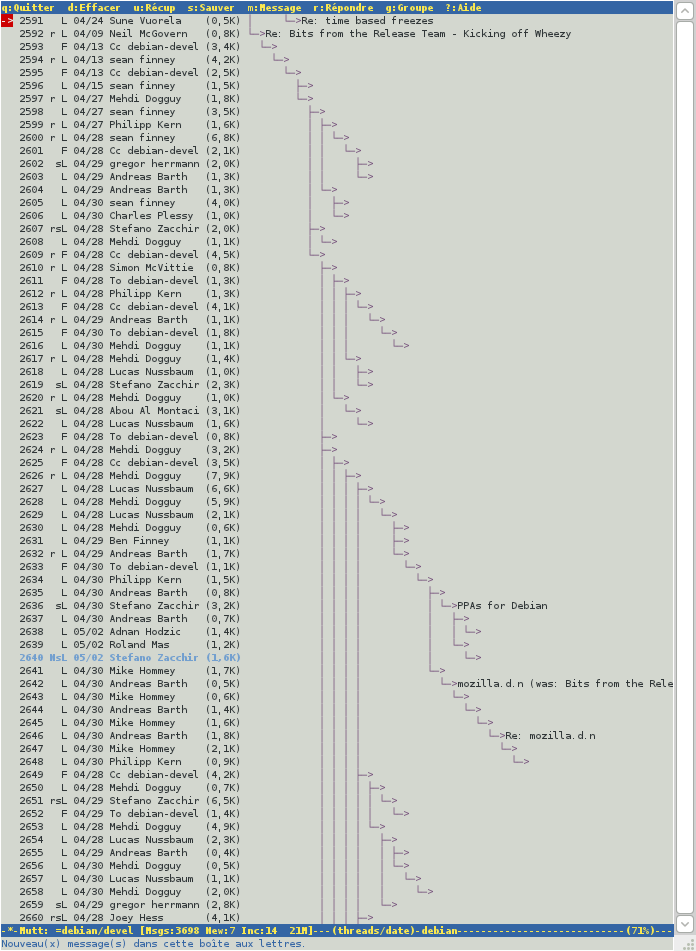
At this point it s a discussion thread of several hundreds of messages (there are several screens of messages like the one above). Many of the sub-threads have been interesting, but the general discussions mixed too many different things so that there s no clear outcome yet. Lucas Nussbaum tried to make a summary. Obviously I must adjust my plan, there s lots of feedback to process. I accepted to drive a DEP together with Sean Finney to help structure the part of the discussion that focuses on allowing development to continue during freezes. But I m also eager to fix the marketing problem of testing and have the project recognize that testing is a product in itself and that end-users should be encouraged to use it. Package Tracking System maintenance The Package Tracking System is an important tool for Debian developers, and it has been broken by some change on the Bug Tracking System. I worked around it quite quickly so that few people noticed the problem but Cron kept reminding me that I had to properly fix it. I ended up doing it last week-end. While working on the PTS, I took the opportunity to merge a patch from Jan Dittberner to enhance the news RSS feed that the PTS provides. And I also integrated information from backports.debian.org (thanks to Mehdi Dogguy for reminding me #549115). Multiarch update Not much new this month. I fixed two bugs in the multiarch dpkg branch thanks to bug reports from Ubuntu users (LP 767634, LP 756381). I m still waiting on Guillem Jover finishing his review of the multiarch branch. I m pinging him from time to time but it looks like multi-arch is no longer in his short term priority list. :-( I ve been running this code for more than 2 months and it works fine. I want to see it merged. I m ready to update my code should anything need to be changed to please Guillem. But without any feedback we re in a deadlock. Misc dpkg work While fixing a bug in update-alternatives (found in one of the valid reports on launchpad), I noticed that there was room for improvements in the error messages output by update-alternatives. I changed them to reuse the same strings that were already used in other parts of dpkg. The result is that there are a few strings less to translate (always a nice thing for the poor translators who have to deal with the thousands of strings that dpkg contains). I also tried to fix some of the most cryptic error messages in dpkg (see #621763) but that work is stalled at the request of Guillem. Book update We (me and Roland Mas) are almost done with the update of our French book for Debian Squeeze. It will hit the shelves in July or September. I m starting to prepare the fundraising campaign to make an English translation of it. We ll use ulule.com for this. On my blog I have been pleased to interview Meike Reichle, it s the first women that I have interviewed in the series but it s certainly not the last one. I also interviewed Adam D. Barratt, one of our tireless release managers. Thanks Many thanks to the people who gave me 180.35 in March and 235.37 in April. That represents 1.5 and 2 days of work for those months. See you next month for a new summary of my activities.

8 comments Liked this article? Click here. My blog is Flattr-enabled.

2 May 2011

Lucas Nussbaum: Debian rolling discussion on -devel@

Here is my attempt at a summary of the rolling discussion currently happening on debian-devel@. It might not be complete, it s probably a bit biased, but I hope that it s still better than nothing. It was also posted on debian-devel@. If you are involved in Debian development, please discuss it on debian-devel@, rather than in the comments of this blog. If you want to provide feedback about the Debian rolling idea, use this Doodle poll and/or the comments of this blog.
Update : Someone had the good idea to vandalize the poll, and remove all the votes from people in favor of rolling. Before the vadalism (log), the results were:
37 votes: I am a Debian user, I use testing or unstable, and I would like rolling to happen.
6 votes: I am a Debian user, I use testing or unstable, and I DON T want rolling to happen.
17 votes: I am a Debian user, I use stable, and I would like rolling to happen.
3 votes: I am a Debian user, I use stable, and I DON T want rolling to happen.
7 votes: I am NOT a Debian user, but I would probably use it if rolling happened.
1 vote: I am NOT a Debian user, and I don t care about rolling. Motivations There s some user demand for rolling releases. For evidence, one can look at the usage of Debian testing or unstable which clearly goes further than the Debian development community. Or at the quickly growing market share of ArchLinux. Or at the interest in LinuxMint and Aptosid. Or at the DPL s report of his interactions with the press. Debian s only official product is its stable releases. While it s a clearly great and useful product, many users and developers don t recognize themselves in it: it contains software that is too old for their needs. The success of Ubuntu is related to this problem: Ubuntu proposes a different compromise between stability and up-to-date-ness. While concurrencing Ubuntu with more frequent stable releases (released every 6-months, for example) doesn t look like the right thing to do, Debian is in a perfect position to provide a rolling release with marginal additional work, since Debian already has testing (and unstable) to build on. The rolling discussion investigates how we could endorse the concept of a rolling release, provided as a product in addition to stable releases. This rolling release would be based on the current testing branch. Benefits for Debian: Current proposed plan for rolling (Disclaimer: this is mostly my view. It is shared by others, but some details might not be) rolling is mostly about (external) communication. It is not expected to change our development processes fundamentally.
It would be a statement by the project (through a GR, for example). A very preliminary draft was proposed by Raphael Hertzog:
Title: Debian endorses usage of testing by end-users, and renames it to rolling The Debian project recognizes that the Debian testing distribution initially created to make it easier to prepare and test the next stable release has become a useful product of its own. It satisfies the needs of users who are looking for the latest stable versions of software and who can cope (or even appreciate) a system that s constantly evolving. The Debian project decides to endorse this usage and will strive to provide a good experience to users of testing . To better communicate this policy change to our users, testing will be renamed rolling .
Yes, it s mostly PR bullshit , and I don t expect it to significantly change Debian development processes. However, communication is necessary if we want to attract new users. What would change is more attention from developers to what happens in testing/rolling, which is a good thing since a better testing/rolling makes it easier to create stable releases from it. Open questions Most of the discussion is about the influence of the introduction of rolling on Debian development processes, and in particular, on the painful process resulting in stable releases. Many fear that, with rolling , it will be harder to get stable releases out. The root question is: if we do rolling, what do we do during freezes? Several options have been mentioned in the thread:
  1. We could decide not to do anything special: just freeze rolling for ~6 months, as we used to freeze testing. That might bore people who like the constant flux of new upstream releases, but if we decide that it s the only way to ensure high-quality stable releases, so be it.
  2. We could decide to fork a frozen branch when we freeze, and continue to manage rolling using migrations from unstable.
  3. We could mix both solutions: freeze rolling for 3 months, so that most of the stabilization work occurs with a single active branch, and then, for the final release preparation, fork frozen off rolling, and unfreeze rolling.
Two kinds of objections have been raised: Other things that were discussed: Tentative personal conclusion I have the impression that advertising testing as a rolling release usable by end-users is generally considered a good thing.
The renaming of testing to rolling is not as consensual, but most opponents have a whatever ; if you want position. How we deal with freezes is the hard point in this discussion. I m personnally in favor of the freeze rolling for 3 months, then fork frozen and unfreeze rolling plan, though it has some problems too (it is not clear whether the required manpower really decreases at the end of freezes). Where do we go from there? After another round of discussion, we might postpone the how to deal with freezes question to later, and proceed with a GR to measure the support for the testing for end-users + s/testing/rolling/ proposal.

Next.

Previous.


