/etc/opendkim/signing.table:
*@debian.org marcos-debian.anarcat.user
/etc/opendkim/key.table:
marcos-debian.anarcat.user debian.org:marcos-debian.anarcat.user:/etc/opendkim/keys/marcos-debian.anarcat.user.private
Yes, that's quite a mouthful! That magic selector is long in that
way because it needs a special syntax (specifically the
.anarcat.user suffix) for Debian to be happy. The -debian
string is to tell me where the key is published. The marcos
prefix is to remind me where the private is used.opendkim-genkey --directory=/etc/opendkim/keys/ --selector=marcos-debian.anarcat.user --domain=debian.org --verbose
This creates the DNS record in
/etc/opendkim/keys/marcos-debian.anarcat.user.txt (alongside the
private key in .key).service opendkim restart
The DNS record will look something like this:
marcos-debian.anarcat.user._domainkey IN TXT ( "v=DKIM1; h=sha256; k=rsa; "
"p=MIIBIjANBgkqhkiG9w0BAQEFAAOCAQ8AMIIBCgKCAQEAtKzBK2f8vg5yV307WAOatOhypQt3ANQ95iDaewkVehmx42lZ6b4PzA1k5DkIarxjkk+7m6oSpx5H3egrUSLMirUiMGsIb5XVGBPFmKZhDVmC7F5G1SV7SRqqKZYrXTufRRSne1eEtA31xpMP0B32f6v6lkoIZwS07yQ7DDbwA9MHfyb6MkgAvDwNJ45H4cOcdlCt0AnTSVndcl"
"pci5/2o/oKD05J9hxFTtlEblrhDXWRQR7pmthN8qg4WaNI4WszbB3Or4eBCxhUdvAt2NF9c9eYLQGf0jfRsbOcjSfeus0e2fpsKW7JMvFzX8+O5pWfSpRpdPatOt80yy0eqpm1uQIDAQAB" ) ; ----- DKIM key marcos-debian.anarcat.user for debian.org
"p=MIIB..." string needs to be joined together, without the
quotes and the p=, and sent in a signed email to
changes@db.debian.org:
-----BEGIN PGP SIGNED MESSAGE-----
dkimPubKey: marcos.anarcat.user MIIB[...]
-----BEGIN PGP SIGNATURE-----
[...]
host -t TXT marcos-debian.anarcat.user._domainkey.debian.org nsp.dnsnode.net
(nsp.dnsnode.net being one of the NS records of the
debian.org zone.)anarcat@debian.org.
check-auth@verifier.port25.com. Those tools will run Spamassassin
on the received emails and report the results. What you are looking
for is:
-0.1 DKIM_VALID: Message has at least one valid DKIM or DK
signature-0.1 DKIM_VALID_AU: Message has a valid DKIM or DK signature from
author's domain-0.1 DKIM_VALID_EF: Message has a valid DKIM or DK signature from
envelope-from domainMAIL FROM: header
as sent by the originating MTA, which you see as from=<> in the
postfix lost.
The following will happen anyways, as soon as you have a signature,
that's normal:
0.1 DKIM_SIGNED: Message has a DKIM or DK signature, not necessarily valid1.1 DKIM_ADSP_ALL No valid author signature, domain signs all mail--- a/opendkim/key.table
+++ b/opendkim/key.table
@@ -1 +1 @@
-marcos anarc.at:marcos:/etc/opendkim/keys/marcos.private
+marcos %:marcos:/etc/opendkim/keys/marcos.private
Welcome to gambaru.de. Here is my monthly report (+ the first week in April) that covers what I have been doing for Debian. If you re interested in Java, Games and LTS topics, this might be interesting for you.
I am sure I am not the only one who will remember March 2020 in the future as a month nobody was really fond of. I was mostly occupied with non-Debian work and managed to get ill in the same week I wanted to celebrate my birthday but it didn t matter anyway because of ehm quarantine and social distancing. Maybe next year March will be great again.
TLDR: setxkbmap -layout us -variant altgr-intl and become a happier programmer./etc/default/keyboardXKBLAYOUT="us"
XKBVARIANT="altgr-intl"
After restarting the X server, you can check that the settings have been applied withsetxkbmap -print -verbose 10If using Gnome, you can also set the keyboard layout and variant by changing the schema org.gnome.desktop-inputsources, which will override the desktop-agnostic settings of /etc/default/keyboard.dconf write /org/gnome/desktop/input-sources/sources "[('xkb', 'us+altgr-intl')]"
or navigate with the gui tool dconf-settings to org.gnome.desktop-inputsources and set the value there.
Armadillo is a powerful and expressive C++ template library for linear algebra aiming towards a good balance between speed and ease of use with a syntax deliberately close to a Matlab. RcppArmadillo integrates this library with the R environment and language and is widely used by (currently) 706 other packages on CRAN.
A new upstream release 9.860.2 of Armadillo was just released. The theme of convergence continues; the previous release increased the minor from 800 to 850, now we are at 860. We first wrapped this up as version 0.9.859.1.0, but it turned out to have been held back by a buglet between R 4.0.0 and Rcpp which the recent patch release fixed (along with other woes on old R or non-CRAN-alike macOS). It then turns out that the new (upstream) version 9.860.1 had a minor bug which I missed as I reverse-depends checked the prior version. Doh. My thanks, as always, to CRAN for spotting this. The fix was added upstream and we have 9.860.2 as RcppArmadillo 0.9.860.2.0.
Changes in the new release are noted below.
Courtesy of CRANberries, there is a diffstat report relative to previous release. More detailed information is on the RcppArmadillo page. Questions, comments etc should go to the rcpp-devel mailing list off the R-Forge page. If you like this or other open-source work I do, you can now sponsor me at GitHub. For the first year, GitHub will match your contributions.Changes in RcppArmadillo version 0.9.860.2.0 (2020-04-13)
- Upgraded to Armadillo release 9.860.2 (Roasted Mocha Fix)
- Added
powmat()- Faster access to columns in sparse submatrix views
- Faster handling of relational expressions by
accu()- Faster handling of sympd matrices by
expmat(),logmat(),sqrtmat()- Workaround for save/load issues with HDF5 v1.12
- Vignettes are now pre-made and include (#285)
- Two test files are now skipped on 32-bit Windows
This post by Dirk Eddelbuettel originated on his Thinking inside the box blog. Please report excessive re-aggregation in third-party for-profit settings.
A minor routine update 0.0.4 of gettz arrived on CRAN overnight.
gettz provides a possible fallback in situations where Sys.timezone() fails to determine the system timezone. That happened when e.g. the file /etc/localtime somehow is not a link into the corresponding file with zoneinfo data in, say, /usr/share/zoneinfo. Since the package was written (in the fall of 2016), R added a similar extended heuristic approach itself.
This release adds registration of the compiled routine via R_registerRoutines() and R_useDynamicSymbols(), adds .registration=TRUE to useDynLib() in NAMESPACE, and uses an unquoted symbol in .Call(). Two new badges were added to the README.md as well. And as in the previous release in 2016: No new code, or new features.
Courtesy of CRANberries, there is a comparison to the previous release.
More information is on the gettz page. For questions or comments use the issue tracker off the GitHub repo.
If you like this or other open-source work I do, you can now sponsor me at GitHub. For the first year, GitHub will match your contributions.
This post by Dirk Eddelbuettel originated on his Thinking inside the box blog. Please report excessive re-aggregation in third-party for-profit settings.
In a previous job I wrote some simple utilities which were helpful for continuous-integration pipelines. Most of these were very very simple, for example:
*.json files, and validate them.*.yaml files, and validate them.run-parts does this on Debian GNU/Linux systems, but on CentOS there is no -exit-on-error flag.sysbox validate-yaml [path/to/find/files/beneath]
Of course if you symlink validate-yaml to sysbox you don't need to prefix with the name - so this is just like busybox in this regard.
Might be interesting to some.
" 'Boa constrictors swallow their prey whole, without chewing it. After that they are not able to move, and they sleep through the six months that they need for digestion.'
I pondered deeply, then, over the adventures of the jungle. And after some work with a colored pencil I succeeded in making my first drawing.
My Drawing Number One.
It looked something like this:
I showed my masterpiece to the grown-ups, and asked them whether the drawing frightened them.
But they answered: 'Frighten? Why should any one be frightened by a hat?'
My drawing was not a picture of a hat. It was a picture of a boa constrictor digesting an elephant. But since the grown-ups were not able to understand it, I made another drawing: I drew the inside of a boa constrictor, so that the grown-ups could see it clearly. They always need to have things explained.
My Drawing Number Two looked like this:
The grown-ups' response, this time, was to advise me to lay aside my drawings of boa constrictors, whether from the inside or the outside, and devote myself instead to geography, history, arithmetic, and grammar.
That is why, at the age of six, I gave up what might have been a magnificent career as a painter. I had been disheartened by the failure of my Drawing Number One and my Drawing Number Two.
Grown-ups never understand anything by themselves, and it is tiresome for children to be always and forever explaining things to them."
from The Little Prince by Antoine de Saint Exup ry
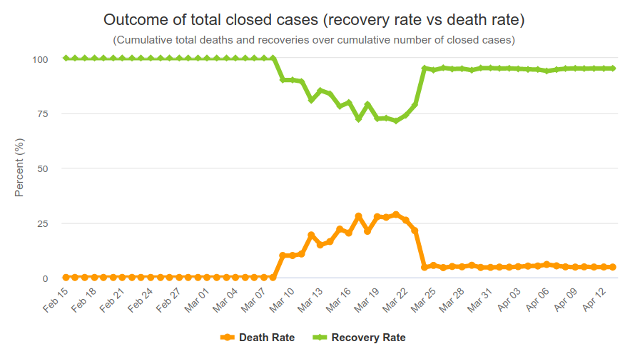
from the Corona Fun with Statistics department at Worldometers
(source, archive.org link)
@debian.org are very nice and well-behaving, any random spammer can
easily send emails from whatever@debian.org, and even if you trust
people from @debian.org you cannot easily configure your antispam
filter to just accept all emails from @debian.org, because spammers
would get in too.
Since nearly ten years DKIM is there to help you. If you send an email
from @debian.org with DKIM, it will have a header like this:
DKIM-Signature: v=1; a=rsa-sha256; c=simple/simple; d=debian.org;
s=vps.gio.user; t=1586779391;
bh=B6tckJy2cynGjNRdm3lhFDrp0tD7fF8hS4x0FCfLADo=;
h=From:Subject:To:Date:From;
b=H4EDlATxVm7XNqPy2x7IqCchBUz1SxFtUSstB23BAsdyTKJIohM0O4RRWhrQX+pqE
prPVhzcfNALMwlfExNE69940Q6pMCuYsoxNQjU7Jl/UX1q6PGqdVSO+mKv/aEI+N49
vvYNgPJNLaAFnYqbWCPI8mNskLHLe2VFYjSjE4GJFOxl9o2Gpe9f5035FYPJ/hnqBF
XPnZq7Osd9UtBrBq8agEooTCZHbNFSyiXdS0qp1ts7HAo/rfrBfbQSk39fOOQ5GbjV
6FehkN4GAXFNoFnjfmjrVDJC6hvA8m0tJHbmZrNQS0ljG/SyffW4OTlzFzu4jOmDNi
UHLnEgT07eucw==
d=debian.org is the domain this email claims to be from
and the fields bh= and b= are a cryptographic public key signature
certifying this fact. How do I check that the email is actually from
@debian.org? I use the selector s=vps.gio.user to fetch the public
key via DNS, and then use the public key to verify the signature.
$ host -t TXT vps.gio.user._domainkey.debian.org
vps.gio.user._domainkey.debian.org descriptive text "v=DKIM1; k=rsa; s=email; h=sha256; p=" "MIIBIjANBgkqhkiG9w0BAQEFAAOCAQ8AMIIBCgKCAQEAsM/W/kxtKWT58Eak0cfm/ntvurfbkkvugrG2jfvSMnHHkFyfJ34Xvn/HhQPLwX1QsjhuLV+tW+BQtxY7jxSABCee6nHQRBrpDej1t86ubw3CSrxcg1mzJI5BbL8un0cwYoBtUvhCYAZKarv1W2otCGs43L0s" "GtEqqtmYN/hIVVm4FcqeYS1cYrZxDsjPzCEocpYBhqHh1MTeUEddVmPHKZswzvllaWF0mgIXrfDNAE0LiX39aFKWtgvflrYFKiL4hCDnBcP2Mr71TVblfDY0wEdAEbGEJqHR1SxvWyn0UU1ZL4vTcylB/KJuV2gMhznOjbnQ6cjAhr2JYpweTYzz3wIDAQAB"
@debian.org. The spammer
hopefully does not have access to Debian's DKIM keys, and they cannot
sign emails.
Many large and small email services have already deployed DKIM since
years, while most @debian.org emails still do not use it. Why not?
Because people send @debian.org emails from many different
servers. Basically, every DD used their @debian.org address sends
email from their own mail server, and those mail servers (fortunately)
do not have access to Debian's DNS record to install their DKIM
keys. Well, that was true until yesterday! :-)
A few weeks ago I poked DSA asking to allow any Debian Developer to
install their DKIM keys, so that DDs could use DKIM to sign their
emails and hopefully reduce the amount of spam sent from
@debian.org. They have done it (thank you DSA very much, especially
adsb), and now it is possible to use it!
How do I configure it?
I will not write here a full DKIM tutorial, there are
many
around. You
have to use opendkim-genkey to generate a key and then configure
your mail server to use opendkim to digitally sign outbound email.
There are a few Debian-specific things you have to care about, though.
First the have to choose a selector, which is a string used to
distinguish many DKIM keys belonging to the same domain. Debian allows
you to installa a key whose selector is <something>.<uid>.user,
where <uid> is your Debian uid (this is done both for namespacing
reasons and for exposing who might be abusing the system). So check
carefully that your selector has this form.
Then you cannot edit directly Debian's DNS record. But you can use the
email-LDAP gateway on db.debian.org to
install your key in a way similar to how entries in debian.net are
handled (see the updated
documentation). Specifically,
suppose that opendkim-genkey generated the following thing for
selector vps.gio.user and domain debian.org:
vps.gio.user._domainkey IN TXT ( "v=DKIM1; h=sha256; k=rsa; "
"p=MIIBIjANBgkqhkiG9w0BAQEFAAOCAQ8AMIIBCgKCAQEAsM/W/kxtKWT58Eak0cfm/ntvurfbkkvugrG2jfvSMnHHkFyfJ34Xvn/HhQPLwX1QsjhuLV+tW+BQtxY7jxSABCee6nHQRBrpDej1t86ubw3CSrxcg1mzJI5BbL8un0cwYoBtUvhCYAZKarv1W2otCGs43L0sGtEqqtmYN/hIVVm4FcqeYS1cYrZxDsjPzCEocpYBhqHh1MTeUE"
"ddVmPHKZswzvllaWF0mgIXrfDNAE0LiX39aFKWtgvflrYFKiL4hCDnBcP2Mr71TVblfDY0wEdAEbGEJqHR1SxvWyn0UU1ZL4vTcylB/KJuV2gMhznOjbnQ6cjAhr2JYpweTYzz3wIDAQAB" ) ; ----- DKIM key vps.gio.user for debian.org
p= field (without
being fooled by it being split between different strings) and
construct a request of the form:
dkimPubKey: vps.gio.user MIIBIjANBgkqhkiG9w0BAQEFAAOCAQ8AMIIBCgKCAQEAsM/W/kxtKWT58Eak0cfm/ntvurfbkkvugrG2jfvSMnHHkFyfJ34Xvn/HhQPLwX1QsjhuLV+tW+BQtxY7jxSABCee6nHQRBrpDej1t86ubw3CSrxcg1mzJI5BbL8un0cwYoBtUvhCYAZKarv1W2otCGs43L0sGtEqqtmYN/hIVVm4FcqeYS1cYrZxDsjPzCEocpYBhqHh1MTeUEddVmPHKZswzvllaWF0mgIXrfDNAE0LiX39aFKWtgvflrYFKiL4hCDnBcP2Mr71TVblfDY0wEdAEbGEJqHR1SxvWyn0UU1ZL4vTcylB/KJuV2gMhznOjbnQ6cjAhr2JYpweTYzz3wIDAQAB
changes@db.debian.org:
echo 'dkimPubKey: vps.gio.user blahblahblah' gpg --clearsign mail changes@db.debian.org
host -t TXT vps.gio.user._domainkey.debian.org to chech the
key gets published (it will probably take some minutes/hours, I don't
know). Once it is published, you can enable DKIM in you mail server
and your email will be signed. Congratulations, you will not look like
a spammer any more!
You can send an email to check-auth@verifier.port25.com to check
that your setup is correct. They will reply with a report, including
the success of DKIM test.
Notice that currently Debian's setup only allows you to use RSA DKIM
keys and doesn't allow you to set other DKIM fields (but you probably
won't need to set them).
EDIT DSA made an official announcement about DKIM
support,
which you might want to check out as well, together with its links.
EDIT 2 Now ed25519 keys are supported, the syntax for specifying
keys on LDAP is a little bit more flexible and you can also insert
CNAME records. See the official
documentation for the updated
details.
So we have solved our problems with spam?
Ha, no! DKIM is only a small step. Useful, also because it enable
other steps to be taken in the future, but small.
In particular, DKIM enables you to say: "This particular email
actually comes from @debian.org", but doesn't tell anybody what to
do with emails that are not signed. A third-party mail server might
wonder whether @debian.org emails are actually supposed to be signed
or not.
There is another standard for dealing with that, which is called
DMARD, and I believe that Debian should eventually use it, but not
now: the problem is that currently virtually no email from
@debian.org is signed with DKIM, so if DMARC was enabled other mail
servers would start to nuke all @debian.org emails, except those
which are already signed, a minority. If people and services sending
emails from @debian.org will start configuring DKIM on their
servers, which is now possible, it will eventually come a time when
DMARC can be enabled, and spammers will find themselves unable to send
forged @debian.org emails. We are not there yet, but todays we are a
little step closer than yesterday.
Also, notice that having DKIM on @debian.org only counters spam
pretending to be from @debian.org, but there is much more. The
policy on what to accept is mostly independent on that on what you
send. However, knowing that @debian.org emails have DKIM and DMARC
would mean that we can set our spam filters to be more aggressive in
general, but whitelist official Debian Developers and services. And
the same can be done for other domains using DKIM and DMARC.
Finally, notice that some incompatibilities between DKIM and mailing
lists are known, and do not have a definitive answer yet. Basically,
most mailing list engines modify either the body of the headers in
forwarded emails, which means that DKIM does not validate any
more. There are many proposed solutions, possibly none completely
satisfying, but since spam is not very satisfying as well, something
will have to be worked out. I wrote a lot already, though, so I wont't
discuss this here.
A few days ago we have released upstream TeX Live 2020, and Debian packages are already available in the sid/unstable suite, and will (hopefully) migrate to testing rather soon.
All the changes listed in the upstream release blog apply also to the Debian packages:
The currently available versions in unstable are
I was gonna use this blog post to share about the migrant worker woes as there has been multiple stories doing the rounds. For e.g. a story which caught the idea of few people but most of us, i.e. middle-class people are so much into our own thing that we care a fig leaf about what happens to migrants. This should not be a story coming from a humane society but it seems India is no different than any other country of the world and in not a good way. Allow me to share
Or for those who don t like youtube, here s an alternative link
https://www.invidio.us/watch?v=JGEgZq_1jmc
Now the above two editorial shares two stories, one of Trump retaliatory threat to India in the Q&A of the journalist. In fact, Trump has upped the ante on visa sanctions as India buckled so easily under pressure.
There have been other stories doing the rounds how people who have illnesses who need HCQ in India are either dying or are close to death because of unavailability of HCQ in the medicine shop. There have been reports in Pune as well as South Mumbai (one of the poshest localities in Mumbai/Bombay) that medicine shops are running empty or emptier. There have been so many stories on that, with reporters going to shops and asking owners of the medicine shops and shop-owners being clueless.
I think the best article which vividly describes the Government of India (GOI) response to the pandemic is the free-to-read article shared by Arundhati Roy in Financial Times. It has reduced so much of my work or sharing that it s unbelievable. And she has shared it with pictures and all so I can share other aspects of how the pandemic has been affecting India and bringing the worst out in the Government in its our of need. In fact, not surprisingly though, apparently there was also a pro-Israel similar thing which happened in Africa too . As India has too few friends now globally, hence it decided to give a free pass to them.
News Broadcasters Association reply to Mrs. Gandhi
Aryan Plastic bottle
Dhauladhar range Northern Punjab Copyright CNN.Com

Intel's Dynamic Platform and Thermal Framework (DPTF) is a feature that's becoming increasingly common on highly portable Intel-based devices. The adaptive policy it implements is based around the idea that thermal management of a system is becoming increasingly complicated - the appropriate set of cooling constraints to place on a system may differ based on a whole bunch of criteria (eg, if a tablet is being held vertically rather than lying on a table, it's probably going to be able to dissipate heat more effectively, so you should impose different constraints). One way of providing these criteria to the OS is to embed them in the system firmware, allowing an OS-level agent to read that and then incorporate OS-level knowledge into a final policy decision.
Welcome to the 25nd post in the randomly recurring R recitations series, or R4 for short.
Just yesterday, we posted a short post along with a video and supporting slides. It covered how to test the soon-to-be-released R 4.0.0 on a custom Ubuntu 18.04 Rocker container.
A container for Ubuntu 20.04, which is itself in final beta stages, was being built while the video was made. As it is available now, we created a quick follow-up video showing the use under Ubuntu 20.04:
The updated supporting slides from the video are still at this link. What we showed in both videos does of course also work directly on Ubuntu (or Debian, using those source repos) installations; the commands shown in the Rocker use case generally apply equally to a normal installation. If you like this or other open-source work I do, you can now sponsor me at GitHub. For the first year, GitHub will match your contributions.
This post by Dirk Eddelbuettel originated on his Thinking inside the box blog. Please report excessive re-aggregation in third-party for-profit settings.
I am switching jobs, and after a two year stint as a full stack developer at BPMasters, I am joining Red Hat as a Technical Account Manager (Platform and Openshift). A good friend of a good friend already worked at Red Hat, and advised me to apply, which I did, and I am starting in May in Vienna, the place where I live.
Welcome to the 24nd post in the relentlessly regular R ravings series, or R4 for short.
R 4.0.0 will be released in less than two weeks, and testing is very important. I had uploaded two alpha release builds (at the end of March and a good week ago) as well as a first beta release yesterday, all to the Debian experimental distribution (as you can see here) tracking the release schedule set by Peter Dalgaard. Because R 4.0.0 will require reinstallation of all packages, it makes some sense to use a spare machine. Or a Docker container. So to support that latter mode, I have now complemented the binaries created from the r-base source package with all base and recommended packages, providing a starting point for actually running simple tests. Which is what we do in the video, using again the R on Ubuntu (18.04) Rocker container:
Slides from the video are at this link. This container based on 18.04 is described here on the Docker Hub; a new 20.04 container with the pre-release of the next Ubuntu LTS should be there shortly once it leaves the build queue. What we showed does of course also work on direct Ubuntu (or Debian, using those source repos) installations; the commands shown in the Rocker use case generally apply equally to a normal installation. If you like this or other open-source work I do, you can now sponsor me at GitHub. For the first year, GitHub will match your contributions.
This post by Dirk Eddelbuettel originated on his Thinking inside the box blog. Please report excessive re-aggregation in third-party for-profit settings.
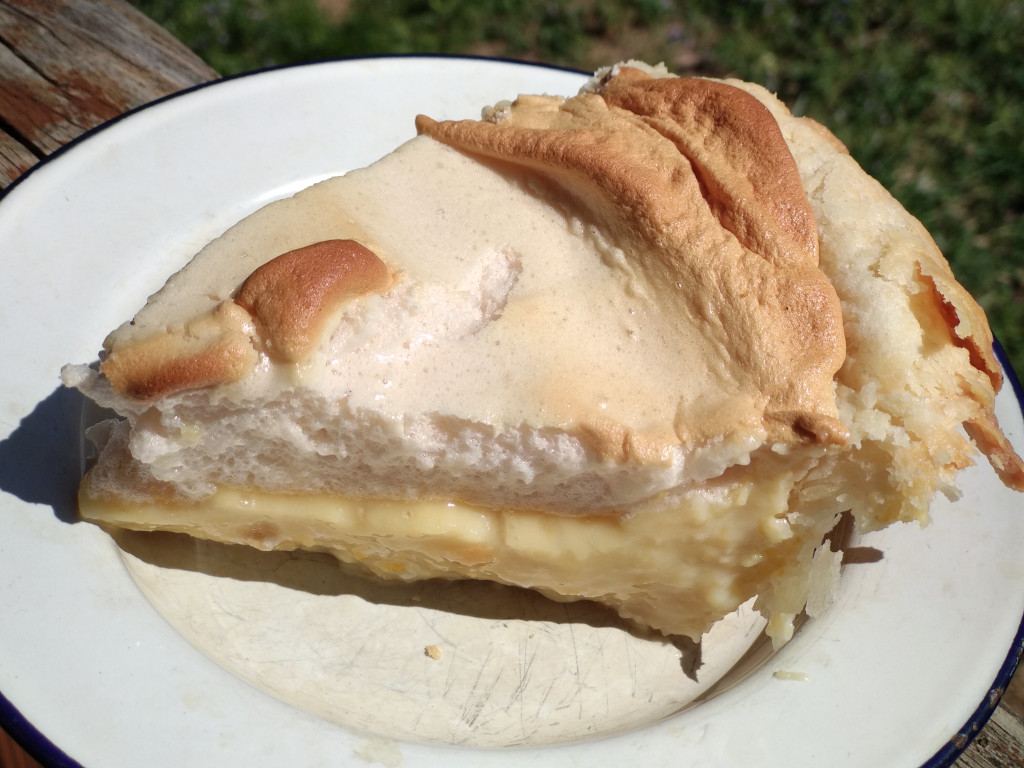
Lemon is one of my things. I homegrow meyer lemons and mostly eat them
whole. My mom makes me lemon meringue pie on my birthday. I thought
I knew how much work that must be.
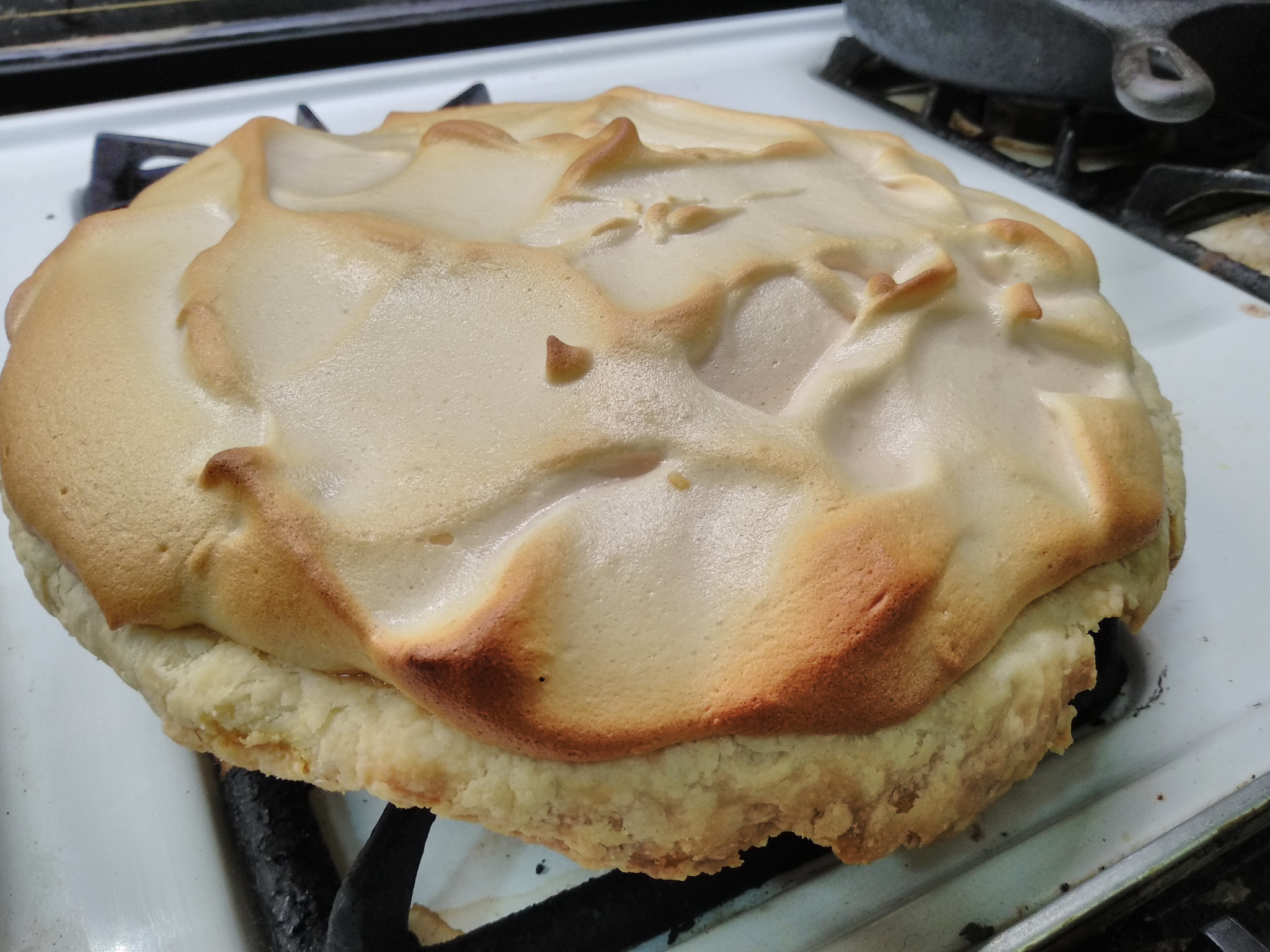
Well, that was harder than anticipated, and so worth it. Glad my mom was
there on jitsi to give moral support while I hand whisked the egg whites
and cursed.
I also got a homemade mask whose quarantimer
expired just in time.
But all I really want want for my birthday, this April 11th 2020, is for
the coronavirus to have peaked today. I mean, having a pandemic peak on your
birthday is sour, but it's better than the alternative.
Please give me that gift. Stay home. Even when some are saying
it's over, watch the graphs. Don't go visit even
just one person,
even on their birthday. I think you can do it.
Yes?
If you read this post through Planet
Debian, then you may already know this
through "Johnathan"'s
post
on the subject: on the 29th of February this year, Tammy and I got
married. Yes. Really. No, I didn't expect this to happen myself about
five years ago, but here we are.
Tammy and I met four years ago at DebConf16 in Cape Town, South Africa,
where she was a local organizer. If you were at dc16, you may remember
the beautifully designed conference stationery, T-shirts, and bag; this
was all her work. In addition, the opening and closing credits on the
videos
of that conference were designed by her.
As it happens, that's how we met. I've been a member of the Debconf
video team since about 2010, when I first volunteered to handle a few
cameras. In 2015, since someone had to do it, I installed Carl's
veyepar on Debian's on-site
servers, configured, and ran it. I've been in charge of the
postprocssing infrastructure -- first using veyepar, later using my own
SReview -- ever
since. So when I went to the Debconf organizers in 2016 to ask for
preroll and postroll templates for the videos, they pointed me to Tammy;
and we haven't quite stopped talking since.
I can speak from experience now when saying that a long-distance
relationship is difficult. My previous place of residence, Mechelen, is
about 9600km away from Cape Town, and so just seeing Tammy required
about a half month's worth of pay -- not something I always have to
spare. But after a number of back-and-forth visits and a lot of
paperwork, I have now been living in Cape Town for just over a year.
Obviously, this has simplified things a lot.
The only thing left for me to do now is to train my brain to stop
thinking there's something stuck on my left ring finger. It's really
meant to be there, after all...
:wq for today.
Get the Champagne ready, we have released the final images of TeX Live 2020.
Due to COVID-19, DVD production will be delayed, but we have decided to release the current image and update the net installer. The .iso image is available on CTAN, and the net installer will pull all the newest stuff. Currently we are working on getting those packages updated during the freeze to the newest level in TeX Live.
Before providing the full list of changes, here a few things I would like to pick out:
lualatex is now based on LuaHBTeX, meaning that one can use the HarfBuzz renderer which in particular for complicated scripts (Tibetan, Bengali, ) works better than the Lua-based renderer. Note that luatex itself remains normal LuaTeX, only the luaLAtex one uses LuaHBTeX.foobar.tar.xz while the name never changed. We have now changed all the infrastructure and TeX Live Manager to work with versioned containers foobar.rNNNNN.tar.xz. This should help quite some distributors!\input primitive in all TeX engines, including tex, now also accepts a group-delimited lename argument, as a system-dependent extension. The usage with a standard space/token-delimited lename is completely unchanged. The group-delimited argument was previously implemented in LuaTeX; now it is available in all engines. ASCII double quote characters ( ) are removed from the lename, but it is otherwise left unchanged after tokenization. This does not currently a ect LaTeX s \input command, as that is a macro rede nition of the standard \input primitive. cnf-line for kpsewhich, tex, mf, and all other engines, to support arbitrary con guration settings on the command line.\Uchar, \Ucharcat, \current(x)spacingmode, \ifincsname; revise \fontchar?? and \iffontchar. For eupTeX only: \currentcjktoken.
LuaTeX: Integration with HarfBuzz library, available as new engines luahbtex (used for lualatex) and luajithbtex. New primitives: \eTeXgluestretchorder, \eTeXglueshrinkorder.
pdfTeX: New primitive \pdfmajorversion; this merely changes the version number in the PDF output; it has no e ect on any PDF content. \pdfximage and similar now search for image les in the same way as \openin.
pTeX: New primitives \ifjfont, \iftfont. Also in epTeX, upTeX, eupTeX.
XeTeX: Fixes for \Umathchardef, \XeTeXinterchartoks, \pdfsavepos.
Dvips: Output encodings for bitmap fonts, for better copy/paste capabilities (https://tug.org/TUGboat/tb40-2/tb125rokicki-type3search.pdf).
MacTeX: MacTeX and x86_64-darwin now require 10.13 or higher (High Sierra, Mojave, and Catalina); x86_64-darwinlegacy supports 10.6 and newer. MacTeX is notarized and command line programs have hardened runtimes, as now required by Apple for install packages. BibDesk and TeX Live Utility are not in MacTeX because they are not notarized, but a README le lists urls where they can be obtained.
tlmgr and infrastructure:
tlmgr check texmfdbs, to to check consistency of ls-R les and !! speci cations for each tree.tlnet/archive/pkgname.rNNN.tar.xz; should be invisible to users, but a notable change in distribution.catalogue-date information no longer propagated from the TeX Catalogue, since it was often unrelated to package updates.
Rcpp 1.0.4 was released on March 17, following the usual sequence of fairly involved reverse-depends check along with a call for community testing issued weeks before the release. In that email I specifically pleaded with folks to pretty-please test non-standard setups:
It would be particularly beneficial if those with unsual build dependencies tested it as we would increase overall coverage beyond what I get from testing against 1800+ CRAN packages. BioConductor would also be welcome.Alas, you can t always get what you want. Shortly after the release we were made aware that the two (large) pull request at the book ends of the 1.0.3 to 1.0.4 release period created trouble. Of these two, the earliest PR in the 1.0.4 release upset older-than-CRAN-tested installation, i.e. R 3.3.0 or before. (Why you d want to run R 3.3.* when R 3.6.3 is current is something I will never understand, but so be it.) This got addressed in two new PRs. And the matching last PR had a bit of sloppyness leaving just about everyone alone, but not all those macbook-wearing data scientists when using newer macOS SDKs not used by CRAN. In other words, unsual setups. But boy, do those folks have an ability to complain. Again, two quick PRs later that was addressed. Along came a minor PR with two more
Rcpp::Shield<> uses (as life is too short to manually count PROTECT and UNPROTECT). And then a real issue between R 4.0.0 and Rcpp first noticed with RcppParallel builds on Windows but then also affecting RcppArmadillo. Another quickly issued fix. So by now the count is up to six, and we arrived at Rcpp 1.0.4.6.
Which is now on CRAN, after having sat there for nearly a full week, and of course with no reason given. Because the powers that be move in mysterious ways. And don t answer to earthlings like us.
As may transpire here, I am little tired from all this. I think we can do better, and I think we damn well should, or I may as well throw in the towel and just release to the drat repo where each of the six interim versions was available for all to take as soon as it materialized.
Anyway, here is the state of things. Rcpp has become the most popular way of enhancing R with C or C++ code. As of today, 1897 packages on CRAN depend on Rcpp for making analytical code go faster and further, along with 191 in BioConductor. And per the (partial) logs of CRAN downloads, we are running steasy at one millions downloads per month.
The changes for this interim version are summarized below.
Thanks to CRANberries, you can also look at a diff to the previous release. Questions, comments etc should go to the rcpp-devel mailing list off the R-Forge page. Bugs reports are welcome at the GitHub issue tracker as well (where one can also search among open or closed issues); questions are also welcome underChanges in Rcpp patch release version 1.0.4.6 (2020-04-02)
- Changes in Rcpp API:
- The exception handler code in #1043 was updated to ensure proper include behavior (Kevin in #1047 fixing #1046).
- A missing
Rcpp_list6definition was added to support R 3.3.* builds (Davis Vaughan in #1049 fixing #1048).- Missing
Rcpp_list 2,3,4,5definition were added to the Rcpp namespace (Dirk in #1054 fixing #1053).- A further updated corrected the header include and provided a missing else branch (Mattias Ellert in #1055).
- Two more assignments are protect with
Rcpp::Shield(Dirk in #1059)- Changes in Rcpp Attributes:
- Changes in Rcpp Deployment:
rcpp tag at StackOverflow which also allows searching among the (currently) 2356 previous questions.
If you like this or other open-source work I do, you can now sponsor me at GitHub. For the first year, GitHub will match your contributions.
This post by Dirk Eddelbuettel originated on his Thinking inside the box blog. Please report excessive re-aggregation in third-party for-profit settings.
Next.