Search Results: "zed"

14 June 2007

Ingo Juergensmann: Gallery2 and Comment Spam BotNets

For about two weeks now it seems that a botnet is attacking one of my Gallery2 installations in order to either comment spam me or to solve the captchas:


121.132.186.55 - - [14/Jun/2007:09:09:27 +0200] "POST /main.php?g2_GALLERYSID=4cc6b5e4b7ce4a207957a07c081b6f65 HTTP/1.1" 200 12167 "http://gallery.foobar.net/main.php?g2_GALLERYSID=631acbacb15f2cfb83cdaf592721c082" "Mozilla/4.0 (compatible; MSIE 6.0; Windows NT 5.1)" 0 gallery.foobar.net
121.132.186.55 - - [14/Jun/2007:09:09:30 +0200] "GET /main.php?g2_view=comment.AddComment&g2_itemId=7152&g2_return=main.php%3Fg2_itemId%3D7152%26&&g2_returnName=photo HTTP/1.1" 200 10349 "http://gallery.foobar.net/main.php?g2_view=comment.AddComment&g2_itemId=7152&g2_return=main.php%3Fg2_itemId%3D7152%26&&g2_returnName=photo" "Mozilla/4.0 (compatible; MSIE 6.0; Windows NT 5.1)" 0 gallery.foobar.net
121.132.186.55 - - [14/Jun/2007:09:09:32 +0200] "POST /main.php?g2_GALLERYSID=b45c76223a933ba3bed6e09a9589a6cd HTTP/1.1" 200 12081 "http://gallery.foobar.net/main.php?g2_view=comment.AddComment&g2_itemId=7152&g2_return=main.php%3Fg2_itemId%3D7152%26&&g2_returnName=photo" "Mozilla/4.0 (compatible; MSIE 6.0; Windows NT 5.1)" 0 gallery.foobar.net


Sadly Gallery2 seems to not offer the configuration option to disable comments for non-authorized/logged-in users, just only to disable captchas for some users/groups, but apparently disabling captchas for guests seems totally wrong for me.
Currently I'm blocking the hosts with an iptables rule whenever I see an attacking host by accident, but I guess that there should be a better option...

13 June 2007

David Welton: Ruby gems annoyance - GPL'ed libraries

I tend not to be much of a license bigot, and think that they all have their places, but GPL'ed libraries are annoying, especially when they've been "blessed" by being inserted into an official repository like Ruby's gems. Consider:
  1. A big, large stand-alone application, like...Linux, for instance. I can see why people might GPL it - because there is a very real risk of someone "taking it proprietary" (or was - these days the comunity is too big and too fast to compete with). So I can understand the use of the GPL there.
  2. 200 lines of library code. There is no way anyone is going to "take it proprietary" and make any money off it. Even incorporated into some proprietary application, it's not going to make or break it. So, if it's GPL'ed, those working on proprietary software won't use it. If, on the other hand it uses a liberal license, then they can use it, and if they're smart, they'll contribute back any improvements to it.
I suppose that in case 2, someone might still GPL the code if their goal is solely to keep it out of the hands of proprietary developers, even at the cost of having less utilized and contributed to free code, but it's not an optimal strategy otherwise. The problem that I've stumbled upon is that Ruby's Gem repository is full of randomly licensed code, including lots of GPL stuff. At the very least, this information ought to be very visible so that it's possible to weed out any GPL'ed libraries. At best, the Ruby guys would only accept MIT/BSD licensed code for the standard repository. This is something that's done well in the Tcl community. Tcl is BSD licensed, and so is everything that surrounds it. Sure, people at times consciously decide to GPL their applications, but that's their right, and it's much easier to understand than some tiny bit of random code that one might like to use for some particular function in an application.

Adam Rosi-Kessel: Parmet on Public Health and Individualism

Via Jason, my brilliant former Constitutional Law professor Wendy Parmet weighs in on the XDR-TB scare. Unlike most coverage, Professor Parmet brings out the big picture of how the incident fits into a larger flawed public health policy:
…It is trite but true that in America we admire individual self-sufficiency and rugged individualism. Not only do we admire this taking care of number 1 attitude, but public health has encouraged it. Over the last several decades, public health has emphasized the role that individuals can and should play in determining their own health. Indeed, every day of week, we are bombarded with messages about how we can do this or that to take care of ourselves. Sometimes the message extends to what we can do for our families. Seldom are we told what or how we can do for unnamed others. Even infectious disease policies perpetuate this myth of self-control. We are told to vaccinate our children to protect them. We are told to help ourselves by getting a flu shot. And the federal government provides us with information about how we should prepare to help ourselves and our family in the event of an influenza pandemic. This privatization of infectious disease control is even evident in the U.S. approach to quarantine. During the SARS epidemic, governments in Canada and in Asia quickly realized that quarantines would not be effective without income protection. So laws were passed to assure that people would receive compensation while under quarantine. In the United States, in contrast, despite all the efforts that have been made at public health preparedness and public health law modernization, income replacement remains off the table (the Family and Medical Leave Act only guarantees unpaid leaves for some ill employees). Perhaps even more astonishingly, in its proposed quarantine regulations, the CDC failed to ensure that it would provide all necessary health care to those it quarantined. …

Mario Iseli: Organize stuff and prepare for Debconf

Hello World :) Debconf (16.6.2007) is getting closer, in 77 hours I will take the train to the airport in Geneva and then fly to Edinburgh. I didn’t really organize anything yet so it becomes stressful.
* Today I organized a kilt from a friend, looks quite funny, I will wear it on Saturday.
* Wednesday I want to prepare my private notebook and maybe even my IBM x60s from the office.
* Wednesday I want to prepare my digital camera and clean the memory stick.
* Wednesday I’ll organize 95 for the LPI exams.
* Wednesday evening I’ll go out with some friends to have party (several of my friends go to the Greenfield festival Thursday evening and I go to Debconf, time to celebrate)
* Thursday evening I will leave work early and go to Biel to buy some clothes for me, cheese for madduck and the othere Cheese’n'Wine participiants, chocolate for ana, cookies for Joerg. (If you also want something from .ch, please ping me on IRC)
* Thursday after shopping I need to go to a business dinner in a Mongolian BBQ restaurant.
* Friday I need to organize some W-Lan cards for the airport in Geneva in a Swisscom-Shop.
* Friday I would like to bring a friend a birthday gift.
* Friday I would like to go to have a drink with my ex-girlfriend.
* Friday night I need to prepare my baggage including all technical stuff. So you see, several tasks I have to do (this weren’t all of them) and I hope to be able to do all of that ;) See you in Teviot, Saturday afternoon!

12 June 2007

Antti-Juhani Kaijanaho: Benja on denotational semantics

My friend Benja Fallenstein got carried away in the comment section of my latest post on recursion and wrote a tutorial on how it all relates to denotational semantics. It’s a shame it is buried somewhere in the comments, so I am reposting the comment here with Benja’s permission. The tagline is, Denotational semantics tutorials. It s the new monad tutorials!
Benja Fallenstein writes: Having read and understood [the] entire post, I can now summarize Antti-Juhani s complaint in a way that programmers with no theoretical background will understand: The definition is an infinite recursion. Sure, it s self-referential, but since it recurses forever, it doesn t actually define what recursion is! :-) That said, I find it kind of a pity to introduce all this theory without talking about why it nicely models the real world. Antti-Juhani argues that this pretty much the definition of popularized science, but I have to admit that, as definitions go, I like recursion: see recursion better. :) So let me have a quick go. [UPDATE: Didn t turn out to be quick at all. This is, in fact, as long as Antti-Juhani s original post. Proceed at your own peril.] All of this comes from denotational semantics, which is concerned with what expressions in a programming language mean and which ones mean the same thing. For example, 7 denotes the number seven, 7+2 denotes the number nine, and 5+4 also denotes the number nine. Now, here s the knotty problem. If we have f(x) = if x = 0 then 1 else x*f(x-1) then f(4) denotes the number twenty-four, but what does f(-2) denote? So, denotational semantics introduces a new, special value, recurses forever. An expression of type integer either denotes an integer, or, like f(-2), it denotes recurses forever. Now, about these partial orders. (Reminder: A partial order says, for every pair (x,y) of elements of a certain set, that x is smaller than y, equal to y, larger than y, or incomparable to y.) Here is Benja s guide to what the partial orders of denotational semantics mean: Let s say that you write a program where, in one place, you can plug in either x or y. If you can write such a program that prints foo when you plug in x and prints bar when plug in y, then x and y are incomparable. If you can t do that, but you can write a program that prints foo when you plug in y, and recurses forever when you plug in x, then x is smaller than y. If every program you can write will do the same thing whether you plug in x or y, then x and y are equal. (We ignore details like out-of-memory errors and *how long* a program takes to do something.) Examples: - 5 and 7 are incomparable. Proof: if ___ == 5 then print foo else print bar . - f(-2) f(2). Proof: if ___ == 2 then print foo else print foo if you plug in f(-2), this will loop forever, if you plug in f(2), it ll print foo . - (5+2) = 7. Whatever program I write, it will do the same thing, no matter which of these expressions I plug in. Now, with expressions of type integer, the resulting partial order is: Recurses forever is smaller than everything else. All other values are incomparable. Recall from Antti-Juhani s post that the bottom element ( ) is defined to be the smallest element of a mathematical universe (if such a beast exists). Since recurses forever is smaller than everything else, it s the bottom element of this universe. That s what denotational semantics calls it. (Haskell, too.) Of course, this partial order is kind of boring (the technical term is flat ). It gets more interesting when we consider functions. In general, we can talk about functions from values of type S to values of type T, where we already know the partial orders of S and T. In particular, we can talk about functions from integers to integers. Now, if you can find an x and a program that prints foo when you plug in f(x) and bar if you plug in g(x), then you can write a program that prints foo when you plug in f, and bar when you plug in g. (Exercise! ;-) ) Further, denotational semantics wants applying a function to a parameter and then doing something with the result to be the *only* way you can get information about a function. No f.get_function_name, please. (If your programming language has that, you can t map the functions of your programming language 1:1 to the functions of denotational semantics.) By my rule above, this implies that f = g if and only if f(x) = g(x) for all x. Since formal theories can t have fuzzy stuff like my rule, denotational semantics takes this as the *definition* of the partial order on functions. The bottom element of this mathematical universe, then, is the function that always returns bottom, no matter what it is given or in other words, a function that recurses forever, no matter what parameter you pass to it. (Side note. Denotational semantics allows only monotone functions that is, if x = y, then f(x) = f(y) for all f, x, and y. That s an example of how all these definitions allow us to make formal statements about the real world. In the real world, if you can find a function f and a program that prints foo when given f(x) and bar when given f(y), then you have a program that prints foo when given x and bar when given y so if f(x) and f(y) are incomparable, then x and y must be incomparable, and the other way around, if x and y are comparable, then f(x) and f(y) must be comparable, too. (This reasoning doesn t exclude the case that x = y and f(x) >= f(y). If you really care, prove it yourself. :) ) This ends the side note.) Recall, now, Antti-Juhani s definition of recursion: An equation of the form x = some expression (which may contain x), interpreted as a recursive definition, defines x to be the smallest value satisfying this equation. The models constructed in denotational semantics have the property that for any equation of this form, the set of values satisfying it does have a smallest element, so x is well-defined no matter what the equation is. It s important to note that this does not mean that x has to be bottom, because there are equations to which bottom is not a solution. Let s look at a slightly simpler example than the one Antti-Juhani gave. f(x) = if x = 0 then 0 else f(x-1) We have f(0) = 1, but bottom(0) = bottom, so f can t be bottom. The equation has more than one solution, though. It is satisfied by a function that returns 0 for x >= 0 and returns bottom (recurses forever) for x 0; but it is also satisfied by a function that returns 0 for every input. And by an infinite number of functions that return 0 for some negative inputs and bottom for others. We want the first of these solutions, of course, because that s what we get if we interpret the equation as a computer program, and computer programs are what we re trying to model. But we re in luck: The first solution is smaller than all the other ones, because for all inputs, they either return the same value, or the solution we want returns bottom and the solution we don t want returns 0 (and bottom 0). The point of it all is, of course, that when we interpret an equation as a computer program, we always get the least value satisfying the equation (if we use a partial order that follows my rule, above). And that, my friend, is denotational semantics.

David Welton: Information Asymmetry and IT Hiring

It appears as though Akerlof's "market for lemons" that Bruce Schneier wrote about has caught on. While hiring is certainly a case of information asymmetry like the "lemons market", there are some other factors at work: The Principal-agent problem: even once you've hired someone, there are some asymmetries at work of a different sort: your motives may not be the same as your employer's, and it may be difficult for the employer to monitor what you're doing. If you're digging ditches, it's pretty easy to see what you've done, and how well you've done it. If you're creating a complex system, on the other hand, it's much harder, even for an expert, to tell what sort of job you've done, let alone for a "pointy haired boss" with little knowledge of the domain at hand. The wikipedia article discusses different schemes and problems with attempting to align the interests of employee and employer. The curious may wonder why anyone hires anyone at all, rather than just having all work be a series of contracts between independant individuals, rather than companies and employees. Ronald Coase asked the same question a number of years ago, and determined that the answer lies in transaction costs - the subtle friction that permeates any real world exchange. Think about having to continuously search for potential contract workers, and bargain with them over prices. It's easier to employ someone, and be able to count on their work, at a steady rate, than to have to outsource important functions continuously and at variable prices. It's also probably cheaper in some ways because of people's tendency to be "risk averse" - they prefer the steady but stable job over a more variable, but higher paying income stream. As we've seen in recent years, as transaction costs have come down, it does become easier to outsource certain kinds of work, and we have seen more of it. Economics provides a fascinating lens through which to view the world of high tech and information goods, and the superficial overview that I've attained has certainly served me well. A good place to start, besides perusing wikipedia, is the book Information Rules by Hal Varian and Carl Shapiro.

Clint Adams: Universal healthwhat

Biella, you ingrate, just be thankful you don't live in one of those commie countries with socialized medicine. Those people have to wait in line for 3 months before they can get triaged at the ER, and then receive second-class organs while the corrupt party leaders buy up the delicious prime organs on the black market. Surely we wouldn't want to give up our current system when it works so much better than that.

11 June 2007

Joey Hess: unicode eye chart

E
￿ ڿ
ᛯ ℇ ✈
ㄝ ಅ ΐ ʐ 𝍇
Щ অ ℻ ⌬ ⌨ ⌣
₰ ⠝ ‱ ‽ ח ֆ ∜ ⨀ IJ
Ⴊ ⇠ ਐ ῼ இ ╁ ଠ ୭ ⅙ ㈣
⧒ ₔ ⅷ ﭗ ゛ 〃 ・ ↂ ﻩ ✞ ℼ ⌧


Reference key for the Optometrist:

LATIN CAPITAL LETTER E

THAT DAMN UNICODE BOX WITH F'S IN, ARABIC LETTER TCHEH WITH DOT ABOVE

RUNIC TVIMADUR SYMBOL, EULER CONSTANT, AIRPLANE

BOPOMOFO LETTER EH, KANNADA LETTER A, GREEK SMALL LETTER IOTA WITH DIALYTIKA AND TONOS, LATIN SMALL LETTER Z WITH RETROFLEX HOOK, TETRAGRAM FOR DEPARTURE

CYRILLIC CAPITAL LETTER SHCHA, BENGALI LETTER A, FACSIMILE SIGN, BENZENE RING, KEYBOARD, SMILE

GERMAN PENNY SYMBOL, BRAILLE PATTERN DOTS-1345 (or GLIDER), PER TEN THOUSAND SIGN, INTERROBANG, HEBREW LETTER HET, ARMENIAN SMALL LETTER FEH, FOURTH ROOT, N-ARY CIRCLED DOT OPERATOR, LATIN CAPITAL LIGATURE IJ

GEORGIAN CAPITAL LETTER LAS, LEFTWARDS DASHED ARROW, GURMUKHI LETTER AI, GREEK CAPITAL LETTER OMEGA WITH PROSGEGRAMMENI, TAMIL LETTER I, BOX DRAWINGS DOWN HEAVY AND UP HORIZONTAL LIGHT, ORIYA LETTER TTHA, ORIYA DIGIT SEVEN (or INVERTED DEBIAN LOGO), VULGAR FRACTION ONE SIXTH, PARENTHESIZED IDEOGRAPH FOUR

BOWTIE WITH RIGHT HALF BLACK, LATIN SUBSCRIPT SMALL LETTER SCHWA, SMALL ROMAN NUMERAL EIGHT, ARABIC LETTER PEH FINAL FORM, KATAKANA-HIRAGANA VOICED SOUND MARK, DITTO MARK, KATAKANA MIDDLE DOT, ROMAN NUMERAL TEN THOUSAND, ARABIC LETTER HEH ISOLATED FORM, SHADOWED WHITE LATIN CROSS, DOUBLE-STRUCK SMALL PI, X IN A RECTANGLE BOX

Biella Coleman: Blue Cross Blue Shield Chronicles: Blue Distinction, Not

A few weeks ago, I posted an account of my trials and tribulations with Blue Cross Blue Shield Horizon of New Jersey. Well now it is high time for an update, an update I think readers of this blog will be interested in because it tells a fascinating story about the Internet, blogging, and perhaps new uses of Google Alerts. My goal in writing the post was to inform readers of their options when faced with problems caused by their health insurance company. Well, I had no idea a response would arrive from Blue Cross Blue Shield, and so quickly. For within 2 hours of posting my blog entry, the Public Relations Director of Blue Cross Blue Shield of NJ wrote me an email, which basically said that he came across my blog posting and was offering his assistance. Needles to say, I was shocked. After months of getting some of the worst customer service I have ever received (when on the phone with Blue Cross, I always felt like I was talking to smarmy collection agency reps), I get an email from upper-level management, offering his assistance. At first, I thought some of my geek readers were playing a practical joke on me. While it seemed plausible that Blue Cross monitors links to their site, and probably do so with Google Alerts, I had a harder time believing that the Director of Public Relations would fire off an email to me, directly. Naturally, following the arrival of his message in my inbox, a small glimmer of hope flickered, especially after he had someone from the Appeals Department contact me. And this small intervention had a large noticeable effect: decent and transparent customer service became a reality, for the very first time. Instead of interactions that were opaque and frustrating, I finally had ones that were crystal clear and intelligible. According to the main Blue Cross Blue Shield Web Site, they pride themselves on Blue Distinction:
Blue DistinctionSM is the Blue Cross and Blue Shield companies’ nationwide program that will create an unprecedented level of transparency with two goals: engaging consumers to enable more informed healthcare decisions and collaborating with providers to improve quality outcomes and affordability.
The contrast of my service before and after having the Public Relations director contact me speaks volumes to the actual nature of Blue Distinction as it pertains to BCBS of NJ. For most of my interactions with Blue Cross Blue Shield, I encountered an unprecedented level of opaqueness and frustration until there was intervention from high-above. I actually appreciated the service I received and saw it as a laudable move. Unfortunately, the outcome has been far from my liking. I recently got word they are not paying up for any of the dermatological services. So perhaps the fact that a PR person contacted me was significant because in the end, it has panned out as a typical PR move: all gloss and lacking substance. What now? I am moving to an internal BCBS appeal process and if that does not work, I will move on to small claims court in NYC and perhaps a more organized web campaign. In the mean time I have basically have decided to blog about the process so look out for future updates!

MJ Ray: Aside: Redway Pictures and Signs

Mark Brown wrote:
"My major problem with the redways when I tried to use them was that they had very bad signage so it was often hard to figure out where you are and where you were going. The last time I walked any distance in MK I actually ended up walking along the side of the road mostly (there are very wide verges where there's no footpath) since that way I could at least tell where I was."
Well, when I was there, the signs were very good. They had a standard white-on-blue format, with major destinations in capitals and cross-city route identifiers. Sadly, it seemed lots of them could be spun around on their round posts and they went missing an awful lot. Once, I even saw a route sign being used as a washing line prop somewhere near Linford! (I'm not sure where - I was lost because so many signs had been nicked!) I think the Redways could teach us three lessons about signs: how to design a clear route sign, how not to secure the signs and always carry a route map! Michael Greb commented:
"I want pictures! I went to the Milton Keynes cycling page but all they have are some tiny thumbnails. I want to see some pictures of the various types of junctions and what not. ;) This is the first I've heard of such a system and it sounds just dreamy. I understand of course your contention that it isn't ideal but surely it beats the nothingness that we have hear in my medium sized American town."
I'm not sure. The few North American cities that I've visted had far wider roads than is typical in England (even in Milton Keynes) and the Franklin papers suggest that having no cycle tracks would be better than these cycle tracks. I suspect wide roads with cycle-friendly junctions would be the best, with some car-free cycle tracks as extras. I don't have any pictures handy and PedNet's article doesn't have very big pictures either. Next time I'm visiting MK, I'll see if I can take an hour out with my camera. Or has another kind reader got a good picture collection?

Joachim Breitner: Visualizer for Anagrams

For my uncles wedding my brothers and I did a show where we took his name and use its letters to create a bunch of new words that are part of a speech about him. This was visualized on a projector by a program by me that let s the letter swirl around, forming each built word, as well as some special effects (such as rotating one letter around to show another).The program is written in Haskell, using gtk2hs and Cairo. You can find the sources in my darcs repository (Browse via DarcsWeb). To build it on a debian machine, this should work:
apt-get install darcs gtk2hs libghc6-cairo-dev libghc6-gtk-dev libghc6-mtl-dev happy
darcs get http://darcs.nomeata.de/anapres
make
./anapres examples/RolandHochzeit.anapres
I can also provide pre-compiled binaries, if you want.There is a very simple text file format that describes the sequence of words and special effects, but so far it is only tested with the one example file (the one from the wedding).If you want to try this and have any kind of trouble, do not hesitate to contact me. I m also interested in bug reports and patches, of course.

John Goerzen: Tourists

Today as we were getting ready to head out, Terah said to me, "There are people on our yard with cameras and I don't know who they are!"

I looked out and they looked friendly, so I went on out and said hi.

I'm glad I did, too, because these weren't just any random people with cameras. The group included Ed, who grew up in what is now our house. He's probably in his 70s or 80s now. His wife, son, and daughter-in-law were along, too. They had all driven up from Oklahoma and wanted to see the old farm. Ed's family had sold it to my grandparents back in the 40s.

They apologized for tresspassing. I told them, "I don't mind as long as you share a few stories."

Ed told us that he remembered the second story and kitchen being added on to the house when he was about 10, shortly after it was moved to its present location. He remembered his dad building the elevator that still stands on our property. It is quite the marvel of engineering and craftsmanship. I learned that its first power source was an engine from a Model T.

Ed kept looking at the house smiling. A few years ago, maybe 2 or 3, he got to see the place for the first time in 40 years. But it wasn't doing so well then already. He said we had done a wonderful job restoring it. He remembered, back before there was a sidewalk, sitting on the porch letting his feet dangle in the mud. Or sitting out there Sunday evenings making ice cream.

I invited them to take a quick look inside. They politely declined, not wanting to impose. Terah and I assured them that it would be fine, though we did need to leave in a few minutes. They came inside and Ed started describing the place to his family.

He pointed to the oak floor in the living room. "Is that original?" I told him, "Yes, it is; we added on about 2 feet to it but the rest of it is original." He said that he helped lay that floor. I asked him something I had been wondering for awhile: did they put the oak floor on top of a pine floor? He smiled and said, "Yes, we sure did!"

We came to the office. He asked if the wood ceilings were original. Yes, I told him they are. He confirmed what I had heard about the reason for a burned spot on the office floor: that someone had opened a wood stove and a live log fell out. He also asked if we had taken out the chimney. Yes, we did, but we saved the bricks. "Ah! We had a chimney fire in there one time! We all thought the whole house might burn down." I told him that the bricks still were marked from that.

He told me of one time he was standing on the north side of the house, idly throwing stones at it. His sister was playing piano at a window, in what is now the office. One of Ed's stones went through the window and hit her (but didn't hurt her seriously). "Boy did I ever hear about breaking that window!" One of his relatives asked, "What about hitting your sister?" "Well, that wasn't as bad as the window."

This isn't the first time something like this has happened. It's really neat to hear stories about the place and learn about its life before it came to be in my family.

I was glad I went out and said hi to our visitors instead of ignoring them or chasing them off.

Good things can come from strangers sometimes. I think I'm going to gather up a batch of photos and send them to Ed and his family, along with a few questions for them!

10 June 2007

Christoph Berg: Postpone

I just finished implementing postpone, a wrapper that is intended to take an arbitrary command, fork into the background, wait until some lockfile is freed, and then run the command. Of course the idea is that the lockfile is /var/lib/dpkg/lock, and that postpone is used in maintainer scripts. (Update-menus already does that, and I've basically grabbed that code and generalized it as a separate program.) As a test implementation, I modified the post inst,rm templates in the tex-common package and rebuilt texlive-lang-* using that. dpkg -i texlive-lang-*.deb takes over 4 minutes in the old version, but only a total of 60s with postpone used (35s for dpkg -i plus 25s for the background jobs). A Debian package is currently sitting in NEW, let's hope it will actually get used in maintainer scripts.

DebConf team: Yet another camera (Posted by Holger Levsen)

We’re sitting in Teviot, the network is up and running and everyone here is happily hacking. So we can make detailed and concrete plans about the video setup now. And we just realized, that seven cameras are just not enough ;-) If possible we would like to use eight cameras, because we’ll be switching between three cameras in the two main talk rooms, plus another camera in each BOF room. So if you happen to have another DV camera, please get in contact with us (to make sure we don’t end up having fourteen cameras…) and then bring it with you. That way, we won’t have to switch equiqment around and the people operating the cameras will always know what to expect in a certain venue.

9 June 2007

Axel Beckert: .org registration rules arbitrariness

For about nine years, my domain deuxchevaux.org was hosted (which means web, DNS and a catchall e-mail forward) by Internett at Saarbr cken. Although it was a sponsered hosting without much support I was quite happy with their service. But especially my ideas and demands regarding spam filtering grew out of the possibilities of a mass hosting solution. Since I run my own web, mail and name servers for a while now, it was no question that also deuxchevaux.org should become self-hosted. Since I run a root-server at Hetzner and their “robot” also offers domain handling, I planned to transfer deuxchevaux.org to them. Therefore I first had to register my two DNS servers (sym.noone.org and virt.noone.org) with them. In the documentation there was a note that for .org domains, name servers in a .org domain have to be registered with the same registrar. And just a few hours after registering the name servers via their web interface I got a mail from Hetzner Support that the domain of my name servers are not registered with Hetzner and so I cannot use them form .org domains. Asking for the cause of this rule, I got the answer that this is a rule by Hetzner’s upstream registrar, Cronos AG. Well, since I don’t understand such arbitrarily looking rules, I was looking around for another registrar with usable web interface. On the DaLUG mailing list, someone recommended eDNS. Since their single user account is free of setup and monthly fees, I signed up with them and started playing around with their web interface. When I tried to transfer deuxchevaux.org using the Auth-Code, I got the response that the transfer failed and when I clicked on “Details”, I got “$VAR1 = [];” as detailed information about the failure. Data::Dumper says hello. I wrote them and asked if they can tell me, what that should mean last Thursday and got no answer so far. I don’t think, I’ll register domains with them anymore. So where to try it now? Someone recommended GoDaddy, but I neither like their website (way too much targeted on beginners and mainstream) nor do I want to apply for a credit card or a PayPal account to be able to pay their bills. So a bill from my UML hoster Korypet (aka VD Server) caught my eye: They were lowering prices for registrations at some top level domains (and in comparison to the recent lowerings at eDNS the new prices also apply to existing contracts) including .at and .org (and I only have .at, .ch and .org domains). I didn’t knew they also do domains outside of selling them in packages with UML hosts. So I wrote to Korypet support, if they offer a web interface for domain handling and got a reply less than two hours later: Not yet, but they’re working on it. Until then, I can request domain handling tasks by e-mail to their support. Since I know their UML managing web interface – which works fine – and since I’m happy with their support, service and prices since years (I’m customer there since 2003), I replied with all the necessary data for the transfer. Well, the transfer failed, too. But in comparsion to Hetzner or eDNS, they made the effort to exactly find out, what happened. So what did happen? The rule which the Hetzner support guy told me that it was from their upstream registrar wasn’t from there but from Public Internet Registry (PIR) itself. And the rule seems to match not that often, so that many people involved in domain registration don’t know about it (and usually neither understand its existence when they hear about it). Also I have no understanding for this harassment and so I felt the strong urge to get one over on them. Korypet suggested several solutions fitting my needs (i.e. the usage of my DNS servers for my domains). They even offered A records under some of their PIR registrered domains pointing to the IP addresses of my DNS servers for no fee, but luckily some A records under my own .ch domain sufficed. So the transfer was successful on Friday evening, 6pm local time, my own mail server (running Postfix) was happily rejecting a lot of spam to (and even from) non-existing users (which came in over the catch-all before) as well as hosts greeting with not fully qualified or invalid HELOs and greylisting others via David Schweikert’s Postgrey. The number of accepted mails and recognized spam sunk immediately by approximately factor four on the whole mail server, although deuxchevaux.org isn’t the only domain that receives mail there (but was the only one which had a catch-all before). So in the long run, I’ll probably move all .org and .at domains over to Korypet since they have not only fair prices but also a competent and individual support. (And yes, this is a recommendation. ;-)

7 June 2007

Miriam Ruiz: Sponsorship of Debian Packages

One of the worse things for a maintainer that happens not to be a DD (Heh!) is finding a sponsor for the packages. I remember some time ago I preferred to send the packages I had developed to upstream so that they could hang them in their own pages, instead of Debian repositories, because it was much more effort for me (and more emotionally stressing) to deal with finding a sponsor than to develop and maintain the package itself. I still have that feeling when I need to find an sponsor for any of my packages. The fact that I’m maintaining much more of them now doesn’t help, and I seem to be needing a sponsor almost every day lately. Even though I might have been spending lots of hours in getting a package ready for Debian, solved the problems with upstream, replaced non-free stuff inside, getting everything ready so that other people can benefit from my work, I still have that strange feeling that they’re doing me a favor by letting me put that package into the repositories. I wonder if the people developing other distributions have that feeling too or if it’s Debian-specific. Of course, having a lot of friends as DDs, knowing them in person, knowing that they trust you, helps a lot. At least you don’t have the feeling that you’re being scrutinized that you have when you’re a newbie to Debian Development. Still, when I need sponsorship for any of my packages, I still have the feeling that I’m appealing to friendship to achieve it, and that I’m pestering my friends. I’ve even been directly accused by some of pestering them about sponsoring my packages. It makes me feel bad. I don’t like spending lots of hours doing something for other people, and afterwards feeling an egoist for wanting to share it. That’s how the current sponsorship process makes me feel, and I guess I’m not the only one out there feeling this way. Do people doing stuff from Ubuntu feel this way too? “Finish your NM, Become a DD“, I’m often told when I complain about this. Yup, it’s true, I agree. Anyway I’m mentioning this not as a personal problem I myself have, but something that many non-DD maintainers feel, and that might be one of the reasons why some of them might decide in the end to jump into another distribution that doesn’t make them feel kinda bad people just for doing stuff. It might be surprising to here, but I don’t feel myself ready for becoming a DD yet. It might be kinda Impostor Syndrome, dunno, but I cannot keep myself from feeling it.

6 June 2007

Michael Prokop: Python on the console

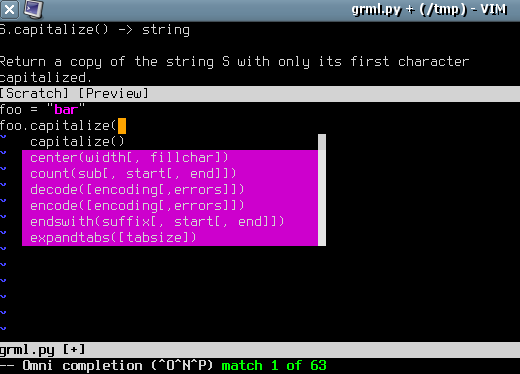
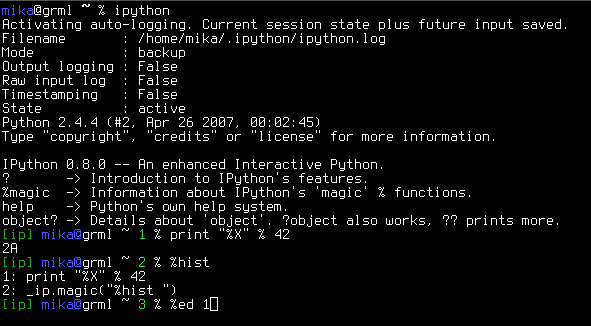
I wrote a small python webpage for the grml-wiki to provide some information regarding Python-development on grml. I just upgraded Vim on my main system to version 7.1 and omnicompletion with vim-python became better once more. So time for a short demo of ctrl-x-o: Python coding in Vim 7.1 - Screenshot I also very much like ‘%ed’ within ipython using the following snippet in my ~/.ipython/ipythonrc:
editor 1
editor /usr/bin/vim.python
Notice: Don’t wonder about the prompt style of the following ipython-screenshot, I customized it a little bit (see python-webpage in the grml-wiki again to get an idea). ipython demo - Screenshot So running the last line containing ‘%ed 1′ will execute /usr/bin/vim.python providing the code from the first command line of ipython and I can use all the magic of Vim for editing the code. When exiting the editor I have the code within ipython. Rocking. :) Oh, don’t forget to check out the Quick tips of ipython when exploring it. Now what’s missing in ipython is the edit-command-line feature of Zsh. That would allow me to edit already typed (but not yet executed) code with an external editor. Anyone out there with an according tip? ;-)

5 June 2007

Martin-Éric Racine: Award to the Debian community of Finland

Open Source 2006 is a one-day seminar that provides Free Software actors of Finland with a forum to present their work and the current trends in Free Software development to a greater audience comprised mainly of decision-makers from the business and governmental sectors. Finnish Open Office localization team This year, a noticeable trend were governmental cases of transition to Open Office and other Free Software solutions on the municipal desktop. Thus, it was only fitting that Finnish localization took greater importance than before and, in concordance, that this year's Linux-tekij award went to the Finnish Open Office localization team. The jury invited 3 people from the localization team to receive the award on their team's behalf: Pastor Koskinen also gave a very stimulating lecture on the collaborative effort behind the localization, mentioning in passing that Czech Pavel Jani k also plays an important role in building the Open Office binaries for a number of Baltic and Scandinavian languages. Debian community of Finland The jury also granted an honorary mention to the Debian community of Finland to acknowledge years of achievements, reaching an important milestone in 2005 when Finland hosted the yearly Debian Conference. Another motivation was a number of nominations for Ubuntu, both as a distribution and for its extremely active local user community. Given how a majority of Ubuntu developers actually are Debian Developers, the jury unanimously decided to honor them collectively from the perspective of Debian and its derivatives. The jury invited 3 people to receive the honorary mention on the community's behalf: Lars gave the audience a very interesting perspective of his long involvement with Debian, while Tapio emphasized particular pride in seeing non-programmers that maintain documentation or localize software be acknowledged. Fabian gave a very emotional speech in which he praised the commendable efforts of dozens of volunteer DebConf5 organizers that discretely handled unpleasant tasks that were nonetheless essential to the success of the event. The Jury Yours truly was invited to join the jury on behalf of Linux Aktivaattori, alongside representatives from the academic, business and Free Software communities. During the prize ceremony, FLUG chairman Arto Ter s and myself took turns at describing the award's selection process and at introducing the winners.

Martin-Éric Racine: Retour sur ma semaine Paris

In a nutshell: I'm extremely tempted to dump Finland and move to France. 6nergies This business networking evening was simply amazing. How about a discussion on the phonetic niceties of Northern versus Central and Southern Vietnamese accents, as a conversation starter? How about another one, on ethnic versus national identities, as the icing on the cake leading towards a business card exchange? Lovely, isn't it? So was the girl... Xin c m n, ng Mai! I however had the nasty surprise of realizing that I no longer speak French to a native level, when Alain did my video profile. Oh, the hesitations... Saaks mie puhuu suomee siin videoesittelyzz ? Eik ha? H ? The Food From Italian pizza to Japanese street noodles you name it, they have the real thing, cooked by expats. No way in hell you'll ever find that quality in Helsinki, especially not for that cheap! The Book Heaven France gave the world this wonderful language book collection called Assimil and the FNAC had them all... minus Le Lithuanien sans peine, whose publication appears forever delayed. Still, as recently found out, they even offer material in languages other than French. Combien vous gagez que le duc de Novgorod-la-Grande aura r ussi assimiler la langue de Moli re avant Debconf7? The People Courteous, smily and easy-going; the exact opposite of the average Finn. What more can I say? The Crossroad Of course, resetting the citizenship counter to zero is not exactly my idea of fun, but then again I have a strong feeling that my 8-year venture into Finnish society has pretty much come to a full circle, so... Y'a-tu quelqu'un dans la r gion parisienne qui cherche un commercial avec une forte exp rience de la gestion de produits bas s sur du logiciel libre et de l'exportation vers la Scandinavie et les pays baltes? En bonus: le ons de joual [en] [fr] gratis, tabarnak! The Paradox Visiting the South Karelia on the Senate Square event and feeling homesick for my adoptive hometown of Lappeenranta, as I kept on running into familiar faces who are still thankful after all these years that I dared become fluent in what they speak out East (which differs tremendously from normalized Finnish). Isn't life ironic, sometimes?

Martin-Éric Racine: Linutop: Use the source, Luke!

I recently blogged about putting together the Linutop source code ISO. The resulting image has now been uploaded to our wiki. The ISO's content is divided in two sections: Developers who are interested in producing customized OS images should download this ISO and consult the wiki for details on developing for the Linutop.

Next.

Previous.