Search Results: "pm"

15 November 2010

Alessio Treglia: Bits from the Debian Multimedia Maintainers

This brief announcement was published in the debian-devel-announce mailing list and I repeat it here for your information.
Hi! Since there has been a lot happening in the Debian Multimedia world during the Squeeze release, so we figured we should give you an update on that. Who are we? In the dark old ages, there were two teams involved in multimedia: the Debian Multimedia and Debian Multimedia Packages teams. Please note that neither of them is related to debian-multimedia.org (which is maintained by Christian Marillat, and is known to break current ffmpeg-based applications like mplayer and vlc in Debian Squeeze.). During late 2008, both teams were merged into one, the Debian Multimedia Maintainers team, to avoid effort fragmentation. Since then, there has been a lot of work done: Consumer Multimedia in Debian Consumer Multimedia is about playing and, well, consuming multimedia. Squeeze will feature: Squeeze will not feature: Producer Multimedia in Debian Producer multimedia is software for producing multimedia. Squeeze will
feature: End user applications: Platforms and technologies: Squeeze will not feature: Debian Multimedia Blend There is also an effort to start a Debian Multimedia Blend to give a better overview about what multimedia applications are available in Debian. There is a short list for a quick overview as well as a long package list separated in sections to give a more detailed overview (including translations, screenshots, popularity of package etc). You are invited to help improving the tasks either directly in SVN or by sending patches to Andreas Tille <tille@debian.org> or debian-multimedia@lists.debian.org (see below). Note that not all of the packages listed in the tasks pages are maintained by the Debian Multimedia team, since they are aimed at producing useful package sets instead of showing only our own packages. For those who want to squash some bugs in multimedia packages there is also the bugs page generated by the Blends tools, or our team bug page. Other activity The team has seen a lot of growth since the merger. Of the current 52 members of the Alioth team, 20 were added during 2009 and 18 in 2010, many of whom are involved in upstream development as well as the debian packaging. The number of packages has also grown, with 112 of the current 205 git repositories in our team area having its first commit during 2010. Where to reach us The Debian Multimedia Maintainers can be reached at pkg-multimedia-maintainers@lists.alioth.debian.org, should you have any questions. We have also decided to repurpose the old debian-multimedia@lists.debian.org address for user and more general discussion. We would like to invite everyone interested in multimedia to join us there. Interested developers/packagers can also join us at the first address. Some of the team members are also in the #debian-multimedia channel on OFTC.

Regards,

Alessio Treglia on behalf of the Debian Multimedia Maintainers

11 November 2010

Matt Zimmerman: Back to the future

In my professional role as Ubuntu CTO, I take on a number of different perspectives, which sometimes compete for my attention, including: My recent work, as Canonical has gone through a period of organizational growth and change, has prioritized the inward perspective. I took on a six-month project which was inwardly focused, temporarily handing off many of my day-to-day responsibilities (well done, Robbie!). I ve grappled with an assortment of growing pains as many new people joined Canonical over the past year. With that work behind me, it s time to rebalance myself and focus more outside of Canonical again. It s good to be back! In my outward facing capacity, I ll shortly be attending Web 2.0 Summit in San Francisco. I attend several free software conferences each year, but this is a different crowd. I hope to renew some old ties, form some new ones, and generally derive inspiration from the people and organizations represented there. Being in the San Francisco Bay area will also give me an opportunity to meet with some of Canonical s partners there, as well as friends and acquaintances from the free software community. With my head down, working hard to make things happen, it s easy to lose perspective on how that work fits into the outside world. Spending more time with people outside of Canonical and Ubuntu is an important way of balancing that effect. Looking forward, I ll be thinking about the longer term direction for the Ubuntu platform. The platform is the layer of Ubuntu which makes everything else possible: it s how we weave together products like Desktop Edition and Server Edition, and it s what developers target when they write applications. Behind the user interfaces and applications, there is a rich platform of tools and services which link it all together. It s in this aspect of Ubuntu that I ll be investing my time in research, experimentation and imagination. This includes considering how we package and distribute software, how we adapt to technological shifts, and highlighting opportunities to cooperate with other open source projects. My primary outside-in role is as chair of the Ubuntu Technical Board. In this capacity, I m accountable to the Ubuntu project, the interests of its members, and the people who use the software we provide. Originally, the TB was closely involved with a range of front-line technical decisions in Ubuntu, but today, there are strong, autonomous teams in place for the most active parts of the project, so we only get involved when there is a problem, or if a technical question comes up which doesn t fit the charter of an established team. It s something of a catch-all. I d like to re-establish the TB in a more central role in Ubuntu, looking after concerns which affect the project as a whole, such as transparency and development processes. I m also re-joining Debian as a non-uploading contributor, to work on stimulating and coordinating cooperation between Debian and Ubuntu. I m looking forward to working more with Zack on joint projects in this area. This change will help me to support Canonical and Ubuntu more effectively as they continue to grow and change. I look forward to exercising some mental muscles I haven t used very much lately, and facing some new challenges as well.

10 November 2010

John Goerzen: We re All Home

I wrote yesterday about our scare with Jacob. It s been quite the day. Before I go into it, I want to say thank you to all the many of you that have sent comments and support our way. Terah and I haven t had the chance to reply to many of them, but we have read every one, and very much appreciate it! Terah spent the night with Jacob, and I spent the day with him today (others were present for parts of it too). Jacob was mostly in good spirits. He was up and around, pushed his IV around himself in the room and to the bathroom. He called it my VI machine (not a typo take that, Emacs, eh?) He continued to enjoy measuring his trips to the bathroom. We went exploring a few times. He would walk or run down one of the long corridors in the hospital, holding my hand, while I pulled the IV along. We often went by the cafeteria, which he called the kitchen. One time he insisted that I get a cup of coffee from the free coffee dispenser. I insisted that I didn t want to, but eventually asked, Shall I get a pretend cup of coffee? Yeah! So he watched me get a pretend cup, pretend to fill it, and pretend to drink it and smiled and clapped for me after. He spent hours watching videos of trains on YouTube. This is a favorite activity at home too, but we obviously limit the amount of time he can spend doing it. I had to limit the amount of time he spent with it today too, of course, but he got rather more time with it than usual. Jacob had his usual books, but I thought we might try something new today. This morning, I loaded The Tale of Peter Rabbit (with illustrations) onto my Kindle. Jacob loved it, and enjoyed pressing the Next Page button in the Kindle. We read it twice, and he is interested by the promise of other stories about rabbits. It also probably didn t hurt that his grandma had given him a rabbit in the hospital yesterday. As we got on towards evening, I told him that tomorrow could be a normal day. His response: enthusiastic applause and a big grin, plus YAY! Jacob loved eating today. He wolfed down breakfast and lunch. He enjoyed the lemonade I brought for him again, and played with some toys, and yes, watched some more train videos in the afternoon. He also pretended to ignore the visitors he got as much as possible (pretty typical for him actually). The doctor came by at about 6:00PM and again was just stunned at how well he s doing. Jacob neither complained of any pain nor acted like he had any even when the nurses would rub neosporin on his wounds. The doctor was still just stunned at how well he was doing. He told us his last tractor accident resulted in a death before LifeWatch could arrive, and the one before that turned a good student and a promising athlete into a wheelchair-bound person with a vocabulary of 20 words. I can t believe I m discharging him today, but try as I might, as I go over all the details, there s no reason for him to stay. I thanked him for all his help, and he said, I didn t do anything for him. All I did was figure out what had happened to him . I guess we have the CT to prove that something really did happen, but the fact that he showed up at my office in the first place was stunning enough. Jacob started to get more excited after the IV was unhooked from him. He didn t particularly like having the needle removed, due to the pain of taking off the tape, but was happy to have it gone. He was making plans: will we stop by the train station on the way home? It s the middle of the night maybe a train will be there! (If it s dark outside, it s middle of the night to him) We agreed to stop by the cafeteria to pick him up one last lemonade, than stop at the train station. The nurses offered a wheelchair to take him out to the car with. I said I didn t think he d want it. One of them said, Wouldn t you like a FUN ride in a WHEELCHAIR? Jacob: No. Me: I suspect he will want to run out of here. Nurse: OK then. We walked, or half ran, to the cafeteria to get his lemonade. Then we went out to the car. He was excitedly jabbering about everything: the car, my radio, and especially the train station. We did drive by, and at least got to see a freight engine go past. He noticed the Christmas lights starting to be set out along Main Street, and said, Dad, it s CHRISTMAS! Well, almost Then he got quiet, and eventually fell asleep in the car. He had almost fallen asleep while eating his lunch, but stayed awake, and then got interested in other things so he had no nap today. When we got home, I unbuckled him and pulled him out of his seat. He opened his eyes for just a second, wrapped his arms tightly around my neck, put his head on my shoulder, and fell back asleep while I carried him up to his room. I put him down on his own bed. He had a contented sigh, pulled his favorite blanket up to his neck like he loves to do, and was back asleep in no time. Our little boy is home, safe and sound. It s a happy day.

8 November 2010

Ritesh Raj Sarraf: apt-offline - 1.0

Hello World. I am very pleased to announce apt-offline, version 1.0. This release adds a Graphical User Interace to apt-offline.
Big thanks to Abhishek Mishra and Manish Sinha who did all the development work to make this GUI happen. Help: I was wondering if there is a logo for APT that I could use in the big blank space on the main window. Apart from the GUI, there are a bunch of bug fixes in this release (which have already been made available for the Squeeze release also).
Generate Signature Window
Download Window
Install Window
I look forward to your feedback and comments on the GUI front. Note: The GUI in its current form is basic and does not provide all the features that are available in apt-offline.

Joey Hess: chop chop

I've always loathed cheap particle board and peg bookcases, and when I broke one while reorgaising the living room at the Hollow today, I finally found a good use for them. They're great fun to chop up with an axe, and make for a very hot fire in the stove later. I released git-annex 0.03 today. The main improvements are being able to configure the backend to use on a per-extension basis in .gitattributes, a fsck subcommand that will find dangling annexed content, and bugfixes, including massive memory use savings. The big feature under development next is an idea Josh Triplett and I batted around; a way to checkout annexed files to edit their contents. Today I also got the radio working well here. Set up a car radio with a 40 foot wire for an antenna, and I finally got it almost static free. Pity that running a nslu2 on the same power circuit causes interference, so I am not able to use that to feed in music via the radio's AUX jack yet, which is the eventual plan. And the radio's powered USB outlet is wasted, I had hoped to run the nslu2 from that. Seems I can run the radio for 9 hours and still have plenty of solar power, even this time of year. Wish it were colder..

7 November 2010

Adnan Hodzic: Ubuntu Developer Summit (UDS-N) Debianized Summary

Last week I was on my first Ubuntu Developer Summit (UDS-N), I wanted to attended this summit for couple of reasons: 1. Developer, I m part of Debian Java, working on Eclipse IDE, and as you re developing Debian, you re automatically developing Ubuntu, no? Nerd 2. DebConf11 main organizer, I really wanted to see how it s all done on corporate level, for instance we re going with hotels instead of student dorms and so on. 3. Migration to Linux infrastructure, make contacts and have some talks on this topic, because after DebConf11 in Bosnia a lot of institution will most probably open doors to open solutions such as Linux. I went to this summit without any expectations or plans, just said I ll play it by ear. This years UDS was held in Orlando, Florida before Orlando I was planning to stay in NYC for couple of days, therefor my whole plan was to get to NYC, then Orlando then head back home Smile I Heart NYC I spent couple of days here with my cousins and friends, as always NYC never fails to surprise me, and I ll always stop by even if it s only for couple of days Wink I wanted to meet up with couple of Debian people as well, but unfortunately my schedule was too tight so Caribe Royale, Orlando Please note that this whole trip was crazy (in a good way) starting from Sarajevo; on my flight from NYC to Orlando I see a guy that s sitting in front of me is wearing Canonical Landscape tshirt, I approach him and it turns he was Jamu Kakar working on Landscape. Since my luggage was late we had conversations from Debian over Ubuntu to Java to everything pretty much. While we were still at the airport, we bump into two more people going to UDS. As we got to hotel, same moment we walked out of cab there he was Jorge Castro, was he there just to smoke a cigarette or whatever doesn t even matter, what matters is that even before walking into hotel building I knew where reception, my tower and bar was, everything I needed to know at that moment High Five! Hotel where everything was held was Caribe Royale and even though I looked at their website I thought there was no way it s all going to be that nice, to my delight it was exact replica. Place is All-Suite Hotel and Convention Center , which meant that both accomodation, venue and everything else was in one place which is Yes 15 minutes later after I checked in, I was at a bar talking to Jim Baker about Java, Jython and Python, exact things I wanted to talk about at that given moment. What I said in these last couple of paragraphs sounds pretty cool eh? Well to me this whole UDS was just like this, everybody was so accessible and open for discussion, from Jono Bacon walking around offering candy to UDS reception staff Michelle, Marianna and others who were always there whether you had a complaint, problem or a praise. I really should stop mentioning names, because I ll forget somebody, and since it s just not fair because I had a feeling everybody was just there for you, whatever it was you needed. Ubuntu Developer Summit (UDS-N) Ubuntu, Debian, DebConf, differences? Even though I said I ll play it by ear, from very beginning I thought I d be complete outsider, being part of Debian and all. Quite contrary, I was everything but outsider, and even more there was plenty of Debian people there, including current DPL Stefano Zacchiroli, Colin Watson, Riku Voipio just to name few. There was also a Debian Healt Check plenary. But overall, there are differences between DebConf and UDS. One of the things is that you can attend UDS remotely I m not sure how much is this doable on DebConf, but then again vast differences are that UDS is filled with BOF s (as we would call it in Debian) meetings of different teams, I attended a lot of these, and most of them end with some kind of conclusion. While each day there was (only?) an hour of lectures on various topics, which on DebConf we would characterize maybe even as speed talks . However, everything was high paced, and it all ended up on You think that s a problem? How do you think we could solve it? . I had a feeling even if I didn t say something out loud that someone would hear me and approach me to discuss it. Everything was straight forward, all in goal to resolve certain issue or a problem, which I absolutely loved. Clap Fun It wasn t all work, even though Orlando doesn t seem to be my kind of city from what I saw, it s way too magical for my taste Party There was a lot of places where you could go to enjoy yourself. Good people at Canonical even offered me free ticket to Disney World, there was a lot of destinations to visit and transpiration was also organized by Canonical. Unfortunately I missed the notorious UDS party on Friday because I had to head home early, but possibly I ll make it next year Razz Even though, hotel was that great and to be honest you didn t have to leave to look for party. My favorite was Universal City Walk, one night I decided to go to see Blue Man Group, best part of it was that I got pulled up on stage by one of the members and was part of one of the acts! ROTFL This is definitely something everyone should see during his life, one moment you re laughing like a lunatic, while other moment you re just having goose bumps from the performance itself. Amazing stuff. After all I wrote here along with the pictures, is there even anything else I need to say? Smile I believe that even if I didn t play it by ear, this whole trip would exceed all my expectations in every possible sense. Because that s really what happened, those three reasons I was going to UDS for? Far more happened than that. All I can say in the end is that I ll move closer to having a part in Ubuntu development, and yea, I ll try to be regular on UDS from now on Smile See you in Budapest? If all these photos weren t enough, you can find official group photo as well as personal set of photos can be found on: UDS-N photos by 2010 Sean Sosik-Hamor




Debian News: Debian project accepted in the Google Code-in 2010

Google Code-in, Google s contest to introduce pre-university students of ages between 13 and 18, to the many kinds of contributions that make open source software development possible, is starting on November 22, 2010 and Debian is one of the 20 organizations selected to take part.

If you are student interested in contributing to Debian, you can find more information in the wiki page http://wiki.debian.org/GoogleCodeIn2010.
A list of tasks is available at http://wiki.debian.org/GoogleCodeIn2010/Tasks and if you a Debian Developer, you still can add tasks by filling the template provided in the top of that wiki page.

You can join the IRC channel #debian-soc (on irc.debian.org) and the Debian GSOC mailing list to talk about your ideas and applications or if you have any question.

Christian Perrier: Help cleaning spam in Debian mailing lists

Debian mailing lists' standard policy is to allow posts from unsubscribed users. That of course fits our standards for opened development but has the drawback of allowing a lot of spam to reach our mailing lists. This spam also clutters the mailing lists archives. However, 1.5 years ago, listmasters established a well-working system to clean out spam from the mailing lists. It basically works in four steps:
  1. first, spam can be "reported" by anyone meeting it. While you are reading the mailing lists, reporting spam is as simple as bouncing the offending mail to a dedicated address: report-listspam@lists.debian.org. I, for instance, use a mutt macro to set ESC-L as a "report spam" hotkey. Spam can also be reported when browsing the mailing lists archives and clicking on the "Report as spam" button;
  2. when a given mail has been reported as spam more than five times, it is then "nominated" for review;
  3. nominated mails must the be reviewed by volunteers in order to confirm they really are spam. The review algorithm is complex but, in short, when a mail has been confirmed as spam by 3 reviewers without being qualified as "ham" by anyone else, then it is considered spam;
  4. such mails are then removed from the mailing lists archives.
Steps 2 and 4 are performed by a weekly script that runs on Sunday mornings (5:00 UTC, IIRC) How can you help? Process nominated spam We need more reviewers for step 3. At this moment 2 people are doing this on a regular basis (every Sunday with the morning coffee). Some others are working on this in a less frequent way. It seems that 1 or 2 more regulars reviewers would guarantee that we can cope with the nominated spam incoming flow. Only Debian developers can do that step. They should read instructions, ask for a password, then start reviewing. The first 1 or 2 people joining this will have a quite big amount of nominated spam to process, for their first effort. However, as most of these have been classified as spam by at least the two people doing this for months....the amount will slowly decrease. I, for instance, now only spend 5-10 minutes reviewing the nominated mails every week. Report spam Everybody can work on reporting spam. You can start by doing this on mailing lists you read by just bouncing spams to the spam report address; If you want to do more, you can join existing spam cleaning efforts, such as the one running for debian-boot or the one running in debian-l10n-french (the latter probably more for French speakers). Or you can of course start a similar effort for your pet list. To be efficient, this effort needs to gather 5-6 people who will process the mailing lists archives systematically. Let's clean out these archives!

6 November 2010

Joey Hess: howto: create your own time zone

Tomorrow I won't have to deal with it getting dark at a soul-crushing 5:30 pm. Nor will I have to wake up blearily an hour early in the spring. Instead I will be enjoying my new, custom time zone. It's "JEST", for "Joey's Eastern (non)Standard Time", and in JEST, there is no spring forward or fall back stress. The folly of daylight savings time (Ben Franlin's best prank ever) really becomes apparent when you have solar power. It's bad enough that the sun is setting at 6:30 without compounding that by an hour. By keeping my clock set so the sun sets in midwinter at 6 pm, I will maximise what little light there is, and minimise time spent using batteries in the dark. Of course, it helps that I'm my own boss, and that most of the people I work with are probably not in a nearby timezone anyway, and that most things are done asynchronously. Since JEST is an hour ahead of local time here in the winter, I will, at worst, tend to be running early. So I only have to change my clocks one time -- and by "change", I mean create a custom timezone in Linux. Here's how to do that.
  1. Make a custom timezone file. The standard one for North America is a bewildering 3000 lines of special cases, conflicting legistlation, and historical weirdness, but I only need one: echo "Zone JEST -4:00 - JEST" > JEST.zone
  2. Compile and install it to somewhere; I put it in ~/.zoneinfo zic JEST.zone -d ~/.zoneinfo
  3. Set TZ to use it. Also TZDIR if it's not in the system directory. export TZDIR=~/.zoneinfo TZ=JEST
Update: Turns out it was easier than I thought, just setting TZ=FOO+4 will make date display a timezone "FOO" that is 4 hours behind GMT. So all I need is to set TZ=JEST+4 Result:
date: Sat Oct 30 21:43:39 JEST 2010
date -R: Sat, 30 Oct 2010 21:43:39 -0400
Previously:

5 November 2010

Vincent Sanders: Keeping kindling dry

I, along with a great number of people I know, now posses a 3rd generation Kindle. It seems Amazon have found a feature set and price point which makes this device a winning solution.

My bookshelf complete with covered kindle
I did look at a huge number of alternatives like the Sony PRS600 and others but they were all more expensive than the 110 for the Kindle and did not have enough features to make a compelling argument for spending more.

Yes it has DRM. Yes it "only" supports PDF, MOBI and mp3. Yes it will not win any style or usability awards. But I went into this eyes open the device is "good enough".

The device lets me read books from a reasonable display. The integration with amazon.com is so seamless it poses a serious danger to my bank account. I should expand on that last point :-) Amazon have got the whole spending money for a book thing executed so well that you do not think twice about a couple of pounds here and there, this soon adds up. I have set myself a rigid budget.

My main complaints are really just niggles:

  • Another different USB connector! Wahh, I thought everyone had agreed on mini USB? seems that I now have to have yet another lead for micro USB

  • The commercial book selection is a bit limited and missing a surprising number of popular titles. Some of this appears to be the publishers and authors simply clinging to their old business model. I fear some of them might not survive and early indications are they are behaving like the music industry did...Guys you are selling an infinite good a scarcity model is going to fail!

  • The price of some of the books is absurd...they are asking hardback prices for the electronic edition! Seriously? how on earth can that possibly be justified? I can see that a hardback book with its print run could cost 5 per physical item (going from hulu print on demand prices as a worst case) plus shipping and stocking fees. So how can you possibly justify charging the same price for a pile of bits where none of that applies? Also the pile of bits cannot be lent or sold, not impressed.

  • eBook formatting is generally dreadful. I do not know who is mastering these books but they need to do a better job. If they tried to pull this in the physical editions they would get a seriously large number of returns.

  • I still have to pay for whispernet delivery fees even though, because its the wi-fi model, I am providing the bandwidth myself. I can see that differentiating between 3G and wi-fi delivery is a bit hard for them though.
However my one and only real complaint with the offering as a whole is the astronomical asking price for the leather cover. The cover is currently 25% of the price of the kindle itself! ( 30 cover 110 kindle) which is just silly. It is a pretty nice cover and the clever clip attachment means it does offer an integrated solution to protecting your kindle, but not 30 nice.

Kindle in a sock cover
So my lovely wife (her kindle was bought with the cover) made me a sock for mine. This is great for casual round the house usage to stop me scuffing the screen but was a bit lightweight for protecting the kindle when out and about.

One day last week I had an idea. I would make my own protective cover by crafting something I had wanted to do for ages. And the (unoriginal I am sure) project of a hollowed out book for housing my kindle was implemented.


My hollowed out book kindle cover
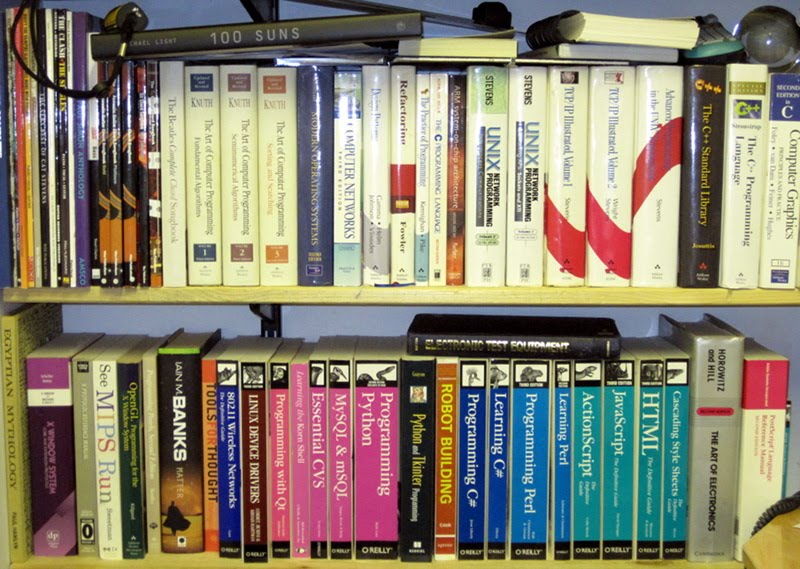
A quick Google later and I had a set of plausible instructions to follow. I used possibly the most out of date book ever (published 1981) on electronic test equipment, partly because it was a ex library sell off book which cost 10pence back in 1995 but mainly because it was the right size to just enclose the kindle without adding to much size.

I learnt a couple of things doing this:
  • Do not let your pva (white) glue mix get too runny, you want it fluid enough to be easily absorbed but not watery - this is important because otherwise the paper absorbs too much water and crinkles
  • Do not use a book where the binding has gone bad already and select a "clean" book. The spine of this book was yellowed and cracking before I started. This means the book spine simply cracks open at the hollowed out bit and it is very obvious.
  • Work out where the "solid" part at the back is going to be and treat that separately so you get a nice solid base at the back of the hole. In mine its not all stuck together and is a bit wavy. Do be sure you left enough depth for the kindle though.
  • Take your time and be careful with the glue, it is amazing how obvious even a simple splash of glue in the wrong place is. Use a small brush for this a paint brush is fast but sloppy.
  • Measure carefully and cut only a few pages at a time, it takes a bit longer but looks much better. Also I did not drill the corners of my hole which means they are a little scruffy.
  • Use the sharpest thinnest knife you can, this really helps. I started with a small stanley knife but switching to my hobby scalpel gave much better results.
  • If you have some, use woodworking clamps to clamp a bit of timber (I had some offcuts of shelving) around the book to compress it while the glue dries. Do not clamp the spine if you can avoid it. This method ensures:
    1. Heavy things do not fall off the book while it dries.
    2. An even strong pressure is applied.
    3. The book does not warp or bend while the glue dries
All in all I kinda like the results and I think I will try again with a more modern book where the spine is not so broken to begin with.

Dominique Dumont: Test CPANPLUS install on a Debian system

Hello I m a Perl author working on a Debian unstable system. The great thing about Debian is that a lot of Perl modules are available though Debian packages. I follow Debian way of life to the point that I no longer install my modules (under development) with sudo make install (or its Module::Build equivalent). I ve often been bitten by weird test errors due to old version of module lingering in /usr/local. Now, I always create Debian package of my modules under development with dh-make-perl. This way, I avoid installing Perl module in /usr/local and my developement versions are cleaned up when actual package are availalble through Debian unstable. () This method has an unfortunate side effect: I never test installation the CPAN way. And Config::Model did fail to install with CPANPLUS. Now here s a way to create a barebone Debian chroot with cowbuilder to test CPANPLUS installation. First create a new chroot: $ sudo cowbuilder --create --distribution sid

Loging into this chroot (the bindmount option is necessary for cpanp to work correctly) : $ sudo cowbuilder --login --bindmounts /dev

In the chroot: Run cpan to configure CPAN: # cpan

Hit return to configure CPAN automatically. Then install your module: # cpanp i Config::Model

Or, if your module is not yet uploaded: # cpanp i http://<path-to-tar.gz>

Once you quit, the chroot is restored to its barebone state. Et voila. I tested full installation with dependencies the CPAN way without mucking up my system. Many thanks to Christian Kuelker of Cipux project for his comments that enable me to improve Config::Model All the best

4 November 2010

Michal &#268;iha&#345;: What things to flattr?

With increasing popularity of Flattr (114,057 has gone through the Flattr system in two months), several people start to recommend what things to flattr. I'm not going into this business, however they seem so find interesting things for me so you might like it as well. The Flattr Free and Open Source Software by Rapha l Hertzog is actually thing which has attracted me to the Flattr. It collects recommendations how to tag your free software on Flattr and each month it publishes five recommendations which projects to flattr. The other thing I've noticed is list made each month by Evgeni Golov, which I've mostly noticed because increasing popularity of phpMyAdmin on Flattr, because he was really fast in advertising it :-).

Filed under: Debian Phpmyadmin 5 comments Flattr this

Andrew Pollock: [life] Zoe at six months

Today, Zoe is six months old. The last three months certainly feel like they've taken their time, but a lot has happened. Developmentally, she's doing great. She's now in the 70th percentile for height (up from around the 25th percentile), and 31st percentile for weight (up from the 25th percentile). She cut her bottom front teeth a few days ago. Crawling is imminent, I'd say. She can already scoot around in reverse, and by a combination of shuffling and rolling, doesn't seem to be having problems moving around the floor. We started her on solids at five months, and she's taken like a duck to water to pureed pumpkin, sweet potato, beans, zucchini, apple, pear, banana and avocado. Speaking of water, she's also decided she likes to drink water from our glasses whenever she sees us doing it. Hilarity usually ensues, closely followed by a change of outfit. She's sleeping well, only waking up once a night under normal circumstances, and that wake-up is getting later and later. She loves her baths. She usually lets out a series of loud sighs as soon as we put her in the bath. She got her first cold a couple of weeks ago. It coincided with her first day in ad hoc daycare, but Sarah and I were both sick as well, so I think it's more likely that she caught the cold from us than from daycare. She's still battling it, but it hasn't really bothered her all that much. She's just a bit snotty. The NoseFrida has been very handy for dealing with this. She had her six month shots today, and seems to be tolerating them fairly well. Sarah says she hardly even cried when she got them. She continues to be a remarkably happy baby. She always wakes up with a smile, she really only fusses if we keep here away for more than a couple of hours, or haven't fed her on time. Even with this current cold she has, she's still stayed very happy. We feel incredibly lucky to have such a wonderful baby. The next big adventure is to try a babysitter. Zoe and me in early October

Gintautas Miliauskas: Living a monastic life for 10 days

About a month ago, at the end of August, I finished a 10-day Vipassana meditation course. This was probably one of the more extreme activities I have ever participated in, and it's well worth a blog post. I found out about the course in a ridiculously trivial way, by following a link in a Reddit comment (I wonder if I could track down that comment...). The website referenced by the comment contained (almost) no new-agey mumbo-jumbo and looked legit in general. I also appreciated the fact that this was a relatively serious and intensive course, which should be enough to form a reasonably founded opinion on meditation in general. When learning sporadically, in small bits, it is hard to say whether the material itself is no good, or you just do not understand it yet and need to study more; I was quite skeptical towards the practice, but wanted to give it fair trial. I was quite impressed that there was a course available in Lithuania, a few hours by train from where I live. Finally, the course was free (by tradition Vipassana is taught without monetary compensation). I went ahead and signed up for a standard introductory 10-day course. Vipassana (also called insight meditation) is a meditation technique allegedly coming back from Gautama Buddha himself (well, all the traditions like to claim that origin...). It has been experiencing a renaissance, partly due to an organization set up by a meditation teacher S. N. Goenka which has founded meditation centers all over the world. The essence of Vipassana is a method of teaching your mind to act instead of merely reacting to outside stimuli such as pain, anger of other people or hardships. The technique provided is to monitor your sensations, watch them with equanimity and suspend any reaction, and slowly it sinks in that all things are temporary and you can choose what to react to and how. That's the basic idea; I don't want to go deep into exposition of Vipassana as there is plenty of information about that (also at the same time the information is almost useless because you have to experience it to really understand it). Instead, I will sure some of the more personal remarks and experiences. The course took place in an cottage near Kretinga, housing around 50 people. The living conditions were absolutely great, and this would have been a true holiday if not for the regime and the rules. The day would start very early, at 4 AM (ending at around 9:30 PM), and we'd do about 12 hours of meditation in total inbetween, with occasional breaks, but the most gruesome part is that no communication at all was allowed with anyone except the manager of the camp (and the teacher during a specified time). That gets to you after a few days, but still, there are people around you, so it's bearable; on the other side, the senses (touch, smell) become very acute. The food was taken care of by volunteers (students who have finished the course), and I could say it was quite good actually. The goal, of course, was to keep the environment from interfering with meditation, and I think it was done very well. The presentation of the actual technique also did not disappoint. Each day a new step would be introduced, with the whole day to practice before moving on. Looking back, the pacing worked well. Every day in the evening there were lectures on theory. They were somewhat informative, but also sometimes annoyingly primitive and verbose. The little mistakes, holes in logic and slight doses of mumbo-jumbo almost drove me nuts by the middle of the course, until I learned not to react to them. Despite the shortcomings of presentation, the simplicity and lucidity of the practice and lightness of theoretical baggage really appealed to me. The whole organisation in general gave the impression of complete transparency, with no strings attached, no financial interests in play and no agitation for further involvement. While there are many meditation techniques, I am happy that I've gone with Vipassana in particular for one reason: Vipassana meditation uses no artificial tools to help you concentrate, such as mantras, visualisations, counting, etc. Such methods make concentration much easier, but they also create a dependence on the methods themselves. I appreciate the purity of Vipassana in this regard. Not everything in the practice is roses though. First, a particular worldview supported by Vipassana is presented as "scientific" and supposedly "the right way to live", and if even if you don't agree, "the truth" of Vipassana will become obvious to you with time. This is a distinctive mark of ideologies. The thing that makes everything break is the reincarnation, which is generally assumed as true, even if it's not shoved down the student's throat. Every rationalization of a world view has a "white lie" (usually related to the concept of eternity somehow) at the core, and in this context reincarnation is it. Given what we know now about the relationship between the mind and the body, reincarnation is absolutely ridiculous and completely untenable, and that breaks all "moral" reasoning for practicing meditation as opposed to doing something else. I'm not the first to bring up this problem, there's plenty of material about it online. The second slippery idea is that the concept of "negative happiness" is central in Vipassana, that is: happiness is defined as lack of suffering. This point is not that unreasonable actually, from personal experience I could indeed call the state of non-suffering happiness, but there is definitely something missing when compared to the state of mind when I'm truly, positively happy. Whether you consider that something important or not, it's definitely there. Third, Vipassana suggests that it is only you who is at fault when your inner state is disturbed; the world affects you as much as you let it, and in order to find happiness you should learn to control the "interface" rather than the outside world, which will usually not behave as you want. This may be correct, but sometimes it could just be easier to fix the world rather than change yourself, and I have the suspicion that it this is much more frequently the case in the modern world compared to the pre-modern environment. (This is one of the points which break when reincarnation is rejected, as with reincarnation you have the whole eternity to fix yourself.) While the complaints are serious, they do not mean complete rejection of Vipassana but rather integration among the various other techniques available. The actual meditation technique is still great for gaining and maintaining mental composure, reducing anxiety and improving well-being. Now, if I could only get used to meditating regularly... If you have the chance, I highly recommend you try out an introductory 10-day course. There is little to lose and a lot to gain. And if you do go ahead, I have two hints. First, do not even think about leaving the course before it's over. Any hardships are temporary and will be overcome quickly. Second, use the time with the teacher, those interactions were very helpful to me. Also, given the "noble silence", talking to someone once in a while will not hurt.

3 November 2010

Julien Viard de Galbert: Working on X isn t that hard !

First, Hello Planet Debian ! Some words about me I m a new member of the X Strike Force, the debian team responsible for packaging Xorg. I basically stepped in with the openchrome driver.
I also have wider interest in free software or open source in general, but you can have a look at the rest of my blog, so I won t bother you with too much details. More about X Talking with various attendant at MiniDebConf Paris, I got the impression that people think working on Xorg is hard. I must say: It s not ! First debian work is mostly packaging, and the developers of the applications we package (debian call them upstream) are pretty responsive, so you won t be on your own.
Most of the work is preparing the packages for their new release, place them in experimental first, and ask for testers.
Then people test and the real work start: we receive bug reports.
Sometime seeing the report, it s easy to point the user to test some other version, do some change, remove some old libraries in /usr/local/lib.
Sometime we need to ask for more information. I said we, but for now unless it s about openchrome, I can t help much, but I follow the bugs on the X mailing list and learn from others response, I think I ll be able to help soon. An other way to help: TXBW I m sure you ve read about RCBW, kudos to every one posting some and to every BSP attendant.
But if you thought X was hard, you certainly find the remaining RC bugs too hard (Or if not, you might want some distraction with an easier task). So I have a proposition for you: Triage X Bugs of the Week (TXBW) As Lucas told on his blog I ve proposed him a patch to help triaging X bugs using UDD. And he accepted it, Thanks ! So here is the link I m using: XSF unstable bugs sorted by date.
But remember the udd database is not live data, if you close a bug, it won t disappear immediately.
Also please read the X Strike Force Bug Closing Procedure before starting. To conclude my TXBW data (well TXB of the Day so to speak) I hope this can be a success like the RCBW initiative is.
Currently there are hundreds of X bugs, more that a half are at least one year old so they deserve to be triaged ! The X Strike Force (still) needs you !

2 November 2010

Sam Hartman: Review of Git DPM

I ve been looking at git dpm. It s a tool for managing Debian packages in git. The description promises the world: use of git to maintain both a set of patches to some upstream software along with the history of those patches both at the same time. It also promises the ability to let me share my development repositories. The overhead is much less than topgit. My feelings are mixed. It does deliver on its promise to allow you to maintain your upstream patches and to use git normallyish. It produces nice quilt patch series. In order to understand the down side, it s necessary to understand a bit about how it works. It maintains your normal branch roughly the way you do things today. There s also a branch that is rebased often that is effectively the quilt series. It starts from the upstream and has a commit for every patch in your quilt series containing exactly the contents of that patch. This branch is merged into your debian branch when you run git dpm update-patches. The down side is that it makes the debian branch kind of fragile. If you commit an upstream change to the Debian branch it will be reverted by the next git dpm update-patches. The history will not be lost, but unless you have turned that change into a commit along your patches branch, git dpm update-patches will remove the change without warning. This can be particularly surprising if the change in question is a merge from the upstream branch. In that case, the merged in changes will all be lost, but since the tip of the upstream branch is in your history, then future merges will not bring them back. If you either also merge your changes into the patches branch, or tell git dpm about a new upstream, then the changes will reappear at the next git dpm update-patches. The other fragility is that rebasing your debian branch can have really unpleasant consequences. The problem is that rebase removes merge commits: it assumes that the only changes introduced by merge commits are resolution of conflicts. However, git dpm synthesizes merge commits. In particular, it takes the debian directory from your debian branch, plus the upstream sources from your upstream branch, plus all the patches you applied and calls that your new debian branch. There s also a metadata file that contains pointers to the upstream branch and the quilt patch series branch. In addition, debian/patches gets populated. Discarding this commit completely would simply roll you back to the previous state of your patches. However, this loses history! There is no reference that is left pointing to the patches branch; the only reason it is still referenced is that it s a parent of the commit rebase is throwing away. This isn t really all that unusual; if you merged in any branch, deleted the branch and rebased away both the merge and the commits from the branch, you d lose history. I do find it a bit easier to do with git dpm. However, it s more likely that you ll manage to rebase and keep the commits from the patches branch. In particular, if the horizon of your rebase includes a merge of the patches branch,then for every patch that involves changes to the debian branch from the point where rebase starts rewriting history, you will see a commit included by your rebase. My suspicion is that this commit is more likely to generate conflicts than usual because it s a patch on top of the upstream sources being applied to a partially patched debian branch. However I have not fully worked through things: it may be that such a patch is exactly as likely to cause conflicts as it would in a git dpm update-patches operation. If that succeeds and you do not manage to fail to pick one of these commits, you ll end up with roughly the same debian sources you started with. There are two key exceptions: the git dpm metadata file is not updated and your debian/patches is not consistent with your sources. The first means you re in the state of the previous paragraph: git dpm update-patches will blow away your changes. The second means that any source package you produce is going to be kind of funky if not out right broken. It is possible to recover from git dpm plus rebase. I think if you git dpm checkout-patches, then cherry pick the patch related commits from your debian branch that were introduced by the rebase, then git dpm update-patches, you ll be in a sane state. Obviously you could also recover by finding the pre-rebase commit and resetting there. I m assuming though that you actually needed to rebase for some reason. Of course git dpm does involve a space penalty. You generate a commit for every patch in your quilt series for every version of the upstream sources you deal with. Also, you will introduce and store every version of the quilt series directly in your debian directory. The extra commits probably aren t a big deal: the blobs probably delta compress well. I m not sure though that the quilt patch blobs will compress well with other things. In my opinion the ability to get nice quilt patches is well worth the space penalty. In conclusion, git dpm is a sharp tool. Actually, I think that s understating things. Git dpm involves a bunch of rotating blades. You stick your face and foot between the blades, and if you use it correctly, there s exactly enough clearance that nothing gets damaged and you get some fairly neat results. Other outcomes are available. I m still trying to evaluate if it is worth it. I think the tradeoff might be different for something like the krb5 package which is maintained by two very experienced maintainers than say for Shibboleth which seems to involve several more maintainers. I m not sure that there is much git dpm can do to make things better. Even detecting loss-of-foot events might be kind of tricky.

1 November 2010

Rapha&#235;l Hertzog: 5 free software to support with Flattr

Flattr FOSS LogoIt s already the fourth issue of Flattr FOSS: it means 20 different projects using Flattr that I presented you. Here are the 5 suggestions for November:
  1. Redshift is a small utility that adjusts the color temperature of your screen to make it less aggressive on your eyes, in particular during evening/nights. It uses the time of the day and the geographic location to know whether it s night or day. I discovered it this summer and I liked it, although I m not running it permanently.
  2. Noscript is a Firefox plugin to control what sites can execute javascript, flash and other plugins. All those are creating supplementary security risks and you browse safer if you allow only some sites to run them. This is the number one entry on Flattr in the opensource category, it recently took the place of dpkg.
  3. phyMyAdmin is a web interface to manage MySQL databases. If you have such a database on a web-hosting service, you have likely already seen it in action. It s an award-winning software with a 12 year history, it s not so common for PHP applications. :-)
  4. Chromium maintenance in Debian. Chromium is a rapidly-evolving & complex software and Giuseppe Iuculano has been tirelessly working on packaging it. Almost alone within Debian. He deserves kudos for his work even though he reused work made by Fabien Tassin on the Ubuntu package.
  5. Dulwich is a pure-Python implementation of the Git file formats and protocols. It s an important building block for interoperability between Bazaar and Git: bzr-git (a Bazaar plugin providing Git integration) is notably using it. Given the large usage of bzr in Ubuntu and the popularity of Git world-wide, it s important to have such gateways.
This article is part of the Flattr FOSS project.
Update: mentioned the work of Fabien Tassin on the chromium package within Ubuntu.

Flattr this Share/Bookmark 6 comments Support my work

30 October 2010

Rapha&#235;l Hertzog: Latest features of dpkg-dev: debian packaging tools

I m attending the mini-Debconf Paris and I just gave a talk about the latest improvement of dpkg-dev the package providing the basic tools used to build Debian packages. Latest is a bit stretched since it embraces the last 2-3 years of development. My talk covered the following topics: The slides are relatively verbose so that you can understand them even if you did not attend the talk. Click here to get the slides. Related links This section points to various articles that cover more extensively some of the features mentioned in my talk. Concerning dpkg-source: Concerning dpkg-maintscript-helper: Concerning dpkg-vendor:

Flattr this Share/Bookmark One comment Support my work

Lucas Nussbaum: Debian becoming upstream for ubuntu-dev-tools?

Launchpad bug #643691: Please sync ubuntu-dev-tools 0.103 (universe) from Debian experimental (main) Did development of ubuntu-dev-tools move from Ubuntu to Debian? :-)

Tim Retout: LibreOffice

I've been ill this week. The only hacking I've been doing is of the cough variety. :) I think I'm recovering, though. This evening, I finally checked out LibreOffice, to get an idea what's going on - kicked off a build, joined the mailing lists. Some of the easy hacks look quite feasible, but there's always a bit of work to get started. The community looks very welcoming, though, so no problems there. The various Perl bits in the installer/build system seem an obvious place to get started. I've also got an eye on the mdbtools code - I theoretically maintain the Debian package, and have come close to forking it. But I aspire to be writing "real" patches, of course. I've been thinking about where I should put my development time over the next year or so, and LibreOffice is likely to be one of those places.

Next.

Previous.