Search Results: "ean"

5 December 2014

Michal Čihař: Weblate 2.1

Weblate 2.1 has been released today. It comes with native Mercurial support, user interface cleanup and various other fixes. Full list of changes for 2.1: You can find more information about Weblate on http://weblate.org, the code is hosted on Github. If you are curious how it looks, you can try it out on demo server. You can login there with demo account using demo password or register your own user. Ready to run appliances will be soon available in SUSE Studio Gallery. Weblate is also being used https://hosted.weblate.org/ as official translating service for phpMyAdmin, Gammu, Weblate itself and others. If you are free software project which would like to use Weblate, I'm happy to help you with set up or even host Weblate for you. Further development of Weblate would not be possible without people providing donations, thanks to everybody who have helped so far!

Filed under: English phpMyAdmin SUSE Weblate 0 comments Flattr this!

Enrico Zini: the-smell-of-email

The smell of email This was written in response to a message with a list of demotivating behaviours in email interactions, like fingerpointing, aggressiveness, resistance when being called out for misbehaving, public humiliation for mistakes, and so on There are times when I stumble on an instance of the set of things that were mentioned, and I think "ok, today I feel like doing some paid work rather than working on Debian". If another day I wake up deciding to enjoy working on Debian, which I greatly do, I try and make sure that I can focus on bits of Debian where I don't stumble on any instances of the set of things that were mentioned. Then I stumble on Gregor's GDAC and I feel like I'd happily lose one day of pay right now, and have fun with Debian. I feel like Debian is this big open kitchen populated by a lot of people: I have fun cooking and tring out the food. I have fun being around people who cook and try out the food. The fun in the kitchen seems to be correlated to several things, one of which is that it seems to be inversely proportional to the stink. I find this metaphore interesting, and I will start thinking about the smell of a mailing list post. I expect it should put posts into perspective, I expect I will develop an instinct for it, so that I won't give a stinky post the same importance of a post that smells of food. I also expect that the more I learn to tell the smell of food from the smell of shit, the more I can help cleaning it, and the more I can help telling people who repeatedly contribute to the stink to please try cooking instead, or failing that, just try and stay out of the kitchen.

Michael Meskes: Conferences in Q4

Together with members of almost all credativ offices world-wide I travelled to Madrid in October to attend PGConf Europe, the most important European PostgreSQL event. The conference, as usual, was greatly organized and had a lot of interesting presentations and thus, was rightfully sold-out. It again brought together a lot of the PostgreSQL community. My non-technical presentation about whether Open Source is a blessing or a curse attracted a sizeable audience despite starting early. Also we got into a good discussion about some of the points raised which again showed that Open Source in general and PostgreSQL in particular are more and more considered because of their strategic importance.Then in November I was invited to do a presentation at Open Source India Days 2014 in Bangalore or as it nowadays is called again Bengaluru. I was able to conveniently combine the trip to the conference with a scheduled visit to our office there.The conference was a very pleasant surprise. Despite being called the largest Open-Source conference in Asia I never made it there before. And, frankly, I was impressed about the size. Maybe not so surprisingly the conference was dominated by presentations about cloud solutions and technology.I, however, talked about the importance of community for businesses in particular pointing to Debian and PostgreSQL as very successful community projects. And again a large audience listened ini showing again the interest in strategic aspects of Open Source. Due to time constraints we weren't able to do a discussion during the presentation, or even allow questions/answers at the end, but a lot of people caught me afterwards to discuss points or make valuable remarks.Both events are very worthy entries for next year's schedule.

Russell Coker: BTRFS Status Dec 2014

My last problem with BTRFS was in August [1]. BTRFS has been running mostly uneventfully for me for the last 4 months, that s a good improvement but the fact that 4 months of no problems is noteworthy for something as important as a filesystem is a cause for ongoing concern. A RAID-1 Array A week ago I had a minor problem with my home file server, one of the 3TB disks in the BTRFS RAID-1 started giving read errors. That s not a big deal, I bought a new disk and did a btrfs replace operation which was quick and easy. The first annoyance was that the output of btrfs device stats reported an error count for the new device, it seems that btrfs device replace copies everything from the old disk including the error count. The solution is to use btrfs device stats -z to reset the count after replacing a device. I replaced the 3TB disk with a 4TB disk (with current prices it doesn t make sense to buy a new 3TB disk). As I was running low on disk space I added a 1TB disk to give it 4TB of RAID-1 capacity, one of the nice features of BTRFS is that a RAID-1 filesystem can support any combination of disks and use them to store 2 copies of every block of data. I started running a btrfs balance to get BTRFS to try and use all the space before learning from the mailing list that I should have done btrfs filesystem resize to make it use all the space. So my balance operation had configured the filesystem to configure itself for 2*3TB+1*1TB disks which wasn t the right configuration when the 4TB disk was fully used. To make it even more annoying the btrfs filesystem resize command takes a devid not a device name. I think that when BTRFS is more stable it would be good to have the btrfs utility warn the user about such potential mistakes. When a replacement device is larger than the old one it will be very common to want to use that space. The btrfs utility could easily suggest the most likely btrfs filesystem resize to make things easier for the user. In a disturbing coincidence a few days after replacing the first 3TB disk the other 3TB disk started giving read errors. So I replaced the second 3TB disk with a 4TB disk and removed the 1TB disk to give a 4TB RAID-1 array. This is when it would be handy to have the metadata duplication feature and copies= option of ZFS. Ctree Corruption 2 weeks ago a basic workstation with a 120G SSD owned by a relative stopped booting, the most significant errors it gave were BTRFS: log replay required on RO media and BTRFS: open_ctree failed . The solution to this is to run the command btrfs-zero-log , but that initially didn t work. I restored the system from a backup (which was 2 months old) and took the SSD home to work on it. A day later btrfs-zero-log worked correctly and I recovered all the data. Note that I didn t even try mounting the filesystem in question read-write, I mounted it read-only to copy all the data off. While in theory the filesystem should have been OK I didn t have a need to keep using it at that time (having already wiped the original device and restored from backup) and I don t have confidence in BTRFS working correctly in that situation. While it was nice to get all the data back it s a concern when commands don t operate consistently. Debian and BTRFS I was concerned when the Debian kernel team chose 3.16 as the kernel for Jessie (the next Debian release). Judging by the way development has been going I wasn t confident that 3.16 would turn out to be stable enough for BTRFS. But 3.16 is working reasonably well on a number of systems so it seems that it s likely to work well in practice. But I m still deploying more ZFS servers. The Value of Anecdotal Evidence When evaluating software based on reports from reliable sources (IE most readers will trust me to run systems well and only report genuine bugs) bad reports have a much higher weight than good reports. The fact that I ve seen kernel 3.16 to work reasonably well on ~6 systems is nice but that doesn t mean it will work well on thousands of other systems although it does indicate that it will work well on more systems than some earlier Linux kernels which had common BTRFS failures. But the annoyances I had with the 3TB array are repeatable and will annoy many other people. The ctree coruption problem MIGHT have been initially caused by a memory error (it s a desktop machine without ECC RAM) but the recovery process was problematic and other users might expect problems in such situations.

4 December 2014

Chris Lamb: Don't ask your questions in private

(If I've linked you to this page, it is my feeble attempt to provide a more convincing justification.)


I often receive instant messages or emails requesting help or guidance at work or on one of my various programming projects. When asked why they asked privately, the responses vary; mostly along the lines of it simply being an accident, not knowing where else to ask, as well as not wishing to "disturb" others with their bespoke question. Some will be more candid and simply admit that they were afraid of looking unknowledgable in front of others. It is always tempting to simply reply with the answer, especially as helping another human is inherently rewarding unless one is a psychopath. However, one can actually do more good overall by insisting the the question is re-asked in a more public forum.
This is for many reasons. Most obviously, public questions are simply far more efficient as soon as more than one person asks that question the response can be found in a search engine or linked to in the future. These time savings soon add up, meaning that simply more stuff can be done in any given day. After all, most questions are not as unique as people think. Secondly, a private communication cannot be corrected or elaborated on if someone else notices it is incorrect or incomplete. Even this rather banal point is more subtle that it first appears the lack of possible corrections deprives both the person asking and the person responding of the true and correct answer. Lastly, conversations that happen in private are depriving others of the answer as well. Perhaps someone was curious but hadn't got around to asking? Maybe the answer or even the question! contains a clue to solving some other issue. None of this can happen if this is occurs behind closed doors. (There are lots of subtler reasons too in a large organisation or team, simply knowing what other people are curious about can be curiously valuable information.)
Note that this is not as you might immediately suspect simply a way of ensuring that one gets the public recognition or "kudos" from being seen helping others. I wouldn't deny that technical communities work on a gift economy basis to some degree, but to attribute all acts of assistance as "selfish" and value-extracting would be to take the argument too far in the other direction. Saying that, the lure and appeal of public recognition should not be understated and can certainly provide an incentive to elaborate and provide a generally superior response.

More philosophically, there's also something fundamentally "honest" about airing issues in an appropriately public and transparent manner. I feel it promotes a culture of egoless conversations, of being able to admit one's mistakes and ultimately a healthy personal mindset. So please, take care not only in the way you phrase and frame your question, but also consider wider context in which you are asking it. And don't take it too personally if I ask you to re-ask elsewhere...

Olivier Berger: Shell script to connecting to a Shibboleth protected web app with curl

Here s a shell script I ve created (reusing one meant for CAS protected resources), which will allow to connect to a Web application protected by the Shibboleth SSO mechanism.
It uses cURL to navigate through the various jumps required by the protocol, perform the necessary posts, etc.
I haven t read the Shibboleth specs, so it may not be the best way, and may not work in all cases, but that was enough for my case, at least. Feel free to improve it on Github Gists. After the connection is succesful, one may reuse the .cookieJar file to perform further cURL connections, or even some automated content mirroring with httrack, for instance (see a previous experiment of mine with httrack for Moodle).

3 December 2014

Michael Stapelberg: Announcing the new Debian Code Search Instant

For the last few months, I have been working on a new version of Debian Code Search, and today it s going live! I call it Debian Code Search Instant, for multiple reasons, see below. A lot faster The new Debian Code Search is still hosted by Rackspace (thank you!), but our new architecture finally allows us to use their Performance Cloud Servers hardware generation. The old code search architecture was split across 5 different servers, however the search itself was only performed on a single machine with a network attached block volume backed by SSD. The new Code Search spreads out both the trigram index and the source code onto 6 different servers, and thanks to the new hardware generation, we have a locally connected SSD drive in each of them. So, we now get more than 6 times the IOPS we ve had before, at much lower latency :). Grouping by Debian source package The first feature request we ever got for Code Search was to group results by Debian source package. I ve tried tackling that before, but it s a pretty hard problem. With the new architecture and capacity, this finally becomes feasible. After your query completes, there is a checkbox called Group search results by Debian source package . Enable it, and you ll get neatly grouped results. For each package, there is a link at the bottom to refine the search to only consider that package. In case you are more interested in the full list of packages, for example because you are doing large-scale changes across Debian, that s also possible: Click on the symbol right next to the Filter by package list, and a curl command will be revealed with which you can download the full list of packages. Expensive queries (with lots of results) now possible Previously, we had a 60 second timeout during which queries must complete. This timeout has been completely lifted, and long-running queries with tons and tons of results are now possible. We kindly ask you to not abuse this feature it s not very exciting to play with complexity explosion in regular expression engines by preventing others from doing their work. If you re interested in that sort of analysis, go grab the source code and play with it on your own machine :). Instant results While your query is running, you will almost immediately see the top 10 results, even though the search may still take a while. This is useful to figure out if your regular expression matches what you thought it would, before having to wait until your 5 minute query is finished. Also, the new progress bar tells you how far the system is with your search. Instant indexing Previously, Code Search was deployed to a new set of machines from scratch every week in order to update the index. This was necessary because the performance would severely degrade while building the index, so we were temporarily running with twice the amount of machines until the new version was up. In the new architecture, we store an index for each source package and then merge these into one big index shard. This currently takes about 4 minutes with the code I wrote, but I m sure this can be made even faster if necessary. So, whenever new packages are uploaded to the Debian archive, we can just index the new version and trigger a merge. We get notifications about new package uploads from FedMsg. Packages that are not seen on FedMsg for some reason are backfilled every hour. The time between uploading a package and being able to find it in Debian Code Search therefore now ranges from a couple of minutes to about an hour, instead of about a week! New, beautiful User Interface Since we needed to rewrite the User Interface anyway thanks to the new architecture, we also spent some effort on making it modern, polished and beautiful. Smooth CSS animations make you aware of what s going on, and the search results look cleaner than ever. Conclusion At least to me, the new Debian Code Search seems like a significant improvement over the old one. I hope you enjoy the new features into which I put a lot of work. In case you have any feedback, I m happy to hear it (see the contact link at the bottom of every Code Search site).

Diego Escalante Urrelo: Link pack #01

Following the lead of my dear friend Daniel and his fantastic and addictive Summing up series, here s a link pack of recent stuff I read around the web. Link pack is definitely a terrible name, but I m working on it.
How to Silence Negative Thinking
On how to avoid the pitfall of being a Negatron and not an Optimist Prime. You might be your own worst enemy and you might not even know it:
Psychologists use the term automatic negative thoughts to describe the ideas that pop into our heads uninvited, like burglars, and leave behind a mess of uncomfortable emotions. In the 1960s, one of the founders of cognitive therapy, Aaron Beck, concluded that ANTs sabotage our best self, and lead to a vicious circle of misery: creating a general mindset that is variously unhappy or anxious or angry (take your pick) and which is (therefore) all the more likely to generate new ANTs. We get stuck in the same old neural pathways, having the same negative thoughts again and again.
Meet Harlem s Official Street Photographer
A man goes around Harlem with his camera, looking to give instead of taking. Makes you think about your approach to people and photography, things can be simpler. Kinda like Humans of New York, but in Harlem. And grittier, and on film but as touching, or more:
I tell people that my camera is a healing mechanism, Allah says. Let me photograph it and take it away from you.
What Happens When We Let Industry and Government Collect All the Data They Want
Why having nothing to hide is not about the now, but about the later. It s not that someone is going to judge for pushing every detail of your life to Twitter and Instagram, it s just that something you do might be illegal a few years later:
There was a time when it was essentially illegal to be gay. There was a time when it was legal to own people and illegal for them to run away. Sometimes, society gets it wrong. And it s not just nameless bureaucrats; it s men like Thomas Jefferson. When that happens, strong privacy protections including collection controls that let people pick who gets their data, and when allow the persecuted and unpopular to survive.
The Sex-Abuse Scandal Plaguing USA Swimming
Abusive coaches and a bullying culture in sports training are the perfect storm for damaging children. And it s amazing the extent to which a corporation or institution is willing to look the other way, as long as they save face. Very long piece, but intriguing to read. What Cities Would Look Like if Lit Only by the Stars
Thierry Cohen goes around the world and builds beautiful and realistic composite images of how would big cities look like if lit only by stars. The original page has some more cities: Villes teintes (Darkened Cities). On Muppets & Merchandise: How Jim Henson Turned His Art into a Business
Lessons from how Jim Henson managed to juggle both art and business without selling out for the wrong reasons. Really interesting, and reminds you to put Henson in perspective as a very smart man who managed to convince everyone to give him money for playing with muppets. The linked video on How the Muppet Show is Made is also cool. Made me curious enough to get the book. Barbie, Remixed: I (really!) can be a computer engineer
Mattel launched the most misguided book about empowering Barbie to be anything but a computer engineer in a book about being a computer engineer. The internet did not disappoint and fixed the problem within hours. There s now even an app for that (includes user submitted pages).

Craig Small: WordPress 4.0.1 fixes for Debian stable

Previously I posted a short article about the WordPress package for Debian and how that SID was getting the updated WordPress 4.0.1 which had some security fixes. The question a lot of people were asking was: What about stable (or Wheezy). After way too much time due to other pressing issues, I have just uploaded the patched WordPress debian package for stable. The fixed version has the catchy number of 3.6.1~deb7u5. This package has all of the relevant patches that went in from WordPress 3.7.4 to 3.7.5 and there are even CVE IDs for this package (and 4.0.1 which all this stems from). Stolen from the 3.6.1 changelog, these are the fixes: I d like to thank the Debian security team especially Salvatore for their assistance and checking the package looked ok. Backporting and Git Part of the delay in getting the wordpress stable package out is that backporting is fiddly. I m currently using pdebuild with a custom pbuilderrc file that points to wheezy. Getting things to that point took a lot of trial and error; with one of the errors being that the pbuilder puts the files in a result directory, not the parent. This also means that the wheezy backports are out of the git repository. I see that there is a git-pbuild but to me it looks like yet another workflow which will slow me right down. Anyone got some good and simple suggestions on having a wheezy track (branch?) and requiring backporting that doesn t get complicated or broken quick? sbuild died in a wave of permission denieds within the chroot.

2 December 2014

Richard Hartmann: Tabletop games

Wood. I really like wood. Even more, I like working with wood. Touching it, following its grain, and contemplating that it was made mostly from thin air and water. Normally, I just turn trees into handy pieces of firewood. While that's already deeply satisfying in the sense that you actually get to see what you worked for, it's a mostly destructive task. You kill a tree, you chop it up, only to turn it back into (mostly) thin air. As chance would have it, I needed a new table. After dragging myself through way too many furniture stores, I realized that I wouldn't be happy with what's on offer. So I struck a deal with a local carpenter: I would buy from them, but only if I could help building my own table; I would finally create something larger than a carving from wood. After some scouting, the carpenter found five planks of oak which were 4+ meter long, about 40-60 cm wide, and 8+ cm thick: Five raw planks of oak If you think this wood looks old, worn, and broken: You should have seen it up close; it was worse than on the potato-cam picture ;) But that's another great thing about working with wood: by taking off a laughably thin layer of surface material, you can renew the whole thing. We cut off 10 cm from each side as that's what tends to split and tossed that away. Afterwards, we cut off 80 cm from the wider side for the legs. Again, the base tends to have more imperfections and as you don't need to cut long pieces, you have more freedom in deciding how to cut. Cutting is an art in itself; tiny imperfections in the wood's surface can hint at large fissures underneath. The fact that the wood looks worn and spotty does not help in figuring this out. After cutting to minimize waste, you end up with a pile like this: Planks after cutting And a surprising amount of waste, i.e. firewood: Leftovers After a lot of planing, the wood becomes cleaner and smoother: Planed planks Then, everything's fitted so that neighbouring planks have their heartwood running into different directions, and so that the upper surface gets (most of) the interesting features. This is another surprisingly involved process and took about two hours. And no, the potato-cam does not manage to capture the wood's beauty. Set planks After sanding the sides down to perfection to ensure the glue can bond really tightly, the table feet are glued and put into a hydraulic press: Table feet about to be pressed while the tabletop itself shines in all its 287 cm x 107 cm x 6.3 cm glory: Tabletop set and glued Tomorrow, we will sand down the top and bottom of the tabletop and prepare the feet. Grooves will be milled into the wood to glue steel bars into it, as well as another plank that will be glued to the bottom of the tabletop, running along the middle. Along with the alternating heartwood, this helps ensure that this beast of a table will not fold in on itself or otherwise succumb to internal torsion or gravity. The final steps will be to fit the feet, sand down the surface again and then apply two layers of oil. And while most people may not fancy taking a week off just to rise way too early and then do unpaid work, I love it. As I said: I like wood.

Sven Hoexter: Out of the comfort zone: Backporting net-snmp from CentOS 7 to CentOS 5 and 6

Lately I faced the requirement to create a backport of net-snmp 5.7.2, which is part of CentOS 7, to a largely CentOS 5 and 6 based infrastructure. Due to some prior adventures in the rpm world I already knew about Mock (the Fedora equivalent to pbuilder). The easy part was the backporting to CentOS 6. Here the major objectiv is ripping out the newly added systemd support. That boils down to just ripping out a patch, removing a configure flag, some %post, %preun, %postun script snippets and the corresponding %install magic from the spec file. Builds fine but leaves us with the issue that the init script ships in a package net-snmp-sysvinit but the whole chkconfig registration magic is gone. I put that aside for a moment and moved on to CentOS 5. It did not even start to build.
  1. There is no tcp_wrappers-devel in CentOS 5.
  2. The perl libraries are in the main perl package and not in perl-devel.
  3. lm_sensors-devel is not at version 3.
I lowered the versioned build-dep on lm_sensors, disabled via a spec file toggle the tcp-wrapper support and changed the perl build-dep. This time it failed in the configure script due to DTLS support issues with the ancient openssl in CentOS 5. Decided to drop that one as well from the list of configure flags since we do not use it. Tried to build it again, now it failed somewhere down the road post compilation when assembling the package. Not cool. At that time we pushed a few other ideas back and forth. We found an isolated patch for net-snmp 5.6 that could fix our most pressing issue and someone had a look if that could be backported to CentOS 5 easily. Nope, internal structure of net-snmp changed a lot in between. So back to backporting. After staring long enough at the build log I could understand that the variable % RPM_BUILD_ROOT is empty in the CentOS 5 world. And indeed the BuildRoot stanza is also gone from the spec file. So I reintroduced that one and later even found documentation in the Fedora Wiki about this issue. If you know it it's easy to work around it, so I just defined it by hand:
BuildRoot: % _tmppath /% name -% version -% release -root
%global RPM_BUILD_ROOT % buildroot 
About ten minutes later I had a set of rpm files for CentOS 5. Tried to install it, failed due to a depedency on libmysqlclient15 which is part of the mysql package in CentOS 5. Yes, eight years back RedHat did not split off the lib packages and that would mean for us to install a mysql database on every system. So no, we won't do it and we just removed the mysql support. Left with only the init script setup missing I tried to be clever and failed miserable. Be warned, this would've also been a bad idea in the Debian world. Since we have the init script in a seperate binary package I thought I could just use something like
Requires: net-snmp-sysvinit
in the main net-snmp package and re-add the old %post, %preun and %postun magic. Of course that failed at install time for a good reason. In the second (desperate) try to work around it I tried something similar to "PreDepends"
Requires(post): net-snmp-sysvinit 
That works at install time but still breaks on a removal/update. So I think I did the right thing in the end (after reading some more documentation) and just added the scripts to the net-snmp-sysvinit package. It's just about adding the package name to the %post macro invocation. My initial plan included the wish to have one spec file that is usable to build on CentOS 5 and 6 but now I'm left with a number of special cases for CentOS 5. I already knew about the %if %endif conditional macro you can use in rpm spec files, so what was missing was a proper variable to base my decisions on. Every CentOS release ships with a "/etc/rpm/" directory that includes several macro file. Within those one can find the % rhel variable that defines an int we can use.
%if % rhel  <= 5
BuildRequires: perl
%else
BuildRequires: perl-devel
%endif
And finally I could build from one spec file a backport for CentOS 5 and 6. My diff against the CentOS 7 spec is at https://sven.stormbind.net/centos/netsnmp-bp-el56/net-snmp-backport.from_el7.diff Drawbacks of the resulting packages:
  1. No tcp-wrapper support, we don't care but that should be just another package name issue for the conditional Requires, simililar to the perl isssue.
  2. No mysql support. We do not care, one could change that and/or make it conditional or build against newer mysql releases where the -lib package is split.
  3. No DTLS support on CentOS 5. We do not care and that is not easy to fix.
  4. You've to install the net-snmp-sysvinit script to get back the usual setup you'd expect.
  5. We ripped out the systemd support, I did not investigate yet if it's possible to keep that included and just not enable it.
By now CentOS 5 is old. It's painful to backport to it. But it's still possible. Another strategy someone tried was packaging the current net-snmp upstream release based on the CentOS 5 spec file. That would've meant throwing away all 106 patches RedHat includes in that package at the moment and to depend on new upstream releases for your own security support. In case we start using CentOS 7 we would also diverge on the version of snmpd we use. So we decided to stick with the RedHat sources and keep the version consistent on our infrastructure even if we can not keep feature parity. After all the issues one encounters while backporting packages in the rpm world are similar to those in the dpkg world. Still it feels different if you're not familar with the toolchain. For example
  1. If you build a src.rpm with mock you've to copy it out of the result directory before you rebuild it with mock to create the binary package. Mock deletes everything from the result directory when starting a new build. So I guess parallel builds for the same chroot will not work.
  2. Depedencies on files instead of packages are a strange thing.
  3. How on earth do you maintain a patchset of over a hundred patches without something like quilt? I guess you always have to apply them in a for loop on your source directory and then you create a copy of that to implement your modifications and create another patch. I'm pretty sure eight years ago Fedora was far away from using git so I would rule out patch branches in a VCS for the moment. Not sure what they invented inside RedHat to keep track of it.

1 December 2014

Iustin Pop: SSD adventures

SSD adventures and fun times! TL;DR: Oh boy. Things work now, but I'm not sure exactly what happened :( When it all worked fine almost In June, I bought a new laptop, and a new SSD for it. I used that model of SSD before (Samsung 840 Evo), although not for a long time, so I wasn't expecting anything unusual. Since the laptop is a slower one, I installed Debian as follows: connect SSD to my workstation, do an install on it (via Virtualbox connected to the raw device), disconnect and install in the laptop. First sign of trouble was that the SSD didn't boot reliably. I said - maybe my Virtualbox method (new method) wasn't right - so I reinstalled on the laptop, and everything was mostly OK. Mostly OK because rarely the laptop had issues with seeing the SSD. Maybe not cold booting, requiring a restart, or giving some ATA errors on boot (bot nothing afterwards). I didn't use the laptop too much - I mostly use it when travelling - so I didn't investigate further. Trouble begins Fast forward to two weeks ago: I was preparing to leave on a trip, so I booted the laptop (everything OK), apt-get dist-upgrade, synced my git trees, etc. Everything was fine. The next day, in the airport between two flights, the laptop doesn't boot - doesn't see the SSD at all. I tried rebooting a gazillion times, nothing. I was quite upset - at the hardware, and at me for not paying attention to the unreliability signs before. Once I arrived at the destination, I opened the laptop, tried re-seating the SSD, nothing. I bought a SATA-to-USB bridge, and surprise! Boots from the first, no issues. Diagnosis A: Laptop SATA connector has issues. I work with this SATA-to-USB bridge for a couple of days, but it was quite slow (~20MB/s), so I buy a SATA-to-USB3 cradle, which should be much faster. But the SSD was not visible in this cradle. Not only that, but it was causing the laptop to hang in the POST screen - reliably. Turn the cradle off, the laptop passes POST, turn it on, the laptop took 2 minutes to pass the POST. OK, the cradle is broken. Connect the SSD back to the USB2 thing not booting For about five minutes, it was like "dead". After that, it booted and behaved normally. I didn't know what to think, I just put it aside. So worked for the rest of the week on the USB2 bridge, with no issues (once it the SSD dropped off, but I think that was just USB being USB). So at the end of the week, diagnosis (A) still was the main contender. On the flight back home, I worked from the plane for a good number of hours, again no issue. Laptop/SSD were fully powered off before the flight, powered with no issues, worked fine. At the end of the flight I completely shut down my laptop. Diagnosis A still on top. Real trouble now After getting home and sleeping a bit, I wanted to power up the laptop just to transfer the code I wrote on the plane. But it didn't power up. No problem, I said, now I actually have access to running Linux machines and I can check what's happening. And to my surprise, the SSD was behaving erratically: The looked like this (when connected over SATA):
20:22:57 kernel: ata2.00: ATA-9: Samsung SSD 840 EVO 500GB, EXT0BB6Q, max UDMA/133
20:22:57 kernel: ata2.00: 976773168 sectors, multi 1: LBA48 NCQ (depth 31/32), AA
20:22:57 kernel: ata2.00: configured for UDMA/133
20:22:57 kernel: scsi 3:0:0:0: Direct-Access     ATA      Samsung SSD 840  EXT0 PQ: 0 ANSI: 5
20:22:57 kernel: sd 3:0:0:0: [sdc] 488397168 512-byte logical blocks: (250 GB/232 GiB)
20:22:57 kernel: sd 3:0:0:0: [sdc] Write Protect is off
20:22:57 kernel: sd 3:0:0:0: [sdc] Mode Sense: 00 3a 00 00
20:22:57 kernel: sd 3:0:0:0: [sdc] Write cache: enabled, read cache: enabled, doesn't support DPO or FUA
20:22:57 kernel: ata2.00: exception Emask 0x0 SAct 0x2 SErr 0x400001 action 0x6 frozen
20:22:57 kernel: ata2: SError:   RecovData Handshk  
20:22:57 kernel: ata2.00: failed command: READ FPDMA QUEUED
20:22:57 kernel: ata2.00: cmd 60/08:08:68:01:00/00:00:00:00:00/40 tag 1 ncq 4096 in
20:22:57 kernel:         res 40/00:00:00:00:00/00:00:00:00:00/00 Emask 0x4 (timeout)
20:22:57 kernel: ata2.00: status:   DRDY  
20:22:57 kernel: ata2: hard resetting link
20:22:57 kernel: ata2: SATA link up 6.0 Gbps (SStatus 133 SControl 300)
20:22:57 kernel: ata2.00: failed to get NCQ Send/Recv Log Emask 0x1
20:22:57 kernel: ata2.00: configured for UDMA/133
20:22:57 kernel: ata2.00: device reported invalid CHS sector 0
20:22:57 kernel: ata2: EH complete
20:22:57 kernel: ata2.00: exception Emask 0x0 SAct 0x400000 SErr 0x400001 action 0x6
20:22:57 kernel: ata2.00: irq_stat 0x44000008
20:22:57 kernel: ata2: SError:   RecovData Handshk  
20:22:57 kernel: ata2.00: failed command: READ FPDMA QUEUED
20:22:57 kernel: ata2.00: cmd 60/08:b0:08:03:00/00:00:00:00:00/40 tag 22 ncq 4096 in
20:22:57 kernel:         res 41/84:00:08:03:00/00:00:00:00:00/00 Emask 0x410 (ATA bus error) <F>
20:22:57 kernel: ata2.00: status:   DRDY ERR  
20:22:57 kernel: ata2.00: error:   ICRC ABRT  
20:22:57 kernel: ata2: hard resetting link
20:22:57 kernel: ata2: SATA link up 6.0 Gbps (SStatus 133 SControl 300)
20:22:57 kernel: ata2.00: failed to get NCQ Send/Recv Log Emask 0x1
20:22:57 kernel: ata2.00: configured for UDMA/133
20:22:57 kernel: ata2: EH complete
Note that all of the messages were in short order (during boot, they show the same timestamp but I don't think it was actually the same second). I tried connecting the SSD over USB2 (partially working), over USB3 (not working!), and directly over SATA (initially not working). I connected another SSD I had around (same model, just smaller capacity) over all three, it worked (so the USB3 bridge was working, at least). Diagnosing (A) was out the door now, and the situation was very clear: SSD dying/dead/almost gone. So I connected both broken SSD and empty SSD to my workstation over SATA, and started copying data (once I managed to boot with the old one being visible and working). During the data copy, I saw that the "broken" SSD behaved erratically indeed: it was copying data off it with either ~40MB/s, ~70MB/s, and ~160MB/s. Not other speed, at least not for long time, just cycling between these three; and this is a very slow speed for this SSD model. And then I remembered that there is, for this model (Samsung 840 Evo), an advisory/firmware fix that old data gets harder to access (slower and slower), due to how TLC cells levels are read/etc. I don't know exactly what "old" means, but since the partition table was written only once, it should be the oldest thing written, which would make it the most susceptible to the slowdown, and could explain the cfdisk slowness. So after the data copy, I tested this: So yes, it is something related to this, probably. Diagnosis B: "just" the Samsung Evo bug. So I proceed to (try to) upgrade the firmware: Uh oh, so it's more than this - the SSD seems to be actually broken. I don't have much experience with SSDs, I used for many years an Intel X25-M and more recently I have a couple of Samsung 840 Pro, but I never had issues until now, so maybe the cheap Evo is just cheap and fast Note that during all this drama, SMART gives good info about SSD, and SMART tests are perfect (short/long). Just a number of UDMA CRC errors so thanks for nothing. I try to the firmware upgrade a few times, I give up. Diagnosis C: SSD is just plain broken. I'll send the SSD for a replacement/fix, so (even though it's encrypted), let's try to erase it first (as I can still read/write to it). And since just dd if=/dev/zero of=/dev/sdX is too common, let's try a builtin (ATA) erase! After fighting with hdparm and the fact that my BIOS does indeed "security freeze" on the drives (so you can't change the security settings nor erase the drives), and finding an article on the net that gives a few workaround, I manage to "unfreeze" it by not only live unplugging the SATA cable, but also the power cable, and plugging them back in. Time to erase. Side-note here: So, especially given the very fast ENHANCED erase, I now believe the SSD is truly broken. Diagnosis C rules. And finally, just confusion After the SSD erase, reading (the zeros) from the SSD is really fast: more than 500MB/s, as expected. I also try once more to upgrade the firmware for the Evo bug, and it works flawlessly this time. Even rebooting the machine many times works without problems, the SSD is seen every single time. I still can't make it work well over the USB3 bridge (but I'm not very convinced that device work well, since Linux does apply quirks when it detects it). But it doesn't give any ATA errors this time, and it works (read and write) consistently fast (as per the Evo specs). I still have to let it go through a long burnin with verification, but a short one works fine, so at this point I'm just very confused as what was (is?) the actual problem with this device, and why it behaves so strange Was the laptop broken? Clearly no. Was the SSD broken, or just impacted by the slowdown issue? Time will tell. I'll put it through the paces, and see. But unless I replace it, I'll keep this just for "fast cache" use cases, and not to hold real data. Yep, computers are fun!

30 November 2014

Enrico Zini: cxx11-talk-examples

C++11 talk examples On 2014-11-27 I gave a talk about C++ and new features introduced with C++11: these are the examples. They are all licensed under the wtfpli version 2. See cxx11-talk-notes for the talk notes. Note that the wrapper interfaces turns errors from the underlying libraries into exceptions, so the method calls just do what they should, without the need of documenting special return values for error messages, and removing the need for each library to implement yet another way of reporting errors. Also note that all wrapper objects do RAII: you create them and they clean after themselves when they go out of scope. The wrapper objects also have cast operators to make them behave as the pointer or handle that they are wrapping, so that they can be transparently passed to the underlying libraries. (note: I had to add U+2063 INVISIBLE SEPARATOR to prevent noreturn statements to be misinterpreted by the blog formatter. If you copypaste the code and encounter issues, you may want to delete the noreturn statements and retype them) A gcrypt hash class This class is a light wrapper around gcrypt's hashing functions. ezhash.h
#ifndef EZHASH_H
#define EZHASH_H
#include <string>
#include <gcrypt.h>
namespace ezhash  
class Hash
 
protected:
    // members can now be initialized just like this, without needing to repeat
    // their default assignment in every constructor
    gcry_md_hd_t handle = nullptr;
public:
    Hash(int algo, unsigned int flags=0);
    ~Hash();
    // Assign 'delete' to a method to tell the compiler not to generate it
    // automatically. In this case, we make the object non-copiable.
    Hash(const Hash&) = delete;
    Hash(const Hash&&) = delete;
    Hash& operator=(const Hash&) = delete;
    // Add a buffer to the hash
    void hash_buf(const std::string& buf);
    // Add the contents of a file to the hash
    void hash_file(int fd);
    // Get a string with the hexadecimal hash
    std::string read_hex(int algo=0);
    /// Pretend that we are a gcry_md_hd_t handle
    operator gcry_md_hd_t()   return handle;  
 ;
 
#endif
ezhash.cpp
#include "ezhash.h"
#include <unistd.h>
#include <errno.h>
#include <string>
#include <cstring>
#include <sstream>
#include <iomanip>
#include <stdexcept>
using namespace std;
namespace ezhash  
namespace  
// noreturn attribute, to tell the compiler that this function never returns
[ [noreturn]] void throw_gcrypt_error(gcry_error_t err)
 
    string msg;
    msg += gcry_strsource(err);
    msg += "/";
    msg += gcry_strerror(err);
    throw runtime_error(msg);
 
string errno_str(int error)
 
    char buf[256];
#if (_POSIX_C_SOURCE >= 200112L   _XOPEN_SOURCE >= 600) && ! _GNU_SOURCE
    strerror_r(errno, buf, 256);
    string res(buf);
#else
    string res(strerror_r(errno, buf, 256));
#endif
    return res;
 
[ [noreturn]] void throw_libc_error(int error)
 
    throw runtime_error(errno_str(error));
 
 
Hash::Hash(int algo, unsigned int flags)
 
    gcry_error_t err = gcry_md_open(&handle, algo, flags);
    if (err) throw_gcrypt_error(err);
 
Hash::~Hash()
 
    gcry_md_close(handle);
 
void Hash::hash_buf(const std::string& buf)
 
    gcry_md_write(handle, buf.data(), buf.size());
 
void Hash::hash_file(int fd)
 
    char buf[4096];
    while (true)
     
        ssize_t res = ::read(fd, buf, 4096);
        if (res < 0) ezfs::throw_libc_error();
        if (res == 0) break;
        gcry_md_write(handle, buf, res);
     
 
std::string Hash::read_hex(int algo)
 
    unsigned char* res = gcry_md_read(handle, algo);
    unsigned int len = gcry_md_get_algo_dlen(
            algo == 0 ? gcry_md_get_algo(handle) : algo);
    // Format the hash into a hex digit
    stringstream hexbuf;
    hexbuf << hex << setfill('0');
    for (unsigned i = 0; i < len; ++i)
        hexbuf << setw(2) << (unsigned)res[i];
    return hexbuf.str();
 
 
Example usage
        ezhash::Hash sha256(GCRY_MD_SHA256);
        sha256.hash_buf("ciao\n");
        sha256.hash_buf("foo\n");
        cout << sha256.read_hex() << endl;
Simple sqlite bindings Remarkably simple sqlite3 bindings based on lambda callbacks. ezsqlite.h
#ifndef EZSQLITE_H
#define EZSQLITE_H
#include <sqlite3.h>
#include <string>
#include <functional>
#include <stdexcept>
namespace ezsqlite  
/// RAII wrapper around a sqlite3 database handle
class DB
 
protected:
    sqlite3* handle = nullptr;
public:
    // Open a connection to a SQLite database
    DB(const std::string& filename, int flags=SQLITE_OPEN_READWRITE   SQLITE_OPEN_CREATE);
    DB(const DB&) = delete;
    DB(const DB&&) = delete;
    DB& operator=(const DB&) = delete;
    ~DB();
    /**
     * Execute a query, optionally calling 'callback' on every result row
     *
     * The arguments to callback are:
     *  1. number of columns
     *  2. text values of the columns
     *  3. names of the columns
     */
    // std::function can be used to wrap any callable thing in C++
    // see: http://en.cppreference.com/w/cpp/utility/functional/function
    void exec(const std::string& query, std::function<bool(int, char**, char**)> callback=nullptr);
    /// Pretend that we are a sqlite3 pointer
    operator sqlite3*()   return handle;  
 ;
 
#endif
ezsqlite.cpp
#include "ezsqlite.h"
namespace ezsqlite  
DB::DB(const std::string& filename, int flags)
 
    int res = sqlite3_open_v2(filename.c_str(), &handle, flags, nullptr);
    if (res != SQLITE_OK)
     
        // From http://www.sqlite.org/c3ref/open.html
        // Whether or not an error occurs when it is opened, resources
        // associated with the database connection handle should be
        // released by passing it to sqlite3_close() when it is no longer
        // required.
        std::string errmsg(sqlite3_errmsg(handle));
        sqlite3_close(handle);
        throw std::runtime_error(errmsg);
     
 
DB::~DB()
 
    sqlite3_close(handle);
 
namespace  
// Adapter to have sqlite3_exec call a std::function
int exec_callback(void* data, int columns, char** values, char** names)
 
    std::function<bool(int, char**, char**)> cb = *static_cast<std::function<bool(int, char**, char**)>*>(data);
    return cb(columns, values, names);
 
 
void DB::exec(const std::string& query, std::function<bool(int, char**, char**)> callback)
 
    char* errmsg;
    void* cb = callback ? &callback : nullptr;
    int res = sqlite3_exec(handle, query.c_str(), exec_callback, cb, &errmsg);
    if (res != SQLITE_OK && errmsg)
     
        // http://www.sqlite.org/c3ref/exec.html
        //
        // If the 5th parameter to sqlite3_exec() is not NULL then any error
        // message is written into memory obtained from sqlite3_malloc() and
        // passed back through the 5th parameter. To avoid memory leaks, the
        // application should invoke sqlite3_free() on error message strings
        // returned through the 5th parameter of of sqlite3_exec() after the
        // error message string is no longer needed. 
        std::string msg(errmsg);
        sqlite3_free(errmsg);
        throw std::runtime_error(errmsg);


Example usage
    // Connect to the database
    ezsqlite::DB db("erlug.sqlite");
    // Make sure we have a table
    db.exec(R"(
        CREATE TABLE IF NOT EXISTS files (
                name TEXT NOT NULL,
                sha256sum TEXT NOT NULL
        )
    )");
    // Read the list of files that we know
    map<string, string> files;
    db.exec("SELECT name, sha256sum FROM files", [&](int columns, char** vals, char** names)  
        if (columns != 2) return false;
        files.insert(make_pair(vals[0], vals[1]));
        return true;
     );
A fast Directory object This is a lightweight wrapper around O_PATH file descriptors for directories. I'd love to see a library of well-maintained and thin C++ bindings around libc, that do little more than turning errors into exceptions and making it also work with std::string buffers. ezfs.h
#ifndef EZFS_H
#define EZFS_H
#include <string>
#include <functional>
#include <memory>
#include <cerrno>
#include <sys/types.h>
#include <sys/stat.h>
#include <fcntl.h>
#include <unistd.h>
#include <dirent.h>
namespace ezfs  
class Directory
 
protected:
    int handle = -1;
public:
    Directory(const std::string& pathname, int flags=0);
    ~Directory();
    Directory(const Directory&) = delete;
    Directory(const Directory&&) = delete;
    Directory& operator=(const Directory&) = delete;
    /// List the directory contents
    void ls(std::function<void(const dirent&)> callback);
    int open(const std::string& relpath, int flags, mode_t mode=0777);
 ;
std::string errno_str(int error=errno);
[ [noreturn]] void throw_libc_error(int error=errno);
 
#endif
ezfs.cpp
#include "ezfs.h"
#include <stdexcept>
#include <memory>
#include <cstring>
#include <cstdlib>
#include <string>
#include <linux/limits.h>
using namespace std;
namespace ezfs  
string errno_str(int error)
 
    char buf[256];
#if (_POSIX_C_SOURCE >= 200112L   _XOPEN_SOURCE >= 600) && ! _GNU_SOURCE
    strerror_r(errno, buf, 256);
    string res(buf);
#else
    string res(strerror_r(errno, buf, 256));
#endif
    return res;
 
[ [noreturn]] void throw_libc_error(int error)
 
    throw runtime_error(errno_str(error));
 
Directory::Directory(const std::string& pathname, int flags)
 
    handle = ::open(pathname.c_str(), O_PATH   O_DIRECTORY   flags);
    if (handle < 0) throw_libc_error();
 
Directory::~Directory()
 
    ::close(handle);
 
void Directory::ls(std::function<void(const dirent&)> callback)
 
    int fd = openat(handle, ".", O_DIRECTORY);
    if (fd < 0) throw_libc_error();
    // RAII Self-cleaning DIR object
    unique_ptr<DIR, std::function<void(DIR*)>> dir(fdopendir(fd), [](DIR* dir)   if (dir) closedir(dir);  );
    if (!dir)
     
        // fdopendir(3): After a successful call to fdopendir(), fd is used
        // internally by the implementation, and should not otherwise be used
        // by the application.
        //
        // but if the fdopendir call was not successful, fd is not managed by
        // DIR, and we still need to close it, otherwise we leak a file
        // descriptor.
        //
        // However, close() may modify errno, so we take note of the errno set
        // by fdopendir and raise the exception based on that.
        int fdopendir_errno = errno;
        close(fd);
        throw_libc_error(fdopendir_errno);
     
    // Size the dirent buffer properly
    const unsigned len = offsetof(dirent, d_name) + PATH_MAX + 1;
    unique_ptr<dirent, std::function<void(void*)>> dirbuf((dirent*)malloc(len), free);
    while (true)
     
        dirent* res;
        int err = readdir_r(dir.get(), dirbuf.get(), &res);
        // End of directory contents
        if (err == 0)
         
            if (res)
                callback(*res);
            else
                break;
          else
            throw_libc_error(err);
     
 
int Directory::open(const std::string& relpath, int flags, mode_t mode)
 
    int res = openat(handle, relpath.c_str(), flags, mode);
    if (res < 0) throw_libc_error();
    return res;
 
 
Example usage
        // This is almost the equivalent of running "sha256sum ."
        ezfs::Directory dir(".");
        dir.ls([&](const dirent& d)  
            if (d.d_type != DT_REG) return;
            ezhash::Hash sha256(GCRY_MD_SHA256);
            // I have no RAII wrapper around file handles at the moment, so
            // I'll have to use a try/catch for cleaning up after errors
            int fd = dir.open(d.d_name, O_RDONLY);
            try  
                sha256.hash_file(fd);
                close(fd);
              catch (...)  
                close(fd);
                throw;
             
            cout << sha256.read_hex() << "  " << d.d_name << endl;
         );

Thorsten Alteholz: My Debian Activities in November 2014

FTP assistant In contrast to the last month, this month has been rather quiet and I really liked that :-) . The stress has moved to the next team. So all in all I marked 101 packages for accept and had to reject 27 packages. As I mostly reviewed really new packages, I didn t have to file any RC bug this month. Squeeze LTS This was my fifth month that I did some work for the Squeeze LTS initiative, started by Raphael Hertzog at Freexian. This month I got assigned a workload of 14.25h and I spent these hours to upload new versions of: I also uploaded [DLA 85-1] libxml-security-java security update, but as nobody of the LTS sponsors had any interest in this package, I did this in my spare time. A package with security in its name should not be affected by security issues. This month my failure of the month has been the binutils package. Although the security team prepared the way for finding the correct patches for all those CVEs, I somehow managed to not find them. This is embarassing I am also a bit disappointed by current LTS users. All important packages have been made available for testing before uploading them to the archive. Apart from some brave fellow DDs, no other feedback was reported on debian-lts. Complaints arrived only when the packages have been finally uploaded. Do admins have enough time nowadays and don t need to use some kind of testbed? Times are changing Other packages This month I even found some time to sponsor uploads, so please welcome a new version of fastaq in experimental and patiently wait for aegaen and kmc to pass NEW. At this point I also want to mention the Debian Med Advent Calendar, which was announced in this email and already mentioned by Andreas in his latest Debian Med bits. Everybody is invited to take care of as much as possible poor souls. Support If you would like to support my Debian work you could either be part of the Freexian initiative (see above) or consider to send some bitcoins to 1JHnNpbgzxkoNexeXsTUGS6qUp5P88vHej. Contact me at donation@alteholz.eu if you prefer another way to donate. Every kind of support is most appreciated.

Johannes Schauer: simple email setup

I was unable to find a good place that describes how to create a simple self-hosted email setup. The most surprising discovery was, how much already works after:

apt-get install postfix dovecot-imapd
Right after having finished the installation I was able to receive email (but only in in /var/mail in mbox format) and send email (bot not from any other host). So while I expected a pretty complex setup, it turned out to boil down to just adjusting some configuration parameters.

Postfix The two interesting files to configure postfix are /etc/postfix/main.cf and /etc/postfix/master.cf. A commented version of the former exists in /usr/share/postfix/main.cf.dist. Alternatively, there is the ~600k word strong man page postconf(5). The latter file is documented in master(5).

/etc/postfix/main.cf I changed the following in my main.cf
@@ -37,3 +37,9 @@
mailbox_size_limit = 0
recipient_delimiter = +
inet_interfaces = all
+
+home_mailbox = Mail/
+smtpd_recipient_restrictions = permit_mynetworks reject_unauth_destination permit_sasl_authenticated
+smtpd_sasl_type = dovecot
+smtpd_sasl_path = private/auth
+smtp_helo_name = my.reverse.dns.name.com
At this point, also make sure that the parameters smtpd_tls_cert_file and smtpd_tls_key_file point to the right certificate and private key file. So either change these values or replace the content of /etc/ssl/certs/ssl-cert-snakeoil.pem and /etc/ssl/private/ssl-cert-snakeoil.key. The home_mailbox parameter sets the default path for incoming mail. Since there is no leading slash, this puts mail into $HOME/Mail for each user. The trailing slash is important as it specifies qmail-style delivery'' which means maildir. The default of the smtpd_recipient_restrictions parameter is permit_mynetworks reject_unauth_destination so this just adds the permit_sasl_authenticated option. This is necessary to allow users to send email when they successfully verified their login through dovecot. The dovecot login verification is activated through the smtpd_sasl_type and smtpd_sasl_path parameters. I found it necessary to set the smtp_helo_name parameter to the reverse DNS of my server. This was necessary because many other email servers would only accept email from a server with a valid reverse DNS entry. My hosting provider charges USD 7.50 per month to change the default reverse DNS name, so the easy solution is, to instead just adjust the name announced in the SMTP helo.

/etc/postfix/master.cf The file master.cf is used to enable the submission service. The following diff just removes the comment character from the appropriate section.
@@ -13,12 +13,12 @@
#smtpd pass - - - - - smtpd
#dnsblog unix - - - - 0 dnsblog
#tlsproxy unix - - - - 0 tlsproxy
-#submission inet n - - - - smtpd
-# -o syslog_name=postfix/submission
-# -o smtpd_tls_security_level=encrypt
-# -o smtpd_sasl_auth_enable=yes
-# -o smtpd_client_restrictions=permit_sasl_authenticated,reject
-# -o milter_macro_daemon_name=ORIGINATING
+submission inet n - - - - smtpd
+ -o syslog_name=postfix/submission
+ -o smtpd_tls_security_level=encrypt
+ -o smtpd_sasl_auth_enable=yes
+ -o smtpd_client_restrictions=permit_sasl_authenticated,reject
+ -o milter_macro_daemon_name=ORIGINATING
#smtps inet n - - - - smtpd
# -o syslog_name=postfix/smtps
# -o smtpd_tls_wrappermode=yes

Dovecot Since above configuration changes made postfix store email in a different location and format than the default, dovecot has to be informed about these changes as well. This is done in /etc/dovecot/conf.d/10-mail.conf. The second configuration change enables postfix to authenticate users through dovecot in /etc/dovecot/conf.d/10-master.conf. For SSL one should look into /etc/dovecot/conf.d/10-ssl.conf and either adapt the parameters ssl_cert and ssl_key or store the correct certificate and private key in /etc/dovecot/dovecot.pem and /etc/dovecot/private/dovecot.pem, respectively. The dovecot-core package (which dovecot-imapd depends on) ships tons of documentation. The file /usr/share/doc/dovecot-core/dovecot/documentation.txt.gz gives an overview of what resources are available. The path /usr/share/doc/dovecot-core/dovecot/wiki contains a snapshot of the dovecot wiki at http://wiki2.dovecot.org/. The example configurations seem to be the same files as in /etc/ which are already well commented.

/etc/dovecot/conf.d/10-mail.conf The following diff changes the default email location in /var/mail to a maildir in ~/Mail as configured for postfix above.
@@ -27,7 +27,7 @@
#
# <doc/wiki/MailLocation.txt>
#
-mail_location = mbox:~/mail:INBOX=/var/mail/%u
+mail_location = maildir:~/Mail

# If you need to set multiple mailbox locations or want to change default
# namespace settings, you can do it by defining namespace sections.

/etc/dovecot/conf.d/10-master.conf And this enables the authentication socket for postfix:
@@ -93,9 +93,11 @@


# Postfix smtp-auth
- #unix_listener /var/spool/postfix/private/auth
- # mode = 0666
- #
+ unix_listener /var/spool/postfix/private/auth
+ mode = 0660
+ user = postfix
+ group = postfix
+

# Auth process is run as this user.
#user = $default_internal_user

Aliases Now Email will automatically put into the '~/Mail' directory of the receiver. So a user has to be created for whom one wants to receive mail...
$ adduser josch
...and any aliases for it to be configured in /etc/aliases.
@@ -1,2 +1,4 @@
-# See man 5 aliases for format
-postmaster: root
+root: josch
+postmaster: josch
+hostmaster: josch
+webmaster: josch
After editing /etc/aliases, the command
$ newaliases
has to be run. More can be read in the aliases(5) man page.

Finishing up Everything is done and now postfix and dovecot have to be informed about the changes. There are many ways to do that. Either restart the services, reboot or just do:
$ postfix reload
$ doveadm reload
Have fun!

25 November 2014

Scott Kitterman: On being excellent to each other

There has been a lot of discussion recently where there is strong disagreement, even about how to discuss the disagreement. Here s a few thoughts on the matter. The thing I personally find the most annoying is when someone thinks what someone else says is inappropriate and says so, it seems like the inevitable response is to scream censorship. When people do that, I m pretty sure they don t know what the word censorship actually means. Debian/Ubuntu/Insert Project Name Here resources are not public spaces and no government is telling people what they can and can t say. When you engage in speech and people respond to that speech, even if you don t feel all warm and fuzzy after reading the response, it s not censorship. It s called discussion. When someone calls out speech that they think is inappropriate, the proper response is not to blame a Code of Conduct or some other set of rules. Projects that have a code, also have a process for dealing with claims the code has been violated. Unless someone invokes that process (which almost never happens), the code is irrelevant. What s relevant is that someone is having a problem with what or how you are saying something and are in some way hurt by it. Let s focus on that. The rules are irrelevant, what matters is working together in a collegial way. I really don t think project members actively want other project members to feel bad/unsafe, but it s hard to get outside ones own defensive reaction to being called out. So please pay less attention to how you re feeling about things and try to see things from the other side. If we can all do a bit more of that, then things can be better for all of us. Final note: If you ve gotten this far and thought Oh, that other person is doing this to me , I have news for you it s not just them.

Erich Schubert: Installing Debian with sysvinit

First let me note that I am using systemd, so these things here are untested by me. See e.g. Petter's and Simon's blog entries on the same overall topic.
According to the Debian installer maintainers, the only accepted way to install Debian with sysvinit is to use preseeding. This can either be done at the installer boot prompt by manually typing the magic spell:
preseed/late_command="in-target apt-get install -y sysvinit-core"
or by using a preseeding file (which is a really nice feature I used for installing my Hadoop nodes) to do the same:
d-i preseed/late_command string in-target apt-get install -y sysvinit-core
If you are a sysadmin, using preseeding can save you a lot of typing. Put all your desired configuration into preseeding files, put them on a webserver (best with a short name resolvable by local DNS). Let's assume you have set up the DNS name d-i.example.com, and your DHCP is configured such that example.com is on the DNS search list. You can also add a vendor extension to DHCP to serve a full URL. Manually enabling preseeding then means adding
auto url=d-i
to the installer boot command line (d-i is the hostname I suggested to set up in your DNS before, and the full URL would then be http://d-i.example.com/d-i/jessie/./preseed.cfg. Preseeding is well documented in Appendix B of the installer manual, but nevertheless will require a number of iterations to get everything work as desired for a fully automatic install like I used for my Hadoop nodes.

There might be an easier option.
I have filed a wishlist bug suggesting to use the tasksel mechanism to allow the user to choose sysvinit at installation time. However, it got turned down by the Debian installer maintainers quire rudely in a "No." - essentially this is a "shut the f... up and go away", which is in my opinion an inappropriate to discard a reasonable user wishlist request.
Since I don't intend to use sysvinit anymore, I will not be pursuing this option further. It is, as far as I can tell, still untested. If it works, it might be the least-effort, least-invasive option to allow the installation of sysvinit Jessie (except for above command line magic).
If you have interest in sysvinit, you (because I don't use sysvinit) should now test if this approach works.
  1. Get the patch proposed to add a task-sysvinit package.
  2. Build an installer CD with this tasksel (maybe this documentation is helpful for this step).
  3. Test whether the patch works. Report results to above bug report, so that others interested in sysvinit can find them easily.
  4. Find and fix bugs if it didn't work. Repeat.
  5. Publish the modified ("forked") installer, and get user feedback.
If you are then still up for a fight, you can try to convince the maintainers (or go the nasty way, and ask the CTTE for their opinion, to start another flamewar and make more maintainers give up) that this option should be added to the mainline installer. And hurry up, or you may at best get this into Jessie reloaded, 8.1. - chance are that the release manager will not accept such patches this late anymore. The sysvinit supporters should have investigated this option much, much earlier instead of losing time on the GR.
Again, I won't be doing this job for you. I'm happy with systemd. But patches and proof-of-concept is what makes open source work, not GRs and MikeeUSA's crap videos spammed to the LKML...
(And yes, I am quite annoyed by the way the Debian installer maintainers handled the bug report. This is not how open-source collaboration is supposed to work. I tried to file a proper wishlist bug reporting, suggesting a solution that I could not find discussed anywhere before and got back just this "No. Shut up." answer. I'm not sure if I will be reporting a bug in debian-installer ever again, if this is the way they handle bug reports ...)
I do care about our users, though. If you look at popcon "vote" results, we have 4179 votes for sysvinit-core and 16918 votes for systemd-sysv (graph) indicating that of those already testing jessie and beyond - neglecting 65 upstart votes, and assuming that there is no bias to not-upgrade if you prefer sysvinit - about 20% appear to prefer sysvinit (in fact, they may even have manually switched back to sysvinit after being upgraded to systemd unintentionally?). These are users that we should listen to, and that we should consider adding an installer option for, too.

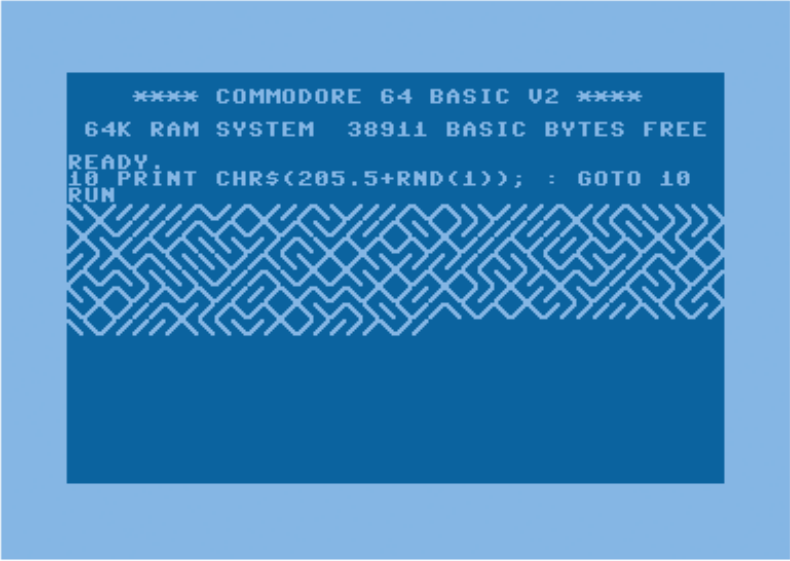
Gunnar Wolf: 10 PRINT CHR$(205.5+RND(1)); : GOTO 10 (also known as #10print )

The line of BASIC code that appears as the subject for this post is the title for a book I just finished reading And enjoyed thoroughly. The book is available online for download under a CC-BY-NC-SA 3.0 License, so you can take a good look at it before (or instead of) buying it. Although it's among the books I will enjoy having on my shelf; the printing is of a very enjoyable good quality. And what is this book about? Well, of course, it analizes that very simple line of code, as it ran on the Commodore 64 thirty years ago. And the analysis is made from every possible angle: What do mazes mean in culture? What have they meant in cultures through history? What about regularity in art (mainly 20th century art)? How would this code look (or how it would be adapted) on contemporary non-C64 computers? And in other languages more popular today? What does randomness mean? And what does random() mean? What is BASIC, and how it came to the C64? What is the C64, and where did it come from? And several other beautiful chapters. The book was collaboratively written by ten different authors, in a Wiki-like fashion. And... Well, what else is there to say? I enjoyed so much reading through long chapters of my childhood, of what attracted me to computers, of my cultural traits and values... I really hope that, in due time, I can be a part of such a beautiful project!
24 November 2014

Rog rio Brito: Problems with Emacs 24.4

This is, essentially, a call for help, as I don't really know which program is at a fault here. Given that Emacs's upstream converted their repository from bzr to git, all the commits in mirror repositories became "invalid" in relation to the official repository. What does this mean in practical terms, in my case? Well, bear with me while I try to report my steps.
Noticing a regression and reporting a bug There is a regression with Emacs 24.4 relative to 24.3, which I discovered after Emacs 24.4 became available in Debian's sid. The regression in particular is that Emacs 24.4 doesn't seem to respect my Xresources, while 24.3 does (and this is 100% reproducible: I kept the binary packages of version 24.3 of emacs24 and I can install and reinstall things). When I reported this to upstream, I received a reply that it worked fine with another person that was using XFCE with unstable.

Testing various Desktop environments As I am using the MATE desktop environment, I proceeded to test this assertion by installing XFCE. Emacs 24.4 read my Xresources. I went ahead and installed LXDE. It worked again. I tried once more with GNOME 3, but "regular" GNOME 3 just crashed. I tried with GNOME 3 Classic and Emacs 24.4 just worked again.

Going deep into the rabbit's hole Then, I got more curious and I tried to see why things worked the way that they did and given that there was a mirror of the Emacs repo on github, I cloned it and started to git bisect to find the first problematic commit (I have no idea if bzr even offers something like git's bisect and I wouldn't really know how to do it as quickly as I do with git). To cut short a long story, after many recompiles, many wasted hours, a lot of wasted electrical energy, I found a bad commit and reported it. I received no response after that.

The new repo enters in action Of course, all my hard work bisecting things was completely invalidated after the transition to the new repository went live. To make things relevant again, I used the awesome powers of git, restricting the changes of the newly cloned repository to the e-mail of the committer in question (Chong Yidong) and, from there, I proceeded to another painful process of git bisects. And, sure enough, the first bad commit was the same one that I found with the previous tree. Semi-blindly reverting this commit, and also semi-blindly resolving the conflicts make Emacs's from master work again on my system, but I highly suspect that (given the way that I did it), it would not really be appropriate for upstream. But given also that I failed to receive feedback after my original report, I am not too confident that this bug can be solved soon (even if it doesn't qualify for being fixed in Debian 8). After all this, I don't really know what else to do. I even filed a bug report (more like a request for help) to the Debian MATE maintainers. As a side note, I would have filed a bug to upstream MATE, but it is not really clear what the proper procedure to report bugs to them is---they seem to use github's issues system, but given that they have separate repositories for each component of the project, and that I don't know precisely what repository to report to (or even if it applies to MATE after all), I am more or less paralyzed.

A side note I must say that the conversion was well done by Eric Raymond, because the whole .git repository of the new repo is only about 200MB, with history going back to 1985, while the other repository had about 800GB.

John Goerzen: My boys love 1986 computing

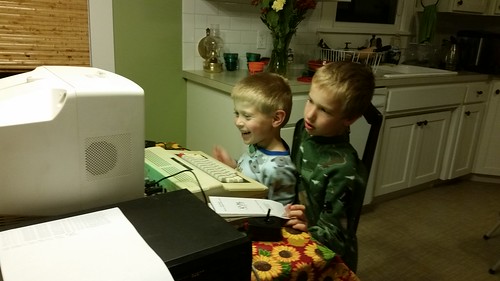
Yesterday, Jacob (age 8) asked to help me put together a 30-year-old computer from parts in my basement. Meanwhile, Oliver (age 5) asked Laura to help him learn cursive. Somehow, this doesn t seem odd for a Saturday at our place. 2014-11-22 18.58.36 Let me tell you how this came about. I ve had a project going on for a while now to load data from old floppies. It s been fun, and had a surprise twist the other day: my parents gave me an old TRS-80 Color Computer II (aka CoCo 2 ). It was, in fact, my first computer, one they got for me when I was in Kindergarten. It is nearly 30 years old. I have been musing lately about the great disservice Apple did the world by making computers easy to learn namely the fact that few people ever bother to learn about them. Who bothers to learn about them when, on the iPhone for instance, the case is sealed shut, the lifespan is 1 or 2 years for many purchasers, and the platform is closed in lots of ways? I had forgotten how finicky computers used to be. But after some days struggling with IDE incompatibilities, booting issues, etc., when I actually managed to get data off a machine that had last booted in 1999, I had quite the sense of accomplishment, which I rarely have lately. I did something that was hard to do in a world where most of the interfaces don t work with equipment that old (even if nominally they are supposed to.) The CoCo is one of those computers normally used with a floppy drive or cassette recorder to store programs. You type DIR, and you feel the clack of the drive heads through the desk. You type CLOAD and you hear the relay click closed to turn on the tape motor. You wiggle cables around until they make contact just right. You power-cycle for the times when the reset button doesn t quite do the job. The details of how it works aren t abstracted away by innumerable layers of controllers, interfaces, operating system modules, etc. It s all right there, literally vibrating your desk. So I thought this could be a great opportunity for Jacob to learn a few more computing concepts, such as the difference between mass storage and RAM, plus a great way to encourage him to practice critical thinking. So we trekked down to the basement and came up with handfulls of parts. We brought up the computer, some joysticks, all sorts of tangled cables. We needed adapters, an old TV. Jacob helped me hook everything up, and then the moment of truth: success! A green BASIC screen! I added more parts, but struck out when I tried to connect the floppy drive. The thing just wouldn t start up right whenever the floppy controller cartridge was installed. I cleaned the cartridge. I took it apart, scrubbed the contacts, even did a re-seat of the chips. No dice. So I fired up my CoCo emulator (xroar), and virtually saved some programs to cassette (a .wav file). I then burned those .wav files to an audio CD, brought up an old CD player from the basement, connected the cassette in plug to the CD player s headphone jack, and presto instant programs. (Well, almost. It takes a couple of minutes to load a program from audio codes.) The picture above is Oliver cackling at one of the very simplest BASIC programs there is: number find. The computer picks a random number between 1 and 2000, and asks the user to guess it, giving a too low or too high clue with each incorrect guess. Oliver delighted in giving invalid input (way too high numbers, or things that weren t numbers at all) and cackled at the sarcastic error messages built into the program. During Jacob s turn, he got very serious about it, and is probably going to be learning about how to calculate halfway points before too long. But imagine my pride when this morning, Jacob found the new CD I had made last night (correcting a couple recordings), found my one-line instruction on just part of how to load a program, and correctly figured out by himself all the steps to do in order (type CLOAD on the CoCo, advance the CD to the proper track, press play on the player, wait for it to load on the CoCo, then type RUN). I ordered a replacement floppy controller off eBay tonight, and paid $5 for a coax adapter that should fix some video quality issues. I rescued some 5.25 floppies from my trash can from another project, so they should have plenty of tools for exploration. It is so much easier for them to learn how a disk drive works, and even what the heck a track is, when you can look at a floppy drive with the cover off and see the heads move. There are other things we can do with more modern equipment Jacob has shown a lot of interest in Arduino projects but I have so far drawn a blank on ways to really let kids discover how a modern PC (let alone a modern phone or tablet) works. Update Nov. 24: Every so often, the world surprises me by deciding to, well, read one of my random blog posts. For the benefit of those of you that don t already know my boys, you might want to know that among their common play activites are turning trees into pretend trains, typing at a manual typewriter, reading, writing their own books, using a cassette recorder, building a PC and learning to use bash or xmonad, making long paper tapes with an adding machine, playing records on a record player, building electric gizmos, and even making mud balls. I am often asked about the role of the computer in the lives, given that my hobby and profession involves computers. The answer: less than that of most of their peers. I look for opportunities for them to learn by doing, discovering, playing, or imagining. I make no presumption that they will develop the passion for computers that I did. What I want is for them to have the curiosity and drive to learn everything there is to know about whatever they do develop a passion for, so they will be great at it.

Next.

Previous.
