Search Results: "dom"

19 May 2009

Martin-Éric Racine: Invandringskonsult

In close to 11 years of living in Europe, I've accomplished plenty beyond working in the high-tech sector: I've also been fairly active in Immigration Policy, especially on aspects that affect migrant labor. Because of this, I keep on getting more and more requests to produce statements or to appear on panels to discuss issues pertaining to migrant labor and to immigrants' integration. The hot topic of last week was Swedish language for immigrants, the crux of the issue being that even though Swedish has an official language status in Finland, in practice, it is pretty much impossibly for immigrants to register their kids at the Swedish language school, to claim public services in Swedish or, even more so, to request labor training in the Swedish language at the Employment Office. The weekly newspaper Helsinki Times, in collaboration with the media think tank Magma, recently conduced a survey of the immigrant population, to find out how much they know about Swedish culture in Finland and about the Swedish language. It was in this context that the Helsinki Times and the national television's Swedish programming (FST) asked for an interview with yours truly, because I have recently visited the Ministry of Employment and Economics with a concrete proposal to facilitate the availability of labor training in the Swedish language. This FST webcast, starting at 16:03 minutes into the show, and the above Helsinki Times article provide more details about the context and about my proposal to the Ministry.

Neil Williams: libqof2

It's taken a lot longer than I expected (mostly due to getting other things done in Emdebian etc.) but now that Lenny is out, QOF can finally drop all the previously deprecated code and move to libqof2, so the upstream code has now been released via Alioth (0.8.0) and the binaries have been uploaded to Debian and are waiting in NEW.

QOF provides a set of C language utilities for performing generic structured complex queries on a set of data held by a set of C/C++ objects. This framework allows programmers to add query support to their applications without having to hook into a SQL Database. QOF is a large part of my attempts to get some degree of data freedom to complement the source code freedom. This remains a problem with certain applications, especially financial ones, so I've tried to make it easier to both import and export data between programs using QOF and to convert the default QOF data storage formats into other common formats using simple tools and scripts based on XSL or perl. Having a SQL-type query interface accessible via the command line is a huge bonus when dealing with large data sets.

There is a patch for gnotime that makes the final adjustments to handling the removed code. pilot-qof and gpe-expenses already build cleanly without the deprecated code but each of these is also pending a new upstream release, so rather than need a binNMU, I'm simply going to make those releases when QOF clears NEW.

Having said that, pilot-qof and gpe-expenses introduce new binary packages themselves so they will spend time in NEW too. pilot-qof will be the last of the set to be released because the new upstream version can use symbols from the new gpe-expenses release to make it easier to move data between applications. However, that support is optional at build time and could be done via a Debian revision, so I might do it that way.

This also marks the completion of the migration of QOF from SourceForge to Alioth - principally for easier bug tracking and a usable mailing list archive. The QOF VCS is in svn.debian.org.

The mailing list for QOF development is therefore at alioth:
QOF-devel and archives also.

I'm still working on two other QOF-based utilities - one that can handle simple accounts and one to handle simple invoices. The invoice handling is already partially implemented in pilot-qof but I'm looking at a GTK+ frontend with a robust command line interface so that scripts can update the invoice data behind-the-scenes. Hopefully, some form of arbitrary-format parser can be arranged that can handle extracting data from whatever form the client happens to send - typically PDF. It'll need tweaking for each client, but it could work. The objects used by gpe-expenses and pilot-qof (including invoices) are exposed via QOF and can be mixed together in any new QOF application, easily able to read data from multiple sources, merge data sets, query data sets and export into other formats. The core currency and expense types come from pilot-link but are then enhanced to support GnuCash conventions.

For information on another QOF application called "estron" - an idea for a data-driven query interface - see http://estron.alioth.debian.org/. Problem 1 with estron: the examples all rely on postgres and I just can't get that to setup properly as either a test system or as a Debian package. Problem 2: estron was intended to be an interpreter that could be written "in itself" but whilst this is possible for the simpler examples, doing more complicated stuff like calculating values from other values makes the estron XML very obtuse. The current codebase uses GOB2 to

QOF is now stable and I don't expect to need another SONAME bump for quite a while. If anyone is interested in taking on estron or helping with the Cash and/or Invoice frontends, let me know. The problem with estron currently is bitrot - the GTK+ frontend has too many gtk1.2 hangovers which now fail to build.

17 May 2009

Holger Levsen: Appropriate talk about porn: it's abuse

Russel, I agree that some porn sites are facing interesting technical challenges, but I wouldn't suggest using them as example for anything, just like a talk about the challenges of torture is always inappropriate in a human society.

Porn is, except for self made porn and some other corner cases, abuse and oppression. Simple as that.

And please, before you try to argue against that simple statement, read the lyrics of no answer for a dancer from one of my favorite bands, consolidated, and think for more than ten minutes. If we were living in really free societies, porn could be fun.

Which reminds me of a quote from Rebecca L. Eisenberg: "A truly radical view of pornography recognizes that we are what we consume -- and if we are going to alter the face of society, and destroy Victorian and religious notions like gender altogether -- as I believe we must -- we must be willing to evaluate and change every aspect of our lives, including the images we feed ourselves as we fuck, as terrifying as it sounds. Like it or not, revolution is a scary concept." The complete text where this quote is from can be found online on her webpage.

P.S: If you hear me playing "the internet is for porn" (this musicalsong) or remember me doing so - can you now see the great irony? I would have hoped you've seen it before. Or at least wondered, what the hell I was doing.

Russell Coker: Appropriate Talks about Porn

There is currently some discussion about a talk which used pornographic imagery and jokes to illustrate points about Ruby programming [1]. A similar event happened in 2006 here is the description of the event from the author - which includes an unreserved apology [2]. It seems to me that the current discussion focusing on what is inappropriate for a public lecture is the wrong way to do it as there is a vast range of inappropriate material. I suggest that instead a white-list of appropriate references to porn in lectures will be more effective - if nothing else it makes for a much smaller list. Here is a first draft of such a list:

  1. Pornographic web sites handle a lot of traffic. There are significant technical problems that need to be solved. A lecture from an employee of an Internet porn company which covers the solutions to those technical problems would be of interest to many system administrators. Of course such a lecture should not promote the Internet porn company or show any samples of their products.

  2. Digital processing of images is an interesting topic. Having a digital editor from a magazine such as Vogue describe in detail how they do their job would be really interesting. There is a lot of overlap between the range of pictures displayed in Vogue and those displayed on porn sites. Having an employee of a porn company demonstrate how they touch up the picture of a fully clothed model would be an interesting technical topic, but of course it would be totally inappropriate to make any specific mentions of how the parts of the picture which are not PG-13 rated are edited. Even showing a picture of a porn star might be controversial, but I m sure that the same work could be reproduced with a photo of someone who has a more respectable career. Touching up a picture of RMS to make him look like a politician would make for a challenge for the presenter and an interesting lecture.

  3. The image known as Lenna is a photograph of a Playboy model named Lena that is widely used to test image compression [3]. While the image remains controversial, it seems to me that it would be impossible to give a complete and factual account of the history of image compression without mentioning it.

  4. The police have great discretionary powers to determine which crimes should be actively investigated. Senior police decide how many resources to assign to each case. I believe that in many jurisdictions the police will assign a much lower priority to a hacking case if the victim is running a porn service. Rumor has it that porn sites put a lot more effort into system security than most Internet services, partly due to not having as much protection from the police as other industries and partly because their customers don t want to be identified. I would be very interested in attending a presentation about practical computer security by a system administrator from a porn site. As an aside I m always interested in talking to people who do security work, so I would like to have a chat with someone who does such work for a porn site.

  5. A few years ago I attended a lecture about the security implications of porn surfing. It had some scary statistics on the number of porn sites that try to deploy malware on the computers of the people who view porn, and it made a good business case for banning porn at work without reference to HR issues (which is very relevant for the jurisdictions where viewing porn at work is not considered to be a social problem). I would like to see a new version of that talk with statistics based on more recent research, my theory is that modern porn sites are more toxic than the old ones due to the general increase in criminal activity on the net - but I have no evidence to support it.

Of course in all cases jokes about porn are not acceptable, mentions of porn need to be strictly on the basis of historical analysis or the description of technical and legal issues which are relevant to the audience. Delivering a talk about porn without inappropriate jokes would take a great deal of effort, but it can be done (and I ve seen it done once). For these five cases (and the few others that will probably be suggested in comments) it would probably be best if the conference organisers viewed the talk first to ensure that there was no misunderstanding about what is appropriate. I think that comparing a short list of specific cases where porn can reasonably be mentioned in a public lecture with the vast number of potential inappropriate references illustrates the probability of a random porn reference being acceptable. The probability of making a random porn reference that is appropriate is probably slightly less than that of winning the lottery.

16 May 2009

Steve Kemp: Humans don't drink blood.

I've said it multiple times, but all mailing list managers suck. Especially mailman. (On that topic SELinux is nasty, Emacs is the one true editor, and people who wear furry boots are silly.) Having setup some new domains I needed a mailing list manager, and had to re-evaluate the available options. Mostly I want something nice and simple, that doesn't mess around with character sets, that requires no fancy deamons, and has no built in archiving solution. Really all we need is three basic operations: Using pipes we can easily arrange for a script to be invoked for different options:
# Aliases for 'list-blah' mailing list.
#
^list-blah-subscribe$:   " /sbin/skxlist --list=list-blah --domain=example.com --subscribe"
^list-blah-unsubscribe$: " /sbin/skxlist --list=list-blah --domain=example.com --unsubscribe"
^list-blah$:             " /sbin/skxlist --list=list-blah --domain=example.com --post"
The only remaining concerns are security related. The most obvious concern is that the script named will be launched by the mailserver user (Debian-exim in my case). That suggests that any files it creates (such as a list of email addresses - i.e. list members) will be owned by that user. That can be avoided with setuid-fu and having the mailing list manager be compiled. But compiled code? When there are so many lovely Perl modules out there? No chance! In conclusion, if you're happy for the exim user to own and be able to read the list data then you can use skxlist. It is in live use, allows open lists, member-only lists, and admin-only lists. It will archive messages in a maildir, but they are ignored for you to use if you see fit. List options are pretty minimal, but I do a fair amount of sanity checking and I see no weaknesses except for the use of the Debian-exim UID. ObFilm: Blade

14 May 2009

Antti-Juhani Kaijanaho: Asynchronous transput and gnutls

CC0
To the extent possible under law,
Antti-Juhani Kaijanaho has waived all copyright and related or neighboring rights to
Asynchronous transput and gnutls. This work is published from Finland.
GnuTLS is a wonderful thing. It even has a thick manual but nevertheless its documentation is severely lacking from the programmer s point of view (and there doesn t even seem to be independent howtos floating on the net). My hope is to remedy with this post, in small part, that problem. I spent the weekend adding STARTTLS support to the NNTP (reading) server component of Alue. Since Alue is written in C++ and uses the Boost ASIO library as its primary concurrency framework, it seemed prudent to use ASIO s SSL sublibrary. However, the result wasn t stable and debugging it looked unappetizing. So, I wrote my own TLS layer on top of ASIO, based on gnutls. Now, the gnutls API looks like it works only with synchronous transput: all TLS network operations are of the form do this and return when done ; for example gnutls_handshake returns once the handshake is finished. So how does one adapt this to asynchronous transput? Fortunately, there are (badly documented) hooks for this purpose. An application can tell gnutls to call application-supplied functions instead of the read(2) and write(2) system calls. Thus, when setting up a TLS session but before the handshake, I do the following:
                gnutls_transport_set_ptr(gs, this);
                gnutls_transport_set_push_function(gs, push_static);
                gnutls_transport_set_pull_function(gs, pull_static);
                gnutls_transport_set_lowat(gs, 0);
Here, gs is my private copy of the gnutls session structure, and the push_static and pull_static are static member functions in my sesssion wrapper class. The first line tells gnutls to give the current this pointer (a pointer to the current session wrapper) as the first argument to them. The last line tells gnutls not to try treating the this pointer as a Berkeley socket. The pull_static static member function just passes control on to a non-static member, for convenience:
ssize_t session::pull_static(void * th, void *b, size_t n)
 
        return static_cast<session *>(th)->pull(b, n);
 
The basic idea of the pull function is to try to return immediately with data from a buffer, and if the buffer is empty, to fail with an error code signalling the absence of data with the possibility that data may become available later (the POSIX EAGAIN code):
class session
 
        [...]
        std::vector<unsigned char> ins;
        size_t ins_low, ins_high;
        [...]
 ;
ssize_t session::pull(void *b, size_t n_wanted)
 
        unsigned char *cs = static_cast<unsigned char *>(b);
        if (ins_high - ins_low > 0)
         
                errno = EAGAIN;
                return -1;
         
        size_t n = ins_high - ins_low < n_wanted
                ?  ins_high - ins_low
                :  n_wanted;
        for (size_t i = 0; i < n; i++)
         
                cs[i] = ins[ins_low+i];
         
        ins_low += n;
        return n;
 
Here, ins_low is an index to the ins vector specifying the first byte which has not already been passed on to gnutls, while ins_high is an index to the ins vector specifying the first byte that does not contain data read from the network. The assertions 0 <= ins_low, ins_low <= ins_high and ins_high <= ins.size() are obvious invariants in this buffering scheme. The push case is simpler: all one needs to do is buffer the data that gnutls wants to send, for later transmission:
class session
 
        [...]
        std::vector<unsigned char> outs;
        size_t outs_low;
        [...]
 ;
ssize_t session::push(const void *b, size_t n)
 
        const unsigned char *cs = static_cast<const unsigned char *>(b);
        for (size_t i = 0; i < n; i++)
         
                outs.push_back(cs[i]);
         
        return n;
 
The low water mark outs_low (indicating the first byte that has not yet been sent to the network) is not needed in the push function. It would be possible for the push callback to signal EAGAIN, but it is not necessary in this scheme (assuming that one does not need to establish hard buffer limits). Once gnutls receives an EAGAIN condition from the pull callback, it suspends the current operation and returns to its caller with the gnutls condition GNUTLS_E_AGAIN. The caller must arrange for more data to become available to the pull callback (in this case by scheduling an asynchronous write of the data in the outs buffer scheme and scheduling an asynchronous read to the ins buffer scheme) and then call the operation again, allowing the operation to resume. The code so far does not actually perform any network transput. For this, I have written two auxiliary methods:
class session
 
        [...]
        bool read_active, write_active;
        [...]
 ;
void session::post_write()
 
        if (write_active) return;
        if (outs_low > 0 && outs_low == outs.size())
         
                outs.clear();
                outs_low = 0;
         
        else if (outs_low > 4096)
         
                outs.erase(outs.begin(), outs.begin() + outs_low);
                outs_low = 0;
         
        if (outs_low < outs.size())
         
                stream.async_write_some
                        (boost::asio::buffer(outs.data()+outs_low,
                                             outs.size()-outs_low),
                         boost::bind(&session::sent_some,
                                     this, _1, _2));
                write_active = true;
         
 
void session::post_read()
 
        if (read_active) return;
        if (ins_low > 0 && ins_low == ins.size())
         
                ins.clear();
                ins_low = 0;
                ins_high = 0;
         
        else if (ins_low > 4096)
         
                ins.erase(ins.begin(), ins.begin() + ins_low);
                ins_high -= ins_low;
                ins_low = 0;
         
        if (ins_high + 4096 >= ins.size()) ins.resize(ins_high + 4096);
        stream.async_read_some(boost::asio::buffer(ins.data()+ins_high,
                                                   ins.size()-ins_high),
                               boost::bind(&session::received_some,
                                           this, _1, _2));
        read_active = true;
 
Both helpers prune the buffers when necessary. (I should really remove those magic 4096s and make them a symbolic constant.) The data members read_active and write_active ensure that at most one asynchronous read and at most one asynchronous write is pending at any given time. My first version did not have this safeguard (instead trying to rely on the ASIO stream reset method to cancel any outstanding asynchronous transput at need), and the code sent some TLS records twice which is not good: sending the ServerHello twice is guaranteed to confuse the client. Once ASIO completes an asynchronous transput request, it calls the corresponding handler:
void session::received_some(boost::system::error_code ec, size_t n)
 
        read_active = false;
        if (ec)   pending_error = ec; return;  
        ins_high += n;
        post_pending_actions();
 
void session::sent_some(boost::system::error_code ec, size_t n)
 
        write_active = false;
        if (ec)   pending_error = ec; return;  
        outs_low += n;
        post_pending_actions();
 
Their job is to update the bookkeeping and to trigger the resumption of suspended gnutls operations (which is done by post_pending_actions). Now we have all the main pieces of the puzzle. The remaining pieces are obvious but rather messy, and I d rather not repeat them here (not even in a cleaned-up form). But their essential idea goes as follows: When called by the application code or when resumed by post_pending_actions, an asynchronous wrapper of a gnutls operation first examines the session state for a saved error code. If one is found, it is propagated to the application using the usual ASIO techniques, and the operation is cancelled. Otherwise, the wrapper calls the actual gnutls operation. When it returns, the wrapper examines the return value. If successful completion is indicated, the handler given by the application is posted in the ASIO io_service for later execution. If GNUTLS_E_AGAIN is indicated, post_read and post_write are called to schedule actual network transput, and the wrapper is suspended (by pushing it into a queue of pending actions). If any other kind of failure is indicated, it is propagated to the application using the usual ASIO techniques. The post_pending_actions merely empties the queue of pending actions and schedules the actions that it found in the queue for resumption. The code snippets above are not my actual working code. I have mainly removed from them some irrelevant details (mostly certain template parameters, debug logging and mutex handling). I don t expect the snippets to compile. I expect I will be able to post my actual git repository to the web in a couple of days. Please note that my (actual) code has received only rudimentary testing. I believe it is correct, but I won t be surprised to find it contains bugs in the edge cases. I hope this is, still, of some use to somebody :)

Marco d'Itri: sarge domUs in a lenny dom0

In a service provider environment it is often required by customers to support old server installations for much longer than it is recommended by vendors. Recently I had to move some Xen VPSes running Debian 3.1 to a modern Xen host running lenny and the 2.6.26 kernel. Since Xen is a FPOS and has been unable for years to maintain a stable ABI, I always use in the domUs the same kernel version of the dom0. The Debian Xen kernels require using an initramfs to load the paravirtualized block device driver and mount the root, at least. This would usually not be a big deal, but in this case breaks the VPS because the lenny version of udev is started in the initramfs and the system has either no udev or the old sarge version. The most immediately visible effect is that /dev/pts does not exist, which makes ssh less than useful. This is my solution:
dpkg --purge hotplug udev
printf '#!/bin/sh\nmkdir /dev/pts\n' > /etc/rcS.d/S02mkdir
chmod +x /etc/rcS.d/S02mkdir

11 May 2009

Russell Coker: Dom0 Memory Allocation and X

I ve previously written about memory squeeze problems in a Xen Dom0 when large amounts of memory were assigned to DomUs [1]. In summary the Dom0 would have problems if started with default options and the majority of the RAM was later assigned to DomUs, but if the memory of the Dom0 was limited by the dom0_mem parameter to the Xen kernel then things would work well. Fatal server error:
xf86MapVidMem: Could not mmap framebuffer (0xfae80000,0 80000) (Invalid argument) I have since found another exciting bug with Xen. I was in the process of upgrading an AMD64 workstation to using Xen so that I could test other versions of some software in the background. The first stage was to install the Xen kernel and the Xen enabled Linux kernel and boot the machine. Unfortunately I then received the above message when trying to start the X server. I discovered the solution to this in the comments section of Different Colours blog post about Virtualisation on Lenny [2]. It seems that there is a problem gaining mmap access to MMIO memory regions in Xen and that restricting the memory of the Dom0 is a work-around. My AMD64 workstation has 3G of RAM because the motherboard can t support more than 3.25G and buying 4G of RAM to have 3.25G usable would be an expensive way of doing it. So I used dom0_mem=1500M and now X works again. I have yet to discover if anything strange and exciting happens when I create DomUs on the machine. I don t have any immediate plans for running Xen on the machine. It s main uses at the moment is torcs (a slightly realistic 3D car racing game), supertuxkart (a cartoon 3D car racing game), and mplayer so it doesn t really need a lot of RAM. I like to keep my options open and have all my machines capable of virtualisation apart from routers.

James Morrison: Same Cities

On thursday I went out to see Loquat, The Greycoats, and Head like a kite. Head like a kite was a lot of fun, they had a dancing panda and foam heads (the ones you put whigs on) to throw around the audience. The strange part of the night was that I met Mark Johnson again. Mark was someone who knew a bunch of the same people as me in secondary school, then we both did co-op Math/CS degrees at UWaterloo, and since leaving school have both lived in the bay area. I didn't know Mark was in SF until this week, well, now we've met again, four years later.

Random thought:
Why are Canadians more patriotic when they are away from Canada? I saw a guy with a flag on his ipod shuffle while running yesterday.

10 May 2009

Martin Meredith: This whole GPG/PGP thing

So, SHA-1 has potential exploits, but you know what? I only use it for signing plain text things. Email, change files I ve no reason to use it for encryption, as I don t encrypt things Surely, if anyone is going to make something that collides with a valid signature of mine, it s going to either a) be noticable to the person reading it (random characters in an email?) or b) not be processable by whatever automated sytem is using it. I ve yet to hear of any exploit that could affect the way I use SHA-1 in a meaningful way. Ok, yes, I m not going to be using it to hash passwords in future (well, GPG uses it to hash passwords, but generally, to be able to crack that, someone would have to have my secret key anyway, which I would count as being compromised!) If someone can give me a real world example of how this can be used against me, I might go out of my way to replace my key, but for now, I don t see the need. Ok, I might take the next time I meet up with a fellow Debian Developer as a chance to replace my key, but I m not going to go out of my way to do so (as I had to for getting my key signed by my first Debian/Ubuntu Developer in the first place)

7 May 2009

Steve Kemp: I'm fireproof, you're not

I've mostly been avoiding the computer this evening, but I did spend the last hour working on attempt #2 at distributed monitoring. The more I plot, plan & ponder the more appealing the notion becomes. Too many ideas to discuss, but in brief:
My previous idea of running tests every few minutes on each node scaled badly when the number of host+service pairs to be tested grew. This lead to the realisation that as long as some node tests each host+service pair you're OK. Every node need not check each host on every run - this was something I knew, and had discussed, but I assumed that would be a nice optimisation later rather than something which is almost mandatory. My previous idea of testing for failures on other nodes after seeing a local failure was similarly flawed. It introduces too many delays:
  • Node 1 starts all tests - notices a failure. Records it
    • Fetches current results from all neighbour nodes.
    • Sees they are OK - the remote server only just crashed. Oops.
  • Node 2 starts all tests - notices a failure. Records it.
    • Fetches current results from all neighbour nodes.
    • Sees they are OK - the remote server only just crashed. Oops.
In short you have a synchronisation problem which coupled with the delay of making a large number of tests soon grows. Given a testing period of five minutes, ten testing nodes, and 150 monitored hosts+services, you're looking at delays of 8-15 minutes. On average. (Largely depends on where in the cycle the failing host is, and how many nodes must see a failure prior to alerting.) So round two has each node picking tests at "random" (making sure no host+service was tested more than 5 minutes ago) and at the point a failure is detected the neighbour nodes are immediately instructed to test and report their results (via XML::RPC). The new code is simpler, more reliable, and scales better. Plus it doesn't need Apache/CGI.
Anyway bored now. Hellish day. MySQL blows goats. ObFilm: Hellboy

Biella Coleman: Make our words glisten


glisten vs hardened words, originally uploaded by the biella.
Now that I am (thankfully) done teaching until September, I have time to devour two small mountains of readings that I need to finish before I return to my manuscript, which I will be working on, I hope uber-productively, all summer long. One pile of readings deals with coding, open source, and the commons, such as Scott Rosenberg s Dreaming in Code and David Bollier s Viral Spiral. Another pile of reading edges toward the theoretical side of things, having to do with craft, pleasure, and humor, since it is pleasure in its many many many guises from from the calm feeling of self-satisfaction that underlies pride in one s craft, to the more sublime feeling of ecstatic bliss that powers many creative sprints. If one entertains pleasure, one must also entertain its darker side, for all of this feel good stuff is nonetheless often springs forth from a deep sea of passionate frustration. This seems to be the driving theme of Dreaming in Code and it is also what animates Ellen Ullman s fictional account of pure frustration, The Bug. I am quite fond of native expressions of geek frustration and recently was provided with an exquisite example a rant against the Adobe PSD format. The author of Xee, A light-weight, fast and convenient image viewer for Mac OS X explained his utter contempt for the Adobe PSD in the following way:
At this point, I d like to take a moment to speak to you about the Adobe PSD format. PSD is not a good format. PSD is not even a bad format. Calling it such would be an insult to other bad formats, such as PCX or JPEG. No, PSD is an abysmal format. Having worked on this code for several weeks now, my hate for PSD has grown to a raging fire that burns with the fierce passion of a million suns. If there are two different ways of doing something, PSD will do both, in different places. It will then make up three more ways no sane human would think of, and do those too. PSD makes inconsistency an art form. Why, for instance, did it suddenly decide that *these* particular chunks should be aligned to four bytes, and that this alignement should *not* be included in the size? Other chunks in other places are either unaligned, or aligned with the alignment included in the size. Here, though, it is not included. Were it within my power, I would gather every single copy of those specs, and launch them on a spaceship directly into the sun.
Even if this account represents unadulterated irritation, he leaves us, the reader, with nothing of the irritation, only pleasure. This aftermath of frustration is delivered through the vehicle of humor, which within the hacker context, is the cultural container that best captures the spirit of hacker pleasure or so I will be arguing. Like many humorous rants from the world of hacking (and please send me any others you know of), this text dances with liveliness; it exudes its own rhythm; it glistens to use Ronald Barthes apt phrasing from his short book The Pleasure of Text, which I just finished as part of my theoretical escape into the pleasure-dome. Although there are parts of his book which are to be frank, *really* *not* *pleasurable*, partly due to obscure references to High French Theory, which elide even an academic pair of eyes, the book generally pleases. And one of the most pleasing chunks is his definition of a stereotype:
The stereotype is the word repeated without any magic, any enthusiasm, as though it were natural, as though by some miracle this recurring words were adequate on each occasion for different reasons, as though to imitate could no longer be sensed as an imitation: an unconstrained word that claims consistency and is unaware of its own insistence
In contrast to the stereotype, a string of words that enchants does so by slipping off the page to hit you squarely in the heart or the gut. Unfortunately, while academic writing steers clear of stereotypes, often trying to present the detailed singularity of a phenomena (even when conditioned by social forces), it does not exactly glisten, though there are a handful of exceptions. I think we need more texts that glisten, even if only during sections or parts of our books and articles (much like the rant helped enliven the more staid technical document). In recent years, in large part due to the influence of free software, there has been an explosion, a move toward going open access. All of this is laudable and I fully embrace it (and have gotten into some small battles over it). But without an aesthetic politics that values pleasure in reading and writing we are doomed to obscurity anyway. A move toward making our knowledge public also required a move toward thinking about the literary aesthetics of pleasure.

Ian Wienand: Quickly describing hash utilisation

I think the most correct way to describe utilisation of a hash-table is using chi-squared distributions and hypothesis and degrees of freedom and a bunch of other things nobody but an actuary remembers. So I was looking for a quick method that was close-enough but didn't require digging out a statistics text-book. I'm sure I've re-invented some well-known measurement, but I'm not sure what it is. The idea is to add up the total steps required to look-up all elements in the hash-table, and compare that to the theoretical ideal of a uniformly balanced hash-table. You can then get a ratio that tells you if you're in the ball-park, or if you should try something else. A diagram should suffice. Scheme for acquiring a hash-utilisation ratio This seems to give quite useful results with a bare minimum of effort, and most importantly no tricky floating point math. For example, on the standard Unix words with a 2048 entry hash-table, the standard DJB hash came out very well (as expected)
Ideal 2408448
Actual 2473833
----
Ratio 0.973569
To contrast, a simple "add each character" type hash:
Ideal 2408448
Actual 6367489
----
Ratio 0.378241
Example code is hash-ratio.py. I expect this measurement is most useful when you have a largely static bunch of data for which you are attempting to choose an appropriate hash-function. I guess if you are really trying to hash more or less random incoming data and hence only have a random sample to work with, you can't avoid doing the "real" statistics.

3 May 2009

Steve Kemp: We can't just let you walk away!

My Desktop
I use a number of computers in my daily life, but the machine I use the most often is my "desktop box". This is one of a pair of machines sat side by side on my desk. One machine is desktop (Sid) and one is the backup host (Lenny). The backup machine is used by random visitors to my flat, and otherwise just runs backups for my remote machines (www.steve.org.uk, www.debian-administration.org, etc) every 4/6/24 hours. I apply updates to both boxes regularly but my desktop machine tends to have lots of browsers open, and terminals. I rarely restart it, or logout. So the recent updates to X, hal, udev, mostly pass me by - I can go months without logging out and restarting the system. On Saturday the desktop machine died with a OOM condition when I wrote some bad recursive code for indexing a collection of mailboxes. Oops. When it came back I was greeted with a new login window, and all the fonts look great. Now in the past the fonts looked OK, but now? They look great. I cannot pin down what has changed precisely, but everything looks so smooth and sexy. So, a long entry, the summary is "I restarted my machine after a few months of being logged in, and now it looks better".
Distributed Monitoring?
Random conversation with Alex about monitoring yesterday made me curious to see if anybody has put together a useful distributed monitoring system? Assume you have a network with Nagios, or similar, monitoring it. If your link between the monitoring box and the hosts being checked is flaky, unreliable, or has blips you will see false positives. We've all been there and seen that. So, what is the solution? There are two "obvious" ones:
  • Move the monitoring as close to the services as possible.
  • Monitor from multiple points.
Moving the monitoring closer to the services does reduce the risk of false positives, but introduces its own problems. (i.e. You could be monitoring your cluster, and it could be saying "MySQL up", "Web up", but your ISP could have disconnected you - and you're not connected to the outside world. Oops. The solution there is to test external connectivity too, but that re-introduces the flakyness problem if your link is lossy.) Distributed monitoring brings up its own issues, but seems like a sane way to go. I wrote a simple prototype which has the ability to run as a standalone tester, or a CGI script under Apache. The intention is that you run it upon >3 nodes. If the monitoring detects a service is unavailable it queries the other monitoring nodes to see if they also report a failure - if they do it alerts, if not it assumes the failure is due to a "local" issue. There is a lot of scope for doing it properly, which seems to be Alex's plan, having the nodes run in a mesh and communicate amongst each other "Hey I'm node #1 - I cannot see service X on host Y - Is down for you too?" - but the simple version of having the script just do a wget on the CGI-version on the other nodes is probably "good enough". I really don't track the state of the art in this field, just struggle to battle nagios into submission. Do there exist systems like this already? (sample code is here, sample remote-status checks are here and here. Each node will alert if >=2 nodes see a failure. Otherwise silence is golden.)
ObFilm: X-Men Origins: Wolverine

1 May 2009

Chris Lamb: April 2009 in UK civil liberties

Wednesday 1st
At the G20 protests, Londoner Ian Tomlinson collapses and is attended to by the emergency services; Metropolitan Police claim "during this time a number of missiles - believed to be bottles - were being thrown at them". Tomlinson dies that evening.
Thursday 2nd
The Evening Standard reports that "police were bombarded with bricks, bottles and planks of wood" as they helped Tomlinson.
Saturday 4th
Postmortem of Tomlinson finds he died of a heart attack.
Monday 6th
The EC Data Retention Regulations 2009 comes into force requiring internet service providers to retain details of emails, internet phone calls and other web traffic.
Tuesday 7th
The Guardian publishes a video of a police officer assualting Tomlinson on 1st April.
Wednesday 8th
Twelve Pakistani students are arrested on suspicion of planning terror attacks over the Easter holiday weekend.
Thursday 9th
The Guardian publishes a second video of Tomlinson's assualt, contributing that no missiles were thrown.
Monday 13th
Police arrest 114 climate protestors on conspiracy to cause criminal damage at Nottingham power plant. [ref]
Tuesday 14th
A video of a seperate assualt at the G20 protests is published.
Thursday 16th
Police claim tourist's photography of transport-related buildings is "strictly forbidden" and demand the photos are deleted. [ref]
Friday 17th
A second postmortem of Iam Tomlinson finds the cause of death to be an abdominal haemorrhage. A policeman is interviewed under caution on suspicion of manslaughter. [ref]
Saturday 18th
The Times reveals MP Damian Green private emails were searched by the police using the keywords "Shami Chakrabarti" (director of Liberty) after his arrest last year.
Monday 20th
The Guardian reveals police intelligence was given to E.On before the Nottingham climate demonstration, including movements of protesters and their meetings.
Tuesday 21st
Another video of the Tomlinson assault is revealed showing his head hitting the pavement. The Independent Police Complaints Commission fails to obtain an injunction to prevent broadcast.
Wednesday 22nd
Nine Pakistani students arrested during anti-terror raids are released after 13 days without charge and are passed to UK Border Agency custody for deportation. [ref]
Monday 27th
Home Secretary Jacqui Smith announces that ISPs and telecoms companies will be asked to record usage "to track murderers and paedophiles" without a warrant. [ref]
Tuesday 28th
Emails are revealed of the Home Office asking Phorm, the behavioural targeted advertising service, whether they are falling outside the law. Home Office claim Phorm would be legal if consent is obtained and that "providers of goods and services need only ensure they are compliant with relevant legislation". [ref]
Wednesday 29th
The Guardian documents the friends of the 7/7 bombers were denied bail on secret evidence - "the appellant asked the judge the question: why are you sending me to prison? To which the judge replied: 'I cannot tell you that.'"

Simon McVittie: Implementing D-Bus clients with telepathy-glib (and telepathy-qt4)

(The much-delayed part 2 in an ongoing series: shiny things in telepathy-glib) Over a year ago I explained my first major round of work on telepathy-glib, with which it could be used to implement D-Bus services. I started to write this post shortly after, but then got distracted by a bee or something; recent discussion about having a D-Bus binding in GLib has finally prompted me to finish it. The second major round of work on telepathy-glib dealt with implementing client code, and went sufficiently well that telepathy-qt4 (currently under development) uses essentially the same model. Again, while telepathy-glib is intended for Telepathy implementors, I think TpProxy's ideas are generically useful, particularly for "large" D-Bus APIs.

Some background: dbus-glib and libtelepathy
GObject-CRITICAL: Assertion failed: proxy->convenient
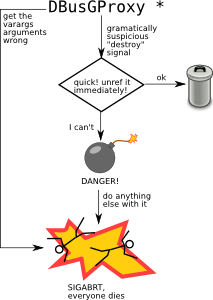
The life-cycle of a DBusGProxy (PD clipart credit: karderio and Andy)
The API provided by dbus-glib for client code is, er, rather less than ideal. The basic object is DBusGProxy, which has a few problems. There's one per interface, rather than one per object; this leads to a maze of twisty GObjects, all suspiciously similar. Our old client library, libtelepathy, got round this by subclassing DBusGProxy to make helper objects called TpChan, TpConn etc., which were simultaneously the proxy for the "main" interface (Channel, Connection etc.), and a factory for proxies for the other interfaces (like Channel.Type.Text and Channel.Interface.Password). This still wasn't ideal, but it was a start. If you use a DBusGProxy in any way after it has emitted the destroy signal, this is considered to be invalid use of the API, and dbus-glib asserts all over the place. We'd rather it didn't do that - remote objects becoming invalid is a fact of life, and if you don't immediately discard all your references to those objects, remote operations on them should just give you a runtime error. You have to be prepared to handle such runtime errors already, because any IPC call can fail at any time. The main API for calling methods uses varargs and is rather subtle. Notably, the calling convention for variant parameters (of D-Bus signature 'v') is not consistent with the calling convention for any other container. For any other container, for instance a GPtrArray *, you pass in a GPtrArray ** pointing to a GPtrArray * variable containing NULL; on success, a pointer to a new GPtrArray is written into that variable. For variant parameters, though, you must pass in a GValue * pointing to a zero-filled GValue, and the result will be written into that GValue. dbus-binding-tool generates thin wrappers around this method-calling API which provide type-safety, although they can't directly specify a non-default timeout. As for signals, before binding to a signal, you have to tell dbus-glib about its signature. This tells dbus-glib how it should push the signal arguments onto the C stack (in GObject terminology: how it should marshal them), to match the signature of the signal-handler function. The documentation claims that this isn't necessary for objects supporting the Introspect method, but that's untrue - on the other hand, if the documented behaviour actually happened, I would consider this to be a critical bug in dbus-glib, since it would enable remote objects to crash dbus-glib clients (by causing signal arguments to be pushed onto the stack in a way that does not match the signature of the signal handler). Of course, the signal-adding function takes varargs, and has to be called exactly once per signal per object. If you don't, dbus-glib asserts when you connect to the signal; if you call it twice, dbus-glib asserts anyway.

TpProxy TpProxy is a GObject subclass vaguely inspired by Python's dbus.proxy.ProxyObject. It isn't a subclass of DBusGProxy, which lets us encapsulate dbus-glib almost completely - in fact, all the references to DBusGProxy are in a separate header, proxy-subclass.h, only used by subclasses of TpProxy (as opposed to normal library API users). TpProxy instances are per-remote-object (per-object-path) like in dbus-python, rather than per-interface like in dbus-glib or QtDBus. As explained below, I believe that this is the most natural object mapping for D-Bus interfaces; in practice it tends to lead to clearer code for us, since one remote object often maps nicely to one UI element (of course, if your objects only have one interface, this approach is no better or worse than dbus-glib's). TpProxy provides support for the following common D-Bus things:
  • Calling methods
  • Connecting to signals
  • Objects becoming invalid
  • Objects with optional interfaces
  • Extensibility
It doesn't currently provide any particular help with Properties - the Properties interface is just another interface as far as we're concerned. We find that, in practice, that's not a problem (even though we use D-Bus properties extensively). In telepathy-qt4 we basically reinvented TpProxy in C++, as Tp::DBusProxy. I've put in some comments below illustrating how the general ideas we used in TpProxy translate into a different object mapping.

Calling methods Method calls on TpProxy are done through auto-generated wrapper functions, much like DBusGProxy. These look something like this:
typedef void (*tp_cli_channel_callback_for_close) (TpChannel *proxy,
    /* any 'out' arguments would go here - Close() doesn't have any */
    const GError *error, gpointer user_data,
    GObject *weak_object);
TpProxyPendingCall *tp_cli_channel_call_close (TpChannel *proxy,
    gint timeout_ms,
    /* any 'in' arguments would go here - Close() doesn't have any */
    tp_cli_channel_callback_for_close callback,
    gpointer user_data,
    GDestroyNotify destroy,
    GObject *weak_object);
Methods for some interfaces, like DBus.Properties, are available on TpProxy itself; others, like Telepathy's Channel.anything, are only available on a particular subclass, like TpChannel. Things to note here:
  • It's an asynchronous call with a callback. General design principle: "this is IPC, get over it". We don't try to hide the fact that IPC is taking place by doing pseudo-blocking calls.
  • The timeout is explicit (although you can always pass -1 to let libdbus pick a "reasonable" default for you). This is because the remote service might not respond, and API users should be at least vaguely aware of this: "this is IPC, get over it".
  • The callback isn't a GCallback; it has an explicit signature, for some semblance of type-safety (it's not much, but it's better than nothing).
  • The callback takes a GError, because any IPC call can fail for any reason.
  • A TpProxyPendingCall * is returned. This is a pointer to an object that only exists until just after the callback is called (so you can ignore it if you don't want it), with a method you can call to cancel the method call (with hindsight this is not ideal, and if I was writing this API now, I'd use gio's GCancellable). "Cancel" is perhaps slightly misleading: the method call still takes place (it was already in libdbus's outgoing queue) but the result gets ignored and the callback isn't called. This is mostly so you an object can forget all the calls it was busy making at the time that the results become irrelevant (e.g. the object is destroyed).
  • There is an extra weak_object argument, which is weakly referenced and is passed to the callback: in practice, most users of telepathy-glib use this as well as or instead of user_data. If the weak_object runs out of references, the callback is automatically cancelled, which means that in practice, explicit cancellation is almost never needed.
  • The generated code has as its first argument a suitable subclass of TpProxy, in this case TpChannel (we tell the code generator about subclasses).
  • You can't see it in the API, but the TpProxy gains an extra ref while a method call is in progress, so you never have to worry about what happens if the proxy gets unreffed during a method call.
  • There's an explicit destructor for the user_data, which is called even if you "cancel" the method call.
In telepathy-qt4, these methods are on small generated helper classes similar to dbus-python's dbus.Interface, one per interface (we provide accessors for them on the non-generated DBusProxy subclass). Instead of using callbacks, we return a temporary QObject per call, which emits a Qt signal on success or failure (that's how all async calls in QtDBus work).

Connecting to signals Similarly, signals have some generated functions:
typedef void (*tp_cli_channel_signal_callback_closed) (TpChannel *proxy,
    /* any arguments would go here - Closed doesn't have any */
    gpointer user_data, GObject *weak_object);
TpProxySignalConnection *tp_cli_channel_connect_to_closed (TpChannel *proxy,
    tp_cli_channel_signal_callback_closed callback,
    gpointer user_data,
    GDestroyNotify destroy,
    GObject *weak_object,
    GError **error);
API notes for these:
  • The callback doesn't take a GError any more, because signals can't fail; the weak_object and the user_data are the same as for method calls
  • This isn't actually a GObject signal at all: those aren't particularly typesafe, and lack namespacing. This might not be very binding-friendly, we haven't tried doing that yet... it might be worth introducing a signal with details, like in dbus-glib, for which these functions are "C bindings".
  • The returned TpProxySignalConnection lets you disconnect from the signal, just like the TpProxyPendingCall above; it can safely be ignored
  • Similarly, if the weak_object dies, then the signal automatically disconnects
  • It is possible for connecting to a signal to fail: this happens if the proxy doesn't actually have the requested interface. If this happens, it's graceful, not a crash. In practice, the flow of code is almost always such that error can safely be NULL because the interfaces are already known.
In telepathy-qt4 the per-interface generated helper classes emit Qt signals. In many cases, we end up proxying these signals by responding to them in the hand-written Tp::DBusProxy subclass by emitting a different signal, in order to give them a nicer representation.

Becoming invalid This is IPC, and any error can happen to you at any time. We found that it was useful to have a general concept of "this object is no longer useful", so we introduced the concept of an object becoming invalidated. The invalidation reason is stored on the object as a GError. If this GError is NULL (as it is initially), then the object is still expected to be valid; if it's non-NULL, the remote object has vanished and the local proxy no longer works. There are several ways a TpProxy can become invalid:
  • its bus name falls off the bus (the process exited or crashed)
  • application-specific reasons (usually triggered by a D-Bus signal in a subclass, like the Telepathy Channel's Closed signal)
  • the GObject gets disposed
Method calls on an invalidated object always fail, with the invalidation reason as the error. This means that calling a method on a TpProxy should never crash your process. The method's callback has to be prepared to handle an error in any case, because this is Sparta^WIPC, so there's no loss in giving it another error. Connecting to signals on an invalidated object always fails, and any existing signal connections are disconnected when it becomes invalidated. This means that if a new remote object appears, and it happens to have the same object path, bus name etc. as the old one, you won't get its signals. A TpProxy can either be bound to a unique bus name or a well-known bus name. In the equivalent code in telepathy-qt4, we call this "stateful" or "stateless" - these names don't capture the intention perfectly, but they're the best we could come up with. A proxy for a stateful API like Telepathy's Channel should always bind to a unique name - when the unique name falls off the bus, the TpProxy becomes invalidated automatically, representing the fact that the Channel you had no longer exists, and nothing can be a perfect replacement for it (the VoIP call has already been terminated, you've already left the chatroom, or whatever - if you make another Channel, that's e.g. a distinct VoIP call). A proxy for a stateless API like Telepathy's ConnectionManager, where an exiting process can disappear, be service-activated again, and still have exactly the same API, should bind to the well-known name. Proxies for well-known names aren't invalidated when the process exits. Qt doesn't have a natural equivalent for GError, so the invalidation reasons in telepathy-qt4 are just a pair of strings, the namespaced name and the message - basically a libdbus DBusError. The principle is the same, though.

Optional interfaces As mentioned above, TpProxy instances are per-remote-object (per-object-path) like in dbus-python, rather than per-interface like in dbus-glib or QtDBus. I believe that this is the most natural object mapping for the D-Bus object model, because the D-Bus interfaces on a remote object can behave like any of these:
  • classes and subclasses (Telepathy.Channel.Type.Text is a Telepathy.Channel)
  • shared interfaces (some Telepathy.Channel objects, of many Types, implement Telepathy.Channel.Interface.Group; any D-Bus object can implement DBus.Properties)
  • optional features (some Telepathy.Channel.Type.Text objects implement Telepathy.Channel.Interface.ChatStates, some do not)
  • discoverable extensions (some Telepathy.Channel.Type.Text objects implement Telepathy.Channel.Interface.Messages, which is more or less Text 2.0)
The way in which interfaces are discovered is also variable. The "classic" D-Bus way to discover interfaces would be to call Introspect. Telepathy services still support that style of introspection, but we don't use it for anything beyond d-feet:
  • Introspect returns a blob of XML, which you have to parse into something useful; if it was in a D-Bus data structure, you'd already have some sensible data structure.
  • Finding out more information about the supported interfaces than their names isn't very useful: in a static language like C you already need to know the methods, signals, properties and their signatures in order to write and compile your code, and in a dynamic language like Python consumers of Introspect end up being remotely crashable by services with unexpected method signatures (this is one of dbus-python's big mistakes in my opinion).
  • If a method that you want to call turns out to be missing, the worst that can happen (in a competently written service) is that it fails with a D-Bus error - and you have to handle D-Bus errors anyway, because this is IPC and anything could fail.
  • Static bindings like dbus-glib have poor support for removing interfaces for which C code exists at runtime, whereas Telepathy needs features like an IM connection that might or might not support avatars (we don't get to find out until we've successfully connected to the server).
Instead, our older interfaces have a method on the "base class" (Channel, Connection etc.) called GetInterfaces, which just returns an array of strings. Newer interfaces (like Account), and older interfaces that have been ported (like Channel), have a property called Interfaces which is, again, an array of strings - this lets us combine the download of the interfaces list with downloading other basic information in a GetAll call. To cater for all these ways to use interfaces, the TpProxy base class has very basic support for interface discovery - you can ask it whether it supports an interface, and you can tell it that it does, in fact, support an interface. Asking which interfaces are supported is directly useful for library users; it's also used as a check by the generated method-call and signal-connection stubs, which return a canned error (Telepathy.Error.NotImplemented in Telepathy's case) if the object isn't known to have the interface. Telling TpProxy that it does support an interface is intended for use by subclasses, and might have been protected if we were writing C++: what happens in practice is that a concrete subclass like TpChannel knows how to discover the fully supported interfaces for this particular object, does so, and calls methods on the TpProxy to tell it which interfaces can work.

Extensibility The API stubs used by TpProxy to call methods and bind to signals are generated from XML documents containing an augmented form of D-Bus introspection data. These XML documents contain various Telepathy-specific extensions, but none of the extensions are language-specific - telepathy-glib, telepathy-python and telepathy-qt4 all operate from exactly the same XML specification. telepathy-qt4's different object-mapping did require us to tighten up some rules that were previously only conventions, but even so, the format is the same. I think this is vitally important - it just doesn't scale to have one set of language-specific annotations in a D-Bus API for each language that will have bindings. One thing that we make heavy use of is what I call "Ugly_Case", which is camel-case with underscores at word boundaries. This gives us a simple, unambiguous and foolproof rule to use in code generators whenever we generate any of the popular conventions for identifiers:
  • CamelCase: delete underscores
  • javaCamelCase: force everything before the first underscore to lower case, then delete underscores
  • lower_case: force everything to lower case, retain underscores
  • UPPER_CASE: force everything to upper case, retain underscores
dbus-glib, by contrast, applies a complex and subtly buggy algorithm to the CamelCase D-Bus names, which results in our SendDTMF method being mapped into GLib as send_dt_mf, and requires that telepathy-glib's Python reimplementation of dbus-binding-tool uses a bug-for-bug compatible implementation (we ended up reimplementing dbus-binding-tool in order to generate the TpProxy-based bindings). Our code generation tools are still rather ad-hoc, because so is our spec format, but for draft interfaces it's possible to copy them into individual projects and use them to generate additional methods for TpProxy or any subclass. This is how we implement unfinished APIs like geolocation in Empathy, for instance. The Interfaces or GetInterfaces hook described above is entirely usable for these extension interfaces, and in fact that's how they're set up. In telepathy-qt4, the generated method stubs are genuine C++ methods, so we can't just append methods to an existing class: this is why we have one helper class per interface, so individual clients can generate a helper class for their particular version of an unfinished API, and instantiate an object of this class attached to a particular Tp::DBusProxy. When an interface becomes stable, it can be added to the set of interfaces for which code is generated in telepathy-glib or telepathy-qt4, at which point any client or service that was already using the final draft of that interface can easily be ported to the library version using sed (the API remains the same).

Becoming ready The concept of being "ready" does not directly exist in TpProxy, but is implemented in TpChannel, TpConnection and TpConnectionManager. The idea is that a freshly created proxy object isn't really fully usable yet - you have to connect to basic signals and recover the initial state of the remote object, as well as checking which extension interfaces are supported. In many well-designed D-Bus APIs you can do this initial setup with a few signal connections and a DBus.Properties.GetAll call. After doing that initial setup (which has to be done asynchronously, because it's IPC), the TpProxy subclass has a local cache of the remote object's state (not necessarily in the same format as the representation on the bus), which can be accessed synchronously at any time, and will be updated in response to change-notification signals. TpChannel and subclasses like it have explicit support for checking for readiness, and having a callback called when the object is ready or invalidated (whichever happens first). The "ready" property also supports the GObject notify signal. telepathy-qt4 took this concept and ran with it - there is library support for objects that can become ready, including a mixin. If I had as much time to work on telepathy-glib as I wish I had, this would be one of the first telepathy-qt4 features to be added to telepathy-glib.

Features becoming ready Going beyond that, in an extensible framework like Telepathy it's probable that not every client understands (or wants to understand) every feature of every object, so it's highly inefficient for every proxy object to subscribe to all the change notification signals and cache all the remote state on the off-chance that the library user wants them. In the API for TpContact (which is not actually a TpProxy for various reasons) we introduced the concept of optional features; telepathy-qt4 extended this idea throughout the library. The idea is that each library user knows which of the optional features are "interesting" to it, and makes a single asynchronous call (which expands into a series of D-Bus calls inside the library) to download the state for core functionality plus all of the selected features, and subscribe to change notification for all of those. This is another telepathy-qt4 thing that telepathy-glib still needs to catch up with; until someone works out how to make the clone() syscall apply to programmers, I fear all libraries are doomed to lag behind how their designers want them to look :-) (license: CC-BY-3.0 / LGPL-2.1+)

29 April 2009

Biella Coleman: The Politics of Open Source

Call for papers: JITP-2010
The Politics of Open Source
May 6-7, 2010 - Amherst, Massachusetts Full Paper Submission Due Date: January 10, 2010 Approach
Free/Libre and Open Source Software (FOSS) has made significant advances, both technically and organizationally, since its emergence in the mid-1980s. Over the last decade, it has moved from a software development approach involving mostly volunteers to a more complex ecology where firms, nonprofit organizations, government agencies and volunteers may be involved. Moreover, the production paradigm continues to expand to other areas of digital content (e.g., Creative Commons, Wikipedia, Connexions, etc.). In this conference we use the phrase open source to capture this broader phenomenon. The Program Committee encourages disciplinary and interdisciplinary approaches to the study of open source, broadly defined. Politics in the conference title, can have many interpretations. Political issues closely tied to the free and open source software movement(s) include: national government policies related to the adoption of open source technologies or questions related to interoperability and open standards, software patents, vendor lock-in, and copyright. These are central themes we expect may be discussed in this forum. In this context, we welcome international submissions since differences in the political perspective appear in international contexts. However, topics related to how the concept of openness has led to various interpretations, adaptations, and applications of open source in other domains, and political issues that surround these broader innovations, are also welcome. Specific topics might include, but are not limited to: General topics related to the politics of open source:
+ How open source software or its principles are changing politics
+ Emerging transparencies in software, systems and society
+ Open source in the developing world and other international contexts
+ The political economy of open source
+ Digital divides and open source Open source and the public sector:
+ Open source software and transparency in government
+ Government policies toward open source and open standards
+ Regulation and open source Open source and democracy:
+ Open source and democratic engagement
+ Open source voting systems
+ Activism, political mobilization and open source The expansion of open source into other domains:
+ Understanding how open source collaboration works and how it can be extended into other areas of collective action
+ Policy areas, such as the effects of free textbooks on education policy or the politics of One Laptop Per Child
+ The political implications of open source in other cultural domains Keynote Speakers
We are pleased to confirm Eric von Hippel (MIT) and Clay Johnson (Sunlight Labs) as the daily keynote speakers for JITP-2010. Paper Submissions
Authors are invited to prepare and submit to JITP a manuscript following one of the six submission formats by January 10, 2010. These formats include research papers, policy viewpoints, workbench notes, review essays, book reviews, and papers on teaching innovation. The goal is to produce a special issue, or double issue, of JITP with a wide variety of approaches to the broad theme of The Politics of Open Source.

How to Submit
Everything you need to know about how to prepare and submit a strong JITP paper is documented at http://www.jitp.net/. Papers will be put through an expedited blind peer review process by the Program Committee, and authors will be notified about a decision by March 10, 2010. A small number of papers will be accepted for presentation at the conference. Other paper authors will be invited to present a poster during the Friday evening reception. All posters must include a YouTube version of their research findings. Best Paper and Poster Cash Prizes
The author (or authors) of the best research paper will receive a single $1,000 prize. The creator (or creators) of the best poster/research presentation will also receive a single prize of $1,000. Program Committee
M.V. Lee Badgett, University of Massachusetts Amherst
Paul M.A. Baker, Georgia Institute of Technology
Deborah Bryant, Oregon State University Open Source Lab
Andrea Calderaro, European University Institute
Mark Cassell, Kent State University
Edward Cherlin, Earth Treasury
Gabriella Coleman, New York University
Doug Downham, University of Massachusetts Amherst
Robert English, Daystar Computing & University of Massachusetts Amherst
Joseph Feller, University College Cork
Jelena Karanovic, Rutgers University
Dave Karpf, University of Pennsylvania/Miller Center for Public Affairs
Jeremy Hunsinger, Virginia Tech
Andrea Kavanaugh, Virginia Tech
Jose Marichal, California Lutheran University
Jens Hardings Perl, Pontificia Universidad Cat lica de Chile
Charlie Schweik, University of Massachusetts Amherst, co-chair
Stuart Shulman, University of Massachusetts Amherst, co-chair
Megan Squire, Elon University
Krishna Ravi Srinivas, Research Information System For Developing Nations
Louis Suarez-Potts, Sun Microsystems, Inc. & OpenOffice.org
Anas Tawileh, Cardiff University & Meedan.net

27 April 2009

Russell Coker: Email Passwords

I was doing some routing sysadmin work for a client when I had to read mail in the system administration mailbox. This mailbox is used for cron job email, communication with ISPs that run servers for the company, and other important things. I noticed that the account was subscribed to some mailing lists related to system administration, the following is from one of the monthly messages from a list server: Passwords for sysadmin@example.com: List Password // URL
-
whatever-users@example.org victoria3 That doesn t seem terribly exciting, unless you know that the password used for the list server happens to be the same as the one used for POP and IMAP access to the account in question, and that it is available as webmail Of course I didn t put the real password in my blog post, I replaced it with something conceptually similar and equally difficult to guess (naturally I ve changed the password). The fact that the password wasn t a string of 8 semi-random letters and digits is not a good thing, but not really bad on it s own. It s only when the password gets used for 3rd party servers that you have a real problem. I wonder how many list servers are run by unethical people who use the passwords to gain access to email accounts, and how many hostile parties use such lists of email addresses and passwords when they compromise servers that run mailing lists. Now there would be an obvious security benefit to not having the list server store the password in clear-text or at least not send it out every month. Of course the down-side to doing that is that it doesn t give someone like me the opportunity to discover the problem and change the password.

Next.

Previous.