Search Results: "edd"

15 August 2007

Mike Hommey: WebKit (almost) in unstable

I finally uploaded the first release of WebKit to unstable. It will obviously need to go through NEW first, which might take some time. There still is work to do, first of which being to correctly setup the git repositories. For the moment, there is only a git repository following upstream svn available on git.d.o. The branches are a bit messy, though ; I have to figure out why git-svn insists on randomly recreating the master branch… I supposedly removed the master branch to have the svn branch follow the git-svn remote. Anyways, once it is sorted out, I’ll set up a special branch to create our tarballs and from which we’d derive the debian branch (or not, this is not decided yet). This special branch will be a copy of the upstream branch with some stuff removed (see debian/copyright in the current packages source for a list of these). Speaking of the package source, since NEW is not available, I made the packages sources and binaries available on gluck. An important note: the version I uploaded is made from revision 24735 of upstream svn repository, which is from July 27. Unfortunately, to be able to build the first version of epiphany that includes webkit embedding (2.19.6) as is, webkit_gtk_page_can_go_forward and webkit_gtk_page_can_go_backward are needed, and these, while available in the API headers, only appeared in the source code on July 30. However, I built a hacked epiphany with calls to these functions removed (which means back and forward buttons won’t work properly), and made it available on gluck too. Be aware this version requires glib and gtk from experimental, which, I’ve been said, made all gtk/glib warnings fatal. That means all applications that usually fill your .xsession-errors log file are likely to crash with these versions. You’ll note integration is not yet perfect, biggest misfeature being the scrollbars missing, and some glitches such as the user agent (it is hardcoded in WebKit :-/), and the about window still saying it is based on Gecko ;) I’ll try to push a new version of WebKit soon enough. Stay tuned.

Bastian Venthur: My top 5 Firefox/Thunderbird annoyances

Firefox is constantly gaining marked share (especially here in Europe) and it’s little not-yet-so-popular brother Thunderbird is evolving too. While I’m happy that they’re contributing their part to bring Free Software to the masses, I’m concerned that the quality of their software (especially Firefox under Linux) has decreased in the last months. Here are my top 5 annoyances for Firefox and Thunderbird. Some of them only apply to Debian’s version others are more visible on my fairly old and “slow” (1.5GHz/512MiB) Laptop than on current and therefor faster machines: Firefox Thunderbird While I’m still happy with Thunderbird (or Iceddove as we call it here) I’m really searching for an alternative to Firefox (Iceweasel). Unfortunately there is currently no alternative available which fits all my needs. Firefox has two extensions no other browser seems to provide and without which I wouldn’t want to work anymore (I wonder if that was a proper English sentence…): While other browsers have some ad-blocking functionality too, they all seem to lack the filter set updater. The next best alternatives are Konqueror and Epiphany but besides the lack of the above features every one of them has it’s own little quirks which doesn’t really motivate me to make the switch yet. But Konqueror is making progress and I’m really looking forward to KDE4 which will hopefully bring a usable web browser so I can finally get rid of Firefox. Update: Ooops, I nearly forgot my favorite pet annoyance of Firefox under Linux: Why does it have to insult the user’s eyes with this ugly toolkit when drawing check boxes, line edits, buttons etc? Firefox under Windows paints stuff like that according to Windows’ current theme, Konqueror under Linux as well, but what does Firefox for years?

13 August 2007

MJ Ray: Read-Write Web Links

Here's what I wrote on other people's sites last week:
Drake.org.uk: Welcome back..
MartynD reboots his blog yet again. This time with added eyetests.
Two Questions for All Serious Free Software Contributors
I answered, as did many others.
ProBlogger Redesign - Bedding Down for the Night
Much easier-to-read, but I still had an enhancement suggestion.
Blowing bubbles niq's soapbox
Comment on house-building and house-owning in England today.
gravityboy: This Is My Good Free Software Experience
I think the GPL is useful for things other than programs and CC is confusing about DRM for everything.
Antti-Juhani Kaijanaho I am going to rank MJ Ray low from now on
Commented more on my blog, but also directly. The criticism might be fairer if the SPI ballot were secret, but it isn't.
WEBlog -- Wouter's Eclectic Blog - Voting tactics
Is this about SPI? How is IRV broken?
Constitutional amendment: reduce the length of DPL election process
Amending the amendment proposal - got enough seconds to reach the ballot, for a change.
Amendment to: reduce the length of DPL election process
This one doesn't look like it will get onto the ballot. Informative subthread on combination of amendments.
Here's some of what I read last week:
talks with Linus Torvalds
He's much ruder than I am, but can get away with it because he's done more.
The Most Excellent and Lamentable Tragedy of Richard Stallman - Edward O'Connor
He's much ruder than I am, but doesn't get away with it because he's done more.
Mayor wants London to copy Paris bike rentals News This is London
I saw those bikes in Paris. Seemed like a good idea.
Parisian-style hire bicycles to beat London traffic jams - Independent Online Edition > Transport
Slightly inaccurate report.
Hacking gadflies: Open Document Format
It's almost September again.
dgh: Bike power
Interesting idea.
apenwarr's log
quite a funny letter to google
Bristol Climate Protesters En-Route to Camp
My legs hurt after cycling only 6 miles yesterday. Not sure what I did wrong.
The Weston Mercury - Call to 'have a say' on the future of Britain
Pensioners to save country. Or not.
BBC NEWS Technology UN's website breached by hackers
Can't be bothered to check netcraft.
Little's Log: North Norfolk Councillor defects to UKIP
Little's still raging against the media.

12 August 2007

Dirk Eddelbuettel: The amazing Prof. Ripley (cont'ed)

A little mini-meme got started on August 1 when Ben Bolker posted the following code to the r-devel list (and here I substituted the more standard '-' assignment operator for the less standard though-now permitted '='):
x <- readLines("http://developer.r-project.org/R.svnlog.2007")
rx <- x[grep("^r",x)]
who <- gsub(" ","",sapply(strsplit(rx,"\\ "),"[",2))
twho <- table(who)
twho["ripley"]/sum(twho)
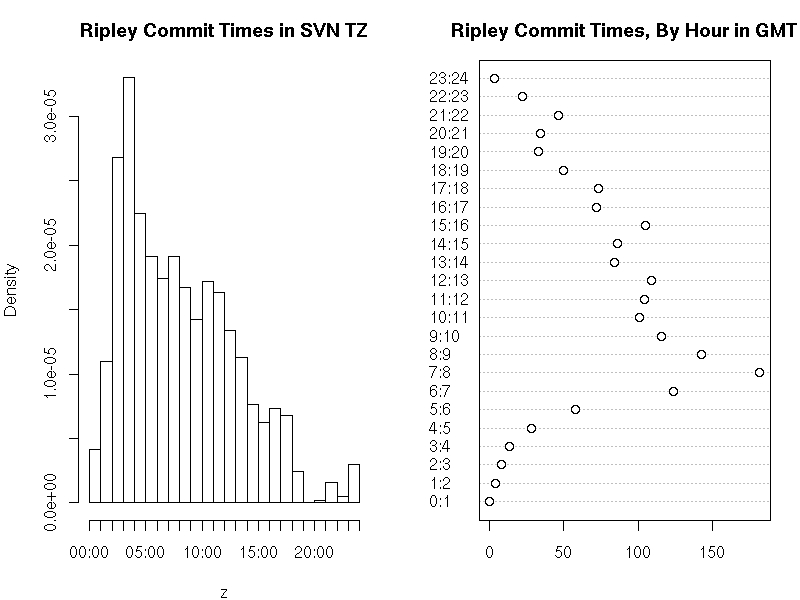
In five lines (that could be shortened to three at the expense of some readibility), the SVN log for R is downloaded directly from the website, the revision authors are extraced and then tabulated by submitter. The relative percentage of Brian Ripley is found to be a staggering 74.8% -- or about three times as much as the other fifteen committers combined. Smokes. [ Oh, and for those who don't know him, he's also got a day job which presumably entails looking after his graduate students at Oxford. Who knows, he may even teach. Kidding aside, he's actually one of the nicest persons you'll ever meet in real life. ] Now yesterday, Simon Jackman who had at first simply repeated Ben's analysis on his own blog followed up with a nice analysis (albeit typeset in a way that rendered the code inoperational, which has now been fixes) that creates both a histogram and a dotplot of commits per hour of the day. Omitting Ben's code which Simon reuses, we have the following for histogram and dotchart:
tod <- unlist(sapply(rx,function(x)strsplit(x,split=" ")[[1]][6]))
tod <- tod[who=="ripley"]
tz <- sub(pattern=".*(-[0-9] 4 ).*",replacement="\\1",x=rx)
tz <- tz[who=="ripley"]
tz <- as.numeric(tz)/100
offset <- 3600*tz
z <- strptime(tod,format="%H:%M:%S")
hist(z,"hours",main="Ripley Commit Times in SVN TZ")
h <- z - offset
h <- format(h,format="%H")
h <- factor(as.numeric(h), levels=0:23)
dotchart(table(h), main="Ripley Commit Times, By Hour in GMT",
         labels=paste(0:23,1:24,sep=":"))
This extracts the commit times, subsets to the ones by Prof. Ripley, extracts the timezones component (as strptime seemingly doesn't do that which is a pain), extracts the tz-less time via strptime into a variable 'z' for which the histogram is drawn. He then corrects the times by the tz offset expressed in seconds, formats is as hour of the day and turns it into a 'factor' (an R data type for qualitative variables which may be ordered as is the case here) and draws a dotplot. This results in the following chart: Simon Jackman's per-hour charts of Brian Ripley's commit patterns Now, nobody has looked at the time series. So we correct this and add the following:
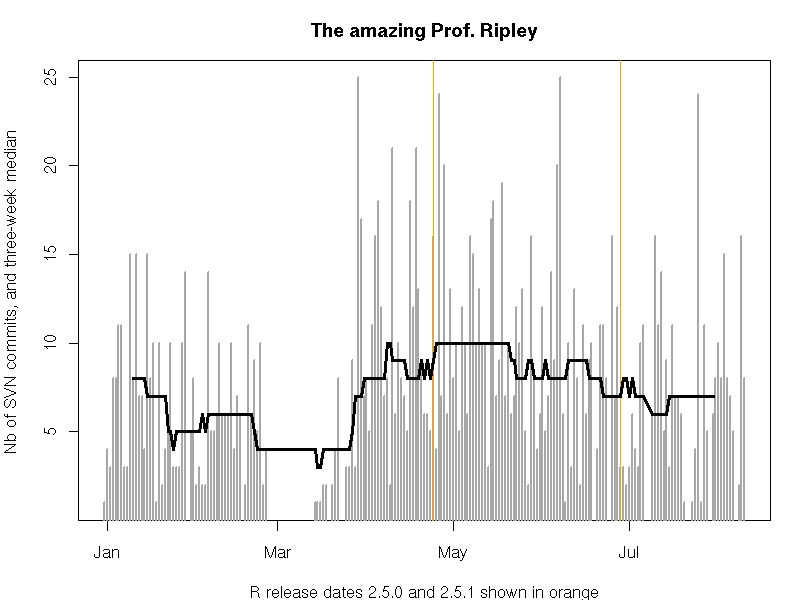
## rather extract both  date and time
dat <- unlist(sapply(rx, function(x)  
  txt <- strsplit(x,split=" ")[[1]]
  paste(txt[5], txt[6])
 ))
## subset on Prof Ripley
dat <- dat[who == "ripley"]
## and convert to POSIXct, correcting by tz as well
datpt <- as.POSIXct(strptime(dat,format="%Y-%m-%d %H:%M:%S")) - offset
## turn into zoo -- we use a constant series of ones as each
## committ is taken as a timestamped event
datzoo <- zoo(1, order.by=datpt)
## and use zoo to aggregate into commits per date
daily <- aggregate(datzoo, as.Date(index(datzoo)), sum)
## now plot as grey bars
plot(daily, col='darkgrey', type='h', lwd=2,
     ylab="Nb of SVN commits, three-week median",
     xlab="R release dates 2.5.0 and 2.5.1 shown in orange",
     main="The amazing Prof. Ripley")
## mark the two R releases of 2007
abline(v=c(as.Date("2007-04-24"),as.Date("2007-06-28")),col='orange',lwd=1.5)
## and do a quick centered rolling median
lines(rollmedian(daily, 21, align="center"), lwd=3)
This extracts both date and time, creates a proper R time object (a so-called POSIXct type) from it, fills a zoo ('the' magic class for time series) object with it, uses zoo to aggregate commits per day and plots those in a barchart-alike (I know, I know, ...) plot to which we add the two releases as well as a rolling and centered three-week median (as a real quick hack rather than a proper smooth). Timeseries of Brian Ripley's commit patterns This shows that Prof Ripley averaged about ten commits a day before and after the release of R 2.5.0, and that he has slowed down ever so slightly since then to end up at around a mere seven commits a day. Every day. For the seven-plus months we looked at. So, anyone for analysing his r-help posting frequencies ?

11 August 2007

Dirk Eddelbuettel: UseR! 2007: Two talks and a new R package 'RDieHarder'

The first UseR! conference in North America ended yesterday. I gave two talks and updated my presentations page accordingly. One talk was joint work with Steffen Moeller (who had also presented our work in Italy in June, and I added that presentation too), David Vernazobres and Albrecht Gebhard and concerns automated building of around two thousand (!!) new Debian source packages for all CRAN and BioConductor packages for GNU R. I plan to send something to debian-devel on that in a day or two as well because the time is right for some feedback on this. The other talk was on about RDieHarder. This is joint work with Robert G. Brown and uses his DieHarder library for random number testing (that I've added to Debian a few months back). It allows R to both runs these tests, and to further analyse and visualize the test results. I finally uploaded RDieHarder to CRAN a few days ago -- in fact, my CRANberries rss feed of new CRAN packages had it show up the morning of the presentation. And now that I've added a webpage about RDieHarder I can finally say it's been released.

9 August 2007

Eddy Petri&#537;or: small commits

Update: I have been informed that git and mercurial have support for the hunk commit feature, excellent! See the comments section if you want to know the details. IIRC, The last time someone talked about this feature was when John Gorzen analyzed his options for another VCS (still now I can't find any reference to this issue).


Lars, darcs allows this and, as a supplement that is missing from any other VCS I know, is the ability to select individually changes in a file. That means you can commit only some of the changes affecting a file and leave others for later commits.

So for this diff:

$ darcs diff -u
diff -rN -u old-asd/asdnbfnd new-asd/asdnbfnd
--- old-asd/asdnbfnd 2007-08-08 18:12:17.000000000 +0300
+++ new-asd/asdnbfnd 2007-08-08 18:12:17.000000000 +0300
@@ -1,3 +1,3 @@
-#!/bin/ash
+#!/bin/sh

-echo "intentionaol spelling error"
+echo "intentional spelling error"

you can do this:

$ darcs rec -m "spelling correction"
hunk ./asdnbfnd 1
-#!/bin/ash
+#!/bin/sh
Shall I record this change? (1/?) [ynWsfqadjkc], or ? for help: n
hunk ./asdnbfnd 3
-echo "intentionaol spelling error"
+echo "intentional spelling error"
Shall I record this change? (2/?) [ynWsfqadjkc], or ? for help: y
Finished recording patch 'spelling correction'

$ darcs rec -m "make the script run on posix shell"
hunk ./asdnbfnd 1
-#!/bin/ash
+#!/bin/sh
Shall I record this change? (1/?) [ynWsfqadjkc], or ? for help: y
Finished recording patch 'make the script run on posix shell'

Of course, being able to unrecord/uncommit or to rollback is a nice thing to have.

8 August 2007

Eddy Petri&#537;or: Bash says: I am different from myself!

Dear lazyweb, is this a bug? Should I fill this?

$ sh -x rpm/build_latest_srpm foo 2>&1 grep -E '\'
+ alias 'rpmbuilder=rpmbuild --define "_topdir /tmp/rpmbuildarea/foo/redhat"'
+ rpmbuild --define '_topdir /tmp/rpmbuildarea/foo/redhat' -bs foo.spec
$ sh rpm/build_latest_srpm foo 2>&1 grep -E '\'

$ bash -x rpm/build_latest_srpm foo 2>&1 grep -E '\'
+ alias 'rpmbuilder=rpmbuild --define "_topdir /tmp/rpmbuildarea/foo/redhat"'
+ rpmbuilder -bs foo.spec
rpm/build_latest_srpm: line 46: rpmbuilder: command not found
$ bash rpm/build_latest_srpm foo 2>&1 grep -E '\'
rpm/build_latest_srpm: line 46: rpmbuilder: command not found

$ rpm/build_latest_srpm foo 2>&1 grep -E '\'
rpm/build_latest_srpm: line 46: rpmbuilder: command not found

$ type sh
sh is hashed (/bin/sh)
$ type bash
bash is hashed (/bin/bash)
$ ll /bin/*sh
-rwxr-xr-x 1 root root 677184 2006-12-11 23:20 /bin/bash
lrwxrwxrwx 1 root root 21 2006-08-17 21:05 /bin/csh -> /etc/alternatives/csh
-rwxr-xr-x 1 root root 80200 2007-02-02 09:34 /bin/dash
lrwxrwxrwx 1 root root 4 2006-12-19 15:02 /bin/rbash -> bash
lrwxrwxrwx 1 root root 4 2006-12-19 15:02 /bin/sh -> bash
lrwxrwxrwx 1 root root 13 2006-08-17 20:58 /bin/tcsh -> /usr/bin/tcsh


The script has /bin/bash in the shabang.

I tried to reproduce with another simpler script, and I observed that the issue happens when the script is processed by bash. With a /bin/sh shabang, it didn't since the command processing the script was sh, also all sh commands were ok.

I also suspect that it has to do with this paragraph from the bash manual:


Aliases are not expanded when the shell is not interactive, unless the expand_aliases shell option is set using
shopt (see the description of shopt under SHELL BUILTIN COMMANDS below).


... but different and (I would say) worse behaviour than the sh invocation should not happen.

The test script follows:

#!/bin/bash

alias rpm-build="echo \"I:\""
alias dpkg-select="dpkg --get-selections \"ls\*\""

echo "alias1:" && rpm-build test
echo "alias2:" && dpkg-select

Test and enjoy. Before you ask, yes, I use bash functionality.

Update: Also using set -i just before the alias definition and keeping it during the expansion does not help.

Eddy Petri&#537;or: this is the way forward

leveraging existing technologies and obtaining cool things

John Goerzen: Disasters happen

It's been one of those days.

It started with me forgetting my laptop bag at home. Then I had to work with an attorney on some things. He's a nice guy, and does a good job, but you know, it's not what I'd really like to spend my day doing.

Then in the middle of the afternoon, I hung up the phone and checked my email. About 50 messages from Samba telling me that processes with various PIDs had crashed unexpectedly. Uh-oh. I think we still have some 80ish people using that.

About a minute later, a coworker says, "John, I've been bad." "Is that why I just got 50 emails from Samba?" "No. Well, yes. Well, maybe. I don't know."

It turned out he was working on a restore from tape that, out of necessity, grabbed more data than he needed. He meant to type rm -r ./var but typed rm -r /var instead. Oops. He hit Ctrl-C halfway through, so /var was still there enough to send email but not enough for Samba (or, apparently, NFS) to work.

As he dashed off to pull yesterday's tapes from offsite storage, I prepared the restore and made a plan. We hadn't installed any software since yesterday, so I restored var to a temporary location, took the server down into single-user mode, overwrote the /var that still existed, and rebooted the Xen instance in question. Everything back to normal. Except, that is, for the potentially dozens of users that will require assistance running SCANPST.EXE because their Outlook PST, being the fragile heap of garbage that it is, will have somehow been corrupted by this little incident.

So, what did we learn from this?

7 August 2007

Eddy Petri&#537;or: tilting at windmills - the NSLU2 issues

It turns out I was playing Don Quijote when I was trying to fix the reset issues I had with my slug.

Of course, I was suspecting the USB rack for the issues, but the issues never showed up on the laptop... until now.

I decied to temporary use a USB stick for the FS and started copying files over to the stick. During the copying the rack disconnected and everything became more clear. I was tilting at the windmills all the time.

BTW, be smarter than myself and just change the UUID to mach the old one instead of regenerating the initrd and reflashing it:

tune2fs -U the_uuid_of_the_previous_root_partition /dev/sda1


Oh, next on the agenda will be to use my ipod mini as a hdd for the slug in order to prevent ruining the stick... And another thing, total silence is really nice, even if the rack was not that noisy.

6 August 2007

Eddy Petri&#537;or: nslu2, the kernel...

Update: it didn't work .... :((

eddy@ritter ~ $ grep '##### kern' -A 2000 /var/log/syslog grep -E '(reset ####)'
Aug 6 11:19:00 ritter manual message: ##### kernel was changed to linux-image-2.6.18-4-ixp4xx_2.6.18.dfsg.1-12etch2.1_arm.deb #####
Aug 6 11:23:08 ritter kernel: usb 3-1: reset high speed USB device using ehci_hcd and address 2
Aug 6 11:35:15 ritter kernel: usb 3-1: reset high speed USB device using ehci_hcd and address 2
Aug 6 11:52:41 ritter kernel: usb 3-1: reset high speed USB device using ehci_hcd and address 2
Aug 6 11:54:47 ritter kernel: usb 3-1: reset high speed USB device using ehci_hcd and address 2


I cross built this:

Changes:
linux-2.6 (2.6.18.dfsg.1-12etch2.1) stable; urgency=low
.
* Non-maintainer upload.
* ixp4xx kernel:
Disabled options:
- USB_EHCI_SPLIT_ISO
- USB_EHCI_ROOT_HUB_IT
Enabled options:
- USB_BANDWITH

And it took me on my amd64:

real 105m0.331s
user 79m43.423s
sys 12m46.324s

Is not an upload, is just my try to fix this issue. Let's see if it works.

Oh, thanks to Riku for pointing out that cross building the kernel is trivial.

4 August 2007

Edd Dumbill: Zonbu: an intersection of open source, Web 2.0 and energy efficiency

Salon.com recently reviewed Zonbu, a highly compact general-purpose computer with no moving parts. Zonbu's key features are its incredibly low power consumption, network-connected storage and that it works right out of the box without any installation. Under the covers, it's a Gentoo Linux installation with mainstream open source apps such as OpenOffice and Firefox.

Zonbu skins
Zonbu and its skins — high-powered dressing for a low-power device Price-wise, you can get the Zonbu for as little as $99 if you commit to two years' subscription to the network storage. Understanding the open source ethos, Zonbu also offer the box without any tether for $250. As with the Mac mini, supplying the keyboard, mouse and monitor is up to you. Preloaded with an office suite, email, IM, web browser, multimedia player, games and Skype, Zonbu is aimed at being a general computing appliance. You can't install anything else on it, but then again, that way you can't break it easily either. It sounds the sort of thing I'd be happy leaving with non-technical family and friends. Storage with Amazon S3 Low-power solid state devices are nothing new of course, there are a variety available, and things such as the NSLU2 have been in production for some years. The novel thing about the Zonbu however is in how it manages its storage. The Zonbu has 4GB of compact flash storage on board, which it uses as a cache for Amazon's S3 storage network. All your files get encrypted and sent to S3, and are retrieved when you need them. One really neat consequence of this is that you can get at your data via the web any time you want. Secondly, it gives me some sense of security for my data. I don't know if Zonbu will give me the 'keys' to my data on S3, but it wouldn't be hard for them to provide an easy way to migrate out. Either way, S3 is a place I'd trust with my data. Why Zonbu is important Windows, and to some extent, Mac OS X, are becoming the needy children of computing, always tugging on your arm and asking you something. In contrast, Zonbu looks like a great step towards "appliance computing". Its features are more like those you'd expect from your phone or cable TV provider:

Zonbu has the potential to change domestic computing. The low price point lowers the barrier to computer ownership. Low maintenance needs lower the technical barrier to entry and use. And Zonbu's a green and economical technology, yet as useful as the full power version. As a company, I feel Zonbu to be a well-intentioned player because of their strong support for open source, and the ease with which you can get at your data despite its appliance nature. I hope they continue to develop in this open data direction. Zonbu itself probably won't attain ubiquity, but it will change the marketplace and open up a new category of network-connected appliances for the home. Further reading

Riku Voipio: Debian armel status

The debian armel port reached one milestone yesterday: Being able to run debootstrap from DD-signed, upto-date unmodified debian/unstable packages.

Looking backward:

* When watching the buildd's, the worst of Debian is visible. You don't spend much time wondering on successful builds. The time goes into wondering about the crappy code that fails to compile, the maintainers who ignore RC bugs for months, code with dead upstream..
* bootstrapping a Debian port is still painful. Fortunately Lennert did that for us this time.
* Most maintainers are very responsive, and are happy enough apply patches that help even unofficial ports. The few who ignore patches or are else effectively MIA can cause long delays...
* C++ code is evil. or at least the g++ implementation of it. A random game written in C++ can take 5h to build, when even the most complex C apps compile in 2-3 hours (with a few exceptions like glibc and linux-2.6). Worse, g++-4.2 seems to be another 10-20% slower than g++-4.1... Remember God kills a kitten every time you upload a c++ package unnecessarily!.
* Esoteric language bindings suck too.

Looking forward:

There is some 500 (out of 7100) packages that in Dep-Wait state due some missing packages on armel port:
* ~290 packages that would need FORTRAN (!). specifically the old g77 version...
* ~80 packages waiting for objective C / gnustep
* ~70 packages waiting for ghc6 or related Haskell code
* ~40 packages waiting for Java (being worked on)
* ~15 packages waiting for mono (patch in BTS)
* Then there usual crop of esoteric languages, packages failing to build with current unstable on any port, and packages build-depending on stuff removed or to-be-removed packages.

Effectively this means getting armel over 90% built of Debian needs either g77 to armel or getting Debian to migrate from g77 to gfortran (which is available but not throughly tested on armel). I'm working on the second route..

* Start building d-i images. So that Eddyp can have blazingly fast softfloat rrdtool on his nslu-2 without bugs and trouble.

* Request inclusion into Debian ftp archives. I think with the latest milestones, armel should be ready for archive as a "second class citizen". Inclusion for lenny needs still some work.

* Finally: there's tablets and phones waiting to for Debian armel mobile ;)

3 August 2007

Eddy Petri&#537;or: dear anonymous reader...

I have answered to your request about the config files for bluetooth.

Have fun!

Eddy Petri&#537;or: more news from the nslu2 front

The main reason for the lack of activity during this week was that I had some problems with my router, a NSLU2 running the debian arm port. This was the machine I wanted the softfloat rrdtool I was talking about in these 2 posts.

It turns out that for some weird reason the USB controller of the slug resets when there is too much traffic going on. I got lots and lots of messages like:


$ grep reset -A 1 /var/log/syslog grep -E '(reset repeated)'
Aug 3 07:02:27 ritter kernel: usb 3-1: reset high speed USB device using ehci_hcd and address 2
...
Aug 3 11:50:29 ritter kernel: usb 3-1: reset high speed USB device using ehci_hcd and address 2
Aug 3 11:51:03 ritter last message repeated 4 times
Aug 3 11:53:15 ritter kernel: usb 3-1: reset high speed USB device using ehci_hcd and address 2
Aug 3 11:53:46 ritter kernel: usb 3-1: reset high speed USB device using ehci_hcd and address 2
Aug 3 11:55:48 ritter kernel: usb 3-1: reset high speed USB device using ehci_hcd and address 2
Aug 3 11:56:07 ritter last message repeated 2 times
Aug 3 11:56:52 ritter kernel: usb 3-1: reset high speed USB device using ehci_hcd and address 2
Aug 3 11:56:57 ritter kernel: usb 3-1: reset high speed USB device using ehci_hcd and address 2


That wouldn't have been a problem as long as the damn thing worked, but in some cases after the reset the root filesystem was lost and all the services running on the machine died (except the networking itself since all of that is part of the kernel and is loaded in memory).

It took me about three evenings to get to this conclusion (imagine being locked out of a machine which advertised running ssh, http, and dns services, being able to telnet and getting a respons, but the full protocol failed).

It all became more clear when, while being connected via ssh I got his result:

eddy@ritter ~ $ ls
-bash: ls: command not found

"WHAT?" was the first reaction, then I figured that life without ls is unbearable and came up with this bit:

alias ls='for I in * ; do echo $I ; done'

Quite cool to understand a little bit about the system. Still, cat was unavailable so having /proc and /sys available did not help that much. At some point I was thinking about a busybox shell, tried that, it didn't work since it wanted to remove some important bits like the initramfs tools.


I googled again and found a good starting point for a discussion of the same problem someone else was having. I ended up trying all the proposed solutions: rmmod-ing ehci-hcd, blacklisting the module, regenerating a initrd image with the blacklisted module... None of these worked (individually) and I ended up having an even more unstable system when ehci was not present (I was loosing the root FS after aprox. 1 min after logging in remotely immediately after start). Restoring the image with ehci was a pain (not to mention the time spent trying to figure a way to revert the change safely, since bricking the machine was not out of the question - imagine loosing the FS while flashing the ram drive image).

I finally managed to revert the ehci enabled image and tried the workaround proposed in this gentoo BR. I tried 128 and now I am at 64 and I am still getting those resets; Still something good came out of this, I followed Michael Prokop's Use root=UUID on NSLU2 article and I think I have now a stable root file system just thanks to him.

Now I am stuck:


grep -E '(max_sect reset)' /var/log/syslog
Aug 3 07:02:27 ritter kernel: usb 3-1: reset high speed USB device using ehci_hcd and address 2
Aug 3 08:27:38 ritter kernel: usb 3-1: reset high speed USB device using ehci_hcd and address 2
Aug 3 08:38:43 ritter manual message: max_sectors was set to 128
Aug 3 08:55:25 ritter kernel: usb 3-1: reset high speed USB device using ehci_hcd and address 2
Aug 3 09:31:47 ritter kernel: usb 3-1: reset high speed USB device using ehci_hcd and address 2
Aug 3 09:54:11 ritter set_max_sectors: max_sectors was set to 128
Aug 3 10:09:32 ritter set_max_sectors: max_sectors was set to 128
Aug 3 10:15:27 ritter set_max_sectors: sda's max_sectors was set to 128
Aug 3 10:24:24 ritter set_max_sectors: sda's max_sectors was set to 128
Aug 3 10:38:12 ritter set_max_sectors: sda's max_sectors was set to 128
Aug 3 10:47:04 ritter kernel: usb 3-1: reset high speed USB device using ehci_hcd and address 2
Aug 3 10:48:27 ritter set_max_sectors: sda's max_sectors was set to 64
Aug 3 11:04:36 ritter kernel: usb 3-1: reset high speed USB device using ehci_hcd and address 2
Aug 3 11:06:16 ritter kernel: usb 3-1: reset high speed USB device using ehci_hcd and address 2
....
Aug 3 15:05:58 ritter kernel: usb 3-1: reset high speed USB device using ehci_hcd and address 2

Should I try setting to 32?

In case you're wondering, I am doing the setting with this script:

#!/bin/sh

MAX_SECTORS=64
DISK=$(ls -l grep 'uuid.* / ' /etc/fstab awk ' print $1; ' sed 's#.*/\(.*\)$#\1#' tr -d '[0-9]')

[ -z "$DISK" ] && logger -t 'set_max_sectors' "error: could not detect root disk" && exit

echo "$MAX_SECTORS" > /sys/block/$DISK/device/max_sectors
logger -t 'set_max_sectors' "$ DISK 's max_sectors was set to $ MAX_SECTORS "

exit 0


Dear (not at all) lazy web, what can I do to fix/workaround this issue? Any help would be gratly appreciated (personal mail or comments).

Note: I am reluctant to try the fix proposed in the last comment that claims to fix the issue since compiling an arm kernel natively is a pain and I would like to have an official kernel from Debian Etch, as I do now.

2 August 2007

Eddy Petri&#537;or: softfloat rrdtool sequel

Hey, I am back from vacation. I was back on Saturday but I didn't had the time to blog or do Debian work, so hello :-D.

After coming back from my vacation I went back to the softfloat rrdtool thingie I was working on before and I finaly managed to compile a statically linked softfloat uclibc rrdtool. Needless to say that I found that a pain and I ended up:

If you are curious about the hideous details, just add a comment or email me and I'll send them or publish them.

So, in the end, I managed to produce a staticlly linked arm-softfloat-uclibc rrdtool which:
So that was fun. The total round trip for a round of graph generation was about 15 min which was more than cool and fast compared to the slow native variant, whohoo!

Now the downside, I am not through with it. If you look at the picture you'll notice that there is a "small-ish" problem: there are no scales, legends and no letters/glyphs of any kind, so the graphs are still quite useless, but better than nothing:


They should look something like this:


Notice any difference? :-/

Of course, I won't stop here!

I suspect the problems come from the cross compiled libfreetype and libart_lgpl, and I'll probably end up doing some native compiling after all, sigh!

1 August 2007

Ross Burton: Poky Linux 3.0 "Blinky" Released

After much blood, sweat and tears, Poky Linux 3.0 (also known as Blinky) is released. Poky is an OpenEmbedded derivative, focused on building GNOME Mobile-based images for embedded and handheld devices such as the Sharp Zaurus or the Nokia N800. Aside from the usual set of software updates and infrastructure improvements, Blinky contains the first public release of Sato, an example GTK+/Matchbox based PDA environment aimed at devices with high resolution, physically small screens. This includes a new Matchbox panel and desktop, the Pimlico suite of PIM applications, and a fast, clear GTK+ theme. Pretty much everyone at OpenedHand has been involved in Poky to some extent, so it's great to see a release. Personally I'm really pleased with how far Blinky has advanced over the last release, Clyde, and will shortly be working on a branch of Blinky to integrate the complete GNOME 2.20 release set. If anyone is interested in Poky then it is easy to try: there are for a several devices: the Nokia N800 and several Sharp Zaurus models; and Qemu images for both ARM and Intel. Give it a go and tell us what you think! NP: Love and Affection, Joan Armatrading

31 July 2007

Adrian von Bidder: Debian Press Clippings

I am subscribed to the Google news alerts for the keyword Debian, and usually this means that I am notified of every security upgrade at least three or four times (needlessly, since I'm subscribed to Debian's security announcements anyway...) But today, two headlines sparked my interest: One, Carla Schroeder wrote an introductory article into building Custom Linux kernels with Debian and Fedora (though why somebody would want to do this is beyond me...), showing how easy the process is (I may be biased, but I find Debian's way is easier. On the other hand, it within the -- rpm -- package framework instead of a custom command -- make-kpkg in Debian -- feels more consistent and logical. Without reading documentation you won't get anywhere on both systems, so it probably doesn't matter...) One down for Carla, however, for not doing enough basic research: “The new naming convention [linux-* instead of kernel-* packages] opens the door to using other kernels with Debian, which I don't know what those would be, but Debian is ready for them.” Or one down for us, the Debian project, for not making enough noise around the various non-Linux ports. Though that will come when GNU/kFreeBSD is released with lenny... Two, Debian derivative SimplyMEPIS, which switched to Ubuntu as a base operating system a year ago, is now returning to Debian GNU/Linux as its base system. The main reason seems to be long term stability and upgradeability - which is a key strength of Debian for many other users as well (me, for one.) The reason for switching to Ubuntu in the first place has been newer application versions and predictable upgrade schedules (and that Warren Woodford misunderstood how Ubuntu LTS was to be maintained, apparently) -- both issues are being addressed within Debian as we get better release management and faster integration of new application versions (the big pieces of software I use regularly are the Linux kernel, X.org, KDE and OpenOffice.org, all of which I find are integrated in unstable fast enough, and much faster than 2 years ago. That the testing migration sometimes takes time is not a problem since mixing etch, lenny and sid is usually possible without problems even in a production (desktop) environment.) So, if we take a step back from the day-to-day squabbling between developers working at cross purposes and look at the output we produce, I believe we're still doing some things right.

27 July 2007

Jeff Bailey: Whirlwind trip

So this is it, I've actually finished at Canonical! For most of the past week, I've been in Portland, OR at Ubuntu Live. I gave two talks (Ubuntu Technical Demonstration and Bringing your software to Ubuntu users) and one tutorial (packaging for Ubuntu and Debian derived distributions). I had a great time, and was glad to get a chance to see my former coworkers one last time. I'm happy to be leaving on great terms with my former employers, and hope to be at UbuntuLive again next year.

This conference was a whirlwind of meeting people. JP, Teri, Jim, Andy and MaryBeth are people I'm really looking forward to seeing in the bay area when I get there; I got to see Steve and Patty in the Debian booth; I managed to go for dinner with Chris and Leslie; A going away party that included many of the above plus Matt, Steve, Etienne and Torsten; I had lunch with Katie, whom I haven't seen since my wedding; I had another lunch with Mermaid, whom I thought had fallen off the face of the earth; my final lunch at Veganopolous included MaryBeth again and Rob. I did miss seeing Kamaya, which is sad, though. I got *almost* everyone I wanted to see.

It's a crazy list. Some of these people will be random business contacts. Some of these are folks that I feel like remeeting them after several years was like only missing a day. Some of these are people I miss already.

Sabrina and I are making the trek up north to Kit and Hannah's wedding. We're staying at Miriam's and had lovely Ethiopian food.

Time to sleep. 7am is going to come too early.

24 July 2007

Evan Prodromou: 5 Thermidor CCXV

24 July 2007 is the fourth birthday of Wikitravel, the free travel guide that I and my wife Michele Ann Jenkins started on July 24, 2003. It's been a long and complicated road, but I'm really proud of all the work Wikitravellers have done over these last four years. The project has gone from being a pretty-good idea to being one of the definitive travel resources on the Web. Winning the Webby Award for Best Travel Site this year was a real recognition of that trajectory. I'm wondering what 24 July 2008 will bring... it will be interesting to see. tags:

Vinismo It's only partly a coincidence, then, that today I'm launching, with my friend Niko, a new Open Content project dedicated to demystifying an even more complex and byzantine world: wine. Tonight we're demoing the site at DemoCampMontreal3, so it's as good a time as any to throw open the doors:
        http://vinismo.com/
We don't pretend to be wine experts or even connoisseurs. We're just two guys who like to drink wine and want to learn more about it. Ward Cunningham once said that wiki link is a great way to ask a question. We want to share the learning experience with people of all levels of expertise. We think that working together with our friends and family, with other Internet users, and with the public at large, we can create a detailed, readable, useful wine guide for people at any level of expertise. Our liberal Creative Commons license means that the guide is Free -- free for anyone to copy, modify, or publish in any medium. I need your help to make this project a success. If you can, I'd really appreciate if you could help us out with one or more of the following tasks:
  • Please sign up to use our site at, and create a user page describing yourself.
  • Drop us a note in the Wine Bar letting us know what you like and don't like about the site.
  • Try adding some information about your favorite wines, wineries, wine regions or wine styles! It doesn't have to be perfect -- every little bit counts!
  • Please forward this info to people you know who might be interested in Vinismo. They don't have to be experts to be interested in wine.
  • If you have a blog, please post a link to our new site on it!
  • If you use a social bookmarking tool, like del.icio.us, please add us to your list!
  • If you use digg.com, please vote for our site there: http://digg.com/software/Open_Content_wine_guide_launches
  • If you use reddit.com, please vote for our site there: http://freeculture.reddit.com/info/296au/comments
tags:

Next.

Previous.