Search Results: "cas"

5 August 2014

Andrew Pollock: [geek] Lifehacking with NFC, Tasker and HabitRPG

Oh man, I'm such a geek... Being a single parent has required a considerable amount of self-discipline on my behalf. I find I do best in an environment with routine to make sure stuff gets done. One of the things I did to try and make sure stuff got done was to form positive habits. To help and make this a bit more "fun", I started using HabitRPG, an online role-playing game based on habits. I've only ever used it in a half-arsed manner, and as a result, I die a lot. Often I'll do my dailies, but then forget to mark them off. Sometimes I just fall off the habit wagon altogether. And die. One of my dailies is to scoop my cat's litterboxes. For whatever reason, I find this a tad onerous, and had found myself falling out of the habit of doing it on a daily basis. My cat deserves better than this, so I wanted to get back on the habit wagon, but make it a bit more "fun" as well. I love NFC, I've been a big NFC weenie for a long time. It's a solution looking for a problem. I have a huge collection of NFC tags, and I've finally found a problem I could use them with. I wanted to make it more frictionless to mark a task as completed in HabitRPG. I didn't want to have to take out my phone, unlock it, open the HabitRPG app and check off the daily task. I just wanted to wave my phone at an NFC tag. Here's how I did it. The inimitable Paul Fenwick, who first inspired me to use HabitRPG, has a way more complicated set up to achieve something similar. The Site Reliability Engineer in me wanted the least number of moving parts and third-parties to have to get from my phone to HabitRPG. After some hunting around, I found this wiki page on integrating Tasker with HabitRPG's API, so based on that breadcrumb, I got hacking. I'd not used Tasker before. I was already using AutomateIt to do some other, reasonably dumb automation on my phone, though. Tasker is a little bit obtuse, and it took me a couple of days of casual fiddling with it to wrap my head around it's usage model. The fact that it can run arbitrary JavaScript, and that NFC Tools integrates with it is where the real awesome lies. So based off the wiki, I crafted a couple of bits of JavaScript, one to mark daily tasks as complete on HabitRPG, and one to query HabitRPG to see if they have been marked as complete. For the former, it was trivial, using NFC Tools, to write an NFC tag that then runs the Tasker task to call the HabitRPG API to mark a daily task as complete. That goal was now complete. The equally satisfying part was also having Tasker do a time-based conditional nag based on the state of the daily task in HabitRPG. So now if it gets to 4:45pm and I haven't scooped the litterboxes, my phone literally tells me I'd better go do it. I've also done the same thing with putting the dishwasher on. I've stuck an NFC tag on the dishwashing powder bottle lid, and I get a conditional reminder before bed time. It used to be an unconditional reminder with AutomateIt, and it was dumb, because I rarely forget to put the dishwasher on. Now, I can use HabitRPG to keep state on it instead. The hunk of JavaScript to update HabitRPG is very simple:
function mark_completed()   
  var http = new XMLHttpRequest();
  http.open("POST", http_post_url, false);
  http.setRequestHeader("x-api-user", global('HabitrpgUserid'));
  http.setRequestHeader("x-api-key", global('HabitrpgApiToken'));
  http.send();
  return(http.responseText); 
 
try   
  var result = mark_completed(); 
  catch(e)   
  var error = e.message; 
 
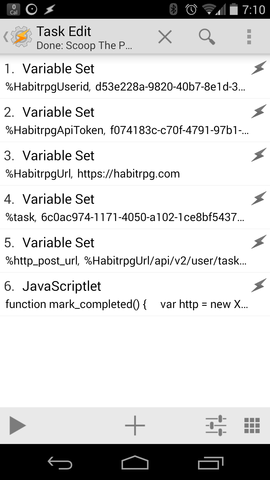
All of the interesting stuff is defined in variables preceding the JavaScript in the task definition. Here's a screenshot of the Task in Tasker that tells a thousand words: Screenshot of Tasker task that uses HabitRPG API to mark a task complete Similarly, to query HabitRPG, I'm using:
function query_task()   
  var http = new XMLHttpRequest();
  http.open("GET",http_get_url,false);
  http.setRequestHeader("x-api-user", global('HabitrpgUserid'));
  http.setRequestHeader("x-api-key", global('HabitrpgApiToken'));
  http.send();
  var p = JSON.parse(http.responseText);
  return p['completed'];
 
try   
  var task_completed = query_task(); 
  catch(e)   
  var error = e.message; 
 
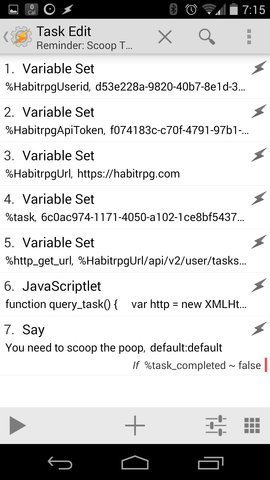
It's only slightly trickier because you have to parse the JSON blob that comes back. Again, a screenshot. Screenshot of Tasker task that uses HabitRPG API to query task state Now maybe I'll stop dying so much in HabitRPG, my cat will have the clean toilet she deserves, and I'll stop getting reminded about putting the dishwasher on when I already have. Better living through automation, that's my motto.

4 August 2014

Ian Donnelly: New Release: Elektra 0.8.7

Hi Everybody! I am very proud to inform you all that Elektra has just shipped a new release, version 0.8.7, with many great features and fixes! First of all, I want to let you all know that a lot of work from my Google Summer of Code Project has made its way into this release. Elektra now includes support for a three way merge of KeySets! A special and sincere thanks goes out to Felix Berlakovich for helping me test this new merge feature and adding some great features to allow for different merge strategies and dealing with meta keys. You can try out the new merge features using the kdb merge command or by using the Elektra API. There is still work to be done with Merging and improving documentation (also look for some posts on this blog soon about the feature). Additionally, thanks to Felix, we have technical previews for some new plug-ins. The new plug-ins are keytometa and ini. In short the keytometa plugin allows to convert normal keys to meta keys during the get operation and reverting this conversion during the set operation. The ini plugin is basically a rewrite of the simpleini plugin and makes use of the inih library. Also there have been many improvements made to the glob plug-in. He even found some time to add a new script for bash tab completion which is located under scripts/kdb-bash-completion. To use it on debian just copy it to /etc/bash_completion.d/ and make sure it is executable. Moreover, we fixed a lot of things with this newest release. Pino Toscano has been working on fixing up the Debian packages for Elektra but he has also fixed many other things along the way including fixing a lot of spelling errors, simplifying the RPATH setting, improvements to respecting $HOME and $TMPDIR, and improvements to some test cases. The kdb tool now does a better job of checking for subfolders that aren t allow and it now makes sure to output warnings before errors so errors can more easily be seen. We have also improved some tests for kdb tool and some plugins as well as fixed compiler warnings on clang and gcc 4.9. We also made some fixes to kdb import and export for some storage plugins and fixed some bugs so that kdb run_all now works flawlessly. There have also been a few tweaks to the API for this release, specifically in the C++ bindings. There is now a delMeta() function for C++. The reason for this is that contrary to the C API, calling

key.setMeta("metaname", NULL)

does not delete the metadata, but stores the value 0 . Additionally, we changed the arguments for isBelow, isDirectBelow, and isBelowSame for the C++ binding to be easier to understand and be more natural to use. Before this change, the C++ binding closely mirrored the C API which lead to an unintuitive behaviour. Before the change the API did the following:

Key ( user/config/key/below ).isBelow (Key ( user/config )) == false
Key ( user/config/key/below ).isBelow (Key ( user/config/key/below/deeper )) == true

That is because the first argument in the C API is the object itself in the C++ API.
The attribute of being below the key in question (the object) refers to the second key in the C API.
While this makes some sense for the C API, it definitely does not for the C++ API. Now the API behaves as follows (as intuitively expected):

Key ( user/config/key/below ).isBelow (Key ( user/config )) == true
Key ( user/config/key/below ).isBelow (Key ( user/config/key/below/deeper )) == false

We even had time for a bunch of documentation changes. We now have a tutorial for contextual values to GitHub so developers can start using contextual values with Elektra. We also included a specification for metadata and a better specification for contracts. There is even a little bit of extra news to share. We now use GitHub for active development of Elektra. We have adopted its issue tracker for issues. Also, now pull requests automatically get built by the server to see if the merge would brake the build and whether it passes all the tests. We are also in the process of updating a lot of our documentation and READMEs to use Markdown so they can be viewed easily on GitHub. Also, Raffael Pancheri has been making really great progress on a qt-gui for Elektra. There is still work to be done but it looks great and is coming along nicely. You can download the release now from Markus site: http://www.markus-raab.org/ftp/elektra/releases/elektra-0.8.7.tar.gz size: 1566800
md5sum: 4996df62942791373b192c793d912b4c
sha1: 00887cc8edb3dea1bc110f69ea64f6b700c29402
sha256: 698ebd41d540eb0c6427c17c13a6a0f03eef94655fbd40655c9b42d612ea1c9b Also there are packages already ready for some distributions: There is a lot of ongoing work to fix the Debian packages and I will post about it on this blog when they are good to go! Enjoy the new release!
-Ian S. Donnelly

Russ Allbery: Review: Parasite

Review: Parasite, by Mira Grant
Series: Parasitology #1
Publisher: Orbit
Copyright: October 2013
ISBN: 0-316-21893-6
Format: Kindle
Pages: 504
It's 2027, and a company named Symbogen has revolutionized medicine and health. They manufacture a genetically-engineered parasite based on a tapeworm that can stabilize and protect the health of just about anyone. It can synthesize medication, fix chronic medical problems, and be adapted to different conditions. (Yes, I know biological systems don't work this way. That's not going to be the only suspension of disbelief problem.) This has made Symbogen one of the most powerful corporations in the country, aided by the skill at marketing and self-promotion shown by one of the founders. Sal, the protagonist of the novel, is one of Symbogen's most famous success stories. Sally was the victim of a horrible car crash that put her into an apparently irreversible coma. But as her family was debating whether to turn off life support, she woke up. She had no memory of her previous life at all, and had to relearn fine motor control, reading, and many other skills. She was essentially a new person. But she was alive; her symbiont had saved her. When the story proper starts, Sal is still a ward of her parents. She has generally adult skills despite still struggling with reading, but she still has occasional attacks and is under intensive monitoring by Symbogen. That means periodic mandatory appointments with Symbogen, which she hates, but she's otherwise started building a life for herself: a job in an animal shelter, an interest in exotic predatory plants, and, most notably, a boyfriend. There are things about her life she doesn't like, and she wants to be free of Symbogen, but she doesn't have a bad life. But then a mysterious illness begins sweeping through the population, causing people to go blank, apparently lose their minds, and then start attacking those near them. Some of you have doubtless already figured out the key plot revelation. It's not hard; even if you didn't from the summary, you will probably figure it out shortly into the book. And therein lies a large problem with this novel: it's hopelessly predictable. Creepy evil corporation that supposedly has your best interests at heart, check. Plucky mad scientist opposition who understands exactly what's going on, check. Well-meaning but heavy-handed government agents who try to get involved but mostly make everything worse, check. (Although it's unusual to have those agents as part of the protagonist's family, and I thought that added some additional depth.) Mostly clueless protagonist sucked into the plot and becoming critical to its resolution, check. Very few readers are going to be surprised by this story. This is not, by itself, a fatal flaw. Predictable story structures can carry satisfying variations, or introduce the reader to enjoyable characters. And I think Grant manages both here. Seanan McGuire, both as herself and under her Mira Grant pseudonym, tends to write damaged and struggling characters. Both her Newsflesh and October Daye series feature protagonists that have been hurt badly, but are coping and muddling through in their own ways. In Parasite, I think she takes a more daring and intriguing approach: a protagonist that other people in the story perceive as damaged and struggling, but who actually isn't. Sal is not a badly injured Sally, and she's quite a bit healthier than those around her think she is. Her thought processes don't work quite the same as those around her, but that's not because she's hurt. That's because she's a different person. This makes Parasite partly a novel about identity, about Sal claiming ownership of her own life. Grant drags this out longer than I wish she had, but I liked the idea. In Sal, she strikes a good balance between gratitude and genuine affection for her family and the need to become her own person unconstrained by other people's expectations. As with the Newsflesh series, Grant uses quotes and excerpts from interviews to fill in the world background: a few at the start of each chapter, and more around each part boundary. I like this technique, and Grant uses it well. By the end of the book, the Rolling Stone interview with the head of Symbogen has added a lot of insight into how Symbogen manages its public relations. Grant also throws in a few of her trademark dangerously off-beat characters: hyper-competent, wise-cracking, but eerily skewed. I loved those in Blackout and I loved Tansy and Dr. Cale here. (Adam was much less successful.) A whole book from Tansy's perspective wouldn't work, since she needs Sal as a straight woman, but I thought she stole every scene she was in. However, I agree wholeheartedly with Tansy on another point: Sal is remarkably, irritatingly dim about what is apparently intended to be the critical revelation of the book. I won't state it outright; given its significant presence in the final scene, apparently it is intended to be a spoiler. But I figured it out about 50 pages into the book. Grant telegraphs this revelation heavily, and Tansy considers it painfully obvious (with quite a bit of justification). But Sal doesn't figure it out for the entire book, ignores all the signs, and is apparently willfully blind. In a book written from the first-person perspective by an otherwise-reliable narrator, this is highly annoying. It significantly undermined my enjoyment of the book. I spent much of the novel ahead of the narrator in my understanding of the plot and waiting, in vain, for her to get on with it already. That unfortunately makes Parasite a mixed bag. I really liked many of the characters, and I think Grant did some interesting things with family dynamics and with claiming one's own identity. But this is undermined by a very predictable plot, the protagonist deciding to be dumber than a sack of hammers about a critical plot point, and some rather dubious world logic. (For example, why is Sal terrified of bad driving? It makes sense as a post-traumatic stress reaction... except it's a critical point to her characterization that she never went through that stress.) Sometimes I wanted to like this book and sometimes I wanted to shake it, and sometimes I felt both reactions at the same time. I like Grant's writing and characterization well enough that I will probably read the sequel, but this is more like the later books in the Newsflesh series than it is like the spectacular Feed. Worth reading, at least for me, but it could have been better. Rating: 7 out of 10

3 August 2014

Bits from Debian: DebConf14 - schedule available

Debconf14 will be held in three weeks in Portland, OR, USA and we're happy to announce that the schedule is already available. Of course, it is still possible for some minor changes to happen! DebConf will open on Saturday, August 23 with the Welcome talk followed by two highlighted talks: There will also be also a plethora of social events, such as our traditional cheese and wine party, our group photo and our day trip. The complete schedule can be found at: https://summit.debconf.org/debconf14/ DebConf talks will be broadcast live on the Internet when possible, and videos of the talks will be published on the web along with the presentation slides.

Dirk Eddelbuettel: Introducing sanitizers 0.1.0

A new package sanitizers is now on CRAN. It provides test cases for Address Sanitizers, and Undefined Behaviour Sanitizers. These are two recent features of both g++ and clang++, and described in the Checking Memory Access section of the Writing R Extension manual. I set up a new web page for the sanitizers package which illustrates their use case via pre-built Docker images, similar to what I presented at the end of my useR! 2014 keynote a few weeks ago. So instead of repeating this over here, I invite you to read the detailed discussion on the sanitizers page.

This post by Dirk Eddelbuettel originated on his Thinking inside the box blog. Please report excessive re-aggregation in third-party for-profit settings.

2 August 2014

Don Armstrong: ErgoDox keyboard assembly

I routinely use a Kinesis Advantage Pro keyboard, which is a split, ergonomic keyboard with thumb clusters that uses brown cherryMX switches. Over the thirteen years that I've been using it, I've become a huge fan of this style of keyboard. However, I have two major annoyances with the Kinesis. First, while the firmware is good, remapping the keys is complicated and producing more complicated keyboard layouts with layers and keycodes that are not present in the original layout is not possible. Secondly, the interconnect between the main key wells and the controller board in the middle occasionally fails, and requires disassembly and occasional re-tinning of the circuit board interconnect connector. 1 About a year ago, I became aware of the ErgoDox keyboard, which is a keyboard design which mimics the kinesis to some degree, but with completely separated key halves (useful, because I'm substantially bigger than the average human), programmable firmware (so I can finally have the layers and missing keys) and with slightly more elegant interconnects (TRRS cables). Unfortunately, at the time I first heard about it (and other custom keyboards), making it required sourcing circuit boards, parts, and finding someone to cut a case for the keyboard. Then, a few months ago, I learned about MassDrop, a company who puts together groups of people to do buys of products at near-wholesale level prices, and their offer of all of the parts to build an ErgoDox. After waiting for a group buy of the keyboard to become available, I put in an order, and received the parts two months later. Over a few hours yesterday, I learned how to do surface mount soldering of the 78 diodes (one for each key), and finished assembling and flashing the firmware. This morning, I fixed up the few key bindings that I needed to be productive, and viola, my laptop at home now has a brand new ergonomic keyboard.

1 August 2014

Ian Donnelly: How-To: Write a Plug-In (Part 1, The Basics)

Hi Everybody! For the first part of my Plug-In tutorial, I am going to cover the basic overview of an elektra plug-in. This post just explains the basic format and functions of an Elektra plug-in, specifically a storage plug-in (this will be the focus of my tutorial). All plug-ins use the same basic interface. This interface consists of five basic functions, elektraPluginOpen, elektraPluginGet, elektraPluginSet, elektraPluginError, and elektraPluginClose. The developer replaces Plugin with the name of their plugin. So in the case of my plugin, the names of these functions would be elektraLineOpen(), elektraLineGet(), elektraLineSet(), elektraLineError(), and elektraLineClose(). Additionally, there is one more function called ELEKTRA_PLUGIN_EXPORT(plugin), where once again Plugin should be replaced with the name of the plug-in, this time in lower-case. So for my line plugin this function would be ELEKTRA_PLUGIN_EXPORT(line). The KDB relies on the first five functions for interacting with configuration files stored in the key database. Calls for kdbGet() and kdbClose() will call the functions elektraPluginGet() and elektraPluginClose() respectively for the plugin that was used to mount the configuration data. kdbSet() calls elektraPluginSet() but also elektraPluginError() when an error occurs. elektraPluginOpen() is called before the first call to elektraPluginGet() or elektraPluginSet(). These functions serve different purposes that allow the plug-in to work: Most simply put: most plug-ins consist of five major functions, elektraPluginOpen(), elektraPluginClose(), elektraPluginGet(), elektraPluginSet(), and ELEKTRA_EXPORT_PLUGIN(Plugin). Because remembering all these functions can be cumbersome, we provide a skeleton plugin in order to easily create a new plugin. The skeleton plugin is called template and a new plugin can be created by calling the copy-template script. For example for my plugin I called

../../scripts/copy-template line

from within the plugins directory. Afterwards two important things are left to be done:
  1. remove all functions (and their exports) from the plugin that are not needed. For example not every plugin actually makes use of the elektraPluginOpen() function.
  2. provide a basic contract as described above
After these two steps your plugin is ready to be compiled, installed and mounted for the first time. Have a look at the mount tutorial for details on howto do this. So Part 1 of the tutorial covers the implementation details for a plug-in. Next up will be Part 2, which will cover the theory behind contracts in Elektra as well as how to implement them. Sincerely,
Ian S. Donnelly

31 July 2014

Russell Coker: BTRFS Status July 2014

My last BTRFS status report was in April [1], it wasn t the most positive report with data corruption and system hangs. Hacker News has a brief discussion of BTRFS which includes the statement Russell Coker s reports of his experiences with BTRFS give me the screaming heebie-jeebies, no matter how up-beat and positive he stays about it [2] (that s one of my favorite comments about my blog). Since April things have worked better. Linux kernel 3.14 solves the worst problems I had with 3.13 and it s generally doing everything I want it to do. I now have cron jobs making snapshots as often as I wish (as frequently as every 15 minutes on some systems), automatically removing snapshots (removing 500+ snapshots at once doesn t hang the system), balancing, and scrubbing. The fact that I can now expect that a filesystem balance (which is a type of defragment operation for BTRFS that frees some chunks ) from a cron job and expect the system not to hang means that I haven t run out of metadata chunk space. I expect that running out of metadata space can still cause filesystem deadlocks given a lack of reports on the BTRFS mailing list of fixes in that regard, but as long as balance works well we can work around that. My main workstation now has 35 days of uptime and my home server has 90 days of uptime. Also the server that stores my email now has 93 days uptime even though it s running Linux kernel 3.13.10. I am rather nervous about the server running 3.13.10 because in my experience every kernel before 3.14.1 had BTRFS problems that would cause system hangs. I don t want a server that s an hour s drive away to hang The server that runs my email is using kernel 3.13.10 because when I briefly tried a 3.14 kernel it didn t work reliably with the Xen kernel 4.1 from Debian/Wheezy and I had a choice of using the Xen kernel 4.3 from Debian/Unstable to match the Linux kernel or use an earlier Linux kernel. I have a couple of Xen servers running Debian/Unstable for test purposes which are working well so I may upgrade my mail server to the latest Xen and Linux kernels from Unstable in the near future. But for the moment I m just not doing many snapshots and never running a filesystem scrub on that server. Scrubbing In kernel 3.14 scrub is working reliably for me and I have cron jobs to scrub filesystems on every system running that kernel. So far I ve never seen it report an error on a system that matters to me but I expect that it will happen eventually. The paper An Analysis of Data Corruption in the Storage Stack from the University of Wisconsin (based on NetApp data) [3] shows that nearline disks (IE any disks I can afford) have an incidence of checksum errors (occasions when the disk returns bad data but claims it to be good) of about 0.42%. There are 18 disks running in systems I personally care about (as opposed to systems where I am paid to care) so with a 0.42% probability of a disk experiencing data corruption per year that would give a 7.3% probability of having such corruption on one disk in any year and a greater than 50% chance that it s already happened over the last 10 years. Of the 18 disks in question 15 are currently running BTRFS. Of the 15 running BTRFS 10 are scrubbed regularly (the other 5 are systems that don t run 24*7 and the system running kernel 3.13.10). Newer Kernels The discussion on the BTRFS mailing list about kernel 3.15 is mostly about hangs. This is correlated with some changes to improve performance so I presume that it has exposed race conditions. Based on those discussions I haven t felt inclined to run a 3.15 kernel. As the developers already have some good bug reports I don t think that I could provide any benefit by doing more testing at this time. I think that there would be no benefit to me personally or the Linux community in testing 3.15. I don t have a personal interest in RAID-5 or RAID-6. The only systems I run that have more data than will fit on a RAID-1 array of cheap SATA disks are ones that I am paid to run and they are running ZFS. So the ongoing development of RAID-5 and RAID-6 code isn t an incentive for me to run newer kernels. Eventually I ll test out RAID-6 code, but at the moment I don t think they need more bug reports in this area. I don t have a great personal interest in filesystem performance at this time. There are some serious BTRFS performance issues. One problem is that a filesystem balance and subtree removal seem to take excessive amounts of CPU time. Another is that there isn t much support for balancing IO to multiple devices (in RAID-1 every process has all it s read requests sent to one device). For large-scale use of a filesystem these are significant problems. But when you have basic requirements (such as a mail server for dozens of users or a personal workstation with a quad-core CPU and fast SSD storage) it doesn t make much difference. Currently all of my systems which use BTRFS have storage hardware that exceeds the system performance requirements by such a large margin that nothing other than installing Debian packages can slow the system down. So while there are performance improvements in newer versions of the BTRFS kernel code that isn t an incentive for me to upgrade. It s just been announced that Debian/Jessie will use Linux 3.16, so I guess I ll have to test that a bit for the benefit of Debian users. I am concerned that 3.16 won t be stable enough for typical users at the time that Jessie is released.

29 July 2014

Ian Campbell: Debian Installer ARM64 Dailies

It's taken a while but all of the pieces are finally in place to run successfully through Debian Installer on ARM64 using the Debian ARM64 port. So I'm now running nightly builds locally and uploading them to http://www.hellion.org.uk/debian/didaily/arm64/. If you have CACert in your CA roots then you might prefer the slightly more secure version. Hopefully before too long I can arrange to have them building on one of the project machines and uploaded to somewhere a little more formal like people.d.o or even the regular Debian Installer dailies site. This will have to do for now though. Warning The arm64 port is currently hosted on Debian Ports which only supports the unstable "sid" distribution. This means that installation can be a bit of a moving target and sometimes fails to download various installer components or installation packages. Mostly it's just a case of waiting for the buildd and/or archive to catch up. You have been warned! Installing in a Xen guest If you are lucky enough to have access to some 64-bit ARM hardware (such as the APM X-Gene, see wiki.xen.org for setup instructions) then installing Debian as a guest is pretty straightforward. I suppose if you had lots of time (and I do mean lots) you could also install under Xen running on the Foundation or Fast Model. I wouldn't recommend it though. First download the installer kernel and ramdisk onto your dom0 filesystem (e.g. to /root/didaily/arm64). Second create a suitable guest config file such as:
name = "debian-installer"
disk = ["phy:/dev/LVM/debian,xvda,rw"]
vif = [ '' ] 
memory = 512
kernel = "/root/didaily/arm64/vmlinuz"
ramdisk= "/root/didaily/arm64/initrd.gz"
extra = "console=hvc0 -- "
In this example I'm installing to a raw logical volume /dev/LVM/debian. You might also want to use randmac to generate a permanent MAC address for the Ethernet device (specified as vif = ['mac=xx:xx:xx:xx:xx:xx']). Once that is done you can start the guest with:
xl create -c cfg
From here you'll be in the installer and things carry on as usual. You'll need to manually point it to ftp.debian-ports.org as the mirror, or you can preseed by appending to the extra line in the cfg like so:
mirror/country=manual mirror/http/hostname=ftp.debian-ports.org mirror/http/directory=/debian
Apart from that there will be a warning about not knowing how to setup the bootloader but that is normal for now. Installing in Qemu To do this you will need a version of http://www.qemu.org which supports qemu-system-aarch64. The latest release doesn't yet so I've been using v2.1.0-rc3 (it seems upstream are now up to -rc5). Once qemu is built and installed and the installer kernel and ramdisk have been downloaded to $DI you can start with:
qemu-system-aarch64 -M virt -cpu cortex-a57 \
    -kernel $DI/vmlinuz -initrd $DI/initrd.gz \
    -append "console=ttyAMA0 -- " \
    -serial stdio -nographic --monitor none \
    -drive file=rootfs.qcow2,if=none,id=blk,format=qcow2 -device virtio-blk-device,drive=blk \
    -net user,vlan=0 -device virtio-net-device,vlan=0
That's using a qcow2 image for the rootfs, I think I created it with something like:
qemu-img create -f qcow2 rootfs.qcow2 4G
Once started installation proceeds much like normal. As with Xen you will need to either point it at the debian-ports archive by hand or preseed by adding to the -append line and the warning about no bootloader configuration is expected. Installing on real hardware Someone should probably try this ;-).

Russell Coker: Happiness and Lecture Questions

I just attended a lecture about happiness comparing Australia and India at the Australia India Institute [1]. The lecture was interesting but the questions were so bad that it makes a good case for entirely banning questions from public lectures. Based on this and other lectures I ve attended I ve written a document about how to recognise worthless questions and cut them off early [2]. As you might expect from a lecture on happiness there were plenty of stupid comments from the audience about depression, as if happiness is merely the absence of depression. Then they got onto stupidity about suicide. One question claimed that Australia has a high suicide rate, Wikipedia however places Australia 49th out of 110 countries, that means Australia is slightly above the median for suicide rates per country. Given some of the dubious statistics in the list (for example the countries claiming to have no suicides and the low numbers reported by some countries with extreme religious policies) I don t think we can be sure that Australia would be above the median if we had better statistics. Another question claimed that Sweden had the highest suicide rate in Europe, while Greenland, Belgium, Finland, Austria, France, Norway, Denmark, Iceland, and most of Eastern Europe are higher on the list. But the bigger problem in regard to discussing suicide is that the suicide rate isn t about happiness. When someone kills themself because they have a terminal illness that doesn t mean that they were unhappy for the majority of their life and doesn t mean that they were any unhappier than the terminally ill people who don t do that. Some countries have a culture that is more positive towards suicide which would increase the incidence, Japan for example. While people who kill themselves in Japan are probably quite unhappy at the time I don t think that there is any reason to believe that they are more unhappy than people in other countries who only keep living because suicide is considered to be wrong. It seems to me that the best strategy when giving or MCing a lecture about a potentially contentious topic is to plan ahead for what not to discuss. For a lecture about happiness it would make sense to rule out all discussion of suicide, anti-depressants, and related issues as they aren t relevant to the discussion and can t be handled in an appropriate manner in question time.

28 July 2014

Chris Lamb: start-stop-daemon: --exec vs --startas

start-stop-daemon is the classic tool on Debian and derived distributions to manage system background processes. A typical invokation from an initscript is as follows:
start-stop-daemon \
    --quiet \
    --oknodo \
    --start \
    --pidfile /var/run/daemon.pid \
    --exec /usr/sbin/daemon \
    -- -c /etc/daemon.cfg -p /var/run/daemon.pid
The basic operation is that it will first check whether /usr/sbin/daemon is not running and, if not, execute /usr/sbin/daemon -c /etc/daemon.cfg -p /var/run/daemon.pid. This process then has the responsibility to daemonise itself and write the resulting process ID to /var/run/daemon.pid. start-stop-daemon then waits until /var/run/daemon.pid has been created as the test of whether the service has actually started, raising an error if that doesn't happen. (In practice, the locations of all these files are parameterised to prevent DRY violations.)
Idempotency By idempotence we are mostly concerned with repeated calls to /etc/init.d/daemon start not starting multiple versions of our daemon. This might not seem to be particularly big issue at first but the increased adoption of stateless configuration management tools such as Ansible (which should be completely free to call start to ensure a started state) mean that one should be particularly careful of this apparent corner case. In its usual operation, start-stop-daemon ensures only one instance of the daemon is running with the --exec parameter: if the specified pidfile exists and the PID it refers to is an "instance" of that executable, then it is assumed that the daemon is already running and another copy is not started. This is handled in the pid_is_exec method (source) - the /proc/$PID/exe symlink is resolved and checked against the value of --exec.
Interpreted scripts However, one case where this doesn't work is interpreted scripts. Lets look at what happens if /usr/sbin/daemon is such a script, eg. a file that starts:
#!/usr/bin/env python
# [..]
The problem this introduces is that /proc/$PID/exe now points to the interpreter instead, often with an essentially non-deterministic version suffix:
$ ls -l /proc/14494/exe
lrwxrwxrwx 1 www-data www-data 0 Jul 25 15:18
                              /proc/14494/exe -> /usr/bin/python2.7
When this process is examined using the --exec mechanism outlined above it will be rejected as an instance of /usr/sbin/daemon and therefore another instance of that daemon will be incorrectly started.
--startas The solution is to use the --startas parameter instead. This omits the /proc/$PID/exe check and merely tests whether a PID with that number is running:
start-stop-daemon \
    --quiet \
    --oknodo \
    --start \
    --pidfile /var/run/daemon.pid \
    --startas /usr/sbin/daemon \
    -- -c /etc/daemon.cfg -p /var/run/daemon.pid
Whilst it is therefore less reliable (in that the PID found in the pidfile could actually be an entirely different process altogether) it's probably an acceptable trade-off against the case of running multiple instances of that daemon. This danger can be ameliorated by using some of start-stop-daemon's other matching tests, such as --user or even --name.

Daniel Pocock: Secure that Dictaphone

2014 has been a big year for dictaphones so far. First, it was France and the secret recordings made by Patrick Buisson during the reign of President Sarkozy. Then, a US court ordered the release of the confidential Boston College tapes, part of an oral history project. Originally, each participant had agreed their recording would only be released after their death. Sinn Fein leader Gerry Adams was arrested and questioned over a period of 100 hours and released without charge. Now Australia is taking its turn. In #dictagate down under, a senior political correspondent from a respected newspaper recorded (most likely with consent) some off-the-record comments of former conservative leader Ted Baillieu. Unfortunately, this journalist misplaced the dictaphone at the state conference of Baillieu's arch-rivals, the ALP. A scandal quickly errupted. Secure recording technology There is no question that electronic voice recordings can be helpful for people, including journalists, researchers, call centers and many other purposes. However, the ease with which they can now be distributed is only dawning on people. Twenty years ago, you would need to get the assistance of a radio or TV producer to disseminate such recordings so widely. Today there is email and social media. The Baillieu tapes were emailed directly to 400 people in a matter of minutes. Just as technology brings new problems, it also brings solutions. Encryption is one of them. Is encryption worthwhile? Coverage of the Snowden revelations has revealed that many popular security technologies are not one hundred percent safe. In each of these dictaphone cases, however, NSA-level expertise was not a factor. Even the most simplistic encryption would have caused endless frustration to the offenders who distributed the Baillieu tape. How can anybody be sure encryption is reliable? Part of the problem is education. Everybody using the technology needs to be aware of the basic concepts, for example, public key cryptography. Another big question mark is back doors. There is ongoing criticism of Apple iPhone/iPod devices and the many ways that their encryption can be easily disabled by Apple engineers and presumably many former staff, security personnel and others. The message is clear: proprietary, closed-source solutions should be avoided. Free and open source technologies are the alternative. If a company does not give you the source code, how can anybody independently audit their code for security? With encryption software, what use is it if nobody has verified it? What are the options? However, given that the majority of people don't have a PhD in computer science or mathematics, are there convenient ways to get started with encryption? Reading is a good start. The Code Book by Simon Singh (author of other popular science books like Fermat's Last Theorem) is very accessible, not classified and assumes no formal training in mathematics. Even for people who do know these topics inside out, it is a good book to share with friends and family. The Guardian Project (no connection with Guardian Media of Edward Snowden fame) aims to provide a secure and easy to use selection of apps for pocket devices. This project has practical applications in business, journalism and politics alike. How should a secure dictaphone app work? Dictaphone users typically need to take their dictaphones in the field, so there is a risk of losing it or having it stolen. A strong security solution in this situation may involve creating an RSA key pair on a home/office computer, keeping the private key on the home computer and putting the public key on the dictaphone device. Configured this way, the dictaphone will not be able to play back any of the recordings itself - the user will always have to copy them to the computer for decryption.

Russ Allbery: AFS::PAG 1.02

This is primarily a testing exercise. I moved my software release process and web page generation to a different host, and wanted to run through a release of a package to make sure that I got all the details right. It's still a bit clunky, and I need to tweak the process, but it's close enough. That said, there are a few minor changes in this module (which provides the minimum C glue required to do AFS operations from Perl only the pieces that can't be duplicated by calling command-line programs). I'm improving the standardization of my Perl distributions, so I've moved NEWS to Changes and switched to the Lancaster Consensus environment variables for controlling testing. I also added some more pieces to the package metadata. You can get the latest version from the AFS::PAG distribution page.

25 July 2014

Juliana Louback: Extending an xTuple Business Object

xTuple is in my opinion incredibly well designed; the code is clean and the architecture ahderent to a standardized structure. All this makes working with xTuple software quite a breeze. I wanted to integrate JSCommunicator into the web-based xTuple version. JSCommunicator is a SIP communication tool, so my first step was to create an extension for the SIP account data. Luckily for me, the xTuple development team published an awesome tutorial for writing an xTuple extension. xTuple cleverly uses model based business objects for the various features available. This makes customizing xTuple very straightforward. I used the tutorial mentioned above for writing my extension, but soon noticed my goals were a little different. A SIP account has 3 data fields, these being the SIP URI, the account password and an optional display name. xTuple currently has a business object in the core code for a User Account and it would make a lot more sense to simply add my 3 fields to this existing business object rather than create another business object. The tutorial very clearly shows how to extend a business object with another business object, but not how to extend a business object with only new fields (not a whole new object). Now maybe I m just a whole lot slower than most people, but I had a ridiculously had time figuring this out. Mind you, this is because I m slow, because the xTuple documentation and code is understandable and as self-explanatory as it gets. I think it just takes a bit to get used to. Either way, I thought this just might be useful to others so here is how I went about it. Setup First you ll have to set up your xTuple development environment and fork the xtuple and xtuple-extesions repositories as shown in this handy tutorial. A footnote I d like to add is please verify that your version of Vagrant (and anything else you install) is the one listed in the tutorial. I think I spent like two entire days or more on a wild goose (bug) chase trying to set up my environment when the cause of all the errors was that I somehow installed an older version of Vagrant - 1.5.4 instead of 1.6.3. Please don t make the same mistake I did. Actually if for some reason you get the following error when you try using node:
<<ERROR 2014-07-10T23:52:46.948Z>> Unrecoverable exception. Cannot call method 'extend' of undefined
    at /home/vagrant/dev/xtuple/lib/backbone-x/source/model.js:37:39
    at Object.<anonymous> (/home/vagrant/dev/xtuple/lib/backbone-x/source/model.js:1364:3)
    ...
chances are, you have the wrong version. That s what happened to me. The Vagrant Virtual Development Environment automatically installs and configures everything you need, it s ready to go. So if you find yourself installing and updating and apt-gets and etc, you probably did something wrong. Coding So by now we should have the Vagrant Virtual Development Environment set up and the web app up and running and accessible at localhost:8443. So far so good. Disclaimer: You will note that much of this is similar - or rather, nearly identical - to xTuple s tutorial but there are some small but important differences and a few observations I think might be useful. Other Disclaimer: I m describing how I did it, which may or may not be up to snuff . Works for me though. Schema First let s make a schema for the table we will create with the new custom fields. Be sure to create the correct directory stucture, aka /path/to/xtuple-extensions/source/<YOUR EXTENSION NAME>/database/source or in my case /path/to/xtuple-extensions/source/sip_account/database/source, and create the file create_sa_schema.sql, sa is the name of my schema. This file will contain the following lines:
do $$
  /* Only create the schema if it hasn't been created already */
  var res, sql = "select schema_name from information_schema.schemata where schema_name = 'sa'",
  res = plv8.execute(sql);
  if (!res.length)  
    sql = "create schema sa; grant all on schema sa to group xtrole;"
    plv8.execute(sql);
   
$$ language plv8;
Of course, feel free to replace sa with your schema name of choice. All the code described here can be found in my xtuple-extensions fork, on the sip_ext branch. Table We ll create a table containing your custom fields and a link to an existing table - the table for the existing business object you want to extend. If you re wondering why make a whole new table for a few extra fields, here s a good explanation, the case in question is adding fields to the Contact business object. You need to first figure out what table you want to link to. This might not be uber easy. I think the best way to go about it is to look at the ORMs. The xTuple ORMs are a JSON mapping between the SQL tables and the object-oriented world above the database, they re .json files found at path/to/xtuple/node_modules/xtuple/enyo-client/database/orm/models for the core business objects and at path/to/xtuplenyo-client/extensions/source/<EXTENSION NAME>/database/orm/models for exension business objects. I ll give two examples. If you look at contact.json you will see that the Contact business object refers to the table cntct . Look for the type : Contact on the line above, so we know it s the Contact business object. In my case, I wanted to extend the UserAccount and UserAccountRelation business objects, so check out user_account.json. The table listed for UserAccount is xt.usrinfo and the table listed for UserAccountRelation is xt.usrlite. A closer look at the sql files for these tables (usrinfo.sql and usrlite.sql) revealed that usrinfo is in fact a view and usrlite is A light weight table of user information used to avoid punishingly heavy queries on the public usr view . I chose to refer to xt.usrlite - that or I received error messages when trying the other table names. Now I ll make the file /path/to/xtuple-extensions/source/sip_account/database/source/usrlitesip.sql, to create a table with my custom fields plus the link to the urslite table. Don t quote me on this, but I m under the impression that this is the norm for naming the sql file joining tables: the name of the table you are referring to ( usrlite in this case) and your extension s name. Content of usrlitesip.sql:
select xt.create_table('usrlitesip', 'sa');
select xt.add_column('usrlitesip','usrlitesip_id', 'serial', 'primary key', 'sa');
select xt.add_column('usrlitesip','usrlitesip_usr_username', 'text', 'references xt.usrlite (usr_username)', 'sa');
select xt.add_column('usrlitesip','usrlitesip_uri', 'text', '', 'sa');
select xt.add_column('usrlitesip','usrlitesip_name', 'text', '', 'sa');
select xt.add_column('usrlitesip','usrlitesip_password', 'text', '', 'sa');
comment on table sa.usrlitesip is 'Joins User with SIP account';
Breaking it down, line 1 creates the table named usrlitesip (no duh), line 2 is for the primary key (self-explanatory). You can then add any columns you like, just be sure to add one that references the table you want to link to. I checked usrlite.sql and saw the primary key is usr_username, be sure to use the primary key of the table you are referencing. You can check what you made by executing the .sql files like so:
$ cd /path/to/xtuple-extensions/source/sip_account/database/source
$ psql -U admin -d dev -f create_sa_schema.sql
$ psql -U admin -d dev -f usrlitesip.sql
After which you will see the table with the columns you created if you enter:
$ psql -U admin -d dev -c "select * from sa.usrlitesip;"
Now create the file /path/to/xtuple-extensions/source/sip_account/database/source/manifest.js to put the files together and in the right order. It should contain:
 
  "name": "sip_account",
  "version": "1.4.1",
  "comment": "Sip Account extension",
  "loadOrder": 999,
  "dependencies": ["crm"],
  "databaseScripts": [
    "create_sa_schema.sql",
    "usrlitesip.sql",
    "register.sql"
  ]
 
I think the name has to be the same you named your extension directory as in /path/to/xtuple-extensions/source/<YOUR EXTENSION NAME>. I think the comment can be anything you like and you want your loadOrder to be high so it s the last thing installed (as it s an add on.) So far we are doing exactly what s instructed in the xTuple tutorial. It s repetitive, but I think you can never have too many examples to compare to. In databaseScripts you will list the two .sql files you just created for the schema and the table, plus another file to be made in the same directory named register.sql. I m not sure why you have to make the register.sql or even if you indeed have to. If you leave the file empty, there will be a build error, so put a ; in the register.sql or remove the line register.sql from manifest.js as I think for now we are good without it. Now let s update the database with our new extension:
$ cd /path/to/xtuple
$ ./scripts/build_app.js -d dev -e ../xtuple-extensions/source/sip_account
$ psql -U admin -d dev -c "select * from xt.ext;"
That last command should display a table with a list of extensions; the ones already in xtuple like crm and billing and some others plus your new extension, in this case sip_account . When you run build_app.js you ll probably see a message along the lines of <Extension name> has no client code, not building client code and that s fine because yeah, we haven t worked on the client code yet. ORM Here s where things start getting different. So ORMs link your object to an SQL table. But we DON T want to make a new business object, we want to extend an existing business object, so the ORM we will make will be a little different than the xTuple tutorial. Steve Hackbarth kindly explained this new business object/existing business object ORM concept here. First we ll create the directory /path/to/xtuple-extensions/source/sip_account/database/orm/ext, according to xTuple convention. ORMs for new business objects would be put in /path/to/xtuple-extensions/source/sip_account/database/orm/models. Now we ll create the .json file /path/to/xtuple-extensions/source/sip_account/database/orm/ext/user_account.jscon for our ORM. Once again, don t quote me on this, but I think the name of the file should be the name of the business object you are extending, as is done in the turorial example extending the Contact object. In our case, UserAccount is defined in user_account.json and that s what I named my extension ORM too. Here s what you should place in it:
 1 [
 2    
 3     "context": "sip_account",
 4     "nameSpace": "XM",
 5     "type": "UserAccount",
 6     "table": "sa.usrlitesip",
 7     "isExtension": true,
 8     "isChild": false,
 9     "comment": "Extended by Sip",
10     "relations": [
11        
12         "column": "usrlitesip_usr_username",
13         "inverse": "username"
14        
15     ],
16     "properties": [
17        
18         "name": "uri",
19         "attr":  
20           "type": "String",
21           "column": "usrlitesip_uri",
22           "isNaturalKey": true
23          
24        ,
25        
26         "name": "displayName",
27         "attr":  
28           "type": "String",
29           "column": "usrlitesip_name"
30          
31        ,
32        
33         "name": "sipPassword",
34         "attr":  
35           "type": "String",
36           "column": "usrlitesip_password"
37          
38        
39     ],
40     "isSystem": true
41    ,
42    
43     "context": "sip_account",
44     "nameSpace": "XM",
45     "type": "UserAccountRelation",
46     "table": "sa.usrlitesip",
47     "isExtension": true,
48     "isChild": false,
49     "comment": "Extended by Sip",
50     "relations": [
51        
52         "column": "usrlitesip_usr_username",
53         "inverse": "username"
54        
55     ],
56     "properties": [
57        
58         "name": "uri",
59         "attr":  
60           "type": "String",
61           "column": "usrlitesip_uri",
62           "isNaturalKey": true
63          
64        ,
65        
66         "name": "displayName",
67         "attr":  
68           "type": "String",
69           "column": "usrlitesip_name"
70          
71        ,
72        
73         "name": "sipPassword",
74         "attr":  
75           "type": "String",
76           "column": "usrlitesip_password"
77          
78        
79     ],
80     "isSystem": true
81    
82 ]
Note the context is my extension name, because the context + nameSpace + type combo has to be unique. We already have a UserAccount and UserAccountRelation object in the XM namespace in the xtuple context in the original user_account.json, now we will have a UserAccount and UserAccountRelation object in the XM namespace in the sip_account conext. What else is important? Note that isExtension is true on lines 7 and 47 and the relations item contains the column of the foreign key we referenced. This is something you might want to verify: column (lines 12 and 52) is the name of the attribute on your table. When we made a reference to the primary key usr_usrname from the xt.usrlite table we named that column usrlitesip_usr_usrname. But the inverse is the attribute name associated with the original sql column in the original ORM. Did I lose you? I had a lot of trouble with this silly thing. In the original ORM that created a new UserAccount business object, the primary key attribute is named username , as can be seen here. That is what should be used for the inverse value. Not the sql column name (usr_username) but the object attribute name (username). I m emphasizing this because I made that mistake and if I can spare you the pain I will. If we rebuild our extension everything should come along nicely, but you won t see any changes just yet in the web app because we haven t created the client code. Client Create the directory /path/to/xtuple-extensions/source/sip_account/client which is where we ll keep all the client code. Extend Workspace View I want the fields I added to show up on the form to create a new User Account, so I need to extend the view for the User Account workspace. I ll start by creating a directory /path/to/xtuple-extensions/source/sip_account/client/views and in it creating a file named workspace.js containing this code:
XT.extensions.sip_account.initWorkspace = function ()  
	var extensions = [
  	 kind: "onyx.GroupboxHeader", container: "mainGroup", content: "_sipAccount".loc() ,
  	 kind: "XV.InputWidget", container: "mainGroup", attr: "uri"  ,
  	 kind: "XV.InputWidget", container: "mainGroup", attr: "displayName"  ,
  	 kind: "XV.InputWidget", container: "mainGroup", type:"password", attr: "sipPassword"  
	];
	XV.appendExtension("XV.UserAccountWorkspace", extensions);
 ;
So I m initializing my workspace and creating an array of items to add (append) to view XV.UserAccountWorkspace. The first item is this onyx.GroupboxHeader which is a pretty divider for my new form fields, the kind you find in the web app at Setup > User Accounts, like Overview . I have no idea what other options there are for container other than mainGroup , so let s stick to that. I ll explain content: _sipAccount .loc() in a bit. Next I created three input fields of the XV.InputWidget kind. This also confused me a bit as there are different kinds of input to be used, like dropdowns and checkboxes. The only advice I can give is snoop around the webapp, find an input you like and look up the corresponding workspace.js file to see what was used. What we just did is (should be) enough for the new fields to show up on the User Account form. But before we see things change, we have to package the client. Create the file /path/to/xtuple-extensions/source/sip_account/client/views/package.js. This file is needed to package groups of files and indicates the order the files should be loaded (for more on that, see this). For now, all the file will contain is:
enyo.depends(
"workspace.js"
);
You also need to package the views directory containing workspace.js, so create the file Create the file /path/to/xtuple-extensions/source/sip_account/client/package.js and in it show that the directory views and its contents must be part of the higher level package:
enyo.depends(
"views"
);
I like to think of it as a box full of smaller boxes. This will sound terrible, but apparently you also need to create the file /path/to/xtuple-extensions/source/sip_account/client/core.js containing this line:
XT.extensions.icecream =  ;
I don t know why. As soon as I find out I ll be sure to inform you. As we ve added a file to the client directory, be sure to update /path/to/xtuple-extensions/source/sip_account/client/package.js so it included the new file:
enyo.depends(
"core.js",
"views"
);
Translations Remember _sipAccount .loc() in our workspace.js file? xTuple has great internationalization support and it s easy to use. Just create the directory and file /path/to/xtuple-extensions/source/sip_account/client/en/strings.js and in it put key-value pairs for labels and their translation, like this:
(function ()  
  "use strict";
  var lang = XT.stringsFor("en_US",  
    "_sipAccount": "Sip Account",
    "_uri": "Sip URI",
    "_displayName": "Display Name",
    "_sipPassword": "Password"
   );
  if (typeof exports !== 'undefined')  
    exports.language = lang;
   
 ());
So far I included all the labels I used in my Sip Account form. If you write the wrong label (key) or forget to include a corresponding key-value pair in strings.js, xTuple will simply name your lable _lableName , underscore and all. Now build your extension and start up the server:
$ cd /path/to/xtuple 
$ ./scripts/build_app.js -d dev -e ../xtuple-extensions/source/sip_account
$ node node-datasource/main.js
If the server is already running, just stop it and restart it to reflect your changes. Now if you go to Setup > User Accounts and click the + button, you should see a nice little addition to the form with a Sip Account divider and three new fields. Nice, eh? Extend Parameters Currently you can search your User Accounts list using any of the User Account fields. It would be nice to be able to search with the Sip account fields we added as well. To do that, let s create the directory /path/to/xtuple-extensions/source/sip_account/client/widgets and there create the file parameter.js to extend XV.UserAccountListParameters. One again, you ll have to look this up. In the xTuple code you ll find the application s parameter.js in /path/to/xtuple/enyo-client/application/source/widgets. Search for the business object you are extending (for example, XV.UserAccount) and look for some combination of the business object name and Parameters . If there s more than one, try different ones. Not a very refined method, but it worked for me. Here s the content of our parameter.js:
XT.extensions.sip_account.initParameterWidget = function ()  
  var extensions = [
     kind: "onyx.GroupboxHeader", content: "_sipAccount".loc() ,
     name: "uri", label: "_uri".loc(), attr: "uri", defaultKind: "XV.InputWidget" ,
     name: "displayName", label: "_displayName".loc(), attr: "displayName", defaultKind: "XV.InputWidget" 
  ];
  XV.appendExtension("XV.UserAccountListParameters", extensions);
 ;
Node that I didn t include a search field for the password attribute for obvious reasons. Now once again, we package this new code addition by creating a /path/to/xtuple-extensions/source/sip_account/client/widgets/package.js file:
enyo.depends(
"parameter.js"
);
We also have to update /path/to/xtuple-extensions/source/sip_account/client/package.js:
enyo.depends(
"core.js",
"widgets"
"views"
);
Rebuild the extension (and restart the server) and go to Setup > User Accounts. Press the magnifying glass button on the upper left side of the screen and you ll see many options for filtering the User Accounts, among them the SIP Uri and Display Name. Extend List View You might want your new fields to show up on the list of User Accounts. There s a bit of an issue here because unlike what we did in workspace.js and parameter.js, we can t append new things to the list of UserAccounts with the funciton XV.appendExtension(args). First I tried overwriting the original UserAccountList, which works but it s far from ideal as this could result in a loss of data from the core implementation. After some discussion with the xTuple dev community, now there s a better alternative: Create the file /path/to/xtuple-extensions/source/sip_account/client/views/list.js and add the following:
1 var oldUserAccountListCreate = XV.UserAccountList.prototype.create;
2 
3 XV.UserAccountList.prototype.create = function ()  
4   oldUserAccountListCreate.apply(this, arguments);
5   this.createComponent(
6    kind: "XV.ListColumn", container: this.$.listItem, components: [
7         kind: "XV.ListAttr", attr: "uri" 
8    ] )
9  ;
To understand what I m doing, check out the XV.UserAccountList implementation in /path/to/xtuple/enyo-client/application/source/views/list.js the entire highlighted part. What we are doing is extending XV.UserAccountList through prototype-chaining ; this is how inheritance works with Enyo. In line 1 we create a prototype and in line 4 we inherit the features including original components array which the list is based on. We then create an additional component immitating the setup shown in XV.UserAccountList: An XV.ListColumn containing an XV.ListAttr, which should be placed in the XV.ListItem components array as is done with the existing columns (refer to implementation). Components can or should (?) have names which are used to access said components. You d refer to a specific component by the this.$.componentName hash. The components in XV.UserAccountList don t have names, so Enyo automatically names them (apparently) based on the kind name, for example something of the kind ListItem is named listItem. I found this at random after a lot of trial and error and it s not a bullet proof solution. Can be bettered. It s strange because if you encapsulate that code with
XT.extensions.sip_account.initList = function ()  
 //Code here
 ;
as is done with parameter.js and workspace.js (and in the xTuple tutorial you are supposed to do that with a new business object), it doesn t work. I have no idea why. This might be wrong or against xTuple coding norms; I will find out and update this post ASAP. But it does work this way. * shrugs * That said, as we ve created the list.js file, we need to ad it to our package by editing /path/to/xtuple-extensions/source/sip_account/client/views/package.js:
enyo.depends(
"list.js",
"workspace.js"
);
That s all. Rebuild the app and restart your server and when you select Setup > User Accounts in the web app you should see the Sip URI displayed on the User Accounts that have the Sip Account data. Add a new User Account to try this out.

23 July 2014

Russ Allbery: WebAuth 4.6.1

This is a bug-fix release of the WebAuth site-wide web authentication system. As is typical, I accumulated a variety of minor bug fixes and improvements that I wanted to get into a release before starting larger work (in this case, adding JSON support for the user information service protocol). The most severe bug fix is something that only folks at Stanford would notice: support for AuthType StanfordAuth was broken in the 4.6.0 release. This is for legacy compatibility with WebAuth 2.5. It has been fixed in this release. In other, more minor bug fixes, build issues when remctl support is disabled have been fixed, expiring password warnings are shown in WebLogin after any POST-based authentication, the confirmation page is forced if authorization identity switching is available, the username field is verified before multifactor authentication to avoid subsequent warnings, newlines and tabs are allowed in the XML sent from the WebKDC for user messages, empty RT and ST parameters are correctly diagnosed, and there are some documentation improvements. The main new feature in this release is support for using FAST armor during password authentication in mod_webkdc. A new WebKdcFastArmorCache directive can be set to point at a Kerberos ticket cache to use for FAST armor. If set, FAST is required, so the KDC must support it as well. This provides better wire security for the initial password authentication to protect against brute-force dictionary attacks against the password by a passive eavesdropper. This release also adds a couple of new factor types, mp (mobile push) and v (voice), that Stanford will use as part of its Duo Security integration. Note that, for the FAST armor feature, there is also an SONAME bump in the shared library in this release. Normally, I wouldn't bump the SONAME in a minor release, but in this case the feature was fairly minor and most people will not notice the change, so it didn't feel like it warranted a major release. I'm still of two minds about that, but oh well, it's done and built now. (At least I noticed that the SONAME bump was required prior to the release.) You can get the latest release from the official WebAuth distribution site or from my WebAuth distribution pages.

Michael Prokop: Book Review: The Docker Book

Docker is an open-source project that automates the deployment of applications inside software containers. I m responsible for a docker setup with Jenkins integration and a private docker-registry setup at a customer and pre-ordered James Turnbull s The Docker Book a few months ago. Recently James he s working for Docker Inc released the first version of the book and thanks to being on holidays I already had a few hours to read it AND blog about it. :) (Note: I ve read the Kindle version 1.0.0 and all the issues I found and reported to James have been fixed in the current version already, jey.) The book is very well written and covers all the basics to get familiar with Docker and in my opinion it does a better job at that than the official user guide because of the way the book is structured. The book is also a more approachable way for learning some best practices and commonly used command lines than going through the official reference (but reading the reference after reading the book is still worth it). I like James approach with ENV REFRESHED_AT $TIMESTAMP for better controlling the cache behaviour and definitely consider using this in my own setups as well. What I wasn t aware is that you can directly invoke docker build $git_repos_url and further noted a few command line switches I should get more comfortable with. I also plan to check out the Automated Builds on Docker Hub. There are some references to further online resources, which is relevant especially for the more advanced use cases, so I d recommend to have network access available while reading the book. What I m missing in the book are best practices for running a private docker-registry in a production environment (high availability, scaling options, ). The provided Jenkins use cases are also very basic and nothing I personally would use. I d also love to see how other folks are using the Docker plugin, the Docker build step plugin or the Docker build publish plugin in production (the plugins aren t covered in the book at all). But I m aware that this are fast moving parts and specialised used cases upcoming versions of the book are already supposed to cover orchestration with libswarm, developing Docker plugins and more advanced topics, so I m looking forward to further updates of the book (which you get for free as existing customer, being another plus). Conclusion: I enjoyed reading the Docker book and can recommend it, especially if you re either new to Docker or want to get further ideas and inspirations what folks from Docker Inc consider best practices.

Andrew Pollock: [tech] Going solar

With electricity prices in Australia seeming to be only going up, and solar being surprisingly cheap, I decided it was a no-brainer to invest in a solar installation to reduce my ongoing electricity bills. It also paves the way for getting an electric car in the future. I'm also a greenie, so having some renewable energy happening gives me the warm and fuzzies. So today I got solar installed. I've gone for a 2 kWh system, consisting of 8 250 watt Seraphim panels (I'm not entirely sure which model) and an Aurora UNO-2.0-I-OUTD inverter. It was totally a case of decision fatigue when it came to shopping around. Everyone claims the particular panels they want to sell at the best. It's pretty much impossible to make a decent assessment of their claims. In the end, I went with the Seraphim panels because they scored well on the PHOTON tests. That said, I've had other solar companies tell me the PHOTON tests aren't indicative of Australian conditions. It's hard to know who to believe. In the end, I chose Seraphim because of the PHOTON test results, and they're also apparently one of the few panels that pass the Thresher test, which tests for durability. The harder choice was the inverter. I'm told that yield varies wildly by inverter, and narrowed it down to Aurora or SunnyBoy. Jason's got a SunnyBoy, and the appeal with it was that it supported Bluetooth for data gathering, although I don't much care for the aesthetics of it. Then I learned that there was a WiFi card coming out soon for the Aurora inverter, and that struck me as better than Bluetooth, so I went with the Aurora inverter. I discovered at the eleventh hour that the model of Aurora inverter that was going to be supplied wasn't supported by the WiFi card, but was able to switch models to the one that was. I'm glad I did, because the newer model looks really nice on the wall. The whole system was up at running just in time to catch the setting sun, so I'm looking forward to seeing it in action tomorrow. Apparently the next step is Energex has to come out to replace my analog power meter with a digital one. I'm grateful that I was able to get Body Corporate approval to use some of the roof. Being on the top floor helped make the installation more feasible too, I think.

Jonathan McCrohan: Git remote helpers

If you follow upstream Git development closely, you may have noticed that the Mercurial and Bazaar remote helpers (use git to interact with hg and bzr repos) no longer live in the main Git tree. They have been split out into their own repositories, here and here. git-remote-bzr had been packaged (as git-bzr) for Debian since March 2013, but was removed in May 2014 when the remote helpers were removed upstream. There had been a wishlist bug report open since Mar 2013 to get git-remote-hg packaged, and I had submitted a patch, but it was never applied. Splitting out of these remote helpers upstream has allowed Vagrant Cascadian and myself to pick up these packages and both are now available in Debian.
apt-get install git-remote-hg git-remote-bzr

22 July 2014

Russell Coker: Public Lectures About FOSS

Eventbrite I ve recently started using the Eventbrite Web site [1] and the associated Eventbrite Android app [2] to discover public events in my area. Both the web site and the Android app lack features for searching (I d like to save alerts for my accounts and have my phone notify me when new events are added to their database) but it is basically functional. The main issue is content, Eventbrite has a lot of good events in their database (I ve got tickets for 6 free events in the next month). I assume that Eventbrite also has many people attending their events, otherwise the events wouldn t be promoted there. At this time I haven t compared Eventbrite to any similar services, Eventbrite events have taken up much of my available time for the next 6 weeks (I appreciate the button on the app to add an entry to my calendar) so I don t have much incentive to find other web sites that list events. I would appreciate comments from users of competing event registration systems and may write a post in future comparing different systems. Also I have only checked for events in Melbourne, Australia as I don t have any personal interest in events in other places. For the topic of this post Eventbrite is good enough, it meets all requirements for Melbourne and I m sure that if it isn t useful in other cities then there are competing services. I think that we need to have free FOSS events announced through Eventbrite. We regularly have experts in various fields related to FOSS visiting Melbourne who give a talk for the Linux Users of Victoria (and sometimes other technical groups). This is a good thing but I think we could do better. Most people in Melbourne probably won t attend a LUG meeting and if they did they probably wouldn t find it a welcoming experience. Also I recommend that anyone who is looking for educational things to do in Melbourne visit the Eventbrite web site and/or install the Android app. Accessible Events I recently attended an Eventbrite event where a professor described the work of his research team, it was a really good talk that made the topic of his research accessible to random members of the public like me. Then when it came to question time the questions were mostly opinion pieces disguised as questions which used a lot of industry specific jargon and probably lost the interest of most people in the audience who wasn t from the university department that hosted the lecture. I spent the last 15 minutes in that lecture hall reading Wikipedia and resisted the temptation to load an Android game. Based on this lecture (and many other lectures I ve seen) I get the impression that when the speaker or the MC addresses a member of the audience by name (EG John Smith has a question ) then it s strongly correlated with a low quality question. See my previous post about the Length of Conference Questions for more on this topic [3]. It seems to me that when running a lecture everyone involved has to agree about whether it s a public lecture (IE one that is for any random people) as opposed to a society meeting (which while free for anyone to attend in the case of a LUG is for people with specific background knowledge). For a society meeting (for want of a better term) it s OK to assume a minimum level of knowledge that rules out some people. If 5% of the audience of a LUG don t understand a lecture that doesn t necessarily mean it s a bad lecture, sometimes it s not possible to give a lecture that is easily understood by those with the least knowledge that also teaches the most experienced members of the audience. For a public lecture the speaker has to give a talk for people with little background knowledge. Then the speaker and/or the MC have to discourage or reject questions that are for a higher level of knowledge. As an example of how this might work consider the case of an introductory lecture about how an OS kernel works. When one of the experienced Linux kernel programmers visits Melbourne we could have an Eventbrite event organised for a lecture introducing the basic concepts of an OS kernel (with Linux as an example). At such a lecture any questions about more technical topics (such as specific issues related to compilers, drivers, etc) could be met with we are having a meeting for more technical people at the Linux Users of Victoria meeting tomorrow night or we are having coffee at a nearby cafe afterwards and you can ask technical questions there . Planning Eventbrite Events When experts in various areas of FOSS visit Melbourne they often offer a talk for LUV. For any such experts who read this post please note that most lectures at LUV meetings are by locals who can reschedule, so if you are only in town for a short time we can give you an opportunity to speak at short notice. I would like to arrange to have some of those people give a talk aimed at a less experienced audience which we can promote through Eventbrite. The venue for LUV talks (Melbourne University 7PM on the first Tuesday of the month) might not work for all speakers so we need to find a sponsor for another venue. I will contact Linux companies that are active in Melbourne and ask whether they would be prepared to sponsor the venue for such a talk. The fallback option would be to have such a lecture at a LUV meeting. I will talk to some of the organisers of science and technology events advertised on Eventbrite and ask why they chose the times that they did. Maybe they have some insight into which times are best for getting an audience. Also I will probably get some idea of the best times by just attending many events and observing the attendance. I think that the aim of an Eventbrite event is to attract delegates who wouldn t attend other meetings, so it is a priority to choose a suitable time and place. Finally please note that while I am a member of the LUV committee I m not representing LUV in this post. My aim is that community feedback on this post will help me plan such events. I will discuss this with the LUV committee after I get some comments here. Please comment if you would like to give such a public lecture, attend such a lecture, or if you just have any general ideas.

21 July 2014

Chris Lamb: Disabling internet for specific processes with libfiu

My primary usecase is to prevent testsuites and build systems from contacting internet-based services. This, at the very least, introduces an element of non-determinism and malicious code at worst. I use Alberto Bertogli's libfiu for this, specifically the fiu-run utility which part of the fiu-utils package on Debian and Ubuntu. Here's a contrived example, where I prevent Curl from talking to the internet:
$ fiu-run -x -c 'enable name=posix/io/net/connect' curl google.com
curl: (6) Couldn't resolve host 'google.com'
... and here's an example of it detecting two possibly internet-connecting tests:
$ fiu-run -x -c 'enable name=posix/io/net/connect' ./manage.py text
[..]
----------------------------------------------------------------------
Ran 892 tests in 2.495s
FAILED (errors=2)
Destroying test database for alias 'default'...

Note that libfiu inherits all the drawbacks of LD_PRELOAD; in particular, we cannot limit the child process that calls setuid binaries such as /bin/ping:
$ fiu-run -x -c 'enable name=posix/io/net/connect' ping google.com
PING google.com (173.194.41.65) 56(84) bytes of data.
64 bytes from lhr08s01.1e100.net (17.194.41.65): icmp_req=1 ttl=57 time=21.7 ms
64 bytes from lhr08s01.1e100.net (17.194.41.65): icmp_req=2 ttl=57 time=18.9 ms
[..]
Whilst it would certainly be more robust and flexible to use iptables such as allowing localhost and other local socket connections but disabling all others I gravitate towards this entirely userspace solution as it requires no setup and I can quickly modify it to block other calls on an ad-hoc basis. The list of other "modules" libfiu supports is viewable here.

Next.

Previous.