Search Results: "spa"

21 February 2015

Dirk Eddelbuettel: RcppAPT 0.0.1

Over the last few days I put together a new package RcppAPT which interfaces the C++ library behind the awesome apt, apt-get, apt-cache, ... commands and their GUI-based brethren. The package currently implements two functions which permit search for package information via a regular expression, as well as a (vectorised) package name-based check. More to come, and contributions would be very welcome. A few examples just to illustrate follow.
R> hasPackages(c("r-cran-rcpp", "r-cran-rcppapt"))
   r-cran-rcpp r-cran-rcppapt 
          TRUE          FALSE 
This shows that Rcpp is (of course) available as a binary, but this (very new) package is (unsurprisingly) not yet available pre-built. We can search by regular expression:
R> library(RcppAPT)
R> getPackages("^r-base-c.")
          Package      Installed       Section
1 r-base-core-dbg 3.1.2-1utopic0 universe/math
2 r-base-core-dbg           <NA> universe/math
3     r-base-core 3.1.2-1utopic0 universe/math
4     r-base-core           <NA> universe/math
R> 
With the (default) expression catching everything, we see a lot of packages:
R> dim(getPackages())
[1] 104431      3
R> 
A bit more information is on the package page here as well as as the GitHub repo.

This post by Dirk Eddelbuettel originated on his Thinking inside the box blog. Please report excessive re-aggregation in third-party for-profit settings.

19 February 2015

Niels Thykier: Partial rewrite of lintian s reporting setup

I had the mixed pleasure of doing a partial rewrite of lintian s reporting framework. It started as a problem with generating the graphs, which turned out to be not enough memory . On the plus side, I am actually quite pleased with the end result. I managed to scope-creep myself quite a bit and I ended up getting rid of a lot of old issues. The major changes in summary: There are also some nice minor features : As you can probably tell, I am quite pleased with the end result. The reporting framework lacks behind in development, since it just sits there and takes care of itself . Also with the complete lack of testing, it also suffers from the if it is not broken, then do not fix it paradigm (because we will not notice if we broke until it is too late). Of course, I managed to break the setup a couple of times in the process. However, a bonus feature of the reporting setup is that if you break it, it simply leaves an outdated report on the website. Anyway, enjoy. :)
Filed under: Debian, Lintian

18 February 2015

Richard Hartmann: Listing screen sessions on login

Given Peter Eisentraut's blog post on the same topic, I thought I would also share this Zsh function (from 2011):
startup ()  
    # info on any running screens
    if [[ -x $(which screen) ]]
    then
        ZSHRC_SCREENLIST=($ $ (M)$ (f)"$(screen -ls)" :#(#s)?:space:##([0-9]##).* /(#b)?:space:#([0-9]##).*/$match[1] )
        if [[ $#ZSHRC_SCREENLIST -ge 1 ]]
        then
            echo "There are $#ZSHRC_SCREENLIST screens running. $ZSHRC_SCREENLIST"
        fi
    fi
 

Mark Brown: Kernel build times for automated builders

Over the past year or so various people have been automating kernel builds with the aim of both setting the standard that things should build reliably and using the resulting builds for automated testing. This has been having good results, it s especially nice to compare the results for older stable kernel builds with current ones and notice how much happier everything is. One of the challenges with doing this is that for good coverage you really need to include allmodconfig or allyesconfig builds to ensure coverage of as much kernel code as possible but that s fairly resource intensive given the size of the kernel, especially when you want to cover several architectures. It s also fairly important to get prompt results, development trees are changing all the time and the longer the gap between a problem appearing and it being identified the more likely the report is to be redundant. Since I was looking at my own setup and I know of several people who ve done similar benchmarking I thought I d publish some ballpark numbers for from scratch allmodconfig builds on a single architecture:
i7-4770 with SSD 20 minutes
linode 2048 1.25 hours
EC2 m3.medium 1.5 hours
EC2 c3.large 2 hours
Cubietruck with SSD 20 hours
Intel Celeron N2940 1.75 hours
All with the number of tasks spawned by make set to the number of execution threads the system has and no speedups from anything like ccache. I may keep this updated in future with further results. Obviously there s tradeoffs beyond the time, especially for someone like me doing this at home with their own resources my desktop is substantially faster than anything else I ve tried but I m also using it interactively for my work, it s not easily accessible when not at home and the fans spin up during builds while EC2 starts to cost noticeable money to use as you add more builds.

17 February 2015

Lucas Nussbaum: Some email organization tips and tricks

I d like to share a few tips that were useful to strengthen my personal email organization. Most of what follows is probably not very new nor special, but hey, let s document it anyway. Many people have an inbox folder that just grow over time. It s actually similar to a twitter or RSS feed (except they probably agree that they are supposed to read more of their email feed ). When I send an email to them, it sometimes happen that they don t notice it, if the email arrives at a bad time. Of course, as long as they don t receive too many emails, and there aren t too many people relying on them, it might just work. But from time to time, it s super-painful for those interacting with them, when they miss an email and they need to be pinged again. So let s try not to be like them. :-) Tip #1: do Inbox Zero (or your own variant of it) Inbox Zero is an email management methodology inspired from David Allen s Getting Things Done book. It s best described in this video. The idea is to turn one s Inbox into an area that is only temporary storage, where every email will get processed at some point. Processing can mean deleting an email, archiving it, doing the action described in the email (and replying to it), etc. Put differently, it basically means implementing the Getting Things Done workflow on one s email. Tip #1.1: archive everything One of the time-consuming decisions in the original GTD workflow is to decide whether something should be eliminated (deleted) or stored for reference. Given that disk space is quite cheap, it s much easier to never decide about that, and just archive everything (by duplicating the email to an archive folder when it is received). To retrieve archived emails when needed, I then use notmuch within mutt to easily search through recent (< 2 year) archives. I use archivemail to archive older email in compressed mboxes from time to time, and grepmail to search through those mboxes when needed. I don t archive most Debian mailing lists though, as they are easy to fetch from master.d.o with the following script:
#!/bin/sh
rsync -vP master.debian.org:~debian/*/*$1/*$1.$ 2:-$(date +%Y%m) * .
Then I can fetch a specific list archive with getlist devel 201502, or a set of archives with e.g. getlist devel 2014, or the current month with e.g. getlist devel. Note that to use grepmail on XZ-compressed archives, you need libmail-mbox-messageparser-perl version 1.5002-3 (only in unstable I was using a locally-patched version for ages, but finally made a patch last week, which Gregor kindly uploaded). Tip #1.2: split your inbox (Yes, this one looks obvious but I m always surprised at how many people don t do that.) Like me, you probably receive various kinds of emails: Splitting those into separate folders has several advantages: I ve seen some people splitting their inbox into too many folders. There s not much point in having a per-sender folder organization (unless there s really a recurring flow of emails from a specific person), as it increases the risk of missing an email. I use procmail to organize my email into folders. I know that there are several more modern alternatives, but I haven t looked at them since procmail does the job for me. Resulting organization I use one folder for my day-job email, one for my DPL email, one for all other email directed or Cced to me. Then, I have a few folders for automated notifications of stuff. My Debian mailing list folders are auto-managed by procmail s $MATCH:
:0:
 * ^X-Mailing-List: <.*@lists\.debian\.org>
 * ^X-Mailing-List: <debian-\/[^@]*
 .ml.debian.$MATCH/
Some other mailing lists are in they separate folders, and there s a catch-all folder for the remaining ones. Ah, and since I use feed2imap, I have folders for the RSS/Atom feeds I follow. I have two different commands to start mutt. One only shows a restricted number of (important) folders. The other one shows the full list of (non-empty) folders. This is a good trick to avoid spending time reading email when I am supposed to do something more important. :) As for many people probably, my own organization is loosely based on GTD and Inbox Zero. It sometimes happen that some emails stay in my Inbox for several days or weeks, but I very rarely have more than 20 or 30 emails in one of my main inbox folders. I also do reviews of the whole content of my main inbox folders once or twice a week, to ensure that I did not miss an email that could be acted on quickly. A last trick is that I have a special folder replies, where procmail copies emails that are replies to a mail I sent, but which do not Cc me. That s useful to work-around Debian s no Cc on reply to mailing list posts policy. I receive email using offlineimap (over SSH to my mail server), and send it using nullmailer (through a SSH tunnel). The main advantage of offlineimap over using IMAP directly in mutt is that using IMAP to a remote server feels much more sluggish. Another advantage is that I only need SSH access to get my full email setup to work. Tip #2: tracking sent emails Two recurring needs I had was: I developed a short script to address that. It scans the content of my Sent maildir and my archive maildirs, and, for each email address I use, displays (see example output in README) the list of emails sent with this address (one email per line). It also detects if an email was replied to ( R column after the date), and abbreviates common parts in email addresses (debian-project@lists.debian.org becomes d-project@l.d.o). It also generates a temporary maildir with symlinks to all emails, so that I can just open the maildir if needed.

John Goerzen: Has Linux lost its way? comments prompt a Debian developer to revisit FreeBSD after 20 years

I ll admit it. I have a soft spot for FreeBSD. FreeBSD was the first Unix I ran, and it was somewhere around 20 years ago that I did so, before I switched to Debian. Even then, I still used some of the FreeBSD Handbook to learn Linux, because Debian didn t have the great Reference that it does now. Anyhow, some comments in my recent posts ( Has modern Linux lost its way? and Reactions to that, and the value of simplicity), plus a latent desire to see how ZFS fares in FreeBSD, caused me to try it out. I installed it both in VirtualBox under Debian, and in an old 64-bit Thinkpad sitting in my basement that previously ran Debian. The results? A mixture of amazing and disappointing. I will say that I am quite glad that both exist; there is plenty of innovation happening everywhere and neat features exist everywhere, too. But I can also come right out and say that the statement that FreeBSD doesn t have issues like Linux does is false and misleading. In many cases, it s running the exact same stack. In others, it s better, but there are also others where it s worse. Perhaps this article might dispell a bit of the FUD surrounding jessie, while also showing off some of the nice things FreeBSD does. My conclusion: Both jessie and FreeBSD 10.1 are awesome Free operating systems, but both have their warts. This article is more about FreeBSD than Debian, but it will discuss a few of Debian s warts as well. The experience My initial reaction to FreeBSD was: wow, this feels so familiar. It reminds me of a commercial Unix, or maybe of Linux from a few years ago. A minimal, well-documented base system, everything pretty much in logical places in the filesystem, and solid memory management. I felt right at home. It was almost reassuring, even. Putting together a FreeBSD box is a lot of package installing and config file editing. The FreeBSD Handbook, describing how to install X, talks about editing this or that file for this or that feature. I like being able to learn directly how things fit together by doing this. But then you start remembering the reasons you didn t like Linux a few years ago, or the commercial Unixes: maybe it s that programs like apache are still not as well supported, or maybe it s that the default vi has this tendency to corrupt the terminal periodically, or perhaps it s that root s default shell is csh. Or perhaps it s that I have to do a lot of package installing and config file editing. It is not quite the learning experience it once was, either; now there are things like paste this XML file into some obscure polkit location to make your mouse work or something. Overall, there are some areas where FreeBSD kills it in a way no other OS does. It is unquestionably awesome in several areas. But there are a whole bunch of areas where it s about 80% as good as Linux, a number of areas (even polkit, dbus, and hal) where it s using the exact same stack Linux is (so all these comments about FreeBSD being so differently put together strike me as hollow), and frankly some areas that need a lot of work and make it hard to manage systems in a secure and stable way. The amazing Let s get this out there: I ve used ZFS too much to use any OS that doesn t support it or something like it. Right now, I m not aware of anything like ZFS that is generally stable and doesn t cost a fortune, so pretty much: if your Unix doesn t do ZFS, I m not interested. (btrfs isn t there yet, but will be awesome when it is.) That s why I picked FreeBSD for this, rather than NetBSD or OpenBSD. ZFS on FreeBSD is simply awesome. They have integreated it extremely well. The installer supports root on zfs, even encrypted root on zfs (though neither is a default). top on a FreeBSD system shows a line of ZFS ARC (cache) stats right alongside everything else. The ZFS defaults for maximum cache size, readahead, etc. auto-tune themselves at boot (unless overridden) based on the amount of RAM in a system and the system type. Seriously, these folks have thought of everything and it just reeks of solid. I haven t seen ZFS this well integrated outside the Solaris-type OSs. I have been using ZFSOnLinux for some time now, but it is just not as mature as ZFS on FreeBSD. ZoL, for instance, still has some memory tuning issues, and is not really suggested for 32-bit machines. FreeBSD just nails it. ZFS on FreeBSD even supports TRIM, which is not available in ZoL and I think fairly unique even among OpenZFS platforms. It also supports delegated administration of the filesystem, both to users and to jails on the system, seemingly very similar to Solaris zones. FreeBSD also supports beadm, which is like a similar tool on Solaris. This lets you basically use ZFS snapshots to make lightweight boot environments , so you can select which to boot into. This is useful, say, before doing upgrades. Then there are jails. Linux has tried so hard to get this right, and fallen on its face so many times, a person just wants to take pity sometimes. We ve had linux-vserver, openvz, lxc, and still none of them match what FreeBSD jails have done for a long time. Linux s current jail-du-jour is LXC, though it is extremely difficult to configure in a secure way. Even its author comments that you won t hear any of the LXC maintainers tell you that LXC is secure and that it pretty much requires AppArmor profiles to achieve reasonable security. These are still rather in flux, as I found out last time I tried LXC a few months ago. My confidence in LXC being as secure as, say, KVM or FreeBSD is simply very low. FreeBSD s jails are simple and well-documented where LXC is complex and hard to figure out. Its security is fairly transparent and easy to control and they just work well. I do think LXC is moving in the right direction and might even get there in a couple years, but I am quite skeptical that even Docker is getting the security completely right. The simply different People have been throwing around the word distribution with respect to FreeBSD, PC-BSD, etc. in recent years. There is an analogy there, but it s not perfect. In the Linux ecosystem, there is a kernel project, a libc project, a coreutils project, a udev project, a systemd/sysvinit/whatever project, etc. You get the idea. In FreeBSD, there is a base system project. This one project covers the kernel and the base userland. Some of what they use in the base system is code pulled in from elsewhere but maintained in their tree (ssh), some is completely homegrown (kernel), etc. But in the end, they have a nicely-integrated base system that always gets upgraded in sync. In the Linux world, the distribution makers are responsible for integrating the bits from everywhere into a coherent whole. FreeBSD is something of a toolkit to build up your system. Gentoo might be an analogy in the Linux side. On the other end of the spectrum, Ubuntu is a just install it and it works, tweak later sort of setup. Debian straddles the middle ground, offering both approaches in many cases. There are pros and cons to each approach. Generally, I don t think either one is better. They are just different. The not-quite-there I said that there are a lot of things in FreeBSD that are about 80% of where Linux is. Let me touch on them here. Its laptop support leaves something to be desired. I installed it on a few-years-old Thinkpad basically the best possible platform for working suspend in a Free OS. It has worked perfectly out of the box in Debian for years. In FreeBSD, suspend only works if it s in text mode. If X is running, the video gets corrupted and the system hangs. I have not tried to debug it further, but would also note that suspend on closed lid is not automatic in FreeBSD; the somewhat obscure instuctions tell you what policykit pkla file to edit to make suspend work in XFCE. (Incidentally, it also says what policykit file to edit to make the shutdown/restart options work). Its storage subsystem also has some surprising misses. Its rough version of LVM, LUKS, and md-raid is called GEOM. GEOM, however, supports only RAID0, RAID1, and RAID3. It does not support RAID5 or RAID6 in software RAID configurations! Linux s md-raid, by comparison, supports RAID0, RAID1, RAID4, RAID5, RAID6, etc. There seems to be a highly experimental RAID5 patchset floating around for many years, but it is certainly not integrated into the latest release kernel. The current documentation makes no mention of RAID5, although it seems that a dated logical volume manager supported it. In any case, RAID5 does not seem to be well-supported in software like it is in Linux. ZFS does have its raidz1 level, which is roughly the same as RAID5. However, that requires full use of ZFS. ZFS also does not support some common operations, like adding a single disk to an existing RAID5 group (which is possible with md-raid and many other implementations.) This is a ZFS limitation on all platforms. FreeBSD s filesystem support is rather a miss. They once had support for Linux ext* filesystems using the actual Linux code, but ripped it out because it was in GPL and rewrote it so it had a BSD license. The resulting driver really only works with ext2 filesystems, as it doesn t work with ext3/ext4 in many situations. Frankly I don t see why they bothered; they now have something that is BSD-licensed but only works with a filesystem so old nobody uses it anymore. There are only two FreeBSD filesystems that are really useable: UFS2 and ZFS. Virtualization under FreeBSD is also not all that present. Although it does support the VirtualBox Open Source Edition, this is not really a full-featured or fast enough virtualization environment for a server. Its other option is bhyve, which looks to be something of a Xen clone. bhyve, however, does not support Windows guests, and requires some hoops to even boot Linux guest installers. It will be several years at least before it reaches feature-parity with where KVM is today, I suspect. One can run FreeBSD as a guest under a number of different virtualization systems, but their instructions for making the mouse work best under VirtualBox did not work. There may have been some X.Org reshuffle in FreeBSD that wasn t taken into account. The installer can be nice and fast in some situations, but one wonders a little bit about QA. I had it lock up on my twice. Turns out this is a known bug reported 2 months ago with no activity, in which the installer attempts to use a package manger that it hasn t set up yet to install optional docs. I guess the devs aren t installing the docs in testing. There is nothing like Dropbox for FreeBSD. Apparently this is because FreeBSD has nothing like Linux s inotify. The Linux Dropbox does not work in FreeBSD s Linux mode. There are sketchy reports of people getting an OwnCloud client to work, but in something more akin to rsync rather than instant-sync mode, if they get it working at all. Some run Dropbox under wine, apparently. The desktop environments tend to need a lot more configuration work to get them going than on Linux. There s a lot of editing of polkit, hal, dbus, etc. config files mentioned in various places. So, not only does FreeBSD use a lot of the same components that cause confusion in Linux, it doesn t really configure them for you as much out of the box. FreeBSD doesn t support as many platforms as Linux. FreeBSD has only two platforms that are fully supported: i386 and amd64. But you ll see people refer to a list of other platforms that are supported , but they don t have security support, official releases, or even built packages. They includ arm, ia64, powerpc, and sparc64. The bad: package management Roughly 20 years ago, this was one of the things that pulled me to Debian. Perhaps I am spolied from running the distribution that has been the gold standard for package management for so long, but I find FreeBSD s package management even pkg-ng in 10.1-RELEASE to be lacking in a number of important ways. To start with, FreeBSD actually has two different package management systems: one for the base system, and one for what they call the ports/packages collection ( ports being the way to install from source, and packages being the way to install from binaries, but both related to the same tree.) For the base system, there is freebsd-update which can install patches and major upgrades. It also has a cron option to automate this. Sadly, it has no way of automatically indicating to a calling script whether a reboot is necessary. freebsd-update really manages less than a dozen packages though. The rest are managed by pkg. And pkg, it turns out, has a number of issues. The biggest: it can take a week to get security updates. The FreeBSD handbook explains pkg audit -F which will look at your installed packages (but NOT the ones in the base system) and alert you to packages that need to be updates, similar to a stripped-down version of Debian s debsecan. I discovered this myself, when pkg audit -F showed a vulnerability in xorg, but pkg upgrade showed my system was up-to-date. It is not documented in the Handbook, but people on the mailing list explained it to me. There are workarounds, but they can be laborious. If that s not bad enough, FreeBSD has no way to automatically install security patches for things in the packages collection. Debian has several (unattended-upgrades, cron-apt, etc.) There is pkg upgrade , but it upgrades everything on the system, which may be quite a bit more than you want to be upgraded. So: if you want to run Apache with PHP, and want it to just always apply security patches, FreeBSD packages are not up to the job like Debian s are. The pkg tool doesn t have very good error-handling. In fact, its error handling seems to be nonexistent at times. I noticed that some packages had failures during install time, but pkg ignored them and marked the package as correctly installed. I only noticed there was a problem because I happened to glance at the screen at the right moment during messages about hundreds of packages. In Debian, by contrast, if there are any failures, at the end of the run, you get a nice report of which packages failed, and an exit status to use in scripts. It also has another issue that Debian resolved about a decade ago: package scripts displaying messages that are important for the administrator, but showing so many of them that they scroll off the screen and are never seen. I submitted a bug report for this one also. Some of these things just make me question the design of pkg. If I can t trust it to accurately report if the installation succeeded, or show me the important info I need to see, then to what extent can I trust it? Then there is the question of testing of the ports/packages. It seems that, automated tests aside, basically everyone is running off the master branch of the ports/packages. That s like running Debian unstable on your servers. I am distinctly uncomfortable with this notion, though it seems FreeBSD people report it mostly works well. There are some other issues, too: FreeBSD ports make no distinction between development and runtime files like Debian s packages do. So, just by virtue of wanting to run a graphical desktop, you get all of the static libraries, include files, build scripts, etc for XOrg installed. For a package as concerned about licensing as FreeBSD, the packages collection does not have separate sections like Debian s main, contrib, and non-free. It s all in one big pot: BSD-license, GPL-license, proprietary without source license. There is /usr/local/share/licenses where you can look up a license for each package, but there is no way with FreeBSD, like there is with Debian, to say never even show me packages that aren t DFSG-free. This is useful, for instance, when running in a company to make sure you never install packages that are for personal use only or something. The bad: ABI stability I m used to being able to run binaries I compiled years ago on a modern system. This is generally possible in Linux, assuming you have the correct shared libraries available. In FreeBSD, this is explicitly NOT possible. After every major version upgrade, you must reinstall or recompile every binary on your system. This is not necessarily a showstopper for me, but it is a hassle for a lot of people. Update 2015-02-17: Some people in the comments are pointing out compat packages in the ports that may help with this situation. My comment was based on advice in the FreeBSD Handbook stating After a major version upgrade, all installed packages and ports need to be upgraded . I have not directly tried this, so if the Handbook is overstating the need, then this point may be in error. Conclusions As I said above, I found little validation to the comments that the Debian ecosystem is noticeably worse than the FreeBSD one. Debian has its warts too particularly with keeping software up-to-date. You can see that the two projects are designed around a different passion: FreeBSD s around the base system, and Debian s around an integrated whole system. It would be wrong to say that either of those is always better. FreeBSD s approach clearly produces some leading features, especially jails and ZFS integration. Yet Debian s approach also produces some leading features in the way of package management and security maintainability beyond the small base. My criticism of excessive complexity in the polkit/cgmanager/dbus area still stands. But to those people commenting that FreeBSD hasn t lost its way like Linux has, I would point out that FreeBSD mostly uses these same components also, and FreeBSD has excessive complexity in its ports/package system and system management tools. I think it s a draw. You pick the best for your use case. If you re looking for a platform to run a single custom app then perhaps all of the Debian package management benefits don t apply to you (you may not even need FreeBSD s packages, or just a few). The FreeBSD ZFS support or jails may well appeal. If you re looking to run a desktop environment, or a server with some application that needs a ton of PHP, Python, Perl, or C libraries, then Debian s package management and security handling may well be attractive. I am disappointed that Debian GNU/kFreeBSD will not be a release architecture in jessie. That project had the promise to provide a best of both worlds for those that want jails or tight ZFS integration.

16 February 2015

Julien Danjou: Hacking Python AST: checking methods declaration

A few months ago, I wrote the definitive guide about Python method declaration, which had quite a good success. I still fight every day in OpenStack to have the developers declare their methods correctly in the patches they submit. Automation plan The thing is, I really dislike doing the same things over and over again. Furthermore, I'm not perfect either, and I miss a lot of these kind of problems in the reviews I made. So I decided to replace me by a program a more scalable and less error-prone version of my brain. In OpenStack, we rely on flake8 to do static analysis of our Python code in order to spot common programming mistakes. But we are really pedantic, so we wrote some extra hacking rules that we enforce on our code. To that end, we wrote a flake8 extension called hacking. I really like these rules, I even recommend to apply them in your own project. Though I might be biased or victim of Stockholm syndrome. Your call. Anyway, it's pretty clear that I need to add a check for method declaration in hacking. Let's write a flake8 extension! Typical error The typical error I spot is the following:
class Foo(object):
# self is not used, the method does not need
# to be bound, it should be declared static
def bar(self, a, b, c):
return a + b - c

That would be the correct version:
class Foo(object):
@staticmethod
def bar(a, b, c):
return a + b - c

This kind of mistake is not a show-stopper. It's just not optimized. Why you have to manually declare static or class methods might be a language issue, but I don't want to debate about Python misfeatures or design flaws. Strategy We could probably use some big magical regular expression to catch this problem. flake8 is based on the pep8 tool, which can do a line by line analysis of the code. But this method would make it very hard and error prone to detect this pattern. Though it's also possible to do an AST based analysis on on a per-file basis with pep8. So that's the method I pick as it's the most solid. AST analysis I won't dive deeply into Python AST and how it works. You can find plenty of sources on the Internet, and I even talk about it a bit in my book The Hacker's Guide to Python. To check correctly if all the methods in a Python file are correctly declared, we need to do the following: Flake8 plugin In order to register a new plugin in flake8 via hacking, we just need to add an entry in setup.cfg:
[entry_points]
flake8.extension =
[ ]
H904 = hacking.checks.other:StaticmethodChecker
H905 = hacking.checks.other:StaticmethodChecker

We register 2 hacking codes here. As you will notice later, we are actually going to add an extra check in our code for the same price. Stay tuned. The next step is to write the actual plugin. Since we are using an AST based check, the plugin needs to be a class following a certain signature:
@core.flake8ext
class StaticmethodChecker(object):
def __init__(self, tree, filename):
self.tree = tree

def run(self):
pass

So far, so good and pretty easy. We store the tree locally, then we just need to use it in run() and yield the problem we discover following pep8 expected signature, which is a tuple of (lineno, col_offset, error_string, code). This AST is made for walking The ast module provides the walk function, that allow to iterate easily on a tree. We'll use that to run through the AST. First, let's write a loop that ignores the statement that are not class definition.
@core.flake8ext
class StaticmethodChecker(object):
def __init__(self, tree, filename):
self.tree = tree

def run(self):
for stmt in ast.walk(self.tree):
# Ignore non-class
if not isinstance(stmt, ast.ClassDef):
continue

We still don't check for anything, but we know how to ignore statement that are not class definitions. The next step need to be to ignore what is not function definition. We just iterate over the attributes of the class definition.
for stmt in ast.walk(self.tree):
# Ignore non-class
if not isinstance(stmt, ast.ClassDef):
continue
# If it's a class, iterate over its body member to find methods
for body_item in stmt.body:
# Not a method, skip
if not isinstance(body_item, ast.FunctionDef):
continue

We're all set for checking the method, which is body_item. First, we need to check if it's already declared as static. If so, we don't have to do any further check and we can bail out.
for stmt in ast.walk(self.tree):
# Ignore non-class
if not isinstance(stmt, ast.ClassDef):
continue
# If it's a class, iterate over its body member to find methods
for body_item in stmt.body:
# Not a method, skip
if not isinstance(body_item, ast.FunctionDef):
continue
# Check that it has a decorator
for decorator in body_item.decorator_list:
if (isinstance(decorator, ast.Name)
and decorator.id == 'staticmethod'):
# It's a static function, it's OK
break
else:
# Function is not static, we do nothing for now
pass

Note that we use the special for/else form of Python, where the else is evaluated unless we used break to exit the for loop.
for stmt in ast.walk(self.tree):
# Ignore non-class
if not isinstance(stmt, ast.ClassDef):
continue
# If it's a class, iterate over its body member to find methods
for body_item in stmt.body:
# Not a method, skip
if not isinstance(body_item, ast.FunctionDef):
continue
# Check that it has a decorator
for decorator in body_item.decorator_list:
if (isinstance(decorator, ast.Name)
and decorator.id == 'staticmethod'):
# It's a static function, it's OK
break
else:
try:
first_arg = body_item.args.args[0]
except IndexError:
yield (
body_item.lineno,
body_item.col_offset,
"H905: method misses first argument",
"H905",
)
# Check next method
continue

We finally added some check! We grab the first argument from the method signature. Unless it fails, and in that case, we know there's a problem: you can't have a bound method without the self argument, therefore we raise the H905 code to signal a method that misses its first argument. Now you know why we registered this second pep8 code along with H904 in setup.cfg. We have here a good opportunity to kill two birds with one stone. The next step is to check if that first argument is used in the code of the method.
for stmt in ast.walk(self.tree):
# Ignore non-class
if not isinstance(stmt, ast.ClassDef):
continue
# If it's a class, iterate over its body member to find methods
for body_item in stmt.body:
# Not a method, skip
if not isinstance(body_item, ast.FunctionDef):
continue
# Check that it has a decorator
for decorator in body_item.decorator_list:
if (isinstance(decorator, ast.Name)
and decorator.id == 'staticmethod'):
# It's a static function, it's OK
break
else:
try:
first_arg = body_item.args.args[0]
except IndexError:
yield (
body_item.lineno,
body_item.col_offset,
"H905: method misses first argument",
"H905",
)
# Check next method
continue
for func_stmt in ast.walk(body_item):
if six.PY3:
if (isinstance(func_stmt, ast.Name)
and first_arg.arg == func_stmt.id):
# The first argument is used, it's OK
break
else:
if (func_stmt != first_arg
and isinstance(func_stmt, ast.Name)
and func_stmt.id == first_arg.id):
# The first argument is used, it's OK
break
else:
yield (
body_item.lineno,
body_item.col_offset,
"H904: method should be declared static",
"H904",
)

To that end, we iterate using ast.walk again and we look for the use of the same variable named (usually self, but if could be anything, like cls for @classmethod) in the body of the function. If not found, we finally yield the H904 error code. Otherwise, we're good. Conclusion I've submitted this patch to hacking, and, finger crossed, it might be merged one day. If it's not I'll create a new Python package with that check for flake8. The actual submitted code is a bit more complex to take into account the use of abc module and include some tests. As you may have notice, the code walks over the module AST definition several times. There might be a couple of optimization to browse the AST in only one pass, but I'm not sure it's worth it considering the actual usage of the tool. I'll let that as an exercise for the reader interested in contributing to OpenStack. Happy hacking!
The Hacker's Guide to Python
A book I wrote talking about designing Python applications, state of the art, advice to apply when building your application, various Python tips, etc. Interested? Check it out.

Vincent Sanders: To a child, often the box a toy came in is more appealing than the toy itself.

I think Allen Klein might not have been referring to me when he said that but I do seem to like creating boxes for my toys.

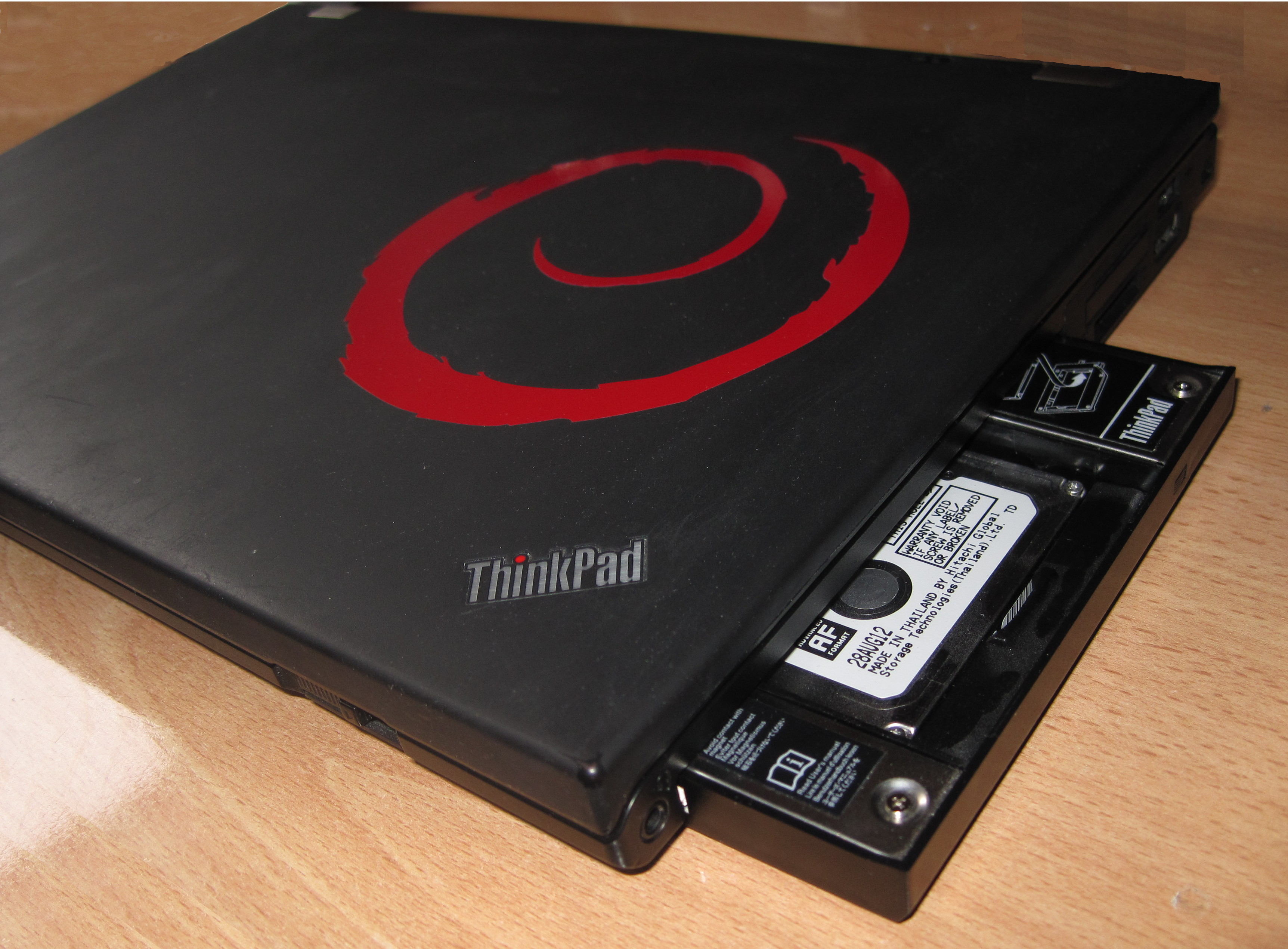
Lenovo laptop with ultrabay ejected
My Lenovo laptop has an Ultrabay, these are a way to easily swap optical and hard drives drives. They allow me to carry around additional storage and, providing I remembered to pack the drive, access optical media.
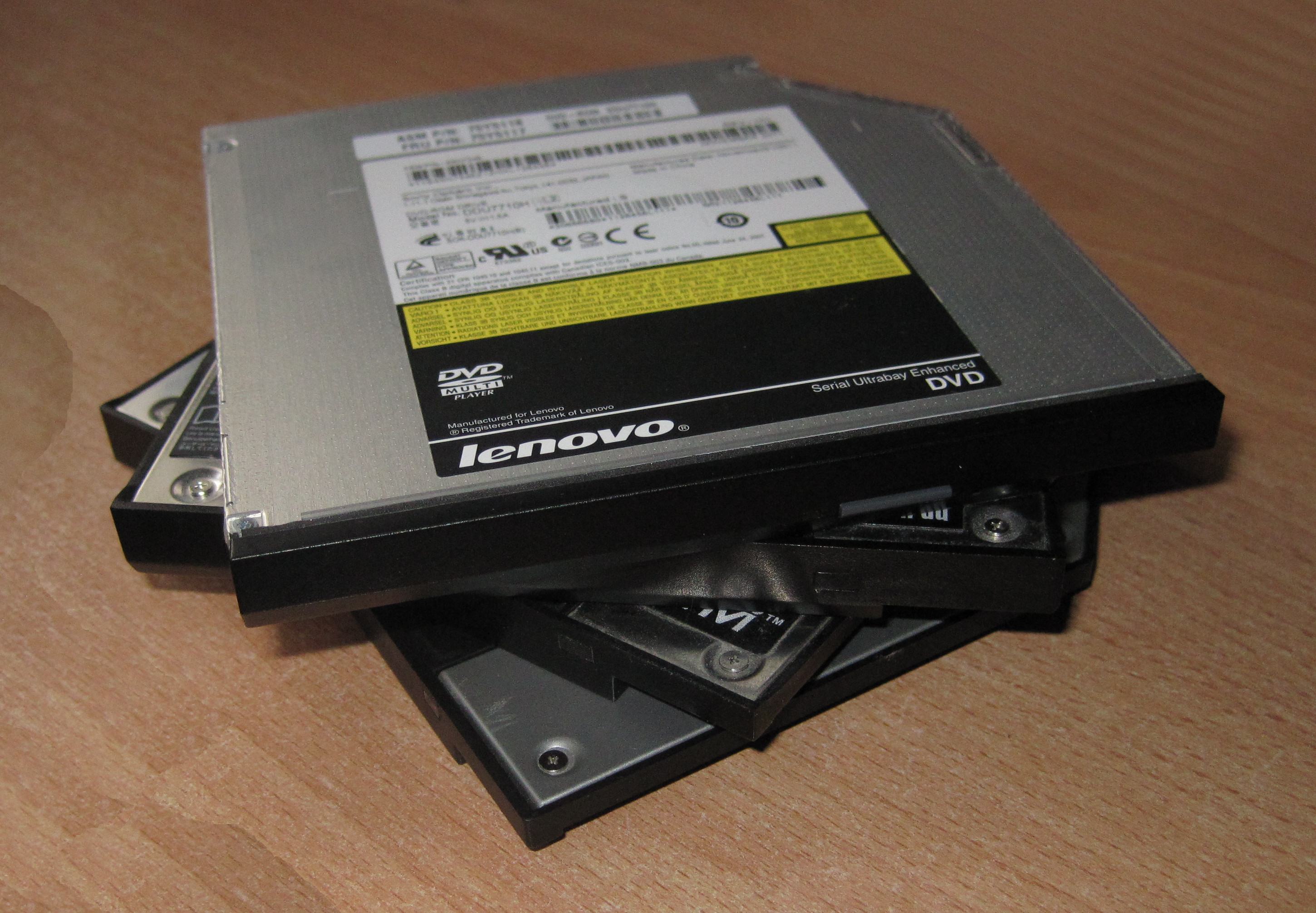
Over time I have acquired several additional hard drives housed in Ultrabay caddies. Generally I only need to access one at a time but increasingly I want to have more than one available.

Lenovo used to sell docking stations with multiple Ultrabays but since Series 3 was introduced this is no longer the case as the docks have been reduced to port replicators.

One solution is to buy a SATA to USB convertor which lets you use the drive externally. However once you have more than one drive this becomes somewhat untidy, not to mention all those unhoused drives on your desk become something of a hazard.

Recently after another close call I decided what I needed was a proper external enclosure to house all my drives. After some extensive googling I found nothing suitable ready to buy. Most normal people would give up at this point, I appear to be an abnormal person so I got the CAD package out.

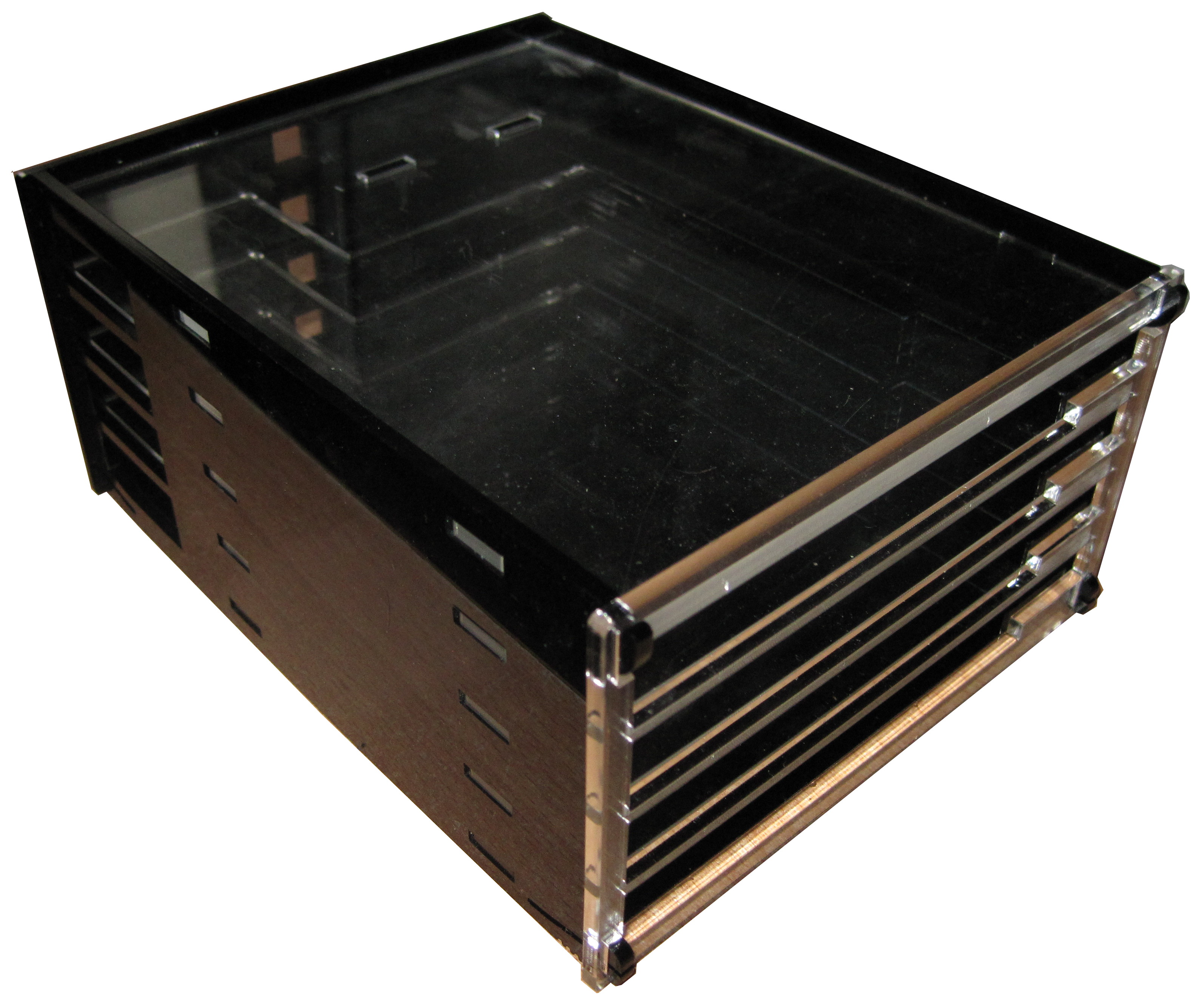
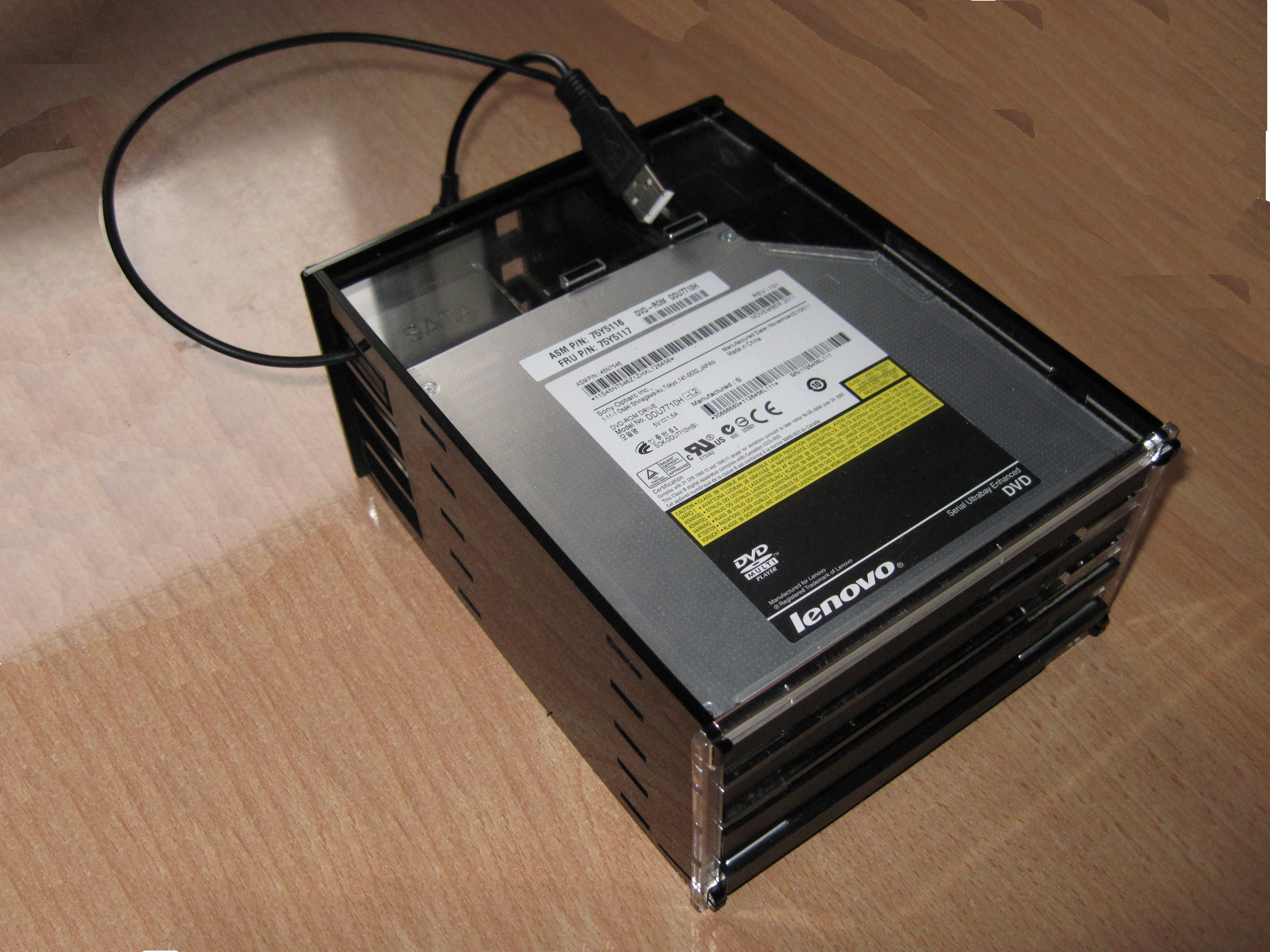
A few hours of design and a load of laser cutting later I came up with a four bay enclosure that now houses all my Ultrabay caddies.

The design was slightly evolved to accommodate the features of some older caddies and allow a pencil to be used to eject the drives (I put a square hole in the back)

The completed unit uses about 10 of plastic and takes 30 minutes to lasercut.

The only issue with the enclosure as manufactured is that Makespace ran out of black plastic stock and I had to use transparent to finish so it is not in classic black as lenovo intended.

As usual all the design files are publicly available from my design repo.

15 February 2015

Antonio Terceiro: rmail: reviving upstream maintaince

It is always fun to write new stuff, and be able to show off that shiny new piece of code that just come out of your brilliance and/or restless effort. But the world does not spin based just on shiny things; for free software to continue making the world work, we also need the dusty, and maybe and little rusty, things that keep our systems together. Someone needs to make sure the rust does not take over, and that these venerable but useful pieces of code keep it together as the ecosystem around them evolves. As you know, Someone is probably the busiest person there is, so often you will have to take Someone s job for yourself. rmail is a Ruby library able to parse, modify, and generate MIME mail messages. While handling transitions of Ruby interpreters in Debian, it was one of the packages we always had to fix for new Ruby versions, to the point where the Debian package has accumulated quite a few patches. The situation became ridiculous. It was considered to maybe drop it from the Debian archive, but dropping it would mean either also dropping feed2imap and sup or porting both to other mail library. Since doing this type of port is always painful, I decided instead to do something about the sorry state in which rmail was on the upstream side. The reasons why it was not properly maintained upstream does not matter: people lose interest, move on to other projects, are not active users anymore; that is normal in free software projects, and instead of blaming upstream maintainers in any way we need to thank them for writing us free software in the first place, and step up to fix the stuff we use. I got in touch with the people listed as owner for the package on rubygems.org, and got owner permission, which means I can now publish new versions myself. With that, I cloned the repository where the original author had imported the latest code uploaded to rubygems and had started to receive contributions, but that repository was inactive for more than one year. It had already got some contributions from the sup developers which never made it in a new rmail release, so the sup people started using their own fork called rmail-sup . Already in my repository, I have imported all the patches that still made sense from the Debian repository, did a bunch of updates, mainly to modernize the build system, and did a 1.1.0 release to rubygems.org. This release is pretty much compatible with 1.0.0, but since I did not test it with Ruby versions older than than one in my work laptop (2.1.5), I bumped the minor version number as warning to prospective users still on older Ruby versions. In this release, the test suite passes 100% clean, what always gives my mind a lot of comfort:

$ rake
/usr/bin/ruby2.1 -I"lib:." -I"/usr/lib/ruby/vendor_ruby" "/usr/lib/ruby/vendor_ruby/rake/rake_test_loader.rb" "test/test*.rb"
Loaded suite /usr/lib/ruby/vendor_ruby/rake/rake_test_loader
Started
...............................................................................
...............................................................................
........
Finished in 2.096916712 seconds.
166 tests, 24213 assertions, 0 failures, 0 errors, 0 pendings, 0 omissions, 0 notifications
100% passed
79.16 tests/s, 11546.95 assertions/s

And in the new release I have just uploaded to the Debian experimental suite (1.1.0-1), I was able to drop all of the patches and just use the upstream source as is. So that s it: if you use rmail for anything, consider testing version 1.1.0-1 from Debian experimental, or 1.1.0 from rubygems.org if you into that, and report any bugs to the [github repository](https://github.com/terceiro/rmail). My only commitment for now is keep it working, but if you want to add new features I will definitively review and merge them.

14 February 2015

Wouter Verhelst: Docker

... is the new hype these days. Everyone seems to want to be part of it; even Microsoft wants to allow Docker to run on its platform. How they visualise that is slightly beyond me, seen as how Docker is mostly a case of "run a bunch of LXC instances", which by their definition can't happen on Windows. Presumably they'll just run a lot more VMs, then, which is a possible workaround. Or maybe Docker for Windows will be the same in concept, but not in implementation. I guess the future will tell. As I understand the premise, the idea of Docker is that getting software to run on "all" distributions is a Hard Problem[TM], so in a Docker thing you just define that this particular stuff is meant to run on top of this and this and that environment, and Docker then compartmentalises everything for you. It should make things easier to maintain, and that's a good thing. I'm not a fan. If the problem that Docker tries to fix is "making software run on all platforms is hard", then Docker's "solution" is "I give up, it's not possible". That's sad. Sure, having a platform which manages your virtualisation for you, without having to manually create virtual machines (or having to write software to do so) is great. And sure, compartmentalising software so that every application runs in its own space can help towards security, manageability, and a whole bunch of other advantages. But having an environment which says "if you want to run this applicaiton, I'll set up a chroot with distribution X for you; if you want to run this other application, I'll set up a chroot with distribution Y for you; and if you want to run yet this other application yere, I'll start doing a chroot with distribution Z for you" will, in the end, get you a situation where, if there's another bug in libc6 or libssl, you now have a nightmare trying to track down all the different versions in all the docker instances to make sure they're all fixed. And while it may work perfectly well on the open Internet, if you're on a corporate network with a paranoid firewall and proxy, downloading packages from public mirrors is harder than just creating a local mirror instead. Which you now have to do not only for your local distribution of choice, but also for the distributions of choice of all the developers of the software you're trying to use. Which may result in more work than just trying to massage the software in question to actually bloody well work, dammit. I'm sure Docker has a solution for some or all of the problems it introduces, and I'm not saying it doesn't work in practice. I'm sure it does fix some part of the "Making software run on all platforms is hard" problem, and so I might even end up using it at some point. But from an aesthetical point of view, I don't think Docker is a good system. I'm not very fond of giving up.

13 February 2015

Daniel Leidert: Motion picture capturing: Debian + motion + Logitech C910 - part II

In my recent attempt to setup a motion detection camera I was disappointed, that my camera, which should be able to record with 30 fps in 720p mode only reached 10 fps using the software motion. Now I got a bit further. This seems to be an issue with the format used by motion. I've check the output of v4l2-ctl ...
$ v4l2-ctl -d /dev/video1 --list-formats-ext
[..]
ioctl: VIDIOC_ENUM_FMT
Index : 0
Type : Video Capture
Pixel Format: 'YUYV'
Name : YUV 4:2:2 (YUYV)
[..]
Size: Discrete 1280x720
Interval: Discrete 0.100s (10.000 fps)
Interval: Discrete 0.133s (7.500 fps)
Interval: Discrete 0.200s (5.000 fps)
[..]

Index : 1
Type : Video Capture
Pixel Format: 'MJPG' (compressed)
Name : MJPEG
[..]
Size: Discrete 1280x720
Interval: Discrete 0.033s (30.000 fps)
Interval: Discrete 0.042s (24.000 fps)
Interval: Discrete 0.050s (20.000 fps)
Interval: Discrete 0.067s (15.000 fps)
Interval: Discrete 0.100s (10.000 fps)
Interval: Discrete 0.133s (7.500 fps)
Interval: Discrete 0.200s (5.000 fps)
[..]
... and motion:
$ motion
[..]
[1] [NTC] [VID] v4l2_set_pix_format: Config palette index 17 (YU12) doesn't work.
[1] [NTC] [VID] v4l2_set_pix_format: Supported palettes:
[1] [NTC] [VID] v4l2_set_pix_format: (0) YUYV (YUV 4:2:2 (YUYV))
[1] [NTC] [VID] v4l2_set_pix_format: 0 - YUV 4:2:2 (YUYV) (compressed : 0) (0x56595559)
[1] [NTC] [VID] v4l2_set_pix_format: (1) MJPG (MJPEG)
[1] [NTC] [VID] v4l2_set_pix_format: 1 - MJPEG (compressed : 1) (0x47504a4d)
[1] [NTC] [VID] v4l2_set_pix_format Selected palette YUYV
[1] [NTC] [VID] v4l2_do_set_pix_format: Testing palette YUYV (1280x720)
[1] [NTC] [VID] v4l2_do_set_pix_format: Using palette YUYV (1280x720) bytesperlines 2560 sizeimage 1843200 colorspace 00000008
[..]
Ok, so both formats YUYV and MJPG are supported and recognized and I can choose both via the v4l2palette configuration variable, citing motion.conf:
# v4l2_palette allows to choose preferable palette to be use by motion
# to capture from those supported by your videodevice. (default: 17)
# E.g. if your videodevice supports both V4L2_PIX_FMT_SBGGR8 and
# V4L2_PIX_FMT_MJPEG then motion will by default use V4L2_PIX_FMT_MJPEG.
# Setting v4l2_palette to 2 forces motion to use V4L2_PIX_FMT_SBGGR8
# instead.
#
# Values :
# V4L2_PIX_FMT_SN9C10X : 0 'S910'
# V4L2_PIX_FMT_SBGGR16 : 1 'BYR2'
# V4L2_PIX_FMT_SBGGR8 : 2 'BA81'
# V4L2_PIX_FMT_SPCA561 : 3 'S561'
# V4L2_PIX_FMT_SGBRG8 : 4 'GBRG'
# V4L2_PIX_FMT_SGRBG8 : 5 'GRBG'
# V4L2_PIX_FMT_PAC207 : 6 'P207'
# V4L2_PIX_FMT_PJPG : 7 'PJPG'
# V4L2_PIX_FMT_MJPEG : 8 'MJPEG'
# V4L2_PIX_FMT_JPEG : 9 'JPEG'
# V4L2_PIX_FMT_RGB24 : 10 'RGB3'
# V4L2_PIX_FMT_SPCA501 : 11 'S501'
# V4L2_PIX_FMT_SPCA505 : 12 'S505'
# V4L2_PIX_FMT_SPCA508 : 13 'S508'
# V4L2_PIX_FMT_UYVY : 14 'UYVY'
# V4L2_PIX_FMT_YUYV : 15 'YUYV'
# V4L2_PIX_FMT_YUV422P : 16 '422P'
# V4L2_PIX_FMT_YUV420 : 17 'YU12'
#
v4l2_palette 17
Now motion uses YUYV as default mode as shown by its output. So it seems that all I have to do is to choose MJPEG in my motion.conf:
v4l2_palette 8
Testing again ...
$ motion
[..]
[1] [NTC] [VID] vid_v4lx_start: Using V4L2
[1] [NTC] [ALL] image_ring_resize: Resizing pre_capture buffer to 1 items
[1] [NTC] [VID] v4l2_set_control: setting control "Brightness" to 25 (ret 0 )
Corrupt JPEG data: 5 extraneous bytes before marker 0xd6
[1] [CRT] [VID] mjpegtoyuv420p: Corrupt image ... continue
[1] [NTC] [VID] v4l2_set_control: setting control "Brightness" to 14 (ret 0 )
Corrupt JPEG data: 1 extraneous bytes before marker 0xd5
[1] [CRT] [VID] mjpegtoyuv420p: Corrupt image ... continue
[1] [NTC] [VID] v4l2_set_control: setting control "Brightness" to 36 (ret 0 )
Corrupt JPEG data: 3 extraneous bytes before marker 0xd2
[1] [CRT] [VID] mjpegtoyuv420p: Corrupt image ... continue
[1] [NTC] [VID] v4l2_set_control: setting control "Brightness" to 58 (ret 0 )
Corrupt JPEG data: 1 extraneous bytes before marker 0xd7
[1] [CRT] [VID] mjpegtoyuv420p: Corrupt image ... continue
[1] [NTC] [VID] v4l2_set_control: setting control "Brightness" to 80 (ret 0 )
Corrupt JPEG data: 4 extraneous bytes before marker 0xd7
[1] [CRT] [VID] mjpegtoyuv420p: Corrupt image ... continue
[1] [ERR] [ALL] motion_init: Error capturing first image
[1] [NTC] [ALL] image_ring_resize: Resizing pre_capture buffer to 16 items
Corrupt JPEG data: 4 extraneous bytes before marker 0xd1
[1] [CRT] [VID] mjpegtoyuv420p: Corrupt image ... continue
Corrupt JPEG data: 11 extraneous bytes before marker 0xd1
[1] [CRT] [VID] mjpegtoyuv420p: Corrupt image ... continue
Corrupt JPEG data: 3 extraneous bytes before marker 0xd4
[1] [CRT] [VID] mjpegtoyuv420p: Corrupt image ... continue
Corrupt JPEG data: 7 extraneous bytes before marker 0xd1
[..]
... and another issue is turning up :( The output above goes on and on and on and there is no video capturing. So accordingly to $searchengine the above happens to a lot of people. I just found one often suggested fix: pre-load v4l2convert.so from libv4l-0:
$ LD_PRELOAD=/usr/lib/x86_64-linux-gnu/libv4l/v4l2convert.so motion
But the problem persists and I'm out of ideas :( So atm it lokks like I cannot use the MJPEG format and don't get 30 fps at 1280x720 pixels. During writing I then discovered a solution by good old trial-and-error: Leaving the v4l2_palette variable at its default value 17 (YU12) and pre-loading v4l2convert.so makes use of YU12 and the framerate at least raises to 24 fps:
$ LD_PRELOAD=/usr/lib/x86_64-linux-gnu/libv4lg/v4l2convert.so motion
[..]
[1] [NTC] [VID] v4l2_do_set_pix_format: Testing palette YU12 (1280x720)
[1] [NTC] [VID] v4l2_do_set_pix_format: Using palette YU12 (1280x720) bytesperlines 1280 sizeimage 1382400 colorspace 00000008
[..]
[1] [NTC] [EVT] event_new_video FPS 24
[..]
Finally! :) The results are nice. It would maybe even be a good idea to limit the framerate a bit, to e.g. 20. So that is a tested configuration for the Logitech C910 running at a resolution of 1280x720 pixels:
v4l2_palette 17
width 1280
height 720
framerate 20
minimum_frame_time 0
pre_capture 10 # 0,5 seconds pre-recording
post_capture 50 # 2,5 seconds after-recording
auto_brightness on
ffmpeg_variable_bitrate 2 # best quality
Now all this made me curious, which framerate is possible at a resolution of 1920x1080 pixels now and how the results look like. Although I get 24 fps too, the resulting movie suffers of jumps every few frames. So here I got pretty good results with a more conservative setting. By increasing framerate - tested up to 15 fps with good results - pre_capture needed to be decreased accordingly to values between 1..3 to minimize jumps:
v4l2_palette 17
width 1920
height 1080
framerate 12
minimum_frame_time 0
pre_capture 6 # 0,5 seconds pre-recording
post_capture 30 # 2,5 seconds after-recording
auto_brightness on
ffmpeg_variable_bitrate 2 # best quality
Both configurations lead to satisfying results. Of course the latter will easily fill your hardrive :) TODOI guess, the results can be optimzed further by playing around with ffmpeg_bps and ffmpeg_variable_bitrate. Maybe then it is possible to record without jumps at higher framerates too(?). I also didn't test the various norm settings (PAL, NTSC, etc.).

12 February 2015

Rapha&#235;l Hertzog: Freexian s report about Debian Long Term Support, January 2015

Like each month, here comes a report about the work of paid contributors to Debian LTS. Individual reports In January, 48 work hours have been equally split among 4 paid contributors. Their reports are available: Evolution of the situation During the last month, the number of paid work hours has made a noticeable jump: we re now at 58 hours per month. At this rate, we would need 3 more months to reach our minimal goal of funding the equivalent of a half-time position. Unfortunately, the number of new sponsors actually in the process is not likely to be enough to have a similar raise next month. So, as usual, we are looking for more sponsors. In terms of security updates waiting to be handled, the situation looks a bit worse than last month: the dla-needed.txt file lists 37 packages awaiting an update (7 more than last month), the list of open vulnerabilities in Squeeze shows about 63 affected packages in total (7 more than last month). The increase is not too worrying, but the waiting time before an issue is dealt with is sometimes more problematic. To be able to deal with all incoming issues in a timely manner, the LTS team needs more resources: some months will have more issues than usual, some issues will be longer to handle than others, etc. Thanks to our sponsors The new sponsors of the month are in bold.

No comment Liked this article? Click here. My blog is Flattr-enabled.

11 February 2015

John Goerzen: Reactions to Has modern Linux lost its way? and the value of simplicity

Apparently I touched a nerve with my recent post about the growing complexity of issues. There were quite a few good comments, which I ll mention here. It s provided me some clarity on the problem, in fact. I ll try to distill a few more thoughts here. The value of simplicity and predictability The best software, whether it s operating systems or anything else, is predictable. You read the documentation, or explore the interface, and you can make a logical prediction that when I do action X, the result will be Y. grep and cat are perfect examples of this. The more complex the rules in the software, the more hard it is for us to predict. It leads to bugs, and it leads to inadvertant security holes. Worse, it leads to people being unable to fix things themselves one of the key freedoms that Free Software is supposed to provide. The more complex software is, the fewer people will be able to fix it by themselves. Now, I want to clarify: I hear a lot of talk about ease of use. Gnome removes options in my print dialog box to make it easier to use. (This is why I do not use Gnome. It actually makes it harder to use, because now I have to go find some obscure way to just make the darn thing print.) A lot of people conflate ease of use with ease of learning, but in reality, I am talking about neither. I am talking about ease of analysis. The Linux command line may not have pointy-clicky icons, but at least at one time once you understood ls -l and how groups, users, and permission bits interacted, you could fairly easily conclude who had access to what on a system. Now we have a situation where the answer to this is quite unclear in terms of desktop environments (apparently some distros ship network-manager so that all users on the system share the wifi passwords they enter. A surprise, eh?) I don t mind reading a manpage to learn about something, so long as the manpage was written to inform. With this situation of dbus/cgmanager/polkit/etc, here s what it feels like. This, to me, is the crux of the problem: It feels like we are in a twisty maze, every passage looks alike, and our flashlight ran out of battieries in 2013. The manpages, to the extent they exist for things like cgmanager and polkit, describe the texture of the walls in our cavern, but don t give us a map to the cave. Therefore, we are each left to piece it together little bits at a time, but there are traps that keep moving around, so it s slow going. And it s a really big cave. Other user perceptions There are a lot of comments on the blog about this. It is clear that the problem is not specific to Debian. For instance: This stuff is really important, folks. People being able to maintain their own software, work with it themselves, etc. is one of the core reasons that Free Software exists in the first place. It is a fundamental value of our community. For decades, we have been struggling for survival, for relevance. When I started using Linux, it was both a question and an accomplishment to have a useable web browser on many platforms. (Netscape Navigator was closed source back then.) Now we have succeeded. We have GPL-licensed and BSD-licensed software running on everything from our smartphones to cars. But we are snatching defeat from the jaws of victory, because just as we are managing to remove the legal roadblocks that kept people from true mastery of their software, we are erecting technological ones that make the step into the Free Software world so much more difficult than it needs to be. We no longer have to craft Modelines for X, or compile a kernel with just the right drivers. This is progress. Our hardware is mostly auto-detected and our USB serial dongles work properly more often on Linux than on Windows. This is progress. Even our printers and scanners work pretty darn well. This is progress, too. But in the place of all these things, now we have userspace mucking it up. We have people with mysterious errors that can t be easily assisted by the elders in the community, because the elders are just as mystified. We have bugs crop up that would once have been shallow, but are now non-obvious. We are going to leave a sour taste in people s mouth, and stir repulsion instead of interest among those just checking it out. The ways out It s a nasty predicament, isn t it? What are your ways out of that cave without being eaten by a grue? Obviously the best bet is to get rid of the traps and the grues. Somehow the people that are working on this need to understand that elegance is a feature a darn important feature. Sadly I think this ship may have already sailed. Software diagnosis tools like Enrico Zini s seat-inspect idea can also help. If we have something like an ls for polkit that can reduce all the complexity to something more manageable, that s great. The next best thing is a good map good manpages, detailed logs, good error messages. If software would be more verbose about the permission errors, people could get a good clue about where to look. If manpages for software didn t just explain the cavern wall texture, but explain how this room relates to all the other nearby rooms, it would be tremendously helpful. At present, I am unsure if our problem is one of very poor documentation, or is so bad that good documentation like this is impossible because the underlying design is so complex it defies being documented in something smaller than a book (in which case, our ship has not just sailed but is taking on water). Counter-argument: progress One theme that came up often in the comments is that this is necessary for progress. To a certain extent, I buy that. I get why udev is important. I get why we want the DE software to interact well. But here s my thing: this already worked well in wheezy. Gnome, XFCE, and KDE software all could mount/unmount my drives. I am truly still unsure what problem all this solved. Yes, cloud companies have demanding requirements about security. I work for one. Making security more difficult to audit doesn t do me any favors, I can assure you. The systemd angle To my surprise, systemd came up quite often in the discussion, despite the fact that I mentioned I wasn t running systemd-sysv. It seems like the new desktop environemt ecosystem is the systemd ecosystem in a lot of people s minds. I m not certain this is justified; systemd was not my first choice, but as I said in an earlier blog post, jessie will still boot . A final note I still run Debian on all my personal boxes and I m not going to change. It does awesome things. For under $100, I built a music-playing system, with Raspberry Pis, fully synced throughout my house, using a little scripting and software. The same thing from Sonos would have cost thousands. I am passionate about this community and its values. Even when jessie releases with polkit and all the rest, I m still going to use it, because it is still a good distro from good people.

Daniel Leidert: Issues with Server4You vServer running Debian Stable (Wheezy)

I recently acquired a vServer hosted by Server4You and decided to install a Debian Wheezy image. Usually I boot any device in backup mode and first install a fresh Debian copy using debootstrap over the provided image, to have a clean system. In this case I did not and I came across a few glitches I want to talk about. So hopefully, if you are running the same system image, it saves you some time to figure out, why the h*ll some things don't work as expected :) Cron jobs not runningI installed unattended-upgrades and adjusted all configuration files to enable unattended upgrades. But I never received any mail about an update although looking at the system, I saw updates waiting. I checked with
# run-parts --list /etc/cron.daily
and apt was not listed although /etc/cron.daily/apt was there. After spending some time to figure out, what was going on, I found the rather simple cause: Several scripts were missing the executable bit, thus did not run. So it seems, for whatever reason, the image authors have tempered with file permissions and of course, not by using dpkg-statoverride :( It was easy to fix the file permissions for everything beyond /etc/cron*, but that still leaves a very bad feeling, that there are more files that have been tempered with! I'm not speaking about customizations. That are easy to find using debsums. I'm speaking about file permissions and ownership.Now there seems no easy way to either check for changed permissions or ownership. The only solution I found is to get a list of all installed packages on the system, install them into a chroot environment and get all permission and ownership information from this very fresh system. Then compare file permissions/ownership of the installed system with this list. Not fun. init from testing / upstart on holdToday I've discovered, that apt-get wanted to update the init package. Of course I was curious, why unattended-upgrades didn't yet already do so. Turns out, init is only in testing/unstable and essential there. I purged it, but apt-get keeps bugging me to update/install this package. I really began to wonder, what is going on here, because this is a plain stable system:
  • no sources listed for backports, volatile, multimedia etc.
  • sources listed for testing and unstable
  • only packages from stable/stable-updates installed
  • sets APT::Default-Release "stable";
First I checked with aptitude:
# aptitude why init
Unable to find a reason to install init.
Ok, so why:
# apt-get dist-upgrade -u
Reading package lists... Done
Building dependency tree
Reading state information... Done
Calculating upgrade... Done
The following NEW packages will be installed:
init
0 upgraded, 1 newly installed, 0 to remove and 0 not upgraded.
Need to get 0 B/4674 B of archives.
After this operation, 29.7 kB of additional disk space will be used.
Do you want to continue [Y/n]?
JFTR: I see a stable system bugging me to install systemd for no obvious reason. The issue might be similar! I'm still investigating. (not reproducible anymore)Now I tried to debug this:
# apt-get -o  Debug::pkgProblemResolver="true" dist-upgrade -u
Reading package lists... Done
Building dependency tree
Reading state information... Done
Calculating upgrade... Starting
Starting 2
Investigating (0) upstart [ amd64 ] < 1.6.1-1 1.11-5 > ( admin )
Broken upstart:amd64 Conflicts on sysvinit [ amd64 ] < none -> 2.88dsf-41+deb7u1 2.88dsf-58 > ( admin )
Conflicts//Breaks against version 2.88dsf-58 for sysvinit but that is not InstVer, ignoring
Considering sysvinit:amd64 5102 as a solution to upstart:amd64 10102
Added sysvinit:amd64 to the remove list
Fixing upstart:amd64 via keep of sysvinit:amd64
Done
Done
The following NEW packages will be installed:
init
0 upgraded, 1 newly installed, 0 to remove and 0 not upgraded.
Need to get 0 B/4674 B of archives.
After this operation, 29.7 kB of additional disk space will be used.
Do you want to continue [Y/n]?
Eh, upstart?
# apt-cache policy upstart
upstart:
Installed: 1.6.1-1
Candidate: 1.6.1-1
Version table:
1.11-5 0
500 http://ftp.de.debian.org/debian/ testing/main amd64 Packages
500 http://ftp.de.debian.org/debian/ sid/main amd64 Packages
*** 1.6.1-1 0
990 http://ftp.de.debian.org/debian/ stable/main amd64 Packages
100 /var/lib/dpkg/status
# dpkg -l upstart
Desired=Unknown/Install/Remove/Purge/Hold
Status=Not/Inst/Conf-files/Unpacked/halF-conf/Half-inst/trig-aWait/Trig-pend
/ Err?=(none)/Reinst-required (Status,Err: uppercase=bad)
/ Name Version Architecture Description
+++-=============================-===================-===================-===============================================================
hi upstart 1.6.1-1 amd64 event-based init daemon
Ok, at least one package is at hold. This is another questionable customization, but in case easy to fix. But I still don't understand apt-get and the difference to aptitude behaviour? Can someone please enlighten me? Customized filesThis isn't really an issue, but just for completion: several files have been customized. debsums easily shows which ones:
# debsums -ac
I don't have the original list anymore - please check yourself

10 February 2015

Enrico Zini: systemd-default-rescue

seat-inspect Four months ago I wrote this somewhere:
Seeing a DD saying "this new dbus stuff scares me" would make most debian users scared. Seeing a DD who has an idea of what is going on, and who can explain it, would be an interesting and exciting experience. So, let's be exemplary, competent and patient. Or at least, competent. Some may like or not like the changes, but do we all understand what is going on? Will we all be able to support our friends and customers running jessie? I confess that although I understand the need for it, I don't feel competent enough to support systemd-based machines right now. So, are we maybe in need of help, cheat sheets, arsenals of one-liners, diagnostic tools? Maybe a round of posts on -planet like "one debian package a day" but with new features that jessie will have, and how to understand them and take advantage of them?
That was four months ago. In the meantime, I did some work, and it got better for me. Yesterday, however, I've seen an experienced Linux person frustrated because the shutdown function of the desktop was doing nothing whatsoever. Today I found John Goerzen's post on planet. I felt like some more diagnostic tools were needed, so I spent the day making seat-inspect. seat-inspect tries to make the status of the login/seat system visible, to help with understanding and troubleshooting. The intent of running the code is to have an overview of the system status, both to see what the new facilities are about, and to figure out if there is something out of place. The intent of reading the code is to have an idea of how to use these facilities: the code has been written to be straightforward and is annotated with relevant bits from the logind API documentation. seat-inspect is not a finished tool, but a starting point. I put it on github hoping that people will fork it and add their own extra sanity checks and warnings, so that it can grow into a standard thing to run if a system acts weird. As it is now, it should be able to issue warnings if some bits are missing for network-manager or shutdown functions to work correctly. I haven't really tested that, though, because I don't have a system at hand where they are currently not working fine. Another nice thing of it is that when running seat-inspect -v you get a dump of what logind/consolekit think about your system. I found it an interesting way to explore the new functionalities that we recently grew. The same can be done, and in more details, with loginctl calls, but I lacked a summary. After writing this I feel a bit more competent, probably enough to sit at somebody's computer and poke into loginctl bits. I highly recommend the experience.

Petter Reinholdtsen: Nude body scanner now present on Norwegian airport

Aftenposten, one of the largest newspapers in Norway, today report that three of the nude body scanners now is put to use at Gardermoen, the main airport in Norway. This way the travelers can have their body photographed without cloths when visiting Norway. Of course this horrible news is presented with a positive spin, stating that "now travelers can move past the security check point faster and more efficiently", but fail to mention that the machines in question take pictures of their nude bodies and store them internally in the computer, while only presenting sketch figure of the body to the public. The article is written in a way that leave the impression that the new machines do not take these nude pictures and only create the sketch figures. In reality the same nude pictures are still taken, but not presented to everyone. They are still available for the owners of the system and the people doing maintenance of the scanners, as long as they are taken and stored. Wikipedia have a more on Full body scanners, including example images and a summary of the controversy about these scanners. Personally I will decline to use these machines, as I believe strip searches of my body is a very intrusive attack on my privacy, and not something everyone should have to accept to travel.

John Goerzen: Has modern Linux lost its way? (Some thoughts on jessie)

For years, I used to run Debian sid (unstable) on all my personal machines. Laptops, workstations, sometimes even my personal servers years ago ran sid. Sid was, as its name implies, unstable. Sometimes things broke. But it wasn t a big deal, because I could always get in there and fix it fairly quickly, whatever it was. It was the price I paid for the latest and greatest. For the last number of months, I ve dealt with a small but annoying issue in jessie: None of Nautilus, Thunar, or digikam (yes, that represents Gnome, XFCE, and KDE) can mount USB drives I plug in anymore. I just get Not authorized to perform operation. I can, of course, still mount -o uid=1000 /dev/sdc1 /mnt, but I miss the convenience of doing it this way. One jessie system I switched to systemd specifically to get around this problem. It worked, but I don t know why. I haven t had the time to switch my workstation, and frankly I am concerned about it. Here s the crux of the issue: I don t even know where to start looking. I ve googled this issue, and found all sorts of answers pointing to polkit, or dbus, or systemd-shim, or cgmanager, or lightdm, or XFCE, or I found a bug report of this exact problem Debian #760281, but it s marked fixed, and nobody replied to my comment that I m still seeing it. Nowhere is it documented that a Digikam mounting issue should have me looking in polkit, let alone cgmanager. And even once I find those packages, their documentation suffers from Bad Unix Documentation Disease: talking about the nitty-gritty weeds view of something, without bothering to put it in context. Here is the mystifying heading for the cgmanager(8) manpage:
cgmanager is a daemon to manage cgroups. Programs and users can make D-Bus requests to administer cgroups over which they have privilege. To ensure that users may not exceed their privilege in manipulating cgroups, the cgroup manager accepts regular D-Bus requests only from tasks within its own process-id and user namespaces. For tasks in private namespaces (such as containers), SCM-enhanced D-Bus calls are available. Using these manually is not recommended. Rather, each container is advised to run a cgproxy, which will forward plain D-Bus requests as SCM-enhanced D-Bus requests to the host cgmanager.
That s about as comprehensible as Vogon poetry to me. How is cgmanager started? What does SCM-enhanced mean? And I even know what a cgroup is. This has been going on for months, which has me also wondering: is it only me? (Google certainly suggests it s not, and there are plenty of hits for this exact problem with many distros, and some truly terrible advice out there to boot.) And if not, why is something so basic and obvious festering for so long? Have we built something that s too complex to understand and debug? This is, in my mind, orthogonal to the systemd question. I used to be able to say Linux was clean, logical, well put-together, and organized. I can t really say this anymore. Users and groups are not really determinitive for permissions, now that we have things like polkit running around. (Yes, by the way, I am a member of plugdev.) Error messages are unhelpful (WHY was I not authorized?) and logs are nowhere to be found. Traditionally, one could twiddle who could mount devices via /etc/fstab lines and perhaps some sudo rules. Granted, you had to know where to look, but when you did, it was simple; only two pieces to fit together. I ve even spent time figuring out where to look and STILL have no idea what to do. systemd may help with some of this, and may hurt with some of it; but I see the problem more of an attitude of desktop environments to add features fast without really thinking of the implications. There is something to be said for slower progress if the result is higher quality. Then as I was writing this, of course, my laptop started insisting that it needed the root password to suspend when I close the lid. And it s running systemd. There s another quagmire Update: Part 2 with some reactions to this and further thoughts is now available.

9 February 2015

Eddy Petri&#537;or: uClibc based toolchain using Gentoo for NSLU2

I was asked in the previous post why I didn't used the Debian armel port for my NSLU2.

My intention was to create a uclibc based system (and a uclibc based toolchain) for my NSLU2. This was not obvious in the post because building the uclibc based toolchain resulted in this error:
crossdev armv5-softfloat-linux-uclibceabi
[..]/var/tmp/portage/cross-armv5-softfloat-linux-uclibceabi/gcc-4.9.2/work/gcc-4.9.2/libsanitizer/sanitizer_common/sanitizer_platform_limits_posix.cc:67:21: fatal error: wordexp.h: No such file or directory
#include
^
compilation terminated.
Makefile:416: recipe for target 'sanitizer_platform_limits_posix.lo' failed
make[4]: *** [sanitizer_platform_limits_posix.lo] Error 1
make[4]: *** Waiting for unfinished jobs....

So, yesterday, to not forget what I did, I tried building a glibc based toolchain and posted that.

Today, after looking at the offending error, it seems gcc 4.9.2 assumes wordexp.h is always available on non-Android platforms and Gentoo does not make that file availble when installing uclibc.


I think the problem was introduced in gcc in 2013 with this commit, but I haven't cheked in detail. What I know for sure is that gcc 4.8.3 works at this moment with uclibc and the buildroot guys are still using gcc 4.8.4 in their default uClibc based toolchain. So here it is the command that generated the uClibc based toolchain:

crossdev --g 4.8.3 armv5-softfloat-linux-uclibceabi

I hope this helps other people. Yes, I know I should report the issue to GCC/Gentoo after further investigation.

8 February 2015

Diego Escalante Urrelo: Link Pack #06

The story of Mel Blanc being saved by Bugs Bunny
Such a fantastic and romantic story. Mel Blanc, voice of half the Looney Tunes characters was in an car crash and hanging from a thread in a comma. And it took his characters to save him. It s a very interestingly edited podcast too:
( ) a crazy story about Mel nearly dying in a crash on Dead Man s Curve on Hollywood Boulevard and about the moment two weeks later when Bugs Bunny emerged from Mel s coma before Mel did. In fact, according to neurosurgeon Louis Conway who attended to Mel at the time, it seemed as though Bugs Bunny was trying to save his life.
The audacious rescue plan that might have saved space shuttle Columbia
This is probably the best documentary/kinda fiction article I have read in a long time. It s a long read going over the hypothetical, and nail bitting, plan to rescue the Columbia if it ever got in trouble. It s really intense, and something to sit down and read fully focused, book style.
But imagine an alternate timeline for the Columbia mission in which NASA quickly realized just how devastating the foam strike had been. Could the Columbia astronauts have been safely retrieved from orbit?
Ocean Gravity: Riding sea currents
Cool video of a sea diver running through seafloor currents, really cool and fascinating :). El chavo del ocho en el infierno
This one is in Spanish, and it s a funny take on El chavo del ocho and how it follows some classic models and myths of literature. Chespirito was very fond of classics, so this would make sense. But, of course, the whole article is written on a tongue in cheek style.
En El Chavo del Ocho, Bola os, o el Camus azteca, cre su propia versi n del mito de S sifo. El chavo y compa a est n condenados a empujar por una empinada colina todos los d as esta piedra enorme que siempre regresa, obligandolos al tormento del eterno retorno. La piedra de Quico es cuadrada, no rueda, se desliza. Es c mico, a pesar de tr gico.

Go for some more Link Pack, it s sugar free

Ian Wienand: Netgear CG3100D-2 investigation

The Netgear CG3100D-2 is the default cable-modem you get for Telstra Cable, at least at one time. Having retired it after changing service providers, I wanted to see if it was somewhat able to be re-purposed. In short it's hackability is low. First thing was to check out the Netgear Open Source page to see if the source had anything interesting. There is some source, but honestly when you dig into the platform code and see things like kernel/linux/arch/mips/bcm963xx/setup.c:
/***************************************************************************
 * C++ New and delete operator functions
 ***************************************************************************/
/* void *operator new(unsigned int sz) */
void *_Znwj(unsigned int sz)
 
    return( kmalloc(sz, GFP_KERNEL) );
 
/* void *operator new[](unsigned int sz)*/
void *_Znaj(unsigned int sz)
 
return( kmalloc(sz, GFP_KERNEL) );
 
...
there's a bit of a red-flag that this is not the cleanest code in the world (I guess it interfaces with some sort of cross-platform SDK written in some sort of C++). So next we can open it up, where it turns out there are two separate UARTs as shown in the following image.
UART connections on Netgear CG3100D 2BPAUS
One of these is for the bootloader and eCOS environment, and the other seems to be connected to the Linux side. A copy of the boot-logs for the bootloader and eCOS and Linux don't show anything particuarly interesting. The Linux boot does identify itself as Linux version 2.6.30-V2.06.05u while the available source lists its version as 2.6.30-1.0.5.83.mp2 so it's questionable if the source matches whatever firmware has made it onto the modem. We do see that this identifies as a BCM338332 which seems to be one of the many sub-models of the BCM3383 SoC cable-modem solution. There is an OpenWrt wiki page that indicates support is limited. Both Linux and eCos boot to a login prompt where all the usual default combinations of login/passwords fail. So my next thought was to try and get to the firmware via the bootloader, which has a simple interface
BCM338332 TP0 346890
Reset Switch - Low GPIO-18 50ms
MemSize:            128 M
Chip ID:     BCM3383G-B0
BootLoader Version: 2.4.0alpha14R6T Pre-release Gnu spiboot dual-flash reduced DDR drive linux
Build Date: Mar 24 2012
Build Time: 14:04:50
SPI flash ID 0x012018, size 16MB, block size 64KB, write buffer 256, flags 0x0
Dual flash detected.  Size is 32MB.
parameter offset is 49944
Signature/PID: a0e8
Image 1 Program Header:
   Signature: a0e8
     Control: 0005
   Major Rev: 0003
   Minor Rev: 0000
  Build Time: 2013/4/18 04:01:11 Z
 File Length: 3098751 bytes
Load Address: 80004000
    Filename: CG3100D_2BPAUS_V2.06.02u_130418.bin
         HCS: 1e83
         CRC: b95f4172
Found image 1 at offset 20000
Image 2 Program Header:
   Signature: a0e8
     Control: 0005
   Major Rev: 0003
   Minor Rev: 0000
  Build Time: 2013/10/17 02:33:29 Z
 File Length: 3098198 bytes
Load Address: 80004000
    Filename: CG3100D_2BPAUS_V2.06.05u_131017.bin
         HCS: 2277
         CRC: a6c0fd23
Found image 2 at offset 800000
Image 3 Program Header:
   Signature: a0e8
     Control: 0105
   Major Rev: 0002
   Minor Rev: 0017
  Build Time: 2013/10/17 02:22:30 Z
 File Length: 8277924 bytes
Load Address: 84010000
    Filename: CG3100D_2BPAUS_K2630V2.06.05u_131017.bin
         HCS: 157e
         CRC: 57bb0175
Found image 3 at offset 1000000
Enter '1', '2', or 'p' within 2 seconds or take default...
. .
Board IP Address  [0.0.0.0]:           192.168.2.10
Board IP Mask     [255.255.255.0]:
Board IP Gateway  [0.0.0.0]:
Board MAC Address [00:10:18:ff:ff:ff]:
Internal/External phy? (e/i/a)[a]
Switch detected: 53125
ProbePhy: Found PHY 0, MDIO on MAC 0, data on MAC 0
Using GMAC0, phy 0
Enet link up: 1G full
Main Menu:
==========
  b) Boot from flash
  g) Download and run from RAM
  d) Download and save to flash
  e) Erase flash sector
  m) Set mode
  s) Store bootloader parameters to flash
  i) Re-init ethernet
  p) Print flash partition map
  r) Read memory
  w) Write memory
  j) Jump to arbitrary address
  X) Erase all of flash except the bootloader
  z) Reset
Flash Partition information:
Name           Size           Offset
=====================================
bootloader   0x00010000     0x00000000
image1       0x007d0000     0x00020000
image2       0x007c0000     0x00800000
linux        0x00800000     0x01000000
linuxapps    0x00600000     0x01800000
permnv       0x00010000     0x00010000
dhtml        0x00200000     0x01e00000
dynnv        0x00040000     0x00fc0000
vennv        0x00010000     0x007f0000
The "read memory" seems to give you one byte at a time and I'm not certain it actually works. So I think the next step is solder some leads to dump out the firmware from the flash-chip directly, which is on the underside of the board. At that point, I imagine the passwords would be easily found in the image and you might then be able to leverage this into some sort of further hackability. If you want a challenge and have a lot of time on your hands, this might be your platform but practically I think the best place for this is the recycling bin.

Next.

Previous.