Search Results: "ron"

18 September 2015

Dimitri John Ledkov: Clear Containers for Docker* Engine

Today at work, I announced something James Hunt, Ikey Doherty and myself have been working on. We integrated Clear Containers technology with Docker* Engine to create Clear Containers for Docker* Engine.

After following installation instructions, one can pull and run existing Docker* containers in the secure Clear Containers environment. This means that instead of namespaces, a fast virtual machine is started using the kvmtool hypervisor. This VM is running an optimised minimal Linux* kernel and the optimised Clear Linux* for Intel Architecture Project user-space, with the only goal to execute the Docker* workload and then shut down.

The net effect is almost indistinguishable from typical Docker* container usage:
$ docker run -ti ubuntu:vivid
root@d88a60502ed7:/# systemd-detect-virt
kvm
Apart from, as you see, it's running inside a kvm VM, and thus protected by Intel Virtualization Technology.

This is available on Clear Linux* as well as multiple other operating systems.

I hope this is exciting enough for people to try out, and if you have any feedback, feel free to leave comments or join our mailing list.

*Other names and brands may be claimed as the property of others

The postings on this site are my own and don't necessarily represent Intel s positions, strategies, or opinions.

Russ Allbery: Review: The Three-Body Problem

Review: The Three-Body Problem, by Cixin Liu & Ken Liu
Series: Three-Body Problem #1
Author: Liu Cixin ( )
Translator: Ken Liu
Publisher: Tor
Copyright: 2006, 2014
Printing: November 2014
ISBN: 1-4668-5344-1
Format: Kindle
Pages: 399
Liu Cixin ( ) is one of the best-known and most popular SF authors in China, but, due to the paucity of translated SF in the English-speaking world, was largely unknown to English-speaking SF readers. That made this translation by Ken Liu (no relation) highly anticipated: a window into a large world of SF by authors most of us have never read. And Ken Liu is an excellent writer in his own right (see, for instance, "The Literomancer" or "Altogether Elsewhere, Vast Herds of Reindeer"), which was a hopeful sign for a good translation. Indeed, the translation is very good. One can tell that the book comes from a different literary tradition, but primarily from unusual (to US readers, at least) emotional focal points for the characters and lots of Chinese history that the author feels little need to explain. (Ken Liu adds translator notes for the bits most likely to lose non-Chinese audiences.) I found the characters a bit odd and occasionally hard to identify with, but I didn't mind: it added to the feeling of exploring a slightly different literary tradition with different character conventions. Unfortunately, the end of the book went entirely off the rails, at least for me. The Three-Body Problem opens during the Cultural Revolution, with the murder of Ye Wenjie's father, a physics professor, and the suicide of her advisor and friend. Two years later, she's at a work camp in inner Mongolia, cutting trees, numb, keeping her head down. But a traveling journalist smuggles in a secret copy of Silent Spring and gives it to her. The book both hardens her own belief in the evil of humanity and gets her into deeper trouble when she agrees to recopy a draft of a letter to the central leadership about the environmental devastation caused by the logging. Ye Wenjie is forced to choose permanent exile to an experimental radar facility on a remote mountain in Mongolia. Ye Wenjie is vital to the slowly-developing plot of the book, but this is the last the reader sees of her for some time. Part II jumps to present time and to a different protagonist: Wang Miao, a distinguished nanotechnology researcher who is recruited by the PLA and the police into a secret war room. Distinguished scientists are killing themselves in frighteningly large numbers, including one that Wang Miao had a crush on. She left a suicide note before overdosing on sleeping pills, one that says only, cryptically, that physics doesn't exist. The government is desperate to figure out what's going on. The "radar" facility and the suicide of scientists are linked, of course, but it takes much of the book for Wang Miao and his colleagues to piece together how. Key clues come in the form of an odd puzzle virtual reality MMORPG that becomes a popular sensation. In it, players find themselves on an alien world whose suns rise and set at strange and unpredictable intervals: sometimes far too far away and horribly cold, sometimes far too close and destructively hot, and sometimes not seen for long periods of time. The players can somehow dehydrate themselves and the rest of the population to weather the worst seasons, but life is a constant struggle against apparently unpredictable elements. Despite that, players slowly find ways to build civilizations and attempt to predict the strange cycles of heat and cold. It takes the characters a long time to understand what's happening. Readers will probably be much faster, since they have out-of-band information the characters don't. At first, this game seems entirely unrelated to the suicides of the scientists or, for that matter, to Ye Wenjie, who is easy to almost forget. But they all weave together in a way that's almost compelling. I say almost because the motivations of the characters are quite tangled and interesting, but the science is... awful. Those who have read my other book reviews know that I don't insist on hard science in my SF. Usually I'm willing to roll with it, and I can read past even obvious scientific nonsense. But science is critical to the plot of this book; some very specific actions, with a detailed in-book scientific justifications, are the underpinning of the entire plot. And they make utter nonsense of physics. I've rarely had science in a novel destroy my suspension of disbelief this thoroughly. Physics isn't even alone: biology, chemistry, computing, and astronomy are all in for it as Liu reveals the causes of the book's events. I wanted to be engaged by the conflict of ethics and philosophy that drive the plot, and some of that conflict is quite interesting. But every other page would have another colossal pile of scientific nonsense that would throw me out of the book again, usually in the service of a set piece that missed grand and landed on absurdly silly. Be warned that this book also ends on a bit of a cliff-hanger, and there are two more books in the series. The second has been released in a translated edition, but with a different translator, which is disappointing (Ken Liu did an excellent job); the third isn't out yet. If you can get past the awful science, The Three-Body Problem is doing some interesting things. The characters are a bit wooden and forgettable, but the philosophical problems they encounter are ones I don't see often in western SF. This a refreshing change, and I'm interested enough that I'm still considering picking up the sequels. But the science hurts the book so badly. Followed by The Dark Forest. Rating: 6 out of 10

17 September 2015

Lunar: A key signing party keyserver as a Tor hidden service

Key signing parties are a pain and hopefully, one day, we will have better ways to authentication keys than reading hexadecimal strings out loud. The Zimmermann Sassaman key-signing protocol makes them much more bearable already by having only one single hexadecimal string read out loud. That string is the cryptographic hash of a document given to every participant listing all participants and their fingerprints. If everyone has the same hash, then we assume that everyone has the same document. Then, participants in turn will confirm that they fully recognize the fingerprint listed in the document. Alexander Wirt wrote a small key server dedicated to receive keys from the participants. There is also a script that will generate the document from the submitted keys and a ready-to-use keyring. The latter can be run automatically using inoticoming when a new key arrives. Finally, it would be nice if participants could confirm that their key has been properly added to the document, e.g. by making the list available on a web server. Setting all this up seemed like a good opportunity to play with Tor hidden services and systemd-nspawn. Here's the setup log with some comments. This was done on a small armhf device with Debian Jessie. Create a new hidden service Edit /etc/tor/torrc on the host to setup the hidden service:
HiddenServiceDir /var/lib/tor/ksp/
HiddenServicePort 80 10.0.0.2:80
HiddenServicePort 11371 10.0.0.2:11371
Run:
host# systemctl reload tor.service
Then, to learn the name of the newly created hidden service name:
host# cat /var/lib/tor/ksp/hostname
ksp123456789abcd.onion
Install the container debootstrap as always:
host# debootstrap --variant=minbase jessie /var/lib/container/ksp
Preliminary container configuration We do the following step simply using chroot as we are going to use the host network configuration for this stage. The container itself will not have access to the Internet.
host# chroot ksp
Let's set the hostname:
ksp-chroot# echo 'ksp' > /etc/hostname
Set up APT:
ksp-chroot# echo 'deb http://httpredir.debian.org/debian jessie main' > /etc/apt/sources.list
ksp-chroot# apt update
We need dbus to get systemd to work well:
ksp-chroot# apt-get install dbus
Make sure that we can resolve our own hostname:
ksp-chroot# apt-get install libnss-myhostname
ksp-chroot# sed -e '/^hosts:/s/files/myhostname \0/' -i /etc/nsswitch.conf
These are dependencies of the keyserver:
ksp-chroot# apt-get install --no-install-recommends libhttp-daemon-perl \
                liblog-loglite-perl libproc-reliable-perl
These ones are needed for the script generating the list:
ksp-chroot# apt-get install bzip2 inoticoming
And we will use the smallest HTTP server available:
ksp-chroot# apt-get install netcat-traditional micro-httpd
Finally, let's unconfigure all DNS resolvers:
ksp-chroot# echo > /etc/resolv.conf
And we are done with the chroot:
ksp-chroot# exit
Let's retrieve the ksp-tools repository now:
host# cd /var/lib/container/srv
host# git clone https://github.com/formorer/ksp-tools
Container setup We will now start the container with a shell to configure it:
host# systemd-nspawn -D ksp --network-veth
Let's ask systemd to configure the network for us:
ksp# systemctl enable systemd-networkd
Let's not forget to set a root password:
ksp# passwd
We add a dedicated user to run the keyserver and the list generation script:
ksp# adduser --system --group --disabled-password --disabled-login --home /var/lib/ksp ksp
Let's configure the keyserver:
ksp# cp /srv/ksp-tools/keyserver.conf /var/lib/ksp/keyserver.conf
Let's edit /var/lib/ksp/keyserver.conf:
homedir = /var/lib/ksp
Now create the GnuPG homedir for the keyserve:
ksp# mkdir /var/lib/ksp/keys
ksp# install -d -o ksp -g ksp -m 0700 /var/lib/ksp/keys/gpg
Copy the template list generator:
ksp# cp -r /srv/ksp-tools/example /var/lib/ksp/keys/ksp123456789abcd_onion
Create the key repository:
ksp# install -d -o ksp -g ksp -m 0700 /var/lib/ksp/keys/ksp123456789abcd_onion/keys
Create a directory accessible to the web server where the participant list will be generated:
ksp# mkdir -p /var/www
ksp# install -d -o ksp -g ksp -m 0755 /var/www/keys
Let's configure the list generation script by editing /var/lib/ksp/keys/ksp123456789abcd_onion/conf/vars:
KS=ksp123456789abcd.onion
export GNUPGHOME=/tmp/ksp-gpg
KSPFILE="/var/www/keys/ksp-event.txt"
Don't forget to adjust the header in /var/lib/ksp/keys/ksp123456789abcd_onion/conf/list-header. Now we create a unit file for the keyserver in /etc/systemd/system/keyserver.service:
[Unit]
Description=Key signing party keyserver
[Service]
Type=simple
Environment="KSP_HOMEDIR=/var/lib/ksp"
ExecStart=/srv/ksp-tools/bin/kspkeyserver.pl --nodaemonize
User=ksp
Group=ksp
PrivateTmp=yes
ProtectHome=yes
ProtectSystem=full
ReadOnlyDirectories=/
ReadWriteDirectories=-/var/lib/ksp
CapabilityBoundingSet=CAP_NET_BIND_SERVICE
[Install]
WantedBy=multi-user.target
Another unit for the list generator as /etc/systemd/system/ksp-list-generator.service:
[Unit]
Description=Key signing party list generator
[Service]
Type=simple
EnvironmentFile=/var/lib/ksp/keys/ksp123456789abcd_onion/conf/vars
ExecStart=/usr/bin/inoticoming --foreground /var/lib/ksp/keys/ksp123456789abcd_onion/keys --chdir /var/lib/ksp/keys/ksp123456789abcd_onion bin/generate-list \;
User=ksp
Group=ksp
PrivateTmp=yes
ProtectHome=yes
ProtectSystem=full
ReadOnlyDirectories=/
ReadWriteDirectories=/var/www/keys
CapabilityBoundingSet=
[Install]
WantedBy=multi-user.target
For the web server, we first configure a socket listening on port 80 in /etc/systemd/system/micro-httpd.socket:
[Unit]
Description=micro-httpd socket
[Socket]
ListenStream=80
Accept=yes
[Install]
WantedBy=sockets.target
And then the web server in /etc/systemd/system/micro-httpd@.service:
[Unit]
Description=micro-httpd server
[Service]
ExecStart=-/usr/sbin/micro-httpd /var/www/ksp
StandardInput=socket
PrivateTmp=yes
ProtectHome=yes
ProtectSystem=full
ReadOnlyDirectories=/
CapabilityBoundingSet=
Let's now ask systemd to start all of these at boot time:
ksp# systemctl daemon-reload
ksp# systemctl enable keyserver.service
ksp# systemctl enable ksp-list-generator.service
ksp# systemctl enable micro-httpd.socket
One way to kill the container is to type Control+] three times. Boot the container Let's get this party started!
host# systemd-nspawn -b -D /var/lib/container/ksp --network-veth
Hopefully, things should work now. Participants to the KSP should then be able to send their key with:
$ torsocks gpg --keyserver ksp123456789abcd.onion --send-key $KEYID
(Sadly, this is broken with GnuPG 2.1 at the moment.) The participant list should be available at http://ksp123456789abcd.onion/ksp-event.txt. Final steps We need to tell systemd to start the container started at boot time:
host# systemctl enable systemd-nspawn@ksp.service
But the default command-line will not use a dedicated network, so we need to override that part of the configuration. First create a directory:
host# mkdir /etc/systemd/system/systemd-nspawn@ksp.service.d
And edit /etc/systemd/system/systemd-nspawn@ksp.service.d/use-network-veth.conf:
[Service]
# The empty line because we want to override all previous ExecStart
# and not add an extra command
ExecStart=
ExecStart=/usr/bin/systemd-nspawn --quiet --keep-unit --boot --link-journal=try-guest --directory=/var/lib/container/%i --network-veth
Let's reload systemd and verify that our snippet is there:
host# systemctl daemon-reload
host# systemctl cat systemd-nspawn@ksp.service
All good? Let's start it:
host# systemctl start systemd-nspawn@ksp.service
One should also add a firewall to disallow any outgoing connections from the ve-ksp interface as an extra protection.

Julien Danjou: My interview in le Journal du Hacker

A few days ago, the French equivalent of Hacker News, called "Le Journal du Hacker", interviewed me about my work on OpenStack, my job at Red Hat and my self-published book The Hacker's Guide to Python. I've spent some time translating it into English so you can read it if you don't understand French! I hope you'll enjoy it.
Hi Julien, and thanks for participating in this interview for the Journal du Hacker. For our readers who don't know you, can you introduce you briefly?
You're welcome! My name is Julien, I'm 31 years old, and I live in Paris. I now have been developing free software for around fifteen years. I had the pleasure to work (among other things) on Debian, Emacs and awesome these last years, and more recently on OpenStack. Since a few months now, I work at Red Hat, as a Principal Software Engineer on OpenStack. I am in charge of doing upstream development for that cloud-computing platform, mainly around the Ceilometer, Aodh and Gnocchi projects.
Being myself a system architect, I follow your work in OpenStack since a while. It's uncommon to have the point of view of someone as implied as you are. Can you give us a summary of the state of the project, and then detail your activities in this project?
The OpenStack project has grown and changed a lot since I started 4 years ago. It started as a few projects providing the basics, like Nova (compute), Swift (object storage), Cinder (volume), Keystone (identity) or even Neutron (network) who are basis for a cloud-computing platform, and finally became composed of a lot more projects. For a while, the inclusion of projects was the subject of a strict review from the technical committee. But since a few months, the rules have been relaxed, and we see a lot more projects connected to cloud-computing joining us. As far as I'm concerned, I've started with a few others people the Ceilometer project in 2012, devoted to handling metrics of OpenStack platforms. Our goal is to be able to collect all the metrics and record them to analyze them later. We also have a module providing the ability to trigger actions on threshold crossing (alarm). The project grew in a monolithic way, and in a linear way for the number of contributors, during the first two years. I was the PTL (Project Technical Leader) for a year. This leader position asks for a lot of time for bureaucratic things and people management, so I decided to leave my spot in order to be able to spend more time solving the technical challenges that Ceilometer offered. I've started the Gnocchi project in 2014. The first stable version (1.0.0) was released a few months ago. It's a timeseries database offering a REST API and a strong ability to scale. It was a necessary development to solve the problems tied to the large amount of metrics created by a cloud-computing platform, where tens of thousands of virtual machines have to be metered as often as possible. This project works as a standalone deployment or with the rest of OpenStack. More recently, I've started Aodh, the result of moving out the code and features of Ceilometer related to threshold action triggering (alarming). That's the logical suite to what we started with Gnocchi. It means Ceilometer is to be split into independent modules that can work together with or without OpenStack. It seems to me that the features provided by Ceilometer, Aodh and Gnocchi can also be interesting for operators running more classical infrastructures. That's why I've pushed the projects into that direction, and also to have a more service-oriented architecture (SOA)
I'd like to stop for a moment on Ceilometer. I think that this solution was very expected, especially by the cloud-computing providers using OpenStack for billing resources sold to their customers. I remember reading a blog post where you were talking about the high-speed construction of this brick, and features that were not supposed to be there. Nowadays, with Gnocchi and Aodh, what is the quality of the brick Ceilometer and the programs it relies on?
Indeed, one of the first use-case for Ceilometer was tied to the ability to get metrics to feed a billing tool. That's now a reached goal since we have billing tools for OpenStack using Ceilometer, such as CloudKitty. However, other use-cases appeared rapidly, such as the ability to trigger alarms. This feature was necessary, for example, to implement the auto-scaling feature that Heat needed. At the time, for technical and political reasons, it was not possible to implement this feature in a new project, and the functionality ended up in Ceilometer, since it was using the metrics collected and stored by Ceilometer itself. Though, like I said, this feature is now in its own project, Aodh. The alarm feature is used since a few cycles in production, and the Aodh project brings new features on the table. It allows to trigger threshold actions and is one of the few solutions able to work at high scale with several thousands of alarms. It's impossible to make Nagios run with millions of instances to fetch metrics and triggers alarms. Ceilometer and Aodh can do that easily on a few tens of nodes automatically. On the other side, Ceilometer has been for a long time painted as slow and complicated to use, because its metrics storage system was by default using MongoDB. Clearly, the data structure model picked was not optimal for what the users were doing with the data. That's why I started Gnocchi last year, which is perfectly designed for this use case. It allows linear access time to metrics (O(1) complexity) and fast access time to the resources data via an index. Today, with 3 projects having their own perimeter of features defined and which can work together Ceilometer, Aodh and Gnocchi finally erased the biggest problems and defects of the initial project.
To end with OpenStack, one last question. You're a Python developer for a long time and a fervent user of software testing and test-driven development. Several of your blogs posts point how important their usage are. Can you tell us more about the usage of tests in OpenStack, and the test prerequisites to contribute to OpenStack?
I don't know any project that is as tested on every layer as OpenStack is. At the start of the project, there was a vague test coverage, made of a few unit tests. For each release, a bunch of new features were provided, and you had to keep your fingers crossed to have them working. That's already almost unacceptable. But the big issue was that there was also a lot of regressions, et things that were working were not anymore. It was often corner cases that developers forgot about that stopped working. Then the project decided to change its policy and started to refuse all patches new features or bug fix that would not implement a minimal set of unit tests, proving the patch would work. Quickly, regressions were history, and the number of bugs largely reduced months after months. Then came the functional tests, with the Tempest project, which runs a test battery on a complete OpenStack deployment. OpenStack now possesses a complete test infrastructure, with operators hired full-time to maintain them. The developers have to write the test, and the operators maintain an architecture based on Gerrit, Zuul, and Jenkins, which runs the test battery of each project for each patch sent. Indeed, for each version of a patch sent, a full OpenStack is deployed into a virtual machine, and a battery of thousands of unit and functional tests is run to check that no regressions are possible. To contribute to OpenStack, you need to know how to write a unit test the policy on functional tests is laxer. The tools used are standard Python tools, unittest for the framework and tox to run a virtual environment (venv) and run them. It's also possible to use DevStack to deploy an OpenStack platform on a virtual machine and run functional tests. However, since the project infrastructure also do that when a patch is submitted, it's not mandatory to do that yourself locally.
The tools and tests you write for OpenStack are written in Python, a language which is very popular today. You seem to like it more than you have to, since you wrote a book about it, The Hacker's Guide to Python, that I really enjoyed. Can you explain what brought you to Python, the main strong points you attribute to this language (quickly) and how you went from developer to author?
I stumbled upon Python by chance, around 2005. I don't remember how I hear about it, but I bought a first book to discover it and started toying with that language. At that time, I didn't find any project to contribute to or to start. My first project with Python was rebuildd for Debian in 2007, a bit later. I like Python for its simplicity, its object orientation rather clean, its easiness to be deployed and its rich open source ecosystem. Once you get the basics, it's very easy to evolve and to use it for anything, because the ecosystem makes it easy to find libraries to solve any kind of problem. I became an author by chance, writing blog posts from time to time about Python. I finally realized that after a few years studying Python internals (CPython), I learned a lot of things. While writing a post about the differences between method types in Python which is still one of the most read post on my blog I realized that a lot of things that seemed obvious to me where not for other developers. I wrote that initial post after thousands of hours spent doing code reviews on OpenStack. I, therefore, decided to note all the developers pain points and to write a book about that. A compilation of what years of experience taught me and taught to the other developers I decided to interview in the book.
I've been very interested by the publication of your book, for the subject itself, but also the process you chose. You self-published the book, which seems very relevant nowadays. Is that a choice from the start? Did you look for an editor? Can you tell use more about that?
I've been lucky to find out about others self-published authors, such as Nathan Barry who even wrote a book on that subject, called Authority. That's what convinced me it was possible and gave me hints for that project. I've started to write in August 2013, and I ran the firs interviews with other developers at that time. I started to write the table of contents and then filled the pages with what I knew and what I wanted to share. I manage to finish the book around January 2014. The proof-reading took more time than I expected, so the book was only released in March 2014. I wrote a complete report on that on my blog, where I explain the full process in detail, from writing to launching. I did not look for editors though I've been proposed some. The idea of self-publishing really convince me, so I decided to go on my own, and I have no regret. It's true that you have to wear two hats at the same time and handle a lot more things, but with a minimal audience and some help from the Internet, anything's possible! I've been reached by two editors since then, a Chinese and Korean one. I gave them rights to translate and publish the books in their countries, so you can buy the Chinese and Korean version of the first edition of the book out there. Seeing how successful it was, I decided to launch a second edition in Mai 2015, and it's likely that a third edition will be released in 2016.
Nowadays, you work for Red Hat, a company that represents the success of using Free Software as a commercial business model. This company fascinates a lot in our community. What can you say about your employer from your point of view?
It only has been a year since I joined Red Hat (when they bought eNovance), so my experience is quite recent. Though, Red Hat is really a special company on every level. It's hard to see from the outside how open it is, and how it works. It's really close to and it really looks like an open source project. For more details, you should read The Open Organization, a book wrote by Jim Whitehurst (CEO of Red Hat), which he just published. It describes perfectly how Red Hat works. To summarize, meritocracy and the lack of organization in silos is what makes Red Hat a strong organization and puts them as one of the most innovative company. In the end, I'm lucky enough to be autonomous for the project I work on with my team around OpenStack, and I can spend 100% working upstream and enhance the Python ecosystem.

Raphaël Hertzog: Freexian s report about Debian Long Term Support, August 2015

A Debian LTS logoLike each month, here comes a report about the work of paid contributors to Debian LTS. Individual reports In August, 71.50 work hours have been dispatched among 7 paid contributors. Their reports are available: Evolution of the situation September is stable compared to August (71.50 hours per month) and has not caught up back to the level of July as I hoped. Again it s because 2 sponsors were not able to pay their renewal invoice on time (one of last month paid, but another bigger sponsor failed this month). Those sponsors will continue to support us and I would like to be able to say that things will be back to normal next month, but I can t say it since we have also been informed of the (hopefully temporary) defection of another bronze sponsor that will affect us next month. Fortunately there are also good news, we have 3 new sponsors in the pipe (2 silver, 1 platinum) who shall join the project soon. And Blablacar increased their support from Silver to Gold (from 4h/month to 8h/month). But we still need more support in particular since we would like to commit to support virtualization related packages in Wheezy: that s clearly an objective for us. I recently published the summary of the work session held during DebConf 15 in Heidelberg (video recording). It would be really nice if we could get closer to the goal of funding a full-time position. In terms of security updates waiting to be handled, the situation is close to last month: the dla-needed.txt file lists 18 packages awaiting an update (2 less than last month), the list of open vulnerabilities in Squeeze shows about 30 affected packages in total (8 more than last month). Thanks to our sponsors

No comment Liked this article? Click here. My blog is Flattr-enabled.

16 September 2015

Ben Hutchings: Debian LTS work, August 2015

This was my ninth month working on Debian LTS. I was assigned 15 hours of work by Freexian's Debian LTS initiative. Front desk I spent another week in the 'front desk' role, largely overlapping with DebConf. I investigated which new CVEs affected LTS-supported packages in squeeze, recorded this in the secure-testing repository, and mailed the package maintainers to give them a chance to handle the updates. I found that one claimed security flaw in glusterfs was actually harmless for all supported Debian releases. conntrack conntrack had one new issue (CVE-2015-6496, possible remote DoS if certain kernel modules aren't loaded). I didn't find a way to reproduce it, but it still seemed to be applicable to squeeze (but for fewer protocols). I was able to backport the upstream fix without difficulty, after which I uploaded and issued DLA-295-1. DebConf I attended the LTS BoF at DebConf 15 to discuss the plans for wheezy LTS. Raphael just posted a summary of these discussions. linux-2.6 I spent some time on kernel security fixes, but haven't uploaded an update yet. That will probably come in September.

Russ Allbery: Review: The Goblin Emperor

Review: The Goblin Emperor, by Katherine Addison
Publisher: Tor
Copyright: April 2014
ISBN: 1-4299-4640-7
Format: Kindle
Pages: 446
Maia is the child of the current emperor of the Elflands, but not a favored one. He's the half-goblin son of a political marriage to a goblin princess, quickly orphaned away from the capital and kept in seclusion well out of the way of his father and court politics. And in the care of his cousin Setheris: cruel and abusive companionship. Then the airship Wisdom of Choharo crashes with no survivors, killing everyone in the line of succession. Except Maia. Maia is in no way prepared to be emperor, but the rules of succession are clear: he is now emperor. We all know from medieval history, both real and fantastic, that clear rules rarely got in the way of aggressive political maneuvering, but Maia's short-term survival is helped considerably by complex factions at play at court (of which he is almost wholly ignorant), and a certain lack of bloodthirstiness in elven politics. Rather than disposing of the unexpected heir, people instead start maneuvering to manipulate and control him. The current Lord Chancellor is the first, beginning his play in the message sent informing Maia of his father's death, and his cousin isn't far behind, but they're only the first two. Meanwhile, Maia, who had never been trained for any sort of court life, has to learn nearly everything about his new life: how to interact with servants, the rituals of court, his new duties, and all of the factions in play. One might expect that Maia would quickly be reduced to a pawn of one faction or another, but he has two secret weapons. One is that he is a legitimately nice person with a strongly developed sense of empathy. Early on, he lucks into some opportunities to show this and wins some popularity and some allies of his own, particularly among those people not used to being treated with respect. And two, he's had enough of his cousin controlling and abusing him. He's determined to make his own decisions and not take orders from someone else, and now has enough nominal power to possibly pull this off. The Goblin Emperor is a fantasy of political agency, and a story about political maneuvering, tricky decisions, navigating alliances, and learning politics. There isn't a lot of action here: most of the plot happens in conversation. The tension is high Maia's situation is precarious but it mostly involves second-guessing his decisions and actions, and hoping that his weaknesses and ignorance don't get him into too much trouble. That is an extremely tricky book to write. Addison had to walk a tightrope between letting Maia's new responsibilities come unrealistically easily, making him seem like a Chosen One with special plot powers, and having readers get too frustrated with realistically bad decisions and lose their desire to read about him. Addison walks that tightrope magnificently. I liked Maia throughout this book, and that's the strength of it. He never felt like the typical fantasy coming of age hero who is magically protected by the plot. He's just a genuine, honest person, reacting to his own past as best he can, making the best decisions he knows how to make. He makes mistakes, but Addison wisely avoids making those mistakes cringe-worthy or too obvious. Instead, they're like bad moves in a chess match: they create problems but also some opportunities, and they're realistically recoverable. And it's a delight to see Maia bring empathy and a disinterested outside perspective to the hothouse mess of court politics and come up with some very creative solutions. Obviously, the situation that allows Maia to succeed is artificial. This is a fantasy: Maia happens to be just the right person the empire needs, and that's clearly an authorial construction. It may be impossible to write a political story about a well-meaning, naive outsider that isn't a tragedy without a bit of cheating. But Addison hides the cheating well. Maia may be very lucky in the empire he inherits, but it feels coherent and believable. By the end of the book, Maia has dealt with everything from international diplomacy to the incredibly complex negotiations around further heirs to the empire. And (realistically) he doesn't stay lucky throughout the book: eventually, no matter how careful he tries to be, he angers some powerful people. I enjoyed every step along the way, and would have happily read more about Maia. In my personal ranking, this was second only to Ancillary Sword in the nominees for the 2015 Hugo, and I wouldn't disagree too strongly with someone who argued it was better. It's not a typical sort of fantasy, but it's one I enjoyed very much. Recommended. One warning: consider going to the back of the book and reading the glossary at the start. There may be some mild spoilers in there, but it also explains the title conventions in the empire, and some of those titles look very much like proper names. If, like me, you don't read this until the end of the book, you may find yourself horribly confused by several apparently similarly-named characters. Rating: 8 out of 10

15 September 2015

Russ Allbery: Review: Let's Pretend This Never Happened

Review: Let's Pretend This Never Happened, by Jenny Lawson
Publisher: Berkley
Copyright: 2012, 2013
Printing: March 2013
ISBN: 0-425-26101-8
Format: Trade paperback
Pages: 366
Let's Pretend This Never Happened, subtitled (A Mostly True Memoir), is the closest that I've ever found to the book form of a stand-up comedy routine. Lawson grew up in rural Texas with a taxidermist father, frequent contact with animals in various forms of distress, an undiagnosed anxiety disorder, and a talent for creatively freaking out about things that never occur to anyone else. But, more importantly, she has a talent for putting down on paper the random thoughts that go through her head so the rest of us can read them. Not to mention excellent comic timing and absolute mastery of the strangely relevant digression. It's always tricky to review comedy. I think tastes differ more wildly in this genre than any other. Things some people find hilarious others will find offensive or just boring. That may be particularly true of Lawson, who, similar to some of the best stand-up comics, specializes in taking off filters and saying all sorts of offensive things that people might think but not say. This kind of comedy is a knife's edge, since it can easily turn into punching down. Lawson avoids this (rather well, in my opinion) by making herself the punch line of most of the jokes. A pretty typical paragraph of the book, so that you know the sort of thing that you're in for:
The following is a series of actual events pulled form my journal that led me to believe that our home was possessed by demons and/or built over an Indian burial ground. (Also, please note that the first part of this chapter actually happens just before the previous chapter, and the last part of it happens just after it. This could be viewed as "clunky and awkward," but I prefer to think of it as "intellectually challenging and chronologically surreal. Like if Memento was a book. About dead dogs and vaginas and puppets made out of squirrel corpses." You can feel free to use that quote if you're reviewing this chapter, or if you're a student and your teacher asks you, "What was the author trying to say here?" That was it. That's what I was trying to say. That and "Use condoms if you're going to have sex, for God's sake. There are a lot of skanks out there." That's not really covered in this book, but it's still good advice.)
That has a little bit of everything this book had for me: Lawson's somewhat surreal worries, the extended digression, a rhythm that's quite compelling once you start reading it, random uncomfortable topics, and the occasional miss that I don't find funny (the last few sentences). It's all mixed together in a slightly breathless rush of narrative momentum. For more samples, Lawson's writing started as a blog and she's still actively blogging, so you can get a good advance sample by reading some of The Bloggess. Her tone there matches the book closely. What makes this book more than only comedy is that Lawson is very open about her struggles with mental illness (anxiety and depression). A lot of the humor comes from "this is the ridiculous nonsense that my brain throws out on a regular basis" and inviting you to laugh along with her, but the undertone is use of humor as a coping mechanism to deal with anxiety spirals. And alongside that coping mechanism is an open-hearted message of "you are not the only person to have completely irrational reactions to the world please laugh along with mine and feel better about yours." Due to that, the best comparison I can make to another book I've read is to Allie Brosh's Hyperbole and a Half. Brosh is more serious in places, more analytical, and a bit better at generalizing to experiences the reader can identify with. (And, of course, more graphical.) Lawson is more madcap, a bit more manic, and focused on absurd situations that don't normally happen to people. I loved this book from beginning to end, and it had me laughing out-loud in multiple places. Despite being a collection of disconnected stories, it has a rhythm and flow that kept me reading. Some books of this kind are best read in small segments with a break between, but I devoured Let's Pretend This Never Happened in large chunks (and had to be careful about reading it in public and laughing too loudly). Check first whether the sense of humor works for you, but if it does, highly recommended. Rating: 9 out of 10

14 September 2015

Julien Danjou: Visualize your OpenStack cloud: Gnocchi & Grafana

We've been hard working with the Gnocchi team these last months to store your metrics, and I guess it's time to show off a bit. So far Gnocchi offers scalable metric storage and resource indexation, especially for OpenStack cloud but not only, we're generic. It's cool to store metrics, but it can be even better to have a way to visualize them! Prototyping We very soon started to build a little HTML interface. Being REST-friendly guys, we enabled it on the same endpoints that were being used to retrieve information and measures about metric, sending back text/html instead of application/json if you were requesting those pages from a Web browser. But let's face it: we are back-end developers, we suck at any kind front-end development. CSS, HTML, JavaScript? Bwah! So what we built was a starting point, hoping some magical Web developer would jump in and finish the job. Obviously it never happened. Ok, so what's out there? It turns out there are back-end agnostic solutions out there, and we decided to pick Grafana. Grafana is a complete graphing dashboard solution that can be plugged on top of any back-end. It already supports timeseries databases such as Graphite, InfluxDB and OpenTSDB. That was largely enough for that my fellow developer Mehdi Abaakouk to jump in and start writing a Gnocchi plugin for Grafana! Consequently, there is now a basic but solid and working back-end for Grafana that lies in the grafana-plugins repository.
With that plugin, you can graph anything that is stored in Gnocchi, from raw metrics to metrics tied to resources. You can use templating, but no annotation yet. The back-end supports Gnocchi with or without Keystone involved, and any type of authentication (basic auth or Keystone token). So yes, it even works if you're not running Gnocchi with the rest of OpenStack.
It also supports advanced queries, so you can search for resources based on some criterion and graphs their metrics. I want to try it! If you want to deploy it, all you need to do is to install Grafana and its plugins, and create a new datasource pointing to Gnocchi. It is that simple. There's some CORS middleware configuration involved if you're planning on using Keystone authentication, but it's pretty straightforward just set the cors.allowed_origin option to the URL of your Grafana dashboard. We added support of Grafana directly in Gnocchi devstack plugin. If you're running DevStack you can follow the instructions which are basically adding the line enable_service gnocchi-grafana. Moving to Grafana core Mehdi just opened a pull request a few days ago to merge the plugin into Grafana core. It's actually one of the most unit-tested plugin in Grafana so far, so it should be on a good path to be merged in the future and have support of Gnocchi directly into Grafana without any plugin involved.

Lunar: Reproducible builds: week 20 in Stretch cycle

What happened in the reproducible builds effort this week: Media coverage Motherboard published an article on the project inspired by the talk at the Chaos Communication 15. Journalists sadly rarely pick their headlines. The sensationalist How Debian Is Trying to Shut Down the CIA got started a few rants here and there. One from OpenBSD developper Ted Unangst lead to a good email contact and some thorough comments. Toolchain fixes The modified version of gettext has been removed from the experimental toolchain. Fixing individual package seems a better approach for now. Chris Lamb sent two patches for abi-compliance-checker: one to drop the timestamp from generated HTML reports and another to make umask and timestamps deterministic in the abi tarball. Bugs submitted by Dhole lead to a discussion on the best way to adapt pod2man now that we have SOURCE_DATE_EPOCH specified. There is really a whole class of issues that are currently undiscovered waiting for tests running on a different date. This is likely to should happen soon. Chris Lamb uploaded a new version of debhelper in the reproducible repository, cherry-picking a fix for interactions between ddebs and udebs. Packages fixed The following packages became reproducible due to changes in their build dependencies: aspic, django-guardian, erlang-sqlite3, etcd, libnative-platform-java, mingw-ocaml, nose2, oar, obexftp, py3cairo, python-dugong, python-secretstorage, python-setuptools, qct, qdox, recutils, s3ql, wine. The following packages became reproducible after getting fixed: Some uploads fixed some reproducibility issues but not all of them: Patches submitted which have not made their way to the archive yet: reproducible.debian.net The configuration of all remote armhf and amd64 nodes in now finished. The remaining reproducibility tests running on the Jenkins host has been removed. armhf results and graphs are now visible in dashboard. We can now test the whole archive in 2-3 weeks using the current 12 amd64 jobs and 3 months using the current 6 armhf builders. We will be looking at improving the armhf sitation, maybe using more native systems or via arm64. (h01ger) The Jenkins UI is now more responsive since all jobs building packages have been moved to remote hosts. (h01ger) A new job has been added to collect information about build nodes to be included in the variation table. (h01ger) The currently scheduled page has been split for amd64 and armhf. They now give an overview (refreshed every minute, thanks to Chris Lamb) of the packages currently being tested. (h01ger) Several cleanup and bugfixes have been made, especially in the remote building and maintenance scripts. They should now be more robust against network problems. The automatic scheduler is now also run closer to when schroots and pbuilders are updated. (h01ger, mapreri) Package reviews 16 reviews have been removed, 54 added and 55 updated this week. Santiago Vila renamed lc_messages_randomness with the more descriptive different_pot_creation_date_in_gettext_mo_files. New issues added this week: timestamps_in_reports_generated_by_abi_compliance_checker, umask_and_timestamp_variation_in_tgz_generated_by_abi_compliance_checker, and timestamps_added_by_blast2. 23 new FTBFS bugs have been filled by Chris Lamb, and Niko Tyni. Misc. Red Hat developper Mike McLean had a talk at Flock 2015 about reproducible builds in Koji. Slides and video recording are available. Koji is the build infrastructure used by Fedora, Red Hat and other distributions. It already keeps track of the environment used for a given build, so the required changes for handling the environment are smaller than the ones in Debian. Fedora is still missing a team effort to fix non-determinism in the package builds, but it is great to see Fedora moving forward.

13 September 2015

Russ Allbery: Accumulated haul

I haven't posted one of these in a while, but now that I'm finally caught up with writing reviews (although not posting them yet), I've been feeling about reading again. And of course the backlog always grows. Let's see if I can figure out what I've picked up since the last post. Catherine Asaro The Phoenix Code (sff)
Annie Bellet Justice Calling (sff)
Annie Bellet Murder of Crows (sff)
Annie Bellet Pack of Lies (sff)
Zen Cho Sorcerer to the Crown (sff)
J.J. Gribble Steel Victory (sff)
Judith L. Herman Trauma and Recovery (non-fiction)
Janis Ian & Mike Resnick Stars: The Anthology (sff anthology)
Megg Jensen Hidden (sff)
T. Kingfisher Bryony and Roses (sff)
T. Kingfisher The Seventh Bride (sff)
Nancy Kress Crossfire (sff)
Edmond Lau The Effective Engineer (non-fiction)
Yoon Ha Lee The Fox's Tower and Other Tales (sff collection)
Lozzi Roma Rome and the Vatican (non-fiction)
Elizabeth Lynn The Dancers of Arun (sff)
Elizabeth Lynn The Northern Girl (sff)
Rhonda Mason Empress Game (sff)
Vonda N. McIntyre Starfarers (sff)
Linda Nagata Memory (sff)
Jody Lynn Nye Strong Arm Tactics (sff)
Cat Rambo Near + Far (sff)
Kristine Kathryn Rusch The Diving Bundle (sff collection)
Kristine Kathryn Rusch Recovering Apollo 8 (sff)
L. Shelby Serendipity's Tide (sff)
L. Shelby Treachery's Harbor (sff)
L. Shelby Fealty's Shore (sff)
K.B. Spangler Digital Divide (sff)
Judith Tarr Forgotten Suns (sff)
Greg van Eekhout California Bones (sff) Hm, that's quite a lot. Most of it is various ebooks I picked up from various places, including a Humble Bundle. I've been impulse-buying a lot of stuff based on James Nicoll's reviews. The travel guide was a gift from a friend from a vacation in Italy.

Russ Allbery: Review: My Real Children

Review: My Real Children, by Jo Walton
Publisher: Tor
Copyright: May 2014
ISBN: 0-7653-3265-5
Format: Hardcover
Pages: 317
Patricia, the one form of her name that she's never used, is what the staff in the nursing home call her. "VC" is the frequent annotation on her daily chart: very confused. She's old, and forgetful, and trying very hard not to be her mother, and she remembers two lives. Not only remembers but lives: the nursing home isn't the same from day to day. They keep misplacing the lift, and the staff keep changing. But the memories are the strongest. She has two lives, two sets of children, all of whom she recognizes. When someone from one life visits, the other feels like a dream, but both of them persist. Two lives that divided at the most significant decision of her life. My Real Children is one of those books that fits in the broader speculative fiction genre as alternate history, but also has many of the virtues of mimetic fiction. It's the story of one woman's life, told, except for the opening frame, chronologically from start to finish. At the start, it's simple biography, telling Patty's story from childhood, through World War II, until the moment of her fateful decision in 1949. From there the narrative splits, and she lives two lives. And the world splits as well: in one, Kennedy was assassinated by a bomb; in another, the Cuban Missile Crisis escalated into something much worse. Much is still unchanged, including the general lives of people Patty knew well in one life and not in another, but the worlds keep diverging from each other and from ours. The exact nature of the divergence is not, however, a significant part of the book. This is not the type of alternate history that is obsessed with the point of change, or even the implications for the world. Rather, this novel is about one woman, one decision, and two very different paths through life. Different friends, different challenges, different careers... different hopes and dreams, and different children. But always the same person, the same sense of practicality, the same ethics. It's beautifully told, striking just the right balance of showing important moments in detail and passing quickly, but smoothly, over some years. And, as with Among Others, Walton strikes the perfect emotional balance, leaving some reactions understated, letting the reader bring their own reactions to the book, and filling it with small bits of telling, factual detail rather than internal monologues. This is also one of the most heart-wrenching books I've ever read. My Real Children is a whole life, and not an easy one, complete with the heartaches and betrayals, the good and bad decisions, care for elderly relatives, dementia, tragedy, and even abuse. And moments of shining joy or profound satisfaction, but made all the more poignant because they're fleeting. The reader knows, in a sense, how the story ends, which casts a shadow over the rest of the book. But, even without that shadow, life can be hard, or cruel, alongside the wonder and joy. And it ends, and the ending is not neat and clean and uplifting, although one can choose how one meets it. This is the story of a life, all of it, and how choices can divide that life, and how they can cast a long shadow over how one later defines oneself. This book hurts. A lot. Enough that I want to warn you in advance I was in tears through the last third of the book. But it hurts because it's so very real and deep, not via a blow-by-blow description of daily actions, but by striding unafraid into the deep complications of choice and consequence. It's also a profoundly feminist book, in a quiet and descriptive way. It shared the Tiptree award for 2015 and fully deserved it. Both of the protagonist's lives are struggles against expectations, around gender, sexuality, and the role of women in society. Those struggles take very different forms, but they share some deep similarities. Walton shows the impact from the bottom up: the effects on specific lives, specific people, specific situations. It's brilliantly done. One can't help but think of The Female Man given the telling of parallel lives, but this is a case study, whereas Russ's novel was a battle cry. It gets under your skin instead of in your face. (Use of subtlety on this topic is easier now, forty years of occasional progress past when Russ wrote her classic.) This is a much harder book to read than Among Others. It's less forgiving, less reassuring, less willing to provide a happy ending. Lives rarely have clean, happy endings; one has to construct them, by choosing the material to build the ending on. But it's a brilliant, profound book, in that way that stories about people in all their complexity can be. Be cautious about your mood when you read this, particularly if you've had the experience of caring for a dying relative, but it's a book I will remember for a very long time. Rating: 9 out of 10

Steve Kemp: All about sharing files easily

Although I've been writing a bit recently about file-storage, this post is about something much more simple: Just making a random file or two available on an ad-hoc basis. In the past I used to have my email and website(s) hosted on the same machine, and that machine was well connected. Making a file visible just involved running ~/bin/publish, which used scp to write a file beneath an apache document-root. These days I use "my computer", "my work computer", and "my work laptop", amongst other hosts. The SSH-keys required to access my personal boxes are not necessarily available on all of these hosts. Add in firewall constraints and suddenly there isn't an obvious way for me to say "Publish this file online, and show me the root". I asked on twitter but nothing useful jumped out. So I ended up writing a simple server, via sinatra which would allow: This worked, and was even secure-enough, given that I run SSL if you import my CA file. But using basic auth felt like cheating, and I've been learning more Go recently, and I figured I should start taking it more seriously, so I created a small repository of learning-programs. The learning programs started out simply, but I did wire up a simple TOTP authenticator. Having TOTP available made me rethink things - suddenly even if you're not using SSL having an eavesdropper doesn't compromise future uploads. I'd also spent a few hours working out how to make extensible commands in go, the kind of thing that lets you run:

cmd sub-command1 arg1 arg2
cmd sub-command2 arg1 .. argN
The solution I came up with wasn't perfect, but did work, and allow the seperation of different sub-command logic. So suddenly I have the ability to run "subcommands", and the ability to authenticate against a time-based secret. What is next? Well the hard part with golang is that there are so many things to choose from - I went with gorilla/mux as my HTTP-router, then I spend several hours filling in the blanks. The upshot is now that I have a TOTP-protected file upload site:
publishr init    - Generates the secret
publishr secret  - Shows you the secret for import to your authenticator
publishr serve   - Starts the HTTP daemon
Other than a lack of comments, and test-cases, it is complete. And stand-alone. Uploads get dropped into ./public, and short-links are generated for free. If you want to take a peak the code is here: The only annoyance is the handling of dependencies - which need to be "go got ..". I guess I need to look at godep or similar, for my next learning project. I guess there's a minor gain in making this service available via golang. I've gained protection against replay attacks, assuming non-SSL environment, and I've simplified deployment. The downside is I can no longer login over the web, and I must use curl, or similar, to upload. Acceptible tradeoff.

12 September 2015

Ritesh Raj Sarraf: Google Take Action - Encryption

So I got an email yesterday from Google's Jess Hemerly, talking about how they care about encryption To quote a small snippet of the email:
We use locks to keep our homes and our possessions safe offline. But how can we protect our digital things, like photos on a smartphone or email traveling across the web? The answer is encryption.
To change, it has to start from home. That means, add encryption support to Gmail. Add encryption to Google Photos. To every service you provide. So that, if tomorrow, your service is compromised, you don't public our data. What all the service providers need to realize, is that it is not the tool that needs encryption, but the data. You could claim that newer Androids are safer because encryption is enabled by default. But the data that you are backing up on your cloud, is not encrypted. It only makes sense to have an end-to-end encryption, or rather, encryption at source. Had you just stacked the interface to have write() transparently call encrypt() for any and all data, there'd be no worry about privacy. But wait, then how'd you munch.

Categories:

Keywords:

Like:

11 September 2015

Matthias Klumpp: Deploying Limba packages: Ideas & current status

LimbaHubThe Limba project does not only have the goal to allow developers to deploy their applications directly on multiple Linux distributions while reducing duplication of shared resources, it should also make it easy for developers to build software for Limba. Limba is worth nothing without good tooling to make it fun to use. That s why I am working on that too, and I want to share some ideas of how things could work in future and which services I would like to have running. I will also show what is working today already (and that s quite something!). This time I look at things from a developer s perspective (since the last posts on Limba were more end-user centric). If you read on, you will also find a nice video of the developer workflow  1. Creating metadata and building the software To make building Limba packages as simple as possible, Limba reuses already existing metadata, like AppStream metadata to find information about the software you want to create your package for. To ensure upstreams can build their software in a clean environment, Limba makes using one as simple as possible: The limba-build CLI tool creates a clean chroot environment quickly by using an environment created by debootstrap (or a comparable tool suitable for the Linux distribution), and then using OverlayFS to have all changes to the environment done during the build process land in a separate directory. To define build instructions, limba-build uses the same YAML format TravisCI uses as well for continuous integration. So there is a chance this data is already present as well (if not, it s trivial to write). In case upstream projects don t want to use these tools, e.g. because they have well-working CI already, then all commands needed to build a Limba package can be called individually as well (ideally, building a Limba package is just one call to lipkgen). I am currently planning DeveloperIPK packages containing resources needed to develop against another Limba package. With that in place and integrated with the automatic build-environment creation, upstream developers can be sure the application they just built is built against the right libraries as present in the package they depend on. The build tool could even fetch the build-dependencies automatically from a central repository. 2. Uploading the software to a repository While everyone can set up their own Limba repository, and the limba-build repo command will help with that, there are lots of benefits in having a central place where upstream developers can upload their software to. I am currently developing a service like that, called LimbaHub . LimbaHub will contain different repositories distributors can make available to their users by default, e.g. there will be one with only free software, and one for proprietary software. It will also later allow upstreams to create private repositories, e.g. for beta-releases. 3. Security in LimbaHub Every Limba package is signed with they key of its creator anyway, so in order to get a package into LimbaHub, one needs to get their OpenPGP key accepted by the service first. Additionally, the Hub service works with a per-package permission system. This means I can e.g. allow the Mozilla release team members to upload a package with the component-ID org.mozilla.firefox.desktop or even allow those user(s) to own the whole org.mozilla.* namespace. This should prevent people hijacking other people s uploads accidentally or on purpose. 4. QA with LimbaHub LimbaHub should also act as guardian over ABI stability and general quality of the software. We could for example warn upstreams that they broke ABI without declaring that in the package information, or even reject the package then. We could validate .desktop files and AppStream metadata, or even check if a package was built using hardening flags. This should help both developers to improve their software as well as users who benefit from that effort. In case something really bad gets submitted to LimbaHub, we always have the ability to remove the package from the repositories as a last resort (which might trigger Limba to issue a warning for the user that he won t receive updates anymore). What works Limba, LimbaHub and the tools around it are developing nicely, so far no big issues have been encountered yet. That s why I made a video showing how Limba and LimbaHub work together at time: Still, there is a lot of room for improvement Limba has not yet received enough testing, and LimbaHub is merely a proof-of-concept at time. Also, lots of high-priority features are not yet implemented. LimbaHub and Limba need help! At time I am developing LimbaHub and Limba alone with only occasional contributions from others (which are amazing and highly welcomed!). So, if you like Python and Flask, and want to help developing LimbaHub, please contact me the LimbaHub software could benefit from a more experienced Python web developer than I am  (and maybe having a designer look over the frontend later makes sense as well). If you are not afraid of C and GLib, and like to chase bugs or play with building Limba packages, consider helping Limba development :-)

Russell Coker: Running a Shell in a Daemon Domain

allow unconfined_t logrotate_t:process transition;
allow logrotate_t shell_exec_t bin_t :file entrypoint;
allow logrotate_t unconfined_t:fd use;
allow logrotate_t unconfined_t:process sigchld; I recently had a problem with SE Linux policy related to logrotate. To test it out I decided to run a shell in the domain logrotate_t to interactively perform some of the operations that logrotate performs when run from cron. I used the above policy to allow unconfined_t (the default domain for a sysadmin shell) to enter the daemon domain. Then I used the command runcon -r system_r -t logrotate_t bash to run a shell in the domain logrotate_t. The utility runcon will attempt to run a program in any SE Linux context you specify, but to succeed the system has to be in permissive mode or you need policy to permit it. I could have written policy to allow the logrotate_t domain to be in the role unconfined_r but it was easier to just use runcon to change roles. Then I had a shell in the logrotate_t command to test out the post-rotate scripts. It turned out that I didn t really need to do this (I had misread the output of an earlier sesearch command). But this technique can be used for debugging other SE Linux related problems so it seemed worth blogging about.

Daniel Pocock: Payment for shadow work

A significant court ruling yesterday means that companies in the EU have to pay employees for time spent traveling to and from work. If something seems too good to be true, it usually is. Once you get past the headline, you find that it only applies to workers who are going to appointments outside their workplace. Some companies have been careless about scheduling such appointments, sometimes leaving an employee more than 2 hours from his home at the end of the day and this new ruling may just force them to either try a little harder to schedule appointments with consideration for the employee or pay for the extra time if excessive travel sometimes occurs. The ruling may be good news for IT workers, road congestion and the environment. With companies now becoming more efficient in managing travel time, they may well need to improve the software they use for scheduling the employee's time. With certain types of employee potentially having a shorter journey after the last appointment, this means less road congestion and less pollution. Professionals who have to fly may also be taking note: if you work in Paris but have to fly to London one day for meetings, then your working time starts when you leave your home at 05:30 and finishes at 22:00 when you get home. Shadow work comes in many forms It is good to see society taking note of the hidden cost of shadow work. What about all those other nasty and inefficient practices that take time but you don't get paid for them? Have you ever wondered why some companies send bills and statements to you by email or post, but others expect you to waste 5 minutes of your time logging in to their web site to download the bill or statement? Should people be paid for this time too and would that force these companies to stop being so lazy? Some companies have been trying to avoid doing the right thing by arguing that email is not secure, but this just doesn't add up: the original PGP MIME specs for email encryption were published through the IETF process in 1996. Barclaycard recently began offering to send credit card statements using encrypted PDF, proving that many of the excuses given by other companies are just that: excuses. For developers For people who are interested in improving the way their organization sends communications to customers, a popular choice is the Apache Camel integration framework. I've deployed Camel for customer trade notification and other purposes at several large and well known firms in financial services. It has a rich set of features for transforming messages, including a PGP data format for encryption and it is able to send messages out using a vast number of connectivity options, including many of the basic ones like SMTP, SMPP (for SMS), XMPP/Jabber and message queues.

10 September 2015

Gunnar Wolf: So you want to get our book?

OK, I already bragged that our book on Operating Systems is finally printed and has, thus, been formally published. What I had not yet mentioned is how we planned its physical distribution. Yes, it is available for sale at some UNAM libraries... But coming to UNAM is sadly an option only for people who are in Mexico City. I have been quite busy, and was unable to come up with anything earlier, but I have finally finished setting up a decent although minimal web page for the book. In it, I mention the possible ways you can get your own printed copy of Fundamentos de sistemas operativos:
  • If you are in Mexico, the advised way is to call or mail the library at Instituto de Investigaciones Econ micas (+52-55)5623-0080 or ventiiec@unam.mx.
    They will ship the book (they would ship it overseas, but it'd be too expensive!) and are able to process electronic payment opetions.
    The book printed at UNAM has substantive part of its pages printed in color, and let me tell you... It's worth it.
  • If you are not in Mexico or you prefer not to deal with a human, you can buy the book from the on-demand printing service lulu.com.
    For cost reasons, it is printed in black and white, but it is the same content (minus two typos ;-) ). Lulu.com is an international company, so they will get it shipped to you cheaper and faster And I have requested the book to be made available to libraries such as Amazon and Barnes and Noble (and was told it should take a couple of weeks to have it ready there).
Of course, the book is and will always be free for downloading, and its sources are online so you can easily derive from it as well. Enjoy! (and please report me any bugs you see!)

Norbert Preining: Getting CafeOBJ via MacPorts

I have finally finished the Portfile for CafeOBJ, which allows users to install CafeOBJ via the usual port command of MacPorts. For one needs to add our local source (which only ships CafeOBJ port), but I hope to get the port into the standard distribution soon. cafeobj-logo Necessary steps:
  • Add the following line to your MacPorts sources.conf, which usually resides in /opt/local/etc/macports/sources.conf:
    http://cafeobj.org/macport/ports.tar.gz
  • After that, call the following two commands (as root or with sudo), the first syncronizing the ports, the second one installing CafeOBJ:
    port sync
    port install cafeobj
This should give you a working installation of CafeOBJ 1.5.3. The port will be updated as soon as 1.5.4 is released (which should be rather soon). Enjoy, and please leave comments and suggestions how to improve the port file here, per email, or at our bug tracker.

Antoine Beaupr : Switched to bootstrap theme

I finally gave up and drank the cool-aid of the Bootstrap theme. The main reason was that I noticed the site was basically unusable on any mobile device, including tablet computers like the iPad, which are unfortunately very, very common. Phones wouldn't render the site in a legible way either, unfortunately. The change is rather drastic, so I figured it was important to mention it here. I am not so satisfied pretty exctied with the result: the theme is very basic, if not absent. I actually like that purified form now, and it works across devices now much better. But I do feel I just made my blog look like everyone else that uses Bootstrap. We seem to enter an era where non-graphic designers (like me) are back to building web pages that all look the same, not very different, in a way, from the old days of plain HTML, like the default ikiwiki theme. I did some work to change the look at least minimally, but the top black navbar is really a killer giveaway this is a bootstrap theme. Bootstrap does a lot for the typography, at least when checking the presslabs checklist or the practical typography checklist, but I still had to change the main body width, which helped a lot I think. Anyways, the old Night City theme is still available for download and I could still flip it back on here if I need to.

What changed The new theme keeps the distractions away, but ironically, it's slower than the previous theme even though there are no images and basically no colors at all. On my tests, it now loads in about 3.42 seconds on the "Regular 2G (250Kbps)" simulation of Chromium with 72KB in 12 requests. Whereas my tests with the previous theme were taking 3.25 seconds with 43.5KB in 17 requests. This is due to the Bootstrap CSS, which takes a whopping 19KB itself, but especially because I now load JQuery, which takes a whopping 32.8KB! And that is probably gzip-compressed, as the original is more around 90KB. But at least the thing is readable on phones and tablets now. Compare:

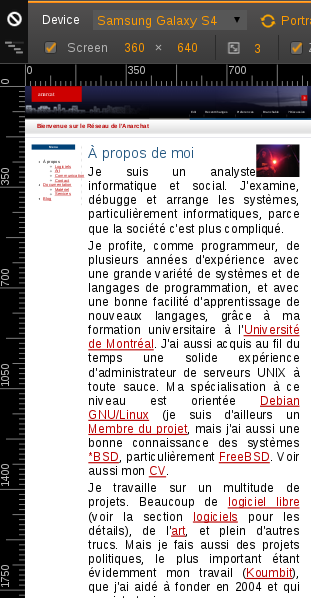
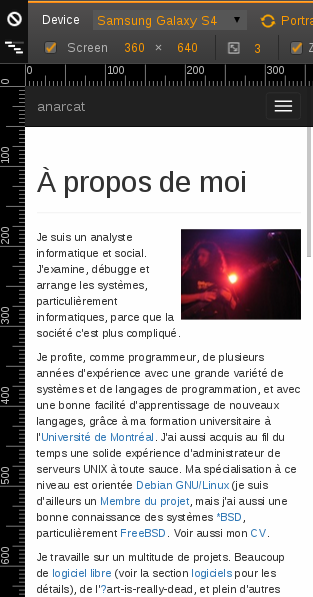
Samsung S3, before Screenshot of a fake rendering on the Samsung Galaxy S3 in night city

Samsung S3, after Screenshot of a fake rendering on the Samsung Galaxy S3 in bootstrap I like this: much simpler, purer version on smaller devices. And we see what counts: the freaking text. Of course, on tablets, it doesn't fare as well: the top menu gets wrapped around...

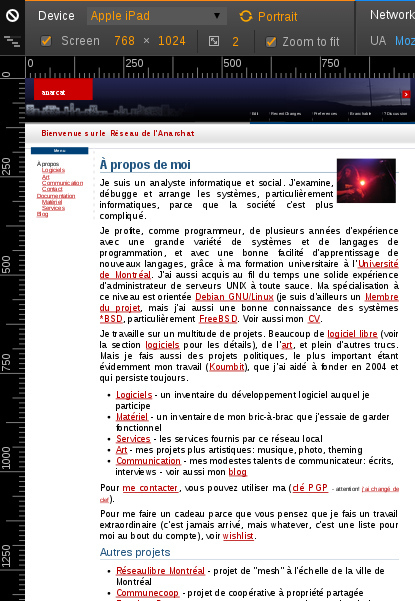
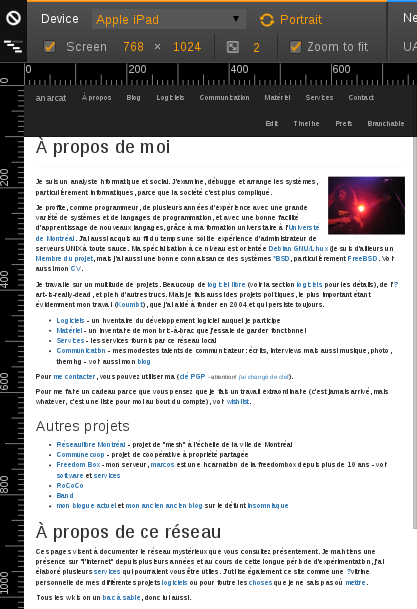
Apple iPad, before Screenshot of a fake rendering on the iPad in night city

Apple iPad, after Screenshot of a fake rendering on the iPad in bootstrap Apparently, the fix would be for me to "customize the @grid-float-breakpoint variable" in LESS (which I thought was a pager, but seems to be a CSS preprocessor, graaah). Still, I think it's better that way, more readable, and less crufty.

How it was done After doing a thorough evaluation of all the Bootstrap ikiwiki themes I could find (there are more than 4 at least!), I figured I prefered the Jak Linux one. It seemed to be better implemented than the others, cleaner, and I liked the mean black border on top. Black is cool. Oh, and I liked the subtle footer as well. Subtle is cool. Unfortunately, that theme originally required a custom plugin to have a menu on top, which i thought was silly. So I patched it to make it work with the sidebar plugin, which turned out to be trivially simple: just dump the sidebar content, and make the sidebar page have explicit HTML tags in it that match Bootstrap's required classes. I also added the regular action links in the top navbar, but that does overload it quite a bit. I also did some code cleanups and various other small changes, all of which are available in my personnal git repo.

What doesn't work So of course, there are always problems. The first problem is the extra bandwidth usage. Not sure that can be fixed, other than switching to the upcoming Bootstrap 4, which is smaller than Bootstrap 3, bizarrely. The more annoying problems are weird alignment issues. If the screen gets two narrow without kicking some collapse rules in place (the iPad bug above), the navbar rows overflow and look ugly. Even more bizarre, in some cases the right navbar can just completely disappear, in fact, that's the only fix I could find: to assign the hidden-xs and hidden-sm classes to the navbar-right <UL> element. But then it just goes away, which is pretty darn stupid. Still - I assigned the classes to a few actions that seemed low priority, both in the theme and in the sidebar page. Similarly, the search form at the bottom of the page doesn't seem to want to fit in the footer properly. No idea why and I can't bother to figure that one out. I ended up merging this with the backlinks, tags and trails navigation items. Oh, and amazingly enough: comments are simply not rendered at all right now. Oops. I seemed to have picked the single bootstrap Ikiwiki theme that does *not* have comments rendering... Aaaargh. For now I just copy-pasted stuff from the [ramseydsilva][] theme and it looks pretty ugly, but at least it works. I ended up theming comments the same way i did for Night City, which looks pretty good, but is not in sync with the LESS stuff in Bootstrap. I also add to add back trails, backlinks and favicon... looks like the Jak theme wasn't made for a blog after all... but that's now fixed! :) Another improvement would be to change the font from the canonical Helvetica to something prettier, like suggested in Practical Typography, in the font recommendations section, or the presslabs checklist. So far I have settled on Mozilla's Fira font (which means, yes, one set of objects is actually loading from the CDN, sorry). Feedback welcome.

Next.

Previous.