Search Results: "mak"

26 October 2016

Daniel Pocock: FOSDEM 2017 Real-Time Communications Call for Participation

FOSDEM is one of the world's premier meetings of free software developers, with over five thousand people attending each year. FOSDEM 2017 takes place 4-5 February 2017 in Brussels, Belgium. This email contains information about:
  • Real-Time communications dev-room and lounge,
  • speaking opportunities,
  • volunteering in the dev-room and lounge,
  • related events around FOSDEM, including the XMPP summit,
  • social events (the legendary FOSDEM Beer Night and Saturday night dinners provide endless networking opportunities),
  • the Planet aggregation sites for RTC blogs
Call for participation - Real Time Communications (RTC) The Real-Time dev-room and Real-Time lounge is about all things involving real-time communication, including: XMPP, SIP, WebRTC, telephony, mobile VoIP, codecs, peer-to-peer, privacy and encryption. The dev-room is a successor to the previous XMPP and telephony dev-rooms. We are looking for speakers for the dev-room and volunteers and participants for the tables in the Real-Time lounge. The dev-room is only on Saturday, 4 February 2017. The lounge will be present for both days. To discuss the dev-room and lounge, please join the FSFE-sponsored Free RTC mailing list. To be kept aware of major developments in Free RTC, without being on the discussion list, please join the Free-RTC Announce list. Speaking opportunities Note: if you used FOSDEM Pentabarf before, please use the same account/username Real-Time Communications dev-room: deadline 23:59 UTC on 17 November. Please use the Pentabarf system to submit a talk proposal for the dev-room. On the "General" tab, please look for the "Track" option and choose "Real-Time devroom". Link to talk submission. Other dev-rooms and lightning talks: some speakers may find their topic is in the scope of more than one dev-room. It is encouraged to apply to more than one dev-room and also consider proposing a lightning talk, but please be kind enough to tell us if you do this by filling out the notes in the form. You can find the full list of dev-rooms on this page and apply for a lightning talk at https://fosdem.org/submit Main track: the deadline for main track presentations is 23:59 UTC 31 October. Leading developers in the Real-Time Communications field are encouraged to consider submitting a presentation to the main track. First-time speaking? FOSDEM dev-rooms are a welcoming environment for people who have never given a talk before. Please feel free to contact the dev-room administrators personally if you would like to ask any questions about it. Submission guidelines The Pentabarf system will ask for many of the essential details. Please remember to re-use your account from previous years if you have one. In the "Submission notes", please tell us about:
  • the purpose of your talk
  • any other talk applications (dev-rooms, lightning talks, main track)
  • availability constraints and special needs
You can use HTML and links in your bio, abstract and description. If you maintain a blog, please consider providing us with the URL of a feed with posts tagged for your RTC-related work. We will be looking for relevance to the conference and dev-room themes, presentations aimed at developers of free and open source software about RTC-related topics. Please feel free to suggest a duration between 20 minutes and 55 minutes but note that the final decision on talk durations will be made by the dev-room administrators. As the two previous dev-rooms have been combined into one, we may decide to give shorter slots than in previous years so that more speakers can participate. Please note FOSDEM aims to record and live-stream all talks. The CC-BY license is used. Volunteers needed To make the dev-room and lounge run successfully, we are looking for volunteers:
  • FOSDEM provides video recording equipment and live streaming, volunteers are needed to assist in this
  • organizing one or more restaurant bookings (dependending upon number of participants) for the evening of Saturday, 4 February
  • participation in the Real-Time lounge
  • helping attract sponsorship funds for the dev-room to pay for the Saturday night dinner and any other expenses
  • circulating this Call for Participation (text version) to other mailing lists
See the mailing list discussion for more details about volunteering. Related events - XMPP and RTC summits The XMPP Standards Foundation (XSF) has traditionally held a summit in the days before FOSDEM. There is discussion about a similar summit taking place on 2 and 3 February 2017. XMPP Summit web site - please join the mailing list for details. We are also considering a more general RTC or telephony summit, potentially in collaboration with the XMPP summit. Please join the Free-RTC mailing list and send an email if you would be interested in participating, sponsoring or hosting such an event. Social events and dinners The traditional FOSDEM beer night occurs on Friday, 3 February. On Saturday night, there are usually dinners associated with each of the dev-rooms. Most restaurants in Brussels are not so large so these dinners have space constraints and reservations are essential. Please subscribe to the Free-RTC mailing list for further details about the Saturday night dinner options and how you can register for a seat. Spread the word and discuss If you know of any mailing lists where this CfP would be relevant, please forward this email (text version). If this dev-room excites you, please blog or microblog about it, especially if you are submitting a talk. If you regularly blog about RTC topics, please send details about your blog to the planet site administrators:
Planet site Admin contact
All projects Free-RTC Planet (http://planet.freertc.org) contact planet@freertc.org
XMPP Planet Jabber (http://planet.jabber.org) contact ralphm@ik.nu
SIP Planet SIP (http://planet.sip5060.net) contact planet@sip5060.net
SIP (Espa ol) Planet SIP-es (http://planet.sip5060.net/es/) contact planet@sip5060.net
Please also link to the Planet sites from your own blog or web site as this helps everybody in the free real-time communications community. Contact For any private queries, contact us directly using the address fosdem-rtc-admin@freertc.org and for any other queries please ask on the Free-RTC mailing list. The dev-room administration team:

Joachim Breitner: Showcasing Applicative

My plan for this week s lecture of the CIS 194 Haskell course at the University of Pennsylvania is to dwell a bit on the concept of Functor, Applicative and Monad, and to highlight the value of the Applicative abstraction. I quite like the example that I came up with, so I want to share it here. In the interest of long-term archival and stand-alone presentation, I include all the material in this post.1

Imports In case you want to follow along, start with these imports:
import Data.Char
import Data.Maybe
import Data.List
import System.Environment
import System.IO
import System.Exit

The parser The starting point for this exercise is a fairly standard parser-combinator monad, which happens to be the result of the student s homework from last week:
newtype Parser a = P (String -> Maybe (a, String))
runParser :: Parser t -> String -> Maybe (t, String)
runParser (P p) = p
parse :: Parser a -> String -> Maybe a
parse p input = case runParser p input of
    Just (result, "") -> Just result
    _ -> Nothing -- handles both no result and leftover input
noParserP :: Parser a
noParserP = P (\_ -> Nothing)
pureParserP :: a -> Parser a
pureParserP x = P (\input -> Just (x,input))
instance Functor Parser where
    fmap f p = P $ \input -> do
	(x, rest) <- runParser p input
	return (f x, rest)
instance Applicative Parser where
    pure = pureParserP
    p1 <*> p2 = P $ \input -> do
        (f, rest1) <- runParser p1 input
        (x, rest2) <- runParser p2 rest1
        return (f x, rest2)
instance Monad Parser where
    return = pure
    p1 >>= k = P $ \input -> do
        (x, rest1) <- runParser p1 input
        runParser (k x) rest1
anyCharP :: Parser Char
anyCharP = P $ \input -> case input of
    (c:rest) -> Just (c, rest)
    []       -> Nothing
charP :: Char -> Parser ()
charP c = do
    c' <- anyCharP
    if c == c' then return ()
               else noParserP
anyCharButP :: Char -> Parser Char
anyCharButP c = do
    c' <- anyCharP
    if c /= c' then return c'
               else noParserP
letterOrDigitP :: Parser Char
letterOrDigitP = do
    c <- anyCharP
    if isAlphaNum c then return c else noParserP
orElseP :: Parser a -> Parser a -> Parser a
orElseP p1 p2 = P $ \input -> case runParser p1 input of
    Just r -> Just r
    Nothing -> runParser p2 input
manyP :: Parser a -> Parser [a]
manyP p = (pure (:) <*> p <*> manyP p)  orElseP  pure []
many1P :: Parser a -> Parser [a]
many1P p = pure (:) <*> p <*> manyP p
sepByP :: Parser a -> Parser () -> Parser [a]
sepByP p1 p2 = (pure (:) <*> p1 <*> (manyP (p2 *> p1)))  orElseP  pure []
A parser using this library for, for example, CSV files could take this form:
parseCSVP :: Parser [[String]]
parseCSVP = manyP parseLine
  where
    parseLine = parseCell  sepByP  charP ',' <* charP '\n'
    parseCell = do
        charP '"'
        content <- manyP (anyCharButP '"')
        charP '"'
        return content

We want EBNF Often when we write a parser for a file format, we might also want to have a formal specification of the format. A common form for such a specification is EBNF. This might look as follows, for a CSV file:
cell = '"',  not-quote , '"';
line = (cell,  ',', cell    ''), newline;
csv  =  line ;
It is straightforward to create a Haskell data type to represent an EBNF syntax description. Here is a simple EBNF library (data type and pretty-printer) for your convenience:
data RHS
  = Terminal String
    NonTerminal String
    Choice RHS RHS
    Sequence RHS RHS
    Optional RHS
    Repetition RHS
  deriving (Show, Eq)
ppRHS :: RHS -> String
ppRHS = go 0
  where
    go _ (Terminal s)     = surround "'" "'" $ concatMap quote s
    go _ (NonTerminal s)  = s
    go a (Choice x1 x2)   = p a 1 $ go 1 x1 ++ "   " ++ go 1 x2
    go a (Sequence x1 x2) = p a 2 $ go 2 x1 ++ ", "  ++ go 2 x2
    go _ (Optional x)     = surround "[" "]" $ go 0 x
    go _ (Repetition x)   = surround " " " " $ go 0 x
    surround c1 c2 x = c1 ++ x ++ c2
    p a n   a > n     = surround "(" ")"
            otherwise = id
    quote '\'' = "\\'"
    quote '\\' = "\\\\"
    quote c    = [c]
type Production = (String, RHS)
type BNF = [Production]
ppBNF :: BNF -> String
ppBNF = unlines . map (\(i,rhs) -> i ++ " = " ++ ppRHS rhs ++ ";")

Code to produce EBNF We had a good time writing combinators that create complex parsers from primitive pieces. Let us do the same for EBNF grammars. We could simply work on the RHS type directly, but we can do something more nifty: We create a data type that keeps track, via a phantom type parameter, of what Haskell type the given EBNF syntax is the specification:
newtype Grammar a = G RHS
ppGrammar :: Grammar a -> String
ppGrammar (G rhs) = ppRHS rhs
So a value of type Grammar t is a description of the textual representation of the Haskell type t. Here is one simple example:
anyCharG :: Grammar Char
anyCharG = G (NonTerminal "char")
Here is another one. This one does not describe any interesting Haskell type, but is useful when spelling out the special characters in the syntax described by the grammar:
charG :: Char -> Grammar ()
charG c = G (Terminal [c])
A combinator that creates new grammar from two existing grammars:
orElseG :: Grammar a -> Grammar a -> Grammar a
orElseG (G rhs1) (G rhs2) = G (Choice rhs1 rhs2)
We want the convenience of our well-known type classes in order to combine these values some more:
instance Functor Grammar where
    fmap _ (G rhs) = G rhs
instance Applicative Grammar where
    pure x = G (Terminal "")
    (G rhs1) <*> (G rhs2) = G (Sequence rhs1 rhs2)
Note how the Functor instance does not actually use the function. How should it? There are no values inside a Grammar! We cannot define a Monad instance for Grammar: We would start with (G rhs1) >>= k = , but there is simply no way of getting a value of type a that we can feed to k. So we will do without a Monad instance. This is interesting, and we will come back to that later. Like with the parser, we can now begin to build on the primitive example to build more complicated combinators:
manyG :: Grammar a -> Grammar [a]
manyG p = (pure (:) <*> p <*> manyG p)  orElseG  pure []
many1G :: Grammar a -> Grammar [a]
many1G p = pure (:) <*> p <*> manyG p
sepByG :: Grammar a -> Grammar () -> Grammar [a]
sepByG p1 p2 = ((:) <$> p1 <*> (manyG (p2 *> p1)))  orElseG  pure []
Let us run a small example:
dottedWordsG :: Grammar [String]
dottedWordsG = many1G (manyG anyCharG <* charG '.')
*Main> putStrLn $ ppGrammar dottedWordsG
'', ('', char, ('', char, ('', char, ('', char, ('', char, ('',  
Oh my, that is not good. Looks like the recursion in manyG does not work well, so we need to avoid that. But anyways we want to be explicit in the EBNF grammars about where something can be repeated, so let us just make many a primitive:
manyG :: Grammar a -> Grammar [a]
manyG (G rhs) = G (Repetition rhs)
With this definition, we already get a simple grammar for dottedWordsG:
*Main> putStrLn $ ppGrammar dottedWordsG
'',  char , '.',  char , '.' 
This already looks like a proper EBNF grammar. One thing that is not nice about it is that there is an empty string ('') in a sequence ( , ). We do not want that. Why is it there in the first place? Because our Applicative instance is not lawful! Remember that pure id <*> g == g should hold. One way to achieve that is to improve the Applicative instance to optimize this case away:
instance Applicative Grammar where
    pure x = G (Terminal "")
    G (Terminal "") <*> G rhs2 = G rhs2
    G rhs1 <*> G (Terminal "") = G rhs1
    (G rhs1) <*> (G rhs2) = G (Sequence rhs1 rhs2)
	 
Now we get what we want:
*Main> putStrLn $ ppGrammar dottedWordsG
 char , '.',  char , '.' 
Remember our parser for CSV files above? Let me repeat it here, this time using only Applicative combinators, i.e. avoiding (>>=), (>>), return and do-notation:
parseCSVP :: Parser [[String]]
parseCSVP = manyP parseLine
  where
    parseLine = parseCell  sepByP  charG ',' <* charP '\n'
    parseCell = charP '"' *> manyP (anyCharButP '"') <* charP '"'
And now we try to rewrite the code to produce Grammar instead of Parser. This is straightforward with the exception of anyCharButP. The parser code for that inherently monadic, and we just do not have a monad instance. So we work around the issue by making that a primitive grammar, i.e. introducing a non-terminal in the EBNF without a production rule pretty much like we did for anyCharG:
primitiveG :: String -> Grammar a
primitiveG s = G (NonTerminal s)
parseCSVG :: Grammar [[String]]
parseCSVG = manyG parseLine
  where
    parseLine = parseCell  sepByG  charG ',' <* charG '\n'
    parseCell = charG '"' *> manyG (primitiveG "not-quote") <* charG '"'
Of course the names parse are not quite right any more, but let us just leave that for now. Here is the result:
*Main> putStrLn $ ppGrammar parseCSVG
 ('"',  not-quote , '"',  ',', '"',  not-quote , '"'    ''), '
' 
The line break is weird. We do not really want newlines in the grammar. So let us make that primitive as well, and replace charG '\n' with newlineG:
newlineG :: Grammar ()
newlineG = primitiveG "newline"
Now we get
*Main> putStrLn $ ppGrammar parseCSVG
 ('"',  not-quote , '"',  ',', '"',  not-quote , '"'    ''), newline 
which is nice and correct, but still not quite the easily readable EBNF that we saw further up.

Code to produce EBNF, with productions We currently let our grammars produce only the right-hand side of one EBNF production, but really, we want to produce a RHS that may refer to other productions. So let us change the type accordingly:
newtype Grammar a = G (BNF, RHS)
runGrammer :: String -> Grammar a -> BNF
runGrammer main (G (prods, rhs)) = prods ++ [(main, rhs)]
ppGrammar :: String -> Grammar a -> String
ppGrammar main g = ppBNF $ runGrammer main g
Now we have to adjust all our primitive combinators (but not the derived ones!):
charG :: Char -> Grammar ()
charG c = G ([], Terminal [c])
anyCharG :: Grammar Char
anyCharG = G ([], NonTerminal "char")
manyG :: Grammar a -> Grammar [a]
manyG (G (prods, rhs)) = G (prods, Repetition rhs)
mergeProds :: [Production] -> [Production] -> [Production]
mergeProds prods1 prods2 = nub $ prods1 ++ prods2
orElseG :: Grammar a -> Grammar a -> Grammar a
orElseG (G (prods1, rhs1)) (G (prods2, rhs2))
    = G (mergeProds prods1 prods2, Choice rhs1 rhs2)
instance Functor Grammar where
    fmap _ (G bnf) = G bnf
instance Applicative Grammar where
    pure x = G ([], Terminal "")
    G (prods1, Terminal "") <*> G (prods2, rhs2)
        = G (mergeProds prods1 prods2, rhs2)
    G (prods1, rhs1) <*> G (prods2, Terminal "")
        = G (mergeProds prods1 prods2, rhs1)
    G (prods1, rhs1) <*> G (prods2, rhs2)
        = G (mergeProds prods1 prods2, Sequence rhs1 rhs2)
primitiveG :: String -> Grammar a
primitiveG s = G (NonTerminal s)
The use of nub when combining productions removes duplicates that might be used in different parts of the grammar. Not efficient, but good enough for now. Did we gain anything? Not yet:
*Main> putStr $ ppGrammar "csv" (parseCSVG)
csv =  ('"',  not-quote , '"',  ',', '"',  not-quote , '"'    ''), newline ;
But we can now introduce a function that lets us tell the system where to give names to a piece of grammar:
nonTerminal :: String -> Grammar a -> Grammar a
nonTerminal name (G (prods, rhs))
  = G (prods ++ [(name, rhs)], NonTerminal name)
Ample use of this in parseCSVG yields the desired result:
parseCSVG :: Grammar [[String]]
parseCSVG = manyG parseLine
  where
    parseLine = nonTerminal "line" $
        parseCell  sepByG  charG ',' <* newline
    parseCell = nonTerminal "cell" $
        charG '"' *> manyG (primitiveG "not-quote") <* charG '"
*Main> putStr $ ppGrammar "csv" (parseCSVG)
cell = '"',  not-quote , '"';
line = (cell,  ',', cell    ''), newline;
csv =  line ;
This is great!

Unifying parsing and grammar-generating Note how simliar parseCSVG and parseCSVP are! Would it not be great if we could implement that functionality only once, and get both a parser and a grammar description out of it? This way, the two would never be out of sync! And surely this must be possible. The tool to reach for is of course to define a type class that abstracts over the parts where Parser and Grammer differ. So we have to identify all functions that are primitive in one of the two worlds, and turn them into type class methods. This includes char and orElse. It includes many, too: Although manyP is not primitive, manyG is. It also includes nonTerminal, which does not exist in the world of parsers (yet), but we need it for the grammars. The primitiveG function is tricky. We use it in grammars when the code that we might use while parsing is not expressible as a grammar. So the solution is to let it take two arguments: A String, when used as a descriptive non-terminal in a grammar, and a Parser a, used in the parsing code. Finally, the type classes that we except, Applicative (and thus Functor), are added as constraints on our type class:
class Applicative f => Descr f where
    char :: Char -> f ()
    many :: f a -> f [a]
    orElse :: f a -> f a -> f a
    primitive :: String -> Parser a -> f a
    nonTerminal :: String -> f a -> f a
The instances are easily written:
instance Descr Parser where
    char = charP
    many = manyP
    orElse = orElseP
    primitive _ p = p
    nonTerminal _ p = p
instance Descr Grammar where
    char = charG
    many = manyG
    orElse = orElseG
    primitive s _ = primitiveG s
    nonTerminal s g = nonTerminal s g
And we can now take the derived definitions, of which so far we had two copies, and define them once and for all:
many1 :: Descr f => f a -> f [a]
many1 p = pure (:) <*> p <*> many p
anyChar :: Descr f => f Char
anyChar = primitive "char" anyCharP
dottedWords :: Descr f => f [String]
dottedWords = many1 (many anyChar <* char '.')
sepBy :: Descr f => f a -> f () -> f [a]
sepBy p1 p2 = ((:) <$> p1 <*> (many (p2 *> p1)))  orElse  pure []
newline :: Descr f => f ()
newline = primitive "newline" (charP '\n')
And thus we now have our CSV parser/grammar generator:
parseCSV :: Descr f => f [[String]]
parseCSV = many parseLine
  where
    parseLine = nonTerminal "line" $
        parseCell  sepBy  char ',' <* newline
    parseCell = nonTerminal "cell" $
        char '"' *> many (primitive "not-quote" (anyCharButP '"')) <* char '"'
We can now use this definition both to parse and to generate grammars:
*Main> putStr $ ppGrammar2 "csv" (parseCSV)
cell = '"',  not-quote , '"';
line = (cell,  ',', cell    ''), newline;
csv =  line ;
*Main> parse parseCSV "\"ab\",\"cd\"\n\"\",\"de\"\n\n"
Just [["ab","cd"],["","de"],[]]

The INI file parser and grammar As a final exercise, let us transform the INI file parser into a combined thing. Here is the parser (another artifact of last week s homework) again using applicative style2:
parseINIP :: Parser INIFile
parseINIP = many1P parseSection
  where
    parseSection =
        (,) <$  charP '['
            <*> parseIdent
            <*  charP ']'
            <*  charP '\n'
            <*> (catMaybes <$> manyP parseLine)
    parseIdent = many1P letterOrDigitP
    parseLine = parseDecl  orElseP  parseComment  orElseP  parseEmpty
    parseDecl = Just <$> (
        (,) <*> parseIdent
            <*  manyP (charP ' ')
            <*  charP '='
            <*  manyP (charP ' ')
            <*> many1P (anyCharButP '\n')
            <*  charP '\n')
    parseComment =
        Nothing <$ charP '#'
                <* many1P (anyCharButP '\n')
                <* charP '\n'
    parseEmpty = Nothing <$ charP '\n'
Transforming that to a generic description is quite straightforward. We use primitive again to wrap letterOrDigitP:
descrINI :: Descr f => f INIFile
descrINI = many1 parseSection
  where
    parseSection =
        (,) <*  char '['
            <*> parseIdent
            <*  char ']'
            <*  newline
            <*> (catMaybes <$> many parseLine)
    parseIdent = many1 (primitive "alphanum" letterOrDigitP)
    parseLine = parseDecl  orElse  parseComment  orElse  parseEmpty
    parseDecl = Just <$> (
        (,) <*> parseIdent
            <*  many (char ' ')
            <*  char '='
            <*  many (char ' ')
            <*> many1 (primitive "non-newline" (anyCharButP '\n'))
	    <*  newline)
    parseComment =
        Nothing <$ char '#'
                <* many1 (primitive "non-newline" (anyCharButP '\n'))
		<* newline
    parseEmpty = Nothing <$ newline
This yields this not very helpful grammar (abbreviated here):
*Main> putStr $ ppGrammar2 "ini" descrINI
ini = '[', alphanum,  alphanum , ']', newline,  alphanum,  alphanum ,  ' ' 
But with a few uses of nonTerminal, we get something really nice:
descrINI :: Descr f => f INIFile
descrINI = many1 parseSection
  where
    parseSection = nonTerminal "section" $
        (,) <$  char '['
            <*> parseIdent
            <*  char ']'
            <*  newline
            <*> (catMaybes <$> many parseLine)
    parseIdent = nonTerminal "identifier" $
        many1 (primitive "alphanum" letterOrDigitP)
    parseLine = nonTerminal "line" $
        parseDecl  orElse  parseComment  orElse  parseEmpty
    parseDecl = nonTerminal "declaration" $ Just <$> (
        (,) <$> parseIdent
            <*  spaces
            <*  char '='
            <*  spaces
            <*> remainder)
    parseComment = nonTerminal "comment" $
        Nothing <$ char '#' <* remainder
    remainder = nonTerminal "line-remainder" $
        many1 (primitive "non-newline" (anyCharButP '\n')) <* newline
    parseEmpty = Nothing <$ newline
    spaces = nonTerminal "spaces" $ many (char ' ')
*Main> putStr $ ppGrammar "ini" descrINI
identifier = alphanum,  alphanum ;
spaces =  ' ' ;
line-remainder = non-newline,  non-newline , newline;
declaration = identifier, spaces, '=', spaces, line-remainder;
comment = '#', line-remainder;
line = declaration   comment   newline;
section = '[', identifier, ']', newline,  line ;
ini = section,  section ;

Recursion (variant 1) What if we want to write a parser/grammar-generator that is able to generate the following grammar, which describes terms that are additions and multiplications of natural numbers:
const = digit,  digit ;
spaces =  ' '   newline ;
atom = const   '(', spaces, expr, spaces, ')', spaces;
mult = atom,  spaces, '*', spaces, atom , spaces;
plus = mult,  spaces, '+', spaces, mult , spaces;
expr = plus;
The production of expr is recursive (via plus, mult, atom). We have seen above that simply defining a Grammar a recursively does not go well. One solution is to add a new combinator for explicit recursion, which replaces nonTerminal in the method:
class Applicative f => Descr f where
     
    recNonTerminal :: String -> (f a -> f a) -> f a
instance Descr Parser where
     
    recNonTerminal _ p = let r = p r in r
instance Descr Grammar where
     
    recNonTerminal = recNonTerminalG
recNonTerminalG :: String -> (Grammar a -> Grammar a) -> Grammar a
recNonTerminalG name f =
    let G (prods, rhs) = f (G ([], NonTerminal name))
    in G (prods ++ [(name, rhs)], NonTerminal name)
nonTerminal :: Descr f => String -> f a -> f a
nonTerminal name p = recNonTerminal name (const p)
runGrammer :: String -> Grammar a -> BNF
runGrammer main (G (prods, NonTerminal nt))   main == nt = prods
runGrammer main (G (prods, rhs)) = prods ++ [(main, rhs)]
The change in runGrammer avoids adding a pointless expr = expr production to the output. This lets us define a parser/grammar-generator for the arithmetic expressions given above:
data Expr = Plus Expr Expr   Mult Expr Expr   Const Integer
    deriving Show
mkPlus :: Expr -> [Expr] -> Expr
mkPlus = foldl Plus
mkMult :: Expr -> [Expr] -> Expr
mkMult = foldl Mult
parseExpr :: Descr f => f Expr
parseExpr = recNonTerminal "expr" $ \ exp ->
    ePlus exp
ePlus :: Descr f => f Expr -> f Expr
ePlus exp = nonTerminal "plus" $
    mkPlus <$> eMult exp
           <*> many (spaces *> char '+' *> spaces *> eMult exp)
           <*  spaces
eMult :: Descr f => f Expr -> f Expr
eMult exp = nonTerminal "mult" $
    mkPlus <$> eAtom exp
           <*> many (spaces *> char '*' *> spaces *> eAtom exp)
           <*  spaces
eAtom :: Descr f => f Expr -> f Expr
eAtom exp = nonTerminal "atom" $
    aConst  orElse  eParens exp
aConst :: Descr f => f Expr
aConst = nonTerminal "const" $ Const . read <$> many1 digit
eParens :: Descr f => f a -> f a
eParens inner =
    id <$  char '('
       <*  spaces
       <*> inner
       <*  spaces
       <*  char ')'
       <*  spaces
And indeed, this works:
*Main> putStr $ ppGrammar "expr" parseExpr
const = digit,  digit ;
spaces =  ' '   newline ;
atom = const   '(', spaces, expr, spaces, ')', spaces;
mult = atom,  spaces, '*', spaces, atom , spaces;
plus = mult,  spaces, '+', spaces, mult , spaces;
expr = plus;

Recursion (variant 2) Interestingly, there is another solution to this problem, which avoids introducing recNonTerminal and explicitly passing around the recursive call (i.e. the exp in the example). To implement that we have to adjust our Grammar type as follows:
newtype Grammar a = G ([String] -> (BNF, RHS))
The idea is that the list of strings is those non-terminals that we are currently defining. So in nonTerminal, we check if the non-terminal to be introduced is currently in the process of being defined, and then simply ignore the body. This way, the recursion is stopped automatically:
nonTerminalG :: String -> (Grammar a) -> Grammar a
nonTerminalG name (G g) = G $ \seen ->
    if name  elem  seen
    then ([], NonTerminal name)
    else let (prods, rhs) = g (name : seen)
         in (prods ++ [(name, rhs)], NonTerminal name)
After adjusting the other primitives of Grammar (including the Functor and Applicative instances, wich now again have nonTerminal) to type-check again, we observe that this parser/grammar generator for expressions, with genuine recursion, works now:
parseExp :: Descr f => f Expr
parseExp = nonTerminal "expr" $
    ePlus
ePlus :: Descr f => f Expr
ePlus = nonTerminal "plus" $
    mkPlus <$> eMult
           <*> many (spaces *> char '+' *> spaces *> eMult)
           <*  spaces
eMult :: Descr f => f Expr
eMult = nonTerminal "mult" $
    mkPlus <$> eAtom
           <*> many (spaces *> char '*' *> spaces *> eAtom)
           <*  spaces
eAtom :: Descr f => f Expr
eAtom = nonTerminal "atom" $
    aConst  orElse  eParens parseExp
Note that the recursion is only going to work if there is at least one call to nonTerminal somewhere around the recursive calls. We still cannot implement many as naively as above.

Homework If you want to play more with this: The homework is to define a parser/grammar-generator for EBNF itself, as specified in this variant:
identifier = letter,  letter   digit   '-' ;
spaces =  ' '   newline ;
quoted-char = non-quote-or-backslash   '\\', '\\'   '\\', '\'';
terminal = '\'',  quoted-char , '\'', spaces;
non-terminal = identifier, spaces;
option = '[', spaces, rhs, spaces, ']', spaces;
repetition = ' ', spaces, rhs, spaces, ' ', spaces;
group = '(', spaces, rhs, spaces, ')', spaces;
atom = terminal   non-terminal   option   repetition   group;
sequence = atom,  spaces, ',', spaces, atom , spaces;
choice = sequence,  spaces, ' ', spaces, sequence , spaces;
rhs = choice;
production = identifier, spaces, '=', spaces, rhs, ';', spaces;
bnf = production,  production ;
This grammar is set up so that the precedence of , and is correctly implemented: a , b c will parse as (a, b) c. In this syntax for BNF, terminal characters are quoted, i.e. inside ' ', a ' is replaced by \' and a \ is replaced by \\ this is done by the function quote in ppRHS. If you do this, you should able to round-trip with the pretty-printer, i.e. parse back what it wrote:
*Main> let bnf1 = runGrammer "expr" parseExpr
*Main> let bnf2 = runGrammer "expr" parseBNF
*Main> let f = Data.Maybe.fromJust . parse parseBNF. ppBNF
*Main> f bnf1 == bnf1
True
*Main> f bnf2 == bnf2
True
The last line is quite meta: We are using parseBNF as a parser on the pretty-printed grammar produced from interpreting parseBNF as a grammar.

Conclusion We have again seen an example of the excellent support for abstraction in Haskell: Being able to define so very different things such as a parser and a grammar description with the same code is great. Type classes helped us here. Note that it was crucial that our combined parser/grammars are only able to use the methods of Applicative, and not Monad. Applicative is less powerful, so by giving less power to the user of our Descr interface, the other side, i.e. the implementation, can be more powerful. The reason why Applicative is ok, but Monad is not, is that in Applicative, the results do not affect the shape of the computation, whereas in Monad, the whole point of the bind operator (>>=) is that the result of the computation is used to decide the next computation. And while this is perfectly fine for a parser, it just makes no sense for a grammar generator, where there simply are no values around! We have also seen that a phantom type, namely the parameter of Grammar, can be useful, as it lets the type system make sure we do not write nonsense. For example, the type of orElseG ensures that both grammars that are combined here indeed describe something of the same type.

  1. It seems to be the week of applicative-appraising blog posts: Brent has posted a nice piece about enumerations using Applicative yesterday.
  2. I like how in this alignment of <*> and <* the > point out where the arguments are that are being passed to the function on the left.

25 October 2016

Laura Arjona Reina: Rankings, Condorcet and free software: Calculating the results for the Stretch Artwork Survey

We had 12 candidates for the Debian Stretch Artwork and a survey was set up for allowing people to vote which one they prefer.

The survey was run in my LimeSurvey instance, surveys.larjona.net. LimeSurvey its a nice free software with a lot of features. It provides a Ranking question type, and it was very easy for allowing people to vote in the Debian style (Debian uses the Condorcet method in its elections).

However, although LimeSurvey offers statistics and even graphics to show the results of many type of questions, its output for the Ranking type is not useful, so I had to export the data and use another tool to find the winner.
Export the data from LimeSurvey
I ve created a read-only user to visit the survey site. With this visitor you can explore the survey questionnaire, its results, and export the data.
Username: stretch
Password: artwork
First attempt, the quick and easy (and nonfree, I guess)
There is an online tool to calculate the Condorcet winner, http://www.ericgorr.net/condorcet/
The steps I followed to feed the tool with the data from LimeSurvey were these:
1.- Went to admin interface of lime survey, selected the stretch artwork survey, responses and statistics, export results to application
2.- Selected Completed responses only , Question codes , Answer codes , and exported to CSV. (results_stretch1.csv)
3.- Opened the CSV with LibreOffice Calc, and removed these columns:
id submitdate lastpage startlanguage
4.- Remove the first row containing the headers and saved the result (results_stretch2.csv)
5.- In commandline:
sort results_stretch2.csv   uniq -c > results_stretch3.csv
6.- Opened results_stretch3.csv with LibreOffice Calc and merge delimitors when importing.
7.- Removed the first column (blank) and added a column between the numbers and the first ranked option, and fulfilled that column with : value. Saved (results_stretch4.csv)
8.- Opened results_stretch4.csv with my preferred editor and search and replace ,:, for : and after that, search and replace , for > . Save the result (results_stretch5.csv)
9.- Went to http://condorcet.ericgorr.net/, selected Condorcet basic, tell me some things , and pasted the contents of results_stretch5.csv there.
The results are in results_stretch1.html
But where is the source code of this Condorcet tool?
I couldn t find the source code (nor license) of the solver by Eric Gorr.
The tool is mentioned in http://www.accuratedemocracy.com/z_tools.htm where other tools are listed and when the tool is libre software, is noted so. But not in this case.
There, I found another tool, VoteEngine, which is open source, so I tried with that.
Second attempt: VoteEngine, a Free Open Source Software tool made with Python
I used a modification of voteengine-0.99 (the original zip is available in http://vote.sourceforge.net/ and a diff with the changes I made (basically, Numeric -> numpy and Int -> int, inorder that works in Debian stable), here.
Steps 1 to 4 are the same as in the first attempt.
5.- Sorted alphabetically the different 12 options to vote, and
assigned a letter to each one (saved the assignments in a file called
6.- Opened results_stretch2.csv with my favorite editor, and search
and replace the name of the different options, for their corresponding
letter in stretch_key.txt file.
Searched and replaced , for (space). Then, saved the results into
7.- Copied the input.txt file from voteengine-0.99 into stretch.txt and edited the options
to our needs. Pasted the contents of results_stretch3_voteengine.cvs
at the end of stretch.txt
8.-In the commandline
./voteengine.py <stretch.txt  > winner.txt
(winner.txt contains the results for the Condorcet method).
9.- I edited again stretch.txt to change the method to shulze and
calculated the results, and again with the smith method. The winner in
the 3 methods is the same. I pasted the summary of these 3 methods
(shulze and smith provide a ranked list) in stretch_results.txt
If it can be done, it can be done with R
I found the algstat R package:
which includes a condorcet function but I couldn t make it work with the data.
I m not sure how the data needs to be shaped. I m sure that this can be done in R and the problem is me, in this case. Comments are welcome, and I ll try to ask to a friend whose R skills are better than mine!
And another SaaS
I found https://www.condorcet.vote/ and its source code. It would be interesting to deploy a local instance to drive future surveys, but for this time I didn t want to fight with PHP in order to use only the solver part, nor install another SaaS in my home server just to find that I need some other dependency or whatever.
I ll keep an eye on this, though, because it looks like a modern and active project.
Finally, devotee
Well and which software Debian uses for its elections?
There is a git repository with devotee, you can clone it:
I found that although the tool is quite modular, it s written specifically for the Debian case (votes received by mail, GPG signed, there is a quorum, and other particularities) and I was not sure if I could use it with my data. It is written in Perl and then I understood it worse than the Python from VoteEngine.
Maybe I ll return to it, though, when I have more time, to try to put our data in the shape of a typicall tally.txt file and then see if the module solving the condorcet winner can work for me.
That s all, folks! (for now )
Comments
You can coment on this blog post in this pump.io thread

Filed under: Tools Tagged: data mining, Debian, English, SaaS, statistics

Russ Allbery: Review: Lord of Emperors

Review: Lord of Emperors, by Guy Gavriel Kay
Series: Sarantine Mosaic #2
Publisher: Eos
Copyright: 2000
Printing: February 2001
ISBN: 0-06-102002-8
Format: Mass market
Pages: 560
Lord of Emperors is the second half of a work that began with Sailing to Sarantium and is best thought of as a single book split for publishing reasons. You want to read the two together and in order. As is typical for this sort of two-part work, it's difficult to review the second half without spoilers. I'll be more vague about the plot and the characters than normal, and will mark one bit that's arguably a bit of a spoiler (although I don't think it would affect the enjoyment of the book). At the end of Sailing to Sarantium, we left Crispin in the great city, oddly and surprisingly entangled with some frighteningly powerful people and some more mundane ones (insofar as anyone is mundane in a Guy Gavriel Kay novel, but more on that in a bit). The opening of Lord of Emperors takes a break from the city to introduce a new people, the Bassanids, and a new character, Rustem of Karakek. While Crispin is still the heart of this story, the thread that binds the entirety of the Sarantine Mosaic together, Rustem is the primary protagonist for much of this book. I had somehow forgotten him completely since my first read of this series many years ago. I have no idea how. I mentioned in my review of the previous book that one of the joys of reading this series is competence porn: watching the work of someone who is extremely good at what they do, and experiencing vicariously some of the passion and satisfaction they have for their work. Kay's handling of Crispin's mosaics is still the highlight of the series for me, but Rustem's medical practice (and Strumosus, and the chariot races) comes close. Rustem is a brilliant doctor by the standards of the time, utterly frustrated with the incompetence of the Sarantine doctors, but also weaving his own culture's belief in omens and portents into his actions. He's more reserved, more laconic than Crispin, but is another character with focused expertise and a deep internal sense of honor, swept unexpectedly into broader affairs and attempting to navigate them by doing the right thing in each moment. Kay fills this book with people like that, and it's compelling reading. Rustem's entrance into the city accidentally sets off a complex chain of events that draws together all of the major characters of Sailing to Sarantium and adds a few more. The stakes are no less than war and control of major empires, and here Kay departs firmly from recorded history into his own creation. I had mentioned in the previous review that Justinian and Theodora are the clear inspirations for this story; that remains true, and many other characters are easy to map, but don't expect history to go here the way that it did in our world. Kay's version diverges significantly, and dramatically. But one of the things I love the most about this book is its focus on the individual acts of courage, empathy, and ethics of each of the characters, even when those acts do not change the course of empires. The palace intrigue happens, and is important, but the individual acts of Kay's large cast get just as much epic narrative attention even if they would never appear in a history book. The most globally significant moment of the book is not the most stirring; that happens slightly earlier, in a chariot race destined to be forgotten by history. And the most touching moment of the book is a moment of connection between two people who would never appear in history, over the life of a third, that matters so much to the reader only because of the careful attention to individual lives and personalities Kay has shown over the course of a hundreds of pages. A minor spoiler follows in the next paragraph, although I don't think it affects the reading of the book. One brilliant part of Kay's fiction is that he doesn't have many villains, and goes to some lengths to humanize the actions of nearly everyone in the book. But sometimes the author's deep dislike of one particular character shows through, and here it's Pertennius (the clear analogue of Procopius). In a way, one could say the entirety of the Sarantine Mosaic is a rebuttal of the Secret History. But I think Kay's contrast between Crispin's art (and Scortius's, and Strumosus's) and Pertennius's history has a deeper thematic goal. I came away from this book feeling like the Sarantine Mosaic as a whole stands in contrast to a traditional history, stands against a reduction of people to dates and wars and buildings and governments. Crispin's greatest work attempts to capture emotion, awe, and an inner life. The endlessly complex human relationships shown in this book running beneath the political events occasionally surface in dramatic upheavals, but in Kay's telling the ones that stay below the surface are just as important. And while much of the other art shown in this book differs from Crispin's in being inherently ephemeral, it shares that quality of being the art of life, of complexity, of people in dynamic, changing, situational understanding of the world, exercising competence in some area that may or may not be remembered. Kay raises to the level of epic the bits of history that don't get recorded, and, in his grand and self-conscious fantasy epic style, encourages the reader to feel those just as deeply as the ones that will have later historical significance. The measure of people, their true inner selves, is often shown in moments that Pertennius would dismiss and consider unworthy of recording in his history. End minor spoiler. I think Lord of Emperors is the best part of the Sarantine Mosaic duology. It keeps the same deeply enjoyable view of people doing things they are extremely good at while correcting some of the structural issues in the previous book. Kay continues to use a large cast, and continues to cut between viewpoint characters to show each event from multiple angles, but he has a better grasp of timing and order here than in Sailing to Sarantium. I never got confused about the timeline, thanks in part to more frequent and more linear scene cuts. And Lord of Emperors passes, with flying colors, the hardest test of a novel with a huge number of viewpoint characters: when Kay cuts to a new viewpoint, my reaction is almost always "yes, I wanted to see what they were thinking!" and almost never "wait, no, go back!". My other main complaint about Sailing to Sarantium was the treatment of women, specifically the irresistibility of female sexual allure. Kay thankfully tones that down a lot here. His treatment of women is still a bit odd one notices that five women seem to all touch the lives of the same men, and little room is left for Platonic friendship between the genders but they're somewhat less persistently sexualized. And the women get a great deal of agency in this book, and a great deal of narrative respect. That said, Lord of Emperors is also emotionally brutal. It's beautifully done, and entirely appropriate to the story, and Kay does provide a denouement that takes away a bit of the sting. But it's still very hard to read in spots if you become as invested in the characters and in the world as I do. Kay is writing epic that borders on tragedy, and uses his full capabilities as a writer to make the reader feel it. I love it, but it's not a book that I want to read too often. As with nearly all Kay, the Sarantine Mosaic as a whole is intentional, deliberate epic writing, wearing its technique on its sleeve and making no apologies. There is constant foreshadowing, constant attempts to draw larger conclusions or reveal great principles of human nature, and a very open, repeated stress on the greatness and importance of events while they're being described. This works for me, but it doesn't work for everyone. If it doesn't work for you, the Sarantine Mosaic is unlikely to change your mind. But if you're in the mood for that type of story, I think this is one of Kay's best, and Lord of Emperors is the best half of the book. Rating: 10 out of 10

24 October 2016

Reproducible builds folks: Reproducible Builds: week 78 in Stretch cycle

What happened in the Reproducible Builds effort between Sunday October 16 and Saturday October 22 2016: Media coverage Upcoming events buildinfo.debian.net In order to build packages reproducibly, you not only need identical sources but also some external definition of the environment used for a particular build. This definition includes the inputs and the outputs and, in the Debian case, are available in a $package_$architecture_$version.buildinfo file. We anticipate the next dpkg upload to sid will create .buildinfo files by default. Whilst it's clear that we also need to teach dak to deal with them (#763822) its not actually clear how to handle .buildinfo files after dak has processed them and how to make them available to the world. To this end, Chris Lamb has started development on a proof-of-concept .buildinfo server to see what issues arise. Source Reproducible work in other projects Packages reviewed and fixed, and bugs filed Reviews of unreproducible packages 99 package reviews have been added, 3 have been updated and 6 have been removed in this week, adding to our knowledge about identified issues. 6 issue types have been added: Weekly QA work During of reproducibility testing, some FTBFS bugs have been detected and reported by: diffoscope development tests.reproducible-builds.org Misc. Our poll to find a good time for an IRC meeting is still running until Tuesday, October 25st; please reply as soon as possible. We need a logo! Some ideas and requirements for a Reproducible Builds logo have been documented in the wiki. Contributions very welcome, even if simply by forwarding this information. This week's edition was written by Chris Lamb & Holger Levsen and reviewed by a bunch of Reproducible Builds folks on IRC.

Russ Allbery: Review: The Design of Everyday Things

Review: The Design of Everyday Things, by Don Norman
Publisher: Basic Books
Copyright: 2013
ISBN: 0-465-05065-4
Format: Trade paperback
Pages: 298
There are several editions of this book (the first under a different title, The Psychology of Everyday Things). This review is for the Revised and Expanded Edition, first published in 2013 and quite significantly revised compared to the original. I probably read at least some of the original for a class in human-computer interaction around 1994, but that was long enough ago that I didn't remember any of the details. I'm not sure how much impact this book has had outside of the computer field, but The Design of Everyday Things is a foundational text of HCI (human-computer interaction) despite the fact that many of its examples and much of its analysis is not specific to computers. Norman's goal is clearly to write a book that's fundamental to the entire field of design; not having studied the field, I don't know if he succeeded, but the impact on computing was certainly immense. This is the sort of book that everyone ends up hearing about, if not necessarily reading, in college. I was looking forward to filling a gap in my general knowledge. Having now read it cover-to-cover, would I recommend others invest the time? Maybe. But probably not. There are several things this book does well. One of the most significant is that it builds a lexicon and a set of general principles that provide a way of talking about design issues. Lexicons are not the most compelling reading material (see also Design Patterns), but having a common language is useful. I still remember affordances from college (probably from this book or something else based on it). Norman also adds, and defines, signifiers, constraints, mappings, and feedback, and talks about the human process of building a conceptual model of the objects with which one is interacting. Even more useful, at least in my opinion, is the discussion of human task-oriented behavior. The seven stages of action is a great systematic way of analyzing how humans perform tasks, where those actions can fail, and how designers can help minimize failure. One thing I particularly like about Norman's presentation here is the emphasis on the feedback cycle after performing a task, or a step in a task. That feedback, and what makes good or poor feedback, is (I think) an underappreciated part of design and something that too often goes missing. I thought Norman was a bit too dismissive of simple beeps as feedback (he thinks they don't carry enough information; while that's not wrong, I think they're far superior to no feedback at all), but the emphasis on this point was much appreciated. Beyond these dry but useful intellectual frameworks, though, Norman seems to have a larger purpose in The Design of Everyday Things: making a passionate argument for the importance of design and for not tolerating poor design. This is where I think his book goes a bit off the rails. I can appreciate the boosterism of someone who feels an aspect of creating products is underappreciated and underfunded. But Norman hammers on the unacceptability of bad design to the point of tedium, and seems remarkably intolerant of, and unwilling to confront, the reasons why products may be released with poor designs for their eventual users. Norman clearly wishes that we would all boycott products with poor designs and prize usability above most (all?) other factors in our decisions. Equally clearly, this is not happening, and Norman knows it. He even describes some of the reasons why not, most notably (and most difficultly) the fact that the purchasers of many products are not the eventual users. Stoves are largely sold to builders, not kitchen cooks. Light switches are laid out for the convenience of the electrician; here too, the motive for the builder to spend additional money on better lighting controls is unclear. So much business software is purchased by people who will never use it directly, and may have little or no contact with the people who do. These layers of economic separation result in deep disconnects of incentive structure between product manufacturers and eventual consumers. Norman acknowledges this, writes about it at some length, and then seems to ignore the point entirely, returning to ranting about the deficiencies of obviously poor design and encouraging people to care more about design. This seems weirdly superficial in this foundational of a book. I came away half-convinced that these disconnects of incentive (and some related problems, such as the unwillingness to invest in proper field research or the elaborate, expensive, and lengthy design process Norman lays out as ideal) are the primary obstacle in the way of better-designed consumer goods. If that's the case, then this is one of the largest, if not the largest, obstacle in the way of doing good design, and I would have expected this foundational of a book to tackle it head-on and provide some guidance for how to fight back against this problem. But Norman largely doesn't. There is some mention of this in the introduction. Apparently much of the discussion of the practical constraints on product design in the business world was added in this revised edition, and perhaps what I'm seeing is the limitations of attempting to revise an existing text. But that also implies that the original took an even harder line against poor design. Throughout, Norman is remarkably high-handed in his dismissal of bad design, focusing more on condemnation than on an investigation of why bad design might happen and what we, as readers, can learn from that process to avoid repeating it. Norman does provide extensive analysis of the design process and the psychology of human interaction, but still left me with the impression that he believes most design failures stem from laziness and stupidity. The negativity and frustration got a bit tedious by the middle of the book. There's quite a lot here that someone working in design, particularly interface design, should be at least somewhat familiar with: affordances, signifiers, the importance of feedback, the psychological model of tasks and actions, and the classification of errors, just to name a few. However, I'm not sure this book is the best medium for learning those things. I found it a bit tedious, a bit too arrogant, and weirdly unconcerned with feasible solutions to the challenge of mismatched incentives. I also didn't learn that much from it; while the concepts here are quite important, most of them I'd picked up by osmosis from working in the computing field for twenty years. In that way, The Design of Everyday Things reminded me a great deal of the Gang of Four's Design Patterns, even though it's a more readable book and less of an exercise in academic classification. The concepts presented are useful and important, but I'm not sure I can recommend the book as a book. It may be better to pick up the same concepts as you go, with the help of Internet searches and shorter essays. Rating: 6 out of 10

22 October 2016

Matthieu Caneill: Debugging 101

While teaching this semester a class on concurrent programming, I realized during the labs that most of the students couldn't properly debug their code. They are at the end of a 2-year cursus, know many different programming languages and frameworks, but when it comes to tracking down a bug in their own code, they often lacked the basics. Instead of debugging for them I tried to give them general directions that they could apply for the next bugs. I will try here to summarize the very first basic things to know about debugging. Because, remember, writing software is 90% debugging, and 10% introducing new bugs (that is not from me, but I could not find the original quote). So here is my take at Debugging 101. Use the right tools Many good tools exist to assist you in writing correct software, and it would put you behind in terms of productivity not to use them. Editors which catch syntax errors while you write them, for example, will help you a lot. And there are many features out there in editors, compilers, debuggers, which will prevent you from introducing trivial bugs. Your editor should be your friend; explore its features and customization options, and find an efficient workflow with them, that you like and can improve over time. The best way to fix bugs is not to have them in the first place, obviously. Test early, test often I've seen students writing code for one hour before running make, that would fail so hard that hundreds of lines of errors and warnings were outputted. There are two main reasons doing this is a bad idea: I recommend to test your code (compilation and execution) every few lines of code you write. When something breaks, chances are it will come from the last line(s) you wrote. Compiler errors will be shorter, and will point you to the same place in the code. Once you get more confident using a particular language or framework, you can write more lines at once without testing. That's a slow process, but it's ok. If you set up the right keybinding for compiling and executing from within your editor, it shouldn't be painful to test early and often. Read the logs Spot the places where your program/compiler/debugger writes text, and read it carefully. It can be your terminal (quite often), a file in your current directory, a file in /var/log/, a web page on a local server, anything. Learn where different software write logs on your system, and integrate reading them in your workflow. Often, it will be your only information about the bug. Often, it will tell you where the bug lies. Sometimes, it will even give you hints on how to fix it. You may have to filter out a lot of garbage to find relevant information about your bug. Learn to spot some keywords like error or warning. In long stacktraces, spot the lines concerning your files; because more often, your code is to be blamed, rather than deeper library code. grep the logs with relevant keywords. If you have the option, colorize the output. Use tail -f to follow a file getting updated. There are so many ways to grasp logs, so find what works best with you and never forget to use it! Print foobar That one doesn't concern compilation errors (unless it's a Makefile error, in that case this file is your code anyway). When the program logs and output failed to give you where an error occured (oh hi Segmentation fault!), and before having to dive into a memory debugger or system trace tool, spot the portion of your program that causes the bug and add in there some print statements. You can either print("foo") and print("bar"), just to know that your program reaches or not a certain place in your code, or print(some_faulty_var) to get more insights on your program state. It will give you precious information.
stderr >> "foo" >> endl;
my_db.connect(); // is this broken?
stderr >> "bar" >> endl;
In the example above, you can be sure it is the connection to the database my_db that is broken if you get foo and not bar on your standard error. (That is an hypothetical example. If you know something can break, such as a database connection, then you should always enclose it in a try/catch structure). Isolate and reproduce the bug This point is linked to the previous one. You may or may not have isolated the line(s) causing the bug, but maybe the issue is not always raised. It can depend on many other things: the program or function parameters, the network status, the amount of memory available, the decisions of the OS scheduler, the user rights on the system or on some files, etc. More generally, any assumption you made on any external dependency can appear to be wrong (even if it's right 99% of the time). According to the context, try to isolate the set of conditions that trigger the bug. It can be as simple as "when there is no internet connection", or as complicated as "when the CPU load of some external machine is too high, it's a leap year, and the input contains illegal utf-8 characters" (ok, that one is fucked up; but it surely happens!). But you need to reliably be able to reproduce the bug, in order to be sure later that you indeed fixed it. Of course when the bug is triggered at every run, it can be frustrating that your program never works but it will in general be easier to fix. RTFM Always read the documentation before reaching out for help. Be it man, a book, a website or a wiki, you will find precious information there to assist you in using a language or a specific library. It can be quite intimidating at first, but it's often organized the same way. You're likely to find a search tool, an API reference, a tutorial, and many examples. Compare your code against them. Check in the FAQ, maybe your bug and its solution are already referenced there. You'll rapidly find yourself getting used to the way documentation is organized, and you'll be more and more efficient at finding instantly what you need. Always keep the doc window open! Google and Stack Overflow are your friends Let's be honest: many of the bugs you'll encounter have been encountered before. Learn to write efficient queries on search engines, and use the knowledge you can find on questions&answers forums like Stack Overflow. Read the answers and comments. Be wise though, and never blindly copy and paste code from there. It can be as bad as introducing malicious security issues into your code, and you won't learn anything. Oh, and don't copy and paste anyway. You have to be sure you understand every single line, so better write them by hand; it's also better for memorizing the issue. Take notes Once you have identified and solved a particular bug, I advise to write about it. No need for shiny interfaces: keep a list of your bugs along with their solutions in one or many text files, organized by language or framework, that you can easily grep. It can seem slightly cumbersome to do so, but it proved (at least to me) to be very valuable. I can often recall I have encountered some buggy situation in the past, but don't always remember the solution. Instead of losing all the debugging time again, I search in my bug/solution list first, and when it's a hit I'm more than happy I kept it. Further reading degugging Remember this was only Debugging 101, that is, the very first steps on how to debug code on your own, instead of getting frustrated and helplessly stare at your screen without knowing where to begin. When you'll write more software, you'll get used to more efficient workflows, and you'll discover tools that are here to assist you in writing bug-free code and spotting complex bugs efficiently. Listed below are some of the tools or general ideas used to debug more complex software. They belong more to a software engineering course than a Debugging 101 blog post. But it's good to know as soon as possible these exist, and if you read the manuals there's no reason you can't rock with them! Don't hesitate to comment on this, and provide your debugging 101 tips! I'll be happy to update the article with valuable feedback. Happy debugging!

Iain R. Learmonth: The Domain Name System

As I posted yesterday, we released PATHspider 1.0.0. What I didn t talk about in that post was an event that occured only a few hours before the release. Everything was going fine, proofreading of the documentation was in progress, a quick git push with the documentation updates and CI FAILED!?! Our CI doesn t build the documentation, only tests the core code. I m planning to release real soon and something has broken. Starting to panic.
irl@orbiter# ./tests.sh
................
----------------------------------------------------------------------
Ran 16 tests in 0.984s
OK
This makes no sense. Maybe I forgot to add a dependency and it s been broken for a while? I scrutinise the dependencies list and it all looks fine. In fairness, probably the first thing I should have done is look at the build log in Jenkins, but I ve never had a failure that I couldn t reproduce locally before. It was at this point that I realised there was something screwy going on. A sigh of relief as I realise that there s not a catastrophic test failure but now it looks like maybe there s a problem with the University research group network, which is arguably worse. Being focussed on getting the release ready, I didn t realise that the Internet was falling apart. Unknown to me, a massive DDoS attack against Dyn, a major DNS host, was in progress. After a few attempts to debug the problem, I hardcoded a line into /etc/hosts, still believing it to be a localised issue.
192.30.253.112  github.com
I ve just removed this line as the problem seems to have resolved itself for now. There are two main points I ve taken away from this: This afternoon I read a post by [tj] on the 57North Planet, and this is where I learnt what had really happened. He mentions multicast DNS and Namecoin as distributed name system alternatives. I d like to add some more to that list: Only the first of these is really a distributed solution. My idea with ICMP Domain Name Messages is that you send an ICMP message to a webserver. Somewhere along the path, you ll hit either a surveillance or censorship middlebox. These middleboxes can provide value by caching any DNS replies that are seen so that an ICMP DNS request message will cause the message to not be forwarded but a reply is generated to provide the answer to the query. If the middlebox cannot generate a reply, it can still forward it to other surveillance and censorship boxes. I think this would be a great secondary use for the NSA and GCHQ boxen on the Internet, clearly fits within the scope of defending national security as if DNS is down the Internet is kinda dead, plus it d make it nice and easy to find the boxes with PATHspider.

Christoph Egger: Running Debian on the ClearFog

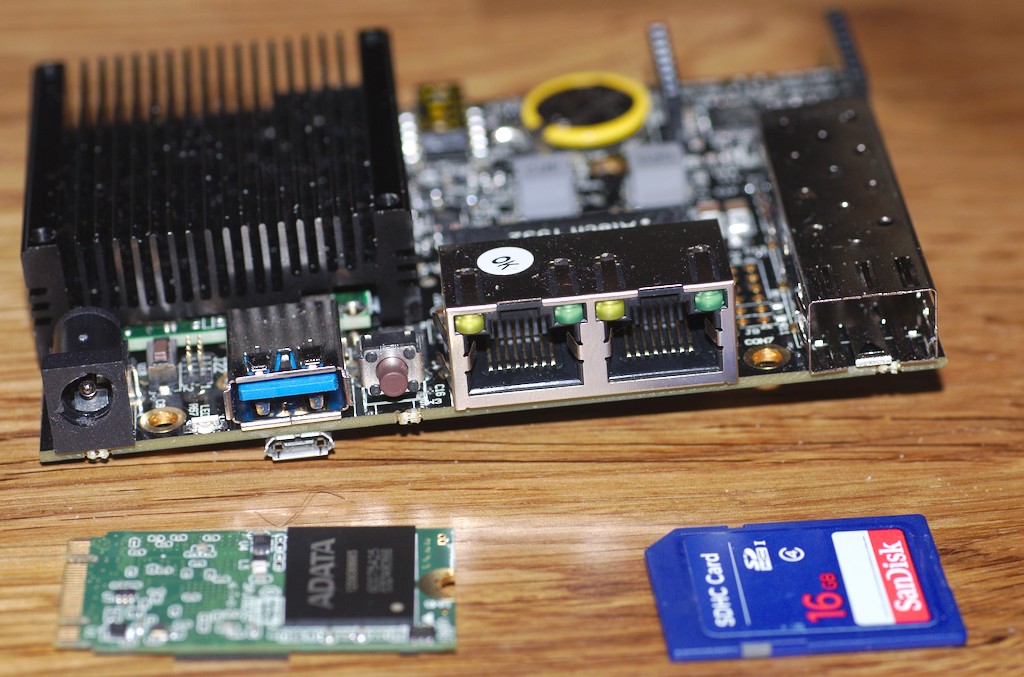
Back in August, I was looking for a Homeserver replacement. During FrOSCon I was then reminded of the Turris Omnia project by NIC.cz. The basic SoC (Marvel Armada 38x) seemed to be nice hand have decent mainline support (and, with the turris, users interested in keeping it working). Only I don't want any WIFI and I wasn't sure the standard case would be all that usefully. Fortunately, there's also a simple board available with the same SoC called ClearFog and so I got one of these (the Base version). With shipping and the SSD (the only 2242 M.2 SSD with 250 GiB I could find, a ADATA SP600) it slightly exceeds the budget but well. ClearFog with SSD When installing the machine, the obvious goal was to use mainline FOSS components only if possible. Fortunately there's mainline kernel support for the device as well as mainline U-Boot. First attempts to boot from a micro SD card did not work out at all, both with mainline U-Boot and the vendor version though. Turns out the eMMC version of the board does not support any micro SD cards at all, a fact that is documented but others failed to notice as well. U-Boot As the board does not come with any loader on eMMC and booting directly from M.2 requires removing some resistors from the board, the easiest way is using UART for booting. The vendor wiki has some shell script wrapping an included C fragment to feed U-Boot to the device but all that is really needed is U-Boot's kwboot utility. For some reason the SPL didn't properly detect UART booting on my device (wrong magic number) but patching the if (in arch-mvebu's spl.c) and always assume UART boot is an easy way around. The plan then was to boot a Debian armhf rootfs with a defconfig kernel from USB stick. and install U-Boot and the rootfs to eMMC from within that system. Unfortunately U-Boot seems to be unable to talk to the USB3 port so no kernel loading from there. One could probably make UART loading work but switching between screen for serial console and xmodem seemed somewhat fragile and I never got it working. However ethernet can be made to work, though you need to set eth1addr to eth3addr (or just the right one of these) in U-Boot, saveenv and reboot. After that TFTP works (but is somewhat slow). eMMC There's one last step required to allow U-Boot and Linux to access the eMMC. eMMC is wired to the same PINs as the SD card would be. However the SD card has an additional indicator pin showing whether a card is present. You might be lucky inserting a dummy card into the slot or go the clean route and remove the pin specification from the device tree.
--- a/arch/arm/dts/armada-388-clearfog.dts
+++ b/arch/arm/dts/armada-388-clearfog.dts
@@ -306,7 +307,6 @@
                        sdhci@d8000  
                                bus-width = <4>;
-                               cd-gpios = <&gpio0 20 GPIO_ACTIVE_LOW>;
                                no-1-8-v;
                                pinctrl-0 = <&clearfog_sdhci_pins
                                             &clearfog_sdhci_cd_pins>;
Next Up is flashing the U-Boot to eMMC. This seems to work with the vendor U-Boot but proves to be tricky with mainline. The fun part boils down to the fact that the boot firmware reads the first block from eMMC, but the second from SD card. If you write the mainline U-Boot, which was written and tested for SD card, to eMMC the SPL will try to load the main U-Boot starting from it's second sector from flash -- obviously resulting in garbage. This one took me several tries to figure out and made me read most of the SPL code for the device. The fix however is trivial (apart from the question on how to support all different variants from one codebase, which I'll leave to the U-Boot developers):
--- a/include/configs/clearfog.h
+++ b/include/configs/clearfog.h
@@ -143,8 +143,7 @@
 #define CONFIG_SPL_LIBDISK_SUPPORT
 #define CONFIG_SYS_MMC_U_BOOT_OFFS             (160 << 10)
 #define CONFIG_SYS_U_BOOT_OFFS                 CONFIG_SYS_MMC_U_BOOT_OFFS
-#define CONFIG_SYS_MMCSD_RAW_MODE_U_BOOT_SECTOR        ((CONFIG_SYS_U_BOOT_OFFS / 512)\
-                                                + 1)
+#define CONFIG_SYS_MMCSD_RAW_MODE_U_BOOT_SECTOR        (CONFIG_SYS_U_BOOT_OFFS / 512)
 #define CONFIG_SYS_U_BOOT_MAX_SIZE_SECTORS     ((512 << 10) / 512) /* 512KiB */
 #ifdef CONFIG_SPL_BUILD
 #define CONFIG_FIXED_SDHCI_ALIGNED_BUFFER      0x00180000      /* in SDRAM */
Linux Now we have a System booting from eMMC with mainline U-Boot (which is a most welcome speedup compared to the UART and TFTP combination from the beginning). Getting to fine-tune linux on the device -- we want to install the armmp Debian kernel and have it work. As all the drivers are build as modules for that kernel this also means initrd support. Funnily U-Boots bootz allows booting a plain vmlinux kernel but I couldn't get it to boot a plain initrd. Passing a uImage initrd and a normal kernel however works pretty well. Back when I first tried there were some modules missing and ethernet didn't work with the PHY driver built as a module. In the meantime the PHY problem was fixed in the Debian kernel and almost all modules already added. Ben then only added the USB3 module on my suggestion and as a result, unstable's armhf armmp kernel should work perfectly well on the device (you still need to patch the device tree similar to the patch above). Still missing is an updated flash-kernel to automatically generate the initrd uImage which is work in progress but got stalled until I fixed the U-Boot on eMMC problem and everything should be fine -- maybe get debian u-boot builds for that board. Pro versus Base The main difference so far between the Pro and the Base version of the ClearFog is the switch chip which is included on the Pro. The Base instead "just" has two gigabit ethernet ports and a SFP. Both, linux' and U-Boot's device tree are intended for the Pro version which makes on of the ethernet ports unusable (it tries to find the switch behind the ethernet port which isn't there). To get both ports working (or the one you settled on earlier) there's a second patch to the device tree (my version might be sub-optimal but works), U-Boot -- the linux-kernel version is a trivial adaption:
--- a/arch/arm/dts/armada-388-clearfog.dts
+++ b/arch/arm/dts/armada-388-clearfog.dts
@@ -89,13 +89,10 @@
                internal-regs  
                        ethernet@30000  
                                mac-address = [00 50 43 02 02 02];
+                               managed = "in-band-status";
+                               phy = <&phy1>;
                                phy-mode = "sgmii";
                                status = "okay";
-
-                               fixed-link  
-                                       speed = <1000>;
-                                       full-duplex;
-                                ;
                         ;
                        ethernet@34000  
@@ -227,6 +224,10 @@
                                pinctrl-0 = <&mdio_pins>;
                                pinctrl-names = "default";
+                               phy1: ethernet-phy@1   /* Marvell 88E1512 */
+                                    reg = <1>;
+                                ;
+
                                phy_dedicated: ethernet-phy@0  
                                        /*
                                         * Annoyingly, the marvell phy driver
@@ -386,62 +386,6 @@
                tx-fault-gpio = <&expander0 13 GPIO_ACTIVE_HIGH>;
         ;
-       dsa@0  
-               compatible = "marvell,dsa";
-               dsa,ethernet = <&eth1>;
-               dsa,mii-bus = <&mdio>;
-               pinctrl-0 = <&clearfog_dsa0_clk_pins &clearfog_dsa0_pins>;
-               pinctrl-names = "default";
-               #address-cells = <2>;
-               #size-cells = <0>;
-
-               switch@0  
-                       #address-cells = <1>;
-                       #size-cells = <0>;
-                       reg = <4 0>;
-
-                       port@0  
-                               reg = <0>;
-                               label = "lan1";
-                        ;
-
-                       port@1  
-                               reg = <1>;
-                               label = "lan2";
-                        ;
-
-                       port@2  
-                               reg = <2>;
-                               label = "lan3";
-                        ;
-
-                       port@3  
-                               reg = <3>;
-                               label = "lan4";
-                        ;
-
-                       port@4  
-                               reg = <4>;
-                               label = "lan5";
-                        ;
-
-                       port@5  
-                               reg = <5>;
-                               label = "cpu";
-                        ;
-
-                       port@6  
-                               /* 88E1512 external phy */
-                               reg = <6>;
-                               label = "lan6";
-                               fixed-link  
-                                       speed = <1000>;
-                                       full-duplex;
-                                ;
-                        ;
-                ;
-        ;
-
        gpio-keys  
                compatible = "gpio-keys";
                pinctrl-0 = <&rear_button_pins>;
Conclusion Apart from the mess with eMMC this seems to be a pretty nice device. It's now happily running with a M.2 SSD providing enough storage for now and still has a mSATA/mPCIe plug left for future journeys. It seems to be drawing around 5.5 Watts with SSD and one Ethernet connected while mostly idle and can feed around 500 Mb/s from disk over an encrypted ethernet connection which is, I guess, not too bad. My plans now include helping to finish flash-kernel support, creating a nice case and probably get it deployed. I might bring it to FOSDEM first though. Working on it was really quite some fun (apart from the frustrating parts finding the one-block-offset ..) and people were really helpful. Big thanks here to Debian's arm folks, Ben Hutchings the kernel maintainer and U-Boot upstream (especially Tom Rini and Stefan Roese)

Russell Coker: Another Broken Nexus 5

In late 2013 I bought a Nexus 5 for my wife [1]. It s a good phone and I generally have no complaints about the way it works. In the middle of 2016 I had to make a warranty claim when the original Nexus 5 stopped working [2]. Google s warranty support was ok, the call-back was good but unfortunately there was some confusion which delayed replacement. Once the confusion about the IMEI was resolved the warranty replacement method was to bill my credit card for a replacement phone and reverse the charge if/when they got the original phone back and found it to have a defect covered by warranty. This policy meant that I got a new phone sooner as they didn t need to get the old phone first. This is a huge benefit for defects that don t make the phone unusable as you will never be without a phone. Also if the user determines that the breakage was their fault they can just refrain from sending in the old phone. Today my wife s latest Nexus 5 developed a problem. It turned itself off and went into a reboot loop when connected to the charger. Also one of the clips on the rear case had popped out and other clips popped out when I pushed it back in. It appears (without opening the phone) that the battery may have grown larger (which is a common symptom of battery related problems). The phone is slightly less than 3 years old, so if I had got the extended warranty then I would have got a replacement. Now I m about to buy a Nexus 6P (because the Pixel is ridiculously expensive) which is $700 including postage. Kogan offers me a 3 year warranty for an extra $108. Obviously in retrospect spending an extra $100 would have been a benefit for the Nexus 5. But the first question is whether new phone going to have a probability greater than 1/7 of failing due to something other than user error in years 2 and 3? For an extended warranty to provide any benefit the phone has to have a problem that doesn t occur in the first year (or a problem in a replacement phone after the first phone was replaced). The phone also has to not be lost, stolen, or dropped in a pool by it s owner. While my wife and I have a good record of not losing or breaking phones the probability of it happening isn t zero. The Nexus 5 that just died can be replaced for 2/3 of the original price. The value of the old Nexus 5 to me is less than 2/3 of the original price as buying a newer better phone is the option I want. The value of an old phone to me decreases faster than the replacement cost because I don t want to buy an old phone. For an extended warranty to be a good deal for me I think it would have to cost significantly less than 1/10 of the purchase price due to the low probability of failure in that time period and the decreasing value of a replacement outdated phone. So even though my last choice to skip an extended warranty ended up not paying out I expect that overall I will be financially ahead if I keep self-insuring, and I m sure that I have already saved money by self-insuring all my previous devices.

21 October 2016

Iain R. Learmonth: PATHspider 1.0.0 released!

In today s Internet we see an increasing deployment of middleboxes. While middleboxes provide in-network functionality that is necessary to keep networks manageable and economically viable, any packet mangling whether essential for the needed functionality or accidental as an unwanted side effect makes it more and more difficult to deploy new protocols or extensions of existing protocols. For the evolution of the protocol stack, it is important to know which network impairments exist and potentially need to be worked around. While classical network measurement tools are often focused on absolute performance values, PATHspider performs A/B testing between two different protocols or different protocol extensions to perform controlled experiments of protocol-dependent connectivity problems as well as differential treatment. PATHspider is a framework for performing and analyzing these measurements, while the actual A/B test can be easily customized. Late on the 21st October, we released version 1.0.0 of PATHspider and it s ready for production use (whatever that means for Internet research software). Our first real release of PATHspider was version 0.9.0 just in time for the presentation of PATHspider at the 2016 Applied Networking Research Workshop co-located with IETF 96 in Berlin earlier this year. Since this release we have made a lot of changes and I ll talk about some of the highlights here (in no particular order):

Switch from twisted.plugin to straight.plugin While we anticipate that some plugins may wish to use some features of Twisted, we didn t want to have Twisted as a core dependency for PATHspider. We found that straight.plugin was not just a drop-in replacement but it simplified the way in which 3rd-party plugins could be developed and it was worth the effort for that alone.

Library functions for the Observer PATHspider has an embedded flow-meter (think something like NetFlow but highly customisable). We found that even with the small selection of plugins that we had we were duplicating code across plugins for these customisations of the flow-meter. In this release we now provide library functions for common needs such as identifying TCP 3-way handshake completions or identifying ICMP Unreachable messages for flows.

New plugin: DSCP We ve added a new plugin for this release to detect breakage when using DiffServ code points to achieve differentiated services within a network.

Plugins are now subcommands Using the subparsers feature of argparse, all plugins including 3rd-party plugins will now appear as subcommands to the PATHspider command. This makes every plugin a first-class citizen and makes PATHspider truly generalised. We have an added benefit from this that plugins can also ask for extra arguments that are specific to the needs of the plugin, for example the DSCP plugin allows the user to select which code point to send for the experimental test.

Test Suite PATHspider now has a test suite! As the size of the PATHspider code base grows we need to be able to make changes and have confidence that we are not breaking code that another module relies on. We have so far only achieved 54% coverage of the codebase but we hope to improve this for the next release. We have focussed on the critical portions of data collection to ensure that all the results collected by PATHspider during experiments is valid.

DNS Resolver Utility Back when PATHspider was known as ECNSpider, it had a utility for resolving IP addresses from the Alexa top 1 million list. This utility has now been fully integrated into PATHspider and appears as a plugin to allow for repeated experiments against the same IP addresses even if the DNS resolver would have returned a different addresss.

Documentation Documentation is definitely not my favourite activity, but it has to be done. PATHspider 1.0.0 now ships with documentation covering commandline usage, input/output formats and development of new plugins.
If you d like to check out PATHspider, you can find the website at https://pathspider.net/. Debian packages will be appearing shortly and will find their way into stable-backports within the next 2 weeks (hopefully). Current development of PATHspider is supported by the European Union s Horizon 2020 project MAMI. This project has received funding from the European Union s Horizon 2020 research and innovation programme under grant agreement No 688421. The opinions expressed and arguments employed reflect only the authors view. The European Commission is not responsible for any use that may be made of that information.

20 October 2016

H ctor Or n Mart nez: Build a Debian package against Debian 8.0 using Download On Demand (DoD) service

In the previous post Open Build Service software architecture has been overviewed. In the current blog post, a tutorial on setting up a package build with OBS from Debian packages is presented. Steps: Generate a test environment by creating Stretch/SID VM Really, use whatever suits you best, but please create an untrusted test environment for this one. In the current tutorial it assumes $hostname is stretch , which should be stretch or sid suite. Be aware that copy & paste configuration files from current post might lead you into broken characters (i.e. ). Debian Stretch weekly netinst CD Enable experimental repository
# echo "deb http://httpredir.debian.org/debian experimental main" >> /etc/apt/sources.list.d/experimental.list
# apt-get update
Install and setup OBS server, api, worker and osc CLI packages
# apt-get install obs-server obs-api obs-worker osc
In the install process mysql database is needed, therefore if mysql server is not setup, a password needs to be provided.
When OBS API database obs-api is created, we need to pick a password for it, provide opensuse . The obs-api package will configure apache2 https webserver (creating a dummy certificate for stretch ) to serve OBS webui.
Add stretch and obs aliases to localhost entry in your /etc/hosts file.
Enable worker by setting ENABLED=1 in /etc/default/obsworker
Try to connect to the web UI https://stretch/
Login into OBS webui, default login credentials: Admin/opensuse).
From command line tool, try to list projects in OBS
 $ osc -A https://stretch ls
Accept dummy certificate and provide credentials (defaults: Admin/opensuse)
If the install proceeds as expected follow to the next step. Ensure all OBS services are running
# backend services
obsrun     813  0.0  0.9 104960 20448 ?        Ss   08:33   0:03 /usr/bin/perl -w /usr/lib/obs/server/bs_dodup
obsrun     815  0.0  1.5 157512 31940 ?        Ss   08:33   0:07 /usr/bin/perl -w /usr/lib/obs/server/bs_repserver
obsrun    1295  0.0  1.6 157644 32960 ?        S    08:34   0:07  \_ /usr/bin/perl -w /usr/lib/obs/server/bs_repserver
obsrun     816  0.0  1.8 167972 38600 ?        Ss   08:33   0:08 /usr/bin/perl -w /usr/lib/obs/server/bs_srcserver
obsrun    1296  0.0  1.8 168100 38864 ?        S    08:34   0:09  \_ /usr/bin/perl -w /usr/lib/obs/server/bs_srcserver
memcache   817  0.0  0.6 346964 12872 ?        Ssl  08:33   0:11 /usr/bin/memcached -m 64 -p 11211 -u memcache -l 127.0.0.1
obsrun     818  0.1  0.5  78548 11884 ?        Ss   08:33   0:41 /usr/bin/perl -w /usr/lib/obs/server/bs_dispatch
obsserv+   819  0.0  0.3  77516  7196 ?        Ss   08:33   0:05 /usr/bin/perl -w /usr/lib/obs/server/bs_service
mysql      851  0.0  0.0   4284  1324 ?        Ss   08:33   0:00 /bin/sh /usr/bin/mysqld_safe
mysql     1239  0.2  6.3 1010744 130104 ?      Sl   08:33   1:31  \_ /usr/sbin/mysqld --basedir=/usr --datadir=/var/lib/mysql --plugin-dir=/usr/lib/mysql/plugin --log-error=/var/log/mysql/error.log --pid-file=/var/run/mysqld/mysqld.pid --socket=/var/run/mysqld/mysqld.sock --port=3306
# web services
root      1452  0.0  0.1 110020  3968 ?        Ss   08:34   0:01 /usr/sbin/apache2 -k start
root      1454  0.0  0.1 435992  3496 ?        Ssl  08:34   0:00  \_ Passenger watchdog
root      1460  0.3  0.2 651044  5188 ?        Sl   08:34   1:46      \_ Passenger core
nobody    1465  0.0  0.1 444572  3312 ?        Sl   08:34   0:00      \_ Passenger ust-router
www-data  1476  0.0  0.1 855892  2608 ?        Sl   08:34   0:09  \_ /usr/sbin/apache2 -k start
www-data  1477  0.0  0.1 856068  2880 ?        Sl   08:34   0:09  \_ /usr/sbin/apache2 -k start
www-data  1761  0.0  4.9 426868 102040 ?       Sl   08:34   0:29 delayed_job.0
www-data  1767  0.0  4.8 425624 99888 ?        Sl   08:34   0:30 delayed_job.1
www-data  1775  0.0  4.9 426516 101708 ?       Sl   08:34   0:28 delayed_job.2
nobody    1788  0.0  5.7 496092 117480 ?       Sl   08:34   0:03 Passenger RubyApp: /usr/share/obs/api
nobody    1796  0.0  4.9 488888 102176 ?       Sl   08:34   0:00 Passenger RubyApp: /usr/share/obs/api
www-data  1814  0.0  4.5 282576 92376 ?        Sl   08:34   0:22 delayed_job.1000
www-data  1829  0.0  4.4 282684 92228 ?        Sl   08:34   0:22 delayed_job.1010
www-data  1841  0.0  4.5 282932 92536 ?        Sl   08:34   0:22 delayed_job.1020
www-data  1855  0.0  4.9 427988 101492 ?       Sl   08:34   0:29 delayed_job.1030
www-data  1865  0.2  5.0 492500 102964 ?       Sl   08:34   1:09 clockworkd.clock
www-data  1899  0.0  0.0  87100  1400 ?        S    08:34   0:00 /usr/bin/searchd --pidfile --config /usr/share/obs/api/config/production.sphinx.conf
www-data  1900  0.1  0.4 161620  8276 ?        Sl   08:34   0:51  \_ /usr/bin/searchd --pidfile --config /usr/share/obs/api/config/production.sphinx.conf
# OBS worker
root      1604  0.0  0.0  28116  1492 ?        Ss   08:34   0:00 SCREEN -m -d -c /srv/obs/run/worker/boot/screenrc
root      1605  0.0  0.9  75424 18764 pts/0    Ss+  08:34   0:06  \_ /usr/bin/perl -w ./bs_worker --hardstatus --root /srv/obs/worker/root_1 --statedir /srv/obs/run/worker/1 --id stretch:1 --reposerver http://obs:5252 --jobs 1
Create an OBS project for Download on Demand (DoD) Create a meta project file:
$ osc -A https://stretch:443 meta prj Debian:8 -e
<project name= Debian:8 >
<title>Debian 8 DoD</title>
<description>Debian 8 DoD</description>
<person userid= Admin role= maintainer />
<repository name= main >
<download arch= x86_64 url= http://deb.debian.org/debian/jessie/main repotype= deb />
<arch>x86_64</arch>
</repository>
</project>
Visit webUI to check project configuration Create a meta project configuration file:
$ osc -A https://stretch:443 meta prjconf Debian:8 -e
Add the following file, as found at build.opensuse.org
Repotype: debian
# create initial user
Preinstall: base-passwd
Preinstall: user-setup
# required for preinstall images
Preinstall: perl
# preinstall essentials + dependencies
Preinstall: base-files base-passwd bash bsdutils coreutils dash debconf
Preinstall: debianutils diffutils dpkg e2fslibs e2fsprogs findutils gawk
Preinstall: gcc-4.9-base grep gzip hostname initscripts insserv libacl1
Preinstall: libattr1 libblkid1 libbz2-1.0 libc-bin libc6 libcomerr2 libdb5.3
Preinstall: libgcc1 liblzma5 libmount1 libncurses5 libpam-modules
Preinstall: libpcre3 libsmartcols1
Preinstall: libpam-modules-bin libpam-runtime libpam0g libreadline6
Preinstall: libselinux1 libsemanage-common libsemanage1 libsepol1 libsigsegv2
Preinstall: libslang2 libss2 libtinfo5 libustr-1.0-1 libuuid1 login lsb-base
Preinstall: mount multiarch-support ncurses-base ncurses-bin passwd perl-base
Preinstall: readline-common sed sensible-utils sysv-rc sysvinit sysvinit-utils
Preinstall: tar tzdata util-linux zlib1g
Runscripts: base-passwd user-setup base-files gawk
VMinstall: libdevmapper1.02.1
Order: user-setup:base-files
# Essential packages (this should also pull the dependencies)
Support: base-files base-passwd bash bsdutils coreutils dash debianutils
Support: diffutils dpkg e2fsprogs findutils grep gzip hostname libc-bin 
Support: login mount ncurses-base ncurses-bin perl-base sed sysvinit 
Support: sysvinit-utils tar util-linux
# Build-essentials
Required: build-essential
Prefer: build-essential:make
# build script needs fakeroot
Support: fakeroot
# lintian support would be nice, but breaks too much atm
#Support: lintian
# helper tools in the chroot
Support: less kmod net-tools procps psmisc strace vim
# everything below same as for Debian:6.0 (apart from the version macros ofc)
# circular dependendencies in openjdk stack
Order: openjdk-6-jre-lib:openjdk-6-jre-headless
Order: openjdk-6-jre-headless:ca-certificates-java
Keep: binutils cpp cracklib file findutils gawk gcc gcc-ada gcc-c++
Keep: gzip libada libstdc++ libunwind
Keep: libunwind-devel libzio make mktemp pam-devel pam-modules
Keep: patch perl rcs timezone
Prefer: cvs libesd0 libfam0 libfam-dev expect
Prefer: gawk locales default-jdk
Prefer: xorg-x11-libs libpng fam mozilla mozilla-nss xorg-x11-Mesa
Prefer: unixODBC libsoup glitz java-1_4_2-sun gnome-panel
Prefer: desktop-data-SuSE gnome2-SuSE mono-nunit gecko-sharp2
Prefer: apache2-prefork openmotif-libs ghostscript-mini gtk-sharp
Prefer: glib-sharp libzypp-zmd-backend mDNSResponder
Prefer: -libgcc-mainline -libstdc++-mainline -gcc-mainline-c++
Prefer: -libgcj-mainline -viewperf -compat -compat-openssl097g
Prefer: -zmd -OpenOffice_org -pam-laus -libgcc-tree-ssa -busybox-links
Prefer: -crossover-office -libgnutls11-dev
# alternative pkg-config implementation
Prefer: -pkgconf
Prefer: -openrc
Prefer: -file-rc
Conflict: ghostscript-library:ghostscript-mini
Ignore: sysvinit:initscripts
Ignore: aaa_base:aaa_skel,suse-release,logrotate,ash,mingetty,distribution-release
Ignore: gettext-devel:libgcj,libstdc++-devel
Ignore: pwdutils:openslp
Ignore: pam-modules:resmgr
Ignore: rpm:suse-build-key,build-key
Ignore: bind-utils:bind-libs
Ignore: alsa:dialog,pciutils
Ignore: portmap:syslogd
Ignore: fontconfig:freetype2
Ignore: fontconfig-devel:freetype2-devel
Ignore: xorg-x11-libs:freetype2
Ignore: xorg-x11:x11-tools,resmgr,xkeyboard-config,xorg-x11-Mesa,libusb,freetype2,libjpeg,libpng
Ignore: apache2:logrotate
Ignore: arts:alsa,audiofile,resmgr,libogg,libvorbis
Ignore: kdelibs3:alsa,arts,pcre,OpenEXR,aspell,cups-libs,mDNSResponder,krb5,libjasper
Ignore: kdelibs3-devel:libvorbis-devel
Ignore: kdebase3:kdebase3-ksysguardd,OpenEXR,dbus-1,dbus-1-qt,hal,powersave,openslp,libusb
Ignore: kdebase3-SuSE:release-notes
Ignore: jack:alsa,libsndfile
Ignore: libxml2-devel:readline-devel
Ignore: gnome-vfs2:gnome-mime-data,desktop-file-utils,cdparanoia,dbus-1,dbus-1-glib,krb5,hal,libsmbclient,fam,file_alteration
Ignore: libgda:file_alteration
Ignore: gnutls:lzo,libopencdk
Ignore: gnutls-devel:lzo-devel,libopencdk-devel
Ignore: pango:cairo,glitz,libpixman,libpng
Ignore: pango-devel:cairo-devel
Ignore: cairo-devel:libpixman-devel
Ignore: libgnomeprint:libgnomecups
Ignore: libgnomeprintui:libgnomecups
Ignore: orbit2:libidl
Ignore: orbit2-devel:libidl,libidl-devel,indent
Ignore: qt3:libmng
Ignore: qt-sql:qt_database_plugin
Ignore: gtk2:libpng,libtiff
Ignore: libgnomecanvas-devel:glib-devel
Ignore: libgnomeui:gnome-icon-theme,shared-mime-info
Ignore: scrollkeeper:docbook_4,sgml-skel
Ignore: gnome-desktop:libgnomesu,startup-notification
Ignore: python-devel:python-tk
Ignore: gnome-pilot:gnome-panel
Ignore: gnome-panel:control-center2
Ignore: gnome-menus:kdebase3
Ignore: gnome-main-menu:rug
Ignore: libbonoboui:gnome-desktop
Ignore: postfix:pcre
Ignore: docbook_4:iso_ent,sgml-skel,xmlcharent
Ignore: control-center2:nautilus,evolution-data-server,gnome-menus,gstreamer-plugins,gstreamer,metacity,mozilla-nspr,mozilla,libxklavier,gnome-desktop,startup-notification
Ignore: docbook-xsl-stylesheets:xmlcharent
Ignore: liby2util-devel:libstdc++-devel,openssl-devel
Ignore: yast2:yast2-ncurses,yast2-theme-SuSELinux,perl-Config-Crontab,yast2-xml,SuSEfirewall2
Ignore: yast2-core:netcat,hwinfo,wireless-tools,sysfsutils
Ignore: yast2-core-devel:libxcrypt-devel,hwinfo-devel,blocxx-devel,sysfsutils,libstdc++-devel
Ignore: yast2-packagemanager-devel:rpm-devel,curl-devel,openssl-devel
Ignore: yast2-devtools:perl-XML-Writer,libxslt,pkgconfig
Ignore: yast2-installation:yast2-update,yast2-mouse,yast2-country,yast2-bootloader,yast2-packager,yast2-network,yast2-online-update,yast2-users,release-notes,autoyast2-installation
Ignore: yast2-bootloader:bootloader-theme
Ignore: yast2-packager:yast2-x11
Ignore: yast2-x11:sax2-libsax-perl
Ignore: openslp-devel:openssl-devel
Ignore: java-1_4_2-sun:xorg-x11-libs
Ignore: java-1_4_2-sun-devel:xorg-x11-libs
Ignore: kernel-um:xorg-x11-libs
Ignore: tetex:xorg-x11-libs,expat,fontconfig,freetype2,libjpeg,libpng,ghostscript-x11,xaw3d,gd,dialog,ed
Ignore: yast2-country:yast2-trans-stats
Ignore: susehelp:susehelp_lang,suse_help_viewer
Ignore: mailx:smtp_daemon
Ignore: cron:smtp_daemon
Ignore: hotplug:syslog
Ignore: pcmcia:syslog
Ignore: avalon-logkit:servlet
Ignore: jython:servlet
Ignore: ispell:ispell_dictionary,ispell_english_dictionary
Ignore: aspell:aspel_dictionary,aspell_dictionary
Ignore: smartlink-softmodem:kernel,kernel-nongpl
Ignore: OpenOffice_org-de:myspell-german-dictionary
Ignore: mediawiki:php-session,php-gettext,php-zlib,php-mysql,mod_php_any
Ignore: squirrelmail:mod_php_any,php-session,php-gettext,php-iconv,php-mbstring,php-openssl
Ignore: simias:mono(log4net)
Ignore: zmd:mono(log4net)
Ignore: horde:mod_php_any,php-gettext,php-mcrypt,php-imap,php-pear-log,php-pear,php-session,php
Ignore: xerces-j2:xml-commons-apis,xml-commons-resolver
Ignore: xdg-menu:desktop-data
Ignore: nessus-libraries:nessus-core
Ignore: evolution:yelp
Ignore: mono-tools:mono(gconf-sharp),mono(glade-sharp),mono(gnome-sharp),mono(gtkhtml-sharp),mono(atk-sharp),mono(gdk-sharp),mono(glib-sharp),mono(gtk-sharp),mono(pango-sharp)
Ignore: gecko-sharp2:mono(glib-sharp),mono(gtk-sharp)
Ignore: vcdimager:libcdio.so.6,libcdio.so.6(CDIO_6),libiso9660.so.4,libiso9660.so.4(ISO9660_4)
Ignore: libcdio:libcddb.so.2
Ignore: gnome-libs:libgnomeui
Ignore: nautilus:gnome-themes
Ignore: gnome-panel:gnome-themes
Ignore: gnome-panel:tomboy
Substitute: utempter
%ifnarch s390 s390x ppc ia64
Substitute: java2-devel-packages java-1_4_2-sun-devel
%else
 %ifnarch s390x
Substitute: java2-devel-packages java-1_4_2-ibm-devel
 %else
Substitute: java2-devel-packages java-1_4_2-ibm-devel xorg-x11-libs-32bit
 %endif
%endif
Substitute: yast2-devel-packages docbook-xsl-stylesheets doxygen libxslt perl-XML-Writer popt-devel sgml-skel update-desktop-files yast2 yast2-devtools yast2-packagemanager-devel yast2-perl-bindings yast2-testsuite
#
# SUSE compat mappings
#
Substitute: gcc-c++ gcc
Substitute: libsigc++2-devel libsigc++-2.0-dev
Substitute: glibc-devel-32bit
Substitute: pkgconfig pkg-config
%ifarch %ix86
Substitute: kernel-binary-packages kernel-default kernel-smp kernel-bigsmp kernel-debug kernel-um kernel-xen kernel-kdump
%endif
%ifarch ia64
Substitute: kernel-binary-packages kernel-default kernel-debug
%endif
%ifarch x86_64
Substitute: kernel-binary-packages kernel-default kernel-smp kernel-xen kernel-kdump
%endif
%ifarch ppc
Substitute: kernel-binary-packages kernel-default kernel-kdump kernel-ppc64 kernel-iseries64
%endif
%ifarch ppc64
Substitute: kernel-binary-packages kernel-ppc64 kernel-iseries64
%endif
%ifarch s390
Substitute: kernel-binary-packages kernel-s390
%endif
%ifarch s390x
Substitute: kernel-binary-packages kernel-default
%endif
%define debian_version 800
Macros:
%debian_version 800
Visit webUI to check project configuration Create an OBS project linked to DoD
$ osc -A https://stretch:443 meta prj test -e
<project name= test >
<title>test</title>
<description>test</description>
<person userid= Admin role= maintainer />
<repository name= Debian_8.0 >
<path project= Debian:8 repository= main />
<arch>x86_64</arch>
</repository>
</project>
Visit webUI to check project configuration Adding a package to the project
$ osc -A https://stretch:443 co test ; cd test
$ mkdir hello ; cd hello ; apt-get source -d hello ; cd - ; 
$ osc add hello 
$ osc ci -m "New import" hello
The package should go to dispatched state then get in blocked state while it downloads build dependencies from DoD link, eventually it should start building. Please check the journal logs to check if something went wrong or gets stuck. Visit webUI to check hello package build state OBS logging to the journal Check in the journal logs everything went fine:
$ sudo journalctl -u obsdispatcher.service -u obsdodup.service -u obsscheduler@x86_64.service -u obsworker.service -u obspublisher.service
Troubleshooting Currently we are facing few issues with web UI: And there are more issues that have not been reported, please do reportbug obs-api .

19 October 2016

Pau Garcia i Quiles: FOSDEM Desktops DevRoom 2017 all for Participation

FOSDEM is one of the largest (5,000+ hackers!) gatherings of Free Software contributors in the world and happens each February in Brussels (Belgium, Europe). Once again, one of the tracks will be the Desktops DevRoom (formerly known as CrossDesktop DevRoom ), which will host Desktop-related talks. We are now inviting proposals for talks about Free/Libre/Open-source Software on the topics of Desktop development, Desktop applications and interoperability amongst Desktop Environments. This is a unique opportunity to show novel ideas and developments to a wide technical audience. Topics accepted include, but are not limited to: Talks can be very specific, such as the advantages/disadvantages of distributing a desktop application with snap vs flatpak, or as general as using HTML5 technologies to develop native applications. Topics that are of interest to the users and developers of all desktop environments are especially welcome. The FOSDEM 2016 schedule might give you some inspiration. Submissions Please include the following information when submitting a proposal: How to submit All submissions are made in the Pentabarf event planning tool: https://penta.fosdem.org/submission/FOSDEM17 To submit your talk, click on Create Event , then make sure to select the Desktops devroom as the Track . Otherwise your talk will not be even considered for any devroom at all. If you already have a Pentabarf account from a previous year, even if your talk was not accepted, please reuse it. Create an account if, and only if, you don t have one from a previous year. If you have any issues with Pentabarf, please contact desktops-devroom@lists.fosdem.org. Deadline The deadline for submissions is December 5th 2016. FOSDEM will be held on the weekend of 4 & 5 February 2017 and the Desktops DevRoom will take place on Sunday, February 5th 2017. We will contact every submitter with a yes or no before December 11th 2016. Recording permission The talks in the Desktops DevRoom will be audio and video recorded, and possibly streamed live too. In the Submission notes field, please indicate that you agree that your presentation will be licensed under the CC-By-SA-4.0 or CC-By-4.0 license and that you agree to have your presentation recorded. For example:
If my presentation is accepted for FOSDEM, I hereby agree to license all recordings, slides, and other associated materials under the Creative Commons Attribution Share-Alike 4.0 International License. Sincerely, <NAME>.
If you want us to stop the recording in the Q & A part (should you have one), please tell us. We can do that but only for the Q & A part. More information The official communication channel for the Desktops DevRoom is its mailing list desktops-devroom@lists.fosdem.org. Use this page to manage your subscription: https://lists.fosdem.org/listinfo/desktops-devroom Organization The Desktops DevRoom 2017 is managed by a team representing the most notable open desktops: If you want to join the team, please contact desktops-devroom@lists.fosdem.org

Michal &#268;iha&#345;: Gammu 1.37.90

Yesterday Gammu 1.37.90 has been released. This release brings quite a lot of changes and it's for testing purposes. Hopefully stable 1.38.0 will follow soon as soon as I won't get negative feedback on the changes. Besides code changes, there is one news for Windows users - there is Windows binary coming with the release. This was possible to automate thanks to AppVeyor, who does provide CI service where you can download built artifacts. Without this, I'd not be able to do make this as I don't have single Windows computer :-). Full list of changes: Would you like to see more features in Gammu? You an support further Gammu development at Bountysource salt or by direct donation.

Filed under: Debian English Gammu 0 comments

Reproducible builds folks: Reproducible Builds: week 77 in Stretch cycle

What happened in the Reproducible Builds effort between Sunday October 9 and Saturday October 15 2016: Media coverage Documentation update After discussions with HW42, Steven Chamberlain, Vagrant Cascadian, Daniel Shahaf, Christopher Berg, Daniel Kahn Gillmor and others, Ximin Luo has started writing up more concrete and detailed design plans for setting SOURCE_ROOT_DIR for reproducible debugging symbols, buildinfo security semantics and buildinfo security infrastructure. Toolchain development and fixes Dmitry Shachnev noted that our patch for #831779 has been temporarily rejected by docutils upstream; we are trying to persuade them again. Tony Mancill uploaded javatools/0.59 to unstable containing original patch by Chris Lamb. This fixed an issue where documentation Recommends: substvars would not be reproducible. Ximin Luo filed bug 77985 to GCC as a pre-requisite for future patches to make debugging symbols reproducible. Packages reviewed and fixed, and bugs filed The following updated packages have become reproducible - in our current test setup - after being fixed: The following updated packages appear to be reproducible now, for reasons we were not able to figure out. (Relevant changelogs did not mention reproducible builds.) Some uploads have addressed some reproducibility issues, but not all of them: Some uploads have addressed nearly all reproducibility issues, except for build path issues: Patches submitted that have not made their way to the archive yet: Reviews of unreproducible packages 101 package reviews have been added, 49 have been updated and 4 have been removed in this week, adding to our knowledge about identified issues. 3 issue types have been updated: Weekly QA work During of reproducibility testing, some FTBFS bugs have been detected and reported by: tests.reproducible-builds.org Debian: Openwrt/LEDE/NetBSD/coreboot/Fedora/archlinux: Misc. We are running a poll to find a good time for an IRC meeting. This week's edition was written by Ximin Luo, Holger Levsen & Chris Lamb and reviewed by a bunch of Reproducible Builds folks on IRC.

18 October 2016

MJ Ray: Rinse and repeat

Forgive me, reader, for I have sinned. It has been over a year since my last blog post. Life got busy. Paid work. Another round of challenges managing my chronic illness. Cycle campaigning. Fun bike rides. Friends. Family. Travels. Other social media to stroke. I m still reading some of the planets where this blog post should appear and commenting on some, so I ve not felt completely cut off, but I am surprised how many people don t allow comments on their blogs any more (or make it too difficult for me with reCaptcha and the like). The main motive for this post is to test some minor upgrades, though. Hi everyone. How s it going with you? I ll probably keep posting short updates in the future. Go in peace to love and serve the web.

17 October 2016

Russ Allbery: pgpcontrol 2.5

pgpcontrol is the collection of the original signing and verification scripts that David Lawrence wrote (in Perl) for verification of Usenet control messages. I took over maintenance of it, with a few other things, but haven't really done much with it. It would benefit a lot from an overhaul of both the documentation and the code, and turning it into a more normal Perl module and supporting scripts. This release is none of those things. It's just pure housekeeping, picking up changes made by other people (mostly Julien LIE) to the copies of the scripts in INN and making a few minor URL tweaks. But I figured I may as well, rather than distribute old versions of the scripts. You can tell how little I've done with this stuff by noting that they don't even have a distribution page on my web site. The canonical distribution site is ftp.isc.org, although I'm not sure if that site will pick up the new release. (This relies on a chain of rsync commands that have been moved multiple times since the last time I pushed the release button, and I suspect that has broken.) I'll ping someone about possibly fixing that; in the meantime, you can find the files on archives.eyrie.org.

Russell Coker: Improving Memory

I ve just attended a lecture about improving memory, mostly about mnemonic techniques. I m not against learning techniques to improve memory and I think it s good to teach kids a variety of things many of which won t be needed when they are younger as you never know which kids will need various skills. But I disagree with the assertion that we are losing valuable skills due to digital amnesia . Nowadays we have programs to check spelling so we can avoid the effort of remembering to spell difficult words like mnemonic, calendar apps on our phones that link to addresses and phone numbers, and the ability to Google the world s knowledge from the bathroom. So the question is, what do we need to remember? For remembering phone numbers it seems that all we need is to remember numbers that we might call in the event of a mobile phone being lost or running out of battery charge. That would be a close friend or relative and maybe a taxi company (and 13CABS isn t difficult to remember). Remembering addresses (street numbers etc) doesn t seem very useful in any situation. Remembering the way to get to a place is useful and it seems to me that the way the navigation programs operate works against this. To remember a route you would want to travel the same way on multiple occasions and use a relatively simple route. The way that Google maps tends to give the more confusing routes (IE routes varying by the day and routes which take all shortcuts) works against this. I think that spending time improving memory skills is useful, but it will either take time away from learning other skills that are more useful to most people nowadays or take time away from leisure activities. If improving memory skills is fun for you then it s probably better than most hobbies (it s cheap and provides some minor benefits in life). When I was in primary school it was considered important to make kids memorise their times tables . I m sure that memorising the multiplication of all numbers less than 13 is useful to some people, but I never felt a need to do it. When I was young I could multiply any pair of 2 digit numbers as quickly as most kids could remember the result. The big difference was that most kids needed a calculator to multiply any number by 13 which is a significant disadvantage. What We Must Memorise Nowadays the biggest memory issue is with passwords (the Correct Horse Battery Staple XKCD comic is worth reading [1]). Teaching mnemonic techniques for the purpose of memorising passwords would probably be a good idea and would probably get more interest from the audience. One interesting corner-case of passwords is ATM PIN numbers. The Wikipedia page about PIN numbers states that 4-12 digits can be used for PINs [2]. The 4 digit PIN was initially chosen because John Adrian Shepherd-Barron (who is credited with inventing the ATM) was convinced by his wife that 6 digits would be too difficult to memorise. The fact that hardly any banks outside Switzerland use more than 4 digits suggests that Mrs Shepherd-Barron had a point. The fact that this was decided in the 60 s proves that it s not digital amnesia . We also have to memorise how to use various supposedly user-friendly programs. If you observe an iPhone or Mac being used by someone who hasn t used one before it becomes obvious that they really aren t so user friendly and users need to memorise many operations. This is not a criticism of Apple, some tasks are inherently complex and require some complexity of the user interface. The limitations of the basic UI facilities become more obvious when there are operations like palm-swiping the screen for a screen-shot and a double-tap plus drag for a 1 finger zoom on Android. What else do we need to memorise?

16 October 2016

Thomas Goirand: Released OpenStack Newton, Moving OpenStack packages to upstream Gerrit CI/CD

OpenStack Newton is released, and uploaded to Sid OpenStack Newton was released on the Thursday 6th of October. I was able to upload nearly all of it before the week-end, though there was a bit of hick-ups still, as I forgot to upload python-fixtures 3.0.0 to unstable, and only realized it thanks to some bug reports. As this is a build time dependency, it didn t disrupt Sid users too much, but 38 packages wouldn t build without it. Thanks to Santiago Vila for pointing at the issue here. As of writing, a lot of the Newton packages didn t migrate to Testing yet. It s been migrating in a very messy way. I d love to improve this process, but I m not sure how, if not filling RC bugs against 250 packages (which would be painful to do), so they would migrate at once. Suggestions welcome. Bye bye Jenkins For a few years, I was using Jenkins, together with a post-receive hook to build Debian Stable backports of OpenStack packages. Though nearly a year and a half ago, we had that project to build the packages within the OpenStack infrastructure, and use the CI/CD like OpenStack upstream was doing. This is done, and Jenkins is gone, as of OpenStack Newton. Current status As of August, almost all of the packages Git repositories were uploaded to OpenStack Gerrit, and the build now happens in OpenStack infrastructure. We ve been able to build all packages a release OpenStack Newton Debian packages using this system. This non-official jessie backports repository has also been validated using Tempest. Goodies from Gerrit and upstream CI/CD It is very nice to have it built this way, so we will be able to maintain a full CI/CD in upstream infrastructure using Newton for the life of Stretch, which means we will have the tools to test security patches virtually forever. Another thing is that now, anyone can propose packaging patches without the need for an Alioth account, by sending a patch for review through Gerrit. It is our hope that this will increase the likeliness of external contribution, for example from 3rd party plugins vendors (ie: networking driver vendors, for example), or upstream contributors themselves. They are already used to Gerrit, and they all expected the packaging to work this way. They are all very much welcome. The upstream infra: nodepool, zuul and friends
The OpenStack infrastructure has been described already in planet.debian.org, by Ian Wienand. So I wont describe it again, he did a better job than I ever would. How it works All source packages are stored in Gerrit with the deb- prefix. This is in order to avoid conflict with upstream code, and to easily locate packaging repositories. For example, you ll find Nova packaging under https://git.openstack.org/cgit/openstack/deb-nova. Two Debian repositories are stored in the infrastructure AFS (Andrew File System, which means a copy of that repository exist on each cloud were we have compute resources): one for the actual deb-* builds, under jessie-newton , and one for the automatic backports, maintained in the deb-auto-backports gerrit repository. We re using a git tag based workflow. Every Gerrit repository contains all of the upstream branch, plus a debian/newton branch, which contains the same content as a tag of upstream, plus the debian folder. The orig tarball is generated using git archive , then used by sbuild to produce binaries. To package a new upstream release, one simply needs to git merge -X theirs FOO (where FOO is the tag you want to merge), then edit debian/changelog so that the Debian package version matches the tag, then do git commit -a amend , and simply git review . At this point, the OpenStack CI will build the package. If it builds correctly, then a core reviewer can approve the merge commit , the patch is merged, then the package is built and the binary package published on the OpenStack Debian package repository. Maintaining backports automatically The automatic backports is maintained through a Gerrit repository called deb-auto-backports containing a packages-list file that simply lists source packages we need to backport. On each new CR (change request) in Gerrit, thanks to some madison-lite and dpkg compare-version magic, the packages-list is used to compare what s in the Debian archive and what we have in the jessie-newton-backports repository. If the version is lower in our repository, or if the package doesn t exist, then a build is triggered. There is the possibility to backport from any Debian release (using the -d flag in the packages-list file), and even we can use jessie-backports to just rebuild the package. I also had to write a hack to just download from jessie-backports without rebuilding, because rebuilding the webkit2gtk package (needed by sphinx) was taking too resources (though we ll try to never use it, and rebuild packages when possible). The nice thing with this system, is that we don t need to care much about maintaining packages up-to-date: the script does that for us. Upstream Debian repository are NOT for production The produced package repositories are there because we have interconnected build dependencies, needed to run unit test at build time. It is the only reason why such Debian repository exist. They are not for production use. If you wish to deploy OpenStack, we very much recommend using packages from distributions (like Debian or Ubuntu). Indeed, the infrastructure Debian repositories are updated multiple times daily. As a result, it is very likely that you will experience failures to download (hash or file size mismatch and such). Also, the functional tests aren t yet wired in the CI/CD in OpenStack infra, and therefore, we cannot guarantee yet that the packages are usable. Improving the build infrastructure There s a bunch of things which we could do to improve the build process. Let me give a list of things we want to do. Generalizing to Debian During Debconf 16, I had very interesting talks with the DSA (Debian System Administrator) about deploying such a CI/CD for the whole of the Debian archive, interfacing Gerrit with something like dgit and a build CI. I was told that I should provide a proof of concept first, which I very much agreed with. Such a PoC is there now, within OpenStack infra. I very much welcome any Debian contributor to try it, through a packaging patch. If you wish to do so, you should read how to contribute to OpenStack here: https://wiki.openstack.org/wiki/How_To_Contribute#If_you.27re_a_developer and then simply send your patch with git review . This system, however, currently only fits the git tag based packaging workflow. We d have to do a little bit more work to make it possible to use pristine-tar (basically, allow to push in the upstream and pristine-tar branches without any CI job connected to the push). Dear DSA team, as we now nice PoC that is working well, on which the OpenStack PKG team is maintaining 100s of packages, shall we try to generalize and provide such infrastructure for every packaging team and DDs?

Steinar H. Gunderson: backup.sh opensourced

It's been said that backup is a bit like flossing; everybody knows you should do it, but nobody does it. If you want to start flossing, an immediate question is what kind of dental floss to get and conversely, for backup, which backup software do you want to rely on? I had some criteria: I looked at basically everything that existed in Debian and then some, and all of them failed. But Samfundet had its own script that's basically just a simple wrapper around tar and ssh, which has worked for 15+ years without a hitch (including several restores), so why not use it? All the authors agreed to a GPLv2+ licensing, so now it's time for backup.sh to meet the world. It does about the simplest thing you can imagine: ssh to the server and use GNU tar to tar down every filesystem that has the dump bit set in fstab. Every 30 days, it does a full backup; otherwise, it does an incremental backup using GNU tar's incremental mode (which makes sure you will also get information about file deletes). It doesn't do inter-file diffs (so if you have huge files that change only a little bit every day, you'll get blowup), and you can't do single-file restores without basically scanning through all the files; tar isn't random-access. So it doesn't do much fancy, but it works, and it sends you a nice little email every day so you can know your backup went well. (There's also a less frequently used mode where the backed-up server encrypts the backup using GnuPG, so you don't even need to trust the backup server.) It really takes fifteen minutes to set up, so now there's no excuse. :-) Oh, and the only good dental floss is this one. :-)
Next.

Previous.