Search Results: "ean"

8 January 2015

Russell Coker: Conference Suggestions

LCA 2015 is next week so it seems like a good time to offer some suggestions for other delegates based on observations of past LCAs. There s nothing LCA specific about the advice, but everything is based on events that happened at past LCAs. Don t Oppose a Lecture Question time at the end of a lecture isn t the time to demonstrate that you oppose everything about the lecture. Discussion time between talks at a mini-conf isn t a time to demonstrate that you oppose the entire mini-conf. If you think a lecture or mini-conf is entirely wrong then you shouldn t attend. The conference organisers decide which lectures and mini-confs are worthy of inclusion and the large number of people who attend the conference are signalling their support for the judgement of the conference organisers. The people who attend the lectures and mini-confs in question want to learn about the topics in question and people who object should be silent. If someone gives a lecture about technology which appears to have a flaw then it might be OK to ask one single question about how that issue is resolved, apart from that the lecture hall is for the lecturer to describe their vision. The worst example of this was between talks at the Haecksen mini-conf last year when an elderly man tried at great length to convince me that everything about feminism is wrong. I m not sure to what degree the Haecksen mini-conf is supposed to be a feminist event, but I think it s quite obviously connected to feminism which is of course was why he wanted to pull that stunt. After he discovered that I was not going to be convinced and that I wasn t at all interested in the discussion he went to the front of the room to make a sexist joke and left. Consider Your Share of Conference Resources I ve previously written about the length of conference questions [1]. Question time after a lecture is a resource that is shared among all delegates. Consider whether you are asking more questions than the other delegates and whether the questions are adding benefit to other people. If not then send email to the speaker or talk to them after their lecture. Note that good questions can add significant value to the experience of most delegates. For example when a lecturer appears to be having difficulty in describing their ideas to the audience then good questions can make a real difference, but it takes significant skill to ask such questions. Dorm Walls Are Thin LCA is one of many conferences that is typically held at a university with dorm rooms offered for delegates. Dorm rooms tend to have thinner walls than hotel rooms so it s good to avoid needless noise at night. If one of your devices is going to make sounds at night please check the volume settings before you start it. At one LCA I was startled at about 2AM but the sound of a very loud porn video from a nearby dorm room, the volume was reduced within a few seconds, but it s difficult to get to sleep quickly after that sort of surprise. If you set an alarm then try to avoid waking other people. If you set an early alarm and then just get up then other people will get back to sleep, but pressing snooze repeatedly for several hours (as has been done in the past) is anti-social. Generally I think that an alarm should be at a low volume unless it is set for less than an hour before the first lecture in which case waking people in other dorm rooms might be doing them a favor. Phones in Lectures Do I need to write about this? Apparently I do because people keep doing it! Phones can be easily turned to vibrate mode, most people who I ve observed taking calls in LCA lectures have managed this but it s worth noting for those who don t. There are very few good reasons for actually taking a call when in a lecture. If the hospital calls to tell you that they have found a matching organ donor then it s a good reason to take the call, but I can t think of any other good example. Many LCA delegates do system administration work and get calls at all times of the day and night when servers have problems. But that isn t an excuse for having a conversation in the middle of the lecture hall while the lecture is in progress (as has been done). If you press the green button on a phone you can then walk out of the lecture hall before talking, it s expected that mobile phone calls sometimes have signal problems at the start of the call so no-one is going to be particularly surprised if it takes 10 seconds before you say hello. As an aside, I think that the requirement for not disturbing other people depends on the number of people who are there to be disturbed. In tutorials there are fewer people and the requirements for avoiding phone calls are less strict. In BoFs the requirements are less strict again. But the above is based on behaviour I ve witnessed in mini-confs and main lectures. Smoking It is the responsibility of people who consume substances to ensure that their actions don t affect others. For smokers that means smoking far enough away from lecture halls that it s possible for other delegates to attend the lecture without breathing in smoke. Don t smoke in the lecture halls or near the doorways. Also using an e-cigarette is still smoking, don t do it in a lecture hall. Photography Unwanted photography can be harassment. I don t think there s a need to ask for permission to photograp people who harass others or break the law. But photographing people who break the social agreement as to what should be done in a lecture probably isn t. At a previous LCA a man wanted to ask so many questions at a keynote lecture that he had a page of written notes (seriously), that was obviously outside the expected range of behaviour but probably didn t justify the many people who photographed him. A Final Note I don t think that LCA is in any way different from other conferences in this regard. Also I don t think that there s much that conference organisers can or should do about such things.

Tanguy Ortolo: Proof of address: use common sense!

As I have just moved to a new home, I had to declare my new address to all my providers, including banks and administrations which require a proof of address, which can be a phone, DSL or electricity bill. Well, this is just stupid, as, by definition, one will only have a bill after at least a month. Until then, that means the bank will keep a false address, and that the mail they send may not be delivered to the customer.Now, bankers and employees of similar administrations, if you could use some common sense, I have some information for you: when someone moves to a new home, unless he is hosted by someone else, he is either renter or owner. Well, you should now that a renter has one contract that proves it, which is called a lease. And an owner has one paper that proves it, which is called a title, or, before it has been issued by administration, a certificate of sale. Now if you do not accept that as a proof of address, you just suck. Besides, such a zeal to check one's address is just pointless, as it is just to get a proof of address without waiting for a phone, DSL or electricity bill (or to prove a false address, actually ) by just faking one. And as a reminder, at least in France, forgery is punishable by law but defined as an alteration of truth which can cause a prejudice, which means modifying a previous electricity bill to prove your actual address is not considered as a forgery (but using the same mean to prove a false address is, of course!).

7 January 2015

Chris Lamb: Web scraping: Let's move on

Every few days, someone publishes a new guide, tutorial, library or framework about web scraping, the practice of extracting information from websites where an API is either not provided or is otherwise incomplete. However, I find these resources fundamentally deceptive the arduous parts of "real world" scraping simply aren't in the parsing and extraction of data from the target page, the typical focus of these articles. The difficulties are invariably in "post-processing"; working around incomplete data on the page, handling errors gracefully and retrying in some (but not all) situations, keeping on top of layout/URL/data changes to the target site, not hitting your target site too often, logging into the target site if necessary and rotating credentials and IP addresses, respecting robots.txt, target site being utterly braindead, keeping users meaningfully informed of scraping progress if they are waiting of it, target site adding and removing data resulting in a null-leaning database schema, sane parallelisation in the presence of prioritisation of important requests, difficulties in monitoring a scraping system due to its implicitly non-deterministic nature, and general problems associated with long-running background processes in web stacks. Et cetera. In other words, extracting the right text on the page is the easiest and trivial part by far, with little practical difference between an admittedly cute jQuery-esque parsing library or even just using a blunt regular expression. It would be quixotic to simply retort that sites should provide "proper" APIs but I would love to see more attempts at solutions that go beyond the superficial.

6 January 2015

Holger Levsen: 20150106-lts-december-2014

My LTS December In December 2014 I spent 11h on Debian LTS work and managed to get six DLAs released and another one almost done... I did: Thanks to everyone who is supporting Squeeze LTS in whatever form! Even just expressing that you or the company or project you're working with is using LTS, is useful, as it's always nice to hear once work is used and appreciated. If you can contribute more, please do so. If you can't, that's also fine. It's free software after all :-)

B lint R czey: Kodi from Debian

The well known XBMC Media Center has been renamed to Kodi with the 14.0 Helix release and following upstream s decision the xbmc packages are renamed to kodi as well. Debian ships a slightly changed version of XBMC using the XBMC from Debian name and following that tradition ladies and gentlemen let me introduce you Kodi from Debian :
Kodi from Debian main  screen

Kodi from Debian main screen

As of today Kodi from Debian uses the FFmpeg packages instead of the Libav ones which have been used by XBMC from Debian. The reason for the switch was upstream s decision of dropping the Libav compatibility code and FFmpeg becoming available again packaged in Debian (thanks to Andreas Cadhalpun). It is worth noting that while upstream Kodi 14.0 downloads and builds FFmpeg 2.4.4 by default, Debian ships FFmpeg 2.5.1 already and FFmpeg under Kodi will be updated independently from Kodi thanks to the packaging mechanism. The new kodi packages are uploaded to the NEW queue and are waiting for being accepted by the FTP Masters who are busy with preparing Jessie for the release (Many thanks to them for their hard work!), but in the meantime you can install kodi from https://people.debian.org/~rbalint/ppa/xbmc-ffmpeg/. Happy recovery from the holidays! :-)

5 January 2015

Russ Allbery: Review: Ancillary Sword

Review: Ancillary Sword, by Ann Leckie
Series: Imperial Radch #2
Publisher: Orbit
Copyright: October 2014
ISBN: 0-316-24665-4
Format: Trade paperback
Pages: 354
This is the second book in the Imperial Radch series and a direct sequel to Ancillary Justice. You don't want to read this book out of order, since the previous book sets up the background of everything that happens here. Besides, Ancillary Justice is an amazing book. It's going to be challenging to review Ancillary Sword without spoiling the previous book. If you're planning on reading Ancillary Justice but haven't gotten to it, you may want to stop here and come back to this review after you've read it. Or, even better, just read both books. They're some of the best science fiction I've read. Ancillary Justice started small, with one person and their quixotic search for revenge, and grew large, to encompass conflicts and confrontations that would shake the Radch. Ancillary Sword returns to a smaller scale and stays there. This means that much of what was left unresolved at the end of the previous book is still unresolved; Leckie does not continue escalating into large-scale conflict. It also means that we see a lot more of Breq making personal choices and trying to work out her own sense of morality, plus semi-adopting a couple more injured people along the way. One of my favorite types of stories is where I get to watch someone who is very good at something do the thing that they're very good at. Breq's unique background and experience makes her a wildcard outsider with vast experience in her new role. (Not to mention the special advantages she has from her implants.) Her long experience with people, similarly from a unique perspective, lets her use her power to effectively navigate political situations while keeping people slightly off-balance. And now she has some real power, made more potent for being somewhat ill-defined. In short, this is a story of political agency, given to someone who hasn't had it before but who is very good at using it. It's immensely satisfying, in part because it's not a simple wish fulfillment. Breq can't just reshape the world to her preferences; in fact, she can't do much about one of the social conflicts she runs into, except treat the people involved with unexpected respect. But she can occasionally do something, and she can always upset existing power structures in subtle ways, and the way Leckie writes this makes it so much fun to read. I think one of the reasons why I enjoyed this so much is that Breq is not relentlessly introspective. She just acts. Usually this sort of book involves lots of soul-searching and analysis, and the lack is refreshing. The other people in the story analyze Breq much more than she analyzes herself, sometimes incorrectly, and Breq finds the whole thing faintly amusing. Not only does this keep the story from bogging down in too much internal drama, it means that Breq frequently surprises the reader, usually in ways that had me grinning. And, despite not mulling things over incessantly, she is growing and developing, finding her own sense of morality and and ethics in a way that's sometimes only apparent in retrospect. The one caveat I will mention is that this is a book that concerns itself a great deal with colonialism and racial slavery, but it's a fantasy of political agency focused on someone who's part of the dominant culture. While it's not quite accurate to say that Breq is this world's equivalent of white, she can pass, and she's Radchaai. I thought the book handles the issues reasonably well, but it is still using oppressed cultures to focus on the agency and power of someone who is, comparatively, privileged. This didn't bother me while I was reading the story, but it started to bother me a little afterwards once it was pointed out. There's nothing inherently wrong with that story, but it's a rather common pattern, and I'm afraid Ancillary Sword doesn't do much to broaden the pattern. That said, it's a caveat rather than a fatal flaw, at least for me. Ancillary Sword is obviously the middle book of a trilogy, and normally the lack of forward progress on the overarching story and the sense of filling in background and setting the scene would undermine the book. But Breq and the other characters in this world are so fascinating that I didn't mind. The ending was not quite what I expected, but worked better the more that I thought about it. I'm really looking forward to the next book. Followed by Ancillary Mercy. Rating: 9 out of 10

4 January 2015

Russ Allbery: Review: Programming Ruby

Review: Programming Ruby, by Dave Thomas, et al.
Publisher: Pragmatic Bookshelf
Copyright: 2005
Printing: May 2006
ISBN: 0-9745140-5-5
Format: Trade paperback
Pages: 785
There are a few different editions of this book. The version I read is the second edition, written by Dave Thomas with Chad Fowler and Andy Hunt and published in 2005, covering Ruby 1.8.2. There's now a fourth edition, covering Ruby 1.9 and 2.0, which is probably what you'd want if you were buying this book today. This book, in whatever edition, is called the Pickaxe in the Ruby community after its cover. I've used a lot of different programming languages, so I can usually pick one up on the fly reasonably well, but I still like to read a good introductory book before using one seriously. It's a bit too easy to get lost or to fall into habits that don't match the best practices of the language community without a solid introduction. I've been using a bit of Ruby off and on since I started using Puppet, but I'm looking at doing more serious development using Chef, so I decided it was time to get that introduction. (It helped that I had this book sitting around, although that's also why I read an older edition.) Programming Ruby starts with the obligatory introduction to installing and running Ruby, and then provides a high-level introduction to the language and its basic types just enough to make Ruby comprehensible before starting into the object system. Everything is an object in Ruby, so the book introduces the object system as early as possible, and then shows the rest of the language from constants up in the light of that object system. The rest of part one follows the normal language introduction path, building up from constants and methods to exceptions, modules, and basic IO. It closes with chapters about threads and processes, unit testing, and the debugger. Part two is a grab-bag of one-chapter topics describing how to use Ruby in a particular setting, or showing one angle of the language. The best of those chapters for me was the one on RDoc, partly because I'm quite impressed by Ruby's documentation system. A few of these chapters are oddly in-depth for an introductory book I doubt I'm ever going to use all the details about special irb configuration, and if I do, I'd just look them up but I greatly appreciated the solid chapter on how to write Ruby extensions in C. There is also the obligatory chapter on writing GUI applications with Tk, which always seems to show up in these sorts of introductions and which always baffles me. Does anyone actually do this any more instead of writing a web application? Part three dives back into the language and provides a more complete and formal description. The authors aren't afraid to get into some of the internals, which I appreciated. There is a good chapter here on the details of the type system and how objects and classes interact, and a much-needed extended discussion of duck typing. This type of weak typing and runtime binding is fundamental to how Ruby approaches objects, for better or worse. (I have mixed opinions; it makes some things easier, but I increasingly appreciate strong typing and more formal interface definitions.) Some discussion of marshalling and introspection closes out the discussion portion of the book. That's about 420 pages of the material. The rest of the book is a detailed reference on all of the core classes, and a quicker overview of the standard library. Normally, this sort of thing is thrown into language introductions to pad out the page count, but usually the language's official documentation is better at this sort of reference. But I found Programming Ruby to be an exception. The reference is succinct, sticking to a paragraph or two for each method, and did a great job of providing enough cross-reference and discussion to put each class into a broader perspective. It's the most useful example of this type of reference section I've seen. I still probably won't use it after this initial reading, but I think I got a better feel for the language from reading through it. It's hard to review a book like this without reviewing the language it documents, at least a little bit. I'll indulge: it entertains me how much Ruby is obviously based on Perl, including borrowing some of Perl's more dubious ideas. The global punctuation variables will look familiar to any Perl programmer, and the oddly-named global variables for the interpreter flags are in the same spirit. The language unfortunately has similar problems as Perl with safely running commands without using the shell; it's possible, but not the default and not what the built-ins do. There are places where I wish Ruby were a little less like Perl. The plus side for an experienced Perl programmer is that Ruby feels quite familiar and has made some clear improvements. The ? and ! convention for methods that return booleans or modify objects in-place is brilliant in its simplicity, and something I'd love to see in more languages. And the way Ruby implements ubiquitous code blocks for both iterators and for any temporary objects is lovely once one gets used to it. It's similar to Python's context managers, except more general and built deeper into the language. Returning to the review of the book, rather than the topic, Programming Ruby has a good, clear explanation of blocks, iterators, and yield. If you're interested in getting a grounding in Ruby, this book still feels like a solid introduction. The edition I read is getting a bit long in the tooth now that we're on Ruby 2.1, but the pace of language change has slowed, and most of the book is still applicable. (If you're buying it new, you should, of course, get the later edition.) The table of contents makes it seem like the book is covering the same ground multiple times, but that organizational strategy worked better than I expected. Ruby is not the most organized language in the world, so I still felt a bit overwhelmed with random method names in places, but I never felt lost in the mechanics of the language. In short, recommended if you want a good introduction to the language, although probably in a later edition. Rating: 8 out of 10

2 January 2015

Russell Coker: DNSSEC

reason= verification failed; insecure key I ve recently noticed OpenDKIM on systems I run giving the above message when trying to verify a DKIM message from my own domain. According to Google searches this is due to DNSSEC not being enabled. I m not certain that I really need DNSSEC for this reason (I can probably make DKIM work without it), but the lack of it does decrease the utility of DKIM and DNSSEC is generally a good thing to have. Client (Recursive) Configuration The Debian Wiki page about DNSSEC is really good for setting up recursive resolvers [1]. Basically if you install the bind9 package on Debian/Wheezy (current stable) it will work by default. If you have upgraded from an older release then it might not work (IE if you modified the BIND configuration and didn t allow the upgrade to overwrite your changes). The Debian Wiki page is also quite useful if you aren t using Debian, most of it is more Linux specific than Debian specific. dig +short test.dnssec-or-not.net TXT tail -1 After you have enabled DNSSEC on a recursive resolver the above command should return Yes, you are using DNSSEC . dig +noall +comments dnssec-failed.org The above command queries a zone that s deliberately misconfigured, it will fail if DNSSEC is working correctly. Signing a Zone Digital Ocean has a reasonable tutorial on signing a zone [2]. dnssec-keygen -a NSEC3RSASHA1 -b 2048 -n ZONE example.com The above command creates a Zone Signing Key. dnssec-keygen -f KSK -a NSEC3RSASHA1 -b 4096 -n ZONE example.com The above command creates a Key Signing Key. This will take a very long time if you don t have a good entropy source, on my systems it took a couple of days. Run this from screen or tmux. $INCLUDE ksk/Kexample.com.+123+12345.key
$INCLUDE zsk/Kexample.com.+123+34567.key When you have created the ZSK and KSK you need to add something like the above to your zone file to include the DNSKEY records. all: example.com.signed %.signed: %
dnssec-signzone -A -3 $(shell head -c 100 /dev/random sha1sum cut -b 1-16) -k $(shell echo ksk/K$<*.key) -N INCREMENT -o $< -t $< $(shell echo zsk/K$<*.key)
rndc reload Every time you change your signed zone you need to create a new signed zone file. Above is the Makefile I m currently using to generate the signed file. This relies on storing the KSK files in a directory named ksk/ and the ZSK files in a directory named zsk/. Then BIND needs to be configured to use example.com.signed instead of example.com. The Registrar Every time you sign the zone a file with a name like dsset-example.com. will be created, it will have the same contents every time which are the DS entries you send to the registrar to have your zone publicly known as being signed. Many registrars don t support DNSSEC, if you use such a registrar (as I do) then you need to transfer your zone before you can productively use DNSSEC. Without the DS entries being signed by a registrar and included in the TLD no-one will recognise your signatures on zone data. ICANN has a list of registrars that support DNSSEC [3]. My next task is to move some of my domains to such registrars, unfortunately they cost more so I probably won t transfer all my zones. Some of my zones don t do anything that s important enough to need DNSSEC.

1 January 2015

Russ Allbery: Review: Three Parts Dead

Review: Three Parts Dead, by Max Gladstone
Series: Craft #1
Publisher: Tor
Copyright: October 2012
ISBN: 1-4668-0203-0
Format: Kindle
Pages: 336
Tara Abernathy was a student in the Hidden Schools, learning Craft, until she was expelled. Literally expelled: thrown from the floating schools to crash painfully to earth in the Badlands, left to return to her family and village and a life of small workings of Craft and contracts on behalf of local farmers. She had largely resigned herself to that life until raiders started killing people. Tara is not the sort of person who could stand by and watch that, or someone to refrain from using Craft to fix the world. The result was undead guardians for the town, perhaps unwisely formed from the town's risen dead, and only a job offer saves Tara from the ungrateful attention of her neighbors. That's how Tara finds herself employed by the firm of Kelethras, Albrecht, and Ao, in the person of partner Elayne Kevarian. Provisionally, depending on her performance on their job: the investigation of the death of a god. It's possible to call Three Parts Dead urban fantasy if you squint at it the right way. It is fantasy that takes place largely in cities, it features the investigation of a crime (and, before long, several crimes), and Tara's attitude is reminscent of an urban fantasy heroine. But this is considerably different from the normal fare of supernatural creatures. In this world, magic, called Craft, is an occupation that requires a great deal of precision and careful construction. Small workings are described similar to magic, although with an emphasis on metaphor. Larger workings more often come in the form of energy flows, contracts, and careful hedging, and the large Craft firms bear more resemblence to mergers and acquisitions specialists than to schools of wizards. This means that the murder investigation of the god of Alt Coulumb involves a compelling mix of danger, magic, highly unusual library investigations, forensic accounting, hidden Craft machinery, unexpected political alliances, and an inhuman police force. Rather than the typical urban fantasy approach of being beaten up until the resolution of the mystery becomes obvious, Tara and her companions do quite a lot of footwork and uncover a more complex political situation than they were expecting. And, in keeping with this take on magic, the story culminates in a courtroom drama (of a sort). I really enjoyed this. It combines the stylistic elements of urban fantasy that I like with some complex and original world-building and a great take on magical contracts. I prefer worlds like this one, where any source of power people have lived with for a long time is surrounded by the controls, formal analysis, and politics that humans create around anything of value. Tara is also a great protagonist. This is a coming of age story in a sense, and Tara is sometimes unsure of her abilities, but it's refreshingly devoid of worry or angst over new-found abilities. Tara enjoys her work, and approaches it with a well-written mix of uncertainty, impulsiveness, and self-confidence (sometimes warranted, sometimes not). I've read some good stories where the protagonist gets dragged into the story against their will, and some of them are quite good, but it's refreshing to read a book about someone who takes to the story like a duck to water. This is a believable protrayal of a character with a lot of native ability and intelligence, not much wisdom (yet), but a lot of thoughtful enthusiasm. I was disappointed to learn that she isn't the protagonist of the next book in the series. The biggest flaw I found in this book is that Gladstone doesn't stick reliably to his world conception. At times, Craft collapses into something more like typical fantasy magical battles, instead of legal procedure and contract made concrete. I suppose this makes parts of the book more exciting, but I would have preferred a plot resolution that involved less combat and more argument. This isn't helped by the utterly hissable villain. There's a lot of complexity in understanding what happened and who was going to benefit (and how), but there is absolutely no doubt who the enemy is, and he's essentially without redeeming qualities. I would have preferred more nuance, given how satisfyingly complex the rest of the world-building is. Three Parts Dead also occasionally suffers from the typical first novel problem of being a bit overstuffed. The world-building comes fast and thick, and nearly everything Tara does involves introducing new concepts. But the world does have a coherent history, and quite a lot of it. It used to be a more typical fantasy world ruled by gods, each with their own territory and worshippers (and Alt Coulumb is a throwback to this era), but an epic war between gods and Craft is in Tara's past, leading to the defeat or destruction of many of the gods. She lives in a time of uneasy truce between human and inhuman powers, featuring some very complex political and economic alliances. There's a lot of material here for an ongoing series. This is a great first novel. It's not without its flaws, but I enjoyed it from beginning to end, and will definitely keep reading the series. Recommended. Followed by Two Serpents Rise. Rating: 8 out of 10

31 December 2014

Wouter Verhelst: Perl 'issues'

I just watched a CCC talk in which the speaker claims Perl is horribly broken. Watching it was fairly annoying however, since I had to restrain myself from throwing things at the screen. If you're going to complain about the language, better make sure you actually understand the language first. I won't deny that there are a few weird constructions in there, but hey. The talk boils down to a claim that perl is horrible, because the list "data type" is "broken". First of all, Netanel, in Perl, lists are not arrays. Yes, that's confusing if you haven't done more than a few hours of Perl, but hear me out. In Perl, a list is an enumeration of values. A variable with an '@' sigil is an array; a construct consisting of an opening bracket ('(') followed by a number of comma- or arrow-separated values (',' or '=>'), followed by a closing bracket, is a list. Whenever you assign more than one value to an array or a hash, you need to use a list to enumerate the values. Subroutines in perl also use lists as arguments or return values. Yes, that last bit may have been a mistake. Perl has a concept of "scalar context" and "list context". A scalar context is what a sub is in when you assign the return value of your sub to a scalar; a list context is when you assign the return value of your sub to an array or a hash, or when you use the list construct (the thing with brackets and commas) with sub calls (instead of hardcoded values or variables) as the individual values. This works as follows:
sub magic  
    if (wantarray())  
        print "You're asking for a list!";
        return ('a', 'b', 'c');
      else  
        print "You're asking for a scalar!";
        return 'a';
     
 
print ("list: ", magic(), "\n");
print "scalar: " . magic() . "\n";
The above example will produce the following output:
You're asking for a list!
list: abc
You're asking for a scalar!
scalar: a
What happens here? The first print line creates a list (because things are separated by commas); the second one does not (the '.' is perl's string concatenation operator; as you can only concatenate scalars, the result is that you call the magic() sub in scalar context). Yes, seen as how arrays are not lists, the name of the wantarray() sub is horribly chosen. Anyway. It is documented that lists cannot be nested. Lists can only be one-dimensional constructs. If you create a list, and add another list as an element (or something that can be converted to a list, like an array or a hash), then the result is that you get a flattened list. If you don't want a flattened list, you need to use a reference instead. A reference is a scalar value that, very much like a pointer in C, contains a reference to another variable. This other variable can be an array, a hash, or a scalar. But it cannot be a list, because it must be a variable -- and lists cannot be variables. If you need to create multi-dimensional constructs, you need to use references. Taking a reference is done by prepending a backslash to whatever it is you're trying to take a reference of; or, in the case of arrays of hashes, one can create an anonymous array or hash with [] resp . E.g., if you want to add a non-flattened array to a list, you instead create a reference to an array, like so:
$arrayref = [ 'this', 'is', 'an', 'anonymous', 'array'];
you can now create a multi-dimensional construct:
@multiarray = ('elem1', $arrayref);
Or you can do that in one go:
@multiarray = ('elem1', [ 'this', 'is', 'an', 'anonymous', 'array']);
Alternatively, you can create a non-anonymous array first:
@onedimarray = ('this', 'is', 'not', 'an', 'anonymous', 'array');
@multiarray = ('elem1', \@onedimarray);
In perl, curly brackets can be used to create a reference to anonymous hashes, whereas square brackets can be used to create a reference to anonymous arrays. This is all a basic part of the language; if you don't understand that, you simply don't understand Perl. In other words, whenever you see someone doing this:
%hash =  'a' => 'b' ;
or
@array = [ '1', '2' ];
you can say that they don't understand the language. For reference, the assignment to %hash will result in an (unusable) hash with a single key that is a reference to an anonymous hash (which cannot be accessed anymore) and a value of undef; the assignment to @array will result in a two-dimensional array with one element in the first dimension, and two elements in the second. The CGI.pm fix which Natanel dismisses in the Q&A part of the talk as a "warning" which won't help (because it would be too late) is actually a proper fix, which should warn people in all cases. That is, if you do this:
%hash =   'name' => $name, 'password' => $cgi->param('password')  ;
then CGI.pm's param() sub will notice that it's being called in list context, and issue a warning -- regardless of whether the user is passing one or two password query-parameters. It uses the wantarray() sub, and produces a warning if that returns true. In short, Perl is not the horribly broken construct that Natanel claims it to be. Yes, there are a few surprises (most of which exist for historical reasons), and yes, those should be fixed. This is why the Perl community has redone much of perl for Perl 6. But the fact that there are a few surprises doesn't mean the whole language is broken. There are surprises in most languages; that is a fact of life. Yes, the difference between arrays and hashes on the one hand, and lists on the other hand, is fairly confusing; it took me a while to understand this. But once you get the hang of it, it's not all that difficult. And then these two issues that Natanel found (which I suppose could be described as bugs in the core modules) aren't all that surprising anymore. So, in short: What I do agree with is that if you want to use a language, you should understand its features. Unfortunately, this single line in the final slide of Natanel's talk is just about the only thing in the whole talk that sortof made sense to me. Ah well.

30 December 2014

Niels Thykier: Status on Jessie (December 2014)

Here is a slightly overdue status on Jessie. Stricter freeze policy per January 5th The next timed change of the freeze policy will apply per January 5th. After that date, we will only accept RC bugs fixes. Which means it is final chance for translation updates. More on RC bugs In absolute numbers, the RC bugs have declined quite well. We are below 150 now. We lost quite a bit of traction in December compared to November. However, November was an extremely efficient month. However, we still need the final push here. Debian installer release pending Yesterday, we received a list of packages that needed to be unblocked for d-i with a remark that a release of d-i might follow. Based on what we have unblocked previously, it will likely contain some (improved?) UEFI support. Pending Debian 7.8 release While not directly relevant to Jessie, we also got a pending Wheezy release planned for the 10th of January. The window for getting changes into the 7.8 release closes this weekend. Want to help? Thank you, [RN source]: https://anonscm.debian.org/viewvc/ddp/manuals/trunk/release-notes/ svn co https://anonscm.debian.org/viewvc/ddp/manuals/trunk/release-notes/ Git Repo: http://anonscm.debian.org/cgit/users/jcristau/release-notes.git/
Filed under: Debian, Release-Team

Benjamin Mako Hill: Consider the Redirect

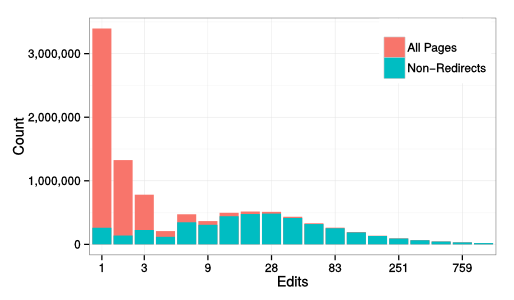
In wikis, redirects are special pages that silently take readers from the page they are visiting to another page. Although their presence is noted in tiny gray text (see the image below) most people use them all the time and never know they exist. Redirects exist to make linking between pages easier, they populate Wikipedia s search autocomplete list, and are generally helpful in organizing information. In the English Wikipedia, redirects make up more than half of all article pages. seattle_redirectOver the years, I ve spent some time contributing to to Redirects for Discussion (RfD). I think of RfD as like an ultra-low stakes version of Articles for Deletion where Wikipedians decide whether to delete or keep articles. If a redirect is deleted, viewers are taken to a search results page and almost nobody notices. That said, because redirects are almost never viewed directly, almost nobody notices if a redirect is kept either! I ve told people that if they want to understand the soul of a Wikipedian, they should spend time participating in RfD. When you understand why arguing about and working hard to come to consensus solutions for how Wikipedia should handle individual redirects is an enjoyable way to spend your spare time where any outcome is invisible you understand what it means to be a Wikipedian. That said, wiki researchers rarely take redirects into account. For years, I ve suspected that accounting for redirects was important for Wikipedia research and that several classes of findings were noisy or misleading because most people haven t done so. As a result, I worked with my colleague Aaron Shaw at Northwestern earlier this year to build a longitudinal dataset of redirects that can capture the dynamic nature of redirects. Our work was published as a short paper at OpenSym several months ago. It turns out, taking redirects into account correctly (especially if you are looking at activity over time) is tricky because redirects are stored as normal pages by MediaWiki except that they happen to start with special redirect text. Like other pages, redirects can be updated and changed over time are frequently are. As a result, taking redirects into account for any study that looks at activity over time requires looking at the text of every revision of every page. Using our dataset, Aaron and I showed that the distribution of edits across pages in English Wikipedia (a relationships that is used in many research projects) looks pretty close to log normal when we remove redirects and very different when you don t. After all, half of articles are really just redirects and, and because they are just redirects, these articles are almost never edited. edits_over_pagesAnother puzzling finding that s been reported in a few places and that I repeated myself several times is that edits and views are surprisingly uncorrelated. I ll write more about this later but the short version is that we found that a big chunk of this can, in fact, be explained by considering redirects. We ve published our code and data and the article itself is online because we paid the ACM s open access fee to ransom the article.

28 December 2014

Ian Donnelly: New Release and Farewell to Planet Debian

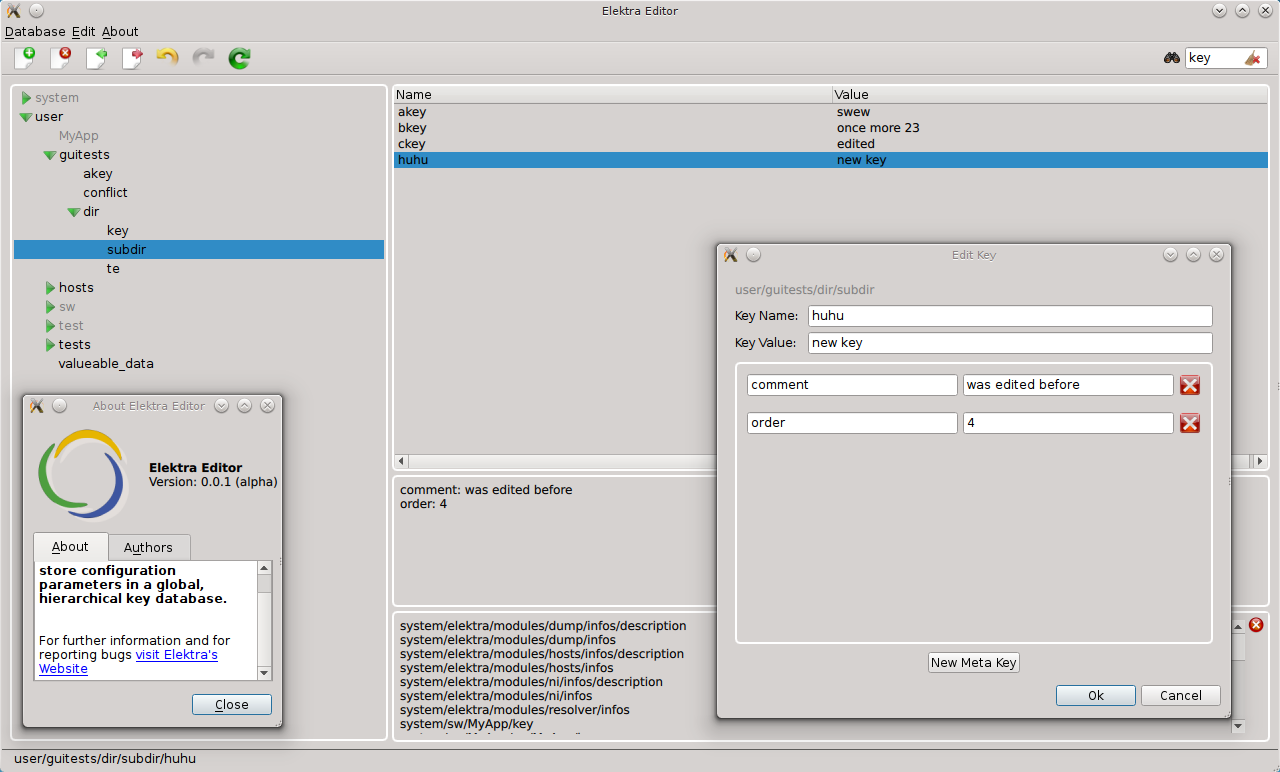
Hi Everyone, So first I want to say, that I appreciate all the interest in our project from the folks who read our posts at Planet Debian. This will be our last post there for now, I hope you enjoyed the posts about my Google Summer of Code project and other info about Elektra we posted there. To stay informed about Elektra s releases, please subscribe to this RSS feed. Today I want to thank you all and tell you about the latest exciting Elektra news, our newest release 0.8.10! This new release brings many exciting updates and features, since I didn t to a post for Elektra 0.8.9, this post will cover changes and additions from Elektra 0.8.8 to 0.8.10. First of all, there is now a new gui for KDB! A big thanks goes out to Raffael Pancheri for developing this GUI! Once included in your Elektra build, this gui can be run using the command kdb qt-gui. It is very important to note that the gui is in version 0.0.2, meaning it is an alpha project and shouldn t be considered stable yet! This GUI is a convenient tool that lets you mount, unmount, search, import and export configurations. We are very excited about this tool and we hope it makes Elektra more accessible to all users. Check out the screenshot below to see this new GUI in action:

A screenshot of the new qt-gui tool

A few other new features are that Felix added support for multi-line into the ini plugin. Users are able to turn this feature on or off for each configuration. Additionally, Kai-Uwe added support for Windows 7 to Elektra! The Windows 7 port relies on a new resolver called wresolver which is a simpler version of the regular resolver which is compatible with Windows. Additionally, there is a new Java binding, so now Elektra is compatible with applications and plugins written in Java! On top of these features, a new hosts plugin and a new rename plugin have been written. The new hosts in conjunction with improvements to the ini plugin allows for multiple styles of comments (because some ini dialects allow ; and # to be used to differentiate comments) to be used and preserved in configuration files. Additionally, this new hosts plugin is compatible with and differentiates between ipv4 and ipv6 entries. There have also been a huge number of under-the-hood improvements, changes, and fixes; there have been so many in-fact that I am going to list them: There are many more new changes that I could not mention here. Please keep up-to-date with Elektra news and releases by subscribing to this RSS feed and following our news page on GitHub. As always feel free to comment on our posts and I will get back to you as soon as possible. Again, thanks for reading our blog, enjoy the new release! Sincerely,
Ian S. Donnelly P.S. Happy New Year to everybody!

Russ Allbery: Review: Some Remarks

Review: Some Remarks, by Neal Stephenson
Publisher: William Morrow
Copyright: June 2013
ISBN: 0-06-202444-2
Format: Trade paperback
Pages: 336
This is going to be another weird review, since I read this essay collection about three months ago, and I borrowed it from a friend. So this is both from fading memory and without a handy reference other than Internet searches. Apologies in advance for any important details that I miss. The advantage is that you'll see what parts of this collection stuck in my memory. Some Remarks is, as you might guess from the title, a rather random collection of material. There's one long essay that for me was the heart of the book (more on that in a moment), two other longer essays, two short stories, and thirteen other bits of miscellaneous writing of varying lengths. I found most of the short essays unremarkable. Stephenson uses a walking desk because sitting is bad for you that sentence contains basically all of the interesting content of one of the essays. I think it takes a large topic and some running room before Stephenson can get up to speed and produce something that's more satisfying than technological boosterism. That means the most interesting parts of this book are the three longer works. "In the Kingdom of Mao Bell" was previously published in Wired and is still available. Some Remarks contains only excerpts; Stephenson says that some of the original essay is no longer that interesting. I had mixed feelings about this one. Some of the sense of place he creates was fun to read, but Stephenson can't seem to quite believe that the Chinese don't care about "freedom" according to his definitions in the same way and therefore don't have the same political reaction to hacker culture that he does. This could have been an opportunity for him to question assumptions, but instead it's mostly an exercise in dubious, sweeping cultural evaluation, such as "the country has a long history of coming up with technologies before anyone else and then not doing a lot with them." A reminder that the detail with which Stephenson crams his writing is not always... true. Stronger is "Atoms of Cognition: Metaphysics in the Royal Society 1715 2010," which covers material familiar to readers of Stephenson's Baroque Cycle. The story of Newton, Leibniz, their rivalry, and the competing approaches to thinking about mathematics and science was my favorite part of that series, and in some ways the non-fiction treatment is better than the fictional one. If you liked the Baroque Cycle, this is worth reading. But the highlight of the book for me was "Mother Earth Mother Board." This is a long essay (50,000 words, practically a small book and the largest part of this collection) about the laying of undersea fiber-optic cables. Those who have read Cryptonomicon will recognize some of the themes here, but there's way more to this essay than there was to the bits about undersea cables in Cryptonomicon. It's mostly about technology, rather than people, which puts Stephenson on firmer ground. The bit about people reads more like a travelogue, full of Stephenson's whole-hearted admiration of people who build things and make things work. There's a bit of politics, a bit of history, a bit of tourism, and a lot of neat trivia about a part of the technological world that I'd not known much about before. I would say this is worth the price of the collection, but it too was previously published in Wired, so you can just read it online. Those reading this review on my web site will notice that I filed it in non-fiction. There are a couple of stories, but they're entirely forgettable (in fact, I had entirely forgotten them, and had to skim them again). But, for the record, here are short reviews of those: "Spew": This originally appeared in Wired and can still be read on-line. The protagonist takes a job as a sort of Internet marketing inspector who looks for deviations from expected profiles. While tracing down an anomaly, though, he finds another use of the Internet that's outside of the marketing framework he's using. It's unlikely that anyone who's been online for long will find much new in this story. Some of that is because it was originally published in 1994, but most of it is just that this isn't a very good story. Stephenson seems to have turned up his normal manic infodump to 11 to satisfy the early Wired aesthetic, and the result is a train wreck of jargon, bad slang, and superficial social observation. (3) "The Great Simoleon Caper": Originally published in TIME, this story too is still available online. It's primarily interesting because it's a story about Bitcoin (basically), written in 1995. And it's irritating for exactly the same reason that Bitcoin enthusiasm often tends to be irritating: the assumption that cryptocurrency is somehow a revolutionary attack on government-run currency systems. I'm not going to get into the ways in which this doesn't make sense given how money is used socially (David Graeber's Debt is the book to read if you want more information); just know that the story follows that path and doesn't engage with any of the social reasons why that outcome is highly unlikely. Indeed, the lengths to which the government tries to go to discredit cryptocurrency in this story are rather silly. Apart from that, this is typical early Stephenson writing. It's very in love with ideas, not as much with characterization, and consists mostly of people explaining things to each other. Sometimes this is fun, but when focused on topics about which considerably more information has become available, it doesn't age very well. (5) Overall, there was one great essay and a few interesting bits, but I wouldn't have felt I was missing much if I'd never read this collection. I borrowed Some Remarks from a friend, and I think that's about the right level of effort. If it falls into your hands, or you see it in a library, some of the essays, particularly "Mother Earth Mother Board," are worth reading, but given that the best parts are available on-line for free, I don't think it's worth a purchase. Rating: 6 out of 10

26 December 2014

Russ Allbery: pam-krb5 4.7

It's been a long, long time since the last upstream release. Rather too long, as the changes to the portability and test framework were larger than the changes to the module itself. But there are a few bug fixes here and one new feature. The new feature is a new option, no_update_user, which disables the normal update of PAM_USER for the rest of the PAM stack to the canonicalized local username. This allows users to do things like enter Kerberos principals into the login prompt and have the right thing happen, but sometimes it's important to keep the authentication credentials as originally entered and not canonicalize, even if there's a local canonicalization available. This new option allows that. In the bug-fix department, the module now suppresses spurious password prompts from Heimdal while using PKINIT and understands more Kerberos errors for purposes of try_first_pass support and returning better PAM errors. The documentation now notes next to each option the version of pam-krb5 at which it was introduced with its current meaning. You can get the latest version from the pam-krb5 distribution page.

Vasudev Kamath: Notes: LXC How-To

LXC - Linux Containers allows us to run multiple isolated Linux system under same control host. This will be useful for testing application without changing our existing system. To create an LXC container we use the lxc-create command, it can accepts the template option, with which we can choose the OS we would like to run under the virtual isolated environment. On a Debian system I see following templates supported
[vasudev@rudra: ~/ ]% ls /usr/share/lxc/templates
lxc-alpine*    lxc-archlinux*  lxc-centos*  lxc-debian*    lxc-fedora*  lxc-openmandriva*  lxc-oracle*  lxc-sshd*    lxc-ubuntu-cloud*
lxc-altlinux*  lxc-busybox*    lxc-cirros*  lxc-download*  lxc-gentoo*  lxc-opensuse*      lxc-plamo*   lxc-ubuntu*
For my application testing I wanted to create a Debian container for my By default the template provided by lxc package creates Debian stable container. This can be changed by passing the option to debootstrap after -- as shown below.
sudo MIRROR=http://localhost:9999/debian lxc-create -t debian \
     -f   container.conf -n container-name -- -r sid
-r switch is used to specify the release, MIRROR environment variable is used to choose the required Debian mirror. I wanted to use my own local approx installation, so I can save some bandwidth. container.conf is the configuration file used for creating the LXC, in my case it contains basic information on how container networking should b setup. The configuration is basically taken from LXC Debian wiki
lxc.utsname = aptoffline-dev
lxc.network.type = veth
lxc.network.flags = up
lxc.network.link = br0.1
lxc.network.name = eth0
lxc.network.ipv4 = 192.168.3.2/24
lxc.network.veth.pair = vethvm1
I'm using VLAN setup described in Debian wiki: LXC VLAN Networking page. Below is my interfaces file.
iface eth0.1 inet manual
iface br0.1  inet manual
   bridge_ports eth0.1
   bridge_fd 0
   bridge_maxwait 0
Before launching the LXC make sure you run below command
sudo ifup eth0.1
sudo ifup br0.1
# Also give ip to bridge in same subnet as lxc.network.ipv4
sudo ip addr add 192.168.3.1/24 dev br0.1
I'm giving ip address to bridge so that I can communicate with container from my control host, once it comes up. Now start the container using below command
sudo lxc-start -n container -d -c tty8
We are starting lxc in daemon mode and attaching it to console tty8. If you want, you can drop -d and -c option to start lxc in foreground. But its better you start it in background and attach using lxc-console command shown below.
sudo lxc-console -n container -t tty8
You can detach from console using Ctrl+a q combination and let lxc execute in background. Its also possible to simply ssh into the running container since we have enabled networking. Stopping the container should be done using lxc-stop command, but without -k switch (kill) this command never returned. Even with timeout container is not stopped.
sudo lxc-stop -n container
-r can be used for reboot of container. Since I couldn't get clean shutdown I normally attach the console and issue a halt command in container itself. Not sure if this is the right way, but it gets the thing done. I consider Linux container as a better alternative for spawning a virtual Linux environment instead of running a full blown VM like Virtualbox or VMware.

Russ Allbery: rra-c-util 5.6

rra-c-util is my personal collection of infrastructure for C and Perl packages. This release has a quite-large accumulation of small fixes, mostly from work Julien LIE has done on merging it into INN and testing INN's portability on a wide variety of platforms. The highlights: You can get the latest version from the rra-c-util distribution page.

24 December 2014

Chris Lamb: find(1), trailing slashes and symbolic links to directories

Here's a nice little "gotcha" in find(1). First, let's create a directory and a symlink to that directory. We'll add an empty file just underneath to illustrate what is going on:
$ mkdir a
$ ln -s a b
$ touch a/file
If we invoke find with a trailing slash, everything works as expected:
$ find a/
a/
a/file
$ find b/
b/
b/file
... but if we omit the trailing slash, find does not traverse the symlink:
$ find a
a
a/file
$ find b
b
This implies that any normal-looking invokation of find such as:
find /path/to/dir -name 'somefile.ext' ...
... is subtly buggy as it won't accomodate the sysadmin replacing that path with a symlink.
This is, of course, well-covered in the find(1) manpage (spoiler: the safest option is to specify -H, or simply to append the trailing slash), but I would still class this as a "gotcha" because of the subtle difference between the trailing and non-trailing slash variants. Putting it another way, it's completely reasonable that find doesn't follow symlinks, but when this behaviour based on the presence of the trailing slash a usually meaningless syntactic distinction it crosses the rubicon to being counter-intutive.

Gregor Herrmann: GDAC 2014/24

the last year hasn't been an easy one for debian. we've seen lots of fights, unproductive discussions, & in general behaviour which contributed to what enrico in his brilliant blog post called the "stink in the kitchen". people's feelings were hurt, some became less active, others resigned from a specific position or retired completely. it happened to me as well that reading through threads full of trolling, aggressiveness, finger-pointing, unrespectful or abusive behaviour, etc. made me frustrated, or sad, or angry, or all kinds of other negative feelings. but then I usually told myself: this is not the debian project as I know it; this is only a small part a part which urgently needs improvement! ; but if we only look at it alone, our picture of debian at large is distorted. the much bigger part of the debian life I know doesn't happen on this handful of high-profile mailing lists; it happens on dozens of specialized mailing lists, in many small IRC channels, in the BTS, & in in-person meetings. & what I see there is most of the time constructive, collaborative, respectful communication, & committed, helpful, funny, awesome people. the idea of this advent calendar was to give examples of some of my recent experiences which demonstrate what the bright side of debian is in my opinion & what contributes to my fun in debian. with the aim of sharing my impression that the proverbial "stink" is, if we take a step back, only one piece of the bigger picture, & that we shouldn't let ourselves get demotivated by only staring at this puzzle piece. thanks to all the awesome contributors for polishing existing & adding new shiny puzzle pieces to our common picture every day! finally: thanks for reading this series of posts, & especially thank you to all who provided positive feedback this in turn motivated me to follow through! & now: back to work, & don't forget to help cleaning the kitchen :)
this posting is part of GDAC (gregoa's debian advent calendar), a project to show the bright side of debian & why it's fun for me to contribute.

Next.

Previous.