Search Results: "ana"

19 November 2014

Erich Schubert: What the GR outcome means for the users

The GR outcome is: no GR necessary
This is good news.
Because it says: Debian will remain Debian, as it was the last 20 years.
For 20 years, we have tried hard to build the "universal operating system", and give users a choice. We've often had alternative software in the archive. Debian has come up with various tool to manage alternatives over time, and for example allows you to switch the system-wide Java.
You can still run Debian with sysvinit. There are plenty of Debian Developers which will fight for this to be possible in the future.
The outcome of this resolution says:
  • Using a GR to force others is the wrong approach of getting compatibility.
  • We've offered choice before, and we trust our fellow developers to continue to work towards choice.
  • Write patches, not useless GRs. We're coders, not bureocrats.
  • We believe we can do this, without making it a formal MUST requirement. Or even a SHOULD requirement. Just do it.
The sysvinit proponents may perceive this decision as having "lost". But they just don't realize they won, too. Because the GR may easily have backfired on them. The GR was not "every package must support sysvinit". It was also "every sysvinit package must support systemd". Here is an example: eudev, a non-systemd fork of udev. It is not yet in Debian, but I'm fairly confident that someone will make a package of it after the release, for the next Debian. Given the text of the GR, this package might have been inappropriate for Debian, unless it also supports systemd. But systemd has it's own udev - there is no reason to force eudev to work with systemd, is there?
Debian is about choice. This includes the choice to support different init systems as appropriate. Not accepting a proper patch that adds support for a different init would be perceived as a major bug, I'm assured.
A GR doesn't ensure choice. It only is a hammer to annoy others. But it doesn't write the necessary code to actually ensure compatibility.
If GNOME at some point decides that systemd as pid 1 is a must, the GR only would have left us three options: A) fork the previous version, B) remove GNOME altogether, C) remove all other init systems (so that GNOME is compliant). Does this add choice? No.
Now, we can preserve choice: if GNOME decides to go systemd-pid1-only, we can both include a forked GNOME, and the new GNOME (depending on systemd, which is allowed without the GR). Or any other solution that someone codes and packages...
Don't fear that systemd will magically become a must. Trust that the Debian Developers will continue what they have been doing the last 20 years. Trust that there are enough Debian Developers that don't run systemd. Because they do exist, and they'll file bugs where appropriate. Bugs and patches, that are the appropriate tools, not GRs (or trolling).

Thorsten Glaser: Debian init system freedom of choice GR worst possible outcome

Apparently (the actual results have not yet been published by the Secretary), the GR is over, and the worst possible option has won. This is an absolutely ambiguous result, while at the same time sending a clear signal that Debian is not to be trusted wrt. investing anything into it, right now. Why is this? Simply: GR not required means that whatever people do is probably right . Besides this, we have one statement from the CTTE ( systemd is default init system for jessie. Period. ) and nothing else. This means that runit, or upstart, or file-rc, or uselessd, can be the default init system for zurg^H^H^H^Hstretch, or even the only one. It also means that the vast majority of Debian Developers are sheeple, neither clearly voting to preserve freedom of choice between init systems for its users, nor clearly voting to unambiguously support systemd and progress over compatibility and choice, nor clearly stating that systemd is important but supporting other init systems is still recommended. (I ll not go into detail on how the proposer of the apparently winning choice recommends others to ignore ftpmaster constraints and licences, and even suggests to run a GR to soften up the DFSG interpretation.) I d have voted this as no, absolutely not if it was possible to do so more strongly. Judging from the statistics, the only thing I voted above NOTA/FD is the one least accepted by DDs, although the only other proposal I considered is the first-rated of them: support for other init systems is recommended but not required. What made me vote it below NOTA/FD was: The Debian Project makes no statement at this time on sysvinit support beyond the jessie release. This sentence made even this proposal unbearable, unacceptable, for people wanting to invest (time, money, etc.) into Debian. Update: Formal result announced. So 358 out of 483 voting DDs decided to be sheeple (if I understand the eMail correctly). We had 1006 DDs with voting rights, which is a bit ashaming as well. That s 48.01% only. I wonder what s worse. This opens up a very hard problem: I m absolutely stunned by this and wondering what to do now. While there is no real alternative to Debian at $dayjob I can always create customised packages in my own APT repository, and while it was great when those were eventually (3.1.17-1) accepted into Debian, even replacing the previous packages completely it is simpler and quicker to not do so. While $dayjob benefits from having packages I work on inside Debian itself, even though I cannot always test all scenarios Debian users would need, some work reduction due to reactions already led to Debian losing out on Mediawiki for jessie and some additional suffering. With my own package repository, I can modulo installing/debootstrap serve my needs for $dayjob much quicker, easily, etc. and only miss out on absolutely delightful user feedback. But then, others could always package software I m upstream of for Debian. Or, if I do not leave the project, continue doing so via QA uploads. I m also disappointed because I have invested quite some effort into trying to make Debian better (my idea to join as DD was if I ve got to use it, it better be damn good! ), into packaging software and convincing people at work that developing software as Debian packages instead of (or not) thinking of packaging later was good. I ve converted our versions of FusionForge and d-push to Debian packages, and it works pretty damn well. Sometimes it needs backports of my own, but that s the corportate world, and no problem to an experienced DD. (I just feel bad we ($orkplace) lost some people, an FTP master along them, before this really gained traction.) I d convert to OpenBSD because, despite MirBSD s history with them, they re the only technically sound alternative, but apparently tedu (whom I respect technically, and who used to offer good advice to even me when asked, and who I think wouldn t choose systemd himself) still (allying with the systemd side (I m not against people being able to choose systemd, for the record, I just don t want to be forced into it myself!)) has some sort of grudge against me. Plus, it d be hard to get customers to follow. So, no alternative right now. But I m used to managing my own forks of software; I m doomed to basically hack and fix anything I use (I recently got someone who owns a licence to an old-enough Visual Studio version to transfer that to me, so I can hack on the Windows Mobile 6 version of Cachebox, to fix bugs in one of the geocaching applications I use. Now I just need to learn C# and the .NET Compact Framework. So I m also used to some amount of pain.) I m still unresolved wrt. the attitude I should show the Debian project now. I had decided to just continue to live on, and work on the things I need done, but that was before this GR non-result. I absolutely cannot recommend anyone to invest into Debian (without sounding hypocriet), but I cannot recommend anything else either. I cannot justify leaving but don t know if I want to stay. I think I should sleep over it. One thing I promised, and thus will do, is to organise a meeting of the Debian/m68k people soonish. But then, major and important and powerful forces inside Debian still insist that Debian-Ports are not part of it [Update: yes, DSA is moving it closer, thanks for that by the way, but that doesn t mean anything to certain maintainers or the Release Team, although, the latter is actually understandable and probably sensible.] yet, all forks of Debian now suffer from the systemd adoption in it instead of having a freedom-of-choice upstream. I ve said, and I still feel that systemd adoption should have done in a Debian downstream / (pure?) blend, and maybe (parts of) GNOME removed from Debian itself for it. (Adding cgroups support to the m68k kernel to support systemd was done. I adviced against it, on the grounds of memory and code size. But no downstream can remove it now.)

Dirk Eddelbuettel: R / Finance 2015 Call for Papers

Earlier today, Josh send the text below to the R-SIG-Finance list, and I updated the R/Finance website, including its Call for Papers page, accordingly. We are once again very excited about our conference, thrilled about the four confirmed keynotes, and hope that many R / Finance users will not only join us in Chicago in May 2015 -- but also submit an exciting proposal. So read on below, and see you in Chicago in May! Call for Papers: R/Finance 2015: Applied Finance with R
May 29 and 30, 2015
University of Illinois at Chicago, IL, USA
The seventh annual R/Finance conference for applied finance using R will be held on May 29 and 30, 2015 in Chicago, IL, USA at the University of Illinois at Chicago. The conference will cover topics including portfolio management, time series analysis, advanced risk tools, high-performance computing, market microstructure, and econometrics. All will be discussed within the context of using R as a primary tool for financial risk management, portfolio construction, and trading. Over the past six years, R/Finance has included attendees from around the world. It has featured presentations from prominent academics and practitioners, and we anticipate another exciting line-up for 2015. This year will include invited keynote presentations by Emanuel Derman, Louis Marascio, Alexander McNeil, and Rishi Narang. We invite you to submit complete papers in pdf format for consideration. We will also consider one-page abstracts (in txt or pdf format) although more complete papers are preferred. We welcome submissions for both full talks and abbreviated "lightning talks." Both academic and practitioner proposals related to R are encouraged. All slides will be made publicly available at conference time. Presenters are strongly encouraged to provide working R code to accompany the slides. Data sets should also be made public for the purposes of reproducibility (though we realize this may be limited due to contracts with data vendors). Preference may be given to presenters who have released R packages. The conference will award two (or more) $1000 prizes for best papers. A submission must be a full paper to be eligible for a best paper award. Extended abstracts, even if a full paper is provided by conference time, are not eligible for a best paper award. Financial assistance for travel and accommodation may be available to presenters, however requests must be made at the time of submission. Assistance will be granted at the discretion of the conference committee. Please make your submission online at this link. The submission deadline is January 31, 2015. Submitters will be notified via email by February 28, 2015 of acceptance, presentation length, and financial assistance (if requested). Additional details will be announced via the R/Finance conference website as they become available. Information on previous years' presenters and their presentations are also at the conference website. For the program committee:
Gib Bassett, Peter Carl, Dirk Eddelbuettel, Brian Peterson, Dale Rosenthal,
Jeffrey Ryan, Joshua Ulrich

18 November 2014

Jonathan Wiltshire: Getting things into Jessie (#3)

Make sure everything you ve changed is in the changelog We do read the diffs in detail, and if there s no explanation for something that s changed we ll ask. We also expect it to be in the changelog. Do save some round-trips by making sure your changelog is in order. One round-trip about your package is an inconvenience; when it s scaled up to the number of requests we receive, it s a serious time-sink for us.
Getting things into Jessie (#3) is a post from: jwiltshire.org.uk Flattr

Antoine Beaupr : bup vs attic silly benchmark

after see attic introduced in a discussion about bup, i figured out i could give it a try. it was answering two of my biggest concerns with bup: and seemed to magically out of nowhere and basically do everything i need, with an inline manual on top of it.

disclaimer Note: this is not a real benchmark! i would probably need to port bup and attic to liw's seivot software to report on this properly (and that would amazing and really interesting, but it's late now). even worse, this was done on a production server with other stuff going on so take results with a grain of salt.

procedure and results Here's what I did. I setup backups of my ridiculously huge ~/src directory on the external hard drive where I usually make my backups. I ran a clean backup with attic, than redid it, then I ran a similar backup with bup, then redid it. Here are the results:
anarcat@marcos:~$ sudo apt-get install attic # this installed 0.13 on debian jessie amd64
[...]
anarcat@marcos:~$ attic init /mnt/attic-test:
Initializing repository at "/media/anarcat/calyx/attic-test"
Encryption NOT enabled.
Use the "--encryption=passphrase keyfile" to enable encryption.
anarcat@marcos:~$ time attic create --stats /mnt/attic-test::src ~/src/
Initializing cache...
------------------------------------------------------------------------------
Archive name: src
Archive fingerprint: 7bdcea8a101dc233d7c122e3f69e67e5b03dbb62596d0b70f5b0759d446d9ed0
Start time: Tue Nov 18 00:42:52 2014
End time: Tue Nov 18 00:54:00 2014
Duration: 11 minutes 8.26 seconds
Number of files: 283910
                       Original size      Compressed size    Deduplicated size
This archive:                6.74 GB              4.27 GB              2.99 GB
All archives:                6.74 GB              4.27 GB              2.99 GB
------------------------------------------------------------------------------
311.60user 68.28system 11:08.49elapsed 56%CPU (0avgtext+0avgdata 122824maxresident)k
15279400inputs+6788816outputs (0major+3258848minor)pagefaults 0swaps
anarcat@marcos:~$ time attic create --stats /mnt/attic-test::src-2014-11-18 ~/src/
------------------------------------------------------------------------------
Archive name: src-2014-11-18
Archive fingerprint: be840f1a49b1deb76aea1cb667d812511943cfb7fee67f0dddc57368bd61c4bf
Start time: Tue Nov 18 00:05:57 2014
End time: Tue Nov 18 00:06:35 2014
Duration: 38.15 seconds
Number of files: 283910
                       Original size      Compressed size    Deduplicated size
This archive:                6.74 GB              4.27 GB            116.63 kB
All archives:               13.47 GB              8.54 GB              3.00 GB
------------------------------------------------------------------------------
30.60user 4.66system 0:38.38elapsed 91%CPU (0avgtext+0avgdata 104688maxresident)k
18264inputs+258696outputs (0major+36892minor)pagefaults 0swaps
anarcat@marcos:~$ sudo apt-get install bup # this installed bup 0.25
anarcat@marcos:~$ free && sync && echo 3   sudo tee /proc/sys/vm/drop_caches && free # flush caches
anarcat@marcos:~$ export BUP_DIR=/mnt/bup-test
anarcat@marcos:~$ bup init
D p t Git vide initialis  dans /mnt/bup-test/
anarcat@marcos:~$ time bup index ~/src
Indexing: 345249, done.
56.57user 14.37system 1:45.29elapsed 67%CPU (0avgtext+0avgdata 85236maxresident)k
699920inputs+104624outputs (4major+25970minor)pagefaults 0swaps
anarcat@marcos:~$ time bup save -n src ~/src
Reading index: 345249, done.
bloom: creating from 1 file (200000 objects).
bloom: adding 1 file (200000 objects).
bloom: creating from 3 files (600000 objects).
Saving: 100.00% (6749592/6749592k, 345249/345249 files), done.
bloom: adding 1 file (126005 objects).
383.08user 61.37system 10:52.68elapsed 68%CPU (0avgtext+0avgdata 194256maxresident)k
14638104inputs+5944384outputs (50major+299868minor)pagefaults 0swaps
anarcat@marcos:attic$ time bup index ~/src
Indexing: 345249, done.
56.13user 13.08system 1:38.65elapsed 70%CPU (0avgtext+0avgdata 133848maxresident)k
806144inputs+104824outputs (137major+38463minor)pagefaults 0swaps
anarcat@marcos:attic$ time bup save -n src2 ~/src
Reading index: 1, done.
Saving: 100.00% (0/0k, 1/1 files), done.
bloom: adding 1 file (1 object).
0.22user 0.05system 0:00.66elapsed 42%CPU (0avgtext+0avgdata 17088maxresident)k
10088inputs+88outputs (39major+15194minor)pagefaults 0swaps
Disk usage is comparable:
anarcat@marcos:attic$ du -sc /mnt/*attic*
2943532K        /mnt/attic-test
2969544K        /mnt/bup-test
People are encouraged to try and reproduce those results, which should be fairly trivial.

Observations Here are interesting things I noted while working with both tools:
  • attic is Python3: i could compile it, with dependencies, by doing apt-get build-dep attic and running setup.py - i could also install it with pip if i needed to (but i didn't)
  • bup is Python 2, and has a scary makefile
  • both have an init command that basically does almost nothing and takes little enough time that i'm ignoring it in the benchmarks
  • attic backups are a single command, bup requires me to know that i first want to index and then save, which is a little confusing
  • bup has nice progress information, especially during save (because when it loaded the index, it knew how much was remaining) - just because of that, bup "feels" faster
  • bup, however, lets me know about its deep internals (like now i know it uses a bloom filter) which is probably barely understandable by most people
  • on the contrary, attic gives me useful information about the size of my backups, including the size of the current increment
  • it is not possible to get that information from bup, even after the fact - you need to du before and after the backup
  • attic modifies the files access times when backing up, while bup is more careful (there's a pull request to fix this in attic, which is how i found out about this)
  • both backup systems seem to produce roughly the same data size from the same input

Summary attic and bup are about equally fast. bup took 30 seconds less than attic to save the files, but that's not counting the 1m45s it took indexing them, so on the total run time, bup was actually slower. attic is also (almost) two times faster on the second run as well. but this could be within the margin of error of this very quick experiment, so my provisional verdict for now would be that they are about as fast. bup may be more robust (for example it doesn't modify the atimes), but this has not been extensively tested and is more based with my familiarity with the "conservatism" of the bup team rather than actual tests. considering all the features promised by attic, it makes for a really serious contender to the already amazing bup.

Next steps The properly do this, we would need to:
  • include other software (thinking of Zbackup, Burp, ddar, obnam, rdiff-backup and duplicity)
  • bench attic with the noatime patch
  • bench dev attic vs dev bup
  • bench data removal
  • bench encryption
  • test data recovery
  • run multiple backup runs, on different datasets, on a cleaner environment
  • ideally, extend seivot to do all of that
Note that the Burp author already did an impressive comparative benchmark of a bunch of those tools for the burp2 design paper, but it unfortunately doesn't include attic or clear ways to reproduce the results.

17 November 2014

Vincent Sanders: NetSurf Developer workshop IV

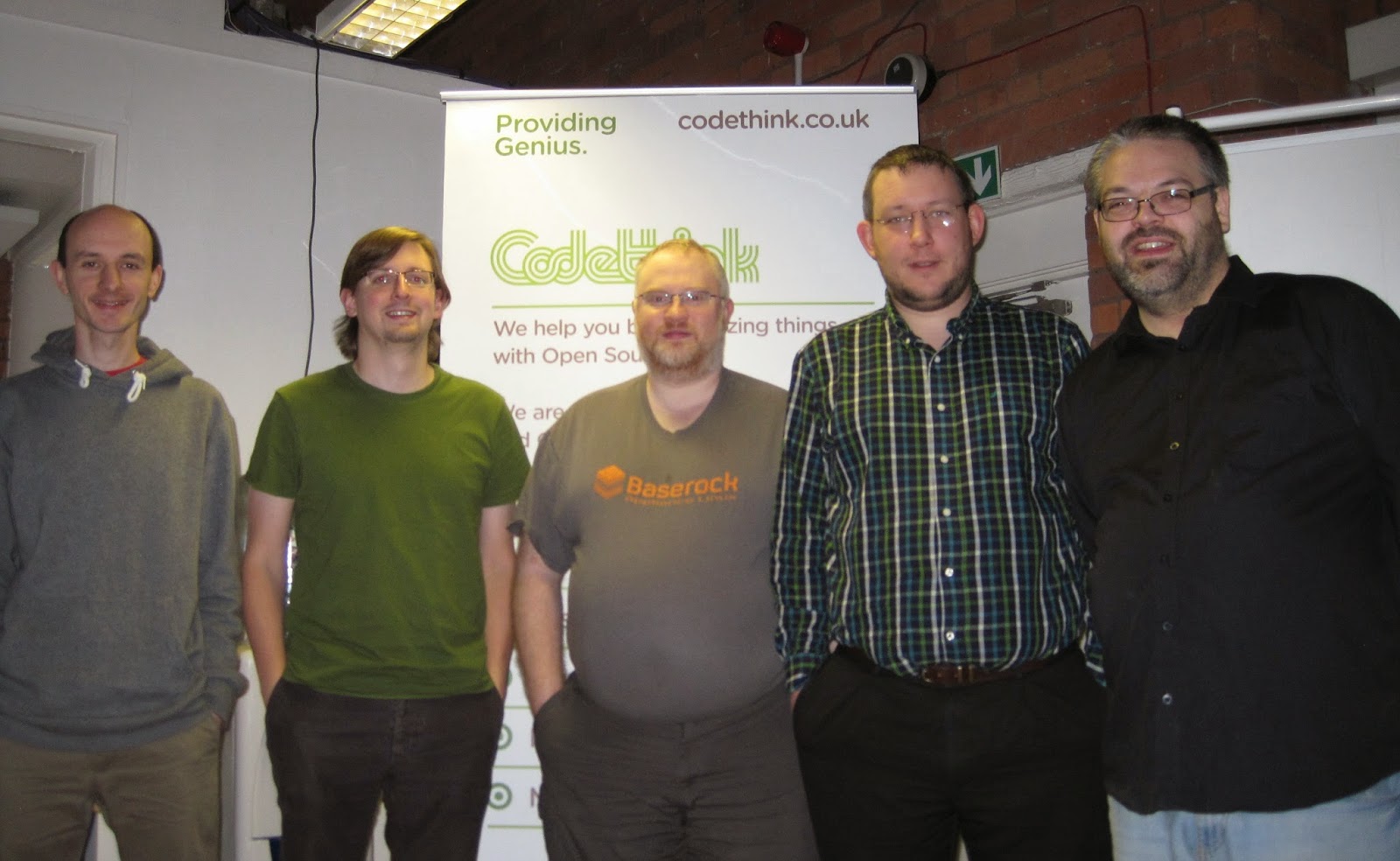
Michael Drake, John-Mark Bell, Daniel Silverstone, Rob Kendrick and Vincent Sanders at the Codethink manchester office
Over the weekend the NetSurf developers met to make a concentrated effort on improving the browser. This time we were kindly hosted by Codethink in their Manchester office in a pleasant environment with plenty of refreshments.

Five developers managed to attend in person from around the UK: Michael Drake, John-Mark Bell, Daniel Silverstone, Rob Kendrick and Vincent Sanders. We also had Chris Young providing some bug fixes remotely.

We started the weekend by discussing all the thorny core issues that had been put on the agenda and ensuring the outcomes were properly noted. We also held the society AGM which was minuted by Daniel.

The emphasis of this weekend was very much on planning and doing the disruptive changes we had been putting off until we were all together.

John-Mark and myself managed to change the core build system as used by all the libraries to using standard triplets to identify systems and use the gnu autoconf style of naming for parameters (i.e. HOST, BUILD and CC being used correctly).

This was accompanied by improvements and configuration changes to the CI system to accommodate the new usage.

Several issues from the bug tracker were addressed and we put ourselves in a stronger position to address numerous other usability problems in the future.

We managed to pack a great deal into the 20 hours of work on Saturday and Sunday although because we were concentrating much more on planning and infrastructure rather than a release the metrics of commits and files changed were lower than at previous events.

Thorsten Alteholz: Manage own CA with Debian

Self signed SSL certificates are nice, but only provide encryption of retrieved data. Nobody knows who is really sending the data. If one buys an SSL certificate for a website, the browser doesn t complain as much as with a self signed certificate. But can you really trust the other side? Almost every commercial CA has some kind of fast validation or domain validation, issued in minutes , which is done by email or phone. So if required, within minutes everybody might become you. Even with putting money on the table your users can not be sure whether this server really belongs to the right guy. Well, why wasting time and money? Just create your own Root CA and tell users that they need to add something in order to avoid some error messages. In Debian we basically have five packages who claim to be able to manage some kind of CA. easy-rsa is mainly needed to manage certificates used by openVPN. Within this use case it works like a charm, but I don t want to manage a more complex CA with it. gnomint is dead upstream and only uses SHA1 as signature algorithm. This will cause lots of problems as Mircrosoft and Google want to deprecate SHA1 in their products by 2017. Besides, this package is already orphaned and maybe it can disappear now. tinyCA uses more signature algorithms, unfortunately SHA1 seems to be the best it can. There are some patches to support up to SHA512, but they don t work for all parts of the software yet. For example Sub-CAs still use SHA1 despite of choosing something different in the GUI. So nice, but not (yet) usable in Jessie. FreeIPA seems to be great, but didn t make it into Jessie in time. Unfortunately the Release Team has reasons to not unblock it. So nice, but not usable in Jessie. xca is based on QT4. As announced in the 15th DPN of 2014 the deprecated QT4 will be removed from Debian Stretch (= Jessie+1). Apart from this, the software meets all my requirements.

Daniel Leidert: Removal of debian.wgdd.de and cvs,svn,vcs .wgdd.de

If you've recently tried to browse to or apt-get from either cvs.wgdd.de, svn.wgdd.de, vcs.wgdd.de, debian.wgdd.de or ubuntu.wgdd.deyou've probably seen (and still are) an error (410, Gone) coming up and I'd like to give a short explanation why. cvs,svn,vcs .wgdd.deI've left my server provider and shut down the above services and only keep a small amount of services running. The domains cvs,svn,vcs .wgdd.de were used to provide (a) a subversion (SVN) server (via HTTPS and dav_svn) for some public and private work and (b) a CVS web-client to some old project works in CVS.Among the latter was e.g. old code to generate manual pages for the proprietary fglrx graphics driver, stuff that laid there untouched for many years. So I guess, it was about time to finally remove it :)The subversion web-client gave public access to some packaging work I do for the Debian GNU/Linux distribution, e.g. for the cvsweb, gtypist packages and some non-official packaging work. For the official packages I plan to move the files into the collab-maint web space and adjust the packages control files accordingly. Everything else will be hosted non-publicly in the future. I still intend to move stuff, that turns out to be useful for more people, to public places like github and Co. Update 17.11.2014: cvsweb, gurlchecker and gtypist have been moved to collab-maint. debian.wgdd.deI used this site to describe my usage of Debian GNU/Linux on the hardware I own ... laptop, servers etc. I wrote a few HOWTOs and provided a link collection with useful links. You can still find all of this using the archive.org service. I also had a repository up and working, especially to provide bluefish packages for users of Debian stable and Ubuntu. Half a year ago I dropped the Ubuntu build environments and packages and moved the Debian stable backports to official places. This effectively emptied the repository and left only the wgdd-archive-keyring package in place. So, there is no real need for a public repository anymore and the linklist probably got outdated too. All in all, I decided to stop this service (maybe I'll forward the site to here later :)).If you see an error regarding the debian.wgdd.de URL running apt-get or aptitude, then there is a reference to this site in /etc/apt/sources.list or /etc/apt/sources.list.d/*, which can be safely removed. Further you should get rid of the wgdd-archive-keyring package:
apt-get autoremove --purge wgdd-archive-keyring
... or the repository key:
apt-key del E394D996
What elseIn case you need any content from the mentioned services, just let me know.

16 November 2014

Daniel Leidert: Getting the audio over HDMI to work for the HP N54L microserver running Debian Wheezy and a Sapphire Radeon HD 6450

Conclusion: Sound over HDMI works with the Sapphire Radeon HD 6450 card in my HP N54L microserver. It requires a recent kernel and firmware from Wheezy 7.7 backports and the X.org server. There is no sound without X.org, even if audio has been enabled for the radeon kernel module. Last year I couldn't get audio over HDMI to work after I installed a Sapphire Radeon HD 6450 1 GB (11190-02-20g) card into my N54L microserver. The cable that connects the HDMI interfaces between the card and the TV monitor supports HDMI 1.3, so audio should have been possible even then. However, I didn't get any audio output by XBMC playing video or music files. Nothing happened with stock Wheezy 7.1 and X.org/XBMC installed. So I removed the latter two and used the server as stock server without X/desktop and delayed my plans for an HTPC.Now I tried again after I found some new hints, that made me curious for a second try :) Imagine my joy, when (finally) speaker-test produced noise on the TV! So here is my configuration and a step-by-step guide to
  • enable Sound over HDMI for the Radeon HD 6450
  • install a graphical environment
  • install XBMC
  • automatically start XBMC on boot
The latter two will be covered by a second post. Also note, that there is lot of information out there to achive the above tasks. So this is only about my configuration. Some packages below are marked as optional. A few are necessary only for the N54L microserver (firmware) and for a few I'm not sure they are necessary at all. Step 1 - Prepare the systemAt this point I don't have any desktop nor any other graphical environment (X.org) installed. First I purged pulseaudio and related packages completely and only use ALSA:
# apt-get autoremove --purge pulseaudio pulseaudio-utils pulseaudio-module-x11 gstreamer0.10-pulseaudio
# apt-get install alsa-base alsa-utils alsa-oss
Next I installed a recent linux kernel and recent firmware from Wheezy backports:
# apt-get install -t wheezy-backports linux-image-amd64 firmware-linux-free firmware-linux firmware-linux-nonfree firmware-atheros firmware-bnx2 firmware-bnx2x
This put linux-image-3.16-0.bpo.3-amd64 and recent firmware onto my system. I've chosen to upgrade linux-image-amd64 instead to pick a special (recent) linux kernel package from Wheezy backports to keep up-to-date with recent kernels from there.Then I enabled the audio output of the kernel radeon module. Essentially there are at least three ways to do this. I use the one to modify /etc/modules.d/radeon.conf and set the audio parameter there. The hw_i2c parameter is disabled. I read, that it might cause trouble with the audio output here although I never personally experienced it:
options radeon audio=1 hw_i2c=0
JFTR: This is how I boot the N54L by default:
GRUB_CMDLINE_LINUX_DEFAULT="quiet splash acpi=force pcie_aspm=force nmi_watchdog=0"
After rebooting I see this for the Radeon card in question:

# lsmod egrep snd\ radeon\ drm awk ' print $1 ' sort
[..]
drm
drm_kms_helper
i2c_algo_bit
i2c_core
radeon
snd
snd_hda_codec
snd_hda_codec_hdmi
snd_hda_controller
snd_hda_intel
snd_hwdep
snd_pcm
snd_seq
snd_seq_device
snd_timer
soundcore
ttm
[..]
# lspci -k
[..]
01:00.0 VGA compatible controller: Advanced Micro Devices, Inc. [AMD/ATI] Caicos [Radeon HD 6450/7450/8450 / R5 230 OEM]
Subsystem: PC Partner Limited / Sapphire Technology Device e204
Kernel driver in use: radeon
01:00.1 Audio device: Advanced Micro Devices, Inc. [AMD/ATI] Caicos HDMI Audio [Radeon HD 6400 Series]
Subsystem: PC Partner Limited / Sapphire Technology Radeon HD 6450 1GB DDR3
Kernel driver in use: snd_hda_intel
[..]
# cat /sys/module/radeon/parameters/audio
1
# cat /sys/module/radeon/parameters/hw_i2c
0
# aplay -l
**** List of PLAYBACK Hardware Devices ****
card 0: HDMI [HDA ATI HDMI], device 3: HDMI 0 [HDMI 0]
Subdevices: 0/1
Subdevice #0: subdevice #0
# aplay -L
null
Discard all samples (playback) or generate zero samples (capture)
pulse
PulseAudio Sound Server
hdmi:CARD=HDMI,DEV=0
HDA ATI HDMI, HDMI 0
HDMI Audio Output
At this point, without having the X.org server installed, I still have no audio output to the connected monitor. Running alsamixer I only see the S/PDIF bar for the HDA ATI HDMI device, showing a value of 00. I can mute and un-mute this device but not change the value. No need to worry, sound comes with step two. Step 2 - Install a graphical environment (X.org server)Next is to install a graphical environment, basically the X.org server. This is done in Debian by the desktop task. Unfortunately tasksel makes use of APT::Install-Recommends="true" and would install a desktop environment and some more recommended packages. At the moment I don't want this, only X. So basically I installed only the task-desktop package with dependencies:
# apt-get install task-desktop xfonts-cyrillic
Next is to install a display manager. I've chosen lightdm:
# apt-get install lightdm accountsservice
Done. Now (re-)start the X server. Simply ...
# service lightdm restart
... should do. And now there is sound, probably due to the X.org Radeon driver. The following command created noise on the two monitor speakers :)
# speaker-test -c2 -D hdmi:0 -t pink
Finally there is sound over HDMI! Step 3 - Install XBMC To be continued ...

Tollef Fog Heen: Resigning as a Debian systemd maintainer

Apparently, people care when you, as privileged person (white, male, long-time Debian Developer) throw in the towel because the amount of crap thrown your way just becomes too much. I guess that's good, both because it gives me a soap box for a short while, but also because if enough people talk about how poisonous the well that Debian is has become, we can fix it. This morning, I resigned as a member of the systemd maintainer team. I then proceeded to leave the relevant IRC channels and announced this on twitter. The responses I've gotten have been almost all been heartwarming. People have generally been offering hugs, saying thanks for the work put into systemd in Debian and so on. I've greatly appreciated those (and I've been getting those before I resigned too, so this isn't just a response to that). I feel bad about leaving the rest of the team, they're a great bunch: competent, caring, funny, wonderful people. On the other hand, at some point I had to draw a line and say "no further". Debian and its various maintainer teams are a bunch of tribes (with possibly Debian itself being a supertribe). Unlike many other situations, you can be part of multiple tribes. I'm still a member of the DSA tribe for instance. Leaving pkg-systemd means leaving one of my tribes. That hurts. It hurts even more because it feels like a forced exit rather than because I've lost interest or been distracted by other shiny things for long enough that you don't really feel like part of a tribe. That happened with me with debian-installer. It was my baby for a while (with a then quite small team), then a bunch of real life thing interfered and other people picked it up and ran with it and made it greater and more fantastic than before. I kinda lost touch, and while it's still dear to me, I no longer identify as part of the debian-boot tribe. Now, how did I, standing stout and tall, get forced out of my tribe? I've been a DD for almost 14 years, I should be able to weather any storm, shouldn't I? It turns out that no, the mountain does get worn down by the rain. It's not a single hurtful comment here and there. There's a constant drum about this all being some sort of conspiracy and there are sometimes flares where people wish people involved in systemd would be run over by a bus or just accusations of incompetence. Our code of conduct says, "assume good faith". If you ever find yourself not doing that, step back, breathe. See if there's a reasonable explanation for why somebody is saying something or behaving in a way that doesn't make sense to you. It might be as simple as your native tongue being English and their being something else. If you do genuinely disagree with somebody (something which is entirely fine), try not to escalate, even if the stakes are high. Examples from the last year include talking about this as a war and talking about "increasingly bitter rear-guard battles". By using and accepting this terminology, we, as a project, poison ourselves. Sam Hartman puts this better than me:
I'm hoping that we can all take a few minutes to gain empathy for those who disagree with us. Then I'm hoping we can use that understanding to reassure them that they are valued and respected and their concerns considered even when we end up strongly disagreeing with them or valuing different things.
I'd be lying if I said I didn't ever feel the urge to demonise my opponents in discussions. That they're worse, as people, than I am. However, it is imperative to never give in to this, since doing that will diminish us as humans and make the entire project poorer. Civil disagreements with reasonable discussions lead to better technical outcomes, happier humans and a healthier projects.

John Goerzen: Contemplative Weather

Sometimes I look out the window and can t help but feel this weather is deep. Deep with meaning, with import. Almost as if the weather is confident of itself, and is challenging me to find some meaning within it. This weekend brought the first blast of winter to the plains of Kansas. Saturday was chilly and windy, and overnight a little snow fell. Just enough to cover up the ground and let the tops of the blades of grass poke through. Just enough to make the landscape look totally different, without completely hiding what lies beneath. Laura and I stood silently at the window for a few minutes this morning, gazing out over the untouched snow, extending out as far as we can see. Yesterday, I spent some time with my great uncle and aunt. My great uncle isn t doing so well. He s been battling cancer and other health issues for some time, and can t get out of the house very well. We talked for an hour and a half about news of the family, struggles in life now and in the past, and joys. There were times when all three of us had tears in our eyes, and times when all of us were laughing so loudly. My great uncle managed to stand up twice while I was there this took quite some effort once to give me a huge hug when I arrived, and another to give me an even bigger hug when I left. He has always been a person to give the most loving hugs. He hadn t been able to taste food for awhile, due to treatment for cancer. When I realized he could taste again, I asked, When should I bring you some borscht? He looked surprised, then got a huge grin, glanced at his watch, and said, Can you be back by 3:00? His brother, my grandpa, was known for his beef borscht. I also found out my great uncle s favorite kind of bread, and thought that maybe I would do some cooking for him sometime soon. Today on my way home from church, I did some shopping. I picked up the ingredients for borscht and for bread. I came home, said hi to the cats that showed up to greet me, and went inside. I turned on the radio Prairie Home Companion was on and started cooking. It takes a long time to prepare what I was working on I spent a solid two hours in the kitchen. As I was chopping up a head of cabbage, I remembered coming to what is now my house as a child, when my grandpa lived here. I remembered his borscht, zwiebach, monster cookies; his dusty but warm wood stove; his closet with toys in it. I remembered two years ago, having nearly 20 Goerzens here for Christmas, hosted by the boys and me, and the 3 gallons of borscht I made for the occasion. I poured in some tomato sauce, added some water. The radio was talking about being kind to people, remembering that others don t always have the advantages we do. Garrison Keillor s fictional boy in a small town, when asked what advantages he had, mentioned belonging. Yes, that is an advantage. We all deal with death, our own and that of loved ones, but I am so blessed by belonging to a loving family, two loving churches, a wonderful community. Out came three pounds of stew beef. Chop, chop, slice, plunk into the cast iron Dutch oven. It s my borscht pot. It looks as if it would be more at home over a campfire than a stovetop, but it works anywhere. Outside, the sun came up. The snow melts a little, and the cats start running around even though it s still below freezing. They look like they re having fun playing. I m chopping up parsley and an onion, then wrapping them up in a cheesecloth to make the spice ball for the borscht. I add the basil and dill, some salt, and plonk them in, too. My 6-quart pot is nearly overflowing as I carefully stir the hearty stew. On the radio, a woman who plays piano in a hospital and had dreamed of being on that particular radio program for 13 years finally was. She played with passion and delight I could hear through the radio. Then it s time to make bread. I pour in some warm water, add some brown sugar, and my thoughts turn to Home On The Range. I am reminded of this verse:
How often at night when the heavens are bright
With the light from the glittering stars
Have I stood here amazed and asked as I gazed
If their glory exceeds that of ours.
There s something about a beautiful landscape out the window to remind a person of all the blessings in life. This has been a quite busy weekend actually, a busy month but despite the fact I have a relative that is sick in the midst of it all, I am so blessed in so many ways. I finish off the bread, adding some yeast, and I remember my great uncle thanking me so much for visiting him yesterday. He commented that a lot of younger people have no use for visiting an old geezer like me. I told him, I ve never been like that. I am so glad I could come and visit you today. The best gifts are those that give in both directions, and this surely is that. Then I clean up the kitchen. I wipe down the counters from all the bits of cabbage that went flying. I put away all the herbs and spices I used, and finally go to sit down and reflect. From the kitchen, the smells of borscht and bread start to seep out, sweeping up the rest of the house. It takes at least 4 hours for the borscht to cook, and several hours for the bread, so this will be an afternoon of waiting with delicious smells. Soon my family will be home from all their activities of the day, and I will be able to greet them with a warm house and the same smells I stepped into when I was a boy. I remember this other verse from Home On the Range:
Where the air is so pure, the zephyrs so free,
The breezes so balmy and light,
That I would not exchange my home on the range
For all of the cities so bright.
Today s breeze is an icy blast from the north maybe not balmy in the conventional sense. But it is the breeze of home, the breeze of belonging. Even today, as I gaze out at the frozen landscape, I realize how balmy it really is, for I know I wouldn t exchange my life on the range for anything.

Vincent Bernat: Intel Wireless 7260 as an access point

My home router acts as an access point with an Intel Dual-Band Wireless-AC 7260 wireless card. This card supports 802.11ac (on the 5 GHz band) and 802.11n (on both the 5 GHz and 2.4 GHz band). While this seems a very decent card to use in managed mode, this is not really a great choice for an access point.
$ lspci -k -nn -d 8086:08b1
03:00.0 Network controller [0280]: Intel Corporation Wireless 7260 [8086:08b1] (rev 73)
        Subsystem: Intel Corporation Dual Band Wireless-AC 7260 [8086:4070]
        Kernel driver in use: iwlwifi
TL;DR: Use an Atheros card instead.

Limitations First, the card is said dual-band but you can only uses one band at a time because there is only one radio. Almost all wireless cards have this limitation. If you want to use both the 2.4 GHz band and the less crowded 5 GHz band, two cards are usually needed.

5 GHz band There is no support to set an access point on the 5 GHz band. The firmware doesn t allow it. This can be checked with iw:
$ iw reg get
country CH: DFS-ETSI
        (2402 - 2482 @ 40), (N/A, 20), (N/A)
        (5170 - 5250 @ 80), (N/A, 20), (N/A)
        (5250 - 5330 @ 80), (N/A, 20), (0 ms), DFS
        (5490 - 5710 @ 80), (N/A, 27), (0 ms), DFS
        (57240 - 65880 @ 2160), (N/A, 40), (N/A), NO-OUTDOOR
$ iw list
Wiphy phy0
[...]
        Band 2:
                Capabilities: 0x11e2
                        HT20/HT40
                        Static SM Power Save
                        RX HT20 SGI
                        RX HT40 SGI
                        TX STBC
                        RX STBC 1-stream
                        Max AMSDU length: 3839 bytes
                        DSSS/CCK HT40
                Frequencies:
                        * 5180 MHz [36] (20.0 dBm) (no IR)
                        * 5200 MHz [40] (20.0 dBm) (no IR)
                        * 5220 MHz [44] (20.0 dBm) (no IR)
                        * 5240 MHz [48] (20.0 dBm) (no IR)
                        * 5260 MHz [52] (20.0 dBm) (no IR, radar detection)
                          DFS state: usable (for 192 sec)
                          DFS CAC time: 60000 ms
                        * 5280 MHz [56] (20.0 dBm) (no IR, radar detection)
                          DFS state: usable (for 192 sec)
                          DFS CAC time: 60000 ms
[...]
While the 5 GHz band is allowed by the CRDA, all frequencies are marked with no IR. Here is the explanation for this flag:
The no-ir flag exists to allow regulatory domain definitions to disallow a device from initiating radiation of any kind and that includes using beacons, so for example AP/IBSS/Mesh/GO interfaces would not be able to initiate communication on these channels unless the channel does not have this flag.

Multiple SSID This card can only advertise one SSID. Managing several of them is useful to setup distinct wireless networks, like a public access (routed to Tor), a guest access and a private access. iw can confirm this:
$ iw list
        valid interface combinations:
                 * #  managed   <= 1, #  AP, P2P-client, P2P-GO   <= 1, #  P2P-device   <= 1,
                   total <= 3, #channels <= 1
Here is the output of an Atheros card able to manage 8 SSID:
$ iw list
        valid interface combinations:
                 * #  managed, WDS, P2P-client   <= 2048, #  IBSS, AP, mesg point, P2P-GO   <= 8,
                   total <= 2048, #channels <= 1

Configuration as an access point Except for those two limitations, the card works fine as an access point. Here is the configuration that I use for hostapd:
interface=wlan-guest
driver=nl80211
# Radio
ssid=XXXXXXXXX
hw_mode=g
channel=11
# 802.11n
wmm_enabled=1
ieee80211n=1
ht_capab=[HT40-][SHORT-GI-20][SHORT-GI-40][DSSS_CCK-40][DSSS_CCK-40][DSSS_CCK-40]
# WPA
auth_algs=1
wpa=2
wpa_passphrase=XXXXXXXXXXXXXXX
wpa_key_mgmt=WPA-PSK
wpa_pairwise=TKIP
rsn_pairwise=CCMP
Because of the use of channel 11, only 802.11n HT40- rate can be enabled. Look at the Wikipedia page for 802.11n to check if you can use either HT40-, HT40+ or both.

14 November 2014

Debian Med: Bits from Debian Med team (by Andreas Tille)

New set of metapackagesThe version number of debian-med metapackages was bumped to 1.99 as a signal that we plan to release version 2.0 with Jessie. As usual the metapackages will be recreated shortly before the final release to include potential changes in the package pool. Feel free to install the metapackages med-* with the package installer of your choice. As always you can have a look at the packages in our focus by visiting our tasks pages. Please note that there may be new packages that aren t ready for release and that won t be installed by using the current metapackages. This is because we don t stop packaging software when the current testing is in freeze. Some support for Hospital Information SystemsThis release contains, for the first time some support for Hospital Information Systems (HIS) with the dependency fis-gtm of the med-his metapackage. This was made possible due to the work of Luis Ibanez (at kitware at the time when working on the packaging) and Amul Shah (fisglobal). Thanks to a fruitful cooperation between upstream FIS and Debian the build system of fis-gtm was adapted to enable an easier packaging. The availability of fis-gtm will simplify running Vista-foia on Debian systems and we are finally working on packaging Vista as well to make Debian fit for running inside hospitals. There was some interesting work done by Emilien Klein who was working hard to get GNUHealthpackaged. Emilien has given a detailed explanation on the Debian Med mailing list giving reasons why he removed the existing packages from the Debian package pool again. While this is a shame for GNUHealth users there might be an opportunity to revive this effort if there was better coordination between upstream and Tryton (which is the framework GNUHealth is based upon). In any case the packaging code in SVN as a useful resource to base private packages on. Feel free to contact us via the Debian Med mailing list if you consider creating GNUHealth Debian packages. Packages moved from non-free to mainThe Debian Med team worked hard to finally enable DFSG free licenses for PHYLIPand other package based on this tool. PHYLIP is well known in bioinformatics and actually one of the first packages in this field inside Debian (oldest changelog entry 28 Aug 1998). Since then it was considered non-free because its use was restricted to scientific / non-commercial use and also has the condition that you need to pay a fee to the University of Washington if you intend to use it commercially. Since Debian Med was started we were in continuous discussion with the author Joe Felsenstein. We even started an online petition to show how large the interest in a DFSG free PHYLIP might be. As a side note: This petition was *not* presented to the authors since they happily decided to move to a free license because of previous discussion and since they realised that the money they "gained" over they years was only minimal. The petition is mentioned here to demonstrate that it is possible to gather support to see positive changes implemented that benefit all users and that this approach can be used for similar cases. So finally PHYLIP was released in September under a BSD-2-clause license and in turn SeaView (a similarly famous program and also long term non-free citizen) depending on PHYLIP code was freed as well. There are several other tools like python-biopython and python-cogent which are calling PHYLIP if it exists. So not only is PHYLIP freed we can now stop removing those parts of the test suites of these other tools that are using PHYLIP. Thanks to all who participated in freeing PHYLIP specifically its author Joe Felsenstein. Autopkgtest in Debian Med packagesWe tried hard to add autopkgtests to all packages where some upstream test suite exists and we also tried to create some tests on our own. Since we consider testing of scientific software a very important feature this work was highly focused on for the Jessie release. When doing so we were able to drastically enhance the reliability of packages and found new formerly hidden dependency relations. Perhaps the hardest work was to run the full test suite of python-biopython which also has uncovered some hidden bugs in the upstream code on architectures that are not so frequently used in the field of bioinformatics. This was made possible by the very good support of upstream who were very helpful in solving the issues we reported. However, we are not at 100% coverage of autopkgtest and we will keep on working on our packages in the next release cycle for Jessie+1. General quality assuranceA general inspection of all Debian Med packages was done to check all packages which were uploaded before the Wheezy release and never touched since then. Those packages where checked for changed upstream locations which might have been hidden from uscan and in some cases new upstream releases were spotted by doing this investigation. Other old packages were re-uploaded conforming to current policy and packaging tools also polishing lintian issues. Publication with Debian Med involvementThe Debian Med team is involved in a paper which is in BioMed Central (in press). The title will be "Community-driven development for computational biology at Sprints, Hackathons and Codefests" Updated team metricsThe team metrics graphs on the Debian Med Blend entry page were updated. At the bottom you will find a 3D Bar chart of dependencies of selected metapackages over different versions. It shows our continuous work in several fields. Thanks to all Debian Med team members for their rigorous work on our common goal to make Debian the best operating system for medicine and biology. Please note that VCS stat calculation is currently broken and does not reflect the latest commits this year. Blends installable via d-i?In bug #758116 it is requested to list all Blends and thus also Debian Med in the initial tasksel selection. This would solve a long term open issue which was addessed more than eleven years ago (in #186085) in a more general and better way. This would add a frequently requested feature by our users who always wonder how to install Debian Med. While there is no final decision on bug #758116 and we are quite late with the request to get this implemented in Jessie feel free to contribute ideas so that this selection of Blends can be done in the best possible manner. Debian Med Bug Squashing Advent Calendar 2014The Debian Med team will again do the Bug Squashing Advent Calendar. Feel free to join us in our bug squashing effort where we close bugs while other people are opening doors. :-)

13 November 2014

Steve McIntyre: Mini-Debconf in Cambridge, November 6-9 2014

People in the sunshine! For the second year running, we held our mini-debconf in Cambridge last weekend. Roughly 70 people turned up this year to the ARM offices in Cambridge over the 4 days. Alongside our originally planned general sprint work on Thursday and Friday, the Release Team had their own sprint to work through remaining post-freeze decisions about policies, architectures, naming etc. The rest of us worked through a range of topics all over Debian: installer, admin, ARM arch support etc. We even managed to fix Andy's laptop :-). Saturday and Sunday were two days devoted to more traditional conference sessions. Our talks covered a wide range of topics: d-i progress and an update from the Release Team, backup software and an arm64 laptop project to name but a few. I was very happy that the Release Team announced Zurg"Stretch" and "Buster" as upcoming release names, and obviously it was lovely to have arm64 and ppc64el confirmed as release architectures for Jessie. It's a shame to see the kfreebsd ports dropped from the official Jessie list, but let's see if the porters can do an unofficial release anyway. I'll help if I can with things like CD builds... Several volunteers from the DebConf video team were on hand too, so our talks were recorded and are already online at http://meetings-archive.debian.net/pub/debian-meetings/2014/mini-debconf-cambridge/webm/. Yay! Again, the mini-conf went well and feedback from attendees was universally positive. We may run again next year. More importantly, I can confirm that we're definitely planning on bidding to host a full DebConf in Cambridge in the summer of 2017. Thanks to all our helpers, and of course to our sponsors: ARM for providing the venue and infrastructure for the event, and Codethink for helping with food costs.

Vincent Sanders: The care of open source creatures

A mini Debian conference happened at the weekend in Cambridge at which I was asked to present. Rather than go with an old talk I decided to try something new. I attempted to cover the topic of application life cycle for open source projects.

The presentation abstract tried to explain this:
A software project that is developed by more than a single person starts requiring more than just the source code. From revision control systems through to continuous integration and issue tracking, all these services need deploying and maintaining.

This presentation takes a look at what a services a project ought to have, what options exist to fulfil those requirements and a practical look at an open source projects actual implementation.
I presented on Sunday morning but got a good audience and I am told I was not completely dreadful. The talk was recorded and is publicly available along with all the rest of the conference presentations.

Unfortunately due to other issues in my life right now I did not prepare well enough in advance and my slide deck was only completed on Saturday so I was rather less familiar with the material than I would have preferred.

The rest of the conference was excellent and I managed to see many of the presentations on a good variety of topics without an overwhelming attention to Debian issues. My youngest son brought himself along on both days and "helped" with front desk. He was also the only walk out in my presentation, he insists it was just because he "did not understand a single thing I was saying" but perhaps he just knew who the designated driver was.

I would like thank everyone who organised and sponsored this event for an enjoyable weekend and look forward to the next one.

12 November 2014

Rapha&#235;l Hertzog: Freexian s third report about Debian Long Term Support

Like last month, here comes a report about the work of paid contributors to Debian LTS. Individual reports In October 2014, we affected 13.75h works hours to 3 contributors: Obviously, only the hours done have been paid. Should the backlog grow further, we will seek for more paid contributors (to share the workload) and to make it easier to redispatch work hours once a contributor knows that he won t be able to handle the hours that were affected to him/her. Evolution of the situation Compared to last month, we gained two new sponsors (Daevel and FOSSter, thanks to them!) and we have now 45.5 hours of paid LTS work to spend each month. That s great but we are still far from our minimal goal of funding the equivalent of a half-time position. In terms of security updates waiting to be handled, the situation is a bit worse than last month: while the dla-needed.txt file only lists 33 packages awaiting an update (6 less than last month), the list of open vulnerabilities in Squeeze shows about 60 affected packages in total. This differences has two explanations: CVE triaging for squeeze has not been done in the last days, and the POODLE issue(s) with SSLv3 affects a very large number of packages where it s not always clear what the proper action is. In any case, it s never too late to join the growing list of sponsors and help us do a better job, please check with your company managers. If not possible for this year, consider including it in the budget for next year. Thanks to our sponsors Let me thank our main sponsors:

No comment Liked this article? Click here. My blog is Flattr-enabled.

11 November 2014

John Goerzen: I m hiring a senior Linux sysadmin/architect

I m never sure whether to post such things here, but I hope that it s of interest to people: I m trying to hire a top-notch Linux person for a 100% telecommute position. I m particularly interested in people with experience managing 500 or more OS instances. It s a shop with a lot of Debian, by the way. You can apply at that URL and mention you saw it in my blog if you re interested.

10 November 2014

Gustavo Noronha Silva: Yay, the left won! Or did it?

Originally published on politi.kov I have been asked by a bunch of friends from outside of Brazil for my opinion regarding the recent elections we had in Brazil, and it is a bit complicated to explain it without some background, so I decided to write this piece providing a bit of history so that people can understand my opinion. The elections this year were a rematch of our traditional polarization between the workers party (PT) and the social democracy party (PSDB), which has been going on since 1994. PT and PSDB used to be allies. In the 80s, when the dictatorship dropped the law that forbade more than 2 parties, the opposition party, MDB, began breaking up in several smaller ones. PSDB was founded by politicians and intelectuals who were inspired by Europe s social democracy and political systems. Parliamentarism, for instance, is one of the historical causes of the party. The workers party had a more grassroots origin, with union leaders, marxist intelectuals and marxist-inspired catholic priests being the main founders. They drew their inspiration from the USSR and Cuba, and were very close to social movements.
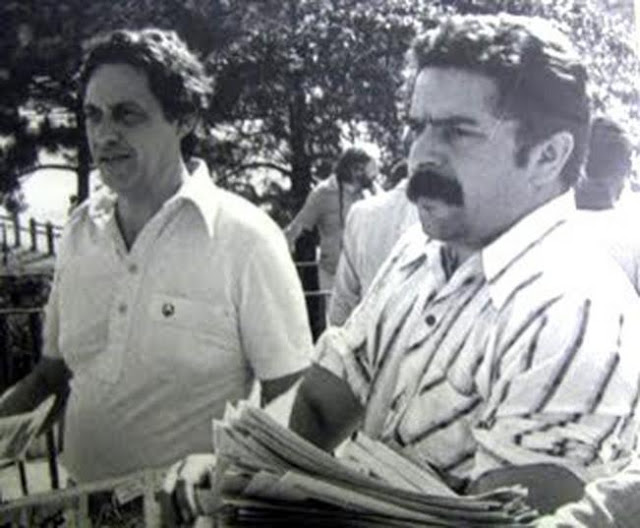
Lula and FHC campaigning together in 1981, by Cl vis Cranchi Sobrinho

Lula (PT) and FHC (PSDB) campaigning together in 1981, by Cl vis Cranchi Sobrinho

Some people have celebrated the reelection of Dilma Roussef as a victory of the left against the right. In my opinion that view is wrong for several reasons. First, because I disagree that PSDB and A cio Neves in particular are right-wing, both in terms of economics and social/moral issues. Second, because I believe Dilma s first government has taken a quite severe turn to the right in several topics that matter a lot to me. Since comparisons with PSDB s government during the 90s has been one of the main strategies of the campaign this year, I ll argue why I think it was actually a pretty good government with a lot of left in it. Unlike what happens in most other places, Brazil does not really have an actual right-wing party, economics-wise. Although we might see the birth of a couple in the near future, no current party is really against public health, education and social security being provided by the state as rights, or wants to decrease state size and lower taxes significantly. It should come as no surprise that even though it has undergone a lot of liberal reforms over the last 20 years, Brazil is still a very closed country, with very high import tariffs and a huge presence of the state in the economy. There is a certain consensus about all of that, with disagreements being essentially on implementation details, not goals. On the other hand, and contrary to popular belief, when it comes to social and moral issues we are a very conservative people. Ironically, the two parties which have been in power over the last 20 years are quite progressive, being historically proponents of diversity, minorities rights, reproductive rights. They have had to compromise on those causes to become viable alternatives, given the conservative nature of the majority of the voters. Despite their different origins and beliefs, both parties share socialist inclinations and were allies from the onset. That changed in 1992, when president Collor, who had been elected on a runoff against Lula (who PSDB supported), was impeached by Congress for corruption. With no formal political support and a chaotic situation in his hands, Itamar Franco, the vice president, called for a national union government to go through the last two years of his term. PSDB answered the call, but the workers party decided against being part of the government. Fernando Henrique Cardoso, a sociologist who was one of the leaders of PSDB was chosen to lead the Foreign Relations Ministry, but a few months later got nominated to the Economy. At the time, Brazil lived under hyperinflation of close to 1000% a year, and several stabilization plans had been attempted. Economy Ministers did not last very much in office at the time. FHC gathered a team of economists and sponsored their stabilization plan, which turned out to be highly successful: the Plano Real ( Real Plan ). In addition to introducing a new currency, something that was becoming pretty common to Brazilians by then, it also attacked the structural causes of inflation. Lula was counting on the failure of the Plano Real when he ran against FHC in 1994, but the plan succeeded, giving FHC two terms as president. During those two terms, FHC introduced several institutional changes that made Brazil a saner country. In addition to the hyperinflation, Brazil had lived a debt crises for decades and was still in default. FHC s team renegotiated the debts, reopened lines of credit, but most importantly, introduced reforms that made the Brazilian finances and financial system credible. The problem was not even that Brazil had a fiscal d ficit, it just did not have any control whatsoever of money supply and budget. Banks, regardless of whether they were private or public, had very little regulation and took advantage of the hyperinflation to hide monstrous holes in their balances. When inflation was gone and regulation became more strict, those became apparent, and it was pretty clear that the system would collapse if nothing was done. Some people like to say that FHC was a president who ruled for the rich and didn t care about the poor. I think the way the potential collapse of the banking system was handled is a great counter-example of that. The government passed laws that made the owners of the banks responsible for the financial problems, regardless of whether caused by mismanagement or fraud. If a bank went under, the central bank intervened and added enough money to protect the deposits, but that money was a loan that had to be repaid by the owners of the bank, and the owners properties were added as collateral to the loan. As a brazilian journalist once said, the people did not risk losing their deposits, the bankers did risk losing the banks, though. Today, we have a separate fund, filled with money from the banks, that does what the central bank did back then when required. Compare that to countries where the banking system was saved with tax payer money and executives kept getting huge bonuses regardless, while owners kept their profits. It is hard to find an initiative that is more focused on the public interest against the interest of the rich people who caused the problem. This legislation, called PROER, is still in place today, and it came along with solid regulation of the banking system. It should come as no surprise that Brazil went through the financial crisis of 2008 with not a single hiccup of the banking system and no fear of bank runs. Despite having been against PROER back in the day, Lula celebrated its existence in 2008, when it was clear it was one of the reasons we would not suffer much. He even advertised it as something that should be adopted by the US and Europe. It is also pretty common to hear that under FHC social questions were not a priority. I believe it is pretty simple to see that that was not the case both by inspecting the growth of social spending and the improvement of social indicators for the period, such as UN s human development index. One area in which people are particularly critical of the FHC government is the investment on higher education, and they are actually quite right. Brazil has free Federal universities and those did not get a lot of priority in the 90s. However, I would argue that while it is a matter of priorities, it is not one of education versus something else, but rather of what to invest on inside education. The reality is basic education was the priority. When FHC came to power, Brazil had a significant number of children who were not going to school at all. The goal was to make access to schools universal for young children, and that goal was reached. Every child has been going to school since the early 2000s, and that is a significant achievement which reaches the poorest. While the federal universities are attended essentially by the Brazilian elite, given the difficulty of passing the exams and the relative lack of quality of free public schools compared to private ones, which is still a reality to this day, investment on getting children to even go to school for the early years has a significant impact on the lives of the poorest. It is important to remember that getting every child to go to school is also what gave birth to one of the most celebrated programs from the Lula era: Bolsa Fam lia ( Family Allowance ) is a direct money transfer to poor families, particularly those who have children and has been an important contribution to lowering inequality and getting people out of extreme poverty. To get the money, the families need to ensure their children are 1) attending school and 2) getting vaccinated. That program comes from the FHC government, in which it was created with the name Bolsa Escola ( School Allowance ), in its turn inspired by a program of the same name by governor Cristovam Buarque, from PT. What Lula did, and he deserves a lot of credit for this, was to merge a series of smaller programs with Bolsa Escola, and then expand the program to ensure it got to more and more people. Interestingly, during the announcement of the program he credited the idea of doing that to a state governor from PSDB. You can see why I think these two should be allies again. When faced with all these arguments, people will eventually say that FHC was bad because he privatized companies and used orthodox economic policies. Well, if that is what it takes, then we ll have to take Lula down with him, because his first term was essentially a continuation of FHC s second term: orthodox economic policies to keep inflation down, along with privatization of several state-owned companies and banks. But Lula, whom I voted for and whose government I believe was a good one, is not my subject: Dilma is. On Lula s second term, Dilma gained a lot of power when other major leaders of PT went down for corruption. She became second in command and started leading several programs. A big believer in developmentalism, she started pushing for a bigger role of the state in the coordination of the productive sector, with a clear focus on growing the industrial base. One of the initiatives she sponsored was a sizable increase on the number and size of subsidized loans given out by the national development bank (BNDES). Brazil started an unnofficial national champions program, where the government elected a few big companies to get a huge amount of subsidized credit. The goal was for these selected firms to get big enough to be competitive on the global market. The criteria for the choices is completely opaque, if it even exists, and includes handing out milions in subsidized credit for Eike Batista, who became Brazil s richest enterpreneur for a while, and lost pretty much everything when it became clear the oil would not be pumping out of his camps after all, sinking with them a huge amount of public funds invested by BNDES. The way this policy was enacted, it is unclear how much it really costs in terms of public funds: the Brazilian treasury emits debt to capitalize, lends that money to BNDES with higher than market interest, and BNDES then lends it out to the big companies with a lower than market interest rate. Although it is obviously unsustainable, the problem does not yet show in the balance because the grace period for BNDES debt with the treasury is 2040. The fact that this has a cost and, perhaps more importantly, a huge opportunity cost is not clear because it is not part of the government budget. Why are we putting money in this rather than quadrupling Bolsa Fam lia, which studies show generates 1,78 reais in GDP for every 1 real invested? Worse, why are we not even updating Bolsa Fam lia enough to cover inflation? When Dilma got elected in 2010, the first signs were pretty bad. She was already seen as someone who did not care much for the environment, and on her first month in power she made good on that promise by pushing to get the Belo Monte Dam building started as soon as possible regardless of conditionalities being satisfied. To this day there are several issues with how the building of the dam is going: the handling of the indigenous people and the small city nearby are lacking, conditionalities are not met. Beyond Belo Monte, indigenous leaders are being assassinated, deforestation in the Amazon forest has increased by 122% in 2014 alone. Dilma s answer to people who question her on these kinds of issues is essentially: would you rather not have electric power? Her populist authoritarian nature and obsession with industry are also pretty evident when it comes to her policies in the energy area as a whole. She showed up in national tv on the eve of our independence day celebration to announce a reduction in electric tariffs, mainly for industry, but also for homes. Nobody really knew how. The following week she sent a fast-track project to Congress to automatically renew concessions of power grid operators, requiring those who accepted it to lower tariffs, instead of doing an auction, which was already necessary anyway because the concessions were up on 2015. There was no discussion with stakeholders, there was just a populist announcement and a great deal of rhethoric to paint anyone who opposed as being against the people. And now, everything went into the crapper because that represented a breach of contract that required indemnification, and we had a pretty bad drought that made power more expensive given the need to turn on the thermal generators. Combining the costs of the thermal generation, indemnity, and financial fallout that the grid operators suffered, we are already at 105 billion reais and counting, nobody knows how high the cost will reach. Any reduction in tariffs has long been invalidated. And the fact that industry has lowered production significantly ends up being good news, we would probably be under rationing already if that was not the case. You would expect someone who fought a dictatorship to be pretty good in terms of human and civil rights. What we see in reality is a lack of respect for those things. During the world cup, Dilma has put the army on the streets and has supported arbitrary behaviour from state polices throughout the country. They jailed a bunch of demonstrators preemptively. No shit. The would be demonstrators were kept in jail throghout the tournament under false accusations. Dilma s Minister of Justice said several times that the case against them was solid and that the arrests were legal, but it turned out the case simply did not exist. Just this week we had a number of executions orchestrated by policemen in the state of Par and there is zero reaction from the federal government. In the oil industry, Dilma has enacted a policy of subsidizing gas prices by using a fixed price that used to be lower than the international prices (it is no longer the case with the fall in international prices). That would not be a problem if Brazil was selfsufficient in oild and gas, which we are not: we had to import a significant amount of both. The implicit subsidy cost Petrobr s a huge amount of cash the more gas it sold, the bigger the losses. This lead not only to decreasing the company s market value (it is a state-controlled, but open company), but to reducing its capacity of investment as well. That is more problematic than it sounds because, with our current concession model, every single oil camp needs to have Petrobr s as a member of the consortium. Limiting the company s investment capacity limits the rate at which our pre-salt oil camps can be explored and thus the speed at which we can become selfsufficient. Chicken and egg anyone? To make things worse, Dilma has made policies that lowered taxes on car production, used to foster economic activity during the crisis in 2008-2010, essentially permanent. This lead to a significant increase in traffic and polution on Brazilian cities, while at the same time increasing the pressure on Petrobr s, which had to import more and more gas. Meanwhile, Brazilian cities suffer from a severe lack of mobility infrastructure. A recent study has shown that Brazil has spend almost twice as much subsidized money on pro-car policies than on pro-mass transit projects. Talk about good usage of public funds. One of the only remaining good news the government was still able to mention was the constant reduction in extreme poverty. Dilma was actually ellected promising to erradicate extreme poverty and changed the government s slogan to A rich country is a country with no poverty (Pa s rico pa s sem pobreza). Well, it turns out all of these policies caused inequality and extreme poverty both to stop falling as of 2013. And given the policies were actually deepened in 2014, I believe it is very likely we ll see an increase in both when we get the data for 2014, next year. Other than that, her policies ended up being a complete failure. Despite giving tax benefits to several sectors, investment has fallen, growth has fallen and inflation is quite high at 6,6% for the last 12 months. In terms of minorities, her government has been a severe set back, with the government going back on educational material against homophoby saying it would not do advertisement of sexual choice , and going back on a decree that allowed the public health system to perform abortions on the cases allowed by the law (essentially if the woman has been raped). Looking at Dilma s policies, I really can t see that much of the left, honestly. So why, you might ask, has this victory been deemed a victory of the left over the right? My explanation is the aura the workers party still manages to keep over itself. There s a notion that whatever PT does, it will still be more to the left than PSDB, which I think is just crazy. There is also a fair amount of idealizing Dilma just because she is Lula s proteg . People will forgive anything, provided it is the workers party doing it. Thankfully, the number of people aligned on the left that supported the candidate from PSDB this election tells me this is changing quite rapidly. Hopefully that leads to PT having to reinvent itself, and get in touch with the left again.

Matthias Klumpp: Introducing Limba a software installer experiment

As some of you already know, since the larger restructuring in PackageKit for the 1.0 release, I am rethinking Listaller, the 3rd-party application installer for Linux systems, as well. During the past weeks, I was playing around with a lot of different ideas and code, to make installations of 3rd-party software easily possible on Linux, but also working together with the distribution package manager. I now have come up with an experimental project, which might achieve this. Motivation Many of you know Lennart s famous blogpost on how we put together Linux distributions. And he makes a lot of good and valid points there (in fact, I agree with his reasoning there). The proposed solution, however, is not something which I am very excited about, at least not for the use-case of installing a simple application[1]. Leaving things like the exclusive dependency on technology like Btrfs aside, the solution outlined by Lennart basically bypasses the distribution itself, instead of working together with it. This results in a duplication of installed libraries, making it harder to overview which versions of which software component are actually running on the system. There is also a risk for security holes due to libraries not being updated. The security issues are worked around by a superior sandbox, which still needs to be implemented (but will definitively come soon, maybe next year). I wanted to explore a different approach of managing 3rd-party applications on Linux systems, which allows sharing as much code as possible between applications. Limba Glick2 and Listaller concepts mergedlimba-small In order to allow easy creation of software packages, as well as the ability to share software between different 3rd-party applications, I took heavy inspiration from Alexander Larssons Glick2 project, combining it with ideas from the application-directory based Listaller. The result is Limba (named after Limba tree, not the voodoo spirit I needed some name starting with li to keep the prefix used in Listaller, and for a tool like this the name didn t really matter ;-) ). Limba uses OverlayFS to combine an application with its dependencies before running it, as well as mount namespaces and shared subtrees. Except for OverlayFS, which just landed in the kernel recently, all other kernel features needed by Limba are available for years now (and many distributions ship with OverlayFS on older kernels as well). How does it work? In order to to achieve separation of software, each software component is located in a separate container (= package). A software component can be an application, like Kate or GEdit, but also be a single shared library (openssl) or even a full runtime (KDE Frameworks 5 parts, GNOME 3). Each of these software components can be identified via AppStream metadata, which is just a few bits of XML. A Limba package can declare a dependency on any other software component. In case that software is available in the distribution s repositories, the version found there can be used. Otherwise, another Limba package providing the software is required. Limba packages can be provided from software repositories (e.g. provided by the distributor), or be nested in other packages. For example, imagine the software Kate requires a version of the Qt5 libraries, >= 5.2. The downloadable package for Kate can be bundled with that dependency, by including the Qt5 5.2 Limba package in the Kate package. In case another software is installed later, which also requires the same version of Qt, the already installed version will be used. Since the software components are located in separate directories under /opt/software, an application will not automatically find its dependencies, or be able to locate its own files. Therefore, each application has to be run by a special tool, which merges the directory trees of the main application and it s dependencies together using OverlayFS. This has the nice sideeffect that the main application could override files from its dependencies, if necessary. The tool also sets up a new mount namespace, so if the application is compiled with a certain prefix, it does not need to be relocatable to find its data files. At installation time, to achieve better system integration, certain files (like e.g. the .desktop file) are split out of the installed directory tree, so the newly installed application achieves almost full system integration. AQNAY* Can I use Limba now? Limba is an experiment. I like it very much, but it might happen that I find some issues with it and kill it off again. So, if you feel adventurous, you can compile the source code and use the example Foobar application to play around with Limba. Before it can be used in production (if at all), some more time is needed. I will publish documentation on how to test the project soon. Doesn t OverlayFS have a maximum stacking depth? Oh yes it has! The How does it work explanation doesn t tell the whole truth in that regard (mainly to keep the section small). In fact, Limba will generate a runtime for the newly installed software, which is a directory with links to the actual individual software components the runtime consists of. The runtime is identified by an UUID. This runtime is then mounted together with the respective applications using OverlayFS. This works pretty great, and also results in no dependency-resolution to be done immediately before an application is started. Than dependency stuff gives me a headache Admittedly, allowing dependencies adds a whole lot of complexity. Other approaches, like the one outlined by Lennart work around that (and there are good reasons for doing that as well). In my opinion, the dependency-sharing and de-duplication of software components, as well as the ability to use the components which are packaged by your Linux distribution is worth the extra effort. Can you give an overview of future plans for Limba? Sure, so here is the stuff which currently works: These features are planned for the new future: Remember that Limba is an experiment, still ;-) XKCD 927 Technically, I am replacing one solution with another one here, so the situation does not change at all ;-). But indeed, some duplicate work is done due to more people working in this area now on similar questions. But I think this is a good thing, because the solutions worked on are fundamentally different approaches, and by exploring multiple ways of doing things, we will come up with something great in the end. (XKCD reference) Doesn t the use of OverlayFS have an impact on the performance of software running with Limba? I ran some synthetic benchmarks and didn t notice any problems even the startup speed of Limba applications is only a few milliseconds slower than the startup of the raw native application. However, I will still have to run further tests to give a definitive answer on this. How do you solve ABI compatibility issues? This approach requires software to keep their ABI stable. But since software can have strict dependencies on a specific version of a software (although I d discourage that), even people who are worried about this issue can be happy. We are getting much better at tracking unwanted ABI breaks, and larger projects offer stable API/ABI during a major release cycle. For smaller dependencies, there are, as explained above, stricter dependencies. In summary, I don t think ABI incompatibilities will be a problem with this approach at least not more than they have been in general. (The libuild facilities from Listaller to minimize dependencies will still be present im Limba, of course) You are wrong because of $X! Please leave a comment in this case! I d love to discuss new ideas and find the limits of the Limba concept that s why I am writing C code afterall, since what looks great on paper might not work in reality or have issues one hasn t thought about before. So any input is welcomed! Conclusion Last but not least I want to thank Alexander Larsson for writing Glick2, which Limba is heavily inspired from, and for his patient replies to my emails. If Limba turns out to be a good idea, you can expect a few more blog posts about it soon.
* Answered questions nobody asked yet [1]: Don t get me wrong, I would like to have these ideas implemented they offer great value. But I think for simple software deployment, the solution is an overkill.

9 November 2014

Antti-Juhani Kaijanaho: About to retire from Debian

I got involved with Debian development in, I think, 1998. In early 1999, I was accepted as a Debian developer. The next two or three years were a formative experience for me. I learned both software engineering and massively international collaboration; I also made two major contributions to Debian that are still around (of this, I am very proud). In consequence, being a Debian developer became a part of my identity. Even after my activity lessened more than a decade ago, after I no longer was a carefree student, it was very hard for me to let go. So I ve hung on. Until now. I created my 4096-bit GPG key (B00B474C) in 2010, but never got around to collecting signatures to it. I ve seen other people send me their key transition statements, but I have not signed any keys based on them. It just troubles me to endorse a better secured key based on the fact that I once verified a less secure key and I have a key signature chain to it. For this reason, I have not made any transition statements of my own. I ve been meaning to set up key signing meetings with Debian people in Finland. I never got around to that, either. That, my friends, was my wakeup call. If I can t be bothered to do that, what business do I have clinging on to my Debian identity? My conclusion is that there is none. Therefore, I will be retiring from Debian. This is not a formal notice; I will be doing the formal stuff (including disposing of my packages) separately in the appropriate forums in the near future. I agree with the sentiment that Joey Hess wrote elsewhere: It s become abundantly clear that this is no longer the project I originally joined . Unlike Joey, I think that is a good thing. Debian has grown, a lot. It s not perfect, but like my elementary-school teacher once said: A thing that is perfect was not made by people. Just remember to continue growing and getting better. And keep making the Universal Operating System. Thank you, all.

Next.

Previous.