Search Results: "ag"

20 November 2005

Martin Michlmayr: Time

Yesterday I went to Austria to visit friends and family for a few days. I started going through some of my old stuff, throwing away some of it and scanning material that's still of interest. While doing so, I came across the invoice for the first computer I bought myself, just a little bit more than 10 years ago. It was a Pentium 90 with 32 MB RAM and a 1 GB hard drive. It had all kind of expensive components because I wanted to run NEXTSTEP (which only supported high-end hardware) and so the machine cost a fortune. In fact, for the price of the 17" screen alone you could get a powerful system these days. Coincidentally, I was just playing with my wifi AP/router the other day, a device with 32 MB RAM, 8 MB flash and a 200 MHz MIPS CPU that I got for under 50 bucks... However, this is not a rant about the speed of change in the computer industry. This is all well and good, and I definitely enjoy having a laptop with a gig of RAM. Instead, it's more about observations of time. I still remember when 2001 was years away and we were all looking forward to it (you know, we'd finally have flying cars, thinking machines and all that stuff); I also remember celebrating the millennium. Now, when I see stuff from 2001, 2002 or even 2003, it feels old. But what really freaks me out is when I have to write down a date starting with 19... I actually have to check it twice to see whether I really got it right and I feel so retro adding stuff that old... time's a strange thing.

Erinn Clark: quod libet

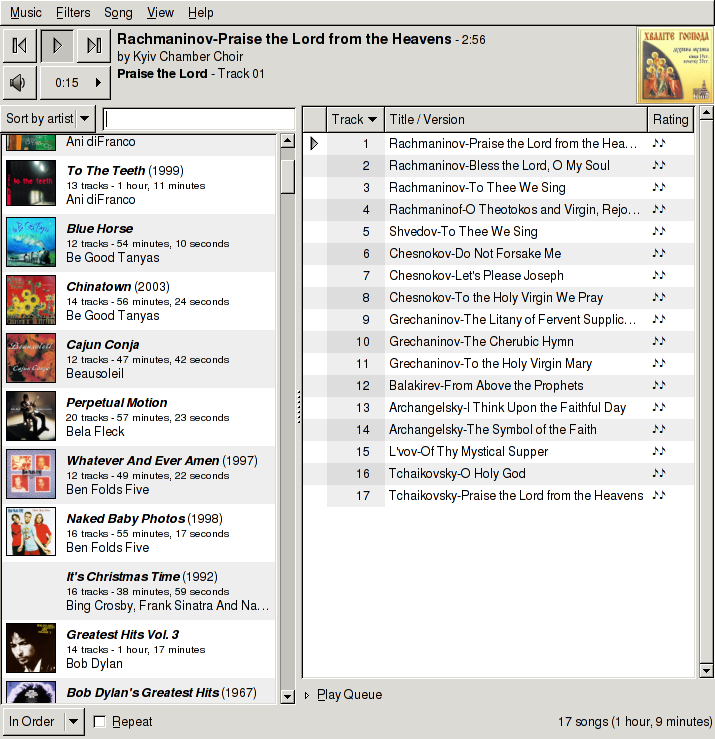
Joey Hess blogs about how nice Quod Libet is. In general, I agree with him. I use it at work now, though I've historically preferred cplay as it's nice and simple and does what I want. Due to the popularity of Audioscrobbler and my curiosity about it, I decided I'd try out some of the clients that support it. It was sort of a rude awakening to discover that QL won't actually work on AMD64, which I use at home. The reason for the bug not being fixed (or RC for that matter) is really sort of funny in a sad way.

Aigars Mahinovs: Low fireworks & sbackup


Low fireworks
The photo is from yesterday, but it is still new for most of you so the photo-a-day is still going strong for me :)
Today was spend in a very productive fashion - bugfixing. I had a lot of feedback for SBackup over last couple of months - it was time to fix some of the bugs people were reporting. Therefore version 0.9 of SBackup will be hitting you nearest mirror as we speak (I mean, I am uploading it now :)).
This realease is mostly a hey-this-thing-is-still-alive-and-kicking-ouch release and it also includes a TODO file with my plans for its future. I expect more feedback both on features and bugfixes for the stable 1.0 branch and for the planned 2.0 rewrite.
Also I spent couple of hours reviewing Wiki engines with an idea to put one on SourceForge to provide documentation for SBackup - I found no good candidates. I wanted a simple wiki, preferably in python, with MySQL database (SourceForge mounts web directories read-only). Not good. Now I am considering making a page in Wikipedia and using that as a documentation page. Scream at me violently if have any other solutions :)

Jordi Mallach: Hard drive failure

On Thursday, I went up to my father's house to pick up my desktop, now that I finally have Internet access at home so I can have permanent access to it from a more convenient place. While I was there, I decided it'd be a good idea to do an upgrade on my dad's box. While I was doing this, the nfs share of the Debian mirror in the home server that serves this blog stopped working, and I couldn't ssh in, although the console and ICMP appeared to work. Having no monitor attached to that box, I decided to reboot it and resolve the problem in a lame way. Had I known my primary hard drive had decided enough is enough, I would have looked for a monitor instead. After reboot, the server started doing a very loud and scary noise, which was not new to me. When the BIOS tried to probe the disk, it would not start up and would instead whine like that. When this happened in the past, switching the box for a few minutes and trying again was enough. Not this time, though, it looked like it was the end. Horrified by the fact that I had no really useful backup of /etc and /home, I tried over and over to get it working. I plugged the HD into another old AT box (which once served as my GNU Hurd playground), but I still got those scary noises. At least I knew it had nothing to do with the mother board. As it was getting late, I decided to take the HD with me, and another Maxtor of the same size (but not exact model) with me, to have a look in office the next day. I thought I'd have to restort to try to transplant the logic board from the good one to the faulty disk, but before that, I realised I could try mounting it in a USB cage. For some reason or another, this worked, and I quickly saved thetwo partitions it contained with no read errors. After this, I realised I had not done the copy as root, so I had lost all my ownerships. I plugged the disk again, and re-rsynced. It still worked. Alleviated, I went back home, copied the data to another old disk, and I don't remember why, I tried mounting the faulty disk again. I got scary noises even using the USB case, and no other tries have been successful, so I think it's completely dead now, just before my final mount which saved the data. The box is now back online, using a Seagate disk I had stored in a drawer and with no notes on it about it having any kind of problem. I suspect I will need to do real backups now, because the drive isn't as safe as it looked...
hda: dma_timer_expiry: dma status == 0x20
hda: DMA timeout retry
hda: timeout waiting for DMA
hda: status error: status=0x58   DriveReady SeekComplete DataRequest  
hda: drive not ready for command
hda: status timeout: status=0xd0   Busy  
hda: drive not ready for command
ide0: reset: success
My little P150 needs a 6GB drive. I'll have to find one somewhere.

Andres Salomon: obey your master

I missed a bus to Boston by about 5 minutes on thursday (I seem to be doing that a lot lately), so I went up to 8th Ave to find some internet access. The coffee shop I entered was packed, so I sat down at an already occupied table. The guy sitting across from me was in a wheelchair, reading the newspaper. After a few minutes of me typing away at my computer, and him reading his newspaper, he started up a conversation with me. “So, I was just reading that they’re going to have a feature in DVRs that has a video camera that watches over your home.” I have no idea why he thought I might know what a DVR is, or why he chose that topic. Maybe I just exude geek pheromones or something. “Oh?” “Yeah, they want to be able to have you be able to see watch it over your cell phone. How’s that for security? Being able to monitor your home through your cell phone?” “Ok, I guess…” “I’d want that, it seems like an excellent idea.” “Sure, but who else might be able to look into your home?” “What do you mean?” He seemed genuinely confused by my remark. I thought maybe he hadn’t heard me; I tend to mumble. “Who else might have access to see your home?” “Oh, I see. So if someone else gets access to your cell phone, they can watch?” At this point he went off about cell phone IDs and PIN numbers. I cut in, “Well, yea, there’s that. But what about people with direct access to the video feed? People who work for the DVR company, and people who work for the cell phone companies. They’ll be able to watch the video. Not to mention people who manage to access the networks of these companies. If it’s in a DVR, is there a way to turn it off, or is it a video of your living room, 24 hours a day, 7 days a week?” He pondered that for a minute, and responded with, “Yeah, I guess it’s a double edged-sword..” He made a few more comments about the DVR and how he had never thought about it that way, but I had already started tuning him out. My work there was done; another happy citizen infected with my special brand of distrust and cynicism. Big Brother is unnecessary in a world where all the high-tech consumer garbage you buy comes equipped with built-in security flaws. I’m hoping the next time I go there, I see him wearing a tin foil hat.

Joey Hess: quod libet

screenshot Earlier I dismissed the quod libet music player since it needed 20% of my laptop's cpu to play music. The new version has been improved, it only needs a still exorbitant 13%, but at home I use my shuttle PC for music now, so CPU usage doesn't matter. And I think quod libet is worth the slightly lowered battery life on the road too. There's no end to the features -- and plugins full in all kinds of interesting edges (onscreen display, audioscrobbler, alarm clock) -- and while it's still under development with a rough spot here and there, mostly around the plugins, it mostly just works. I'm especially impressed at how powerful the tag editing is in quod libet. It makes it so easy to clean up the missing and broken metadata in even a large sound library like mine, and the effects are so immediate and nice as things get sorted into the right place, albums ordered as missing track info is added, album covers displayed, that it's addictive just to putter around in there. Some other features that IMHO make it worth using include the ramdom album plugin, which lets it pick a new album at random when it finishes playing the current one (my collection is too varied and big for random track play to work, but this, mostly, does), the gorgeous album list, and the queue, an odd little feature that lets you insert any songs you like into a play queue, to play after the currently playing song. Which solves a lot situations I've been in before. And the little details are all there too, little things like right-clicking on the play button to turn off the music player after the current song finishes; and automatically and quickly finding new music on startup; and properly supporting multiple artist albums. And that just scratches the surface of things I've found to like over a day.. there's a whole regexp/tag based search engine in there, a music prefernces learning system with weighted playback, internet radio, playlists and more. And it's actively developed, and kinda oddly marketed squarely at Debian users. Buh-bye rhythmbox..

Jordi Mallach: One year of Blue Gold

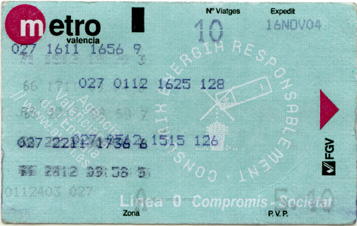
Today, my magic metro card is one year old. When I bought it twelve months ago, I never thought I'd be so lucky. I don't know exact figures, but I think I've done 200 more train rides that it should have let me, and the card should have expired the 1st of February. But it didn't, and I've been using it over and over throught the year. I only was very, very careful when inserting the card or storing it in my wallet so it wouldn't bend or be damaged in some way... it's worth a lot of money! While my primary means of transportation is the bicycle once again, having this handy is a great way to save maybe 25 every month. The Blue Gold Rush is eternal, although time does leave marks on it.


The magic card, when I found its magic properties After some hundred uses...


Go on, my blue friend! I should find someone with equipment that can copy the data in the magnetic band. That would rock.

Andrew Pollock: [life] Hello America!

Where do I start? It's been an eventful couple of days... The flight to LA was uneventful. Qantas is certainly orders of magnitude more pleasant to fly with than United, even though we were seated in a bulkhead area. I had a 13-month old baby seated next to me (no, Mikal was on the other side), and he was about as well behaved as you could possibly ask a 13-month old baby to behave. Mikal also behaved himself. I had the intention of trying to get something approximating 8 hours sleep, as we arrived at LAX at 7am local time, but I only managed about 4 hours. I did spend about 8 hours with a mask on and my brain in idle, so I arrived at LAX being mostly coherent. Entering the US via LAX was a much less traumatic experience than I was expecting. The E-3 visa was accepted fine, and I now have an I-94 stapled into my passport. Quarantine involved getting looked up and down by a guy in a booth, who waved me through. We had 3 hours to spare (or about 2 by the time we cleared all the immigration/customs queues) and then hopped on a 50 minute American Airlines flight to San Francisco, hired a car and drove to Santa Clara. The accommodation we're staying in for a month is very spiffy indeed. It's a largish gated community of units. Mine's got a ground floor entry, but everything else (except the garage) is upstairs. When Sarah gets here, we'll put up some photos. The weather is lovely as well. Our first outing was to the Social Security office to attempt to get social security numbers. This wasn't as successful as I'd hoped, as we were too freshly in the country to show up on their systems, so we left with letters saying we'd get one within four weeks, when our details had been verified. Yesterday evening, we went for a general recce of the surrounding area, and checked out a supermarket. That was less disconcerting than I expected, although I don't think it was a terribly huge supermarket. Having a GPS certainly raises one's confidence when navigating significantly. Last night I discovered that all the keys in my apartment were not created equal, and that the two loose in the lock box on the front door were the only two that opened the unit, and the two sets on key rings on the coffee table only opened the amenities and my mailbox. So I got to spend a bit of time sitting on my front doorstep until the nice man from Synergy Relocations came out to let me in (except his key didn't work either, so he got to make conversation with a legal alien while we waited for someone else to come out with a key). Today, we drove around to see a shopping mall, and the first set of shops we found happened to be around the corner from an enormous (by my standards) apartment complex, which had some signage implying that it had vacancies, so we decided to get the low down on how renting worked before we did our rental tours. Casey drove us around in a golf buggy and gave a tour of what two different floor plans looked liked. It seems that in this part, it's standard for an apartment to include the refrigerator, dishwasher, microwave, washing machine and clothes dryer, which is good to know. Let me just say that if this is what living in an apartment complex is like, it's more like living in a resort. The place had pools everywhere, tennis courts, two gyms, a community centre, it was just unreal. It was also cheaper than I was expecting. We then went to a massive shopping mall to do some window shopping. Discovered Wetzel's Pretzels. Hope they're not too fattening... Tomorrow, I'm going to avail myself to the complex's gym, and generally get ready for the week ahead. Future posts will be in a new category, which I won't be feeding to Planet Debian as not to bore people. I will inflict Planet Linux Australia readers with them until someone asks me to stop. If you'd like a custom feed that excludes my American adventures, please let me know. I wonder if adjusting Blosxom's idea of timezone buggers up existing posts and aggregators like Planet in general?

19 November 2005

Edd Dumbill: The Web as it was meant to be used

Since giving XTech 2006 the tagline "Building Web 2.0", I've received a few questions as to how wise this was. The Web 2.0 label has been accused in some quarters of being a vague, marketing-oriented, term. Perhaps an attempt to kickstart a new bubble. I was going to write further, defending my choice: that, practically speaking, Web 2.0 encapsulates a combination of technologies and practices driving the web forward. Yes, it's a label of convenience, but the implementation trends are real. The maturation of XML, a revival in browser technology, a willingness to share data openly and new web development frameworks. Just as I embarked on distilling these thoughts into a fuller form, Paul Graham published an excellent essay on Web 2.0. In it he analyses the Web 2.0 term:
Does "Web 2.0" mean anything? Till recently I thought it didn't, but the truth turns out to be more complicated. Originally, yes, it was meaningless. Now it seems to have acquired a meaning. And yet those who dislike the term are probably right, because if it means what I think it does, we don't need it.
So what's the reasoning that means we don't need the term? Graham writes: "Web 2.0 means using the web the way it's meant to be used." There's nothing fundamentally new, but there is a groundswell of understanding of what's been there all along. For me, that's a wonderful encapsulation of both current web trends and my aspirations for XTech. "Web 2.0" is a just a handy label for this. "The Web as it was meant to be used" will strike a chord with many web practitioners today--whether it's sensible use of web services with REST, improving user interaction in web design, or open semantics and data interchange. If you're involved in using the web as it's meant to be used, consider submitting an XTech proposal.

Bartosz Fenski aka fEnIo: libpam-encfs

I've just uploaded sponsored package libpam-encfs. With it it's possible to have encrypted home directory, which will be mounted during login.

Dirk Eddelbuettel: Cringely on what Google may be up to

In another installation of my pointing to Cringely's columns, let me mention yesterday's column speculating about Google. Choice quotes:
[...]
Google hired a pair of very bright industrial designers to figure out how to cram the greatest number of CPUs, the most storage, memory and power support into a 20- or 40-foot box. We're talking about 5000 Opteron processors and 3.5 petabytes of disk storage that can be dropped-off overnight by a tractor-trailer rig. The idea is to plant one of these puppies anywhere Google owns access to fiber, basically turning the entire Internet into a giant processing and storage grid.
While Google could put these containers anywhere, it makes the most sense to place them at Internet peering points, of which there are about 300 worldwide.
Two years ago Google had one data center. Today they are reported to have 64. Two years from now, they will have 300-plus.
[...] There will be the Internet, and then there will be the Google Internet, superimposed on top. We'll use it without even knowing.
[...] All this is based, of course, on Google's proven network and hardware expertise. Have you seen Google's Search Appliance? They ship you a 1U prebuilt server. You connect it to your network, fill out a simple configuration screen, and it scans and indexes your web site (or sites) for you. Google monitors and manages it remotely, and sucks up the data and adds it to theirs. You just plug the thing in and turn it on. It just works. You need do nothing else to keep it running. Google understands how to do this stuff. Microsoft definitely does not.
[...] Microsoft can't compete. Yahoo probably can't compete. Sun and IBM are like remora, along for the ride. And what does it all cost, maybe $1 billion? That's less than Microsoft spends on legal settlements each year.
Game over. And yet next week I'll take it one more step.
Fact? Fiction? Feasible? As they say, read the whole thing.

Brett Parker: Wooo!

Right - I've got some clean django packages ready, just waiting on my pbuilders to update then I'll upload them to my repository, it's the first official django release, and they state (quite clearly) on the site that there maybe backwards incompatible changes between now and 1.0, so I'm not sure wether I'll try to get this sponsored in to unstable or not at this point. My debian repository for django is at: deb http://www.sommitrealweird.co.uk/debian/ unstable django or for sarge (yes, there should be some sarge packages soon!): deb http://www.sommitrealweird.co.uk/debian/ stable django At the moment these contain an older set of django packages built from an svn snapshot, I may make some new svn snapshots in the future, depending on time constraints and if anyone is interested in having them :)

Erich Schubert: Bug hunting on SELinux

I've been trying to track down an annoying bug with SELinux these days. The situation is as follows: when I'm running enforcing mode, binds' "host" command, "named" itself and "dig" won't work. They fail with an odd error message: mem.c:653: INSIST(ctx->stats[size].gets > 0U) failed. or with the latest bind backported to stable: host: isc_taskmgr_create: no available threads the SELinux audit error reported is denied execmem for pid=28566 comm="host" scontext=root:sysadm_r:sysadm_t tcontext=root:sysadm_r:sysadm_t tclass=process. As far as I know, "execmem" means the process can do runtime code generation (i.e. make its own memory executable) - that is a privilege you don't want to give out lightly. But everybody should be able to use the "host" command... so the situation sucks. Right now I guess that this is caused by pthreads, not bind itself. Anyone some hints for me? Does this mean I have to build a customized libc to run stable with SELinux (or make huge modifications to the policy, to add a domain for "host" and exec permissions to every other domain that needs to be able to run "host"...)?

Erich Schubert: Memory management issues

Dear Lazyweb,
,
Nothing is perfect, but on Linux you can at least improve it and tune it. I just ran into memory problems on my development box - I had tons of applications open, and since this is a laptop I prefer to have swap disabled. I then started to build bind9 for a sarge backport, which meant that a long sequence of C compiler processes were launched, each allocating some memory, working with it, terminating, next. Being really at the limit of the available memory, the system became unresponsive - and that behavious is really bad... I thought that sooner or later it will really run out of memory, and decided to watch some TV in the meantime. One hour later when I returned, it was still torturing my HD and still unresponsive. Apparently the compile process has been all the time just below the memory limit, causing the kernel to remove pages from memory and load them back from the disk later, which slowed everything down just horribly. So now I'm searching for a way to prevent such situations. The traditional ulimit approach won't help - no single process was responsible for using all the memory, but each one had its reasonable share. So dear lazyweb, is there a way to tell the kernel to reserve a share of the memory (lets say, 64 MB) for buffers and caches only? I can live with out-of-memory errors a bit early (and the just enable swap), but a massive slowdown as described above (where the kernel is apparently reading some data from the HD, then forgetting it again and replacing it with the next) must not happen that easily... Right now I fear that you could bring down any Linux system easily with a "slow" forkbomb where each forked process allocates 100 MB and starts writing some random data to its memory, forking a new child every 50 MB or so. Neither the OOM killer, ulimit nor traditional forkbomb detectors will be able to counter that, since already a couple of processes will cause the system to become completely IO-bound. Oh, and I have no idea how Windows would react on that either. So don't assume any OS is better, just because I say Linux isn't doing perfectly well here. If you have any tips for me, send me an email.

Christine Spang: Hello Winter

Despite whatever connotations the above might hold, I do in fact like both winter and snow.

Aigars Mahinovs: Little tiny side note: F-Spot rules as a photo org...

Little tiny side note: F-Spot rules as a photo organiser: I can import my photos from the camera, tag them, print them, export them too photo albums, BUT there are two tiny issues:
* why cann't I start GIMP on a photo and automatically get a new Version of it when I save (preferable a separate version for each save operation)? or why can't I just say that photo 1 is a version of photo 2?
* why exactly does F-Spot consume over 250 Mb or real nonshared memory during photo import from camera and almost 150 Mb of memory at all other times?!?!?!!?!

grumble, grumble, grumble, must file bug reports, grumble, grumble...

18 November 2005

Aigars Mahinovs: Real fotoday


Creepy windows
Today was the Independence day of Latvia. I spent most of it walking around the city of Riga with a camera and taking pictures. The weather was fantastic (except it was cold and icy) the colors that spread across the sky and people were truly amazing. I took lots and lots of pictures and managed to select 10 of them to upload to flickr for others to enjoy. Unfortunately none of 150 pictures I took during the fireworks are good enough for me to dare showing them around - the fireworks were kind of weak this year. Maybe next time.
So - I hope you'll enjoy looking at those pictures at least as much as I enjoyed taking them.

David Welton: Ruby the Rival, Tk, "mini-lang"

I saw Ruby the Rival via an article on Lambda the Ultimate, and of course it tickled my interest in the diffusion, rise, and decline of programming languages. The guys they picked to interview have pretty good commentary - I found it thoughtful and insightful. Robert Cooper's comments to the effect that you should do the easy things first and make the complex stuff available are spot on. Simple stuff has got to be simple in order for the language and its libraries and applications to scale down, and without scaling down, you leave yourself vulnerable to someone who is willing and able to get people started with something easier than what you're offering. Bill Venners points out that the Rails folks have done a very good job of marketing what they've done. Agreed. It's been hard to see the opposite effect in the Tcl community, which has some really good technology that has been sold very poorly. Speaking of which, James Duncan Davidson says Ruby doesn't have a "compelling" gui toolkit. It has Tk though, and if they do their homework, will soon have Tile. And that's not bad... maybe it's not the glitziest thing out there, so I could see why it might not appeal to a Mac guy, but on the other hand, there are countless very compelling desktop apps waiting to be written that are interesting to people for what they do, not just because they are slick looking. And frankly, it's not like Java is that hot in the gui space in any case... Mini-Language Only tangentially related to the above, I found this while looking at ofbiz, which looks to be a pretty good system for what it does. However, the "scripting language" doesn't really make sense to my way of doing things. Look at the example towards the end: http://www.ofbiz.org/docs/minilang.html That seems like an awful lot of verbosity for something that doesn't absolutely need to be edited by a computer.

Bdale Garbee: A True Story

Flying home from Frankfurt yesterday via Chicago, as usual I randomly selected a shortish looking line in the immigration and customs hall. When it was my turn, the agent behind the counter saw the "business" box checked on my form and asked who I work for, which is pretty standard. He then asked me what I do for HP, but before I could answer, he said "No, wait. You've been through here before. I recognize your passport." I managed to retain my composure just enough to agree that he certainly could have seen my passport before. He smiled, stamped my form, and waved me through. My wife wonders why I was so surprised.

Clint Adams: Must... scrobble... branes

Let's say you have a bunch of Ogg Vorbis files that you've tagged with tp_tagger, and you want to extract the relevant information so you can somehow submit it to last.fm via Audioscrobbler 1.1. ogginfo has lousy output for machine parsing, but that's okay.
#!/bin/zsh
setopt extendedglob
zmodload -i zsh/datetime   exit 1
parse_ogginfo()  
  local output album artist mbid title len tstamp
  output=($ (f)"$(ogginfo $1)" )
  album=$ $ (M)output:#*ALBUM=* #*ALBUM= 
  artist=$ $ (M)output:#*ARTIST=* #*ARTIST= 
  mbid=$ $ (M)output:#*MUSICBRAINZ_TRACKID=* #*MUSICBRAINZ_TRACKID= 
  title=$ $ (M)output:#*TITLE=* #*TITLE= 
  len=$ $ (M)output:#*Playback length:* #*Playback length:  
  if [[ "$len" == (#b)([0-9]##)m:([0-9.]##)s ]]
  then
    (( len = $match[1] * 60 + $match[2] + 1 ))
  else
    (( len = 0 ))
  fi
  typeset -i len
  tstamp=$(export TZ=UTC; strftime "%Y-%m-%d %H:%M:%S" $ EPOCHSECONDS )
  print "$ (qqq)artist  $ (qqq)title  $ (qqq)album  $ (qqq)mbid  $ (qqq)len  $ (qqq)tstamp "
 
for i in "$@"
do
  parse_ogginfo $i
done
There's an off-by-one error if you should happen to have a track whose length is an exact number of seconds, and obviously the timestamps are useless if you don't run it on exactly one file at the correct time. Sample output:
"Too Much Joy" "Making Fun of Bums" "Son of Sam I Am" "0077f5e2-ffe8-4f5c-83c5-d2a7bdc79776" "172" "2005-11-18 17:00:10"
"Too Much Joy" "Song for a Girl Who Has One" "Son of Sam I Am" "af48111b-27e3-4c2b-8c42-927864b0e1f4" "209" "2005-11-18 17:00:10"
"Too Much Joy" "Clowns" "Son of Sam I Am" "5cc2cf9c-2c68-48d4-be2c-ff0cbbae17e6" "219" "2005-11-18 17:00:10"
"Too Much Joy" "My Past Lives" "Son of Sam I Am" "abd67bc7-1813-421b-9145-d072e58e62e5" "241" "2005-11-18 17:00:10"
"Too Much Joy" "That's a Lie (remix)" "Son of Sam I Am" "dc22b8b2-7965-4c27-9cbc-9e529b2b1c87" "143" "2005-11-18 17:00:10"
"Too Much Joy" "Hugo!" "Son of Sam I Am" "e0bba321-f654-4512-b052-66d605f96194" "144" "2005-11-18 17:00:10"
"Too Much Joy" "Kicking (That Gone Fishing Song)" "Son of Sam I Am" "f9a3deb2-1b99-4fab-a32f-d594606bc1df" "244" "2005-11-18 17:00:10"
"Too Much Joy" "Life is Flowers" "Son of Sam I Am" "053c11b7-577d-48d0-94cd-182af0b0cc84" "218" "2005-11-18 17:00:10"
"Too Much Joy" "Connecticut" "Son of Sam I Am" "ad34c9c0-08bb-482b-aa75-41f7422e8fc7" "196" "2005-11-18 17:00:10"
"Too Much Joy" "Bad Dog" "Son of Sam I Am" "c0641c0f-6357-47ae-a967-f39c57546236" "196" "2005-11-18 17:00:10"
"Too Much Joy" "1964" "Son of Sam I Am" "0e56e785-75ec-4fa6-adb6-5fc2e58ffb7f" "223" "2005-11-18 17:00:10"
"Too Much Joy" "Worse" "Son of Sam I Am" "2e4ccf4c-ba42-4206-8e38-758105475f06" "147" "2005-11-18 17:00:10"
"Too Much Joy" "Seasons in the Sun" "Son of Sam I Am" "61d7f977-ef05-4648-b913-c4826c12e425" "212" "2005-11-18 17:00:10"
"Too Much Joy" "If I Was a Mekon" "Son of Sam I Am" "7ca27d50-bc12-43c8-83b7-e28cd3a3be1d" "172" "2005-11-18 17:00:10"
"Too Much Joy" "Train in Vain" "Son of Sam I Am" "14b48a3e-e448-47e5-850c-b9e3e01a1d10" "108" "2005-11-18 17:00:10"

Next.

Previous.