Search Results: "sf"

27 December 2009

Andreas Barth: Backup non-NIH?

I'm currently looking for some backup tool, but each tool lacks some features. I'd like to I took a deeper look at duplicity, but the encryption to gnupg means I need to copy files around. Also the webdav-uploader has some issues if backups get too large (i.e. uploads take too long). Any other hints? Or is it worth to start to enhance duplicity? Update: I'd like to generate the backup on the backuped system, but to manage them (i.e. purge old versions) on the backup system. And of course restore to any host within my control. Without exposing any affected gpg key, but just the one-time key(s) for the affected backup(s).

25 December 2009

Joachim Breitner: Building arbtt for Windows

A friend of mine is interested in trying out the Automatic Rule Based Time-Tracker arbtt which I programmed. Unfortunately, he is using Windows and up to now, arbtt only worked on Linux. But as I wanted to check out Haskell s cross-platform abilities for a while, this was a good opportunity to do so. I don t have Windows installed myself (and did not plan to do so), so I did all this under WINE, the Windows compatibility layer, which works very well: It takes only a few minutes to install the Haskell Platform for Windows and then I was able to run wine ghc --make and cabal install. I played around with some simple programs and was surprised by these timings:
$ rm *.o *.hi; ghc --make fourfours.hs ; time ./fourfours > /dev/null
[1 of 1] Compiling Main             ( fourfours.hs, fourfours.o )
Linking fourfours ...
real	0m1.909s
user	0m1.692s
sys	0m0.208s
$ rm *.o *.hi; wine ghc --make fourfours.hs ; time wine ./fourfours.exe > /dev/null
[1 of 1] Compiling Main             ( fourfours.hs, fourfours.o )
Linking fourfours.exe ...
real	0m1.631s
user	0m1.376s
sys	0m0.092s
So it is faster to run a compiled Haskell program on top of a compatibility layer than directly on Linux! The world is in order again, though, if optimization is enabled:
$ rm *.o *.hi; ghc -O --make fourfours.hs ; time ./fourfours > /dev/null
[1 of 1] Compiling Main             ( fourfours.hs, fourfours.o )
Linking fourfours ...
real	0m0.981s
user	0m0.876s
sys	0m0.108s
$ rm *.o *.hi; wine ghc -O --make fourfours.hs ; time wine ./fourfours.exe > /dev/null
[1 of 1] Compiling Main             ( fourfours.hs, fourfours.o )
Linking fourfours.exe ...
real	0m1.270s
user	0m1.036s
sys	0m0.072s
Funny. Anyways, I wanted to port arbtt. The only platform-dependent part is the capture module that gathers the list of open Windows. The Win32 package that comes with the Haskell Platform did not cover all the functions needed to do so, but creating additional function bindings is really easy with Haskell, as can be seen in the Graphics.Win32.Window.Extra module. I also replaced the locking code that prevents two instances of arbtt-capture to run at the same time by equivalent code using Windows mutexes (module System.Win32.Mutex). With these small changes and some CPP conditionals to make the code compile for either platform, the porting was done! Even accessing the files in ~/.arbtt works correctly on Windows, where it will look in the Application Data folder, without changing the code, thanks to System.Directory.getAppUserDataDirectory. But Windows users won t like compiling software on their own. They won t even like installing software by copying various files to certain directories. Therefore, I also had to create a Windows Installer. I picked Inno Setup, because it s Free Software and seems to be simpler than NSIS. The installer puts the compiled .exe files, the example categorize.cfg and the HTML documentation in the right spot, adds icons to the Start Menu ( Edit categorize.cfg , which fires up wordpad, a link to the documentation and the uninstaller), puts arbtt-capture in the Autorun folder, puts the path to arbtt-stats in the PATH variable and starts arbtt-capture at the end (the last three points being optional). Of course it undoes all this when removing the program again. I integrated the call to the Inno Setup installer into the usual ./Setup build process of Haskell packages. Some more details of how to create the Windows installer are mentioned in the README file. Now all this does not magically add a graphical user interface to arbtt, so users will still have to work with arbtt-stats on the command line even on Windows. If this is not a problem for you then you can fetch the latest installer from the arbtt homepage. And if you happen to become a serious user of arbtt on Windows and want to help maintaining the Windows port, I ll gladly share some responsibilities. I m very satisfied with the process and the result and I m happy to know that I can offer some of my programs also to Windows users in the future.It is also a big plus for Haskell with Python, shipping a program for Windows users is likely more difficult. The next step will be providing gtk-based graphical Haskell applications for Windows, including a nice installer that ideally includes all dependencies (gtk etc.).

Erich Schubert: Media Players

Somehow, I'm still lacking the optimal media player application. Many popular ones are totally overloaded (e.g. amarok). Others like totem seems to be just a minimalistic frontend for a particular backend.My current choice: However, there is one thing I'm really not satisfied with: when putting together a CD compilation for friends (say, as Christmas present), they are quite useless. A key issue here is the total playlist length. Guess what, I want to make sure it fits on a single CD. So I really need to know the total playlist length. Why do so many media players (e.g. totem, alsa-player-gtk, xfmedia4, vlc, mplayer, ...) not show you the total playlist length? They did read all the files to get artist and title. Many even have the individual song lengths, just not the total sum.In the past I've been using old XMMS1 to check for the total length, or a CD burning application like K3B by repeatedly importing my current folder.Right now, I'm using Quod Libet (since I like the tag-editing component exfalso a lot) to arrange the playlist. It also gives me the total length, albeit I belive I've had incorrect song lengths in it before (broken VBR files?), and it's not perfect, too: being database-driven it has really long startup times for occasional users (because of updating the database) and is much more heavyweight. I also believe I've lost some playlists because I had moved my files around once ... so I'm a bit sceptical.Anyway, there are still hundreds of media players I havn't looked at. Don't bother me to send me an email about one I havn't mentioned!But if you are developing a media player, please consider the use case of putting together a music CD for your friends. In particular, for users that do not use your player all day.

24 December 2009

Julien Blache: Packard Bell OneTwo all-in-one with touch screen

I ve just bought a Packard Bell OneTwo (M3700), a 600 Euros all-in-one computer with a 20 multipoint touch screen (there are bigger models with 23 touch screen, wifi and some other options). This machine will be used to run OpenBravoPOS, a free (libre) point of sale software. So far, I think this machine is just perfect for the job. Getting it to run smoothly under Linux is not a walk in the park, however. There are some quirks and some assembly is required, but once you re done (that takes a couple of hours at most once you ve got all the info, which you have if you re reading this) this machine is just great. It s fast, with a 2.1 GHz Pentium Dual-Core (T4300) CPU, 4 GB of RAM, an Intel GM45 GPU with up to 256 MB of shared RAM, gigabit networking, a fast 320 GB SATA disk and a combo DVD-drive (not a slot-in, too bad). The screen is nice, and the touchscreen is incredibly smooth, precise and sensitive. The sound is good, the webcam is great and it works out of the box, too! Update: added a note about the card reader. Before you go Enter the BIOS and bump the amount of memory allocated to the GPU to 256 MB. By default, the machine ships with only 64 MB allocated to the GPU, which is low and ridiculous considering it is equipped with 4 GB Installing Debian Forget about installing Lenny with debian-installer on this machine. The standard installer with its 2.6.26 kernel doesn t support the network interface properly. Upgraded installer images with 2.6.28 or 2.6.30 kernels end up locking the machine solid before the first installer screen. Your best friend: System Rescue CD. Your other best friend: debootstrap. Before rebooting, install the 2.6.30 kernel from backports.org. It works like a charm, even if the 2.6.30 on the upgraded installer locked up solid. Go figure :) While you re at it, install X from Testing. You need a recent enough version of the intel driver that will support the GM45 chip. Configuring X This is the first and the biggest quirk on this machine. The LCD is actually wired up to both the VGA and the LVDS outputs on the graphic card, and advertises different resolutions on both. The native resolution (1600 900 on this model) is only advertised on the LVDS output. While fiddling with X, it becomes obvious that the VGA output is used as the boot video device. If you disable the output in X with xrandr, you loose the text consoles. My un(?)educated guess is that this setup allowed them to use a standard desktop PC BIOS instead of using a more expensive laptop BIOS. I may be wrong, but that s pretty much the only thing that makes sense to me. Anyway. If you want X to work properly, you ll have to tell it to ignore the VGA output entirely.
Section "Device"
 Identifier  "Intel X4500"
 Option  "Monitor-LVDS"  "Panel on LVDS"
 Option  "Monitor-VGA"  "Panel on VGA"
EndSection
Section "Monitor"
 Identifier  "Panel on LVDS"
EndSection
Section "Monitor"
 Identifier  "Panel on VGA"
 # The LCD panel is wired up on both VGA and LVDS
 # Ignore the VGA output as far as X is concerned
 Option  "Ignore"  "True"
EndSection
If you don t tell X to ignore the VGA output, you ll end up with a mirror setup and your desktop will use the smallest size so as to fit on both monitors. It isn t pretty, it s plain silly and we want those 20 used fully, dammit! See the full xorg.conf. Touch screen The touch screen is an infrared multipoint touch screen from Quanta. No kernel driver is needed, only an input driver for X is required. Start by adding an udev rule like this one:
SUBSYSTEM=="usb", ATTRS idVendor =="0408", ATTRS idProduct =="3000", SYMLINK+="usb/quanta_touch"
The touch screen will now appear as /dev/usb/quanta_touch, which is more handy and stable than /dev/usb/hiddevN. Grab xf86-input-hidtouch from HidTouch Suite on SF.net, and apply this patch. The aim of the patch is to ignore anything but the first reported pressure point. The touch screen is a multipoint touch screen and as such can report 2 or 3 (not sure) pressure points at the same time. The driver can t handle that yet. The patch also fixes a bad comment and an API difference with newer X versions. Build and install the driver, then edit xorg.conf:
Section "InputDevice"
 Identifier  "Optical Touch Screen"
 Driver  "hidtouch"
 Option  "SendCoreEvents"  "true"
 Option  "ReportingMode"  "Raw"
 Option  "Device"  "/dev/usb/quanta_touch"
 Option  "PacketCount"  "13"
 Option  "OpcodePressure"  "852034"
 Option  "OpcodeX"  "65584"
 Option  "OpcodeY"  "65585"
 Option  "CalibrationModel"  "1"
 Option  "CornerTopLeftX"  "0"
 Option  "CornerTopLeftY"  "0"
 Option  "CornerTopRightX"  "1600"
 Option  "CornerTopRightY"  "0"
 Option  "CornerBottomLeftX"  "0"
 Option  "CornerBottomLeftY"  "900"
 Option  "CornerBottomRightX"  "1600"
 Option  "CornerBottomRightY"  "900"
 Option  "CornerScreenWidth"  "1600"
 Option  "CornerScreenHeight"  "900"
EndSection
There you are. Working touch screen! Credit: the above touch screen setup instructions, including the patch (which I reworked slightly ) were taken from this post on the Ubuntu-fr.org forum. The instructions cover the Packard Bell Viseo 200T touch screen, which is identical to what s used on the OneTwo. If you re looking for a 20 touch screen, go for it; at 200 Euros it s a good deal. Sound The Realtek ALC268 codec as used in the OneTwo isn t properly supported yet, however using model=acer-aspire works for the integrated speakers and the headphone jack. Line out and the integrated microphone do not work. Webcam The webcam is a UVC webcam and the image quality is stunning. I m seriously considering stealing that webcam to replace the iSight in my MacBook Pro. It works out of the box without any firmware. Quite a good surprise :) Flash card reader The integrated flash card reader also works out of the box, for the card formats supported by Linux.

Clint Adams: Muppetry

I'm a notoriously late adopter of new technologies. Sure, if I think that something is potentially a good idea, I'll go for it, but for the most part, I assume that things are stupid. I refused to use the WWW for many years, thinking it was idiotic. Now I use the WWW. I find microblogging to be inane and narcissistic at best, but I have derived mild amusement from Shaq on Twitter. Microsoft Windows is something I thought would be ridiculously unsuccessful, because it didn't do anything I would find useful. The list goes on and on, and includes something known in the popular vernacular as configuration management . I've been hearing about BladeLogic and Opsware for quite some time, and idly wondering who the incompetent fools are that need something like this. Back in my day we could manage 100 servers with relative ease; no centralized authentication (because it was a running argument about whether NIS sucked more than NIS+ or vice-versa), no cfengine, no prebuilt server images or any of that jazz. If, for some reason, we needed to make the same change to all servers at once, or some subset thereof, we would just script it. So when one of my acquaintances started raving about Puppet, I assumed it was equally pointless. We'll call him Downs. Downs exhibits a pattern of behavior where he will rave about something for a few weeks, sometimes without having even tried it first, and then eventually become disillusioned with it and start ranting with the same fervor with which he had insisted that whatever fad of the week was the greatest thing ever. It came as no surprise to me when he fell out of love with Puppet and started raving about how much better Chef is. In case you're wondering, he still has not tried Chef to this day. Finally someone convinced me of the value of Puppet. I do not think it is the Way and the Light, but I do see a few situations wherein it makes sense to sacrifice efficiency, flexibility, sanity, and system resources to gain a way of building a near-identical machine from scratch. Now, beyond the flaws inherent to a solution like this, Puppet does have some annoying flaws which I find unnecessary, and which Downs ranted about back when I had absolutely no idea what he was talking about. I disregarded his alleged preference for Chef, but I have heard intelligent people extoll the virtues of Chef, and to a lesser extent Bcfg2. So I took a very brief look at each of those, and was pretty much horrified by what I found. If I need something Puppet-like in the very near future, I will probably be choosing Puppet. I have no intention of running Puppet on machines I manage all by myself though. For that eventuality I am NIHing something with what I consider a better design. The current code is published, but it does not do very much, and requires linking with libdpkg.a which does not exist in any package (but Guillem's working on that, I think). I have no idea whether or not I'll have the motivation to finish it all by myself, but it is Free Software. This post is intentionally weak on details, or deets as the kids call them.

Mark Brown: EIFF 2009

The Edinburgh Film Festival finished a couple of weeks ago. As ever, I went along and saw a bunch of films and stage interviews. The programme had been a little disappointing, mostly due to feeling a little constricted some things that are usually present were dropped (Mirrorball being the most obvious example) and the late night movies weren t very late night, starting about 10:30 for the most part. That said, it was a lot of fun I was more successful than normal in avoiding duds and there were several things that really stood out. Two films I saw early on that really stood out were Moon and Exam, two low budget indie science fiction films. Moon has had an awful lot of publicity already so I won t repeat what other people have said about it. Exam is a very tight, taut thriller eight people in a room in the final test of a long interview process, one of whom will get the job. Both films looked great a testament to how affordable good CGI has become. I ll be interested to see what follows them now there s some examples of low budget SF out there, and I m not sure what to make of the fact that both of the films were British. Pontypool was also excellent, a zombie movie about the dangers, or possibily salvation, of talk radio. If you see it (which you should) make sure you stay for the end of the credits. Also good was Modern Love is Automatic. It s a low budget indie flick which reminded me an awful lot of The Unbelievable Truth partly in terms of visual design but more in the way it decided to just jump off and handle things in a totally non-naturalistic fashion. It s a really tricky thing to pull off without looking like you just don t care about the audience (witness a lot of experimental films) but it s very impressive when it works and it worked here. On the down side Dario Argento s Giallo had the audience laughing, and I m fairly sure it was an at laugh rather than a with laugh. There came a point in the film where it felt like they d just run out of enthusiasm for the whole thing and were just throwing anything on the screen to tie up the loose ends. Very disappointing at a film festival. That was the only real blip, though overall it was good though there was cost cutting in evidence.

23 December 2009

Gunnar Wolf: Preparing for the geeky holidays with suitable wine

Preparing for the geeky holidays with suitable wine
Quoting The Klezmatics: It's everybody-else's annual end-of-the-year-time holiday, the name of which respectfully we do not choose to say, but that does not prohibit us in any concievable way from wishing you a very merry everybody-else's end-of-the-year-time holiday!
In order to properly welcome this 2010 in a geeky fashion, I got the following wines to share with my friends: Happy $ joyful_ocassion !

Gerfried Fuchs: Merry Season Greetings

This poem is only in German language, but I hope you can forgive me to run it in my English language feed nevertheless. I send you the best season greetings, have a nice time, use it well, relax and think about it. :)

Weihnachtsgedicht 2009

Vor ungef hr zweitausend Jahren
glaubt man, wurde ein Mann geboren
glaubt man, dass es Gottes Sohn gewesen ist
glaubt man, der uns alle erl sen sollte

Irgendwann sp ter
dachte man, das w re ein Grund, daran zu denken
dachte man, es w re ein Grund, in sich zu kehren
dachte man, es w re eine besinnliche Zeit

Heute jedoch
stresst man, um nur ja Geschenke f r alle zu finden
stresst man, weil jeder berall mit einem feiern will
stresst man, um sich besonders g tig zu zeigen

Ich w nsche mir, dass
wir helfen, uns zur ck zu erinnern
wir helfen, uns zur ck zu besinnen
wir helfen, wieder ruhiger zu werden

Ich w nsche euch ein erl stes, besinnliches,
g tiges und ruhiges Weihnachtsfest!

22 December 2009

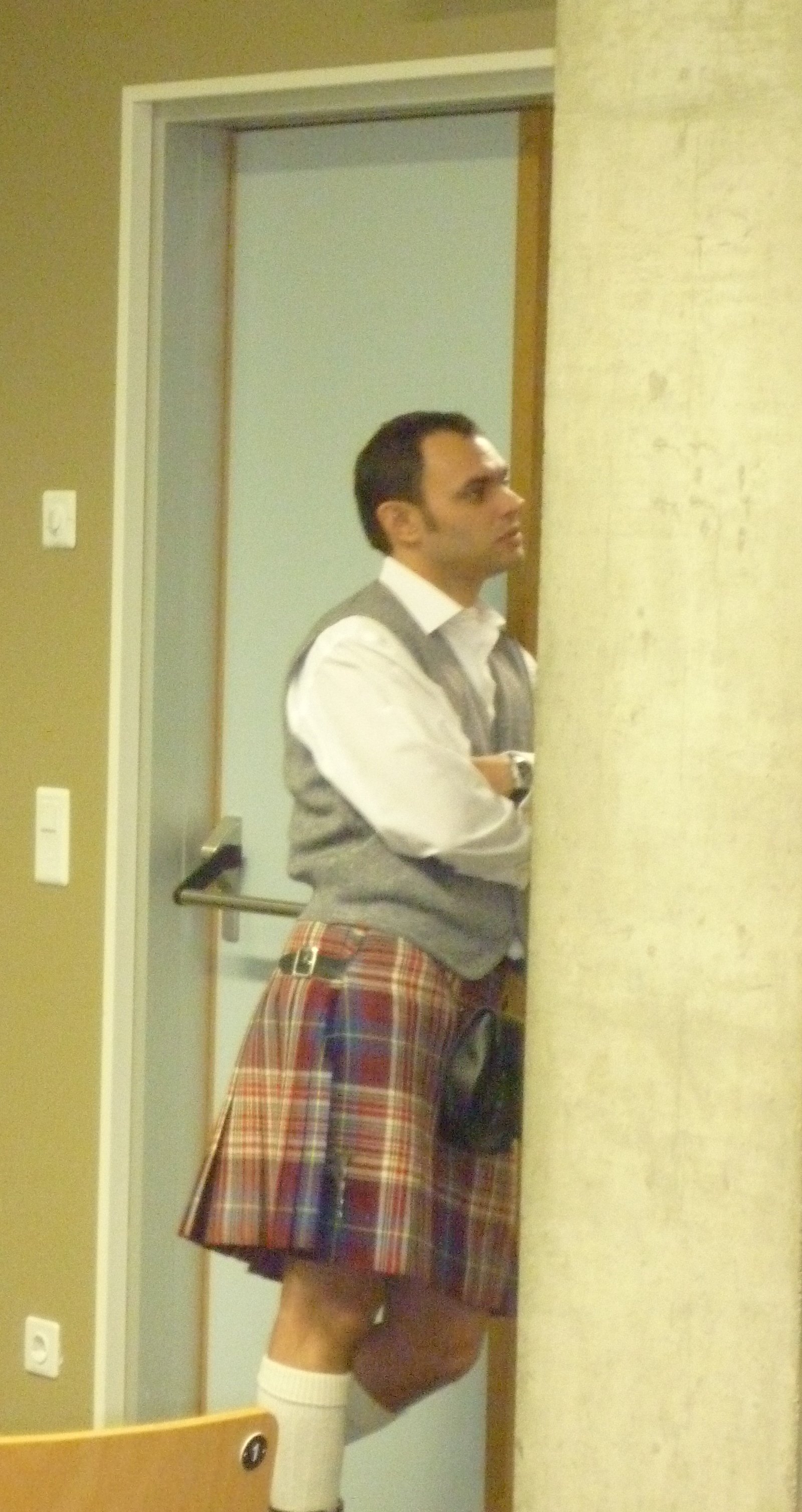
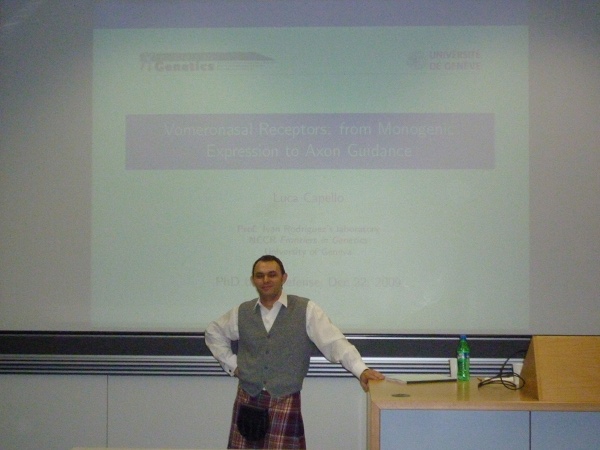
Lucas Nussbaum: Doctor Capello!

He might too shy to tell everybody, but the world must know. Luca Capello successfully defended his PhD thesis today at Universit de Gen ve, getting a Tr s Bien mention. I must admit that my last biology lesson was 13 years ago, so I m not sure I can really comment on his work on Vomeronasal Receptors: from Monogenic Expression to Axon Guidance. But I was very impressed by the quality of the experimental process, especially compared to what we do in computer science. Debian was well represented at the defense, since Axel Beckert, Didier Raboud and the Debian kilt were also there. Welcome to the list of Debian Developers holding PhD degrees, Luca!

Luca waiting at the door (again).
luca1
Luca ready to start.

21 December 2009

Martin-Éric Racine: Wanted: a coherent, sane Finnish political party

In more than 11 years in Finland, I've been politically involved in a couple of political parties on the Right side of the spectrum - mainly because those parties tend to favor a free market economy and a work-oriented immigration. In one case, I was invited by fellow immigrants to attend the meetings of their favorite party's English section, because of my expertise on Immigration legislation and common practices. In an other case, a member of the Finnish parliament invited me to participate in his party's immigrant workgroup, which resulted in my getting involved in a number of proactive initiatives and eventually joining that party as a card-carrying member. Simultaneously, I was approached by no less than 4 Finnish political parties to become a candidate in the municipal elections (in Finland, foreigners who have lived at least 2 years on an A-status residence permit can vote and stand as a candidate in municipal elections). Despite this, I've come to the conclusion that none of these Finnish political parties is genuine: On one hand, there's politicians who claim to know everything about the Immigration question and yet their speeches tell an entirely different story than what immigrants experience. On the other hand, there's politicians who complain about the immigrants' lack of participation in political life, but who quickly add that their personal group of supporters is all they're interested in hearing from. Correlating these facts, it's been found by many politically-involved immigrants that Finnish political parties don't genuinely want to involve immigrants; all they are interested in is acquiring a few extra votes from the immigrant population and in transferring those votes to their party's star Finnish candidate, who often is someone favored by the party's old-timers but disavowed by the majority of grassroot members. In a few more extreme cases, party brasses will sheepishly admit that all they want is a couple of niggers in the candidate list to show a vague sense of adhesion to the multicultural agenda - despite the assurances they have given to often naive immigrant candidates that they "genuinely" hope that they'll be elected. As it turns out, many immigrants are actively involved at the grassroot level and receiving the praises of their Finnish colleagues for their innovative and proactive initiatives. As a result, genuinely interested Finns have joined forces with active immigrants to launch various initiatives for improving Finland's competitive position in the global economy through a thriving cosmopolitanism and a stronger culture of entrepreneurship. For instance, I am personally involved at several public and private sector initiatives. Nonetheless, grassroot initiatives can only ever accomplish so much; without the unflinching support of Finland's significant political players, several key elements of these innovative solutions cannot be implemented. However, given the grassroot's frustrating experiences of the political scene, one cannot help but wonder: Is there any Finnish political party whose actions are coherent with its stated political agenda and in sync with the grassroot initiatives being put forward by the immigrants and their Finnish associates?

Daniel Kahn Gillmor: dd, netcat, and disk throughput

I was trying to dump a large Logical Volume (LV) over ethernet from one machine to another. I found some behavior which surprised me.fun constraints(how do i get myself into these messes?)This entry has been truncated read the full entry.Tags: lvm, netcat

20 December 2009

Dirk Eddelbuettel: Rcpp and inline example

Following up on yesterday's Rcpp 0.7.0 release, here is a quick example of why the new feastures can be so useful. The following R code defines a character variable gslrng. This variable contains a short C++ code segment, which is then transformed by the function cfunction into a function of two arguments assigned to funx: <body style="background-color:#ffffff">
    ## now use Rcpp to pass down a parameter for the seed, and a vector size
    gslrng <- '
       int seed = RcppSexp(s).asInt();
       int len = RcppSexp(n).asInt();
       gsl_rng *r;
       gsl_rng_env_setup();
       std::vector<double> v(len);
       r = gsl_rng_alloc (gsl_rng_default);
       gsl_rng_set (r, (unsigned long) seed);
       for (int i=0; i<len; i++)  
           v[i] = gsl_rng_get (r);
        
       gsl_rng_free(r);
       return RcppSexp(v).asSexp();
    '
    ## turn into a function that R can call
    ## compileargs redundant on Debian/Ubuntu as gsl headers are found anyway
    funx <- cfunction(signature(s="numeric", n="numeric"),
                      gslrng,
                      includes="#include <gsl/gsl_rng.h>",
                      Rcpp=TRUE,
                      cppargs="-I/usr/include",
                      libargs="-lgsl -lgslcblas")
    print(funx(0, 5))
</body> The signature argument to cfunction defines two variables s and n -- which the C++ function then reads in from R and converts to two integers seed and len. seed is used to initialize the random-number generator, and len draws are then taken and stored in the STL vector v which returned at the end. As the R level, we now have a function of two arguments returning a vector of RNG draws of the given lenth and using the given seed. Also note how we tell cfunction to add the GSL include line, specify that we want to compile and link against Rcpp and provide -I and -L arguments to compile and link with the GSL. (The include statement is not needed as the compiler would have found them in /usr/include anyway, but it shows how to set this if needed.) Finally, we simply call our freshly compiled, linked and loaded C++ function with arguments zero for the seed and five for the length, and print the results vector returned to R from C++.

Gregor Herrmann: RC bugs 2009/51

after attending the Munich BSP 3 weeks ago (thanks for inviting me, & thanks especially to Stefan for hosting me) I've tasted blood & started to look at our RC bugs more often. I'm still far from zack's RCBW frequency; but I thought I'd give a short overview anyway; maybe it motivates others to chime in? So here's a list of RC bugs I've touched in the last weeks (not counting some merges in the BTS): remarks:

19 December 2009

Michael Banck: 19 Dec 2009

Tutorials at the Garching Debian Stammtisch Munich traditionally used to have a lot of Debian Developers, but over the last couple of years quite a few of us who used to be students graduated and moved elsewhere or became very busy with their day jobs. We still meet for having a beer and a chat, but not as much as some years ago. We used to meet about once a month, but in 2009 we only managed to meet four times (however, we organized a Bug Squashing Party in November and had a special meeting as Lenny Release Party in February) As the meetings are really rather informal and not necessarily very Debian related, it is difficult to attract new people this way. So Johannes Wiedersich and I decided to try a more hands-on approach by having a second meeting in Garching, in the student-run bar on the campus of the Technische Universit t M nchen (TUM). The idea was to get more of the local science, mathematics and computer science students (as well as possibly interested faculty members) involved. We tried a first time about a year ago, but after two or three meeting in late 2008 and early 2009, we lost momentum. However, we began organizing the meetings again with the start of the winter term, and had two rather successful meetings so far. For the first meeting, we basically handed out some information on how to get involved locally (the Debian-Munich list, its subscription address, the wiki etc.) and discussed Debian in general and Debconf11 in Munich in particular. About half a dozen people showed up, and two of these attended the Bug Squashing Party later that month, and another one (a faculty member) got very active in Debconf11 organization. Thus, I was quite happy with the outcame of that meeting. Some days ago, we had another meeting, and this time I was doing a live-tutorial on Debian package building. As Johannes was ill, we did not manage to announce or publicize the meeting well in advance, so only three people showed up. Still, I think it went rather OK, and we will be doing another Debian package-building tutorial for the next meeting, and possibly other turorials/workshops afterwards (ideas so far include library maintenance, Debconf, how the Debian community is organized and how to get involved in it). As doing a live-tutorial on one notebook is a bit difficult if you both have to type on it and people should see what happens, we will either use some extra hardware next time, or move to some nearby seminar room with a projector, this will be announced in advance. So if you are on Garching campus or nearby and interested in Debian development (and Debian package-building in particular), come to the next meeting on January 13th! We decided to meet on the second Wednesday of each month, at 18h. Subscribe to the Debian-Munich list to get the invitation or watch out for the flyers on the campus.

18 December 2009

Asheesh Laroia: Diversity in Free Software: South Asians as an example

As someone born in India, I sometimes look around and wonder, Where are the Indians (and other South Asians) in Free Software? (I don't mean to exclude South Asians from other countries, so I will lump us together. I believe that we are more similar than we are different, although I know more about India than about the rest of South Asia.) There is no shortage of Indians performing information technology jobs in the United States. The same is true in academia; the Computing Research Association uses National Science Foundation data to show about 15% of computer science bacholor's degrees are awarded to "Asians or Pacific Islanders." These are not precise numbers targeted at South Asians in particular, but they confirm a general feeling that plenty of technologists in the United States are from that part of the world. South Asia is quite a populous region, coming in at over one billion people. It, too, has plenty of technology workers. So much FLOSS conversation happens in English, and India is well-suited to handle this; English is an "official language". Indian academia reports that there are 350 million English users and about 90 million English speakers. So let's visually compare the Debian developers map for South Asia (over one billion people) and that of New Zealand, a country of four million. India: New Zealand: These two countries have about the same number of Debian developers (at least, who have marked their location in the Debian LDAP database). About four. South Asians comprise about one sixth of the world's population. There are about one thousand Debian developers; we represent at best 1% of that. These numbers are comparable to the under-representation of women in Free Software, especially when you compare the figure to South Asians' over-representation in the rest of information technology. That makes me sad. Take a look at the Debian developer map again. You'll see that Debian is certainly not an Americans-only project, or even an English-speakers-only project. South America has a respectable dotting of developers, and Western- to Central-Europe are packed. I have strong feelings about Free Software. It emerges from an ethos of personal empowerment, and with open source it has become a dominant force in computing. Yet there are plenty of sharp people -- at least women and South Asians -- who, somehow, become culturally excluded from participating.

Why care about diversity? Consider the diversity of contributors we already have. Some contribute to Free Software because of particular business needs, such as what caused Avi Kivity to write KVM, the new leader in Linux-based virtualization. Everaldo's art background gave us the "Crystal" icon set that set the standard for sharp-looking icons on the Free Desktop for years. Josh Coalson knew about compressing sound, and his Free Lossless Audio Codec is now the standard in high quality audio. We already have a great deal of diversity. We should be celebrating! Back in 2001, FLAC's users were celebrating. In that year, I decided to ditch proprietary operating systems because I felt I could achieve all my computing needs in the Free world. A happy user of FLAC myself, I lurked on the mailing list as I watched grateful people thank Josh for the great software he wrote. Different contributions will excite different sorts of users. The more different people we have improving FLOSS, the more happy users we can make. Happy users of FLOSS are Free users. Happy users can become contributors, putting forth code, documentation, translations, and word-of-mouth marketing. The first reason to improve diversity in FLOSS is to better suit our users' needs. The more diversity we have in our contributors, the more chance we have of tickling our users in the ways that please them the most. I wish to see an end to software that restricts users' freedom, so I want to see us build the tools that users want. One thing that pleases me is when I see other people contributing who seem similar to me. When I went to Debconf, I was thrilled to be surrounded by people who cared about software freedom and technical excellence. I had even more fun being social, chatting about rainforests, mutual friends, websites, and music. I might have had the most fun playing the card game Mao. A second reason, then, to improve diversity in FLOSS is to increase contributor retention by increasing joy. Mao was an example of a cultural bond I happened to share with a handful of Debianites. The more diversity we have, the more frequent these sorts of coincidences will be. The final, most obvious, reason to reach out to groups of people who do not typically contribute is that we can increase our numbers. That by itself is so valuable. Ubuntu sees 100 new bugs per week, even after the bug squad's efforts. If we can do a better job of recruiting new contributors, the raw numbers give us more strength in creating and maintaining world-class software as well as letting the world know about it.

Changing the balance I believe that there are plenty of South Asians quite capable of contributing to FLOSS. I believe the same of women. I believe the same of men. Back to the topic at hand. Why do the South Asians vanish when we look at Free Software, not tech in general? There are plenty of reasons I can dream up, based on my experience with Indians.
  • Plenty of South Asian parents urge their children to make low-risk career choices.
  • My mother reports that schools in India focus on memorization instead of creativity. This can leave little room for extracurricular pursuits.
It's tough for FLOSS advocates to work directly on these distant issues. But I think we can focus some problems we can help solve. Crucially, awareness of Free Software spreads best by social circles. I learned about Linux from a friend at a summer camp. I'll repeat that:
  • Awareness of Free Software spreads best by social networks.
So if you want to spread that awareness, try to be a bridge. If you meet someone from an unusual background for open source who needs support or mentorship, try to help. That is an investment in the diversity and growth of Free Software. Those people can now unlock more "open source minorities."

What success looks like Google Summer of Code helps some new contributors get started and provides that mentorship. Rachel McCreary was invited to the SciPy conference after a successful summer. Her father left a comment explaining how her sisters participated in FLOSS via Google's Highly Open Participation (GHOP) Contest:
Rachel was inspired and motivated by BOTH of her little sisters, each completing six GHOP tasks (if memory serves).
GHOP and GSOC has been a game-changer for these girls. Rachel's younger sister is applying to schools such as MIT with an interest in a science major. The youngest daughter now has a Caltech poster on her wall with the intent to eventually attend.
Their proud Dad
Soon, these stories will be commonplace. Until then, we have work to do. (I'm still researching these topics. If you can help me find any sort of data to help me learn more about diversity in FLOSS, even if it seems like I wouldn't like it, leave a comment.)

Jurij Smakov: Slow boot

For a very long time my laptop (running sid for a few years now) has been booting kind of slowly. It looked like there was a 2-3 second delay every time a kernel module was loaded, which resulted in something like 3 minutes total boot time. Never bothered me enough, but yesterday I've finally got some time to investigate. After increasing the verbosity of udev logging in /etc/udev/udev.conf I've found lots and lots of messages like this in the log:
Dec 18 00:41:46 droopy udevd-work[425]: wait for '/sys/some/path/bInterfaceProtocol' for 20 mseconds
The only udev rule file containing a reference to bInterfaceProtocol was /etc/udev/rules.d/z60_libccid.rules with the following lines in it:
# last file created by the kernel, if this is present everything should be
WAIT_FOR_SYSFS="bInterfaceProtocol"
The libccid package itself is long gone (I don't remember installing it at all), and the versions of the package starting with 1.3.4-1 (uploaded in February 2008) do not contain this rule. However, the file survived on my system, so this rule was continuing to trigger for every device, even the ones not providing the bInterfaceProtocol at all. Removing the now-redundant file resulted in a dramatic boot speedup (it now takes about 30 seconds), so if you are experiencing similar problems, you might want to check it out.

17 December 2009

Eugene V. Lyubimkin: a small script to satisfy build-dependencies from .dsc

Here it is: http://paste.debian.net/54275/. It needs /usr/bin/cupt from testing or unstable to work. Please report bugs or suggestions in comments to this post or anywhere where you can reach me.

Typical usage:

1) './script package.dsc -s' - preview
2) 'sudo ./script package.dsc' - do the work

Type './script' to see usage.

I will move it to more permanent storage soon.
UPD: Moved. http://people.debian.org/~jackyf/satisfy-dsc-deps.

Vincent Sanders: What is it with embedded computing?

Last week I was given a development board for a system on chip (SoC) we were looking at using. All i had to do was ensure I could get a reasonable, supportable, bootloader and Linux kernel running on it.

Now I am a fairly competent engineer, I have worked with the ARM processors and SoC for many years. It should not therefor take me four days of almost continuous frustration to get a bootloader and kernel onto a system, but it has.

Firstly the system arrives and we look it over, the hardware design is not exactly elegant but seems like it will get the job done. That is at least a step up from several previous offerings which have been just plain broken. So I power it up and it boots into Fedora core 8, possibly not my first OS choice for a diskless system, but it does work.

Perhaps its worth mentioning that my experience with doing any Open Source development has caused me to have a severe aversion to software which is not upstream, especially kernels. The effort required to run your own patch series and keep it up to date is nothing short of Herculean.

Let us be honest, how many developers do you know who are talented enough to generate good code and patient enough to separately maintain it over a long period of time? I shall not belabor this point as others have repeatedly made it for me in much more eloquent ways. Lets us just say from my point of view. Upstream - good. Long term forks - bad.

With this in mind, the solutions Simtec develop are always with a view to our customers being able to simply download and use the standard upstream software wherever possible. Here is where the story stops being smooth and becomes a rant.

The system was running 2.6.22, one that was patched all which ways. "maybe they just shipped an old kernel" I thought. I opened the CD they provided and...oh, OK its just zips and tarballs of the binaries and source they used (actually that in itself is a minor miracle with a lot of vendors right now - see the almost continuous stream of copyright infringement litigation from the FSF) but sill stuck back in July 2007.

So i did teh normal thing, entered the URL printed on the outside of the box and went looking for the updates. No dice, just the same old stuff. So I contacted the company and recived the news that no there were no updates, that was what was published for the device, thats what I could have.

My initial reaction was of tired resignation...this would not be my first SoC port (probably around the fifth or sixth!) So I responded with cd linux-2.6;git checkout master;git pull and went to see what I could see. and lo and behold, there in the kernel, was full support for not only the SoC but for the other version of the very board I had.

Fortunately after mentioning this on IRC my giraffe loving friend. pointed me at the correct community git tree to find the tiny patch required to support my board.

So the vendor was not only shipping old code but actively dissuading customers from even looking for new stuff, which it turns out was mainline anyway! To add to this somewhere along the lines the company name on the box and contact information has changed and...well confusion reigned.

Right Plain sailing from here on? not quite...that would have been too easy. So you can build a mainline kernel...but you cannot boot it. you guessed it the bootloader they ship on the board is ancient, specifically a u-boot fork from December 2005. Having finally figured out how this was going to go, I went to the uboot repo, pulled the latest and built it for my target. And then I needed to upgrade the u-boot and joy of joys bricked the system.

Fortunately the system has a integrated FDTI serial/JTAG port so re-writing the flash should be as simple as running openOCD configured correctly. Of course this did not work...in the end I resorted to running their binary built versions from the CD (tarfile inside a zip inside a tarfile...whatever) and wrote their original image back to the board...which worked.

Long story short, next day I discover that i need a magic different uboot target (make u-boot.kwb for those that care) write this with the binary openocd build and...success
From then on its all been a bit anticlimactic and straightforward and I now have a system capable of starting a kernel over the network and a root fs on network, disc or flash.

My main complaint from all of this is what the hell are vendors doing shipping crap like this? Why do they all insist on taking a dreadful code drop from the SoC manufacturer when they first brought the part up and shipping that prototype junk until the part reaches the end of its life?!?

All the usual excuses about support etc. will come out, but seriously, you recive *no* support from vendors unless you pay for it and even then they will simply tell you whats on the CD is "it". Btw the diff for u-boot to support this board is larger than the original sources and the 2.6.22 is attacked with a 65MB diff which cannot be good.

The Open Source option is continuously innovating and improving, producing ever better software...but the embedded world seems to be forever stuck shipping crap. Is this just me? Does anyone have any solutions? Or am I stuck with this until I change profession?

16 December 2009

Holger Levsen: Debian Wine soon to be sold out?

In case you want to buy some (more) bottles of wine made for DebConf9, you need to hurry up. Also a bit more hurry is appropriate if you want it to be delivered til XMas :-)


(Picture credit belongs to Chris.)

I'm planing another (offline) sale at the 26C3 congress in Berlin at the end of the year, which might or might not work out. If it does, the number of bottles available for online ordering will be reduced significantly, and basically I'm only waiting for some details to be finalized for announcing this for real, so hurry up and mail order now - unless you have enough Debian wine bottles at home already :-)

Information how to order is available in our wiki at DebianWine. The profit made will be given to DebConf9, and as that has been dealt with finacially successfully, it will be given to DebConf10!

15 December 2009

John Goerzen: Review: A Christmas Carol

I guess you can say that A Christmas Carol by Charles Dickens has been a success. It was published in 1843 and has never been out of print since then. It s spawned all manner of plays, films, adaptations, and spoofs. It s been adapted at least twice by Disney, once featuring Mickey Mouse and another time featuring Jim Carey. We re almost inundated with the story I m not sure how many ways I ve seen it. Yet I had never read the original story by Dickens until just now. And I must say, what a treat it was. Despite knowing the plot in advance, it was a very good read. The 19th century London setting was done well. It wasn t some idealized London as is often portrayed in film adaptations. It had depth, as did the characters. Dickens Scrooge had a troubled childhood, the son of poor and apparently abusive parents. He turned to business, with which he was successful. Along the way, he lost sight of family, and really of his humanity in general, striving to be a richer and more successful businessman at the cost of all else. How apropos this story is for us in the 21st century. Our large banks define success in terms of profits made for their shareholders, while adding more gotchas to the terms of the credit cards held by their customers. Our governments play geopolitical games over weapons, oil, and gas, while unwilling to sacrifice anything to prevent a climate disaster. Our politicians, even in the season of Christmas, turn a blind eye and a cold heart to the suffering of those that can t afford health care for naught but political reasons, rather than trying their hardest to make a plan that will help them reality as soon as possible. And what of us, the citizens of the 21st century? We consume ever flashier cars, houses, computers, and cellphones with data plans, while poverty intensifies across the globe in this economic downturn. Well, count me among those many inspired and reminded by Dickens to be a more empathetic person, to remember how good even many of the poor in the West have it compared to other parts of the world, and to try to do more for others. And that, perhaps, is part of the genius of Dickens. He inspired a complete change of how people looked at Christmas in his time. And his work is no less relevant today; perhaps it hits even closer to home these days. He invites us to carefully consider the question: what does it mean to achieve success in life? And he deftly illustrates that wealth is wrong answer. Here s hoping that many others will also learn a small bit about life from Dickens. How to find it: A Christmas Carol is available for free from Project Gutenberg for reading online, printing, or reading on an ebook reader such as the Kindle. Be careful when buying printed editions. Many have been abridged or improved for a modern audience , and thus lose a lot of the quality of the original. I found at least one edition that looks true to the original; I m sure there are others. [This review also posted to Goodreads]

Next.

Previous.