Jan Wagner: Container Orchestration Thoughts

 Since some time everybody (read developer) want to run his new microservice stacks in containers. I can understand that building and testing an application is important for developers.
One of the benefits of containers is, that developer (in theory) can put their new version of applications into production on their own. This is the point where operations is affected and operations needs to evaluate, if that might evolve into better workflow. For yolo^WdevOps people there are some challenges that needs to be solved, or at least mitigated, when things needs to be done in large(r) scale.
- Which Orchestration Engine should be considered?
- How to provide persistent (shared) storage?
- How to update the base image(s) the apps are build upon and to test/deploy them?
Orchestration Engine
Running Docker, which is actual the most preferred container solution, on a single host with docker command line client is something you can do, but there you leave the gap between dev and ops.
UI For Docker
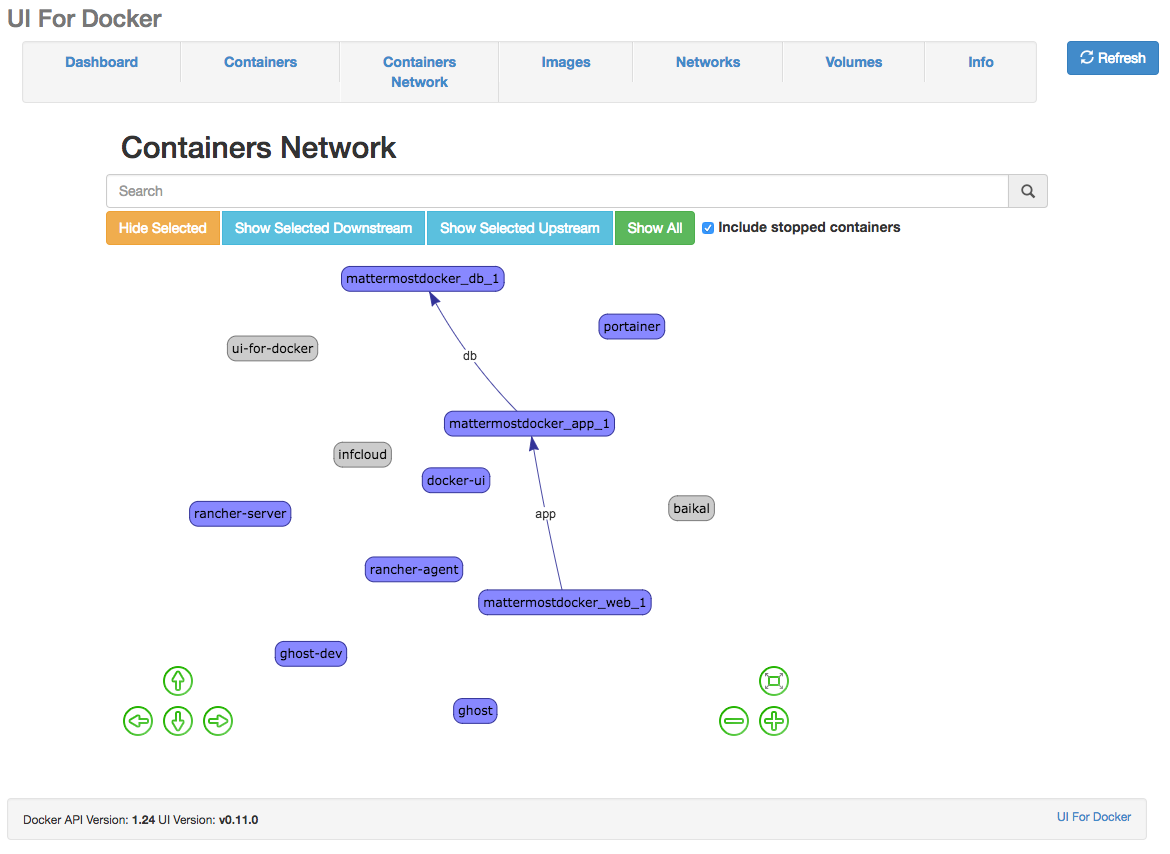
Since some time there is UI For Docker available for visualizing and managing containers on a single docker node. It's pretty awesome and the best feature so far is the Container Network view, which also shows the linked container.
Portainer
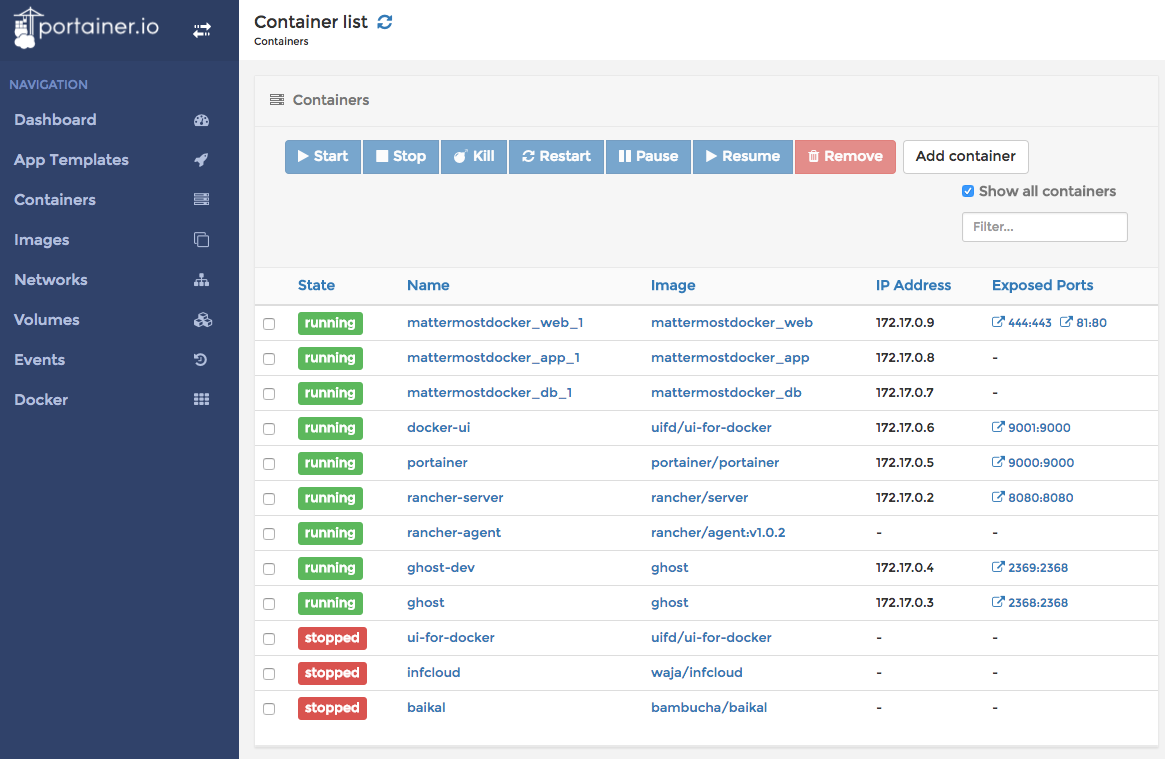
Portainer is pretty new and it can be deployed as easy as UI For Docker. But the (first) great advantage: it can handle Docker Swarm. Beside that it has many other great features.
Rancher
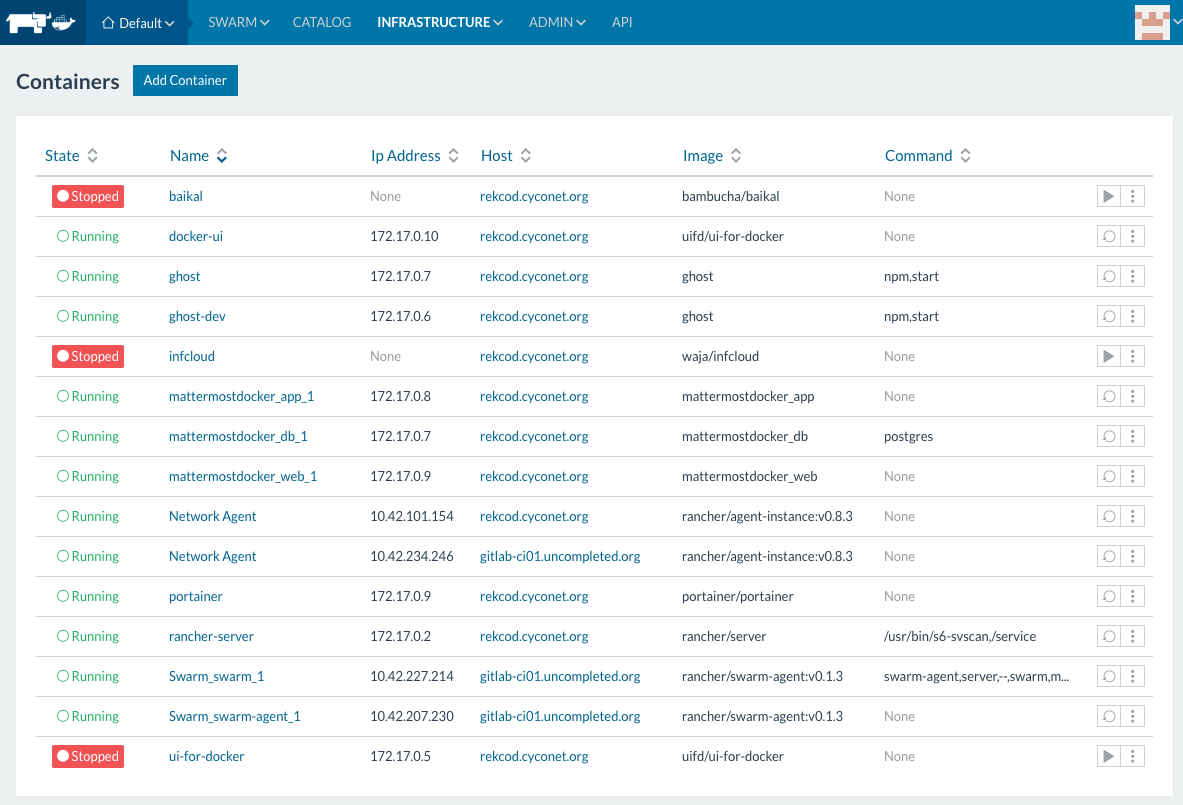
Rancher describes themselves as 'container management platform' that 'supports and manages all of your Kubernetes, Mesos, and Swarm clusters'. This is great because this are all of the relevant docker cluster orchestrations at the market actually.
 For the use cases, we are facing, Kubernetes and Mesos seems both like bloated beasts. Usman Ismail has written a really good comparison of Orchestration Engine options which goes into details.
Docker Swarm
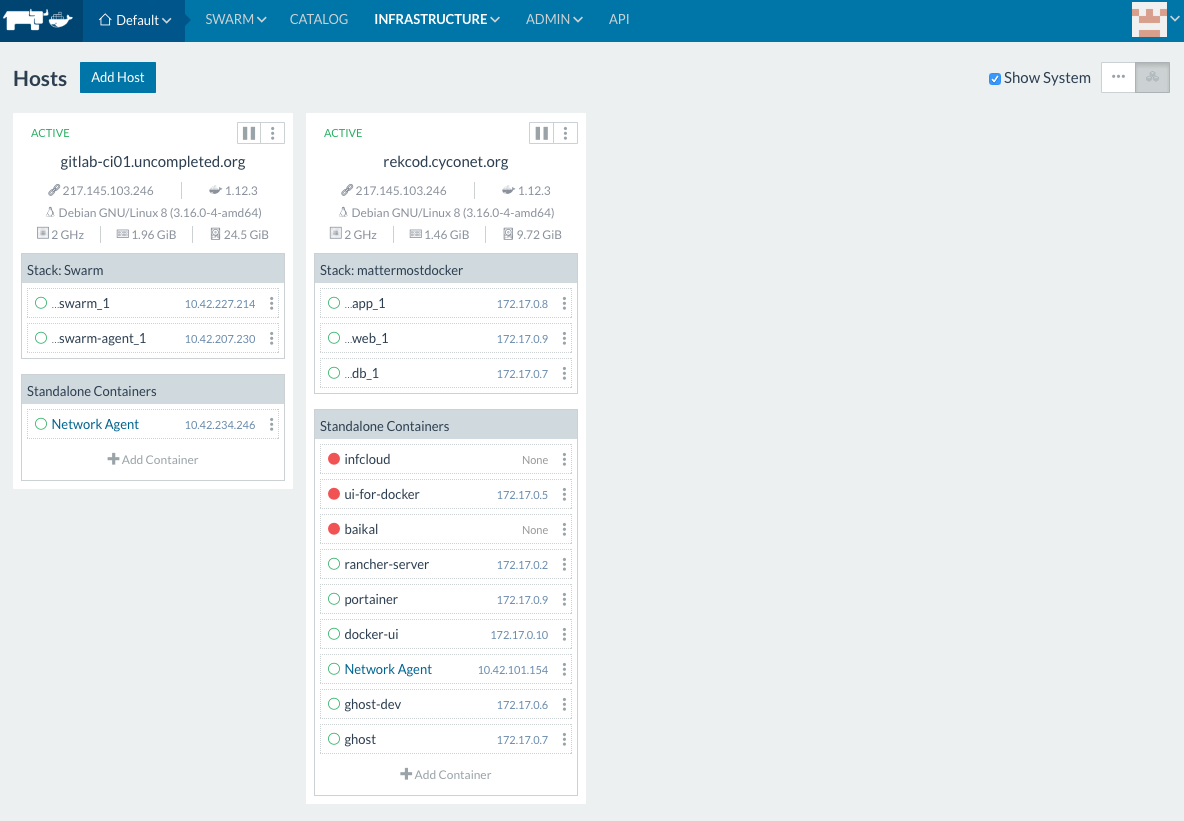
As there is actually no clear defacto standard/winner of the (container) orchestration wars, I would prevent to be in a vendor lock-in situation (yet). Docker swarm seems to be evolving and is getting more nice features other competitors doesn't provide.
Due the native integration into the docker framework and great community I believe Docker Swarm will be the Docker Orchestration of the choice on the long run. This should be supported by Rancher 1.2 which is not released yet.
From this point of view it looks very reasonable that Docker Swarm in combination with Rancher (1.2) might be a good strategy to maintain your container farms in the future.
If you think to put Docker Swarm into production in the actual state, I recommend to read Docker swarm mode: What to know before going live on production by Panjamapong Sermsawatsri.
Persistent Storage
While it is a best practice to use data volume container these days, providing persistent storage across multiple hosts for shared volumes seems to be tricky.
In theory you can mount a shared-storage volume as a data volume and there are several volume plugins which supports shared storage.
For example you can use the convoy plugin which gives you:
- thin provisioned volumes
- snapshots of volumes
- backup of snapshots
- restore volumes
As backend you can use:
- Device Mapper
- Virtual File System(VFS)/Network File System(NFS)
- Amazon Elastic Block Store(EBS)
The good thing is, that convoy is integrated into Rancher. For more information I suggest to read Setting Up Shared Volumes with Convoy-NFS, which also mentions some limitations. If you want test Persistent Storage Service, Rancher provides some documentation.
Actually I did not evaluate shared-storage volumes yet, but I don't see a solution I would love to use in production (at least on-premise) without strong downsides. But maybe things will go further and there might be a great solution for this caveats in the future.
Keeping base images up-to-date
Since some time there are many projects that tries to detect security problems in your container images in several ways.
Beside general security considerations you need to deal somehow with issues in your base images that you build your applications on.
Of course, even if you know you have a security issue in your application image, you need to fix it, which depends on the way how you based your application upon.
Ways to base your application image
- You can build your application image entire from scratch, which leaves all the work to your development team and I wouldn't recommend it that way.
- You also can create one (or more) intermediate image(s) that will be used by your development team.
- The development team might ground their work on images in public available or private (for example the one bundled to your gitlab CI/CD solution) registries.
Whats the struggle with the base image?
If you are using images being not (well) maintained by other people, you have to wait for them to fix your base image. Using external images might also lead into trust problems (can you trust those people in general?).
In an ideal world, your developers have always fresh base images with fixed security issues. This can probably be done by rebuilding every intermediate image periodically or when the base image changes.
Paradigm change
Anyway, if you have a new application image available (with no known security issues), you need to deploy it to production. This is summarized by Jason McKay in his article Docker Security: How to Monitor and Patch Containers in the Cloud:
To implement a patch, update the base image and then rebuild the application image. This will require systems and development teams to work closely together.
So patching security issues in the container world changes workflow significant. In the old world operation teams mostly rolled security fixes for the base systems independent from development teams.
Now hitting containers the production area this might change things significant.
Bringing updated images to production
Imagine your development team doesn't work steady on a project, cause the product owner consider it feature complete. The base image is provided (in some way) consistently without security issues. The application image is build on top of that automatically on every update of the base image.
How do you push in such a scenario the security fixes to production?
From my point of view you have two choices:
- Let the development team require to test the resulting application image and put it into production
- Push the new application image without review by the development team into production
The first scenario might lead into a significant delay until the fixes hit production created by the probably infrequent work of the development team.
The latter one brings your security fixes early to production by the notable higher risk to break your application. This risk can be reduced by implementing massive tests into CI/CD pipelines by the development team. Rolling updates provided by Docker Swarm might also reduce the risk of ending with a broken application.
When you are implementing an update process of your (application) images to production, you should consider Watchtower that provides Automatic Updates for Docker Containers.
Conclusion
Not being a product owner or the operations part of an application that is facing a widely adopted usage that would compensate the actual tradeoffs we are still facing I tend not to move large scale production projects into a container environment.
This means not that this might be a bad idea for others, but I'd like to sort out some of the caveats before.
I'm still interested to put smaller projects into production, being not scared to reimplement or move them on a new stack.
For smaller projects with a small number of hosts Portainer looks not bad as well as Rancher with the Cattle orchestration engine if you just want to manage a couple of nodes.
Things are going to be interesting if Rancher 1.2 supports Docker swarm cluster out of the box. Let's see what the future will bring us to the container world and how to make a great stack out of it.
Update
I suggest to read Docker in Production: A History of Failure and the answer Docker in Production: A retort to understand the actual challenges when running Docker in larger scale production environments.
Portainer
Portainer is pretty new and it can be deployed as easy as UI For Docker. But the (first) great advantage: it can handle Docker Swarm. Beside that it has many other great features.
Rancher
Rancher describes themselves as 'container management platform' that 'supports and manages all of your Kubernetes, Mesos, and Swarm clusters'. This is great because this are all of the relevant docker cluster orchestrations at the market actually.
For the use cases, we are facing, Kubernetes and Mesos seems both like bloated beasts. Usman Ismail has written a really good comparison of Orchestration Engine options which goes into details.
Docker Swarm
As there is actually no clear defacto standard/winner of the (container) orchestration wars, I would prevent to be in a vendor lock-in situation (yet). Docker swarm seems to be evolving and is getting more nice features other competitors doesn't provide.
Due the native integration into the docker framework and great community I believe Docker Swarm will be the Docker Orchestration of the choice on the long run. This should be supported by Rancher 1.2 which is not released yet.
From this point of view it looks very reasonable that Docker Swarm in combination with Rancher (1.2) might be a good strategy to maintain your container farms in the future.
If you think to put Docker Swarm into production in the actual state, I recommend to read Docker swarm mode: What to know before going live on production by Panjamapong Sermsawatsri.
Persistent Storage
While it is a best practice to use data volume container these days, providing persistent storage across multiple hosts for shared volumes seems to be tricky.
In theory you can mount a shared-storage volume as a data volume and there are several volume plugins which supports shared storage.
For example you can use the convoy plugin which gives you:
- thin provisioned volumes
- snapshots of volumes
- backup of snapshots
- restore volumes
As backend you can use:
- Device Mapper
- Virtual File System(VFS)/Network File System(NFS)
- Amazon Elastic Block Store(EBS)
The good thing is, that convoy is integrated into Rancher. For more information I suggest to read Setting Up Shared Volumes with Convoy-NFS, which also mentions some limitations. If you want test Persistent Storage Service, Rancher provides some documentation.
Actually I did not evaluate shared-storage volumes yet, but I don't see a solution I would love to use in production (at least on-premise) without strong downsides. But maybe things will go further and there might be a great solution for this caveats in the future.
Keeping base images up-to-date
Since some time there are many projects that tries to detect security problems in your container images in several ways.
Beside general security considerations you need to deal somehow with issues in your base images that you build your applications on.
Of course, even if you know you have a security issue in your application image, you need to fix it, which depends on the way how you based your application upon.
Ways to base your application image
- You can build your application image entire from scratch, which leaves all the work to your development team and I wouldn't recommend it that way.
- You also can create one (or more) intermediate image(s) that will be used by your development team.
- The development team might ground their work on images in public available or private (for example the one bundled to your gitlab CI/CD solution) registries.
Whats the struggle with the base image?
If you are using images being not (well) maintained by other people, you have to wait for them to fix your base image. Using external images might also lead into trust problems (can you trust those people in general?).
In an ideal world, your developers have always fresh base images with fixed security issues. This can probably be done by rebuilding every intermediate image periodically or when the base image changes.
Paradigm change
Anyway, if you have a new application image available (with no known security issues), you need to deploy it to production. This is summarized by Jason McKay in his article Docker Security: How to Monitor and Patch Containers in the Cloud:
To implement a patch, update the base image and then rebuild the application image. This will require systems and development teams to work closely together.
So patching security issues in the container world changes workflow significant. In the old world operation teams mostly rolled security fixes for the base systems independent from development teams.
Now hitting containers the production area this might change things significant.
Bringing updated images to production
Imagine your development team doesn't work steady on a project, cause the product owner consider it feature complete. The base image is provided (in some way) consistently without security issues. The application image is build on top of that automatically on every update of the base image.
How do you push in such a scenario the security fixes to production?
From my point of view you have two choices:
- Let the development team require to test the resulting application image and put it into production
- Push the new application image without review by the development team into production
The first scenario might lead into a significant delay until the fixes hit production created by the probably infrequent work of the development team.
The latter one brings your security fixes early to production by the notable higher risk to break your application. This risk can be reduced by implementing massive tests into CI/CD pipelines by the development team. Rolling updates provided by Docker Swarm might also reduce the risk of ending with a broken application.
When you are implementing an update process of your (application) images to production, you should consider Watchtower that provides Automatic Updates for Docker Containers.
Conclusion
Not being a product owner or the operations part of an application that is facing a widely adopted usage that would compensate the actual tradeoffs we are still facing I tend not to move large scale production projects into a container environment.
This means not that this might be a bad idea for others, but I'd like to sort out some of the caveats before.
I'm still interested to put smaller projects into production, being not scared to reimplement or move them on a new stack.
For smaller projects with a small number of hosts Portainer looks not bad as well as Rancher with the Cattle orchestration engine if you just want to manage a couple of nodes.
Things are going to be interesting if Rancher 1.2 supports Docker swarm cluster out of the box. Let's see what the future will bring us to the container world and how to make a great stack out of it.
Update
I suggest to read Docker in Production: A History of Failure and the answer Docker in Production: A retort to understand the actual challenges when running Docker in larger scale production environments.
- thin provisioned volumes
- snapshots of volumes
- backup of snapshots
- restore volumes
- Device Mapper
- Virtual File System(VFS)/Network File System(NFS)
- Amazon Elastic Block Store(EBS)
Keeping base images up-to-date
Since some time there are many projects that tries to detect security problems in your container images in several ways.
Beside general security considerations you need to deal somehow with issues in your base images that you build your applications on.
Of course, even if you know you have a security issue in your application image, you need to fix it, which depends on the way how you based your application upon.
Ways to base your application image
- You can build your application image entire from scratch, which leaves all the work to your development team and I wouldn't recommend it that way.
- You also can create one (or more) intermediate image(s) that will be used by your development team.
- The development team might ground their work on images in public available or private (for example the one bundled to your gitlab CI/CD solution) registries.
Whats the struggle with the base image?
If you are using images being not (well) maintained by other people, you have to wait for them to fix your base image. Using external images might also lead into trust problems (can you trust those people in general?).
In an ideal world, your developers have always fresh base images with fixed security issues. This can probably be done by rebuilding every intermediate image periodically or when the base image changes.
Paradigm change
Anyway, if you have a new application image available (with no known security issues), you need to deploy it to production. This is summarized by Jason McKay in his article Docker Security: How to Monitor and Patch Containers in the Cloud:
To implement a patch, update the base image and then rebuild the application image. This will require systems and development teams to work closely together.
So patching security issues in the container world changes workflow significant. In the old world operation teams mostly rolled security fixes for the base systems independent from development teams.
Now hitting containers the production area this might change things significant.
Bringing updated images to production
Imagine your development team doesn't work steady on a project, cause the product owner consider it feature complete. The base image is provided (in some way) consistently without security issues. The application image is build on top of that automatically on every update of the base image.
How do you push in such a scenario the security fixes to production?
From my point of view you have two choices:
- Let the development team require to test the resulting application image and put it into production
- Push the new application image without review by the development team into production
The first scenario might lead into a significant delay until the fixes hit production created by the probably infrequent work of the development team.
The latter one brings your security fixes early to production by the notable higher risk to break your application. This risk can be reduced by implementing massive tests into CI/CD pipelines by the development team. Rolling updates provided by Docker Swarm might also reduce the risk of ending with a broken application.
When you are implementing an update process of your (application) images to production, you should consider Watchtower that provides Automatic Updates for Docker Containers.
Conclusion
Not being a product owner or the operations part of an application that is facing a widely adopted usage that would compensate the actual tradeoffs we are still facing I tend not to move large scale production projects into a container environment.
This means not that this might be a bad idea for others, but I'd like to sort out some of the caveats before.
I'm still interested to put smaller projects into production, being not scared to reimplement or move them on a new stack.
For smaller projects with a small number of hosts Portainer looks not bad as well as Rancher with the Cattle orchestration engine if you just want to manage a couple of nodes.
Things are going to be interesting if Rancher 1.2 supports Docker swarm cluster out of the box. Let's see what the future will bring us to the container world and how to make a great stack out of it.
Update
I suggest to read Docker in Production: A History of Failure and the answer Docker in Production: A retort to understand the actual challenges when running Docker in larger scale production environments.
To implement a patch, update the base image and then rebuild the application image. This will require systems and development teams to work closely together.So patching security issues in the container world changes workflow significant. In the old world operation teams mostly rolled security fixes for the base systems independent from development teams.
Now hitting containers the production area this might change things significant.
Bringing updated images to production
Imagine your development team doesn't work steady on a project, cause the product owner consider it feature complete. The base image is provided (in some way) consistently without security issues. The application image is build on top of that automatically on every update of the base image.
How do you push in such a scenario the security fixes to production?
From my point of view you have two choices:
- Let the development team require to test the resulting application image and put it into production
- Push the new application image without review by the development team into production
The first scenario might lead into a significant delay until the fixes hit production created by the probably infrequent work of the development team.
The latter one brings your security fixes early to production by the notable higher risk to break your application. This risk can be reduced by implementing massive tests into CI/CD pipelines by the development team. Rolling updates provided by Docker Swarm might also reduce the risk of ending with a broken application.
When you are implementing an update process of your (application) images to production, you should consider Watchtower that provides Automatic Updates for Docker Containers.
Conclusion
Not being a product owner or the operations part of an application that is facing a widely adopted usage that would compensate the actual tradeoffs we are still facing I tend not to move large scale production projects into a container environment.
This means not that this might be a bad idea for others, but I'd like to sort out some of the caveats before.
I'm still interested to put smaller projects into production, being not scared to reimplement or move them on a new stack.
For smaller projects with a small number of hosts Portainer looks not bad as well as Rancher with the Cattle orchestration engine if you just want to manage a couple of nodes.
Things are going to be interesting if Rancher 1.2 supports Docker swarm cluster out of the box. Let's see what the future will bring us to the container world and how to make a great stack out of it.
Update
I suggest to read Docker in Production: A History of Failure and the answer Docker in Production: A retort to understand the actual challenges when running Docker in larger scale production environments.
This means not that this might be a bad idea for others, but I'd like to sort out some of the caveats before. I'm still interested to put smaller projects into production, being not scared to reimplement or move them on a new stack.
For smaller projects with a small number of hosts Portainer looks not bad as well as Rancher with the Cattle orchestration engine if you just want to manage a couple of nodes. Things are going to be interesting if Rancher 1.2 supports Docker swarm cluster out of the box. Let's see what the future will bring us to the container world and how to make a great stack out of it.
 Welcome to gambaru.de. Here is my monthly report that covers what I have been doing for Debian. If you re interested in Android, Java, Games and LTS topics, this might be interesting for you.
Debian Android

 My monthly report covers a large part of what I have been doing in the free software world. I write it for
 Wishing every one a happy Gujarati New Year, Vikram Samvat 2073 named Kilaka and hoping the upcoming year will be yuuge for you.
These next couple of paragraphs are totally not an excuse for why it will take a few more days for me to reach seven blog posts.
Reading reports about Diwali in the American press, I see a bit of confusion whether Diwali is one day or five. Well, technically it is just one (Sunday 30th this year.) but there are a number of other observances around it which could be classed as subsidiaries if you want to look at it that way.
The season commenced last Wednesday with Rama Ekadashi. (where the Gujarati name is different I'll use that and put the Sanskrit name in parentheses.) That's a fast day and therefore not much fun.
Thursday was Vagh Barash (vyaghra dvadashi) which as the name suggests is something to do with tigers but we don't in my experience particularly do anything special that day.
Friday, things began in earnest with Dhan Terash (dhana trayodashi) when Lakshmi the Goddess of prosperity is worshipped. It is also a good day to buy gold.
Saturday was Kali Chaudash (Kali Chaturdashi or Naraka Chaturdashi) On this day many Gujarati families including mine worship their Kuladevi (patron Goddess of the family) even if She is not an aspect of Kali. (Others observe this on the Ashtami of Navaratri.) The day is also associated with the God Hanuman. Some people say it is His Jayanti (birthday) though we observe it in Chaitra (March-April.) It is also the best day for learning mantras and I initiated a couple of people including my son into a mantra I know.
Sunday was Diwali (Deepavali) proper. As a Brahmana I spent much of the day signing blessings in the account books of shopkeepers. Well, nowadays only a few old people have actual account books so usually the print out a spreadsheet and I sign that. But home is where the main action is. Lights are lit, fireworks are set off, and prayers are offered to Lakshmi. But most important of all, this is the day good boys and girls get presents. Unfortunately I have nothing interesting to report; just the usual utilitarian items of clothing. Fireworks by the way are technically illegal in New Jersey not that that ever stopped anyone from getting them. The past few years, Jersey City has attempted to compromise by allowing a big public fireworks display. Although it was nice and sunny all day, by nighttime we had torrential rain and the firework display got washed out. So I'm glad I rebelled against the system with my small cache of sparklers.
Today (or yesterday by the time this gets posted.) was the Gujarati New Years Day. There is also the commemoration of the time the God Krishna lifted up Mt Govardhan with one finger which every mandir emulates by making an annakuta or mountain of food.
Tuesday is Bhai Beeja (Yama Dvitiya in Sanskrit or Bhai Duj in Hindi) when sisters cook a meal for their brothers. My son is also going to make something (read: microwave something) for his sister.
So those are the five days of Diwali. Though many will not consider it to be truly over until this Saturday, the lucky day of Labh Pancham (Labha panchami.) And if I still haven't managed to write seven blog posts by then, there is always Deva Diwali...
 So, it's now been twenty years since I became a Debian Developer. I
couldn't remember the exact date I signed up, but I
decided to do some forensics to find out. First, I can check on the
dates on my first Debian system, as I've kept it running as a Debian
system ever since!
 Here is my monthly update covering what I have been doing in the free software world (
 I m at an airport, about to board the first of three flights across the world, from timezone +8 to timezone -8. I ll be in transit 27 hours to get to Seattle, Washington state. I m leaving my wife and two young children behind.
My work has given me a days worth of leave under the Corporate Social Responsibility program, and I m taking three days annual leave, to do this. 27 hours each way in transit, for 3 days on the ground.
Why?
Backstory
I started playing in technology as a kid in the 1980s; my first PC was a clone (as they were called) 286 running MS-DOS. It was clunky, and the most I could do to extend it was to write batch scripts. As a child I had no funds for commercial compilers, no network connections (this was pre Internet in Australia), no access to documentation, and no idea where to start programming properly.
It was a closed world.
I hit university in the summer of 1994 to study Computer Science and French. I d heard of Linux, and soon found myself installing the Linux distributions of the day. The Freedom of the licensing, the encouragement to use, modify, share, was in stark contrast to the world of consumer PCs of the late 1980 s.
It was there at the UCC at UWA I discovered Debian. Some of the kind network/system admins at the University maintained a Debian mirror on the campus LAN, updated regularly and always online. It was fast, and more importantly, free for me to access. Back in the 1990s, bandwidth in Australia was incredibly expensive. The vast distances of the country mean that bandwidth was scarce. Telcos were in races to put fiber between Perth and the Eastern States, and without that in place, IP connectivity was constrained, and thus costly.
Over many long days and nights I huddled down, learning window managers, protocols, programming and scripting languages. I became a system/network administrator, web developer, dev ops engineer, etc. My official degree workload, algorithmic complexity, protocol stacks, were interesting, but fiddling with Linux based implementations was practical.
Volunteer
After years of consuming the output of Debian and running many services with it I decided to put my hand up and volunteer as a Debian Developer: it was time to give back. I had benefited from Debian, and I saw others benefit from it as well.
As the 2000 s started, I had my PGP key in the Debian key ring. I had adopted a package and was maintaining it load balancing Apache web servers. The web was yet to expand to the traffic levels you see today; most web sites were served from one physical web server. Site Reliability Engineering was a term not yet dreamed of.
What became more apparent was the applicability of Linux, Open Source, and in my line-of-sight Debian to a wider community beyond myself and my university peers. Debain was being used to revive recycled computers that were being donated to charities; in some cases, unable to transfer commercial software licenses with the hardware that was no longer required by organisations that had upgraded. It appeared that Debian was being used as a baseline above which society in general had access to fundamental capability of computing and network services.
The removal of subscriptions, registrations, and the encouragement of distribution meant this occurred at rates that could never be tracked, and more importantly, the consensus was that it should not be automatically tracked. The privacy of the user is paramount more important than some statistics for the Developer to ponder.
When the Bosnia-Herzegovina war ended in 1995, I recall an email from academics there, having found some connectivity, writing to ask if they would be able to use Debian as part of their re-deployment of services for the Tertiary institutions in the region. This was an unnecessary request as Debian GNU/Linux is freely available, but it was a reminder that, for the country to have tried to procure commercial solutions at that time would have been difficult. Instead, those that could do the task just got on with it.
There s been many similar project where the grass-roots organisations non profits, NGOs, and even just loose collectives of individuals have turned to Linux, Open Source, and sometimes Debian to solve their problems. Many fine projects have been established to make technology accessible to all, regardless of race, gender, nationality, class, or any other label society has used to divide humans. Big hat tip to
 The
 I have just released version 1.20 of


 As web search engines and IRC seems to be of no help, maybe someone
here has a helpful idea. I have some service written in python that
comes with a .service file for systemd. I now want to build&install a
working service file from the software's setup.py. I can override
the build/build_py commands of setuptools, however that way I still
lack knowledge wrt. the bindir/prefix where my service script will be
installed.
Solution
Turns out, if you override the
