Search Results: "ag"

1 February 2022

Russell Coker: First Flounder Meeting

Based on a comment from my previous post [1] I have named the new FOSS group for Australia and NZ Flounder. Here is the link to the agenda for the first meeting [2]. I am currently using a DNS name in my own domain for the group, but in the near future I ll move it to somewhere else under a zone I don t control. My aim is not to have personal control but to create an organisation for the community. But at the moment I m just doing things in the fastest way possible, I will setup HTTP redirects when I get a better DNS name.

Junichi Uekawa: Already February.

Already February. Surprising. I've been practicing Rust every day and I am getting more comfortable with Rust the language now.

Dirk Eddelbuettel: #35: apt install rstudio quarto

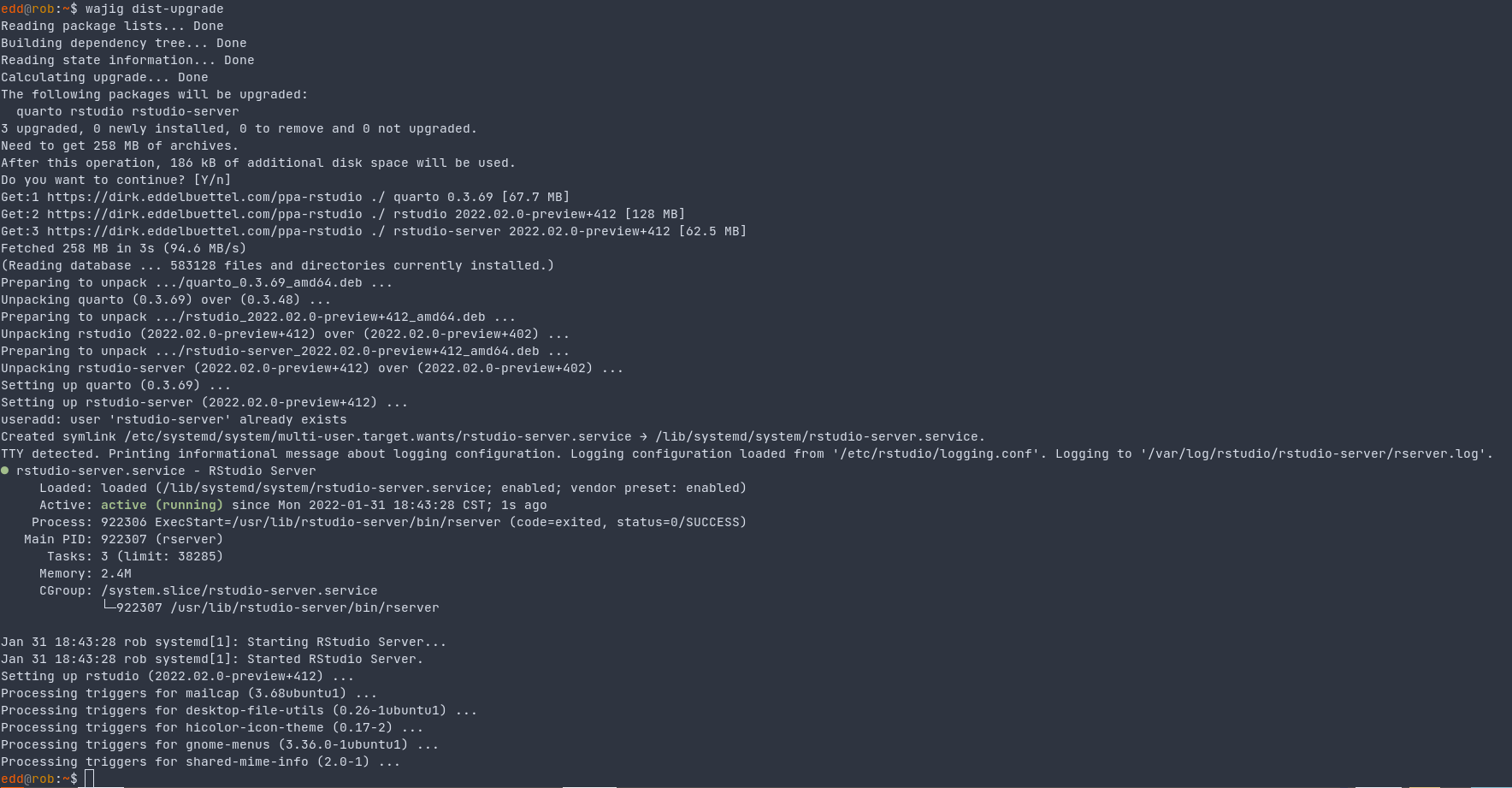
Welcome to the 35th post in the ravishingly rabiant R recommendations, or R4. Today s post is about apt and R tools. Many of us have been running RStudio off our local machines for as long as binaries have been provided. Which is by now probably a bit over a decade. Time flies. And as nice it is to have matching binaries, in my case in the .deb format used on Debian or Ubuntu, it is wee bit a painful to manually download a file and then install it. Twice the pain if you are lucky enough to be on a system where you can also run RStudio Server. And now three times as painful as you may need a matching quarto-cli binary for the nice quarto service. So wouldn t it be nice to have an apt-getable repo? And to autoMAGICall get updated versions when they are available? Oh yes. And I had been bugging JJ from day one. And JJ would almost listen intendly, nod briefly and firmly, and issue an assured we will look into it. Well, they are still looking Luckily, years ago, Carl wrote a helper script for our use in Rocker. I promptly adopted these and kept them in the littler examples directory as a pair of script getRStudioDesktop.r and getRStudioServer.r, later complemented by getQuartoCli.r. And I used these for years, somewhere between weekly and monthly. But it is still very manual: three script calls, one sudo dpkg -i call. And as our good friends at RStudio don t seem to be coming forward with a repo, I created one at GitHub thinking I could serve the files via GitHub Pages. Which of course I cannot as the .deb file for rstudio is well above the 100mb limit. So that seemed to be a bit of a setback. But after a bit of pondering, and recognizing that I am now in the fortunate position to have symmetric broadband access at home, I reckoned that until the bandwidth use gets excessive I will serve this as truly personal package archive (or tPPA) from here. Note that this is calibrated for my use so Ubuntu amd64 it is. Nothing else. And that it installs dailies . Which may cause issues for some people. You have warned. Reading tis paragraphs signifies agreement with the terms and limitations. Just kidding. A quick screenshot from an update earlier is here. Note that I use the fabulous wajig wrapper by Graham Williams here as my frontend to apt, dpkg and more as I have for even longer than I have use RStudio. Its use is tangential here; sudo apt upgrade would have done the same (and is essentially being called). And it demonstrates the main benefit: we are now automated as the cron scheduler launches an update of the PPA at which ever frequency you chose (currently twice a week for me) and after that it becomes part of the normal apt updates we do anyway (and which I do about daily). So that s main gist: automated apt upgrades of rstudio, rstudio-server, and quarto-cli. And you can find the underlying code in the GitHub repo ppa-rstudio which I put together a good week ago. I am currently updating the tPPA twice a week from crontab and have had two full upgrades already. And who knows, maybe with a bid of prodding RStudio may come around. One can always hope. If you like this or other open-source work I do, you can sponsor me at GitHub.

This post by Dirk Eddelbuettel originated on his Thinking inside the box blog. Please report excessive re-aggregation in third-party for-profit settings.

Paul Wise: FLOSS Activities January 2022

Focus This month I didn't have any particular focus. I just worked on issues in my info bubble.

Changes

Issues

Review

Administration
  • Debian BTS: unarchive/reopen/triage bugs for reintroduced packages
  • Debian servers: ping folks about mail forwarding issues
  • Debian wiki: unblock IP addresses, approve accounts

Communication
  • Respond to queries from Debian users and contributors on the mailing lists and IRC

Sponsors The oci-cli, oci-python-sdk, circuitbreaker, autoconf-archive, libpst, purple-discord, sptag work was sponsored. All other work was done on a volunteer basis.

31 January 2022

Ingo Juergensmann: XMPP and Mail Clients

I really like XMPP, but I m a little unhappy about the current general situation of XMPP. I think XMPP could do better if there were some benefits of having an XMPP address. For me one of those benefits is to have the option to have just one address I need to communicate to others. If everything is in place and well-configured, a user can be reached by mail, XMPP and SIP (voice/video calls) by just one address. To address this I would like to see XMPP support in mail clients (MUAs). So when you reply to a mail or write a new one, the client will do a lookup in your addressbook if the address has an XMPP field associated with it and (if not) do a DNS lookup for _xmpp-server._tcp.example.com (or the matching domain part of recipients address). If there is an XMPP address listed in mail header, that JID will be used. When the lookup is successful and an xmpp: protocol handler is configured in the system, the MUA offers an option to begin a chat with the recipient and/or displays the presence status of the recipients (depending on available web-presence or presence subscription). Basically a good candidate could be Thunderbird, because it already has XMPP support built in, albeit not a good implementation and lacking many modern features like OMEMO. But for basic functions (like presence status and such) it should be sufficient for a start. Other candidates could be Evolution, Kmail (as KDE MUA and Kaidan as a native KDE XMPP client) or even Apple Mail.app, because Apples addressbook supports XMPP fields for each contact. Basically the same could be done for SIP contacts: if a SIP SRV record for that domain does exist, the MUA could offer an option to call the recipient. I would be willing to give some money via Bountysource or similar platforms. Is anyone aware of such a project or willing to write some addons? Maybe within the GSoC? PS: there is RFC7259 about Jabber/XMPP JID in mail headers and there is also a page in the XMPP.org wiki.

Russ Allbery: Review: The Story of the Treasure Seekers

Review: The Story of the Treasure Seekers, by E. Nesbit
Publisher: Amazon
Copyright: 1899
Printing: May 2012
ASIN: B0082ZBXSI
Format: Kindle
Pages: 136
The Story of the Treasure Seekers was originally published in 1899 and is no longer covered by copyright. I read the free Amazon Kindle version because it was convenient. My guess is that Amazon is republishing the Project Gutenberg version, but they only credit "a community of volunteers." There are six Bastable children: Dora, Oswald, Dicky, the twins Alice and Noel, and Horace Octavius (H.O.), the youngest. Their mother is dead and the family's finances have suffered in the wake of her death (or, as the first-person narrator puts it, "the fortunes of the ancient House of Bastable were really fallen"), which means that their father works long hours and is very absorbed with his business. That leaves the six kids largely to fend for themselves, since they can't afford school. Clearly the solution is to find treasure. This is a fix-up novel constructed from short stories that were originally published in various periodicals, reordered and occasionally rewritten for the collected publication. To be honest, calling it a fix-up novel is generous; there are some references to previous events, but the first fourteen chapters can mostly stand alone. The last two chapters are closely related and provide an ending. More on that in a moment. What grabs the reader's attention from the first paragraph is the writing style:
This is the story of the different ways we looked for treasure, and I think when you have read it you will see that we were not lazy about the looking. There are some things I must tell before I begin to tell about the treasure-seeking, because I have read books myself, and I know how beastly it is when a story begins, "Alas!" said Hildegarde with a deep sigh, "we must look our last on this ancestral home" and then some one else says something and you don't know for pages and pages where the home is, or who Hildegarde is, or anything about it.
The first-person narrator of The Story of the Treasure Seekers is one of the six kids.
It is one of us that tells this story but I shall not tell you which: only at the very end perhaps I will.
The narrator then goes on to elaborately praise one of the kids, occasionally accidentally uses "I" instead of their name, and then remembers and tries to hide who is telling the story again. It's beautifully done and had me snickering throughout the book. It's not much of a mystery (you will figure out who is telling the story very quickly), but Nesbit captures the writing style of a kid astonishingly well without making the story poorly written. Descriptions of events have a headlong style that captures a child's sense of adventure and heedless immortality mixed with quiet observations that remind the reader that kids don't miss as much as people think they do. I think the most skillful part of this book is the way Nesbit captures a kid's disregard of literary convention. The narrator in a book written by an adult tends to fit into a standard choice of story-telling style and follow it consistently. Even first-person narrators who break some of those rules feel like intentionally constructed characters. The Story of the Treasure Seekers is instead half "kid telling a story" and half "kid trying to emulate the way stories are told in books" and tends to veer wildly between the two when the narrator gets excited, as if they're vaguely aware of the conventions they're supposed to be following but are murky on the specifics. It feels exactly like the sort of book a smart and well-read kid would write (with extensive help from an editor). The other thing that Nesbit handles exceptionally well is the dynamic between the six kids. This is a collection of fairly short stories, so there isn't a lot of room for characterization. The kids are mostly sketched out with one or two memorable quirks. But Nesbit puts a lot of effort into the dynamics that arise between the children in a tight-knit family, properly making the group of kids as a whole and in various combinations a sort of character in their own right. Never for a moment does either the reader or the kids forget that they have siblings. Most adventures involve some process of sorting out who is going to come along and who is going to do other things, and there's a constant but unobtrusive background rhythm of bickering, making up, supporting each other, being frustrated by each other, and getting exasperated at each other's quirks. It's one of the better-written sibling dynamics that I've read. I somehow managed to miss Nesbit entirely as a kid, probably because she didn't write long series and child me was strongly biased towards books that were part of long series. (One book was at most a pleasant few hours; there needed to be a whole series attached to get any reasonable amount of reading out of the world.) This was nonetheless a fun bit of nostalgia because it was so much like the books I did read: kids finding adventures and making things up, getting into various trouble but getting out of it by being honest and kind, and only occasional and spotty adult supervision. Reading as an adult, I can see the touches of melancholy of loss that Nesbit embeds into this quest for riches, but part of the appeal of the stories is that the kids determinedly refuse to talk about it except as a problem to be solved. Nesbit was a rather famous progressive, but this is still a book of its time, which means there's one instance of the n-word and the kids have grown up playing the very racist version of cowboys and indians. The narrator also does a lot of stereotyping of boys and girls, although Nesbit undermines that a bit by making Alice a tomboy. I found all of this easier to ignore because the story is narrated by one of the kids who doesn't know any better, but your mileage may vary. I am always entertained by how anyone worth writing about in a British children's novel of this era has servants. You know the Bastables have fallen upon hard times because they only have one servant. The kids don't have much respect for Eliza, which I found a bit off-putting, and I wondered what this world looks like from her perspective. She clearly did a lot of the work of raising these motherless kids, but the kids view her as the hired help or an obstacle to be avoided, and there's not a lot of gratitude present. As the stories unfold, it becomes more and more clear that there's a quiet conspiracy of surrounding adults to watch out for these kids, which the kids never notice. This says good things about society, but it does undermine the adventures a little, and by the end of the book the sameness of the stories was wearing a bit thin. The high point of the book is probably chapter eight, in which the kids make their own newspaper, the entirety of which is reproduced in the book and is a note-perfect recreation of what an enterprising group of kids would come up with. In the last two stories, Nesbit tacks on an ending that was probably obligatory, but which I thought undermined some of the emotional subtext of the rest of the book. I'm not sure how else one could have put an ending on this book, but the ending she chose emphasized the degree to which the adventures really were just play, and the kids are rewarded in these stories for their ethics and their circumstances rather than for anything they concretely do. It's a bit unsatisfying. This is mostly a nostalgia read, but I'm glad I read it. If this book was not part of your childhood, it's worth reading if only for how well Nesbit captures a child's narrative voice. Rating: 7 out of 10

30 January 2022

Russell Coker: Links Jan 2022

Washington Post has an interesting article on how gender neutral language is developing in different countries [1]. pimaker has an interesting blog post about how they wrote a RISCV CPU emulator to boot a Linux kernel in a pixel shader in the VR Chat platform [2]. ZD has an interesting article about the new Solo Bumblebee platform for writing EBPF programs to run inside the Linux kernel [3]. EBPF is an interesting platform and it s good to have new tools to help people develop for it. Big Think has an interesting article about augmented reality suggesting that it could be worse than social media for driving disputes [4]. Some people would want tags of racial status on all people they see. Vice has an insightful article making the case for 8 hours of work per week [5]. The Guardian has an insightful article about how our attention is being stolen by modern technology [6]. Interesting article about the Ilobleed rootkit that targets the HP ILO server management system [7], it s apparently designed for persistent attacks as it bypasses the firmware upgrade process and updates only the version number so anyone who thinks that a firmware update will fix it is horribly mislead. Nick Bostrom wrote an insightful and disturbing article for Aeon titles None of Our Technologies has Managed to Destroy Humanity Yet [8] about the existential risk of new technologies and how they might be mitigated, much of which involves authoritarian governments unlike any we have seen before. As a counterpoint the novel A Deepness in the Sky claims that universal surveillance would be as damaging to the future of a society as planet-buster bombs. Euronews has an informative article about eco-fascism [9]. The idea that the solution to ecological problems is to have less people in the world and particularly less non-white people is a gateway from green politics to fascism. The developer of the colors and faker npm libraries (for NodeJS) recently uploaded corrupted versions of those libraries as a protest against companies that use them without paying him [10]. This is the wrong way to approach the issue, but it does demonstrate a serious problem with systems like NPM that allow automatic updates. It gives a better result to just use software packaged by a distribution which has QA checks applied including on security updates. VentureBeat has an interesting article on the way that AI is taking over jobs [11]. Lots of white collar jobs can be replaced by machine learning systems, we need to plan for the ways this will change the economy. The Atlantic has an interesting article about tapeworms that infect some ants [12]. The tapeworms make the ants live longer and produce pheromones to make the other ants serve them. This increases the chance that the ants will be eaten by birds which is the next stage in the tapeworm lifecycle.

29 January 2022

Abiola Ajadi: Debci- An introduction for beginners!

Hello again! Been a minute! for this blog i will continue from my previous article where i explained Debci you can read more about it here. In my previous article I mentioned Debci stands for Debian Continous Integration and it exist to make sure packages work currently after an update by testing all of the packages that have tests written in them to make sure it works and nothing is broken. For my internship, I am working on improving the user experience through the UI of the debci site making it easier to use.

Debci consist of the following major terms:
  • Suite
  • Architecture
  • Packages
  • Trigger

How it works together There are three releases in the active maintenance which are Unstable, Testing, and stable(these are known as the suite). What do they mean? Unstable: This is where active development occurs and packages are initially uploaded. This distribution is always called sid. Testing: After packages undergone some degree of testing in unstable, they are installed into the testing directory. This directory contains packages that have not yet been accepted into the stable release but are on their way there. Stable: The stable distribution includes Debian s most recent officially released distribution. The current stable release which is Debian 11 is codenamed Bullseye. Also we have the oldstable which is the previous stable release. The Debian 10 is now old stable which was codenamed Buster. Architectures: These are known as the CPUs achitecture and there are various ports like amd64, arm64, i386 et.c. An scenerio for example is if a user wants to test a package such as acorn in Testing on arm64 along with a package X from Unstable this would be a pin-package (Pin packages are packages that need to be obtained from a different suite than the main suite that selected.), which means the package the user wants to test with the initial Package selected.Finally, trigger can be described as the name of the test job which is optional. This test is done to check if those packages in unstable can be migrated to Testing. This is a break down of Debci and I hope you enjoyed learning about what my internship entails. Till next time! references: Debian releases. Ports

Sylvestre Ledru: An update on rust/coreutils

TLDR: we are making progress on the Rust implementation of the GNU coreutils. Well, it is an understatement to say my previous blog post interested many people. Many articles, blog posts and some podcasts talked about it! As we pushed coreutils 0.0.12 a few days ago and getting closer to the 10 000 stars on github, it is now time to give an update! This has brought a lot of new contributors to this project. Instead of 30 to 60 patches per month, we jumped to 400 to 472 patches every month. Similarly, we saw an increase in the number of contributors (20 to 50 per month from 3 to 8). Two new maintainers (Michael Debertol & Terts Diepraam) stepped in and have been doing a much better job than myself as reviewers now! As a silly metric, according to github, we had 5 561 clones of the repository over the last 2 weeks! The new contributors focused on: Closing the gap with GNU As far as I know, we are only missing stty (change and print terminal line settings) as a program. Thanks to some heroes, basenc, pr, chcon and runcon have been implemented. For example, for the two last programs, Koutheir Attouchi wrote new crates to manage SELinux properly. This crate has been used for some other utilities like cp, ls or id. Leveraging the GNU testsuite to test this implementation Because the GNU testsuite is excellent, we now have a proper CI using it to run the tests. It is pretty long on the Github action CI (almost two hours to run it) but it is an amazing improvement to the way we work. It was a joint work from a bunch of folks (James Robson, Roy Ivy III, etc). To achieve this, we also made it easier to run the GNU testsuite locally with the Rust implementation but also to ignore some tests or adjust some error messages (see build-gnu.sh and run-gnu-test.sh). Following a suggestion of Brian G, a colleague at Mozilla (he did the same for some Firefox major change), we are now collecting the history of fail/pass/error into a separate repository and generating a daily graph showing the evolution of regression. Evolution over time At this date, we have, with GNU/Coreutils 9.0:
Total 611 tests
Pass 214
Skip 84
Fail 298
Error 15
We are now automatically identifying new passing tests and regressions in the CI. For example:
Warning: Congrats! The gnu test tests/chmod/c-option is now passing!
<br />Warning: Congrats! The gnu test tests/chmod/silent is now passing!
<br />Warning: Congrats! The gnu test tests/chmod/umask-x is now passing!
<br />Error: GNU test failed: tests/du/long-from-unreadable. tests/du/long-from-unreadable is passing on 'master'. Maybe you have to rebase?
[...]
<br />Warning: Changes from master: PASS +4 / FAIL +0 / ERROR -4 / SKIP +0
This is also beneficial to GNU as, by implementing some options, Michael Debertol noticed some incorrect behaviors (with sort and cat) or an uninitialized variable (with chmod). Documentations Every day, we are generating the user documentation and of the internal coreutils. User documentation: https://uutils.github.io/coreutils-docs/user/ Example: ls or cp The internal documentation can be seen on: https://uutils.github.io/coreutils-docs/dev/uucore/
For example, the backup style is documented here: https://uutils.github.io/coreutils-docs/dev/uucore/backup_control/index.html More? Besides my work on Debian/Ubuntu, I have also noticed that more and more operating systems are starting to look at this: In parallel, https://github.com/uutils/findutils/, a rust dropped-in replacement for find, is getting more attention lately! Here, the graph showing the evolution of the program using the BFS testsuite (much better than GNU's). Evolution over time - BFS testsuite What is next?
  1. stty needs to be implemented
  2. Improve the GNU compatibility on key programs and reduce the gap
  3. Investigate how to reduce the size of the binaries
  4. Allow Debian and Ubuntu to switch by default without tricky manipulation
How to help? I have been maintaining a list of good first bugs for new comers in the repo! Don't hesitate to contribute, it is much easier than it seems and a terrific way to learn Rust!

28 January 2022

Reproducible Builds (diffoscope): diffoscope 202 released

The diffoscope maintainers are pleased to announce the release of diffoscope version 202. This version includes the following changes:
[ Chris Lamb ]
* Don't fail if comparing a nonexistent file with a .pyc file (and add test).
  (Closes: #1004312)
* Drop a reference in the manual page which claims the ability to compare
  non-existent files on the command-line. This has not been possible since
  version 32 which was released in September 2015. (Closes: #1004182)
* Add experimental support for incremental output support with a timeout.
  Passing, for example, --timeout=60 will mean that diffoscope will not
  recurse into any sub-archives after 60 seconds total execution time has
  elapsed and mark the diff as being incomplete. (Note that this is not a
  fixed/strict timeout due to implementation issues.)
  (Closes: reproducible-builds/diffoscope#301)
* Don't return with an exit code of 0 if we encounter device file such as
  /dev/stdin with human-readable metadata that matches literal, non-device,
  file contents. (Closes: #1004198)
* Correct a "recompile" typo.
[ Sergei Trofimovich ]
* Fix/update whitespace for Black 21.12.
You find out more by visiting the project homepage.

27 January 2022

Jonathan Dowland: Using an iPad for note-taking in talks

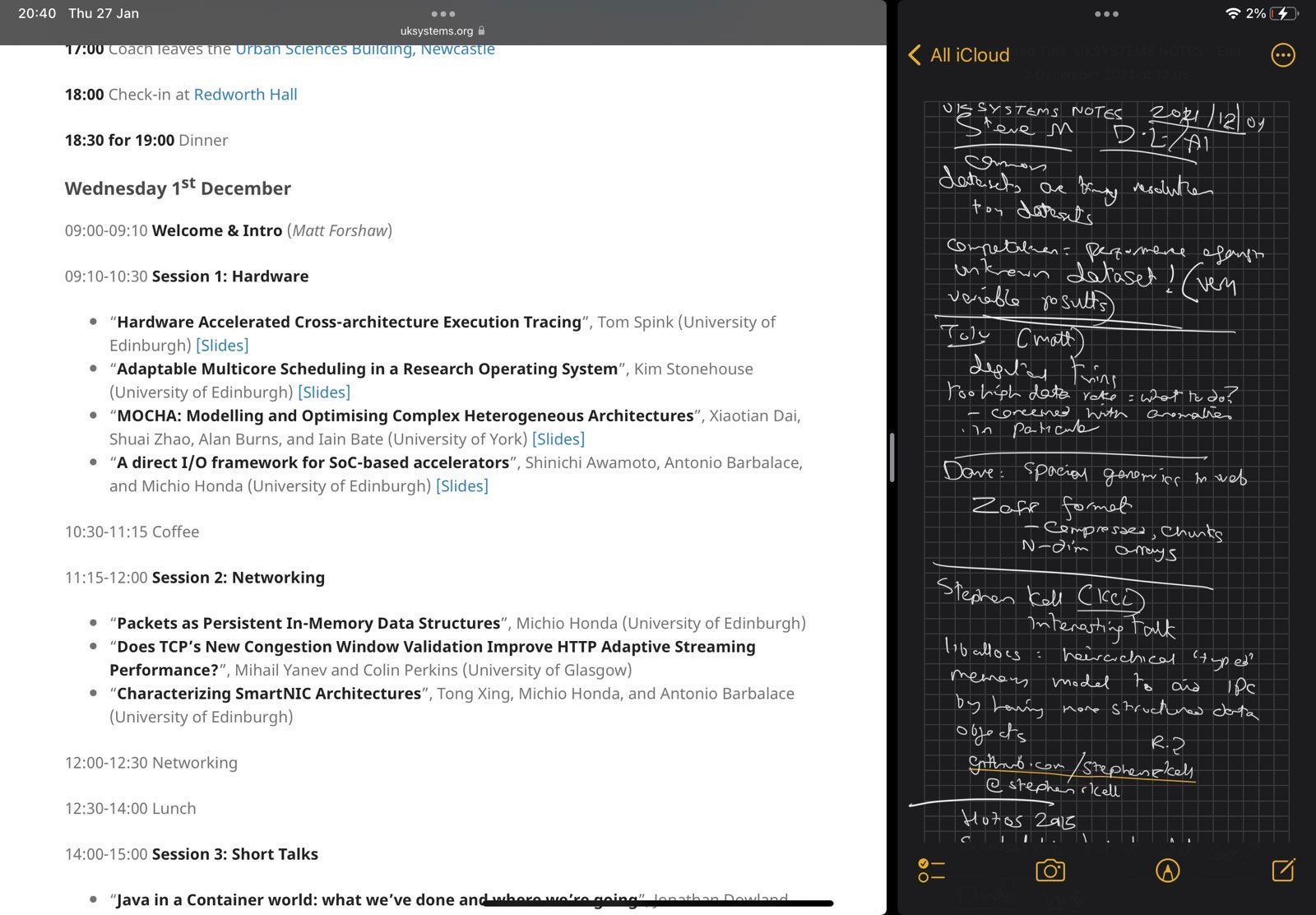
I've found that using a laptop during conference talks means you either end up doing something else and missing important bits of the talk, or at least look like you're doing something else. But it's extremely helpful to be able to look up the person who is talking, or their project, or expand an acronym that's mentioned or read around the subject. At December's uksystems21 conference, I experimented with using an iPad as a kind of compromise. Modern iOS versions let you split the display between two apps1, so I put the built-in Notes app on one side and a web browser on the other. I took notes using the Apple Pencil. I've got a "paper-like" rough surface display protector on the front which vastly improves the experience of using the Apple Pencil for writing2.
An example of note-taking and researching talks on an iPad. An example of note-taking and researching talks on an iPad.
I mostly took notes on the active talk, but I also tweaked my own slides3, looked up supplementary information about the topic and the talker, and things like that. It worked really well: much better than I expected. Apple's split-screen implementation is clunky but essential to make this work. The textured surface protector is a serious improvement over the normal surface for writing. But most importantly I didn't lose focus over the talks, and I don't think I looked like I did either.

  1. Yes, this is something that some Android vendors have supported for years. I remember playing around with Samsung Galaxy Notes when I was still in IT and being pretty impressed. On the other hand, I'd bet not 1% of those tablets are still running Today. My iPad Mini from that time still is, albeit vastly diminished.
  2. It's still not as good as the Remarkable, but that's a topic for another blog post.
  3. A tiny bit. Not serious reworking. Just nervous last minute tweaks that I could probably have not bothered with at all. I'm one of those people who does that right up to the wire.

Russ Allbery: Review: I Didn't Do the Thing Today

Review: I Didn't Do the Thing Today, by Madeleine Dore
Publisher: Avery
Copyright: 2022
ISBN: 0-593-41914-6
Format: Kindle
Pages: 291
At least from my narrow view of it, the world of productivity self-help literature is a fascinating place right now. The pandemic overturned normal work patterns and exacerbated schedule inequality, creating vastly different experiences for the people whose work continued to be in-person and the people whose work could become mostly or entirely remote. Self-help literature, which is primarily aimed at the more affluent white-collar class, primarily tracked the latter disruption: newly-remote work, endless Zoom meetings, the impossibility of child care, the breakdown of boundaries between work and home, and the dawning realization that much of the mechanics of day-to-day office work are neither productive nor defensible. My primary exposure these days to the more traditional self-help productivity literature is via Cal Newport. The stereotype of the productivity self-help book is a collection of life hacks and list-making techniques that will help you become a more efficient capitalist cog, but Newport has been moving away from that dead end for as long as I've been reading him, and his recent work focuses more on structural issues with the organization of knowledge work. He also shares with the newer productivity writers a willingness to tell people to use the free time they recover via improved efficiency on some life goal other than improved job productivity. But he's still prickly and defensive about the importance of personal productivity and accomplishing things. He gives lip service on his podcast to the value of the critique of productivity, but then usually reverts to characterizing anti-productivity arguments as saying that productivity is a capitalist invention to control workers. (Someone has doubtless said this on Twitter, but I've never seen a serious critique of productivity make this simplistic of an argument.) On the anti-productivity side, as it's commonly called, I've seen a lot of new writing in the past couple of years that tries to break the connection between productivity and human worth so endemic to US society. This is not a new analysis; disabled writers have been making this point for decades, it's present in both Keynes and in Galbraith's The Affluent Society, and Kathi Weeks's The Problem with Work traces some of its history in Marxist thought. But what does feel new to me is its widespread mainstream appearance in newspaper articles, viral blog posts, and books such as Jenny Odell's How to Do Nothing and Devon Price's Laziness Does Not Exist. The pushback against defining life around productivity is having a moment. Entering this discussion is Madeleine Dore's I Didn't Do the Thing Today. Dore is the author of the Extraordinary Routines blog and host of the Routines and Ruts podcast. Extraordinary Routines began as a survey of how various people organize their daily lives. I Didn't Do the Thing Today is, according to the preface, a summary of the thoughts Dore has had about her own life and routines as a result of those interviews. As you might guess from the subtitle (Letting Go of Productivity Guilt), Dore's book is superficially on the anti-productivity side. Its chapters are organized around gentle critiques of productivity concepts, with titles like "The Hopeless Search for the Ideal Routine," "The Myth of Balance," or "The Harsh Rules of Discipline." But I think anti-productivity is a poor name for this critique; its writers are not opposed to being productive, only to its position as an all-consuming focus and guilt-generating measure of personal worth. Dore structures most chapters by naming an aspect, goal, or concern of a life defined by productivity, such as wasted time, ambition, busyness, distraction, comparison, or indecision. Each chapter sketches the impact of that idea and then attempts to gently dismantle the grip that it may have on the reader's life. All of these discussions are nuanced; it's rare for Dore to say that one of these aspects has no value, and she anticipates numerous objections. But her overarching goal is to help the reader be more comfortable with imperfection, more willing to live in the moment, and less frustrated with the limitations of life and the human brain. If striving for productivity is like lifting weights, Dore's diagnosis is that we've tried too hard for too long, and have overworked that muscle until it is cramping. This book is a gentle massage to induce the muscle to relax and let go. Whether this will work is, as with all self-help books, individual. I found it was best read in small quantities, perhaps a chapter per day, since it otherwise began feeling too much the same. I'm also not the ideal audience; Dore is a creative freelancer and primarily interviewed other creative people, which I think has a different sort of productivity rhythm than the work that I do. She's also not a planner to the degree that I am; more on that below. And yet, I found this book worked on me anyway. I can't say that I was captivated all the way through, but I found myself mentally relaxing while I was reading it, and I may re-read some chapters from time to time. How does this relate to the genre of productivity self-help? With less conflict than I think productivity writers believe, although there seems to be one foundational difference of perspective. Dore is not opposed to accomplishing things, or even to systems that help people accomplish things. She is more attuned than the typical productivity writer to the guilt and frustration that can accumulate when one has a day in which one does not do the thing, but her goal is not to talk you out of attempting things. It is, instead, to convince you to hold those attempts and goals more lightly, to allow them to move and shift and change, and to not treat a failure to do the thing today as a reason for guilt. This is wholly compatible with standard productivity advice. It's adding nuance at one level of abstraction higher: how tightly to cling to productivity goals, and what to do when they don't work out. Cramping muscles are not strong muscles capable of lifting heavy things. If one can massage out the cramp, one's productivity by even the strict economic definition may improve. Where I do see a conflict is that most productivity writers are planners, and Dore is not. This is, I think, a significant blind spot in productivity self-help writing. Cal Newport, for example, advocates time-block planning, where every hour of the working day has a job. David Allen advocates a complex set of comprehensive lists and well-defined next actions. Mark Forster builds a flurry of small systems for working through lists. The standard in productivity writing is to to add structure to your day and cultivate the self-discipline required to stick to that structure. For many people, including me, this largely works. I'm mostly a planner, and when my life gets chaotic, adding more structure and focusing on that structure helps me. But the productivity writers I've read are quite insistent that their style of structure will work for everyone, and on that point I am dubious. Newport, for example, advocates time-block planning for everyone without exception, insisting that it is the best way to structure a day. Dore, in contrast, describes spending years trying to perfect a routine before realizing that elastic possibilities work better for her than routines. For those who are more like Dore than Newport, I Didn't Do the Thing Today is more likely to be helpful than Newport's instructions. This doesn't make Newport's ideas wrong; it simply makes them not universal, something that the productivity self-help genre seems to have trouble acknowledging. Even for readers like myself who prefer structure, I Didn't Do the Thing Today is a valuable corrective to the emphasis on every-better systems. For those who never got along with too much structure, I think it may strike a chord. The standard self-help caveat still applies: Dore has the most to say to people who are in a similar social class and line of work as her. I'm not sure this book will be of much help to someone who has to juggle two jobs with shift work and child care, where the problem is more sharp external constraints than internalized productivity guilt. But for its target audience, I think it's a valuable, calming message. Dore doesn't have a recipe to sort out your life, but may help you feel better about the merits of life unsorted. Rating: 7 out of 10

Dirk Eddelbuettel: td 0.0.6 on CRAN: Minor Bugfix

The td package for accessing the twelvedata API for financial data has been updated once more on CRAN and is now at version 0.0.6. The release comes in response to an email from CRAN who noticed (via r-devel) that I was sloppy (in one spot, it turns out) with a logical expression resulting in an expression of length greather than one. Fixed by wrapping an all() around it and the package was back at CRAN minutes later thanks to automated processing over their end. The NEWS entry follows.

Changes in version 0.0.6 (2022-01-26)
  • Correct one equality comparison by wrapping in all() to ensure a length-one logical expression is created

Courtesy of my CRANberries, there is a comparison to the previous release. For questions or comments use the issue tracker off the GitHub repo. If you like this or other open-source work I do, you can now sponsor me at GitHub.

This post by Dirk Eddelbuettel originated on his Thinking inside the box blog. Please report excessive re-aggregation in third-party for-profit settings.

Michael Ablassmeier: Qemu backup on Debian Bullseye

In my last article i showed how to use the new features included in Debian Bullseye to easily create backups of your libvirt managed domains. A few years ago as this topic came to my interest, i also implemented a rather small utility (POC) to create full and incremental backups from standalone qemu processes: qmpbackup The workflow for this is a little bit different from the approach i have taken with virtnbdbackup. While with libvirt managed virtual machines, the libvirt API provides all necessary API calls to create backups, a running qemu process only provides the QMP protocol socket to get things going. Using the QMP protocol its possible to create bitmaps for the attached disks and make Qemu push the contents of the bitmaps to a specified target directory. As the bitmaps keep track of the changes on the attached block devices, you can create incremental backups too. The nice thing here is that the Qemu process actually does this all by itself and you dont have to care about which blocks are dirty, like you would have to do with the Pull based approach. So how does it work? The utility requires to start your qemu process with an active QMP socket attached, like so:
 qemu-system-<arch> <options> -qmp unix:/tmp/socket,server,nowait
Now you can easily make qemu push the latest data for a created bitmap to a given target directory:
# qmpbackup --socket /tmp/socket backup --level full --target /tmp/backup/
[2022-01-27 19:41:33,819]    INFO  Version: 0.10
[2022-01-27 19:41:33,819]    INFO  Qemu version: [5.0.2] [Debian 1:5.2+dfsg-11+deb11u1]
[2022-01-27 19:41:33,825]    INFO  Guest Agent socket connected
[2022-01-27 19:41:33,825]    INFO  Trying to ping guest agent
[2022-01-27 19:41:38,827] WARNING  Unable to reach Guest Agent: cant freeze file systems.
[2022-01-27 19:41:38,828]    INFO  Backup target directory: /tmp/backup/
[2022-01-27 19:41:38,828]    INFO  FULL Backup operation: "/tmp/backup//ide0-hd0/FULL-1643308898"
[2022-01-27 19:41:38,836]    INFO  Wrote Offset: 0% (0 of 2147483648)
[2022-01-27 19:41:39,838]    INFO  Wrote Offset: 25% (541065216 of 2147483648)
[2022-01-27 19:41:40,840]    INFO  Wrote Offset: 33% (701890560 of 2147483648)
[2022-01-27 19:41:41,841]    INFO  Wrote Offset: 40% (867041280 of 2147483648)
[2022-01-27 19:41:42,844]    INFO  Wrote Offset: 50% (1073741824 of 2147483648)
[2022-01-27 19:41:43,846]    INFO  Wrote Offset: 59% (1269760000 of 2147483648)
[2022-01-27 19:41:44,847]    INFO  Wrote Offset: 75% (1610612736 of 2147483648)
[2022-01-27 19:41:45,848]    INFO  Saved disk: [ide0-hd0]
The resulting directory now contains a full backup image of the disk attached. From this point on, its possible to create further incremental backups:
# qmpbackup  --socket /tmp/socket backup --level inc --target /tmp/backup/
[2022-01-27 19:42:03,930]    INFO  Version: 0.10
[2022-01-27 19:42:03,931]    INFO  Qemu version: [5.0.2] [Debian 1:5.2+dfsg-11+deb11u1]
[2022-01-27 19:42:03,933]    INFO  Guest Agent socket connected
[2022-01-27 19:42:03,933]    INFO  Trying to ping guest agent
[2022-01-27 19:42:08,938] WARNING  Unable to reach Guest Agent: cant freeze file systems.
[2022-01-27 19:42:08,939]    INFO  Backup target directory: /tmp/backup/
[2022-01-27 19:42:08,939]    INFO  INC Backup operation: "/tmp/backup//ide0-hd0/INC-1643308928"
[2022-01-27 19:42:08,953]    INFO  Wrote Offset: 0% (0 of 1835008)
[2022-01-27 19:42:09,957]    INFO  Saved disk: [ide0-hd0]
The target directory will now have multiple data backups:
/tmp/backup/ide0-hd0/
  FULL-1643308898
  INC-1643308928
Restoring the image Using the qmprebase utility you can now rebase the images to the latest state. The --dry-run option gives an good impression which command sequences are required, if one wants only rebase to a specific incremental backup, thats possible using the --until option.
# qmprebase rebase --dir /tmp/backup/ide0-hd0/ --dry-run
[2022-01-27 17:18:08,790]    INFO  Version: 0.10
[2022-01-27 17:18:08,790]    INFO  Dry run activated, not applying any changes
[2022-01-27 17:18:08,790]    INFO  qemu-img check /tmp/backup/ide0-hd0/INC-1643308928
[2022-01-27 17:18:08,791]    INFO  qemu-img rebase -b "/tmp/backup/ide0-hd0/FULL-1643308898" "/tmp/backup/ide0-hd0/INC-1643308928" -u
[2022-01-27 17:18:08,791]    INFO  qemu-img commit "/tmp/backup/ide0-hd0/INC-1643308928"
[2022-01-27 17:18:08,791]    INFO  Rollback of latest [FULL]<-[INC] chain complete, ignoring older chains
[2022-01-27 17:18:08,791]    INFO  Image files rollback successful.
Filesystem consistency The backup utility also supports to freeze and thaw the virtual machines file system in case qemu is started with a guest agent socket and the guest agent is reachable during backup operation. Check out the README for the full feature set.

26 January 2022

Gunnar Wolf: Progvis Now in Debian proper! (unstable)

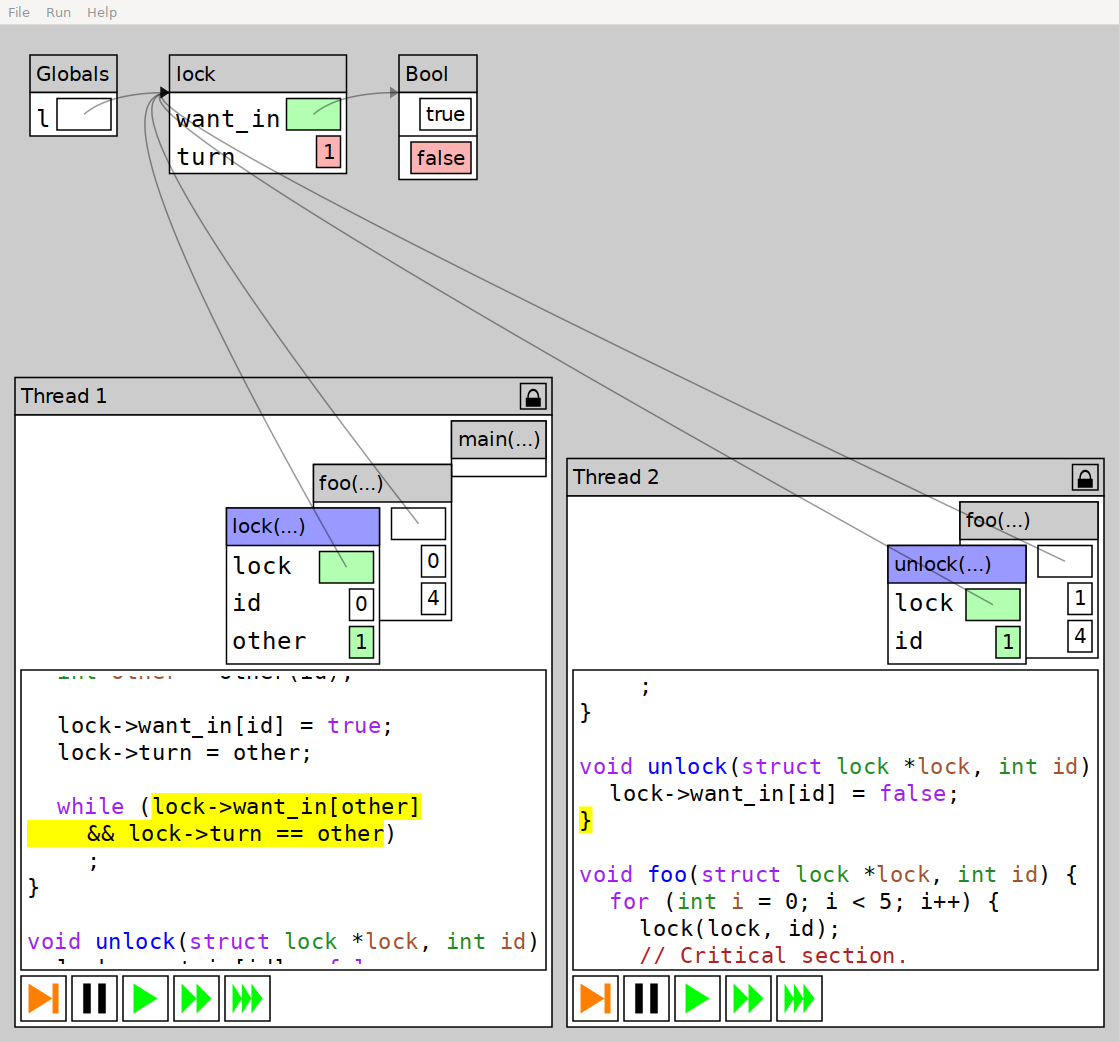
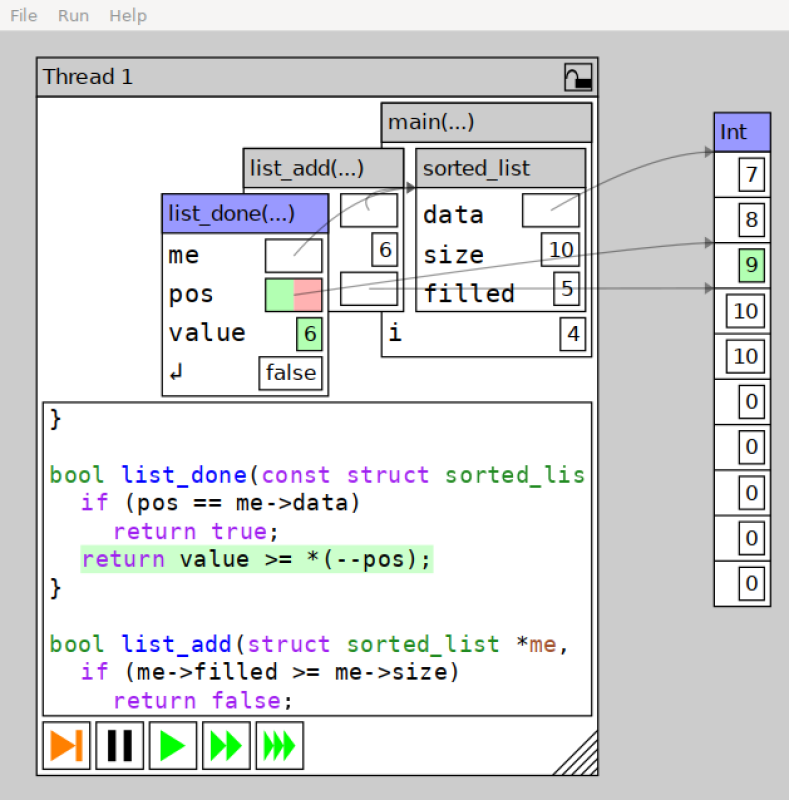
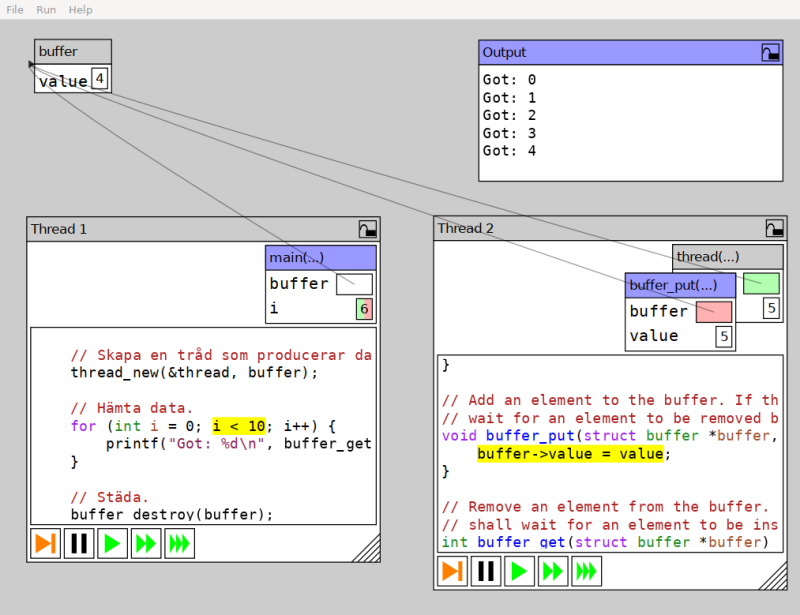
Progvis finally made it into Debian! What is it, you ask? It is a great tool to teach about memory management and concurrency. I first saw progvis in the poster presentation his author, Filip Str mb ck, did last year at the 52nd ACM Technical Sympossium on Computer Science Education (SIGCSE), immediately recognizing it as a tool I wanted to use at my classes, and being it free software, make it available for all interested Debian users. Quoting from Progvis Web page:
This is a program visualization tool aimed at concurrent programs and related issues. The tool itself is mostly language agnostic, and relies on Storm to compile the provided code and provide basic debug information. The generated code is then inspected and instrumented to provide an experience similar to a basic debugger. The tool emphasizes a visual representation of the object hierarchy that is manipulated by the executed program to make it easy to understand how it looks. In particular, a visual representation is beneficial over a text representation since it makes it easier to find shared data that might need to be synchronized in a concurrent program. As mentioned, the tool is aimed at concurrent programs. Therefore, it allows spawning multiple threads running the same program to see if that affects the program s execution (this is mostly interesting if global variables are used). Furthermore, any spawned threads also appear in the tool, and the user may control them independently to explore possible race conditions or other synchronization errors. If enabled from the menu bar, the tool keeps track of reads and writes to the data structure in order to highlight basic race conditions in addition to deadlocks.
So, what is this Storm thing? Filip promptly informed me that Progvis is not just a pedagogical tool Or rather, that it is part of something bigger. Progvis is a program built using the Storm programming language platform is more than a compiler; it presents as a framework for creating languages, designed to make easy to implement languages that can be extended with new syntax and semantics. Storm is much more than what I have explored, and can be used as an interactive compiler, a language server used as a service for highlighting and completing in IDEs. But I won t dig much more into Storm (which is, of course, now also available in Debian as well as the libraries built from the same source). Back to progvis: It implements a very-close-to-C++ language, with some details to better suit its purpose (i.e. instead of using the usual pthread implementation, an own thread model is used; i.e. thread creation is handled via int thread_id = thread_name(funcname, &params) instead of the more complex pthread_create() function (including details such as the thread object being passed as by reference as a parameter) All in all, while I have not yet taken full advantage of this tool in my teaching, it has helped me show somewhat hard to grasp concepts such as: All in all, a great tool. I hope you find it useful and enjoyable as well! PS- I suggest you to install the progvis-examples package to get started. You will find some dozens of sample programs in /usr/share/doc/progvis-examples/examples; playing with them will help you better understand the tool and be able to better write your own programs.

Timo Jyrinki: Unboxing Dell XPS 13 - openSUSE Tumbleweed alongside preinstalled Ubuntu

A look at the 2021 model of Dell XPS 13 - available with Linux pre-installed
I received a new laptop for work - a Dell XPS 13. Dell has been long famous for offering certain models with pre-installed Linux as a supported option, and opting for those is nice for moving some euros/dollars from certain PC desktop OS monopoly towards Linux desktop engineering costs. Notably Lenovo also offers Ubuntu and Fedora options on many models these days (like Carbon X1 and P15 Gen 2).
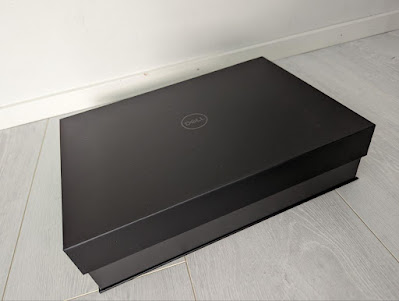
black box

opened box

accessories and a leaflet about Linux support

laptop lifted from the box, closed

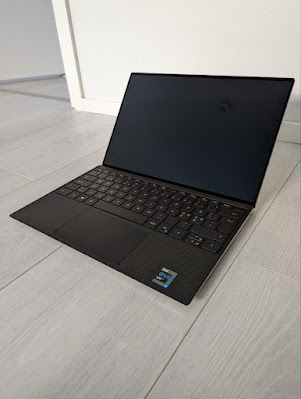
laptop with lid open

Ubuntu running

openSUSE runnin
Obviously a smooth, ready-to-rock Ubuntu installation is nice for most people already, but I need openSUSE, so after checking everything is fine with Ubuntu, I continued to install openSUSE Tumbleweed as a dual boot option. As I m a funny little tinkerer, I obviously went with some special things. I wanted:
  • Ubuntu to remain as the reference supported OS on a small(ish) partition, useful to compare to if trying out new development versions of software on openSUSE and finding oddities.
  • openSUSE as the OS consuming most of the space.
  • LUKS encryption for openSUSE without LVM.
  • ext4 s new fancy fast_commit feature in use during filesystem creation.
  • As a result of all that, I ended up juggling back and forth installation screens a couple of times (even more than shown below, and also because I forgot I wanted to use encryption the first time around).
First boots to pre-installed Ubuntu and installation of openSUSE Tumbleweed as the dual-boot option:
(if the embedded video is not shown, use a direct link)
Some notes from the openSUSE installation:
  • openSUSE installer s partition editor apparently does not support resizing or automatically installing side-by-side another Linux distribution, so I did part of the setup completely on my own.
  • Installation package download hanged a couple of times, only passed when I entered a mirror manually. On my TW I ve also noticed download problems recently, there might be a problem with some mirror I need to escalate.
  • The installer doesn t very clearly show encryption status of the target installation - it took me a couple of attempts before I even noticed the small encrypted column and icon (well, very small, see below), which also did not spell out the device mapper name but only the main partition name. In the end it was going to do the right thing right away and use my pre-created encrypted target partition as I wanted, but it could be a better UX. Then again I was doing my very own tweaks anyway.
  • Let s not go to the details why I m so old-fashioned and use ext4 :)
  • openSUSE s installer does not work fine with HiDPI screen. Funnily the tty consoles seem to be fine and with a big font.
  • At the end of the video I install the two GNOME extensions I can t live without, Dash to Dock and Sound Input & Output Device Chooser.

25 January 2022

Dirk Eddelbuettel: RcppArmadillo 0.10.8.1.0 on CRAN: Upstream Updates

armadillo image Armadillo is a powerful and expressive C++ template library for linear algebra aiming towards a good balance between speed and ease of use with a syntax deliberately close to a Matlab. RcppArmadillo integrates this library with the R environment and language and is widely used by (currently) 950 other packages on CRAN, downloaded over 22.9 million times (per the partial logs from the cloud mirrors of CRAN), and the CSDA paper (preprint/vignette) by Conrad and myself has been cited 451 times according to Google Scholar. This release brings another upstream update 10.8.0, and first bug fix release 10.8.1. As updates by Conrad can come a little quicker than the desired monthly cadence CRAN aims for, we skipped the 10.8.0 release for CRAN only but of course generally provide them via the Rcpp drat repo as well as via general updates to the repo, and full reverse dependency testing (for which results are always logged here). The full set of changes (since the last CRAN release 0.10.7.5.0) follows.

Changes in RcppArmadillo version 0.10.8.1.0 (2022-01-23)
  • Upgraded to Armadillo release 10.8.1 (Realm Raider)
    • fix interaction between OpenBLAS and LAPACK
    • emit warning if find() is incorrectly used to locate NaN elements

Changes in RcppArmadillo version 0.10.8.0.0 (2022-01-02)
  • Upgraded to Armadillo release 10.8 (Realm Raider)
    • faster handling of symmetric matrices by pinv() and rank()
    • faster handling of diagonal matrices by inv_sympd(), pinv(), rank()
    • expanded norm() to handle integer vectors and matrices
    • added datum::tau to replace 2

Courtesy of my CRANberries, there is a diffstat report relative to previous release. More detailed information is on the RcppArmadillo page. Questions, comments etc should go to the rcpp-devel mailing list off the R-Forge page. If you like this or other open-source work I do, you can sponsor me at GitHub.

This post by Dirk Eddelbuettel originated on his Thinking inside the box blog. Please report excessive re-aggregation in third-party for-profit settings.

23 January 2022

Matthieu Caneill: Debsources, python3, and funky file names

Rumors are running that python2 is not a thing anymore. Well, I'm certainly late to the party, but I'm happy to report that sources.debian.org is now running python3. Wait, it wasn't? Back when development started, python3 was very much a real language, but it was hard to adopt because it was not supported by many libraries. So python2 was chosen, meaning print-based debugging was used in lieu of print()-based debugging, and str were bytes, not unicode. And things were working just fine. One day python2 EOL was announced, with a date far in the future. Far enough to procrastinate for a long time. Combine this with a codebase that is stable enough to not see many commits, and the fact that Debsources is a volunteer-based project that happens at best on week-ends, and you end up with a dormant software and a missed deadline. But, as dormant as the codebase is, the instance hosted at sources.debian.org is very popular and gets 200k to 500k hits per day. Largely enough to be worth a proper maintenance and a transition to python3. Funky file names While transitioning to python3 and juggling left and right with str, bytes and unicode for internal objects, files, database entries and HTTP content, I stumbled upon a bug that has been there since day 1. Quick recap if you're unfamiliar with this tool: Debsources displays the content of the source packages in the Debian archive. In other words, it's a bit like GitHub, but for the Debian source code. And some pieces of software out there, that ended up in Debian packages, happen to contain files whose names can't be decoded to UTF-8. Interestingly enough, there's no such thing as a standard for file names: with a few exceptions that vary by operating system, any sequence of bytes can be a legit file name. And some sequences of bytes are not valid UTF-8. Of course those files are rare, and using ASCII characters to name a file is a much more common practice than using bytes in a non-UTF-8 character encoding. But when you deal with almost 100 million files on which you have no control (those files come from free software projects, and make their way into Debian without any renaming), it happens. Now back to the bug: when trying to display such a file through the web interface, it would crash because it can't convert the file name to UTF-8, which is needed for the HTML representation of the page. Bugfix An often valid approach when trying to represent invalid UTF-8 content is to ignore errors, and replace them with ? or . This is what Debsources actually does to display non-UTF-8 file content. Unfortunately, this best-effort approach is not suitable for file names, as file names are also identifiers in Debsources: among other places, they are part of URLs. If an URL were to use placeholder characters to replace those bytes, there would be no deterministic way to match it with a file on disk anymore. The representation of binary data into text is a known problem. Multiple lossless solutions exist, such as base64 and its variants, but URLs looking like https://sources.debian.org/src/Y293c2F5LzMuMDMtOS4yL2Nvd3NheS8= are not readable at all compared to https://sources.debian.org/src/cowsay/3.03-9.2/cowsay/. Plus, not backwards-compatible with all existing links. The solution I chose is to use double-percent encoding: this allows the representation of any byte in an URL, while keeping allowed characters unchanged - and preventing CGI gateways from trying to decode non-UTF-8 bytes. This is the best of both worlds: regular file names get to appear normally and are human-readable, and funky file names only have percent signs and hex numbers where needed. Here is an example of such an URL: https://sources.debian.org/src/aspell-is/0.51-0-4/%25EDslenska.alias/. Notice the %25ED to represent the percentage symbol itself (%25) followed by an invalid UTF-8 byte (%ED). Transitioning to this was quite a challenge, as those file names don't only appear in URLs, but also in web pages themselves, log files, database tables, etc. And everything was done with str: made sense in python2 when str were bytes, but not much in python3. What are those files? What's their network? I was wondering too. Let's list them!
import os
with open('non-utf-8-paths.bin', 'wb') as f:
    for root, folders, files in os.walk(b'/srv/sources.debian.org/sources/'):
        for path in folders + files:
            try:
                path.decode('utf-8')
            except UnicodeDecodeError:
                f.write(root + b'/' + path + b'\n')
Running this on the Debsources main instance, which hosts pretty much all Debian packages that were part of a Debian release, I could find 307 files (among a total of almost 100 million files). Without looking deep into them, they seem to fall into 2 categories: That last point hits home, as it was clearly lacking in Debsources. A funky file name is now part of its test suite. ;)

Antoine Beaupr : Switching from OpenNTPd to Chrony

A friend recently reminded me of the existence of chrony, a "versatile implementation of the Network Time Protocol (NTP)". The excellent introduction is worth quoting in full:
It can synchronise the system clock with NTP servers, reference clocks (e.g. GPS receiver), and manual input using wristwatch and keyboard. It can also operate as an NTPv4 (RFC 5905) server and peer to provide a time service to other computers in the network. It is designed to perform well in a wide range of conditions, including intermittent network connections, heavily congested networks, changing temperatures (ordinary computer clocks are sensitive to temperature), and systems that do not run continuosly, or run on a virtual machine. Typical accuracy between two machines synchronised over the Internet is within a few milliseconds; on a LAN, accuracy is typically in tens of microseconds. With hardware timestamping, or a hardware reference clock, sub-microsecond accuracy may be possible.
Now that's already great documentation right there. What it is, why it's good, and what to expect from it. I want more. They have a very handy comparison table between chrony, ntp and openntpd.

My problem with OpenNTPd Following concerns surrounding the security (and complexity) of the venerable ntp program, I have, a long time ago, switched to using openntpd on all my computers. I hadn't thought about it until I recently noticed a lot of noise on one of my servers:
jan 18 10:09:49 curie ntpd[1069]: adjusting local clock by -1.604366s
jan 18 10:08:18 curie ntpd[1069]: adjusting local clock by -1.577608s
jan 18 10:05:02 curie ntpd[1069]: adjusting local clock by -1.574683s
jan 18 10:04:00 curie ntpd[1069]: adjusting local clock by -1.573240s
jan 18 10:02:26 curie ntpd[1069]: adjusting local clock by -1.569592s
You read that right, openntpd was constantly rewinding the clock, sometimes in less than two minutes. The above log was taken while doing diagnostics, looking at the last 30 minutes of logs. So, on average, one 1.5 seconds rewind per 6 minutes! That might be due to a dying real time clock (RTC) or some other hardware problem. I know for a fact that the CMOS battery on that computer (curie) died and I wasn't able to replace it (!). So that's partly garbage-in, garbage-out here. But still, I was curious to see how chrony would behave... (Spoiler: much better.) But I also had trouble on another workstation, that one a much more recent machine (angela). First, it seems OpenNTPd would just fail at boot time:
anarcat@angela:~(main)$ sudo systemctl status openntpd
  openntpd.service - OpenNTPd Network Time Protocol
     Loaded: loaded (/lib/systemd/system/openntpd.service; enabled; vendor pres>
     Active: inactive (dead) since Sun 2022-01-23 09:54:03 EST; 6h ago
       Docs: man:openntpd(8)
    Process: 3291 ExecStartPre=/usr/sbin/ntpd -n $DAEMON_OPTS (code=exited, sta>
    Process: 3294 ExecStart=/usr/sbin/ntpd $DAEMON_OPTS (code=exited, status=0/>
   Main PID: 3298 (code=exited, status=0/SUCCESS)
        CPU: 34ms
jan 23 09:54:03 angela systemd[1]: Starting OpenNTPd Network Time Protocol...
jan 23 09:54:03 angela ntpd[3291]: configuration OK
jan 23 09:54:03 angela ntpd[3297]: ntp engine ready
jan 23 09:54:03 angela ntpd[3297]: ntp: recvfrom: Permission denied
jan 23 09:54:03 angela ntpd[3294]: Terminating
jan 23 09:54:03 angela systemd[1]: Started OpenNTPd Network Time Protocol.
jan 23 09:54:03 angela systemd[1]: openntpd.service: Succeeded.
After a restart, somehow it worked, but it took a long time to sync the clock. At first, it would just not consider any peer at all:
anarcat@angela:~(main)$ sudo ntpctl -s all
0/20 peers valid, clock unsynced
peer
   wt tl st  next  poll          offset       delay      jitter
159.203.8.72 from pool 0.debian.pool.ntp.org
    1  5  2    6s    6s             ---- peer not valid ----
138.197.135.239 from pool 0.debian.pool.ntp.org
    1  5  2    6s    7s             ---- peer not valid ----
216.197.156.83 from pool 0.debian.pool.ntp.org
    1  4  1    2s    9s             ---- peer not valid ----
142.114.187.107 from pool 0.debian.pool.ntp.org
    1  5  2    5s    6s             ---- peer not valid ----
216.6.2.70 from pool 1.debian.pool.ntp.org
    1  4  2    2s    8s             ---- peer not valid ----
207.34.49.172 from pool 1.debian.pool.ntp.org
    1  4  2    0s    5s             ---- peer not valid ----
198.27.76.102 from pool 1.debian.pool.ntp.org
    1  5  2    5s    5s             ---- peer not valid ----
158.69.254.196 from pool 1.debian.pool.ntp.org
    1  4  3    1s    6s             ---- peer not valid ----
149.56.121.16 from pool 2.debian.pool.ntp.org
    1  4  2    5s    9s             ---- peer not valid ----
162.159.200.123 from pool 2.debian.pool.ntp.org
    1  4  3    1s    6s             ---- peer not valid ----
206.108.0.131 from pool 2.debian.pool.ntp.org
    1  4  1    6s    9s             ---- peer not valid ----
205.206.70.40 from pool 2.debian.pool.ntp.org
    1  5  2    8s    9s             ---- peer not valid ----
2001:678:8::123 from pool 2.debian.pool.ntp.org
    1  4  2    5s    9s             ---- peer not valid ----
2606:4700:f1::1 from pool 2.debian.pool.ntp.org
    1  4  3    2s    6s             ---- peer not valid ----
2607:5300:205:200::1991 from pool 2.debian.pool.ntp.org
    1  4  2    5s    9s             ---- peer not valid ----
2607:5300:201:3100::345c from pool 2.debian.pool.ntp.org
    1  4  4    1s    6s             ---- peer not valid ----
209.115.181.110 from pool 3.debian.pool.ntp.org
    1  5  2    5s    6s             ---- peer not valid ----
205.206.70.42 from pool 3.debian.pool.ntp.org
    1  4  2    0s    6s             ---- peer not valid ----
68.69.221.61 from pool 3.debian.pool.ntp.org
    1  4  1    2s    9s             ---- peer not valid ----
162.159.200.1 from pool 3.debian.pool.ntp.org
    1  4  3    4s    7s             ---- peer not valid ----
Then it would accept them, but still wouldn't sync the clock:
anarcat@angela:~(main)$ sudo ntpctl -s all
20/20 peers valid, clock unsynced
peer
   wt tl st  next  poll          offset       delay      jitter
159.203.8.72 from pool 0.debian.pool.ntp.org
    1  8  2    5s    6s         0.672ms    13.507ms     0.442ms
138.197.135.239 from pool 0.debian.pool.ntp.org
    1  7  2    4s    8s         1.260ms    13.388ms     0.494ms
216.197.156.83 from pool 0.debian.pool.ntp.org
    1  7  1    3s    5s        -0.390ms    47.641ms     1.537ms
142.114.187.107 from pool 0.debian.pool.ntp.org
    1  7  2    1s    6s        -0.573ms    15.012ms     1.845ms
216.6.2.70 from pool 1.debian.pool.ntp.org
    1  7  2    3s    8s        -0.178ms    21.691ms     1.807ms
207.34.49.172 from pool 1.debian.pool.ntp.org
    1  7  2    4s    8s        -5.742ms    70.040ms     1.656ms
198.27.76.102 from pool 1.debian.pool.ntp.org
    1  7  2    0s    7s         0.170ms    21.035ms     1.914ms
158.69.254.196 from pool 1.debian.pool.ntp.org
    1  7  3    5s    8s        -2.626ms    20.862ms     2.032ms
149.56.121.16 from pool 2.debian.pool.ntp.org
    1  7  2    6s    8s         0.123ms    20.758ms     2.248ms
162.159.200.123 from pool 2.debian.pool.ntp.org
    1  8  3    4s    5s         2.043ms    14.138ms     1.675ms
206.108.0.131 from pool 2.debian.pool.ntp.org
    1  6  1    0s    7s        -0.027ms    14.189ms     2.206ms
205.206.70.40 from pool 2.debian.pool.ntp.org
    1  7  2    1s    5s        -1.777ms    53.459ms     1.865ms
2001:678:8::123 from pool 2.debian.pool.ntp.org
    1  6  2    1s    8s         0.195ms    14.572ms     2.624ms
2606:4700:f1::1 from pool 2.debian.pool.ntp.org
    1  7  3    6s    9s         2.068ms    14.102ms     1.767ms
2607:5300:205:200::1991 from pool 2.debian.pool.ntp.org
    1  6  2    4s    9s         0.254ms    21.471ms     2.120ms
2607:5300:201:3100::345c from pool 2.debian.pool.ntp.org
    1  7  4    5s    9s        -1.706ms    21.030ms     1.849ms
209.115.181.110 from pool 3.debian.pool.ntp.org
    1  7  2    0s    7s         8.907ms    75.070ms     2.095ms
205.206.70.42 from pool 3.debian.pool.ntp.org
    1  7  2    6s    9s        -1.729ms    53.823ms     2.193ms
68.69.221.61 from pool 3.debian.pool.ntp.org
    1  7  1    1s    7s        -1.265ms    46.355ms     4.171ms
162.159.200.1 from pool 3.debian.pool.ntp.org
    1  7  3    4s    8s         1.732ms    35.792ms     2.228ms
It took a solid five minutes to sync the clock, even though the peers were considered valid within a few seconds:
jan 23 15:58:41 angela systemd[1]: Started OpenNTPd Network Time Protocol.
jan 23 15:58:58 angela ntpd[84086]: peer 142.114.187.107 now valid
jan 23 15:58:58 angela ntpd[84086]: peer 198.27.76.102 now valid
jan 23 15:58:58 angela ntpd[84086]: peer 207.34.49.172 now valid
jan 23 15:58:58 angela ntpd[84086]: peer 209.115.181.110 now valid
jan 23 15:58:59 angela ntpd[84086]: peer 159.203.8.72 now valid
jan 23 15:58:59 angela ntpd[84086]: peer 138.197.135.239 now valid
jan 23 15:58:59 angela ntpd[84086]: peer 162.159.200.123 now valid
jan 23 15:58:59 angela ntpd[84086]: peer 2607:5300:201:3100::345c now valid
jan 23 15:59:00 angela ntpd[84086]: peer 2606:4700:f1::1 now valid
jan 23 15:59:00 angela ntpd[84086]: peer 158.69.254.196 now valid
jan 23 15:59:01 angela ntpd[84086]: peer 216.6.2.70 now valid
jan 23 15:59:01 angela ntpd[84086]: peer 68.69.221.61 now valid
jan 23 15:59:01 angela ntpd[84086]: peer 205.206.70.40 now valid
jan 23 15:59:01 angela ntpd[84086]: peer 205.206.70.42 now valid
jan 23 15:59:02 angela ntpd[84086]: peer 162.159.200.1 now valid
jan 23 15:59:04 angela ntpd[84086]: peer 216.197.156.83 now valid
jan 23 15:59:05 angela ntpd[84086]: peer 206.108.0.131 now valid
jan 23 15:59:05 angela ntpd[84086]: peer 2001:678:8::123 now valid
jan 23 15:59:05 angela ntpd[84086]: peer 149.56.121.16 now valid
jan 23 15:59:07 angela ntpd[84086]: peer 2607:5300:205:200::1991 now valid
jan 23 16:03:47 angela ntpd[84086]: clock is now synced
That seems kind of odd. It was also frustrating to have very little information from ntpctl about the state of the daemon. I understand it's designed to be minimal, but it could inform me on his known offset, for example. It does tell me about the offset with the different peers, but not as clearly as one would expect. It's also unclear how it disciplines the RTC at all.

Compared to chrony Now compare with chrony:
jan 23 16:07:16 angela systemd[1]: Starting chrony, an NTP client/server...
jan 23 16:07:16 angela chronyd[87765]: chronyd version 4.0 starting (+CMDMON +NTP +REFCLOCK +RTC +PRIVDROP +SCFILTER +SIGND +ASYNCDNS +NTS +SECHASH +IPV6 -DEBUG)
jan 23 16:07:16 angela chronyd[87765]: Initial frequency 3.814 ppm
jan 23 16:07:16 angela chronyd[87765]: Using right/UTC timezone to obtain leap second data
jan 23 16:07:16 angela chronyd[87765]: Loaded seccomp filter
jan 23 16:07:16 angela systemd[1]: Started chrony, an NTP client/server.
jan 23 16:07:21 angela chronyd[87765]: Selected source 206.108.0.131 (2.debian.pool.ntp.org)
jan 23 16:07:21 angela chronyd[87765]: System clock TAI offset set to 37 seconds
First, you'll notice there's none of that "clock synced" nonsense, it picks a source, and then... it's just done. Because the clock on this computer is not drifting that much, and openntpd had (presumably) just sync'd it anyways. And indeed, if we look at detailed stats from the powerful chronyc client:
anarcat@angela:~(main)$ sudo chronyc tracking
Reference ID    : CE6C0083 (ntp1.torix.ca)
Stratum         : 2
Ref time (UTC)  : Sun Jan 23 21:07:21 2022
System time     : 0.000000311 seconds slow of NTP time
Last offset     : +0.000807989 seconds
RMS offset      : 0.000807989 seconds
Frequency       : 3.814 ppm fast
Residual freq   : -24.434 ppm
Skew            : 1000000.000 ppm
Root delay      : 0.013200894 seconds
Root dispersion : 65.357254028 seconds
Update interval : 1.4 seconds
Leap status     : Normal
We see that we are nanoseconds away from NTP time. That was ran very quickly after starting the server (literally in the same second as chrony picked a source), so stats are a bit weird (e.g. the Skew is huge). After a minute or two, it looks more reasonable:
Reference ID    : CE6C0083 (ntp1.torix.ca)
Stratum         : 2
Ref time (UTC)  : Sun Jan 23 21:09:32 2022
System time     : 0.000487002 seconds slow of NTP time
Last offset     : -0.000332960 seconds
RMS offset      : 0.000751204 seconds
Frequency       : 3.536 ppm fast
Residual freq   : +0.016 ppm
Skew            : 3.707 ppm
Root delay      : 0.013363549 seconds
Root dispersion : 0.000324015 seconds
Update interval : 65.0 seconds
Leap status     : Normal
Now it's learning how good or bad the RTC clock is ("Frequency"), and is smoothly adjusting the System time to follow the average offset (RMS offset, more or less). You'll also notice the Update interval has risen, and will keep expanding as chrony learns more about the internal clock, so it doesn't need to constantly poll the NTP servers to sync the clock. In the above, we're 487 micro seconds (less than a milisecond!) away from NTP time. (People interested in the explanation of every single one of those fields can read the excellent chronyc manpage. That thing made me want to nerd out on NTP again!) On the machine with the bad clock, chrony also did a 1.5 second adjustment, but just once, at startup:
jan 18 11:54:33 curie chronyd[2148399]: Selected source 206.108.0.133 (2.debian.pool.ntp.org) 
jan 18 11:54:33 curie chronyd[2148399]: System clock wrong by -1.606546 seconds 
jan 18 11:54:31 curie chronyd[2148399]: System clock was stepped by -1.606546 seconds 
jan 18 11:54:31 curie chronyd[2148399]: System clock TAI offset set to 37 seconds 
Then it would still struggle to keep the clock in sync, but not as badly as openntpd. Here's the offset a few minutes after that above startup:
System time     : 0.000375352 seconds slow of NTP time
And again a few seconds later:
System time     : 0.001793046 seconds slow of NTP time
I don't currently have access to that machine, and will update this post with the latest status, but so far I've had a very good experience with chrony on that machine, which is a testament to its resilience, and it also just works on my other machines as well.

Extras On top of "just working" (as demonstrated above), I feel that chrony's feature set is so much superior... Here's an excerpt of the extras in chrony, taken from the comparison table:
  • source frequency tracking
  • source state restore from file
  • temperature compensation
  • ready for next NTP era (year 2036)
  • replace unreachable / falseticker servers
  • aware of jitter
  • RTC drift tracking
  • RTC trimming
  • Restore time from file w/o RTC
  • leap seconds correction, in slew mode
  • drops root privileges
I even understand some of that stuff. I think. So kudos to the chrony folks, I'm switching.

Caveats One thing to keep in mind in the above, however is that it's quite possible chrony does as bad of a job as openntpd on that old machine, and just doesn't tell me about it. For example, here's another log sample from another server (marcos):
jan 23 11:13:25 marcos ntpd[1976694]: adjusting clock frequency by 0.451035 to -16.420273ppm
I get those basically every day, which seems to show that it's at least trying to keep track of the hardware clock. In other words, it's quite possible I have no idea what I'm talking about and you definitely need to take this article with a grain of salt. I'm not an NTP expert. Update: I should also mentioned that I haven't evaluated systemd-timesyncd, for a few reasons:
  1. I have enough things running under systemd
  2. I wasn't aware of it when I started writing this
  3. I couldn't find good documentation on it... later I found the above manpage and of course the Arch Wiki but that is very minimal
  4. therefore I can't tell how it compares with chrony or (open)ntpd, so I don't see an enticing reason to switch
It has a few things going for it though:
  • it's likely shipped with your distribution already
  • it drops privileges (possibly like chrony, unclear if it also has seccomp filters)
  • it's minimalist: it only does SNTP so not the server side
  • the status command is good enough that you can tell the clock frequency, precision, and so on (especially when compared to openntpd's ntpctl)
So I'm reserving judgement over it, but I'd certainly note that I'm always a little weary in trusting systemd daemons with the network, and would prefer to keep that attack surface to a minimum. Diversity is a good thing, in general, so I'll keep chrony for now. It would certainly nice to see it added to chrony's comparison table.

Switching to chrony Because the default configuration in chrony (at least as shipped in Debian) is sane (good default peers, no open network by default), installing it is as simple as:
apt install chrony
And because it somehow conflicts with openntpd, that also takes care of removing that cruft as well.

Update: Debian defaults So it seems like I managed to write this entire blog post without putting it in relation with the original reason I had to think about this in the first place, which is odd and should be corrected. This conversation came about on an IRC channel that mentioned that the ntp package (and upstream) is in bad shape in Debian. In that discussion, chrony and ntpsec were discussed as possible replacements, but when we had the discussion on chat, I mentioned I was using openntpd, and promptly realized I was actually unhappy with it. A friend suggested chrony, I tried it, and it worked amazingly, I switched, wrote this blog post, end of story. Except today (2022-02-07, two weeks later), I actually read that thread and realized that something happened in Debian I wasn't actually aware of. In bookworm, systemd-timesyncd was not only shipped, but it was installed by default, as it was marked as a hard dependency of systemd. That was "fixed" in systemd-247.9-2 (see bug 986651), but only by making the dependency a Recommends and marking it as Priority: important. So in effect, systemd-timesyncd became the default NTP daemon in Debian in bookworm, which I find somewhat surprising. timesyncd has many things going for it (as mentioned above), but I do find it a bit annoying that systemd is replacing all those utilities in such a way. I also wonder what is going to happen on upgrades. This is all a little frustrating too because there is no good comparison between the other NTP daemons and timesyncd anywhere. The chrony comparison table doesn't mention it, and an audit by the Core Infrastructure Initiative from 2017 doesn't mention it either, even though timesyncd was announced in 2014. (Same with this blog post from Facebook.)

Louis-Philippe V ronneau: Goodbye Nexus 5

I've blogged a few times already about my Nexus 5, the Android device I have/had been using for 8 years. Sadly, it died a few weeks ago, when the WiFi chip stopped working. I could probably have attempted a mainboard swap, but at this point, getting a new device seemed like the best choice. In a world where most Android devices are EOL after less than 3 years, it is amazing I was able to keep this device for so long, always running the latest Android version with the latest security patch. The Nexus 5 originally shipped with Android 4.4 and when it broke, I was running Android 11, with the November security patch! I'm very grateful to the FOSS Android community that made this possible, especially the LineageOS community. I've replaced my Nexus 5 by a used Pixel 3a, mostly because of the similar form factor, relatively affordable price and the presence of a headphone jack. Google also makes flashing a custom ROM easy, although I had more trouble with this than I first expected. The first Pixel 3a I bought on eBay was a scam: I ordered an "Open Box" phone and it arrived all scratched1 and with a broken rear camera. The second one I got (from the Amazon Renewed program) arrived in perfect condition, but happened to be a Verizon model. As I found out, Verizon locks the bootloader on their phones, making it impossible to install LineageOS2. The vendor was kind enough to let me return it. As they say, third time's the charm. This time around, I explicitly bought a phone on eBay listed with a unlocked bootloader. I'm very satisfied with my purchase, but all in all, dealing with all the returns and the shipping was exhausting. Hopefully this phone will last as long as my Nexus 5!

  1. There was literally a whole layer missing at the back, as if someone had sanded the phone...
  2. Apparently, and "Unlocked phone" means it is "SIM unlocked", i.e. you can use it with any carrier. What I should have been looking for is a "Factory Unlocked phone", one where the bootloader isn't locked :L

Next.

Previous.