Search Results: "ag"

26 November 2005

Philipp Kern: C++ ABI transitions

This vast amount of C++ ABI transitions is so bloody annoying. It makes developers maintaining C++ packages so unproductive as they are blocked for weeks waiting to upload new versions of their package.
Why isn’t the package updated in Debian yet?
Well, we have just another C++ ABI transition, this means the libsigc++ is incompatible to the version before and all packages have to be recompiled.
Debian is just too slow, even Ubuntu and Gentoo are faster...
Gentoo is source-based and I had, back when I used it, the impressions that some developers do not really try to compile it before they commit the new version, but I think this has changed now. Ubuntu, well yeah, even they are much quicker in transitions, out of various reasons I’m too tired to rehash here. Not only am I blocked by libsigc++-2.0 which I theoretically could NMU away, but by the whole bunch of gtkmm stuff which also needs to be recompiled with all of its dependencies. It will take weeks until the new revision of Gobby could enter at least Debian unstable. I bet that Ubuntu MOTU will update my package by their own before I am able to upload a new one to Debian to get it synced from there.

Erinn Clark: What is this?

I have a picture of this space on my computer and, for the life of me, I cannot remember the name of it. If anyone can identify it, please email me. p.s., AJ, I thought we all agreed NIv2 would be named NINJA?

Anthony Towns: Queue Building

The biggest difference between the hypothetical security queues and the existing byhand and new queues is that they need to be autobuilt; it’s not really feasible to try saying whether a security update is acceptable if there’s still some possibility it’s not going to build on half our architectures. Additionally, it means that there are two queues that need to be built, rather than just one. The way accepted autobuilding works isn’t too complicated, fortunately. There’s a directory where symlinks are made to uploaded packages and sources, and a Packages files (for all architectures) is generated, as is a Sources file, all of which are made available to buildds. They’re also added to the regular unstable Packages and Sources files and passed to quinn-diff and wanna-build. In order to avoid unnecessary breakage at transitional points (such as when a package moves from accepted to unstable proper), packages are kept in the accepted autobuild directory for a day or so afterwards. There’s also the issue of including the .orig.tar.gz from the archive along with the .dsc and .diff.gz from accepted for uploads that aren’t new upstream versions. Security accepted autobuilding adds two extra wrinkles. The first is that packages being autobuilt can’t be generally visible to other users on the security host, which includes the web server that’s supposed to get the packages to the security buildds. So instead of symlinking, copies have to be made, and care has to be taken to ensure that doesn’t accidently leak information in the process. The second trick is that security needs autobuilding of multiple suites (oldstable and stable, and hopefully testing as well), whereas for the regular archive, it’s sufficient to autobuild unstable packages from accepted, and leave the rest until the daily pulse run. This particularly means that uploads from accepted need to be moved into separate directories depending on the target suite, so that the buildds don’t accidently build a package for woody against the libc from sarge. At a gross level, generalising to supporting autobuilding of multiple queues is therefore straightforward: extend the “accepted_autobuild” table to include information of what queue the files are from (which implies a name change is appropriate), extend the configuration file to allow you to specify which queues should get autobuild handling for which suites, and finally add the code to actually do this when packages are moved into and out of the appropriate queues. Hurray for simplicity! But there’s one little bit of complexity still to bother us. We know we need different directories and Packages files for different suites, but do we need it for different queues as well? Worse, we need different chroots on each autobuilder for each suite, do we need different chroots for each suite for each queue? The latter could well be a complete showstopper. One reason why we might need to treat the queues we’re considering separately is that they have different secrecy requirements: embaroged updates can’t be visible to anyone, even people working on the unembargoed security updates in parallel, and yet the buildd has to forward its logs on to someone to be signed. If embargoed and unembargoed packages are built in the same chroot, by the same buildd, from the same queue, how do the logs magically go to the right person? That’s not necessarily easily answered; currently the hope is that it’ll be okay to have a single shared queue and set of buildds and chroots, and have all the logs forwarded to a single address, at which point they can be redirected to the appropriate security team members by procmail. The assumption this is based on is that there’ll already need to be some magic to do that for the builds themselves once they’re uploaded and need to be moved into either the embargoed or unembargoed queue, so the same thing should be possible with the build logs. Pending further surprises though, that’s enough to move onto the next phases, which is generalising dak to cope with arbitrary queues.

Andres Salomon: save the world

This article cracked me up; specifically, two lines of it. “‘The agreement signed today will defend Somalia’s territorial waters, defeat the pirates and put an end to the illegal fishing and poaching of our precious natural marine resources,’ Prime Minister Mohamed Ali Gedi said.” “Defeat the pirates” sounds like something out of a video game or cartoon. That could’ve just as easily been about killing Shredder, defeating the Foot Clan, and saving April O’Neil. “‘We will end the piracy very quickly, there is no question about that,’ said Mr Casini.” This company is clearly the answer that the RIAA and MPAA have been looking for!

Erich Schubert: Laptop battery dead

My IBM Thinkpad A31ps main system battery is dead. It won't charge any more, instead the battery light starts flashing. The battery is over three years old, but should still have like half of its original capacity. This sucks. My secondary battery, more useful than having two CD drives I never use, is also down to two thirds, giving me a battery run time of less than 90 minutes. Also other stuff has started breaking, starting with an USB port being damaged, bluetooth that never worked etc. - and the laptop is out of warranty by now. I really need to get myself a new laptop (and especially a lighter one), but I know I'll miss the great 135 dpi display my A31p had... :-( also the built-in prism2.5 11 mBit wireless is excellent, good range. My favourites include the ThinkPad X-series, but there are other options which are less expensive... or at least somewhat nonstandard like the Samsung X1, which has impressive specs, too. Or of course an Apple. Debian really needs something like this "Laptop Mission" Ubuntu had... some free laptops for developers if they help on making the distribution work out of the box on their model. I'd apply right away now. ;-)

Kenshi Muto: d-i image for Sarge with kernel 2.6.14

I tried it on yesterday. ISO image is here (131534848 bytes (125MB), MD5: 6c3d5dae6da770e1ef1c8868e72db0e0). To install linux-image-2.6.14 of sid correctly, I needed to tweak some packages and backport some components from sid.

Anthony Towns: The NIv2 Plot

So having found time to catch up satisfactorily on the implementation, time to get back into the blogging. After working out what you actually want to do, the next step in implementing stuff, in my book, is to make sure you fully understand the context of the stuff you’re trying to change. In this case, the “unapproved” queue concept comes from some thoughts from quite a while ago that come under the heading “NIv2” for “new incoming v2”. For reference, the original “new incoming” was the switch to separate queues for new, byhand, and accepted packages, which was followed by a notable update shortly after to make accepted autobuilding possible. That setup works, but has a few problems. One is that packages sit in accepted for quite a while (up to a full 24h), and occassionally in that time it can become inappropriate to actually add the package to the archive – for instance if it’s a build of a package that’s then removed from the archive. This results in an UNACCEPT, and requires manual intervention, since potentially it can result in weird inconsistencies, such as bug closures. Another is that files in the various queues aren’t tracked in the database, which can result in files (particularly upstream tarballs) being lost or left behind, and also requires some unpleasant special casing in the code. A final concern is that one of the bigger time sinks in the daily pulse is the apt-ftparchive scan, which is actually just doing work that’s already been done in order to allow packages in accepted to be autobuilt. Put all those concerns together with the ones mentioned last week, and you get the impetus for NIv2. The principle of that is to put stuff in the queue into the database properly, simplify it, extend the queuing support to deal with different queues, and move stuff from accepted directly into the pool every quarter hour, though only pushing to buildds that frequently, leaving updates of Packages files and mirror pushes to still be daily, or every few hours or whatever. This is what that bit looked like in the dak TODO:
[hard, long term] unchecked -> accepted should go into the db, not a suite, but similar. this would allow katie to get even faster, make madison more useful, decomplexify specialacceptedautobuild and generally be more sane. may even be helpful to have e.g. new in the DB, so that we avoid corner cases like the .orig.tar.gz disappearing ‘cos the package has been entirely removed but was still on stayofexecution when it entered new.
Obviously, it needed to get defined a little more clearly than that to work out how much the changes for the security queues I’m interested in depend on the other changes, and what they actually mean in detail. After some IRC discussion we came up with more or less the following summary of what NIv2 actually means:
How NIv2 should work. q/accepted goes away; once packages are accepted, they get added straight into the pool and the database. At this point they’re added to a micro-suite for the buildds, and so apt-ftparchive can cache the package contents; and a symlink tree is made up so incoming.d.o works. The micro-suite might or mightn’t be a fully fledged suite in the database. Presumably it wouldn’t be visible in dists/ though. The micro-suite probably should contain packages uploaded to unstable for X hours, where X is 48 or 2x pulse-interval or similar. This means UNACCEPT is impossible and apt-ftparchive takes less time in cron.daily. q/byhand and q/new get new friends: q/sec-embargoed, q/sec-unembargoed, q/stable-updates. Rather than checking for “byhand” entries, or a lack of overrides; uploads get diverted to those queues if they’re uploaded to security or stable, and get moved out of there when a security team member or stable RM (ie, Joey) runs an amber/lisa-esque command. This means sec-embargoed and sec-unembargoed need to be autobuilt. This also means that proposed-updates can be a full suite, and point releases can be a matter of (a) adding proposed-updates to stable; (b) removing old versions from stable; (c) removing packages that have to be dropped; and users can put “stable + proposed-updates” in their sources.list reasonably sanely. This also means that REJECTs from accepted (security) or the archive (p-u) aren’t needed. It means the queue ends up looking like:
    unchecked      [uploads go here, insecure]
    holding        [secured]
    new            [waiting NEW processing]
    byhand         [waiting byhand processing]
    stable-updates [waiting stable RM approval]
    done           [.changes files for accepted packages]
    reject         [.changes, .reason and rejected stuff]
    bts_version_track [data for BTS]
with q/accepted disappearing and q/proposed-updates and q/old-proposed-updates being replaced by the stable-updates / oldstable-updates queues.
One of the nice parts about this is that it breaks down fairly neatly into three sets of changes: supporting additional queues, removing the accepted queue, and tracking queue stuff in the database. It does make those changes more or less dependent though – the new queues need to be autobuilt in the way accepted is at present; so it makes sense to add the queues before removing accepted so as not to lose the queue autobuild support. The above actually can be simplified a little further – instead of managing a microsuite for changes since the last update, it’s possible to add accepted packages directly to the real suite; and generate the Packages files needed for autobuilding by querying packages accepted to unstable in the last 24 or 48 hours, simply by adding a field to track upload time for binaries as well as sources. In any event, this thus makes generalising the queue autobuild support the next challenge.

25 November 2005

Aigars Mahinovs: President and people


President and people
No time to process new pictures, so one of the oldies is here - our president again, this time from a more interesting angle.
Today there was a bit IT conference here - it looks like Latvia finally has a strategy for country wide growth capitalising on knowledge. The plans look sound and as specific as such thing can be. Very promising and apolitical.
Also the first day of Animefest was here, I only managed to see the last movie "Grave of the fireflies" - a very sad movie about war and loss and children. Very recommended if you can stand a bit of war shock and death.
Spent couple of hours improving my costume - they mocked the beta, but tomorrow I will be back with release! :D

Benjamin Mako Hill: Buy Yesterday Day

Buy Nothing Day is upon us again. As usual, it's being held in the US on Black Friday and elsewhere either on Friday or the day after. I'm a supporter of BND and try to celebrate each year. Unfortunately, it usually ends up turning into, "buy everything you would buy today the day before day." This arrangement is certainly more convenient for those who like to eat but perhaps not entirely in the spirit of things.

Simon Law: Montr al geeks


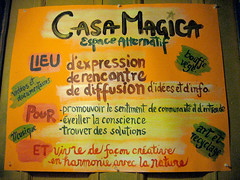
Casa Magica
Originally uploaded by sfllaw.
There's this artists collective on St-Laurent, across from La Sala Rossa. They call their place Casa Magica, and it's really quite groovy. They've got this cozy living area with an open plan. The kitchen is separated from the living room with a tiled countertop someone built themselves. It's decorated in that way with splashes of paint, splashes of light, and furnishings that look like they grew there. I showed up at this place to meet some people in the Free Software world. I've been in Montr al for about a year and I still don't know very many hackers in the city. So when I got invited to Les 24h SQIL, I decided to show up and meet some people. I went up St-Laurent to a non-descript red door with a poster about SQIL on it. "This must be the place," I thought as I tried the door. Upstairs, I was greeted by a living room full of random people: some sitting in front of computers, some chatting away, and one guy fiddling with a projector. I wandered around in a state of confusion until I was introduced to Robin. Robin Millette seems to do a lot of work for FACIL, which is an organisation for promoting free content in Quebec. He introduced me to a bunch of people, like Simon Raven whom I helped with finger-ldap. I met Fran ois from Quebec City, who was interested in Nitix. There was Nicolas who is a Java developer that writes web-based applications. And other people like Alex, Yan, Marco and Matthieu who seemed nice but I can no longer remember what they do. I returned later in the week to Robin's birthday party where I happened to meet Fabien, who is a consultant that does work on Firefox and Yannick who's a Ph.D. student at McGill. We had a good time talking about quantum computing and how to design a programming language for quantum computers. Good geeky times were had.

Andres Salomon: uh, right

When you log into WordPress, it brings you to the Dashboard by default, which begins with a WordPress Development Blog. The latest entry header is: “Don?t Panic! WordPress Is Secure 17 days ago” Yeah, I feel safe; php code especially makes me feel warm and fuzzy. Where did that apostrophe go, anyways?

Jonathan McDowell: I was a brave boy at the dentist today

My main fear in life is pain. I'm a wuss. Nowhere is this more obvious than when I'm at the dentist. I literally start shaking when I sit in the chair. While he's prodding around inside my mouth I can feel myself tense up more and more until I force myself to relax and then the process repeats. Being 6'1" I don't get a lot of people believing me when I tell them just how nervous the whole thing makes me. Anyway. When I came to Norwich I managed to find a dentist who claimed to be suited to nervous patients. I went and didn't find them that good, but did make an appointment for my next checkup 6 months after my initial appointment. And then they cancelled it and I spent the next 3 years thinking I should really get round to sorting it out again and not doing so. Then several weeks ago I was having a conversation at an ALUG meeting with Becca and she recommended her dentist. So I decided I should give them a go and discovered that Phill also uses the same one and said they were good too. I finally got around to going today (having filled out all the forms last week). The dentist was nice and friendly and took me on board about being shit scared. And said some consoling words about my teeth being in reasonable shape. I got away with a scale and polish (which I have to go back to get completed in a couple of weeks) and no mention of a drill anywhere. Rock. Now let's see if I can manage a regular checkup schedule. :) Oh, it's the Guildhall Dental Practice at 9 Upper Goat Lane, Norwich if anyone else is looking. 01603 760032.

Daniel Burrows: Music for everyone

Several years ago (it seems like more than three) I was a student at Brown University. In addition to studying computer science and mathematics, I also took a bunch of courses in the music program, including three years of piano lessons. When I graduated, I gave a recital for friends and family, plus any members of the public who happened to wander in (not many did). And, this being the 21st century, we recorded it and I got a CD of the recording. I edited it, split it into tracks, and handed some copies out to my friends and professors as a going-away present.

Now I'm no longer a student of any sort, and Brown seems a lifetime away, but the music is still sitting on my hard drive. I've always meant to make it available for download, but I couldn't figure out how to get past technical issues of space or bandwidth. A few days ago, though, I had a rather belated bright idea: maybe the Creative Commons project would have links to places where you can host your music for free. Lo and behold, it turns out that the Internet Archive lets anyone upload audio to their server! Better yet, they're even willing to store lossless encodings -- more than willing, actually; FLAC is the preferred encoding of uploads.

So, to make a long story short, click here to hear my bad piano playing. :-)

NOKUBI Takatsugu: A free text-to-speech implementation

Sometimes I use festival as a text-to-speech engine. But it supports only non-Japanese languages. Then I can find a new engine with Japanes support, named GalaTalk. It is a part of production produced by Galatea Project. If I have a spare of time, I'll try to package it.

24 November 2005

Uwe Hermann: Video: Richard Stallman jamming with Gilberto Gil

Richard Stallman and Gilbert Gil OMG! I would have never believed this if I hadn't seen the videos with my own eyes: Richard M. Stallman of GNU and Free Software fame singing various songs, and Gilberto Gil, famous musician and currently Brazil's minister of culture, jamming on his guitar. Unbelievable. (via Boing Boing and netzpolitik.org )

Antti-Juhani Kaijanaho: Cally s War by John Ringo and Julie Cochrane

There’s a reason why I’m going through Baen’s pile of published books. He is the only publisher I know who gets ebooks, I mean really gets them. (Virtually?) all of his catalogue is available in ebook form – with no Digital Restrictions Management! – for a reasonable price, and quite a few are available for free in the Baen Free Library. You can read these books on the browser, or download them to your PDA, whatever works for you. Naturally, you can always buy a dead-tree version, instead. I figure, this publisher is worth the money I pour at him, and hence I pour it in quantity. This is my explanation for having expended six euros for the following ebook. Cally’s War by John Ringo and Julie Cochrane is a sequel to a four-book trilogy by the first author. The trilogy is heavy-duty military science fiction, telling an excellent version of the “aliens invade Earth” story. Cally’s War is set forty years later, and features a minor supporting character from the trilogy as the main character. By the start of the book, Cally is an assassin working for a secret society which wages a secret war against the galactic domination of the Darhel species. The plot of the book revolves around the threat of the secret society being exposed to the opposition, and Cally’s mission in this book is basic counterintelligence: find out the mole and destroy it. However, it would be wrong to think that this book tells an espionage story, or that the counterintelligence plot is integral to the book: the plot is weak, mainly serving as a thin connector between episodes involving Cally’s personal life, or the lack of it, and her sex life (from whose lack she does not suffer). This book, however, seems to suffer from the lack of an editor. There are good ideas, and the storytelling is okay, but to make a really good book, the authors should have regarded this version as the first draft to be thrown away – and rewritten the book completely. There is really no unity in the story, and several good themes worthy of exploration are just skimmed. It is obvious that Ringo did not contribute much prose to this book: the bad politics rants are conspicuosly absent. I think I would have enjoyed the book more had Ringo actually written more of the book, even if it meant suffering through new pro-Bush rhetorics. I suppose this book could work standalone, that is, it does not depend on the reader having read the previous books. On the other hand, there is very little that speaks for reading this book at all, except that it continues the story started in the four-book trilogy. I appreciated the story as a continuation of Cally’s arc, and some of the sex scenes were fun to read, but otherwise it left me wanting. I rate this book 4/10.

Adeodato Sim : Indecision "made in dato", 8 euros a pop

So, uhm, a couple of weeks ago I changed my e-mail address. Surprisingly, though, I haven’t felt completely comfortable with that new one, so I’m now dropping dato(at)the-barrel.org in favour of dato(at)net.com.org.es. I’m hoping for this one to last; it being meaningless is certainly a plus.

Andrew Pollock: [life] My E-3 visa experiences

I've already fielded enquiries from two people who have found my blog via Google, and given the 10,500 visas a year being issued, there's only going to be more, so in the interests of not spending too much time answering questions individually, I'm going to write a detailed account of things. Disclaimer: This article is not a replacement for doing your own homework. I expressly disclaim any responsibility for you getting your visa application denied, being cavity searched when you attempt to enter the US, or being sent to Guantanamo Bay. In particular, this information is subject to change, and as I'm not applying for a new visa every day, I'm not going to know about the changes. If you find something here that is blatantly wrong, or out of date, please let me know, but at the moment, I'm writing about my experiences. I'm undecided about maintaining a website devoted to capturing the state of the art in E-3 visa applications. If in doubt, spend the money (and I do mean spend, it's not a cheap phone call) and call the information line - 1902 941 641 - to speak to a human being, and ask all the questions. Resources What's the process? Your potential employer (sponsor) needs to file a Labor Condition Application (see the form here). At present, this form hasn't been brought up to date with respect to E-3 visas, it's the same form used for H1-B visas. Your employer needs to have written at the top of each page "E-3 - Australia - to be processed". This bit of handwriting is apparently key. You need to have the signed LCA in your hot little hand before you roll up at the US Consulate to apply for your visa. As for how long these take to be processed by the Department of Labor, the FAQ says a week for postal applications. From my experience, and the experience of a couple of other people I've spoken to, it takes anything up to about four weeks. Generally speaking, you do not have to concern yourself with the LCA process, unless for some reason, you're sweating on the LCA so you can apply for your visa. My personal opinion is that the whole process is so long, bureaucratic and unpredictable, that you really don't want to be making any firm plans based on any assumptions on when you think anything is going to happen. Start your planning from when you have been issued your visa, not when you expect you will be issued your visa. Once the LCA has been issued, your sponsor will send it to you along with a wad of paperwork, most of which you just take with you to the consulate. You can make an appointment online. Paperwork-wise, you need to take a completed DS-156 and a DS-157 if you are male between 16 and 45. These forms are available here. You can make an appointment online, the links to make an appointment at each of the US Consulates are also here. I found that the lead time to an appointment was around a month, so if you know the LCA application has been made, you can probably make the booking at the Consulate, so as to try and parallelise things a little bit. What do you need to take to the interview? You need to take your completed DS-156 and DS-157 forms. You need one for each person. So if you are the principal (i.e. the person being hired), you need a DS-156 for yourself, and your spouse, and whichever of you is male needs a DS-157. Bring the sponsor's offer letter too. You need a receipt for a non-refundable visa application fee. You need one receipt per person applying for a visa. You get these receipts by paying $130 per person at any Australia Post outlet. As the visa is non-immigrant, you need to be able show some sort of ongoing connection with Australia. If you own property here, and are planning to continue owning it while in the US, bring a rates notice. I don't know what else is useful to demonstrate an ongoing connection. Also bring a bank statement, as you need to demonstrate an ability to support yourself while in the US. Bring birth certificates and marriage certificates. Also bring a copy of your University transcript, and any assessments that your employer may have had done that state that you hold the equivalent of a US degree. I'm not sure how hard and fast the whole degree thing is. I have an incomplete degree and about 10 years of work experience. This was sufficient. I don't know how you'd go with absolutely no degree and lots of work experience. Finally, you need to bring two US-sized passport photos. These are 5cm x 5cm, which are not what your average passport photo is like if you go somewhere and ask for a passport photo. Processing takes about 3 days, although you get an indication on the day as to whether you are successful or not. If you don't want to come back to collect your passport with the visa in it, you need to leave sufficient stamped, self-addressed envelopes so that the Consulate can mail the passports back to you. It's a bit hazy as to what constitutes 3 days, but assume 3 full working days, plus whatever time it takes for the postage, so up to 5 working days. Good luck with your visa application. Let me know how it goes, and if this has been of assistance.

Clint Adams: Musical Personality Disorder

Decklin, MPD looks pretty interesting. I have filed a wishlist bug on vux on the presumption that integrating it with mpd would be peachy keen. Still, mpdscribble is conspiring against me. That it can't get MusicBrainz IDs is a minor irritation. The more significant problem is that it doesn't work at all. For every song, it whines about skipping, like this:
new song detected (Leonard Cohen - Hey, That's No Way to Say Goodbye)
skipping detected, not submitting.
I'm not doing any skipping, and crossfade is set to '0'. I continue to use my happy NIH pseudosolution.

Benjamin Mako Hill: "You May Go About Your Business"

Access and borrowing privileges at Harvard libraries is one perk of being an MIT graduate student. Actually taking advantage of the privileges of course is a borderline Kafka-esque quest that involves 5 forms, several databases, two universities, a rather impressive MIT libraries official stamp, and three geographically separated offices on opposite ends of Cambridge. Only once all those obstacles are triumphantly overcome can one go through the two card swipes and/or manual verifications necessary to get into the Widener stacks. The webpage makes it sound easy and, in all fairness, nothing about the process is threatening or difficult. While the libraries are worth the effort, it is long and tortuous: by no means for the bureaucratically faint of heart. The high point of the process, in my opinion, is picking up one's ID from the Harvard ID office. The ID office is appropriately located on the ninth floor of a building that requires ID to enter.

Next.

Previous.