Search Results: "xam"

3 June 2012

Johannes Schauer: port bootstrap build-ordering tool report 1

A copy of this post is sent to soc-coordination@lists.alioth.debian.org as well as to debian-bootstrap@lists.mister-muffin.de. Diary May 21 May 22 May 23 May 24 May 25 May 29 May 30 May 31 June 1 June 2 Results I learned a good chunk of ocaml and how to use dose3 and libcudf. I created a gitorious project and a git repository for all the sourcecode.
git clone git://gitorious.org/debian-bootstrap/bootstrap.git
The git as of now contains 30 commits and 1197 lines of ocaml code. So far, 62 emails have been exchanged between me and Pietro and Wookey. I created a mailinglist for this project where all email exchange so far is publicly accessible in the archives. You can also download all of the email exchange in mbox format. Everybody is welcome to join and/or read the list. What seems to be finished: the program that finds the minimal amount of source packages that have to be cross compiled to end up with a minimal build system. What it does is:
  1. get all essential packages
  2. get their runtime dependencies
  3. get build-essential plus runtime dependencies
  4. get all source packages that are necessary to build 1.-3. those are the packages that have to be cross compiled
  5. get a list of all packages that are built by source packages from 4.
  6. add all packages from 1.,2.,3. and 5. plus all arch:all packages to a universe
  7. use Depsolver.trim on that universe to figure out which of those packages are actually installable
The result of 7. will then contain a list of packages that are available automatically on the foreign system due to cross compiled source packages and arch:all packages. For Debian Sid, the output of my program is:
# (1) number of packages with priority:required: 62
# (2) plus, number of dependencies of priority:required packages: 20
# (3) plus, build-essential and dependencies: 31
# number of source packages to build the above: 71
# number of additional packages built from the above source packages: 292
# (4) number of packages of those plus arch:all packages that are installable: 6421
# total number of installable packages (1)+(2)+(3)+(4): 6534
For Ubuntu Natty it is:
# (1) number of packages with priority:required: 96
# (2) plus, number of dependencies of priority:required packages: 7
# (3) plus, build-essential and dependencies: 31
# number of source packages to build the above: 87
# number of additional packages built from the above source packages: 217
# (4) number of packages of those plus arch:all packages that are installable: 2102
# total number of installable packages (1)+(2)+(3)+(4): 2236
So for Debian, 71 source packages definitely have to be made cross compilable while for Natty, the number is 87. The last two days I was toying around with these minimal systems to see how big the number of source packages is, that can be built on top of them without running into dependency cycles. After installing the binary packages that were built, I checked again until no new packages could be built. For Natty, I was only able to find 28 additional packages that can be built on top of the 2236 existing ones. This means that a number of dependency cycles prevent building anything else. In the coming two weeks I will focus on coming up with a tool that cleverly helps the user to identify packages that would be useful to have for building more packages (probably determined by how many packages depend on it - debhelper is an obvious candidate). The tool would then show why that crucial package is not available (in case of debhelper because some of its runtime dependencies are not available and require debhelper to be built) and how the situation can best be resolved. The possible methods to do so are to identify a package that is part of a cycle and either cross compile it or let it have staged build dependencies.

Jordi Mallach: GNOME 3.4 in wheezy

Users of Debian sid will have noticed: the final (and interesting) bits of GNOME 3.4 have landed and if all looks as good as it does now, they should migrate to wheezy in about a week. 3.2 3.4 hasn't been as complicated as the previous horrible transition, but still had some complications due to Cogl/Clutter incompatibilities. Other than that, our major problem has been manpower, but this isn't new for many other Debian teams. We've also seen new incarnations of Linux-only technology is now mandatory which makes our lives a bit more miserable due to kfreebsd-* and hurd-i386, but for now we've still been able to dodge it. It seems wheezy+1 will be fun in that regard though, and we might need to take drastic approaches. If all goes well and the current lot (GNOME Shell, Control Center, Settings daemon, Mutter...) transitions without additional problems, we should be wrapping up our transitions for wheezy with Evolution and friends (currently sitting in experimental), and hopefully GDM 3.4. As we get many questions regarding the status of GDM in Debian, let's add a short note on this. Packaging GDM, at least in its current upstream form, is not a matter of unpacking a new tarball and editing debian/changelog. When Joss works on a new major version, the amount of tweaking to break away from stuff that works on other distros but is not so simple in Debian is outstanding (see, for example, the current unfinished work for GDM 3.2 in our SVN repo). In our case, to handle our GDM defaults, we even need changes to the underlying configuration system, dconf. This evidently takes some effort to do, and unfortunately our GDM expert has had little time for Debian lately, but we're confident we'll end up with a GDM in wheezy that is on par with Debian standards. We are, as always, reachable at #debian-gnome in the OFTC IRC network. Have fun!

1 June 2012

Pietro Abate: apt-get with external solvers : call for testers

Last year we invited David to work with us for a few days to add a generic interface to apt to call external solvers. After a few iterations, this patch finally landed in master and recently (about 3 months ago), in debian unstable.
  [ David Kalnischkies ]
  * [ABI-Break] Implement EDSP in libapt-pkg so that all front-ends which
    use the internal resolver can now be used also with external
    ones as the usage is hidden in between the old API
  * provide two edsp solvers in apt-utils:
    - 'dump' to quickly output a complete scenario and
    - 'apt' to use the internal as an external resolver
Today the new version of apt-cudf was upload in unstable and with it the latest bug fixes that makes it ready for daily use. I've used it quite a lot myself to upgrade my machine and it seems working pretty well so far... The most important difference with the old version is the support for multi-arch enabled machines. This marks an important milestone in our efforts to integrate external solvers, built using different technologies, directly into apt. From a user prospective, this means that (s)he will have the possibility to check if there exists a better (best ?) solution to an installation problem then what proposed by the internal apt solver. Moreover, even if apt-get gives very satisfactory answers, there are occasions where it fails miserably, leaving the user wondering how to unravel the complex web of dependencies to accomplish his task. Available cudf solvers in debian are at the moment : aspcud, mccs and packup. From an architectural point of view this is accomplished by abstracting the installation problem via a simple textual protocol (EDSP) and using an external tool to do the heavy duty translation. Since all solvers now available in debian are not meant to be debian-specific, using them involve a two step translation. The EDSP protocol specification is for the moment "hidden" in the apt documentation. I hope to find a better place for it soon : it would be cool if other package managers as smart or cupt could add an implementation on EDSP in their code so to automatically benefit of this technology. To make it happen, Apt first creates an EDSP file that is then handled to apt-cudf that takes care of the translation to cudf and back into EDSP that is then read back by apt. Apt-cudf is the bridge between edsp and the external solvers and takes care of doing the book keeping and to select the right optimization criteria. Roberto recently wrote a very nice article explaining how to use apt-get with an external solver. In a nutshell, if you want to try this out you just need to install apt-cudf, one external solver like aspcud from the university of Pasdam and then call apt-get using the --solver option (that is not yet documented #67442 ). For example :
apt-get install -s gnome --solver aspcud
This will install gnome while using the a optimization criteria that tries to minimizing the changes on the system. Various other optimization criteria for all apt-get default actions can be specified in the apt-cudf configuration file /etc/apt-cudf.conf I hope the new release of apt-cudf make it into testing before the freeze. Time to test !!!

Francois Marier: Proper indentation of Javascript files using js2-mode in emacs

If you use emacs for Javascript or Node.js development, you should have a look at js2-mode (apt-get install js2-mode in Debian / Ubuntu). In addition to providing syntax highlight, it will parse your Javascript and issue errors and warnings. (It's not as pedantic as jslint or jshint so you'll probably want to fix all of them before committing your files.) Unfortunately the default indentation style looks a bit crazy and adds excessive indentation to your code. Here's an example:

navigator.id.secret.generate(identity, function (plainKey, wrappedKey)
var data = wrappedKey: wrappedKey ;
$.post('/loggedin', data, function (res)
$("#message").text('All done');
, 'json');
, function (error)
$("#message").text('ERROR: ' + error);
);
It turns out that indenting Javascript properly is really hard, but you can turn on a special flag which will cause the indentation to "bounce" between different strategies, starting with the most likely one. This is what I now have in my ~/.emacs:
(custom-set-variables
'(js2-basic-offset 2)
'(js2-bounce-indent-p t)
)
You can find and configure all other options by issuing the following command:
M-x customize-group [RET] js2-mode [RET]
So yes, you can have both the reasonable indentation of the standard js-mode and the helpful warnings and errors of js2-mode!

31 May 2012

Dominique Dumont: cme fix dpkg now track and display changes

Hello I ve released Config::Model 2.018 which is now able to track the changes done with cme to your configuration data. Thw GUI now features a new menu entry File -> show unsaved change that will give you a list of the changes done since running the command or since the last save (whichever occured last). For instance: This feature is also available in non-graphic mode. As an example, let s refresh the lcdproc package:
$ cme fix dpkg
Fixing...
Reading package lists... Done
Building dependency tree       
Reading state information... Done
Warning in 'control source Standards-Version' value '3.9.2': Current standards version is 3.9.3
Warning in 'copyright Format' value 'http://dep.debian.net/deps/dep5/': Format does not match the recommended URL for DEP-5
Changes:
- control source Standards-Version: '3.9.2' -> '3.9.3' # applied fix
- copyright Format: 'http://dep.debian.net/deps/dep5/' -> 'http://www.debian.org/doc/packaging-manuals/copyright-format/1.0/' # applied fix
The Changes list can be reused to update the changelog, but the author does not dare injecting this directly in debian/changelog Let s check the resulting changes:
$ git diff
diff --git a/debian/control b/debian/control
index 11a5b8a..2b81192 100644
--- a/debian/control
+++ b/debian/control
@@ -20,7 +20,7 @@ Build-Depends: autoconf,
                libxosd-dev,
                pkg-config,
                texinfo
-Standards-Version: 3.9.2
+Standards-Version: 3.9.3
 Vcs-Browser: http://git.debian.org/?p=collab-maint/lcdproc.git;a=summary
 Vcs-Git: git://git.debian.org/collab-maint/lcdproc.git
 Homepage: http://www.lcdproc.org/
diff --git a/debian/copyright b/debian/copyright
index 6cea444..4b48619 100644
--- a/debian/copyright
+++ b/debian/copyright
@@ -1,4 +1,4 @@
-Format: http://dep.debian.net/deps/dep5/
+Format: http://www.debian.org/doc/packaging-manuals/copyright-format/1.0/
 Upstream-Name: lcdproc
 Upstream-Contact: William W. Ferrell 
 Source: http://www.lcdproc.org/
domi@ylum:~/debian-dev/lcdproc-stuff/lcdproc$ 
Last but not least, this track and display changes features is also available for other models, like OpenSsh, lcdproc, multistrap All the best
Tagged: Config::Model, dpkg, Perl

Julian Andres Klode: Memory allocators

In the past days, I looked at various memory allocators in a quest to improve performance in my multi-threaded test cases of a reference counting language runtime / object allocator (a fun project). It turns out the glibc s memory allocator is relatively slow, especially if you do loops that create one element and destroy one element at the same time (for example, map() on a list you no longer use after you passed it to map). To fix this problem, I considered various options. The first option was to add a thread-local cache around malloc(). So whenever we want to free() an object, we place it on a thread-local list instead, and if a malloc() request for an object of that size comes in, we reuse the old object. This fixes the problem with the lists, but experiments shown another problem with the glibc allocator: Allocating many objects without releasing others (let s say appending an element to a functional list). I started testing with tcmalloc instead, and noticed that it was several times faster (reducing run time from 6.75 seconds to 1.33 seconds (5 times faster)). As I do not want to depend on a C++ code base, I decided to write a simple allocator that allocates blocks of memory via mmap(), splits those into objects, and puts the objects on a local free list. That allocator performed faster than tcmalloc(), but was also just a simple test case, and not really useable, due to potential fragmentation problems (and because the code was statically linked in, causing thread-local storage to be considerably faster, as it does not need to call a function on every TLS access, but can rather go through a segment register). I then discovered jemalloc, and tried testing with this. It turned out that jemalloc was even faster than tcmalloc in all test cases, and also required about the same amount of memory as tcmalloc (and slightly more than the custom test code, as that combined reference counting with memory allocator metadata and thus had less meta data overhead). Using jemalloc, the list building test performs in 0.9X seconds now (instead of tcmalloc s 1.33 or glibc s 6.75 seconds), requires 0 major page faults (tcmalloc has 2), and uses 5361472 kb memory (tcmalloc uses 5290240, glibc requires 7866608). Given that jemalloc is written in C, I can only recommend it to everyone in need of a scalable memory allocator. Depending on your workload, it might require less memory than tcmalloc (at least that s the case at Facebook) and is most likely faster than tcmalloc. It also provides tcmalloc-compatible profiling facilities (as Facebook needed them). Furthermore, jemalloc is also the memory allocator used by FreeBSD, and is used by Mozilla projects, and on several Facebook projects, and should thus be relatively stable and useable. All tests were run with 4 threads, on a dual-core laptop with hyper-threading, using (e)glibc 2.13, tcmalloc 2.0, and jemalloc 3.0. The tests may not be representative of real world performance, and do not account for fragmentation. Should I try replacing Python s custom caching of malloc() calls with simply calling jemalloc, and run a few Python benchmarks? Anyone interested in that?
Filed under: General

Matthew Garrett: Implementing UEFI Secure Boot in Fedora

Edit 16:17EDT 31/5/12: Clarification of who gets the $99
Edit 02:10EDT 01/6/12: Clarification that it's a one-off payment

(Brief disclaimer - while I work for Red Hat, I'm only going to be talking about Fedora here. Anything written below represents only my opinions and my work on Fedora, not Red Hat's opinions or future plans)

Fedora 17 was released this week. It's both useful and free, and serves as a welcome addition to any family gathering. Do give it a go. But it's also noteworthy for another reason - it's the last Fedora release in the pre-UEFI secure boot era. Fedora 18 will be released at around the same time as Windows 8, and as previously discussed all Windows 8 hardware will be shipping with secure boot enabled by default. While Microsoft have modified their original position and all x86 Windows machines will be required to have a firmware option to disable this or to permit users to enrol their own keys, it's not really an option to force all our users to play with hard to find firmware settings before they can run Fedora. We've been working on a plan for dealing with this. It's not ideal, but of all the approaches we've examined we feel that this one offers the best balance between letting users install Fedora while still permitting user freedom.

Getting the machine booted
Most hardware you'll be able to buy towards the end of the year will be Windows 8 certified. That means that it'll be carrying a set of secure boot keys, and if it comes with Windows 8 pre-installed then secure boot will be enabled by default. This set of keys isn't absolutely fixed and will probably vary between manufacturers, but anything with a Windows logo will carry the Microsoft key[1].

We explored the possibility of producing a Fedora key and encouraging hardware vendors to incorporate it, but turned it down for a couple of reasons. First, while we had a surprisingly positive response from the vendors, there was no realistic chance that we could get all of them to carry it. That would mean going back to the bad old days of scouring compatibility lists before buying hardware, and that's fundamentally user-hostile. Secondly, it would put Fedora in a privileged position. As one of the larger distributions, we have more opportunity to talk to hardware manufacturers than most distributions do. Systems with a Fedora key would boot Fedora fine, but would they boot Mandriva? Arch? Mint? Mepis? Adopting a distribution-specific key and encouraging hardware companies to adopt it would have been hostile to other distributions. We want to compete on merit, not because we have better links to OEMs.

An alternative was producing some sort of overall Linux key. It turns out that this is also difficult, since it would mean finding an entity who was willing to take responsibility for managing signing or key distribution. That means having the ability to keep the root key absolutely secure and perform adequate validation of people asking for signing. That's expensive. Like millions of dollars expensive. It would also take a lot of time to set up, and that's not really time we had. And, finally, nobody was jumping at the opportunity to volunteer. So no generic Linux key.

The last option wasn't hugely attractive, but is probably the least worst. Microsoft will be offering signing services through their sysdev portal. It's not entirely free (there's a one-off $99 fee to gain access edit: The $99 goes to Verisign, not Microsoft - further edit: once paid you can sign as many binaries as you want), but it's cheaper than any realistic alternative would have been. It ensures compatibility with as wide a range of hardware as possible and it avoids Fedora having any special privileges over other Linux distributions. If there are better options then we haven't found them. So, in all probability, this is the approach we'll take. Our first stage bootloader will be signed with a Microsoft key.

Bootloaders
We've decided to take a multi-layer approach to our signing for a fairly simple reason. Signing through the Microsoft signing service is a manual process, and that's a pain. We don't want to have bootloader updates delayed because someone needs to find a copy of Internet Explorer and a smartcard and build packages by hand. Instead we're writing a very simple bootloader[2]. This will do nothing other than load a real bootloader (grub 2), validate that it's signed with a Fedora signing key and then execute it. Using the Fedora signing key there means that we can build grub updates in our existing build infrastructure and sign them ourselves. The first stage bootloader should change very rarely, and we don't envisage updating it more than once per release cycle. It shouldn't be much of a burden on release management.

What about grub? We've already switched Fedora 18 over to using grub 2 by default on EFI systems, but it still needs some work before it's ready for secure boot. The first thing is that we'll be disabling the module loading. Right now you can load arbitrary code into grub 2 at runtime, and that defeats the point of secure boot. So that'll be disabled. Next we'll be adding support for verifying that the kernel it's about to boot is signed with a trusted key. And finally we'll be sanitising the kernel command line to avoid certain bits of functionality that would permit an attacker to cause even a signed kernel to launch arbitrary code. These restrictions will all vanish if secure boot is disabled.

Kernel
Secure boot is built on the idea that all code that can touch the hardware directly is trusted, and any untrusted code must go through the trusted code. This can be circumvented if users can execute arbitrary code in the kernel. So, we'll be moving to requiring signed kernel modules and locking down certain aspects of kernel functionality. The most obvious example is that it won't be possible to access PCI regions directly from userspace, which means all graphics cards will need kernel drivers. Userspace modesetting will be a thing of the past. Again, disabling secure boot will disable these restrictions.

Signed modules are obviously troubling from a user perspective. We'll be signing all the drivers that we ship, but what about out of tree drivers? We don't have a good answer for that yet. As before, we don't want any kind of solution that works for us but doesn't work for other distributions. Fedora-only or Ubuntu-only drivers are the last thing anyone wants, and this really needs to be handled in a cross-distribution way.

Wait signed what
Secure boot is designed to protect against malware code running before the operating system. This isn't a hypothetical threat. Pre-boot malware exists in the wild, and some of it is nastier than you expect. So obviously bootloaders need to be signed, since otherwise you'd just replace the signed bootloader with an unsigned one that installed malware and booted your OS.

But what about the kernel? The kernel is just code. If I take a signed Linux bootloader and then use it to boot something that looks like an unsigned Linux kernel, I've instead potentially just booted a piece of malware. And if that malware can attack Windows then the signed Linux bootloader is no longer just a signed Linux bootloader, it's a signed Windows malware launcher and that's the kind of thing that results in that bootloader being added to the list of blacklisted binaries and suddenly your signed Linux bootloader isn't even a signed Linux bootloader. So kernels need to be signed.

And modules? Again, modules are just code. It's a little trickier, but if your signed kernel loads an unsigned module then that unsigned module can set up a fake UEFI environment and chain into a compromised OS bootloader. Now the attacker just has to include a signed kernel and a minimal initramfs that loads their malware module. It'd slow down boot by a couple of seconds, but other than that it'd be undetectable. X? If you can access the registers on a GPU then you can get the GPU to DMA over the kernel and execute arbitrary code. Trickier again, but still achievable - and if you've locked down every other avenue of attack, it's even attractive.

If we produce signed code that can be used to attack other operating systems then those other operating systems are justified in blacklisting us. That doesn't seem like a good outcome.

Customisation
A lot of our users want to build their own kernels. Some even want to build their own distributions. Signing our bootloader and kernel is an impediment to that. We'll be providing all the tools we use for signing our binaries, but for obvious reasons we can't hand out our keys. There's three approaches here. The first is for a user to generate their own key and enrol it in their system firmware. We'll trust anything that's signed with a key that's present in the firmware. The second is to rebuild the shim loader with their own key installed and then pay $99 and sign that with Microsoft. That means that they'll be able to give copies to anyone else and let them install it without any fiddling. The third is to just disable secure boot entirely, at which point the machine should return to granting the same set of freedoms as it currently does.

But I don't trust Microsoft
A system in custom mode should allow you to delete all existing keys and replace them with your own. After that it's just a matter of re-signing the Fedora bootloader (like I said, we'll be providing tools and documentation for that) and you'll have a computer that will boot Fedora but which will refuse to boot any Microsoft code. It may be a little more awkward for desktops because you may have to handle the Microsoft-signed UEFI drivers on your graphics and network cards, but this is also solvable. I'm looking at ways to implement a tool to allow you to automatically whitelist the installed drivers. Barring firmware backdoors, it's possible to configure secure boot such that your computer will only run software you trust. Freedom means being allowed to run the software you want to run, but it also means being able to choose the software you don't want to run.

You've sold out
We've been working on this for months. This isn't an attractive solution, but it is a workable one. We came to the conclusion that every other approach was unworkable. The cause of free software isn't furthered by making it difficult or impossible for unskilled users to run Linux, and while this approach does have its downsides it does also avoid us ending up where we were in the 90s. Users will retain the freedom to run modified software and we wouldn't have accepted any solution that made that impossible.

But is this a compromise? Of course. There's already inequalities between Fedora and users - trademarks prevent the distribution of the Fedora artwork with modified distributions, and much of the Fedora infrastructure is licensed such that some people have more power than others. This adds to that inequality. It's not the ideal outcome for anyone, and I'm genuinely sorry that we weren't able to come up with a solution that was better. This isn't as bad as I feared it would be, but nor is it as good as I hoped it would be.

What about ARM
Microsoft's certification requirements for ARM machines forbid vendors from offering the ability to disable secure boot or enrol user keys. While we could support secure boot in the same way as we plan to on x86, it would prevent users from running modified software unless they paid money for a signing key. We don't find that acceptable and so have no plans to support it.

Thankfully this shouldn't be anywhere near as much of a problem as it would be in the x86 world. Microsoft have far less influence over the ARM market, and the only machines affected by this will be the ones explicitly designed to support Windows. If you want to run Linux on ARM then there'll be no shortage of hardware available to you.

Is this all set in stone?
No. We've spent some time thinking about all of this and are happy that we can implement it in the Fedora 18 timescale, but there's always the possibility that we've missed something or that a new idea will come up. If we can increase user freedom without making awful compromises somewhere else then we'll do it.

[1] In fact, chances are that everything will carry the Microsoft key. Secure boot requires that UEFI drivers also be signed. The signing format only permits a single signature per binary. For compatibility, approximately all add-on hardware shipped will be signed with Microsoft's key, and that means that all system vendors have to recognise Microsoft's key in order to permit that hardware to run on their systems.
[2] Current source is here. It relies on a port of the UEFI crypto library and OpenSSL that I have building with some handholding, and which I'll upload as soon as possible.

comment count unavailable comments

30 May 2012

Thomas Goirand: New release of MLMMJ (version 1.2.18.0) uploaded in Debian

MLMMJ stands for Mailing List Manager Made Joyful. To me, it s the best mailing list manager available. Not only its written in C (no slow interpreted language here ), but also it is easy and very convenient to setup. No hack is needed to make it run on a multi-domain environment, and no need to run a special subdomain for your lists (yes, I m thinking about you, silly Mailman ). If you didn t know, MLMMJ is used to handle relatively high traffic lists: all mailing lists for Gentoo are using MLMMJ for example. MLMMJ 1.2.18.0 has just been release upstream, few days ago (on the 29 of may). It s with a great pleasure that I packaged (and uploaded to SID) the latest version, and wrote the changelog, where I wrote that 6 Debian specific patches (out of 8) could be removed! One of the funny changes are the renaming of the mlmmj-recieve into mlmmj-receive as it always should have been (with a symlink to keep backward compatibility), and the removal of the .sh extension to the mlmmj-make-ml (which was patched in Debian to be kept policy compliant: that s one of the removed patches ). Even if I did a few quick functional tests before uploading, I d be happy to get some feedback before Wheezy is out, so please test and eventually bug-report!

Sorina Sandu: Initial commit

Hello!

I'm Sorina and this summer I will be working on Debian Installer network setup during Google Summer of Code. I am a second year bachelor's student at Politehnica University of Bucharest, I am studying Computer Science. I very much enjoy what I am doing even if sometimes I feel that the amount of stuff I want/have to learn/do/work on is infinite and I don't really know where to start.

I am at the beginning of the project, I believe now I am accustomed to the way things work and I am waiting forward to finishing the exam period so that I could really start working.

The hardest part for me in what I've done so far is testing what I am doing. It took me a while to figure out at least a part of how the installer functions and to solve the problems that occurred while building. Luckily, there is documentation and internet and even more important, I had help and support from my mentors.

So far I have only written two patches for netcfg, for bugs #610752 and #636211. For the first one I had a version for a while now, but I was unable to test it (unfortunately, it's likely that you will hear this a lot in the future). The idea was to make the link detection timeout preseedable and for this I have added two new templates, asking the user to provide a value for that matter.

The second one involved a missing "Go Back" button. This seemed to be the result of not letting debconf know that the program is capable of handling the user pressing a back button. That could be solved using deb_capb.

As I said before, testing was my main problem. Eventually, I built the image, wrote it to an USB and rebooted my laptop. This served its purpose, since I had access to anything I needed such as the wireless interface and physical access to the network cable. Running it through a virtual machine did not help much in this case, because I was unable to provide those.

Another thing I considered to be hard was blog posting, but now that I have just finished my first post it seems that I overreacted.

That's all for now, have a nice day!

Raphael Geissert: ldebdiff: what local change did I make to a package?

When fixing or modifying a package I at times change the installed files directly. However, once the changes are okay and it is time to prepare a diff, having to keep track and manually diff'ing the installed files is time consuming.

That's when ldebdiff does its thing: it runs diff against the original files of a given package and the ones installed on a system.
For example:

$ ldebdiff acpi-fakekey
--- unpacked/etc/init.d/acpi-fakekey 2012-04-05 05:14:21.000000000 -0500
+++ /etc/init.d/acpi-fakekey 2012-04-12 12:10:55.000000000 -0500
@@ -4,8 +4,8 @@

### BEGIN INIT INFO
# Provides: acpi-fakekey
-# Required-Start: $local_fs $remote_fs
-# Required-Stop: $local_fs $remote_fs
+# Required-Start: $remote_fs
+# Required-Stop: $remote_fs
# Default-Start: 2 3 4 5
# Default-Stop:
# Short-Description: Start acpi_fakekey daemon
($remote_fs implies $local_fs)

29 May 2012

Jon Dowland: Debian Day

After a relatively long period of flux, I've managed to settle into a routine where I've got all the time I can dedicate to open source stuff bunched together: every Tuesday night. I've started calling it "Debian Day", although Debian won't get all that time exclusively. One evening a week doesn't sound like much, but that's unfortunately a realistic amount given my other commitments. Still, having a firm idea of how much resource I have makes planning what I can and can't do much easier. It also means I need to be quite selective about what I spend my time on. This also impacts the type of interactions I can use. I can respond to email, bugs, etc., but I cannot effectively interact with folks on IRC, for example: the period between windows is too large for it to work effectively. Therefore, I can't work reliably with any team or area of Debian that relies on IRC to get things done. Tonight, then. I have recently been ripping some CDs, a task for which I use grip, despite it long since having been dropped by Debian. It still works very well, whereas Sound Juicer, which still pops up whenever I insert an audio CD, does not. I've been interested in helping out with Debian GNOME packaging for a while, and it seems the issue has been fixed upstream, but after asking around in #debian-gnome, the root cause is that the newer musicbrainz API packages have not been uploaded to Debian. (the existing package uses the old API). Two separate people appear to have been working on a new Music Brainz package, but neither filed an ITP bug. I've spent the largest chunk of my Debian time just trying to figure out what has been going on, sadly, but at least there's the likelyhood this will be fixed for wheezy. There's also the tail end of a musicbrainz-2.1 transition finishing up. Another thing I considered this evening was the future of debgtd in Debian stable. On reflection, and after sitting on the fence for several months, I've decided I don't have the time to fix it up enough to have it ready for wheezy, so with regret I've filed a removal bug. With any luck, at some point in the wheezy cycle I'll manage to put more time towards this, because I think it addresses a genuine need and could be useful to people. Finally, whenever I sit down and look at Debian stuff to finish up, I have a strong temptation to fix some issues belonging to the games team. In particular, Gustavo Panizzo has put a lot of work into vavoom packages, but sadly his requests for sponsorship are falling on deaf ears. There's also Johey Shmit's work on packaging zdoom which needs some attention to finish removing some embedded libraries. I have to keep reminding myself I left the team for a reason, to focus on something else, and finding that something else should be the priority. So all in all not the most uplifting evening: I'm starting to think I simply couldn't work effectively with the Debian GNOME team without being able to dedicate more time to use IRC effectively; I spent more time that could be necessary figuring out a bunch of other folks have potentially wasted each other's time by working on packages and not filing ITPs; and I've removed one of my own packages from the distribution altogether. It's not all doom and gloom, though: last week I packaged Simon Howard's lhasa, a library and tool for decompressing LHA files, as used by various old DOS games. (See? I just can't escape that stuff ) I also managed to 'resolve' two bup bugs, one RC. I also finished transitioning from my old PGP key to my new one.

Niels Thykier: Lintian 2.5.7 and 2.5.8

The new version of Lintian (2.5.8) can pretty much be summed up as:
Its like 2.5.7, only with less false positives and no FTBFS.
Especially people annoyed by the hardening flags will hopefully find that 2.5.8 greatly reduces the number of false positives. I believe this is best demonstrated with an example:
$ lintian --print-version && lintian -q -C binaries amarok_2.5.0-1_i386.deb   wc -l 
2.5.7
94
[...]
$ lintian --print-version && lintian -q -C binaries amarok_2.5.0-1_i386.deb   wc -l
2.5.8
4
However, nothing comes for free. We dropped hardening-no-stackprotector from the default profile (and demoted it to an I tag). For hardening-no-fortify-functions we made a false positive -> false negative trade-off by ignoring binaries if their only unprotected function is memcpy. For more information, please refer to #673112. hardening-no-stackprotector is still available and can be used via the debian/extra-hardening profile (or via the tags argument). For the 2.5.7 behaviour of hardening-no-fortify-functions, you have to use hardening-check directly. But 2.5.7 had other changes besides the myriad of false-positives: A consequence of this is that we no longer warn if you use things like dpkg assert-working-epoch or your postinst creates a usr/doc transition symlink . With all the Lintian modules under the Lintian namespace, we can install them in the standard perl @INC path. Admittedly, I am not certain we are ready to commit to the current API in these modules, which is one of the reasons why they are still installed in /usr/share/lintian. But in a couple of releases things may look differently. :) Lintain 2.5.7 ships over 50 data files of various kinds (usually white- or blacklists of some kind). Before 2.5.7, all data files with a few exceptions would be loaded eagerly (i.e. as soon as the check was run for the first time). A few data files had been special cased with manual laziness . In 2.5.7, Lintian::Data was updated to lazily load the data. So depending on the packages being checked, Lintian may now load fewer data files. While this is not something exclusive to 2.5.7, we have separated quite a few checks from their data tables by now. My personal favorites are the table of known interpreters and (from 2.5.8) the table of known versioned interpreters. I am certainly biased here. But this is probably the most awesome feature in Lintian 2.5.7. It is now possible for vendors to extend or simply shadow the core Lintian data files. Allow me to demonstrate how this can be used:
$ lintian --tags build-depends-on-obsolete-package a2ps_4.14-1.1.dsc 
E: a2ps source: build-depends-on-obsolete-package build-depends: dpatch
$ cat ~/.lintian/profiles/local/main.profile 
Profile: local/main
Extends: debian/main
$ cat  ~/.lintian/vendors/local/main/data/fields/obsolete-packages 
@include-parent
@delete dpatch
bison
$ lintian --profile local/main --tags build-depends-on-obsolete-package a2ps_4.14-1.1.dsc
E: a2ps source: build-depends-on-obsolete-package build-depends: bison
$
It is a toy example, but I believe it is a good demonstration of the feature. The full documentation of Vendor specific data files can be found in the Lintian User manual (in lintian/2.5.7 or newer). It will also be on lintian.debian.org when we find time to update lintian there. :)

28 May 2012

Vincent Bernat: Integration of NetSNMP into an event loop

NetSNMP comes with its own event loop based on the select() system call. While you can build your program around it, you may prefer to use an existing event loop, either a custom one or something like libevent, libev or Twisted.

Own custom event loop Let s start with the easiest case: you have written your own event loop. This means you make a call to select(), poll(), epoll(), kqueue() or something similar. All those functions take a set of file descriptors and wait for any of them to become available in a specified time frame. Here is a typical use of select() (adapted from Quagga)
readfd = m->readfd;
writefd = m->writefd;
exceptfd = m->exceptfd;
timer_wait = thread_timer_wait (&m->timer);
num = select (FD_SETSIZE,
              &readfd, &writefd, &exceptfd,
              timer_wait);
if (num < 0)
   
    if (errno == EINTR)
      continue; /* signal received - process it */
    zlog_warn ("select() error: %s",
               safe_strerror (errno));
    return NULL;
   
if (num == 0)
   
    /* Timeout handling */
    thread_timer_process (&m->timer);
   
if (num > 0)
   
    thread_process_fd (&readfd);
    thread_process_fd (&writefd);
   
thread_process_fd (fds) function iterates on each file descriptor fd and executes the appropriate action if FD_ISSET (fds, fd) is true. Integrating NetSNMP into such an event loop is easy: NetSNMP provides the snmp_select_info() function which alters a set of file descriptors to insert its own. Here is the new code:
#if defined HAVE_SNMP
struct timeval snmp_timer_wait;
int snmpblock = 0;
int fdsetsize;
#endif
/* ... */
#if defined HAVE_SNMP
fdsetsize = FD_SETSIZE;
snmpblock = 1;
if (timer_wait)
   
    snmpblock = 0;
    memcpy(&snmp_timer_wait, timer_wait,
           sizeof(struct timeval));
   
snmp_select_info(&fdsetsize, &readfd,
                 &snmp_timer_wait, &snmpblock);
if (snmpblock == 0)
  timer_wait = &snmp_timer_wait;
#endif
num = select (FD_SETSIZE,
              &readfd, &writefd, &exceptfd,
              timer_wait);
if (num < 0)   /* ... */  
#if defined HAVE_SNMP
if (num > 0)
  snmp_read(&readfd);
else if (num == 0)
   
    snmp_timeout();
    run_alarms();
   
netsnmp_check_outstanding_agent_requests();
#endif
/* ... */
snmp_select_info() may modify the provided set of file descriptors (and therefore, its size). It may also modify the provided timer in case it needs to schedule an action before the original timeout. snmpblock is a tricky variable. While select() can be called with a timeout set to NULL, this is not the case of snmp_select_info(): you have to pass a valid pointer. snmpblock is set to 0 if the provided timeout must be considered or to 1 otherwise. snmp_select_info() will set snmpblock to 0 if and only if it alters the timeout. Here are a two examples of integration. Both are for a subagent but the code for a manager is the same:

Third-party event loop With a third party event loop, you don t have access to the select() system call anymore. Therefore, you cannot alter it with snmp_select_info(). Instead, at each iteration of the loop, a list of SNMP related file descriptors is kept up-to-date with the help of snmp_select_info(): new ones are added and old ones are removed.

libevent Let s assume that snmp_fds is the list of current SNMP related events1. A function levent_snmp_update() calls snmp_select_info() to update this list. Here is a partial implementation (error handling removed and some declarations omitted, look at the complete version from lldpd):
static void
levent_snmp_update()
 
    int maxfd = 0;
    int block = 1;
    FD_ZERO(&fdset);
    snmp_select_info(&maxfd, &fdset, &timeout, &block);
    /* We need to untrack any event whose FD is not in  fdset 
       anymore */
    for (snmpfd = TAILQ_FIRST(snmp_fds);
         snmpfd;
         snmpfd = snmpfd_next)  
        snmpfd_next = TAILQ_NEXT(snmpfd, next);
        if (event_get_fd(snmpfd->ev) >= maxfd  
            (!FD_ISSET(event_get_fd(snmpfd->ev), &fdset)))  
            event_free(snmpfd->ev);
            TAILQ_REMOVE(snmp_fds, snmpfd, next);
            free(snmpfd);
          else
            FD_CLR(event_get_fd(snmpfd->ev), &fdset);
     
    /* Invariant: FD in  fdset  are not in list of FD */
    for (int fd = 0; fd < maxfd; fd++)
        if (FD_ISSET(fd, &fdset))  
            snmpfd->ev = event_new(base, fd,
                EV_READ   EV_PERSIST,
                levent_snmp_read,
                NULL);
            event_add(snmpfd->ev, NULL);
            TAILQ_INSERT_TAIL(snmp_fds, snmpfd, next);
         
    /* If needed, handle timeout */
    evtimer_add(snmp_timeout, block?NULL:&timeout);
 
Then, replace the main loop (usually, a call to event_base_dispatch()) with this:
do  
    if (event_base_got_break(base)  
        event_base_got_exit(base))
        break;
    netsnmp_check_outstanding_agent_requests();
    levent_snmp_update();
  while (event_base_loop(base, EVLOOP_ONCE) == 0);
Here is how are defined the two callbacks:
static void
levent_snmp_read(evutil_socket_t fd, short what, void *arg)
 
    FD_ZERO(&fdset);
    FD_SET(fd, &fdset);
    snmp_read(&fdset);
    levent_snmp_update();
 
static void
levent_snmp_timeout(evutil_socket_t fd, short what, void *arg)
 
    snmp_timeout();
    run_alarms();
    levent_snmp_update();
 

Twisted reactor As a second example, here is how to integrate NetSNMP into Twisted reactor. Twisted is an event-driven network programming framework written in Python. It does not come with support for SNMP2. Because of the language mismatch, the integration of NetSNMP in Twisted needs to be done using a C extension or the ctypes module. Twisted event loop is called a reactor. Like for libevent, events need to be registered. It is possible to register file descriptor-like objects using a class implementing a handful of methods. Here is the implementation of such a class (adapted from PyNetSNMP, a subproject of Zenoss using the ctypes module):
class SnmpReader:
    "Respond to input events"
    implements(IReadDescriptor)
    def __init__(self, fd):
        self.fd = fd
    def doRead(self):
        netsnmp.snmp_read(self.fd)
    def fileno(self):
        return self.fd
Like for libevent, we have a function to update the list of SNMP related events (stored as a mapping between file descriptors and SnmpReader instances):
class Timer(object):
    callLater = None
timer = Timer()
fdMap =  
def updateReactor():
    "Add/remove event handlers for SNMP file descriptors and timers"
    fds, t = netsnmp.snmp_select_info()
    for fd in fds:
        if fd not in fdMap:
            reader = SnmpReader(fd)
            fdMap[fd] = reader
            reactor.addReader(reader)
    current = Set(fdMap.keys())
    need = Set(fds)
    doomed = current - need
    for d in doomed:
        reactor.removeReader(fdMap[d])
        del fdMap[d]
    if timer.callLater:
        timer.callLater.cancel()
        timer.callLater = None
    if t is not None:
        timer.callLater = reactor.callLater(t, checkTimeouts)
Contrary to libevent, we cannot alter the main loop to call updateReactor() at each iteration. Therefore, it must be called after each SNMP related function. For another example, have a look at my equivalent implementation as a C extension.

Miscellaneous

Lack of asynchronicity Integrating NetSNMP into an event-based program is not risk-free. I have written a fairly comprehensive article on the lack of asynchronicity in NetSNMP AgentX protocol implementation. I urge you to read it if you want to integrate a SNMP subagent into an existing program. On the manager side, you will get similar drawbacks when using SNMPv3. To retrieve or manipulate management information using SNMPv3, it is necessary to know the identifier of the remote SNMP protocol engine. This identifier can be configured directly on each manager but it is usually discovered by querying SNMP-FRAMEWORK-MIB:: snmpEngineID, as described in RFC 5343. Unfortunately, this discovery is done synchronously by NetSNMP. There is a bug report for this issue but it seems difficult to fix. I have not been able to come up with a proper patch but I have described a workaround around snmp_sess_async_send(). There is no such problem with SNMPv2.

Limitation of file descriptor sets snmp_select_info() and snmp_read() uses the fd_set type to handle a set of file descriptors. This type should be manipulated with FD_CLR(), FD_ISSET(), FD_SET() and FD_ZERO(). Those may be defined as functions but they usually are macros. Moreover, no file descriptor greater than FD_SETSIZE (which is usually set to 1024) can be handled with the fd_set type. This means that if you have a file descriptor greater than 1024, you won t be able to use snmp_select_info() with it. Starting from NetSNMP 5.5, you can use snmp_select_info2() and snmp_read2() instead of snmp_select_info() and snmp_read(). They use the netsnmp_large_fd_set. If you want to keep compatibility with NetSNMP 5.4, here is another twist. The fd_set type is usually a fixed-size array of long integers. FD_CLR(), FD_ISSET() and FD_SET() are size-independant. The size only matters for FD_ZERO() which is not used by either snmp_select_info() or snmp_read(). You can therefore allocate a larger fd_set. A common way is to compile your program with -D__FD_SETSIZE=4096. You can still use FD_ZERO() yourself. However, this is not portable (GNU C Library only). Another way is to allocate your own array of long integers and cast it to fd_set. You ll have to redefine FD_ZERO():
typedef struct  
   long int fds_bits[4096/sizeof(long int)];
  my_fdset;
#undef FD_ZERO
#define FD_ZERO(fdset) memset((fdset), 0, sizeof(my_fdset))
 
   /* ... */
   my_fdset fdset;
   FD_ZERO(&fdset);
   /* ... */
   rc = snmp_select_info(&n, (fd_set *)&fdset, &timeout, &block);
   /* ... */
 

Threads NetSNMP provides two API:
  • the traditional session API which is not thread-safe and
  • the single session API.
In the above examples, I have used the traditional session API. If you are using threads, you need to ensure that all SNMP operations are done in a single thread. Otherwise, you need to adapt the examples to use the single session API. snmp_select_info() is part of the traditional session API. You should replace it with snmp_sess_select_info() and keep a list of SNMP sessions. This API is not available for the agent side of NetSNMP.

  1. The event list is global but some code could be added to bind a different list for each base in case you use different bases. This is not needed in the case of lldpd which uses only one event base.
  2. TwistedSNMP is an SNMP protocol implementation for Twisted based on PySNMP but is not maintained anymore. PySNMP comes with examples on how to integrate with Twisted.

Thibaut Girka: Multiarch Cross-toolchains

Hi! I have been selected to work on multiarch cross-toolchains as part of the Google summer of Code. Although coding officially started last week, I have been busy with exams and other uni stuff at the time. Anyway, let's talk about the project itself, that is, multiarch cross-toolchains. What is multiarch? In order to understand what the project is about, one need to know what multiarch is. I'll quickly describe it, and I invite anyone interested to read the spec (really, it's interesting, and not that long). Basically, multiarch lets you install binary packages for multiple architectures on one system, and let package managers resolve dependencies as one would expect. This works by identifying four sets of packages: Anyway, multiarch is an amazing thing that may be of use in various cases, such as running i386-only software on an amd64 system, running armel software on an armhf system, running i386 software on an armhf system using qemu-user-static and binfmt, cross-grading (switching, for instance, from i386 to amd64 on a running system), and, in our case, easing cross-compilation. State of cross-toolchains in Debian There aren't really cross-toolchains available in Debian (although some can be built from source packages), but they are available in emdebian's repositories. However, those packages predate multiarch, and don't make use of it. Instead, they depend on special packages converted using dpkg-cross. Such packages are merely arch: all versions of foreign packages, with files moved to arch-qualified paths to prevent conflicts with normal packages. Such packages thus have to be generated from real packages, either manually or using some sort of automation. In addition, this additional step brings several issues, like keeping in sync converted packages with real packages from the archive. With multiarch, such packages are rendered useless, and may in fact bring additional problems, since converted and multiarch packages may share the same files, and thus may not be co-installable. Switching from dpkg-cross to cross-arch deps Cross-toolchains packages currently depend on a few packages converted using dpkg-cross (ex: libc6-$ARCH-cross and libc6-dev-$ARCH-cross for some packages). They need to depend on the real package with the right arch (ex: libc6:$ARCH, libc6-dev:$ARCH). The obvious way to do so is by annotating the dependency with a specific arch qualifier (ex: Depends: libc6:armhf ). This is, however, not covered by the multiarch spec. Note that some lib*-$ARCH-cross packages will remain (for instance, libgcc1-armhf-cross). Indeed, those packages are different from the packages mentioned above in that they are of the architecture of the build system and actually part of the toolchain itself.
The above isn't actually true. Indeed, those packages are runtime library cross-built during gcc's build. Likewise, cross-toolchains may build-depend on foreign packages (ex: libc6-dev). Thus, specific arch qualifiers must be handled in the Build-Depends source package field too. Changing dpkg and apt to support that should be fairly straightforward. In fact, I already have a few patches, but I need to refresh them, maybe clean them up a little, and push them a little harder to get them accepted!

Pietro Abate: managing puppet manifest with gitolite

Managing the puppet manifest using a vcs is a best practice and there is a lot of material on the web. The easier way to do it, is to use git directly in the directory /etc/puppet and use a simple synchronization strategy with an external repo, either to publish your work, or simply to keep a backup somewhere. Things are a bit more complicated when you would like to co-administer the machine with multiple people. Setting up user accounts, permission and everything can be a pain in the neck. Moreover working from your desktop is always more comfortable then logging in as root on a remote system and make changes there ... The solution I've chosen to make my life a bit easier is to use gitolite, that is a simple git gateway that works using ssh public keys for authentication and does not require the creating of local users on the server machine. Gitolite is available in debian and installing it is super easy : apt-get install gitolite . If you use puppet already you might be tempted to use puppet to manage your gitolite installation. This is all good, but I don't advice you to use modules like this one http://forge.puppetlabs.com/gwmngilfen/gitolite/1.0.0 as it's going to install gitolite from source and on debian it's not necessary ... For my purposes, I didn't find necessary to manage gitolite with puppet as all the default config options where good enough for me. Once your debian package is installed, in order to initialize your repo, you just need to pass to gitolite the admin public key, that is your .ssh/id_rsa.pub key and then run this command:
sudo -H -u gitolite gl-setup /tmp/youruser.pub
This will create the admin and testing repo in /var/lib/gitolite/repositories and setup few other things. At this point you are ready to test you gitolite installation by cloning the admin repo :
git clone gitolite@example.org:gitolite-admin.git
Gitolite is engineered to use only the gitolite use to manage all your repositories. To add more repositories and users you should have a look at the documentation and then editing the file conf/gitolite.conf to add your new puppet repository. At this point, you can go two ways. If you use git to manage your puppet directory, you can just make a copy of it somewhere and then add gitolite as a remote
git remote add origin gitolite@example.org:puppet.git
If you didn't use git before, you can just copy the manifest in your new git repository, make a first commit and push it on the server.
git push origin master
Every authorized users can now use git to clone your puppet repository, hack, commit, push ...
git clone gitolite@example.org:puppet
One last step is to add a small post-receive hook on the server to synchronize your gitolite repository with the puppet directory in /etc : This will sync your main puppet directory and trigger changes on the nodes for the next puppetd run. First I created a small shell script in /usr/local/bin/puppet-post-receive-hook.sh :
#!/bin/bash
umask 0022
cd /etc/puppet
git pull -q origin master
This script presuppose that your git repo in /etc/puppet has the gitolite repo as origin ... Then I added a simple hook in the gitolite git repo that calls this script using sudo :
sudo /usr/local/bin/puppet-post-receive-hook.sh
And since you are at it you should also add a pre-commit hook to check the manifest syntax. This will save you a lot of useless commits. If you use a more complicated puppet setup using environments (I'm not there yet, and I don't think my setup will evolve in that direction in the near future), you can use puppet-sync that seems a neat script to do the job. For the moment this setup works pretty well. I'm tempted to explore mcollective to trigger puppet runs on my nodes, but I'm there yet...

27 May 2012

Colin Watson: OpenSSH 6.0p1

OpenSSH 6.0p1 was released a little while back; this weekend I belatedly got round to uploading packages of it to Debian unstable and Ubuntu quantal. I was a bit delayed by needing to put together an improvement to privsep sandbox selection that particularly matters in the context of distributions. One of the experts on seccomp_filter has commented favourably on it, but I haven't yet had a comment from upstream themselves, so I may need to refine this depending on what they say. (This is a good example of how it matters that software is often not built on the system that it's going to run on, and in particular that the kernel version is rather likely to be different. Where possible it's always best to detect kernel capabilities at run-time rather than at build-time.) I didn't make it very clear in the changelog, but using the new seccomp_filter sandbox currently requires UsePrivilegeSeparation sandbox in sshd_config as well as a capable kernel. I won't change the default here in advance of upstream, who still consider privsep sandboxing experimental.

26 May 2012

Tanguy Ortolo: Fun with spammers

Email spam is a plague, but sometimes there is at least on category of spammers it is easy to have fun with: naive manual spammers. People that try to do more or less legal business, using Internet in an illegitimate way, for instance (this is a real example, including the spammer's address: spamming bots, please use it ;-) !): Reporting Well, in that case it may or may not be a scam, but even if it is not a criminal activity such as selling fake drugs, it is not a very honest business. Anyway, that lady is using her Google account to send her crap, so neutralizing her is quite easy:
  1. checking that it really comes from Google Mail, using DKIM or SPF;
  2. writing to Google, reporting that spam (and, in that specific case, the abuse they are offering to commit on Google +1);
  3. optional, do not do that with scammers: replying to the spammer explaining that this is spamming, that you reported it and that she can expect to loose her Google account and everything on it.
That should work with any good email provider, that is, any provider that listens to complaints at <abuse@> and takes action on them. For what I have seen, Google and Yahoo! are, but fossils such as traditional national telephonists are not. If the message headers allow you to identify it, you can also report the abuse to the spammer's network operator if it is a good one (this is rarely the case). Consequences With a bit of luck, that can seriously damage the business of the spammer, and if he was really careless (e.g. storing important documents on the same Google account with no local backup), cause serious trouble in his personal stuff. If you replied to the spammer, you can get fun answers such as (these are taken from real examples I got): Conclusion This is too complicated to be done for each spam of course, but it is worth doing for spam messages that are not catch by one's antispam. And the rules for email marketing are well known: only write to people that explicitly allowed you to do so, full stop, so there is no reason to show any mercy for a spammer.

24 May 2012

Vincent Sanders: Interrupt Service Routines

Something a little low level for this post. I have been asked recently how to "test" for the maximum duration of an Interrupt Service Routine (ISR) in Linux

To do this I probably ought to explain what the heck an ISR is!

A CPU executes one instruction after another and runs your programs. However early in the history of the electronic computer it soon became apparent that sometimes there were events happening, generally caused by a hardware peripheral, that required some other code to be executed without having to wait for the running program to check for the event.

This could have been solved by having a second processor to look after those exceptional events but that would have been expensive, difficult to synchronize and the designers took the view that there was a perfectly good processor already sat there just running some users program. This Interruption in the code flow became known as, well, an Interrupt (and the other approach as polling).

The hardware for supporting interrupts started out very simply, the processor would complete execution of the current instruction and when the Program Counter (PC) was about to be incremented if an Interrupt ReQest (IRQ) was pending the PC would be stored somewhere (often a "special" IRQ stack or register) and then execution started at some fixed address.

The interrupting event would be dealt with by some code and execution returned to the original program without it ever knowing the CPU just wandered off to do something else. The code that deals with the interrupt is known as the Interrupt Service Routine (ISR).

Now I have glossed over a lot of issues here (sufficient to say there are a huge number of details in which to hide the devil) but the model is good enough for my purpose. A modern CPU has a extraordinarily complex system of IRQ controllers to deal with numerous peripherals requesting the CPU stop what its doing and look after something else.

This system of controllers will ultimately cause program execution to be delivered to an ISR for that device. If we were living in the old single thread of execution world we could measure how long execution remains within an ISR, perhaps by using a physical I/O line as a semaphore and an external oscilloscope to monitor the line.

You may well ask "Why measure this?" well historically while the ISR was running nothing else could interrupt it executing which meant even if there was an event that was more important it would not get the CPU until the first ISR was complete. This was known as IRQ latency which was undesirable if you were doing something that required an IRQ to be serviced in a timely manner (like playing audio)

This is no longer how things are done while the top half runs with IRQ disabled many are threaded interrupt handlers and are preemptable (I.e. can be interrupted themselves) which leads to the first issue with measuring ISR time in that the ISR may be executed in multiple chunks if something more important interrupts. Indeed it may appear an ISR has taken many times longer one time than another because the CPU has been off servicing multiple other IRQ.

Then we have the issue that Linux kernel drivers often do as little as possible within their ISR, often only as much as is required to clear the physical interrupt line. Processing is then continued in a "bottom half" handler this leads to ISR which take practically no time to execute but processing is still being caused elsewhere in the system.

The next issue is the world is not uniprocessor any more, how many processors does a machine have these days? even a small ARM SoC can often have two or even four cores. This makes our timing harder because it is now possible to be servicing multiple interrupts from a single peripheral on separate cores at the same time!

In summary measuring ISR execution time is not terribly enlightening and almost certainly not what you are interested in. The actual question is much more likely that you really want to be examining something that the ISR time was an historical proxy for like IRQ latency or system overheads in locking.

23 May 2012

Anand Kumria: Lifelong learning

Below are four of my (150!) browser tabs opened, that I oddly had in sequence. Various tabs open to online learning websites. There has been much made of the pheonmen of lifelong learning and although I thought I had finished my exams when I finished University, I'm still doing them. From left to right:
Duolingo, where I am learning Spanish.
Quite a reasonable site, currently invite-only. My worry is my pronounciation will be crap though. I do wish that it did not have to use Flash to accomplish things though.
Udacity, where I am doing CS212 - Design of Computer Programs
Nice interface, annoying that it uses YouTube to host videos as that meant I had to whitelist YouTube in Flashblock.I picked this course as one of the other ones I wanted to do had already closed. I suspect I'll eventually do each of the courses they have on offer. One nice thing is that courses run every 8 weeks or so.
Codeacademy, I am currently doing their Codeyear course.
Well presented, but I find that their Javascript interface is extremely slow to startup. It consistently lags behind my typing speed by about 3 seconds.I'm using Firefox beta, so I'm always running something fairly fast and modern too.I'm primarily doing this course to see how/what they are trying to teach non-programmers. My feedback is that it is not geared towards someone with no programming knowledge. The initial 10 weeks of Javascript presentation proceeded at a very fast pace. If I weren't a programmer already, I'd have stuggled to keep up.
Coursera, here I am doing the Machine Learning class.
I'm not a fan of this interface at all, which is why I find it hard to come back to the site each week. I'm not sure exactly why though, since it uses WebM and no Flash. Hurray!!Either way, I'm doing the Machine Learning class. I tried this last time it was offered and got to week 5 same week I'm on now and then I got suddenly busy IRL, so was not able to complete the course.Unlike Udacity, courses run at set times and you have to do the work on the required dates in order to get the statement of attainment, which can be hard when you are juggling multiple things
Keep in mind, these are just the extra things I have decided to learn. I'm also learning more about Django, Puppet and Python in my work everyday. Plus I'm actually doing a Spanish course in real life too. Oh, and I have a job and I go out. I'm generally actually pushed for time. Which probably explains why I have not been keeping up with the blog. It isn't because I hate you, although it might be too ;-) , I'm just busy.

21 May 2012

Johannes Schauer: sisyphus wins ICRA 2012 VMAC

Sisyphus is a piece of software that I wrote as a member of a team from Jacobs University led by Prof. Dr. Andreas N chter. It managed to place our team first in this year's IEEE ICRA 2012 Virtual Manufacturing Automation Competition in all three rounds. The goal was, to stack a given set of boxes of different length, height and width on a pallet in a way that achieved optimal volume utilization, center of mass and interlock of the boxes. Besides the cartesian placement of a box on the pallet, the only other degree of freedom was a 90 rotation of the box around a vertical axis. Since the arrangement of boxes into a three dimensional container is NP hard (three dimensional orthogonal knapsack), I decided for a heuristic for an approximate solution. The premise is, that there are many boxes of equal height which was the case in the test cases that were available from the 2011 VMAC. Given this premise, my heuristic was, to arrange the boxes into layers of equal height and then stack these layers on top of each other. A set of boxes that would be left over or too little from the start to form its own full layer, would then be stacked on the top of the completed layers. There is a video of how this looked like. My code is now online on github and it even documented for everybody who is not me (or a potential future me of course). This blog post is about the "interesting" parts of sisyphus. You can read about the overall workings of it in the project's README. Python dict to XML and XML to Python dict The evaluation program for the challenge is reading XML files and the pallet size and the list of articles with their sizes are also given in XML format. So I had to have a way to easily read article information from XML and to easily dump my data into XML format. Luckily, all the XML involved was not making use of XML attributes at all, so the only children a node had, where other nodes. Thus, the whole XML file could be represented as an XML dictionary with keys being tagnames and the values being other dictionaries or lists or strings or integers. The code doing that uses xml.etree.ElementTree and turns out to be very simple:
from xml.etree import ElementTree

def xmltodict(element):
def xmltodict_handler(parent_element):
result = dict()
for element in parent_element:
if len(element):
obj = xmltodict_handler(element)
else:
obj = element.text
if result.get(element.tag):
if hasattr(result[element.tag], "append"):
result[element.tag].append(obj)
else:
result[element.tag] = [result[element.tag], obj]
else:
result[element.tag] = obj
return result
return element.tag: xmltodict_handler(element)

def dicttoxml(element):
def dicttoxml_handler(result, key, value):
if isinstance(value, list):
for e in value:
dicttoxml_handler(result, key, e)
elif isinstance(value, basestring):
elem = ElementTree.Element(key)
elem.text = value
result.append(elem)
elif isinstance(value, int) or isinstance(value, float):
elem = ElementTree.Element(key)
elem.text = str(value)
result.append(elem)
elif value is None:
result.append(ElementTree.Element(key))
else:
res = ElementTree.Element(key)
for k, v in value.items():
dicttoxml_handler(res, k, v)
result.append(res)
result = ElementTree.Element(element.keys()[0])
for key, value in element[element.keys()[0]].items():
dicttoxml_handler(result, key, value)
return result

def xmlfiletodict(filename):
return xmltodict(ElementTree.parse(filename).getroot())

def dicttoxmlfile(element, filename):
ElementTree.ElementTree(dicttoxml(element)).write(filename)

def xmlstringtodict(xmlstring):
return xmltodict(ElementTree.fromstring(xmlstring))

def dicttoxmlstring(element):
return ElementTree.tostring(dicttoxml(element))
Lets try this out:
>>> from util import xmlstringtodict, dicttoxmlstring
>>> xmlstring = "<foo><bar>foobar</bar><baz><a>1</a><a>2</a></baz></foo>"
>>> xmldict = xmlstringtodict(xmlstring)
>>> print xmldict
 'foo':  'baz':  'a': ['1', '2'] , 'bar': 'foobar' 
>>> dicttoxmlstring(xmldict)
'<foo><baz><a>1</a><a>2</a></baz><bar>foobar</bar></foo>'
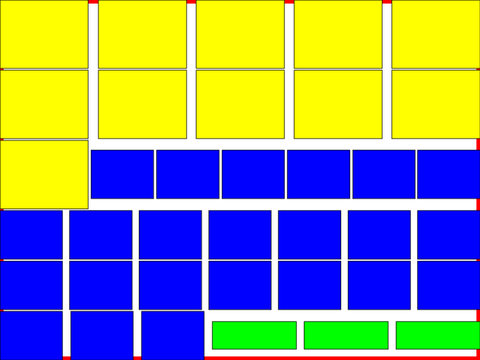
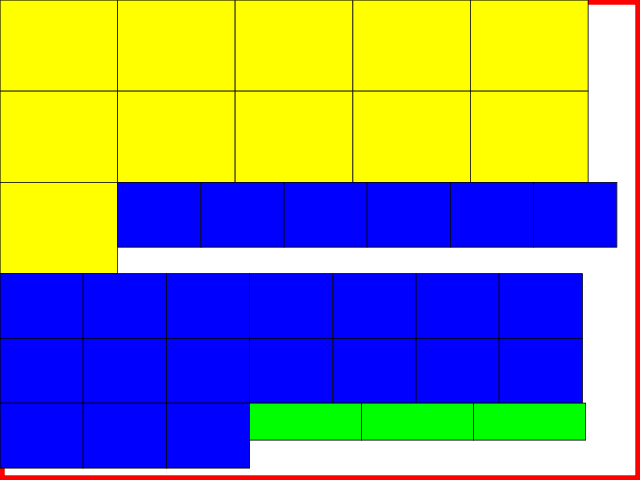
The dict container doesnt preserve order, but as XML doesnt require that, this is also not an issue. Arranging items in layers When it was decided, that I wanted to take the layered approach, it boiled down the 3D knapsack problem to a 2D knapsack problem. The problem statement now was: how to best fit small rectangles into a big rectangle? I decided for a simple and fast approach as it is explained in Jake Gordon's blog article. There is a demo of his code and should the site vanish from the net, the code is on github. This solution seemed to generate results that were "good enough" while simple to implement and fast to execute. If you look very hard, you can still see some design similarities between my arrange_spread.py and his packer.js code. Jake Gordon got his idea from Jim Scott who wrote an article of arranging randomly sized lightmaps into a bigger texture. There is also an ActiveState Code recipe from 2005 which looks very similar to the code by Jake Gordon. The posts of Jake Gordon and Jim Scott explain the solution well, so that I dont have to repeat it. Should the above resources go offline, I made backups of them here and here. There is also a backup of the ActiveState piece here. Spreading items out The algorithm above would cram all rectangles into a top-left position. As a result, there would mostly be space at the bottom and left edge of the available pallet surface. This is bad for two reasons:
  1. the mass is distributed unequally
  2. articles on the layer above at the bottom or left edge, are prone to overhang too much so that they tumble down
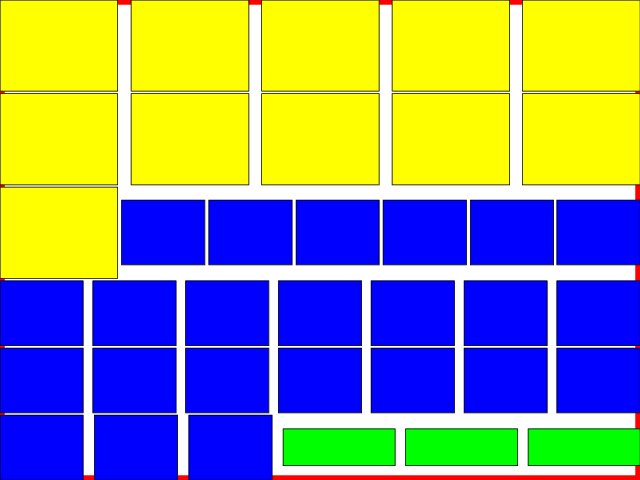
Instead all articles should be spread over the available pallet area, creating small gaps between them instead big spaces at the pallet borders. Since articles were of different size, it was not clear to me from the start what "equal distribution" would even mean because it was obvious that it was not as simple as making the space between all rectangles equal. The spacing had to be different between them to accommodate for differently sized boxes. The solution I came up with, made use of the tree structure, that was built by the algorithm that arranged the rectangles in the first place. The idea is, to spread articles vertically first, recursively starting with the deepest nodes and spreading them out in their parent rectangle. And then spreading them horizontally, spreading the upper nodes first, recursively resizing and spreading child nodes. The whole recursion idea created problems of its own. One of the nicest recursive beauty is the following function:
def get_max_horiz_nodes(node):
if node is None or not node['article']:
return [], []
elif node['down'] and node['down']['article']:
rightbranch, sr = get_max_horiz_nodes(node['right'])
rightbranch = [node] + rightbranch
downbranch, sd = get_max_horiz_nodes(node['down'])
ar = rightbranch[len(rightbranch)-1]['article']
ad = downbranch[len(downbranch)-1]['article']
if ar['x']+ar['width'] > ad['x']+ad['width']:
return rightbranch, sr+[downbranch[0]]
else:
return downbranch, sd+[rightbranch[0]]
else:
rightbranch, short = get_max_horiz_nodes(node['right'])
return [node] + rightbranch, short
get_max_horiz_nodes() traverses all branches of the tree that node has below itself and returns a tuple containing the list of nodes that form the branch that stretches out widest plus the list of nodes that are in the other branches (which are shorter than the widest). Another interesting problem was, how to decide on the gap between articles. This was interesting because the number resulting of the subtraction of the available length (or width) and the sum of the articles lengths (or widths), was mostly not divisible by the amount of gaps without leaving a rest. So there had to be an algorithm that gives me a list of integers, neither of them differing by more than one to any other, that when summed up, would give me the total amount of empty space. Or in other words: how to divide a number m into n integer pieces such that each of those integers doesnt differ more than 1 from any other. Surprisingly, generating this list doesnt contain any complex loop constructs:
>>> m = 108 # total amount
>>> n = 7 # number of pieces
>>> d,e = divmod(m, n)
>>> pieces = (e)*[(d+1)]+(n-e)*[d]
>>> print pieces
[16, 16, 16, 15, 15, 15, 15]
>>> sum(pieces) == m
True
>>> len(pieces) == n
True
You can test out the algorithms that arrange rectangles and spread them out by cloning the git and then running:
PYTHONPATH=. python legacy/arrange_spread.py
The results will be svg files test1.svg and test2.svg, the latter showing the spread-out result. Here is an example how the output looks like (without the red border which is drawn to mark the pallet border): arrange_spread2.py contains an adaption of arrange_spread.py for the actual problem. Permutations without known length When creating a layer out of articles of same height, then there are four strategies that I can choose from. It is four because there are two methods that I can either use or not. I can rotate the article by 90 per default or not and I can rotate the pallet or not. So every time that I build a new layer, there are those four options. Depending on which strategy I choose, there is a different amount of possible leftover articles that did not fit into any layer. The amount is different because each strategy is more or less efficient. To try out all combinations of possible layer arrangements, I have to walk through a tree where at each node I branch four times for each individual strategy. Individual neighboring nodes might be the same but this outcome is unlikely due to the path leading to those neighboring nodes being different. To simplify, lets name the four possible strategies for each layers 0, 1, 2 and 3. I now want an algorithm that enumerates through all possible permutations of those four numbers for "some" length. This is similar to counting. And the itertools module comes with the product() method that nearly does what I want. For example, should I know that my tree does not become deeper than 8 (read: no more than eight layers will be built), then I can just run:
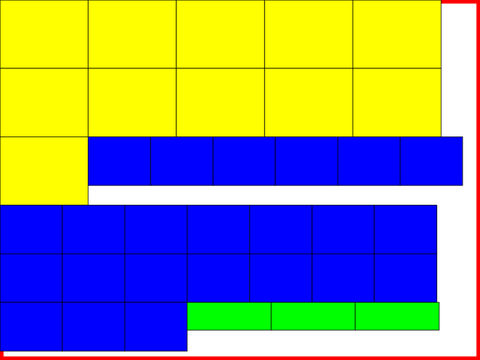
>>> for i in itertools.product([0,1,2,3], repeat=8):
...     print i
...
(0,0,0,0,0,0,0,0)
(0,0,0,0,0,0,0,1)
(0,0,0,0,0,0,0,2)
(0,0,0,0,0,0,0,3)
(0,0,0,0,0,0,1,0)
(0,0,0,0,0,0,1,1)
(0,0,0,0,0,0,1,2)
(0,0,0,0,0,0,1,3)
This would work if the number of layers created with each strategy was the same. But as each strategy behaves differently depending on the input, it cannot be known before actually trying out a sequence of strategies, how many layers it will yield. The strategy (0,0,0,0,0,0,0,0) might create 7 layers, resulting in (0,0,0,0,0,0,0,1), (0,0,0,0,0,0,0,2) and (0,0,0,0,0,0,0,3) yielding the same output as only the first 7 strategies count. This would create duplicates which I should not waste cpu cycles on later. It might also be that (0,0,0,0,0,0,1,0) turns out to be a combination of strategies that creates more than 8 layers in which case the whole thing fails. So what I need is a generator, that gives me a new strategy depending on how often it is asked for one. It should dynamically extend the tree of possible permutations to accommodate for any size. Since the tree will become humongous (4^11 = 4194304), already traversed nodes should automatically be cleaned so that only the nodes that make the current list of strategies stays in memory at any point in time. This sounded all complicated which made me even more surprised by how simple the solution was in the end. Here a version of the algorithm that could easily be ported to C:
class Tree:
def __init__(self, branch_factor):
self.branch_factor = branch_factor
self.root = "value": None, "parent": None, "children": []
self.current = self.root

def next(self):
if not self.current["children"]:
self.current["children"] = [ "value":val, "parent":self.current, "children":[] for val in range(self.branch_factor)]
self.current = self.current["children"][0]
return self.current["value"]

def reset(self):
if self.current["parent"]:
self.current["parent"]["children"].pop(0)
else:
return False
if self.current["parent"]["children"]:
self.current = self.root
return True
else:
self.current = self.current["parent"]
return self.reset()

def __str__(self):
return str(self.root)
It would be used like this:
>>> tree = Tree(4)
>>> print tree.next(), tree.next(), tree.next()
>>> while tree.reset():
...     print tree.next(), tree.next(), tree.next()
Which would be equivalent to calling itertools.product([1,2,3,4], 3). The special part is, that in each iteration of the loop I can call tree.next() an arbitrary amount of times, just how much it is needed. Whenever I cannot generate an additional layer anymore, I can call tree.reset() to start a new permutation. For my code I used a python specific version which is a generator:
def product_varlength(branch_factor):
root = "value": None, "parent": None, "children": []
current = root
while True:
if not current["children"]:
current["children"] = [ "value":val, "parent":current, "children":[] for val in range(branch_factor)]
current = current["children"][0]
if (yield current["value"]):
while True:
if current["parent"]:
current["parent"]["children"].pop(0)
else:
return
if current["parent"]["children"]:
current = root
break
else:
current = current["parent"]
It is used like this:
it = product_varlength(4)
print it.next(), it.send(False), it.send(False)
while True:
    print it.send(True), it.send(False), it.send(False)
Again, the expression in the loop can have any number of it.send(False). The first it.send(True) tells the generator to do a reset.

Next.

Previous.