Search Results: "edd"

28 October 2007

Eddy Petrișor: gpg signatures sent

I finally managed to resend the signatures to the few people I decided to send them a while back after debconf7.

I actually resent all the signatures I thought I should sign (if I didn't socialize at all with you during debconf or before you shouldn't receive a signature from me).

So, please:
Now I can cross one more item on my long todo list. Yay!

This message has emerged thanks to: caff, dato, python's smtplib and rfc822, vi, gpg, exim, linksys, dell, todo(the application from openhand) and blogger :-)

Adam Rosi-Kessel: Growing Up on YouTube

My daughters are perhaps among the first who will grow up seeing much more YouTube than POTV (my newly coined acronym, “Plain Old TV.”) Esther, now 2 , has still never seen anything on a television (recorded, broadcast, or cable). (Havi, a week old today, may not have seen anything at all at this point.) In addition to frequently watching videos from her own blog, Esther loves YouTube. Her most requested videos are embedded below, thanks to the excellent recently-installed Viper’s Video Quicktags. Thus Esther may never know anything but on-demand and user-generated culture. At least those will be her basic assumptions about how it’s supposed to work. It’s possible that this next generation will spell the end of network-scheduled and traditional advertising-interrupted media. I can never understand why anyone would bother to arrange their schedule to watch a show on TV and sit through commercials when they can rent it from Netflix or buy it from Amazon or iTunes and watch it when and how they want — and I grew up, to some extent, with the old TV model. Esther can barely wait for whichever video she wants now. I can’t see her putting up with content on someone else’s schedule as she grows up. Now the videos, as promised (both strong indicators that Esther adheres to the Long Tail theory): Actually, it turns out I didn’t coin POTV. It’s already defined here. Technorati Tags: , , ,

25 October 2007

Neil Williams: Emdebian root filesystem installable

Been a bit busy for the last week or so. Apologies to those who were waiting for other things but I've been dedicating my time to Emdebian in preparation for CELF in Linz, Austria which is now less than a week away.
I spent three days as a guest of Wookey and his employer, TobyChurchill, in Cambridge. TCL are sponsoring Emdebian at CELF and also assisted with this work session so that Wookey and I could work together to fix the root filesystem. I'm very grateful to TCL for donating a balloon3 board that I can use to test all the new packages I'm cross building for Emdebian. Various bugs in emdebian-tools have been fixed, allowing the rootfs scripts to be tested and improved.
Other improvements include outline support for machine-specific customisations of the rootfs from within the tools. Support includes per machine-type and per machine-variant combinations and at three points in the rootfs generation process: package selection, post first_stage_install and post_second_stage_install. I hope to create some extra documentation for those who want to go the whole hog and write a new debootstrap suite-script.
The rootfs uses busybox, dpkg, apt and includes support for ntpdate and cdebconf. Current tarballs are about 14Mb to download, installing to about 25Mb. Two main reasons: Emdebian doesn't recognise "Essential:" and Emdebian doesn't install perl.
I have some more testing to do tomorrow but the current Emdebian target repository does have packages sufficient for a usable root filesystem within a chroot. The remaining stage is combining the kernel modules into the rootfs to make a bootable system.
Support for these new features will be in emdebian-tools 0.4.3, due for upload to Emdebian tomorrow, hopefully. All Debian users of emdebian-tools have access to the emdebian repository so the upgrade will be available immediately after the upload.
Watch the debian-embedded list for full details of the new features (as well as the expanded manpages).

22 October 2007

Dirk Eddelbuettel: Frank Lloyd Wright Race 2007

Today was the 31th annual Frank Lloyd Wright Race in Oak Park, next door to where I live. This is a really nice small race I've run in 2006, 2004 and 2003. Conditions today were almost ideal -- we're having unseasonally warm weather, and it was sunny and in the high 60s without any noticeable winds around the start time making it feel like a nice late summer morning, rather than the middle of fall. I wasn't aiming for something really fast as I am still in training for a longer race and had done some reasonably fast one-mile laps yesterday morning leaving me not exactly well rested. But for once, I actually managed to run a steady pace, and then ended up within seconds of last year's PR for the distance at 41:15 for a pace of around 6:39, so I'm quite pleased.

16 October 2007

Dirk Eddelbuettel: Some marathon data analysis

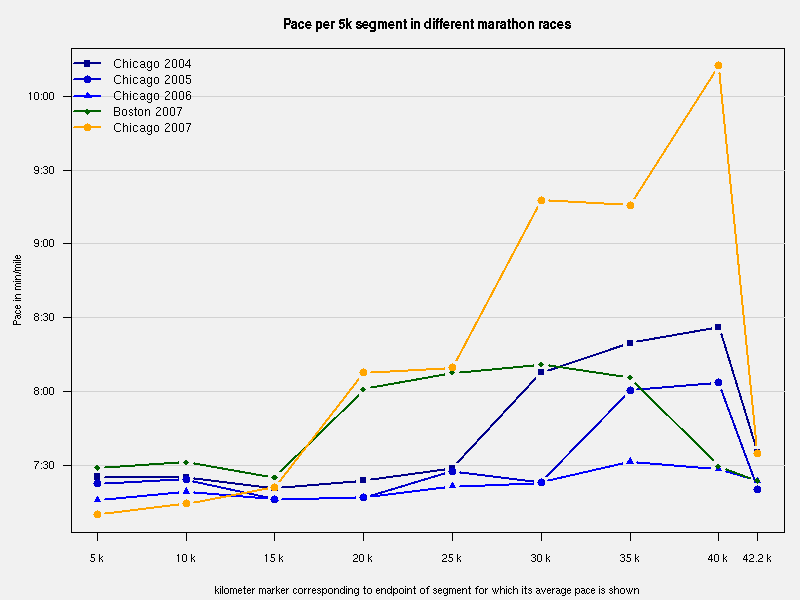
A few days after the Chicago Marathon in record-heat, I was wondering just how much more I had been slowing down, and exactly when during the course of the race this occurred. Bigger races like Chicago provide the so-called 'splits' for every five kilometer segment. Helpfully, they also keep these with the archived results which are all accessible via the web. So it was easy enough to collect a sequence of time such as '0:22:34', '0:45:30', ... and so on. And thanks to R, my data slicing and dicing and visualizing tool of choice, it was just a handful of lines to produce the chart below. The chart covers my four Chicago marathons (2004, 2005, 2006 and 2007) as well as Boston (2007) --- the infamous '27.2 mile marathon' seems to have dropped off the net, and the smaller Sunburst does not have 5k split times. (pace comparison chart) The chart shows a few things quite nicely: While it was a tough race, I clearly ran a lot slower than previously, in particular between 25 km and 40 km. So there.

15 October 2007

Eddy Petrișor: svn-buildpackage 0.6.22 released to experimental

Thanks to Damyan Ivanov for the upload, svn-buildpackage 0.6.22 is now in experimental. The upload was done to experimental due to the big number of changes affecting it and because I wanted to get a fairly significant amount of testing of the major fixes before propagating the code to unstable.

This release should fix 15 (yes, fifteen) bugs[0], most of which were important bugs or bugs affecting usability.

The major fixes are:
Installing the package on an etch, lenny or sid system should be straight forward: just get the deb from experimental and install it (no backporting is necessary).


If you usually use svn-buildpackage, please install the experimental version and report any bugs and/or success stories. I am particularly interested in feedback related to the behaviour around .svn/deb-layout and the other methods of specifying layout information.

Please send success stories to me directly eddy.petrisor @ gmail.com. Bugs should be directed to the BTS, but I hope there will be mail just directly to me :-) .


[0] I wonder, does the thickness of the yellow area on these graphs ever decreases?
[1] as soon as the breakage would have been visible in the past

14 October 2007

Dirk Eddelbuettel: Tunes

Following Adam's suggestion about Pandora, I spent a the rest of the afternoon, evening and this morning listening to music old and new. Pandora's suggestions around Madeleine Peyroux were particularly nice as they lead for example to Sam Philipps which was new to me. I can already see this leading to increased spending on new cds... Recommended.

13 October 2007

Dirk Eddelbuettel: Makin' Tracks 2007

This morning was the annual Makin' Tracks 5k. As this starts three blocks from my house, supports the track at Concordia, a small college up the street from me, and runs right through my immediate neighbourhood, it's hard not to participate. This year was of course not even a week after the somewhat eventful Chicago Marathon in record-heat so I wasn't sure how well I'd do. Once again, I started way too fast and ran two miles at a 6:00 min/mile pace that I couldn't sustain just a week after a (arguably slow but still full distance) marathon, so I slowed down and finished at 19:41.7 or so for a pace of 6:23, or about eight seconds slower than my best time from last year (when we ran before the marathon). Onto the Frank Lloyd Wright 5k/10k next week, then!

Eddy Petrișor: SELinux: MLS/MCS support

When getting this error message:

bounty:~/usr/src/selinux/localpolicies/resolvconf# semodule -i localresovconf.pp
libsepol.link_modules: Tried to link in a non-MLS module with an MLS base.
libsemanage.semanage_link_sandbox: Link packages failed
semodule: Failed!


You have to go back to the checkmodule step and type the same command, but add also the -M parameter:

bounty:~/usr/src/selinux/localpolicies/resolvconf# checkmodule -m -M -o localresovconf.mod *.te
checkmodule: loading policy configuration from resolvconf.te
checkmodule: policy configuration loaded
checkmodule: writing binary representation (version 6) to localresovconf.mod

After that is all OK:

bounty:~/usr/src/selinux/localpolicies/resolvconf# semodule_package -o localresovconf.pp -m *.mod
bounty:~/usr/src/selinux/localpolicies/resolvconf# semodule -i localresovconf.pp
bounty:~/usr/src/selinux/localpolicies/resolvconf# semodule -l grep localresolv
localresolvconf 1.0

12 October 2007

Eddy Petrișor: SELinux: unusable from a newbie perspective

Thanks Russell for the explanations on the execmem bits.

Now I am trying to go further and set up my system to really work with SELinux enabled because, although the promise of the targeted policy is to allow you to do your job mostly as you did before, that "mostly" has a really wide meaning, more than you'd think you bargained for.

Examples from my laptop: hald does not start by default (various denials), resolvconf is denied some getattr operations on tmpfs, hald-addon-dell-backlight is denied access to some character device I just know it should have access to, etc. Of course, this means that automatic mounting does not work anymore and there is a decrease in usability just because of the "mostly" part.

I am sure that some of the denials are correct (see the execstack stuff or the memexec), but there are cases where this "mostly" is stretched way too much. IMHO, desktop installs should suffer no restrictions when using the targeted policy (and I mean "no restrictions that would make my system less than it was before enabling and enforcing SELinux").


But let me tell a reason why SELinux sucks without any help from others:

The interface sucks big time.

Probably there is are good reasons, but if you need to create and use a new policy based on the denials found in the logs, you need to use no less than 4 (four) different tools with the right incantation (although you can use just 2, if you don't want to customize the rules[1]):
In the end, you still hit the bad interface:

bounty:~# semodule -i local.pp
libsepol.check_assertion_helper: assertion on line 0 violated by allow hald_t memory_device_t:chr_file read ;
libsepol.check_assertions: 1 assertion violations occured
libsemanage.semanage_expand_sandbox: Expand module failed
semodule: Failed!

Now what? That error message doesn't tell me much, except that some assertion failed. But where does the assertion come from? Why is it an assertion? What is bad about that line?
To me that really looks like an internal error or an inconsistency in what the SELinux tools generate.


[1] still, why advertise the longer path as the Fedora FAQ does? I would have done it the other way around.

10 October 2007

Russell Coker: Execmem and SE Linux

Eddy writes about problems getting the game oolite to run under SE Linux [1]. Strangely after I fixed the shared object issue with libffcall1 (as described in my previous post [2]) it appeared to work for me. Eddy asked how to allow one application to create write and executable memory regions without allowing such access for all programs. This can be done, in the targeted policy the type unconfined_execmem_exec_t triggers a transtion to the domain unconfined_execmem_t which permits the execstack and execmem operations. For example if the program /usr/bin/foo needs such access then the command chcon -t unconfined_execmem_exec_t /usr/bin/foo will change the type and the next time the program is launched from an unconfined session (a user login session, cron job, or daemon which is not constrained) then the change will apply.

Dirk Eddelbuettel: Chicago Marathon 2007

Last Sunday, the 30th Chicago Marathon took place. This was meant to be the year to make this marathon even bigger: the field had increased substantially to 45,000 registrations yet it still sold out way earlier than in previous years. As it turns out, the weather did have its own surprises in store. Earlier in the preceding week, the forecast changed from overcast and rainy to sunny. And sunny it was. While we had a bit of cloud cover at the start at 8:00am, temperatures were already in the 70s and keep increasing. This year's marathon is now on the books as the hottest ever: the clouds dissipated and it was a scorcher. Needless to say, it was a rather challenging race. I finished in 3:41:39, which is my slowest time by some margin for the by now seven marathons I've ran. It was not the day for running fast. Of course, I didn't quite grok that at the start and ran ten miles reasonably hard in a quick pace, but then paid for it, and then paid some more. That said, apparently around 10,000 registered entrants didn't even start, and another 10,000 did not make it to the finish. With the heat, several hundred were treated by the medical teams. Worse still, one 35-year old runner from Michigan died (though the autopsy claims he had a heart condition; other reports say that alone cannot have been lethal). The race itself was aborted, and those who had not reached the half-way point by 12:00am were diverted to the finish and urged to walk rather than run. According to the (by now fairly extensive) news coverage, this whole experience left quite a few people mad and bewildered. As of today, a good 48 hours after the race, the City seems to be in some sort of crisis management mode to prevent damage for the oh-so-important bid for the 2016 Olympics. For some flavour of the news coverage, see an early report, some stunning pictures and some suggestions to prevent another one like this, all from the Chicagoist blog.

Russell Coker: Lintian and Executable Stacks

Debian has a program called Lintian that is used to search for common bugs in Debian packages. When it encounters a package with a shared object that requests an executable stack (as described in my previous post about executable stacks and shared objects [1]) it gives a warning such as the following:
W: liblzo1: shlib-with-executable-stack usr/lib/liblzo.so.1.0.0 Lintian is run automatically on Debian servers and has a web site at http://lintian.debian.org/. You can search the site for all packages which have such executable stacks [2]. Of all the packages listed I have only two installed on my system, liblzo1 and libsmpeg0, both of which I had already discovered and built new versions with the correct stack settings (I’ll publish an APT repository shortly). For the rest I am not sure whether they are really bugs. The ones that concern me are xserver-xorg-video-nsc (we don’t want a stack smashing attack on something as important as an X server) and the C libraries libuclibc0 and dietlibc which may cause many programs to run with an executable stack. The above URL shows that libffcall1 [4] has this problem (as Eddy discovered [5]). Eddy filed Debian bug report 445895 [6] about this problem (I have just updated the bug report with a patch to make it work on i386). Linda (an alternative to Lintian) does not currently warn about this. I have filed Debian bug report 445826 about this [3].

Eddy Petrișor: selinux darcs policy; same for oolite

If you enable and enforce the targeted policy in Debian and you use darcs you need to allow it to use execmem:

chcon -t unconfined_execmem_exec_t /usr/bin/darcs


This allows to overcome these denials:

type=AVC msg=audit(1191957463.678:108): avc: denied execmem for pid=14811 comm="darcs" scontext=user_u:system_r:unconfined_t:s0 tcontext=user_u:system_r:unconfined_t:s0 tclass=process

And get this ugly message:

$ darcs w -l
darcs: internal error: getMBlock: mmap: Permission denied
(GHC version 6.6.1 for x86_64_unknown_linux)
Please report this as a GHC bug: http://www.haskell.org/ghc/reportabug
Aborted


Since oolite complained of the same issue I also ran this:
chcon -t unconfined_execmem_exec_t /usr/lib/GNUstep/System/Applications/oolite.app/oolite


Update: If you want to know the reasons why darcs (a VCS) to need execmem read the RedHat bugs related to this and the upstream bug report on GHC: https://bugzilla.redhat.com/show_bug.cgi?id=195820
https://bugzilla.redhat.com/show_bug.cgi?id=195821
http://cvs.haskell.org/trac/ghc/ticket/738

9 October 2007

Rob Bradford: Embedded accelerated Clutter bling

With sooper-dooper thanks to Samuel, Richard, Matthew and the space ape we now have Poky and Clutter up and running on the Logic i.MX31 LITEKIT. This ARM11 based development board features OpenGL ES 1.1 compliant hardware (based on Imagination’s MBX) which is now supported by Clutter’s EGL backend. Now we just need some more cool hardware to play with… ;-)
Space ape admires the bling

Eddy Petrișor: SELinux is enabled. Now what?

Disclaimer: I am 100% newbie on SELinux, so any inaccuracies, mistakes or fallacies are almost sure due to this fact.

After reading Russell's latest post on SELinux, and reading the 5 minutes tutorial on SELinux I decided I should try SELinux on my laptop, too.

Now I have it enabled/enforcing/permissive/refpolicy-targeted.

First issue, hal didn't start in my GNOME session, although the hal module appears to be loaded:

bounty:/emul/ia32-linux/usr/lib/dri# semodule -l grep hal
hal 1.4.0


It seemed that gdomap indirectly required execstack. I cleared the execstack bit (or whatever it is) on libcallback.so.0.0.0 and libavcall.so.0.0.0 and gdomap started.

OTOH, oolite failed to start since it required execmem:

0 eddy@bounty ~ $ oolite
trampoline: cannot make memory executable
Aborted

And after allowing execmem it worked:
# setsebool allow_execmem=1

0 eddy@bounty ~ $ oolite
2007-10-09 01:42:04.686 oolite[26717] initialising SDL
open /dev/sequencer: No such file or directory
2007-10-09 01:42:04.789 oolite[26717] init: numSticks=0
2007-10-09 01:42:04.789 oolite[26717] CREATING MODE LIST
2007-10-09 01:42:04.789 oolite[26717] Added res 1024 x 768
...

I also seem to have some other denied messages, but I hope I'll understand this soon enough to make it work.

I would like to know if is possible to allow execmem only for oolite, and since I suspect it is, how can I accomplish this?

So, now my question is, where is the fine manual on setting SELinux? I digged the whole evening to get oolite to start.

8 October 2007

Neil Williams: dpkg-cross 2.0.0 - fragility expected!

OK, changes in dpkg-dev 1.14.7 have forced my hand a little and dpkg-cross 2.0.0 has now been uploaded to Debian unstable (not experimental).
apt-cross 0.2.9 has been uploaded to Emdebian unstable - dependent on
dpkg-cross >= 1.99
apt-cross 0.3.0 has been uploaded to Debian unstable but will spend some time in the NEW queue (hence the 0.2.9 upload to Emdebian). apt-cross 0.3.0 is functionally identical to 0.2.9
emdebian-tools 0.3.9 has been uploaded to Emdebian unstable - dependent on apt-cross >= 0.2.9 and dpkg-cross >= 1.99
All three comprise extensive rewrites. apt-cross, in particular, is barely recognisable. dpkg-cross is a shadow of the former package and v2.0.0 signals the beginning of the long goodbye to both packages. dpkg developers expect to be able to merge all dpkg-cross functionality into dpkg before Lenny. Once that is done, it should be trivial to merge apt-cross behaviour into apt.
Only the new libcache-apt-perl package (containing the modified NorthernCross code from virtuoso) will persist. Once this whole transition is over, I'll upload Cache::Apt::* to CPAN so that it can become its own source package in Debian once apt-cross is removed.

IMPORTANT
dpkg cross-building support is HIGHLY EXPERIMENTAL!
Significant changes are still pending, including remapping the build paths during the
dpkg-buildpackage build and utilising the updated dpkg-shlibdeps code which is a decade ahead of what we had in dpkg-cross 1.39.

  1. dpkg 1.14.7 included dpkg-buildpackage as a perl script instead of shell which breaks dpkg-cross <= 1.39 but the new code to support dpkg-cross >= 1.99 is not implemented yet.

  2. The breakage that Zumbi experienced when using the dpkg version from
    experimental will now occur in unstable.
    http://lists.debian.org/debian-embedded/2007/09/msg00067.html. Note that this breakage would be severity "critical" if filed as a bug because it prevents not only cross-builds but normal Debian builds.

  3. dpkg-cross 2.0.0 fixes this issue. Hence the urgency in uploading dpkg-cross 2.0.0

  4. dpkg-cross 2.0.0 removes the old diversions of dpkg-buildpackage and dpkg-shlibdeps.

  5. dpkg is set to support the removal of the dpkg-cross diversions and code to support this is coming this weekend. This means that there will be a GAP where cross-built packages will fail to find the correct shared libraries. HOWEVER, installing dpkg-cross 2.0.0 restores the ability to build normal Debian packages whilst keeping dpkg-cross installed. This is a far more important gain than a temporary problem in packages that hardly anyone is using yet (our Emdebian crossbuilt packages).

When dpkg-dev 1.14.8 becomes available, apt-cross, dpkg-cross and emdebian-tools will be updated to depend on this version.
Everyone: please note - cross-building support in Debian will be "fragile" for the next week or so. The rewritten packages are being uploaded against experimental dpkg support I expect bugs. :-(

The benefits of these changes are:
  1. The removal of diversions that are a decade out of date.

  2. The implementation of virtuoso's NorthernCross code that transforms apt-cross and fixes lots of awkward bugs.

  3. The incorporation of cross-building support in the heart of dpkg.

  4. The beginning of the long goodbye to dpkg-cross and apt-cross.


RESULTS
With the new packages installed, some packages will produce:
 emdebuild: ERROR /usr/bin/ contains files for the wrong architecture!


i.e. the build appears to succeed but until dpkg-dev 1.14.8 includes support for looking for the correct libraries in /usr/$arch/lib instead of /usr/lib, we get unusable packages. This at least means that packages can be test built and the patches updated.

4 October 2007

Dirk Eddelbuettel: Beancounter minor bug fix release 0.8.8

For some odd reason, the trusted Perl module Date::Manip now wants the "approx" argument to format date differences. Adding this in the five calls across beancounter and BeanCounter.pm is the main change in version 0.8.8 which is now in Debian's incoming area, uploaded to CPAN and onto the beancounter page here.

2 October 2007

Neil Williams: 2038 overflows

Adrian (also sent by email):
Re: 2038 issues on mobile platforms.

It is possible to handle 64bit time on 32bit systems. I got disillusioned with the libglib2.0-0 support (GDate) and I already had a library capable of 64bit mathematics (libqof1) so I wrote QofDate and QofTime that can handle true 64bit date and time calculations, formatting and scanning on 32bit or 64bit installations. I estimate that this gives us enough capacity to handle time for a couple of dozen times the age of the universe to nanosecond precision. The maths can also go backwards as far as it can go forwards so it could handle the date of the Big Bang with nanosecond precision too - if anybody actually works that out.
:-)
I'll be using this library in Emdebian to provide support for 64bit maths for gpe-expenses and the pre-alpha gpe-cash (stripped out gnucash for embedded devices) so at least your financial records will be safe.
http://cashutil.sourceforge.net/gpecash.php
http://gpe-expenses.sourceforge.net/

"QofTime is a lot like the unix 'struct timespec' except that it uses a
64-bit signed int to store the seconds. This should adequately cover
dates in the distant future as well as the distant past, as long as
these are not more than a couple of dozen times the age of the
universe. Values of this type can range from -9,223,372,036,854,775,808
to 9,223,372,036,854,775,807."


http://qof.sourceforge.net/doxy/group__QOFTIME.html#gb93e930907d0e2eba07b1fa7496e7822

http://qof.sourceforge.net/doxy/group__QOFTIME.html

QofTime is defined as 64bit on all systems and will not overflow until
the year 292,471,208,679 (not counting leap years). i.e. approx.
9223372036854775808 / (60*60*24*365). This also means that some values
of QofTime cannot be converted to a time_t on systems where time_t is
defined as 32bit.

http://qof.sourceforge.net/doxy/group__Date.html

A QofDate is theoretically able to go forward to the year
292,471,206,707 AD and back to the year 292,471,206,708 BC. Whether
such dates actually exist is outside the scope of this documentation.

http://packages.debian.org/sid/libqof-doc
http://packages.debian.org/sid/libqof1

30 September 2007

Frans Pop: debtree 0.6.0

I've just "released" debtree 0.6.0. The number of options has almost doubled! It's now possible to suppress Conflicts and to generate full dependency graphs (including packages that are excluded by default). Unknown packages are now marked with a light reddish shading; this could possibly help finding obsolete Conflicts. I've also added verbosity options and fixed a few minor issues. But I'm most exited by two completely new features. Build dependency graphs Besides dependency graphs for binary packages, debtree now also generates build dependency graphs for source packages. It shows both Build-Depends and Build-Depends-Indep dependencies. It also takes into account architecture conditionals (such as [!s390]). It is possible to show such conditionals in the graph, but by default it will just omit any build dependencies not relevant for the selected architecture. Here's an example for dpkg. I expected this to be a lot harder to implement, but it proved relatively straightforward. I've been quite pleased with how extensible this script has proven. Show installed packages With this feature debtree gets back to its original purpose: providing information about what packages will get installed and why. When this option is activated, debtree will shade packages that are already installed light green. So if a graph is generated for a package that is not yet installed, it is easy to see what dependencies are already satisfied and what new packages will be installed. More importantly, you can also see which dependencies could be avoided because they are only recommended or which extra suggested goodies could be installed. Here's an example for clamav. This feature can of course also be used for build dependency graphs. Want to give it a try? The script or the Debian package can be downloaded from the debtree web page. That also has usage information and more examples. P.S. I've found yet another example of an undesired dependency on gconf2.
Update: fixed broken link

Next.

Previous.